


Abstract
Knowledge tracing aims to infer students’ evolving knowledge states from historical question–response interactions to predict future performance. Despite the progress of recent deep models, existing approaches often lack an explicit mechanism for determining how different types of learning evidence should be transferred, retained, and coordinated across cognitive states with different abstraction levels and temporal characteristics. To address this limitation, this study proposes HDTR-KT, a knowledge tracing framework that models cognitive evolution through hierarchical evidence transition and dual-timescale state regulation. At the local level, HDTR-KT establishes an asymmetric transition from question-level experience to concept-level mastery, where question-specific increments are selectively transformed into concept messages rather than directly updating both states with identical interaction evidence. A constrained forgetting mechanism further preserves the hierarchical retention relationship between item memory and concept mastery. At the global level, different evidence sources are assigned to states with distinct temporal dynamics: prediction residuals drive an adaptive short-term state to capture transient deviations, whereas concept-level evidence is conservatively accumulated into a long-term state through a bounded update process. The fused global context subsequently regulates local-state forgetting, forming a closed-loop evolution mechanism between global cognition and localized memory. Extensive experiments on three real-world educational datasets demonstrate that HDTR-KT achieves consistently competitive predictive performance compared with representative baselines.
Keywords:
knowledge tracing; hierarchical state evolution; dual-timescale representation; adaptive forgetting MSC:
68T35; 93A13; 92D15; 68T10
1. Introduction
Knowledge tracing (KT) aims to infer the evolving knowledge state of a student from historical learning interactions to predict future performance. While early probabilistic approaches modeled concept mastery using simple latent variables, modern deep learning has vastly expanded the capacity to encode complex sequence representations and structural relations [1,2]. Despite this progress, a fundamental issue remains underexplored: how learning evidence should be structurally written into, retained by, and coordinated across cognitive states with different levels of abstraction and temporal persistence.
The first issue concerns the propagation of evidence between question-level experience and concept-level mastery. A response is directly observed on a specific question, whereas mastery of the associated concept is an abstract state inferred from multiple learning experiences. While recent studies have exploited question–concept relations through graph propagation and multi-granularity representations [3,4,5], these structural dependencies are primarily utilized for relation aggregation or prediction [6,7,8]. The state-transition path through which concrete response evidence is transferred from item-specific experience to abstract concept mastery remains insufficiently constrained. This motivates a hierarchical update path in which evidence is first represented at the question level, then selectively propagated to the associated concept, rather than symmetrically writing the same interaction into both levels.
Beyond how new evidence is written, a related challenge arises in how historical states are retained and retrieved. Although various learning-process variables, temporal kernels, and forgetting-aware biases have been introduced to model knowledge decay [9,10,11], including the profile-driven adaptive forgetting framework proposed by Chen et al. [12] for multi-level knowledge states, existing formulations mainly focus on adapting the magnitude of decay within individual or multiple representations [13]. What remains less explored is whether the relative retention behavior across different abstraction levels should itself be structurally constrained. In human cognition, the retention of an abstract concept is inherently more resilient than the memory of a specific item. Without mathematically imposing this cross-level retention prior, independently evolving decay processes may fail to preserve this hierarchical relationship.
The second issue concerns the temporal persistence of global cognitive evidence. Different observations carry vastly different implications for a student’s evolving global statee [14]. Transient behavioral fluctuations, such as careless slips or lucky guesses, require rapid adjustment, whereas genuine competence development should be accumulated smoothly over time [15]. Traditional recurrent architectures compress these conflicting dynamics into a single shared latent space [16]. While some recent attempts have recognized the need to separate cognitive trends from behavioral fluctuations [17,18,19], a complementary structural question remains unresolved: How should different sources of evidence dynamically drive states with explicitly different temporal semantics, and how should this resulting global cognition loop back to regulate localized memory?
To address these issues, we propose HDTR-KT, a knowledge tracing framework that organizes cognitive-state evolution through hierarchical local propagation and dual-timescale global regulation. At the local level, the aforementioned hierarchical update is implemented through an asymmetric state-transition path, where an item-specific question increment is selectively transformed into a concept-level message. During retrieval, a unified forgetting mechanism jointly considers interaction gaps, practice frequencies, and the current global cognitive context. Its hierarchical parameterization guarantees that, for each associated question–concept pair, the concept-level retention coefficient is no smaller than the question-level retention coefficient, thereby ensuring that concept-level memory is subject to no stronger multiplicative forgetting than its corresponding question-level memory.
At the global level, HDTR-KT assigns different evidence sources to two recurrent states with distinct update semantics. An agile short-term state integrates local increments with an explicit prediction residual, allowing unexpected outcomes to rapidly influence the transient global representation. In contrast, the long-term state receives only concept-level increments and accumulates them under a strictly bounded update rate, limiting the influence that any individual interaction can exert on the persistent global representation. The two states are subsequently fused into a unified global cognitive context. Importantly, this global context is not used only for prediction: it feeds back to parameterize the forgetting field applied to local question and concept states in the subsequent interaction. Together, these two directions form the mutual regulation in HDTR-KT: local evidence drives global-state evolution, while the evolving global state feeds back to dynamically regulate the forgetting of local memory.
The main contributions of this work are summarized as follows:
- We propose a hierarchical evidence transition mechanism that extends adaptive forgetting from learner-specific decay adjustment to cross-level retention modeling. Instead of directly updating question and concept states with the same interaction signal, HDTR-KT derives concept-level updates from selectively transformed question-level increments. Furthermore, a mathematically constrained retention formulation guarantees that concept-level memory receives no stronger multiplicative attenuation than its associated question-level memory.
- We establish an evidence-specific dual-timescale state evolution scheme. Instead of disentangling heterogeneous signals only at the representation level, HDTR-KT assigns different evidence sources to states with different temporal semantics: prediction residuals rapidly update a short-term cognitive state, whereas concept-level evidence is conservatively accumulated into a long-term state through a bounded update process.
- We develop a closed-loop local–global regulation framework that couples memory retention with cognitive evolution. The evolving global context is not only used for prediction but also feeds back to regulate subsequent local-state forgetting, enabling adaptive coordination between localized learning experiences and global cognitive changes during sequential knowledge evolution.
2. Related Work
2.1. Knowledge State Representation and Hierarchical Modeling
Deep knowledge tracing methods differ primarily in how they represent students’ latent knowledge states. Early approaches compress the interaction sequence into a single recurrent hidden state [16], while memory-augmented networks, such as DKVMN, introduce external key-value structures to maintain concept-specific mastery [3]. Subsequently, attention-based models (e.g., SAKT, AKT) shifted the paradigm toward retrieving historical interactions based on their relevance to the target question [20,21,22]. To further capture the rich structural dependencies between questions and concepts, recent advances have extensively explored graph-based propagation (GIKT [4]), multi-granularity states (ReKT [6]), and hypergraph-based adaptive knowledge transfer (MHAKT [8]).
While these studies demonstrate the necessity of leveraging educational hierarchies, they primarily exploit structural relations for representation construction or attention masking. The state-update mechanism itself typically remains symmetric—applying the same raw interaction vector to update both item and concept representations simultaneously. In contrast, HDTR-KT fundamentally redesigns the evidence propagation path. It enforces an asymmetric state transition where a question-level increment is first extracted and subsequently filtered into a concept-level message. This ensures that abstract concept representations are structurally insulated from raw, item-specific interaction noise. A related but different direction addresses data scarcity through meta-learning. For example, MAML-KT learns an initialization that can be rapidly adapted to previously unseen students from only a few early interactions [23]. Such approaches improve few-shot adaptation through task-level parameter optimization, whereas HDTR-KT introduces an architectural inductive bias within each interaction sequence by explicitly directing question-level evidence toward concept-level states without requiring an additional inner-loop adaptation procedure.
2.2. Learning Dynamics and Behavioral Fluctuations
Beyond the spatial and structural representation of knowledge, modeling temporal learning dynamics and forgetting behavior is another pivotal direction in KT. Standard approaches incorporate temporal spacing through learning-process variables (LPKT [9]), exponentially decaying kernels (RKT [10]), and forgetting-aware linear biases in attention mechanisms (FoLiBi [13]). More recently, LefoKT introduced relative forgetting attention to explicitly separate decay effects from question relevance [11]. Continuous-time approaches provide another perspective on temporal evolution. For example, HawkesKT models temporally decaying cross-effects between knowledge concepts through a Hawkes process [24], while SFBKT employs a neural point-process formulation with continuous-time LSTM dynamics to characterize forgetting over irregular time intervals [25]. In contrast, HDTR-KT adopts interaction-step gaps rather than physical timestamps, allowing temporal spacing to be incorporated directly into recurrent state retrieval when continuous timestamps are unavailable. Alongside the modeling of forgetting, increasing attention has also been paid to the heterogeneous temporal characteristics of student behavior. FlucKT separates long-term cognitive trends from short-term fluctuations in attention representations [17], while KeenKT employs probabilistic modeling to distinguish relatively stable mastery from transient response variations [19].
This line of research has recently been extended toward more explicit disentanglement of heterogeneous learning signals. D2KT disentangles semantic dependencies from temporal effects through a semantic–temporal attention mechanism and further suppresses stochastic behavioral noise through spectral filtering; its two-component serial architecture models the progression from knowledge understanding to internalization [26]. From a different perspective, DSDKT decomposes interaction signals into a trend component representing longer-term evolution and a residual component describing short-term variations, which are subsequently modeled through dual attention streams [27]. These approaches share the general motivation of reducing interference among heterogeneous temporal and behavioral signals, but they perform such separation primarily through representation disentanglement or temporal signal decomposition.
Recent forgetting-aware knowledge tracing studies have increasingly recognized that knowledge states should evolve according to learning history rather than relying on fixed transition patterns. In particular, Chen et al. [12] explored this direction by introducing a profile-driven adaptive forgetting mechanism, where the learner-specific forgetting rate and retention bounds were dynamically generated from historical interaction characteristics and applied to multiple knowledge-state levels. This line of research demonstrates the importance of context-dependent memory decay in knowledge tracing. However, the adaptive forgetting formulation mainly focuses on adjusting the overall forgetting magnitude according to learner characteristics, while the relative retention relationship among different abstraction levels and the pathway through which evidence is transferred between these levels remain less explored.
Building upon this perspective, HDTR-KT further investigates the structured evolution of hierarchical knowledge states. Instead of directly applying the same interaction evidence to different states, HDTR-KT introduces an asymmetric transition from question-level experience to concept-level mastery, where concept updates are derived from selectively transformed question increments. Moreover, the forgetting mechanism is extended from adaptive decay estimation to hierarchical retention modeling by imposing an explicit ordering constraint between question- and concept-level memory. At the global level, HDTR-KT further separates transient response-related fluctuations from persistent competence accumulation through dual-timescale states, where prediction residuals and concept-level evidence are assigned to different update pathways. The resulting global context subsequently regulates local-state forgetting, forming a closed-loop interaction between global cognition and localized memory evolution. Therefore, the main contribution of HDTR-KT is not simply introducing another adaptive forgetting strategy but extending adaptive knowledge-state modeling toward a mutually regulated state-transition framework with hierarchical evidence propagation, constrained retention dynamics, and timescale-specific global evolution.
3. Our Proposed Framework
3.1. Problem Definition and Overview
In a standard knowledge tracing setting [28], the historical interaction sequence of a student is given as , where T denotes the length of the sequence. At each time step t, an interaction is represented as , where denotes the practiced question, denotes the associated knowledge concept, and denotes the observed response.
Following standard difficulty-aware modeling practices in recent literature [21,29], we construct the target-question representation by combining the question embedding, the concept embedding, and a question-specific variation term:
where are learnable embeddings, is a question-specific scalar, and represents the variation direction associated with concept , explicitly isolating inherent item difficulty from overarching concept characteristics. After the response is observed, the corresponding interaction representation is defined as
where is the embedding of the response.
To characterize temporal spacing and repeated practice without relying on external timestamps, the model records step gaps and since the most recent occurrences of and , respectively, together with their historical practice counts ( and ). Temporal spacing and learning history have been widely considered in forgetting-aware knowledge tracing [9,10,11,30]. Given the interaction history up to step t and the pair of the target question and the concept , the objective of knowledge tracing is to estimate
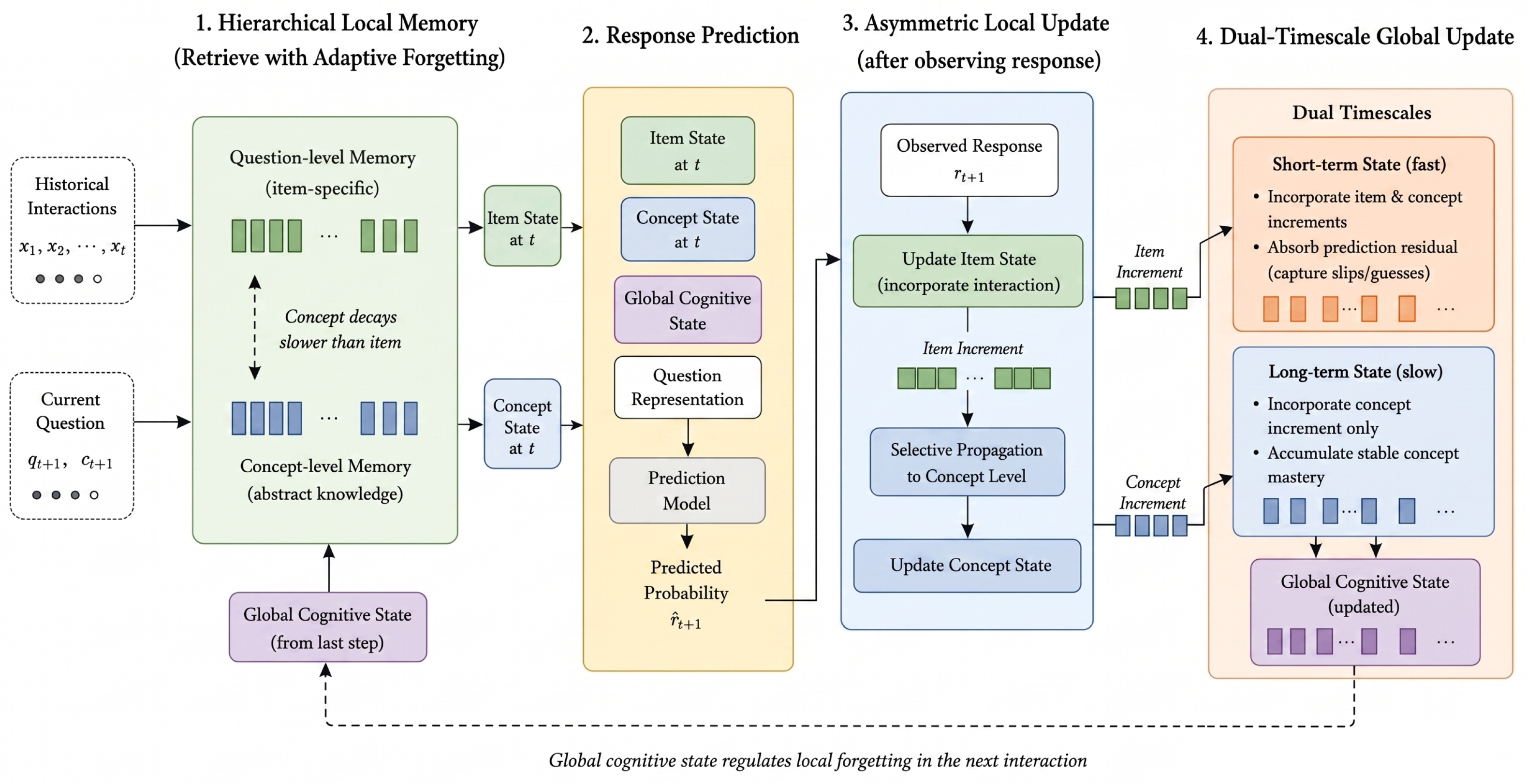
To explicitly model how heterogeneous learning evidence drives the evolution of cognitive states, the HDTR-KT framework is proposed. Different from approaches that primarily aggregate historical interactions into latent representations, HDTR-KT focuses on the state-transition process through which specific response evidence is transferred, retained, and coordinated across different cognitive levels and temporal scales. Accordingly, local memory and global cognition are not modeled as independent components; instead, they are coupled through a closed-loop evolution process. As illustrated in Figure 1, each interaction step consists of four sequential stages.
Figure 1.
The overall architecture of the HDTR-KT framework. The closed-loop evolution consists of four stages: (1) retrieving hierarchical local memory regulated by the global cognitive state, (2) predicting the student’s response, (3) asymmetrically updating the local states based on the observed response, and (4) updating the dual-timescale global representation to capture both transient fluctuations and stable concept mastery.
First, during hierarchical local memory retrieval, the current global cognitive context dynamically regulates the retention of question-level and concept-level states through a constrained forgetting mechanism. Second, the retrieved local states and global context are jointly used for response prediction. Third, after observing the actual response, the newly obtained evidence is incorporated through an asymmetric transition pathway, where a question-level increment is selectively transformed into a concept-level update rather than directly writing identical interaction information into both states. Finally, the dual-timescale global states are updated by assigning different evidence sources to states with different temporal dynamics: prediction residuals adjust the short-term state, whereas concept-level evidence contributes to the long-term state under a bounded update rate. Through this closed-loop design, HDTR-KT enables local memory evolution and global cognitive adaptation to mutually regulate each other over sequential learning interactions.
For clarity and reproducibility, Algorithm 1 summarizes the forward state-evolution procedure of HDTR-KT at each interaction step, while the detailed formulations of the corresponding operations are provided in Section 3.2, Section 3.3 and Section 3.4.
3.2. Hierarchical Local State Evolution
The hierarchical local state evolution module is designed to characterize how specific learning experiences are transformed into and retained as knowledge states at different abstraction levels. It consists of two tightly coupled processes: historical state retrieval before prediction and evidence incorporation after observing a new response. Unlike conventional schemes that independently update multiple representations from the same interaction signal, HDTR-KT considers that item-level responses and concept-level mastery represent different forms of cognitive evidence. Therefore, the evolution of local states should follow an explicit hierarchical transition rather than a parallel updating process.
Before predicting the response to , HDTR-KT retrieves the historical states associated with the target question and its corresponding concept. Existing forgetting-aware KT methods mainly introduce temporal decay within individual representations, while the relationship between forgetting processes at different abstraction levels remains insufficiently constrained. This independent decay formulation may allow the memory of an abstract concept to deteriorate faster than the memory of a specific practiced item, which contradicts the hierarchical nature of knowledge retention. To address this issue, HDTR-KT introduces a coordinated forgetting mechanism that generates a shared forgetting context, adjusts effective temporal gaps according to practice frequency, and imposes a mathematical ordering constraint on retention coefficients. Consequently, the concept-level state is guaranteed to experience no stronger multiplicative attenuation than its associated question-level state during retrieval.
| Algorithm 1 Forward State Evolution of HDTR-KT |
| Input: Interaction sequence and initialized states Output: Predicted probabilities
|
The adaptive forgetting formulation follows the general principle of context-dependent memory decay explored by Chen et al. [12]. However, instead of only adapting the overall decay magnitude according to learner characteristics, the present formulation introduces abstraction-level-specific decay scales and explicitly constrains their relative retention behavior. Formally, let denote the fused global cognitive context after processing interactions up to step t. The valid historical interactions of the student are first summarized using the cumulative profile:
where denotes the set of valid historical interaction indices up to step t. The forgetting context is constructed by adding the projected profile of the history and the global context, followed by layer normalization:
Based on this unified context, the model generates a shared scalar retention floor () and a base decay rate (:)
where and denote the predefined bounds for the retention floor and and bound the decay rate to prevent numerical instability. Consequently, and . It should be noted that and are not manually specified decay coefficients; they are dynamically generated from the current forgetting context, while the predefined bounds only restrict their admissible ranges for stable state evolution.
Based on the intuition that repeated practice should moderate the effect of an elapsed interaction gap, we discount the raw gaps according to the corresponding historical practice frequencies. Let be a learnable positive coefficient controlling this adjustment. The effective gaps are defined as:
To impose a hierarchical retention relationship across abstraction levels, the level-specific decay scales are parameterized as
where is a small numerical constant. Since , this parameterization directly ensures during optimization without requiring additional constraints.
Moreover, the interaction structure naturally provides another hierarchical property. Since practicing a specific question also contributes evidence for its associated concept, the historical practice frequency of a concept is no smaller than that of an individual question (). Meanwhile, the latest occurrence of a concept is no earlier than that of a specific question, resulting in . Therefore, after frequency-based adjustment, the effective temporal gap satisfies .
Combining the bounded decay scales with the above interaction-level ordering yields:
Therefore, the proposed retrieval mechanism guarantees that concept-level memory receives no stronger multiplicative forgetting than its associated question-level memory. This hierarchical retention property is achieved intrinsically through the parameterization design, rather than through an additional constraint loss or post-optimization projection. Since holds for arbitrary values of the learnable parameter (), the hierarchical relation between the two decay scales is preserved throughout end-to-end optimization. The bounded retention coefficients are then formulated as:
Owing to the retention floor, the attenuation remains bounded, even for very long effective gaps: as the gap increases, the exponential component gradually vanishes and the retention coefficient approaches . Let and denote the most recently stored states. The retrieved representations are obtained via scaling:
After observing the response , new evidence must be integrated into the local states. Conventional models typically encode the raw interaction vector into the states of the question and the concept in parallel. This symmetric update scheme assumes that a single response provides equivalent evidence for both the generic mastery of concepts and the familiarity at the item level, thereby making the abstract state of the concept overly vulnerable to isolated noise from responses.
To resolve this limitation, an asymmetric dependency is enforced within the proposed framework. The model first extracts a concrete increment specifically for the state of the question:
The updated state of the question is obtained through a residual connection:
Instead of reusing the raw interaction for the state of the concept, the model transforms the increment of the question into a message at the concept level, thereby structurally building the mastery of concepts from the experience at the item level:
Here, the transformation of projects the question-level increment into the concept representation space. The term selective refers to the subsequent filtering by the scalar transfer strength () and the element-wise gate () such that only the relevant portion of the transformed question-level evidence contributes to the concept update.
This message is combined with the retrieved state of the concept () and is passed through a scalar transfer strength () and an element-wise update gate () to filter irrelevant noise:
Since the transfer is determined from the current question increment, together with the available concept state, it does not require accumulated interaction history and remains well defined at the initial stage of a student sequence. The increment at the concept level is defined as
and the corresponding state of the concept is updated by
3.3. Dual-Timescale Global Representation
While local states track specific items, the learning process of a student is also governed by an overarching global cognitive state. Single-state recurrent architectures typically compress the complete history into a single hidden dimension [31]. However, this entanglement often leads the state to compromise between capturing immediate behavioral shifts, such as lucky guesses or careless slips, and preserving the gradual development of genuine competence. To untangle these conflicting dynamics, we decouple the global updates across two distinct timescales using explicit gradient-isolated prediction residuals.
The first component is an agile short-term state. To make this state responsive to recent predictive deviations, we explicitly incorporate the prediction residual as an online measure of predictive surprise. We achieve this by explicitly incorporating a prediction residual, which quantifies the gap between the expectation of the model and reality and provides an online measure of predictive surprise:
where denotes the stop-gradient operation. The scalar residual is subsequently converted into a question-conditioned residual vector to associate the magnitude of the deviation with the current target representation:
Unlike standard recurrent updates that rely solely on input features, the short-term evidence explicitly integrates local increments with this residual signal:
Let . The short-term state is updated via a GRU-style mechanism to rapidly adjust the current cognitive profile:
Conversely, the long-term pathway is designed to evolve more conservatively across interactions. To reduce its sensitivity to item-specific variations, the long-term state discards the question-specific increment and accepts only the concept-level message:
Let . To preserve the temporal persistence of long-term cognitive evidence, the update rate of the long-term state is explicitly constrained rather than freely learned over the full interval . Specifically, the element-wise update rate is parameterized as
where and define the admissible range of information integration.
Since the sigmoid function maps arbitrary inputs into , this affine-sigmoid parameterization guarantees
for every update step. Consequently, the contribution of a single interaction to the long-term cognitive state is explicitly bounded, preventing transient response evidence from dominating persistent knowledge accumulation. Unlike unconstrained recurrent updates that allow arbitrary interaction influence, HDTR-KT imposes a controllable accumulation process for long-term competence evolution. The long-term state is then smoothly accumulated:
Finally, to provide a holistic view for subsequent operations, the agile short-term state and the stable long-term state are fused through an adaptive gate:
In the subsequent step, this unified context () feeds back to condition the forgetting field (Equation (5)), thereby establishing a mutual regulation mechanism between the updates of local memory and shifts in global cognition. The bounded nonlinear candidates and gated updates also keep the global representations stable under sustained predictive discrepancies, although convergence to a single stationary state is not assumed when the incoming interaction distribution continues to change. In this setting, the magnitude of the online prediction residual may additionally serve as an auxiliary indicator of atypical behavioral changes in real time.
This dual-timescale design also provides a natural adaptation point for non-stationary learning environments. Abrupt curriculum changes can be reflected primarily through the residual-driven short-term state, while the bounded long-term update helps preserve previously accumulated information; when curriculum-stage information is available, it can further be incorporated as contextual input to the global fusion or forgetting module. For multimodal interactions, the current formulation remains based on question–concept–response sequences, while the regulation loop itself operates on latent representations. Therefore, modality-specific encoders can be used to map textual, visual, or behavioral signals into a shared interaction space before they enter the local–global state evolution, providing a natural extension of the framework to heterogeneous student interaction data.
3.4. Prediction and Optimization
Predicting the performance of a student requires matching the evolving cognitive state of the student against specific task demands. Rather than relying on a single level of representation, the proposed framework jointly leverages the specific memory of local states and the holistic context of global states. Specifically, the fused global context (), the retained question state (), the retained concept state (), and the representation of the target question () are concatenated:
The probability of a correct response is computed through a multilayer perceptron:
Let denote the set of valid non-padding prediction positions in the training data. The framework is optimized end-to-end using binary cross-entropy loss:
Crucially, the mutual regulation between the local and the global states modifies the optimization dynamics. In standard architectures, prediction errors merely penalize the final classification layer. In the proposed framework, the explicitly computed prediction residual (Equation (21)) serves as a direct signal for state updating in the subsequent time step. Because the stop-gradient operation prevents the gradients of future state updates from implicitly flowing back into and altering the current prediction representations, the residual specifically modifies the short-term state utilized for future steps without disrupting the primary forecasting objective. Consequently, the optimization process forces the dual-timescale global representation and the modules for hierarchical local propagation to dynamically adjust to predictive surprises, structurally aligning the updates of local memory with overarching shifts in cognition.
From a computational perspective, HDTR-KT processes the interaction sequence recurrently and performs only a fixed number of state transformations at each step. For a sequence of length T and a hidden dimension d, the dominant operations are the linear projections used in hierarchical local evolution and dual-timescale global updating, resulting in a time complexity of . The additional retention, gating, and state-fusion operations are element-wise or involve fixed-size projections and therefore do not change this asymptotic order. Accordingly, HDTR-KT has the same linear dependence on sequence length as recurrent KT models such as DKT [16], although its structured local–global updates introduce a larger constant factor. Relative to multi-granularity graph-based KT models, this additional overhead mainly comes from a fixed number of projection and gating operations for question-to-concept transfer and dual-timescale state updating, rather than from graph construction or multi-hop neighborhood aggregation; therefore, the structural uncoupling increases the per-step constant cost without changing the overall sequence complexity. In contrast, self-attention-based models such as AKT [21] and DTransformer [32] generally involve pairwise temporal interactions with an attention term. Therefore, the proposed structural decoupling does not introduce quadratic dependence on sequence length, making the framework applicable to long interaction sequences without changing the polynomial order of recurrent state evolution.
4. Experiments and Results Analysis
4.1. Experimental Preparation
4.1.1. Datasets
We evaluate HDTR-KT on three publicly available real-world educational datasets: ASSISTments2009 (AS09), Algebra2005 (AL05), and the NeurIPS 2020 Education Challenge dataset (NIPS34) [33,34].
ASSISTments2009 (AS09) was collected from the ASSISTments online tutoring platform and contains students’ question-response records generated during skill-building activities.
Algebra2005 (AL05) originates from the KDD Cup educational data mining challenge and records students’ learning interactions with an intelligent tutoring system for algebra education.
NIPS34 was released for Tasks 3 and 4 of the NeurIPS 2020 Education Challenge and contains learners’ response records from an online educational assessment platform.
Table 1 summarizes the statistics of the processed datasets used in our experiments.
Table 1.
Statistics of the processed datasets used in the experiments.
In the processed datasets, each interaction is represented by an item, its associated concept, and the corresponding response. The question–concept associations are preserved during preprocessing and used directly to construct the hierarchical states.
4.1.2. Baselines
We compare HDTR-KT with eight representative knowledge tracing models covering recurrent networks, external memory, attention mechanisms, forgetting modeling, and explicit knowledge-state modeling.
- DKT [16] uses an RNN to encode the interaction history into a single latent state, providing a comparison with our hierarchical local states and dual-timescale global states.
- DKVMN [3] maintains concept-specific states in a key–value memory, enabling comparison between direct concept updating and question-to-concept state propagation.
- AKT [21] uses context-aware attention and question-difficulty embeddings, providing an attention-based counterpart to our explicit state retrieval and evolution.
- DTransformer [32] employs a diagnostic Transformer to construct stable knowledge representations, allowing comparison with our dynamically regulated local and global states.
- FoLiBiKT [13] introduces a forgetting-aware linear bias into attention scores, contrasting attention-level temporal decay with our state-level hierarchical forgetting.
- simpleKT [29] combines Rasch-based question modeling with standard attention, providing a streamlined comparison to our explicit hierarchical state evolution and forgetting mechanisms.
- stableKT [35] improves length generalization using linear attention biases, providing a comparison with our explicit separation of short- and long-term cognitive dynamics.
- AlignKT [36] aligns a preliminary knowledge state with an ideal state and applies contrastive learning, enabling comparison between ideal-state alignment and our mutual regulation framework.
To maintain a consistent comparison, all models are evaluated using the same data partitions, preprocessing procedure, and evaluation metrics. For the baseline methods, we follow the recommended configurations reported in the corresponding studies or released implementations to avoid introducing model-specific tuning advantages.
4.1.3. Evaluation Metrics
Following common practice in knowledge tracing [28], we adopt the Area Under the Receiver Operating Characteristic Curve (AUC) as the primary evaluation metric and report prediction accuracy (ACC) as a complementary metric. Both metrics are computed over all valid, non-padding prediction positions.
AUC evaluates the model’s ability to discriminate between correct and incorrect responses across different classification thresholds. A higher AUC indicates that the model is more likely to assign a higher predicted probability to a correct response than to an incorrect response.
For ACC, the predicted response label is determined using a threshold of :
where denotes the indicator function. ACC is then computed as
where denotes the set of valid prediction positions. Higher AUC and ACC values indicate better predictive performance.
4.1.4. Experimental Environment and Implementation Details
The proposed framework is implemented in PyTorch 2.11.0 and trained on a single NVIDIA GeForce RTX 5090 GPU. All datasets are processed using the same protocol. For each dataset, we first split the student interaction sequences into 80% for model development and 20% for testing. The development portion is further divided into training and validation sets at an 8:2 ratio. The training, validation, and test sets are mutually exclusive at the student level, ensuring that all interactions of the same student remain within a single subset. Sequence segmentation is performed independently after the data partitioning. Interaction sequences longer than 200 are divided into subsequences with a maximum length of 200, while shorter sequences are left-padded to a fixed length. The validation set is used for early stopping and model selection, while the test set is used only for final evaluation. Sequences containing fewer than three interactions are removed to ensure sufficient historical information for next-response prediction. Only valid, non-padding positions are included in model training and evaluation.
Unless otherwise specified, the embedding dimension and batch size are set to 128 and 64, and the dropout rate is set to 0.3. The model is optimized using Adam with a learning rate of and a weight decay of . Binary cross-entropy is used as the training objective, and gradient clipping with a maximum norm of is applied to stabilize optimization. Training is conducted for at most 200 epochs with an early-stopping patience of 15 epochs. Each reported result is averaged over five repeated training runs using fixed random seeds to reduce the influence of random initialization and improve reproducibility. To ensure numerical stability during state evolution, the hyperparameter bounds in Equations (6), (7) and (28) are empirically set to , , , , , and across all datasets. These bounds define stable admissible ranges rather than dataset-specific decay coefficients, while the actual retention, decay, and long-term update rates are dynamically generated by the model. The same bounds are used for all datasets without dataset-specific tuning.
4.2. Experimental Analysis
To comprehensively evaluate the proposed framework, the experiments are designed to answer the following five research questions:
RQ1: Does HDTR-KT outperform representative knowledge tracing baselines across different datasets?
As shown in Table 2, HDTR-KT achieves the best or tied-best AUC on all three datasets, indicating competitive performance on the primary evaluation metric. Notably, the magnitude of performance improvement varies intuitively across different learning scenarios. On ASSISTments2009 and Algebra2005, HDTR-KT improves AUC over the strongest baselines by 0.81 and 1.77 percentage points, respectively. Algebra2005 typically contains longer interaction sequences and denser conceptual dependencies; in such environments, standard recurrent models easily suffer from temporal noise accumulation. The larger improvement on Algebra2005 suggests that the dual-timescale design may be particularly beneficial for longer learning histories. On NIPS34, HDTR-KT ties with FoLiBiKT for the highest AUC and achieves the best ACC, indicating competitive performance when historical evidence is relatively limited.
Table 2.
Predictive performance on ASSISTments2009, Algebra2005, and NIPS34. Best results are shown in bold, while second-best results are underlined. Tied results are marked equally. * indicates statistically significant improvement () over the best baseline.
These performance gains are structurally tied to the two main architectural designs of HDTR-KT. First, unlike baselines that apply symmetric updates to a single sequence state, the proposed hierarchical local state evolution enforces an asymmetric dependency. It extracts a specific question increment and selectively translates it into a concept message, explicitly preventing item-level noise from distorting abstract knowledge. Second, while attention-based models mainly reweight historical interactions, our dual-timescale representation explicitly directs prediction residuals to the short-term state, while concept-level evidence is accumulated through a more conservatively updated long-term pathway. Furthermore, the fused global context acts as a parameter to regulate subsequent local-state retention, establishing a mutual regulation mechanism between local memory and overarching cognition that static baseline architectures lack.
RQ2: How do hierarchical local state evolution and dual-timescale global cognitive regulation contribute to the predictive performance of HDTR-KT?
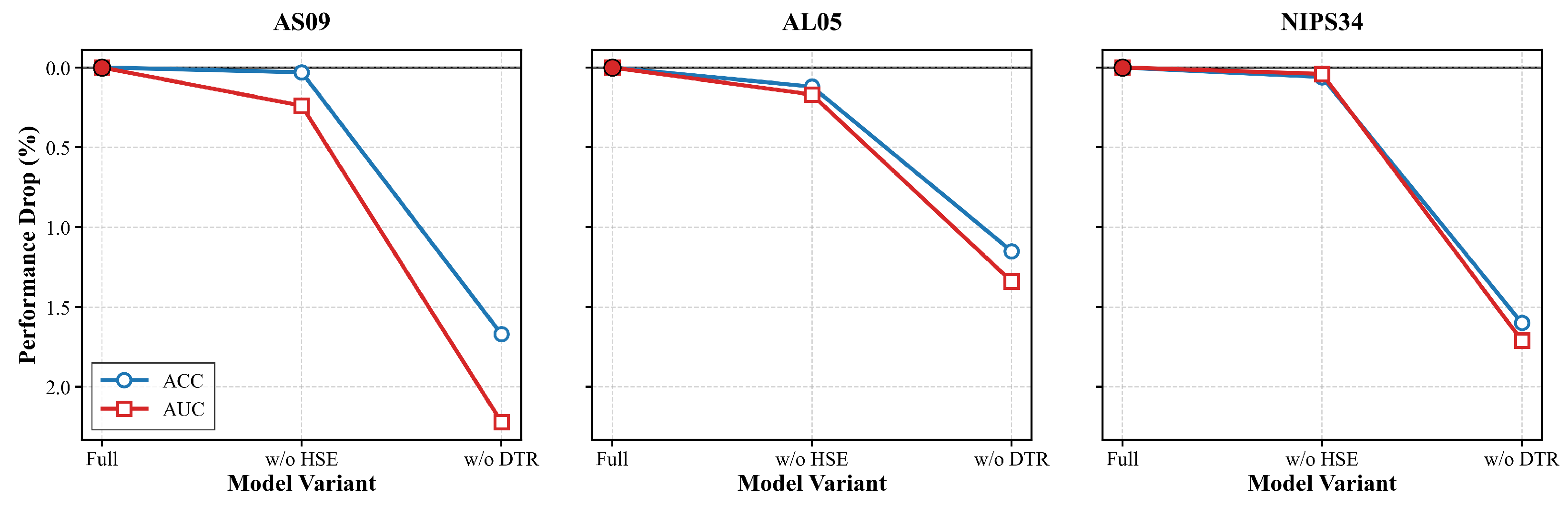
To further distinguish the contributions of the main mechanisms, we consider three ablation variants. In w/o HSE, the hierarchical local-evolution pathway is removed by eliminating asymmetric question-to-concept propagation and constrained hierarchical forgetting, while the dual-timescale global representation is retained. In w/o DTR, the dual-timescale global pathway is replaced by a standard single global sequence state, removing the residual-driven short-term state, bounded long-term updating, gated fusion, and the associated feedback regulation, while the hierarchical local-evolution pathway is retained. To provide a finer-grained analysis of DTR, we additionally introduce w/o Long-term, which removes the slowly evolving long-term pathway and the corresponding Long–Short fusion while retaining the residual-driven short-term state and its feedback regulation of local forgetting. The performance degradation across datasets for these variants is illustrated in Figure 2.
Figure 2.
Performance drop trajectory of HDTR-KT ablation variants across three datasets. The y-axis (inverted) represents the performance drop (%) compared to the full model, with the optimal performance anchored at .
As shown in Table 3, removing HSE produces a small but consistent performance degradation, with AUC reductions of 0.24, 0.17, and 0.04 percentage points on ASSISTments2009, Algebra2005, and NIPS34, respectively. This suggests that while the global pathway can partially compensate for the absence of explicit hierarchy, asymmetric question-to-concept propagation and constrained hierarchical forgetting still provide useful structural guidance for local knowledge evolution.
Table 3.
Ablation study of HDTR-KT on ASSISTments2009, Algebra2005, and NIPS34. Best results are shown in bold.
The finer-grained DTR ablation further reveals the role of the long-term pathway. Removing only the long-term state results in consistent AUC reductions of 0.08, 0.08, and 0.02 percentage points on ASSISTments2009, Algebra2005, and NIPS34, respectively, with corresponding ACC decreases of 0.12, 0.03, and 0.10 percentage points. Although these reductions are modest, their consistency across all three datasets indicates that the slowly evolving pathway provides complementary stable information beyond the residual-driven short-term state.
Removing DTR leads to larger AUC reductions of 2.22, 1.34, and 1.71 percentage points on ASSISTments2009, Algebra2005, and NIPS34, respectively. The much larger degradation of w/o DTR compared with w/o Long-term suggests that the effectiveness of DTR does not arise from the long-term pathway alone, but from the coordinated modeling of rapidly changing short-term evidence and slowly accumulated long-term knowledge. Overall, the ablation results support complementary roles for HSE and DTR, while the additional fine-grained variant provides further evidence for the contribution of the long-term component within the dual-timescale design.
RQ3: How does the embedding dimension affect the predictive performance of HDTR-KT?
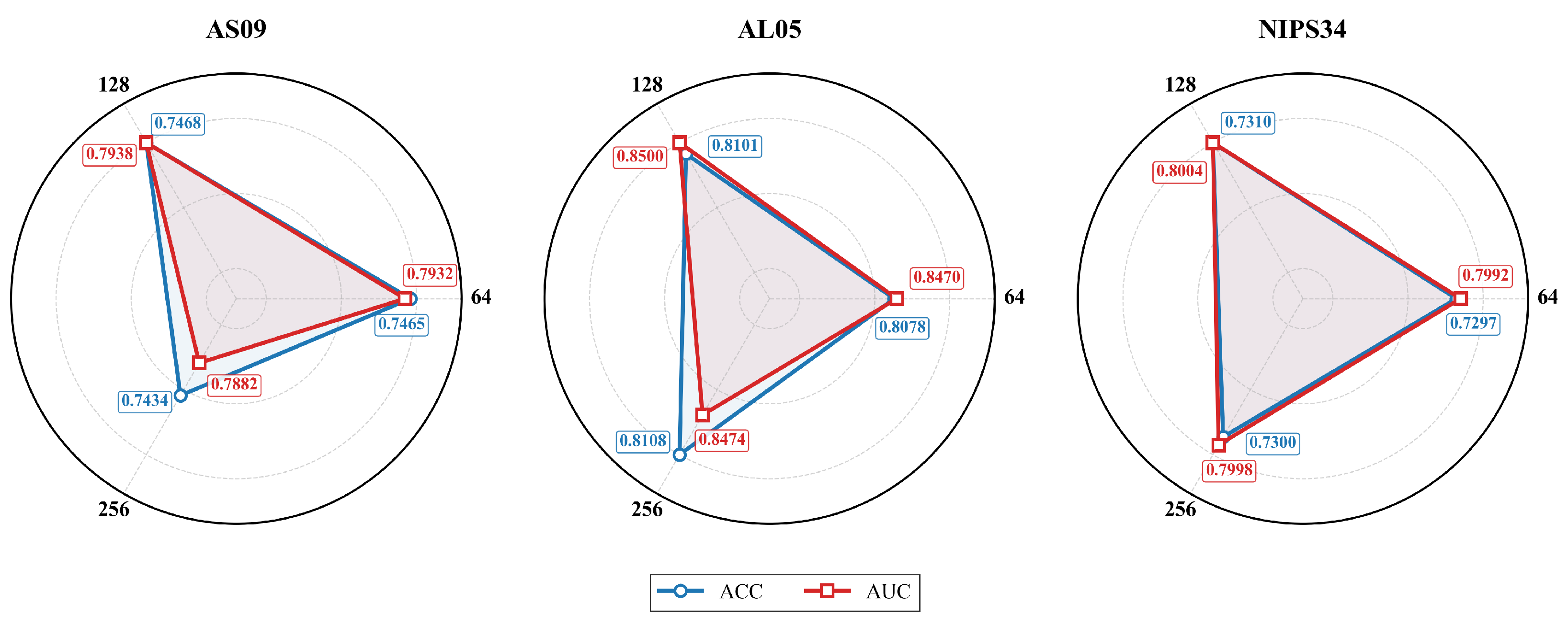
To investigate the influence of representation dimensionality, we vary the embedding dimension as while fixing the learning rate and batch size to and 64, respectively. In HDTR-KT, the dimension d is shared across local hierarchical states and global dual-timescale states, meaning it dictates both input capacity and the representation space for evidence propagation.
As shown in Figure 3, increasing d from 64 to 128 yields consistent improvements in the primary evaluation metric (AUC) across all datasets, with gains of up to 0.30 percentage points on Algebra2005. A 64-dimensional space restricts the model capacity, making it insufficient to simultaneously support asymmetric evidence propagation, adaptive local forgetting, and the separation of global dynamics.
Figure 3.
Impact of the hidden dimensionality () on the predictive performance of HDTR-KT. The results indicate that peak performance across the evaluated datasets is consistently reached at .
However, further increasing the dimension to 256 does not provide additional AUC gains. Compared with , the AUC decreases by 0.56, 0.26, and 0.06 percentage points on ASSISTments2009, Algebra2005, and NIPS34, respectively. Thus, the degradation is most evident on ASSISTments2009 and remains comparatively small on NIPS34. This pattern suggests that increasing the representation capacity beyond does not consistently improve generalization, while the effect of additional dimensions varies across datasets. Overall, provides the most consistent balance between representation capacity and predictive performance.
RQ4: How does the batch size influence the predictive performance and optimization stability of HDTR-KT?
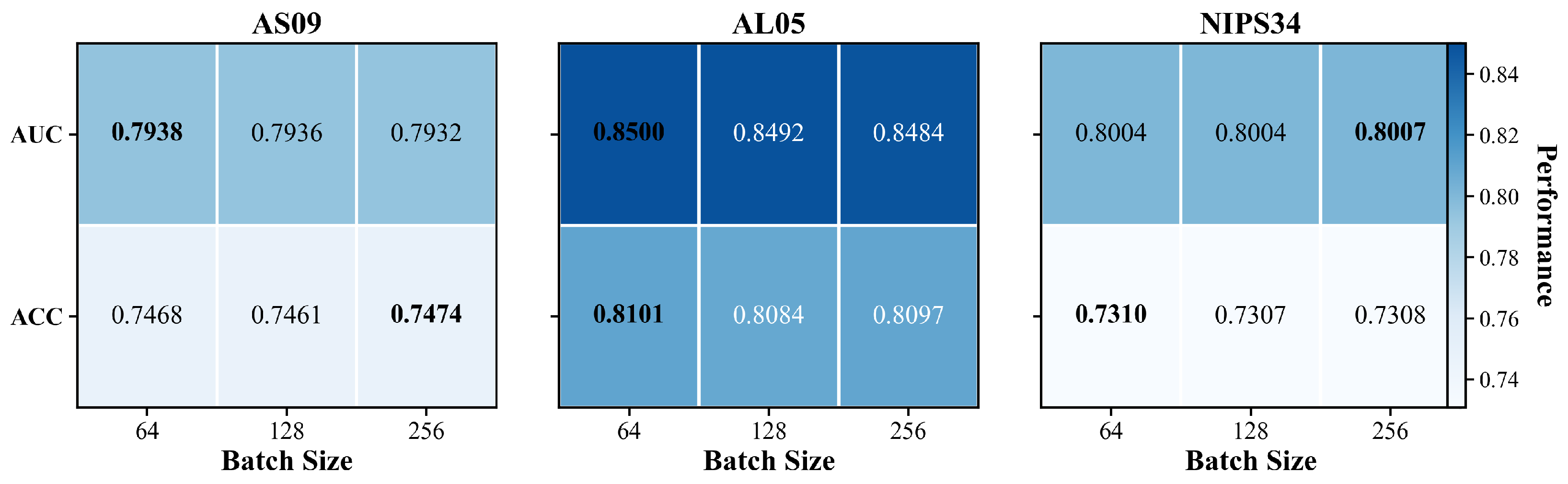
To examine the effect of batch size, we vary while fixing the embedding dimension and learning rate to 128 and , respectively. Because each optimization step jointly adjusts hierarchical local evolution, adaptive forgetting, and dual-timescale regulation, batch size dictates the granularity of the gradient signals coordinating these coupled components.
As shown in Figure 4, the performance variations are relatively small, with AUC ranges confined within , , and percentage points across the three datasets. This limited fluctuation suggests that HDTR-KT is relatively insensitive to batch size within the evaluated range. While a smaller batch size () occasionally yields slightly better performance, this may partly result from more frequent gradient updates, while the overall performance of the coupled mechanisms remains relatively stable across different batch granularities.
Figure 4.
Impact of batch size () on the predictive performance of HDTR-KT. Performance of HDTR-KT under different batch-size settings.
RQ5: How does the learning rate affect the convergence and predictive performance of HDTR-KT?
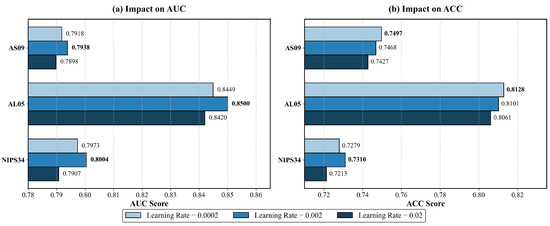
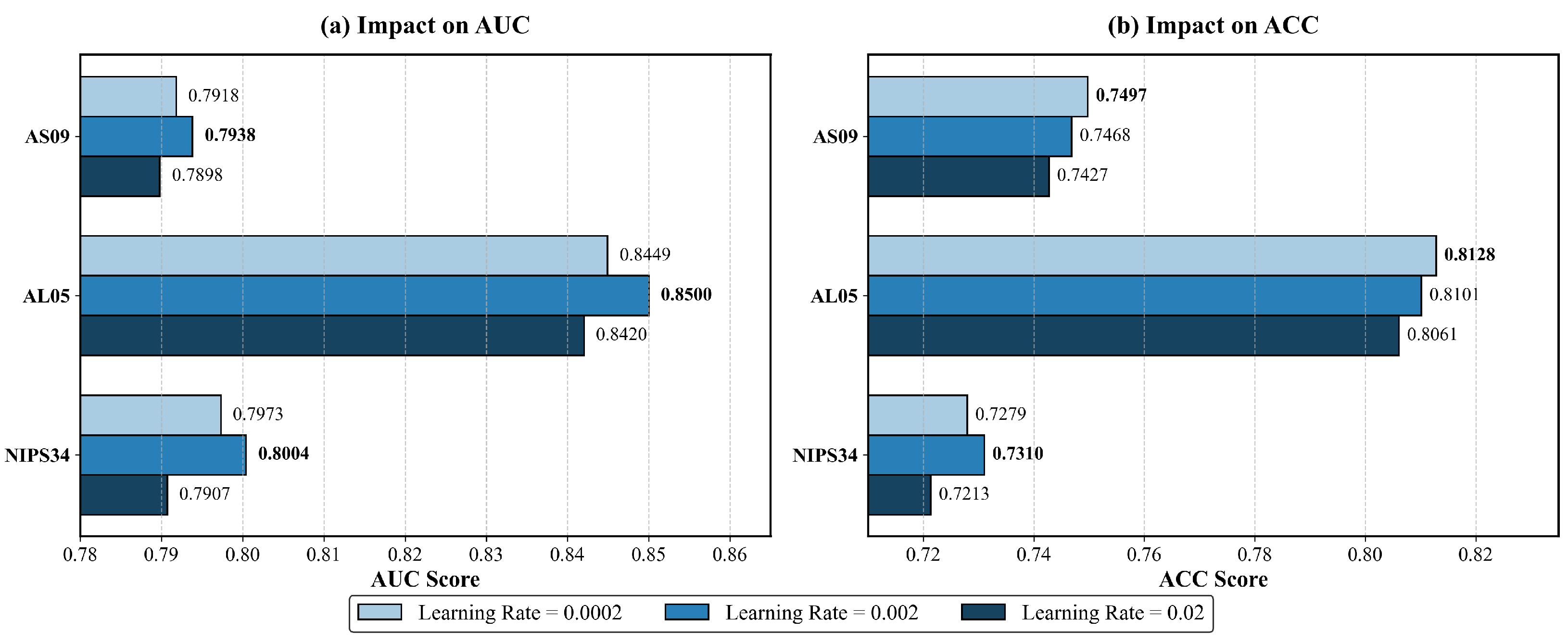
To examine the effect of the learning rate, we vary while fixing both the embedding dimension and batch size to 128 and 64, respectively.
As illustrated in Figure 5, achieves the highest AUC across all three datasets among the evaluated learning-rate settings. While an overly conservative learning rate () occasionally yields higher scores in the supplementary ACC metric, it fails to fully optimize the complex interactions among modules needed for robust rank-ordering. Conversely, an aggressive update pace () triggers severe performance degradation, causing a sharp drop in performance across both metrics.
Figure 5.
Impact of the learning rate () on the predictive performance of HDTR-KT. The best results for each dataset and metric are highlighted in bold.
This sensitivity pattern may be related to the coupled optimization of the mutual regulation mechanism. Because our framework relies on prediction residuals to update short-term states and mathematical bounds to govern long-term accumulation, an excessively large learning rate causes the parameters governing these tightly coupled components to change too abruptly. Although the long-term update gate remains numerically bounded by construction, aggressive optimization can still destabilize the representations entering the bounded update and amplify transient noise. Conversely, strikes an effective balance between responsive state adjustments and stable structural alignment.
5. Conclusions and Future Work
In this paper, we addressed the structural limitations of standard knowledge tracing models, specifically the lack of a directed evidence propagation path between specific items and abstract concepts, as well as the entanglement of transient behavioral shifts and long-term competence development. To resolve these issues, we proposed the HDTR-KT framework. At the local level, the model extracts an item-specific state increment and selectively transforms it into a concept-level message, governed by a constrained hierarchical retention mechanism. At the global level, an agile short-term state absorbs local changes and explicit prediction residuals, while a long-term state smoothly accumulates concept-level evidence. The fused global cognitive context subsequently drives both response prediction and the dynamic regulation of future local retention.
Extensive experiments on three public datasets demonstrate that HDTR-KT achieves highly competitive predictive performance across primary evaluation metrics. Ablation studies further confirm that the asymmetric evidence transfer from items to concepts effectively improves the structural organization of local knowledge states. Furthermore, the ablation results support the effectiveness of the dual-timescale representation in modeling short- and long-timescale evidence through distinct update pathways.
For future work, we intend to incorporate real-world timestamps to model continuous-time forgetting effects, where contextual variables such as inter-interaction duration, session boundaries, prolonged inactivity, and curriculum-stage information could provide additional signals for regulating memory decay. We also plan to conduct student-level case studies through trajectory-based analysis, examining how short- and long-term states, question-to-concept transfer strengths, and retention gates evolve around representative behavioral events such as repeated success, temporary slips, and concept transitions. In addition, text-based concept representations derived from generative large language models could be introduced as semantic priors for concept encoding and retention regulation, allowing the learned retention floor and decay rate to become sensitive to semantic relationships between concepts while preserving the existing hierarchical constraints.
Author Contributions
L.Y.: Conceptualization, Methodology, Investigation, Data Curation, Writing—Original Draft Preparation, Writing—Review and Editing, and Visualization; S.X.: Conceptualization, Methodology, Investigation, Data Curation, Writing—Original Draft Preparation, Writing—Review and Editing, and Visualization; J.Z.: Software, Validation, Resources, Data Curation, Writing—Original Draft Preparation, Writing—Review and Editing, Project Administration, and Funding Acquisition; J.J.: Conceptualization and Validation; F.Y.: Formal Analysis and Funding Acquisition; L.Z.: Validation. All authors have read and agreed to the published version of the manuscript.
Funding
This research was funded by the Research Project for College Ideological and Political Theory Course Teachers of the Ministry of Education of China (grant number 25JDSZK013) and the Fund of Key Laboratory of Education Blockchain and Intelligent Technology (Guangxi Normal University), Ministry of Education (Grant No. EBME2026B07). The APC was funded by the Research Project for College Ideological and Political Theory Course Teachers of the Ministry of Education of China.
Institutional Review Board Statement
Not applicable.
Informed Consent Statement
Not applicable.
Data Availability Statement
The data that support the findings of this study are available from the corresponding author upon reasonable request.
Acknowledgments
During the preparation of this work, the authors used ChatGPT 5.6 in order to improve the language. After using this tool, the authors reviewed and edited the content as needed and take full responsibility for the content of this publication.
Conflicts of Interest
The authors declare no conflicts of interest.
References
- Abdelrahman, G.; Wang, Q.; Nunes, B. Knowledge Tracing: A Survey. ACM Comput. Surv. 2023, 55, 224. [Google Scholar] [CrossRef] [Scilit]
- Zu, S.; Zhao, J.; Qin, B. Enhancing the Knowledge Tracing via a Plug-In Guided Diffusion Model. In Proceedings of the AAAI Conference on Artificial Intelligence; Association for the Advancement of Artificial Intelligence: Washington, DC, USA, 2026; Volume 40, pp. 18108–18116. [Google Scholar] [CrossRef] [Scilit]
- Zhang, J.; Shi, X.; King, I.; Yeung, D.Y. Dynamic Key-Value Memory Networks for Knowledge Tracing. In Proceedings of the 26th International Conference on World Wide Web; International World Wide Web Conferences Steering Committee: Geneva, Switzerland, 2017; pp. 765–774. [Google Scholar] [CrossRef] [Scilit]
- Yang, Y.; Shen, J.; Qu, Y.; Liu, Y.; Wang, K.; Zhu, Y.; Zhang, W.; Yu, Y. GIKT: A Graph-Based Interaction Model for Knowledge Tracing. In Proceedings of the Machine Learning and Knowledge Discovery in Databases: European Conference, ECML PKDD 2020; Springer: Cham, Switzerland, 2021; pp. 299–315. [Google Scholar] [CrossRef] [Scilit]
- Fu, X.; Wang, S.; Gao, Y.; Li, X.; Li, C.; Sun, Q.; Yu, D. Towards LLM-Empowered Knowledge Tracing via LLM-Student Hierarchical Behavior Alignment in Hyperbolic Space. In Proceedings of the AAAI Conference on Artificial Intelligence; Association for the Advancement of Artificial Intelligence: Washington, DC, USA, 2026; Volume 40, pp. 14747–14755. [Google Scholar] [CrossRef] [Scilit]
- Shen, X.; Yu, F.; Liu, Y.; Liang, R.; Wan, Q.; Yang, K.; Sun, J. Revisiting Knowledge Tracing: A Simple and Powerful Model. In Proceedings of the 32nd ACM International Conference on Multimedia; Association for Computing Machinery: New York, NY, USA, 2024; pp. 263–272. [Google Scholar] [CrossRef] [Scilit]
- Cui, C.; Yao, Y.; Zhang, C.; Ma, H.; Ma, Y.; Ren, Z.; Zhang, C.; Ko, J. DGEKT: A Dual Graph Ensemble Learning Method for Knowledge Tracing. ACM Trans. Inf. Syst. 2024, 42, 1–24. [Google Scholar] [CrossRef] [Scilit]
- Liu, S.; Yuan, X.; Wei, T.; Yue, J.; Zhao, Z.; Li, Q.; Chen, S. Enhancing Knowledge Tracing with Multi-Hierarchy Hypergraph Adaptive Knowledge Transfer. ACM Trans. Inf. Syst. 2026, 44, 1–31. [Google Scholar] [CrossRef] [Scilit]
- Shen, S.; Liu, Q.; Chen, E.; Huang, Z.; Huang, W.; Yin, Y.; Su, Y.; Wang, S. Learning Process-Consistent Knowledge Tracing. In Proceedings of the 27th ACM SIGKDD Conference on Knowledge Discovery and Data Mining; Association for Computing Machinery: New York, NY, USA, 2021; pp. 1452–1460. [Google Scholar] [CrossRef] [Scilit]
- Pandey, S.; Srivastava, J. RKT: Relation-Aware Self-Attention for Knowledge Tracing. In Proceedings of the 29th ACM International Conference on Information and Knowledge Management; Association for Computing Machinery: New York, NY, USA, 2020; pp. 1205–1214. [Google Scholar] [CrossRef] [Scilit]
- Bai, Y.; Li, X.; Liu, Z.; Huang, Y.; Tian, M.; Luo, W. Rethinking and Improving Student Learning and Forgetting Processes for Attention Based Knowledge Tracing Models. In Proceedings of the AAAI Conference on Artificial Intelligence; Association for the Advancement of Artificial Intelligence: Washington, DC, USA, 2025; Volume 39, pp. 27822–27830. [Google Scholar] [CrossRef] [Scilit]
- Chen, X.; Zhang, Z.; Hu, H.; Jin, J.; Yu, F.; Zhao, L. Robust English Knowledge Tracing via Profile-Driven Forgetting and Masked Consistency. Appl. Sci. 2026, 16, 6411. [Google Scholar] [CrossRef] [Scilit]
- Im, Y.; Choi, E.; Kook, H.; Lee, J. Forgetting-Aware Linear Bias for Attentive Knowledge Tracing. In Proceedings of the 32nd ACM International Conference on Information and Knowledge Management; Association for Computing Machinery: New York, NY, USA, 2023; pp. 3958–3962. [Google Scholar] [CrossRef] [Scilit]
- Cheng, W.; Du, H.; Li, C.; Ni, E.; Tan, L.; Xu, T.; Ni, Y. Uncertainty-Aware Knowledge Tracing. In Proceedings of the AAAI Conference on Artificial Intelligence; Association for the Advancement of Artificial Intelligence: Washington, DC, USA, 2025; Volume 39, pp. 27905–27913. [Google Scholar] [CrossRef] [Scilit]
- Ma, H.; Yang, Y.; Qin, C.; Yu, X.; Yang, S.; Zhang, X.; Zhu, H. HD-KT: Advancing Robust Knowledge Tracing via Anomalous Learning Interaction Detection. In Proceedings of the ACM Web Conference 2024; Association for Computing Machinery: New York, NY, USA, 2024; pp. 4479–4488. [Google Scholar] [CrossRef] [Scilit]
- Piech, C.; Bassen, J.; Huang, J.; Ganguli, S.; Sahami, M.; Guibas, L.J.; Sohl-Dickstein, J. Deep Knowledge Tracing. In Proceedings of the Advances in Neural Information Processing Systems 28, Montreal, QC, Canada, 7–12 December 2015; pp. 505–513. [Google Scholar]
- Hou, M.; Li, X.; Guo, T.; Liu, Z.; Tian, M.; Luo, R.; Luo, W. Cognitive Fluctuations Enhanced Attention Network for Knowledge Tracing. In Proceedings of the AAAI Conference on Artificial Intelligence; Association for the Advancement of Artificial Intelligence: Washington, DC, USA, 2025; Volume 39, pp. 14265–14273. [Google Scholar] [CrossRef] [Scilit]
- Li, Q.; Yuan, X.; Yue, J.; Shen, X.; Liang, R.; Liu, S.; Yan, Z. Dual-View Multi-Scale Cognitive Representation for Deep Knowledge Tracing. Knowl.-Based Syst. 2025, 310, 113010. [Google Scholar] [CrossRef] [Scilit]
- Li, Z.; Chen, L.; Yi, J.; Hou, X.; Zhao, Y.; Huang, W.; Zhang, M.; Xiao, K.; Yang, B. KeenKT: Knowledge Mastery-State Disambiguation for Knowledge Tracing. In Proceedings of the AAAI Conference on Artificial Intelligence; Association for the Advancement of Artificial Intelligence: Washington, DC, USA, 2026; Volume 40, pp. 19285–19293. [Google Scholar] [CrossRef] [Scilit]
- Pandey, S.; Karypis, G. A Self-Attentive Model for Knowledge Tracing. In Proceedings of the 12th International Conference on Educational Data Mining; International Educational Data Mining Society: Worcester, MA, USA, 2019; pp. 384–389. [Google Scholar]
- Ghosh, A.; Heffernan, N.T.; Lan, A.S. Context-Aware Attentive Knowledge Tracing. In Proceedings of the 26th ACM SIGKDD International Conference on Knowledge Discovery and Data Mining; Association for Computing Machinery: New York, NY, USA, 2020; pp. 2330–2339. [Google Scholar] [CrossRef] [Scilit]
- Pu, Y.; Liu, F.; Shi, R.; Yuan, H.; Chen, R.; Peng, T.; Wu, W. ELAKT: Enhancing Locality for Attentive Knowledge Tracing. ACM Trans. Inf. Syst. 2024, 42, 112. [Google Scholar] [CrossRef] [Scilit]
- Bhattacharjee, I.; Wayllace, C. MAML-KT: Addressing Cold Start Problem in Knowledge Tracing for New Students via Few-Shot Model-Agnostic Meta Learning. In Proceedings of the Artificial Intelligence in Education; Lecture Notes in Computer Science; Springer: Cham, Switzerland, 2026; Volume 16583, pp. 141–149. [Google Scholar] [CrossRef] [Scilit]
- Wang, C.; Ma, W.; Zhang, M.; Lv, C.; Wan, F.; Lin, H.; Tang, T.; Liu, Y.; Ma, S. Temporal Cross-Effects in Knowledge Tracing. In Proceedings of the 14th ACM International Conference on Web Search and Data Mining; Association for Computing Machinery: New York, NY, USA, 2021; pp. 517–525. [Google Scholar] [CrossRef] [Scilit]
- Song, Q.; Luo, W. SFBKT: A Synthetically Forgetting Behavior Method for Knowledge Tracing. Appl. Sci. 2023, 13, 7704. [Google Scholar] [CrossRef] [Scilit]
- Zheng, N.; Hu, R.; Shan, Z.; Mu, S. Dual-disentanglement knowledge tracing: Separating semantic dependencies and behavioral noise. Neurocomputing 2026, 704, 134777. [Google Scholar] [CrossRef] [Scilit]
- Chen, Z.; Fei, Q.; Chen, A.; Chen, J. DSDKT: Robust Knowledge Tracing via Trend Residual Decomposition and Difficulty Debiasing. In Proceedings of the Advanced Intelligent Computing Technology and Applications: 22nd International Conference on Intelligent Computing, ICIC 2026, Proceedings; Lecture Notes in Computer Science; Springer: Singapore, 2026; Volume 16645, pp. 444–455. [Google Scholar] [CrossRef] [Scilit]
- Liu, Z.; Liu, Q.; Chen, J.; Huang, S.; Tang, J.; Luo, W. pyKT: A Python Library to Benchmark Deep Learning Based Knowledge Tracing Models. In Proceedings of the Advances in Neural Information Processing Systems, New Orleans, LA, USA, 28 November–9 December 2022; Volume 35, pp. 18542–18555. [Google Scholar]
- Liu, Z.; Liu, Q.; Chen, J.; Huang, S.; Luo, W. simpleKT: A Simple But Tough-to-Beat Baseline for Knowledge Tracing. In Proceedings of the International Conference on Learning Representations, Kigali, Rwanda, 1–5 May 2023. [Google Scholar]
- Huang, S.; Liu, Z.; Liu, Q.; Chen, J.; Huang, Y. Dual-Attentional Time-Aware Fusion Networks for Knowledge Tracing. Inf. Fusion 2026, 126, 103573. [Google Scholar] [CrossRef] [Scilit]
- Ning, Q.; Guo, C.; Liu, K.; Tang, J.; Zhang, S.; Zeng, W.; Zhao, X. Dual Sequence Modeling for Knowledge Tracing. Data Sci. Eng. 2025, 10, 653–664. [Google Scholar] [CrossRef] [Scilit]
- Yin, Y.; Dai, L.; Huang, Z.; Shen, S.; Wang, F.; Liu, Q.; Chen, E.; Li, X. Tracing Knowledge Instead of Patterns: Stable Knowledge Tracing with Diagnostic Transformer. In Proceedings of the ACM Web Conference 2023; Association for Computing Machinery: New York, NY, USA, 2023; pp. 855–864. [Google Scholar] [CrossRef] [Scilit]
- Wang, J.; Wang, M.; Li, Z.; Chen, K.; Mei, J.; Zhang, S. MixerKT: A Knowledge Tracing Model Based on Pure MLP Architecture. Comput. Mater. Contin. 2025, 82, 485–498. [Google Scholar] [CrossRef] [Scilit]
- Seo, J.; Ryu, S.; Do, H.; Kim, H.; Lee, G. Behavior-Aware Item Modeling via Dynamic Procedural Solution Representations for Knowledge Tracing. In Proceedings of the Findings of the Association for Computational Linguistics: ACL 2026, San Diego, CA, USA, 2–7 July 2026; pp. 22428–22443. [Google Scholar] [CrossRef] [Scilit]
- Li, X.; Bai, Y.; Guo, T.; Liu, Z.; Huang, Y.; Zhao, X.; Xia, F.; Luo, W.; Weng, J. Enhancing Length Generalization for Attention-Based Knowledge Tracing Models with Linear Biases. In Proceedings of the Thirty-Third International Joint Conference on Artificial Intelligence, Jeju, Republic of Korea, 3–9 August 2024; pp. 5918–5926. [Google Scholar] [CrossRef] [Scilit]
- Xiao, J.; You, C.; Chen, Z. AlignKT: Explicitly Modeling Knowledge State for Knowledge Tracing with Ideal State Alignment. In Proceedings of the 2025 IEEE International Conference on Multimedia and Expo; IEEE: Piscataway, NJ, USA, 2025; pp. 1–6. [Google Scholar] [CrossRef] [Scilit]

Disclaimer/Publisher’s Note: The statements, opinions and data contained in all publications are solely those of the individual author(s) and contributor(s) and not of MDPI and/or the editor(s). MDPI and/or the editor(s) disclaim responsibility for any injury to people or property resulting from any ideas, methods, instructions or products referred to in the content. |
© 2026 by the authors. Licensee MDPI, Basel, Switzerland. This article is an open access article distributed under the terms and conditions of the Creative Commons Attribution (CC BY) license.