


Abstract
Travel Reservation Strategy (TRS) provides a capacity-constrained approach for managing recurrent congestion by regulating access to selected urban road links. This study develops a Multidimensional Traffic Split and Assignment (MDTSA) model to evaluate TRS within a heterogeneous multimodal transportation system. The model integrates traveler heterogeneity in value of time, five travel alternatives, non-separable car–bus road impedance, reservation-access constraints, and joint mode–route choice under stochastic user equilibrium. A variational inequality formulation is solved using the Method of Successive Weighted Averages. Numerical experiments on the Sioux Falls network show that TRS increases average network speed by 8.1%, reduces average road saturation by 12.5%, decreases total generalized travel cost by 2.3%, and lowers vehicle-hours traveled by 6.5%. The strategy also shifts travel demand away from private cars, whose modal share decreases by 2.48 percentage points, while bus and metro shares increase by 1.91 percentage points in total. Model-comparison results indicate that neglecting traveler heterogeneity or combined travel modes weakens the estimated effects of TRS, while sensitivity analysis shows that the main performance improvements remain stable across the tested reservation-capacity ratios and demand levels. These findings demonstrate the value of multidimensional equilibrium modeling for evaluating reservation-based urban traffic management.
Keywords:
Travel Reservation Strategy; Multidimensional Traffic Split and Assignment; multimodal transportation; traveler heterogeneity; traffic assignment MSC:
90B06
1. Introduction
Rapid growth in private-car travel and concentrated peak-period demand continue to intensify the mismatch between transportation supply and demand in urban areas. Recurrent congestion on major commuting corridors not only increases travel delays and reduces network efficiency, but also imposes substantial economic and environmental costs. Fundamentally, such congestion reflects competition for limited road capacity when excessive travel demand reaches bottleneck links within a concentrated period [1,2]. Conventional traffic management mainly responds to this imbalance through physical queuing, rerouting, pricing, or access restrictions. With advances in digital platforms, real-time traffic information, and vehicle identification technologies, road access can increasingly be coordinated before travelers reach congested facilities [3]. This creates the possibility of replacing part of the inefficient physical queue with a pre-arranged access mechanism. The Travel Reservation Strategy (TRS) follows this concept by regulating the number of private vehicles permitted to use recurrently congested roads during predefined peak periods, thereby improving the matching between limited road capacity and concentrated travel demand [4].
Existing research has progressively explored reservation-based traffic management in different spatial and operational settings. Early studies mainly focused on highways and holiday traffic, examining whether reservation mechanisms could redistribute vehicle arrivals or departure times and reduce congestion at heavily loaded facilities. Subsequent studies extended reservation management to regions, lanes, intersections, and individual urban roads, generally showing that capacity-based reservation control can reduce queues and delays and improve the utilization of limited road resources [5,6]. More recent research has shifted toward the implementation conditions and behavioral feasibility of TRS. Zhou et al. estimated reasonable reservation capacities for urban roads and showed that selecting highly congested critical links can be more effective than applying reservation control over a broad area. Other studies have examined public acceptance and behavioral intentions toward urban travel reservation, identifying travel-time savings, convenience, value of time (VOT), attitudes, and social or personal norms as important determinants of travelers’ responses [7,8]. These developments indicate that TRS research has gradually evolved from conceptual and operational design toward capacity setting, behavioral acceptance, and strategy evaluation [9].
Evaluating TRS in an urban road network, however, requires consideration of behavioral adjustments beyond the reserved links themselves [10]. When private-car access to a congested road is restricted, travelers may select alternative road paths, shift to bus or metro, or use combined alternatives such as car-to-bus (C&B) and car-to-metro (C&M) [11,12]. Multimodal network-equilibrium research has increasingly incorporated joint mode and route decisions to capture such interactions among private and public transport. Recent studies have also demonstrated the importance of representing multiple user classes, particularly through heterogeneous VOT, because travelers with different time–cost trade-offs may respond differently to changes in network conditions and transport policies [13,14]. For example, multimodal equilibrium models involving bus, metro, private or shared vehicle services have shown that combining stochastic travel choice with heterogeneous VOT can produce differentiated mode-choice responses across traveler classes [15]. These findings provide an important methodological basis for evaluating reservation-based access management in a heterogeneous multimodal network.
Despite these advances, several gaps remain. First, much of the existing reservation literature has focused on highways, special-purpose reservation facilities, reservation-capacity design, or behavioral acceptance, while systematic evaluation of TRS for recurrently congested urban road networks remains relatively limited. Second, previous evaluations commonly emphasize traffic conditions on reserved facilities or aggregate network performance, whereas the simultaneous redistribution of demand among alternative road routes, conventional public transport, and combined car–transit modes has received less attention. Third, traveler heterogeneity and multimodal adjustment are often simplified or investigated separately. Consequently, the effects of reservation-based access restrictions on travelers with different VOTs and on their joint mode–route decisions cannot be fully represented. A unified network-equilibrium framework that simultaneously considers reservation constraints, multimodal interactions, and heterogeneous traveler responses is therefore needed for a more comprehensive assessment of TRS.
To address these gaps, this study aims to evaluate TRS for recurrently congested urban roads by explicitly considering heterogeneous traveler responses and multimodal network interactions. TRS is represented as a capacity-constrained access management strategy in which private-vehicle use of selected congested links is subject to predefined reservation capacities. Based on stochastic user equilibrium (SUE), a Multi-Dimensional Traffic Split and Assignment (MDTSA) model is developed to jointly determine travel mode and route choices. The framework distinguishes traveler classes by VOT, considers five travel alternatives—car, bus, metro, C&B, and C&M—and incorporates non-separable interactions between cars and buses sharing the road network. Numerical experiments further examine system-level performance, link-level traffic redistribution, modal shifts, heterogeneous traveler responses, the effects of simplifying behavioral dimensions, and sensitivity to reservation capacity and travel demand. Accordingly, the contribution of this study lies in embedding TRS directly into a heterogeneous multimodal equilibrium network as an access constraint rather than treating reservation status as an independent travel mode; jointly representing heterogeneous VOT, conventional and combined travel alternatives, and multimodal congestion interactions; and providing a multidimensional evaluation of TRS that links network-performance changes with route, mode, and traveler-class responses.
2. Model Construction
2.1. Problem Description and Modeling Assumptions
(1) Problem Description
This study evaluates the effects of the TRS on recurrently congested urban road segments within a heterogeneous multimodal transportation system. The analysis is conducted from a static network equilibrium perspective, focusing on travelers’ adjustments in travel mode and route choice under reservation-based access restrictions.
Let the multimodal transportation network be represented by (), where () and () denote the sets of nodes and links, respectively. A subset of recurrently congested links, , is selected for TRS implementation. Private vehicles with reservation access may use these links subject to reservation capacity constraints, whereas non-reserved vehicles must select alternative routes or other travel modes.
To capture heterogeneous travel responses, travelers are classified according to their value of time (VOT) [16,17], and five travel alternatives are considered: private car, bus, metro, car-to-bus (C&B), and car-to-metro (C&M). Mode and route choices are jointly determined by generalized travel costs incorporating both travel time and monetary expenditure.
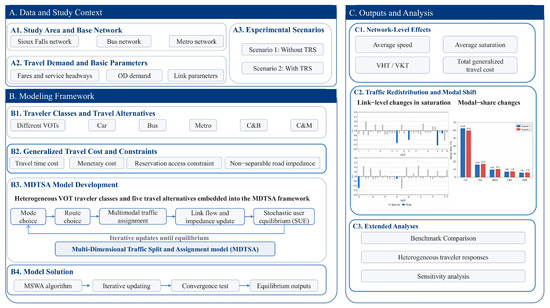
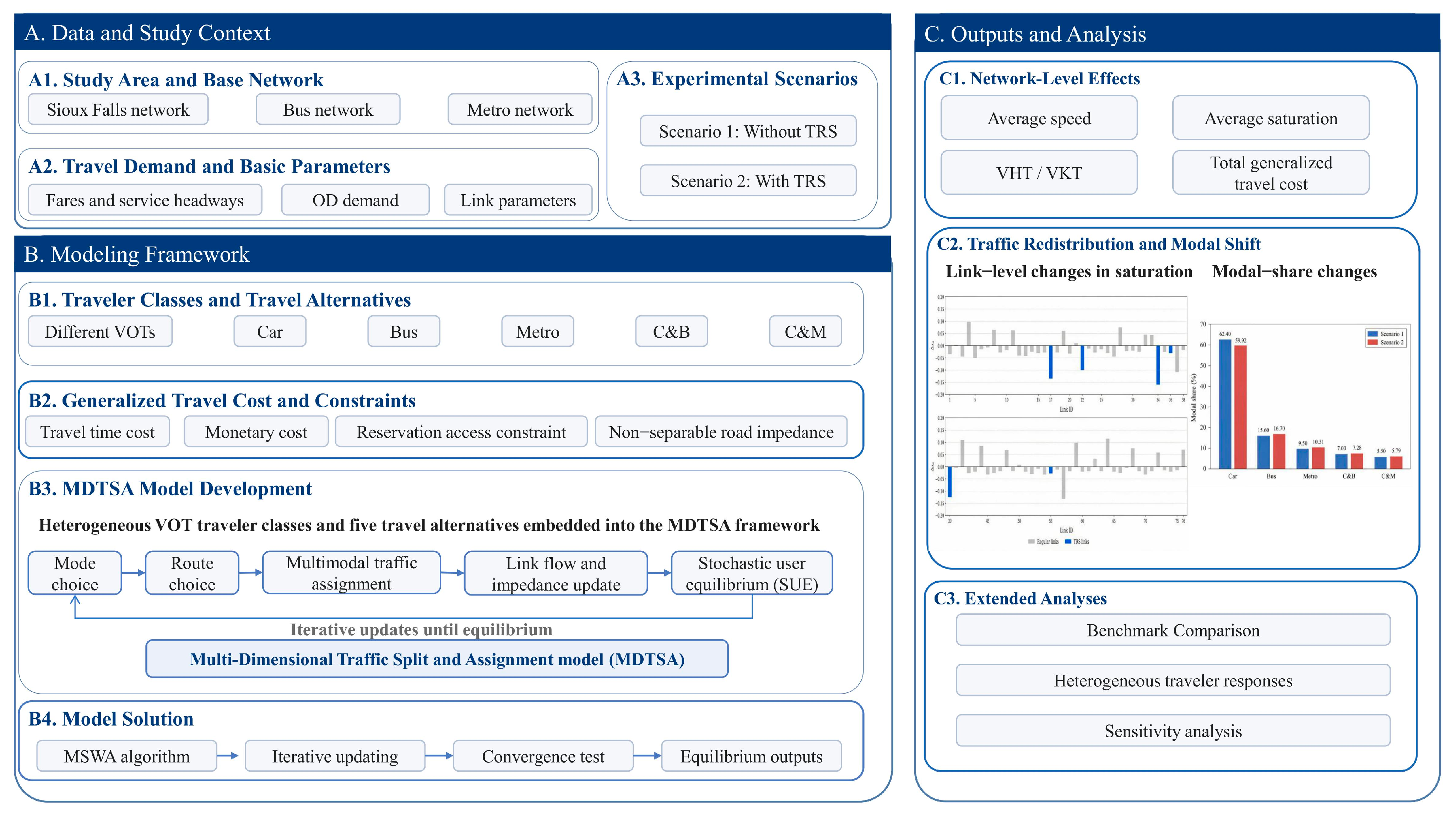
Based on the above considerations, a Multi-Dimensional Traffic Split and Assignment (MDTSA) model is developed to characterize the multimodal network equilibrium under TRS. The overall research framework includes TRS scenario definition, multidimensional travel decision modeling, stochastic network equilibrium solution, and numerical analyses of system performance, traveler heterogeneity, traffic redistribution, and strategy robustness. The technical framework of this study is presented in Figure 1.
Figure 1.
Overall technical framework of this study.
(2) Modeling Assumptions
1) Static peak-period equilibrium. The model represents the average traffic state during a predefined peak period and does not explicitly describe within-period traffic evolution or departure-time adjustment. Consequently, travelers affected by TRS can respond only through mode and route choices within the analyzed period.
2) Fixed travel demand. Total OD demand remains unchanged during the study period, while travelers may adjust their travel modes and routes in response to TRS.
3) Predefined reservation links. TRS is applied only to selected recurrently congested road segments. Non-reserved private vehicles are not permitted to use these links.
4) Exogenous reservation capacity. The reservation capacity of each TRS link is specified before traffic assignment and is treated as an external policy parameter rather than an endogenous optimization variable.
5) Heterogeneous and multi-criteria decisions. Travelers are classified according to VOT, and their travel choices are determined by generalized costs incorporating both travel time and monetary cost.
6) Multimodal interactions. Five travel alternatives are considered. Cars and buses share the road network and interact through congestion, whereas metro services operate independently of surface-road traffic. Only car-to-transit transfers are considered for combined modes.
7) Fixed transit service supply. Bus and metro service headways are held constant across the analyzed scenarios. Thus, increases in transit passenger demand do not trigger endogenous frequency adjustments.
(3) Parameters and Symbols
To facilitate the formulation of the MDTSA model, the principal sets, parameters, and variables used in the following sections are summarized in Table 1.
Table 1.
Definitions of parameters and symbols.
2.2. Representation of TRS in a Static Multimodal Network
In this study, TRS is represented as a capacity-constrained access management strategy for recurrently congested road segments. Let denote the set of road links subject to reservation. For each reservation link , the maximum number of private vehicles permitted to use the link during the study period is defined as its reservation capacity .
The reservation capacity is determined by the traffic capacity of the corresponding link and a predefined reservation capacity ratio, expressed as:
where denotes the traffic capacity of link a, and is the reservation capacity ratio. The value of is determined according to previous research [18] and is treated as an exogenous policy parameter in the present study rather than an optimization variable. TRS is represented as an aggregate capacity constraint on the private-vehicle flow using each reservation link. Travelers are not partitioned into reserved and non-reserved sub-populations, and no priority rule based on VOT, willingness to pay, first-come-first-served order, or other individual characteristics is imposed. Instead,
For OD pair , let denote the set of travel alternatives containing a private-car component. The aggregate private-vehicle flow using reservation link is defined as
where if the private-car component of path under mode traverses link , and 0 otherwise.
For each reservation link , the aggregate private-vehicle flow is required to satisfy
This constraint limits the total private-vehicle flow using each reservation link but does not determine which individual travelers receive reservation access. The numerical enforcement of this aggregate capacity constraint is implemented through the penalty mechanism described in Section 2.3, Section 2.4 and Section 2.5.
The aggregate reservation-capacity constraint applies to all travel alternatives containing a private-car component, including private car, C&B, and C&M. For combined modes, only the private-car segment is subject to the reservation constraint. Public buses are exempt from reservation access restrictions because they provide scheduled public transportation services, although their travel times remain affected by interactions with road traffic. Metro services operate on dedicated infrastructure and are therefore unaffected by TRS road-access constraints.
Through the above formulation, TRS changes the effective generalized costs and capacity conditions associated with reservation links without altering total OD demand. These changes subsequently affect route choice, mode choice, and multimodal network equilibrium.
2.3. Multidimensional Generalized Travel Cost
Travelers evaluate different modes and routes according to their generalized travel costs. To account for heterogeneous preferences, monetary expenditures are converted into equivalent travel time using the VOT of each traveler class [19,20]. Accordingly, the generalized cost of each travel alternative consists of mode-specific travel time, monetary expenditure, and, where applicable, waiting and crowding costs.
(1) Non-Separable Link Impedance
In urban road networks, private cars and buses generally share road space. Their travel times are therefore jointly affected by both car and bus flows, resulting in non-separable link impedance functions. Following the formulation adopted in the model, the travel times of cars and buses on link a are expressed as:
where and denote the free-flow travel times of cars and buses, respectively; and are their corresponding link flows; and denote link capacities; and α, β, and γ are impedance-function parameters. Here, denotes the penalized private-car travel time on reservation link ; is a sufficiently large positive penalty coefficient used to impose a prohibitive additional travel-time penalty when the reservation capacity is violated; and denotes the normalized capacity violation of reservation link , which equals zero when the reservation capacity is satisfied and becomes positive when the private-vehicle flow exceeds the prescribed reservation capacity. Once the reservation capacity is violated, the additional cost increases with the capacity violation, reducing the attractiveness of paths containing the overloaded reservation link in subsequent stochastic-loading iterations. The penalized car cost is also applied to the private-car segments of C&B and C&M alternatives.
(2) Generalized Cost of Private Cars
Reservation status does not change the intrinsic travel cost structure of private cars. Therefore, reserved and non-reserved cars share the same generalized cost function, while their differences are reflected through the feasible path sets and reservation constraints defined in Section 2.2. For traveler class using private car on path between OD pair , the generalized cost is:
where is the fuel cost per unit distance, is the length of link , and is the VOT of traveler class .
(3) Generalized Cost of Bus
The generalized cost of bus travel consists of in-vehicle travel time, waiting time, onboard crowding cost, and fare. For traveler class using bus on path , it is expressed as:
The onboard crowding component can be represented as:
where is the passenger capacity of a bus, and and are crowding parameters. The waiting time is assumed to equal half of the service headway.
(4) Generalized Cost of Metro
Metro services operate on dedicated infrastructure and are therefore independent of surface-road traffic conditions. However, passenger demand may influence perceived travel cost through congestion within the metro system. The generalized cost of metro travel is expressed as:
where the metro link travel time is calculated using:
Here, denotes metro passenger flow, is passenger capacity, is the service headway, and and are congestion parameters. Metro waiting time is also assumed to be half of the corresponding service headway.
(5) Generalized Cost of Combined Modes
To capture the possibility that private-car users shift partially rather than completely to public transportation, two combined travel alternatives are considered: car-to-bus (C&B) and car-to-metro (C&M). Only one transfer between private car and public transportation is considered.
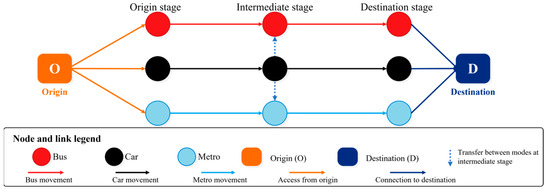
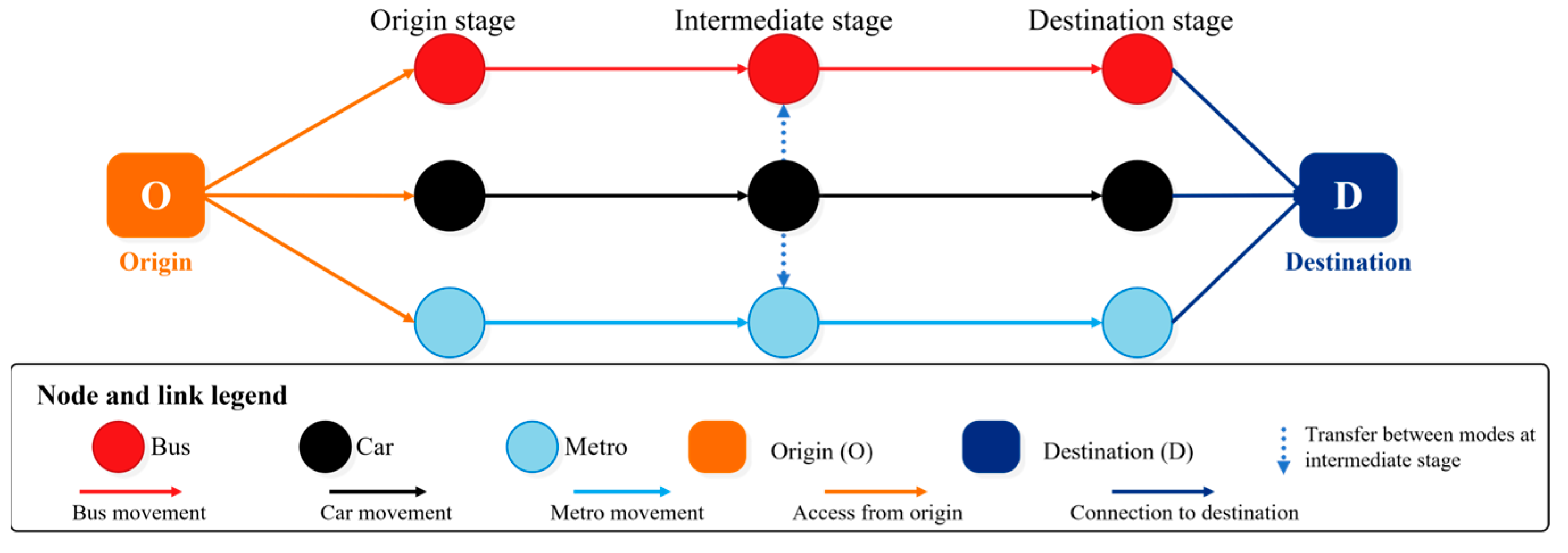
To illustrate the multimodal path structure, Figure 2 presents a simplified network consisting of road, bus, and metro components. Five travel alternatives are considered: private car, bus, metro, C&B, and C&M. For the two combined modes, travelers first use a private car from the origin to a transfer node and then complete the remaining trip by bus or metro. Only transfers between private cars and public transportation are considered in this study [21,22].
Figure 2.
Illustrative multimodal network and transfer structure.
The generalized cost of each travel segment is determined according to the corresponding mode-specific formulation. For C&B and C&M, the private-car segment additionally satisfies the TRS access constraints defined in Section 2.2, while parking and transfer-related costs are incorporated at the transfer node.
Let denote a transfer node. The generalized costs of the two combined modes can be expressed as:
where and denote the private-car and public-transport segments, respectively, and denotes the parking cost at the transfer facility. The private-car segment is subject to the TRS access constraints defined in Section 2.2, whereas the subsequent bus or metro segment follows the corresponding public-transport cost formulation.
The feasible paths of each travel mode are generated using the link-penalty-based path set generation method. Based on the above formulations, each traveler class faces a mode- and route-specific generalized cost that simultaneously reflects VOT heterogeneity, multimodal interactions, and TRS-induced accessibility changes.
2.4. MDTSA Equilibrium Model
Based on the generalized travel costs, the MDTSA model integrates route choice, mode choice, and multimodal traffic assignment within a unified stochastic network equilibrium framework. A Nested Logit structure is adopted to represent travelers’ sequential decisions, in which route choice is conditional on the selected travel mode, while mode choice depends on the expected minimum cost associated with each mode.
(1) Path Choice
For traveler class using travel mode between OD pair , the probability of selecting path is determined according to the generalized cost of the corresponding path:
where denotes the probability that traveler class selects path under mode ; is the corresponding generalized path cost; is the route-choice dispersion parameter; and denotes the feasible path set of mode between OD pair .
The path flow can then be determined by:
where denotes the travel demand of traveler class choosing mode between OD pair .
(2) Mode Choice
Because each travel mode may contain multiple feasible paths, the expected minimum path cost is used to characterize the overall attractiveness of a given mode. For traveler class , the expected minimum cost of mode between OD pair is expressed as:
where represents the expected minimum path cost associated with mode .
Based on this expected cost, the probability of traveler class selecting mode is given by:
Accordingly, the travel demand assigned to mode m is:
where denotes the fixed travel demand of traveler class between OD pair , and is the mode-choice dispersion parameter.
(3) Flow Conservation and TRS Constraints
The mode-specific travel demand must satisfy the OD demand conservation condition:
Meanwhile, the path flows associated with each travel mode satisfy:
Let equal 1 if link is included in path of mode and 0 otherwise. The link flow of traveler class under mode and the total mode-specific link flow are respectively calculated as:
These link flows are subsequently used to update the non-separable impedance functions defined in Section 2.3.
For reservation links, private-vehicle flows are additionally subject to the TRS capacity constraints established in Section 2.2. Let denote the set of travel alternatives containing a private-car component, including car, C&B, and C&M. For each reservation link :
In the numerical solution, the reservation-capacity constraint is enforced through an exterior penalty mechanism. For each reservation link , define the normalized capacity violation as
where . Thus, when the reservation capacity is satisfied and becomes positive only when the admitted private-vehicle flow exceeds the prescribed reservation capacity. When the capacity is violated during an intermediate iteration, the penalty term increases the generalized cost of paths containing the corresponding reservation link, thereby shifting subsequent route and mode loading toward non-reservation paths or alternative modes. At convergence, the remaining capacity violation is required to be within the prescribed tolerance.
(4) Stochastic Network Equilibrium
Under the SUE principle, travelers do not necessarily select the route or mode with the absolute minimum generalized cost because of imperfect perception and heterogeneous preferences. Instead, traffic demand is probabilistically distributed among available modes and paths according to the Nested Logit structure. At equilibrium, the resulting mode and path flows are mutually consistent with the generalized costs generated by the network traffic state.
Because the link impedance functions defined in Section 2.3 are non-separable, the equilibrium problem is formulated directly as a variational inequality rather than through a conventional separable equivalent optimization formulation. Let denote the basic feasible set satisfying the demand-conservation, flow-conservation, and non-negativity conditions in Equations (20)–(23). The reservation-capacity constraint in Equations (24) and (25) is enforced explicitly through the penalty term described below rather than being imposed implicitly through the feasible set.
Accordingly, the penalized generalized cost of path is
where denotes the penalized generalized cost of path for traveler class using mode between OD pair ; is the corresponding original generalized path cost without the reservation-capacity penalty; and denotes the capacity-violation penalty associated with path , as defined in Equation (27).
where and denote the equilibrium path flows and mode-specific demands, respectively.
The first term in Equation (28) characterizes stochastic route choice under the penalized mode-specific generalized costs, whereas the second term represents the stochastic allocation of OD demand among different travel modes. When a reservation link exceeds its prescribed capacity, the penalty term increases the generalized cost of paths containing that link, thereby reducing their attractiveness in subsequent loading iterations. The iterative procedure continues until both the equilibrium gap and the reservation-capacity violation satisfy the prescribed convergence tolerances.
Regarding solution existence, under fixed OD demand and a finite feasible path set, the feasible set defined by the flow-conservation, non-negativity, and TRS-capacity constraints is nonempty, closed, convex, and bounded, provided that at least one feasible travel alternative exists for each OD pair. Since the generalized-cost mapping adopted in this study is continuous over the feasible set, the corresponding variational inequality admits at least one equilibrium solution [23]. For a continuously differentiable mapping, a sufficient condition is the positive definiteness of the symmetric part of its Jacobian. Because the present model incorporates heterogeneous traveler classes, non-separable car–bus interactions, multimodal coupling, and TRS capacity constraints, global strict monotonicity is not imposed. Therefore, existence can be established under the above conditions, whereas uniqueness of the disaggregate mode- and path-flow solution is not guaranteed in general.
2.5. Solution Algorithm
The MDTSA model involves interactions among multimodal link costs, heterogeneous mode choice, route choice, and TRS capacity constraints, forming a fixed-point equilibrium problem. The Method of Successive Weighted Averages (MSWA) [24] is therefore employed to solve the proposed model. Compared with the conventional Method of Successive Averages (MSA), MSWA assigns greater weights to auxiliary flow patterns generated in later iterations, thereby improving the convergence efficiency of stochastic traffic assignment.
The solution procedure is summarized as follows.
Step 1. Initialization
First solve the MDTSA problem without the reservation-capacity penalty and use the resulting equilibrium flow pattern as the initial solution for the constrained assignment. Set the iteration index , specify a sufficiently large fixed penalty coefficient , and set the equilibrium convergence tolerance and reservation-capacity feasibility tolerance to .
Step 2. Link Impedance and Penalized Generalized Cost Calculation
Based on the current link flows, update the travel times of cars, buses, and metro using the impedance functions defined in Section 2.3. For each reservation link , calculate the normalized capacity violation.
The private-car travel cost on a reservation link is then augmented by the penalty term. The same penalized road cost is applied to the private-car segments of C&B and C&M. When the reservation capacity is not violated, and no penalty is added. The generalized costs of all feasible paths are subsequently updated.
Step 3. Route and Mode Choice
For each traveler class and OD pair, calculate the conditional route-choice probabilities using Equation (15) based on the penalized generalized path costs obtained in Step 2, and obtain the corresponding expected minimum modal costs using Equation (17). The mode-choice probabilities and corresponding mode-specific demands are subsequently determined using Equations (18) and (19).
Step 4. TRS-Constrained Network Loading
Load the mode-specific demands onto the multimodal network according to the route-choice probabilities obtained from the penalized generalized costs. Reservation-access eligibility is enforced through the feasible path sets. The reservation-capacity constraint is not imposed by directly truncating the loaded flow; instead, any remaining capacity violation increases the corresponding penalty cost in the subsequent iteration. Public buses and metro services are loaded according to their respective network conditions.
Step 5. Auxiliary Flow Generation
Following the stochastic loading procedure, generate the auxiliary mode-demand vector and auxiliary path-flow vector. The auxiliary solution satisfies OD-demand conservation, flow conservation, and non-negativity. During intermediate iterations, the reservation-capacity constraint may be temporarily violated; such violations are subsequently reduced through the penalty mechanism.
Step 6. MSWA Flow Update
The MSWA step size at iteration n is calculated as:
where is the weighting parameter. In this study, is adopted, allowing greater weights to be assigned progressively to auxiliary solutions obtained in later iterations.
The mode-demand and path-flow vectors are then updated as:
After the flow update, the reservation-capacity violation is reevaluated for all reservation links.
Step 7. Convergence Test
To evaluate the convergence of the stochastic equilibrium assignment, the relative gap is defined based on the difference between the current and auxiliary flow patterns as
where denotes the equilibrium relative gap at iteration .
The feasibility of the reservation-capacity constraint is additionally checked using the maximum normalized capacity violation:
where denotes the maximum normalized reservation-capacity violation among all reservation links at iteration .
The equilibrium iteration terminates when , or when the maximum number of 300 iterations is reached. The reservation-capacity feasibility is then verified by requiring . Because a sufficiently large fixed penalty coefficient is used, capacity violations are strongly penalized during the assignment process. Only solutions satisfying the prescribed reservation-capacity tolerance are accepted as feasible constrained equilibrium solutions.
3. Case Study and Numerical Analysis
3.1. Network Configuration and Experimental Design
3.1.1. Network and Demand Settings
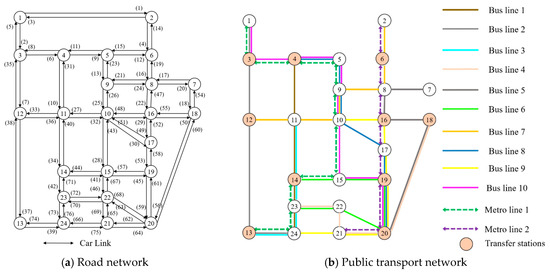
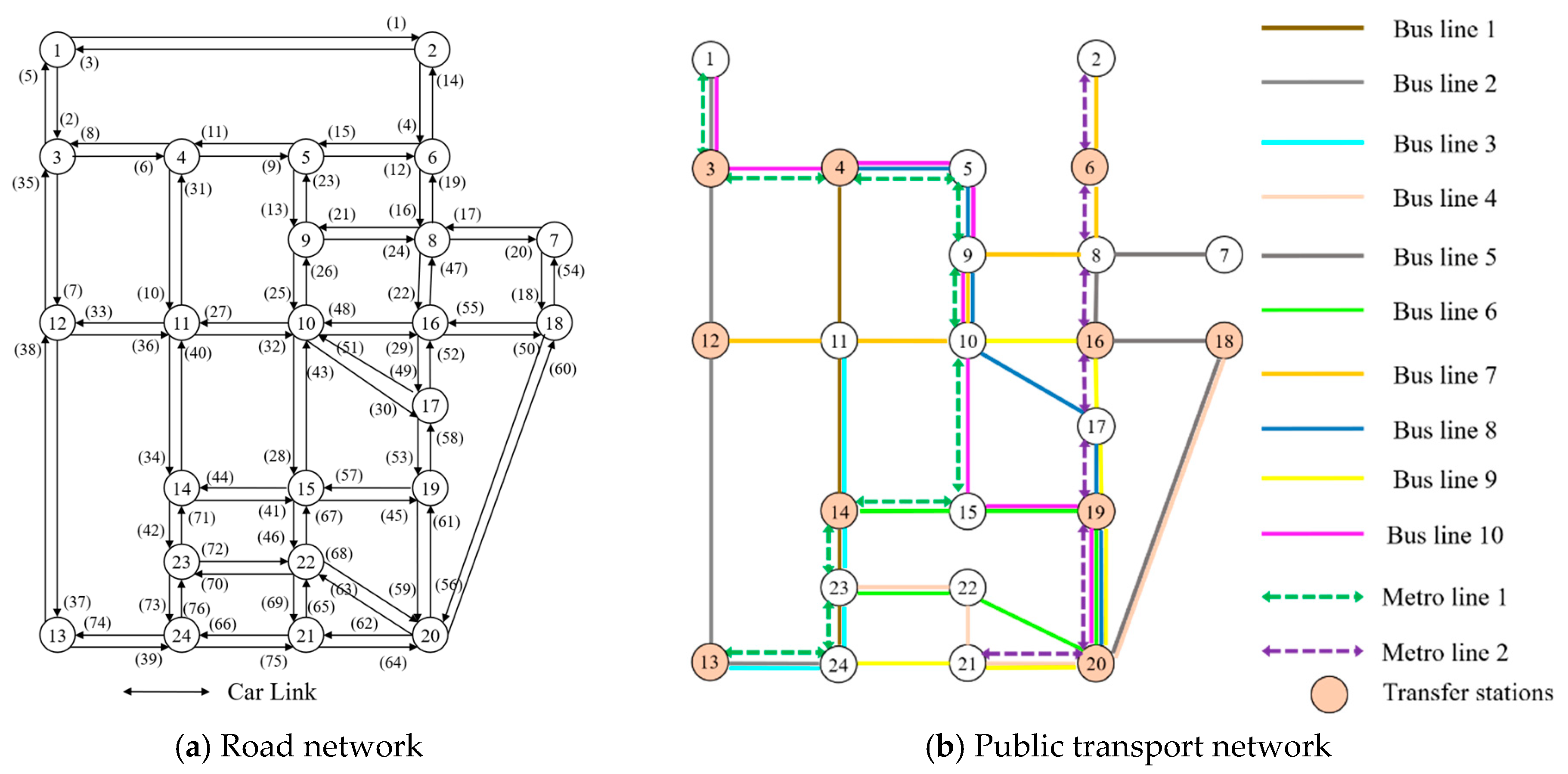
The Sioux Falls network [25] is adopted to evaluate the proposed MDTSA model and the effects of TRS. The network consists of 24 nodes, 76 directed road links, and 552 origin–destination (OD) pairs. The analysis focuses on the morning peak period from 07:00 to 08:00, during which OD travel demand is assumed to remain fixed in accordance with the static equilibrium assumption introduced in Section 2.1. The Sioux Falls network is used here as a benchmark test network for numerical evaluation rather than as an empirical representation of local travel and economic conditions; accordingly, the CNY-based cost parameters are treated as numerical scenario inputs rather than local Sioux Falls prices.
To represent multimodal travel conditions, the road network is supplemented with a public transportation system consisting of 10 bidirectional bus lines, two metro lines, and 10 transfer stations [26]. Cars and buses share the road network, whereas metro services operate on dedicated infrastructure. Transfer stations provide connections between private cars and bus or metro services, thereby supporting the C&B and C&M alternatives considered in the MDTSA framework. The corresponding road and transit networks are illustrated in Figure 3.
Figure 3.
Case study network.
The basic characteristics of each road link, including link length, effective capacities, free-flow travel times, and impedance-function parameters for cars and buses, are summarized in Table 2. The same parameter values are adopted for the two directions of each physical road. The stop sequences and service headways of bus and metro lines are presented in Table 3.
Table 2.
Basic parameters of road links.
Table 3.
Transit lines, stop sequences, and service headways.
3.1.2. Model Parameters and Experimental Scenarios
To represent traveler heterogeneity, travelers are classified into three groups according to their VOT: low-VOT, medium-VOT, and high-VOT travelers, with VOT values of 5, 15, and 25 CNY/h, respectively. The three traveler classes are assumed to account for equal proportions of the total OD demand. The route-choice and mode-choice dispersion parameters are set to and . The bus fare is 2 CNY, the fuel cost is 0.5 CNY/km, and the P&R parking fee is 7 CNY. Metro fares follow the distance-related fare structure listed in Table 4.
Table 4.
Fare structure of metro lines (CNY).
For TRS implementation, the reservation capacity ratio is set to according to the previous reservation-capacity study. The value is treated as an exogenous strategy parameter rather than an optimization variable in the present study. Based on the baseline equilibrium results, six links (17, 22, 34, 36, 39, and 55) with relatively high saturation levels are identified as recurrently congested links for TRS implementation. Two benchmark scenarios are designed to quantify the effects of TRS. Scenario 1 represents the baseline condition without reservation-based road access restrictions. Scenario 2 implements TRS on the six selected congested links, with private-car access restricted by the reservation capacities defined in Section 2.2. All other network, demand, and behavioral parameters remain unchanged between the two scenarios. In particular, the bus and metro service headways listed in Table 3 are fixed across the two scenarios; hence, transit service frequencies do not respond endogenously to passenger-demand changes induced by TRS.
3.1.3. Evaluation Indicators and Numerical Implementation
The performance of TRS is evaluated from the perspectives of network efficiency, congestion, travel cost, traffic redistribution, and modal response. The principal indicators include average network speed, average road saturation, total generalized travel cost, vehicle-hours traveled (VHT) [27], vehicle-kilometers traveled (VKT) [28], and modal shares. These indicators jointly characterize both the overall network performance and the redistribution effects induced by TRS.
The MDTSA equilibrium is solved using the MSWA algorithm described in Section 2.5. The equilibrium relative-gap tolerance is set to , the reservation-capacity feasibility tolerance is also set to , and the maximum number of iterations is 300. The MSWA weighting parameter is . Equilibrium convergence is evaluated using the relative gap , while compliance with the reservation-capacity constraint is verified using . The equilibrium iteration terminates when or when the maximum number of 300 iterations is reached, and the final solution is accepted only when .
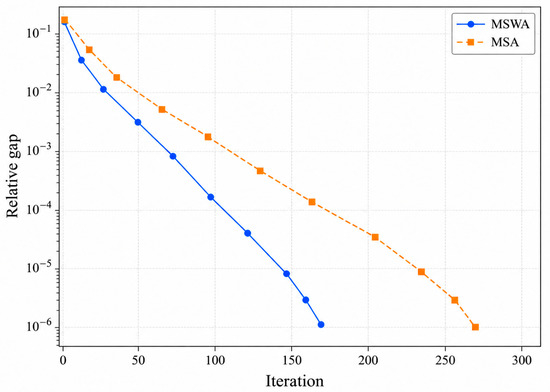
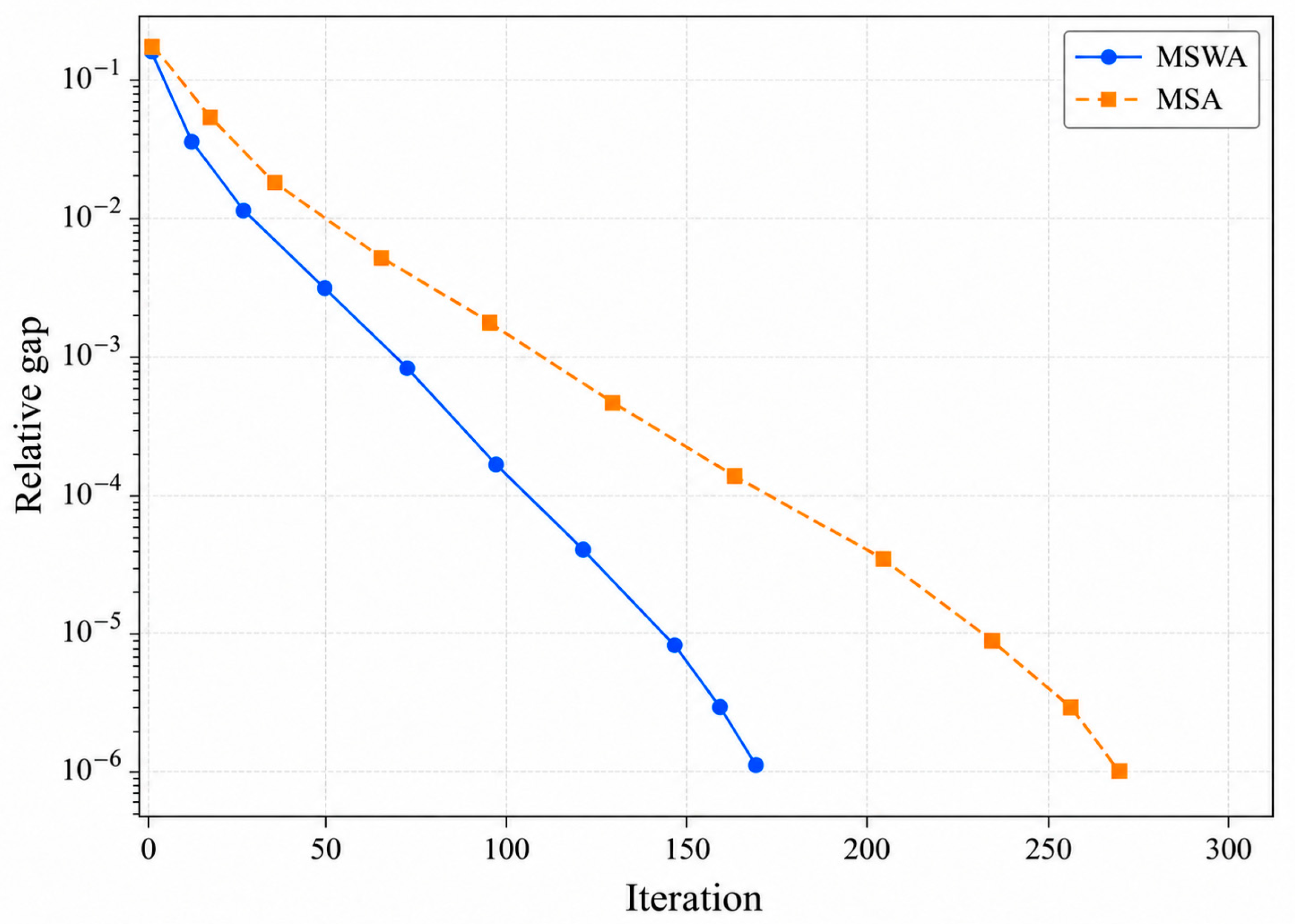
As shown in Figure 4, both MSWA and the standard MSA converge to the specified relative-gap criterion under the same Scenario 2 settings. MSWA reaches convergence after approximately 168 iterations, whereas MSA requires approximately 268 iterations. All computations were performed on a laptop equipped with an Intel Core Ultra 5 225H processor and 32 GB RAM. Under Scenario 2, the computation time was approximately 18.0 min for MSWA and 21.6 min for MSA.
Figure 4.
Convergence comparison of MSWA and MSA.
3.2. Overall Effects and Traffic Redistribution Under TRS
3.2.1. System-Level Effects of TRS
Table 5 compares the principal network performance indicators before and after TRS implementation. The results show that the average network speed increases from 33.2 to 35.9 km/h, while the average saturation decreases from 0.441 to 0.386, corresponding to an 8.1% improvement and a 12.5% reduction, respectively. Meanwhile, total generalized travel cost decreases from 97,919 to 95,631 s, indicating that the improvement in traffic conditions is also reflected in travelers’ overall generalized cost.
Table 5.
Network performance before and after TRS implementation.
The changes in average speed and VHT provide mutually consistent evidence of improved network efficiency. Although the total OD demand remains unchanged, VHT decreases by approximately 6.5%, indicating that vehicles spend less time traveling within the road network after TRS implementation. This reduction is consistent with the increase in average speed and suggests that the reservation restriction primarily reduces congestion-related time losses rather than simply suppressing travel demand. In contrast to the reduction in VHT, VKT increases slightly by approximately 1.1%. This result reflects the route-adjustment mechanism induced by TRS: some private-car travelers who cannot use reservation links select alternative routes, resulting in a small increase in total travel distance. However, the simultaneous decrease in VHT and increase in network speed indicate that the additional distance caused by rerouting is more than offset by reductions in congestion delay. In other words, TRS produces a trade-off between a modest increase in travel distance and a more substantial reduction in travel time. The increase in VKT also has potential environmental implications. A longer total vehicle travel distance may increase distance-related fuel consumption and emissions, whereas the simultaneous reduction in VHT and increase in average network speed indicate less time spent under congested traffic conditions. Since fuel consumption and emissions are not explicitly modeled in the present study, the net environmental effect of these opposing changes cannot be determined from the current results alone.
The reduction in total generalized travel cost is smaller than the reduction in VHT, which is also consistent with the multimodal response mechanism of the MDTSA model. Although reduced road congestion lowers travel-time costs, rerouting and shifts toward public or combined transportation may increase travel distance, waiting time, fares, or P&R parking costs. Consequently, the 2.3% reduction in generalized travel cost represents the net effect of these interacting responses rather than travel-time savings alone.
3.2.2. Spatial Redistribution of Road Traffic
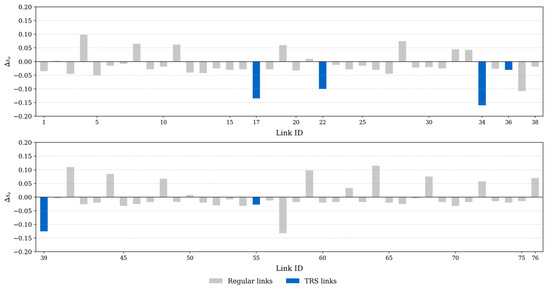
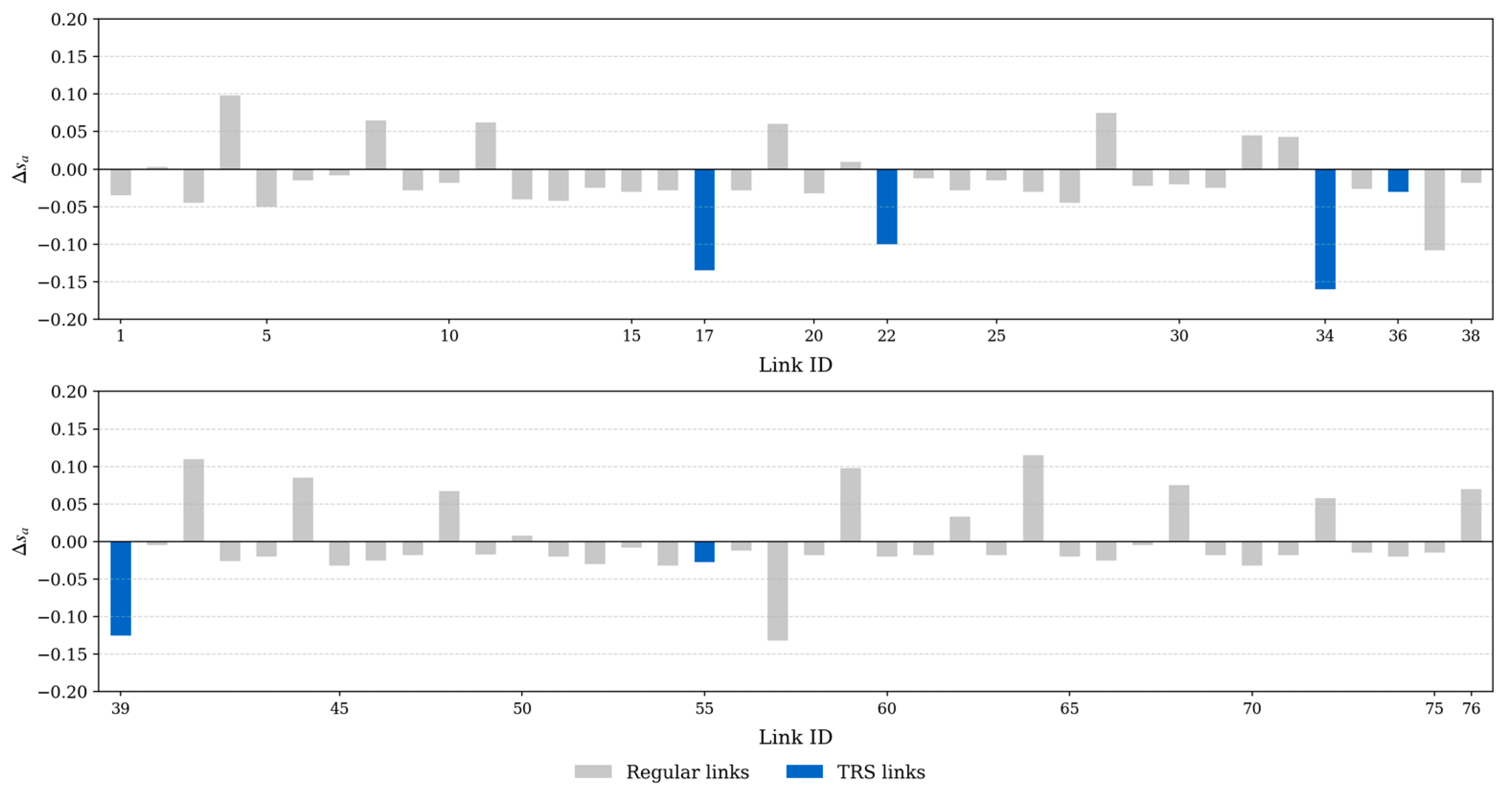
The reduction in average network saturation indicates an overall mitigation of congestion after TRS implementation. However, this aggregate indicator cannot reveal how traffic demand is redistributed across individual links. To further examine the spatial response of the road network, the change in saturation for each of the 76 directed links is calculated as , where indicates a reduction in link saturation and indicates an increase. The link-level changes are presented in Figure 5, with the six TRS links highlighted separately. As shown in Figure 5, all six TRS links exhibit clear reductions in saturation, indicating that the reservation-capacity constraint effectively alleviates excessive traffic loading on recurrently congested links. Meanwhile, several non-TRS links show moderate increases in saturation, reflecting the diversion of some private-car demand toward alternative feasible routes. Most of these increases remain relatively limited, whereas substantial reductions are concentrated on the controlled links, indicating that TRS redistributes traffic away from heavily loaded corridors toward links with available residual capacity.
Figure 5.
Changes in link saturation between Scenario 1 and Scenario 2.
This link-level redistribution is consistent with the network-level changes in VHT and VKT reported. Rerouting increases the total travel distance slightly, leading to a 1.1% increase in VKT, whereas avoiding heavily congested links reduces congestion-related travel time and results in a 6.5% decrease in VHT. Together with the 12.5% reduction in average saturation, these results indicate that the network improvement under TRS arises primarily from more efficient spatial redistribution of the fixed OD demand rather than from changes in total travel demand.
3.2.3. Modal Shift Under TRS
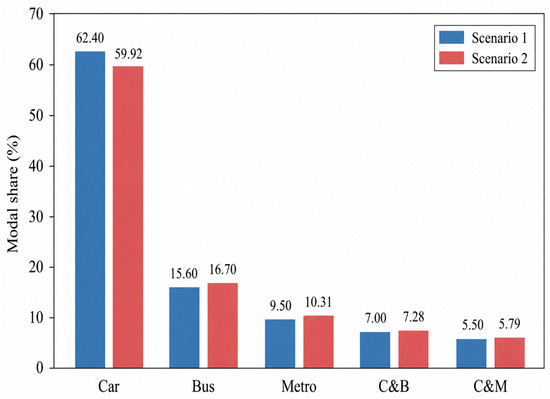
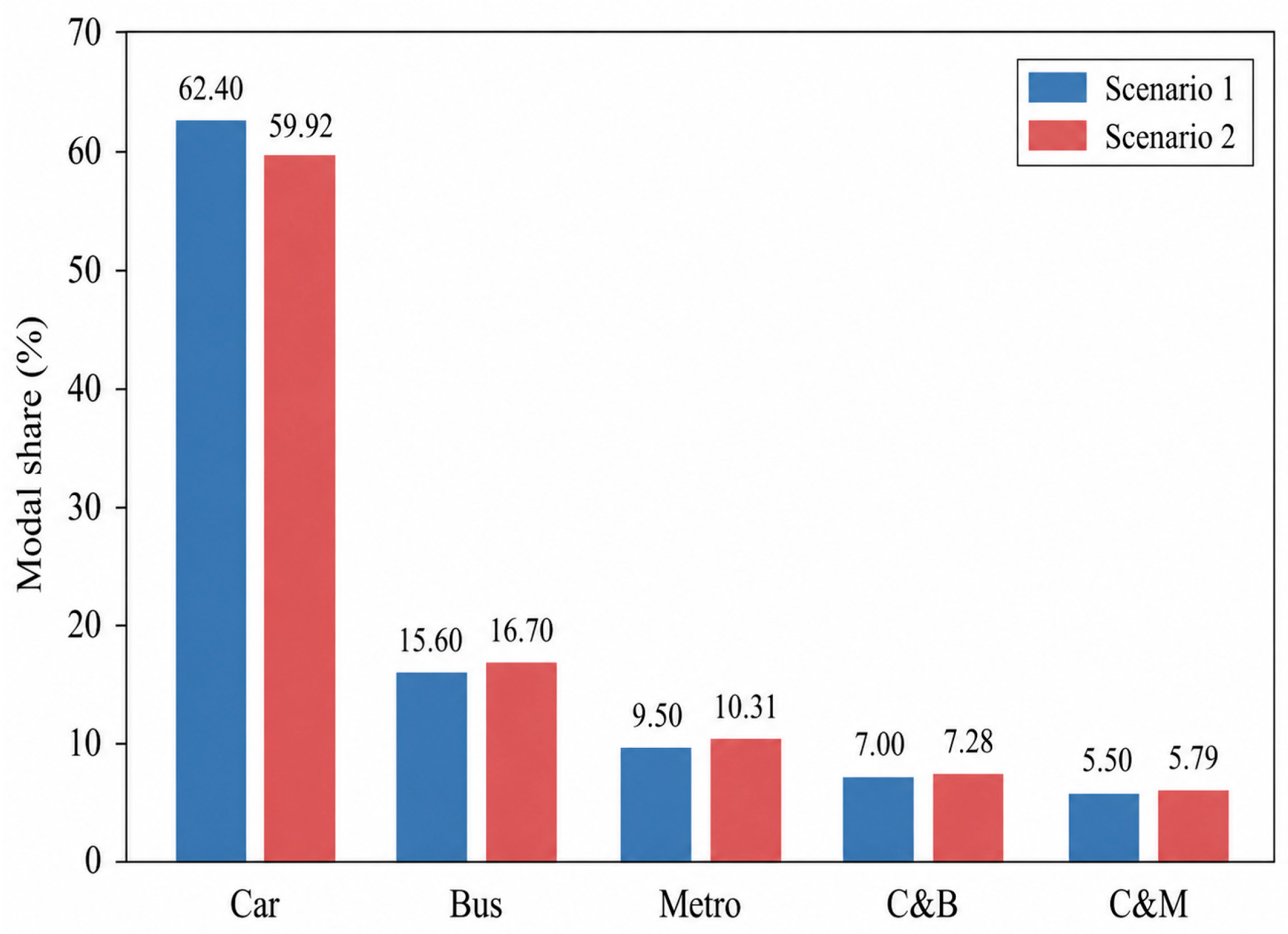
In addition to redistributing traffic across road links, TRS also changes the relative attractiveness of different travel modes. Figure 6 compares the modal shares of the five travel alternatives under Scenario 1 and Scenario 2. After TRS implementation, the share of private-car travel decreases from 62.40% to 59.92%, corresponding to a reduction of 2.48 percentage points. Meanwhile, the shares of bus, metro, C&B, and C&M increase to varying degrees, indicating that the access restrictions imposed on recurrently congested links induce not only route adjustment but also travel-mode adjustment.
Figure 6.
Modal shares under Scenario 1 and Scenario 2.
The modal redistribution occurs through two complementary channels. First, the combined share of bus and metro increases by 1.91 percentage points, suggesting that part of the private-car demand is directly shifted toward public transportation. Second, the combined share of C&B and C&M increases by approximately 0.57 percentage points. This indicates that some travelers do not completely abandon private cars, but instead use them for only part of the trip and complete the remaining segment by public transportation. The two responses jointly account for the reduction in private-car share and reveal the multimodal adjustment mechanism induced by TRS. The increase in combined-mode shares is particularly relevant to the MDTSA framework, because it shows that traveler responses cannot be fully represented by a simple shift between private cars and conventional public transportation. The availability of C&B and C&M provides additional adjustment options when access to congested roads becomes restricted.
The estimated modal shifts should be interpreted in light of the assumptions regarding transit supply and temporal adjustment. Because bus and metro headways are fixed, additional transit demand does not lead to higher service frequencies; waiting times therefore do not decrease as demand shifts toward transit, while crowding-related costs may increase. This assumption may dampen the estimated shift toward public transport relative to a setting with responsive transit service. Conversely, because the static equilibrium does not allow departure-time adjustment, travelers affected by TRS can respond only through route and mode choices, which may amplify the estimated modal shift relative to a dynamic setting.
3.3. Benchmark Comparison
To benchmark the proposed MDTSA framework against more conventional multimodal stochastic user equilibrium (SUE) representations, two reference specifications are considered. The first is a homogeneous-user SUE specification, in which all travelers are assigned a common VOT of 15 CNY/h while the five travel alternatives, including car, bus, metro, C&B, and C&M, are retained. Because C&B and C&M combine a private-car segment with a subsequent public-transport segment, this specification retains P&R-type combined travel alternatives but does not represent traveler heterogeneity. The second is a reduced-mode multimodal SUE specification, which retains heterogeneous VOT but considers only the three basic travel modes of car, bus, and metro, thereby excluding the combined C&B and C&M alternatives. All network, demand, TRS, and other behavioral parameters remain unchanged across the three specifications. For each specification, Scenario 1 and Scenario 2 are solved separately, and the resulting changes in key network and behavioral indicators are compared.
As shown in Table 6, all three equilibrium specifications lead to the same qualitative assessment of TRS: average network speed increases, whereas average saturation, generalized travel cost, VHT, and private-car modal share decrease. This consistency indicates that the overall direction of the estimated TRS effects is robust across different multimodal SUE representations. However, the magnitudes of these effects vary noticeably across the three specifications. Compared with the proposed Full MDTSA model, the homogeneous-user SUE with combined modes and the multimodal SUE without combined modes produce smaller changes in all five indicators.
Table 6.
Benchmark comparison of TRS effects under different specifications.
The homogeneous-user SUE with combined modes retains C&B and C&M but assigns all travelers the same VOT. Consequently, differences in time–cost trade-offs among traveler classes are not explicitly represented, and the resulting route- and mode-choice responses are aggregated toward an average behavioral pattern. In contrast, the multimodal SUE without combined modes retains heterogeneous VOT but excludes C&B and C&M. Travelers affected by TRS must therefore respond mainly through road rerouting or switching among the three basic modes of car, bus, and metro, rather than through intermediate car–transit combinations.
The benchmark comparison therefore shows that the qualitative assessment of TRS is not dependent on a single equilibrium specification, while the estimated magnitude of its effects is sensitive to the behavioral dimensions represented in the model. By simultaneously incorporating heterogeneous VOT and combined car–transit alternatives, the Full MDTSA framework provides a more differentiated representation of travelers’ route and mode adjustments under reservation-based road-access constraints.
3.4. Heterogeneous Traveler Responses
To further examine heterogeneous behavioral responses to TRS, Table 7 compares their modal shares under Scenario 1 and Scenario 2 and reports the corresponding changes in average travel time and generalized travel cost. Low-VOT travelers show the largest reduction in private-car share, accompanied mainly by increases in bus and metro use. Medium-VOT travelers exhibit a more balanced redistribution across public transport and combined modes. In contrast, high-VOT travelers retain a relatively larger share of car travel, while the shares of alternative modes increase more moderately.
Table 7.
Heterogeneous traveler responses under TRS.
TRS also generates different time and cost effects across traveler classes. Average travel time decreases by 4.2%, 5.8%, and 7.1% for low-, medium-, and high-VOT travelers, respectively, while generalized travel cost decreases by 1.5%, 2.3%, and 3.0%. Under the present experimental setting, high-VOT travelers therefore exhibit relatively larger reductions in both travel time and generalized cost, while their private-car share decreases less than those of the other traveler classes. This pattern is consistent with the VOT-based generalized-cost formulation. Because high-VOT travelers place greater weight on travel-time savings and relatively less weight on a given monetary expenditure, private-car travel remains comparatively attractive to this group. When TRS changes the available road routes, these travelers can obtain time savings mainly through route adjustment and improved road traffic conditions rather than through a large-scale shift away from private cars. Consequently, a relatively large travel-time reduction can coexist with a relatively small decline in car share.
It should be noted that these heterogeneous responses are obtained under the aggregate reservation-capacity representation adopted in this study. The model does not assign reservation access according to VOT, willingness to pay, or other traveler-specific priority rules. Therefore, the results in Table 7 should be interpreted as equilibrium responses to an aggregate capacity restriction rather than distributional outcomes of a specific permit-allocation mechanism. Different allocation rules could alter the relative effects across traveler classes.
3.5. Sensitivity Analysis
To examine whether the effects of TRS remain stable under changes in strategy and demand conditions, sensitivity analyses are conducted with respect to the reservation-capacity ratio and the overall travel demand level. Three reservation-capacity ratios, = 0.80, 0.85 and 0.89, are tested. In addition, the baseline OD demand is scaled from 0.8 to 1.2. Average network speed, average saturation, and total generalized travel cost are used as the principal indicators, as shown in Table 8.
Table 8.
Sensitivity analysis of TRS under different reservation capacities and demand levels.
As shown in Panel A, TRS improves network performance under all three reservation-capacity settings. Compared with the baseline condition, average speed remains higher and both average saturation and generalized travel cost remain lower throughout the tested range. Although the magnitude of improvement varies moderately with , the overall direction of the results is unchanged, indicating that the effectiveness of TRS is not highly sensitive to small variations in reservation capacity within the examined range. Panel B further shows that the benefits of TRS vary with congestion intensity. Under relatively low demand, the network contains sufficient residual capacity and the incremental benefits of reservation control are limited. As demand approaches and slightly exceeds the baseline level, TRS produces stronger improvements by redistributing traffic away from heavily loaded links. When demand increases to 1.2D0, the benefits remain positive but become smaller, suggesting that widespread congestion reduces the flexibility available for rerouting and modal adjustment. Overall, TRS remains effective across the tested demand levels, while its relative benefit is more pronounced under moderate-to-high congestion conditions.
4. Conclusions
This study investigated the effectiveness of Travel Reservation Strategy (TRS) for recurrently congested urban roads from a static multimodal network equilibrium perspective. TRS was represented as a capacity-constrained access management strategy, under which private-vehicle access to selected congested links is regulated while travelers can adjust their routes and travel modes. A Multi-Dimensional Traffic Split and Assignment (MDTSA) model was developed to jointly characterize these responses. The main methodological contributions lie in two aspects: first, traveler heterogeneity, represented by different values of time (VOT), is incorporated into the joint mode- and route-choice process; second, the model explicitly represents five travel alternatives—car, bus, metro, car-to-bus (C&B), and car-to-metro (C&M)—together with non-separable interactions between cars and buses, allowing TRS effects to be evaluated within a more comprehensive multimodal framework.
The numerical results demonstrate that TRS can improve network performance while inducing both route and modal redistribution. Under the present experimental setting, average network speed increases from 33.2 to 35.9 km/h (+8.1%), average saturation decreases from 0.441 to 0.386 (−12.5%), total generalized travel cost decreases by 2.3%, and VHT decreases by 6.5%. Although VKT increases slightly by 1.1% because of rerouting, the reduction in VHT indicates that the additional travel distance is offset by lower congestion-related time losses. The private-car modal share decreases by 2.48 percentage points, while bus and metro jointly increase by 1.91 percentage points and the combined C&B and C&M modes increase by approximately 0.57 percentage points. The benchmark comparison further shows that the estimated increase in average speed varies from 8.1% under the Full MDTSA model to 6.6% under the homogeneous-user SUE with combined modes and 5.4% under the multimodal SUE without combined modes, indicating that the estimated magnitude of TRS effects depends on the behavioral dimensions represented in the equilibrium model.
From a theoretical perspective, the proposed framework provides a unified approach for linking reservation-based road access management with heterogeneous multimodal travel decisions and network equilibrium, thereby extending TRS evaluation beyond conventional single-mode or homogeneous-user representations. From a practical perspective, the findings suggest that reservation-based access control can alleviate excessive traffic concentration on recurrently congested corridors by coordinating route redistribution and modal adjustment, providing quantitative support for the design and assessment of demand-management strategies for congested urban roads.
Several limitations remain. First, the numerical analysis is based on the Sioux Falls test network and a static peak-period equilibrium with fixed bus and metro headways; thus, within-period traffic evolution, departure-time adjustment, and endogenous transit-frequency responses are not explicitly represented. Second, TRS is modeled through an aggregate reservation-capacity constraint rather than traveler-level permit allocation, so alternative allocation rules may produce different distributional effects across traveler classes. In addition, the penalty-based capacity-enforcement mechanism does not establish global uniqueness of the disaggregate mode- and path-flow solution. Fuel consumption and emissions are also not explicitly quantified. Future research should extend the framework to dynamic traffic assignment with departure-time choice, adaptive transit operations, and explicit environmental assessment, and further validate the model using empirical data from real urban networks to examine its transferability and practical applicability.
Author Contributions
Conceptualization, H.C.; methodology, H.C. and L.G.; validation, H.C. and L.L.; data curation, L.L. and Q.G.; visualization, Q.G.; writing—original draft preparation, H.C.; writing—review and editing, L.G. and Z.L.; supervision, L.G. and Z.L.; project administration, H.C. and Z.L. All authors have read and agreed to the published version of the manuscript.
Funding
This research was funded by Fujian Provincial Natural Science Foundation of China (Grant No. 2025J08226, 2025J08227), Social Science Foundation of Fujian Province, China (Grant No. FJ2025C177) and the Open Research Fund of the Anhui Provincial Key Laboratory of Urban Rail Transit Safety and Emergency Management, Hefei University (Grant No. 2025GD0007).
Data Availability Statement
The data presented in this study are openly available in https://github.com/matsim-org (accessed on 1 June 2024).
Conflicts of Interest
The authors declare no conflicts of interest.
References
- Li, M.; Zhang, K.; Zhang, Y. Resilience Assessment for Road Network under Rainstorm Events Using Crowdsourced Data. Transp. Res. Part D Transp. Environ. 2025, 149, 105030. [Google Scholar] [CrossRef] [Scilit]
- Borowska-Stefańska, M.; Bartnik, A.; Dulebenets, M.A.; Kowalski, M.; Sahebgharani, A.; Tomalski, P.; Wiśniewski, S. Changes in the Equilibrium of the Urban Transport System of a Large City Following an Urban Flood. Reliab. Eng. Syst. Saf. 2025, 253, 110473. [Google Scholar] [CrossRef] [Scilit]
- Xuan, D.; Ma, X.; Shang, Y. Can China’s Policy of Carbon Emission Trading Promote Carbon Emission Reduction? J. Clean. Prod. 2020, 270, 122383. [Google Scholar] [CrossRef] [Scilit]
- Sun, X.; Feng, S.; Lu, J. Psychological Factors Influencing the Public Acceptability of Congestion Pricing in China. Transp. Res. Part F Traffic Psychol. Behav. 2016, 41, 104–112. [Google Scholar] [CrossRef] [Scilit]
- Zang, Z.; Xu, X.; Qu, K.; Chen, R.; Chen, A. Travel Time Reliability in Transportation Networks: A Review of Methodological Developments. Transp. Res. Part C Emerg. Technol. 2022, 143, 103866. [Google Scholar] [CrossRef] [Scilit]
- Weidig, G.; Kanat, S.; Harth, R.; Guzak, K.; Bush, T.R. Understanding Needs and Challenges with Regard to Pick-up and Drop-off Zones for Persons with Mobility Disabilities: Assessments via Real-Life Street Scenarios. Digit. Transp. Saf. 2025, 4, 161–169. [Google Scholar] [CrossRef] [Scilit]
- Chen, H.; Zhou, R.; Chen, H.; Lau, A. Understanding Behavioral Intentions in Urban Travel Reservation: A Combined Model of Rational Motivation and Social Norms. Transp. Plan. Technol. 2025, 48, 1070–1092. [Google Scholar] [CrossRef] [Scilit]
- Zhou, R.; Chen, H.; Chen, H.; Lau, A. Public Preference and Acceptability of the Travel Reservation Strategy in Xi’an, China. Travel Behav. Soc. 2024, 35, 100753. [Google Scholar] [CrossRef] [Scilit]
- Wong, Y.Z.; Hensher, D.A.; Mulley, C. Mobility as a Service (MaaS): Charting a Future Context. Transp. Res. Part A Policy Pract. 2020, 131, 5–19. [Google Scholar] [CrossRef] [Scilit]
- Zhang, S.; Hui, Q.; Bai, X.; Sun, R. Bilevel Optimization for the Hazmat Transportation Problem with Lane Reservation. J. Adv. Transp. 2020, 2020, 2530154. [Google Scholar] [CrossRef] [Scilit]
- Nagurney, A.; Dong, J. A Multiclass, Multicriteria Traffic Network Equilibrium Model with Elastic Demand. Transp. Res. Part B Methodol. 2002, 36, 445–469. [Google Scholar] [CrossRef] [Scilit]
- Liu, Q.; Liu, Y.; Yin, H.; Xu, X. Which Factors Impact Bus Travel, and the Potential of Replacing Car Travel with Bus Travel: An Empirical Study from a Chinese Third-Tier City. Digit. Transp. Saf. 2025, 4, 195–206. [Google Scholar] [CrossRef] [Scilit]
- Liu, B.; Ji, Y.; Cats, O. Integrating Ride-Hailing Services with Public Transport: A Stochastic User Equilibrium Model for Multimodal Transport Systems. Transp. A Transp. Sci. 2025, 21, 2236240. [Google Scholar] [CrossRef] [Scilit] [PubMed]
- Ma, M.; Chen, Y.; Liu, W.; Waller, S.T. An Economic Analysis of a Multi-Modal Transportation System with Ride-Sourcing Services and Multi-Class Users. Transp. Policy 2023, 140, 1–17. [Google Scholar] [CrossRef] [Scilit]
- Zhang, R.; Ouyang, L.; Xiao, L. Will the Perceptions to Incentive Policies Have Any Effect on Users’ Willingness to Participate in Mobility-as-a-Service? Digit. Transp. Saf. 2024, 3, 53–64. [Google Scholar] [CrossRef] [Scilit]
- Zhu, S.; Jiang, G.; Lo, H.K. Capturing Value of Reliability through Road Pricing in Congested Traffic under Uncertainty. Transp. Res. Part C Emerg. Technol. 2018, 94, 236–249. [Google Scholar] [CrossRef] [Scilit]
- Koster, P.; Verhoef, E.; Shepherd, S.; Watling, D. Preference Heterogeneity and Congestion Pricing: The Two Route Case Revisited. Transp. Res. Part B Methodol. 2018, 117, 137–157. [Google Scholar] [CrossRef] [Scilit]
- Zhou, R.; Chen, H.; Chen, H. Optimal Reservation Volume of Urban Roads Based on Travel Reservation Strategy. J. Adv. Transp. 2024, 2024, 6628446. [Google Scholar] [CrossRef] [Scilit]
- Boyce, D.; Bar–Gera, H. Validation of Multiclass Urban Travel Forecasting Models Combining Origin–Destination, Mode, and Route Choices. J. Reg. Sci. 2003, 43, 517–540. [Google Scholar] [CrossRef] [Scilit]
- Shi, F.; Xu, G.; Liu, B.; Huang, H. Optimization Method of Alternate Traffic Restriction Scheme Based on Elastic Demand and Mode Choice Behavior. Transp. Res. Part C Emerg. Technol. 2014, 39, 36–52. [Google Scholar] [CrossRef] [Scilit]
- Nagurney, A. A Multiclass, Multicriteria Traffic Network Equilibrium Model. Math. Comput. Model. 2000, 32, 393–411. [Google Scholar] [CrossRef] [Scilit]
- Khani, A. An Online Shortest Path Algorithm for Reliable Routing in Schedule-Based Transit Networks Considering Transfer Failure Probability. Transp. Res. Part B Methodol. 2019, 126, 549–564. [Google Scholar] [CrossRef] [Scilit]
- Yan, Y.; Zha, W.; Shi, J.; Yan, L. Prediction of Traffic Flow Considering Electric Vehicle Market Share and Random Charging. J. Adv. Transp. 2023, 2023, 7649689. [Google Scholar] [CrossRef] [Scilit]
- Liu, H.X.; He, X.; He, B. Method of Successive Weighted Averages (MSWA) and Self-Regulated Averaging Schemes for Solving Stochastic User Equilibrium Problem. Netw. Spat. Econ. 2009, 9, 485–503. [Google Scholar] [CrossRef] [Scilit]
- Kim, C.; Jin, Y.-G.; Park, J.; Kang, D. The Influence of an Autonomous Driving Car Operation on Commuters’ Departure Times. Procedia Comput. Sci. 2019, 151, 85–91. [Google Scholar] [CrossRef] [Scilit]
- Fan, Y.; Ding, J.; Liu, H.; Wang, Y.; Long, J. Large-Scale Multimodal Transportation Network Models and Algorithms—Part I: The Combined Mode Split and Traffic Assignment Problem. Transp. Res. Part E Logist. Transp. Rev. 2022, 164, 102832. [Google Scholar] [CrossRef] [Scilit]
- Bahk, Y.; Hyland, M.; An, S. Re-Envisioning the Park-and-Ride Concept for the Automated Vehicle (AV) Era with Private-to-Shared AV Transfer Stations. Transp. Res. Part A Policy Pract. 2024, 181, 104009. [Google Scholar] [CrossRef] [Scilit]
- Li, W.; Pu, Z.; Li, Y.; Ban, X. Characterization of Ridesplitting Based on Observed Data: A Case Study of Chengdu, China. Transp. Res. Part C Emerg. Technol. 2019, 100, 330–353. [Google Scholar] [CrossRef] [Scilit]

Disclaimer/Publisher’s Note: The statements, opinions and data contained in all publications are solely those of the individual author(s) and contributor(s) and not of MDPI and/or the editor(s). MDPI and/or the editor(s) disclaim responsibility for any injury to people or property resulting from any ideas, methods, instructions or products referred to in the content. |
© 2026 by the authors. Licensee MDPI, Basel, Switzerland. This article is an open access article distributed under the terms and conditions of the Creative Commons Attribution (CC BY) license.