


Abstract
This paper establishes directional integral inequalities and associated error estimates along ordered staircases generated by a finite family of directions in a real normed vector space. The endpoint increment along the corresponding staircase is represented as a sum of directional integrals. Exact integral identities are obtained for the errors of the trapezoid and midpoint approximations to this increment. When the absolute value of the derivative of each directional function is convex, both approximations satisfy error estimates with coefficient . Consequences are given for the difference between the two approximations, for uniformly bounded directional derivatives, and for the case in which the directional functions are affine. Applications to successive coordinate updates, quadratic growth, anharmonic potentials, and finite directional staircases in are presented.
Keywords:
normed vector space; Gâteaux derivative; integral inequality; trapezoid rule; midpoint rule MSC:
26D10; 26D15; 26A51; 26A33; 46N10
1. Introduction
Integral inequalities provide bounds for integral means, functional increments, and approximation errors. They arise naturally in numerical integration, approximation theory, optimisation, and functional analysis. In many such problems, convexity permits an integral quantity to be controlled by values of a function or of one of its derivatives at selected points. This relation is particularly useful when an exact integral is replaced by a finite collection of evaluations.
The trapezoid and midpoint rules are two standard approximations of an integral on an interval. Their errors can be expressed through integral identities involving the derivative of the integrand. If the absolute value of that derivative satisfies a convexity condition, the identities yield bounds in terms of its endpoint values. Such estimates connect convexity assumptions with quantitative control of the error in a functional increment.
For real-valued functions on Banach spaces, directional derivatives describe variation along selected elements of the space. Sarıkaya established integral inequalities for a directional path of the form by using the Gâteaux derivative and the associated path integral [1]. In particular, under the regularity required for the fundamental theorem of calculus along the path, the increment on a single directional segment is represented by
The resulting statements include a two-sided integral estimate, identities for the trapezoid and midpoint errors, bounds under convexity of the absolute derivative of the path, uniform bounds, and exactness for affine directional functions.
The Hermite–Hadamard inequality has generated a substantial literature on integral estimates for convex and differentiable functions; see, for example, [2] and the references therein. Of particular relevance to the present work are estimates associated with classical quadrature rules. Dragomir and Agarwal [3] obtained inequalities for differentiable mappings with applications to the trapezoidal formula, while Kırmacı [4] established related inequalities associated with the midpoint formula.
Sharp Hermite–Hadamard-type estimates for two-point quadrature formulae were obtained by Guessab and Schmeisser [5]. Related bounds for the deviation of a function from its integral average, which are closely connected with Ostrowski-type inequalities, were developed by Fink [6].
In a multivariable setting, Dragomir established Hadamard-type inequalities for functions convex on the coordinates of a rectangle [7]. Erden and Sarıkaya obtained Hermite–Hadamard and Ostrowski inequalities for co-ordinated convex functions [8]. Kian and Rostamian Delavar considered bivariate convex functions in a matrix setting [9]. These works concern integral means on coordinate domains. Related Ostrowski-type inequalities for Banach-space-valued mappings were obtained by Almutairi [10].
The work of Sarıkaya [1] is closely related to the present study. In that work, the Hermite–Hadamard, trapezoid, and midpoint estimates are obtained along a single directional segment using the Gâteaux derivative. Here, the same type of estimates is considered for a finite ordered family of successive directional segments. The convexity assumption on the absolute derivative of the directional function is kept on each segment, and the coefficient remains the same. We do not claim that this coefficient is improved or optimal in the staircase setting. Similarly, the exactness obtained for affine directional functions is not a new equality case.
Dragomir [7] and Erden–Sarıkaya [8] considered inequalities for functions convex on the coordinates of rectangular domains. The setting here is different. The segments are taken successively, and the starting point of each segment is the endpoint of the preceding one. Therefore, the directional function depends on the intermediate point and, in general, on the order of the preceding directions. As a consequence, different orderings may lead to different trapezoid and midpoint approximations and different error bounds, although the initial and final points remain the same.
More generally, two finite ordered staircases connecting the same initial and final points may have different intermediate points and associated directional functions. Consequently, they may yield different trapezoid and midpoint approximations and different error bounds, whereas the exact endpoint increment depends only on the initial and final points.
Let be a real normed vector space, let be open and convex, let be Gâteaux differentiable, let , and let be selected directions. Define
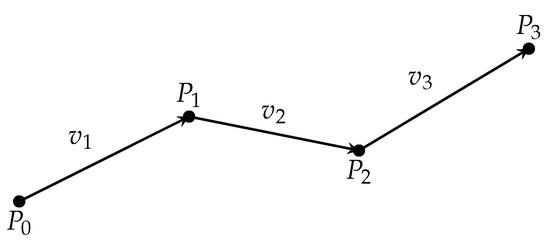
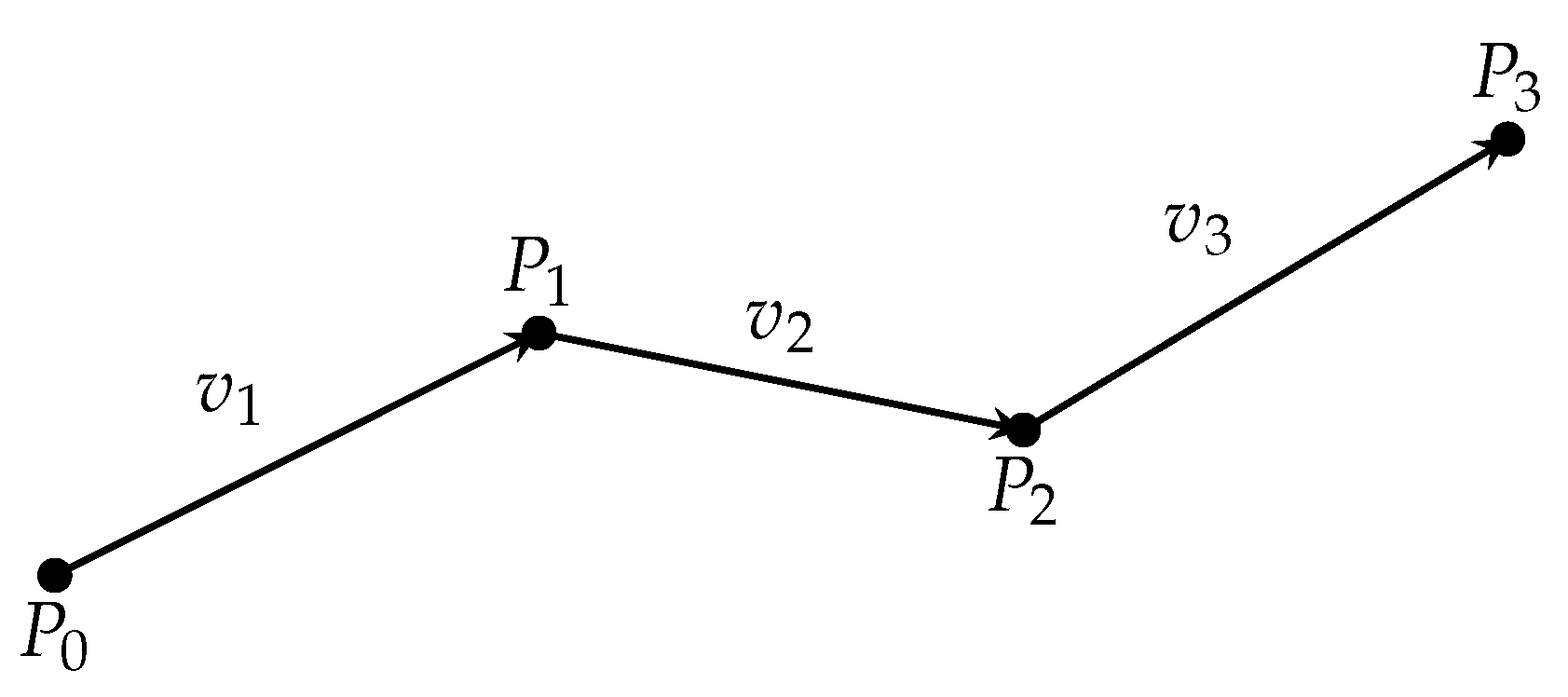
The directions determine an ordered staircase through the points (see Figure 1 for the case ). Assume that every segment is contained in U. For , set
Figure 1.
Schematic representation of an ordered three-step staircase, with , .
Here, is the restriction of f to the r-th segment, whereas is the corresponding directional derivative along . Throughout the paper, denotes the Gâteaux derivative of f at x applied to the direction v. Thus, for each fixed x, is linear in the direction variable.
Whenever is absolutely continuous and almost everywhere, the fundamental theorem of calculus gives
Summing over the ordered segments yields the staircase representation
For , this reduces to the single-direction representation above.
Motivated by the directional-path results of Sarıkaya [1] and the coordinate-domain inequalities of Dragomir [7] and Erden–Sarıkaya [8], this paper considers a finite ordered family of directions in a real normed vector space. Its purpose is to extend the single-direction setting to an ordered staircase formed by successive directional segments. An integral representation for the endpoint increment is established, and trapezoid and midpoint estimates are derived under convexity conditions on the associated directional functions.
The contribution of the staircase formulation is to organize successive directional increments within a single ordered framework in which the endpoint of one segment becomes the initial point of the next. In this way, the directional function on each segment is based at the corresponding intermediate point , and the resulting segmentwise representations combine to describe the total endpoint increment along the finite staircase. This formulation therefore makes the dependence of the directional data on the successive intermediate points explicit, a feature that does not arise in the single-direction case. The case recovers the single-direction setting.
2. Main Results
The following identities describe the errors of the trapezoid and midpoint approximations along the ordered staircase.
Lemma 1.
Suppose that and are absolutely continuous on and that almost everywhere for . Then
Proof.
For each , consider
Since is absolutely continuous on , integration by parts gives
Therefore,
Adding these identities for , we obtain
The directional-path identity gives
Substitution into the preceding equality proves the result. □
The next lemma gives the corresponding identity for the midpoint approximation.
Lemma 2.
Let and be absolutely continuous on and suppose that almost everywhere for . Define
Then
Proof.
For each , put
Splitting the integral at and integrating by parts on each interval, we get
Hence,
Adding these identities for yields
Using the directional-path identity gives the stated formula. □
Theorem 1.
Let be a real normed vector space, let be open and convex, and let be Gâteaux differentiable. Fix and let be such that the segments are contained in U, where
For , define
Here, is the restriction of f to the r-th segment, while is the corresponding directional derivative along .
Suppose that is absolutely continuous on and for almost every . Then
by the one-dimensional fundamental theorem of calculus,
Summing over gives
If every is convex on , then
Proof.
For each , the function describes the variation in f along the segment joining to . Since is absolutely continuous and almost everywhere on , the fundamental theorem of calculus gives
Thus, for every directional segment of the staircase, the functional increment is represented by the integral of the corresponding directional derivative.
Adding these identities for , we obtain
The left-hand side is a telescoping sum. Hence,
and therefore
Now suppose that every is convex on . Applying the Hermite–Hadamard inequality to on gives
Summing these inequalities over yields
Using the identity established above, we conclude that
This completes the proof. □
The following theorems give the trapezoid and midpoint estimates for the ordered staircase.
Theorem 2.
In the setting of Theorem 1, suppose that and that is convex on for . Then
Proof.
Set
By Lemma 1,
Taking absolute values and using the triangle inequality, we obtain
Since is convex on ,
Therefore,
Since
we obtain
This proves the result. □
Corollary 1.
Under the hypotheses of Theorem 2, suppose that for and . Then
In particular, if for every , then
Proof.
By Theorem 2,
The particular case follows by taking for every r. □
Corollary 2.
Under the hypotheses of Theorem 2, suppose that is constant on for every . Then
Proof.
For every , the function is affine on . Therefore,
Summing over r and using the directional-path identity proves the result. □
The next theorem gives the corresponding midpoint estimate.
Theorem 3.
In the setting of Theorem 1, suppose that and that is convex on for . Then
Proof.
Set
By Lemma 2,
Taking absolute values and using the triangle inequality, we obtain
Since is convex on ,
Therefore,
Since
we obtain
This proves the result. □
Remark 1.
The coefficient in Theorems 2 and 3 arises from the corresponding weighted integral estimates on the individual directional segments. The present paper focuses on the finite ordered staircase formulation and does not address the optimality of this coefficient under the stated assumptions. Since the total remainder is a sum of segmentwise remainders, cancellation between different segments may occur; hence, the actual error for a particular ordered staircase may be smaller than the stated upper bound.
Remark 2.
The endpoint
is unchanged under a permutation of the directions . However, the intermediate points generally depend on the chosen order. Since
changing the order may change the associated directional functions. Thus, the exact endpoint increment remains unchanged, whereas the trapezoid and midpoint approximations, as well as their corresponding error bounds, may depend on the chosen order.
Example 1.
Let , let , and consider
Take
For both orderings of these directions, the final point is
and hence
First, consider the ordering . The associated directional functions are
Consequently,
Thus, both the trapezoid and midpoint approximations are exact for this ordering. Moreover, and vanish identically, so the corresponding error bounds are equal to zero.
Now consider the reversed ordering . Put
The associated directional functions are
Therefore,
Since
the common upper bound in Theorems 2 and 3 is
Hence, the two orderings have the same initial and final points but give different trapezoid and midpoint approximations, as well as different error bounds. This illustrates the order-dependent feature of the staircase formulation.
Corollary 3.
Under the hypotheses of Theorem 3, suppose that for and . Then
In particular, if for every , then
Proof.
By Theorem 3,
The particular case follows by taking for every r. □
Corollary 4.
Under the hypotheses of Theorem 3, suppose that is constant on for every . Then
Proof.
For every , the function is affine on . Hence,
Summing over r and using the directional-path identity proves the result. □
Corollary 5.
Suppose that , where , , and for . Under the hypotheses of Theorem 3,
for every .
Proof.
Fix . Applying Theorem 3 to the single segment joining to , that is, with , gives
Since and the Gâteaux derivative is homogeneous in its direction,
Division by gives the result. □
Corollary 6.
Under the hypotheses of Theorems 2 and 3,
Proof.
Insert between the two sums and apply the triangle inequality:
Theorems 2 and 3 bound each term on the right-hand side by
Adding the two bounds proves the result. □
3. Applications
We first consider successive coordinate updates for an anharmonic potential. Let
fix , and, for , put
For the ordered staircase generated by , the function associated with the i-th segment is
Since f is separable in the coordinates, the preceding updates affect only coordinates different from the i-th one. Hence, the directional derivative in the direction is unaffected by these preceding updates, and therefore
and hence
Since
we have , and hence is convex on . Moreover,
and
Using
Theorem 2 gives
Similarly, Theorem 3 gives
Finally,
so can be interpreted as a gradient-descent step in the i-th coordinate with step size .
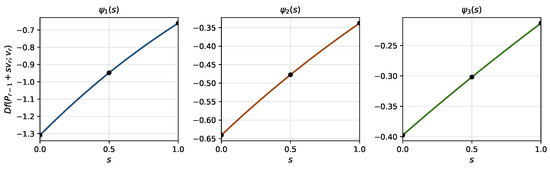
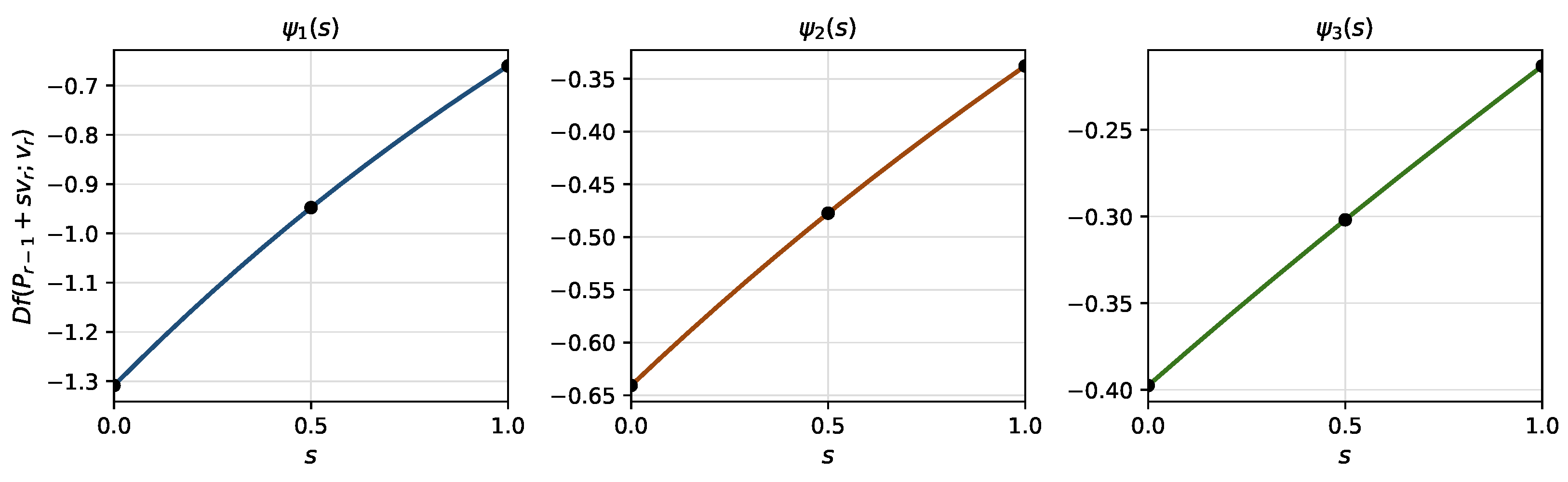
Figure 2.
Directional profiles for a three-step coordinate update of the anharmonic potential with , , , and . The black markers correspond to , , and on each segment.
Figure 3.
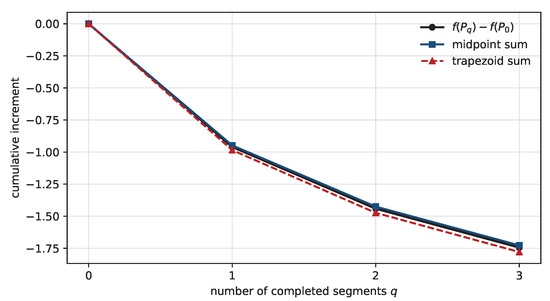
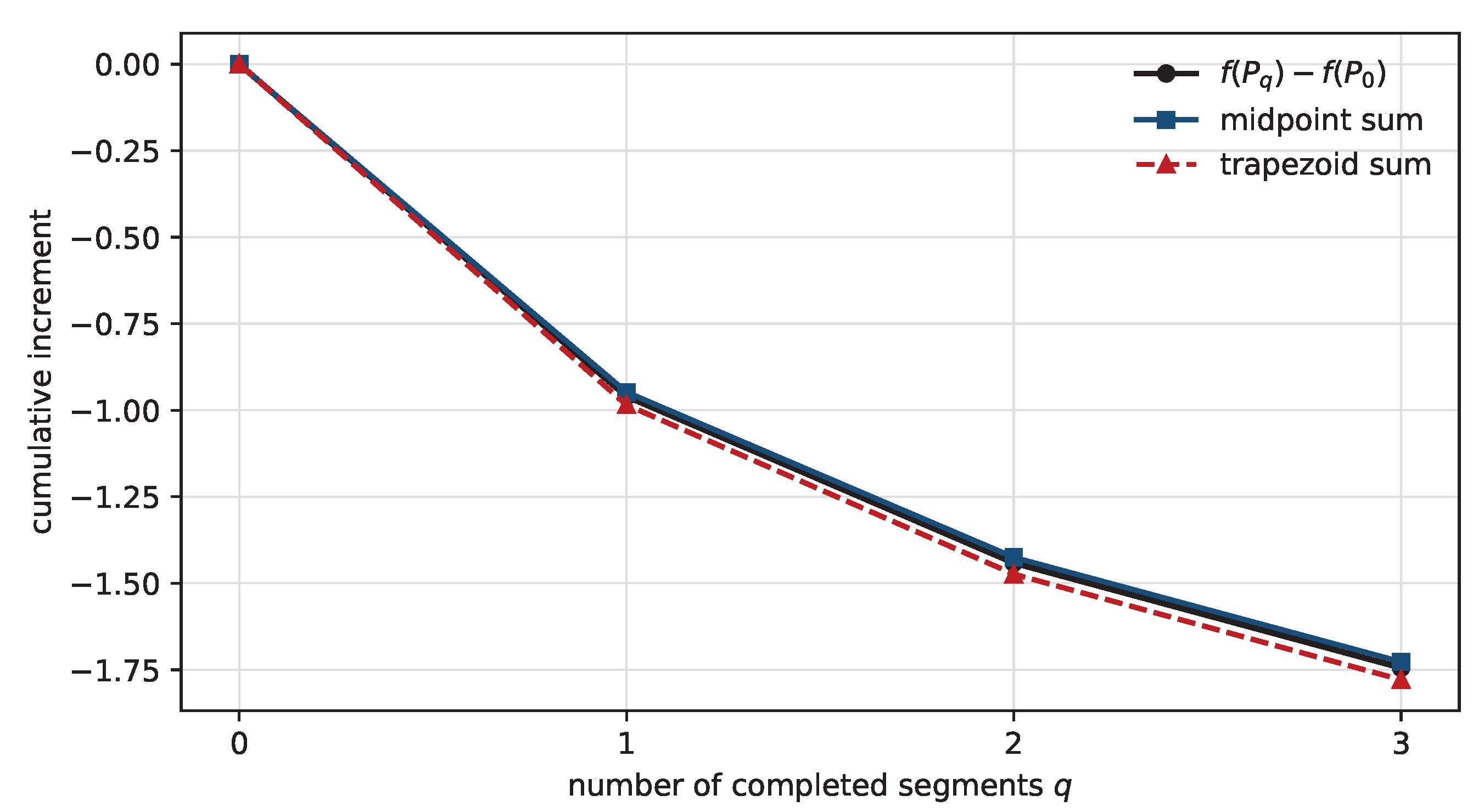
Cumulative values for the same three-step update. The black curve gives the exact increment , while the blue and red curves give the cumulative midpoint and trapezoid approximations, respectively, for .
The trapezoid and midpoint approximations are, respectively,
and hence the corresponding actual errors are
For the same data, the theoretical upper bound given by Theorems 2 and 3 is
Thus, both actual errors are below the theoretical upper bound. For this numerical example, the midpoint approximation has the smaller actual error.
The approximations become exact for quadratic growth. Let be a continuous symmetric bilinear form, let be continuous and linear, and consider
For the r-th segment of an arbitrary ordered staircase,
whence
Thus is constant on . Corollaries 2 and 4 give
Hence both approximations reproduce the total increment for every finite ordered family of directions.
Finally, consider finite directional staircases in . Let , fix , and define
Then , with
and
Let and, for , set
For the finite ordered staircase generated by , one has
Hence is convex on , and the two error estimates apply to every finite truncation. Moreover, their right-hand sides remain bounded as , because . Thus the results apply to arbitrarily long finite directional staircases in the infinite-dimensional space . Moreover, a stronger convergence conclusion holds for this example. There exists a constant , independent of i, such that
Since ,
Consequently, the common right-hand side of the trapezoid and midpoint error estimates converges to a finite limit as . Moreover,
Since f is continuous on , it follows that
4. Conclusions
The results obtained extend the directional-path estimates to a finite ordered family of directions in a real normed vector space. The staircase construction represents the increment between its endpoint values as a sum of directional integrals over the successive segments. Remainder identities for the trapezoid and midpoint approximations follow from this representation.
The principal extension beyond the single-direction setting is that the directional segments are taken successively, with each segment starting at the endpoint of the preceding one. Consequently, the intermediate points depend on the ordering of the directions, and the corresponding trapezoid and midpoint approximations and their error bounds may also depend on that ordering.
Under convexity of the absolute value of the derivative of each directional function, the trapezoid and midpoint approximations satisfy endpoint error estimates. The resulting corollaries compare the two approximations, give uniform bounds, and establish exactness when the directional functions are affine.
The applications illustrate these estimates for successive coordinate updates in anharmonic potentials, for quadratic growth, and for finite directional staircases in . These examples use the same ordered-family framework as the main results.
Funding
This research received no external funding.
Data Availability Statement
The original contributions presented in this study are included in the article. Further inquiries can be directed to the corresponding author.
Conflicts of Interest
The author declares no conflicts of interest.
References
- Sarıkaya, M.Z. Hermite-Hadamard Inequalities via Gateaux Derivatives in Banach Spaces. Bull. Iran. Math. Soc. 2026, 52, 39. [Google Scholar] [CrossRef] [Scilit]
- Dragomir, S.S.; Pearce, C.E.M. Selected Topics on Hermite–Hadamard Inequalities and Applications; RGMIA Monographs; Victoria University: Melbourne, Australia, 2000. [Google Scholar]
- Dragomir, S.S.; Agarwal, R.P. Two inequalities for differentiable mappings and applications to special means of real numbers and to trapezoidal formula. Appl. Math. Lett. 1998, 11, 91–95. [Google Scholar] [CrossRef] [Scilit]
- Kırmacı, U.S. Inequalities for differentiable mappings and applications to special means of real numbers and to midpoint formula. Appl. Math. Comput. 2004, 147, 137–146. [Google Scholar] [CrossRef] [Scilit]
- Guessab, A.; Schmeisser, G. Sharp integral inequalities of the Hermite–Hadamard type. J. Approx. Theory 2002, 115, 260–288. [Google Scholar] [CrossRef] [Scilit]
- Fink, A.M. Bounds on the deviation of a function from its averages. Czechoslov. Math. J. 1992, 42, 289–310. [Google Scholar] [CrossRef] [Scilit]
- Dragomir, S.S. On the Hadamard’s inequality for convex functions on the co-ordinates in a rectangle from the plane. Taiwan. J. Math. 2001, 5, 775–788. [Google Scholar] [CrossRef] [Scilit]
- Erden, S.; Sarıkaya, M.Z. On the Hermite-Hadamard’s and Ostrowski’s inequalities for the co-ordinated convex functions. New Trends Math. Sci. 2017, 5, 33–45. [Google Scholar]
- Kian, M.; Rostamian Delavar, M. Matrix Hermite-Hadamard type inequalities for bivariate convex functions. J. Inequal. Appl. 2026, 2026, 29. [Google Scholar] [CrossRef] [Scilit]
- Almutairi, O.B. New inequalities for differentiable functions with values in a Banach space. AIMS Math. 2026, 11, 24179–24193. [Google Scholar] [CrossRef] [Scilit]
Disclaimer/Publisher’s Note: The statements, opinions and data contained in all publications are solely those of the individual author(s) and contributor(s) and not of MDPI and/or the editor(s). MDPI and/or the editor(s) disclaim responsibility for any injury to people or property resulting from any ideas, methods, instructions or products referred to in the content. |
© 2026 by the author. Licensee MDPI, Basel, Switzerland. This article is an open access article distributed under the terms and conditions of the Creative Commons Attribution (CC BY) license.