


Abstract
Generative synthetic imagery can broaden visual coverage while still providing invalid or incomplete supervision to an object detector. This study revisits a failed synthetic-data pipeline for pile detection and tests whether severe localization-label collapse was sufficient to explain its synthetic-to-real transfer failure. A provenance audit identified a clean corpus of 3200 FLUX.2 [klein] 9B-generated images whose detector labels all used the same normalized box (cx = 0.500, cy = 0.500, w = 0.315, h = 0.525). A balanced 320-image subset was frozen before manual correction and reannotated under a visual-identifiability criterion, yielding 1154 pile instances. The fixed template matched any corrected pile at IoU ≥ 0.50 in only 40/320 images (12.5%) and, by supplying one box per image, necessarily omitted at least 834/1154 corrected instances (72.3%). Four matched YOLOv8n supervision regimes were then compared across three seeds: fixed-template (F0), geometry-matched but image-permuted (P1), corrected-single (C1), and corrected-complete (CAll). C1 and CAll fitted their own synthetic supervision almost perfectly (mAP50 = 0.9949 and 0.9890, respectively), yet real-domain transfer did not recover: on test56, CAll achieved mAP50 = 0.0008 versus 0.0492 for F0; on the secondary 52-image set, CAll achieved 0.0019 versus 0.0237. A small-real-data reference trained on only 19 real images (66 instances) achieved 0.0563 and 0.0298 mAP50 on the same two real sets. A Faster R-CNN control reproduced the absence of corrected-label recovery on the primary real set while fitting CAll in-domain (AP50 = 0.9737). Thus, localization-label collapse was genuine and severe, but correcting it was not sufficient to restore transfer. Annotation integrity is necessary but not sufficient; residual synthetic-to-real mismatch must be evaluated independently of label geometry.
Keywords:
synthetic data; object detection; annotation integrity; localization-label collapse; supervision geometry; synthetic-to-real transfer; construction automation MSC:
68T45; 68T07; 68T05
1. Introduction
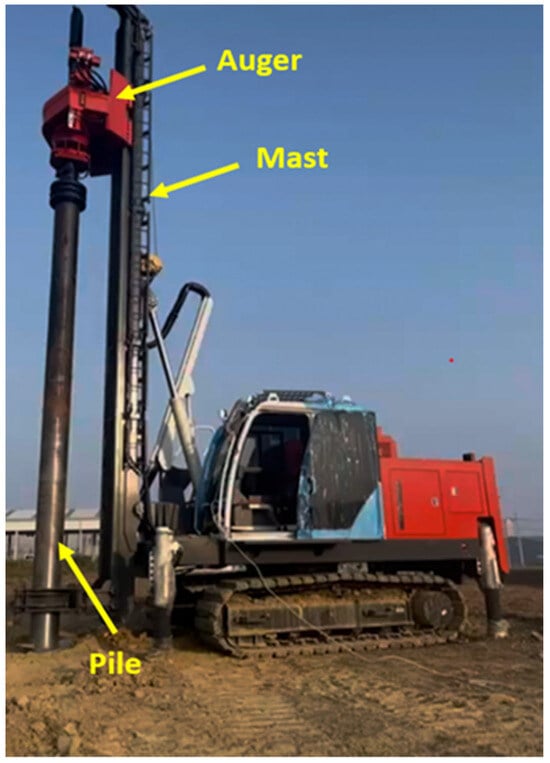
Automation of pile rotary driver operations requires reliable perception of the pile work target as well as machine-control capability. A tracked pile rotary driver must encounter piles while they are stored, lifted, aligned, positioned, partially installed, or distributed across a cluttered site before downstream planning and control can proceed. Recent data-driven control research on rotary pipe pile installation illustrates the complementary challenge on the control side [1]. The present study addresses the perception side: whether generative synthetic imagery can provide localization supervision that remains useful when a detector is transferred to real construction scenes. A reference pile rotary driver and the major components relevant to work-target perception are shown in Figure 1.
Figure 1.
Reference pile rotary driver and major components relevant to work-target perception. The pile is the target object to be localized; the mast and auger/rotary head form the principal installation assembly. The broader automated rotary pipe pile installation context is described in [1].
Construction sites are difficult data domains for computer vision because viewpoint, scale, work state, material appearance, occlusion, target multiplicity, background clutter, and illumination can vary substantially. These conditions make large-scale field acquisition costly and sometimes operationally constrained. Synthetic-data research has therefore expanded rapidly in construction, including diffusion-based dataset synthesis [2], context-aware placement [3], site-specific data-centric design [4], synthetic-to-real adaptation [5], layout-controllable generation [6], and object-centric composition with explicit geometric supervision [7].
The same lesson appears across construction-specific synthetic-data studies. Simulated and generative pipelines have controlled camera position, target location, pose, material, background, and multimodal labels [8,9,10,11,12,13,14]. Domain-randomization approaches broaden the source distribution [15,16,17], domain-adaptive detectors attempt to align source and target representations [18,19], dataset generators can optimize synthetic content toward downstream performance [20], and copy-paste or instance-level generation methods show that object placement and annotation geometry are consequential design variables [21,22,23]. Conventional augmentation is also useful only to the extent that its induced transformations match the task and the relevant deployment variation [24].
A central implication is that visual diversity and supervision diversity are different dataset properties. Object detection is trained not only from image appearance but also from the empirical distribution of bounding-box locations, sizes, multiplicities, and annotation completeness. A dataset can therefore contain visually varied scenes while presenting a narrow or invalid target distribution. More general work on shortcut learning, dataset bias, and underspecification warns that models can exploit repeated regularities or behave unpredictably under distribution shift [25,26,27,28,29,30,31]. Object-detection research likewise treats bounding-box supervision and synthetic annotation as integral components of the detector-learning problem [32,33]. More broadly, label-noise research has shown that corrupted supervision can degrade predictive performance and complicate reliable learning [34]. In object detection, annotation-quality failures extend beyond incorrect category labels to imprecise bounding boxes, localization errors, and missing object instances [35,36]. These findings support treating annotation integrity as a dataset property distinct from visual diversity. However, those concepts do not justify inferring a specific shortcut mechanism solely from a fixed label distribution; the role of the labels must be tested through controlled counterfactual supervision.
The pile-driver synthetic lineage analyzed here was designed around operational scene variety. Its broader generation taxonomy contained ten scenario modes, including operation, vertical installation, crane lifting, partial installation, horizontal stacking, stacked configurations, multiple installation, varied weather, complex construction sites, and distant panoramas. The clean 3200-image detector-training corpus recovered by provenance audit contained eight of these modes (categories 01–05 and 08–10), with 400 images per category and 800 images from each of four source material branches. The scenes were generated with FLUX.2 [klein] 9B [37], following an application-driven scenario design related to earlier synthetic-data work on the same equipment [38].
The failure occurred at the annotation stage. Every detector-training label in the clean corpus used the same normalized bounding box: (0.500, 0.500, 0.315, 0.525). The resulting zero variance in localization geometry was obvious, but zero variance alone could not establish why real-domain transfer failed. A constant or invalid target can favor degenerate learning, but poor transfer is also compatible with missing instances, incorrect extents, image-label mismatch, synthetic-real appearance shift, scene-composition differences, or combinations of these factors. The key scientific question is therefore not whether label collapse existed, but whether correcting it changes the transfer outcome.
The present study therefore frames the failure as a falsification-oriented supervision audit. A balanced 320-image subset was frozen before manual annotation and corrected to 1154 identifiable pile instances. Four matched supervision regimes were then constructed on the exact same images: the original fixed template (F0), a permuted one-box regime preserving the corrected-single geometry distribution but breaking image-label correspondence (P1), a corrected-single regime (C1), and corrected-complete supervision (CAll). The design separates three questions: whether geometric diversity alone is sufficient, whether valid image-label correspondence matters, and whether multi-instance annotation completeness changes transfer.
The study asks three research questions: RQ1, how severe is the fixed-template supervision error when measured against manually corrected localization targets? RQ2, when supervision geometry, image-label correspondence, and annotation completeness are restored in controlled stages, does in-domain learning and real-domain transfer recover? RQ3, do a small-real-data reference and a second detector support the conclusion that the remaining failure extends beyond localization geometry alone?
The main contribution is therefore a controlled evidence chain rather than a claim of a spatial shortcut. First, the fixed-template labels are audited against corrected instance-level geometry. Second, matched supervision counterfactuals isolate geometry diversity, correspondence, and completeness while holding images and training protocol fixed. Third, the corrected models are tested on their own synthetic supervision to distinguish underfitting from transfer failure. Fourth, a small-real-data reference and Faster R-CNN control provide external checks on the interpretation. This design directly tests, and is allowed to reject, the hypothesis that localization-label collapse alone explains the observed synthetic-to-real failure.
2. Materials and Methods
2.1. Study Design and Evidence Structure
The study was organized as a staged diagnostic analysis. The original 3200-image corpus established the provenance and existence of fixed-template supervision. The causal role of that supervision was then tested only on a balanced 320-image subset for which corrected labels could be created without changing image content. All four YOLO counterfactual regimes used the exact same 320 images and differed only in the labels presented during training.
The evidence sequence was: (i) corpus and label provenance audit; (ii) frozen balanced-subset selection; (iii) manual corrected annotation and quality-control review; (iv) fixed-versus-corrected supervision audit; (v) matched YOLOv8n training under F0, P1, C1, and CAll; (vi) in-domain fit and two real-domain evaluations; (vii) a small-real-data reference; and (viii) an architecture control using Faster R-CNN. Model selection on the evaluation sets was not used. Final-epoch checkpoints were prespecified for the matched YOLO experiments and the real-data reference, and the final epoch was likewise used for Faster R-CNN.
2.2. Synthetic Corpus Provenance and Actual Training-Corpus Composition
The authoritative synthetic corpus was recovered through manifest, filename, and SHA-256 audits. A historical directory contained 3209 entries, nine of which were Jupyter checkpoint artifacts rather than training images. Excluding those artifacts yielded 3200 images. The clean set matched the synthetic-selection manifest and an independently retained hash inventory exactly.
The broader generation lineage defined ten scenario categories, but the actual clean 3200-image training corpus contained only eight: pile-driver operation (01), completed vertical installation (02), crane lifting (03), partial installation (04), horizontal stacking (05), varied weather (08), complex construction site (09), and distant panorama (10). Categories 06 and 07 from the broader taxonomy were not represented in the clean corpus; no unsupported explanation is assigned to their absence. Each represented category contained 400 images. Four source material branches (steel, concrete, H-beam, and timber) contributed 800 images each, producing 100 images in each of the 32 category-by-material cells.
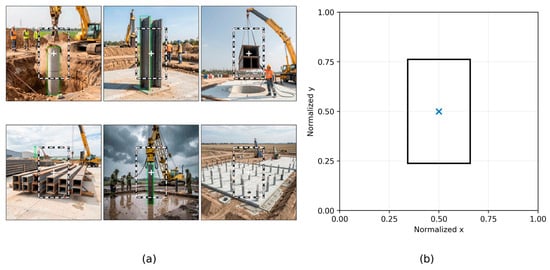
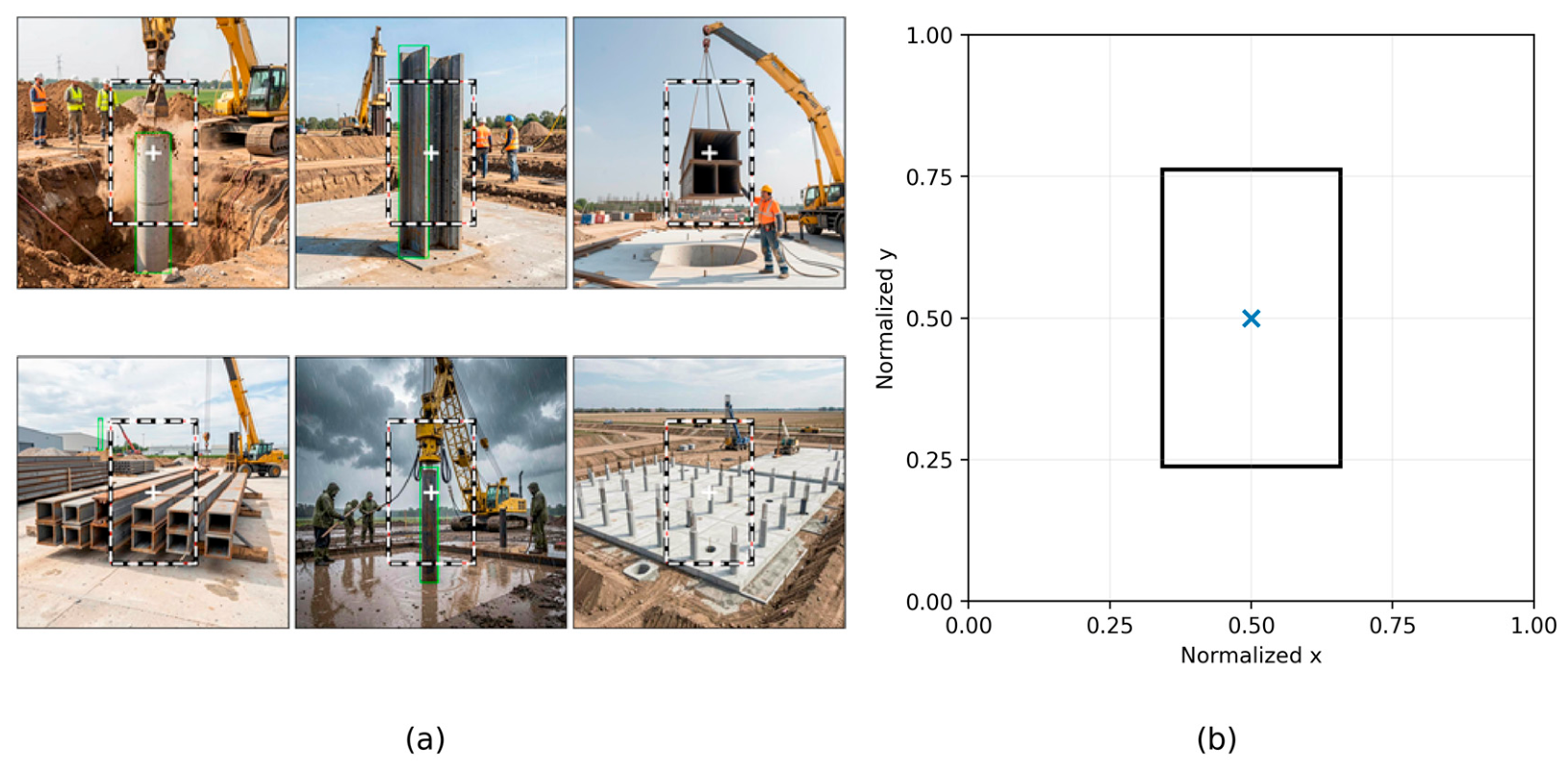
The detector task was evaluated as a single pile class. Source material identity was retained only as provenance and as a balancing stratum for the corrected subset. The visual scene variation and the corresponding fixed localization supervision are illustrated in Figure 2.
Figure 2.
Visual scene variation versus fixed localization supervision. (a) Representative synthetic scenes from categories present in the clean corpus. (b) The historical detector target was the same normalized box for every training image: cx = 0.500, cy = 0.500, w = 0.315, and h = 0.525. The clean corpus therefore had zero empirical variance in all four localization coordinates.
2.3. Frozen 320-Image Correction Subset and Manual Annotation
A 320-image subset was selected before manual annotation using a deterministic, content-blind balancing rule. The eight represented scene categories and four source material strata defined 32 cells. Within each cell, images were sorted by SHA-256 and the first 10 were selected, yielding 8 × 4 × 10 = 320 images. The frozen manifest was not changed after annotation began.
Manual annotation defined one detection class, pile. Each independently identifiable target pile was assigned a tight axis-aligned bounding box over its visible extent. Overlap between boxes was permitted when instances overlapped. Occluded or truncated piles were labeled over the visible extent rather than an imagined full extent. During quality control, the operational inclusion criterion was stated explicitly: an instance was included when it could be identified as an independent target and its visible extent could be boxed reproducibly. Ambiguous distant or merged structures were not forced into instance labels, and no post hoc pixel-size threshold was introduced.
All 320 images contained at least one identifiable target. The corrected-complete annotation (CAll) contained 1154 boxes, with a median of one, mean of 3.606, and range of 1–22 instances per image. A 64-image quality-control subset had been frozen before annotation by selecting two images from each of the 32 strata. Visual review of those 64 images found no clear omissions or invalid boxes under the operational criterion.
2.4. Matched Supervision Regimes
Four label regimes were derived on the same 320 images. Their purpose was to separate label-distribution diversity, valid image-label correspondence, and annotation completeness. The four matched supervision regimes are summarized in Table 1.
Table 1.
Matched supervision regimes used in the 320-image counterfactual experiment.
2.5. Supervision-Integrity Audit
The fixed-template box was compared with every corrected CAll box using intersection over union (IoU). At the image level, the maximum IoU between the fixed template and any corrected pile was recorded. At the instance level, each corrected pile was compared directly with the fixed template. The one-box-per-image structure also places a deterministic lower bound on missing-instance burden: for an image containing ni corrected instances, at least max(ni − 1, 0) instances cannot be represented by F0 regardless of box placement.
Corrected geometry was summarized for normalized center coordinates (cx, cy), width w, and height h. The historical fixed target has zero variance in all four quantities. The corrected labels were used only as reference geometry for the audit and for constructing the counterfactual regimes; the audit itself does not assume that corrected labels will improve real-domain performance.
2.6. Historical Prediction-Geometry Check and Literal Constant Baseline
To address whether a fixed training target simply produced an exact constant-box predictor, the three historical YOLOv8n checkpoints were re-evaluated at confidence 0.001 on both real sets. For each image with at least one prediction, the highest-confidence predicted box was recorded and its coordinate dispersion, Euclidean distance to the fixed template in normalized box space, and IoU with the fixed template were calculated.
A separate analytic baseline emitted exactly one fixed-template box per image with confidence 1.0. Standard one-to-one matching at IoU ≥ 0.50 was used for both the analytic baseline and the neural models. This check distinguishes literal constant output from broader degenerate behavior around a fixed supervision prior. The earlier seed-union matching statistic and copy-paste probe are retained only as historical diagnostics and are not used as causal evidence in the present analysis.
For the retained spatial-bin diagnostic, normalized ground-truth center distance from the image center was recomputed as di = √[(cx,i − 0.5)2 + (cy,i − 0.5)2]. The four intervals [0, 0.15), [0.15, 0.25), [0.25, 0.35), and [0.35, 1.01) contained 45, 58, 88, and 155 test56 objects, respectively. This is the corrected center-distance definition used in the audit.
2.7. YOLOv8n Matched Training and Evaluation
YOLOv8n [39] was trained separately on F0, P1, C1, and CAll using random seeds 0, 1, and 2, for 12 training runs. Each regime contained the exact same 320 images. The training configuration matched the archived historical protocol where applicable: 100 epochs, 640-pixel input size, batch size 16, scale augmentation 0.50, horizontal-flip probability 0.50, translation 0.10, and mosaic, MixUp, and vertical flipping disabled. Ultralytics automatic optimizer selection was retained because it was part of the archived configuration; The exact run arguments and software environment were retained in the study records and may be made available by the corresponding author upon reasonable request, subject to applicable restrictions. No synthetic validation score was used for checkpoint selection; the final-epoch last.pt checkpoint was used for every comparison.
Each final checkpoint was evaluated on its own 320-image supervision set as an in-domain fit diagnostic and on two real test sets. Real-domain evaluation used 640-pixel images, confidence threshold 0.001, NMS IoU 0.70, and a maximum of 300 detections per image. Reported metrics were precision, recall, mAP50, and mAP50-95. With only three seeds per condition, results are reported as raw seed behavior and mean ± sample standard deviation; no formal significance claims are made.
2.8. Real Evaluation Sets
The primary real evaluation set, test56, contained 56 images and 346 pile boxes. It was not used for training the matched synthetic regimes. The set is multi-instance dominant: 43/56 images (76.8%) contain more than one labeled object, with a median of five objects per image. The normalized center-distance distribution contains 45, 58, 88, and 155 objects in the intervals [0,0.15), [0.15,0.25), [0.25,0.35), and [0.35,1.01), respectively.
The secondary set contained 52 images derived from a historical 90-image evaluation pool. It is not described as blind or historically unseen. An integrity audit before the present model metrics were computed found 258 nonempty annotation rows, one of which had zero normalized width (cx = 1.000000, cy = 0.048030, w = 0.000000, h = 0.062875). The source files were left unchanged; a derived evaluation copy excluded only this zero-area row, leaving 257 valid boxes across the same 52 images. All other 51 label files were byte-identical to source. Exact image SHA-256 comparison found no shared images between test56 and the secondary set, but hash disjointness is not interpreted as semantic or acquisition independence.
2.9. Small-Real-Data Reference
A real-data reference was trained from a canonical 19-image subset containing 66 labeled instances. The source folders contained eight steel, five concrete, four H-beam, and two timber images. Their original material-class labels were collapsed to a single pile class without changing box geometry. The 19 training images had no exact SHA-256 overlap with either real test set.
YOLOv8n was trained from the same pretrained initialization under the same archived training configuration and seeds 0, 1, and 2. This condition is termed a small-real-data reference rather than a performance ceiling because the training set is extremely small and was not designed to saturate real-domain performance.
2.10. Second-Detector Architecture Control
To test whether corrected-label non-recovery was specific to YOLOv8n, Faster R-CNN with a ResNet-50-FPN backbone [40] was used as a second detector. The model used COCO-pretrained weights [41] and a two-class output head (background and pile). Only the two endpoint regimes, F0 and CAll, were repeated because the architecture-control question was whether full correction changed the direction of real transfer.
For each seed, F0 and CAll used the same 320 images, identical pretrained parameters, identical randomly initialized pile head, and the same DataLoader shuffle seed. Initialization equality was verified by full model-state SHA-256 before training. Models were trained for 30 epochs with batch size 4, SGD learning rate 0.005, momentum 0.9, weight decay 0.0005, 640-pixel minimum and maximum image size, and learning-rate reductions at epochs 20 and 27 by a factor of 0.1. No validation-based model selection was used.
Faster R-CNN was evaluated with a fixed score threshold of 0.001, NMS threshold 0.50, and maximum 300 detections per image. One-class AP was computed by global confidence ranking, greedy one-to-one matching, and 101-point interpolated precision at IoU 0.50 and averaged over IoU 0.50:0.05:0.95. Absolute AP values from this independent evaluator are interpreted within the Faster R-CNN control rather than as numerically interchangeable with the Ultralytics metrics.
2.11. Reproducibility and Audit Trail
The analysis workflow froze dataset definitions, manifests, and analysis decisions before each major computation. Reproducibility-relevant information, including the clean-corpus composition, frozen 320-image selection rule, manual-annotation and quality-control procedures, P1 permutation rule, matched training and evaluation settings, secondary-ground-truth exclusion rule, REAL19 composition, and Faster R-CNN initialization controls, is documented in the manuscript. Additional non-image audit records may be made available by the corresponding author upon reasonable request, subject to applicable data-governance restrictions. The datasets, their roles, and the final valid annotation counts used in the analysis are summarized in Table 2.
Table 2.
Dataset roles and final valid annotation counts used in the analysis.
3. Results
3.1. Fixed-Template Supervision Was Severely Mismatched to Corrected Geometry
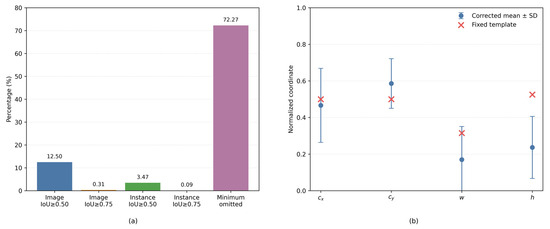
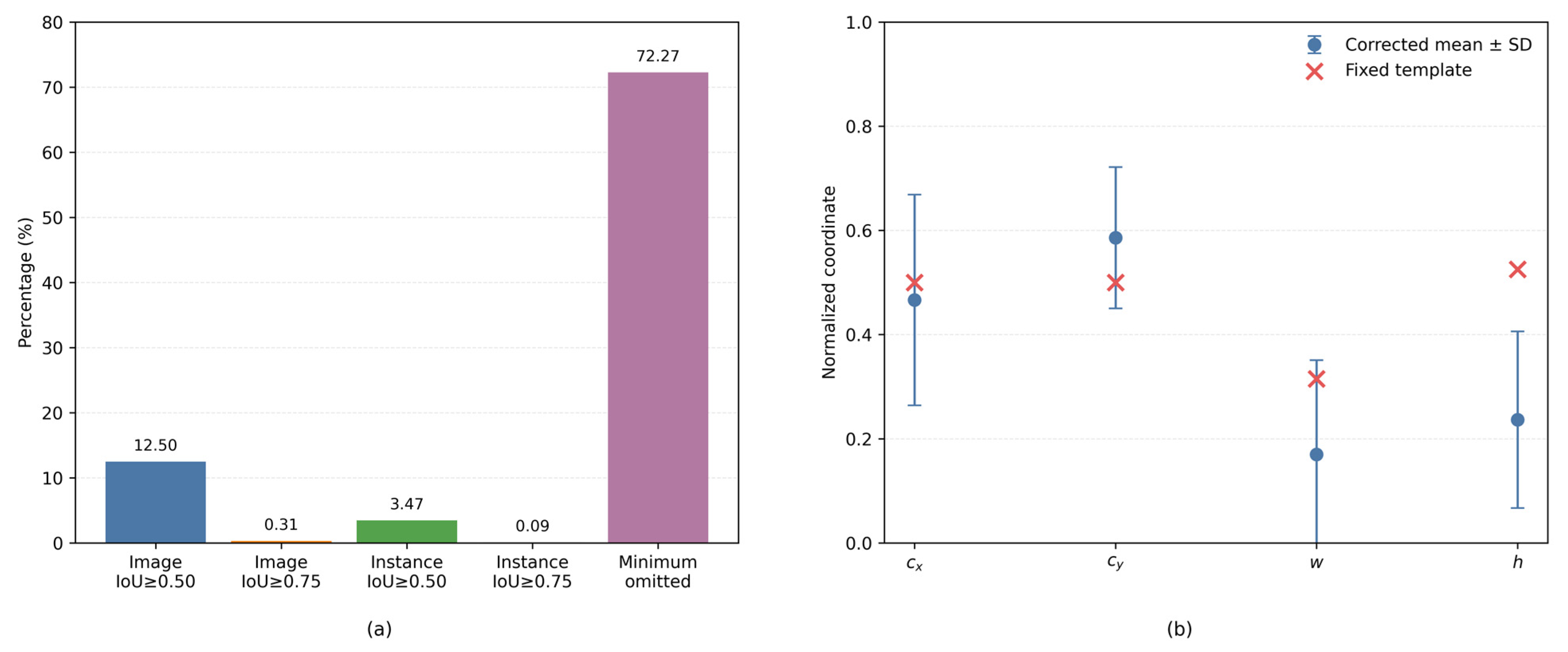
The corrected 320-image subset contained 1154 pile instances, 3.606 times the number of historical labels. Because F0 supplies only one box per image, at least 834 corrected instances could not be represented, corresponding to a minimum omission fraction of 72.27%. This bound does not depend on whether the fixed box happens to overlap one of the visible piles.
At IoU ≥ 0.50, the fixed template matched at least one corrected pile in only 40/320 images (12.50%). At IoU ≥ 0.75, this occurred in only 1/320 images (0.31%). At the instance level, 40/1154 corrected piles (3.47%) reached IoU ≥ 0.50 with the template, and only 1/1154 (0.09%) reached IoU ≥ 0.75. The per-image best-IoU distribution had a mean of 0.277 and median of 0.255.
The corrected labels also occupied a broad geometry range rather than a point distribution. Mean ± sample SD were 0.466 ± 0.202 for cx, 0.586 ± 0.136 for cy, 0.170 ± 0.181 for width, and 0.236 ± 0.170 for height. Corrected median width (0.077) and height (0.188) were substantially smaller than the historical fixed values 0.315 and 0.525. These results establish severe localization-label collapse and mismatch without requiring any assumption about the detector mechanism. The principal supervision-integrity audit results are summarized in Figure 3.
Figure 3.
Quantitative supervision audit on the frozen 320-image subset. (a) Only 12.5% of images contained any corrected pile overlapping the historical fixed template at IoU ≥ 0.50, while the one-box-per-image structure necessarily omitted at least 72.27% of corrected instances. (b) Corrected localization geometry had substantial dispersion in center and size, whereas the historical template was a single point.
3.2. Historical Neural Predictions Were Not a Literal Constant-Box Predictor
The fixed labels did not cause the trained network to emit the exact template on every real image. On test56, the highest-confidence prediction was present on 89.3%, 37.5%, and 98.2% of images for seeds 0, 1, and 2, respectively. Across those top predictions, the standard deviations of cx were 0.138, 0.122, and 0.147; corresponding cy standard deviations were 0.057, 0.110, and 0.088. Width and height were also nonconstant. Median IoU between the top predicted box and the exact template was 0.235, 0.481, and 0.270 across the three seeds.
An analytic predictor that emitted exactly one fixed-template box per image matched only 12/346 test56 objects at IoU ≥ 0.50 (recall 0.0347). Standard one-to-one recall for the three neural checkpoints was 0.0983, 0.0173, and 0.0578. The literal constant-box hypothesis is therefore not supported. At the same time, all three neural models had zero recall for objects beyond normalized center distance 0.35 on test56, so the historical behavior remained strongly restricted relative to the real target distribution. The resulting interpretation is template-concentrated but non-constant degenerate localization behavior, not proof of a spatial shortcut.
3.3. Corrected Supervision Restored In-Domain Learning but Not Real-Domain Transfer
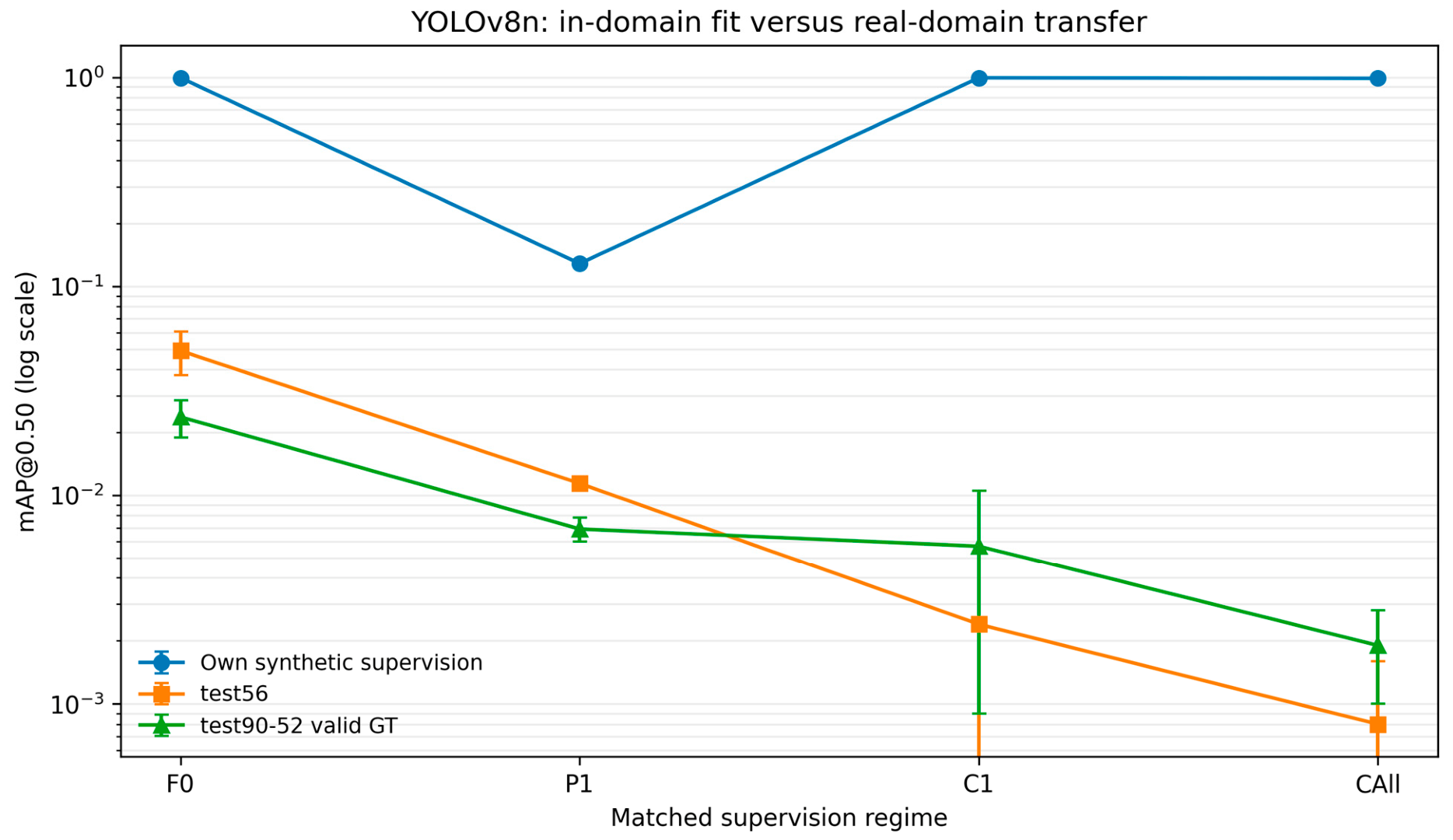
The matched supervision experiment produced a sharp separation between ability to fit synthetic supervision and ability to transfer to real imagery. F0, C1, and CAll all achieved near-perfect mAP50 on their own synthetic supervision: 0.9950, 0.9949, and 0.9890, respectively. CAll also achieved 0.8528 mAP50-95 in-domain despite containing 1154 multi-instance boxes. Thus, the corrected labels were learnable under the chosen training protocol.
P1 behaved differently. Although it contained exactly the same 320 single-box geometries as C1, its labels belonged to different images. Its own-supervision mAP50 was only 0.1285 ± 0.0045, whereas C1 reached 0.9949. This large difference is a positive control showing that valid image-label correspondence, rather than geometry diversity alone, was required for successful in-domain localization learning.
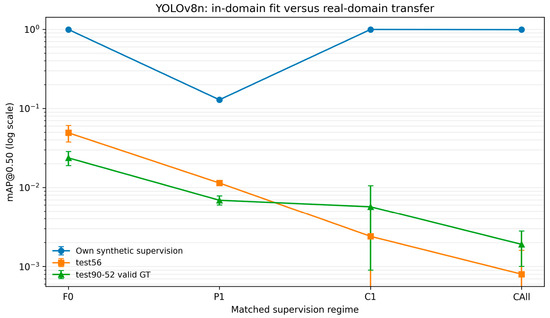
Real-domain performance did not recover after correction. On test56, mean mAP50 was 0.0492 for F0, 0.0114 for P1, 0.0024 for C1, and 0.0008 for CAll. On test90-52, the corresponding values were 0.0237, 0.0069, 0.0057, and 0.0019. The seed-matched CAll-minus-F0 change in mAP50 was −0.0483 ± 0.0122 on test56 and −0.0218 ± 0.0056 on test90-52. Correcting the labels therefore did not rescue transfer; the direction was negative in the YOLOv8n matched experiment. The complete matched-supervision results are summarized in Table 3. The resulting separation between in-domain fit and real-domain transfer is visualized in Figure 4.
Table 3.
YOLOv8n performance under matched supervision regimes (mean ± sample SD over three seeds).
Figure 4.
YOLOv8n fit-versus-transfer behavior across the four matched supervision regimes. C1 and CAll nearly perfectly fit their corrected synthetic supervision, while real-domain mAP50 remained near floor. P1 preserved the C1 geometry distribution but broke image-label correspondence and failed to fit the supervision well. Error bars show mean ± sample SD over three seeds.
3.4. A Small-Real-Data Reference Outperformed the Corrected-Synthetic Models
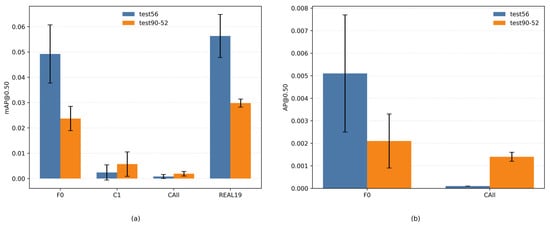
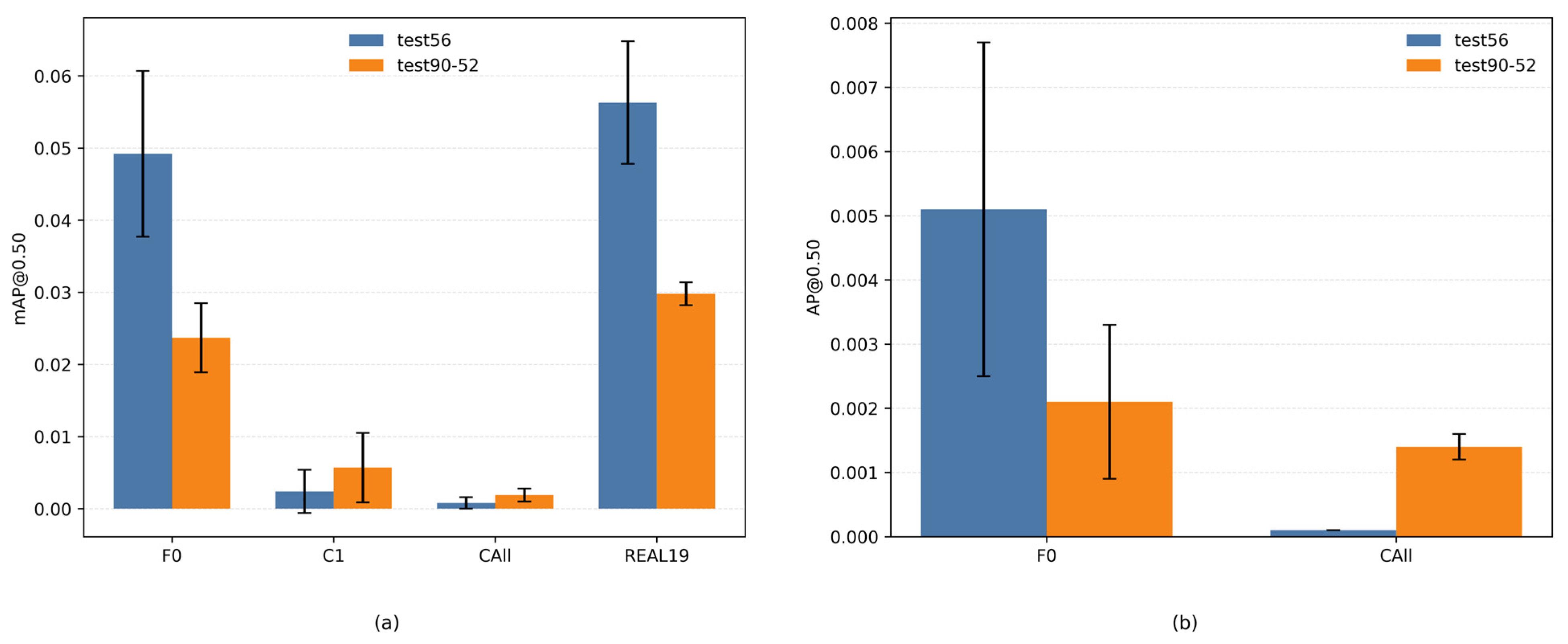
The REAL19 reference contained only 19 training images and 66 instances, yet it achieved higher real-domain accuracy than any corrected-synthetic condition. On test56, REAL19 produced precision 0.1289 ± 0.0116, recall 0.1310 ± 0.0205, mAP50 0.0563 ± 0.0085, and mAP50-95 0.0165 ± 0.0028. On test90-52, the corresponding values were 0.0939 ± 0.0211, 0.0895 ± 0.0078, 0.0298 ± 0.0016, and 0.0085 ± 0.0010.
The comparison is intentionally descriptive rather than a sample-efficiency claim because REAL19 and the synthetic subset differ in domain and content. Nevertheless, the fact that 19 real images outperformed 320 fully corrected synthetic images on both real test sets provides direct evidence that valid localization labels alone were not sufficient to bridge the remaining synthetic-to-real mismatch. The REAL19 results on both real evaluation sets are summarized in Table 4.
Table 4.
Small-real-data reference evaluated on the two real test sets (mean ± sample SD over three seeds).
3.5. Second-Detector Control Reproduced Non-Recovery on the Primary Real Set
Faster R-CNN successfully learned both endpoint supervision regimes in-domain. F0 reached AP50 = 1.0000 ± 0.0000 and AP50:95 = 0.9986 ± 0.0006 on its own synthetic supervision. CAll reached AP50 = 0.9737 ± 0.0041 and AP50:95 = 0.9052 ± 0.0020, with maximum recall at IoU 0.50 of 0.9827 ± 0.0030. Corrected-supervision underfitting is therefore not a plausible explanation for its poor real-domain result.
On test56, Faster R-CNN F0 achieved AP50 = 0.0051 ± 0.0026, whereas CAll achieved 0.0001 with negligible seed variation. The seed-matched CAll-minus-F0 change was −0.0050 ± 0.0026, and all three seeds were negative. On test90-52, F0 and CAll were both near floor at 0.0021 ± 0.0012 and 0.0014 ± 0.0002 AP50, respectively. The mean contrast was negative (−0.0008 ± 0.0014), but one of the three seed contrasts was slightly positive. The architecture control therefore reproduces corrected-label non-recovery clearly on the primary set and shows no consistent positive recovery on the secondary set; it does not support a claim that the exact magnitude is architecture-independent. The Faster R-CNN endpoint-control results are summarized in Table 5. The two external checks are compared graphically in Figure 5.
Table 5.
Faster R-CNN endpoint control (mean ± sample SD over three seeds).
Figure 5.
External checks on the YOLO matched-supervision result. (a) A 19-image real-data reference achieved higher mAP50 than the corrected-synthetic C1 and CAll regimes on both real sets. (b) Faster R-CNN endpoint control reproduced a negative CAll-minus-F0 contrast on test56; both regimes remained near floor on the secondary set.
4. Discussion
4.1. Localization-Label Collapse Was Real, but It Was Not a Sufficient Explanation
The analysis establishes two findings that must be kept separate. First, the historical supervision was severely defective. The fixed template represented only one localization target per image, overlapped any corrected pile at IoU ≥ 0.50 in just 12.5% of the frozen correction subset, and necessarily omitted at least 72.3% of corrected instances. The original zero-covariance observation was therefore not merely a mathematically degenerate statistic; it corresponded to a substantial annotation-integrity failure relative to identifiable objects in the images.
Second, correcting that failure did not restore real-domain detection. C1 and CAll fitted their synthetic supervision nearly perfectly, so the negative transfer result cannot be attributed to an inability to optimize the corrected labels. This directly falsifies the stronger version of the original hypothesis: localization-label collapse alone was not sufficient to explain the synthetic-to-real failure. The paper therefore does not retain “spatial shortcut learning” as its central mechanism claim.
4.2. Geometry Diversity, Correspondence, and Completeness Are Distinct
The P1 control demonstrates why “more diverse boxes” is not equivalent to valid supervision. P1 preserved the exact C1 marginal geometry distribution but intentionally assigned those boxes to different images. Its low in-domain mAP50 shows that a broad target distribution is not useful when image-label correspondence is absent. C1 then restores correspondence while keeping one box per image, and CAll additionally restores multi-instance completeness. This decomposition provides a more informative audit than covariance alone because it distinguishes distributional spread from semantic validity.
The real-domain results add a further distinction: even semantically valid and substantially more complete synthetic labels did not guarantee transferable perception. Correct labels are therefore necessary for a defensible synthetic detection dataset, but they are not a sufficient quality criterion for deployment-oriented transfer.
4.3. Interpreting the Higher F0 Real Score
An initially counterintuitive result is that F0 obtained higher real mAP than C1 or CAll in the matched YOLO experiment. This must not be interpreted as evidence that fixed-template annotation is preferable. F0 is known, from the corrected-label audit, to be geometrically invalid for most training images and structurally unable to represent most visible instances. Its higher real score remains low in absolute terms and can arise from interactions among a low-dimensional localization prior, the real test geometry, prediction confidence, and detector calibration. The analytic fixed-box baseline also matched a small subset of centrally compatible real targets, confirming that limited geometric overlap can produce nonzero detection scores without validating the supervision.
Accordingly, the meaningful counterfactual result is not “bad labels are better.” It is that correcting the synthetic labels did not recover real transfer. The present study treats the direction of the F0-CAll difference as evidence against the proposed rescue mechanism, not as a recommendation to preserve invalid annotations.
4.4. Evidence for Residual Synthetic-to-Real Mismatch
The combination of high corrected in-domain fit, near-floor corrected real performance, and the small-real-data reference indicates substantial residual mismatch between the synthetic and real domains. The present experiments do not isolate that mismatch into a single cause. Plausible contributors include object appearance, local texture, background context, occlusion structure, scale distribution, scene composition, and other source-specific cues. The study therefore uses the term residual synthetic-to-real mismatch rather than attributing the result to a specific appearance mechanism.
This interpretation is consistent with broader work showing that successful synthetic transfer often requires deliberate control of foreground, background, layout, domain randomization, or explicit adaptation [18,19,20,21,22,23,26,33]. For construction perception, a synthetic pipeline should therefore be audited along at least three separate axes: annotation integrity, in-domain learnability, and real-domain transfer. Passing the first two does not imply the third.
4.5. Architecture Robustness and Claim Boundary
The Faster R-CNN experiment reduces the likelihood that corrected-label non-recovery on test56 was unique to YOLOv8n. Both detectors could fit corrected CAll supervision in-domain, yet neither showed a real-domain rescue on the primary set. The secondary Faster R-CNN results remained extremely close to the performance floor and included one small positive seed contrast, so the architecture evidence supports non-recovery rather than a universal negative effect size.
The study therefore does not claim an architecture-independent law, nor does it claim that no synthetic-data correction could improve transfer. The tested intervention was specifically the correction of localization supervision on a frozen 320-image subset. Other interventions, such as regenerating images with object-level layout control, adapting source appearance, mixing real anchors, or explicit domain adaptation, remain open.
4.6. Implications for Construction Automation and Synthetic-Data QA
For automated pile-driver perception, the practical lesson is a quality-assurance sequence rather than a detector prescription. Synthetic images should not be accepted because they look varied, and corrected boxes should not be accepted because the detector fits them. Dataset audits should verify target multiplicity, center and scale coverage, annotation completeness, image-label correspondence, boundary cases, provenance, and real-domain behavior before synthetic data are treated as a substitute for field data.
The REAL19 result is particularly relevant operationally. A very small amount of real-domain supervision provided a stronger reference than the corrected synthetic subset on both real test sets. This does not establish an optimal allocation rule, but it reinforces the value of real anchor data when validating generative synthetic pipelines for construction machinery.
4.7. Limitations
- Only 320 of the 3200 clean synthetic images were manually corrected. The subset was balanced and frozen before annotation, but full-corpus reannotation could produce different quantitative outcomes.
- Manual instance definition is inherently ambiguous for very distant, heavily occluded, or merged structural members. The visual-identifiability criterion and frozen QC subset reduce arbitrariness but do not eliminate human annotation uncertainty.
- The two real test sets are exactly hash-disjoint, but the secondary set originated from a historical evaluation pool and is not claimed to be semantically or acquisition-wise independent.
- The small-real-data reference contains only 19 images and is not a performance ceiling. It is used only to establish a real-domain reference under a much smaller training sample.
- The second detector repeats only F0 and CAll, not P1 and C1, and uses a separate Faster R-CNN evaluator. It supports the direction of the endpoint result rather than exact cross-architecture metric equivalence.
- The experiments identify residual synthetic-to-real mismatch but do not decompose it into texture, appearance, background, composition, scale, or other causal components.
- A raw COCO-pretrained model is not reported as a pile-detection baseline because the COCO label ontology does not contain a pile class; reinterpreting an unrelated pretrained class as pile would not provide a semantically valid detector baseline.
5. Conclusions
This study re-evaluated a failed generative synthetic-data pipeline for construction pile detection using corrected annotations and matched counterfactual supervision. The original clean 3200-image corpus used an identical normalized localization box for every image. On a frozen 320-image subset, manual correction yielded 1154 pile instances. The fixed template overlapped any corrected pile at IoU ≥ 0.50 in only 12.5% of images and necessarily omitted at least 72.3% of corrected instances, confirming severe localization-label collapse.
The decisive result was the absence of recovery after correction. Corrected C1 and CAll models learned their synthetic supervision almost perfectly, yet real-domain detection remained near floor. A geometry-diverse but image-permuted control showed that box diversity without valid correspondence was not sufficient even in-domain. A 19-image real-data reference outperformed the corrected-synthetic models on both real sets, and Faster R-CNN reproduced corrected-label non-recovery on the primary real evaluation while fitting CAll strongly in-domain.
Accordingly, the conclusion is deliberately bounded: localization-label collapse was genuine, but it was not sufficient to explain the synthetic-to-real failure. For generative object-detection data, annotation integrity, supervision learnability, and real-domain transfer must be validated as separate properties. Visual diversity is not supervision diversity, and supervision diversity itself is not a guarantee of transfer.
Author Contributions
Conceptualization, H.J., Y.C. and S.C.; methodology, H.J. and Y.C.; software, H.J.; validation, H.J. and Y.C.; formal analysis, H.J.; investigation, H.J. and Y.C.; resources, Y.C. and S.C.; data curation, H.J.; visualization, H.J.; writing—original draft preparation, H.J.; writing—review and editing, H.J., Y.C. and S.C.; supervision, S.C.; project administration, S.C.; funding acquisition, S.C. All authors have read and agreed to the published version of the manuscript.
Funding
This research was supported by the Machinery Industry Technology Development Program (No. 00421895) funded by the Ministry of Trade, Industry & Energy (MOTIE, Korea) and the Korea Evaluation Institute of Industrial Technology (KEIT).
Data Availability Statement
Raw real-world construction images are not publicly available due to institutional data-governance restrictions. Additional data may be available from the corresponding author subject to applicable restrictions.
Acknowledgments
During the preparation of this manuscript, the authors used generative AI tools (OpenAI ChatGPT, GPT-5.6 Sol and Anthropic Claude, Claude Opus 4.8) to assist with manuscript organization, language refinement, analysis-code drafting, and statistical review. All computational analyses, technical decisions, interpretation of results, and conclusions were independently performed and verified by the authors, who take full responsibility for the integrity and content of the published work.
Conflicts of Interest
The authors declare no conflicts of interest.
Abbreviations
The following abbreviations are used in this manuscript:
| AP | average precision |
| CAll | corrected-complete supervision |
| C1 | corrected-single supervision |
| F0 | fixed-template supervision |
| GT | ground truth |
| IoU | intersection over union |
| mAP | mean average precision |
| NMS | non-maximum suppression |
| P1 | permuted single-box supervision |
| R-CNN | region-based convolutional neural network |
| YOLO | You Only Look Once |
References
- Jang, H.-S.; Lee, Y.; Lee, H.; Cha, Y.; Choi, S.-J. Data-driven machine response modeling framework for reinforcement learning-based adaptive control of rotary pipe pile installation in unknown soil conditions. Autom. Constr. 2026, 190, 107106. [Google Scholar] [CrossRef] [Scilit]
- Hong, S.; Choi, B.; Ham, Y.; Jeon, J.H.; Kim, H. Massive-scale construction dataset synthesis through Stable Diffusion for machine learning training. Adv. Eng. Inform. 2024, 62, 102866. [Google Scholar] [CrossRef] [Scilit]
- Lu, Y.; Liu, B.; Wei, W.; Xiao, B.; Liu, Z.; Li, W. Generating synthetic images for construction machinery data augmentation utilizing context-aware object placement. Dev. Built Environ. 2025, 21, 100610. [Google Scholar] [CrossRef] [Scilit]
- Song, S.; Hong, J.; Jeoung, J.; Ahn, J.; Hong, T. Data-centric enhancement of site-specific automated construction equipment detection in wide-angle site images. Autom. Constr. 2025, 179, 106483. [Google Scholar] [CrossRef] [Scilit]
- Chung, D.; Cho, S.; Kim, Y.; Im, S.; Kim, H. Robust real-time 3D perception for construction equipment using a three-stage synthetic-to-real learning framework. Autom. Constr. 2026, 187, 106965. [Google Scholar] [CrossRef] [Scilit]
- Tang, D.; Cao, X.; Wu, X.; Li, J.; Yao, J.; Bai, X.; Jiang, D.; Li, Y.; Meng, D. AeroGen: Enhancing remote sensing object detection with diffusion-driven data generation. In Proceedings of the IEEE/CVF Conference on Computer Vision and Pattern Recognition (CVPR), Nashville, TN, USA, 11–15 June 2025; pp. 3614–3624. [Google Scholar] [CrossRef] [Scilit]
- Huang, W.; Zhang, J.; Jia, T.; Zheng, C.; Gao, Z.; Park, J.S.; Krishna, R. Synthetic Object Compositions for scalable and accurate learning in detection, segmentation, and grounding. In Proceedings of the IEEE/CVF Conference on Computer Vision and Pattern Recognition (CVPR), Denver, CO, USA, 3–7 June 2026; pp. 6388–6398. [Google Scholar]
- Xu, L.; Liu, H.; Xiao, B.; Luo, X.; Veeramani, D.; Zhu, Z. A systematic review and evaluation of synthetic simulated data generation strategies for deep learning applications in construction. Adv. Eng. Inform. 2024, 62, 102699. [Google Scholar] [CrossRef] [Scilit]
- Lee, J.G.; Hwang, J.; Chi, S.; Seo, J. Synthetic image dataset development for vision-based construction equipment detection. J. Comput. Civ. Eng. 2022, 36, 04022020. [Google Scholar] [CrossRef] [Scilit]
- Tohidifar, A.; Kim, D.; Lee, S.H. Make it till you fake it: Construction-centric computational framework for simultaneous image synthetization and multimodal labeling. Autom. Constr. 2024, 167, 105696. [Google Scholar] [CrossRef] [Scilit]
- Lee, H.; Jeon, J.; Lee, D.; Park, C.; Kim, J.; Lee, D. Game engine-driven synthetic data generation for computer vision-based safety monitoring of construction workers. Autom. Constr. 2023, 155, 105060. [Google Scholar] [CrossRef] [Scilit]
- Kim, H.; Yi, J.S. Image generation of hazardous situations in construction sites using text-to-image generative model for training deep neural networks. Autom. Constr. 2024, 166, 105615. [Google Scholar] [CrossRef] [Scilit]
- Bang, S.; Baek, F.; Park, S.; Kim, W.; Kim, H. Image augmentation to improve construction resource detection using generative adversarial networks, cut-and-paste, and image transformation techniques. Autom. Constr. 2020, 115, 103198. [Google Scholar] [CrossRef] [Scilit]
- Assadzadeh, A.; Arashpour, M.; Brilakis, I.; Ngo, T.; Konstantinou, E. Vision-based excavator pose estimation using synthetically generated datasets with domain randomization. Autom. Constr. 2022, 134, 104089. [Google Scholar] [CrossRef] [Scilit]
- Tobin, J.; Fong, R.; Ray, A.; Schneider, J.; Zaremba, W.; Abbeel, P. Domain randomization for transferring deep neural networks from simulation to the real world. In Proceedings of the IEEE/RSJ International Conference on Intelligent Robots and Systems (IROS), Vancouver, BC, Canada, 24–28 September 2017; pp. 23–30. [Google Scholar] [CrossRef] [Scilit]
- Tremblay, J.; Prakash, A.; Acuna, D.; Brophy, M.; Jampani, V.; Anil, C.; To, T.; Cameracci, E.; Boochoon, S.; Birchfield, S. Training deep networks with synthetic data: Bridging the reality gap by domain randomization. In Proceedings of the IEEE/CVF Conference on Computer Vision and Pattern Recognition Workshops (CVPRW), Salt Lake City, UT, USA, 18–22 June 2018; pp. 969–977. [Google Scholar]
- Prakash, A.; Boochoon, S.; Brophy, M.; Acuna, D.; Cameracci, E.; State, G.; Shapira, O.; Birchfield, S. Structured domain randomization: Bridging the reality gap by context-aware synthetic data. In Proceedings of the IEEE International Conference on Robotics and Automation (ICRA), Montreal, QC, Canada, 20–24 May 2019; pp. 7249–7255. [Google Scholar] [CrossRef] [Scilit]
- Chen, Y.; Li, W.; Sakaridis, C.; Dai, D.; Van Gool, L. Domain Adaptive Faster R-CNN for Object Detection in the Wild. In Proceedings of the IEEE Conference on Computer Vision and Pattern Recognition (CVPR), Salt Lake City, UT, USA, 18–22 June 2018; pp. 3339–3348. [Google Scholar] [CrossRef] [Scilit]
- Saito, K.; Ushiku, Y.; Harada, T.; Saenko, K. Strong-Weak Distribution Alignment for Adaptive Object Detection. In Proceedings of the IEEE/CVF Conference on Computer Vision and Pattern Recognition (CVPR), Long Beach, CA, USA, 16–20 June 2019; pp. 6956–6965. [Google Scholar] [CrossRef] [Scilit]
- Kar, A.; Prakash, A.; Liu, M.-Y.; Cameracci, E.; Yuan, J.; Rusiniak, M.; Acuna, D.; Torralba, A.; Fidler, S. Meta-Sim: Learning to Generate Synthetic Datasets. In Proceedings of the IEEE/CVF International Conference on Computer Vision (ICCV), Seoul, Republic of Korea, 27 October–2 November 2019; pp. 4551–4560. [Google Scholar]
- Dwibedi, D.; Misra, I.; Hebert, M. Cut, Paste and Learn: Surprisingly Easy Synthesis for Instance Detection. In Proceedings of the IEEE International Conference on Computer Vision (ICCV), Venice, Italy, 22–29 October 2017; pp. 1310–1319. [Google Scholar]
- Ghiasi, G.; Cui, Y.; Srinivas, A.; Qian, R.; Lin, T.-Y.; Cubuk, E.D.; Le, Q.V.; Zoph, B. Simple Copy-Paste Is a Strong Data Augmentation Method for Instance Segmentation. In Proceedings of the IEEE/CVF Conference on Computer Vision and Pattern Recognition (CVPR), Nashville, TN, USA, 20–25 June 2021; pp. 2918–2928. [Google Scholar] [CrossRef] [Scilit]
- Feng, C.; Zhong, Y.; Jie, Z.; Xie, W.; Ma, L. InstaGen: Enhancing Object Detection by Training on Synthetic Dataset. In Proceedings of the IEEE/CVF Conference on Computer Vision and Pattern Recognition (CVPR), Seattle, WA, USA, 17–21 June 2024; pp. 14121–14130. [Google Scholar] [CrossRef] [Scilit]
- Shorten, C.; Khoshgoftaar, T.M. A survey on image data augmentation for deep learning. J. Big Data 2019, 6, 60. [Google Scholar] [CrossRef] [Scilit]
- Geirhos, R.; Jacobsen, J.-H.; Michaelis, C.; Zemel, R.; Brendel, W.; Bethge, M.; Wichmann, F.A. Shortcut learning in deep neural networks. Nat. Mach. Intell. 2020, 2, 665–673. [Google Scholar] [CrossRef] [Scilit]
- Zhou, W.; Liu, F.; Zheng, H.; Zhao, R. Mitigating data bias and ensuring reliable evaluation of AI models with shortcut hull learning. Nat. Commun. 2025, 16, 5513. [Google Scholar] [CrossRef] [Scilit] [PubMed]
- Nagano, K.; Fujii, R.; Hachiuma, R.; Sato, F.; Sekii, T.; Saito, H. Learning from synthetic data via provenance-based input gradient guidance. In Proceedings of the IEEE/CVF Conference on Computer Vision and Pattern Recognition (CVPR), Denver, CO, USA, 3–7 June 2026; pp. 18796–18805. [Google Scholar]
- Torralba, A.; Efros, A.A. Unbiased look at dataset bias. In Proceedings of the IEEE Conference on Computer Vision and Pattern Recognition (CVPR), Colorado Springs, CO, USA, 20–25 June 2011; pp. 1521–1528. [Google Scholar] [CrossRef] [Scilit]
- Lapuschkin, S.; Wäldchen, S.; Binder, A.; Montavon, G.; Samek, W.; Müller, K.-R. Unmasking Clever Hans predictors and assessing what machines really learn. Nat. Commun. 2019, 10, 1096. [Google Scholar] [CrossRef] [Scilit] [PubMed]
- D’Amour, A.; Heller, K.; Moldovan, D.; Adlam, B.; Alipanahi, B.; Beutel, A.; Chen, C.; Deaton, J.; Eisenstein, J.; Hoffman, M.D.; et al. Underspecification Presents Challenges for Credibility in Modern Machine Learning. J. Mach. Learn. Res. 2022, 23, 1–61. [Google Scholar]
- Islam, M.A.; Jia, S.; Bruce, N.D.B. How Much Position Information Do Convolutional Neural Networks Encode? In Proceedings of the International Conference on Learning Representations (ICLR), Virtual Conference, 26 April–1 May 2020. [Google Scholar]
- Zou, Z.; Chen, K.; Shi, Z.; Guo, Y.; Ye, J. Object Detection in 20 Years: A Survey. Proc. IEEE 2023, 111, 257–276. [Google Scholar] [CrossRef] [Scilit]
- Hinterstoisser, S.; Pauly, O.; Heibel, H.; Martina, M.; Bokeloh, M. An Annotation Saved Is an Annotation Earned: Using Fully Synthetic Training for Object Detection. In Proceedings of the IEEE/CVF International Conference on Computer Vision Workshops (ICCVW), Seoul, Republic of Korea, 27–28 October 2019. [Google Scholar] [CrossRef] [Scilit]
- Frénay, B.; Verleysen, M. Classification in the Presence of Label Noise: A Survey. IEEE Trans. Neural Netw. Learn. Syst. 2014, 25, 845–869. [Google Scholar] [CrossRef] [Scilit] [PubMed]
- Xu, Y.; Zhu, L.; Yang, Y.; Wu, F. Training Robust Object Detectors From Noisy Category Labels and Imprecise Bounding Boxes. IEEE Trans. Image Process. 2021, 30, 5782–5792. [Google Scholar] [CrossRef] [Scilit] [PubMed]
- Hussain, A.; Ullah, K.; Afaq, M.; Munsif, M.; Hussain, A.; Baik, S.W. Quality over Quantity: A Data-Centric Survey of Annotation Errors in Object Detection Datasets. Artif. Intell. Rev. 2026, 59, 107. [Google Scholar] [CrossRef] [Scilit]
- Black Forest Labs. FLUX.2 [klein]. Available online: https://bfl.ai/models/flux-2-klein (accessed on 25 August 2026).
- Jang, H.-S.; Choi, S.-J. Synthetic Data Generation for Work Target Object Detection in Pile Drivers Using FLUX-Based Generative AI. J. Drive Control 2025, 22, 149–170. [Google Scholar] [CrossRef]
- Ultralytics. Ultralytics 8.4.37. Available online: https://pypi.org/project/ultralytics/8.4.37/ (accessed on 25 August 2026).
- Ren, S.; He, K.; Girshick, R.; Sun, J. Faster R-CNN: Towards Real-Time Object Detection with Region Proposal Networks. IEEE Trans. Pattern Anal. Mach. Intell. 2017, 39, 1137–1149. [Google Scholar] [CrossRef] [Scilit] [PubMed]
- Lin, T.-Y.; Maire, M.; Belongie, S.; Hays, J.; Perona, P.; Ramanan, D.; Dollár, P.; Zitnick, C.L. Microsoft COCO: Common Objects in Context. In Proceedings of the European Conference on Computer Vision (ECCV), Zurich, Switzerland, 6–12 September 2014; pp. 740–755. [Google Scholar] [CrossRef] [Scilit]

Disclaimer/Publisher’s Note: The statements, opinions and data contained in all publications are solely those of the individual author(s) and contributor(s) and not of MDPI and/or the editor(s). MDPI and/or the editor(s) disclaim responsibility for any injury to people or property resulting from any ideas, methods, instructions or products referred to in the content. |
© 2026 by the authors. Licensee MDPI, Basel, Switzerland. This article is an open access article distributed under the terms and conditions of the Creative Commons Attribution (CC BY) license.