


Abstract
This paper examines how the degree of double-counting network effects (w) affects platform interior pricing mechanisms under bilateral partial multi-homing. A major result in the study of two-sided platforms is that platforms do not provide subsidies under the assumption of multi-homing without double-counting network effects on both sides. Addressing this benchmark, this study constructs a bilateral platform competition model based on the Hotelling framework that incorporates double-counting network effects (w ≠ 0) to analyze the interior equilibrium of two-sided competition and pricing strategies systematically. The findings reveal that the candidate stationary prices on one side become negative for sufficiently strong cross-side network effects. Comparative static analyses demonstrate that candidate user participation under bilateral partial multi-homing is positively correlated with network effects and stand-alone intrinsic value and negatively correlated with transportation costs. Numerical simulations further reveal the existence of non-monotonic interior equilibrium patterns in which the degree of double-counting network effects influences candidate user participation, interior stationary pricing, and optimal platform profit. It is contingent upon the relative magnitudes of the fundamental parameters of the two-sided market. This study not only delineates the boundaries of negative candidate stationary price under multi-homing, but also provides important practical insights for managers formulating digital platform pricing strategies.
Keywords:
multi-homing; two-sided platforms; network effects; transportation costs; stand-alone intrinsic value; platform pricing MSC:
91A05; 91A10
1. Introduction
As a pivotal organizational architecture in the modern digital economy, two-sided platforms (such as ride-hailing and food delivery) have attracted widespread attention from both academia and industry due to their cross-market network externalities. Early platform competition literature focusing on bilateral single-homing established a dominant strategic baseline: cross-market demand interdependencies dictate that lowering price on one side enhances the platform’s competitive position and profitability on the complementary side [1,2]. This asymmetric pricing model—where one side acts as a loss leader to cultivate market adoption and the other as a profit engine—has become a fundamental business principle of internet platforms. However, technological advancements have no longer confined consumers and merchants to a single platform [3]. Both consumers and merchants frequently multi-home—merchants simultaneously operating across competing platforms and consumers easily comparing and purchasing across digital platforms. Consequently, platforms have created a new economic model by connecting multiple participants (such as consumers, producers, developers, and service providers) [4,5,6].
Bakos and Halaburda [7] studied the interdependencies between two types of users in a two-sided market with multi-homing and without double-counting network effects (w = 0). Specifically, they investigated whether a platform can enhance its attractiveness to one type of participant by subsidizing the other, thereby maximizing total platform profit. A key conclusion of their study is that there is no interdependence between the bilateral participants connected by the platform. In other words, platforms cannot leverage cross-subsidization to catalyze user participation on the other side. In their discussion and extensions section, they pointed out that secondary interactions between multi-homing users across competing platforms may generate higher network effects than their initial encounters. Therefore, it is crucial to introduce the degree of double-counting network effects (w) into the multi-homing utility function. In the contemporary digital economy, w ∈ [0, 1] can characterize the actual market conditions. Since platforms naturally differentiate in user interfaces, promotional mechanisms, and functional positioning, users may gain additional network effects from repeated cross-platform interactions. For example, in e-commerce markets (e.g., Amazon and eBay), multi-homing buyers and sellers cultivate heightened consumer trust through repeated exposure while simultaneously exploiting platform-specific promotional incentives. Building on this context, this paper generalizes their work to cases with the degree of double-counting network effects, analyzing whether their key conclusions remain valid. This analytical extension ensures that secondary interactions among bilateral multi-homing users generate additive network effects. It reconstructs the cross-side strategic interdependence of two-sided users, further revealing how platforms achieve interior market equilibrium within the bilateral partial multi-homing. Although they demonstrated that subsidies cannot serve as a core competitive strategy with multi-homing on both sides, this study finds that their conclusion no longer holds in the presence of double-counting network effects. That is, when network effects exceed critical thresholds, the presence of double-counting network effects reintroduces conditions under which negative price becomes a candidate interior stationary solution.
This study focuses on candidate user participation and interior stationary pricing in a two-platform competition with multi-homing on both sides. Given the degree of double-counting network effects (w), this research analyzes the theoretical conditions under which a negative candidate stationary price emerges. It also examines the comparative statics of network effects, transportation costs, and stand-alone intrinsic value on the platform interior stationary solution. Furthermore, this paper delineates how continuous variations in w ∈ [0, 1] shape candidate user participation, interior stationary pricing, and platform profit through numerical simulations. The core contributions of this paper are threefold:
- (1)
- This study revises the assertion that prices cannot be negative under bilateral partial multi-homing. It extends the bilateral partial multi-homing benchmark by showing that if w ≠ 0, candidate interior stationary prices on one side can become negative when network effects exceed explicit critical thresholds, in contrast with the w = 0 benchmark.
- (2)
- This paper characterizes the candidate interior stationary solution under different conditions with partial multi-homing on both sides. Additionally, it performs comparative static analyses to systematically examine how variations in network effects, transportation costs, and stand-alone intrinsic value affect the platform’s interior equilibrium.
- (3)
- The research uncovers the existence of non-monotonic patterns of the degree of double-counting network effects (w). It demonstrates that under bilateral partial multi-homing and varying parameter configurations, the impact of w on candidate user participation, interior stationary pricing, and optimal platform profit follows complex and diverse trajectories.
2. Literature Review
With the development of the digital economy and online platforms, platform-based business models have fundamentally reshaped market structures across diverse industry sectors. By designing asymmetric pricing mechanisms to internalize cross-market network externalities, these enterprises effectively facilitate transactions among distinct user sides. Consequently, research on platform competition is a prominent topic in economics and management, focusing on how platforms achieve market dominance through strategic user acquisition and pricing strategies. In recent years, two-sided market theory has evolved into a dominant analytical framework, transitioning from baseline market-clearing models to inquiries into cross-side interdependencies. As platforms exert an increasingly widespread influence on contemporary markets, understanding their equilibrium pricing strategies and governance mechanisms remains a compelling theoretical and practical imperative.
2.1. User Participants’ Behavior
Technological advancements have attenuated multi-homing costs, leading to the common phenomenon of multi-homing on both sides. In the context of platform competition, user multi-homing behavior refers to users on one or both sides of a platform simultaneously joining two competing platforms. Armstrong [1] proposed cross-side network effects and explored user acquisition strategies in platform competition. Cross-side network effects imply that an increase in the number of participants on one side of a platform enhances the utility of participants on the alternative side, thereby generating a positive feedback loop. This cross-market demand interdependency serves as the core driver of the rapid expansion of the platform economy.
Building on this benchmark model, the introduction of multi-homing fundamentally alters the nature of competition and the logic of equilibrium pricing. The literature in this domain has progressed along two analytical streams: market structure characterization and endogenous strategic interactions. Within the first stream, scholars have systematically examined how varying affiliation configurations dictate market equilibrium. Poolsombat and Vernasca [8] were the first to introduce the concept of partial multi-homing into a two-sided market competition model, analyzing equilibrium pricing under three market structures: bilateral single-homing, unilateral partial multi-homing, and bilateral partial multi-homing. Xie et al. [9] demonstrated that when users bilaterally partially multi-home, the existence of a market equilibrium solution cannot be guaranteed. Tremblay et al. [10] further introduced the Cournot competition framework to bilateral markets and systematically analyzed the conditions for equilibrium pricing under mixed affiliation structures. Regarding the endogenous interaction between multi-homing and other platform strategic mechanisms, research has generally revealed multidimensional synergistic effects. Doganoglu and Wright [11] found that when users can multi-home, compatibility is no longer a dominant strategy for the platform. Li and Zhu [12] constructed a bilateral multi-homing game theory model and investigated the strategic behavior of consumers, platform firms, and merchants by reducing information transparency. They found that a reduction in merchants’ multi-homing leads to an increase in consumers’ multi-homing. Furthermore, numerous studies have researched the impact of network effects on platform competition in bilateral platforms [13,14], as well as the interactive relationship between the pricing strategies of the two types of users [15,16].
While existing literature primarily examines market configurations, it often overlooks the impact of various factors on candidate user participation behavior in depth. In contrast, this paper investigates not only the candidate interior stationary solution of two-sided platforms but also the influence of different parameters on candidate user participation, thereby clarifying the comparative static properties within this regime.
2.2. Pricing Strategies in Two-Sided Markets
Rochet and Tirole [2] revealed a core characteristic of two-sided platform pricing: the platform’s optimal pricing structure is typically non-neutral. It tends to impose a premium on one user side while subsidizing or underpricing the counter-side. Platform pricing is influenced not only by cost structures but also by network effects and multi-homing behavior. Bilateral markets can set different price levels based on users’ distinct characteristics [17,18].
Within the framework of asymmetric pricing, scholars have further explored how platforms implement differentiation strategies. Regarding the core logic of asymmetric pricing, research indicates that bilateral platforms often deploy a "divide-and-conquer" architecture toward users, offering free access or subsidies to one side while charging fees to the other [19]. Weyl [20] proposed an optimal pricing model based on users’ participation behavior, demonstrating that the price structure is the core issue in platform competition, with asymmetric pricing emerging as an optimal equilibrium. Offering free services to consumers while charging merchants or advertisers is also a crucial "divide-and-conquer" strategy [21,22]. Lin [23] found that when a platform can identify differences in users’ ad sensitivity, pricing shifts from uniform subsidy to targeted price discrimination in which highly sensitive users pay to avoid ads while less sensitive users watch ads for free. A variety of factors dynamically drive pricing and competition on digital platforms. Cennamo [24] distinguished between platform scale and platform identity, noting that platform competition follows the logic of "winner-takes-all" and platform differentiation. Sui et al. [25] further revealed that platforms’ dynamic pricing and investments in value-added services are co-determined by the strength of cross-side network effects and the degree of differentiation. Interactions among platforms and the ecosystem landscape profoundly influence market strategies [26,27].
In summary, the existing literature on pricing strategies has established two main avenues: one focuses on price distortion mechanisms induced by network effects, while the other examines how a platform’s ecosystem power influences pricing. This paper introduces the degree of double-counting network effects to explore how network effects and transportation costs reconfigure interior pricing dynamics in two-sided markets with bilateral partial multi-homing. By relaxing the restrictive assumption of non-double-counting network effects, this paper extends the Hotelling competition framework to characterize candidate interior stationary solutions. Furthermore, this research also investigates how different degrees of double-counting network effects impact interior platform pricing and optimal profit when other parameters remain constant through numerical simulation.
2.3. Subsidy Strategies in Two-Sided Markets
Regarding the trigger mechanisms and boundary conditions of platform subsidy strategies, research has generally revealed the strategic logic behind subsidies across multidimensional scenarios [28]. In ride-sharing environments characterized by unilateral multi-homing, Bryan and Gans [29] indicated that platforms optimally pay drivers idle compensation to reduce consumer wait times. However, when both sides of the participants are multi-homing, this subsidization incentive disappears. Regarding a multi-homing two-sided platform competition model, Teh et al. [30] showed that the effect of intensified platform competition depends on whether two types of users are allowed to multi-home. Under zero platform entry costs and universal multi-homing, platforms have no reason to offer subsidies. Li and Huang [31] compared three subsidy strategies—including unilateral consumer subsidies, unilateral retailer subsidies, and simultaneous consumer-retailer subsidies—through a study of subsidy strategies on pharmaceutical e-commerce platforms. Their results demonstrate that under specific market conditions, different subsidy strategies can effectively enhance platform revenues.
Regarding digital platform ecosystems through the lens of governance, research has explored how platforms leverage structural advantages to establish rules and standards [32]. From the perspective of power sources, Jacobides et al. [33] pointed out that ecosystem characteristics grant platforms a natural status as coordinators and rule-makers, thereby providing a structural explanation for subsidy strategies. Li [34] conceptualized “ecosystem power” to elucidate how platforms use the dual levers of pricing and contractual restraints to create non-neutral structures. Regarding specific control mechanisms, Wu et al. [35] examined the indirect subsidy via quality gatekeeping, demonstrating how platforms regulate market entry through service standards and finding that quality standards exhibit a non-monotonic trajectory as market size increases.
Departing from the aforementioned studies, this paper focuses on how modifying the degree of double-counting network effects influences local price-setting incentives under bilateral partial multi-homing. Furthermore, this research identifies the theoretical boundaries of network effects that condition local pricing behavior, deriving explicit parameter spaces that delineate regions where candidate interior stationary prices become negative versus positive.
In summary, research on platform competition strategies has primarily focused on user participation behavior, pricing, and subsidy strategies in two-sided markets. However, a prevailing limitation of these theoretical frameworks lies in their restrictive assumption regarding network effects—specifically, the pervasive omission of double-counting network effects. This simplifying assumption overlooks the strategic interactions that occur when multi-homing agents encounter one another across competing platforms. To address this theoretical bottleneck, this paper generalizes the framework of Bakos and Halaburda [7] by incorporating the degree of double-counting network effects into a Hotelling model. This research explores candidate interior stationary solutions with partial multi-homing. Furthermore, this paper investigates scenarios with variable degrees of double-counting network effects (w ∈ [0, 1]), providing insights for interior equilibrium strategies in complex market environments.
3. The Model
This paper investigates candidate interior stationary solutions of two-sided platforms. The Hotelling model in two-sided platforms is a classic analytical framework for examining platform differentiation and pricing strategies. In mature digital platform markets, leading platforms frequently operate under a duopolistic market structure characterized by a high degree of structural symmetry (such as Uber and Lyft), featuring similar algorithmic infrastructures and core service modalities. Research on bilateral platforms is highly representative because it captures the cross-platform choice behavior of users with multi-homing, while preserving the distinctive characteristics of markets.
Suppose there are two platforms, A and B, each with two types of users, X and Y. Assume that each type of user has a unit demand. Based on the Hotelling model, platforms A and B are located at the starting and ending points, respectively, of a linear market of length 1 and . For user X, A is located at 0 and B at 1. For user Y, A is located at 0 and B at . To gain a competitive advantage, the two platforms compete with each other for user scale. Users X and Y are spatially differentiated and uniformly distributed along the linear market, i.e., X~U [0, 1] and Y~U [0, ]. Here, can be less than, greater than, or equal to 1. Assume that the marginal cost of serving an additional user on the platform is zero. This is because modern digital platforms typically exhibit the economic characteristics of high fixed costs and extremely low marginal costs. Once a digital platform is established, the marginal cost of serving an additional user is negligible. The notation used in this paper is summarized in Table 1 below, where i = A, B; j = x, y; .
Table 1.
Meaning of Notations.
3.1. Participant Utility
Consider the partial multi-homing scenario. Suppose that a user X derives stand-alone intrinsic value of from joining both platforms. Let represent the network effect of user Y on user X. Then, the network effect that participant Y joining platform A in the interval brings to participant X is . The network effect that participant Y joining platform B in the interval confers on participant X is . Participants are averse to paying fees. and denote the participation fees charged by platform A and platform B to user X, respectively. Let z denote the transportation cost or individual preference difference for user X, i.e., the utility loss resulting from preference mismatch. For a participant at location x (x∈[0, 1]), the transportation cost of choosing platform A is zx, and that of choosing platform B is z(1 − x). The same applies to user Y. Thus, for a participant located at x on side X (or y on Y), the utility gained from joining platform A and platform B can be expressed as
Equation (1) shows that the utility obtained by a user at location x upon joining platform A is the sum of the stand-alone intrinsic value () and the network effect (), minus the participation fee () and the transportation cost (zx). Equations (2)–(4) are described similarly. In particular, when and , users in both types are single-homing.
If the platforms are sufficiently distinct, cross-platform interactions between participants are not merely meaningless duplication. Instead, multi-homing can provide incremental functional value and richer counter-side information, thereby mitigating transaction uncertainty by strengthening trust. Participants joining both platforms may internalize fully additive network effects (w = 1). Conversely, if cross-encounters across alternative platforms yield zero incremental information or utility, users derive network benefits solely from a single platform, corresponding to the zero double-counting baseline (w = 0). The continuum w ∈ (0, 1) parameterizes intermediate market regimes wherein platforms offer partially differentiated value propositions under moderate competitive intensity. The number of users entering each platform is not independent. Multi-homing results in a non-zero efficiency loss, and the actual market share gained by the two platforms differs from the benchmark under single-platform monopoly. In a realistic economic environment, repeated interactions between participants lead to neither negative utility (w < 0) nor super-additive synergy (w > 1). Participants multi-home when it yields higher utility than single-homing or non-participation. When partial multi-homing, and . Participants falling within the intervals and join both platforms simultaneously. When participants choose multi-homing, they pay participation fees on both platforms alongside dual transportation costs. Their utilities are as follows:
Here, w ∈ [0, 1] represents the degree of double-counting network effects. When w = 0, there is no double-counting. When w = 1, there is entirely double-counting. The parameter w determines the degree of interdependence between the prices charged on the two sides by the same platform. When w is large, this interdependence is strong.
Annotation 1.
Bakos and Halaburda [7] studied the case where w = 0. When w = 0, Equation (5) reduces to , as presented by Bakos and Halaburda [7] (p. 5). Equation (6) reduces to (the literature does not provide its specific expression).
3.2. Marginal User
When the utility derived by a participant from joining both platforms simultaneously equals that from joining only one, such a participant is defined as a marginal user. To characterize the actual market size of the two platforms with multi-homing on both sides, it is necessary to identify the marginal users. Next, the location of the marginal user is determined. For participant X, the location is the indifference point where the utility of a participant at joining only platform B is indistinguishable from that of joining both platforms simultaneously. That is, satisfies the equation . This location is the indifference equilibrium point. Solving this equation yields
For participant X, the location is the indifference point where the utility of a participant at joining only platform A is indistinguishable from that of joining both platforms simultaneously. That is, satisfies the equation . Solving this equation yields
For participant Y, the location is the indifference point where the utility of a participant at joining only platform B is indistinguishable from that of joining both platforms simultaneously. That is, satisfies the equation . Solving this equation yields
For participant Y, the location is the indifference point where the utility of a participant at joining only platform A is indistinguishable from that of joining both platforms simultaneously. That is, satisfies the equation . Solving this equation yields
From Equations (7)–(10), when w ≠ 0, is correlated with . That is, the number of participants X joining platform A is correlated with the number of participants Y.
Annotation 2.
When w = 0, Bakos and Halaburda [7] (p. 6), observed that there is no dependence of on . However, only depends on (the Y-side pricing of the other platform).
3.3. Platform Revenue and Interior Equilibrium Strategy
For platform A, the demand of participants X and Y is and , respectively. The revenue platform A receives from participants X and Y is and , respectively. Therefore, with partial multi-homing on both sides, given and , the profit-maximization problem for platform A is
For platform B, the demand of participants X and Y is and , respectively. The revenue platform B receives from participants X and Y is and , respectively. Therefore, with partial multi-homing on both sides, given and , the profit- maximization problem for platform B is
Solving the system of Equations (7)–(10) yields expressions for and . Substituting and into Equation (11) demonstrates that the profit function for platform A is indeed a four-variable function of and . Platform B is also the same.
Following the work of Bakos and Halaburda [7], this paper solves the interior equilibrium strategies for both platforms with partial multi-homing on both sides. Under this interior stationary solution with multi-homing, neither platform has an incentive to unilaterally adjust its prices, provided another platform’s strategy remains fixed. For the interior feasible strategy profile and (allowing for negative prices), the following holds:
4. Model Solution and Analysis
4.1. Fully Double-Counting Network Effects
When and (bilateral partial multi-homing), substituting w = 1 into Equations (5) and (6), respectively, yields
Proposition 1.
When network effects are fully double-counting (w = 1), the candidate interior stationary positions of the users with multi-homing on both sides are characterized as follows:
Under the interior stationary solution, platform A and platform B set the following prices for the two user sides:
When and , there is ; when and , the opposite holds. See the Appendix A.
The following Corollary 1 specifies the conditions that all parameters satisfy for a bilateral partial multi-homing candidate interior stationary solution to exist.
Corollary 1.
If all parameters satisfy the following four conditions:
- (1)
- (2)
- (3)
- (4)
Corollary 1 ensures that both single-homing and multi-homing participants exist in the market, enabling price-sensitive users to multi-home while highly loyal users remain single-home.
Corollary 2 derives the exact parametric conditions under which the candidate interior stationary prices become negative versus positive.
Corollary 2.
Consider the case of partial multi-homing on both sides.
- (1)
- Assuming that all parameters other than remain constant, and satisfies the second-order sufficient conditions and the conditions in Corollary 1, when , the candidate interior stationary pricing for participant X on both platforms is positive. When , the candidate interior stationary pricing for participant X on both platforms is negative. Here,
- (2)
- Assuming that all parameters other than remain constant, and satisfies the second-order sufficient conditions and the conditions in Corollary 1, when , the candidate interior stationary pricing for participant Y on both platforms is positive. When , the candidate interior stationary pricing for participant Y on both platforms is negative. Here,See the Appendix A.
Illustrative Example 1.
- (1)
- Considers w = 1 for Corollary 2. This paper adopts the parameter vector as shown in Table 2, which satisfies: ① all second-order sufficiency conditions; ② the bilateral partial multi-homing regime conditions of Corollary 1; ③ and . The resulting , and profits are reported in Table 3, which shows the existence of the negative price region.Table 2. Parameter Vector of the Subsidy Region for w = 1.Table 3. Existence of the Subsidy Region for w = 1.
- (2)
- To execute the minimal deviation check against local pricing adjustment, consider the scenario where platform A unilaterally abandons its negative price on side Y by setting = 0, holding platform B’s candidate pricing fixed at = 1.06, = −0.3. The solution is summarized in Table 4.Table 4. The Results when Setting Platform A’s Negative Price to Zero for w = 1 *.The market remains in bilateral partial multi-homing since and . Under this unilateral zero-price deviation, platform A’s profit is = 0.57 < = 0.63, which is inferior to the candidate equilibrium profit. Platform B’s profit remains unchanged.
- (3)
- To examine potential discrete regime-switching deviation, consider the case where platform A attempts a discrete positive price (e.g., = 0.5), while platform B’s candidate prices remain fixed at = 1.06, = −0.3. The solution is summarized in Table 5.Table 5. A Discrete Price Change that Moves the Market out of Bilateral Partial Multi-homing for w = 1.Since the multi-homing threshold on side Y is violated (), the market structurally transitions from bilateral partial multi-homing to a state where users X multi-home while users Y single-home. Under this regime-shifting deviation, platform A’s profit drops to = 0.23 < = 0.63, which is below its candidate equilibrium profit. Platform B’s profit remains unchanged. These numerical checks confirm that platform A has no incentive to deviate from the candidate negative pricing, either via local price adjustments or through discrete strategies that shift the competitive regime.
Corollary 2 shows that with double-counting network effects, both negative and positive prices can emerge within candidate interior stationary solutions, identifying the critical threshold governing the transition between them. This contrasts with the baseline finding of Bakos and Halaburda [7], where w = 0 (the platform does not provide subsidies). When the parameters satisfy the second-order sufficient conditions and the conditions in Corollary 1, a sufficiently large cross-side network effect induces a negative candidate stationary price on a targeted user side. This is because a negative candidate stationary price on one user side drives an increase in user participants on that side. Due to the degree of double-counting network effects, this expanded scale systematically leads to a higher willingness to pay on the other side. When the network effect exceeds a critical threshold, negative price becomes the candidate interior stationary solution since the incremental revenue extracted from the other side fully offsets the expenditures incurred on the targeted side.
Corollary 3 below describes the relationship between candidate user participation and network effects on both platforms.
Corollary 3.
When network effects are fully double-counting, . See the Appendix A.
Corollary 4 below illustrates how transportation costs influence candidate user participation and interior stationary pricing.
Corollary 4.
When network effects are fully double-counting, . When , ; When , the conclusions are reversed. See the Appendix A.
The following Corollary 5 characterizes the marginal impacts of stand-alone intrinsic value on candidate user participation and interior stationary pricing.
Corollary 5.
As specified by the participants’ utility functions, an increase in network effects or stand-alone intrinsic value, as well as a reduction in transportation costs, can enhance participants’ utility. Higher utility levels heighten user incentives to engage in bilateral partial multi-homing. That is, the number of participants X and Y joining both platforms will increase, respectively.
The transportation costs measure users’ sensitivity to platform differentiation. Higher transportation costs enhance platforms’ market power, thereby diminishing participants’ propensity to switch across platforms. When the network effects satisfy , participants X generate a stronger network spillover on participants Y than vice versa, positioning participants X as the key to attracting participants Y. As transportation costs increase, intensified user lock-in strengthens platform local market power, thereby attenuating price competition. Consequently, the platforms can raise candidate stationary prices for participants X without incurring substantial user churn. In addition, a decrease in the number of participants X has an important impact on participants Y’s utility due to network effects. To compensate for the utility loss of participants Y and preserve total platform profitability with multi-homing, platforms strategically lower candidate stationary prices on side Y to sustain participation on that side. Therefore, when , the candidate interior stationary prices set by both platforms for participants X increase and for participants Y decrease monotonically with respect to the transportation costs. When , the opposite holds.
Stand-alone intrinsic value measures the basic utility a user gains from joining a platform. Higher stand-alone intrinsic value directly augments users’ reservation utility. When the network effects satisfy and , an increase in the stand-alone intrinsic value derived by participants X from both platforms reflects a higher valuation of the platforms’ core service offerings. Consequently, the platforms can charge higher candidate interior stationary prices to participants X while simultaneously expanding candidate user participation on that side. An increase in the number of participants X enhances the utility of participants Y, reducing their price sensitivity and allowing the platforms to raise the candidate interior stationary price for participants Y. If the stand-alone intrinsic value for participants Y increases, their heightened willingness to pay allows the platforms to attract more participants Y while raising the candidate interior stationary price for them. However, participants Y’s expansion exerts a relatively weaker network spillover on participants X. The platforms can proactively lower their candidate interior stationary prices for participants X to attract more of them, thereby leveraging network effects to attract a larger base of participants Y and ultimately enhancing candidate optimal platform profits. When the network effects satisfy and , an analogous economic logic applies.
4.2. Partially Double-Counting Network Effects
When and (bilateral partial multi-homing), assume that the degree of double-counting network effects is 0.5. Substituting w = 0.5 into Equations (5) and (6), respectively, yields
Proposition 2.
When network effects are partially double-counting (w = 0.5), the candidate interior stationary positions of the users with multi-homing on both sides are characterized as follows:
Under the interior stationary solution, platform A and platform B set the following prices for the two user sides:
When and , there is ; when and , the opposite holds. See the Appendix A.
The following Corollary 6 specifies the conditions that all parameters satisfy for a bilateral partial multi-homing candidate interior stationary solution to exist.
Corollary 6.
If all parameters satisfy the following four conditions:
- (1)
- (2)
- (3)
- (4)
The following Corollary 7 derives the exact parametric conditions under which the candidate interior stationary prices become negative versus positive.
Corollary 7.
Consider the case of partial multi-homing on both sides.
- (1)
- Assuming that all parameters other than remain constant, and satisfies the second-order sufficient conditions and the conditions in Corollary 6, when , the candidate interior stationary pricing for participant X on both platforms is positive. When , the candidate interior stationary pricing for participant X on both platforms is negative. Here,
- (2)
- Assuming that all parameters other than remain constant, and satisfies the second-order sufficient conditions and the conditions in Corollary 6, when , the candidate interior stationary pricing for participant Y on both platforms is positive. When , the candidate interior stationary pricing for participant Y on both platforms is negative. Here,See the Appendix A.
Illustrative Example 2.
- (1)
- considers w = 0.5 for Corollary 7. This paper adopts the parameter vector as shown in Table 6, which satisfies: ① all second-order sufficiency conditions; ② the bilateral partial multi-homing regime conditions of Corollary 6; ③ and . The resulting , and profits are reported in Table 7, which also shows the existence of the negative price region.Table 6. Parameter Vector of the Subsidy Region for w = 0.5.Table 7. Existence of the Subsidy Region for w = 0.5.
- (2)
- To examine potential discrete regime-switching deviation, consider the scenario where platform A unilaterally abandons its negative price on side Y by setting = 0, holding platform B’s candidate pricing fixed at = 1.21, = −0.17. The solution is summarized in Table 8.Table 8. Setting Platform A’s Negative Price to Zero that Moves the Market out of Bilateral Partial Multi-homing for w = 0.5 *.Since the multi-homing threshold on side Y is violated (), the market structurally transitions from bilateral partial multi-homing to a state where users X multi-home while users Y single-home. Under this regime-shifting deviation, platform A’s profit drops to = 0.81 < = 0.83, which is inferior to the candidate equilibrium profit, while platform B’s profit increases to = 0.93 > = 0.83, which is higher than the candidate equilibrium profit. This numerical check confirms that platform A has no incentive to deviate from the candidate negative pricing.
Corollary 8 below describes the relationship between candidate user participation and network effects on both platforms.
Corollary 8.
When network effects are partially double-counting, . See the Appendix A.
Corollary 8 reflects the impact of the network effects and on candidate user participation in the bilateral market with partially double-counting network effects. As the network effect coefficients increase, the number of participants in both types across the two platforms increases.
Corollary 9 below illustrates how transportation costs influence candidate user participation and interior stationary pricing.
Corollary 9.
When network effects are partially double-counting, . See the Appendix A.
Corollary 9 characterizes how transportation costs shape both candidate user participation and interior stationary pricing, conditional on the bilateral market with partially double-counting network effects. As transportation costs rise, participants’ utility decreases, leading to a decline in the number of participants across both sides and platforms. The enhancement of the platforms’ local market power enables them to elevate candidate interior stationary prices to support platform profits.
The following Corollary 10 characterizes the marginal impacts of stand-alone intrinsic value on candidate user participation and interior stationary pricing.
Corollary 10.
When network effects are partially double-counting, . See the Appendix A.
Corollary 10 delineates the marginal effects of stand-alone intrinsic value on candidate user participation and interior stationary pricing in a two-sided market where network effects are partially double-counting. If the stand-alone intrinsic value derived by participant X from joining both platforms increases, it implies that the baseline valuation of platform offerings increases, and their price sensitivity decreases. Consequently, the platforms can raise the candidate interior stationary price for participant X while simultaneously expanding participation on that side. At the same time, the platforms can proactively lower the candidate interior stationary price for participant Y to attract more of this type and attract more participants of type X through network effects, thereby increasing candidate optimal platform profits. The scenario involving an increase in the stand-alone intrinsic value for participants Y from multi-homing follows an analogous economic logic.
When transportation costs and stand-alone intrinsic value change, the directional shift in the candidate interior stationary price is contingent upon the degree of double-counting network effects. Under different degrees of double-counting, platforms adjust the candidate interior stationary price in different ways. Consequently, platform operators should account for dynamic changes in w and dynamically calibrate their pricing architectures in alignment with prevailing market conditions.
5. Numerical Simulation of the Degree of Double-Counting Network Effects
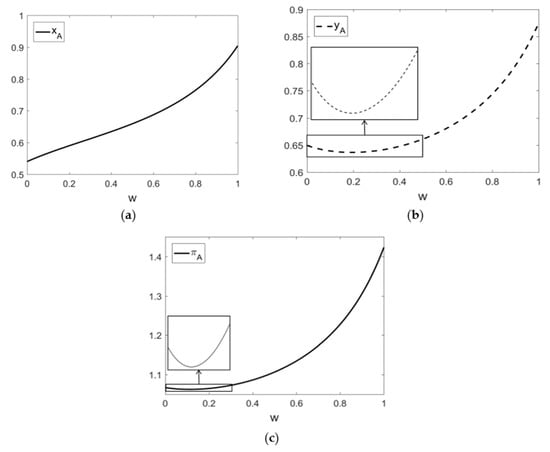
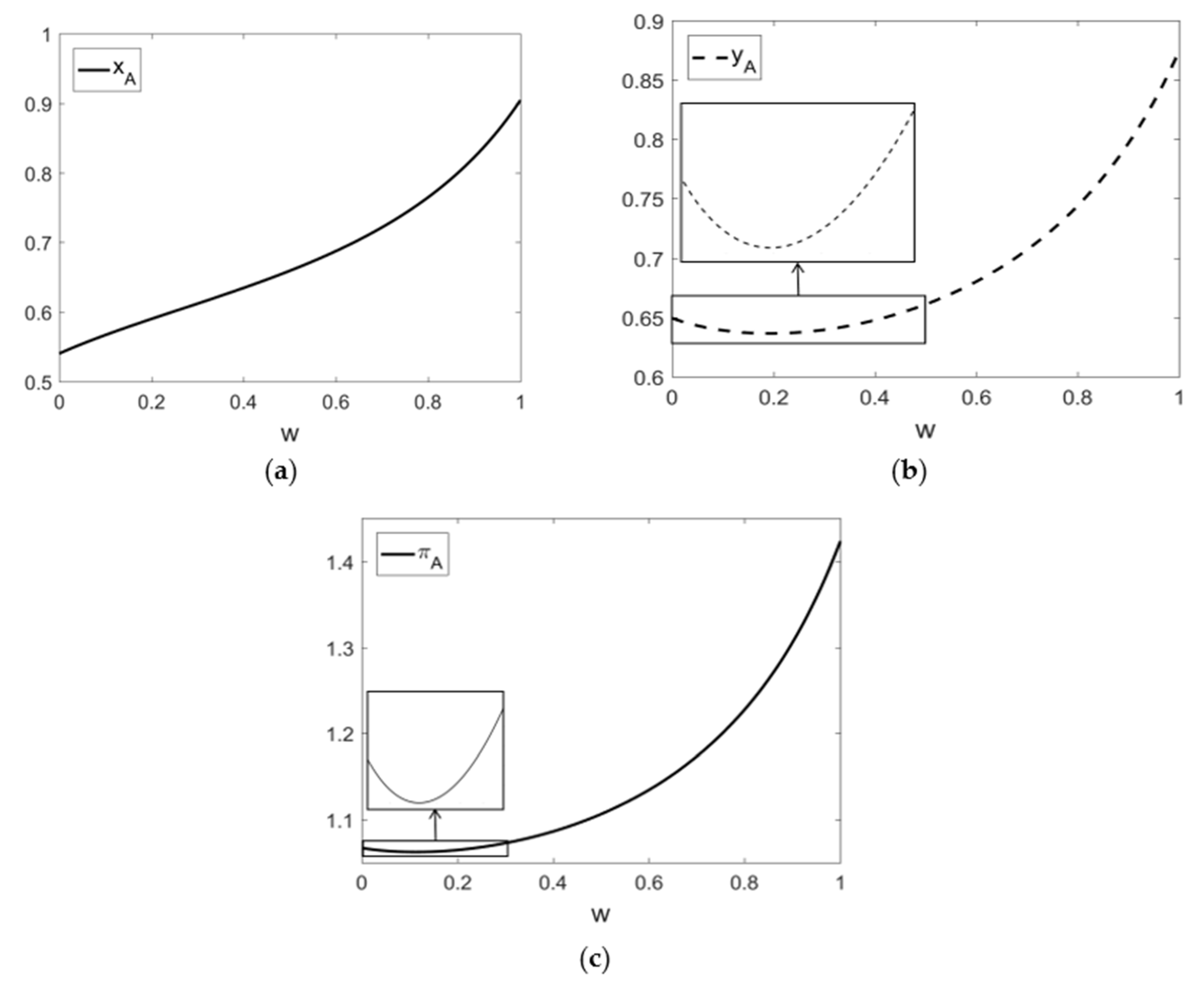
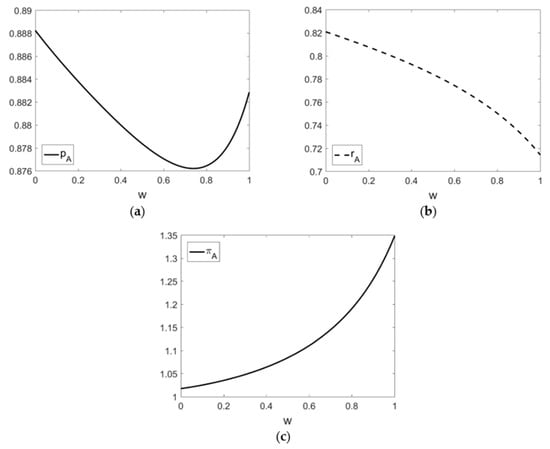
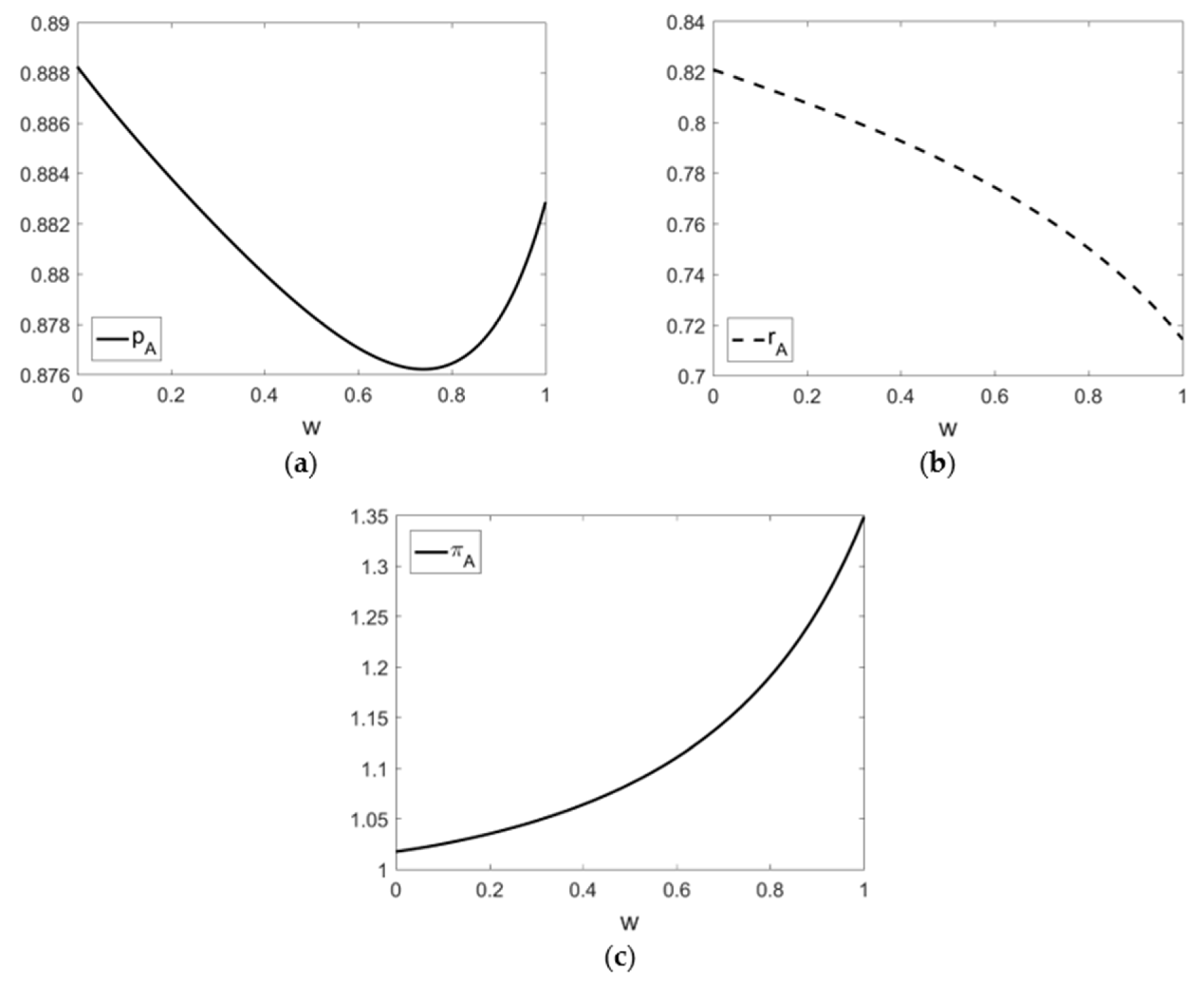
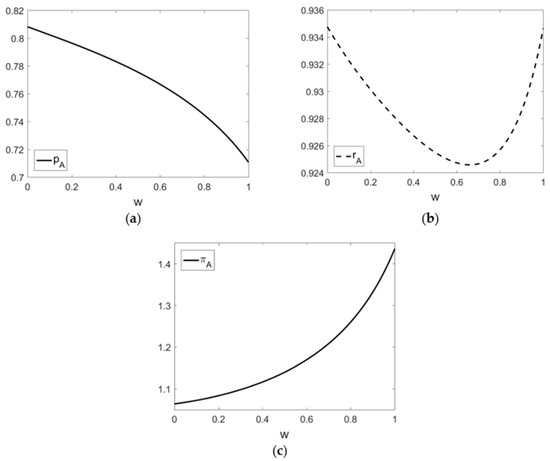
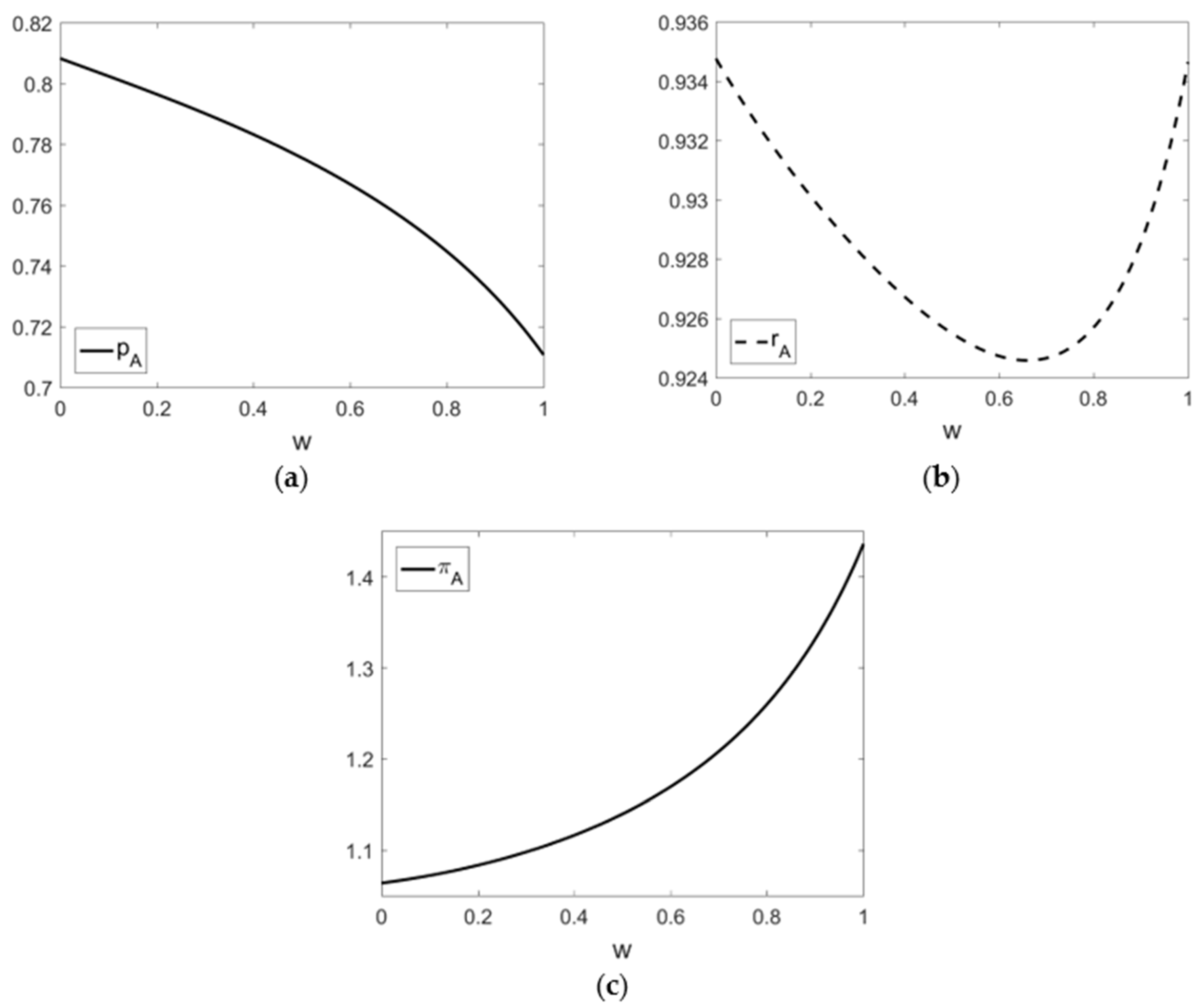
Based on Equations (7)–(12) in Section 3.2 and Section 3.3, this paper conducts a numerical simulation analysis with bilateral partial multi-homing. Expressions for and are obtained by fixing all parameters except w, substituting them into Equations (7)–(10), and solving the system of equations. Inserting and back into Equation (11), and and into Equation (12), yields the profit functions and , respectively. Solving the first-order necessary conditions for interior stationarity obtains expressions for , and in terms of w. Substituting these back into the expressions for candidate user participation and simplifying yields expressions for and as functions of w (The complete calculation process is presented in the Supplementary Material). Using these expressions, this paper simulates the comparative statics of w on candidate user participation, interior stationary pricing, and optimal platform profit. This section primarily analyzes the impact of w on candidate interior stationary solutions across the two types of participants on platform A. The same analysis applies to platform B. To guarantee internal validity, the set of parameters satisfies the second-order sufficiency conditions and the bilateral partial multi-homing constraints, thereby ensuring that all parameters in the numerical analysis strictly fall within the theoretically feasible interior domain. Figure 1, Figure 2, Figure 3 and Figure 4 illustrate the impact of the degree of double-counting network effects (w) on candidate user participation, interior stationary pricing, and optimal platform profit under diverse parametric regimes on platform A with multi-homing on both sides.
Figure 1.
The impact of w when = 0.6, = 1.5, = 1.9, = 2, , = 1. (a) The impact of w on candidate user participation of X on platform A. (b) The impact of w on candidate user participation of Y on platform A. (c) The impact of w on candidate optimal profit of platform A.
Figure 2.
The impact of w when = 1.5, = 0.6, = 1.9, = 2, , = 1. (a) The impact of w on candidate user participation of X on platform A. (b) The impact of w on candidate user participation of Y on platform A. (c) The impact of w on candidate optimal profit of platform A.
Figure 3.
The impact of w when = 1.1, = 0.9, = 1.9, = 2, , = 1. (a) The impact of w on candidate interior stationary pricing of user X on platform A. (b) The impact of w on candidate interior stationary pricing of user Y on platform A. (c) The impact of w on candidate optimal profit of platform A.
Figure 4.
The impact of w when = 0.9, = 1.1, = 2, = 1.9, = 1.6, , = 1. (a) The impact of w on candidate interior stationary pricing of user X on platform A. (b) The impact of w on candidate interior stationary pricing of user Y on platform A. (c) The impact of w on candidate optimal profit of platform A.
As w increases, the candidate participation number of X joining platform A rises monotonically under one parameter setting (Figure 1a). In contrast, it exhibits a U-shaped trajectory, first decreasing and subsequently increasing under alternative parametric conditions (Figure 2a). In addition, the candidate stationary price charged to participants X on platform A traces a U-shaped pattern in Figure 3a, but decreases monotonically in Figure 4a. Participant Y’s candidate user participation and interior stationary pricing respond to variations in w through analogous patterns. Regarding overall platform performance, platform A’s candidate optimal profit follows a U-shaped trajectory with respect to w under the conditions depicted in Figure 1c and Figure 2c, whereas it rises monotonically under the scenarios shown in Figure 3c and Figure 4c.
The baseline framework of Bakos and Halaburda [7] studied the boundary case without double-counting network effects, represented by the points where w = 0 in Figure 1, Figure 2, Figure 3 and Figure 4. The interval w ∈ (0, 1] corresponds to the case where network effects are double-counted. Combining the results from Figure 1, Figure 2, Figure 3 and Figure 4, it can be seen that with partial multi-homing, the effect of w on candidate outcomes exhibits non-monotonic patterns. That is, compared to their findings, the change in candidate user participation, interior stationary pricing, and optimal platform profit does not follow a uniform trajectory.
6. Concluding Remarks
This paper develops a platform competition model with multi-homing and the degree of double-counting network effects (w), systematically examining the impact of w on the candidate interior stationary solution. The findings reveal that when the network effects exceed a critical threshold, the platform’s negative price targeting a specific user side emerges within the candidate interior stationary solution. Through comparative static analyses, this study explores the roles of network effects, transportation costs, and stand-alone intrinsic value in determining candidate user participation, interior stationary pricing, and optimal platform profit. Furthermore, this research delineates how the candidate interior stationary solution responds to changes in the degree of double-counting network effects, providing a numerical simulation to trace interior equilibrium trajectories across continuous shifts in w. By relaxing the baseline assumption that network effects are not double-counted, this paper constructs a more general analytical framework, thereby offering theoretical insights into price-setting incentives and negative candidate stationary price. The main research conclusions of this paper are summarized as follows:
- (1)
- Cross-side demand interdependencies exist between the two types of participants on the same platform with multi-homing and the degree of double-counting network effects. Consequently, the candidate interior stationary pricing for one user side is endogenously linked to that for the counter-side. When the network effects exceed a critical threshold, platforms can obtain higher interior stationary prices on one side by strategically expanding candidate user participation on that side through targeted negative candidate stationary prices.
- (2)
- Network effects, transportation costs, and stand-alone intrinsic value influence the candidate interior outcomes of a two-platform competitive game. The candidate user participation on both sides scales positively with network effects and stand-alone intrinsic value, while diminishing monotonically with transportation costs. When transportation costs or stand-alone intrinsic value change, the direction and magnitude of the response in candidate stationary pricing are contingent upon the degree of double-counting network effects (w).
- (3)
- When the degree of double-counting network effects varies, numerical simulation demonstrates the existence of non-monotonic interior equilibrium patterns of its impact on candidate user participation, interior stationary pricing, and optimal platform profit. Under specific parameter configurations, as w increases, candidate user participation and optimal platform profit exhibit a monotonically increasing or U-shaped trajectory (first declining, then rising), while interior stationary pricing exhibits a monotonically decreasing or U-shaped response.
This study offers a new perspective for understanding competition among two-sided multi-homing platforms by calculating candidate interior stationary solution with varying degrees of double-counting network effects, thereby enriching the micro-foundations for platform interior pricing. Furthermore, for platform managers evaluating multi-homing, this paper provides a strategic framework and guidance based on theoretical mechanisms. When formulating competitive pricing strategies, platforms should evaluate not only users’ multi-homing tendencies, but also network effects and the degree of their double-counting. If the platforms offer highly homogeneous services, managers should follow the advice of Bakos and Halaburda [7] to maintain positive pricing and avert destructive price wars. However, if platforms provide unique incremental value through technological upgrades or differentiated features, a "divide-and-conquer" subsidy strategy remains a rational choice for capturing market share and consolidating a competitive advantage. When making pricing and subsidy decisions, platform operators should take into account specific market micro-structure factors (such as user acquisition costs and financial capacity) to avoid falling into a vicious price war caused by blind subsidies.
The findings of this paper exhibit realistic resonance with contemporary digital platform competition. For example, China’s food delivery market has long been characterized by a duopolistic rivalry between Meituan and Ele.me. Ele.me’s recent structural integration with Alibaba’s Taobao Flash Shopping marks an ecosystem-level evolution in the competitive landscape. Meituan deploys a relatively constrained subsidy strategy to optimize the trade-off between baseline profitability and competitive response. However, Taobao Flash Shopping’s subsidy strategy is more penetrative, offering higher-value coupons with lower usage thresholds to create a short-term price shock. This approach attracts price-sensitive and fringe users on Meituan without obviously eroding merchant-side margins. Here, due to partial multi-homing and double-counting network effects, setting a negative candidate stationary price on a targeted user side emerges as a feasible interior outcome within the delineated parameter region.
This study still has some limitations. Future research could be expanded in the following four areas: First, this study considers two-platform competition. The issue of multi-homing in a multilateral platform setting remains to be discussed. Second, empirical research incorporating econometrics with comprehensive robustness analysis using transaction data from real-world platforms could be conducted to validate and supplement the theoretical findings of this paper. Third, the comprehensive mathematical characterization of the generalized regime where w ∈ [0, 1] requires further in-depth study. Fourth, future work can extend the model by comparing equilibrium profits across single-homing, multi-homing, and non-participation configurations, and formally binding users’ outside option participation constraints.
Supplementary Materials
The following supporting information can be downloaded at https://www.mdpi.com/article/10.3390/math14183258/s1. File S1: Complete calculation process of Numerical Simulation.
Author Contributions
Conceptualization, J.Z. and S.L.; methodology, J.Z. and S.L.; writing—original draft preparation, J.Z. and S.L.; writing—review and editing, J.Z. and S.L.; supervision, S.L.; project administration, S.L.; funding acquisition, S.L. All authors have read and agreed to the published version of the manuscript.
Funding
This research received no external funding.
Data Availability Statement
No new data were created or analyzed in this study. Data sharing is not applicable to this article.
Conflicts of Interest
The authors declare no conflicts of interest.
Appendix A
Proof of Proposition 1.
Substituting w into Equations (7)–(10), the following is obtained:
To ensure the existence of the candidate interior stationary solution, the following conditions should be satisfied:
It follows that, and . The second-order sufficient conditions indicate that high transportation costs and spatial differentiation between platforms can counterbalance the self-reinforcing tendency of network effects. If these conditions are not met, the candidate interior stationary solution loses local validity and the market moves toward tipping or asymmetric boundary outcomes.
When , there are and . Combining these with , yields , therefore
Conversely, the opposite is true. □
Proof of Corollary 1.
The existence of a bilateral partially multi-homing candidate interior stationary solution implies that and hold simultaneously. These two sets of inequalities are equivalent to the following six inequalities:
- (1)
- Solve or , i.e., , to obtain
- (2)
- Solve or , i.e., , to obtain
- (3)
- Solve , i.e., , to obtain
- (4)
- Solve , i.e., , to obtainIn summary, the parameters satisfy the four conditions above. □
Proof of Corollary 2.
From Equation (19), the numerator of is a quadratic function of . From the second-order sufficient conditions, there is , so the denominator is positive. Next, this paper examines the sign of the numerator to determine the range of parameters for which is positive (or negative).
Let C = numerator . Then C , where and are the roots of the quadratic equation C = 0. The discriminant of C is . Solving the quadratic equation C = 0. Its roots are
where and . satisfies the second-order sufficient conditions and the conditions in Corollary 1. Since , when , there is C > 0, so . The candidate interior stationary pricing for participant X on both platforms is positive. When , C < 0, so . The candidate interior stationary pricing for participant X on both platforms is negative.
Similarly, the conditions that the parameters satisfy when the candidate interior stationary prices charged by both platforms to participant Y are either positive or negative can be proven. □
Proof of Corollary 3.
From Equations (15)–(18), taking the partial derivatives of and with respect to and , respectively, yields
□
Proof of Corollary 4.
From Equations (15)–(18), taking the partial derivatives of and with respect to z and q, respectively, yields
Proof of Corollary 5.
From Equations (15)–(18), taking the partial derivatives of and with respect to and , respectively, yields
Proof of Proposition 2.
Substituting w into Equations (7)–(10), the following is obtained:
To ensure the existence of the candidate interior stationary solution, the following conditions should be satisfied:
It follows that, and .
Since , there is . When and , then and . Therefore,
Conversely, the opposite is true. □
Proof of Corollary 6.
Since , it follows that . Based on Equations (23)–(26), together with , solving the same six inequalities as in Corollary 1 yields the four conditions:
- (1)
- Solve or , i.e., , to obtain
- (2)
- Solve or , i.e.,, to obtain
- (3)
- Solve , i.e.,to obtain .
- (4)
- Solve , i.e.,to obtain .
In summary, the parameters satisfy the four conditions above. □
Proof of Corollary 7.
From Equation (27), the numerator of is a quadratic function of . From the second-order sufficient conditions, there is , so the denominator is positive. Next, this paper examines the sign of the numerator to determine the range of parameters for which is positive (or negative).
Let D = numerator . Then D , where and are the roots of the quadratic equation D = 0. The discriminant of D is . Solving the quadratic equation D = 0. Its roots are
where and . satisfies the second-order sufficient conditions and the conditions in Corollary 6. Since , when , there is D > 0, so . The candidate interior stationary pricing for participant X on both platforms is positive. When , D < 0, so . The candidate interior stationary pricing for participant X on both platforms is negative.
Similarly, the conditions that the parameters satisfy when the candidate interior stationary prices charged by both platforms to participant Y are either positive or negative can be proven. □
Proof of Corollary 8.
From Equations (23)–(26), taking the partial derivatives of and with respect to and , respectively, yields
Since , it follows that . Therefore, .
Since , it follows that and . Therefore, . □
Proof of Corollary 9.
From Equations (23)–(26), taking the partial derivatives of and with respect to z and q, respectively, yields
Proof of Corollary 10.
From Equations (23)–(26), taking the partial derivatives of and with respect to and , respectively, yields
References
- Armstrong, M. Competition in two-sided markets. RAND J. Econ. 2006, 37, 668–691. [Google Scholar] [CrossRef] [Scilit]
- Rochet, J.C.; Tirole, J. An economic analysis of the determination of interchange fees in payment card systems. Rev. Netw. Econ. 2003, 2, 69–79. [Google Scholar] [CrossRef] [Scilit][Green Version]
- Saito, Y.; Zhang, Y. Taxing platforms with multi-homing. Math. Soc. Sci. 2026, 139, 102478. [Google Scholar] [CrossRef] [Scilit]
- Parker, G.G.; Van Alstyne, M.W.; Choudary, S.P. Platform Revolution: How Networked Markets Are Transforming the Economy and How to Make Them Work for You; W.W. Norton & Company: New York, NY, USA, 2016. [Google Scholar]
- Gawer, A.; Cusumano, M.A. Industry platforms and ecosystem innovation. J. Prod. Innov. Manag. 2014, 31, 417–433. [Google Scholar] [CrossRef] [Scilit]
- Li, D.; Li, M.; Wei, L.; Nan, J. A novel game approach to price competition and profit-sharing in manufacturing platforms. J. Manag. Sci. China. 2025, 28, 174–190. [Google Scholar] [CrossRef]
- Bakos, Y.; Halaburda, H. Platform competition with multihoming on both sides: Subsidize or not? Manag. Sci. 2020, 66, 5599–5607. [Google Scholar] [CrossRef] [Scilit]
- Poolsombat, R.; Vernasca, G. Partial Multihoming in Two-Sided Markets; Discussion Papers; Department of Economics, University of York: York, UK, 2006. [Google Scholar]
- Xie, J.; Zhu, W.; Wei, L.; Liang, L. Platform competition with partial multi-homing: When both same-side and cross-side network effects exist. Int. J. Prod. Econ. 2021, 233, 108016. [Google Scholar] [CrossRef] [Scilit]
- Tremblay, M.J.; Adachi, T.; Sato, S. Cournot platform competition with mixed-homing. Int. J. Ind. Organ. 2023, 91, 103002. [Google Scholar] [CrossRef] [Scilit]
- Doganoglu, T.; Wright, J. Multihoming and compatibility. Int. J. Ind. Organ. 2006, 24, 45–67. [Google Scholar] [CrossRef] [Scilit]
- Li, H.; Zhu, F. Information transparency, multihoming, and platform competition: A natural experiment in the daily deals market. Manag. Sci. 2021, 67, 4384–4407. [Google Scholar] [CrossRef] [Scilit]
- Chellappa, R.K.; Mukherjee, R. Platform preannouncement strategies: The strategic role of information in two-sided markets competition. Manag. Sci. 2021, 67, 1527–1545. [Google Scholar] [CrossRef] [Scilit]
- Foros, Ø.; Kind, H.J.; Stähler, F. Endogenous multihoming and network effects: Playstation, Xbox, or both? Manag. Sci. 2025, 71, 2993–3012. [Google Scholar] [CrossRef] [Scilit]
- Jullien, B.; Sand-Zantman, W. The economics of platforms: A theory guide for competition policy. Inf. Econ. Policy 2021, 54, 100880. [Google Scholar] [CrossRef] [Scilit]
- Chao, Y.; Derdenger, T. Mixed bundling in two-sided markets in the presence of installed base effects. Manag. Sci. 2013, 59, 1904–1926. [Google Scholar] [CrossRef] [Scilit]
- Casadesus-Masanell, R.; Zhu, F. Strategies to fight ad-sponsored rivals. Manag. Sci. 2010, 56, 1484–1499. [Google Scholar] [CrossRef] [Scilit]
- Chan, L.T. Divide and conquer in two-sided markets: A potential-game approach. RAND J. Econ. 2021, 52, 839–858. [Google Scholar] [CrossRef] [Scilit]
- Lin, X.; Zhou, Y.W.; Xie, W.; Zhong, Y.; Cao, B. Pricing and product-bundling strategies for e-commerce platforms with competition. Eur. J. Oper. Res. 2020, 283, 1026–1039. [Google Scholar] [CrossRef] [Scilit]
- Weyl, E.G. A price theory of multi-sided platforms. Am. Econ. Rev. 2010, 100, 1642–1672. [Google Scholar] [CrossRef] [Scilit]
- Dou, Y.; Wu, D.J. Platform competition under network effects: Piggybacking and optimal subsidization. Inf. Syst. Res. 2021, 32, 820–835. [Google Scholar] [CrossRef] [Scilit]
- Athey, S.; Calvano, E.; Gans, J.S. The impact of consumer multi-homing on advertising markets and media competition. Manag. Sci. 2018, 64, 1574–1590. [Google Scholar] [CrossRef] [Scilit]
- Lin, S. Two-sided price discrimination by media platforms. Mark. Sci. 2020, 39, 317–338. [Google Scholar] [CrossRef] [Scilit]
- Cennamo, C. Competing in digital markets: A platform-based perspective. Acad. Manag. Perspect. 2021, 35, 265–291. [Google Scholar] [CrossRef] [Scilit]
- Sui, R.; Liu, M.; Liu, Y.; Zha, X. Two-sided dynamic pricing and value-added service investment strategies of competitive platforms considering indirect network effects. Int. J. Prod. Econ. 2024, 272, 109262. [Google Scholar] [CrossRef] [Scilit]
- Bourreau, M.; Raizonville, A.; Thébaudin, G. Interoperability Between Ad-Financed Platforms with Endogenous Multi-Homing. J. Ind. Econ. 2026, 74, 197–215. [Google Scholar] [CrossRef] [Scilit]
- Adachi, T.; Sato, S.; Tremblay, M.J. Platform oligopoly with endogenous homing: Implications for mergers and free entry. J. Ind. Econ. 2023, 71, 1203–1232. [Google Scholar] [CrossRef] [Scilit]
- Chellappa, R.K.; Mukherjee, R. Ecosystem competition: Platforms, subsidiary markets and multihoming in the videogames industry. Inf. Syst. Res. 2026. [Google Scholar] [CrossRef] [Scilit]
- Bryan, K.A.; Gans, J.S. A theory of multihoming in rideshare competition. J. Econ. Manag. Strategy 2019, 28, 89–96. [Google Scholar] [CrossRef] [Scilit]
- Teh, T.H.; Liu, C.; Wright, J.; Zhou, J. Multihoming and oligopolistic platform competition. Am. Econ. J. Microecon. 2023, 15, 68–113. [Google Scholar] [CrossRef] [Scilit]
- Li, C.; Huang, Z. Subsidy strategy of pharmaceutical e-commerce platform based on two-sided market theory. PLoS ONE 2019, 14, e0224369. [Google Scholar] [CrossRef] [Scilit]
- Pasquier, N. Competing Ecosystems and Quality Investment; GAEL Working Paper No. 2026-03; Grenoble Applied Economics Laboratory (GAEL): Saint-Martin-d’Hères, France, 2025. [Google Scholar]
- Jacobides, M.G.; Cennamo, C.; Gawer, A. Towards a theory of ecosystems. Strateg. Manag. J. 2018, 39, 2255–2276. [Google Scholar] [CrossRef] [Scilit]
- Li, Y. Characterising ecosystem power: The use of pricing and contractual leverages. Utrecht Law Rev. 2025, 21, 4–18. [Google Scholar] [CrossRef] [Scilit]
- Wu, X.; Jiang, L.; Zhao, X. Managing quality on two-sided platforms in the presence of provider competition. Manuf. Serv. Oper. Manag. 2025, 27, 1532–1550. [Google Scholar] [CrossRef] [Scilit]

Disclaimer/Publisher’s Note: The statements, opinions and data contained in all publications are solely those of the individual author(s) and contributor(s) and not of MDPI and/or the editor(s). MDPI and/or the editor(s) disclaim responsibility for any injury to people or property resulting from any ideas, methods, instructions or products referred to in the content. |
© 2026 by the authors. Licensee MDPI, Basel, Switzerland. This article is an open access article distributed under the terms and conditions of the Creative Commons Attribution (CC BY) license.