


Abstract
In previous work, Wazzan, together with Gilbert, established a connection between the -Zappa–Szép product of bands and groups and Billhardt’s -semidirect product of inverse semigroups using automata-theoretic methods. Motivated by the need for a structural and transparent interpretation of this correspondence, we present an alternative proof based on the Ehresmann–Schein–Nambooripad theorem. The approach reformulates the construction through the associated inductive groupoid and makes the matched-pair actions explicit, so that the interaction between the band component and the group component can be followed directly at the level of arrows, identities, and composition. Within this framework, several structural features of the resulting product are clarified, including regularity, idempotents, inverse-type behavior, orthodoxness, -unipotence, and the connection with semidirect products. The paper also consolidates related intermediate results into a unified proof route and illustrates the construction by examples and schematic figures. This groupoid-based viewpoint provides a conceptually motivated treatment of the -Zappa–Szép product and highlights its role as a bridge between matched-pair decompositions, bands and groups, and inverse semigroup theory.
MSC:
18B40; 20F05; 20M05; 20M18; 20L17
1. Introduction
The theory and applications of Zappa–Szép products have seen substantial development in recent years, particularly within the domains of algebra, category theory, and operator algebras. These advancements highlight the structural richness and versatility of Zappa–Szép constructions, positioning them as a unifying framework across multiple areas of modern mathematics. In semigroup theory, Zenab [1] studied the algebraic properties of Zappa–Szép products with semilattices and restriction semigroups, demonstrating that the restriction semigroup can be intrinsically embedded into the product structure under certain assumptions. Another foundational workload has been produced by Özalan [2], in which the author Introduces a new semigroup structure, which is a generalization of a Rees matrix semigroup and that of a completely zero-simple semigroup. This framework sets the stage for the exploration of new theoretical developments in the study of Zappa–Szép products. In the -algebra category, Brownlowe et al. [3] studied Zappa–Szép products of étale groupoids, where the groupoid -algebra of the product can also be realized as a a -blend, subsuming all of the -algebras of the groupoids. In another direction, Duwenig and Li [4] defined the concept of Zappa–Szép product twists on paired groupoids and established the connection between this intermediate representation and twisted groupoid -algebras. Categorical viewpoints also appear in Mundey and Sims’ work [5] where they constructed a spectral sequence to compute the homology of Zappa–Szép products of small categories to combine homological algebra and self-similar groupoid dynamics. Zaman [6] studies the organization of left P-Ehresmann and right Ehresmann semigroups, presents the concept of -semidirect product as a generalization of the semidirect product. The article represents a link between above mentioned families of semigroups, and Zappa–Szép products, and brings new information about semigroups to semigroup and category theory. In a closely related development, DeWolf and Pronk [7] generalize the Ehresmann–Schein–Nambooripad (ESN) Theorem to inverse categories and prove that inverse categories are equivalent as categories to locally complete inductive groupoids. Their research emphasizes general combinations of the ESN theorem that originally connected inverse semigroups and groupoids, that is inverse categories: so the importance of the ESN theorem is growing in algebraic structures, topology and computer science. Altogether, these works exemplify the increased relevance of Zappa–Szép products as a unifying notion in algebraic structures, category theory, and functional analysis, of which categorical techniques, particularly those that employ monoids (semigroups), seem to be the main focus.
1.1. Literature Position and Contribution
Classical Zappa–Szép products originate in the study of group factorisations developed by Zappa [8] and Szép [9]. They generalise both direct products and semidirect products: in a direct product both components act trivially, while in a semidirect product only one component acts non-trivially. In a Zappa–Szép product both components act on each other through compatible actions, and this two-sided interaction is precisely what makes the construction useful for decompositions beyond the semidirect case. The semigroup version was developed systematically by Kunze [10], and Brin [11] later emphasized the flexibility of the construction for groups, monoids, and categories.
For the present paper, the central point of departure is the work of Gilbert and Wazzan [12], where Zappa–Szép products of bands and groups were related to Billhardt’s -semidirect products of inverse semigroups. Their approach uses automata-theoretic methods and identifies a suitable inverse-semigroup component inside the Zappa–Szép product. Subsequent work of Gould and Zenab [13] placed -Zappa–Szép constructions in the broader setting of restriction semigroups, while Zenab [1], Brownlowe et al. [3], and recent groupoid and categorical treatments [4,5,14] show that Zappa–Szép products remain an active tool across semigroup theory, groupoids, category theory, and operator-algebraic constructions.
1.2. Automata-Theoretic Origin of the Construction
Since the construction studied here traces back to the automata-theoretic approach of Gilbert and Wazzan [12], we record more explicitly how the Zappa–Szép compatibility axioms are related to Mealy-type automata and to self-similar actions. This also clarifies the relationship between the earlier automata-theoretic construction and the inductive-groupoid approach used in the present paper.
Let
be a Zappa–Szép product of semigroups A and S, with structure maps
Following the interpretation used in [12], one may regard S as the state set of a Mealy-type algebraic automaton whose input and output set is A. Define
and
Thus, when the automaton reads an input from a state , it produces the output and moves to the new state . Symbolically, the transition is
The Zappa–Szép axioms express the compatibility of this state/output mechanism with multiplication in A and S. To see this, suppose that two inputs are processed successively from the state s. Processing a first produces the output and changes the state to . Processing from this new state then produces
and changes the state to
Consequently, compatibility between successive processing and the single input is expressed precisely by
and
Thus (SS2) and (SS3) describe what Gilbert and Wazzan call the serial processing of inputs.
There is an analogous compatibility with multiplication of states. For and , the identities
and
show that processing an input by the composite state is consistent with successive processing by t and s, together with the corresponding update of the state component. These are the sequential-processing identities in the automata-theoretic description of [12]. Hence the four central Zappa–Szép axioms may be interpreted as the algebraic consistency conditions for the input/output and state-transition operations.
In the band–group situation considered in the present paper, we specialize to
Accordingly, an element plays the role of a state and plays the role of an input, so that
The two matched-pair maps therefore have distinct automata-theoretic roles: records the transformed input, while records the state retained after the interaction.
This recursive structure is closely related to self-similar group and semigroup actions. In the classical self-similar setting, where the underlying inputs are words in a free monoid, the action of a state on a word is determined recursively by its action on the first letter together with the restriction of that state to the remaining word. The roles of these two operations are played here by ▷ and ◁, respectively. This connection between automata, rooted-tree actions and self-similar groups is developed in [15,16], while the relationship between self-similar actions and Zappa–Szép-type monoid factorisations is treated in [17,18]. More general Zappa–Szép constructions associated with self-similar actions and categorical structures are also considered in [5,11].
For the inverse-semigroup construction, Gilbert and Wazzan [12] subsequently use a second, equivalent automata description adapted to the Billhardt construction. In the semilattice–group case , they pass to a -automaton whose state set is E and whose input/output set is G. With their notation, a transition from has the form
where
The Billhardt subautomaton consists precisely of those transitions for which input and output coincide,
Using the relation above, this is equivalent to
which, in the matched-pair notation adopted in the present paper, is the condition
Thus the -condition defining
has a direct automata-theoretic interpretation: it selects the transitions of the Billhardt automaton for which the input and output group elements agree.
The present paper starts from the same matched-pair data but reorganizes them in a different way. Rather than using the automaton to establish the inverse-semigroup multiplication directly, we regard the elements satisfying the -condition as arrows of a groupoid. The source and target maps, inverses, partial order, restrictions and corestrictions are then determined explicitly. After showing that the ordered groupoid is inductive, the Ehresmann–Schein–Nambooripad correspondence yields the inverse-semigroup multiplication as the associated pseudoproduct. Thus the automata-theoretic and groupoid approaches do not define two different products; rather, they provide two complementary descriptions of the same matched-pair interaction. The former emphasizes state transitions and recursive processing, whereas the latter emphasizes arrows, restrictions, order and the categorical origin of the inverse-semigroup structure. In the automata-theoretic construction of [12], the Billhardt subautomaton retains precisely those transitions for which input and output coincide. Under the matched-pair notation used here, this condition becomes
Thus the defining -condition should be understood as an input–output equality condition, rather than as a return-to-identity condition.
Table 1 summarizes the correspondence relevant to the Billhardt subautomaton and the groupoid construction used below.
Table 1.
Correspondence between the automata-theoretic description of the Billhardt construction and the ordered-groupoid description of the -Zappa–Szép construction.
The present paper goes beyond a reformulation of the results in [12,14] and provides a distinct structural extension of those works. In [12], the -Zappa–Szép construction for bands and groups is obtained mainly through automata-theoretic and direct algebraic arguments, whereas the present approach reconstructs the inverse-semigroup structure from an explicitly defined ordered groupoid and derives the multiplication through the Ehresmann–Schein–Nambooripad correspondence. In particular, we introduce the relevant partial order, verify the ordered-groupoid axioms and restriction properties, and show that the resulting structure is an inductive groupoid; the inverse-semigroup multiplication then arises naturally as the associated pseudoproduct. This changes the nature of the argument from a direct verification of formulas to a structural explanation of why the construction has inverse-semigroup behavior. Moreover, the matched-pair formulation makes the two actions ▷ and ◁ explicit throughout the construction and allows the natural order, restrictions, idempotents, inverses, Green relations, factorisability, orthodoxness, unit-regularity, and L-unipotency to be studied within one coherent framework. Thus, the contribution of this paper is not merely an alternative computation of previously known formulas, but a new ESN-based proof route and a unified groupoid-theoretic interpretation that connects, extends, and clarifies the earlier approaches of [12,14].
A key challenge in the structural theory of inverse semigroups is constructing them from simpler algebraic components. In this context, traditional methods, such as the classical semidirect product, often fall short, as the product of two inverse semigroups does not generally yield another inverse semigroup. Bernd [19] addressed this issue by reformulating semidirect products in a complementary manner, introducing a new construction he termed the -semidirect product. This innovative transformation ensures that the resulting structure retains its inverse properties.
Definition 1
([19] Billhardt’s semidirect product). Let T operate on S by endomorphisms and define equipped with the binary operation defined by
The result which justifies this definition is the following.
Proposition 1
([19]). Let S and T be inverse semigroups such that T operates on S by endomorphisms. Then is an inverse semigroup.
A semidirect product of semigroups is a specific case of a Zappa–Szép product where one of the structure maps is trivial. Semidirect products involving bands and groups are crucial in the structural theory of inverse semigroups. As such, the study of Zappa–Szép products formed from bands and groups is particularly significant, given their role in understanding the algebraic framework of inverse semigroups. Consequently, this opens the door to a broader theoretical framework. Motivated by these findings, our objective in [12] was to establish a connection between the construction of Zappa–Szép products of bands and groups (as derived from automata theory) and the -semidirect product of inverse semigroups introduced by Billhardt. Specifically, we aimed to generalize Billhardt’s -semidirect products to encompass Zappa–Szép product structures. This involves identifying a component of a Zappa–Szép product of a band and a group, whose binary operation can be transformed into a proper operation, thereby qualifying it as an inverse semigroup.
Theorem 1
([12]). If where B is a band and G is a group, then
yields an inverse semigroup equipped with the following multiplication:
The Ehresmann–Schein–Nambooripad (ESN) Theorem [20], (Theorem 4.1.8) is fundamental in the investigation of inverse semigroups and asserts that there is a categorical equivalence between inverse semigroups and inductive groupoids. This correspondence not only gives a deep understanding of the structure of partial symmetries, but also establishes a link between the algebraic and categorical points of view. The theorem has wide applicability in many fields of mathematics, such as topology, category theory, and theoretical computer science (in particular in modeling partial transformations). On the basis of the rich content and practical usability of this result many generalizations have been worked out. For instance, Hollings [21] generalized the theorem to inverse categories, which are connected to locally complete inductive groupoids, and Stokes [22] obtained similar results for bi-unary semigroups related to biaction categories. Later contributions by Wang [23], and Lawson [24], also considered Ehresmann semigroups, and their relationship with Ehresmann categories. Furthermore, ESN has played a key role in applications as the construction of étale groupoids associated to inverse semigroups [25] (Section 4.2), and the study of Galois-type correspondences between semigroup operations on rings [26] (Chapter 5). Such varied applications attest to the theorem’s versatility and foundational nature as well as its driving force in both theoretical and applied research on algebraic and categorical structures.
1.3. Relation to the Recent One-Sided ESN Framework
A recent development relevant to the present construction is the Ehresmann–Schein–Nambooripad-type theorem for left restriction semigroupoids established by Haag, Lautenschlaeger and Tamusiunas [27]. Their approach develops a one-sided version of the ESN philosophy by relating left restriction semigroupoids to locally inductive constellations. This provides a categorical framework for structures having a partially defined multiplication together with a one-sided restriction operation, and also includes inverse-semigroupoid structures as an important special case.
The relation with the construction considered in the present paper can be made explicit. Let
denote the groupoid obtained from the -Zappa–Szép data in Section 2. Since is a groupoid, every arrow possesses an inverse . Consequently, one may define
With the convention for composition adopted in the present paper, is the identity associated with the source of x, and
Thus the groupoid arising from the -Zappa–Szép construction carries the canonical one-sided restriction structure associated with an inverse semigroupoid. In this sense, the groupoid constructed here lies within the inverse-semigroupoid specialization of the framework developed in [27].
This observation shows that the present construction is compatible with the recent one-sided ESN framework once the -Zappa–Szép groupoid has been established. The natural order, identities, and restriction operations appearing in our ordered-groupoid construction may therefore also be viewed through the corresponding one-sided categorical structure.
There is, however, an important distinction between the two approaches. The present paper begins with the matched-pair maps
constructs the corresponding groupoid, introduces its natural partial order, proves that the identities form a meet-semilattice, and then shows that the resulting ordered groupoid is inductive. The classical Ehresmann–Schein–Nambooripad correspondence is subsequently applied to recover the inverse-semigroup multiplication as the associated pseudoproduct. In particular, the multiplication obtained in Theorem 4 is derived from the inductive-groupoid structure itself.
By contrast, the framework of [27] starts with a left restriction semigroupoid already equipped with a unary restriction operation
and a partially defined multiplication satisfying the corresponding one-sided restriction axioms. Therefore, the ESN-based proof developed in the present paper does not extend verbatim to an arbitrary left restriction semigroupoid. A genuine extension of the -Zappa–Szép construction to that setting would require additional compatibility conditions relating the matched-pair actions ▷ and ◁ to the unary restriction operation and to the partially defined semigroupoid composition.
The recent one-sided ESN framework nevertheless suggests a natural direction in which the present construction could be generalized. In particular, it is closely related in spirit to the restriction-semigroup treatment of -Zappa–Szép products developed by Gould and Zenab [13]. Their work places the -Zappa–Szép construction in a broader restriction setting, whereas the present paper works in the inverse-semigroup case obtained from an inductive groupoid. It would therefore be natural to investigate whether the matched-pair construction considered here can be formulated directly within the locally inductive constellation framework.
Thus the one-sided ESN theorem does not replace the classical ESN correspondence required for the inverse-semigroup construction proved here. Rather, it provides a broader categorical setting in which the groupoid obtained in the present paper can be interpreted and suggests a natural framework for future one-sided and multi-object generalizations of -Zappa–Szép products. Driven by the significance of the Ehresmann–Schein–Nambooripad (ESN) Theorem, we offer an alternative proof and conceptual framework for the -Zappa Szép product involving bands and groups—arising via automata theory. Our method adopts a categorical viewpoint grounded in the ESN theorem.
The paper is organized as follows. Section 1 introduces the matched-pair notation and recalls the basic definitions of Zappa–Szép products needed throughout the paper. Section 2 develops the main algebraic properties of Zappa–Szép products of bands and groups and establishes the structural results required for the inverse-semigroup construction. In particular, we construct the associated groupoid, introduce the relevant partial order, prove that the resulting ordered groupoid is inductive, and then apply the Ehresmann–Schein–Nambooripad theorem to obtain the inverse-semigroup structure. Section 2 also includes examples illustrating the construction in both finite and wreath-product settings and showing explicitly how the abstract theory can be applied. Finally, Section 3 summarizes the main conclusions of the groupoid-theoretic approach, discusses its relationship with the earlier results, and indicates possible directions for further research.
We now present the key definitions that serve as the basis for the rest of the article.
Definition 2.
Suppose that A and B are monoids. The Zappa–Szép product is defined on the set equipped with:
- A left structure map written
- A right structure map written
Which satisfy the following compatibility axioms first formulated by G. Zappa [8] for all and for all
- (SS1)
- (SS2)
- (SS3)
- (SS4)
- (SS5)
- (SS6)
- (SS7)
- (SS8)
This structure defines a Zappa–Szép product , where the multiplication is given by:
Definition 3.
Let ϑ be a groupoid with partial order ≤. Then is said to be an ordered groupoid if the following conditions are satisfied:
- (OG1)
- Whenever , the inverses satisfy ; that is, the ordering is preserved under inversion.
- (OG2)
- If and and both compositions and are defined, then it follows that ; in other words, the order is compatible with composition.
- (OG3)
- Let and suppose there exists an identity element such that . Then, there exists a unique element, denoted by , satisfying and
- (OG3)*
- Similarly, for any and identity b such that there exists a unique element, written satisfying andIt is shown in [20] that is a consequence of and and may be expressed as: An ordered groupoid is said to be inductive c if the set of identity elements forms a meet-semilattice under ≤.
Definition 4.
Let be a Zappa–Szép product, where A is a monoid and B is a group, with structure maps
satisfying the compatibility conditions (SS1)–(SS8). The λ-Zappa–Szép product is the subset
equipped with the restricted multiplication inherited from ℘.
We consider the following special case of Zappa–Szép product construction introduced in [14], where a band and a group, and subset of the Zappa–Szép product
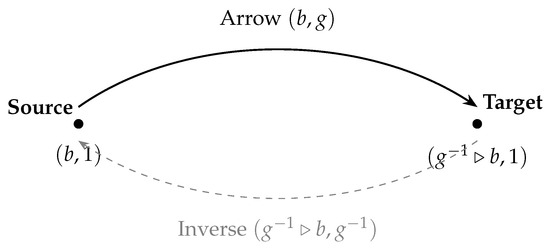
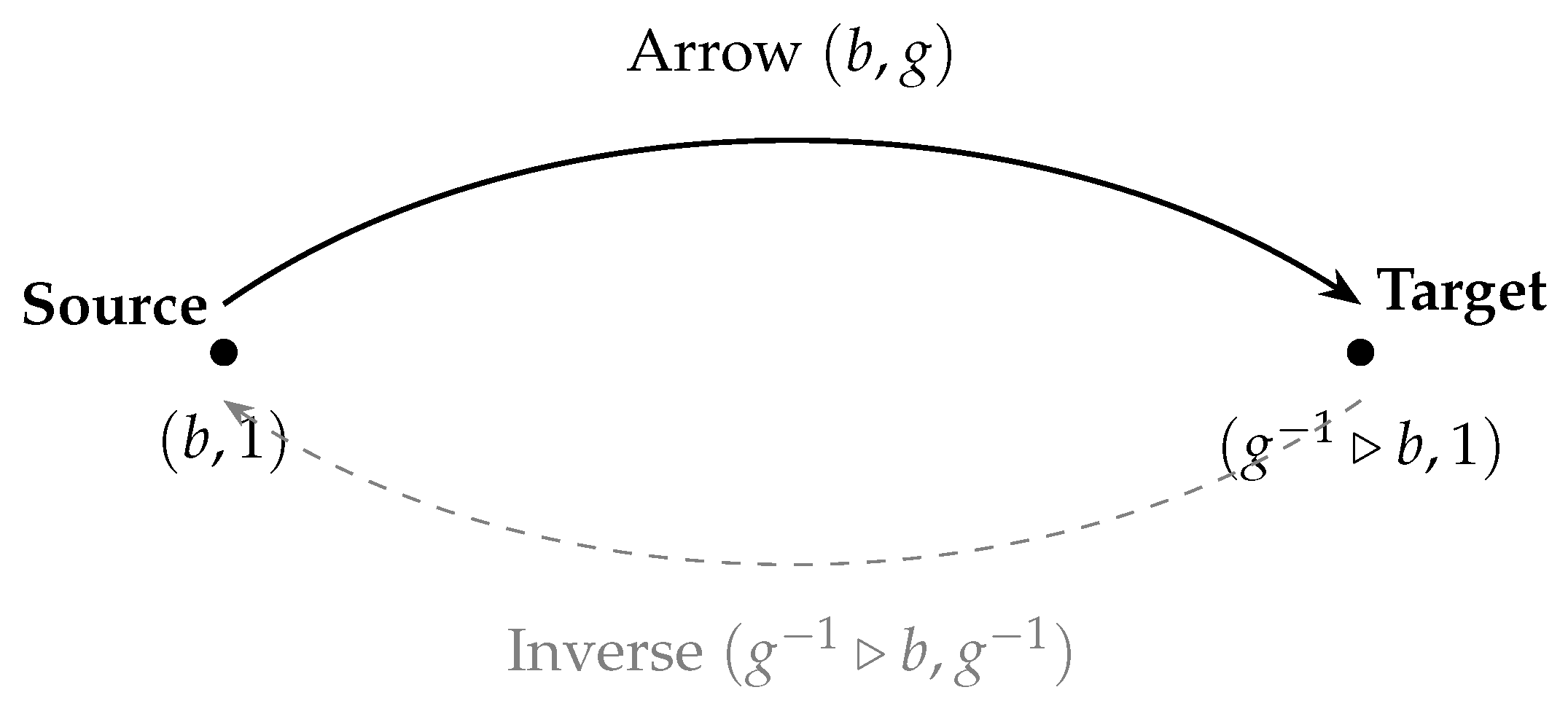
This subset forms the arrow set of a groupoid constructed from the structure map of G on B with the following structure and display in Figure 1:
Figure 1.
Visualization of an arrow in the Zappa–Szép groupoid.
- Vertex set: B;
- Arrow set: ;
- Source and target: an arrow starts at finishes at
- Inverse: the inverse of the arrow is
- Identity: the identity arrow at b is and
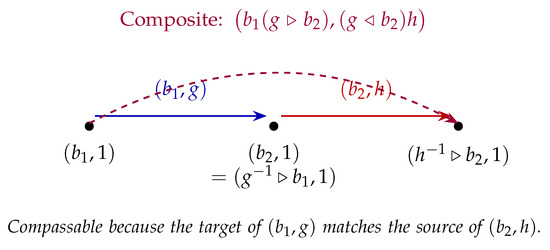
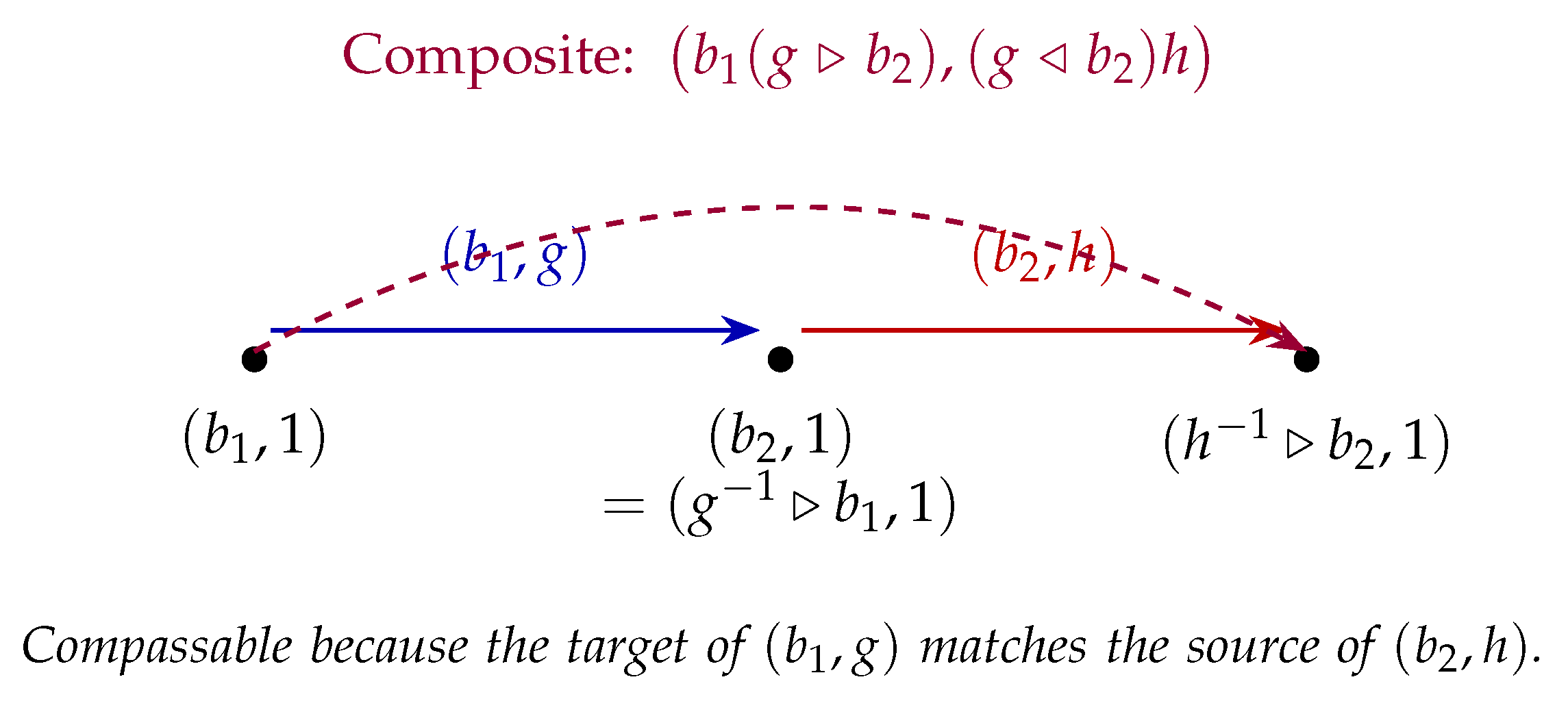
- Composition: arrows and are compassable if and only if , which produces the composite arrow
The set of identities of the groupoid is
We denote by
We note that as in our general Zappa–Szép product the composition of compassable arrows in is just the Zappa–Szép composition. This perspective recuperates Theorem 4.3 in [12] and provides insight into numerous induced identities {like Equation (4.8)} in terms of groupoids. Since these results can be somewhat abstract or nonintuitive, we complement the above general procedure with a specific example that demonstrates how the Zappa–Szép interaction rules are retrieved from the underlying structure of B and G, which gives a simpler way to form the inverse semigroup. We refer the reader to [14] for a comprehensive treatment of the correspondence between inductive groupoids and inverse semigroups, including methods for constructing one from the other. In Section 2 some arithmetic of Zappa–Szép product of a band B and a group G are given: It is regular semigroup with ; with if B has an identity then ℘ is unit-regular, and if B is a semilattice then ℘ is orthodox and -unipotent; is E-unitary inverse if and only if ℘ is the semidirect product of the band B and the group G; If B is a semilattice with identity then ℘ is covered by . We refer to [28,29] for some of the properties of -unipotent semigroups, noting that a right inverse semigroup in [29] is a left inverse semigroup in [28]. For this reason we have preferred the term -unipotent following Clifford [30].
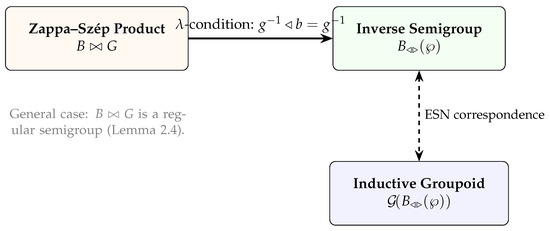
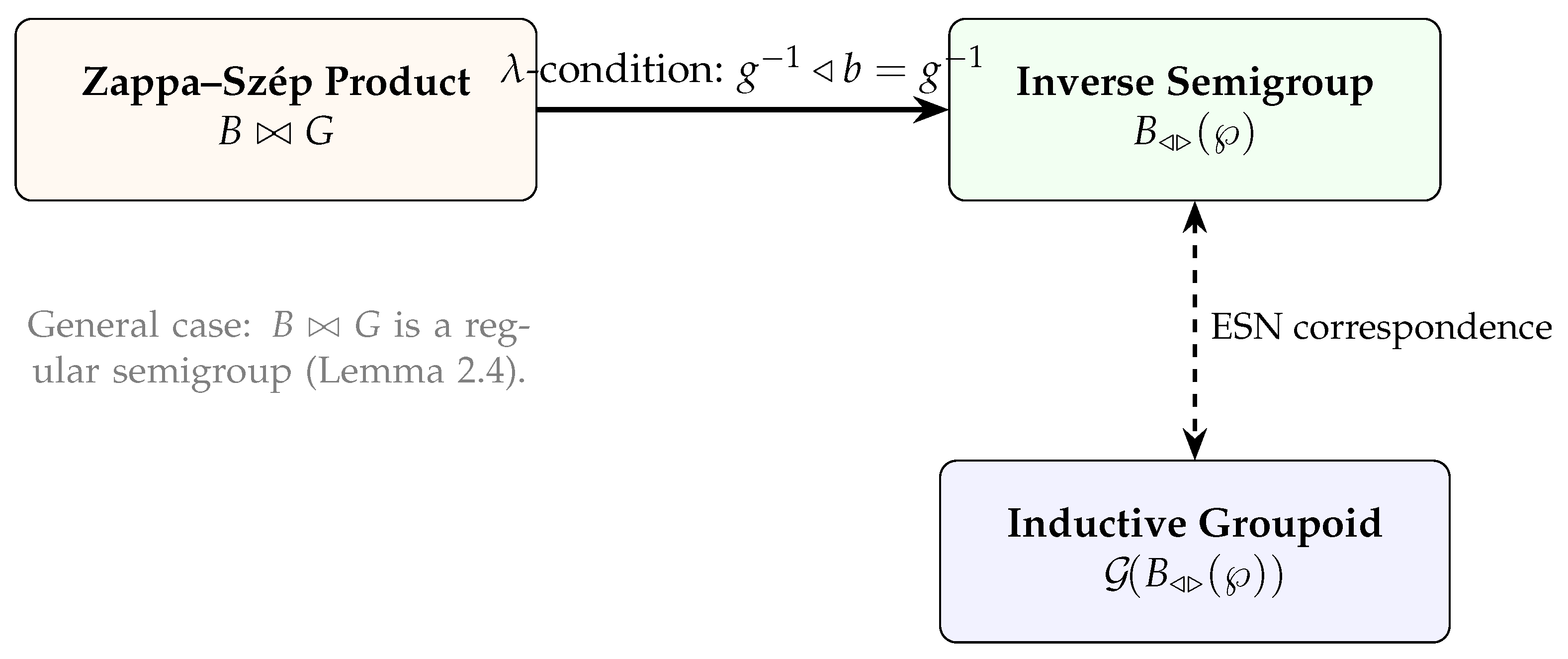
The main construction followed in the sequel is summarized in Figure 2. The diagram emphasizes that the proof does not rely only on element-wise computations; instead, the matched-pair actions are used to pass from the band–group interaction to the associated Zappa–Szép product and then to the corresponding inverse semigroup through the groupoid viewpoint.
Figure 2.
Structural transition from a Zappa–Szép product to the -Zappa–Szép inverse semigroup. Imposing the -condition selects the relevant subset, while the Ehresmann–Schein–Nambooripad correspondence identifies the resulting inverse-semigroup structure with its associated inductive groupoid.
2. The Arithmetic of Zappa–Szép Products of Bands and Groups
This section examines the algebraic structure of the Zappa–Szép product Zappa–Szép product formed from a band B and a group G. We consider left and right structure maps of G on B, denoted by and , respectively, and assume that they satisfy the compatibility conditions (SS1)–(SS7). At this stage, condition (SS8) is not assumed; Lemma 1 (1) shows that it follows automatically in the present group setting. Our focus is on how the structural features of the band and the group interact within the combined product ℘. We analyze properties such as element regularity, the behavior of inverses and idempotents, -unipotent, and unit-regular. The results established here form a foundational toolkit for further exploration of Zappa–Szép constructions in semigroup theory. Recall that a band B is a semigroup of idempotents. The natural partial order on a band is defined by if and only if . This order is fundamental in understanding the structure of bands and their interaction with groups via Zappa–Szép products. We begin with a key lemma that will be referenced throughout the sections.
Lemma 1.
Let B be a band and G a group, and suppose that there are structure maps
satisfying the Zappa–Szép compatibility conditions required below, with (SS8) not assumed. Suppose in particular that
Then the following hold:
- (1)
- for every . Hence condition (SS8) follows automatically in this setting.
- (2)
- For all , :
- (3)
- Let with , where ≤ denotes the natural partial order on the band B, that is,Then, for every ,andIn particular, ifthen
- (4)
- Suppose, in addition, that B is a semilattice. Then, for every and with ,In particular, ifthen
Proof.
For part (1), let and . Using the compatibility condition for the right structure map and the identity , we obtain
Since G is a group, cancellation gives
Thus (SS8) follows from the remaining assumptions.
Using part (1), we compute
and hence
Thus (2) is achieved.
Let with , and let . Since , we have
Using axiom (SS2), we obtain
This proves the first identity.
To prove the second identity, put
By (SS1) and (SS5),
Hence, again by (SS1),
Since B is a band, . Therefore, by (SS2),
We now compute the group element . By (SS4),
Since and , axiom (SS3) gives
Moreover, by part (2),
Consequently,
It follows from (SS5) that
Substituting and yields
which is the second required identity.
Finally, if , then
Therefore the second identity becomes
as required.
Assume that B is a semilattice and let . Set
By part (3),
and
Since B is a semilattice, its multiplication is commutative and idempotent. The equality implies
On the other hand,
so
Hence, by antisymmetry of the natural order,
Therefore,
If, in addition, , then
Consequently,
□
Remark 1.
Lemma 1 (1) shows that, when the second component is a group, axiom (SS8) is redundant under the stated compatibility assumptions: it follows from by cancellation in G. Thus, in this particular setting, (SS8) need not be imposed independently.
We examine the arithmetic of Zappa–Szép products of bands and groups, focusing on how the structure of each component influences the product through their structure maps. A simple portmanteau construction introduces the structural analysis that follows. For each , define the stabilizer of b under the left structure map by
By (SS1) and (SS5), is a subgroup of G. Indeed, , and if , then
Moreover, if , then
so .
Proposition 2.
Let be a Zappa–Szép product of a band B and a group G, with structure maps
For each , define
Then is a subgroup of G. Define
Then the following statements hold.
- 1.
- For every , the mapis a group homomorphism.
- 2.
- Let , , and putThenMoreover, for every ,
- 3.
- If is injective, thenis injective for every .
- 4.
- For each , defineThen the maps are injective for all if and only iffor every and every .
Proof.
Also, byLemma 1 (1),
Thus is a group homomorphism.
For , we have
Consequently,
Let and suppose that
By part (2),
Canceling in G gives
Since
and is injective, we obtain
Hence
Therefore is injective.
By Lemma 1 (1),
Hence
Since is injective, it follows that
First, we show that is a subgroup of G. By (SS5),
so . If , then by (SS1),
Thus . Moreover, if , then
Hence , and therefore .
- (1)
- Let . Since , axiom (SS4) gives
- (2)
- Let
Now let and put
Then , and hence
Since , repeated use of (SS4) gives
By Lemma 1 (2),
Therefore,
- (3)
- Suppose that is injective, and put
- (4)
- Suppose first that is injective for every . Let and satisfy
Conversely, suppose that
for every and .
Fix and let satisfy
Set
Using axiom (SS4), we obtain
Since
axiom (SS1) gives
Moreover, by Lemma 1 (2),
Therefore,
By the assumed condition, we obtain
and hence
Thus is injective. Since was arbitrary, every map is injective. □
Our main structural results are that a Zappa–Szép product of a band and a group is an orthodox semigroup (Theorem 3) and inverse if and only if we have a semidirect product (Theorem 2). As a first step in this direction we have:
Lemma 2.
The Zappa–Szép product of a band B and a group G is a regular semigroup.
Proof.
We prove that for each is an inverse of We calculate by and
and since we have by and
Then is regular element and Thus is regular. □
Remark 2.
The class of E-unitary semigroups is one of the most important in inverse semigroup theory. The simplest examples of E-unitary inverse semigroups are the semidirect products of bands by groups and of course they are also Zappa–Szép product of bands by groups.
Question: Are there other Zappa–Szép product of bands by groups that are inverse and E-unitary? We shall see (Theorem 2) that the answer is no.
Lemma 3.
If Zappa–Szép product of a band B and a group G. Then the subset of idempotents is
Proof.
Suppose that is an idempotent. Then
Thus if and only if and By Lemma 1 part if then Therefore
□
Theorem 2.
Let of a band B and a group G. Then is inverse if and only if B has a trivial structure map on G, so that ℘ is the semidirect product Hence if is inverse then it is unitary.
Proof.
Let is inverse Zappa–Szép products. Then for all and we have by Lemma 1 parts (4) and (1):
Thus so that Hence B has a trivial structure map on G, so that ℘ is the semidirect product □
Remark 3.
We conclude that B has a trivial structure map on G if and only if B is closed under conjugation, in this case we have a semidirect product. Suppose ℘ is the uniquely factorisable product of a submonoid of idempotents subgroup So each element in ℘ is uniquely expressible as and so we write But So if B is closed under conjugation by then and So B has a trivial structure map on G and ℘ is the semidirect product Now consider Zappa–Szép products ℘ of a band B (B has an identity 1 acting trivially on G) and a group G, then ℘ contains subsemigroups subsemillatice subgroup and each element of ℘ is uniquely expressible as So ℘ is uniquely factorizable products of and But is not necessarily closed under conjugation by since
Relation to Szendrei’s full restricted semidirect products.
The recent work of Szendrei [31] provides a useful comparison with the preceding semidirect product specialization. Szendrei’s full restricted semidirect product is defined for inverse semigroups K and T from an action of T on K by endomorphisms together with a surjective homomorphism
satisfying the full-restriction condition
The corresponding product is defined on
with multiplication
The relation with the matched-pair formulation used in the present paper becomes particularly transparent in the semidirect product specialization. If the right Zappa–Szép action is trivial,
then the multiplication in reduces to
so that only the left action ▷ remains. This is exactly the ordinary semidirect product form. Moreover, the -condition
is then automatically satisfied. Thus, when the band B is a semilattice E, and hence is itself an inverse semigroup, this semidirect specialization is compatible with Szendrei’s framework with
Since G is a group, , and the full-restriction condition reduces to the usual group action situation.
The genuinely two-sided case considered in the present paper is, however, different. In general the right action ◁ is nontrivial, and the multiplication contains the factor
Szendrei’s full restricted semidirect product does not contain such an independent right action. Consequently, the general matched-pair arithmetic of Section 2 should not be identified with a full restricted semidirect product.
Nevertheless, Szendrei’s construction indicates how the present notation can be adapted in the one-sided case. For a general inverse semigroup T, one retains the left action by setting
takes the right action to be trivial,
and replaces the unrestricted Cartesian product by the restricted domain
The additional compatibility required in this setting is therefore Szendrei’s full-restriction condition on and the action, rather than an additional matched-pair identity. Extending the genuinely two-sided Zappa–Szép construction to a corresponding “full restricted” matched-pair product for two inverse semigroups would require new compatibility axioms and is left for future work.
Preservation of the semidirect specialization under the ESN construction.
The preceding comparison also clarifies the extent to which the ESN-based construction preserves the semidirect products occurring in Szendrei’s framework. Assume now that is a semilattice and that the right matched-pair action is trivial, that is,
Then the Zappa–Szép multiplication reduces to
which is precisely the usual semidirect product multiplication associated with the action of G on E.
Moreover, in this case the defining -condition is automatic, since
for every and . Consequently,
Substituting the trivial right action into the pseudoproduct multiplication of Theorem 4 gives
Hence the ESN construction does not alter the semidirect product specialization: the pseudoproduct reconstructed from the inductive groupoid is exactly the original semidirect product multiplication.
This agrees with the group-factor specialization of Szendrei’s full restricted semidirect product. Indeed, when the acting inverse semigroup is the group G, one has
Thus the relevant homomorphism to is necessarily
and the full-restriction condition reduces to the ordinary group action situation. Therefore the semidirect product obtained above is compatible with Szendrei’s construction.
It is important, however, not to identify the general -Zappa–Szép product with a full restricted semidirect product. When the right action ◁ is nontrivial, the Zappa–Szép multiplication contains the term
in its second component rather than . Thus the natural projection onto G is not, in general, the homomorphism occurring in an ordinary or full restricted semidirect product. Consequently, there is no general inclusion of the two-sided -Zappa–Szép products considered here into Szendrei’s class merely from the defining matched-pair axioms.
Accordingly, the precise overlap is the semidirect specialization ◁ trivial. A representation of a genuinely two-sided -Zappa–Szép product within Szendrei’s normal-extension framework would require additional hypotheses ensuring the relevant normal-extension and full-restriction conditions, and is not asserted in the present paper.
Theorem 3.
A Zappa–Szép product of a band B and a group G is an orthodox semigroup.
Proof.
By Lemma 2 ℘ is regular and by Proposition 3
Thus it remains to prove that is a subsemigroup of Suppose that and are idempotents in Then
is an idempotent if and only if
We calculate
Using Lemma 1 part (4) we have that since and so . We now have that Using Lemma 1 part (2). Then calculate by
Therefore
Thus is orthodox monoid. □
Proposition 3.
If where B is a band with identity , then ℘ is a unit-regular monoid.
Proof.
We first compute the group of units If is a unit with inverse Then Therefore
Hence and Therefore and which implies Thus Conversely, since such that for each Thus Now let Then there exists a unit such that
Thus is a unit-regular monoid. □
Proposition 4.
where B is a band with identity and G is a group, is covered by
Proof.
We have
The group G acts on by conjugation in ℘; that is, for each and we define
Using the Zappa–Szép multiplication with the actions ▷ and ◁, we obtain
This element belongs to , since
Thus, we may form the semidirect product of the semigroup by the group G, where
Define
Then, is a covering map; namely, is a surjective homomorphism and an isomorphism on idempotents. It is clear that is surjective. The idempotents in are precisely of the form , and
so is bijective on idempotents. Moreover, is a semigroup homomorphism, since
and
Therefore covers □
Remark 4.
However, we get the same results from the following two facts due to MacFadden: for every orthodox unit regular monoid P there is an orthodox uniquely unit regular monoid F and a surjective idempotent separating homomorphism ; thus every orthodox unit regular monoid has an orthodox uniquely unit regular idempotent separating cover and the second fact says that every orthodox, uniquely unit regular monoid is isomorphic to the semidirect product of a band (with identity) and a group and from Theorem 3, Proposition 3.
We now consider the structure of Zappa–Szép products of semilattices and groups that are not necessarily semidirect products . The following consolidated proposition records the inverse-set formula and the main consequences needed later. This presentation avoids separating closely related facts into several short corollaries and makes the logical dependence of the results clearer.
Proposition 5.
Let , where B is a band and G is a group. Then, for every ,
If, in addition, is a semilattice, then the following hold.
- 1.
- If , then
- 2.
- If , then for every ,
- 3.
- The product is orthodox.
- 4.
- The idempotent-generated part satisfieswhere the multiplication is induced by
- 5.
- The product is -unipotent.
Proof.
We first prove (1). Let . Then,
Thus
By Lemma 1 part , this implies
Similarly,
and hence
Therefore and . Moreover,
so that
Consequently, if and only if
Using Lemma 1 parts and , we obtain
Also,
Thus,
Conversely, suppose that . Then
Furthermore,
It follows that
Hence
and similarly
This proves (1).
Now assume that is a semilattice. If , then and by Lemma 1 part . Moreover,
so . Formula (2) follows from (1).
Let . By (3),
This product is idempotent, because
Thus, P is orthodox, and the displayed multiplication gives .
Finally, let and suppose that and both belong to . By (1),
We compute
The same expression is obtained with t in place of s. Hence , proving that P is -unipotent. □
2.1. Zappa–Szép Product of Band and Group
In this section, we construct—from the Zappa–Szép product of a band B and a group G—an inverse semigroup by constructing an inductive groupoid.
Lemma 4.
If then
Proof.
From the assumption that then . Now consider the following calculation: But since by assumption we get: Now multiply both sides on the right by g, which is invertable: This concludes the proof. □
Lemma 5.
Suppose that Then
that is, is the inverse of and is regular.
Proof.
First we compute:
Second we verify
We compute
Therefore, is the invese of and is regular. This is illustrates in Figure 3. □
Figure 3.
Schematic of arrow composition. This illustrates the partial nature of the groupoid multiplication: elements can be multiplied only when they form a continuous path.
Proposition 6.
Let where B is a band and G is a group vie left and right structure maps, satisfying the Zappa–Szép compatibility conditions. Then the subset
forms a groupoid, with composition defined for pairs such that for some . In this case, the product is given by
If the identity element has a trivial structure map on B then is a groupoid.
Proof.
We must verify that is closed under inversion and partial composition, and that source and target maps are well-behaved. Now that is is closed under inverses. This follows from Lemma 5.
- ◀
Now
Since implies that this implies that therefore
Then
- ◀
- starts at
But starts at and so
- ◀
- ends at
But ends at
Thus is a groupoid. □
We now introduce the order used in the inductive-groupoid construction:
This extends the ordering on from Proposition 6.
Proposition 7.
The relation above is a partial order on .
Proof.
Reflexivity follows as follows. Suppose . Then and, by Lemma 5 and Lemma 1 part (2), . Since trivially , we obtain .
For transitivity, we keep the full calculation. We prove that if then
We have
and
By Lemma 1 Part we conclude
and
Now, implies that and
Thus, the relation is transitive.
For antisymmetry, the calculation is as follows. Assume that and , then
Now
and
Thus and
Thus the relation is antisymmetric.
Hence the relation is reflexive, transitive, and antisymmetric. Therefore, is a partially ordered set. □
We next verify the ordered-groupoid axioms and the restriction property in a single consolidated result.
Proposition 8.
The partially ordered groupoid is an inductive groupoid. More precisely:
- (OG1)
- if , then ;
- (OG2)
- if and , and both products are defined, then ;
- (OG3)
- if , then is the restriction of to .
Proof.
(OG1). Suppose that so that and Now, by Lemma 1 Part and we have
Thus,
and
Therefore, Also,
Hence , proving (OG1).
(OG2). Suppose that and are defined
Then, we have
and
and we have the following where by Lemma 1 part (2). where by Lemma 1 part (2). Now,
and
Then, Moreover, Thus, as required.
(OG3). Suppose that and is an identity such that since
then Also
Moreover, and unique since if such that then
Thus and if and only if and Hence is unique whereupon is the restriction of to
Finally, the partially ordered set of identities forms a meet semilattice, . Hence is an inductive groupoid. □
Theorem 4.
If where E is a semilattice and G is a group, then
is an inverse semigroup with multiplication defined by
Proof.
Let since and we form the pseudoproduct using the greatest lower bound
and
and
Now, since then and so,
By Part Lemma 1 we have
Then,
Therefore
Now, we have in the ordering defined on and has a trivial structure map on g this implies that
Then by Part Lemma 1 we have
and
Therefore
That this binary operation makes an inverse semigroup follows from its construction as the pseudoproduct on an inductive groupoid. □
Remark on the pseudoproduct. The arithmetic developed above is valid at the level of the classical ESN pseudoproduct. Indeed, for composable arrows the partial groupoid composition agrees with the original Zappa–Szép multiplication, whereas for arbitrary arrows the pseudoproduct is obtained by restricting and corestricting the two arrows to the meet of the corresponding identities and then composing them. Thus the pseudoproduct should be distinguished from both the ordinary semidirect product and the unrestricted Zappa–Szép product. It is a total inverse-semigroup multiplication reconstructed from the inductive-groupoid structure, while still retaining the matched-pair data through the actions ▷ and ◁. Only in the special case in which the right action is trivial,
does the formula reduce to the ordinary semidirect product multiplication
The one-sided restriction-semigroupoid framework provides a broader possible extension of this construction. However, the pseudoproduct used in the present paper is specifically the classical ESN pseudoproduct associated with the inductive groupoid constructed in Proposition 8.
A direct proof of the associativity of the multiplication given in Theorem 4 is presented in [12]. We record the main structural consequences of this multiplication in one consolidated result.
Proposition 9.
For the inverse semigroup constructed above, the following hold.
- (i)
- The set of idempotents is
- (ii)
- For ,Moreover,
- (iii)
- If B has an identity 1, then is factorisable.
Proof.
(i) Idempotents. We have Then
Hence and Then
Therefore
It follows that
Hence, by parts and Lemma 1
Therefore,
Thus and using the product given on defined by
we have
Thus and so it is a semilattice.
(ii) Green relations. By definition if and only if if and only if
if and only if
Similar to part
Since by definition then
But then if and only if
and
Thus
the reverse inclusion is clear.
(iii) Factorisability. Let then and such that
We conclude is factorisable. □
Effective and automata-theoretic interpretation.
We emphasize that “inductive” in Proposition 8 refers to the inductive-groupoid structure and does not by itself assert an algorithmic or recursive procedure. Nevertheless, the constructions above are effective whenever the semilattice E, the group G, and the structure maps ▷ and ◁ are finite or effectively computable.
Indeed, Proposition 8 gives explicit formulas for restrictions in the ordered groupoid; hence these restrictions can be computed from the order on E, the group operations in G, and the two matched-pair maps. Likewise, the multiplication in Theorem 4 is obtained by a finite sequence of evaluations of the meet, group operations, and the maps ▷ and ◁. Proposition 9 then gives effective tests for idempotents and Green relations using the same data.
From the automata viewpoint of Section 1.2, each evaluation and corresponds respectively to an output and a state transition. Thus the ESN pseudoproduct may be interpreted as a finite algebraic composition of computable transition data. In particular, for finite E and G, all these operations can be implemented directly. For arbitrary infinite structures, however, no general decidability or complexity result is claimed without additional assumptions on their effective presentations.
2.2. Examples
- 1.
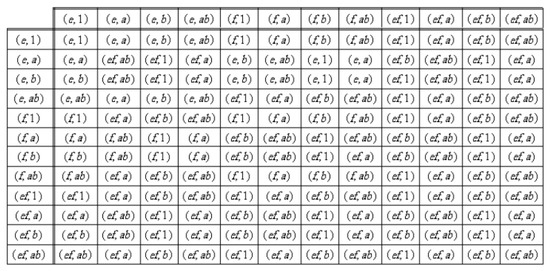
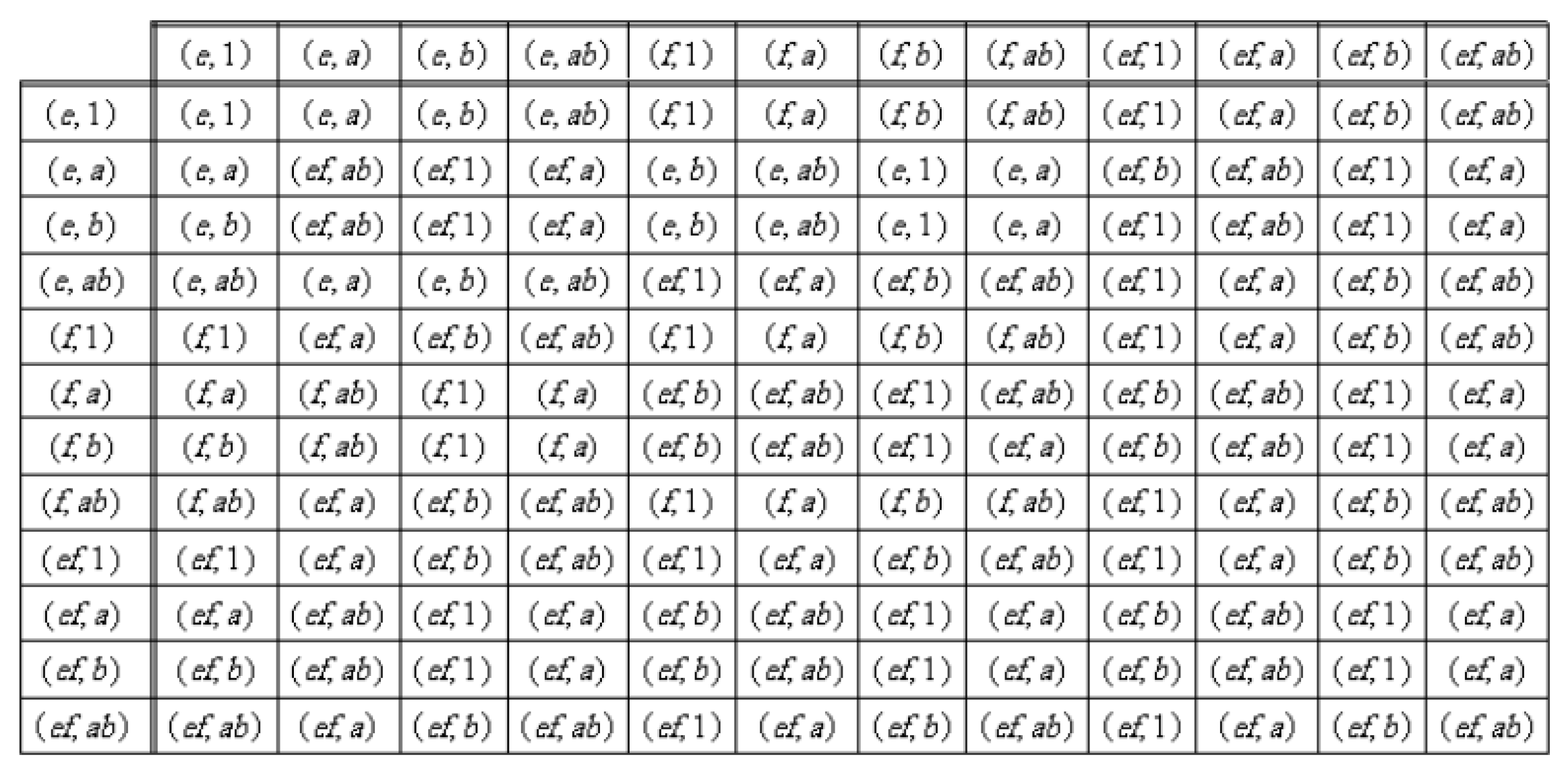
- Let be a commutative band and be the Klein four-group. Define a structure map from G to transformations of B by: and and for all . Define the corresponding structure map from B to transformations of G using: and Then the Zappa-Szép product of B and G is defined with multiplication and display in Figure 4:Figure 4. Zappa–Szép product arising from the interaction between the commutative band and the Klein four-group . The diagram records how the two structure maps determine the multiplication in the product.ThusHence has multiplicationWe have the following multiplication tableThus which is closed subsemigroup of so is orthodox, but it is not an E-unitary semigroup.
- 2.
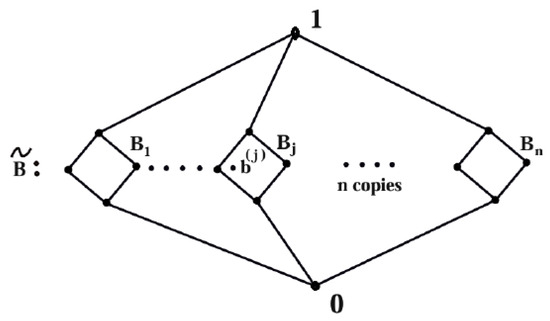
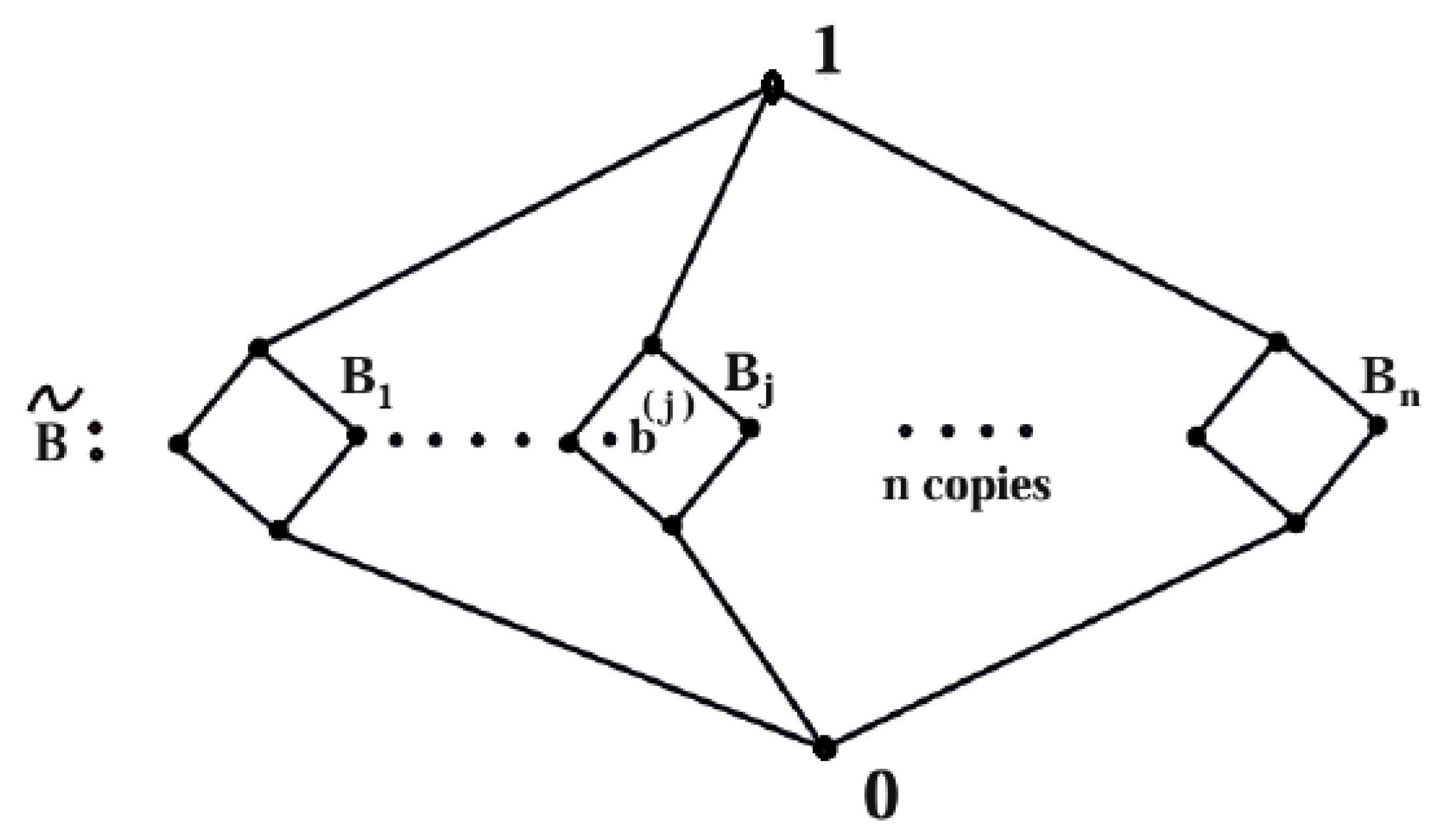
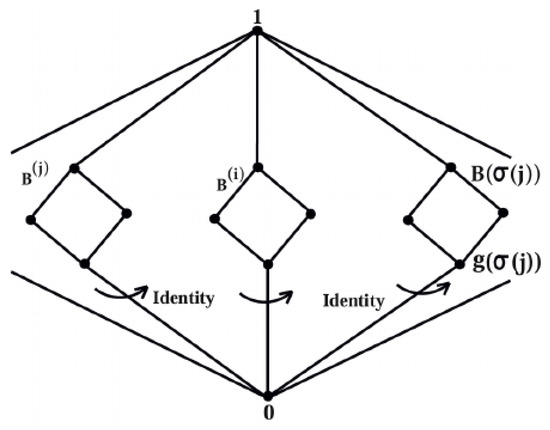
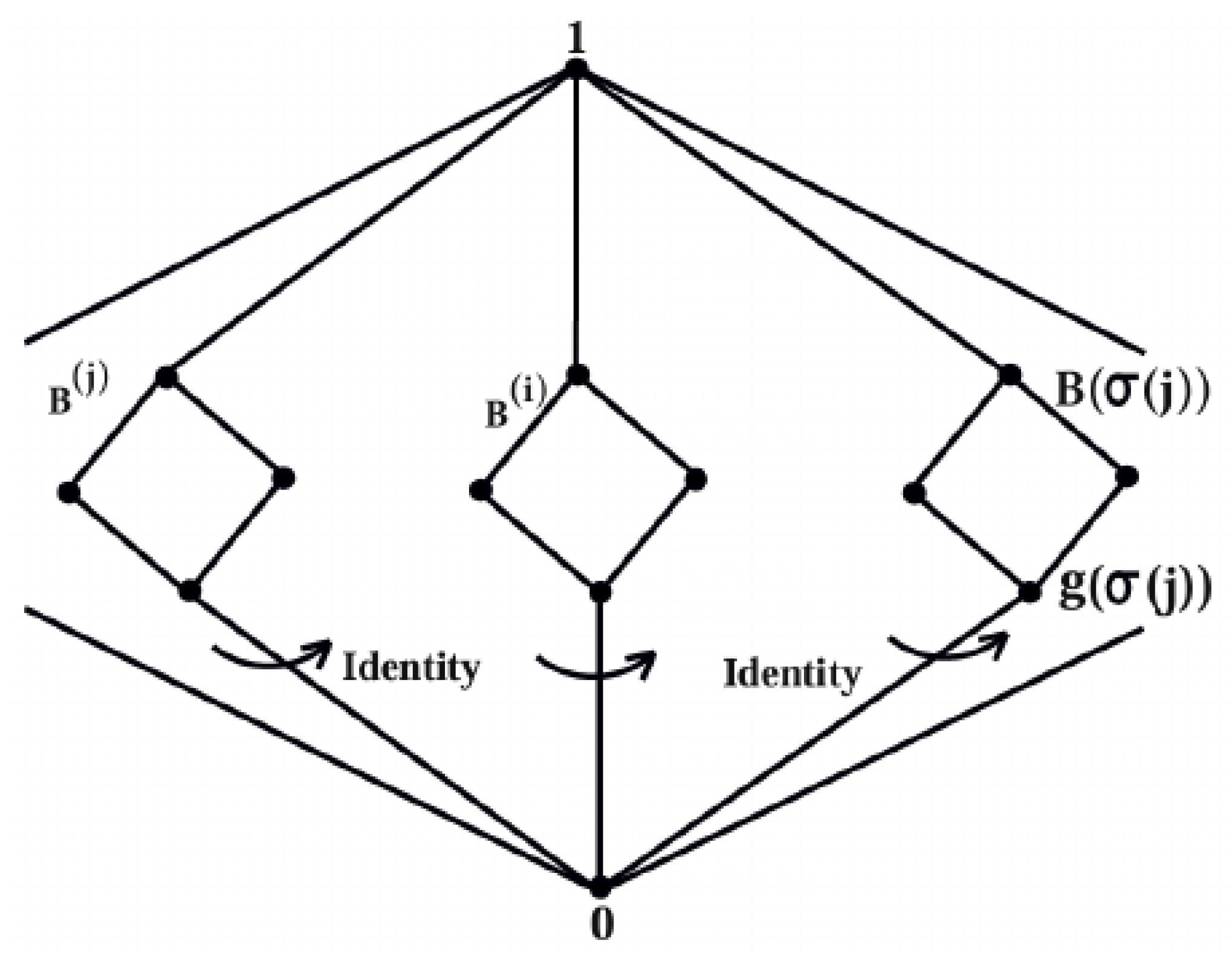
- This example presents a construction that illustrates self-similarity given in [18] through the interaction of a group and a band via a wreath-product operation, and relates it to the notion of Zappa Szép product. This example is discussed in [12], but we expand upon it by providing additional figures and a more detailed explanation. Let B be a band with automorphism group G. Fix a positive integer n, and consider n disjoint copies of B denoted by we form a new band by taking the adjoint union of these copies and adjoining two new elements: a greatest element 1 and a least element 0. Elements from the ◁th copy of are labeled as , where . We represent in Figure 5:Figure 5. The enlarged band obtained from the disjoint copies by adjoining a least element 0 and a greatest element 1. Products between elements in different copies collapse to 0, while each copy retains the band multiplication of B.Let of G with the symmetric group Each element is a pair where:
- is a permutation.
- is a function assigning group elements to indices. The group operates on (the set of functions from ) on the left by permuting components:
This gives a well-defined group operation since . With pointwise multiplication, (n times), and . The left structure map of on is defined as follows:- The elements 0 and 1 are fixed under all ,
- For any , the structure map on is given by:
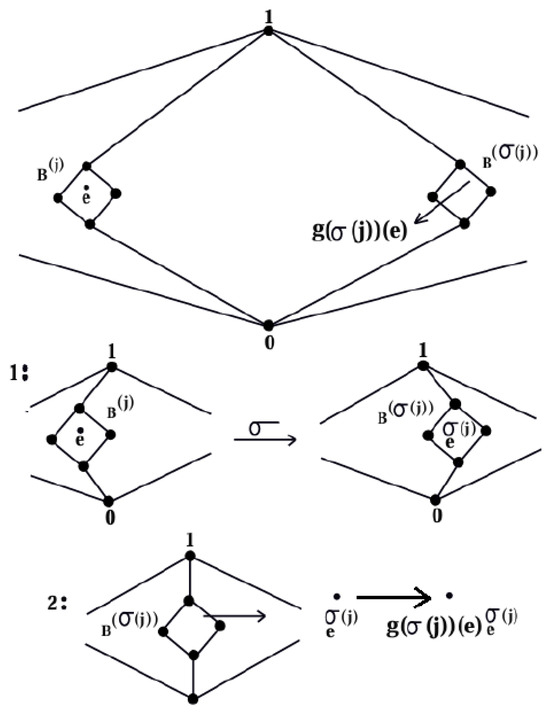
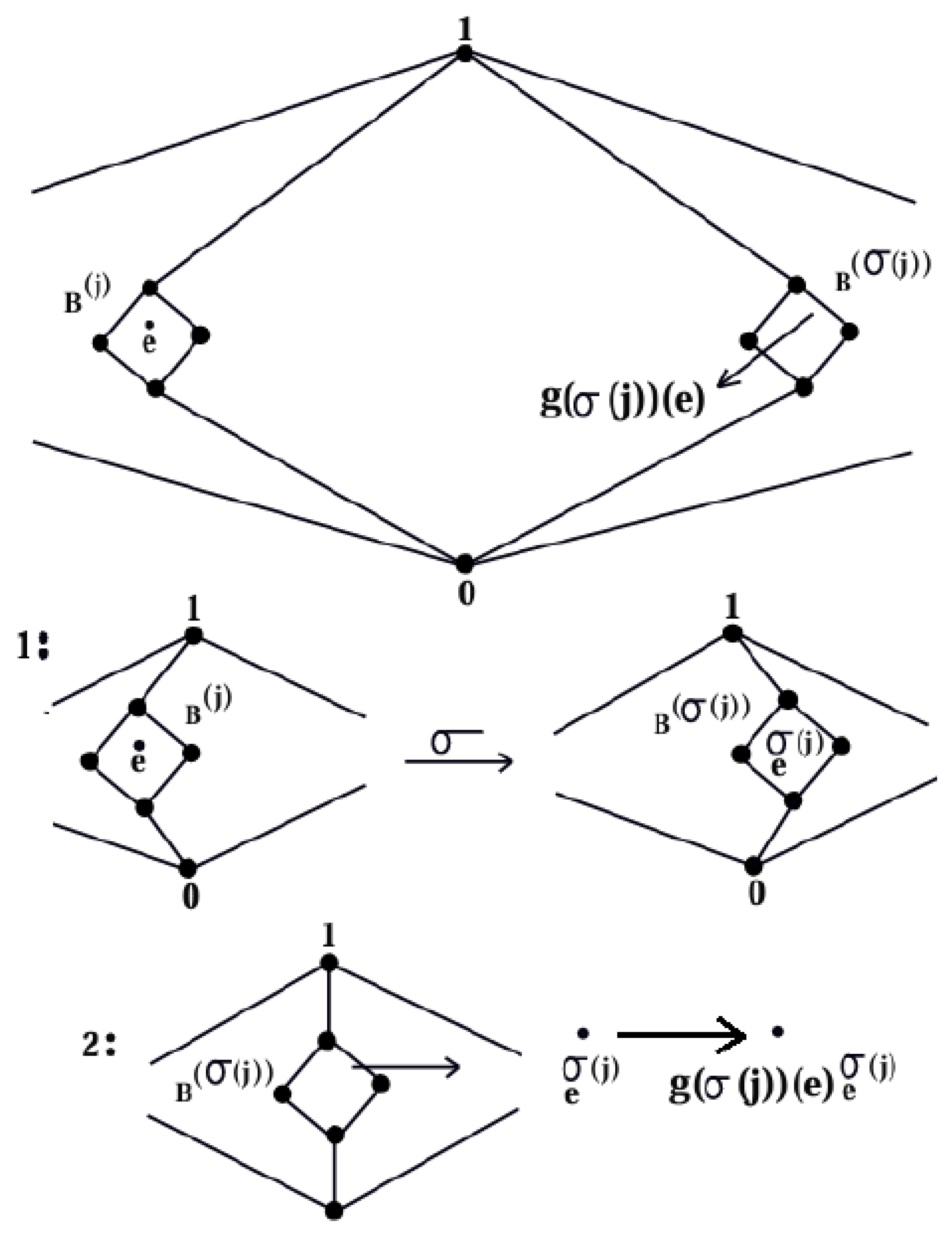
In other words, we move to the -th copy, apply the automorphism , and remain in the new copy . This is well defined since if and then and if . ThenWe represent the structure map of on in Figure 6.Figure 6. Left structure map of the wreath product on . The permutation component moves an element to the corresponding copy, and the group component then applies the appropriate automorphism inside that copy.Under this structure map we take which is copy of element in the jth-copy in we move to we change the copy as in 1, and then find the automorphism in that applies to copy this is apply it to we stay in the same copy as in 2. We denote the identity element of by and the element of that maps and if will be denotedNow define the structure map of on as follows:- and for each
We represent the structure map of on in Figure 7.Figure 7. Right structure map of on . Acting by an element retains the component indexed by and replaces the remaining components by the identity, thereby encoding the local nature of the interaction.we retain out and while replacing all other to the identity automorphism and every element in the same copy operates in the same way.Now we check that these structure maps satisfy and so we have a Zappa–Szép product: let . Let We want to verify . From the definition of the left structure map:Then applying to this gives:Now cosider the group product , where SoNow note:So in and we apply the same automorphism to e and the output lies in the same copy of Therefore, for all and : Since this clearly holds if is replaced by 0 or holds universally.: let and consider elements If either of x or y is equal to the zero or identity element, then the axiom holds trivially. We focus on the case where and , with- Case 1: . In this case, the product and thus Now compute the separate structure maps:
So their product is: . Because preserves multiplication (it is an automorphism). Therefore, both sides of the identity match.- Case 2: In this situation and thus Now examine the product:
Which lies in with the result is 0, by the construction of (copies are disjoint and annihilate each other). So the equality still holds. This confirms that Axiom (ZS2) is satisfied in all cases.: let clearly if either or equals 0 or 1 we have So assume and- Case 1: Then and Now So
But since , Hence the first component in takes value for all and so- Case 2: Then We compute and
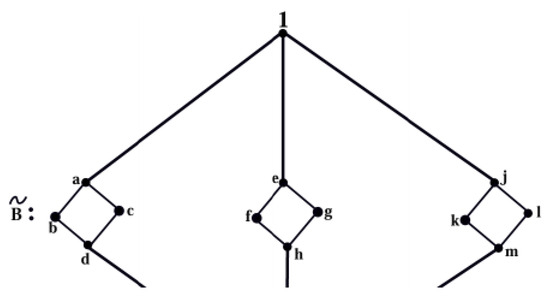
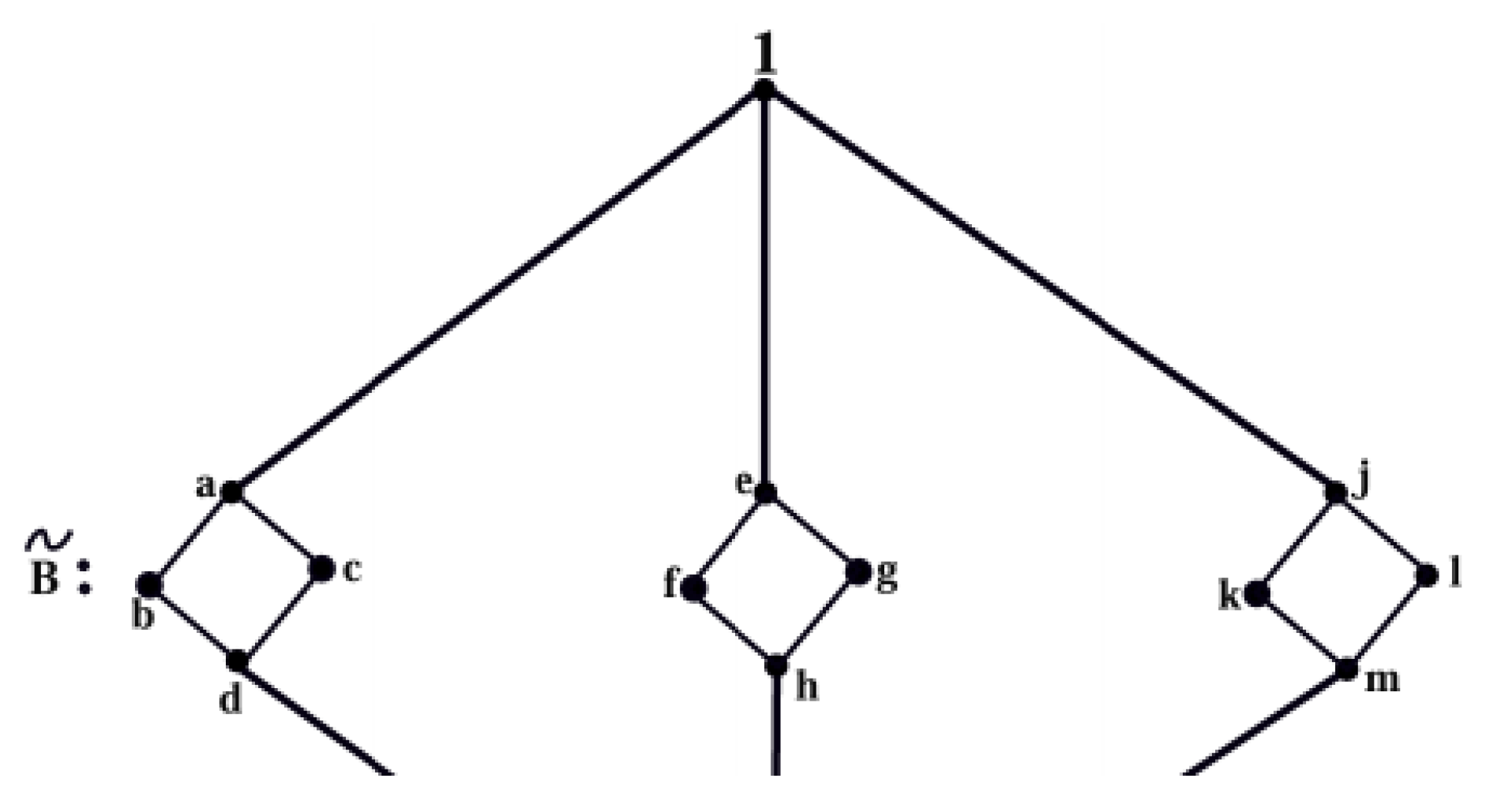
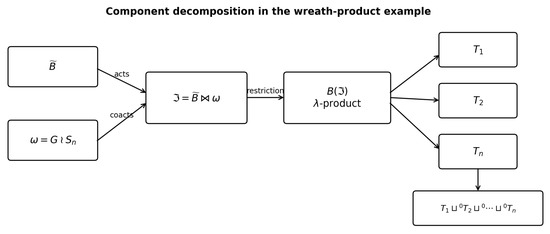
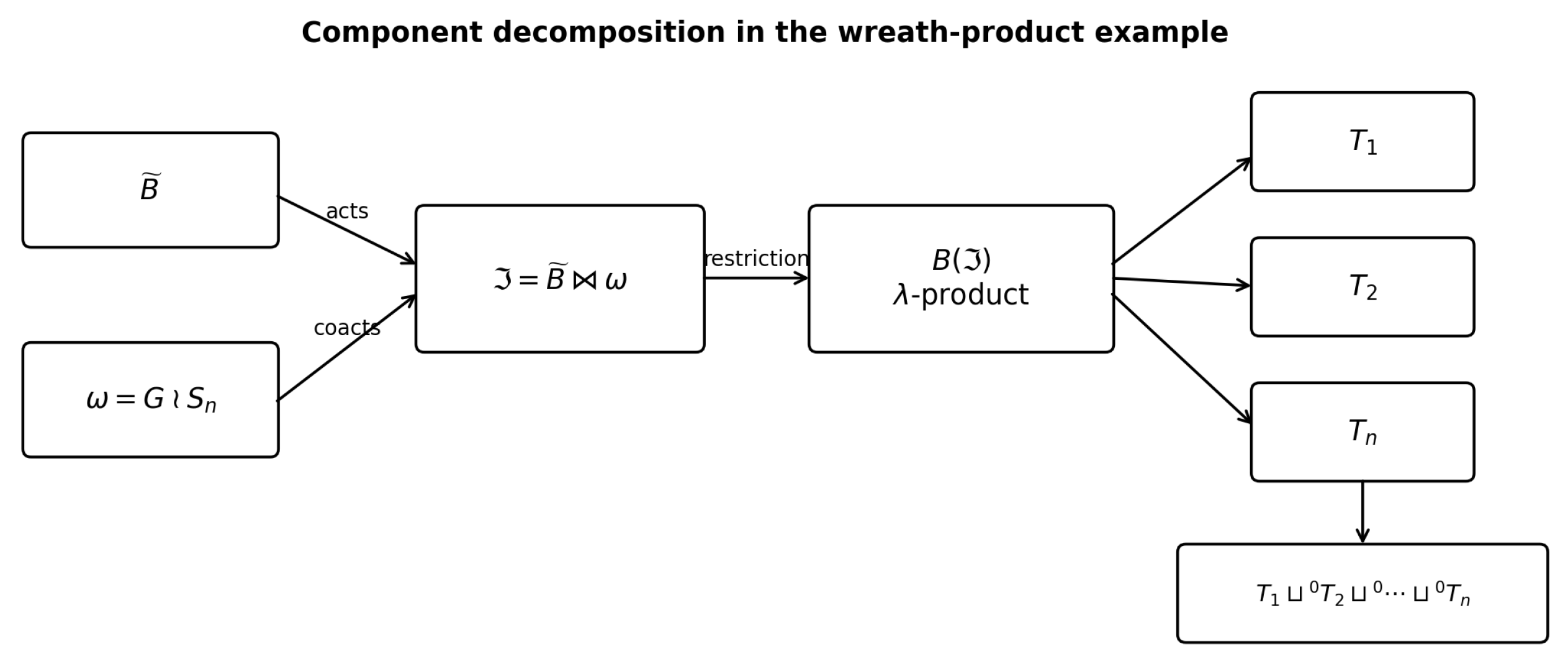
Hence, both sides match and (SS3) is satisfied.: let and Now andAlso,Now take Then:where as defined by:NowTherefore:where as defined as:and thus:So and axiom verified. and hold by definition. For :As a special Case with let and We represent the band visually in Figure 8.Figure 8. Special case and . The picture displays the three copies of the band together with 0 and 1, making explicit how copy permutations and local -actions combine in the wreath-product example.Obvious automorphisms of either operate via G on a fixed copy of , e.g., fixing others, or permute the copies of cyclically:These automorphisms generates a group For example, if with and Then: Now operates on as: since where where where ; and Then the Zappa–Szép product is:So: Here is the map sending ↦ and other values to 1. to . Meanwhile, where is a function takes ↦ for all So the condition matches only if for all HenceThe final decomposition obtained from this construction is summarized in Figure 9. This additional diagram clarifies how the global object is assembled from local semidirect product components and how the symmetric group permutes those components.Figure 9. Component decomposition of the wreath-product example. The -Zappa–Szép product contains local inverse subsemigroups isomorphic to classical semidirect products, and these components combine through a 0-direct union together with the induced permutation action of .To structure the internal components of , fix an index , and define the subset: . Each is an inverse subsemigroup of and it is isomorphic to the classical semidirect product where G operates on B via automorphisms. Now let: denote the 0-dirct union of the -that is, the disjoint union of the where cross-products between elements of different vanish. This construction is well-known in the study of bands and semilattices with local units [20,32]. Then the complement: forms a two sided ideals of and we have where the symmetric group operates on by permuting the indices of the underlying components . This kind of hierarchical decomposition is typical in semigroup theory and aligns with standard constructions of Zappa–Szép-type products over stratified bands and group structure maps.
3. Conclusions
This paper has presented an alternative route to the construction of -Zappa–Szép products of bands and groups. Starting from a matched pair of structure maps, we developed the arithmetic of the Zappa–Szép product and then used the groupoid perspective to recover the corresponding inverse-semigroup structure. The approach highlights the role of the two actions ▷ and ◁ in controlling regularity, idempotents, inverses, unit-regularity, orthodox behaviour, and -unipotency.
A central point of the paper is that the passage from the band–group data to the inverse semigroup is not merely a direct elementwise algebraic verification; rather, the ESN framework provides a structural explanation through the associated inductive groupoid and pseudoproduct. The consolidated structural results show that several properties of the product can be read directly from the compatibility of the actions and from the internal structure of the band.
The examples further demonstrate that the construction is flexible. In the finite example involving a commutative band and the Klein four-group, the multiplication table makes the idempotent and orthodox structure explicit. In the wreath-product example, the enlarged band and the group illustrate how local copies of a band can be combined with permutation symmetries to produce a richer -Zappa–Szép product. The component decomposition of also shows that the resulting object contains natural inverse subsemigroups arranged as a 0-direct union, with the symmetric group acting by permuting the components.
In this sense, the present treatment complements the automata-theoretic approach of Gilbert and Wazzan [12] and connects it with the later restriction-semigroup viewpoint of Gould and Zenab [13]. The matched-pair notation also makes clear where the construction reduces to the semidirect or direct product cases, and where genuinely two-sided Zappa–Szép behaviour occurs. A further possible extension concerns the multi-object situation. Zappa–Szép products of categorical and self-similar structures have already appeared in related settings, for example in the work of Mundey and Sims [5], while ESN-type correspondences for inverse categories have been studied by DeWolf and Pronk [7]. These developments suggest that a semigroupoid or categorical analogue of the present matched-pair construction may be possible. Establishing such a generalization would, however, require additional axioms and lies beyond the scope of the present paper. Similarly, the one-sided ESN theorem of Haag, Lautenschlaeger and Tamusiunas [27] provides a broader categorical setting in which the groupoid obtained in the present paper can be interpreted and suggests a natural framework for future one-sided and multi-object generalizations of -Zappa–Szép products.
These observations suggest several directions for further work. One may investigate when the present construction preserves stronger finiteness, order-theoretic, or categorical properties; compare the resulting products with other semidirect and wreath-type constructions; and study how the graphical and groupoid descriptions can be used to classify examples arising from finite bands, semilattices, and self-similar group actions. Such developments would further clarify the place of -Zappa–Szép products within the broader theory of inverse semigroups and inductive groupoids.
Funding
The project was funded by KAU Endowment (WAQF) at king Abdulaziz University, Jeddah, Saudi Arabia. The authors, therefore, acknowledge with thanks WAQF and the Deanship of Scientific Research (DSR) for technical and financial support.
Data Availability Statement
The original contributions presented in this study are included in the article. Further inquiries can be directed to the corresponding author.
Acknowledgments
The author wishes to express her sincere gratitude to the referees, who carefully reviewed an earlier version of this manuscript that contained a number of shortcomings and placed an unnecessary burden on the reader. Their patience, professionalism, and constructive comments have contributed substantially to improving the clarity and quality of the paper. Any remaining errors or imperfections are, of course, solely the responsibility of the author. Part of this work is based on the author’s PhD thesis [33], supervised by Nick Gilbert at Heriot-Watt University, whose guidance and support are gratefully acknowledged.
Conflicts of Interest
The author declares that she has no known competing financial interests or personal relationships that could have influenced the work reported in this paper.
References
- Zenab, R.E. Algebraic properties of Zappa–Szép products of semigroups and monoids. Semigroup Forum 2018, 96, 316–332. [Google Scholar] [CrossRef] [Scilit]
- Özalan, N.U. New results over Zappa-Szép products via a recent semigroup. Hacet. J. Math. Stat. 2024, 1–12. [Google Scholar] [CrossRef] [Scilit]
- Brownlowe, N.; Pask, D.; Ramagge, J.; Robertson, D.; Whittaker, M.F. Zappa–Szép product groupoids and C*-blends. Semigroup Forum 2017, 94, 500–519. [Google Scholar] [CrossRef] [Scilit]
- Duwenig, A.; Li, B. The Zappa-Szép product of twisted groupoids. arXiv 2024, arXiv:2406.00466. [Google Scholar]
- Mundey, A.; Sims, A. Homology and twisted C*-algebras for self-similar actions and Zappa–Szép products. Results Math. 2025, 80, 9. [Google Scholar] [CrossRef] [Scilit]
- Zaman, B.U. On left P-Ehresmann and right Ehresmann semigroups: λ-lambda-semidirect products and Zappa-Szép products. Hacet. J. Math. Stat. 2024, 53, 1039–1059. [Google Scholar] [CrossRef] [Scilit]
- DeWolf, D.; Pronk, D. The Ehresmann-Schein-Nambooripad theorem for inverse categories. arXiv 2015, arXiv:1507.08615. [Google Scholar]
- Zappa, G. Sulla costruzione dei gruppi prodotto di due dati sottogruppi permutabili tra loro. In Atti del Secondo Congresso dell’Unione Matematica Italiana, Bologna, Italy, 1940; Edizioni Cremonese: Rome, Italy, 1942; pp. 119–125. [Google Scholar]
- Szép, J. Über die als Produkt zweier Untergruppen darstellbaren endlichen Gruppen. Comment. Math. Helv. 1949, 22, 31–33. [Google Scholar] [CrossRef] [Scilit]
- Kunze, M. Zappa products. Acta Math. Hung. 1983, 41, 225–239. [Google Scholar] [CrossRef] [Scilit]
- Brin, M.G. On the Zappa–Szép product. Commun. Algebra 2005, 33, 393–424. [Google Scholar] [CrossRef] [Scilit]
- Gilbert, N.D.; Wazzan, S. Zappa–Szép products of bands and groups. Semigroup Forum 2008, 77, 438–455. [Google Scholar] [CrossRef] [Scilit]
- Gould, V.; Zenab, R.E. Restriction semigroups and λ-Zappa–Szép products. Period. Math. Hung. 2016, 73, 179–207. [Google Scholar] [CrossRef] [Scilit]
- Wazzan, S. Zappa–Szép Groupoids of Inverse Semigroups and an Alternative Proof of Billhardt’s λ-Semidirect Products. Mathematics 2025, 13, 1122. [Google Scholar] [CrossRef] [Scilit]
- Nekrashevych, V. Mathematical Surveys and Monographs; American Mathematical Society: Providence, RI, USA, 2005; Volume 117. [Google Scholar]
- Grigorchuk, R.I.; Nekrashevych, V.V.; Sushchanskii, V.I. Automata, dynamical systems, and groups. Proc. Steklov Inst. Math. 2000, 231, 128–203. [Google Scholar]
- Lawson, M.V. A correspondence between a class of monoids and self-similar group actions I. Semigroup Forum 2008, 76, 489–517. [Google Scholar] [CrossRef] [Scilit]
- Lawson, M.V.; Wallis, A.R. A correspondence between a class of monoids and self-similar group actions II. Int. Algebra Comput. 2015, 25, 633–668. [Google Scholar] [CrossRef] [Scilit]
- Billhardt, B. On a wreath product embedding and idempotent pure congruences on inverse semigroups. Semigroup Forum 1992, 45, 45–54. [Google Scholar] [CrossRef] [Scilit]
- Lawson, M.V. Inverse Semigroups: The Theory of Partial Symmetries; World Scientific: Singapore, 1998. [Google Scholar]
- Hollings, C. Extending the Ehresmann-Schein-Nambooripad Theorem. Semigroup Forum 2010, 80, 453–476. [Google Scholar] [CrossRef] [Scilit]
- Stokes, T. Ehresmann–Schein–Nambooripad theorems for classes of biunary semigroups. Semigroup Forum 2023, 107, 751–779. [Google Scholar] [CrossRef] [Scilit]
- Wang, S. An Ehresmann–Schein–Nambooripad theorem for locally Ehresmann P-Ehresmann semigroups. Period. Math. 2020, 80, 108–137. [Google Scholar] [CrossRef] [Scilit]
- Lawson, M.V. On Ehresmann semigroups. Semigroup Forum 2021, 103, 953–965. [Google Scholar] [CrossRef] [Scilit]
- Steinberg, B.; Szakács, N. Simplicity of inverse semigroup and étale groupoid algebras. Adv. Math. 2021, 380, 107611. [Google Scholar] [CrossRef] [Scilit]
- Amrutam, T.; Karmakar, P. Fejér property and Galois correspondence for groupoid C*-algebras. arXiv 2025, arXiv:2511.14474. [Google Scholar]
- Haag, R.; Lautenschlaeger, W.G.; Tamusiunas, T. An Ehresmann–Schein–Nambooripad-type theorem for left restriction semigroupoids. Semigroup Forum 2026, 112, 820–860. [Google Scholar] [CrossRef] [Scilit]
- Bailes, G.L., Jr. Right inverse semigroups. J. Algebra 1973, 26, 492–507. [Google Scholar] [CrossRef] [Scilit][Green Version]
- Venkatesan, P.S. On right unipotent semigroups. Pac. J. Math. 1976, 63, 555–561. [Google Scholar] [CrossRef] [Scilit]
- Clifford, A.H. The structure of bisimple left unipotent semigroups as ordered pairs. Semigroup Forum 1972, 5, 137–144. [Google Scholar] [CrossRef] [Scilit]
- Szendrei, M.B. Normal extensions and full restricted semidirect products of inverse semigroups. Semigroup Forum 2025, 111, 820–837. [Google Scholar] [CrossRef] [Scilit]
- Clifford, A.H.; Preston, G.B. The Algebraic Theory of Semigroups, Volume 1; American Mathematical Society: Providence, RI, USA, 1961; Volume 2. [Google Scholar]
- Wazzan, S. The Zappa-Szép Product of Semigroups. Ph.D. Thesis, Heriot-Watt University, Edinburgh, UK, 2008. [Google Scholar]

Disclaimer/Publisher’s Note: The statements, opinions and data contained in all publications are solely those of the individual author(s) and contributor(s) and not of MDPI and/or the editor(s). MDPI and/or the editor(s) disclaim responsibility for any injury to people or property resulting from any ideas, methods, instructions or products referred to in the content. |
© 2026 by the author. Licensee MDPI, Basel, Switzerland. This article is an open access article distributed under the terms and conditions of the Creative Commons Attribution (CC BY) license.