


Abstract
This paper presents the nonlinear chaotic dynamics of a power system model within an incommensurate fractional-order framework. Equilibrium points are derived and analyzed using Jacobian-based local stability theory adapted to fractional-order systems. Furthermore, bifurcation analysis is employed to examine how variations in system parameters and incommensurate fractional orders influence the emergence of period-doubling cascades and chaotic motion. The study investigates multistability phenomena characterized by the coexistence of multiple attractors under identical system parameters. The simulation is run in MATLAB R2020a, and nonlinear tools such as time series, bifurcation diagrams, Lyapunov exponents, and phase portraits in 2D and 3D projections are used to visualize the findings.
Keywords:
power system; incommensurate fractional-order; multistability; coexisting attractors; bifurcation; chaos MSC:
34C28
1. Introduction
Power systems are inherently nonlinear dynamical systems whose behavior is strongly influenced by generator dynamics, network topology, and load characteristics [1,2]. Small variations in system parameters or operating conditions may significantly affect system stability, leading to complex nonlinear phenomena such as equilibrium bifurcations, oscillatory responses, and chaotic motion. In particular, the loss of stability of equilibrium points through period-doubling bifurcations represents one of the most important routes to chaos in power system dynamics, potentially resulting in voltage instability and degraded system performance.
Chaos in power systems is characterized by strong sensitivity to initial conditions and parameter variations, which complicates both analysis and control. Classical integer-order models have been widely used to investigate such behaviors; however, these models often neglect memory and hereditary effects that naturally exist in physical components such as generators, transmission lines, and loads. As a result, integer-order modeling may fail to fully capture the true dynamic characteristics of real-world power systems [3,4,5,6].
Fractional-order derivatives offer a robust and adaptable mathematical framework for modeling systems characterized by memory effects and long-term dependence. By extending the notion of differentiation to non-integer orders, fractional-order models introduce extra degrees of freedom that have a big effect on how systems behave. Recent studies have demonstrated that the fractional derivative order itself can act as a critical system parameter, affecting equilibrium stability, shifting bifurcation points, and altering the onset and structure of chaotic behavior [7].
Recent advances in fractional-order power-system research have further demonstrated the effectiveness of fractional calculus in modeling complex dynamical phenomena and enhancing system performance. In particular, secure control strategies for incommensurate fractional-order cyber-physical power systems have been developed to improve resilience against communication attacks [8]. Fractional-order techniques have also been successfully employed for load-frequency regulation in interconnected power networks with energy-storage units [9]. Furthermore, model-free fractional-order excitation stabilizers have shown promising results in enhancing transient stability in multi-machine power systems [10]. More recently, fractional discrete-time power-system models have revealed rich dynamical behaviors, including chaos, complexity, and control-related phenomena, highlighting the growing importance of fractional-order approaches in modern power-system analysis [11].
The interplay of chaos and fractional-order dynamics produces complicated and distinct phenomena that do not exist in standard integer-order systems. The stability of equilibrium points in fractional-order systems is influenced by both the eigenvalues of the Jacobian matrix and the fractional order of the derivative. As a result, stability zones vary, and the transition from stable equilibrium to periodic motion and chaos often through period-doubling bifurcations can occur under quite different conditions than in integer-order models [12].
Chang was recently the subject of a study in [13] that examined the dynamics of a power system with three machines, with a particular emphasis on chaos control and complex nonlinear dynamics. The research uncovered a diverse array of dynamics across a range of parameter values in the bifurcation diagram. Additionally, ref. [14] established a continuous feedback control method that is predicated on synchronization characteristics to mitigate erratic oscillations. An additional investigation conducted by P.C. Gupta and P.P. Singh regarding the modeling and nonlinear analysis of a multi-machine system utilizing swing dynamics is examined in [15], which uncovers the existence of coexisting attractors (multistability). The same authors conducted a nonlinear study and management of a fractional-order small-scale grid (SSG) in [16], investigating disturbances and noise, including multistability and the coexistence of multiple attractors, together with a period-doubling route to chaos. In [17], a thorough investigation was performed on the dynamic behavior of a fractional-order three-machine infinite bus (TMIB) power system model employing Grunwald-Letnikov’s technique. It is essential to acknowledge that prior research exclusively examined comparable fractional-order derivatives. The examination of incommensurate fractional-order nonlinear systems is critically important, as it provides a more accurate and flexible framework for modeling memory, hereditary effects, and complex dynamics that are poorly captured by integer-order or commensurate fractional models.
Motivated by these considerations, this paper investigates the nonlinear, chaotic dynamics and coexisting attractors (Multistability) of a power system model within an incommensurate fractional-order framework. The obtained results provide deeper insight into the role of incommensurate fractional-order dynamics in power system stability and offer a more accurate theoretical basis for chaos analysis in modern power systems.
2. Preliminaries
We provide a few critical preliminaries in relation to the non-integer calculus [18]:
Definition 1.
When applied to the function , the Riemann–Liouville fractional-order integral operator κ is defined as follows:
where , and .
Definition 2.
The fractional-order κ differential operator of the function is as follows in the Caputo sense:
where , and .
The incommensurate fractional-order dynamical system will now be analyzed [19]:
in which and are positive integers, and and are positive integers between 0 and 1. L is the symbol used to represent the least common multiple of the values of . The equilibrium point of the system (3) is denoted by , while a minor perturbation from a fixed point is denoted by for . After that,
We acquire
The system described in (4) is equivalent to
where K is the Jacobian matrix evaluated at point I, which is defined as
Define
If every root of the equation meets the criterion , then the linear system (5) is asymptotically stable [20].
The quantity
provides a measure of the instability of the equilibrium point in an incommensurate fractional-order system. According to [19], the condition is a necessary condition for the occurrence of chaotic dynamics. However, this condition alone is insufficient to establish chaos; additional numerical diagnostics, such as the Lyapunov spectrum, are required for confirmation.
3. Mathematical Model of the Power System
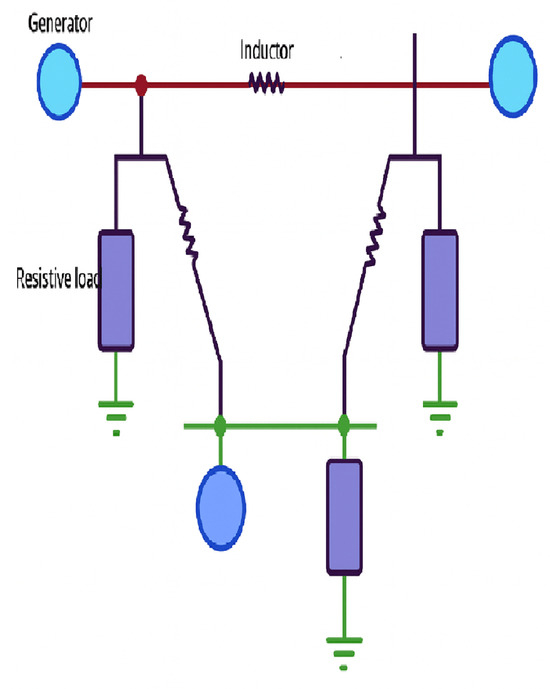
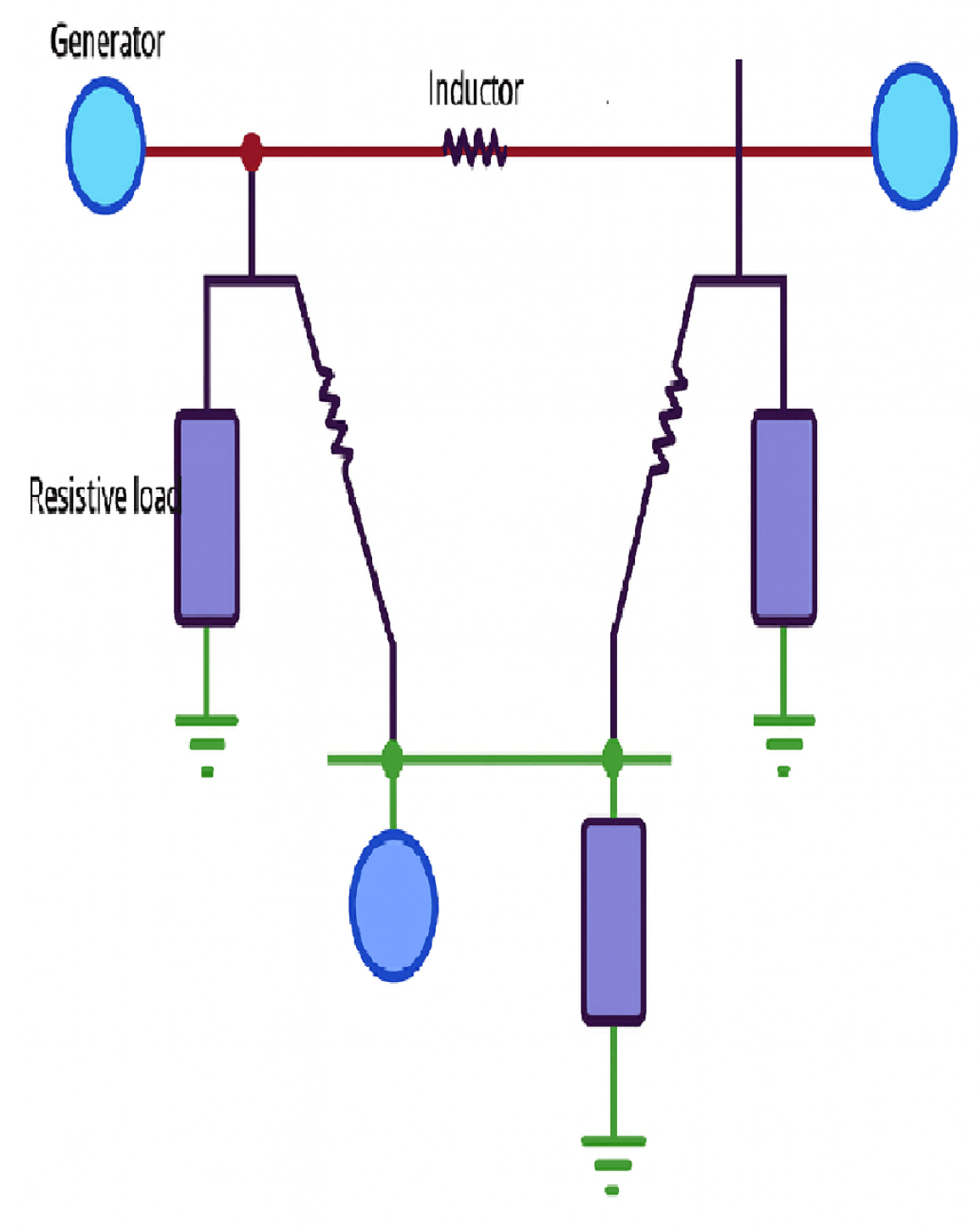
Synchronous generators, although they serve as the principal energy source in power systems, exert a considerable influence on dynamic fluctuations. In [13,14], Shun-Chang Chang examines a power system model with three synchronous generators and a resistive load configuration, as illustrated in Figure 1. The subsequent equations delineate the nonlinear dynamics of the examined power system, according to [21,22]:
Figure 1.
Power system diagrams.
The above system describes a classical third-order swing equation model governing the rotor angle dynamics of a three-machine power system. In order to reduce the complexity while preserving the essential nonlinear behavior, a reduced-order formulation is introduced based on standard simplifying assumptions.
The dynamic analysis of the three-machine system is subsequently examined in a peculiar situation, in which the swing equations are employed. It is presumed that Machine-1 has an inertia that is substantially greater than that of
Additionally, it is presumed that the transmission line connecting Machines 2 and 3 is shorter than the other transmission lines. The external power input of Machine 1 is also assumed to be proportionately substantial and is delineated as
These assumptions allow the system to be expressed in a singular perturbation framework, where Machine 1 acts as a fast/strongly dominant subsystem, enabling model reduction.
The conservative swing equations that govern the dynamics of the three-machine system can be constructed appropriately based on these assumptions. The dynamic behavior is given by:
Under the above assumptions, the system is further simplified by expressing the rotor angle of generator 1 in terms of generators 2 and 3, leading to a reduced-order model.
According to Refs. [21,22], the rotor angle of the first generator can be articulated as
where and .
By substituting Equation (11) into Equation (10a) through (10f), an autonomous reduced-order dynamical system for , , , and is derived.
This transformation eliminates the fast variables and , yielding a four-dimensional reduced-order system that retains the essential nonlinear coupling structure of the original model.
where , , , , , and . For simplicity and without loss of generality, the parameter is set to zero, which allows Equation (12a–d) to be further simplified as follows:
This simplification preserves the essential nonlinear interactions while reducing analytical complexity, which is suitable for bifurcation and chaos analysis.
In accordance with [21,22], the term can be expressed as
where denotes the constant real power input, , and represents the load–frequency coefficient.
Substituting Equation (14) into Equation (13a–d), the system can be rewritten as:
Letting , , , and be the state variables, the state-space representation is obtained.
The are the state variables of the reduced-order swing equation model, where rotor angle differences are measured with respect to generator 1 as the reference machine, and angular speed deviations characterize the system dynamics. All the parameters in system (16) are mentioned in Table 1.
Table 1.
System parameter values (16).
Understanding the dynamic features of power systems requires examination of interconnected systems using synchronous motors as primary components.
This study will employ incommensurate fractional-order derivatives on the system (16) and examine various dynamic behaviors through analytical and numerical methods. The use of incommensurate fractional orders allows different state variables to possess distinct memory characteristics and dynamic responses. In practical power systems, rotor-angle deviations and frequency deviations may be influenced by different physical processes, damping mechanisms, and energy storage effects. Consequently, assigning different fractional orders to the state variables provides a more flexible framework for capturing heterogeneous memory effects and complex dynamical behavior than the commensurate case, where all states share the same fractional order. The fractional-order variant of the preceding power system is represented by the following equations:
In this context, denotes the q-order Caputo differential operator, where for , representing the derivative orders of the state variables for . If the values (for ) are distinct, the fractional-order system (17) is deemed incommensurate. Different fractional orders are introduced to model heterogeneous memory effects. Since the four state variables describe different physical mechanisms of the power system, their memory characteristics are not necessarily identical. Therefore, assigning different fractional orders provides a more flexible and realistic representation. Diethelm utilized the predictor–corrector technique, an advanced iteration of the Adams–Bashforth–Moulton algorithm, for numerical simulations of fractional differential equations defined by the Caputo approach [23].
The Jacobian matrix of the system (17) is given by:
The system (16) has two points of equilibrium: the first is the origin and the second is , where k and m are both integers. The system (16) has an equilibrium point , which can be found numerically by using the parameter values in Table 1. Its eigenvalues are , which means it is a saddle point and is thus unstable.
4. Chaotic Analysis
4.1. Dynamic Analysis Versus the Fractional Orders
This section examines the onset of chaotic dynamics in the incommensurate-order power system through both analytical and numerical approaches. The analysis includes bifurcation diagrams, Lyapunov exponent computations, and phase-space portraits presented in two- and three-dimensional projections. All simulations are conducted using the parameter values listed in Table 1 and the initial condition .
To verify the chaotic behavior of the proposed incommensurate fractional-order system, the Lyapunov spectrum is computed for several fractional-order configurations. The obtained results are summarized in Table 2. The maximum Lyapunov exponent (MLE) is positive for all considered cases, confirming the presence of chaotic dynamics.
Table 2.
Maximum Lyapunov exponent (MLE) for different fractional-order configurations.
The bifurcation diagrams and Lyapunov exponent spectra are analyzed jointly to provide a consistent characterization of the system dynamics.
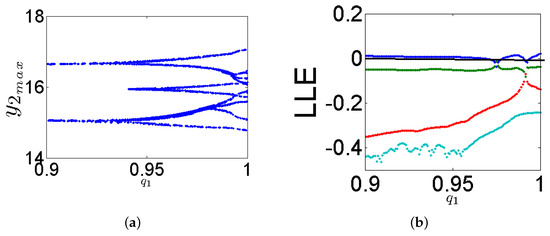
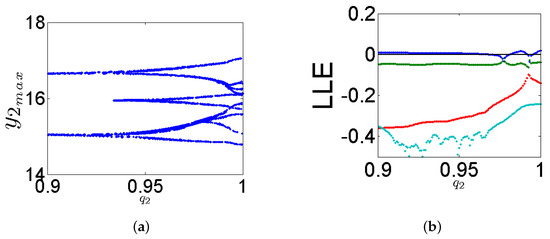
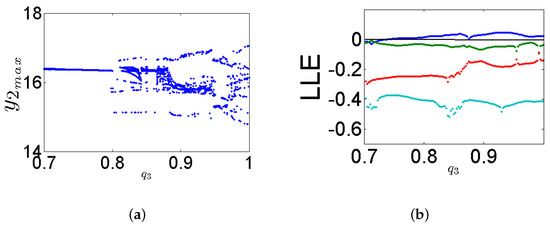
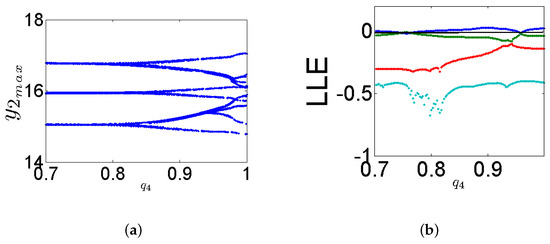
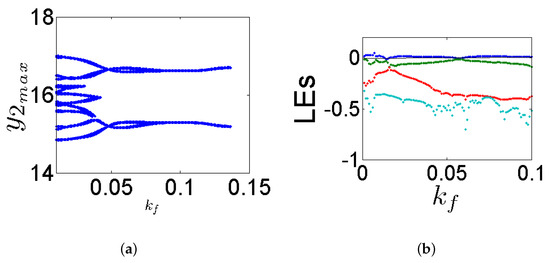
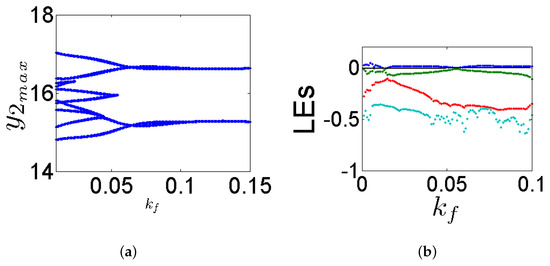
We evaluate the stability of an incommensurate system (17) by generating bifurcation diagrams for four distinct scenarios: with ; with ; with ; and with .
This combined analysis allows a clear identification of the transition mechanism from regular periodic motion to chaos induced by variations in the fractional-order parameters.
When and , it is evident that the equilibrium point of system (17) is asymptotically stable. When and , the incommensurate system began to destabilize, resulting in a transition from periodic motion to chaos.
The incommensurate system (17) demonstrates chaotic behavior for , , and as evidenced by the Lyapunov exponent plots in Figure 2b, Figure 3b, Figure 4b and Figure 5b.
From Figure 2, Figure 3, Figure 4 and Figure 5, it is observed that decreasing the fractional-order parameters leads to a reduction in system complexity, where the system initially exhibits periodic behavior, followed by transitions into chaotic dynamics. The corresponding Lyapunov exponent plots confirm this behavior, as positive values of the largest Lyapunov exponent coincide with the chaotic regions identified in the bifurcation diagrams, ensuring consistency between both diagnostic tools.
To further validate these results, phase portraits are used to visualize the qualitative evolution of the system trajectories under different fractional-order values.
The phase portraits of the incommensurate system (17) on the plane are depicted in Figure 6 for a variety of values of and :
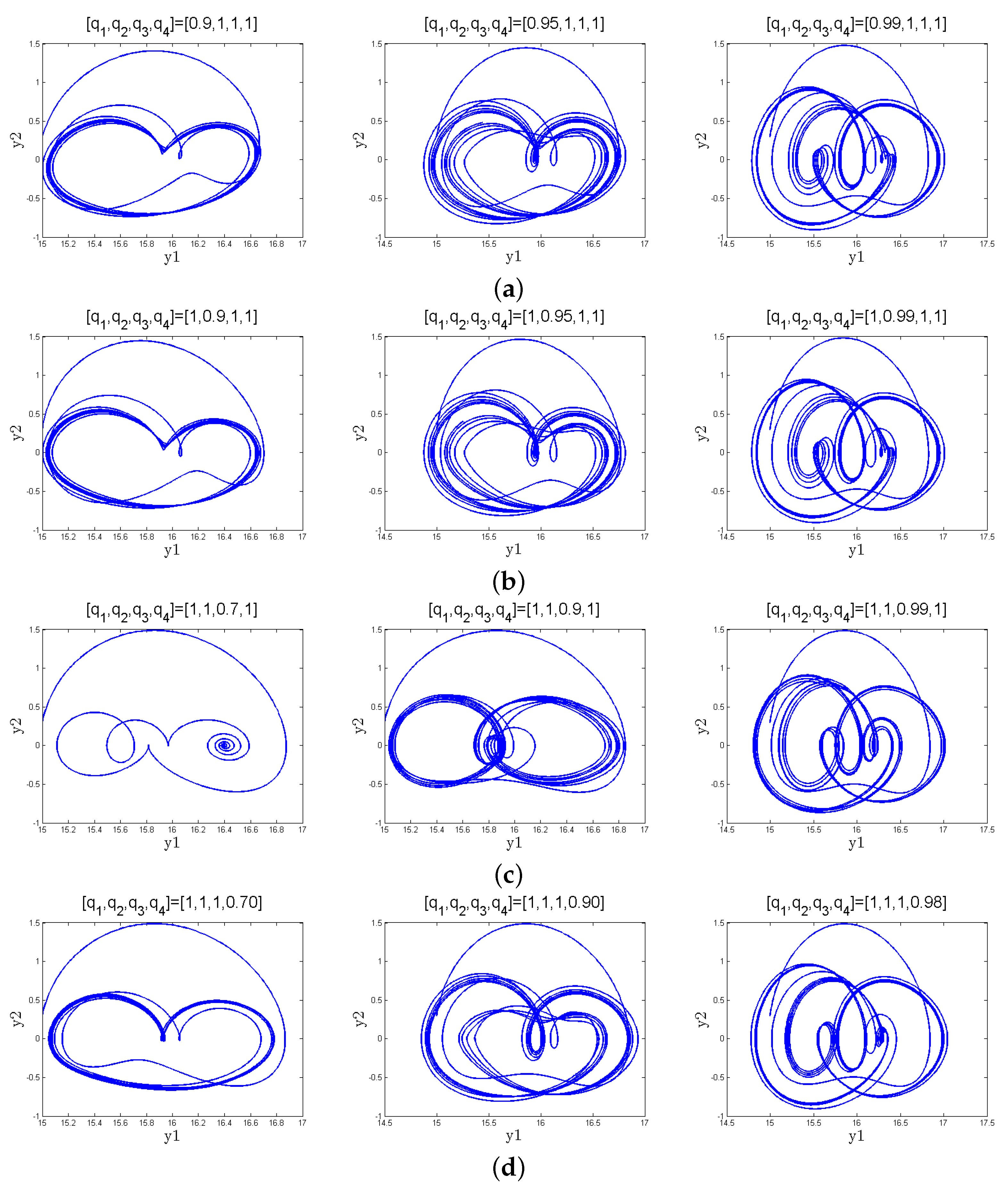
These results demonstrate that incommensurate fractional-order parameters play a crucial role in controlling the system’s dynamical behavior, with specific ranges of the fractional orders inducing transitions from stable periodic motion to chaotic regimes. The agreement between bifurcation diagrams, Lyapunov exponents, and phase portraits confirms the reliability of the numerical analysis.
Furthermore, the stability of an incommensurate order power system was studied theoretically by using the method in Section 2. Consider the system (17). The Lyapunov exponent is positive for (see Figure 2b and Figure 3b) and for (see Figure 4b and Figure 5b). Now consider the following cases:
- *
- . ThereforeSinceA positive IMFOS satisfies only the necessary condition for chaos. The existence of chaotic dynamics is confirmed numerically through the Lyapunov spectrum and phase portraits.The IMFOS of the system is:Though IMFOS > 0, the system shows chaotic behavior. This is confirmed numerically in Figure 2b.
- *
- . Therefore . Since , The IMFOS of the system is:Though IMFOS > 0, the system shows chaotic behavior. This is confirmed numerically in Figure 3b.
- *
- . Therefore . Since , The IMFOS of the system is:Though IMFOS > 0, the system shows chaotic behavior. This is confirmed numerically in Figure 4b.
- *
- . Therefore . Since , The IMFOS of the system is:Though IMFOS > 0, the system shows chaotic behavior. This is confirmed numerically in Figure 5b.
As a result, it is possible to infer that the fractional variant of the power system exhibits chaotic behavior when subjected to a variety of incommensurate fractional orders. Each system has its own chaotic ranges. For the incommensurate order , the system can exhibit chaos at the lowest fractional order value of , with .
4.2. Dynamic Analysis Versus the Parameter of Load-Frequency Coefficient
This section examines the existence of chaotic behavior in the incommensurate order power system using numerical tools, such as Lyapunov exponents and bifurcation diagrams. Table 1 is utilized to ascertain the system parameters and initial circumstances, which are .
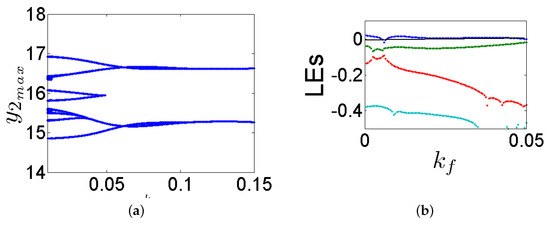
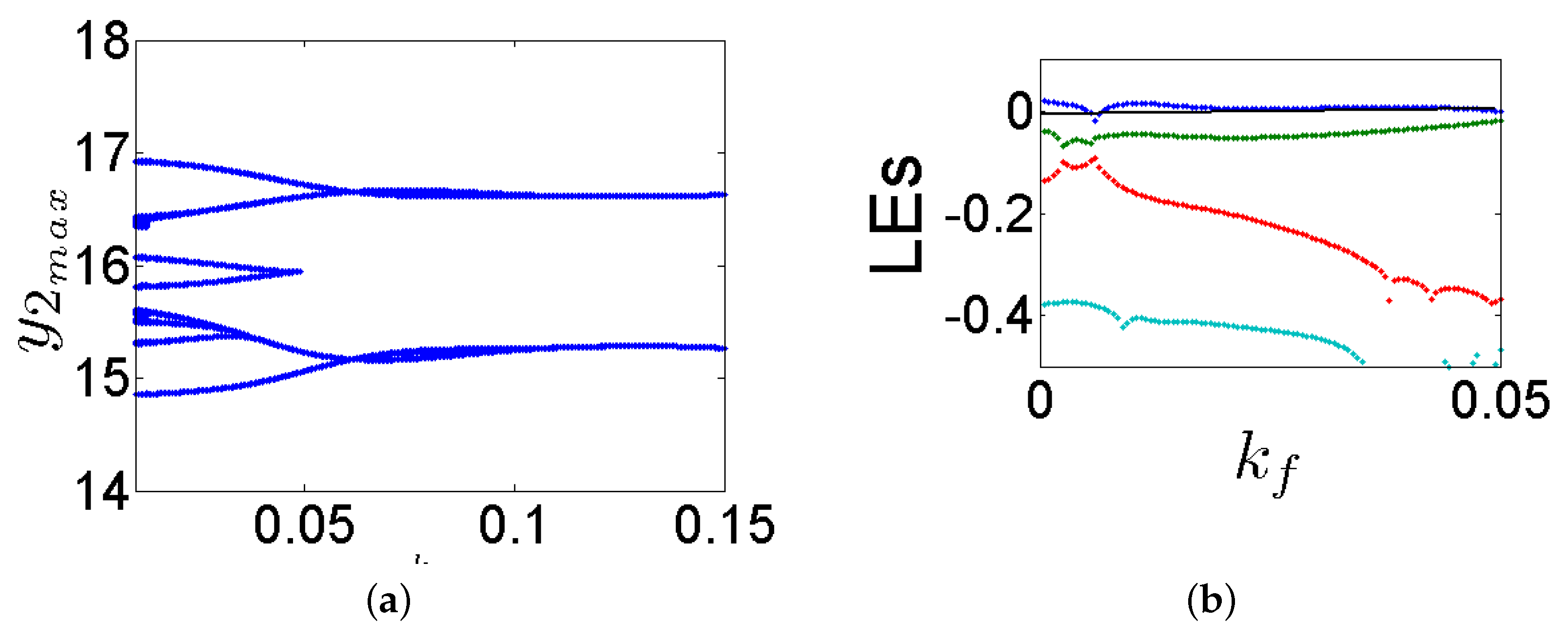
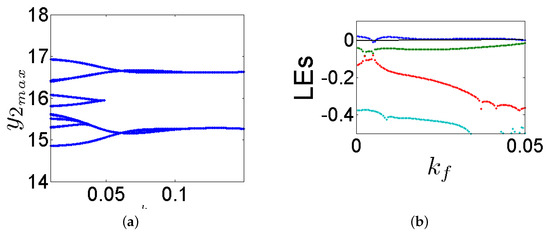
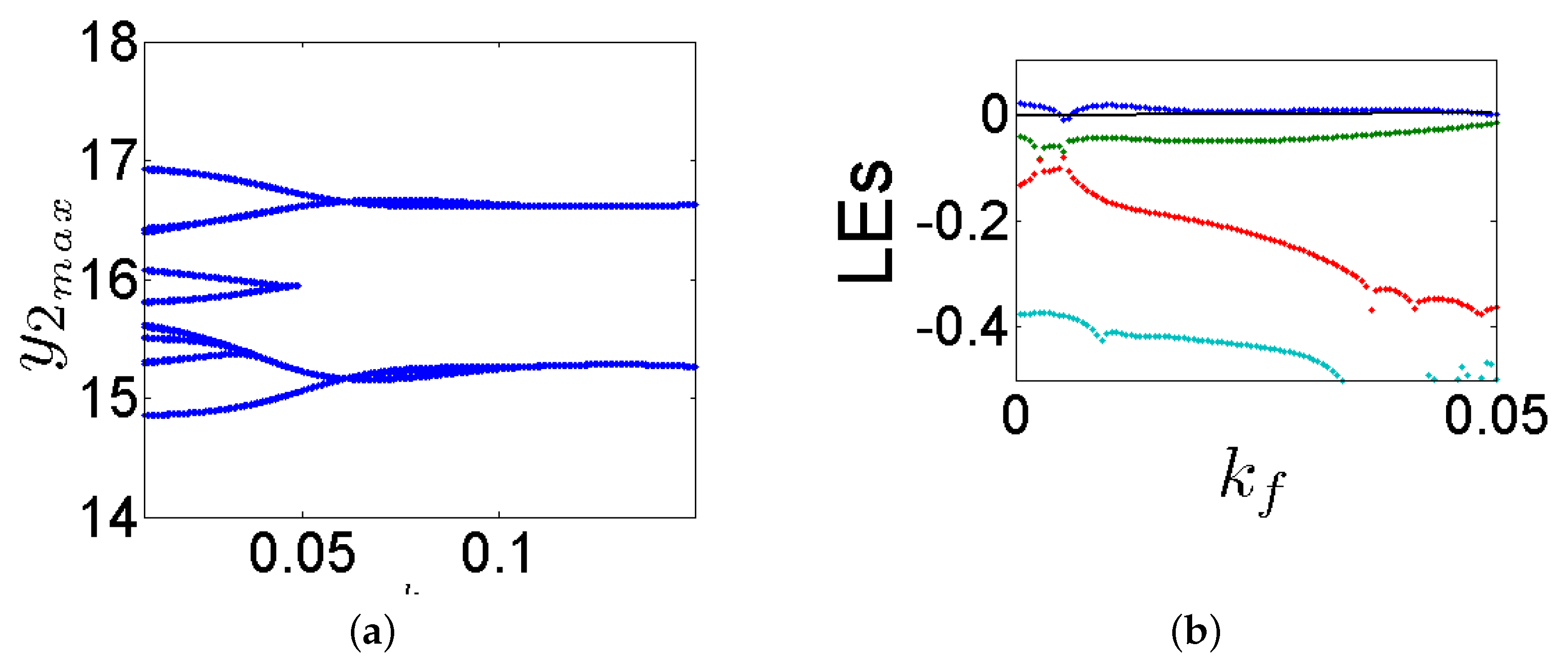
Figure 8a, Figure 9a, Figure 10a and Figure 11a present bifurcation diagrams for four distinct scenarios: , , , and .
Figure 8.
(a) Bifurcation diagram of the considered system, (b) corresponding Lyapunov exponent spectrum of the incommensurate fractional-order model for , with fractional orders . The remaining system parameters are taken from Table 1. The initial state vector is selected as .
The equilibrium point of system (17) is asymptotically stable when throughout the four scenarios, indicating the absence of chatter vibration.
As decreases within the interval , the incommensurate system begins to lose stability, transitioning from periodic motion to chaos. The plots of Lyapunov exponents in Figure 8b, Figure 9b, Figure 10b and Figure 11b indicate that the incommensurate system (17) exhibits chaotic behavior for in the first case, in the second case, in the third case, and in the fourth case. The resultant chatter vibrations were sufficiently intense to cause a voltage failure in the power supply.
5. Multistability and Coexisting Attractors
The coexistence of multiple attractors and multistability in incommensurate fractional-order systems has attracted considerable attention due to its important implications for nonlinear dynamical behavior. In such systems, different initial conditions may lead to distinct long-term responses under identical parameter settings. Throughout this section, the initial conditions are chosen as with . These six initial values are distinguished by different colors in all corresponding figures.
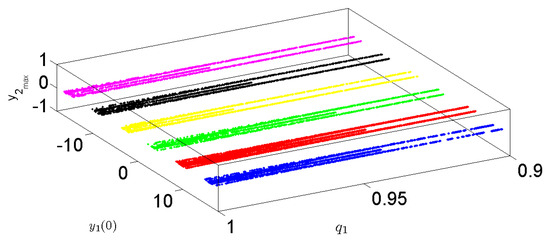
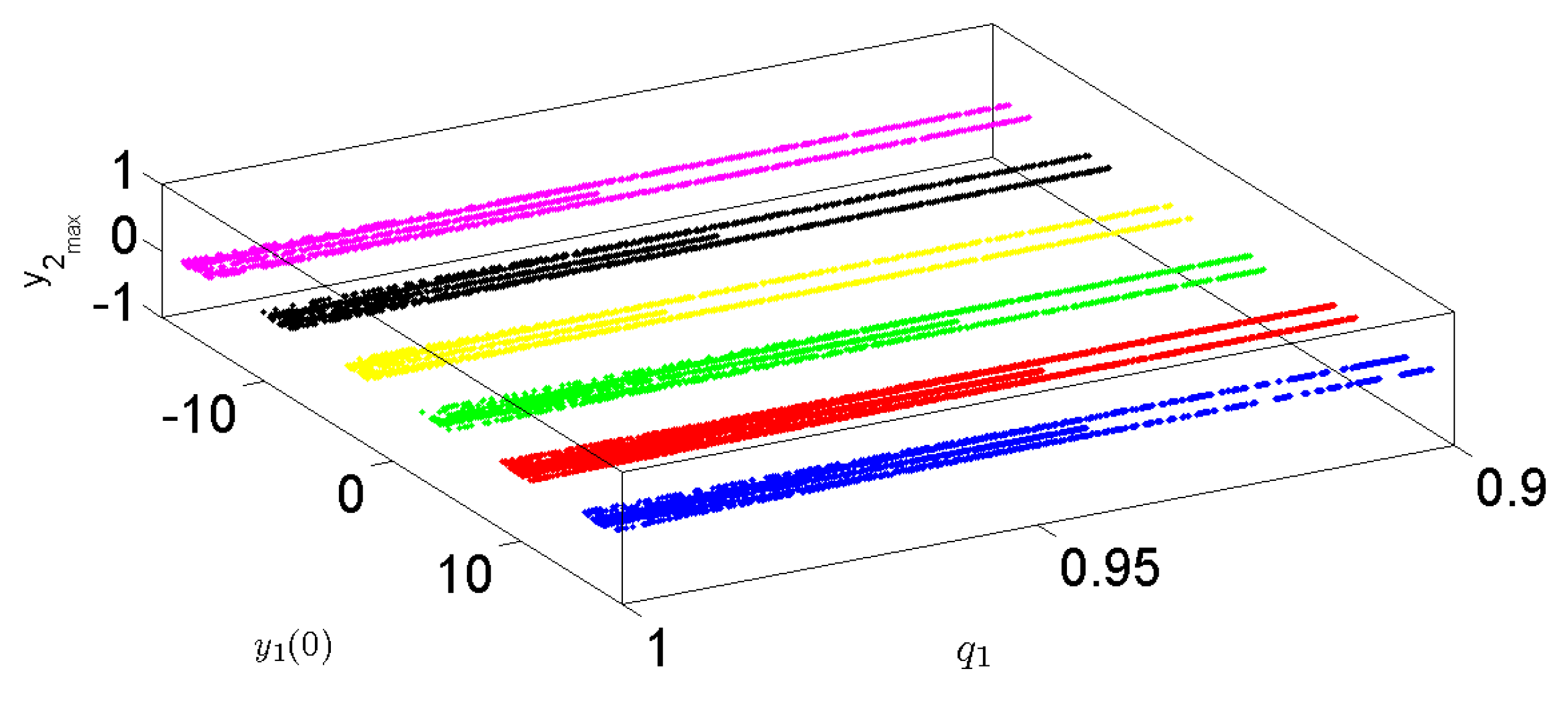
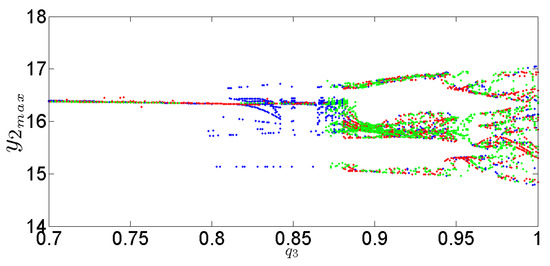
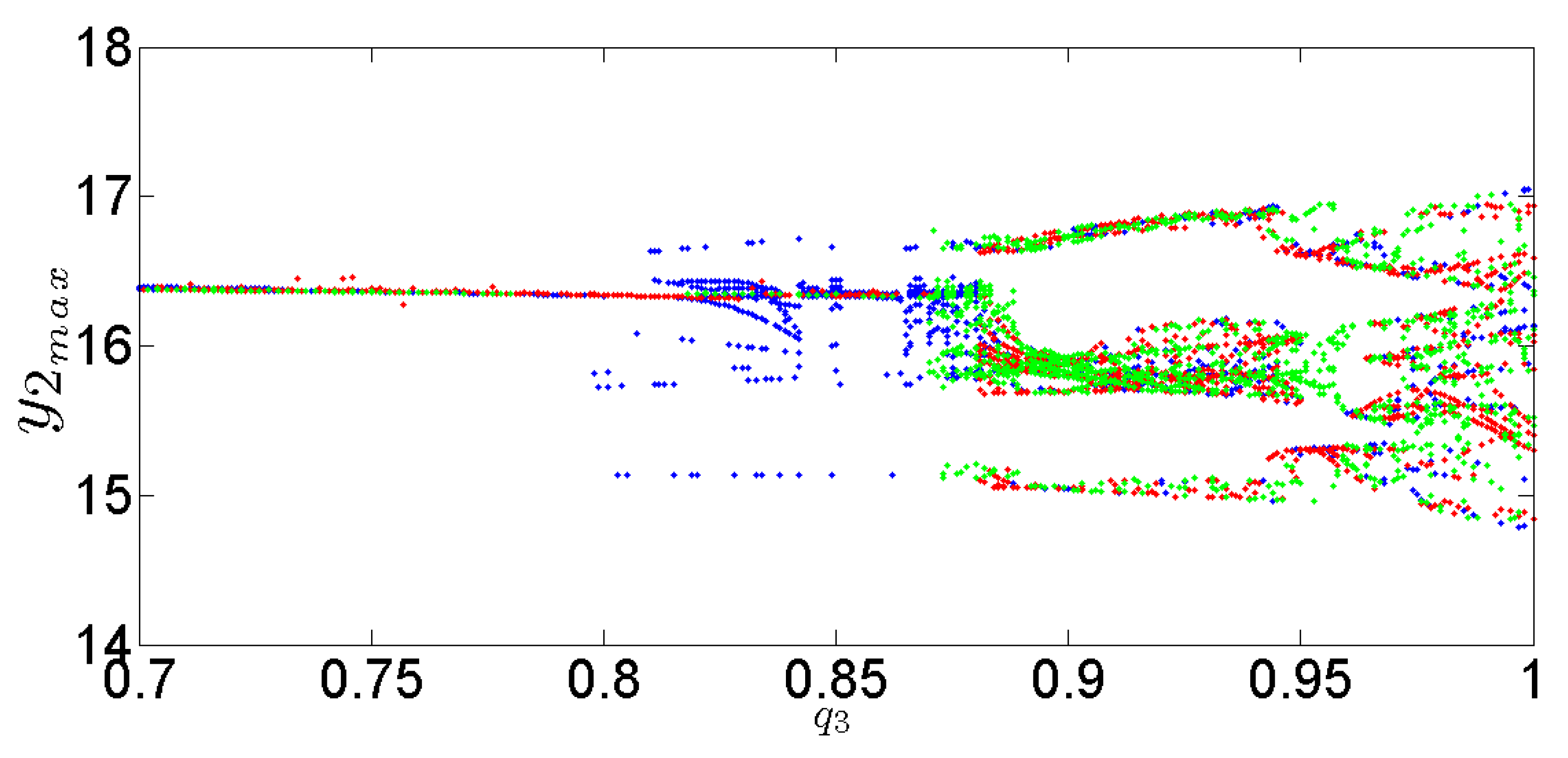
Figure 12 presents the bifurcation diagram of the incommensurate fractional-order power system (17) as the fractional order varies, while the remaining parameters are fixed according to Table 1. The repeated bifurcation structures corresponding to different initial conditions clearly demonstrate the multistability of the proposed system. Moreover, each branch exhibits transitions among stable, periodic, and chaotic regimes, as illustrated in the enlarged view of Figure 9.
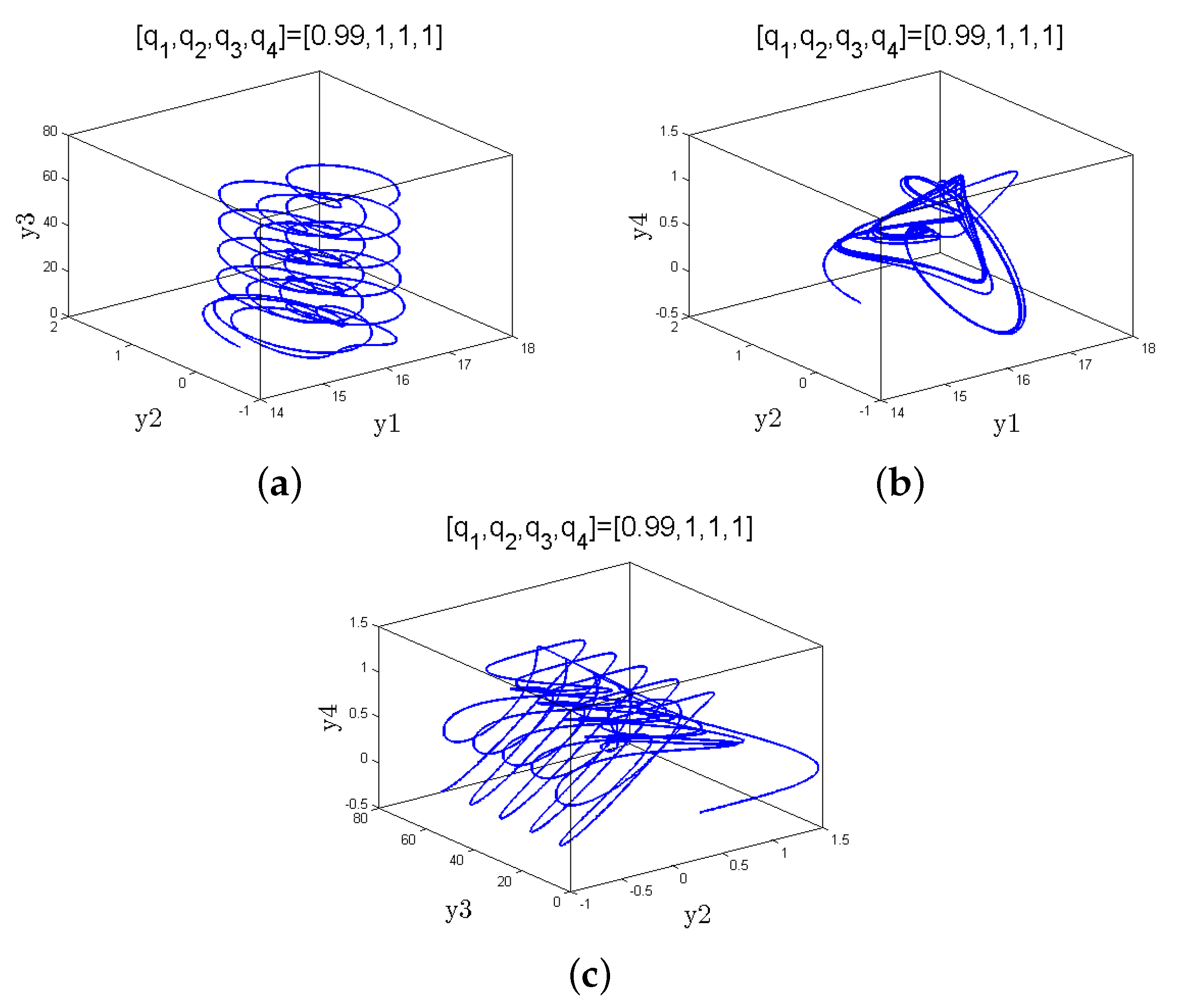
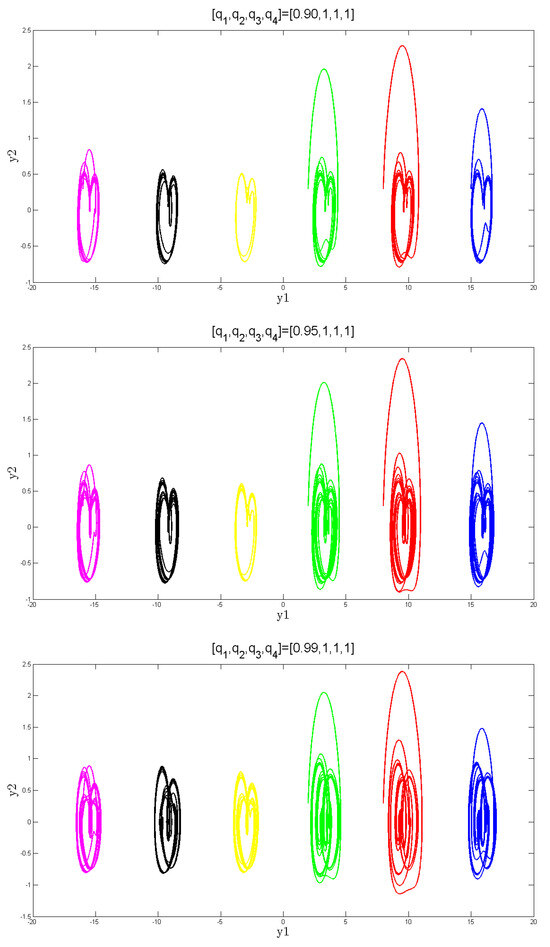
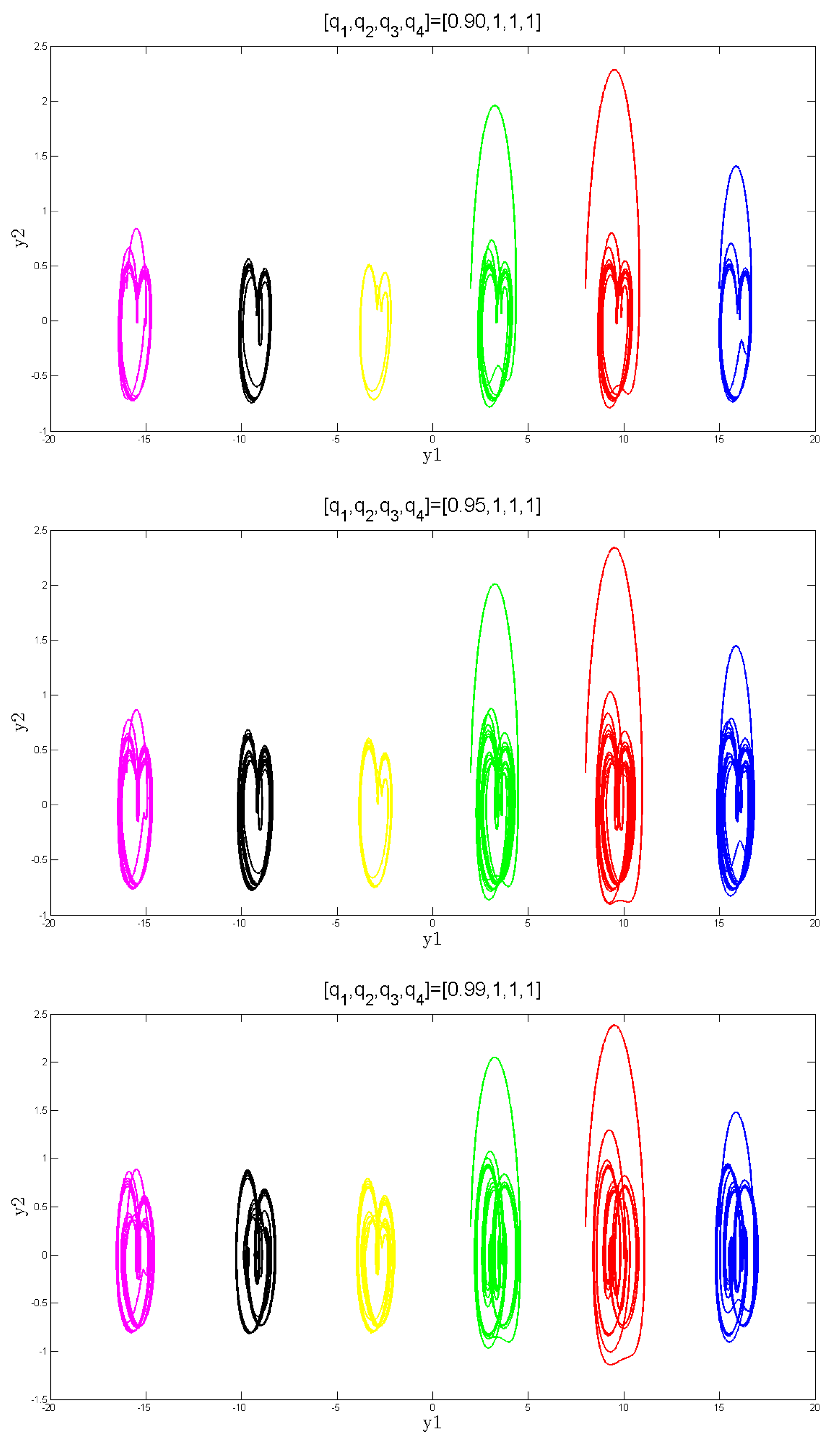
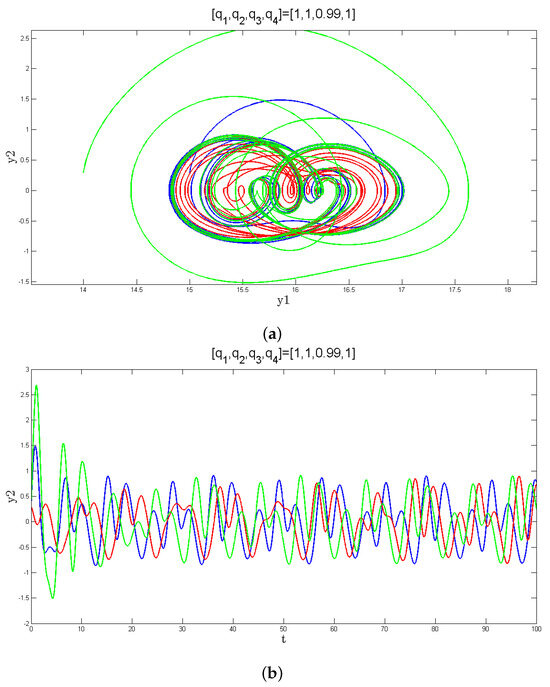
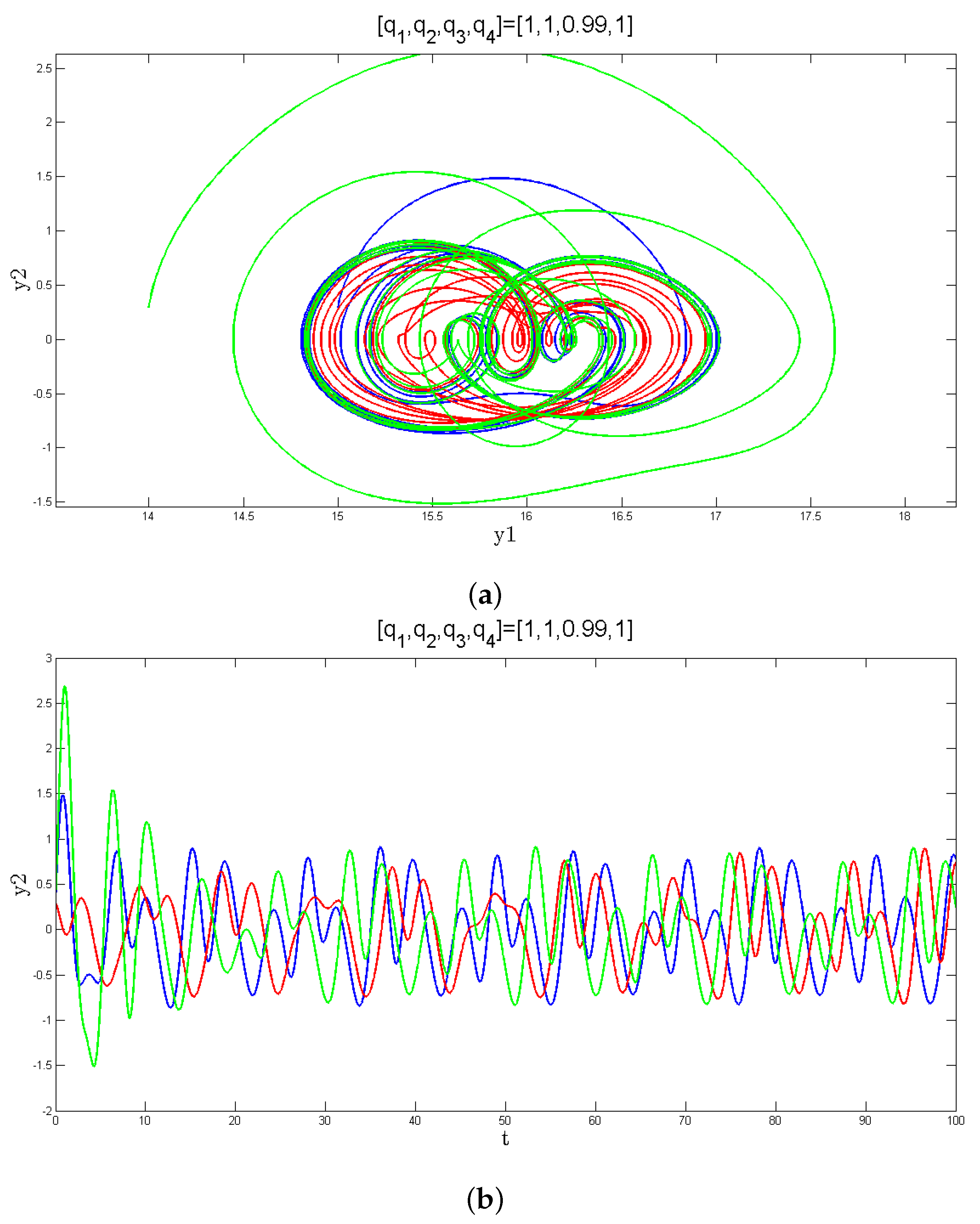
To further illustrate the multistable behavior, the corresponding phase portraits are shown in Figure 13 for three representative values of the fractional order, namely , , and . The coexistence of distinct trajectories generated from different initial conditions confirms that the incommensurate fractional-order power system possesses multiple coexisting dynamical states. Furthermore, the transition from periodic motion to chaotic dynamics follows a period-doubling bifurcation scenario.
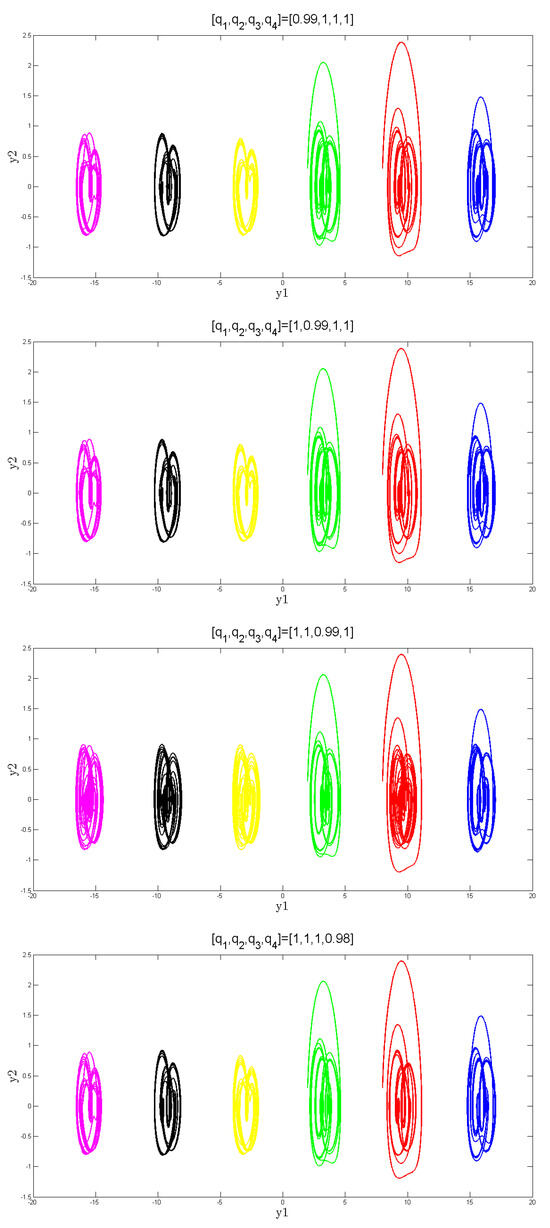
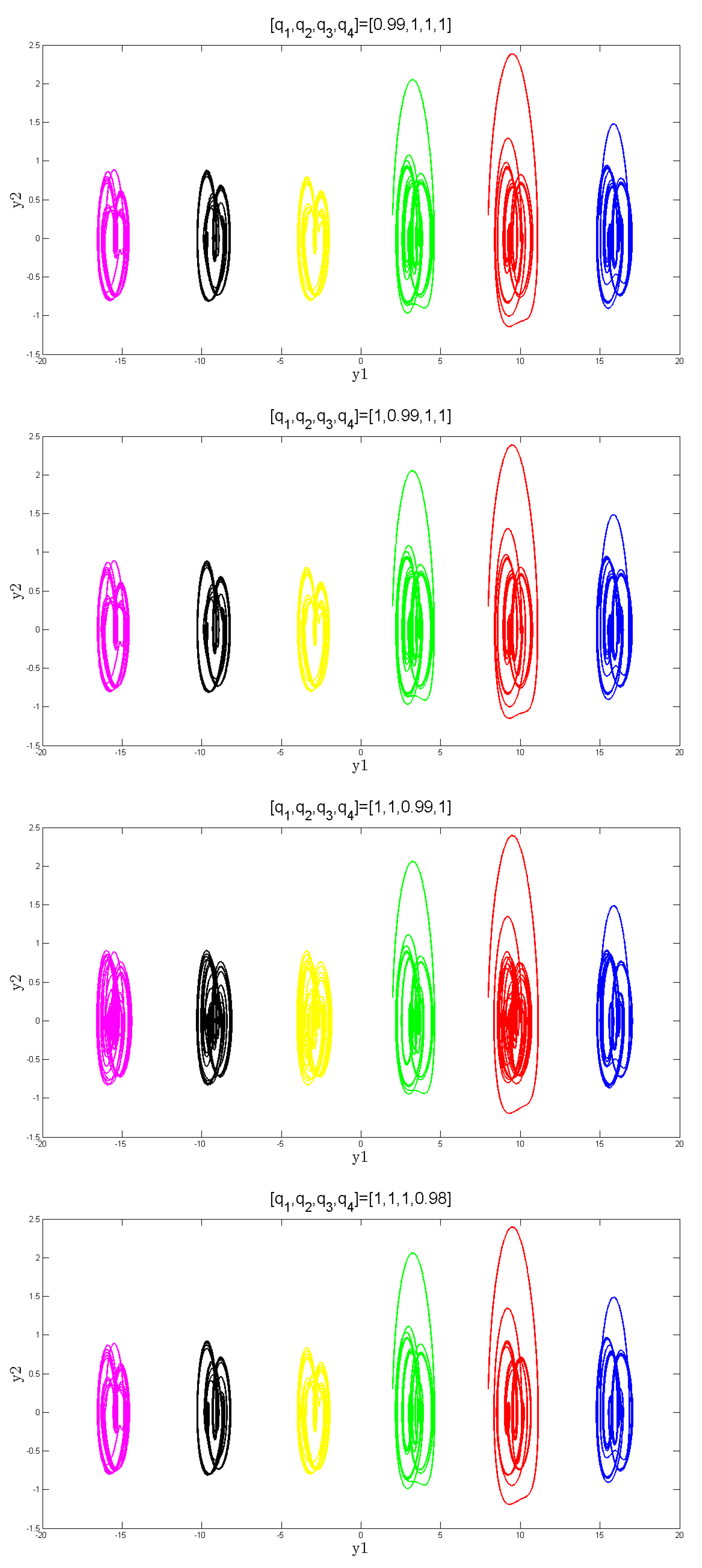
Figure 14 further investigates the influence of the incommensurate fractional orders by varying each of , , , and individually while keeping the remaining orders fixed. The obtained phase portraits reveal the coexistence of multiple chaotic dynamics under identical system parameters but different initial conditions, highlighting the strong sensitivity of the system dynamics to the initial state.
To further examine the influence of nearby initial conditions, coexisting bifurcation diagrams are computed for . Three closely spaced initial conditions, namely , , and , are considered. As shown in Figure 15, similar as well as distinct bifurcation structures are obtained, confirming the persistence of multistability even under small perturbations of the initial state. The corresponding coexisting chaotic dynamics and time series for are presented in Figure 16.
Without changing the system parameters, the incommensurate fractional-order power system’s operating point may fluctuate due to coexistence or multistable behavior. This change raises the possibility that the SSG will either progress toward persistent or chaotic oscillatory behavior or settle into a regular equilibrium.
These findings indicate that the dynamical behavior of the considered incommensurate fractional-order power system is highly dependent not only on the system parameters and fractional orders but also on the initial conditions. The observed coexistence of attractors demonstrates the presence of multiple stable operating regimes under identical parameter settings. From a practical perspective, this sensitivity may affect the predictability and reliability of power system operation, since small variations in the initial state can lead to significantly different long-term responses. Therefore, understanding and controlling such multistable behaviors is essential for ensuring stable system performance.
The sensitivity of the system dynamics to the initial conditions has been partially investigated through the multistability analysis. The obtained coexisting attractors demonstrate that different initial conditions may lead to distinct long-term dynamical behaviors under identical parameter values. These results indicate that the observed dynamics are not exclusively associated with the initial condition but persist for different initial states, highlighting the sensitivity of the incommensurate fractional-order power system to its initial conditions.
6. Chaos Control
From an engineering perspective, chaotic oscillations in power systems are generally undesirable because they may degrade power quality, reduce system reliability, and threaten secure operation. The presence of chaos implies a high sensitivity to initial conditions and parameter variations, which can lead to unpredictable system responses. Therefore, an effective control strategy is required to suppress chaotic oscillations and drive the system toward a stable operating state. The objective of the proposed controller is not only to demonstrate the controllability of the incommensurate fractional-order power system but also to improve its dynamical stability and ensure reliable operation under chaotic conditions.It should be emphasized that the objective of this section is not to introduce a new control design methodology. Rather, the proposed controller is employed as a proof-of-concept framework to demonstrate that the chaotic dynamics generated by the incommensurate fractional-order power system can be effectively suppressed and steered toward a stable operating condition. Before creating the controlled fractional power model, we describe the primary stability frameworks relevant to incommensurate fractional-order continuous-time systems.
We investigate an n-dimensional nonlinear fractional-order system in the Caputo sense described by
Here, denotes the Caputo fractional derivative of order . Let be an equilibrium point satisfying for all . Assume that each is continuously differentiable in a neighborhood of . Define the Jacobian matrix at by
Theorem 1
([24]). Consider an n-dimensional fractional-order continuous-time system of incommensurate order, i.e., for some . Assume that the fractional orders are rational numbers,
Let
Then, the equilibrium point is locally asymptotically stable if all roots λ of the characteristic equation
satisfying
To stabilize the continuous-time fractional power system and drive its states asymptotically toward the origin, suitable control inputs are implemented, particularly for formulations with incommensurate fractional orders.
To focus on the stabilization objective, a nonlinear state-feedback controller is constructed. Such controllers are commonly adopted in nonlinear dynamical systems to investigate the possibility of chaos suppression and equilibrium stabilization.
Let
and denote the control input by
The controlled system can therefore be expressed in the compact form
The proposed controller is a nonlinear state-feedback law of the form
where is designed to cancel the nonlinear terms and stabilize the equilibrium.
Proposition 1.
Consider the controlled continuous fractional-order system given by a fractional-order nonlinear system.
where , . Then, the incommensurate fractional power system is locally asymptotically stable under the nonlinear feedback control laws
The proposed feedback law is constructed according to the feedback linearization principle. Specifically, each controller component cancels the corresponding nonlinear and constant terms appearing in the uncontrolled dynamics, while introducing stabilizing linear terms. Consequently, the closed-loop system is transformed into a linear fractional-order system whose stability can be analyzed directly using Theorem 1.
Proof.
Substituting (26) into (25), the nonlinear and constant terms are completely canceled, yielding the closed-loop system
Let
Assume that the fractional orders are rational numbers of the form.
Let
Substituting the Jacobian matrix (28) into the characteristic equation given in Theorem 1 yields
First, we take , , , and . Then we have
Since the Jacobian matrix has a block upper-triangular structure, its determinant can be factorized into the product of the diagonal block determinants, leading to
All eigenvalues satisfy the condition.
Therefore, the fractional continuous-time power system satisfies the stability condition under the proposed criterion. These results demonstrate that the proposed control scheme successfully suppresses chaotic oscillations and stabilizes the system equilibrium, highlighting its potential usefulness for maintaining stable operation of fractional-order power systems. □
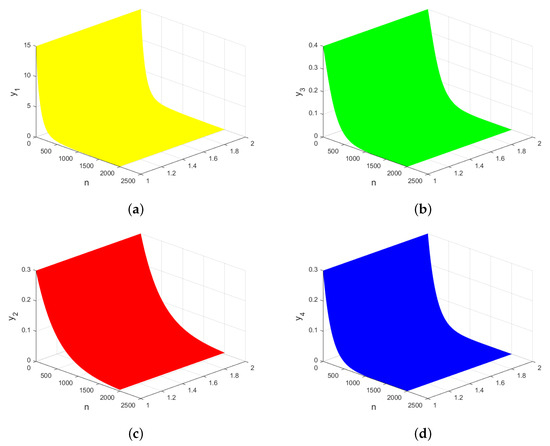
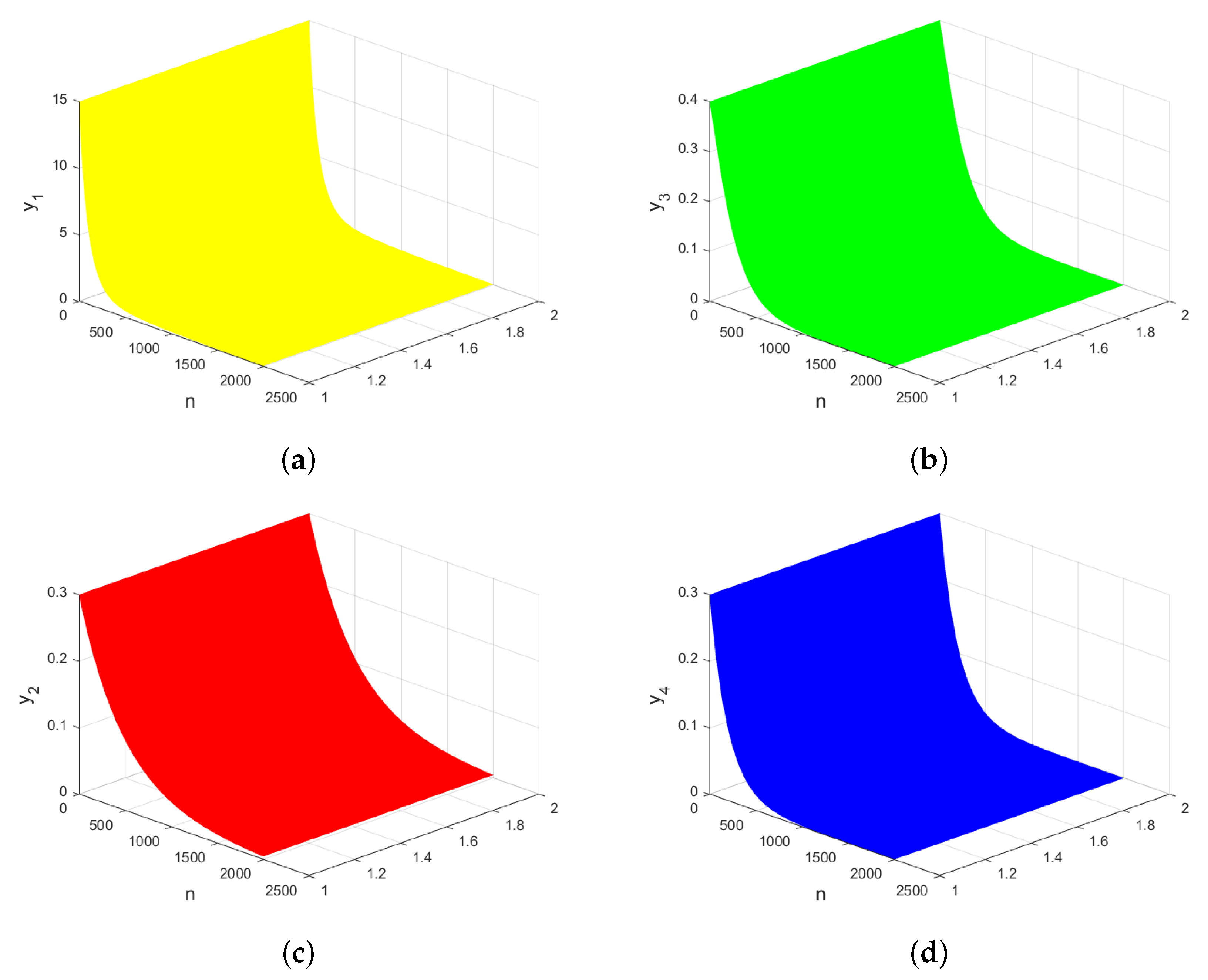
Figure 17 illustrates the effectiveness of the proposed controller. Starting from initial conditions corresponding to a chaotic regime, all state trajectories converge asymptotically toward the equilibrium point, confirming the successful suppression of chaotic oscillations and restoration of stable system behavior.
Figure 17.
The Stabilized state trajectories of the controlled system for , , with initial conditions , , , and : (a) , (b) , (c) , and (d) .
Several control strategies have been proposed for suppressing chaos in fractional-order systems, including state-feedback control, PI controllers, adaptive control, and observer-based approaches. Compared with these methods, the proposed nonlinear state-feedback controller possesses two main advantages. First, the nonlinear terms are explicitly canceled, resulting in a simple closed-loop system whose stability can be rigorously verified using the incommensurate fractional-order stability theorem. Second, the controller requires only direct measurements of the system states and avoids the additional observer dynamics or parameter adaptation required by more sophisticated methods. Therefore, although the controller is intended primarily as a proof-of-concept, it provides an effective and computationally simple approach for stabilizing the considered fractional-order power system.
7. Conclusions and Perspectives
In this study, a power system model based on the traditional N-machine power system framework is presented, and an incommensurate fractional-order analysis is performed using the Caputo technique. The findings show a range of intricate dynamical behaviors that appear under particular parameter settings and incommensurate fractional-order values, such as period-one oscillations, period-doubling events, chaotic dynamics, and angle instability. Qualitative and quantitative analytical techniques are utilized to characterize these behaviors. In addition, the existence of coexisting attractors and multistability is confirmed through bifurcation diagrams, phase portraits, and time-series analyses. The findings clearly indicate that chaos and multistability are intrinsic features of the incommensurate fractional-order power system. Such phenomena are of significant concern due to their potential to induce unpredictable and uncontrollable system responses, leading to power outages, equipment deterioration, and safety risks. Consequently, effective strategies for monitoring, managing, and controlling chaotic and multistable dynamics are essential to ensure the safe and reliable operation of practical power systems.
Author Contributions
Conceptualization, N.D.; Methodology, O.K. and M.A.; Software, M.A.; Validation, A.O.; Formal Analysis, S.A.; Investigation, S.A.; Writing—Original Draft, O.K. and N.D.; Writing—Review and Editing, A.O. and L.E.A.; Visualization, L.E.A. All authors have read and agreed to the published version of the manuscript.
Funding
Princess Nourah bint Abdulrahman University Researchers Supporting Project number (PNURSP2026R831), Princess Nourah bint Abdulrahman University, Riyadh, Saudi Arabia. The authors extend their appreciation to the Deanship of Scientific Research at Northern Border University, Arar, KSA for funding this research work through the project number “NBU-FPEJ-2026-2443-06”.
Data Availability Statement
The original contributions presented in this study are included in the article. Further inquiries can be directed to the corresponding authors.
Acknowledgments
Princess Nourah bint Abdulrahman University Researchers Supporting Project number (PNURSP2026R831), Princess Nourah bint Abdulrahman University, Riyadh, Saudi Arabia. The authors extend their appreciation to the Deanship of Scientific Research at Northern Border University, Arar, KSA for funding this research work through the project number “NBU-FPEJ-2026-2443-06”.
Conflicts of Interest
The authors declare no conflict of interest.
References
- Ma, H.; Min, F.; Wang, Y. Nonlinear dynamic analysis and surface sliding mode controller based on low-pass filter for chaotic oscillation in a power system with power disturbance. Chin. J. Phys. 2018, 56, 2488–2499. [Google Scholar] [CrossRef] [Scilit]
- Samuel, I.A.; Katende, J.; Awosope, C.O.A.; Awelewa, A.A. Prediction of voltage collapse in electrical power system networks using a new voltage stability index. Int. J. Appl. Eng. Res. 2017, 12, 190–199. [Google Scholar]
- Yu, Y.; Jia, H.; Li, P.; Su, J. Power system instability and chaos. Electr. Power Syst. Res. 2003, 65, 187–195. [Google Scholar] [CrossRef] [Scilit]
- Gholizadeh, H.; Hassannia, A.; Azarfar, A. Chaos detection and control in a typical power system. Chin. Phys. B 2013, 22, 010503. [Google Scholar] [CrossRef] [Scilit]
- Vahdati, P.M.; Kazemi, A. Bifurcations and chaos in nonlinear dynamics of power systems. In Proceedings of the 24th Iranian Conference on Electrical Engineering (ICEE), Shiraz, Iran, 10–12 May 2016; pp. 1706–1711. [Google Scholar]
- Wang, X.; Lu, Z.; Song, C. Chaotic threshold for a class of power system model. Shock Vib. 2019, 2019, 3479239. [Google Scholar] [CrossRef] [Scilit]
- Almeida, A.M.d.; Lenzi, M.K.; Lenzi, E.K. A Survey of fractional order calculus applications of multiple-input, multiple-output (MIMO) process control. Fractal Fract. 2020, 4, 22. [Google Scholar] [CrossRef] [Scilit]
- Sharafian, A.; Ullah, I.; Singh, S.K.; Ali, A.; Khan, H.; Bai, X. Adaptive fuzzy backstepping secure control for incommensurate fractional-order cyber-physical power systems under intermittent denial of service attacks. Chaos Solitons Fractals 2024, 186, 115288. [Google Scholar] [CrossRef] [Scilit]
- Wang, P.; Chen, X.; Zhang, Y.; Zhang, L.; Huang, Y. Fractional-Order Load Frequency Control of an Interconnected Power System with Hydrogen Energy-Storage Unit. Preprints 2024. [Google Scholar] [CrossRef] [Scilit]
- Fathollahi, A.; Andresen, B. Enhancing Transient Stability in Multi-Machine Power Systems through a Model-Free Fractional-Order Excitation Stabilizer. Fractal Fract. 2024, 8, 419. [Google Scholar] [CrossRef] [Scilit]
- Kahouli, O.; Zouak, I.; Almohaimeed, S.; Ouannas, A.; Amraoui, L.E.; Ayari, M. On Fractional Discrete-Time Power Systems: Chaos, Complexity and Control. Mathematics 2026, 14, 1354. [Google Scholar] [CrossRef] [Scilit]
- Chen, Y. Applied fractional calculus in controls. In 2009 American Control Conference; IEEE: Piscataway, NJ, USA, 2009; pp. 34–35. [Google Scholar]
- Chang, S.-C. Stability, Chaos Detection, and Quenching Chaos in the Swing Equation System. Math. Probl. Eng. 2020, 2020, 6677084. [Google Scholar] [CrossRef] [Scilit]
- Chang, S.-C. Controlling Chaos through Period-Doubling Bifurcations in Attitude Dynamics for Power Systems. Math. Probl. Eng. 2020, 2020, 8853459. [Google Scholar] [CrossRef] [Scilit]
- Gupta, P.C.; Singh, P.P. Multistability, multiscroll chaotic attractors and angle instability in multi-machine swing dynamics. IFAC PapersOnLine 2022, 55, 572–578. [Google Scholar] [CrossRef] [Scilit]
- Gupta, P.C.; Singh, P.P. Multistability, coexisting behaviours and control of fractional order dissipative small scale grid with disturbances and noise. Eur. Phys. J. Spec. Top. 2023, 232, 2415–2436. [Google Scholar] [CrossRef] [Scilit]
- Gupta, P.C.; Singh, P.P. Chaos and Multistability in Fractional Order Power System: Dynamic Analysis and Implications. In Innovations in Electrical and Electronic Engineering; Lecture Notes in Electrical Engineering; Springer: Berlin/Heidelberg, Germany, 2024; Volume 1109. [Google Scholar]
- Podlubny, I. Fractional Differential Equations; Academic Press: New York, NY, USA, 1999. [Google Scholar]
- Tavazoei, M.S.; Haeri, M. Chaotic attractors in incommensurate fractional order systems. Phys. D Nonlinear Phenom. 2008, 237, 2628–2637. [Google Scholar] [CrossRef] [Scilit]
- Deng, W.; Li, C.; Lu, J. Stability analysis of linear fractional differential system with multiple time delays. Nonlinear Dyn. 2007, 48, 409–416. [Google Scholar] [CrossRef] [Scilit]
- Kopell, N.; Washburn, R. Chaotic motions in the two-degree- of-freedom swing equations. IEEE Trans. Circuits Syst. 1982, 29, 738–746. [Google Scholar]
- Chang, S.C. Study of Structural Stability for Power System. Master’s Thesis, National Central University, Taoyuan City, Taiwan, 1992. [Google Scholar]
- Baleanu, D.; Diethelm, K.; Scalas, E.; Trujillo, J. Fractional Calculus Models and Numerical Methods; World Scientific Publishing Company: Singapore, 2012. [Google Scholar]
- Odibat, Z.; Corson, N.; Aziz-Alaoui, M.A.; Alsaedi, A. Chaos in Fractional Order Cubic Chua System and Synchronization. Int. J. Bifurc. Chaos 2017, 27, 1750161. [Google Scholar] [CrossRef] [Scilit]

Disclaimer/Publisher’s Note: The statements, opinions and data contained in all publications are solely those of the individual author(s) and contributor(s) and not of MDPI and/or the editor(s). MDPI and/or the editor(s) disclaim responsibility for any injury to people or property resulting from any ideas, methods, instructions or products referred to in the content. |
© 2026 by the authors. Licensee MDPI, Basel, Switzerland. This article is an open access article distributed under the terms and conditions of the Creative Commons Attribution (CC BY) license.