


Abstract
We propose two multi-layer controlled multi-output remote state preparation (RSP) schemes for arbitrary single-qubit and single-qudit states. Twelve-particle entangled channels are constructed in two-dimensional and d-dimensional Hilbert spaces, and a hierarchical authorization mechanism is introduced to enable controllers with different permission levels to jointly and selectively regulate the reconstruction of quantum states at multiple receivers. First, based on a twelve-qubit maximally entangled channel, we design a deterministic three-layer controlled multi-output RSP protocol in which one sender assists three receivers in preparing their respective target single-qubit states. In this protocol, the controllers are assigned high-, medium-, and low-level permissions. Under different multi-layer control conditions, the three receivers can reconstruct their respective original single-qubit states by performing appropriate local unitary operations. The results show that the protocol achieves unit success probability, exhibits good universality and provides a structured basis for extension to larger multi-user settings, and enforces hierarchical access control by preventing unauthorized receivers from deterministically reconstructing the target states. Subsequently, we replace the maximally entangled channel with a non-maximally entangled twelve-qubit state. After the sender performs two specific three-qubit projective measurements, the receivers can probabilistically reconstruct their respective target states under the same three-layer control structure by introducing auxiliary qubits, applying controlled-U gates, and measuring the auxiliary systems. Finally, by employing positive operator-valued measurements, the above scheme is generalized from qubit systems to arbitrary d-dimensional qudit systems, providing a theoretical basis for exploring larger multi-user quantum communication settings with hierarchical authorization.
Keywords:
remote state preparation; controlled remote state preparation; multi-output remote state preparation; multi-layer control; single-qubit and single-qudit states MSC:
81P45; 81P68; 81P40; 94A15; 94A40
1. Introduction
Entanglement is among the most distinctive nonclassical features of quantum mechanics. The nonlocal correlations exhibited by entanglement not only pose a profound challenge to classical local realism [1,2], but have also become a core resource in quantum information science, playing an important role in quantum communication, quantum computation, and quantum cryptography [3,4,5]. In quantum network scenarios, entanglement can support information processing and secure communication between spatially separated nodes beyond the limitations of classical physics [6,7,8]. Among various quantum communication protocols, quantum teleportation is one of the most representative. This scheme was first proposed by Bennett et al., and its core idea is to reconstruct an unknown quantum state at a remote location with the assistance of shared entanglement and classical communication, without directly transmitting the original particle [9]. This idea was subsequently verified experimentally [10] and further extended under different entanglement resources and task settings [11,12,13,14]. However, in many quantum network applications, the quantum state to be distributed often has a known classical description. In such cases, RSP is more suitable than teleportation. Although the two protocols are closely related in form, RSP uses the sender’s prior knowledge of the target state and therefore differs essentially from teleportation in terms of information structure and resource requirements.
In RSP protocols, the sender has prior knowledge of the parameters specifying the target quantum state. Such prior knowledge can reduce the resource requirements of the protocol under certain conditions, especially classical communication costs [15,16]. Pati was the first to discuss single-qubit remote state preparation schemes and analyzed their classical communication costs and implementation methods [16]. Subsequently, Bennett et al. systematically characterized RSP in terms of entanglement and classical communication requirements and further clarified the relationship between RSP and quantum teleportation [17,18]. With the development of quantum networks, research on RSP has gradually expanded from idealized single-qubit models to experimental implementations, high-dimensional systems, and multipartite state preparation. Peters et al. experimentally realized the remote preparation of photon polarization states, thereby demonstrating the feasibility of RSP [19]. Yu et al. investigated the remote preparation of qudit states using maximally entangled qubit resources, providing an early example of extending RSP to higher-dimensional systems [20]. Ma et al. investigated the remote preparation of four-particle cluster-type states [21]. Wei et al. proposed a scheme for remotely preparing arbitrary multi-qubit states using two-qubit entangled states [22]. These studies have advanced RSP from simple single-particle systems toward multipartite and high-dimensional systems, as well as more complex network-oriented communication scenarios.
Controlled RSP (CRSP) is an important extension of RSP, with the core idea of introducing a control mechanism into the remote state preparation process. In CRSP protocols, whether the receiver can successfully recover the target state depends not only on the cooperation between the sender and the receiver, but also on the authorization or cooperation of the controller. This feature makes CRSP particularly suitable for multi-user quantum networks and authorization-based quantum communication. Related studies have shown that introducing a control structure when the target state is known can enhance the security and manageability of the protocol [16]. Wang et al. proposed a basic CRSP model and clarified the role of the controller in the protocol’s information flow and state reconstruction [23]. They later showed that tripartite CRSP can also be realized using partially entangled states, thereby reducing its dependence on ideal maximally entangled resources [24]. Li and Ghose further proposed and analyzed the concept of control power, providing a basis for evaluating the performance of CRSP protocols [25]. Building on these studies, CRSP protocols involving multipartite entangled states, high-dimensional systems, and noisy channels have been widely studied. For example, Chen et al. realized CRSP for arbitrary two- and three-qubit states using the Brown state [26]. Liu and Hwang proposed CRSP protocols based on AKLT states [27]. Ma et al. extended CRSP to a three-dimensional cyclic controlled scenario [28]. Sharma et al. analyzed variations in the fidelity of controlled bidirectional RSP in noisy environments [29]. Peng et al. further studied CRSP schemes over noisy channels with memory effects [30]. Peng and Xiang proposed a multi-controller CRSP protocol for multi-qubit string information [31]. Although these works have significantly advanced the development of CRSP, existing studies still have several obvious limitations: most of them adopt a single-control structure or assume that multiple controllers have equal authority, and therefore lack a clear hierarchical authorization mechanism. Although hierarchical controlled remote state preparation and related hierarchical remote-information-processing tasks have been explored in certain specific scenarios [32,33,34,35], the hierarchy in these schemes mainly distinguishes the state-reconstruction or operation-implementation privileges of participating agents. It does not provide a mechanism in which dedicated controllers with different authority levels selectively regulate the reconstruction processes of multiple fixed receivers. Consequently, the systematic integration of dedicated controllers with different permission levels into multi-output remote state preparation, such that distinct output states can be selectively regulated, remains insufficiently investigated.
On the other hand, multi-output RSP has important application value in quantum networks. Its goal is to prepare different target quantum states for multiple receivers within the same communication task, thereby improving the efficiency of quantum state distribution and the scalability of quantum networks. Several multicast-based remote state preparation schemes have been proposed to characterize multi-party and multi-receiver RSP tasks in quantum networks [36,37,38]. In recent years, related studies have also constructed multicast preparation protocols for quantum networks from the perspective of joint remote state preparation (JRSP), and discussed their experimental or platform implementation, providing new implementation routes for multi-output RSP [39]. In addition, multi-sender cooperation and multi-receiver state reconstruction tasks also embody the idea of multi-output quantum state distribution. Existing studies have shown that, through the cooperative operations among multiple senders, multiple receivers can reconstruct different single-qubit or multi-qubit target states in parallel within the same communication task, and this idea can be further extended to chain-type or networked topologies [40,41,42]. However, existing multi-output RSP schemes usually consider only a single controller, or introduce control operations only at a certain stage of the protocol. They have not fully discussed the case in which multiple controllers with different authorization levels selectively regulate the state-reconstruction processes of different fixed receivers. Therefore, how to introduce a multi-layer control mechanism into multi-output RSP, so that controllers with different authority levels can collaboratively and selectively affect different receivers, remains a problem worthy of further investigation.
In addition, practical quantum channels are inevitably affected by decoherence, dissipation, and environmental noise. Ideal maximally entangled states may suffer from entanglement degradation or even entanglement sudden death [43]. Under realistic noise processes, an initially maximally entangled pure state may evolve into a degraded quantum state with reduced entanglement and coherence and, in general, may become a mixed state. Such noisy evolution should be distinguished from replacing a maximally entangled resource by a non-maximally entangled pure resource state characterized by unequal Schmidt coefficients. To address such decoherence effects, several studies have investigated deterministic RSP schemes under dissipative or noisy conditions [44,45,46]. For example, Wang et al. employed a six-qubit entangled resource to construct a JRSP protocol for arbitrary two-qubit states [47]. Dong and Liu further studied the remote preparation of a class of three-qubit W states by using fully and partially entangled resources [48]. Moreno et al. explored the mechanism of remotely preparing quantum states from imperfect bipartite resources [49]. These studies indicate that non-ideal channel conditions are an important factor that must be considered when RSP protocols move toward practical applications. However, existing studies on non-maximally entangled pure resource states mainly focus on relatively simple output structures or single-controller models. When multi-output structures and multi-layer control mechanisms coexist, how channel non-ideality affects the reconstruction processes of different receivers and the overall success probability, and how to balance control complexity with resource consumption, remain insufficiently investigated. It should be emphasized that the non-maximally entangled model considered in the present work is a pure entangled resource state with unequal Schmidt coefficients, rather than a noisy mixed state obtained by applying amplitude-damping, phase-damping, or depolarizing channels. Therefore, the success-probability analysis for the non-maximally entangled resource characterizes the effect of imperfect pure-state entanglement within the adopted model and should not be interpreted as a complete robustness analysis under environmental noise.
High-dimensional quantum systems provide new possibilities for improving the information-carrying capacity and flexibility of quantum communication protocols [50]. In terms of implementation methods, positive operator-valued measurements (POVMs) provide important methodological support for high-dimensional remote state preparation, nonorthogonal measurements, and the construction of complex state families [51]. Existing studies have applied POVM methods to single-qubit and multipartite remote state preparation tasks. For example, Wang discussed POVM-based symmetric single-qubit RSP [52], and Liu et al. realized POVM-based remote preparation of three-particle states as well as arbitrary two- and three-qubit states [53,54]. These works have laid a technical foundation for extending RSP protocols to more general high-dimensional systems and multi-user quantum network scenarios. However, to the best of our knowledge, a unified protocol framework that simultaneously integrates high-dimensional systems, multi-output state preparation, and multi-layer control mechanisms under both maximally and non-maximally entangled channel conditions is still lacking. Here, the non-maximally entangled case considered in this work refers specifically to a non-maximally entangled pure resource state rather than a noisy mixed-state channel. Taken together, existing studies have extensively explored remote state preparation from multiple perspectives, including control mechanisms, multi-output structures, non-maximally entangled channels, and generalizations to high-dimensional systems, and have achieved substantial progress. Nevertheless, most studies still focus on single-controller models, and the discussions of protocols based on maximally entangled and non-maximally entangled channels are often conducted separately. When multi-output structures and complex hierarchical control requirements are considered simultaneously, there is still a lack of systematic research on how to characterize the influence of different control authorities on the reconstruction paths of different receivers within the same protocol framework, and how to systematically analyze the success probabilities and implementation requirements under maximally and non-maximally entangled channels. In the present study, these two cases are modeled using maximally entangled and non-maximally entangled pure resource states, respectively. Based on these considerations, this paper mainly focuses on the following questions. First, in a two-dimensional Hilbert space, when a multi-output RSP protocol introduces a multi-layer control mechanism, is it feasible under maximally entangled channel conditions, and what is its success probability? Second, when the maximally entangled pure resource state is replaced by a non-maximally entangled pure resource state with unequal Schmidt coefficients, how should the protocol be adjusted, and how will its success probability change? Third, can the above results be further generalized to a d-dimensional Hilbert space to realize the remote preparation of arbitrary single-particle states, namely qudit states?
To address the above issues, this paper proposes a class of multi-layer controlled multi-output RSP protocols for realizing hierarchical authorization and the collaborative preparation of distinct single-particle states at multiple receivers. The proposed protocol integrates multi-output remote state preparation with a hierarchical authorization framework, enabling controllers with different permission levels to jointly and selectively regulate the state-reconstruction processes of multiple receivers. In the proposed architecture, the sender, receivers, and controllers have fixed and mutually separated roles, while different receivers are subject to different but fixed authorization conditions. In this way, the proposed protocol goes beyond the single-controller configuration commonly adopted in conventional CRSP schemes. Furthermore, this paper systematically investigates the theoretical construction, state-reconstruction procedures, and success probabilities of the proposed protocol using maximally entangled and non-maximally entangled resource states, respectively, and further generalizes the scheme to high-dimensional quantum systems. In addition, the practical implementation prospects and principal experimental challenges of the proposed protocol are discussed. These investigations reveal the synergistic effects of multi-output transmission and multi-layer control mechanisms in remote state preparation tasks and provide new theoretical insights for constructing multi-user quantum-state distribution protocols with hierarchical control capability, potential for extension to larger multi-user settings, and practical adaptability.
The rest of this paper is organized as follows. Section 2 presents the construction of the two-dimensional protocols based on maximally entangled and non-maximally entangled twelve-qubit pure resource states, together with the corresponding recovery operations and success-probability analysis. Section 3 extends the scheme to general d-dimensional qudit systems and derives the POVM-based implementation procedure along with the associated probability expressions. Finally, Section 4 compares the proposed protocol with representative related RSP schemes and discusses its resource requirements and operational complexity, security and controllability, as well as practical implementation issues, and outlines its potential applications in controlled multi-user quantum communication networks.
2. Multi-Layer Controlled Multi-Output RSP in a Two-Dimensional Hilbert Space
To give a concrete realization of the proposed hierarchical multi-output RSP framework for the qubit case, this section focuses on arbitrary single-qubit states in a two-dimensional Hilbert space. We first construct a twelve-qubit maximally entangled channel and use it to design a deterministic three-layer controlled three-output RSP protocol. Then, to make the scheme applicable to more general entanglement resources, the maximally entangled channel is replaced by a non-maximally entangled one, and the corresponding probabilistic implementation is developed. In both cases, the roles of the layered controllers, the receivers’ recovery operations, and the success probabilities are analyzed in detail.
2.1. Multi-Layer Controlled Multi-Output RSP Based on a Maximally Entangled Channel
To realize the three-layer controlled multi-output remote state preparation task, it is necessary to establish a suitable entangled quantum channel shared among all participants. For clarity, we first construct the twelve-qubit entangled channel used in the two-dimensional case. Initially, all particles are prepared in the ground state,
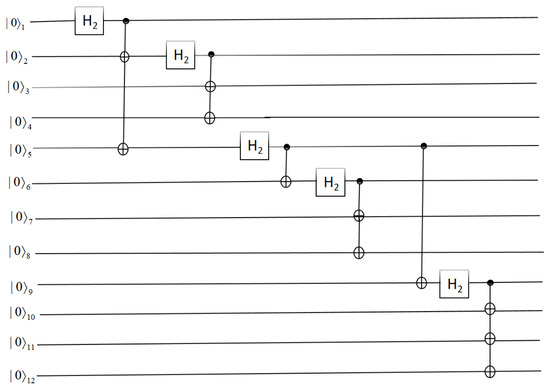
First, the two-dimensional Hadamard gate is first applied to qubit 1. Then, two controlled-NOT operations are applied to the pairs and , with qubit 1 serving as the control qubit and qubits 2 and 5 serving as the corresponding target qubits. After these operations, the initial state evolves into
Next, the Hadamard gate is applied to qubit 2, followed by two controlled-NOT operations on the pairs and . Here, qubit 2 serves as the control qubit, while qubits 3 and 4 serve as the target qubits. Thus, the state in Equation (2) is converted into
Subsequently, the Hadamard gate is applied to qubit 5, followed by a controlled-NOT operation on the pair . In this operation, qubit 5 serves as the control qubit and qubit 6 as the target qubit. One obtains
Afterward, we apply to qubit 6 and perform two controlled-NOT operations on the pairs and . Qubit 6 controls both operations, and qubits 7 and 8 are the corresponding target qubits. The resulting state is
Finally, a controlled-NOT operation is implemented on the pair , where qubit 5 serves as the control qubit and qubit 9 as the target qubit. Subsequently, qubit 9 is processed by , and three controlled-NOT operations are carried out on the pairs , and . In this way, the state in Equation (5) is transformed into
which completes the construction of the twelve-qubit maximally entangled channel. The corresponding quantum circuit is illustrated in Figure 1.
Figure 1.
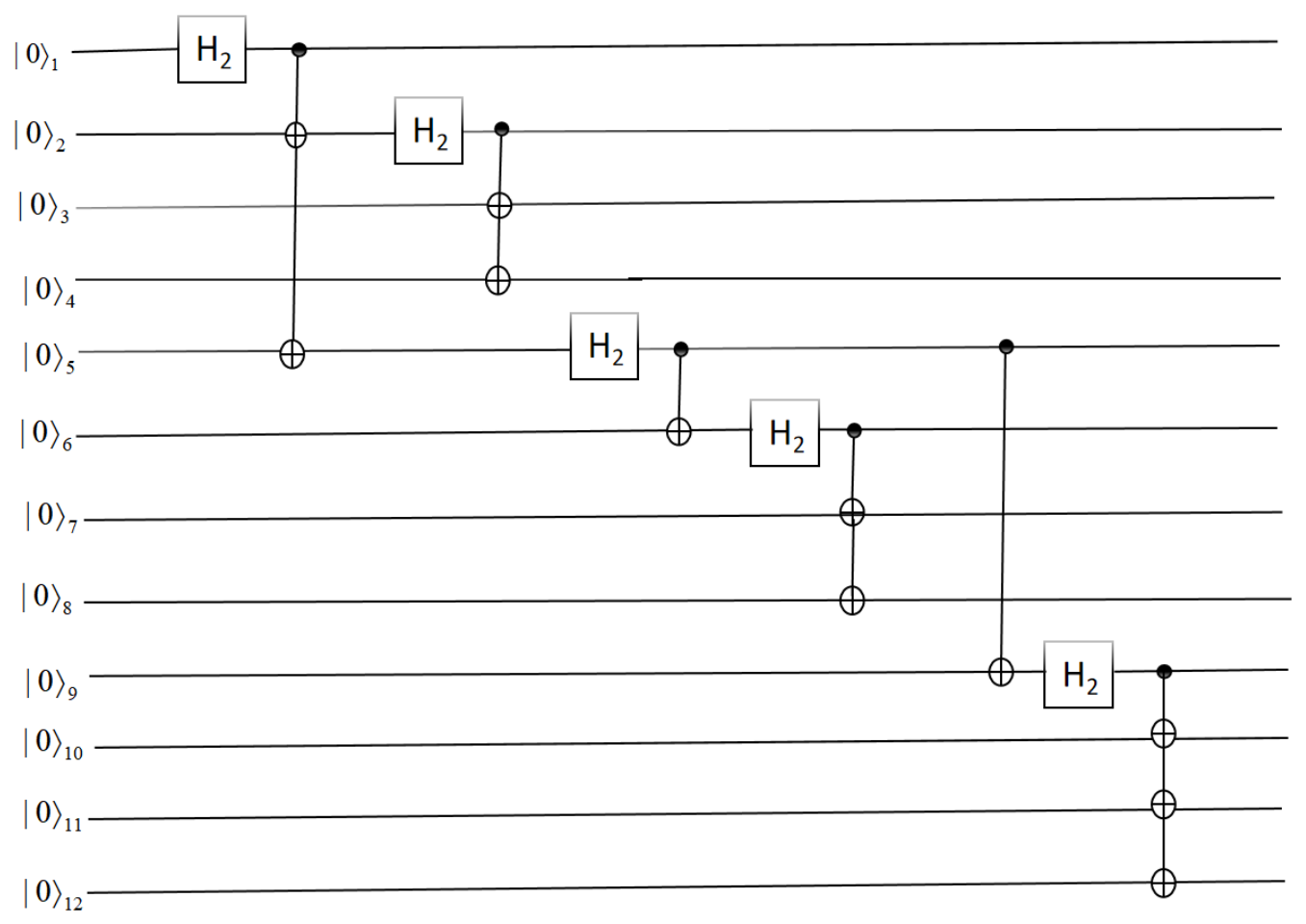
Quantum circuit for generating the twelve-qubit maximally entangled channel state in a two-dimensional Hilbert space. Here, denotes the two-dimensional Hadamard gate, the solid black dot • represents the control particle, and ⊕ denotes the target of the controlled operation.
We now describe the remote state preparation procedure. Suppose that Alice intends to remotely prepare three single-qubit states , and for Bob, Charlie, and David, respectively, under the supervision of Fiona, Grace, and Henry. These states are parameterized as
where and are real parameters satisfying , , , and . Alice is assumed to know all of these parameters, whereas the other participants have no prior knowledge of them. The channel state in Equation (6) is distributed as follows: Alice holds qubits 2, 3, 6, 7, 10 and 11; Bob, Charlie and David possess qubits 4, 8 and 12, respectively; and qubits 1, 5 and 9 are assigned to Fiona, Grace and Henry, respectively.
The protocol consists of the following four steps.
Step 1: Sender’s measurement Since Alice has complete knowledge of the amplitude parameters and y, she constructs the following tailored measurement basis:
Alice then performs a joint measurement on qubits 2, 6, and 10 in this basis.
Step 2: Sender’s feedforward operation According to the outcome obtained in Step 1, Alice performs a feedforward measurement on qubits 3, 7, and 11. Specifically, when the measurement in Step 1 yields the outcome , she measures qubits 3, 7, and 11 in the orthonormal basis
where , and the matrix can be expressed as
After completing the two measurements, Alice sends the corresponding classical information to Bob, Charlie, and David. Each outcome pair occurs with probability , where . As an example, when Alice obtains and , the remaining particles 1, 4, 5, 8, 9, and 12 collapse to
This result is obtained with probability .
Equation (11) shows that qubit 4 is correlated with qubit 1, qubit 8 is correlated with qubits 1 and 5, and qubit 12 is correlated with qubits 1, 5 and 9. Therefore, Bob, Charlie, and David cannot directly recover their target states before the controllers release the corresponding information. More precisely, Bob’s recovery depends on Fiona, Charlie’s on Fiona and Grace, and David’s on all three controllers. This realizes a hierarchical control structure over the three receivers.
Step 3: Controllers’ measurements
When Fiona, Grace, and Henry agree to assist the receivers, Fiona and Grace measure their particles in the Z basis, while Henry uses the X basis. The obtained classical outcomes are then sent according to their authorization levels: Fiona informs Bob, Charlie, and David; Grace sends her result to Charlie and David; and Henry communicates only with David. Let the three outcomes be , and , where and . Since each result occurs with probability , Equation (11) reduces to
From Equation (12), Fiona can fully determine the recovery of qubit 4 and also influence the reconstructions associated with qubits 8 and 12. Grace affects the recovery of qubits 8 and 12, whereas Henry is involved only in the reconstruction of qubit 12. Accordingly, the three controllers form a permission hierarchy: Fiona is placed in the upper layer with the strongest authority, Grace belongs to the middle layer with intermediate control power, and Henry is assigned to the lower layer with the most limited influence.
Step 4: Receivers’ recovery operations
After receiving all required classical information, Bob, Charlie and David apply the local unitary operations , and to qubits 4, 8 and 12, respectively. These operations are defined as
Consequently, the joint operation maps to
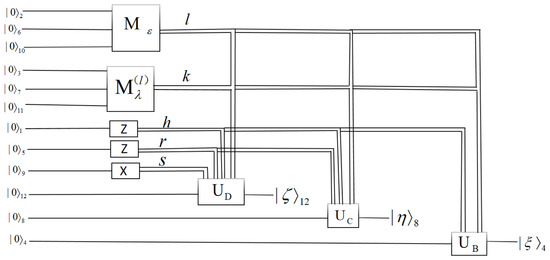
Thus, Bob, Charlie and David obtain the desired single-qubit states, and the RSP task is successfully completed. For a clearer presentation, the whole three-layer controlled three-output RSP process is shown schematically in Figure 2.
Figure 2.
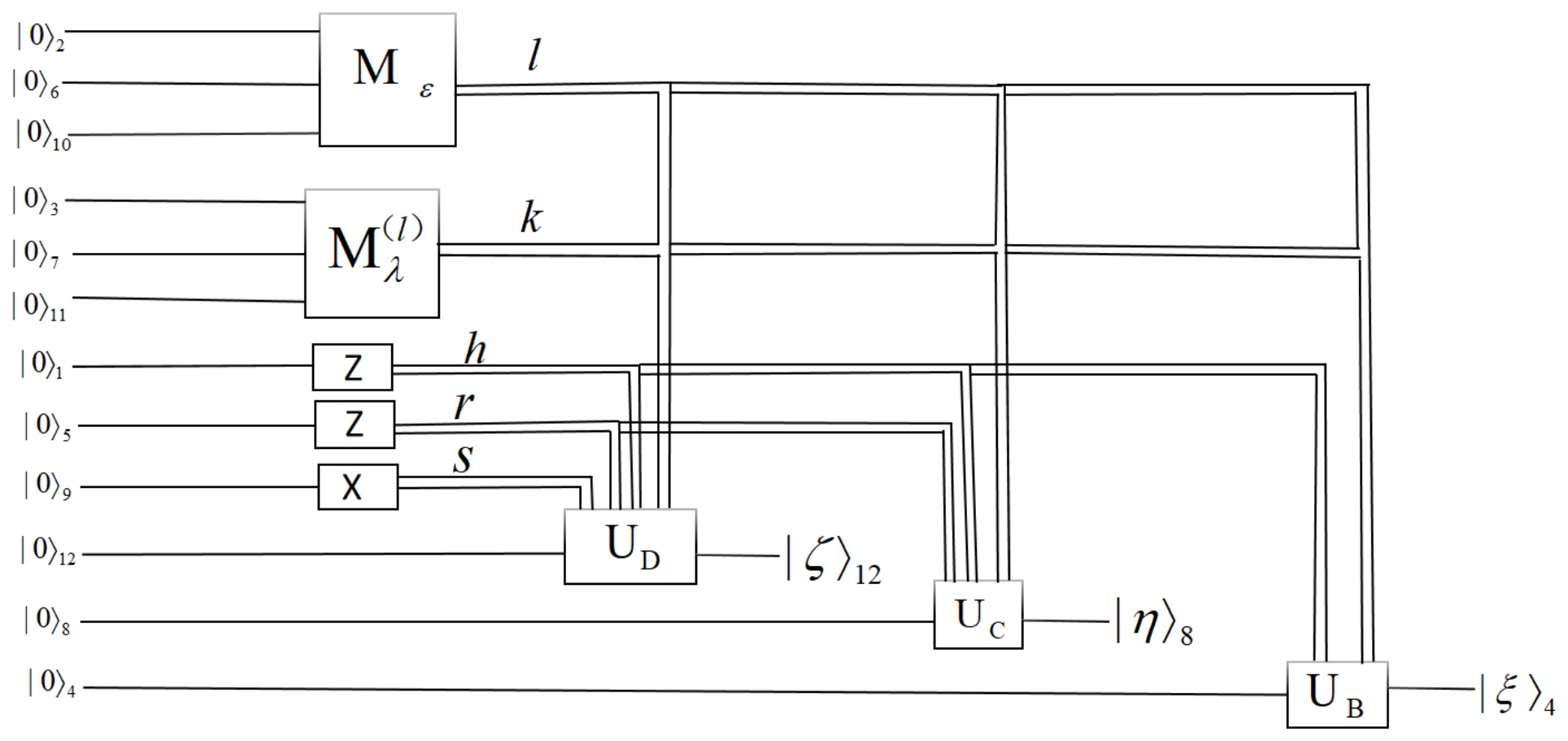
Schematic illustration of the three-layer controlled three-output RSP protocol based on a twelve-qubit entangled channel. Alice performs two adaptive measurements, denoted by and , and obtains the indices l and k, where . The controllers Fiona, Grace and Henry measure their own qubits and generate the binary outcomes h, r and s, where h and r are obtained from Z-basis measurements and s is obtained from an X-basis measurement. The required classical data are then transmitted to the corresponding receivers through classical channels, represented by double lines. Finally, Bob, Charlie, and David perform the conditional operations , and to recover , and , respectively. Single solid lines denote quantum channels.
Since and , the protocol has possible combinations of measurement outcomes. Therefore, the total success probability is
Hence, the proposed scheme is deterministic.
2.2. Multi-Layer Controlled Multi-Output RSP with a Non-Maximally Entangled Channel
In this subsection, the preceding protocol is extended to the case where the shared resource is non-maximally entangled. Specifically, the maximally entangled channel in Equation (6) is replaced by , while the remaining settings of the protocol are kept unchanged. The state is written as
where the real parameters and n satisfy , , and . Without loss of generality, we take , , and .
The protocol is implemented through the following four stages.
Step 1: Sender’s measurement
Alice first measures qubits 2, 6, and 10 in the complete three-qubit orthonormal basis defined in Equation (8). For the non-maximally entangled channel, the probabilities of these measurement outcomes are generally nonuniform and depend on both the target-state amplitudes and the Schmidt coefficients of the shared resource. As an example, when the outcome is , namely , the remaining qubits 1, 3, 4, 5, 7, 8, 9, 11, and 12 are projected onto
Taking the squared norm of Equation (16), the probability of this measurement outcome is The probabilities of the other seven outcomes can be obtained in the same manner. According to the product structure of the basis states in Equation (8), each first-stage probability is a product containing one factor from each of the following three pairs: The eight possible products correspond exactly to the eight outcomes . Their probabilities are properly normalized, since
Thus, unlike the maximally entangled case, the first-stage measurement outcomes are generally not equiprobable. In the maximally entangled limit , all eight probabilities reduce to .
Step 2: Sender’s feedforward measurement
Based on the measurement result obtained in Step 1, Alice chooses the orthonormal basis defined in Equation (9) to measure qubits 3, 7, and 11. The probability of the second measurement is evaluated conditionally on the outcome of the first measurement. Continuing with the example above, if Alice obtains , the remaining particles are projected onto the following unnormalized state
Taking the squared norm of Equation (17), the joint probability of obtaining and is Therefore, for , the corresponding conditional probability is The other measurement branches can be analyzed in the same manner. For every first-stage outcome with nonzero probability, one obtains Alice then announces the results of the two measurements to Bob, Charlie, and David through classical communication.
Equation (17) shows that qubit 4 is correlated with qubit 1, qubit 8 is correlated with qubits 1 and 5, and qubit 12 is associated with qubits 1, 5, and 9. Therefore, Fiona participates in the reconstruction processes of Bob, Charlie, and David; Grace participates in the recovery of Charlie and David; and Henry is involved only in David’s reconstruction. Accordingly, the same three-layer authorization structure as in the maximally entangled protocol is preserved.
Step 3: Controllers’ measurements
When the controllers agree to assist the receivers, Fiona and Grace measure qubits 1 and 5 in the Z basis , respectively. Henry measures qubit 9 in the X basis . The corresponding outcomes are denoted by , , and . For a specified pair of Alice’s measurement outcomes with nonzero probability, the three controller measurements are equiprobable. Therefore,
The controllers then transmit their measurement results to the corresponding receivers through classical communication. For the example considered above, after these measurements, qubits 4, 8, and 12 are projected, up to an overall normalization factor, onto the state
Step 4: Recovery by the receivers
After receiving the classical information from Alice and the controllers, Bob, Charlie, and David carry out the required recovery operations to reconstruct their target states. For the above example, they first perform the local unitary transformations
Then, the state becomes
Next, Bob, Charlie and David introduce auxiliary qubits and with initial states , and , respectively, and then they respectively execute the controlled-U gates , and , where the controlled-U gate is defined as
Here is the identity operator, and denotes a rotation by around the direction , namely
where is a three-dimensional real vector, and consists of the Pauli operators , and . Taking and one obtains
That is, Equation (23) is the result of Bob, Charlie and David performing transformations , and on their respective qubit pairs.
Finally, the receivers measure their auxiliary qubits in the Z basis . The three-output RSP task succeeds when all three auxiliary measurements yield . For these successful auxiliary-measurement outcomes, Bob and David directly recover and , respectively, whereas Charlie obtains and therefore applies the Pauli operator to qubit 8 to recover . For the example branch considered above, the squared norms of the three receiver-side states before the filtering operations are , , and , respectively. Hence, conditioned on this measurement branch, the three successful filtering probabilities are , , and , respectively. Therefore, the joint filtering success probability conditioned on this branch is
Combining the first measurement probability, the conditional probability of the second measurement, the controller-measurement probability, and the conditional filtering probability, the probability of this specified successful branch is
For the remaining measurement branches, the calculation proceeds analogously. For each branch with nonzero probability, the factors appearing in the corresponding first-stage probability are exactly the squared norms of the unnormalized receiver-side states and therefore cancel with the denominators arising in the conditional filtering probability. The indices k, h, r, and s affect only the corresponding correctable signs or phases and do not change the squared norms relevant to the success probability. Consequently, each specified successful branch contributes the same probability . Since and , there are mutually exclusive measurement branches associated with Alice and the controllers. Summing the successful filtering contribution over all these branches gives the total success probability
Thus, the total success probability depends only on the smaller Schmidt coefficients , f, and m of the three effective non-maximally entangled subchannels. When any one of these coefficients approaches zero, the total success probability approaches zero quadratically. If any one of them is exactly zero, the corresponding subchannel no longer contains the effective entanglement required for arbitrary-state preparation, and the complete three-output RSP task cannot succeed.
Remark 1.
When , one obtains . In this case, Equation (24) gives . Thus, the non-maximally entangled-channel protocol reduces to the deterministic maximally entangled-channel scheme in Section 2.1.
3. Multi-Layer Controlled Multi-Output RSP in a -Dimensional Hilbert Space
Following the construction method of in Section 2.1, we employ the d-dimensional Hadamard gate and the d-dimensional controlled-NOT gate to generate the following d-dimensional maximally entangled state:
where . The corresponding non-maximally entangled channel can be written as
where , and are complex coefficients satisfying the normalization conditions , and .
We now describe the proposed RSP scheme by using as the quantum channel. Suppose that Alice aims to remotely prepare three arbitrary single-qudit states , and for Bob, Charlie, and David, respectively, under the supervision of Fiona, Grace and Henry. These target states are expressed as
where , , , , and () are real numbers satisfying , , , and . Alice has complete knowledge of these states, whereas the other participants do not know their parameters. Before the protocol starts, all participants share the twelve-qudit state in Equation (26). The distribution of particles is arranged as follows: Alice holds qudits 2, 3, 6, 7, 10 and 11; Bob, Charlie and David possess qudits 4, 8 and 12, respectively; and Fiona, Grace and Henry hold qudits 1, 5 and 9, respectively.
The whole task can be completed through the following three phases.
Phase 1: Sender’s measurements
Step 1: Alice first performs a single-qudit POVM on qudit 2 according to her knowledge of . The POVM is defined by
where I is the identity operator, , and The superscript “*” denotes complex conjugation; that is, , and are the complex conjugates of , and , respectively. In the following construction, the channel coefficients appearing in the denominators are assumed to be nonzero. The parameter should be selected such that the inconclusive operator remains positive. This condition can be obtained by rewriting and in matrix form:
and
Assume that According to the positivity requirement of , the largest admissible value of is .
The corresponding generalized measurement operators can be chosen as
and
They satisfy and the completeness relation . Upon obtaining the POVM outcome , the state is transformed by as
where Thus, when the POVM outcome is with , qudits 3 and 4 are projected onto .
Alice then measures qudit 3 in the projective basis , where
The state can be rewritten as
Afterward, Alice sends Bob the classical results and .
Step 2: In the same manner, Alice carries out a single-qudit POVM on qudit 6 based on her knowledge of . The POVM and its associated generalized operators are
where The maximum admissible value of is The generalized measurement operators are
The state of qudits 6, 7 and 8 after the POVM is given by
where If the outcome is , the subsystem of qudits 7 and 8 is projected onto .
Next, Alice measures qudit 7 in the basis and informs Charlie of and through a classical channel. Correspondingly,
Step 3: Similarly, Alice carries out a POVM on her qudit 10 based on her knowledge of the original state , where the POVM and the generalized measurement operators are given by
where , and the maximum value of is The corresponding generalized measurement operators are
After the POVM, the state of qudits 9, 10, 11 and 12 evolves as
where Thus, the successful POVM outcome projects the subsystem of qudits 9, 11 and 12 onto .
Subsequently, Alice implements a single-qudit projective measurement on qudit 11 with the basis , and then tells David of the measurement results and via a classical channel. Obviously,
It is worth mentioning that the previous three steps can be performed simultaneously. The reason for dividing into three steps is to present the measurement relationship between multiple particles more clearly.
If Alice obtains the conclusive POVM outcomes labeled by t, s, and r on qudits 2, 6, and 10, corresponding to , , and , respectively, and the projective-measurement outcomes , , and on qudits 3, 7, and 11, respectively, then the remaining qudits collapse into
From Equation (44), qudit 4 is correlated with qudit 1, qudit 8 is linked to qudits 1 and 5, and qudit 12 is associated with qudits 1, 5 and 9. Therefore, Bob’s recovery is controlled by Fiona; Charlie’s reconstruction requires the cooperation of Fiona and Grace; and David’s target state can be obtained only under the joint permission of Fiona, Grace and Henry. Accordingly, the controllers form a three-layer authorization structure: Fiona occupies the upper layer with the highest control authority, Grace belongs to the middle layer, and Henry is placed in the lower layer.
Phase 2: Controllers’ measurements
The above analysis indicates that without the required authorization from the controllers, the multi-output RSP task cannot be completed as a whole. It is interesting that when Fiona collaborates with Bob, Bob can prepare his target state; when Fiona, Grace, and Charlie collaborate, Charlie is able to prepare his own target state; When Fiona, Grace, Henry, and David collaborate, David is able to prepare his own target state. If any of these three collaborations is disrupted, the corresponding state preparation will also fail.
Step 4: When the controllers Fiona, Grace and Henry agree to assist the receivers Bob, Charlie and David, Fiona and Grace perform measurements on qudits 1 and 5 in the d-dimensional Z-basis , respectively.Meanwhile, Henry measures qudit 9 in the d-dimensional X-basis . Suppose that the measurement outcomes obtained by Fiona, Grace and Henry are , and , respectively. Then, the state of qudits 4, 8 and 12 is projected onto
Afterwards, the controllers announce their measurement outcomes to the corresponding recipients via classical communication channels.
Phase 3: Receivers’ recovery operations
Because different receivers experience varying numbers of controllers when reconstructing their respective target states, the amount of measurement information required for selecting local operations varies. Specifically, Bob only needs to use Fiona’s measurement results, Charlie needs to use Fiona and Grace’s measurement information, and David needs to use Fiona, Grace, and Henry’s measurement outcomes.
Step 5: According to the received measurement information, Bob, Charlie and David apply the local unitary transformations , and to qudits 4, 8 and 12, respectively, where these unitary transformations are given by
which change the state into
Therefore, Bob, Charlie and David successfully reconstruct their respective target states.
Using POVMs similar to those employed in Refs. [52,53], Bob, Charlie and David are able to recover the initial states , and with success probabilities , and , respectively. Consequently, the overall success probability of the proposed protocol is
4. Discussion and Conclusions
In this paper, we propose and systematically investigate a class of multi-layer controlled multi-output remote state preparation protocols for single-particle states. By constructing a specific twelve-particle entangled channel, we establish a hierarchical authorization framework consisting of upper-, middle-, and lower-layer controllers, enabling controllers with different permission levels to influence the state-reconstruction processes of multiple receivers in an asymmetric and selective manner. Unlike the single-controller structure commonly adopted in conventional controlled remote state preparation schemes, the proposed protocol clearly distinguishes the functions of the sender, controllers, and receivers: Alice always acts as the sender; Fiona, Grace, and Henry always serve as three independent controllers; and Bob, Charlie, and David always act as three fixed receivers. These roles remain unchanged throughout entangled-channel distribution, local measurements, classical information transmission, and state reconstruction.
In a two-dimensional Hilbert space, we first construct a deterministic three-layer controlled three-output RSP protocol based on a twelve-qubit maximally entangled channel. During the protocol, the sender performs two rounds of adaptive three-qubit projective measurements to extract and transmit information related to the three target states, while the three controllers perform local single-qubit measurements to release the authorization information associated with their respective permission levels. By combining the classical information announced by the sender with that released by the corresponding controllers, the three receivers select appropriate local unitary operations to recover their respective target states. Under ideal maximally entangled channel conditions, all measurement branches lead to correct state reconstruction, and the total success probability of the protocol is unity. To further investigate the protocol under more general pure entanglement resources, we replace the maximally entangled channel with a non-maximally entangled pure resource state. While preserving the original three-layer control structure and the fixed controller–receiver relationships, the receivers introduce auxiliary qubits, perform controlled operations, and measure the auxiliary systems to achieve probabilistic reconstruction of the target states. The analysis shows that the success probability of the protocol depends directly on the relevant Schmidt coefficients of the shared entangled resource. In the maximally entangled limit, the probabilistic scheme naturally reduces to the deterministic protocol.
Finally, we generalize the proposed protocol from two-dimensional qubit systems to an arbitrary d-dimensional Hilbert space. By constructing the corresponding twelve-particle high-dimensional entangled channel and combining positive operator-valued measurements with single-particle projective measurements, we realize multi-layer controlled multi-output remote preparation of arbitrary d-dimensional single-particle states. For successful POVM outcomes, the receivers can accurately reconstruct their respective target states. This generalization demonstrates that the proposed control architecture is not restricted to single-qubit systems, but can also be applied to more general remote preparation tasks involving single-qudit states.
To further clarify the similarities and differences between the proposed protocol and previous studies, we provide a systematic comparison with representative remote state preparation schemes. Table 1 selects Ref. [31] as a representative multi-controller RSP protocol, Refs. [32,33] as representative hierarchical CRSP protocols, and Ref. [39] as a representative multi-sender–multi-receiver RSP protocol. The comparison focuses on the communication task, participant roles, output structure, meaning of hierarchy, authorization rules, controller–receiver relationships, task-completion criterion, and scope of applicability.
Table 1.
Comparison of the proposed protocol with representative multi-controller, hierarchical, and multi-receiver RSP protocols.
As shown in Table 1, the proposed protocol differs substantially from existing schemes. The key distinctions do not simply lie in the numbers of participants or entangled particles, but rather in the communication task, participant roles, and the object to which the hierarchical permissions are applied. In Refs. [32,33], Alice remotely prepares only one arbitrary single-qubit state, while Bob, Charlie, and David serve as three candidate agents. In each protocol execution, one agent is selected as the final receiver, whereas the other two act as assistants. Consequently, the same agent may serve either as a receiver or as an assistant in different execution scenarios. Owing to the no-cloning theorem, only one selected agent can reconstruct the target state in each execution. Therefore, these two schemes are essentially two-level hierarchical CRSP protocols with a single target state, a single output, and switchable receiver roles. In contrast, the present protocol enables one fixed sender to prepare three different target states for three fixed receivers within the same execution, and therefore addresses a multi-receiver parallel-output task.
The hierarchical feature of Refs. [32,33] is mainly reflected in the different cooperation requirements imposed on candidate agents for reconstructing the same target state. In Ref. [32], David is assigned a higher authorization grade and requires the assistance of either Bob or Charlie, whereas Bob and Charlie belong to a lower grade and require the cooperation of both remaining agents. Ref. [33] adopts a similar two-level structure, with Bob as the higher-grade agent and Charlie and David as lower-grade agents. Thus, the hierarchy in these schemes concerns the recovery authority of candidate receivers for a single target state, and the roles of receiver and assistant may change depending on which agent is selected. In contrast, the proposed protocol maintains a fixed separation among the sender, controllers, and receivers throughout the entire execution. Alice always acts as the sender, Fiona, Grace, and Henry serve exclusively as controllers, and Bob, Charlie, and David remain fixed receivers of three distinct target states. The controller–receiver relationships are also fixed and nested: Bob’s reconstruction depends on Fiona, Charlie’s reconstruction depends jointly on Fiona and Grace, and David’s reconstruction depends jointly on Fiona, Grace, and Henry. Equivalently, Fiona can influence all three outputs, Grace can influence two outputs, and Henry can influence only one output. Moreover, the three-output RSP task is regarded as complete only when all three receivers have successfully reconstructed their respective target states. Therefore, unlike Refs. [32,33], where the hierarchy is associated with the recovery authority of candidate agents for the same target state, the hierarchy in the proposed protocol is defined by the authorization scopes of independent controllers over different fixed receivers and output states, thereby establishing an explicit output-dependent multi-layer control structure.
Compared with Ref. [31], the proposed protocol further differentiates the authorization scopes of individual controllers. Ref. [31] mainly considers the joint control of prescribed quantum information by multiple controllers, with the control mechanism acting on the recovery task as a whole. In contrast, the present scheme assigns asymmetric and nested authorization scopes to different controllers according to the corresponding receivers and output states. Consequently, the control mechanism is not limited to joint authorization of the overall task, but provides finer-grained, selective, and receiver-dependent hierarchical control.
Although both Ref. [39] and the proposed protocol involve multiple receivers, their communication tasks and control structures are different. Ref. [39] mainly investigates how multiple senders cooperate to enable multiple receivers to complete joint remote state preparation, with emphasis on information cooperation among multiple senders and parallel outputs at multiple receivers. In contrast, the present work investigates how one sender prepares three different target states for three fixed receivers under the hierarchical authorization of three independent controllers. Its central feature is therefore the integration of multi-output RSP with nested, output-dependent control permissions.
In terms of quantum resources and operational complexity, Refs. [32,33] employ a four-qubit entangled state and a four-qubit cluster state, respectively, as the quantum channel, and the sender performs two single-qubit projective measurements. Since each execution handles only one target state and only one selected agent ultimately performs the reconstruction, their channel sizes, measurement structures, and conditional recovery branches are relatively compact. The present protocol employs a twelve-qubit entangled channel and requires the sender to perform two three-qubit projective measurements in order to support the simultaneous reconstruction of three different target states along three distinct authorization paths. Although these measurements are expressed in three-qubit bases, the corresponding basis transformations can be decomposed into local single-qubit operations followed by single-qubit measurements. Nevertheless, the larger number of conditional branches, the adaptive dependence of the second measurement on the first measurement outcome, and the required classical feed-forward increase the overall operational complexity. In the non-maximally entangled case, the three receivers must additionally introduce one auxiliary qubit each, perform the corresponding controlled-U operations, and measure the auxiliary systems, which further increases the required quantum resources and operational steps. It should be emphasized that the higher resource consumption and operational complexity of the proposed protocol arise from its broader functionality rather than from a simple increase in the number of particles. The additional resources simultaneously support parallel outputs for three fixed receivers, fixed role separation between three controllers and three receivers, three-layer nested authorization for different outputs, probabilistic reconstruction over non-maximally entangled channels, and extension to high-dimensional systems. Therefore, the proposed protocol does not claim resource efficiency as its principal advantage over Refs. [32,33]; indeed, its quantum-channel size and operational complexity are higher than those of the two single-output schemes. Its main advantages lie in finer-grained control, parallel multi-output capability, and a structural basis for further extension. In other words, by reasonably increasing the quantum resources and operational overhead, the proposed protocol integrates multi-output RSP with output-dependent multi-layer selective authorization within a unified framework. To make this trade-off between resource consumption and protocol functionality more explicit, we further quantify the quantum and classical resources required for each execution.
Taking the maximally entangled protocol in Section 2.1 as an example, each execution requires a twelve-qubit entangled channel. Alice’s two measurements each have eight possible outcomes and therefore require a total of 6 classical bits for encoding. Since these results are transmitted separately to Bob, Charlie, and David, Alice contributes 18 classical bits of communication. In addition, the measurement results of Fiona, Grace, and Henry require 3, 2, and 1 classical bits, respectively, according to their authorization ranges. Thus, the total classical communication cost is 24 bits. Therefore, each execution of the maximally entangled protocol requires 12 shared channel qubits and 24 classical bits. The non-maximally entangled protocol in Section 2.2 has the same classical communication cost but additionally requires three local auxiliary qubits, resulting in a total quantum resource consumption of 15 qubits. The d-dimensional protocol in Section 3 can be evaluated according to the same resource-counting principle. Compared with the single-output schemes in Refs. [32,33], the proposed protocol requires more quantum and classical resources. However, this additional cost enables three parallel outputs, fixed controller–receiver roles, and multi-layer selective authorization within a single protocol execution. These resource requirements also provide a basis for estimating how the protocol complexity changes in larger multi-user settings. For N receivers and N control layers following the same nested authorization pattern, the particle allocation of the present three-receiver scheme gives shared channel qubits in the maximally entangled case. In the non-maximally entangled case, the additional local auxiliary qubit required by each receiver increases the total quantum resource to qubits. If the same two-stage sender measurement and point-to-point classical communication structure are retained, the sender contributes classical bits, while the controllers contribute bits. The corresponding total classical communication cost is therefore It should be noted that the above scaling relations represent only a direct resource extrapolation from the explicitly constructed protocol and should not be regarded as a rigorous protocol construction for arbitrary N. For the general N case, complete analytical constructions of the corresponding entangled channel, measurement bases, and receiver-side recovery operations are still required, and a systematic theoretical generalization will be pursued in future work.
From the perspective of practical implementation, the proposed protocol is not restricted to any specific experimental platform. Taking the two-dimensional maximally entangled scheme in Section 2.1 as an example, its implementation can be understood in terms of four main stages: entangled-channel preparation, sender-side measurements, controller authorization, and receiver-side recovery. First, the twelve-qubit entangled channel can be constructed from an initial product state through a sequence of Hadamard gates and controlled-NOT gates, without requiring the direct implementation of an indivisible twelve-qubit global operation. Second, the sender’s adaptive measurements can be realized through appropriate local basis transformations, single-qubit measurements, and classical feed-forward. The three controllers then perform local projective measurements and transmit their corresponding outcomes to the designated receivers, who subsequently apply the appropriate conditional local recovery operations based on the received classical information. In principle, these elementary operations can be mapped onto existing quantum-information platforms such as photonic systems, trapped-ion systems, and superconducting quantum circuits. Nevertheless, a complete implementation of the protocol still faces several experimental challenges, including the high-fidelity preparation, distribution, and preservation of the twelve-particle entangled state, the accumulation of gate and measurement errors, decoherence effects, and the requirements for reliable adaptive measurements, low-latency classical feed-forward, and accurate timing synchronization among multiple participants. For the non-maximally entangled scheme in Section 2.2, the main operations performed by the sender and the controllers remain essentially the same as those in the maximally entangled case, whereas the additional auxiliary-qubit operations, controlled-U transformations, parameter calibration, and postselection increase the circuit depth and impose more stringent requirements on experimental control and stability. For the high-dimensional extension in Section 3, the implementation of generalized high-dimensional quantum operations and positive operator-valued measurements further requires precise control of high-dimensional quantum states, suppression of inter-level or inter-mode crosstalk, accurate parameter calibration, and sufficiently high measurement resolution. It should be particularly emphasized that the non-maximally entangled channels considered in this work are not equivalent to quantum channels arising from environmental noise such as amplitude damping, phase damping, or depolarization. The non-maximally entangled resources studied here remain pure entangled states with unequal Schmidt coefficients. Therefore, the corresponding success-probability analysis reflects the effect of deviations from maximal pure-state entanglement on protocol performance. By contrast, in realistic noisy environments, the shared multipartite entangled state may evolve into a mixed state, in which case protocol performance should also be evaluated in terms of output-state fidelity, conditional or joint success probabilities, and their dependence on the noise strength. Accordingly, the present analysis of non-maximally entangled channels should not be interpreted as a complete robustness analysis under amplitude-damping, phase-damping, or depolarizing noise.
Beyond the above resource requirements and operational complexity, the proposed protocol also exhibits distinctive features in terms of security and controllability. The hierarchical authorization mechanism proposed in this work assigns different and mutually nested authorization scopes to three fixed controllers. Fiona, as the high-level controller, participates in the state reconstruction of all three receivers; Grace, as the middle-level controller, participates in the reconstruction processes of Charlie and David; and Henry, as the low-level controller, participates only in David’s reconstruction. Accordingly, Bob, Charlie, and David must obtain the measurement results of one, two, and three controllers, respectively, before they can determine and perform the correct local recovery operations. If any required controller withholds the corresponding measurement result, the associated receiver cannot uniquely determine the correct correction operation and therefore cannot deterministically reconstruct the target state. Thus, the proposed multi-layer control mechanism prevents unauthorized receivers from bypassing the prescribed authorization paths and independently completing state reconstruction. In addition to preventing unauthorized state reconstruction by legitimate participants without sufficient authorization, the proposed protocol also provides a degree of protection against external eavesdropping. For an external eavesdropper, the classical measurement results announced by the sender and controllers are insufficient by themselves to fully reconstruct the target states, and the target states are not directly transmitted through the channel as independent quantum particles. Provided that the integrity of the shared entangled channel is verified and the classical communication channels are authenticated, interception, replacement, or disturbance of the transmitted quantum particles may destroy the expected entanglement correlations among the legitimate participants and can be detected through appropriate correlation checks or entanglement-verification procedures. Therefore, the proposed protocol can prevent unauthorized receivers from deterministically reconstructing the target states and enhance resistance to eavesdropping when combined with secure channel distribution, identity authentication, and entanglement verification. A rigorous security analysis against specific active attack models remains a subject for future investigation.
In summary, this work establishes a multi-layer controlled multi-output RSP framework in which fixed controllers with different authorization scopes enable the selective and parallel reconstruction of three distinct target states at three fixed receivers. The proposed framework integrates hierarchical permission management, multi-output remote state preparation, non-maximally entangled channels, and high-dimensional quantum systems, thereby providing the state-reconstruction process with explicit hierarchy and selectivity. This study offers a new theoretical approach to hierarchical access control, selective quantum-state distribution, and parallel quantum communication in multi-user quantum networks, and provides a theoretical basis for further exploring larger multi-user quantum communication settings with hierarchical authorization. Future work will also investigate the performance of the proposed protocol under typical noisy environments, including amplitude-damping, phase-damping, and depolarizing channels. By applying the corresponding noise maps to the shared multipartite entangled resource, we will systematically analyze the effects of different noise strengths on the individual output-state fidelities of the receivers, the joint output-state fidelity, the conditional and overall success probabilities, and the effectiveness of the hierarchical authorization mechanism, thereby providing a more comprehensive evaluation of the robustness and experimental feasibility of the proposed protocol in realistic quantum communication environments.
Author Contributions
All authors have made substantial contributions to this study. N.M. and Y.A. contributed equally to this work as co-first authors. Specifically, N.M. contributed to conceptualization, formal analysis, methodology, validation, writing—original draft preparation, writing—review and editing, and funding acquisition. Y.A. contributed to conceptualization, formal analysis, methodology, validation, writing—original draft preparation, and writing—review and editing. J.P. contributed to conceptualization, supervision, project administration, and writing—review and editing. J.T. contributed to formal analysis, methodology, validation, and writing—review and editing. All authors have read and agreed to the published version of the manuscript.
Funding
This work was supported by the Kashi University Flexible Introduction Research Initiation Fund (Nos. 022024075 and 022024077), the Kashi University School-level Research Project (Nos. (2023)1835 and (2024)2923), the Natural Science Foundation of Xinjiang Uygur Autonomous Region (No. 2024D01A10), and the Scientific Research Project of the Fundamental Research Funds for Higher Education Institutions in Xinjiang Uygur Autonomous Region (No. XJEDU2025P076).
Data Availability Statement
No new data were created or analyzed in this study. Data sharing is not applicable.
Acknowledgments
The authors would like to express their sincere gratitude to all reviewers and editors for their careful evaluation of the manuscript, constructive comments, and valuable suggestions, which have greatly contributed to improving the quality and clarity of this paper.
Conflicts of Interest
The authors declare that they have no known competing financial interests or personal relationships that could have appeared to influence the work reported in this paper. All authors of this manuscript have read and approved the final version submitted and contents of this manuscript have not been copyrighted or published previously and is not under consideration for publication elsewhere.
References
- Einstein, A.; Podolsky, B.; Rosen, N. Can quantum-mechanical description of physical reality be considered complete? Phys. Rev. 1935, 47, 777–780. [Google Scholar] [CrossRef] [Scilit]
- Horodecki, R.; Horodecki, P.; Horodecki, M.; Horodecki, K. Quantum entanglement. Rev. Mod. Phys. 2009, 81, 865–942. [Google Scholar] [CrossRef] [Scilit]
- Nielsen, M.A.; Chuang, I.L. Quantum Computation and Quantum Information, 10th Anniversary ed.; Cambridge University Press: Cambridge, UK, 2010. [Google Scholar]
- Gisin, N.; Ribordy, G.; Tittel, W.; Zbinden, H. Quantum cryptography. Rev. Mod. Phys. 2002, 74, 145–195. [Google Scholar] [CrossRef] [Scilit]
- Brunner, N.; Cavalcanti, D.; Pironio, S.; Scarani, V.; Wehner, S. Bell nonlocality. Rev. Mod. Phys. 2014, 86, 419–478. [Google Scholar] [CrossRef] [Scilit]
- Kimble, H.J. The quantum internet. Nature 2008, 453, 1023–1030. [Google Scholar] [CrossRef] [Scilit] [PubMed]
- Wehner, S.; Elkouss, D.; Hanson, R. Quantum internet: A vision for the road ahead. Science 2018, 362, eaam9288. [Google Scholar] [CrossRef] [Scilit] [PubMed]
- Van Meter, R. Quantum Networking; Wiley-ISTE: London, UK, 2014. [Google Scholar]
- Bennett, C.H.; Brassard, G.; Crépeau, C.; Jozsa, R.; Peres, A.; Wootters, W.K. Teleporting an unknown quantum state via dual classical and Einstein–Podolsky–Rosen channels. Phys. Rev. Lett. 1993, 70, 1895–1899. [Google Scholar] [CrossRef] [Scilit] [PubMed]
- Bouwmeester, D.; Pan, J.W.; Mattle, K.; Eibl, M.; Weinfurter, H.; Zeilinger, A. Experimental quantum teleportation. Nature 1997, 390, 575–579. [Google Scholar] [CrossRef] [Scilit]
- Shi, B.S.; Tomita, A. Teleportation of an unknown state by W state. Phys. Lett. A 2002, 296, 161–164. [Google Scholar] [CrossRef] [Scilit]
- Joo, J.; Park, Y.J.; Oh, S.; Kim, J. Quantum teleportation via a W state. New J. Phys. 2003, 5, 136. [Google Scholar]
- Agrawal, P.; Pati, A. Perfect teleportation and superdense coding with W states. Phys. Rev. A 2006, 74, 062320. [Google Scholar] [CrossRef] [Scilit]
- Gao, X.; Zhang, Z.; Gong, Y.; Sheng, B.; Yu, X. Teleportation of entanglement using a three-particle entangled W state. J. Opt. Soc. Am. B 2017, 34, 142–147. [Google Scholar] [CrossRef] [Scilit]
- Lo, H.K. Classical-communication cost in distributed quantum-information processing: A generalization of quantum-communication complexity. Phys. Rev. A 2000, 62, 012313. [Google Scholar] [CrossRef] [Scilit]
- Pati, A.K. Minimum classical bit for remote preparation and measurement of a qubit. Phys. Rev. A 2000, 63, 014302. [Google Scholar] [CrossRef] [Scilit]
- Bennett, C.H.; DiVincenzo, D.P.; Shor, P.W.; Smolin, J.A.; Terhal, B.M.; Wootters, W.K. Remote state preparation. Phys. Rev. Lett. 2001, 87, 077902. [Google Scholar] [CrossRef] [Scilit] [PubMed]
- Bennett, C.H.; Hayden, P.; Leung, D.W.; Shor, P.W.; Winter, A. Remote preparation of quantum states. IEEE Trans. Inf. Theory 2005, 51, 56–74. [Google Scholar] [CrossRef]
- Peters, N.A.; Barreiro, J.T.; Goggin, M.E.; Wei, T.C.; Kwiat, P.G. Remote state preparation: Arbitrary remote control of photon polarization. Phys. Rev. Lett. 2005, 94, 150502. [Google Scholar] [CrossRef] [Scilit] [PubMed]
- Yu, C.; Song, H.; Wang, Y. Remote preparation of a qudit using maximally entangled states of qubits. Phys. Rev. A 2006, 73, 022340. [Google Scholar] [CrossRef] [Scilit]
- Ma, S.Y.; Chen, X.B.; Luo, M.X.; Zhang, R.; Yang, Y.X. Remote preparation of a four-particle entangled cluster-type state. Opt. Commun. 2011, 284, 4088–4093. [Google Scholar] [CrossRef] [Scilit]
- Wei, J.; Shi, L.; Ma, L.; Xue, Y.; Zhuang, X.; Kang, Q.Y.; Li, X. Remote preparation of an arbitrary multi-qubit state via two-qubit entangled states. Quantum Inf. Process. 2017, 16, 260. [Google Scholar] [CrossRef] [Scilit]
- Wang, Z.Y.; Liu, Y.M.; Zuo, X.Q.; Zhang, Z.J. Controlled remote state preparation. Commun. Theor. Phys. 2009, 52, 235–240. [Google Scholar] [CrossRef] [Scilit]
- Wang, C.; Zeng, Z.; Li, X.H. Controlled remote state preparation via partially entangled quantum channel. Quantum Inf. Process. 2015, 14, 1077–1089. [Google Scholar] [CrossRef] [Scilit]
- Li, X.; Ghose, S. Analysis of control power in controlled remote state preparation schemes. Int. J. Theor. Phys. 2017, 56, 667–677. [Google Scholar] [CrossRef] [Scilit]
- Chen, X.B.; Ma, S.Y.; Su, Y.; Zhang, R.; Yang, Y.X. Controlled remote state preparation of arbitrary two- and three-qubit states via the Brown state. Quantum Inf. Process. 2012, 11, 1653–1667. [Google Scholar] [CrossRef] [Scilit]
- Liu, L.L.; Hwang, T. Controlled remote state preparation protocols via AKLT states. Quantum Inf. Process. 2014, 13, 1639–1650. [Google Scholar] [CrossRef] [Scilit]
- Ma, P.C.; Chen, G.B.; Li, X.W.; Zhan, Y.B. Cyclic controlled remote state preparation in the three-dimensional system. Laser Phys. Lett. 2022, 19, 115204. [Google Scholar] [CrossRef] [Scilit]
- Sharma, V.; Shukla, C.; Banerjee, S.; Pathak, A. Controlled bidirectional remote state preparation in noisy environment: A generalized view. Quantum Inf. Process. 2015, 14, 3441–3464. [Google Scholar] [CrossRef] [Scilit]
- Peng, J.Y.; Yang, Z.; Tang, L.; Bai, M.Q. Controlled remote state preparation of single-particle state under noisy channels with memory. Quantum Inf. Process. 2023, 22, 145. [Google Scholar] [CrossRef] [Scilit]
- Peng, J.Y.; Xiang, Y. Multiparty-controlled remote state preparation of multiple qubit-string information. Int. J. Mod. Phys. B 2024, 38, 2450167. [Google Scholar] [CrossRef] [Scilit]
- Ma, P.C.; Chen, G.B.; Li, X.W.; Zhan, Y.B. Hierarchically controlled remote preparation of an arbitrary single-qubit state by using a four-qubit |χ⟩ entangled state. Quantum Inf. Process. 2018, 17, 105. [Google Scholar] [CrossRef] [Scilit]
- Ma, P.C.; Chen, G.B.; Li, X.W.; Zhan, Y.B. Hierarchical controlled remote state preparation by using a four-qubit cluster state. Int. J. Theor. Phys. 2018, 57, 1748–1755. [Google Scholar] [CrossRef] [Scilit]
- Jing, R.H.; Huang, Y.B.; Bi, A.A.; Luo, W.W.; Zhou, P.; Lan, Q. Mentor initialed multiparty hierarchical joint remote preparation of an arbitrary n-qudit state via generalized Bell states. Phys. Scr. 2024, 99, 025103. [Google Scholar] [CrossRef] [Scilit]
- Hou, S.H.; Liang, H.R.; Huang, J.W.; Zhou, P. Deterministic multiparty hierarchical remote implementation of an arbitrary single-qubit operation via partially entangled state. Eur. Phys. J. Plus 2026, 141, 29. [Google Scholar] [CrossRef] [Scilit]
- Peng, J.Y.; Yang, Z.; Tang, L.; Peng, J.S. Multicast-based multiparty remote state preparation of complex coefficient two-qubit states. Quantum Inf. Process. 2023, 22, 141. [Google Scholar] [CrossRef] [Scilit]
- Peng, J.Y.; Lei, H.X. Multiparty multicast schemes for remote state preparation of complex coefficient quantum states via partially entangled channels. Int. J. Theor. Phys. 2022, 61, 130. [Google Scholar] [CrossRef] [Scilit]
- Yu, Y.; Zhao, N.; Pei, C.X. Multicast-based multiparty remote state preparation schemes of two-qubit states. Quantum Inf. Process. 2019, 18, 319. [Google Scholar] [CrossRef] [Scilit]
- Zhang, Z.H.; Shen, B.N.; Zhang, H.C.; Qiu, Z.P. Quantum multicast based on joint remote state preparation. Commun. Theor. Phys. 2024, 76, 105101. [Google Scholar] [CrossRef] [Scilit]
- Hou, K.; Li, Y.B.; Liu, G.H.; Sheng, S.Q. Joint remote preparation of an arbitrary two-qubit state via GHZ-type states. J. Phys. A Math. Theor. 2011, 44, 255304. [Google Scholar] [CrossRef] [Scilit]
- Zhang, Z.H.; Shu, L.; Mo, Z.W.; Zheng, J.; Ma, S.Y.; Luo, M.X. Joint remote state preparation between multi-sender and multi-receiver. Quantum Inf. Process. 2014, 13, 1979–2005. [Google Scholar] [CrossRef] [Scilit]
- Gong, R.; Wei, Y.; Xue, S.; Jiang, M. Joint remote state preparation of an arbitrary multi-qudit state in a chain network. Quantum Inf. Process. 2022, 21, 341. [Google Scholar] [CrossRef] [Scilit]
- Yu, T.; Eberly, J.H. Sudden death of entanglement. Science 2009, 323, 598–601. [Google Scholar] [CrossRef] [Scilit] [PubMed]
- Li, J.F.; Liu, J.M.; Feng, X.L.; Oh, C.H. Deterministic remote two-qubit state preparation in dissipative environments. Quantum Inf. Process. 2016, 15, 2155–2168. [Google Scholar] [CrossRef] [Scilit]
- Sun, L.; Wu, S.; Qu, Z.; Wang, M.; Wang, X. The effect of quantum noise on two different deterministic remote state preparation of an arbitrary three-particle state protocols. Quantum Inf. Process. 2018, 17, 283. [Google Scholar] [CrossRef] [Scilit]
- Xue, Y.; Shi, L.; Da, X.; Zhou, K.; Ma, L.; Wei, J.; Yu, L.; Hu, H. Remote preparation of four-qubit states via two-qubit maximally entangled states. Quantum Inf. Process. 2019, 18, 103. [Google Scholar] [CrossRef] [Scilit]
- Wang, D.; Zha, X.W.; Lan, Q. Joint remote state preparation of arbitrary two-qubit state with six-qubit state. Opt. Commun. 2011, 284, 5853–5855. [Google Scholar] [CrossRef] [Scilit]
- Wang, D.; Liu, Y. Schemes for remotely preparing a class of three-qubit W states based on bipartite maximally and non-maximally entangled quantum channels. Chin. J. Quantum Electron. 2012, 29, 330–338. [Google Scholar]
- Moreno, M.G.M.; Cunha, M.M.; Parisio, F. Remote preparation of W states from imperfect bipartite sources. Quantum Inf. Process. 2016, 15, 3869–3879. [Google Scholar] [CrossRef] [Scilit]
- Han, Z.-Q.-Z.; Wang, X.-H.; Zhou, Z.-Y.; Fu, S.-Y.; Zhang, H.; Zhou, Z.-H.; Liu, B.-W.; Chen, R.-H.; Song, Y.-W.; Guo, Z.-C.; et al. Preparation and characterisation of high-dimensional frequency-orbital angular momentum entangled states. Sci. China Phys. Mech. Astron. 2026, 69, 254211. [Google Scholar] [CrossRef] [Scilit]
- Peres, A. Neumark’s theorem and quantum inseparability. Found. Phys. 1990, 20, 1441–1453. [Google Scholar] [CrossRef] [Scilit]
- Wang, Z.Y. Symmetric remote single-qubit state preparation via positive operator-valued measurement. Int. J. Theor. Phys. 2010, 49, 1357–1369. [Google Scholar] [CrossRef] [Scilit]
- Liu, J.M.; Feng, X.L.; Oh, C.H. Remote preparation of a three-particle state via positive operator-valued measurement. J. Phys. B At. Mol. Opt. Phys. 2009, 42, 055508. [Google Scholar] [CrossRef] [Scilit]
- Liu, J.M.; Feng, X.L.; Oh, C.H. Remote preparation of arbitrary two- and three-qubit states. Europhys. Lett. 2009, 87, 30006. [Google Scholar] [CrossRef] [Scilit]

Disclaimer/Publisher’s Note: The statements, opinions and data contained in all publications are solely those of the individual author(s) and contributor(s) and not of MDPI and/or the editor(s). MDPI and/or the editor(s) disclaim responsibility for any injury to people or property resulting from any ideas, methods, instructions or products referred to in the content. |
© 2026 by the authors. Licensee MDPI, Basel, Switzerland. This article is an open access article distributed under the terms and conditions of the Creative Commons Attribution (CC BY) license.