


Abstract
Accurate estimation of the state of health (SOH) of lithium ion batteries is a fundamental prerequisite for the safe and reliable operation of battery management systems. To address the issues of insufficient feature representativeness, manually dependent hyperparameter tuning, and limited generalization under small sample conditions in existing SOH estimation methods, this paper proposes a hybrid SOH estimation approach based on a convolutional neural network and bidirectional gated recurrent unit optimized by the RIME optimization algorithm. Unlike existing CNN GRU/LSTM models that rely on unidirectional recurrent structures and can only utilize forward temporal information, the proposed CNN-BiGRU architecture captures bidirectional contextual dependencies inherent in battery degradation, enabling more comprehensive characterization of aging dynamics from limited cycle data. Firstly, 13 health indicators (HIs) related to capacity degradation are extracted from the incremental capacity (IC) curves, and Spearman’s rank correlation coefficient is employed to select the optimal feature subset with the highest correlation. Secondly, a CNN BiGRU hybrid architecture is constructed, where CNN extracts local degradation features and BiGRU captures bidirectional temporal dependencies. More importantly, instead of relying on manual trial and error or grid search for hyperparameter determination, the RIME algorithm is introduced to automatically and globally optimize the core hyperparameters of the model. Finally, ablation and comparative experiments are conducted on the public NASA dataset. The results demonstrate that the proposed model significantly outperforms other comparison methods in terms of MAE, MAPE, and RMSE for three battery cells under both 80% and 60% training set ratios, confirming its comprehensive superiority in estimation accuracy, robustness, and generalization capability with limited samples.
Keywords:
lithium-ion batteries; state of health estimation; incremental capacity curve; CNN-BiGRU; RIME optimization algorithm MSC:
68T05
1. Introduction
Lithium-ion batteries have been widely adopted in electric vehicles, grid energy storage, and portable electronic devices due to their advantages of high energy density, long cycle life, and low self-discharge rate. However, during long-term service, batteries inevitably undergo irreversible aging degradation, leading to capacity fade and increased internal resistance, which in turn compromise system safety and reliability. The State of Health (SOH), a key metric quantifying the cumulative degradation of a battery, is commonly defined as the ratio of the current capacity to the rated capacity. Accurate SOH estimation is crucial for battery management systems in terms of safety monitoring, charge/discharge strategy optimization, and life prediction [1].
Traditional SOH estimation methods mainly fall into model-based approaches and direct measurement techniques. Model-based methods construct equivalent circuit models or electrochemical models to derive relevant parameters, but their accuracy heavily depends on the fidelity of the model structure and the reliability of parameter identification, and they struggle to adapt to complex and variable actual operating conditions [2]. Direct measurement methods rely on precision instruments to obtain parameters such as impedance and capacity; although they are computationally efficient, they are expensive and unsuitable for online real-time estimation [3]. In [4], the Malthus physical degradation equation is embedded into a neural network structure, yet the Malthus equation is essentially a macroscopic empirical decay model that does not capture the internal electrochemical degradation mechanisms of the battery. Reference [5] introduces a chemical reaction kinetics model and constructs a data-physics hybrid-driven SOH estimation framework, but this approach still faces challenges in model complexity and computational efficiency. Moreover, Ref. [6] proposes a deep learning-based SEI film growth model that simulates the dynamic evolution of the SEI film to estimate capacity degradation; however, the study mainly focuses on the physical modeling of the SEI film and lacks a systematic design of the overall SOH estimation framework. Therefore, this paper embeds a composite degradation model into a purely data-driven framework. The model is grounded on physical equations that integrate electrochemical mechanisms, simultaneously considering the effects of linear capacity decay, nonlinear decay of active materials, and SEI film growth loss on SOH estimation. By imposing physical constraints, the model enhances physical interpretability and compensates for the shortcomings of purely data-driven methods.
In recent years, with the rapid development of big data technologies and computing power, data-driven SOH estimation methods have gained widespread attention. These methods establish a mathematical mapping between measurable health factors and SOH, thereby circumventing the need for complex electrochemical mechanism modeling, and demonstrate significant advantages in accuracy and generalization. Among data-driven approaches, deep learning models have become a research hotspot due to their powerful nonlinear feature extraction capabilities. Reference [7] builds a gated recurrent unit (GRU) baseline model to mine temporal dependencies in battery capacity degradation, but this model captures only temporal features and fails to adequately recognize spatial patterns in voltage and current curves. Reference [8] proposes a hybrid model combining convolutional neural network (CNN) and GRU, where the convolutional layers extract local spatial features from charge/discharge curves and the GRU then captures temporal dependencies; however, the method still suffers from noise sensitivity. Transformer and its derived hybrid models have become a current research focus, as they leverage multi-head attention mechanisms to fully exploit global correlation features in long-term battery time-series data, thus improving long-term estimation accuracy [9]. Nevertheless, they have drawbacks such as high data dependency, weak physical interpretability, and insufficient sensitivity to local key features, making it difficult to balance global and local feature modeling requirements. Zhong et al. proposed an enhanced multi-scale signal decomposition Transformer network that effectively separates local capacity regeneration from overall degradation [10]. Chen et al. developed a TCN-Transformer fusion model for battery pack SOH estimation under real-world operating conditions [11]. The Transformer-CNN-BiGRU hybrid framework optimized by the grey wolf optimizer (GWO) was proposed to address Transformer’s insufficient sensitivity to local temporal dependencies [12]. Nevertheless, these Transformer-based methods still suffer from drawbacks such as high data dependency, weak physical interpretability, and insufficient sensitivity to local key features, making it difficult to balance global and local feature modeling requirements. In the domain of self-supervised learning, the Battery TTT framework integrates the inherent physical laws of batteries into self-supervised learning through physics-guided test-time training, enabling continuous model adaptation without collecting large amounts of unlabeled target-domain data [13]. For time-series foundation models, the Battery TSFM framework employs backbone-aware temporal resampling and Monte Carlo dropout to quantify prediction uncertainty, achieving average RMSE reductions of 35% in cross-operating-condition tasks and 88% in cross-chemistry tasks [14]. Physics-informed neural networks (PINNs) have also gained prominence: a generalizable PINN framework has been proposed for SOH estimation utilizing partial charging segments, and under 5% Gaussian noise interference, PINN demonstrates a 20-fold improvement in robustness compared to purely data-driven methods [15].
Additionally, reference [16] employs an autoencoder combined with adversarial learning to achieve unsupervised domain adaptation and estimates SOH via similarity comparison in the latent space, but this method has limited feature extraction capability and does not fully utilize temporal information. To address the limitations of the above methods, particularly the need to balance local feature extraction, long-term temporal dependency modeling, and noise suppression, this paper constructs hybrid architecture that uses CNN to extract local features from voltage and current curves, BIGRU to mine temporal dependencies in capacity degradation. First, these models employ unidirectional recurrent structures that utilize only forward temporal information, neglecting the fact that early stage degradation patterns contain discriminative information that can inform subsequent trend inference—a bidirectional dependency that is particularly valuable when training data is limited. Second, hyperparameter determination in these models almost exclusively relies on manual trial and error or grid search, which is not only time consuming and inefficient but also cannot guarantee global optimality due to the high dimensional and coupled nature of the hyperparameter space.
Regarding the extraction of health indicators (HIs) for lithium-ion battery SOH estimation, researchers have recently developed diverse feature extraction strategies from different phases and physical quantities of charge/discharge curves. For charging curves, the research focus has shifted from traditional full charging processes to more practical partial or random charging segments. Li et al. [17] utilized ultra-short charging segments combined with degradation-mechanism-guided feature transformation to automatically identify health features, achieving effective estimation with charging data covering only 10% of the state-of-charge range. To address the practical constraint that batteries often cannot complete full charge/discharge cycles, Dai et al. [18] proposed a strategy based on random charging curve fitting, employing multi-objective optimization to determine the optimal voltage extraction interval and characterizing health features via quadratic function fitting. Furthermore, the constant-current charging time and constant-voltage charging time in the CC-CV charging stage are widely adopted. Sun et al. [19] extracted constant-current charging time features from open-circuit voltage curves as a substitute for complex incremental capacity calculations, and by monitoring the variations in IC curve peaks, the battery health and degradation status can be assessed.
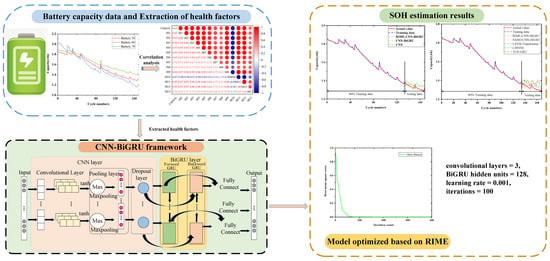
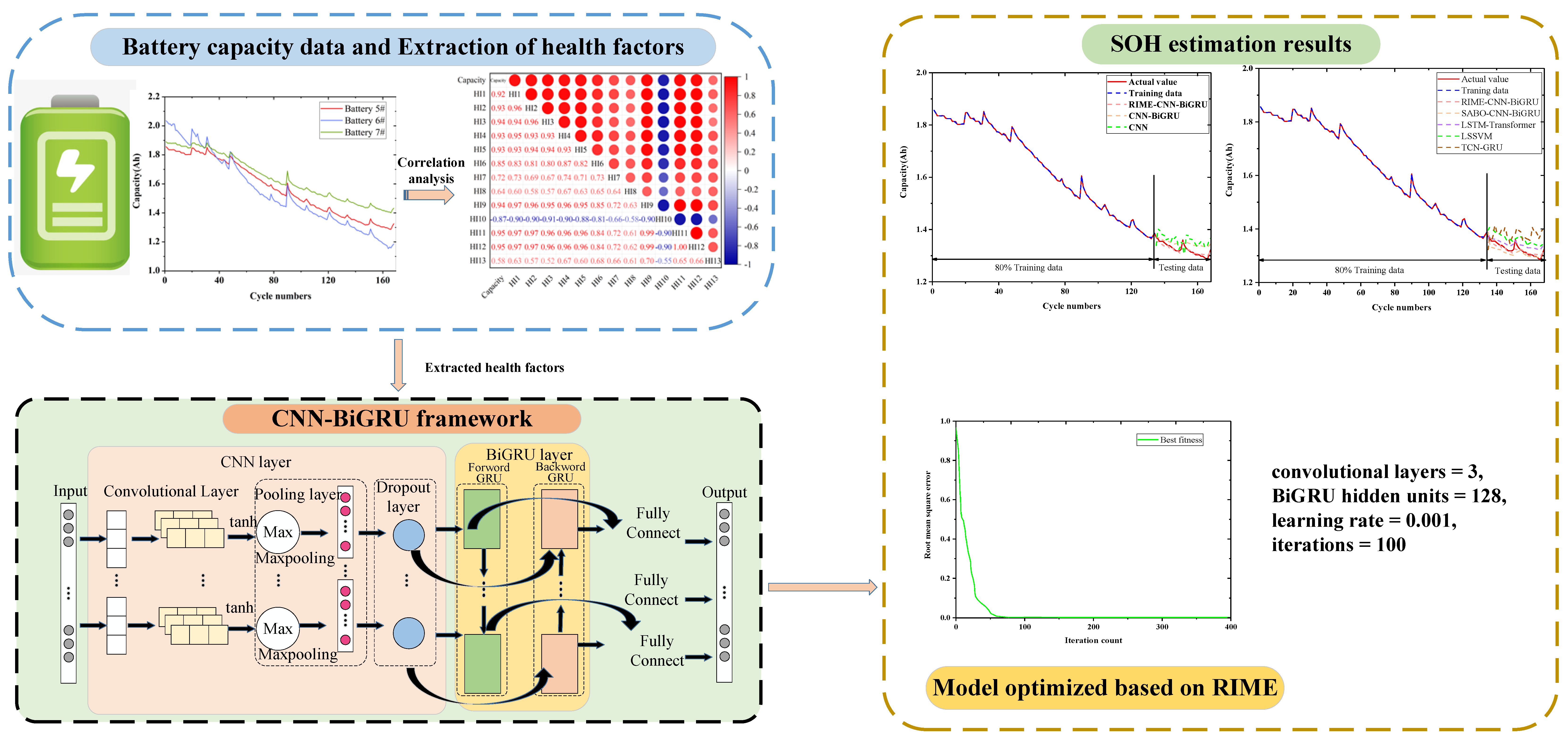
To overcome the problems of weak global information capture, poor long-term prediction accuracy, and low parameter tuning efficiency in traditional estimation methods, this paper proposes a hybrid neural network-based SOH estimation framework for power batteries. The main contributions of this work are as follows:
- (1)
- Based on the incremental capacity (IC) curves of lithium-ion batteries, 13 health indicators (HIs) highly correlated with capacity degradation are extracted, and Spearman’s rank correlation coefficient is employed to quantitatively analyze the correlation between these HIs and battery capacity, providing a statistical basis for the selection of model input features.
- (2)
- A CNN-BiGRU hybrid framework is constructed for end-to-end SOH estimation. Unlike existing CNN-GRU/LSTM models that adopt unidirectional recurrent structures, This framework fully leverages the complementary advantages of CNN in local feature extraction, and the BiGRU captures bidirectional contextual dependencies through both forward and backward hidden layers, enabling more comprehensive characterization of limited cycle data. This synergistic design effectively improves the model’s ability to capture battery degradation trends.
- (3)
- The RIME optimization algorithm is introduced to automatically optimize the core hyperparameters of the proposed CNN-BiGRU model, replacing traditional manual trial-and-error tuning, significantly improving hyperparameter configuration efficiency while enhancing prediction stability and accuracy.
- (4)
- Ablation and comparative experiments are conducted on the public lithium-ion battery aging dataset to systematically evaluate the estimation performance of the proposed model. The experimental results demonstrate that the proposed model outperforms existing comparison methods under various training ratios and evaluation metrics, verifying its effectiveness and superiority in battery SOH estimation tasks.
- (5)
2. Experimental Battery Data and Feature Extraction
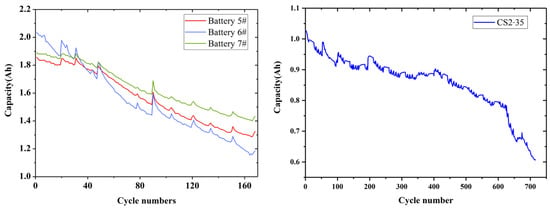
To validate the performance of the proposed hybrid model, the NASA dataset [20] is employed in this paper, which is shown in Figure 1. The charging protocol of this dataset adopts a standard two-stage strategy: first, the battery is charged at a constant current (CC) of 1.5 A until the terminal voltage reaches 4.2 V; then, it switches to constant-voltage (CV) mode, and the charging process continues until the current drops to the termination condition of 20 mA. During the discharge phase, a constant current of 2 A is applied, with different discharge cut-off voltages for the three battery cells B5, B6, and B7, set to 2.7 V, 2.5 V, and 2.2 V, respectively, to simulate usage boundaries under various operating conditions. For the CALCE dataset [21], batteries CS2-35, CS2-36 and CS2-37 are selected, and these batteries are charged at a 1C constant current rate. The discharge cutoff voltage is the same for all, set at 2.7 V, and the End of Life EOL threshold is set to 0.77 Ah. Table 1 provides detailed information about the LiBs used in this study, and the capacity degradation curves for each battery are shown in Figure 1. In this paper, we used MATLAB2023b (The MathWorks, Inc., Natick, USA).
Figure 1.
Battery capacity degradation curve.
Table 1.
Ablation Study Metrics for 80% Battery Training Data.
2.1. Analysis of Battery IC Curves
Incremental Capacity (IC) analysis is an effective approach that transforms the externally measurable voltage-capacity curve of a battery into a representation reflecting internal electrochemical characteristic variations. By differentiating the voltage-capacity curve during the constant-current charging stage, the relationship curve between the rate of capacity change with respect to voltage (dQ/dV) and voltage is obtained, which is referred to as the IC curve. Each peak on the IC curve corresponds to a specific phase transition process or electrochemical reaction within the battery. The characteristic parameters of these peaks, such as peak position, peak height, and peak area, exhibit regular evolutionary patterns as the battery ages, thereby effectively characterizing degradation mechanisms including active material loss, lithium-ion loss, and internal resistance increase. The calculation formula is given in Equation (1).
2.2. Extraction of Health Indicators
In practical charging scenarios, batteries are typically charged without being fully discharged, and the state of charge generally lies within the range of 40% to 90%. To precisely define the peak region of the incremental capacity curve, the voltage corresponding to the main peak is taken as the center, and a voltage width of is extended to both sides to delimit the peak interval.
where is peak voltage and are the left and right terminal voltages at time t, respectively.
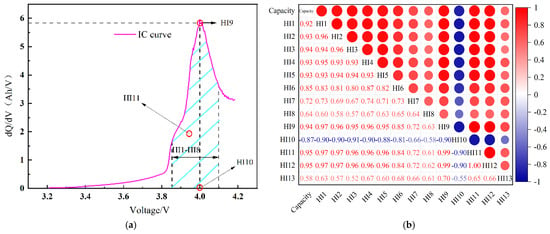
Based on the analysis of the degradation law of the IC curve mentioned above, this study further determined a specific scheme for extracting health factors. Taking B5 battery as an example, the charging voltage range of 3.85 V to 4.09 V is selected as the feature extraction range, and 0.03 V is taken as the equidistant step size. The dQ/dV values corresponding to 8 discrete voltage points are uniformly sampled within this range, which are sequentially referred to as indirect health factors HI1 to HI8, in order to capture the local morphological changes in the IC curve in the main reaction range. At the same time, to characterize the degradation trend of the peak characteristics of the curve, the height of the main peak of the IC curve and its corresponding voltage position are respectively referred to as HI9 and HI10. On this basis, in order to more comprehensively reflect the impact of the overall contour of the IC curve on capacity degradation, the peak area (i.e., the integrated area enclosed by the main peak and baseline), the mean of the curve within the entire voltage window, and the standard deviation of the curve were further extracted as HI11, HI12, and HI13, respectively, to characterize the overall amplitude level, center offset degree, and discrete fluctuation of the IC curve. The graphical representations of HI1 to HI11 are shown in Figure 2, while HI12 and HI13 are obtained through statistical calculations. Through the multi-dimensional feature extraction strategy mentioned above, the 13 health factors constructed comprehensively depict the evolution of IC curves with battery aging from three levels: local morphology, peak characteristics, and global statistics, providing rich and complementary input information for subsequent SOH estimation models.
Figure 2.
Extraction of Health indicators (a) IC Health Factor (b) Correlation analysis results.
In this paper, Spearman method is selected to analyze the correlation between HIs and capacity, which is defined as:
In terms of health indicator selection, this paper employs the Spearman rank correlation coefficient to evaluate the correlations between the 13 HIs and battery capacity. This method is selected based on the following rationale: the capacity degradation of lithium-ion batteries generally exhibits a nonlinear monotonic relationship with the IC curve features. As a non-parametric statistical method, Spearman’s correlation does not require any prior assumptions about the data distribution and can effectively capture such nonlinear correlations, which has been widely adopted and validated in the field of battery SOH estimation, taking B5 battery as an example, the health factors excluded are HI7, HI8, and HI13.
3. Proposed Model
3.1. Principle of Convolutional Neural Network Algorithm
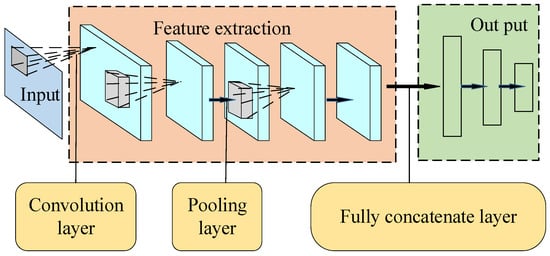
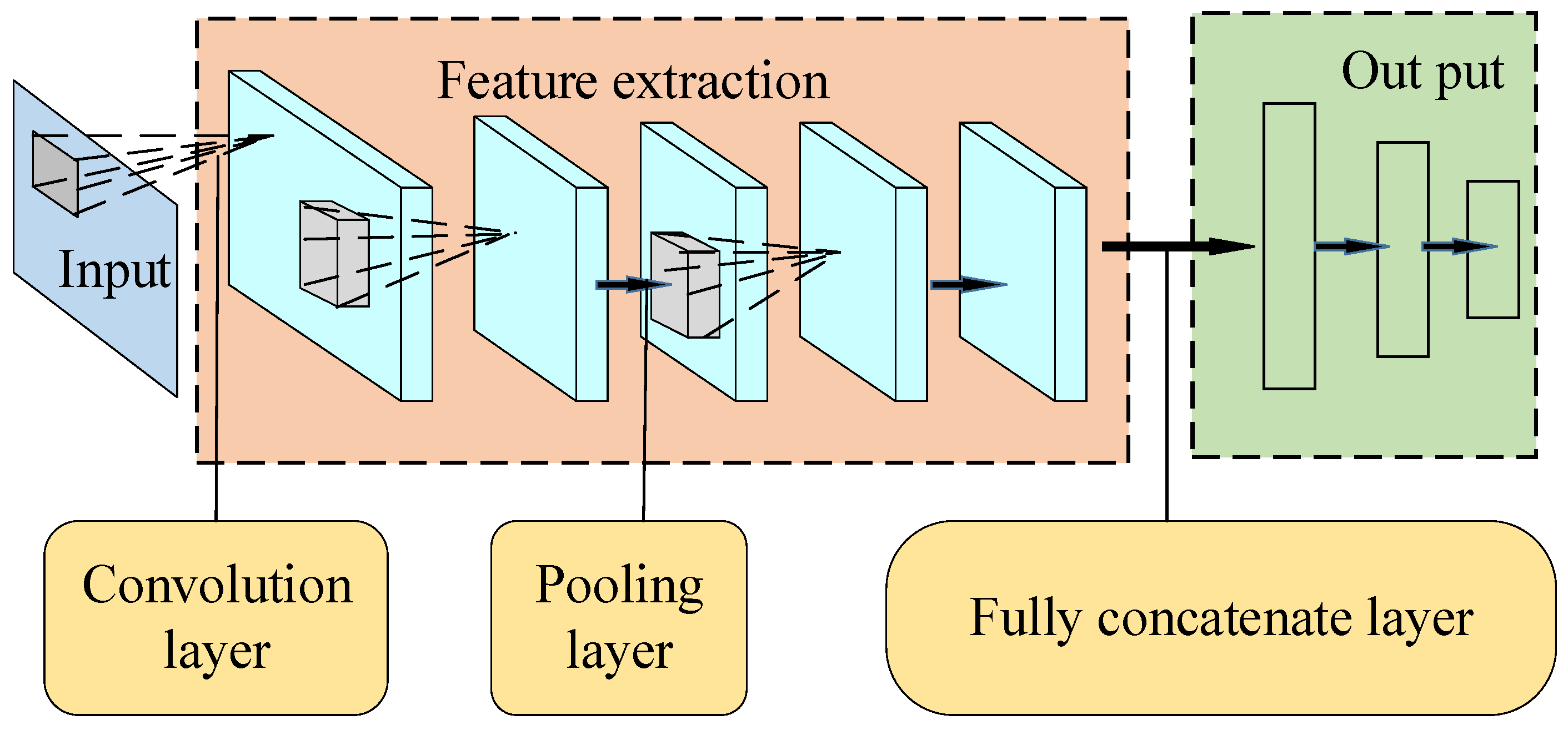
Convolutional Neural Network (CNN) is a feedforward deep learning model specifically designed for gridded data such as images or temporal signals. Its core is to efficiently extract spatial hierarchical features of input data by utilizing the local connections and weight sharing characteristics of convolution operations. The basic structure of CNN usually consists of an input layer, multiple alternately stacked convolutional and pooling layers, and a fully connected layer at the top [19], as shown in Figure 3.
Figure 3.
Structure of CNN.
The convolutional layer is the core of a convolutional neural network, which contains multiple convolutional kernels. Through the sliding scan of input data and the application of activation functions, the convolutional kernels can effectively extract the features of the input data. The calculation formula for the convolution process is:
where Zl and Zl+1 are the convolution inputs and outputs of the l-th layer, b is the deviation, k is the number of channels, f is the size of the convolution kernel, and s0 is the convolution step size.
After performing convolution operations, activation functions are used to assist in expressing complex features. Convolutional neural networks widely use ReLU activation functions, which can solve the problems of gradient explosion and vanishing in deep learning [14]. Subsequently, the pooling layer summarizes and reduces the dimensionality of these features. The pooling methods mainly include max pooling and average pooling. The reduced dimensionality features are integrated by the fully connected layer and transformed into the final output of the network.
3.2. The Principle of BiGRU
Bidirectional Gated Recurrent Unit (BiGRU) is a multivariable time series prediction method based on gated recurrent units. It combines bidirectional models and gating mechanisms to effectively capture temporal relationships and the mutual influence between multiple variables in time series data. It can be seen as a lightweight variant of long short-term memory networks: GRU combines forget gates and input gates into update gates, and memory cells and hidden layers into reset gates, with fewer parameters and computational complexity, and better performance in handling long-term dependencies. The current time information x, when input into GRU units, can be divided into the following three parts:
- (1)
- Update the door
- (2)
- Reset the door
- (3)
- The xt output by the unit will generate a temporary hidden state after resetting the gate, which is an intermediate step in calculating the new hidden state. The temporary hidden state can be represented as:
Finally, update the current hidden state by combining the current input with the previous hidden state. The current hidden state can be represented as:
The traditional GRU structure can only solve multi-step prediction problems in the form of output vectors, which means it cannot consider the sequence dependency between output labels. The Seq2seq structure introduces an encoder and decoder to convey implicit information through an intermediate state, making it more suitable for learning between different sequences.
where represents the input at time t; represents update gate; represents the reset gate; represents the hidden layer at the current time; represents the hidden layer at the previous moment; represents the current candidate set state; W are represents the training parameter matrix. is the Sigmoid function; tanh is the hyperbolic tangent function.
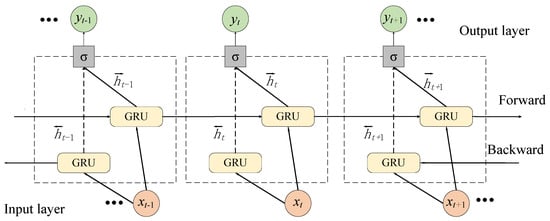
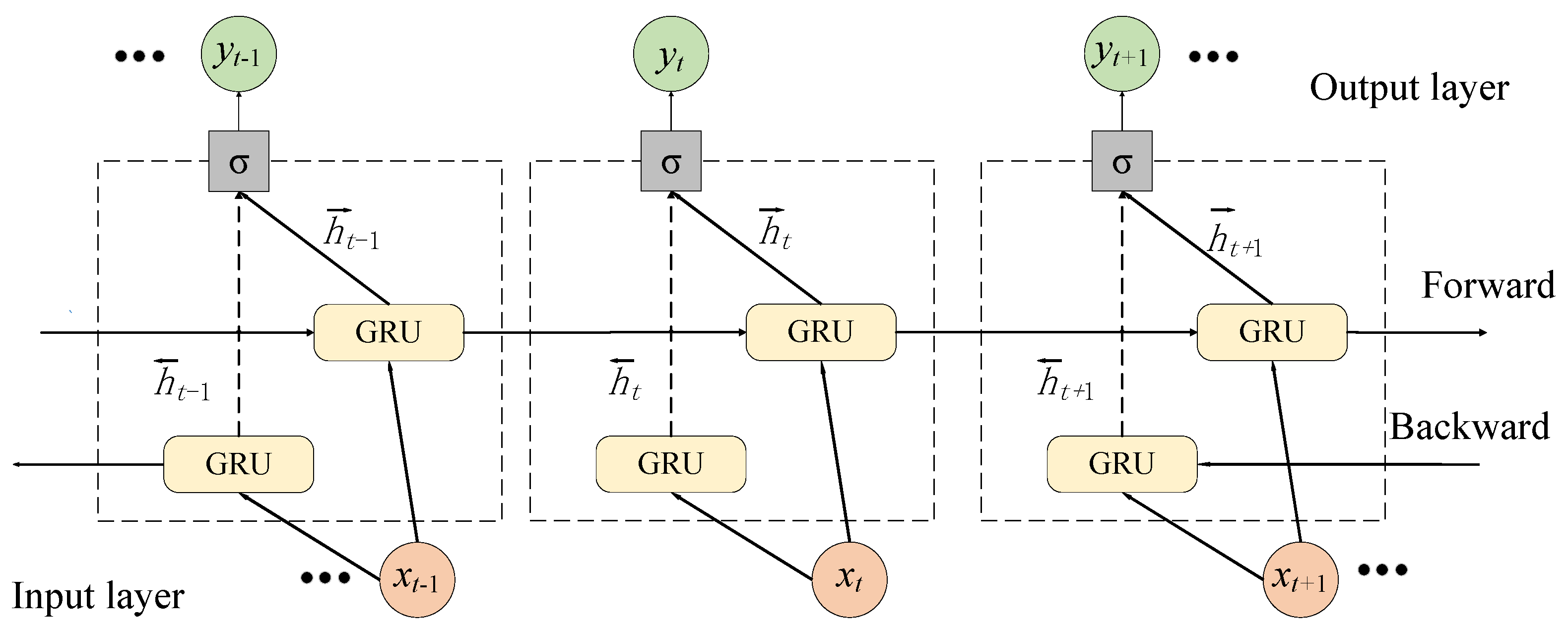
The structure of the BiGRU network model is shown in Figure 4. It consists of two GRU networks with opposite directions, one processing time series data from front to back and the other processing time series data from back to front. This bidirectional structure can simultaneously capture the temporal dependencies between historical and future states, enhancing the ability to capture dynamic features of time series. This bidirectional mechanism leverages both past and future contextual information from the complete historical sequence to maximize feature representation. In online SOH estimation for actual BMS applications, the forward propagation of BiGRU involves only matrix multiplication and activation function operations, with computational costs fully manageable on current embedded platforms. The backward GRU layer only processes data within the sliding window, meeting the update requirements of practical BMS deployment. The output expression of BiGRU is:
where α and β factors of forward GRU and backward GRU; and —outputs of forward GRU and backward GRU.
Figure 4.
Structure of BiGRU.
3.3. SOH Estimation Framework Based on RIME-Optimized CNN-BiGRU Model
To address the issue that the hyperparameters of the CNN-BiGRU model rely on empirical manual tuning and are difficult to optimize globally, this paper introduces the Rime optimization algorithm (RIME) to automatically optimize the core hyperparameters. RIME is a physics-inspired metaheuristic algorithm whose core innovation lies in modeling the growth and expansion process of rime on object surfaces as exploration and exploitation behaviors in the search space. The algorithm adopts a dual-stage search strategy: the soft-RIME search simulates the random deposition of ice crystals under gentle breeze, enhancing the randomness of particle trajectories to broaden population coverage and maintain diversity during early iterations, thereby avoiding local optima; the hard-RIME puncture mechanism mimics the penetrating growth of rime on hard surfaces, performing refined local exploitation through spatial crossover among particles. Additionally, an improved greedy selection mechanism dynamically updates the population to strengthen convergence performance. With few control parameters and fast convergence, RIME achieves an adaptive balance between global exploration and local exploitation, making it suitable for high-dimensional optimization and deep learning hyperparameter tuning in engineering applications [22].
- (1)
- Initial population
First, a rime population is constructed, which consists of multiple rime clusters. Each rime cluster represents a set of potential hyperparameter combinations, and the number of particles contained in each cluster corresponds to the dimension of the optimization problem. The constructed initial population matrix R is given as:
where Si denotes the i-th rime cluster, and xij represents the search position of this cluster in the j-th dimensional space.
- (2)
- Soft-Rime search strategy
In the global exploration phase, a soft rime mechanism is introduced to simulate the random deposition process of ice crystals under a gentle breeze environment. Under this strategy, the movement trajectories of rime particles xij exhibit significant randomness. Although the local growth rate is somewhat slowed, this approach effectively broadens the coverage of the population within the search space [23], ensuring that the algorithm maintains high population diversity during the initial iterations and avoids falling into local optima. Meanwhile, a hard rime puncture mechanism is incorporated, which employs spatial crossover between particles to construct a local exploitation strategy. The corresponding crossover update equation is given as follows:
where is the updated new position of the particle; is the j-th dimensional component of the best individual in the population; and jointly determine the movement direction of the particle; together with the adhesion coefficient E determines whether the particle position is updated.
- (3)
- Greedy selection mechanism
To overcome the limitation of traditional optimization algorithms being prone to getting stuck in local optima, RIME introduces a forward greedy selection mechanism. This mechanism conditionally preserves high-quality suboptimal solutions by comparing the fitness values before and after position updates. The mathematical description of the final position update is:
where is a random number within the range of (−1,1). Therefore, the SOH estimation framework based on the RIME-CNN-BiGRU model is shown in Figure 5, with the following specific steps:
Figure 5.
The SOH estimation framework based on the RIME-CNN-BiGRU model.
Step 1: Based on the current and voltage data of lithium-ion batteries, draw their incremental capacity (IC) curve and extract 13 health factors (HIs) related to capacity degradation from it.
Step 2: Build a CNN-BiGRU hybrid network model, determine the initial network structure and hyperparameters, and use this model to extract deep spatiotemporal features from the input HI sequence, fully exploring the local change patterns and bidirectional temporal dependencies during battery degradation.
Step 3: Use the Frost Ice Optimization Algorithm (RIME) to automatically optimize the core hyperparameters of the model, driving the search process with prediction error as the fitness function to ensure that the model runs under the optimal configuration. The algorithm runs for 100 iterations to ensure convergence while maintaining computational efficiency, and set the population size to 30.
Step 4: Input the HI features extracted from the dataset into the optimized model, and set different training starting points and multiple comparison models for multiple training and prediction experiments.
4. Experimental Verification
4.1. Ablation Experiment
Three evaluation criteria are used in the article to evaluate the performance of the algorithm, which are defined as follows:
where RMSE is the standard error, used to describe the stability of the algorithm, MAE is the average absolute error between the actual value and the predicted value, and MAPE is the average absolute percentage error. representing the actual and predicted values of battery capacity, respectively.
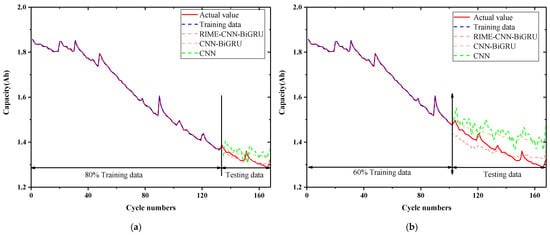
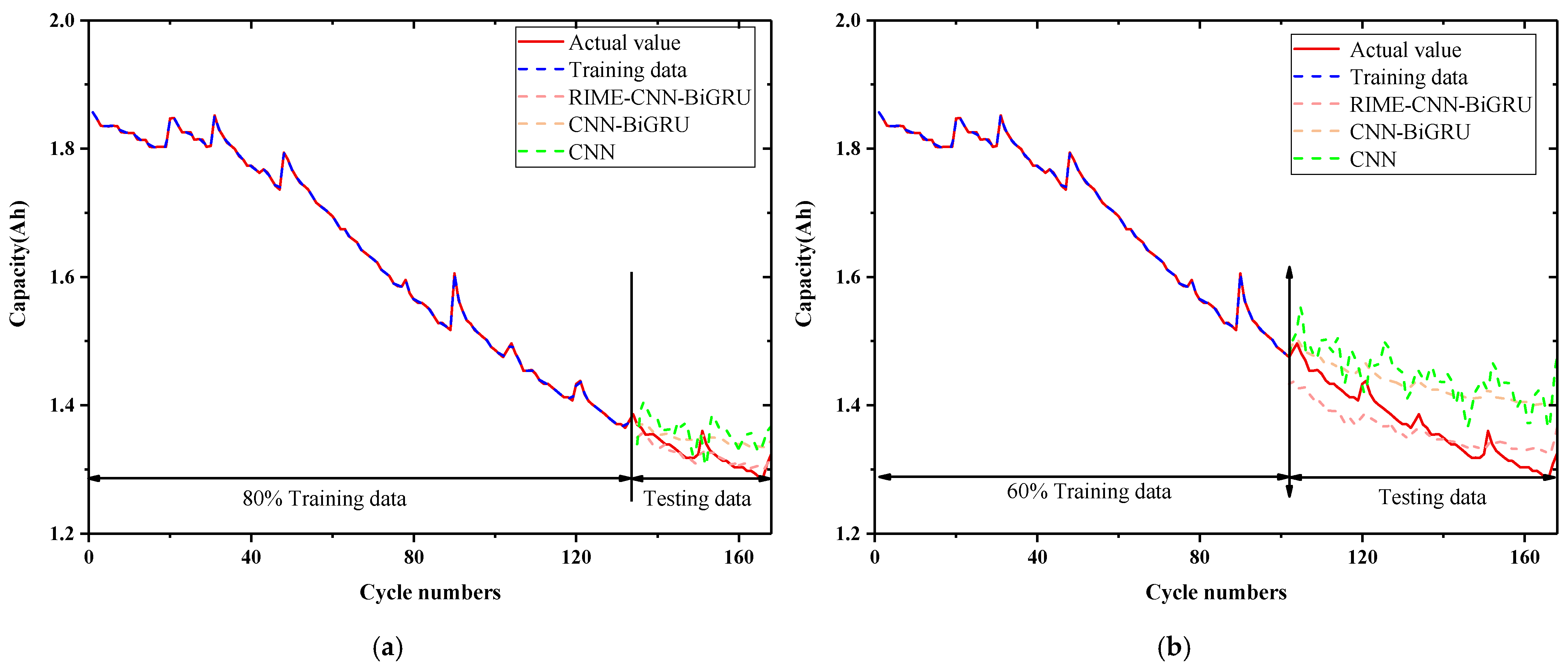
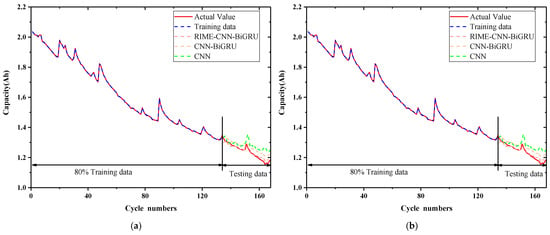
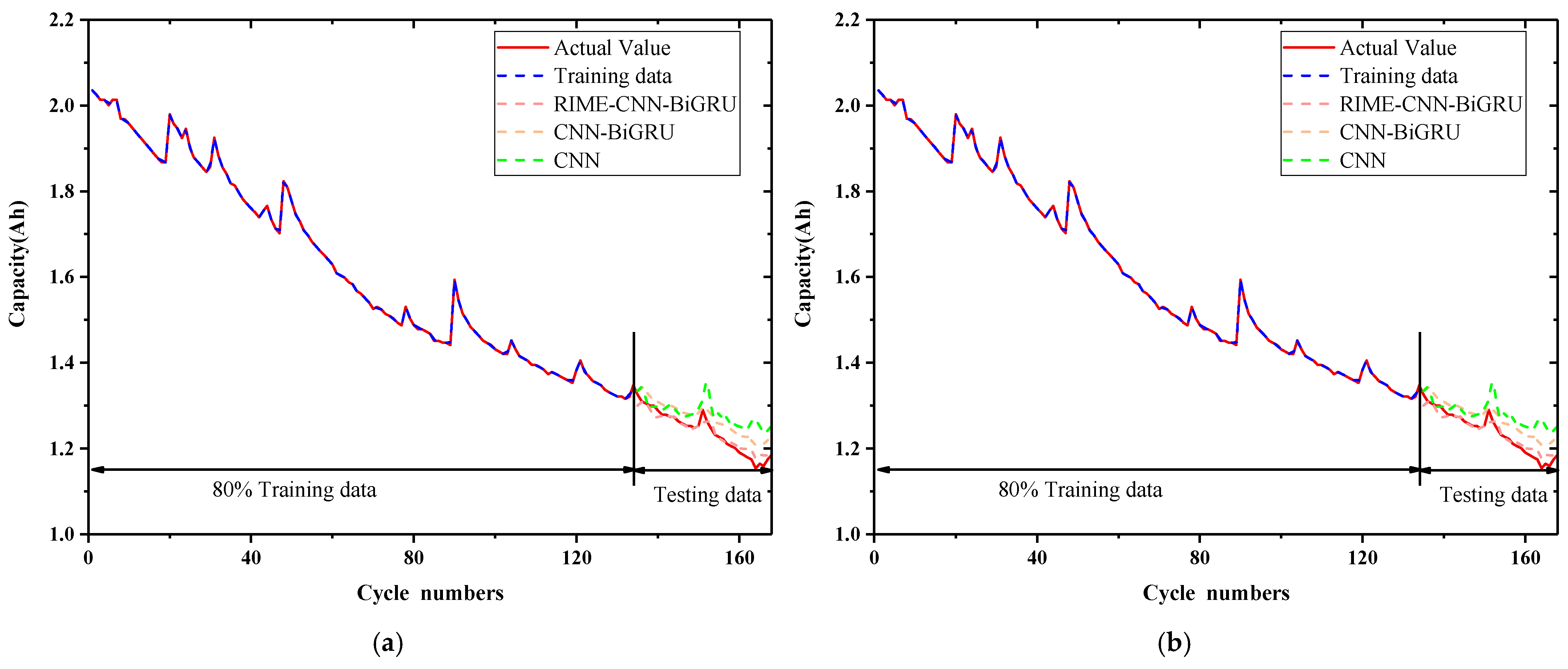
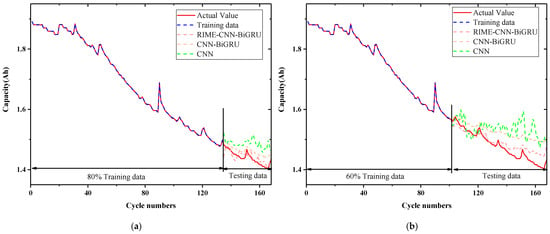
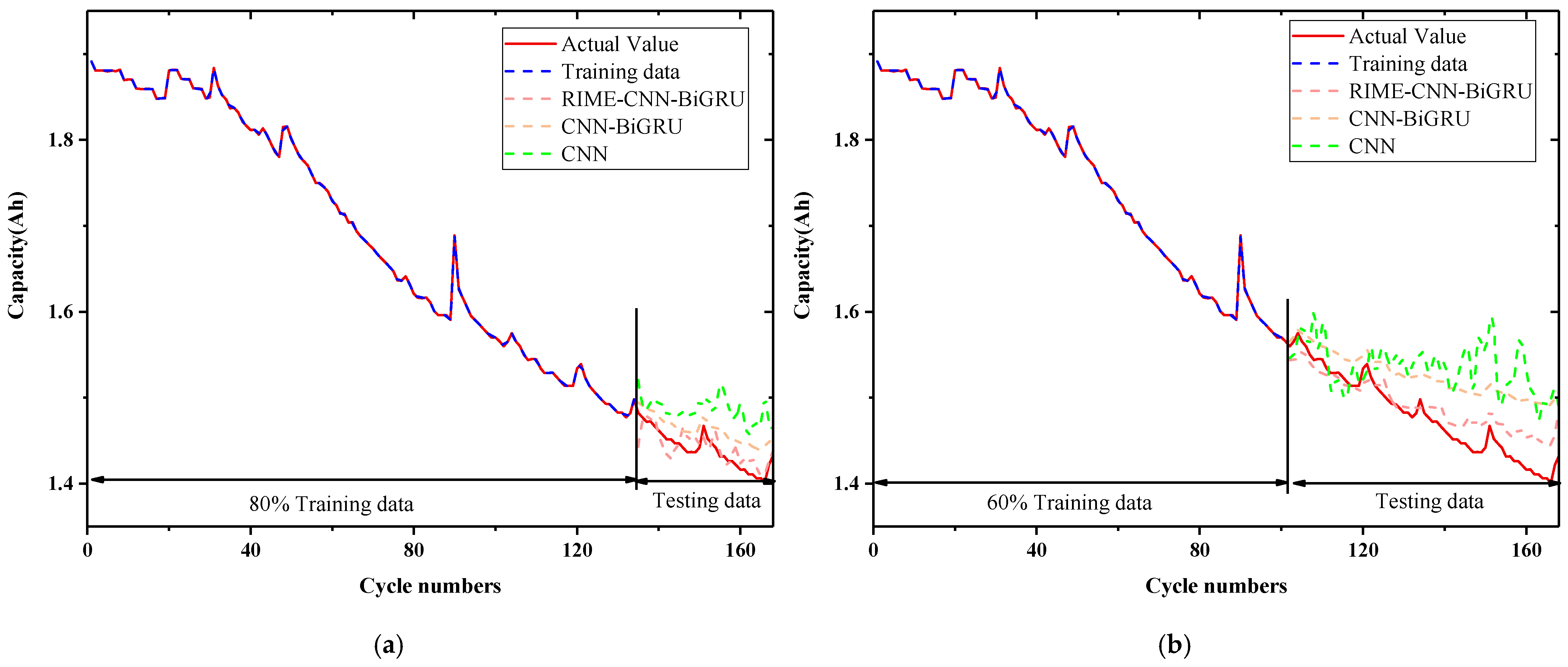
To evaluate the contribution of RIME optimization, we conducted comparative experiments under the following two configurations: the unoptimized CNN-BiGRU with manually selected hyperparameters (convolutional kernel size = 3, number of BiGRU hidden units = 64, learning rate = 0.001), serving as a baseline to assess the inherent capability of the architecture itself; and the same architecture with hyperparameters automatically optimized by the RIME algorithm. Both configurations were tested under identical datasets, training/testing splits, and evaluation metrics to ensure a fair comparison. Figure 6, Figure 7 and Figure 8 shows the comparison of the ablation effects of each model when 80% and 60% data of B5 batteries were used as the training set.
Figure 6.
B5 battery ablation experiment: (a) SP = 80%; (b) SP = 60%.
Figure 7.
B6 battery ablation experiment: (a) SP = 80%; (b) SP = 60%.
Figure 8.
B7 battery ablation experiment: (a) SP = 80%; (b) SP = 60%.
The ablation study results presented in Table 1 fully validate the effectiveness and superiority of the proposed RIME-CNN-BiGRU hybrid model. Across the prediction evaluations for three different batteries (B5, B6, and B7), the proposed model significantly outperformed the standalone CNN and CNN-BiGRU baseline models across all evaluation metrics (MAE, MAPE, and RMSE). The structural advantage of CNN-BiGRU over the standalone CNN lies in the fact that CNN alone can only extract local spatial features from the input sequences through its convolutional kernels, but it lacks the capacity to model the sequential order and long-term dependencies that are essential for tracking the progressive nature of battery capacity degradation. In contrast, the BiGRU module embedded in the hybrid architecture effectively captures bidirectional temporal dependencies—both past and future contextual information—through its forward and backward hidden layers, enabling a more comprehensive characterization of the degradation trajectory.
To further isolate the contribution of RIME-based hyperparameter tuning, we conducted a dedicated ablation experiment by comparing the CNN-BiGRU model with manually selected hyperparameters against the same architecture with RIME-optimized hyperparameters. Taking Battery B5 under the 80% training ratio as an example, Config. A yields MAE = 2.31%, MAPE = 1.79%, and RMSE = 2.54%, while the RIME-optimized model (Config. B) achieves MAE = 1.56%, MAPE = 1.12%, and RMSE = 1.68%, corresponding to relative reductions of 32.5% in MAE, 37.4% in MAPE, and 33.9% in RMSE—gains that are solely attributed to the RIME optimization algorithm, as the network architecture remains unchanged. Taking the B7 dataset, which exhibited the largest errors, as an example, the RMSE was drastically reduced from 5.43% for the pure CNN and 3.44% for the CNN-BiGRU to just 2.06%, confirming that the integration of BiGRU effectively addresses the temporal modeling deficiency of standalone CNN, while the additional RIME optimization further boosts the predictive precision. This performance gain can be attributed to the dual synergy of structural design and optimization algorithms. On one hand, the BiGRU module efficiently extracts bidirectional temporal dependency features from battery capacity degradation data, significantly enhancing the dynamic modeling capability for time series compared to traditional CNNs. On the other hand, the RIME optimization algorithm performs deep global optimization of the hybrid network’s hyperparameters, avoiding the local optima pitfalls common in manual tuning or conventional gradient descent algorithms, as quantitatively evidenced by the 33.9% RMSE improvement over the non-optimized baseline, thereby unleashing the maximum predictive potential of this deep architecture.
Table 2 further presents a comparative analysis of the predictive performance of various ablation models under a limited data scenario, where the training set ratio was reduced to 60%. The experimental results demonstrate that the proposed RIME-CNN-BiGRU model maintains exceptional stability and accuracy even when constrained by insufficient samples. From Figure 6, Figure 7 and Figure 8, the MAE, MAPE, and RMSE were stably confined to extremely low ranges of 2.68–3.02%, 2.27–2.83%, and 3.39–3.99%, respectively, with overall errors significantly lower than those of the standalone CNN and CNN-BiGRU models (without RIME optimization). To quantitatively isolate the contribution of the RIME-based hyperparameter tuning, the CNN-BiGRU model, which employs manually selected hyperparameters—serves as a controlled reference against the RIME-optimized counterpart under identical network architecture and training conditions. The ablation comparison reveals that the RIME optimization alone contributes substantial error reductions: for instance, on the B6 battery, the RMSE is reduced from 6.96% (CNN-BiGRU without RIME) to 3.76% (RIME-CNN-BiGRU), corresponding to a relative improvement of 46.0% that is exclusively attributable to the RIME algorithm’s global search capability. Taking the B6 battery as an example, the MAE of the proposed model was drastically reduced from 8.12% for the pure CNN to just 2.77%, representing a performance improvement of over 65%. This conclusively revalidates the effectiveness of the BiGRU module in capturing long-range temporal dependencies under missing operating conditions, as well as the global optimization efficacy of the RIME algorithm in handling complex, nonlinear hyperparameter combinations. Together, these ablation results unequivocally confirm that RIME-based hyperparameter tuning provides a significant and independent performance enhancement beyond the structural benefits of the CNN-BiGRU architecture.
Table 2.
Ablation Study Metrics for 60% Battery Training Data.
Although the prediction error of the proposed model showed a reasonable increase compared to the results with an 80% training set (as shown in Table 1) due to the reduced data volume, the magnitude of performance degradation was significantly smaller than that of all baseline models, and the absolute error remained well within engineering-acceptable limits. To further isolate the contribution of the RIME-based hyperparameter tuning under this challenging small-sample scenario, we conducted an ablation comparison between the CNN-BiGRU model with manually selected hyperparameters and the same architecture optimized by RIME. The results demonstrate that RIME optimization alone contributes an RMSE reduction of 46.0% on B6 (from 6.96% to 3.76%) and 45.0% on B7 (from 7.02% to 3.99%) when the network architecture remains unchanged. The ablation evidence thus unequivocally validates that the RIME algorithm provides a substantial and independent performance enhancement, ensuring reliable SOH estimation even when training data is severely limited.
4.2. Comparison of SOH Prediction Results of Different Models
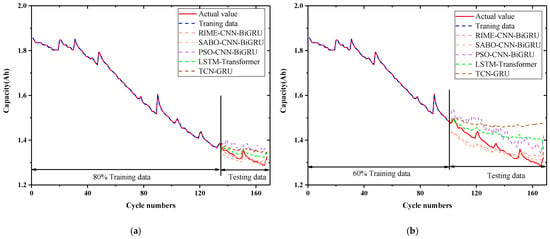
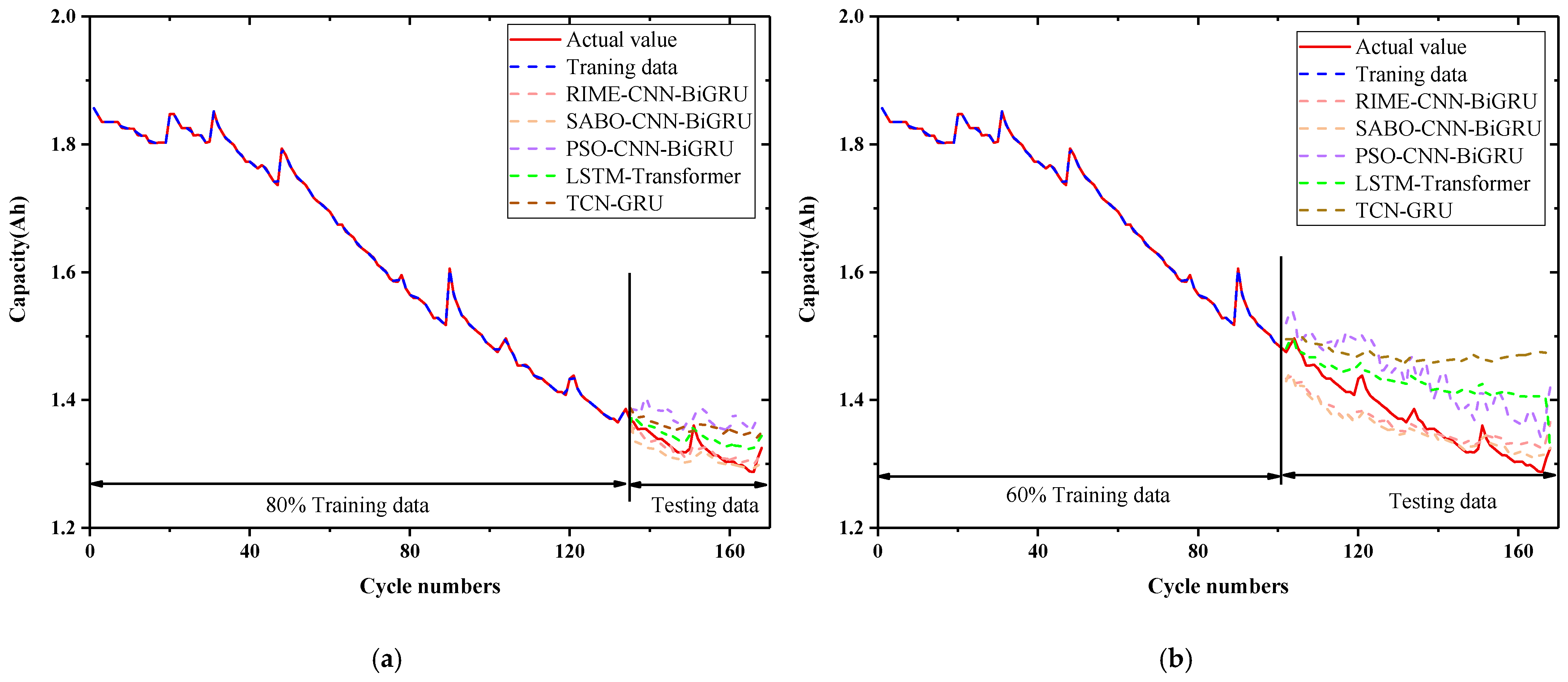
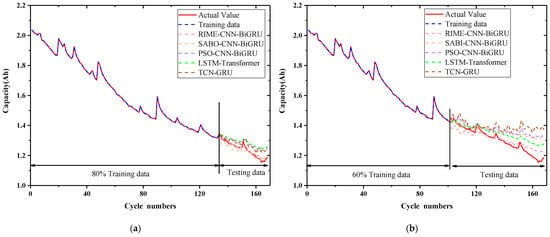
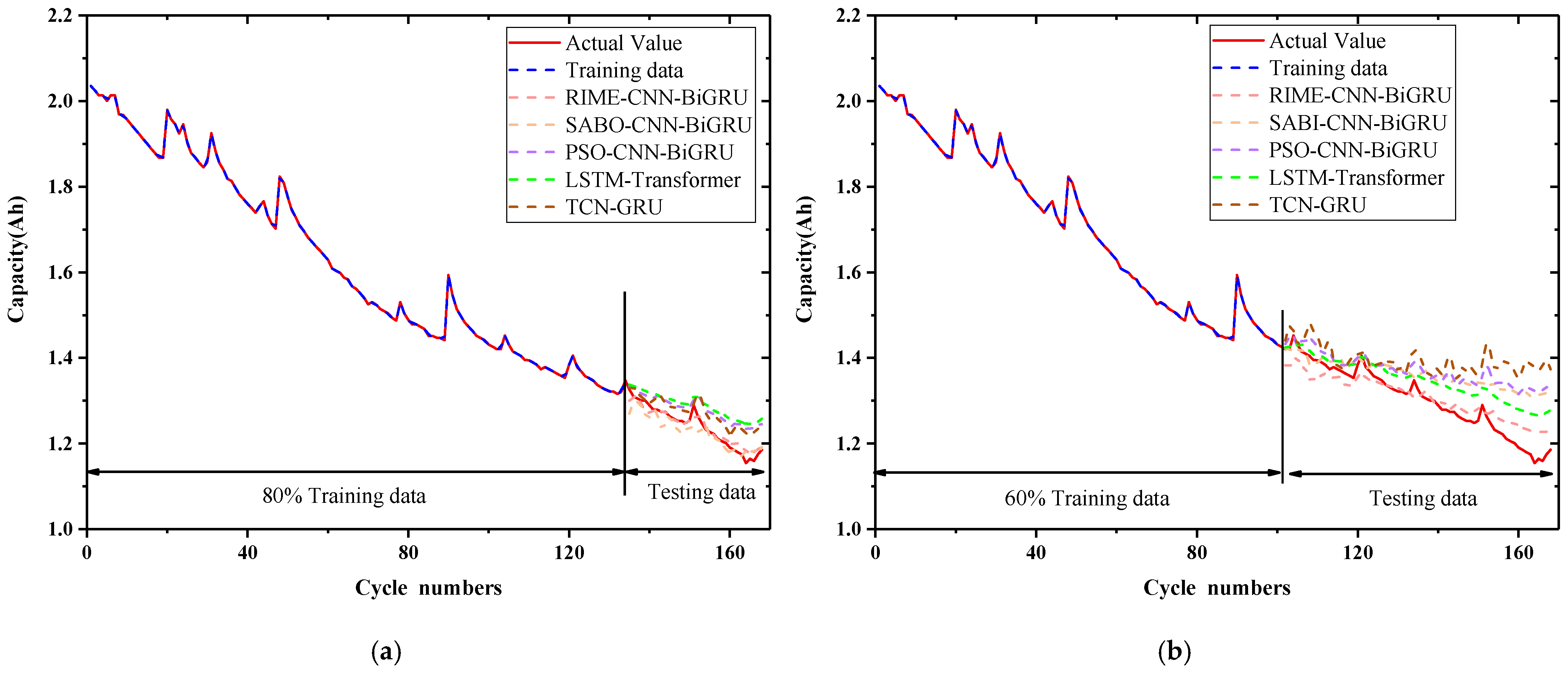
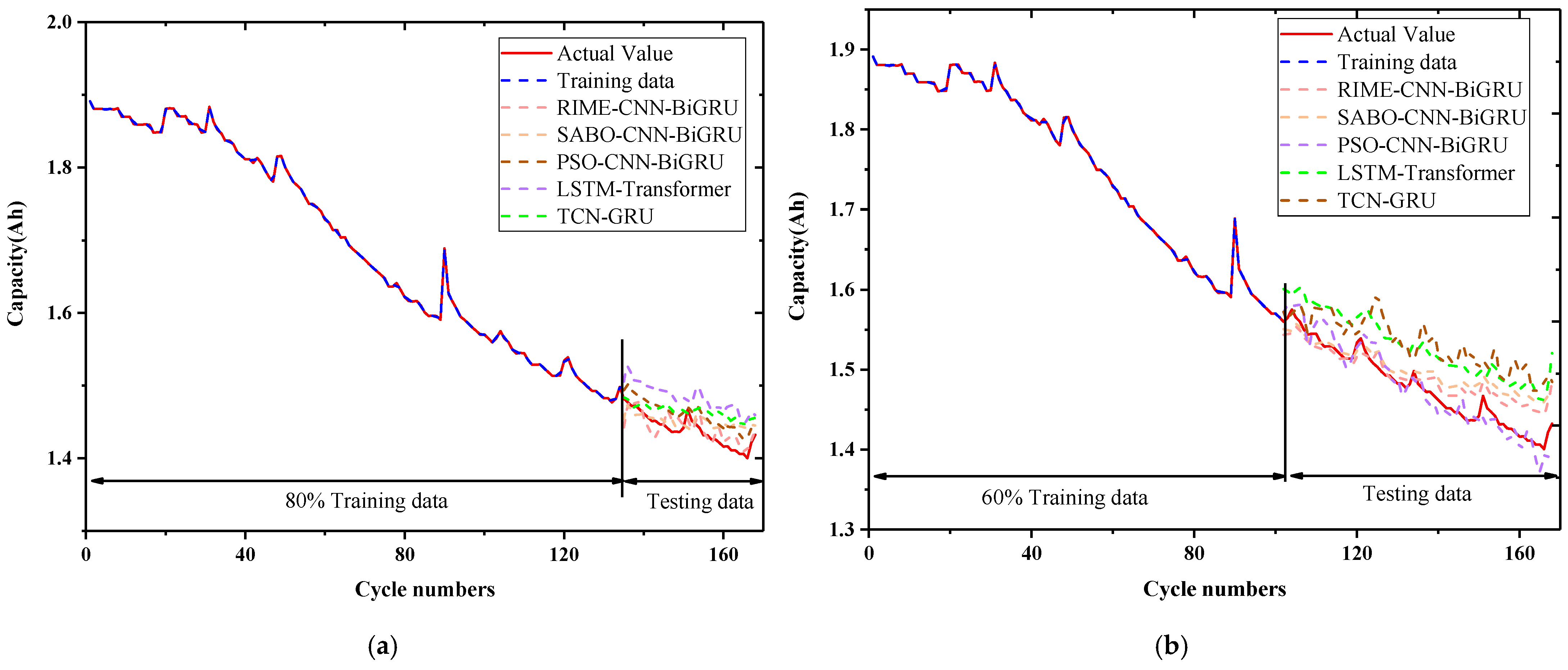
To further demonstrate the superior predictive performance of the proposed method, five commonly used benchmark models are selected for comparative evaluation. Figure 9, Figure 10 and Figure 11 illustrate the comparison results for different battery cells and different prediction starting points.
Figure 9.
SOH prediction results for battery B5 based on different models (a) SP = 80%; (b) SP = 60%.
Figure 10.
SOH prediction results for battery B6 based on different models (a) SP = 80%; (b) SP = 60%.
Figure 11.
SOH prediction results for battery B7 based on different models (a) SP = 80%; (b) SP = 60%.
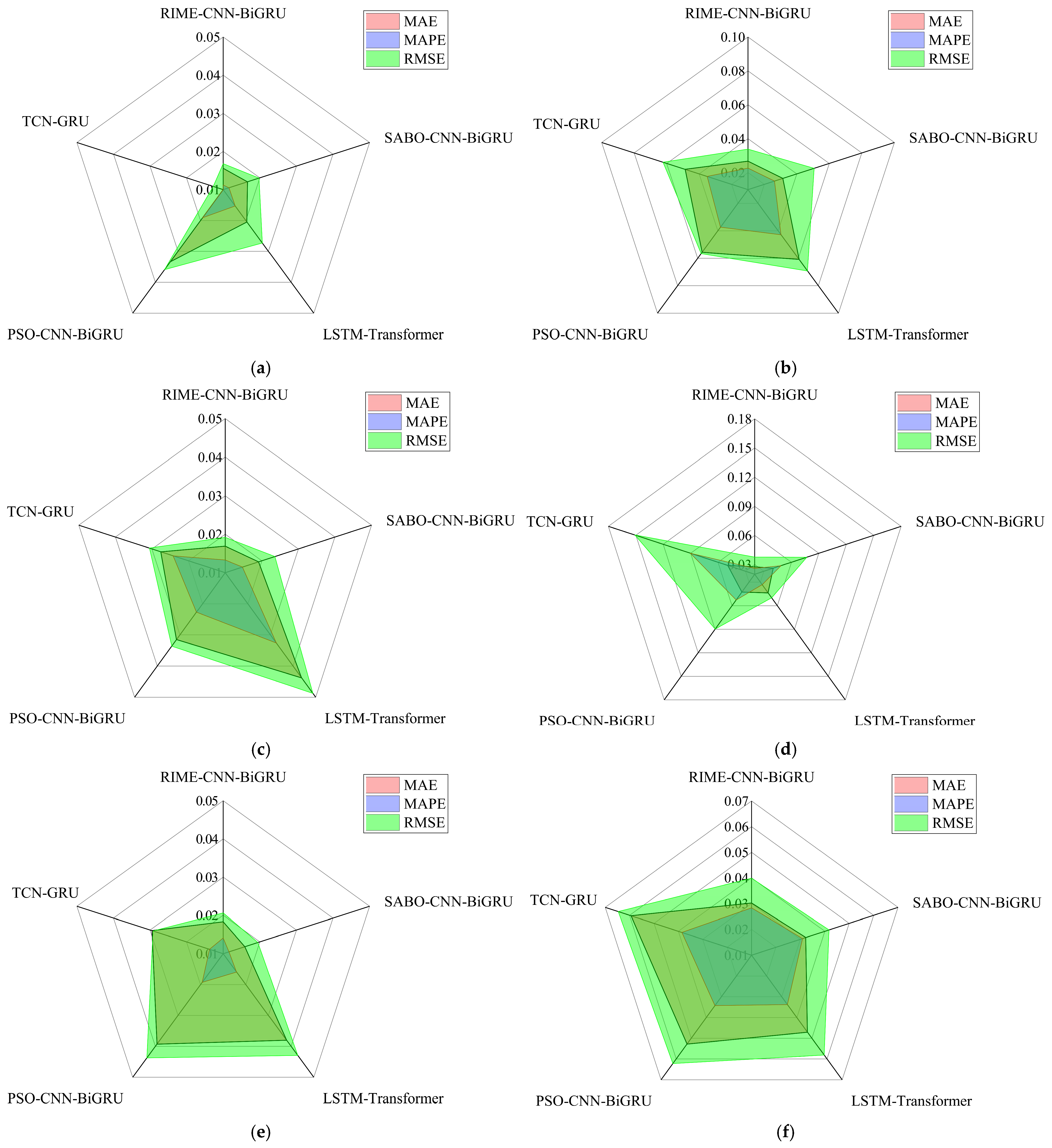
Based on the comparative experimental results shown in Table 3, the proposed RIME-CNN-BiGRU model consistently achieves superior predictive performance across all three battery datasets. For battery B5, the model attains the lowest error values: MAE = 1.56%, MAPE = 1.12%, and RMSE = 1.68%, which are significantly better than those of the suboptimal SABO-CNN-BiGRU model (1.83%, 1.35%, 2.13%) and substantially outperform PSO-CNN-BiGRU (1.97%, 1.49%, 2.67%), and far outperform traditional methods like TCN-GRU (3.73%, 2.89%, 4.02%). Likewise, on B6 and B7, the proposed model maintains the smallest error margins (B6: 1.69%, 1.33%, 1.92%; B7: 1.83%, 1.41%, 2.06%), with RMSE reductions of more than 50% relative to LSTM-Transformer and TCN-GRU, more than 40% relative to SABO-CNN-BiGRU, and approximately 37–40% relative to PSO-CNN-BiGRU (B6: 3.07% vs. 1.92%; B7: 3.44% vs. 2.06%). The superiority of RIME over PSO can be attributed to its unique dual-stage search strategy, which combines soft-RIME exploration for broad population coverage and hard-RIME exploitation for refined local search, effectively avoiding the premature convergence problem that commonly plagues PSO. Moreover, RIME requires fewer control parameters and demonstrates more stable convergence behavior, enabling more reliable and accurate hyperparameter optimization for the CNN-BiGRU architecture. These consistent advantages across different batteries and multiple evaluation metrics fully demonstrate the effectiveness of the RIME-optimized CNN-BiGRU architecture in capturing the spatiotemporal features of battery degradation, while the global hyperparameter search capability provided by the RIME algorithm further enhances the accuracy and robustness of state estimation.
Table 3.
Model Comparison Metrics for 80% Battery Training Data.
Similarly, based on the comparative experimental results shown in Table 4 and Figure 12 (with only 60% of the data used for training), the proposed RIME-CNN-BiGRU model still consistently achieves the lowest prediction errors on all three battery datasets, demonstrating remarkable robustness under reduced training samples. For battery B5, it attains MAE = 2.68%, MAPE = 2.27%, and RMSE = 3.39%, which are substantially lower than those of the second-best SABO-CNN-BiGRU (3.14%, 2.63%, 5.07%) and far superior to PSO-CNN-BiGRU (4.87%, 3.51%, 6.23%), as well as conventional models such as LSTM-Transformer (6.09%, 4.29%, 6.93%) and TCN-GRU (8.21%, 5.73%, 9.12%), with RMSE improvements exceeding 45.6% over PSO-CNN-BiGRU, 33% over SABO-CNN-BiGRU, and 63% over TCN-GRU, respectively. On battery B6, the proposed model yields MAE = 2.77%, MAPE = 2.61%, and RMSE = 3.76%, outperforming all competitors; the contrast with PSO-CNN-BiGRU is particularly striking—RIME achieves a 58.1% RMSE reduction (3.76% vs. 8.98%), demonstrating that RIME’s dual-stage search strategy effectively escapes local optima and maintains robust optimization even when training data is severely limited. Notably, TCN-GRU exhibits a dramatically higher RMSE of 15.11%,indicating that when data scarcity causes severe degradation in other methods, RIME-CNN-BiGRU maintains stable and accurate estimation. For battery B7, the proposed model again records the smallest errors (MAE = 3.02%, MAPE = 2.83%, RMSE = 3.99%), marginally better than SABO-CNN-BiGRU (3.22%, 3.09%, 4.17%) and significantly superior to LSTM-Transformer and TCN-GRU.
Table 4.
Model Comparison Metrics for 60% Battery Training Data.
Figure 12.
SOH prediction errors for battery based on different models; (a) Comparison of model errors for 80% B5 training data; (b) Comparison of model errors for 60% B5 training data; (c) Comparison of model errors for 80% B6 training data; (d) Comparison of model errors for 60% B6 training data; (e) Comparison of model errors for 80% B7 training data; (f) Comparison of model errors for 60% B7 training data.
The structural advantages of CNN-BiGRU over Transformer-based models are particularly evident in this small-sample scenario. While Transformer relies on multi-head self-attention to capture global dependencies, it suffers from high data demand and overfitting when training samples are limited—as reflected by the sharp performance degradation of LSTM-Transformer (RMSE increasing from 2.73% at 80% training to 6.93% at 60% training on B5). In contrast, the CNN front-end acts as a compact local feature extractor that reduces noise and dimensionality, while the BiGRU backend efficiently captures bidirectional temporal dependencies with far fewer parameters. This parameter-efficient architecture inherently resists overfitting under data scarcity, which is quantitatively evidenced by the much smaller performance drop of our model (RMSE from 1.68% to 3.39% under the same condition). Therefore, CNN-BiGRU offers a more suitable inductive bias for battery SOH estimation where labeled aging data is inherently scarce, striking an optimal balance between representational capacity and generalization.
These consistent results confirm that the RIME-optimized CNN-BiGRU architecture not only excels with abundant training data, but also exhibits outstanding generalization capability under limited data conditions, effectively capturing underlying degradation patterns through synergistic spatiotemporal feature extraction and global hyperparameter tuning, thereby providing a reliable solution for battery state-of-health estimation in practical scenarios with sparse labeled samples.
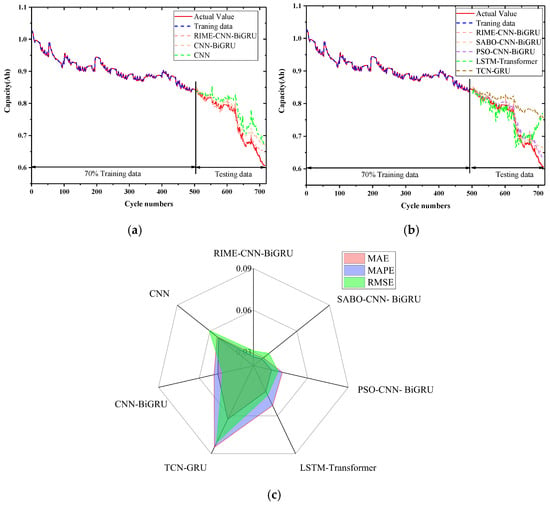
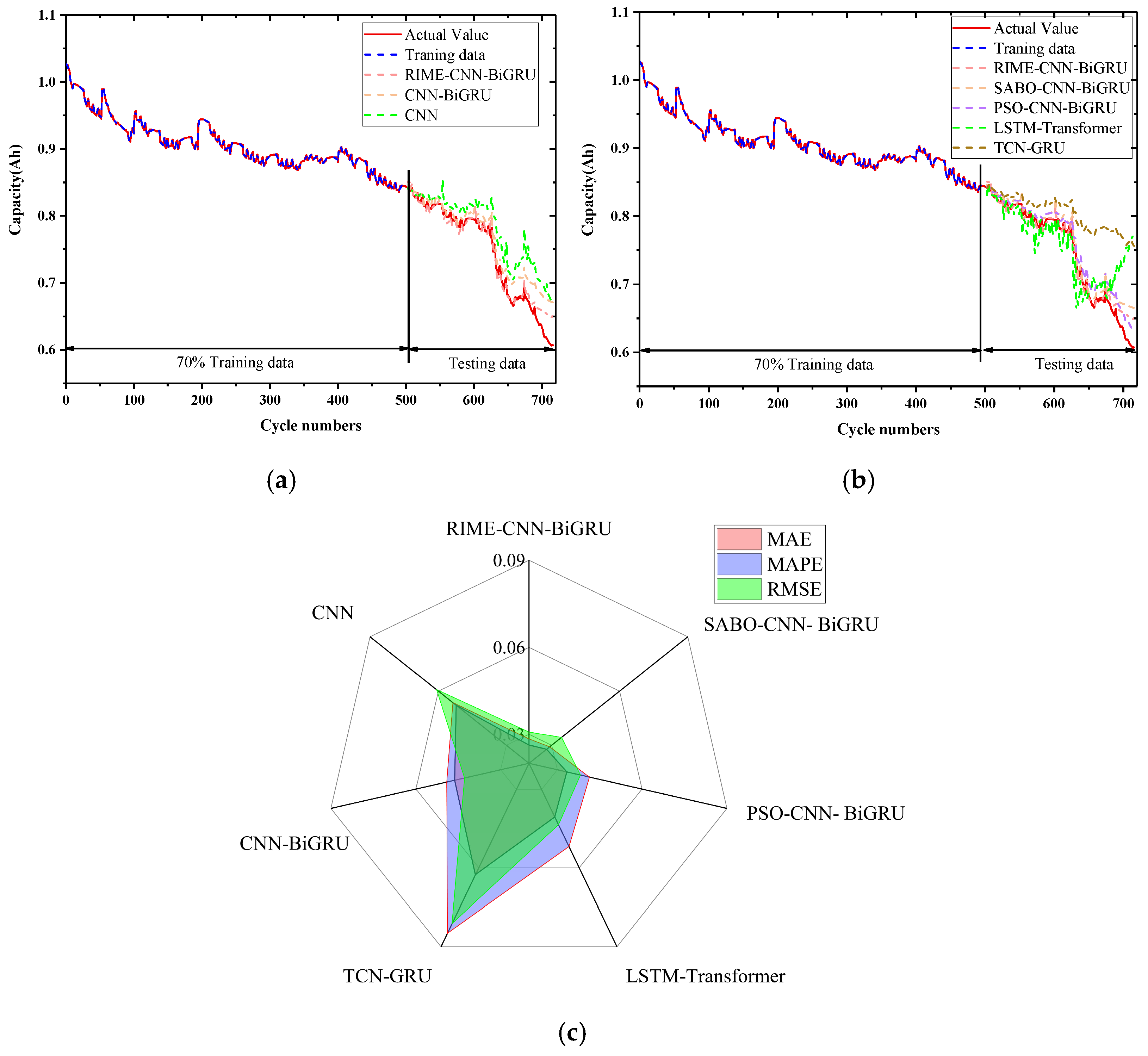
To validate the cross-dataset generalization capability of the proposed model, supplementary experiments are conducted on the CALCE CS2-35 battery dataset. As shown in Table 5 and Figure 13, the RIME-CNN-BiGRU model achieves the best prediction accuracy on the CS2-35 cell, with MAE = 2.63%, MAPE = 2.84%, and RMSE = 3.08%, significantly outperforming SABO-CNN-BiGRU (MAE = 2.78%, RMSE = 3.44%), PSO-CNN-BiGRU (MAE = 3.34%, RMSE = 3.82%), and LSTM-Transformer (MAE = 4.05%, RMSE = 4.35%). Compared with the suboptimal SABO-CNN-BiGRU, the RMSE is reduced by 10.5%; relative to PSO-CNN-BiGRU, the RMSE reduction is 19.4%; and compared with LSTM-Transformer, the RMSE reduction reaches 29.2%. These results fully demonstrate the superiority of the RIME algorithm in hyperparameter optimization—its dual-stage search strategy effectively avoids the local-optima trap that commonly plagues PSO, while exhibiting more stable convergence performance than SABO. In addition, the ablation experimental results show that the CNN-BiGRU model without RIME optimization (RMSE = 4.28%) outperforms the standalone CNN model (RMSE = 6.07%), but still falls short of the RIME-CNN-BiGRU, with RIME optimization yielding a relative RMSE reduction of 28.0%. Meanwhile, the standalone CNN model without the bidirectional mechanism achieves the poorest performance, further validating the effectiveness of the synergistic design—CNN for local feature extraction and BiGRU for capturing bidirectional temporal dependencies—in cross-dataset scenarios. It is worth noting that the RMSE of 3.08% on CS2-35 is higher than the 1.68% achieved on the NASA B5 cell with 80% training data, which is mainly attributable to the distribution shift caused by differences in charge/discharge protocols across datasets; nevertheless, the error remains within acceptable engineering tolerance, demonstrating the model’s adaptability to different battery types and operating conditions in practical applications.
Table 5.
Model Comparison Metrics on the CALCE CS2 35 Battery Dataset.
Figure 13.
SOH prediction results and corresponding errors for battery based on different models; (a) battery ablation experiment for 70% CS2-35 training data; (b) SOH prediction results for battery B7 based on different models; (c) Comparison of model errors for 70% CS2-35 training data.
4.3. SOH Prediction Comparison with Existing Methods
To illustrate the prediction performance of the proposed method this paper, compares it with other classical algorithms: PI-Transfomer [24], CNN-Transformer-LSTM [25], CNN-Transformer [26]. Obviously, the hybrid method is proposed has better-estimated performance accuracy in Table 6.
Table 6.
Comparison of prediction performance RMSE with the existing results.
Compared with the aforementioned Transformer-based methods, the proposed RIME-CNN-BiGRU model achieves competitive estimation accuracy on the NASA B5 dataset, with an RMSE of 1.68%. Although a direct numerical comparison with results from other datasets should be interpreted with caution due to differences in battery types, operating conditions, and experimental settings, the performance of our model is nevertheless encouraging and indicates its potential for reliable SOH estimation. Future work will include systematic benchmarking on multiple public datasets under identical protocols to enable fairer comparisons.
5. Conclusions
This paper presents a hybrid deep learning framework for accurate and robust SOH estimation of lithium-ion batteries, integrating incremental capacity analysis, a CNN-BiGRU hybrid architecture, and RIME-based hyperparameter optimization. The main findings and contributions are summarized as follows.
- (1)
- A total of 13 health indicators are systematically extracted from incremental capacity curves, covering local morphological features, peak characteristics, and global statistical attributes. Spearman’s rank correlation analysis confirms the strong relevance of these indicators to capacity degradation, providing a reliable and physically meaningful feature foundation for the model.
- (2)
- The CNN-BiGRU hybrid architecture effectively combines the strengths of convolutional neural networks in local feature extraction and bidirectional gated recurrent units in capturing long-term temporal dependencies. This synergistic design enables the model to comprehensively characterize the complex degradation dynamics of batteries from both spatial and temporal dimensions. Furthermore, the RIME optimization algorithm is introduced to achieve automatic hyperparameter tuning, effectively overcoming the limitations of manual trial-and-error approaches. The algorithm maintains an efficient balance between global exploration and local exploitation, ensuring that the model operates under the optimal configuration while significantly improving tuning efficiency and predictive stability.
- (3)
- Extensive experiments conducted on the NASAE dataset under various training ratios demonstrate that the proposed RIME-C NN-BiGRU model outperforms advanced comparison methods, including SABO-CNN-BiGRU, LSTM-Transformer, TCN-GRU, and LSSVM, in terms of evaluation metrics such as MAE, MAPE, and RMSE, thereby verifying the effectiveness and accuracy of the proposed model.
The proposed model exhibits favorable deployment prospects in practical applications. During online inference, it operates with a fixed-length historical window in a unidirectional forward propagation manner, strictly satisfying causality constraints. The computational cost involves only matrix multiplications and activation functions, which can be efficiently executed on current embedded platforms. Typical application scenarios include onboard BMS for electric vehicles, rapid health screening for second-life batteries, and operational decision support for stationary energy storage systems. Nevertheless, several limitations of the current approach should be acknowledged. First, the health indicator extraction relies on complete constant-current charging segments, making it difficult to adapt to fast-charging or variable-current conditions. Second, the model’s generalization across different battery chemistries requires further verification. Third, the computational overhead of the RIME algorithm during the optimization phase remains non-negligible for large-scale hyperparameter searches. To address these shortcomings, future work will concentrate on three aspects: developing adaptive feature extraction strategies applicable to fragmented and random charging scenarios to eliminate dependency on complete charging protocols; incorporating more comprehensive electrochemical mechanism knowledge to enhance physical interpretability and extrapolation capability; and achieving model lightweighting through pruning and quantization to accommodate edge-side deployment, which can provide high-accuracy and high-reliability technical support for next-generation intelligent battery management.
Author Contributions
Conceptualization, R.X., J.X. and J.L.; Methodology, R.X., J.X. and J.L.; Software, R.X., J.X. and J.L.; Validation, R.X. and J.X.; Formal analysis, R.X., J.X. and J.L.; Investigation, R.X. and J.X.; Resources, R.X., J.X. and J.L.; Data curation, R.X. and J.X.; Writing—original draft, R.X.; Writing—review and editing, R.X.; Funding acquisition, R.X. All authors have read and agreed to the published version of the manuscript.
Funding
This work was supported in the Scientific Research Program Funded by Education Department of Shaanxi Provincial Government (No. 24JK0317).
Data Availability Statement
The data presented in this study are openly available in https://ti.arc.nasa.gov/tech/dash/groups/pcoe/prognostic-data-repository/ (accessed on 1 June 2026).
Conflicts of Interest
The authors declare no conflicts of interest.
References
- Liu, K.; Shang, Y.; Ouyang, Q.; Widanage, W.D. A data-driven approach with uncertainty quantification for predicting future capacities and remaining useful life of lithium-ion battery. IEEE Trans. Ind. Electron. 2020, 68, 3170–3180. [Google Scholar] [CrossRef] [Scilit]
- Tu, H.; Moura, S.; Wang, Y.; Fang, H. Integrating physics-based modeling with machine learning for lithium-ion batteries. Appl. Energy 2023, 329, 120289. [Google Scholar] [CrossRef] [Scilit]
- Li, J.; Wang, X.; Tian, D.; Ye, M.; Niu, Y. State of charge estimation method for lithium-ion battery based on informer model combining time domain and frequency domain attention. Energy 2025, 335, 138198. [Google Scholar] [CrossRef] [Scilit]
- Yan, H.; Cui, C.; Chen, H.; Zhang, K.; Chen, J.; Kong, Q. Battery SOH estimation method based on fusion of physical model and data-driven model. Chin. J. Power Sources 2025, 49, 1183–1191. Available online: https://manu70.magtech.com.cn/dyjs/CN/10.3969/j.issn.1002-087X.2025.06.013 (accessed on 1 June 2026).
- Yao, F.; Zhang, Z.; Han, Y.; An, R.; Li, Q. A fast method for estimating the state of charge and state of health of lithium-ion batteries based on electrochemical impedance spectroscopy at multiple frequency. Meas. Sci. Technol. 2025, 36, 055501. [Google Scholar] [CrossRef] [Scilit]
- Chen, S.; Gong, Z.; Zhao, P.; Zhang, Y.; Cheng, B.; Hou, J.; Song, J.; Ding, X.; Sun, J.; Shi, J.; et al. Design of nanostructure in solid electrolyte interphase for enhancing the mechanical durability of lithium metal anode by deep-learning approach. Energy Storage Mater. 2024, 65, 103096. [Google Scholar] [CrossRef] [Scilit]
- Mo, Y.; Yu, Z.; Ye, P.; Fan, W.; Lin, Y. Lithium battery SOH estimation method based on combination of transfer learning and GRU neural network. Acta Energiae Solaris Sin. 2024, 45, 233–239. [Google Scholar] [CrossRef]
- Sah, B.K.; Yadav, A.K.; Verma, O.P. Remaining useful life prediction of Li-ion batteries using fusion-based data-driven GRU-CNN hybrid model. Eur. Phys. J. Plus 2026, 27, 141. [Google Scholar] [CrossRef] [Scilit]
- Giuliano, A.; Wu, Y.; Yawney, J.; Gadsden, S.A. Transformer-Based Transfer Learning for Battery State-of-Health Estimation. Energies 2025, 18, 5439. [Google Scholar] [CrossRef] [Scilit]
- Li, Y.; Shi, H.; Huang, Q.; Li, K.; Liu, C.; Nie, S.; Jia, X.; Fernandez, C. Enhanced multi-scale signal decomposition transformer neural network for state of health estimation of lithium-ion batteries. J. Energy Storage 2025, 134, 118191. [Google Scholar] [CrossRef] [Scilit]
- Chen, Y.; Li, D.; Huang, X.; Hong, J.; Mu, C.; Wu, L.; Li, K. Exploring life warning solution of lithium-ion batteries in real-world scenarios: TCN-transformer fusion model for battery pack SOH estimation. Energy 2025, 335, 138053. [Google Scholar] [CrossRef] [Scilit]
- Pang, X.; Yu, P.; Yin, C.; Liu, W.; Zheng, Z. Transformer and bidirectional gated recurrent unit hybrid network with attention mechanisms for lithium-ion battery state-of-health estimation. J. Power Sources 2025, 630, 238370. [Google Scholar] [CrossRef] [Scilit]
- Zhang, Y.; Wang, Y.; Soo, Y.; Sun, Z. A multi-task transformer approach for lithium-ion battery pack health state estimation using self-supervised reconstruction and online fine-tuning. J. Energy Storage 2025, 140, 118922. [Google Scholar] [CrossRef] [Scilit]
- Fan, Z.; Guo, Y.; Song, L.; Du, J.; Wang, H.; Li, X. BatteryTSFM: Generalizable long-horizon degradation prediction across conditions and chemistries via time series foundation models. Energy AI 2025, 22, 100646. [Google Scholar] [CrossRef] [Scilit]
- Wang, F.J.; Zhai, Z.; Zhao, Z.B.; Di, Y.; Chen, X. Physics-informed neural network for lithium-ion battery degradation stable modeling and prognosis. Nat. Commun. 2024, 15, 4332. [Google Scholar] [CrossRef] [Scilit] [PubMed]
- Dou, B.; Hou, S.; Li, H.; Zhao, Y.; Fan, Y.; Sun, L.; Chen, H.-S. Cross-domain state of health estimation for lithium-ion battery based on latent space consistency using few-unlabeled data. Energy 2025, 320, 135257. [Google Scholar] [CrossRef] [Scilit]
- Li, Q.; Wei, Z.; He, H.; Shen, J.; Li, Y.; Yang, X.; Vilathgamuwa, M. Smart health evaluation for lithium-ion battery with super-short-segment charging. Adv. Sci. 2025, 36, e03583. [Google Scholar] [CrossRef] [Scilit] [PubMed]
- Dai, H.; Huang, Y.; Zhu, L.; Lin, H.; Yu, H.; Lai, Y.; Yang, Y. Battery state-of-health estimation based on random charge curve fitting and broad learning system with attention mechanism. J. Power Sources 2025, 636, 236544. [Google Scholar] [CrossRef] [Scilit]
- Sun, J.; Liu, X.; Li, X.; Chen, S.; Xing, S.; Guo, Y. State of health estimation of lithium-ion battery based on constant current charging time feature extraction and internal resistance compensation. Energy 2025, 315, 134472. [Google Scholar] [CrossRef] [Scilit]
- Saha, B.G.K. Battery Data Set. 2020. Available online: https://ti.arc.nasa.gov/tech/dash/groups/pcoe/prognostic (accessed on 10 May 2019).
- Yang, S.J.; Luo, B.Y.; Wang, J.; Kang, J.Q.; Zhu, G.R. Estimation of lithium-ion battery health status based on characteristic parameters of peak interval on capacity increment curve. J. Trans. China Electrotech. Soc. 2024, 36, 2277. [Google Scholar] [CrossRef]
- Yang, D.; Wang, H.; Dang, H.; Yuan, Y.; He, J. Estimation of lithium battery health state based on optimal reconstructed health factor and RIME-SVR. J. Electron. Meas. Instrum. 2025, 39, 188–196. Available online: https://jemi.etmchina.com/jemi/ch/reader/view_abstract.aspx?file_no=B2407835&flag=1 (accessed on 1 June 2026).
- Su, H.; Zhao, D.; Heidari, A.A.; Liu, L.; Zhang, X.; Mafarja, M.; Chen, H. RIME: A physics-based optimization. Neurocomputing 2023, 532, 183–214. [Google Scholar] [CrossRef] [Scilit]
- Li, Y.; Wang, H.; Wang, C.; Wang, L.; Liao, C.; Wang, L. Unified physics-informed subspace identification and transformer learning for lithium-ion battery state-of-health estimation. J. Energy Chem. 2025, 105, 261–279. [Google Scholar] [CrossRef] [Scilit]
- Wang, M.; Sui, Z.; Zhang, L. State-of-health estimation of lithium-ion batteries based on EIS and CNN-Transformer network. In Proceedings of the 2024 Global Reliability and Prognostics and Health Management Conference (PHM-Beijing); IEEE: New York, NY, USA, 2024; pp. 1–7. [Google Scholar] [CrossRef] [Scilit]
- Zeng, F.; Zhang, W.; Ren, M.; Zeng, W. CNN-Transformer-LSTM-based lithium battery health state prediction. J. Phys. Conf. Ser. 2025, 3096, 012008. [Google Scholar] [CrossRef] [Scilit]

Disclaimer/Publisher’s Note: The statements, opinions and data contained in all publications are solely those of the individual author(s) and contributor(s) and not of MDPI and/or the editor(s). MDPI and/or the editor(s) disclaim responsibility for any injury to people or property resulting from any ideas, methods, instructions or products referred to in the content. |
© 2026 by the authors. Licensee MDPI, Basel, Switzerland. This article is an open access article distributed under the terms and conditions of the Creative Commons Attribution (CC BY) license.