


Abstract
This paper studies the stability properties of a class of Hopfield-type neural networks involving conformable derivatives and piecewise constant arguments. By constructing an associated discrete-time formulation, the continuous system is expressed in a form that is more suitable for analysis. A Lyapunov-based approach is then developed to investigate the asymptotic and exponential stability of the equilibrium point of the resulting discrete system. The analysis provides conditions that depend on the system parameters and the conformable derivative order, offering insight into the convergence behavior of solutions. The proposed approach treats the discrete formulation as an analytical tool for studying the original model. A numerical example is included to illustrate the theoretical results.
Keywords:
artificial neural networks; piecewise constant arguments; discrete system; asymptotic stability; exponential stability; conformable derivative MSC:
34D20; 39A30; 92B20
1. Introduction
Artificial intelligence (AI) is a broad scientific field based on the idea of replicating human brain capabilities within a mathematical and computational framework. This field emerged with two key motivations: first, to provide a computational basis for neuroscience by modeling biological brain functions, and second, to develop systems that can outperform the human brain in specific tasks such as image recognition, speech processing, and coordination. Artificial neural networks (ANNs), a crucial subset of AI, are mathematical models inspired by biological neural networks. Neurons receive weighted input through synaptic connections, accumulate these signals, and produce an output when the total input exceeds a threshold value. This mechanism is the fundamental concept of ANNs, which was first mathematically modeled by McCulloch and Pitts in 1943 [1]. Since the computational capacity of a single neuron is highly limited to solving nonlinear problems, the idea of interconnected neurons forming complex networks emerged as a natural extension to overcome these limitations. Significant advances were made in this area with the introduction of Rosenblatt’s Perceptron [2], a multilayer network that can learn patterns, and later Hopfield networks [3], which approached ANNs from the dynamical perspective. Hopfield networks demonstrated remarkable potential in solving optimization problems and pattern recognition tasks, despite their capacity limitations for large-scale data. Their dynamics is governed by differential equations, where the neuron states evolve over time, influenced by connection weights, activation functions, and external inputs. The stability and convergence properties of these networks were widely studied in several studies ([4,5,6]). Such studies laid the foundation for modern neural network research. As neural network models become more complex, understanding their dynamic behavior, stability, and learning capabilities remains important for the advancement of AI systems in both theoretical and practical areas.
Differential Equations with Piecewise Constant Arguments (DEPCAs), which fall into the category of delayed differential equations, first appeared in a contagious disease model established by Busenberg and Cooke [7] in the early 1980s. This topic was later explored by Cooke and Wiener [8], Wiener ([9,10]) and Shah and Wiener [11]. Since DEPCAs exhibit characteristics of both differential and difference equations, they are known as hybrid dynamical systems. Additionally, unlike delay differential equations, solving DEPCAs requires only a finite number of initial points rather than an initial function, making them even more practical. These types of equations have gained significant attention in the literature since they have a wide range of applications in fields such as biology, control theory, and disease modeling ([12,13,14]). The oscillation, stability, and periodicity properties of the solutions of DEPCAs were investigated in ([15,16,17,18,19]). Unsurprisingly, this versatile equation type has also been applied to artificial neural networks. In 2004, Zhu and Huang studied the periodic and convergence properties of a two-neuron system with piecewise continuous arguments [20]. Later, in [21], for the equation
sufficient conditions for the existence of almost periodic solutions were obtained. In 2014, Chiu et al. investigated the global exponential stability of periodic solutions for a neural network model with a generalized piecewise continuous argument [22]; then, Akhmet et al. examined the exponential stability of bounded and periodic solutions of neural network models with a generalized piecewise continuous argument [23]. In [24,25], the global exponential stability and periodicity of a neural network model with generalized and alternately delayed and advanced piecewise continuous arguments were established, respectively.
The conformable derivative is a relatively new formulation that was introduced by Khalil et al. [26] around ten years ago to overcome some of the shortcomings of fractional calculus. It maintains several essential properties, such as linearity, product and quotient rules, mean value theorem, Rolle’s theorem, conformable counterparts of the Gronwall inequality, chain rule, integration by parts formula, power series, and Laplace transforms [27]. The geometric interpretation of conformable curves and orthogonal trajectories was explored in [28]. Although the conformable derivative is a local operator, the simplicity of the definition and its reliance on basic differentiation rules make it particularly useful for analytical work. Unlike other fractional operators, it retains the properties of standard differentiation rules and reduces to the classical derivative when , thereby enhancing its analytical feasibility ([29,30,31,32,33,34]).
In recent years, artificial neural network models with fractional derivatives have attracted great attention. These types of ANNs have been studied from a signal processing perspective and have been observed to be more flexible and advantageous compared to classical derivative-based networks. Such neural networks have not only been effectively applied to fields like finance and economics but also in various physical systems such as electrical circuits, chemical processes, and biological systems. For instance, in 2009, a fractional-order Hopfield neural network model was examined in [35]. Later, the finite-time stability of a delayed neural network model with fractional derivatives and the stability of the fractional-order Hopfield neural network model were investigated in [36,37], respectively. In [38], the classical derivative was replaced by a conformable derivative in the Hopfield ANNs system, and the fractional exponential stability of the system was examined. Similar results were shown for a BAM-type model in [39].
A review of the literature reveals that studies involving fractional derivatives in neural networks with piecewise constant arguments are quite limited. This subject was first introduced in [40], and some criteria were obtained to guarantee the Mittag-Leffler stability of these systems. Subsequently, in [41], using Lyapunov’s theorem, new sufficient Mittag-Leffler stability conditions were developed for neural networks with piecewise constant arguments and fractional derivatives. Furthermore, in [42], the global Mittag-Leffler stability of quaternion-valued neural networks with fractional order, piecewise constant arguments, and impulses was analyzed.
Motivated by this perspective, the stability of a class of Hopfield-type neural networks involving conformable derivatives and piecewise constant arguments is studied. Within this framework, sufficient conditions ensuring the asymptotic and exponential stability of the equilibrium are derived. In addition, the influence of the conformable order on the convergence behavior of the solutions is examined.
In this paper, the following initial value problem containing a Hopfield-type neural network with piecewise constant arguments and conformable derivatives of order is considered:
with the initial conditions
where corresponds to a conformable derivative of order , represents the state variable of the ith unit at time t, corresponds to the activation function of the jth neuron, denotes the rate with which unit i will reset its potential to the resting state when disconnected from the network, and are any real constants, denotes the connection weight of unit j on unit i at time t, represents the input from outside the network to unit i, is the floor function, and , are given real constants.
The paper is organized as follows. Section 2 presents the necessary preliminary results. In Section 3, the discrete form of the system (1) and (2) is constructed and its asymptotic and exponential stability is analyzed using a Lyapunov approach. Section 4 provides a numerical example illustrating the theoretical results. The paper concludes with some remarks and open problems.
2. Preliminaries
In this section, the definition and some basic properties of the conformable derivative are recalled.
Definition 1
([26]). The α-order conformable derivative of is denoted by or and defined as
for all and .
- If f is α-order differentiable in some interval , , and exists, thenOn the other hand, the conformable integral of a function is defined bywhere
This definition can be generalized to the functions defined on the interval as follows:
Definition 2
([27]). The α-order conformable derivative of a function can be defined as
where . Also, the conformable integral of a function is defined as
where
Theorem 1
([26]). If and are α-order differentiable, , at a point , then
- 1.
- for all ;
- 2.
- ;
- 3.
- ;
- 4.
- If f is differentiable, then ;
- 5.
- If c is a constant, then .
Definition 3.
Differential equations with piecewise constant arguments are often investigated with the aid of associated difference equations. In this setting, Lyapunov–Krasovskii functionals and discrete forms of Halanay’s inequality provide suitable tools for stability analysis, especially in the presence of multiple delays. Various extensions of Halanay’s inequality can be found in [43,44,45,46,47].
A Lyapunov–Krasovskii functional criterion and a discrete version of Halanay’s inequality that will be used in the analysis are recalled below.
Theorem 2
([48]). An autonomous, multivariable discrete-time delay system can be represented by the difference equation
with an associated function of initial state
where
is a state vector, is a constant matrix of appropriate dimension and is an unknown time delay in the general case. Let be the space of functions mapping the discrete interval into . Then, , for is the norm of an element and . Let , where .
Lemma 1
([44]). Suppose that there exist constants and such that and . Let be a sequence of positive real numbers satisfying the inequality
If
and
hold for some and integers , , then for , where
and
An equilibrium point of system (1) is defined as a constant vector satisfying the equation
Throughout this paper, the functions , are assumed to be Lipschitz continuous. That is, there exist positive constants such that
for all and .
The following lemma gives the condition for the existence and uniqueness of the equilibrium point of (1). Since the proof is the same as in [38], it is omitted here.
3. Stability Analysis of the Discrete System
In this section, first, the corresponding discrete version of (1) and (2) is constructed. Then, the stability analysis of this discrete system is investigated.
To facilitate analysis, the equilibrium point of Equation (1), given as (5), is shifted to the origin with the help of the transformation
It is clear that and satisfy the Lipschitz condition with for .
Theorem 3.
Proof.
Applying the fourth property of Theorem 1 to Equation (13), we obtain the linear differential equation
The solution of the above equation is
The equilibrium point of the difference equation system (12) is given by the systems of equations
or equivalently
Theorem 4.
In addition to the hypotheses of Lemma 2, assume that
Then, the unique equilibrium point of the discrete system (12) is asymptotically stable.
Proof.
We will apply Theorem 2 for the proof. Consider the functional
It is evident that . Moreover, since , for .
On the other hand, considering the Lipschitz continuity of and the notation , we get
where
Thus, taking , we see that the conditions on in Theorem 2 are satisfied.
On the other hand, from (16), it is clear that
Substituting the right-hand side of (12) in place of above, we have
Usingthe Lipschitz continuity of , we obtain
Therefore, from the above inequality, we have
where
By condition (15), it is clear that Hence, if we take , the conditions on w in Theorem 2 are true. Therefore, according to Theorem 2, the unique equilibrium point is asymptotically stable. □
Now, we shall obtain the sufficient conditions for the exponential stability of the discrete system (12). For this aim, let us consider the following systems of difference inequalities
with the initial conditions (10).
Lemma 3.
Let be a sequence of positive real numbers satisfying the inequality (17).
- If for each ,holds, thenwhereand is a constant.
Proof.
For the proof, we shall apply Lemma 1. It is clear that the terms and in Lemma 1 correspond to the positive constants and , respectively. So, let us define
Considering (18), it can be calculated that
Moreover, by the condition (18), it is observed that
and so
is also satisfied. Therefore, by Lemma 1, we get
□
Theorem 5.
Proof.
Let be a solution of the system (12). Then, for each , we have
This equation can be rewritten as
where
It is obvious that the solution of (22) is
Since satisfies the Lipschitz condition for each , from (22), we get
where b is defined in (18). Now, let us define
and
It is clear that
Corollary 1.
Let the conditions of Theorem 5 be satisfied. If for each
then the convergence rate λ for the system (12) is inversely proportional to the value of α. That is, as α increases, λ decreases.
Proof.
Let us consider the function
Then, by the condition (26), it is clear that
So, decreases under the condition (26). Since
and , the proof is completed. □
Corollary 2.
For , (9) is transformed to
Corollary 3.
Corollary 4.
Remark 1.
In this study, analyses have been carried out for . It is believed that asymptotic stability and α-synchronization in neural networks can be further explored within the range , where .
Remark 2.
In [21], a neural network system with piecewise constant arguments was studied; however, the arguments were restricted to the form , and the model was formulated using the classical derivative. In contrast, the present work considers a more generalized framework in which the neural network system involves m distinct piecewise constant arguments of the form , , …, , and the dynamics are governed by the conformable derivative.
Remark 3.
The exponential stability of continuous-type Hopfield neural networks with conformable derivatives was addressed in [38]. Additionally, the Mittag-Leffler stability of fractional-order neural networks with generalized piecewise constant arguments was explored in [40,41,42], where the systems involved arguments of the form . However, in those works, the inequality was employed under certain restrictive conditions. In contrast, the direct involvement of the delay argument in system (3) marks the primary distinction and advantage of our work compared to these previous studies.
4. Numerical Example
This section includes an example that verifies our results.
Example 1.
Let us consider the system
where . The activation functions satisfy the Lipschitz condition with . Moreover, it can be seen that the condition (7) is also satisfied. So, the system (30) has a unique equilibrium point, which is . Using the transformation , the following system is obtained
where The corresponding discrete version of the system (31) is obtained as
It is observed that the conditions (6), (7) and (15) are fulfilled. Therefore, the unique equilibrium point is asymptotically stable.
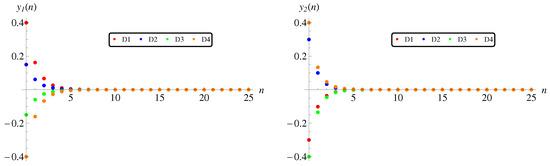
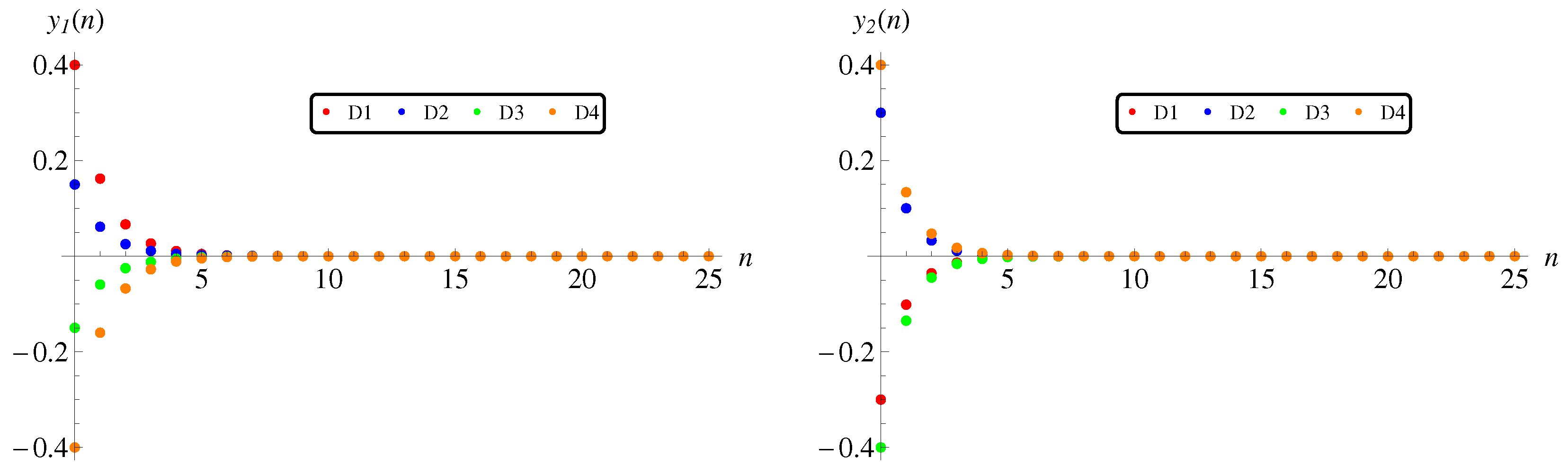
Figure 1 demonstrates the asymptotic stability of the equilibrium point of the system (32) for different initial conditions and fixed . The initial conditions are taken as
Figure 1.
Behavior of and for the system (32) with different initial conditions.
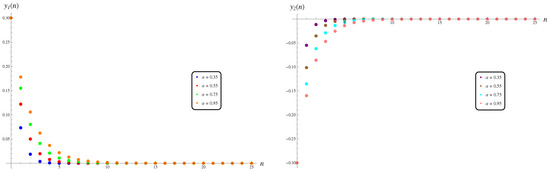
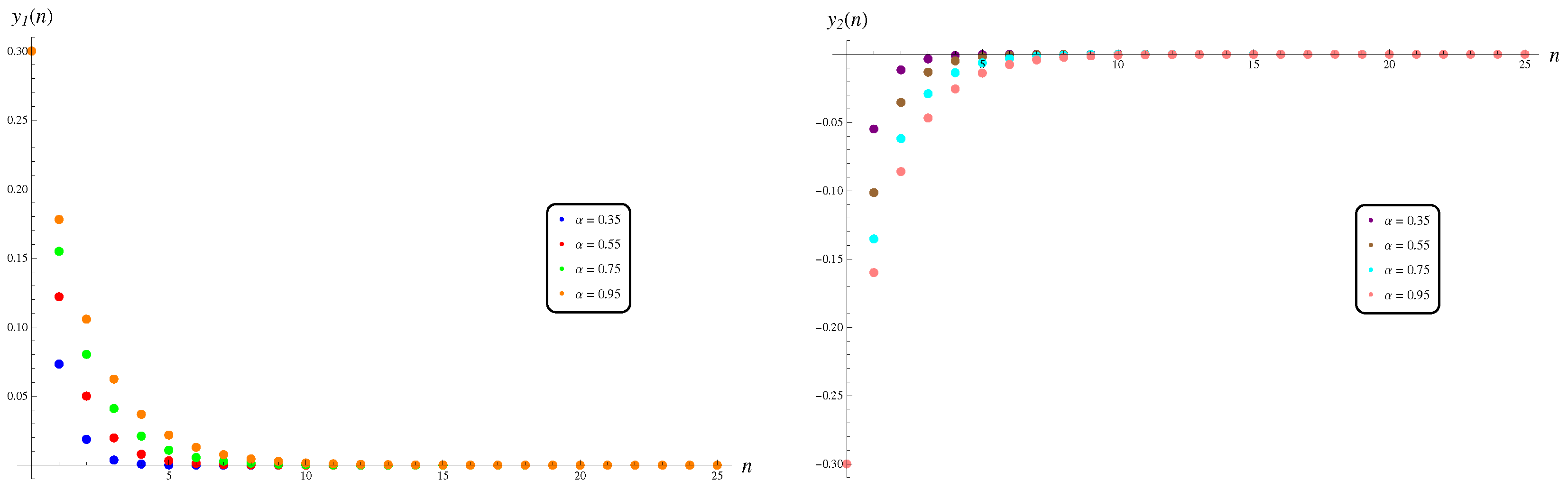
Figure 2 illustratesthe influence of α on the dynamic behavior of the system (32). The state trajectories and are plotted for four distinct values of , while keeping the initial conditions fixed at . It can be observed that the solutions converge to the equilibrium point for all tested values.
Figure 2.
Effect of the parameter on the state trajectories of the system (32).
Table 1 involves the conditions of the main theorems for varying α values between and From Table 1, it is seen that condition (15) is satisfied for all values of α, so the equilibrium point is asymptotically stable. However, the same conclusion cannot be reached for exponential stability, since condition (18) is not satisfied for the first six values of α between and . It is seen that the condition (18) is satisfied for . So, the equilibrium point is exponentially stable for . On the other hand, it is observed that the condition (26) is satisfied for . This means that for , the convergence rate decreases as α increases. In fact, this property is seen from Table 1.
Table 1.
Convergence rate for the system (32) for several values.
To further illustrate the dynamic behavior of the system, the time responses of the state variables are examined under the same initial conditions .
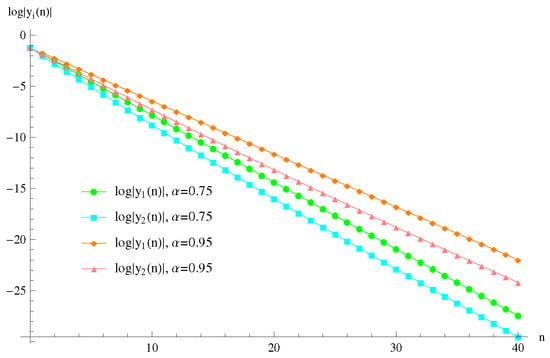
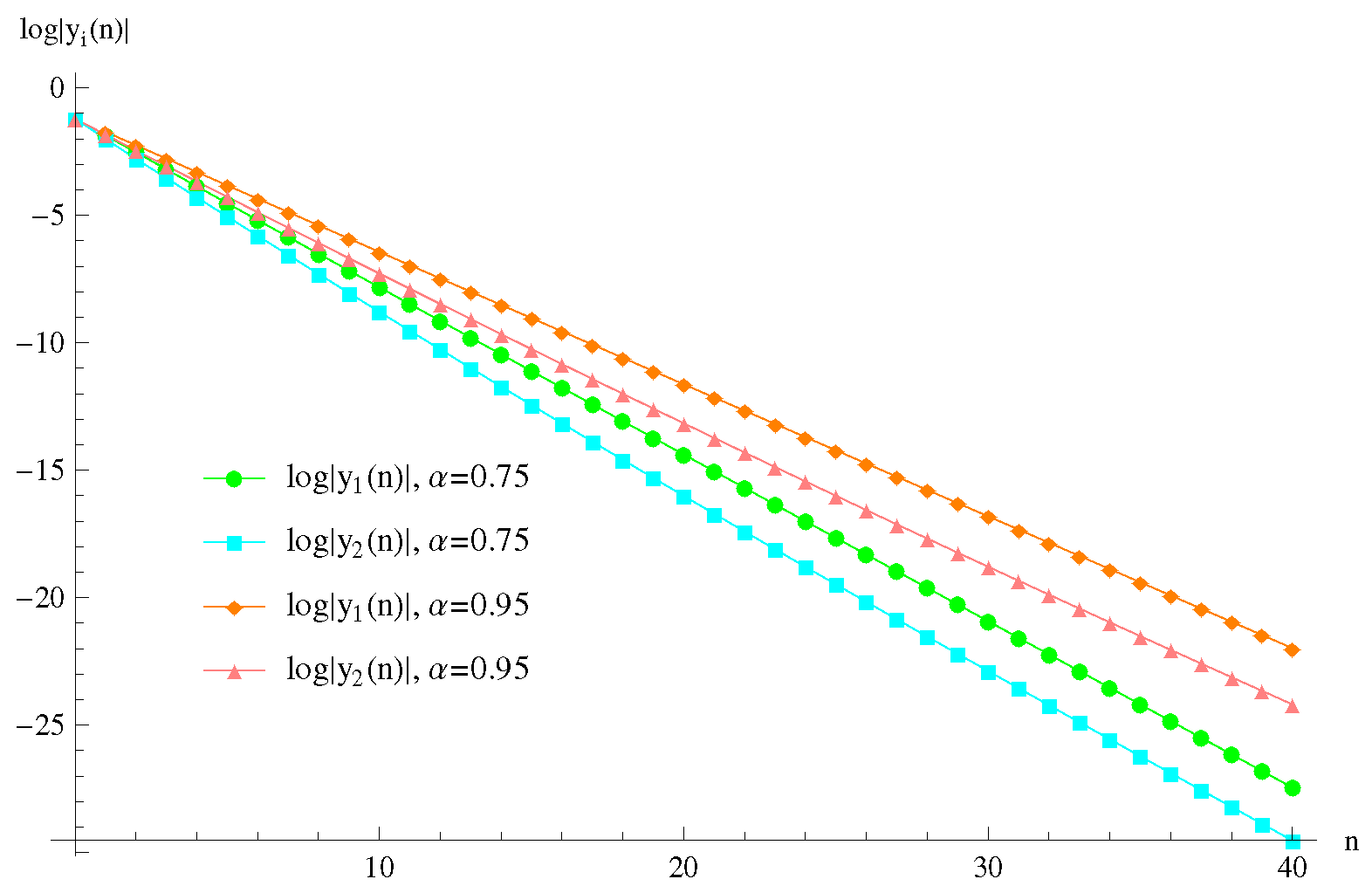
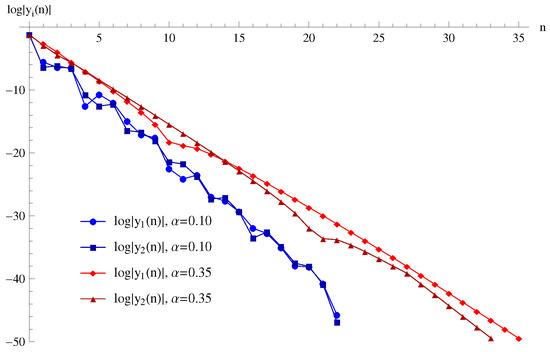
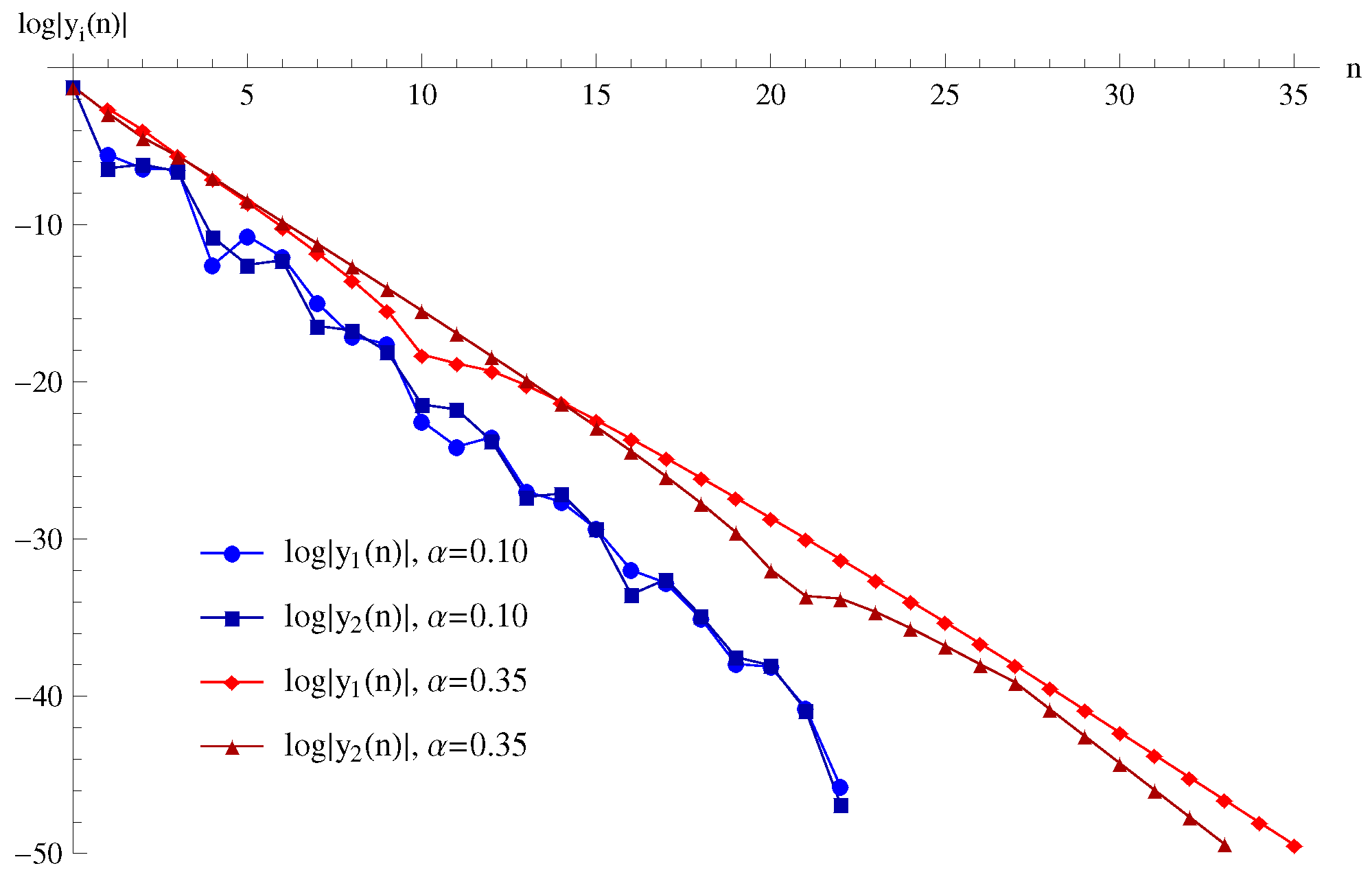
To confirm the exponential nature of convergence, let us consider the cases and , both of which satisfy conditions (18) and (26) (see Table 1). The behavior of the state trajectories for and is given in Figure 2. In addition, Figure 3 presents the log-scale plots of and for and . In both cases, decreases linearly with n, providing definitive evidence that the convergence is indeed exponential. Moreover, the slope of the log-scale trajectories for is steeper than that for , indicating a faster exponential convergence for the smaller value of α. This observation is in perfect agreement with Corollary 1, which states that the convergence rate λ is inversely proportional to α.
Figure 3.
Log-scale plots of for the system (32) with and .
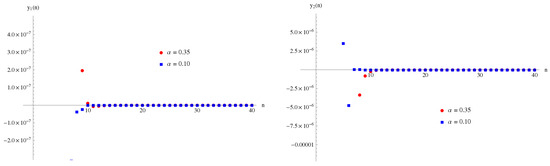
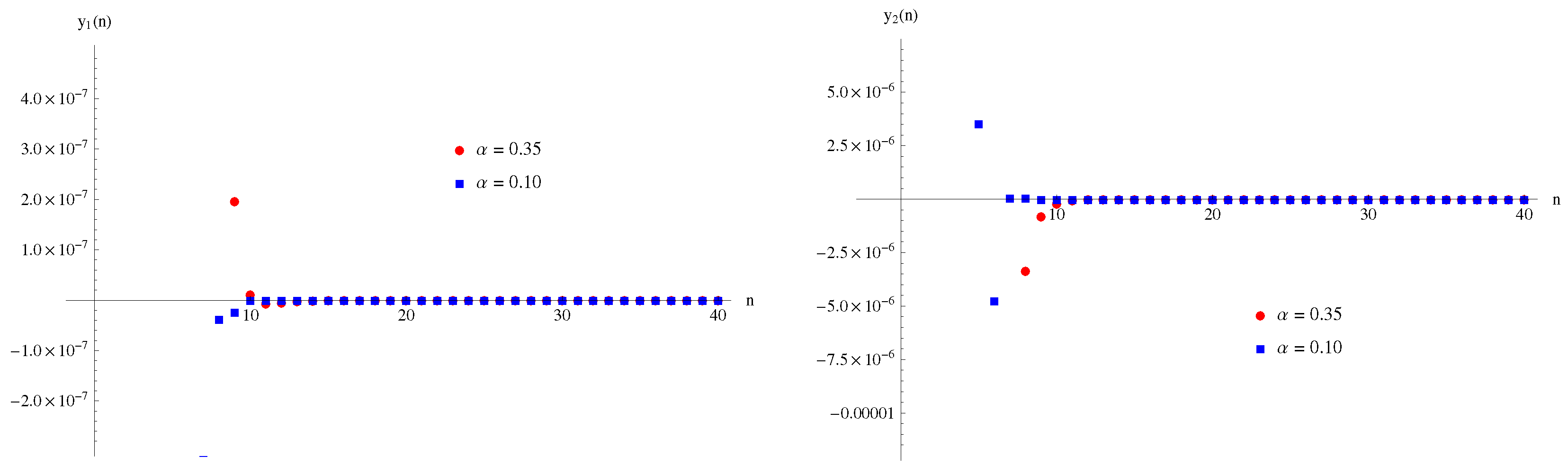
Now, let us consider the cases and , both of which only fulfill the condition (15). Figure 4 presents the normal-scale trajectories of and for . It is observed that the solutions converge to the equilibrium point in both cases, confirming that asymptotic stability is preserved. On the other hand, Figure 5 presents the corresponding log-scale plots of ; here, the log-scale trajectories do not exhibit a linear decrease, confirming that the convergence is genuinely not exponential. This demonstrates that falling outside the region where the condition (18) holds does not imply a loss of stability; asymptotic stability is preserved while exponential convergence may be lost.
Figure 4.
Normal-scale time responses of and for the system (32) with and .
Figure 5.
Log-scale plots of for the system (32) with and .
5. Discussion
In this paper, the asymptotic stability of the unique equilibrium point of artificial neural networks with piecewise constant arguments and conformable derivatives has been investigated. The existence and uniqueness of the equilibrium point have been established and stability results have been obtained for the associated discrete system using a Lyapunov approach. In addition, sufficient conditions for exponential stability have been derived, providing information on the convergence rate. A numerical example has been presented to illustrate the theoretical findings.
Despite the results obtained, several open problems concerning the dynamics of neural network systems remain to be addressed.
- In real-world problems, an impulse effect may change the asymptotic behavior of the system. So, the dynamics of impulsive neural networks with conformable derivatives and piecewise constant arguments is another problem.
- Since synchronization analysis of the systems could provide a more comprehensive understanding of neural network dynamics, some future work may focus on synchronization analysis.
Author Contributions
Conceptualization, F.K.; methodology, G.S.O. and F.K.; software, G.S.O.; validation, G.S.O. and F.K.; formal analysis, G.S.O.; investigation, G.S.O. and F.K.; resources, G.S.O. and F.K.; writing—original draft preparation, G.S.O.; writing—review and editing, F.K.; visualization, G.S.O.; supervision, F.K.; project administration, G.S.O.; funding acquisition, G.S.O. All authors have read and agreed to the published version of the manuscript.
Funding
This work is partially supported by Ankara University Scientific Research Projects (BAP) Coordination Office. Grant number: FB A-2025-3980. The authors would like to thank Ankara University BAP Coordination for their support.
Data Availability Statement
The original contributions presented in this study are included in the article. Further inquiries can be directed to the corresponding author.
Conflicts of Interest
The authors declare no conflicts of interest.
References
- McCulloch, W.S.; Pitts, W. A logical calculus of the ideas immanent in nervous activity. Bull. Math. Biophys. 1943, 5, 115–133. [Google Scholar] [CrossRef] [Scilit]
- Rosenblatt, F. Principles of Neurodynamics: Perceptrons and the Theory of Brain Mechanisms; Spartan Books: Washington, DC, USA, 1962. [Google Scholar]
- Hopfield, J.J. Neural networks and physical systems with emergent collective computational abilities. Proc. Natl. Acad. Sci. USA 1982, 79, 2554–2558. [Google Scholar] [CrossRef] [Scilit] [PubMed]
- Michel, A.N.; Farrell, J.A.; Porod, W. Qualitative analysis of neural networks. In 1988 IEEE International Symposium on Circuits and Systems (ISCAS); IEEE: Espoo, Finland, 1988; pp. 989–992. [Google Scholar]
- Grujic, L.T.; Michel, A.N. Exponential stability and trajectory bounds of neural networks under structural variations. In 29th IEEE Conference on Decision and Control; IEEE: New York, NY, USA, 1990; pp. 1713–1718. [Google Scholar]
- Gopalsamy, K. Stability of artificial neural networks with impulses. Appl. Math. Comput. 2004, 154, 783–813. [Google Scholar] [CrossRef] [Scilit]
- Busenberg, S.; Cooke, K.L. Models of vertically transmitted diseases with sequential-continuous dynamics. In Nonlinear Phenomena in Mathematical Sciences; Academic Press: Houston, TX, USA, 1982; pp. 179–187. [Google Scholar]
- Cooke, K.L.; Wiener, J. Retarded differential equations with piecewise constant delays. J. Math. Anal. Appl. 1984, 99, 265–297. [Google Scholar] [CrossRef] [Scilit]
- Wiener, J. Differential equations with piecewise constant delays. In Trends in Theory and Practice of Nonlinear Differential Equations; CRC Press: Boca Raton, FL, USA, 1983; pp. 547–552. [Google Scholar]
- Wiener, J. Generalized Solutions of Functional Differential Equations; World Scientific: Hackensack, NJ, USA, 1993. [Google Scholar]
- Shah, S.M.; Wiener, J. Advanced differential equations with piecewise constant argument deviations. Int. J. Math. Math. Sci. 1983, 6, 671–703. [Google Scholar] [CrossRef] [Scilit]
- Dai, L.; Singh, M.C. On oscillatory motion of spring-mass systems subjected to piecewise constant forces. J. Sound Vib. 1994, 173, 217–231. [Google Scholar] [CrossRef] [Scilit]
- Liu, P.; Gopalsamy, K. Global stability and chaos in a population model with piecewise constant arguments. Appl. Math. Comput. 1999, 101, 63–88. [Google Scholar] [CrossRef] [Scilit]
- Ozturk, I.; Bozkurt, F. Stability analysis of a population model with piecewise constant arguments. Nonlinear Anal. Real World Appl. 2011, 12, 1532–1545. [Google Scholar] [CrossRef] [Scilit]
- Aftabizadeh, A.R.; Wiener, J.; Xu, J.M. Oscillatory and periodic solutions of delay differential equations with piecewise constant argument. Proc. Am. Math. Soc. 1987, 99, 673–679. [Google Scholar] [CrossRef] [Scilit]
- Bereketoglu, H.; Seyhan, G.; Ogun, A. Advanced impulsive differential equations with piecewise constant arguments. Math. Model. Anal. 2010, 15, 175–187. [Google Scholar] [CrossRef] [Scilit]
- Muroya, Y. Persistence, contractivity and global stability in logistic equations with piecewise constant delays. J. Math. Anal. Appl. 2002, 270, 602–635. [Google Scholar] [CrossRef] [Scilit]
- Wang, G.-Q. Periodic solutions of a neutral differential equation with piecewise constant arguments. J. Math. Anal. Appl. 2007, 326, 736–747. [Google Scholar] [CrossRef] [Scilit]
- Oztepe, G.S.; Karakoc, F.; Bereketoglu, H. Oscillation and periodicity of a second order impulsive delay differential equation with a piecewise constant argument. Commun. Math. 2018, 25, 89–98. [Google Scholar]
- Zhu, H.; Huang, L. Dynamics of a class of nonlinear discrete-time neural networks. Comput. Math. Appl. 2004, 48, 85–94. [Google Scholar] [CrossRef] [Scilit]
- Huang, Z.; Wang, X.; Gao, F. The existence and global attractivity of almost periodic sequence solution of discrete-time neural networks. Phys. Lett. A 2006, 350, 182–191. [Google Scholar] [CrossRef] [Scilit]
- Chiu, K.S.; Pinto, M.; Jeng, J.J. Existence and global convergence of periodic solutions in recurrent neural network models with a general piecewise alternately advanced and retarded argument. Acta Appl. Math. 2014, 133, 133–152. [Google Scholar]
- Akhmet, M.; Çinçin, D.A.; Cengiz, N. Exponential stability of periodic solutions of recurrent neural networks with functional dependence on piecewise constant argument. Turk. J. Math. 2018, 42, 272–292. [Google Scholar] [CrossRef] [Scilit]
- Chiu, K.S.; Córdova-Lepe, F. Global exponential periodicity and stability of neural network models with generalized piecewise constant delay. Math. Slovaca 2021, 71, 491–512. [Google Scholar] [CrossRef] [Scilit]
- Chiu, K.S. Existence and global exponential stability of periodic solution for Cohen-Grossberg neural networks model with piecewise constant argument. Hacet. J. Math. Stat. 2022, 51, 1219–1236. [Google Scholar] [CrossRef] [Scilit]
- Khalil, R.; Horani, M.A.; Yousef, A.; Sababheh, M. A new definition of fractional derivative. J. Comput. Appl. Math. 2014, 264, 65–70. [Google Scholar] [CrossRef] [Scilit]
- Abdeljawad, T. On conformable fractional calculus. J. Comput. Appl. Math. 2015, 279, 57–66. [Google Scholar] [CrossRef] [Scilit]
- Khalil, R.; Horani, M.A.; Hammad, M.A. Geometric meaning of conformable derivative via fractional cords. J. Math. Comput. Sci. 2019, 19, 241–245. [Google Scholar] [CrossRef] [Scilit]
- Alzabut, J.; Manikandan, S.; Muthulakshmi, V.; Harikrishnan, S. Oscillation criteria for a class of nonlinear conformable fractional damped dynamic equations on time scales. J. Nonlinear Funct. Anal. 2020, 2020, 10. [Google Scholar] [CrossRef] [Scilit]
- Elsonbaty, A.; Sabir, Z.; Ramaswamy, R.; Adel, W. Dynamical analysis of a novel discrete fractional SITRS model for COVID-19. Fractals 2021, 29, 2140035. [Google Scholar] [CrossRef] [Scilit]
- Zhang, Q.; Shao, J. Lyapunov type inequalities for nonlinear fractional Hamiltonian systems in the frame of conformable derivatives. Math. Found. Comput. 2024, 7, 284–296. [Google Scholar] [CrossRef] [Scilit]
- Al-Jamel, A.; Al-Masaeed, M.; Rabei, E.; Baleanu, D. The effect of deformation of special relativity by conformable derivative. Rev. Mex. Fís. 2022, 68, 050705. [Google Scholar] [CrossRef] [Scilit]
- Hosseini, K.; Sadri, K.; Mirzazadeh, M.; Salahshour, S.; Park, C.; Lee, J.R. The Guava model involving the conformable derivative and its mathematical analysis. Fractals 2022, 30, 2240195. [Google Scholar] [CrossRef] [Scilit]
- Bereketoglu, H.; Obaidi, H.A.; Kavgaci, M.E.; Oztepe, G.S. Some properties of solutions of α-conformable differential equations with piecewise constant arguments. Math. Model. Anal. 2025, 30, 461–479. [Google Scholar] [CrossRef] [Scilit]
- Boroomand, A.; Menhaj, M.B. Fractional-order Hopfield neural networks. In Advances in Neuro-Information Processing, Part I 15; Springer: Auckland, New Zealand, 2009; pp. 883–890. [Google Scholar]
- Alofi, A.; Cao, J.; Elaiw, A.; Al-Mazrooei, A. Delay-dependent stability criterion of Caputo fractional neural networks with distributed delay. Discret. Dyn. Nat. Soc. 2014, 2014, 529358. [Google Scholar] [CrossRef] [Scilit]
- Zhang, S.; Yu, Y.; Wang, H. Mittag-Leffler stability of fractional-order Hopfield neural networks. Nonlinear Anal. Hybrid Syst. 2015, 16, 104–121. [Google Scholar]
- Kütahyalioglu, A.; Karakoç, F. Exponential stability of Hopfield neural networks with conformable fractional derivative. Neurocomputing 2021, 456, 263–267. [Google Scholar] [CrossRef] [Scilit]
- Kutahyalioglu, A.; Karakoç, F. Exponential stability of BAM-type neural networks with conformable derivative. Proc. Inst. Math. Mech. Natl. Acad. Sci. Azerb. 2023, 49, 78–94. [Google Scholar] [CrossRef] [Scilit]
- Wu, A.; Liu, L.; Huang, T.; Zeng, Z. Mittag-Leffler stability of fractional-order neural networks in the presence of generalized piecewise constant arguments. Neural Netw. 2017, 85, 118–127. [Google Scholar] [PubMed]
- Wang, L.-F.; Wu, H.; Liu, D.-Y.; Boutat, D.; Chen, Y.-M. Lur’e Postnikov Lyapunov functional technique to global Mittag-Leffler stability of fractional-order neural networks with piecewise constant argument. Neurocomputing 2018, 302, 23–32. [Google Scholar]
- Chen, Y.; Song, Q.; Zhao, Z.; Liu, Y.; Alsaadi, F.E. Global Mittag-Leffler stability for fractional-order quaternion-valued neural networks with piecewise constant arguments and impulses. Int. J. Syst. Sci. 2022, 53, 1756–1768. [Google Scholar]
- Cao, J.; Liang, J. Boundedness and stability for Cohen-Grossberg neural network with time-varying delays. J. Math. Anal. Appl. 2004, 296, 665–685. [Google Scholar]
- Liu, X.-G.; Wang, F.-X.; Tang, M.-L.; Qiu, S.-B. Stability and synchronization analysis of neural networks via Halanay-type inequality. J. Comput. Appl. Math. 2017, 319, 14–23. [Google Scholar] [CrossRef] [Scilit]
- Agarwal, R.P.; Kim, Y.-H.; Sen, S.K. New discrete Halanay inequalities: Stability of difference equations. Commun. Appl. Anal. 2008, 12, 83–90. [Google Scholar]
- Liz, E.; Ferreiro, J.B. A note on the global stability of generalized difference equations. Appl. Math. Lett. 2002, 15, 655–659. [Google Scholar] [CrossRef] [Scilit]
- Mohamad, S.; Gopalsamy, K. Continuous and discrete Halanay-type inequalities. Bull. Aust. Math. Soc. 2000, 61, 371–385. [Google Scholar] [CrossRef] [Scilit]
- Stojanović, S.B.; Debeljković, D.L.; Mladenović, I. A Lyapunov-Krasovskii methodology for asymptotic stability of discrete time delay systems. Serb. J. Electr. Eng. 2007, 4, 109–117. [Google Scholar] [CrossRef] [Scilit]

Disclaimer/Publisher’s Note: The statements, opinions and data contained in all publications are solely those of the individual author(s) and contributor(s) and not of MDPI and/or the editor(s). MDPI and/or the editor(s) disclaim responsibility for any injury to people or property resulting from any ideas, methods, instructions or products referred to in the content. |
© 2026 by the authors. Licensee MDPI, Basel, Switzerland. This article is an open access article distributed under the terms and conditions of the Creative Commons Attribution (CC BY) license.