


Abstract
This paper aims to investigate a multiple fractional derivative order system control with multiple delays. The generalized Lyapunov function and YkP lemma are used to obtain algebraic and frequency criteria for asymptotic stability for these systems. Linear fractional systems and linear systems with nonlinear components are analyzed. Frequency criteria are represented graphically by polar plots. In contrast to classical Popov-type polar plots, where the critical point is determined by the system’s nonlinearity, in fractional-order systems, the critical point of the polar plots is determined by the fractional order. Numerical applications highlight the investigation techniques and the particularities of the presented criteria.
MSC:
93D05
1. Introduction
This paper investigates a class of multiple fractional-order systems, with fractional orders ranging between 0 and 1, which, due to their complexity and wide scope of application, have attracted significant attention from researchers in recent decades. Within this class of systems, a special category is represented by systems containing time-delay components, the presence of which adds corresponding layers of difficulty. Nevertheless, investigations in this field have been numerous, making a complete overview difficult to achieve. A summary of these research efforts can be found in [1]. The aspects of the qualitative theory for multi-order fractional differential equation systems are treated in [2,3]. New Lyapunov stability theorems for fractional order systems and new ideas of V-asymptotic stability and V-stability by Lyapunov stability theorems are proposed in [4,5]. Fractional comparison principle for multi-variable fractional order systems is developed in [6]. The theorems of existence, uniqueness, dependence upon initial conditions, and asymptotic stability theorems for fractional order systems are presented in [7]. Vector Lyapunov functions and asymptotic stability by matrix criteria are studied in [8,9]. The stability analysis by Lyapunov methods and Krasovski approaches for fractional order time-varying delay systems are discussed in [10,11]. By using the fractional-order Razumikhin theorem, stability conditions for the asymptotic stability of fractional-order linear time-delay systems are derived in [12,13]. The investigation into the Hyers–Ulam stability of the fractional systems is presented in [14,15]. The sufficient conditions for finite-time stability of fractional-order systems are discussed in [16,17,18,19]. The fractional-order system approximation by complex fractional calculus equations with the estimation of the time-delays is studied in [20,21]. New delay-dependent stability criteria for fractional-order systems in terms of matrix inequalities are developed in [22,23,24].
The present work attempts to introduce several stability evaluation criteria for multiple fractional-order systems with multiple time delays. Furthermore, the presented methods fall within the scope of techniques that serve as investigation and design tools by expressing these criteria in the form of polar plots, which are familiar in the design of automated control systems. The main contributions of this paper, compared with the existing results, are listed as follows:
- The generalized Lyapunov function is proposed to investigate the asymptotic stability of multi-order fractional systems with multiple time delays;
- The application of the Yakubovich–Kalman–Popov lemma, adapted for this class of systems, allows us to obtain new stability criteria presented as frequency criteria and represented graphically by polar plots;
- In contrast to classical Popov-type polar plots, where the critical point is determined by the system’s nonlinearity, in fractional-order systems, the critical point of the polar plots is determined by the fractional order where 0 < < 1;
- By using the generalized Lyapunov function, the results are extended to linear and nonlinear multi-order fractional systems with multiple time delays;
- Numerical applications highlight the investigation techniques and the particularities of the presented criteria;
- An analysis of the advantages of the proposed methods compared to procedures and techniques used in other papers is presented.
The paper is structured as follows: Section 2 presents mathematical preliminaries, and stability criteria, Section 3 presents applications, and Section 4 and Section 5 are dedicated to discussion and conclusions.
Notations: The bold letters denote the vector or matrix variables and non-bold letters denote scalar variables.
2. Materials and Methods
2.1. Preliminaries
Definition 1.
The fractional order system
where denotes Caputo fractional order derivative and is asymptotically stable if [8,9,10]
and are the eigenvalues of . (Denote the -fractional order stable matrix and the Hurwitz stable matrix).
Definition 2.
The system
where is the state vector, , is the Caputo derivative of for , are the delay times, is the output vector, , is a Multivariable Fractional Order System with Multiple Time-Delays (MDFOS).
We consider that
and is the time-delay space for which the stability conditions are ensured for any Also, are continuous specified functions on
Definition 3.
The generalized Lyapunov function of MDFOS is
where . The Multivariable Fractional Order Derivative of is ( is the notation):
Theorem 1.
MDFOS is asymptotically stable if the generalized Lyapunov function satisfies the following conditions:
where
Proof.
See Appendix A. □
Corollary 1.
If , the system is asymptotically stable if
2.2. Main Result
2.2.1. Fractional Order Linear System
Consider the system
where is the state vector, is the Caputo derivative of for is the output, , .
Assume that the following control law
ensures as the matrix either -fractional order stable (
or Hurwitz stable
Define the coefficient
where satisfies the condition
The following relations can be inferred:
If we substitute the control law (14) and (15) into the system (12) and (13), and take (19) and (20) into account, this yields
Considering that from (16) determined such as is Hurwitz, this inequality becomes
Theorem 2.
The system (12), (13) with the control law (15) is asymptotically stable if
where is provided in the proof below.
Proof.
Let be the Lyapunov function that satisfies the condition (9). The -fractional order derivative of is (Appendix B):
Substituting (22) into (24) yields (for the sake of simplicity, throughout the remainder of this section, is denoted as )
Considering that is Hurwitz, adding and subtracting the term , after simple additional manipulations, it follows that
where
Considering that
the inequality (26) becomes
According to Kalman–Yakubovich–Popov Lemma [25], if is Hurwitz stable, the pairs are completely controllable and observable, respectively, a symmetric matrix and the matrix , and a parameter , solution of (27) and
exist if and only if
or
Taking (18) and (20) into account yields
If we denote
This inequality becomes
If (34) is satisfied, taking (30) and (32) into account, the inequality (29) becomes
where
and according to Theorem 1, Corollary 1, if the condition (23) is verified, the system is asymptotically stable. □
Remark 1.
If then , , and the frequency condition (36) is always satisfied.
2.2.2. Fractional Order Linear System with State Delay
Consider the system
where u, y are the state vector, the input and output, respectively, as in the previous section, is the Caputo derivative of for is the delay times, , , . Also, is a continuous specified function on By following the same procedure as described in the preceding section, we consider the control law
where the parameter ensures as the matrix is -fractional order stable.
Define the coefficients,
that satisfies the conditions
If we substitute the control law (42) for into the system (41)–(43) and take into account, this yields
Theorem 3.
The system (41) with the control law (42) is asymptotically stable if
where , are provided in the proof below.
Proof.
Let be the Lyapunov function that satisfies the condition (9). The -fractional order derivative of is (Appendix B)
Substituting (23) into (27) yields (for the sake of simplicity, throughout the remainder of this paper, is denoted as , the time variable is explicitly included only for delay-specific components, i.e., )
Using inequality
By following the same procedure as described in the preceding section
where
According to the Kalman–Yakubovich–Popov Lemma [25], if is Hurwitz stable, the pairs are completely controllable and observable, respectively, a symmetric matrix and the matrix , solution of (54) and
exist if and only if
Assume that the delay component satisfies the condition:
If (59) is satisfied, taking (55) and (57) into account, the inequality (53) becomes
The first term is negative and this inequality becomes
where
and according to Theorem 1, if the conditions (47)–(49) are verified, the system is asymptotically stable. □
2.2.3. Multi-Fractional Order Linear Systems with Multiple State Delays
Consider MDFOS (3)–(5) (Definition 2), where according to (6) the variable is substituted by . Assume that the matrices satisfy the conditions:
The following control law is applied to ensure the -fractional order stability:
and become the -fractional order stable matrices
Let be a positive constant that satisfies inequality
We define the coefficients
The following relations can be inferred:
If we substitute the control law (67) into the system (3)–(5) and take (69) and (72) into account, this yields
Considering that from (70) determines as is Hurwitz, this inequality becomes
Theorem 4.
The system (3)–(5) that satisfies the conditions (65) and (66), with the control law (67) is asymptotically stable if
where , provided in the proof below.
Proof.
Consider the generalized Lyapunov function (17), satisfies the conditions (19). According to Definition 2, the multivariable fractional order derivative of is (Appendix B)
By following the same procedure as described in the preceding section:
Using inequalities
considering that is Hurwitz
and the inequalities
after simple additional manipulations, it follows that
According to Kalman-Yakubovich-Popov Lemma [25], if is Hurwitz stable, the pairs are completely controllable and observable, respectively, a symmetric matrix and the matrix , solution of (82) and
exist if and only if
Provided that (70), (72), (86), yields
If we denote by
This inequality becomes
If (92) is satisfied, taking (80) and (81) into account, the inequality (84) becomes
Provided that the first term is negative, this results in
or,
where
and , are the minimum and maximum eigenvalues of respectively. This inequality becomes,
If we denote by
this inequality becomes
and according to Theorem 3, if the conditions (75)–(77) are verified, the system is asymptotically stable. □
2.2.4. Multi-Fractional Order Systems with State Delays and Nonlinear Components
Consider MDFOS (3)–(5) with nonlinear components
where the initial conditions, the output and the inputs are defined as in the previous sections and the nonlinear components satisfy the conditions:
Theorem 5.
The system (100) that satisfies the conditions (65) and (66), with the control law (67) is asymptotically stable if
where .
Proof.
The proof is similar to previous Section. □
3. Results
3.1. Numerical Example 1
Consider the system
where
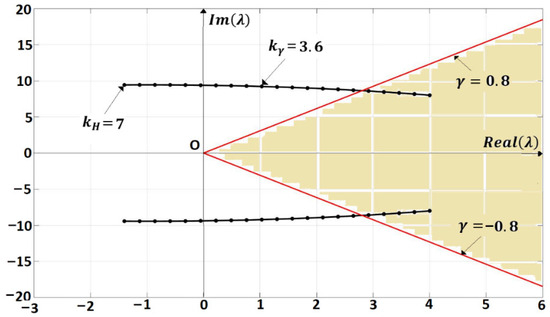
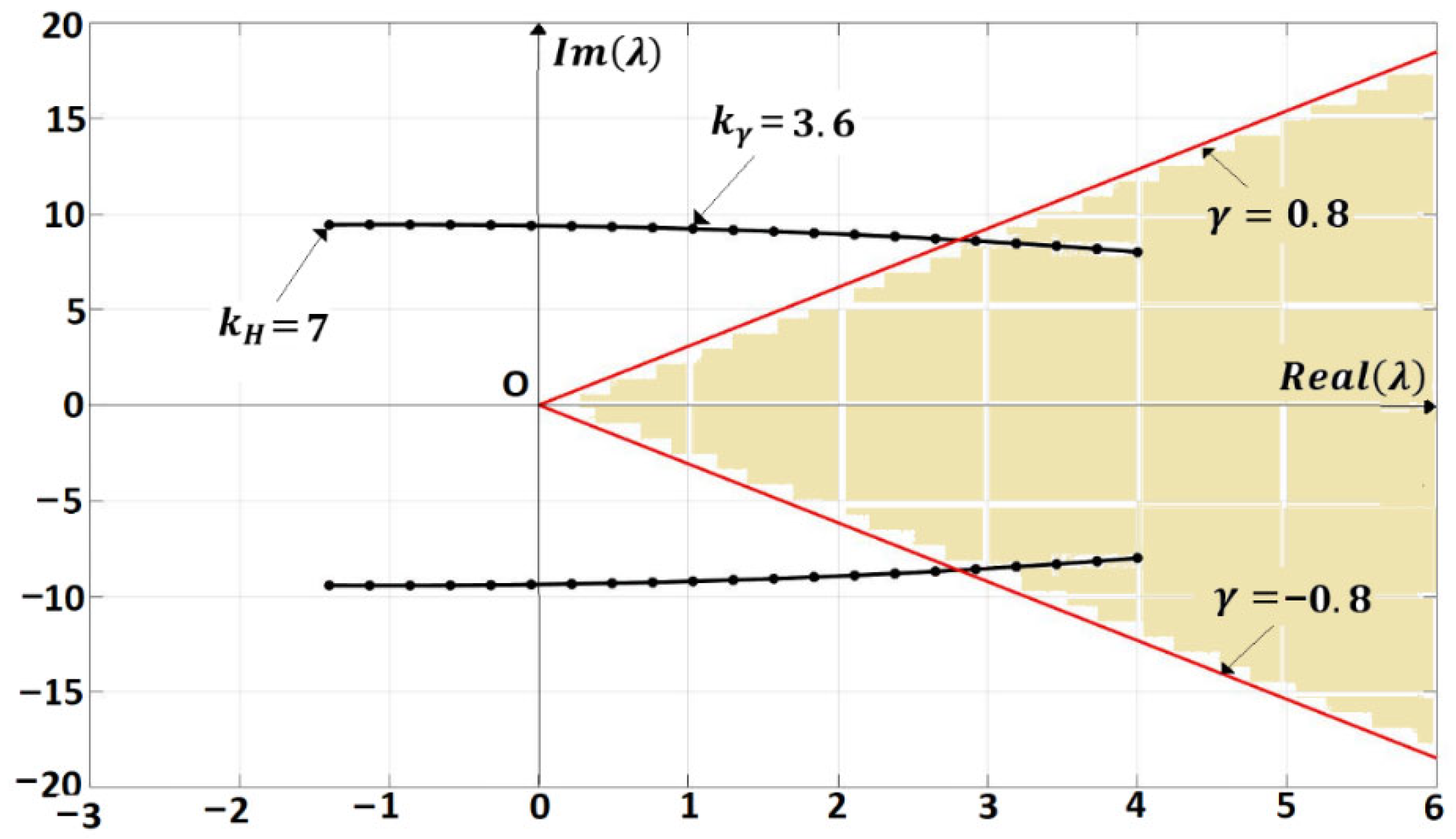
The matrix is -fractional order unstable with The control law (42) ensures that matrix is either 0.8-stable or Hurwitz stable. From Figure 1, it can be observed that for becomes 0.8-stable , whereas for [5:7], it becomes Hurwitz stable . According to (43) and (45), if we consider and yields and the control law (14), . The pairs are completely controllable and observable, respectively, () and solving the system in MATLAB-R2020a.
for yields
Figure 1.
Eigenvalue migration by the control law (42), Example 1.
The conditions (47) become
The first condition of Theorem 3 is verified. The second condition, the frequency condition, requires
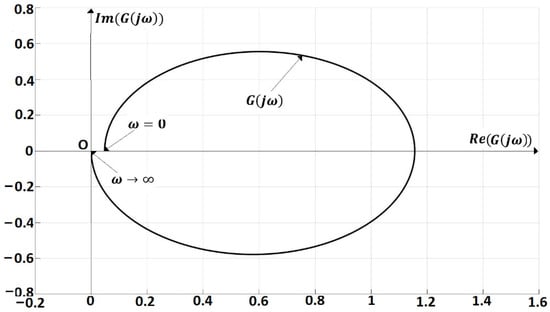
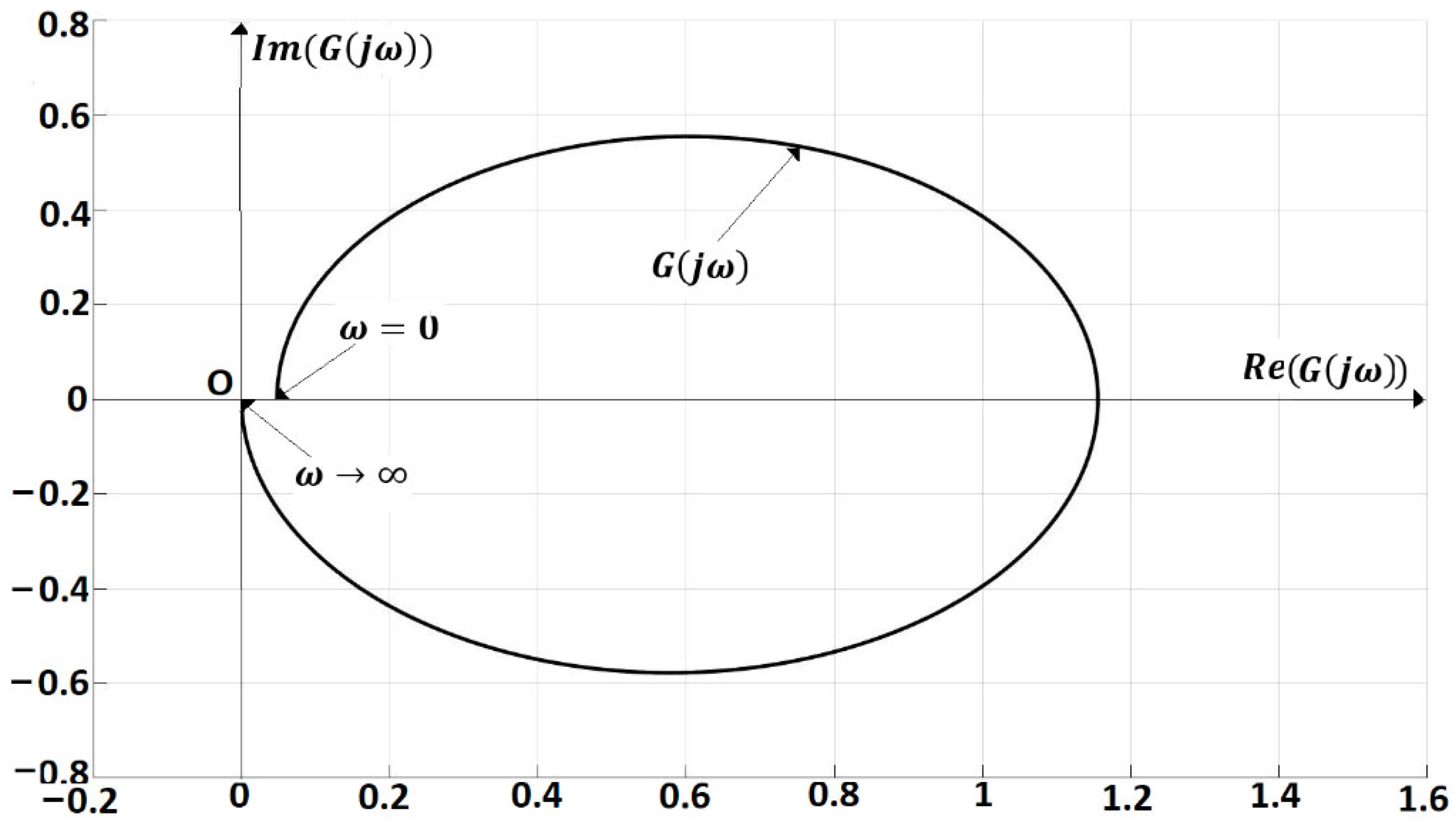
We remark from Figure 2 that the polar plot of satisfies the inequality (113). The conditions of Theorem 3 are satisfied; the system (105)–(107) is asymptotically stable. In Figure 3 are shown the trajectories of the system for and , .
Figure 2.
polar plot, Example 1.
Figure 3.
Trajectories of the system (105)–(107).
3.2. Numerical Example 2
Consider the system
where
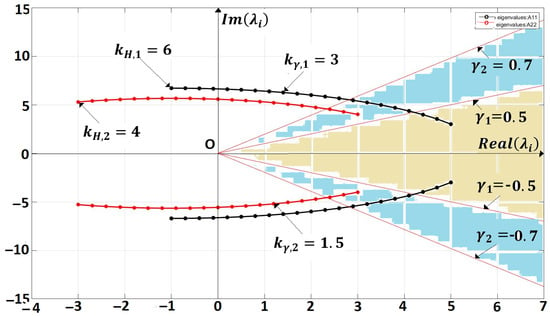
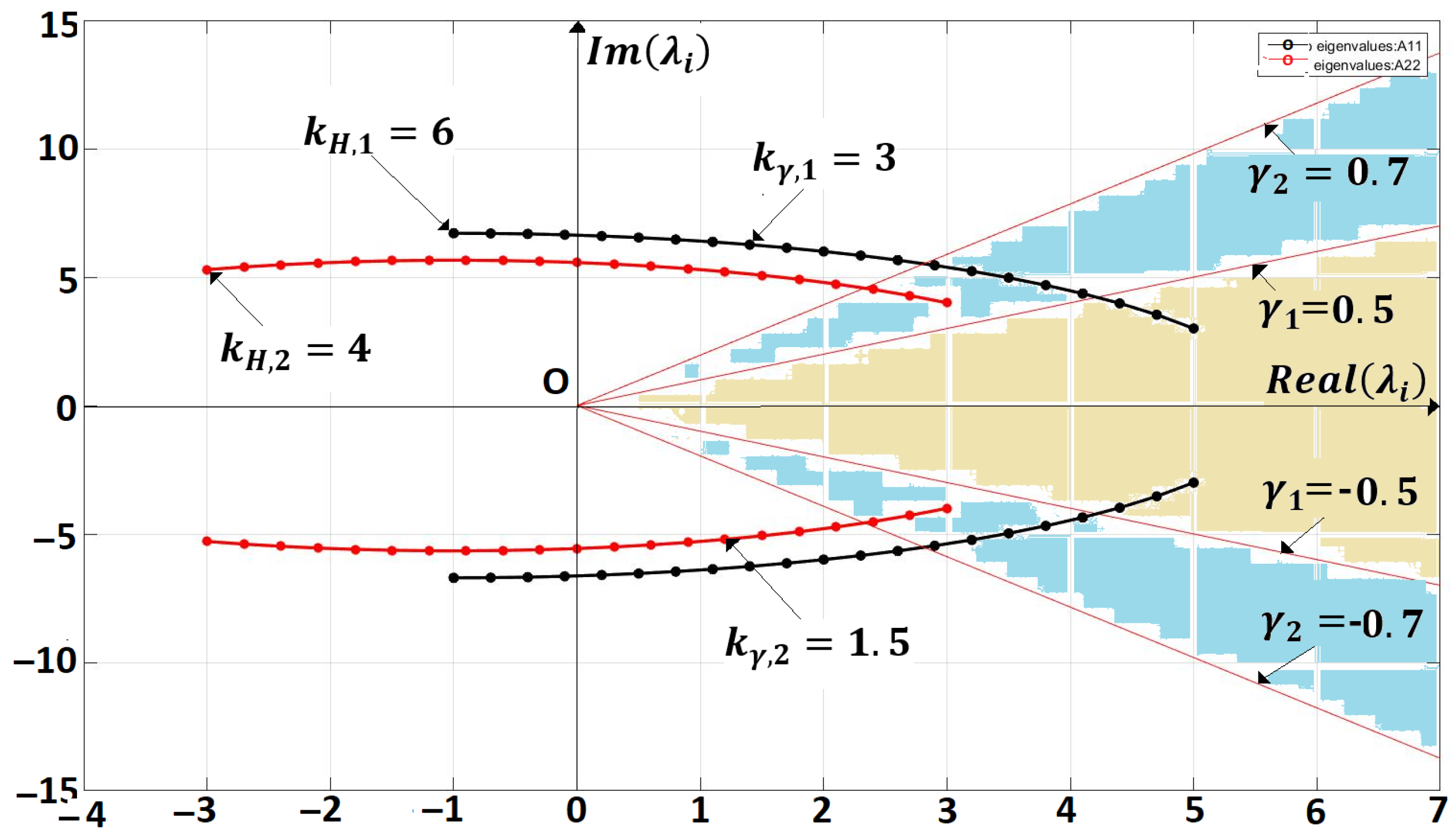
The matrix is -fractional order unstable with The control law (67) ensures that matrix is either 0.5-stable or Hurwitz stable. From Figure 4, it can be observed that for becomes 0.5-stable, whereas for [5.6:6], it becomes Hurwitz stable. According to (69) and (72), if we consider and yields and
Figure 4.
Eigenvalue migrations of by the control law (42), Example 2.
The pairs are completely controllable and observable, respectively, () and solving in MATLAB the system
for yields
Also, the matrix is -fractional order unstable with The control law (67) ensures that matrix is either 0.7-stable or Hurwitz stable. From Figure 3, it can be observed that for becomes 0.7-stable, whereas for [1.9:4], it becomes Hurwitz stable. We consider and and obtain and the control law
The pairs are completely controllable and observable, respectively. () and solving the system in MATLAB
for yields
The inequalities (75) and (76) become
These results can be summarized in
From (77), it follows that
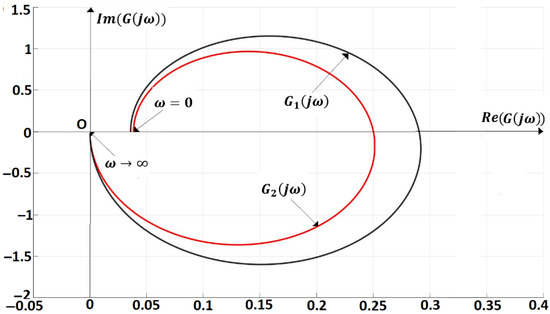
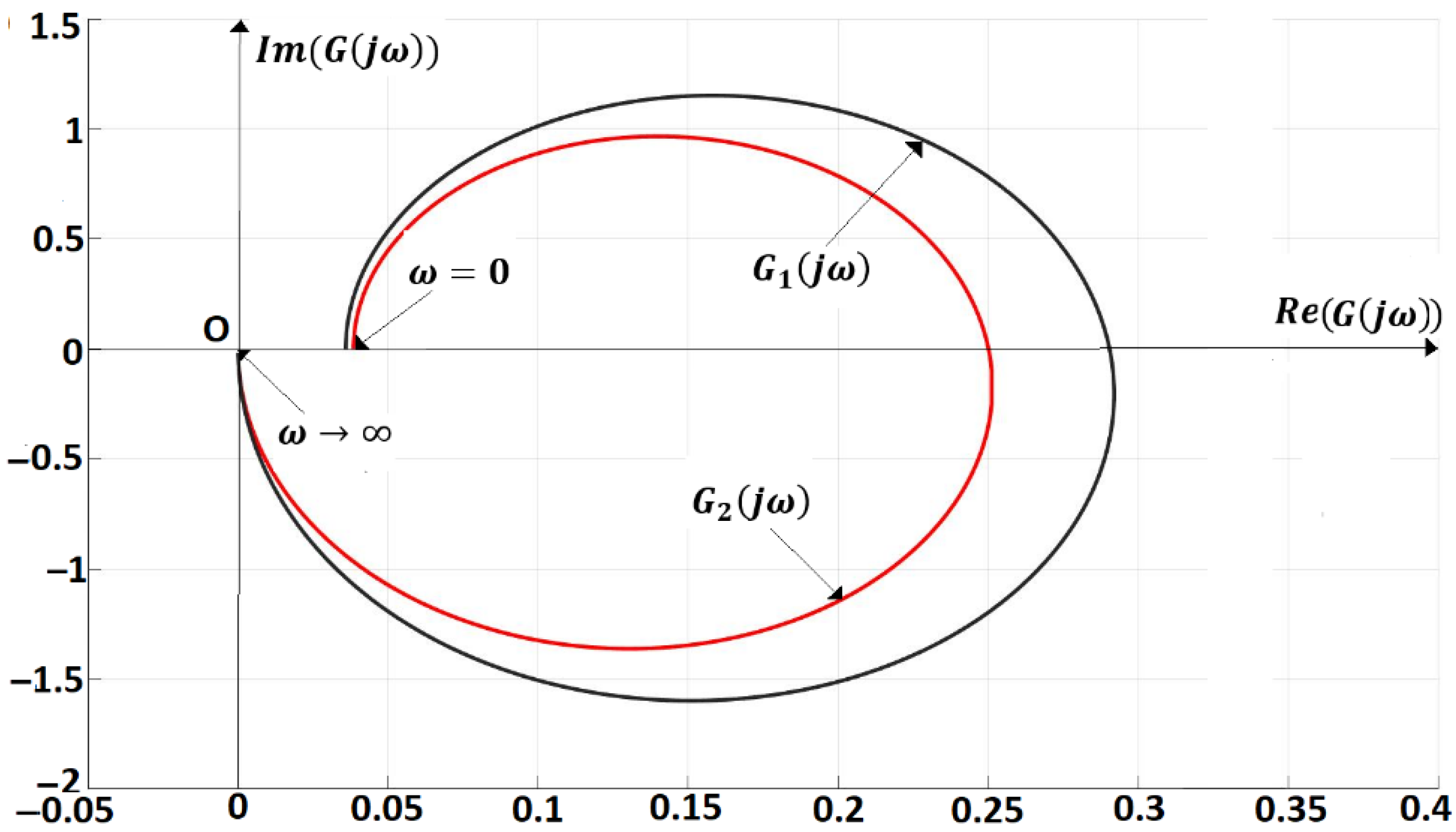
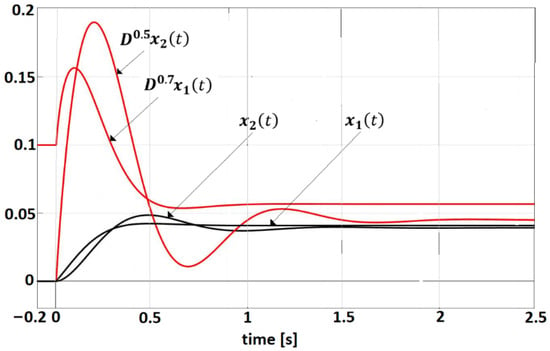
The inequality (77) is verified in Figure 5 by the polar plots of All the conditions of Theorem 4 are satisfied, and we can conclude that the system (114)–(120) is asymptotically stable. The stability is also proved by the trajectories from Figure 6.
Figure 5.
polar plots of Example 2.
Figure 6.
Trajectories of the system, Example 2.
3.3. Human–Machine System: Multi-Order Fractional System with Multiple State Delays
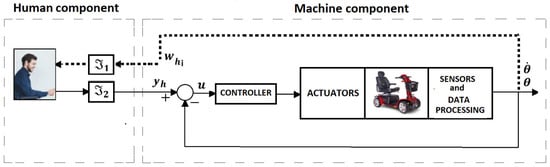
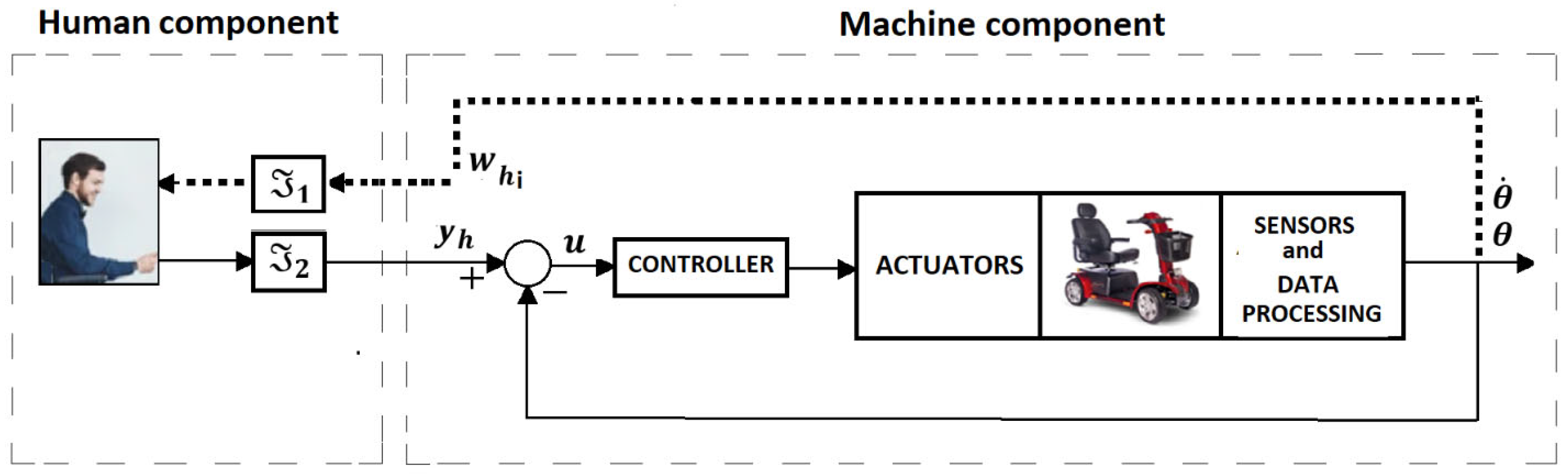
The human–machine system is modeled as a multi-fractional order system to capture its complex dynamics. The literature is quite extensive, and this is not the place to present a synthesis of these papers. The human–machine model discussed in this section is represented by the driver–vehicle model, which completely defines all the characteristics that allow for the determination of the conditions to achieve the desired performance. This model is based on the studies and publications synthesized in [26,27]. In this case, the human–machine system is a complex system where the human model is described by a fractional-order system, while the simplified dynamics of the vehicle’s handling are described by second-order differential equations; see Figure 7.
Figure 7.
Driver–vehicle model.
The human model discussed herein is an extension of the one presented in [27]
where defines the human state, is the human operator’s output, and the parameters define the human driving characteristics.
The driver’s ability to estimate the position (and eventually the velocity) of the vehicle is determined by the matrix in which the coefficients define the delay through which these motion parameters are estimated
The driver’s ability to enforce a desired motion trajectory is defined by , a command generated with a delay that corresponds to the time constant of the driver. The model (135), (136) becomes
where
Remark that is Hurwitz for this is expected, as a vehicle driver must necessarily be a stable person. The data defining this model correspond to a driver with normal driving skills, meaning an equivalent response time constant of approximately = and a good visual observation quality defined by , The driver’s ability to enforce a desired motion trajectory is defined by a command generated with a delay s that corresponds to the time constant of the driver.
An electric vehicle with the front-wheel-steering control is considered [28].
where is the average angle of the two front wheel angles, inertial component is the stiffness of steering system (, damping is a coefficient relative to steering ratio [28] and is the driving torque. The model of (141) can be rewritten as ()
where is the state vector, , the system parameters are: and is determined by two components
The first component is imposed by human operator, it determines how the operator’s state dictates the control command u applied to the vehicle and the second component represents the internal control that ensures the desired performance
For , the matrix becomes Hurwitz and (142)–(144) can be rewritten as
Consider the following Lyapunov generalized function for the human–machine system:
By following the same procedure as described in the preceding examples, for the human model we chose and infer . Considering the controllability and observability of the pairs, respectively, and solving in MATLAB the systems
for yields
For the system (142), (143) (), the lemma YKP’s equations become Lyapunov equation
For yields
The conditions (75) and (76) of Theorem 4 become
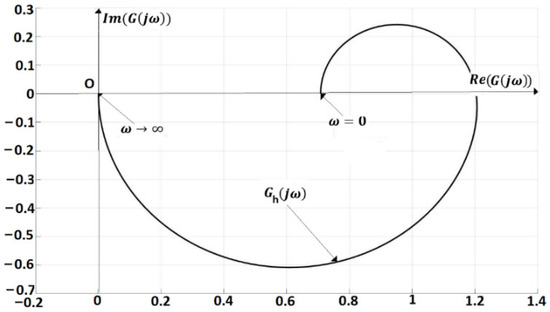
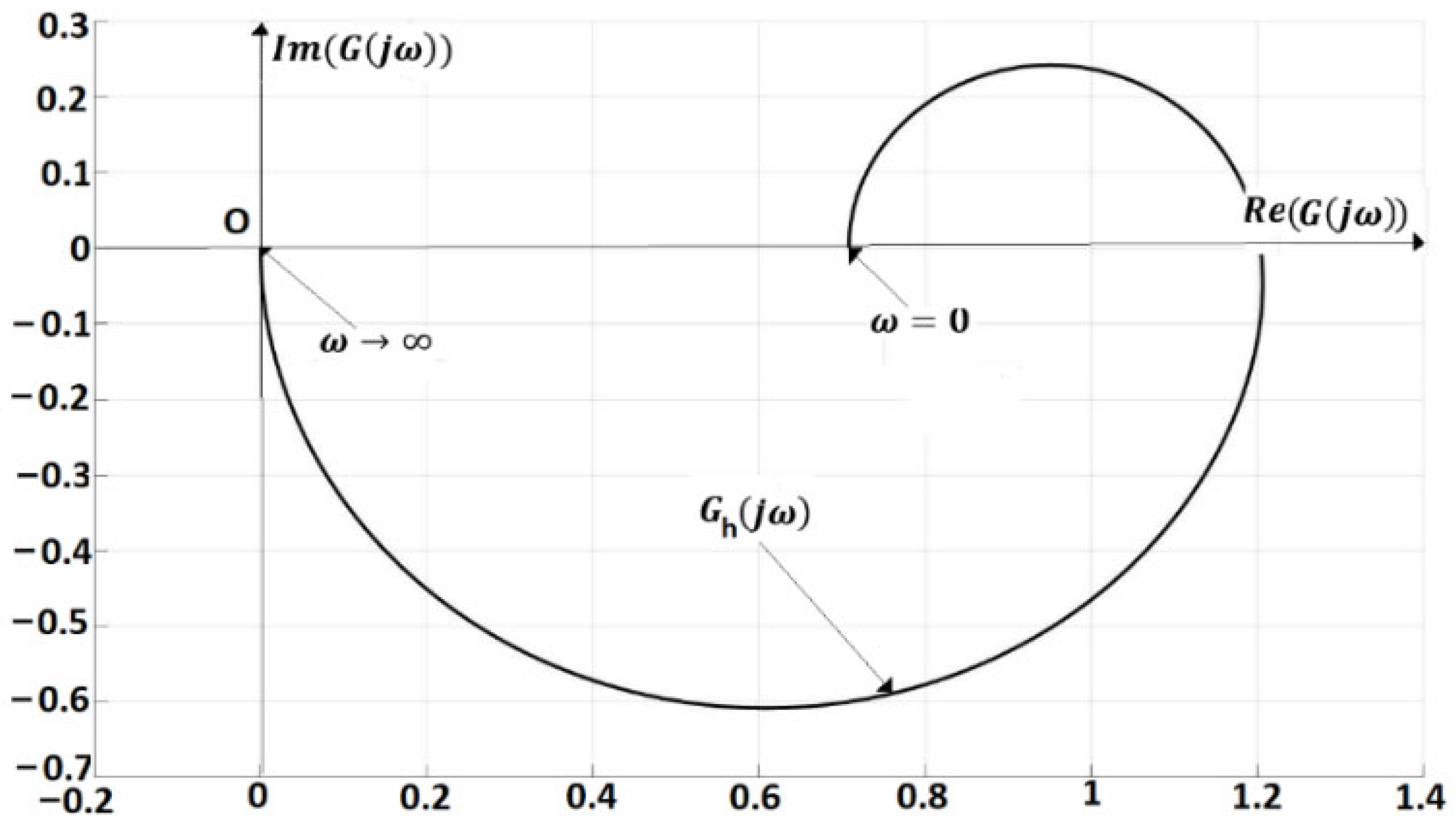
According to Remark 1 (Section 2.2.1) the frequency condition of the system (140) and (141), ( is always satisfied. For the human model (138) and (139) yields, (Figure 8)
Figure 8.
polar plot.
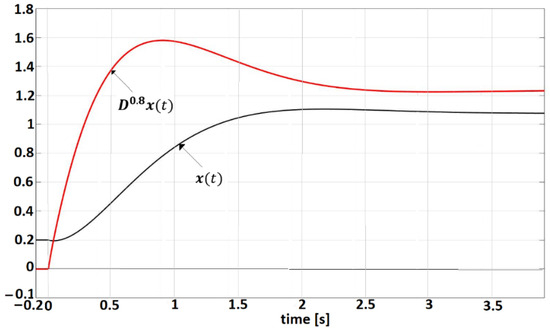
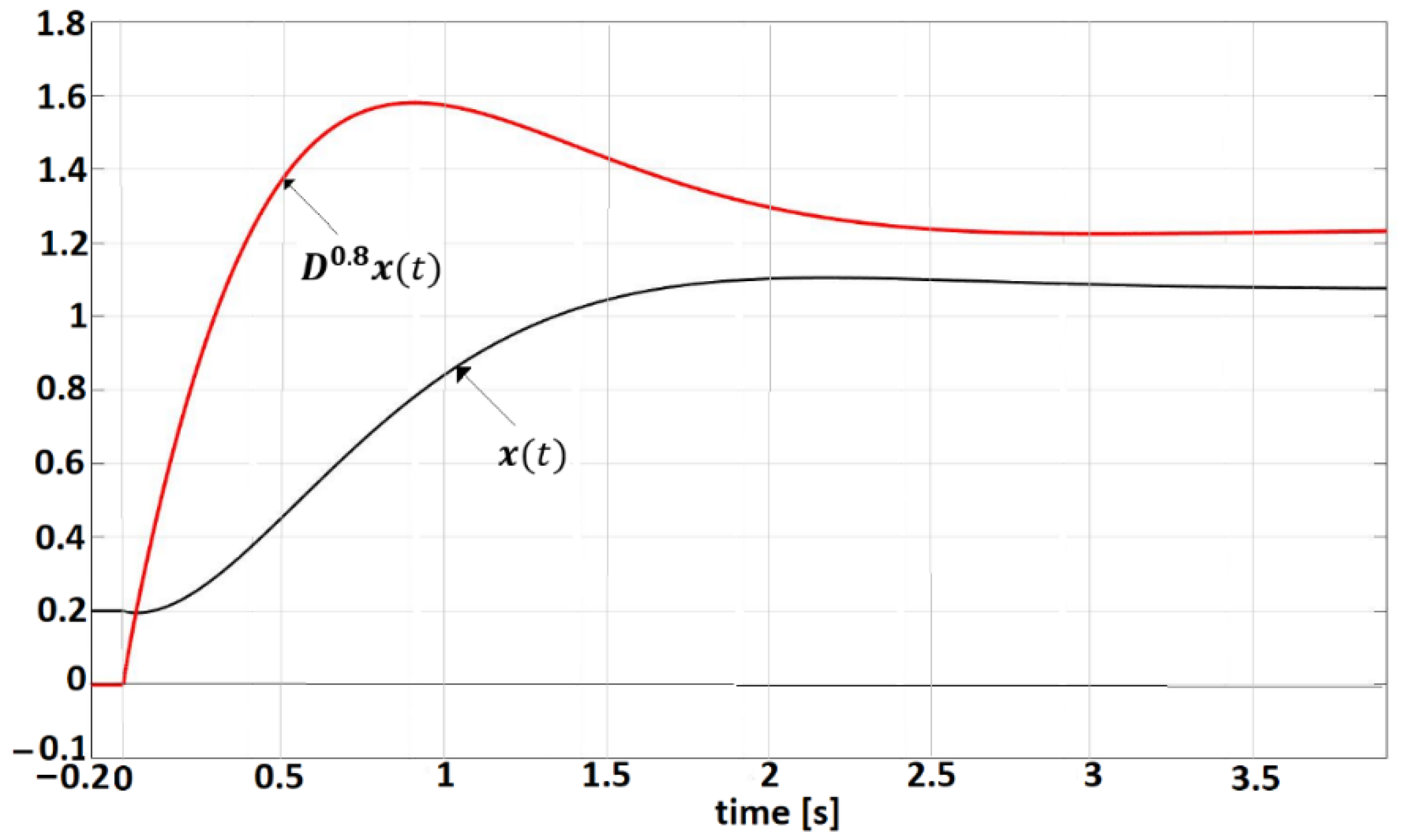
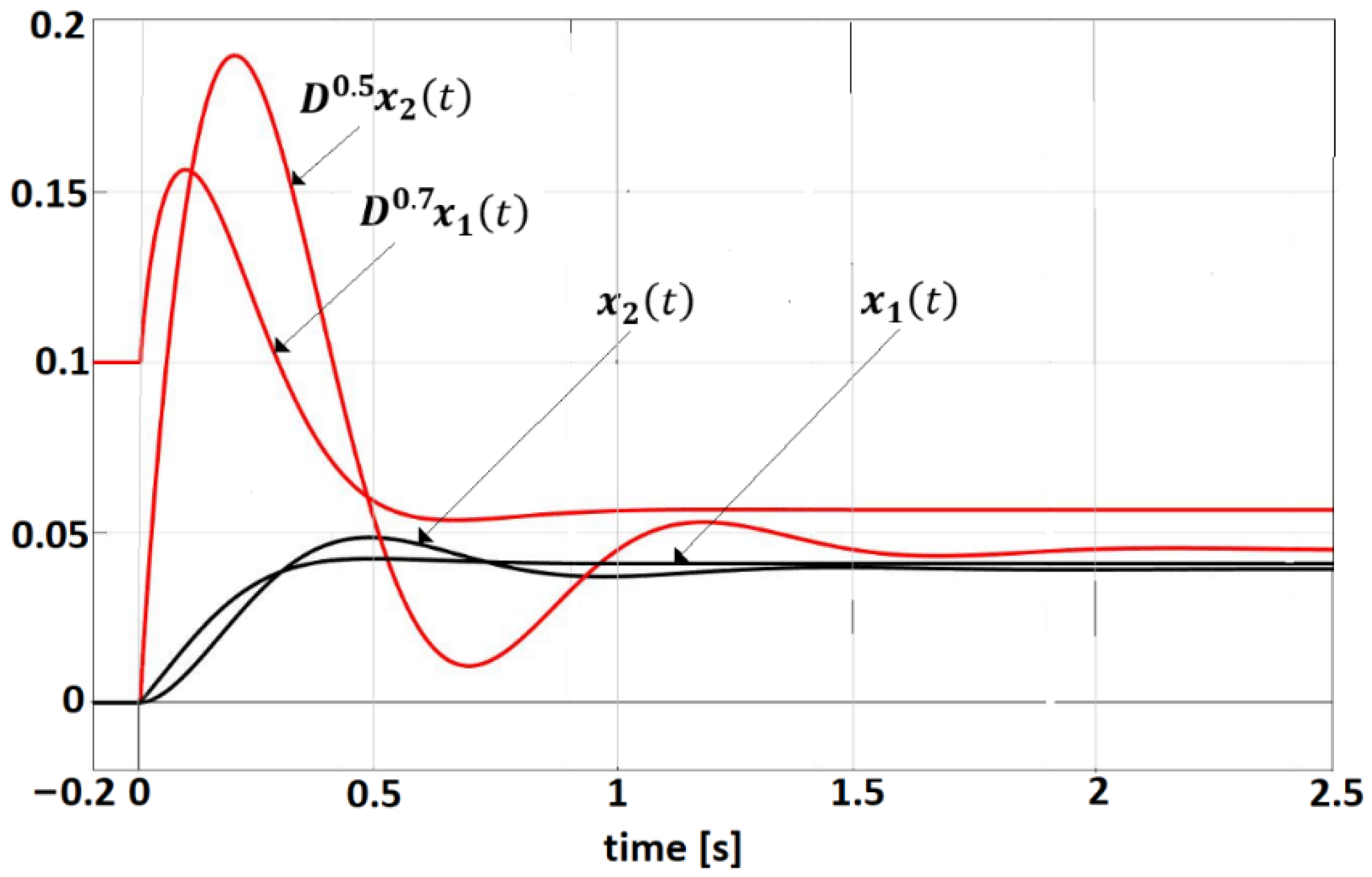
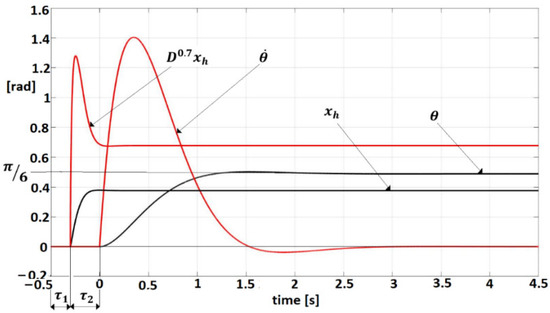
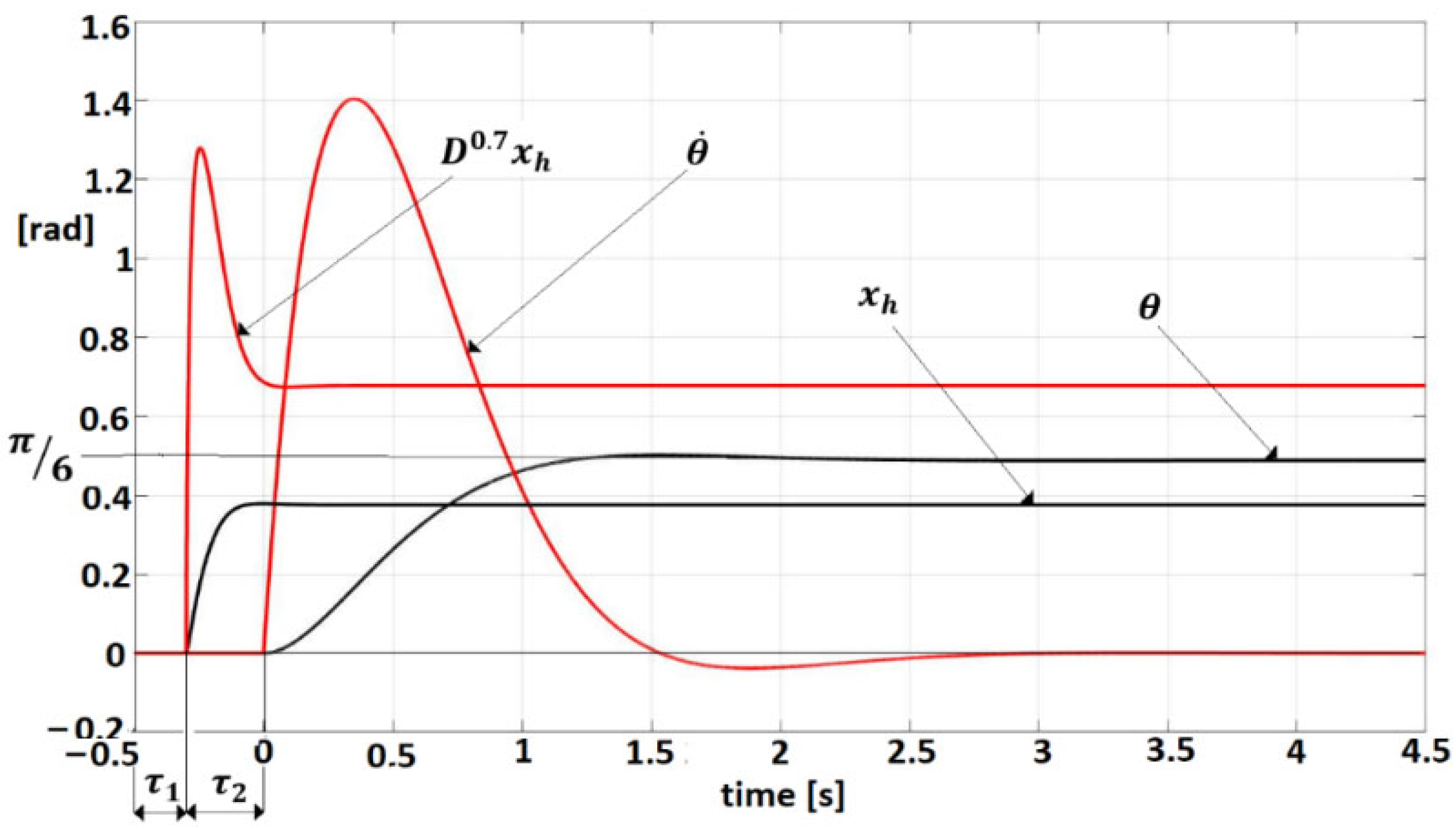
Since all conditions of Theorem 4 are verified, allow us to conclude that system (136), (137), (140), and (141) is asymptotically stable. The trajectories of the system for a desired control position are shown in Figure 9.
Figure 9.
Trajectories of the human–machine system.
The driver needs 0.2 s to estimate the position and 0.3 s to generate new control. The asymptotic stability of the system is confirmed by the evolution of the trajectories presented in Figure 9.
4. Discussion
As discussed in Section 1, papers addressing the complex field of multi-fractional-order systems control with multiple delays are relatively scarce. Our theoretical results are based on papers [4,5,6,7], which offer algebraic criteria for these classes of systems. To the best of the authors’ knowledge, none of these papers analyze these systems from a control perspective. For instance, in [4], the following model is studied:
The stability is studied by Laplace transform and by its characteristic equation
Furthermore, these papers study positive fractional models, which restricts their scope of application. In [3] the following system is analyzed:
where A is Metzler and (A + The system is asymptotically stable ( In [8] is studied the model is studied
where are Lipschitz functions. The stability is verified by ( in Lyapunov vector function
In general, the analysis method in these papers is based on the condition that the matrix in is a Metzler matrix. In physical processes, this condition is not always satisfied. For instance, in the human–machine system model from the previous section, the vehicle model is defined by:
which is obviously not Metzler.
Our paper investigates the problem of establishing criteria that ensure, through the control system, the asymptotic stability for models defined by equations with multiple fractional exponents and multiple delays. In this regard, our paper extends these results to models derived from physical processes and proposes algebraic criteria associated with frequency-domain criteria.
5. Conclusions
The present work attempts to introduce several stability evaluation criteria for multiple fractional-order systems with multiple time delays. Furthermore, the presented methods fall within the scope of techniques that serve as investigation and design tools by expressing these criteria in the form of polar plots, which are familiar in the design of automated control systems. These new stability criteria are presented as frequency criteria and represented graphically by polar plots similar to familiar Nyquist and Popov plots and provide advantages in control systems design. In Theorems 2–4 presented in our paper, the proposed control laws ensure -fractional-order stability; the formulated criteria encompass both simple algebraic criteria and frequency-domain representations via polar plots. It is worth noting that the critical point of these polar plots is not determined by nonlinearity or control coefficients—as is the case with Nyquist or Popov polar plots—but rather by the fractional exponent We consider that, in many applications, these polar plots enable a much easier evaluation of system stability and can serve as a useful tool in control systems design. Throughout the paper, whenever possible, we have demonstrated the simplicity of the proposed methods and criteria in comparison to similar studies. We assume that establishing frequency-domain stability criteria and their associated graphical representations, similar to those obtained through the classical Nyquist and Popov criteria, constitutes an efficient tool for both the analysis and design of control systems for these classes of systems described by multiple fractional-order differential equations and multiple time delays.
Author Contributions
Conceptualization, M.I.; methodology, N.P.; software, D.P.; validation, N.P.; investigation, M.I.; resources, N.P.; data curation, D.P.; writing—original draft preparation, N.P.; writing—review and editing, M.I.; visualization, D.P.; supervision, M.I.; project administration, M.I. All authors have read and agreed to the published version of the manuscript.
Funding
This research received no external funding.
Data Availability Statement
The original contributions presented in this study are included in the article. Further inquiries can be directed to the corresponding author.
Conflicts of Interest
The authors declare no conflicts of interest.
Appendix A
Proof of Theorem 1.
Consider the generalized Lyapunov function of MDFOS that satisfies (8)–(10).
Taking (7) and (8) into account, inequality (10) can be rewritten as
or
where
The system (A2) is a fractional-order positive system where is Metzler matrix and ( is Hurwitz matrix. According to ([8], Theorem 2), the system (MDFOS) is asymptotically stable independent of the magnitude of delays. □
Appendix B
Consider the system
Let be the Lyapunov function.
The Caputo fractional derivative of is [5,8,9,10]
and, using properties of the transpose, which yields:
Consequently, (A5) can be rewritten as
References
- Balaji, A.; Tiwari, S.; Vyasarayani, C.P. Galerkin Approximations for Fractional-Order Delay-Differential Equations with Constant or Time-Periodic Coefficients. J. Comput. Nonlinear Dyn. 2025, 20, 111005. [Google Scholar] [CrossRef] [Scilit]
- Petras, I. Fractional-Order Nonlinear Systems: Modeling Analysis and Simulation, Nonlinear Physical Science; Springer: Berlin/Heidelberg, Germany, 2011. [Google Scholar]
- Kilbas, A.; Srivastava, H.M.; Trujillo, J. Theory and Applications of Fractional Differential Equations; Elsevier: Amsterdam, The Netherlands, 2006; 523p. [Google Scholar]
- Shen, J.; Lam, J. Stability and Performance Analysis for Positive Fractional-order Systems with Time-varying Delays. IEEE Trans. Autom. Control. 2015, 61, 2676–2681. [Google Scholar] [CrossRef] [Scilit]
- Deng, W.; Li, C.; Lü, J. Stability analysis of linear fractional differential system with multiple time delays. Nonlinear Dyn. 2007, 48, 409–416. [Google Scholar] [CrossRef] [Scilit]
- Lenka, B.K.; Upadhyay, R.K. New Lyapunov stability theorems for fractional order systems. J. Nonlinear Complex Data Sci. 2024, 25, 323–337. [Google Scholar] [CrossRef] [Scilit]
- Lenka, B.K. Fractional comparison method and asymptotic stability results for multivariable fractional order systems. Commun. Nonlinear Sci. Numer. Simul. 2019, 69, 398–415. [Google Scholar] [CrossRef] [Scilit]
- Deng, W.; Li, C. Analysis of fractional differential equations with multi-orders. Fractals 2007, 15, 173–182. [Google Scholar] [CrossRef] [Scilit]
- Gallegos, J.A.; Aguila-Camacho, N.; Duarte-Mermoud, M. Vector Lyapunov-like functions for multi-order fractional systems with multiple time-varying delays. Commun. Nonlinear Sci. Numer. Simul. 2020, 83, 105089. [Google Scholar] [CrossRef] [Scilit]
- Duarte-Mermoud, M.; Aguila-Camacho, N.; Gallegos, J.; Castro-Linares, R. Using general quadratic Lyapunov functions to prove Lyapunov uniform stability for fractional order systems. Commun. Nonlinear Sci. Numer. Simul. 2015, 22, 650–659. [Google Scholar] [CrossRef] [Scilit]
- Aguila-Camacho, N.; Duarte-Mermoud, M.; Gallegos, J. Lyapunov functions for fractional order systems. Commun. Nonlinear Sci. Numer. Simul. 2014, 19, 2951–2957. [Google Scholar] [CrossRef] [Scilit]
- Boukal, Y.; Zasadzinski, M.; Darouach, M.; Radhy, N.E. Chapter 5—Fractional Order Time-Varying-Delay Systems: A Delay-Dependent Stability Criterion by Using Diffusive Representation. In Mathematical Techniques of Fractional Order Systems; Advances in Nonlinear Dynamics and Chaos (ANDC); Elsevier: Amsterdam, The Netherlands, 2018; pp. 133–158. [Google Scholar] [CrossRef] [Scilit]
- Jin, X.-C.; Lu, J.-G. Delay-dependent criteria for robust stability and stabilization of fractional-order time-varying delay systems. Eur. J. Control 2022, 67, 100704. [Google Scholar] [CrossRef] [Scilit]
- Hao, Y.; Huang, C.; Cao, J.; Liu, H. Positivity and Stability of Fractional-Order Linear Time-Delay Systems. J. Syst. Sci. Complex 2022, 35, 2181–2207. [Google Scholar] [CrossRef] [Scilit]
- Qiao, M.-Y.; Chang, X.-H.; Park, J.H. Observer-Based Fault Estimation and Compensation Control for Nonlinear Multi-Delays Systems With Multi-Source Faults. IEEE Trans. Autom. Sci. Eng. 2026, 23, 7587–7598. [Google Scholar] [CrossRef] [Scilit]
- Ho, S.P.; Nguyen, T.T.; Duong, D.T.; Le, V.C.; Du Phan, V.; Dinh, V.N.; Dung, H.M.; Dau, M.D.; Phan, V.V. Nonsingular Terminal Sliding Mode Control with High-Order Integral Differentiator for Trajectory Tracking of 4WD Nonholonomic Mobile Robots. In Advances in Engineering Research and Application, ICERA 2025; Nguyen, D.C., Hai, D.T., Vu, N.P., Long, B.T., Eds.; Lecture Notes in Networks and Systems; Springer: Cham, Switzerland, 2025; Volume 1803. [Google Scholar] [CrossRef] [Scilit]
- Xu, X.; Li, X.; Zhang, R.; Zhou, T. Finite-time stability of delayed fractional-order system with nonlinear control. Int. J. Dyn. Control 2025, 13, 70. [Google Scholar] [CrossRef] [Scilit]
- Sánchez, F.T.; Raimundo, A.; Cerda, S.; Pablo, P.; Alzate, C. An Approach to the Stability of Systems of Differential Equations of Fractional Order with Time Delay. J. Hunan Univ. Nat. Sci. 2023, 50, 1–10. [Google Scholar] [CrossRef] [Scilit]
- Jia, W.; Fan, Z.; Li, G. Solutions for Riemann-Liouville fractional delay differential systems with arbitrary order. Math. Found. Comput. 2026, 10, 56–71. [Google Scholar] [CrossRef] [Scilit]
- Chang, X.-H.; Liu, Y. Quantized Output Feedback Control of AFS for Electric Vehicles with Transmission Delay and Data Dropouts. IEEE Trans. Intell. Transp. Syst. 2022, 23, 16026–16037. [Google Scholar] [CrossRef] [Scilit]
- Kothari, K.; Mehta, U.; Vanualailai, J. Fractional-Order Models of Time Delay Systems Using Walsh Operational Matrices. In Proceedings of the 2018 15th International Conference on Control, Automation, Robotics and Vision (ICARCV), Singapore, 18–21 November 2018; pp. 1555–1560. [Google Scholar] [CrossRef] [Scilit]
- Tunç, O.; Tunç, C.; Wang, Y. Delay-Dependent Stability, Integrability, and Boundedeness Criteria for Delay Differential Systems. Axioms 2021, 10, 138. [Google Scholar] [CrossRef] [Scilit]
- Sabatier, J.; Farges, C. On Stability of Commensurate Fractional Order Systems. Int. J. Bifurc. Chaos 2012, 22, 1250084. [Google Scholar] [CrossRef] [Scilit]
- Tavazoei, M. Stability Analysis of Incommensurate Fractional-Order Systems with Multiple Time Delays. In Proceedings of the 2024 10th International Conference on Control, Instrumentation and Automation (ICCIA), Kashan, Iran, 5–7 November 2024; pp. 1–5. [Google Scholar] [CrossRef] [Scilit]
- Khalil, H. Nonlinear Systems; Prentice Hall: Upper Saddle River, NJ, USA, 2002. [Google Scholar]
- Bubb, H. Human Models. In Automotive Ergonomics; Springer: Berlin/Heidelberg, Germany, 2021; pp. 219–256. [Google Scholar] [CrossRef] [Scilit]
- Ivanescu, M.; Dumitrache, I.; Popescu, N.; Popescu, D. Fractional Order Model Identification of a Person with Parkinson’s Disease for Wheelchair Control. Fractal Fract. 2023, 7, 23. [Google Scholar] [CrossRef] [Scilit]
- Wolm, P. Dynamic Stability Control of Front Wheel Drive Wheelchair Using Solid State Accelerometer and Gyroscope. Ph.D. Thesis, University of Canterbury, Christchurch, New Zealand, 2009. [Google Scholar]
Disclaimer/Publisher’s Note: The statements, opinions and data contained in all publications are solely those of the individual author(s) and contributor(s) and not of MDPI and/or the editor(s). MDPI and/or the editor(s) disclaim responsibility for any injury to people or property resulting from any ideas, methods, instructions or products referred to in the content. |
© 2026 by the authors. Licensee MDPI, Basel, Switzerland. This article is an open access article distributed under the terms and conditions of the Creative Commons Attribution (CC BY) license.