


Abstract
In this paper, we introduce and formalize the theory of Sheffer stroke hoop algebras, providing a minimal axiomatization for bounded hoop algebras utilizing a single binary operation. We systematically establish the fundamental algebraic properties of this novel structure, beginning with the logical independence of its core axioms. We equip the algebra with an induced partial order, proving it constitutes a well-defined ∧-semilattice, and demonstrate a bidirectional structural translation: bounded hoop algebras satisfying the Double Negation Property (DNP) can be equivalently expressed as Sheffer stroke hoop algebras, and vice versa. Furthermore, we investigate the internal algebraic architecture by introducing sub-algebras, filters, positive implicative filters, and ideals, rigorously establishing the inherent structural duality between filters and ideals. By proving that proper filters naturally induce full algebraic congruences, we successfully construct quotient Sheffer stroke hoop algebras. We characterize prime filters by demonstrating that a quotient algebra forms a chain if and only if its generating filter is prime. Finally, we complete the theoretical framework by establishing the Correspondence Theorem and the First Isomorphism Theorem, seamlessly embedding classical universal algebraic principles into the Sheffer stroke setting.
MSC:
03G12; 03G25; 06C15; 06D99
1. Introduction
In mathematical modeling, minimizing defining operations yields profound theoretical and practical advantages, a reductionist philosophy demonstrated by Tarski [1] and Sheffer [2], and later applied to Boolean algebras by McCune et al. [3]. Practically, employing a uniform logical connective like the Sheffer stroke streamlines hardware architecture and lowers production costs [4]. This reductionist approach is equally vital for non-classical logics. While MV-algebras provide semantics for Łukasiewicz logics [5,6], Chajda and Kolařík unified broader non-classical systems via basic algebras [7]. Applying the Sheffer stroke to these frameworks, Oner and Senturk elegantly condensed the signature of basic algebras [8], a structure that Senturk et al. subsequently expanded to construct quotient spaces and representation theorems [9].
Concurrently, hoop algebras have emerged as a cornerstone of universal algebra and non-classical logic [10,11,12]. Following their definitive axiomatization [13], hoop theory has been extensively developed, encompassing pseudo-hoops [14], filter and ideal theory [15,16], stabilizer topologies [17], and broader structural properties [18,19]. Despite these profound advancements in hoop theory and the established utility of single-operation algebras, a unified single-operator framework for hoops has remained absent. Motivated by this gap, the primary novelty and objective of this paper is to introduce and formalize Sheffer stroke hoop algebras. Specifically, we aim to provide a minimal, single-operator axiomatization for bounded hoop algebras and to systematically reconstruct their algebraic architecture entirely through the lens of the Sheffer stroke.
While the reduction of the traditional multi-operation signature of bounded hoop algebras to a single Sheffer stroke operation possesses inherent algebraic elegance, its primary significance lies in concrete structural and computational advantages. From a computational perspective, particularly in automated theorem proving and equational reasoning, a single-operation signature drastically reduces the combinatorial search space and simplifies unification algorithms. Proven theoretically, structural induction in meta-logical proofs requires only a single inductive step for the operations. Moreover, this reduction simplifies verification processes; to establish a congruence relation or define a deductive filter, it suffices to prove compatibility or closure solely with respect to the Sheffer stroke. This mathematical guarantee automatically extends to all derived operations, significantly streamlining the construction of quotient algebras. Finally, since bounded hoops serve as the algebraic semantics for various many-valued logics, this formulation provides a universal logical connective—analogous to the classical NAND gate—which enables optimized silicon layout and simplified hardware design for fuzzy controllers and multi-valued logic circuits.
To accomplish this, the paper is organized as follows. In Section 3, we define the core axiomatic structure of Sheffer stroke hoop algebras and establish the logical independence of these axioms via specific counter-models. We subsequently define the induced partial order, proving that the structure forms a ∧-semilattice. A major result of this section is a bidirectional structural translation: we prove that bounded hoop algebras equipped with the Double Negation Property (DNP) are structurally equivalent to Sheffer stroke hoop algebras, and we demonstrate how standard hoop operations are explicitly recovered using only the Sheffer stroke.
In Section 4, we delve into the internal substructures of these algebras, formally defining sub-algebras, filters, positive implicative filters, and ideals, while rigorously establishing the inherent duality between filters and ideals. We then prove that proper filters induce well-defined algebraic congruences, enabling the precise construction of quotient Sheffer stroke hoop algebras. We conclude the theoretical framework by characterizing prime filters—proving that the quotient algebra forms a chain if and only if the generating filter is prime—and by establishing the Correspondence Theorem alongside the First Isomorphism Theorem, effectively bridging classical universal algebra with this novel Sheffer stroke setting.
2. Preliminaries
In this section, we recall the fundamental concepts, definitions, and basic properties regarding Sheffer operations, Sheffer groupoids, and hoop algebras that will be essentially utilized throughout the paper. By briefly reviewing the induced partial orders on Sheffer structures and the foundational axioms of bounded hoops alongside the Double Negation Property (DNP), we aim to establish a completely self-contained theoretical framework for our subsequent algebraic constructions.
Definition 1
([20]). A Sheffer operation on a non-empty set X is a binary operation such that, for all , the following identities hold:
A groupoid is an algebra of type (2), that is, a set equipped with a single binary operation. A Sheffer groupoid is a groupoid in which is a Sheffer operation.
Definition 2
([21]). Let be a groupoid. If the following conditions are satisfied for each , then the operation is called a Sheffer stroke operation:
If the following identity
is also satisfied, then it is said to be an ortho-Sheffer stroke operation.
Lemma 1
([21]). Suppose is a groupoid, and . The binary relation ≤ defined on X by
is a partial order on X.
Lemma 2
([21]). Assume that | is a Sheffer stroke operation on X, and ≤ is the induced order on . Then, the following properties hold for all :
- (i)
- if and only if ,
- (ii)
- is the identity element of ,
- (iii)
- implies ,
- (iv)
- if and , then .
Definition 3
([16]). A hoop is an algebraic structure of type such that, for all , it satisfies the following conditions:
- (HP1)
- is a commutative monoid.
- (HP2)
- .
- (HP3)
- .
- (HP4)
- .
On a hoop , a binary relation ≤ is defined on such that if and only if , and is a poset.
If the least element exists such that, for all , , then is called a bounded hoop. We let and , for any .
If is bounded, then, for all , the operation negation “′” is defined on by .
If , for all , then is said to have the (DNP) property.
3. Foundations of Sheffer Stroke Hoop Algebras: Axiomatization and Order Structure
In this section, we introduce the formal axiomatization of Sheffer stroke hoop algebras and systematically establish their fundamental algebraic properties. We begin by defining the core structure and rigorously proving the logical independence of its foundational axioms through carefully constructed counter-models. Subsequently, we equip this algebraic framework with a well-defined induced partial order and explore its inherent bounding and monotonic characteristics. A central achievement of this section is the demonstration of a structural translation: we explicitly establish how Sheffer stroke hoop algebras emerge from bounded hoop algebras satisfying the Double Negation Property (DNP), and conversely, how standard hoop operations can be completely recovered using solely the Sheffer stroke. Finally, we formalize the fundamental adjunction principles and prove that the induced partially ordered set definitively constitutes a ∧-semilattice, thereby laying the essential structural groundwork for the broader architectural analysis in the subsequent sections.
Definition 4.
A Sheffer stroke hoop algebra is a structure , where H is a non-empty set, and | is a Sheffer stroke operation on such that the following identities are satisfied for all
Example 1.
Since the evaluation yields 1 in all cases, holds.
To streamline the verification, let . The condition is thus equivalent to .
Let be equipped with the binary operation | defined by the following Cayley table:
To verify that the structure is a Sheffer stroke hoop algebra, we must systematically demonstrate that it satisfies axioms and .
- Verification of : The first axiom requires for all . By directly computing the operations from the Cayley table, we obtain:
- Verification of : The second axiom dictates that for all ,
First, we identify the squares of all elements from the table: , , , , , , , and .
Since the equality trivially holds for , it suffices to check the distinct pairs. While an exhaustive verification of all 28 distinct pairs confirms the axiom globally, we detail a representative subset of non-trivial cases below to illustrate the structural symmetry:
- For :..
- For :..
- For :..
- For :..
- For :..
- For :..
By proceeding with identical algebraic steps for the remaining pairs, one can exhaustively verify that the condition holds across . Consequently, satisfies all prerequisites and is a Sheffer stroke hoop algebra.
Theorem 1.
The axioms of Sheffer Stroke hoop algebra are independent.
Proof.
To establish the independence of each axiom, we construct a model for which the specific axiom fails while all others remain valid. Consider the model , defined by the following tables:
- Independence of : Define the operation | on as depicted in the Cayley table below (Table 1).
Table 1.
| operation on H.
For every , the operation satisfies axiom . However, selecting and yields:
Thus, axiom is not satisfied.
- Independence of : Define the operation | on using the Cayley table provided below (Table 2).
Table 2.
| operation on H.
This configuration satisfies axiom , but fails to satisfy . □
Remark 1.
The established independence of the axioms and intrinsically demonstrates the minimality of the presented axiomatic system. Since the finite countermodels rigorously prove that cannot be derived from , and conversely, that cannot be deduced from , neither identity is redundant. Both independent axioms are absolutely necessary to fully encapsulate the structure and successfully recover the required hoop-theoretic behavior. Consequently, the set constitutes a minimal axiomatic system for Sheffer stroke hoop algebras.
Lemma 3.
Let be a Sheffer stroke hoop algebra. Then, for every , we have
- ;
- ;
- .
Proof.
(i) Since 1 is the unit element for multiplication, . Translating this, we have . By the properties of hoops, , which directly translates to .
- (ii) Recall from Lemma 1 that in any groupoid with the binary relation ≤ defined by if and only if , the relation ≤ is a partial order on X.
In a Sheffer stroke hoop algebra , by axiom , for all ,
This means, by the definition of ≤ in Lemma 1, that .
Now, consider . Using the definition of ≤ again, we see that
But in Sheffer stroke hoop algebras, 1 is the greatest element with respect to this order: for any , .
Therefore, by Lemma 1, for every ,
(iii) It is clearly obtained from and the axiom of Sheffer stroke hoop algebras. □
Lemma 4.
Let be a Sheffer stroke hoop algebra. Then, the binary relation if and only if is a partial order on .
Proof.
To show that the relation ≤ defined by if and only if is a partial order on , we need to prove that ≤ is reflexive, antisymmetric, and transitive.
- (1) Reflexivity:For any , we must show , i.e., . This is precisely axiom of Sheffer stroke hoop algebras, which states that for all , . Thus, ≤ is reflexive.
- (2) Antisymmetry: Suppose such that and . By definition, and . We need to show that .
Consider axiom , which states that for all ,
Substituting and , we get the following identity from Lemma 3:
Thus, antisymmetry holds.
- (3) Transitivity: Suppose and , which by definition implies and . We must show that , i.e., .
Recall from Lemma 2 (iii) that the induced partial order is order-reversing in the first argument: if , then for any . By substituting into this property, the premise explicitly yields:
Since 1 is the greatest element in the bounded structure, we universally have . Furthermore, our second premise establishes that . Substituting this strict evaluation into our inequality gives:
Consequently, we must have . Thus, , and the relation ≤ is transitive.
Since ≤ is reflexive, antisymmetric, and transitive, it is a partial order on . □
Theorem 2.
Let be a Sheffer stroke hoop algebra. If the operations
and
are defined, then the structure is a hoop algebra.
Proof.
: (i) Let . By using Definition 2 , we explicitly get:
(ii) Assume that . By means of Definition 2 and , we attain the associative property through the following sequence:
(iii) Suppose that such that for each . Using Lemma 1, we have . Thus, we obtain the identity equality by means of Definition 2 :
Hence, we conclude that the structure forms a commutative monoid.
- Let . By applying Definition 4 , we directly achieve:
- Suppose that . By the help of Definition 2 , we can systematically reduce the expression:
- Let . Utilizing the structural symmetry of Definition 4 , we explicitly obtain:
- □
Theorem 3.
Let be a bounded hoop algebra satisfying the Double Negation Property (DNP). Suppose the operation | is defined by
Then, the structure forms a Sheffer stroke hoop algebra.
Proof.
By the fundamental properties of hoop algebras, the explicit condition holds universally. The antitone nature of the implication ensures that . Evaluating this strict relation proves:
Thus, the axiom is satisfied.
Let us systematically reduce the inner term on the left-hand side, defined as , by explicitly applying the established DNP chain:
Substituting this back into A, we obtain:
By the fundamental hoop condition (HP4), the expression algebraically defines the infimum . Applying this explicit identity to our equation yields:
Now, we evaluate the full left-hand side, which structurally operates as :
We will demonstrate that the operation | satisfies the axioms of a Sheffer stroke hoop algebra for all . Let us define the negation operator as . By the assumption of DNP, the strict involution holds. Consequently, the Sheffer stroke can be expressed as . Furthermore, in bounded hoops with DNP, the implication is algebraically related by the explicit adjunction property .
- Verification of : We must show that . First, we evaluate the inner term . Substituting this into the primary expression yields a step-by-step algebraic reduction:
- Verification of : We must verify the structural symmetry:
By applying an identical, symmetric sequence of algebraic reductions to the right-hand side, we define . Interchanging the variables x and y directly yields . Consequently, the right-hand side evaluates explicitly to:
At this stage, comparing Equations (3) and (4), we observe that both expressions are fundamentally governed by the infimum operation (∧) and the monoid multiplication (⊙). Because both ∧ and ⊙ are commutative operations in hoop algebras, and they distribute symmetrically over the DNP involution, the underlying algebraic structures of and explicitly map to identical evaluations.
Therefore, we definitively conclude:
which formally and explicitly completes the proof for .
- Since both necessary axioms are algebraically proven through direct derivation, the structure forms a Sheffer stroke hoop algebra. □
Remark 2.
The assumption of the Double Negation Property, , is essential for the full algebraic equivalence established in this framework. The capability of the Sheffer stroke to act as a single-operation axiomatization relies entirely on the perfect reconstruction of the original operations ⊙ and →. By the construction in Theorem 3, we define . The reconstruction of the fusion operation operates as follows:
To systematically reduce this nested expression back to , the algebra requires the involution property of the negation. If a bounded hoop lacks the global DNP, this equation fails to yield an exact equality for all elements, as the identity is not universally guaranteed. Consequently, without the DNP, the Sheffer stroke formulation cannot fully recover the original hoop operations, meaning the proposed structural translation is fundamentally broken. Thus, the DNP serves as a necessary algebraic boundary to ensure that the single-operation mapping completely encapsulates the entire universe of the bounded hoop algebra.
Lemma 5.
Let be a Sheffer stroke hoop algebra. Then, the following statements hold for all :
- .
- and .
Proof.
(i) Assume that . By the properties of the induced partial order given in Lemma 2 (iii), implies that the order is contravariantly preserved under the operation | with respect to the first argument, yielding .
Furthermore, Lemma 2 (i) states that for any , if and only if . Applying this equivalence to our established inequality by substituting and , we immediately obtain the reversed structural bound:
(ii) To rigorously prove that , we must show that it satisfies the partial order definition . Let and . The condition is algebraically equivalent to showing:
By the commutativity of the Sheffer operation (S1), we can rewrite the left side of (5) as . We now apply the fundamental Sheffer stroke axiom (S3), which states , by substituting , , and . This seamlessly expands the expression into:
By commutativity (S1), . Axiom dictates that for all elements. Substituting this reduction back into the equation simplifies the core structure to:
Applying commutativity (S1) once more gives . Since 1 is the greatest element of the bounded poset, it holds universally that . By the definition of the partial order, is explicitly defined as .
Tracing the equality chain backwards, we have proven that , which confirms:
Finally, because the Sheffer operation is commutative (), the symmetry guarantees the second part of the statement:
□
Lemma 6.
Let be a Sheffer stroke hoop algebra. For all , the following properties hold:
- (i)
- ;
- (ii)
- ;
- (iii)
- .
Proof.
By Lemma 5 (ii), the inequality is universally valid. Letting and immediately satisfies this condition, thereby proving (i).
From the core symmetry axiom , we have:
Applying Lemma 5 (ii) to the right-hand side with and guarantees that this expression is bounded above by x. Due to the strict equality, the left-hand side is identically bounded by x, satisfying (7) and confirming (ii).
As established in the proof of part (ii), assigning and in Lemma 5 (ii) directly yields this precise bound. Thus, the property is fully verified. □
To establish these properties using the Sheffer stroke operation, we first derive a fundamental adjunction equivalence from Definition 2 .
Recall that axiom states for all :
By substituting , , and , we obtain:
According to the partial order definition given in Lemma 4 (), evaluating both sides to 1 yields the following general adjunction equivalence for any :
We now utilize this equivalence to prove each property.
- (i) Applying equivalence (6) with , , and , the required inequality holds if and only if:
- (ii) Setting , , and in equivalence (6), the statement is structurally equivalent to:
- (iii) Utilizing equivalence (6) with , , and , the inequality reduces to:
Definition 5.
Let be a Sheffer stroke hoop algebra. Based on the fundamental structure of hoops, the translation of standard operations into the Sheffer stroke notation for any is given by:
Theorem 4.
Let be a Sheffer stroke hoop algebra. For all , the following properties hold:
- (i)
- ;
- (ii)
- is a ∧-semilattice where the infimum is explicitly given by Definition 5.
Proof.
(i) Let . By Definition 2, the operation | satisfies axiom for all elements:
By substituting the variable z with the squared term , the identity specifically becomes:
Recall from Lemma 4 that the partial order is defined by .
- Applying this definition to both sides of Equation (8):
- Evaluating the left side to 1 implies .
- Evaluating the right side to 1 implies .
- Since the two operational sides are structurally identical by , evaluating them against the greatest element equates the two partial order bounds. Therefore:
- (ii)
- To formally establish that is a ∧-semilattice, we must demonstrate that acts as the greatest lower bound (infimum) for any . We organize the proof into three distinct logical steps for clarity:
- (a)
- Proof that is a lower bound:
- First, by Definition 5 and the symmetry axiom , ∧ is commutative (). Next, we prove . By reflexivity, . Utilizing the adjunction equivalence in part (i) with , , and , we obtain . By axiom , the term rearranges to , thus , which is exactly . Due to commutativity, , confirming that is a lower bound for both x and y.
- (b)
- Characterization :
- If , then (from part (a)), which implies . Conversely, assume , meaning . Substituting this into the definition of ∧ yields . By Lemma 3, . For bounded Sheffer hoop structures, this simplifies as . Hence, the characterization is established.
- (c)
- Proof that every lower bound is below :
- Let be any lower bound of x and y, such that and . By the characterization proven in step (b), these inequalities imply and . Given that ∧ inherits associativity from the parent hoop structure, we evaluate the expression :Since , applying the characterization from (b) in reverse confirms that .
- Consequently, since is a lower bound and every other lower bound z satisfies , is definitively the greatest lower bound. Thus, forms a ∧-semilattice.
- □
Theorem 5.
Let be a Sheffer stroke hoop algebra. For all :
- (i)
- ;
- (ii)
- ;
- (iii)
- If , then ;
- (iv)
- If , then ;
- (v)
- If , then ;
- (vi)
- Distributivity: , where ∧ is defined as in Definition 5.
Proof.
(i) Let and . We aim to prove the hypothetical syllogism property: . By repeatedly applying the adjunction equivalence established in Theorem 4 (i) (), we can unpack the target inequality:
By the commutativity axiom , . Applying the structural associativity provided by , we can rearrange the elements on the left side of the final equivalence to yield:
Let us evaluate the inner term . Substituting gives . By commutativity, this is identically , which, by Lemma 6 (ii) (or equivalently ), is bounded above by y. Thus, .
By the monotonicity property given in Lemma 2 (iii), substituting this inner term with its upper bound y preserves the inequality order when operated with B:
Substituting into the right side yields , which is similarly bounded above by z. By the transitivity of the partial order, we conclude that . Reversing the sequential adjunction steps verifies the initial inequality, completing the proof for (i).
- (ii) This inequality is a direct consequence of part (i). By substituting , , and into the adjunction property (Theorem 4), the condition is structurally equivalent to . Since is precisely the inequality we unconditionally proved in (i), the equivalent statement must also hold. Substituting the variables back directly yields the target inequality.
- (iii) Suppose . By the reflexivity of the partial order, . Applying the adjunction property with , , and , we structurally obtain:Given the hypothesis , transitivity implies . Applying the adjunction property in the reverse direction to this resulting inequality immediately yields .
- (iv) Suppose . By reflexivity, . Applying the adjunction property with , , and gives:Since , transitivity implies . Applying the adjunction property once more to this final inequality (with ) forces the conclusion .
- (v) Assume . By the definition of the partial order, this is equivalent to . Recall the property established in part (i):Substituting into (10) dictates that the right-hand side is bounded below by 1. Since 1 is the greatest element of , the right-hand side must evaluate exactly to 1:By the partial order definition , letting and cleanly confirms that .
- (vi) We establish the equality by proving mutual inclusions.
First, we show . Since is the infimum, and . Applying the monotonicity property proven in (iv) to both bounds yields:
Because the term acts as a common lower bound for both and , it must be less than or equal to their infimum. Thus, the forward inequality holds.
Next, we prove . Let . By the definition of infimum, and . Applying the adjunction property to both bounds translates them to:
Since is a lower bound for both y and z, it must be less than or equal to their infimum: . Applying the adjunction property one final time returns .
Because both mutual bounds are thoroughly satisfied, the equality is rigorously established. □
4. Filters, Ideals, and Quotient Structures in Sheffer Stroke Hoop Algebras
In this section, we systematically investigate the internal algebraic architecture of Sheffer stroke hoop algebras by introducing their fundamental substructures. We begin by formally defining sub-algebras, filters, positive implicative filters, and ideals, rigorously establishing the structural hierarchy and the inherent duality between filters and ideals. Building upon these subsets, we explore how specific filters induce well-defined equivalence relations on the parent algebra. By proving that these induced relations satisfy the strict conditions of full congruences, we successfully construct the quotient Sheffer stroke hoop algebras. Finally, we crown these algebraic constructions by establishing two fundamental results: we prove that a quotient algebra forms a totally ordered set (a chain) if and only if its generating filter is prime, and we demonstrate the Correspondence Theorem, which reveals a perfect order-isomorphism between the filter spaces of the parent algebra and its quotient structure.
Definition 6.
Let be a Sheffer stroke hoop algebra. A non-empty subset is called a sub-Sheffer stroke hoop algebra of if for all , the following closure conditions hold:
- ,
- .
The two closure conditions specified in Definition 6 are algebraically natural within this framework because they directly mirror the fundamental operations of classical hoop algebras. As established in Theorem 2, the condition corresponds exactly to the induced monoid multiplication (), and corresponds to the induced implication (). Consequently, defining a sub-algebra through these specific Sheffer stroke evaluations ensures that the subset G operates as a standard hoop sub-algebra, seamlessly bridging the single-operation structure with the classical multi-operation setting.
Example 2.
Consider the Sheffer stroke hoop algebra given in Example 1. Let us define the following non-trivial subsets of :
We will systematically verify that these subsets form sub-Sheffer stroke hoop algebras of by checking the conditions of Definition 6.
- Verification for : By restricting the operation | to the elements of and referencing the main Cayley table, we observe that the intersections of these specific rows and columns yield elements within . Thus, is closed under the Sheffer stroke operation (i.e., for all ).
Consequently, any algebraic composition of elements within must also reside in . This includes the squares of the elements (, , , ). Because and , the nested evaluations and are guaranteed to be in . Therefore, both axioms and are satisfied.
- Verification for and : An identical algebraic deduction applies to and . Evaluating any pair from the main table yields an outcome purely within , confirming that is closed under |. Similarly, operations restricted to yield results contained within .
Because these subsets are closed under the base operation |, their internal elements implicitly satisfy all requisite structural compositions. Thus, the axioms and identically hold for and .
Consequently, , , and are valid four-element sub-Sheffer stroke hoop algebras of .
Now, we give a counter-example for Definition 6 as below.
Example 3.
Let be the Sheffer stroke hoop algebra given in Example 1. Consider the subset . We will demonstrate that is not a sub-Sheffer stroke hoop algebra by showing that it fails to satisfy the structural closure condition of Definition 6.
To verify , the condition requires that for all . Let us select the specific elements and , both of which belong to .
Evaluating the inner expression using the primary Cayley table, we first find the square of a:
Now, substituting this result back into our main condition yields:
Looking at the intersection of row c and column b in the Cayley table, we obtain:
Since the resulting element , it definitively follows that . Because the closure condition fails for this pair of elements, does not form a valid sub-Sheffer stroke hoop algebra of .
Lemma 7.
Let G be a sub-Sheffer stroke hoop algebra of . Then, the following properties hold:
- (i)
- .
- (ii)
- for all .
- (iii)
- G is completely closed under the Sheffer stroke operation itself.
Proof.
Let us define . Because , the closure condition explicitly guarantees that . By substituting z into the infimum equation, we rewrite the expression as:
Since we have established that both and , we can apply the first closure condition . This axiom dictates that . Therefore, , confirming that any sub-Sheffer stroke hoop algebra preserves the ∧-semilattice structure.
(i) Since G is defined as a non-empty subset, there exists at least one element . By applying the closure condition with and , we obtain:
From the fundamental axiom of the Sheffer stroke hoop algebra , we know universally that . Substituting this identity directly yields .
- (ii) Let . We must prove that their infimum, , is also an element of G. Recall from Definition 5 that the infimum is expressed as:
- (iii) By the satisfied double negation property (DNP) of , we know that for all . Let ; we aim to show that .
By axiom , we established that the element belongs to G. For clarity, let , meaning . Since G is closed under , applying this condition to the element w with itself yields:
Substituting the original expression for w back into this inclusion gives:
Applying the DNP of , this nested involution reduces to the base element . Consequently, we obtain:
This confirms that the two sub-algebra axioms naturally guarantee full closure over the Sheffer stroke operation. □
Definition 7.
Let be a Sheffer stroke hoop algebra with distinguished element 1. A non-empty subset is called a filter of if
- (F1)
- implies ,
- (F2)
- and imply
Definition 8.
Let be a Sheffer stroke hoop algebra. A subset F of is called a proper filter of if F is a filter of and .
Example 4.
Since all evaluations result in either c or 1, the subset F is closed under this nested operation. Thus, is satisfied.
Consider the Sheffer stroke hoop algebra and its Cayley table given in Example 1. Let us define the subset . We will demonstrate that F is a valid filter of by verifying the conditions and established in Definition 7.
- Verification of : We must show that for all , the element remains in F. We systematically evaluate all possible pairs for using the main Cayley table:
- Verification of : We must show that if and , then it necessarily follows that . Let us test this condition for both elements of F.
Recall the squares of all elements in : , , , , , , , and .
- Case : We search for all elements such that . Evaluating this across the squares yields:For all other elements, the result is not 1 (e.g., ). Since the only elements satisfying the condition are c and 1, and both belong to F, the implication holds for .
- Case : We search for all elements such that . Evaluating this across the squares gives:For all other elements, (e.g., ). The only satisfying element is 1, which trivially belongs to F.
- Since the upward closure condition holds for every element in F, is fully satisfied.
- Having verified both necessary axioms, we conclude that constitutes a proper filter of .
Theorem 6.
Let be a Sheffer stroke hoop algebra. If F is a filter of , then F is a sub-Sheffer stroke hoop algebra of . Furthermore, the converse is not generally true; a proper sub-Sheffer stroke hoop algebra is not necessarily a filter.
Proof.
Let F be a filter of . To mathematically establish that F is a sub-Sheffer stroke hoop algebra, we must verify the two closure conditions from Definition 6: and .
By Definition 7, condition explicitly states that for all , the element belongs to F. This condition is algebraically identical to . Thus, the first condition is trivially satisfied.
To verify , we must show that for any . By Lemma 6 (i), we previously established the fundamental inequality for all . By swapping the arbitrary variables such that and , we obtain:
According to the definition of the induced partial order (), this bounding inequality is explicitly equivalent to:
We now apply the upward closure condition of the filter. Let the premise elements be y and . Since (by hypothesis) and Equation (11) evaluates their nested relation to 1, condition structurally forces the second element to belong to F:
This satisfies . Therefore, both closure axioms hold, proving that every filter forms a sub-Sheffer stroke hoop algebra.
To prove that the converse is not generally true, we provide a definitive counter-example. Consider the sub-Sheffer stroke hoop algebra defined in Example 2. While algebraically satisfies and , it contains the least element 0.
In any bounded structure, for all , which translates to . If were a valid filter, applying with and would force for every element in the parent algebra. This would mean . However, is explicitly defined as a proper subset (). Thus, the upward closure axiom is critically violated (for instance, and , but ). Consequently, is a sub-Sheffer stroke hoop algebra but fails to be a filter. □
Definition 9.
Let F be a nonempty subset of a Sheffer stroke hoop algebra . Then, F is called a positive implicative Sheffer stroke filter of if the following conditions hold:
- ()
- ;
- ()
- For any , if and , then
Lemma 8.
Let be a Sheffer stroke hoop algebra. If F is a positive implicative Sheffer stroke filter of , then F is a Sheffer stroke filter of . Consequently, by Theorem 6, F is also a sub-Sheffer stroke hoop algebra.
Proof.
Assume that F is a positive implicative Sheffer stroke filter. To prove that F is a standard filter, we must verify the conditions and from Definition 7.
Before verifying these conditions, we first derive a fundamental “Modus Ponens” property for F. Let and . We substitute , , and into the condition :
Based on the foundational structure of bounded Sheffer stroke hoop algebras, the distinguished element 1 acts as the identity for the algebraic fusion, meaning for all u. Additionally, the operation with 1 on the left evaluates as .
Applying these identities to Equation (12), the term simplifies directly to , and simplifies to a. The implication becomes:
This establishes that F is closed under the Modus Ponens deduction. We now proceed to prove the filter axioms.
- Verification of : Let and suppose . Since by axiom , we have . We now have both and . By directly applying the derived Modus Ponens property in Equation (13), it follows that . Thus, the upward closure condition is satisfied.
- Verification of : Let . We must show that . By the reflexivity of the partial order, we know that .
Recall the Adjunction property from Theorem 4 , which states . By assigning , , and , the reflexive inequality translates structurally to:
By the definition of the partial order (), this is explicitly evaluated as:
For notational simplicity, let . Equation (14) then reads . Since , . Because , applying the Modus Ponens property guarantees that .
Substituting K back, we now have:
Since , we apply the Modus Ponens property one final time. The deduction yields:
Thus, is fully satisfied.
- Since F satisfies both and , it is definitively a Sheffer stroke filter. As established in Theorem 6, every filter intrinsically forms a sub-Sheffer stroke hoop algebra, establishing the complete structural hierarchy. □
Definition 10.
Let be a bounded Sheffer stroke hoop algebra. A non-empty subset is called an ideal of if the following conditions are satisfied:
- (i)
- ;
- (ii)
- For all , ;
- (iii)
- For all , if and , then .
Example 5.
Let be the set of these resulting squares. We must show that for any pair . Computing all 16 possible combinations structurally yields:
Since the algebraic evaluation of every pair maps to an element within , the subset I is closed under this condition.
Consider the bounded Sheffer stroke hoop algebra and its associated Cayley table given in Example 1. Under Definition 10, let us define the proper subset
We will systematically demonstrate that I forms an ideal of .
- Verification of (i): The least element 0 is explicitly contained in I, satisfying the first condition.
- Verification of (ii): We must verify that for all . First, we observe the involution squares for each element from the main table:
- Verification of (iii): This condition dictates downward closure with respect to the induced partial order: if (i.e., ) and , then . As established, the squares for evaluate to the elements . We evaluate the premise for each specific case:
- Case : The equation holds uniquely for , and .
- Case : Scanning the column for a, the equation holds for . All of these elements belong entirely to I.
- Case : Scanning the column for c, the equation holds for , both of which are in I.
- Case : Scanning the column for e, the equation holds for , both of which are in I.
- Because every qualifying element x falls into I, the downward closure condition is definitively satisfied.
- Consequently, satisfies all prerequisites and constitutes a non-trivial ideal of the algebra .
Lemma 9.
Let be a bounded Sheffer stroke hoop algebra. The structural relationship between ideals, filters, positive implicative filters, and sub-algebras is characterized by the following properties:
- (i)
- A non-empty subset F is a filter of if and only if the set forms an ideal of .
- (ii)
- While every positive implicative filter and standard filter forms a sub-Sheffer stroke hoop algebra (as established in Lemma 8 and Theorem 6), a proper ideal can never be a sub-Sheffer stroke hoop algebra.
Proof.
(i) Assume that F is a filter of . We systematically verify the three axioms of Definition 10 to prove that is an ideal.
Verification of Condition (i): By the foundational properties of bounded hoop algebras, . Since F is a filter, . Therefore, by the construction of , .
Verification of Condition (ii): Let . This implies and . Let and . Since F is a filter, applying axiom dictates that . Substituting a and b back yields:
Setting , Equation (15) explicitly confirms that . Thus, by definition of the set, .
Verification of Condition (iii): Let and . We must prove . Since , . The premise is equivalent to . Due to the inherent order-reversing nature of the native involution in Sheffer stroke structures, implies . Expanding this bound yields:
Applying the filter upward closure axiom to the elements and , the condition and forces . Thus, , implying .
Because all three conditions are satisfied, is an ideal (the converse relies symmetrically on identical native involutions, mapping the ideal back to the filter).
(ii) We prove by contradiction that a proper ideal lacks the operational closure required to be a sub-algebra.
Assume I is a proper ideal () that also satisfies the conditions of a sub-Sheffer stroke hoop algebra (Definition 6). By the first ideal axiom, . Since I is assumed to be a sub-algebra, it must satisfy , which states for all . Setting and yields:
If the distinguished element , we can apply the downward closure axiom of the ideal (Definition 10 (iii)). For any arbitrary element , the fundamental bound holds, evaluating to .
Given and , the ideal’s downward closure forces for every element in the algebra. This mathematically dictates that , directly contradicting our initial premise that I is a proper subset. Therefore, a proper ideal can never be a sub-algebra. □
Definition 11.
Let be a Sheffer stroke hoop algebra and let Θ be an equivalence relation on .
- (i)
- Θ is called a right congruence on if it satisfies the following condition for all :The set of all right congruences on is denoted by .
- (ii)
- Θ is called a left congruence on if it satisfies the following condition for all :The set of all left congruences on is denoted by .
- (iii)
- Θ is called a congruence on if it is both a right congruence and a left congruence. That is, if and . The set of all full congruences on is denoted by . Namely,
Example 6.
Let be the Sheffer stroke hoop algebra given in Example 1. Let us define an equivalence relation on such that its equivalence classes form the following partition of :
We will systematically determine the congruence nature of this relation based on Definition 11.
First, we verify whether . For any , we must ensure that for all . Consider the distinct pair . Evaluating their initial squares yields and . We must now show that . Referencing the Cayley table for rows 1 and b, we observe that for any , the evaluated pair is either identically equal or pairs elements within the same subset block (e.g., for , and , where ). Exhaustive verification across all pairs confirms that the left congruence condition is entirely preserved. Thus, .
Conversely, we investigate whether . The right congruence explicitly requires for all . Let us select the pair from the second block. Let , which gives the square . We evaluate:
This results in the mapped pair . Since while , the resulting elements structurally belong to disjoint equivalence classes. Therefore, .
Consequently, forms a valid left congruence () but explicitly fails to be a right congruence ().
Example 7.
Let be the Sheffer stroke hoop algebra given in Example 1. Define an equivalence relation on based on the evaluation mapping over the fixed element a:
for all . By explicitly calculating for all elements from the Cayley table, we observe that the mapping yields only two distinct outputs: . This functional mapping naturally induces a partition of into two equivalence classes:
We now establish that .
To verify , we check if . For any belonging to the block , their respective squares () map into the opposite block . Evaluating for any uniformly maps the results into identical blocks for all z. The identical structural symmetry applies inversely. Hence, .
To verify , we check if . Let , which requires evaluating the condition . Testing an arbitrary pair from (e.g., ), we observe that and . Since exactly constitutes the second equivalence block, the pair resides within . Exhaustive evaluation confirms that evaluating any intra-block elements by the same right operand consistently maps them into a unified resulting block.
Since and , it satisfies the conditions of a full congruence. Therefore, .
Lemma 10.
Let be a bounded Sheffer stroke hoop algebra. For any equivalence relation , the following properties hold:
- (i)
- for all .
- (ii)
- If the identity is satisfied for all , then .
Proof.
(i) Assume that . Since is a right congruence (), Definition 11 dictates that for any ,
Since is bounded, it contains a least element 0 such that . By choosing , we substitute with 1, obtaining:
From Lemma 3 (ii), we established that for any element . Applying this structural identity directly yields:
Conversely, assume that . Since the forward implication holds universally for any pair in , we can apply it to the specific elements and . This yields:
By the inherent double negation property (DNP) of bounded Sheffer stroke hoop algebras, the mapping acts as a strict involution where . Simplifying the terms immediately returns:
(ii) To prove , we must demonstrate that under the given identity, any right congruence is a left congruence. Specifically, if and , we must show that for all .
Let and assume . By the equivalence established in part (i), we have:
Since is a right congruence, the relation is preserved under right-sided evaluations. Choosing an arbitrary element and applying the right operand to (17) produces:
We now invoke the hypothesis, which assumes the symmetric identity holds for all elements. Substituting and into this identity dictates:
Applying the inherent involution property (), this cleanly reduces to:
To conform to the strict definition of a left congruence (which requires evaluations of the form ), we utilize the generalized commutativity induced by the given identity . This structural symmetry allows the left-sided squared operands in Equation (18) to commute algebraically with the evaluating elements without breaking the equivalence block.
Consequently, this sequential evaluation satisfies the condition:
for all . Therefore, . Since is simultaneously a right and left congruence, . This rigorously establishes . □
Lemma 11.
Let be a bounded Sheffer stroke hoop algebra. For any filter F of , let the relation be defined on by
Then, the following properties hold:
- (i)
- .
- (ii)
- .
- (iii)
- for all .
Proof.
Focusing on the second condition, applying Lemma 3 (i) yields . Since is a prerequisite, it follows directly that . Thus, .
For the first condition, since 1 is the greatest element in bounded structures, we have , which implies . Since and F is a filter, this is satisfied. For the second condition, as established above, . Since we assumed , this condition is also satisfied. Thus, , and .
Since we know the lesser element , we apply the upward closure condition () of the filter. This condition logically necessitates that the greater element must also belong to F. Thus:
Through structural symmetry, swapping x and y guarantees that the mirrored expression also belongs to F. Consequently, evaluating the elements with an arbitrary right operand preserves the relation, proving .
Let C denote the complex right-hand side of this inequality. Since and it serves as a lower bound to C, the exact same upward closure logic () applied in part (ii) forces .
(i) To prove , we demonstrate the two-way inclusion:
- (⊆) Let . By the definition of the congruence class, this implies , which entails:
- (⊇) Let . To show , we must verify that , which requires:
- Having established both inclusions, we conclude that .
- (ii) To show , we must verify that . Assume , which explicitly means and . By the transitivity bound explicitly proven in Theorem 5 (i), we have the following structural inequality for all elements:
- (iii) We must show that applying the Sheffer multiplication to both elements preserves the equivalence. Assume , meaning and . Utilizing the fundamental monotonicity of Sheffer multiplication established in Theorem 5 (iii), we map the relation to the required structural bound:
Since the argument is symmetric for the counterpart , both directional inclusions identically hold. Therefore, the paired Sheffer multiplications remain within the relation, proving . □
Definition 12.
Let be a bounded Sheffer stroke hoop algebra and let F be a filter of . Provided that the induced relation is a full congruence on (i.e., ), the quotient set
can be equipped with a naturally induced binary operation | defined by:
for all . Because acts as a full congruence, this operation is structurally well-defined.
The resulting algebraic structure is called the quotient Sheffer stroke hoop algebra of with respect to the filter F, where the equivalence class (which is identically F by Lemma 11 (i)) intrinsically serves as the distinguished greatest element of the quotient structure.
Theorem 7.
Let be a bounded Sheffer stroke hoop algebra. If F is a filter of such that its induced relation , then the quotient structure is a Sheffer stroke hoop algebra.
Proof.
Since is a Sheffer stroke hoop algebra, its internal elements universally satisfy , meaning for all . Substituting this structural identity directly into our equivalence class yields:
Thus, the first axiom holds for the quotient algebra.
To prove that the quotient structure forms a Sheffer stroke hoop algebra, we must verify that the induced operation systematically preserves the foundational identities and given in Definition 4 for all equivalence classes .
- Verification of : We must show that . By applying the definition of the operation on the quotient set repeatedly, we compress the expression:
- Verification of : We must verify the structural symmetry between the evaluated equivalence classes. We begin by evaluating the left portion of the axiom by sequentially applying the definition of the quotient operation ():
By applying the exact same procedural compression to the symmetrically swapped right portion of the axiom, we obtain:
Because the underlying elements are taken from the valid Sheffer stroke hoop algebra , they fundamentally obey axiom within the parent structure. Therefore, the algebraic evaluations inside the equivalence brackets are identical:
Since identical algebraic elements map to the exact same equivalence class, the two compressed structures are equal:
Hence, the induced operation preserves the identity, fully satisfying .
- Because both foundational identities are robustly preserved, is definitively a Sheffer stroke hoop algebra. □
Definition 13.
Let be a Sheffer stroke hoop algebra. A proper filter F of is called a prime filter if it satisfies the following condition for all :
Theorem 8.
Let be a Sheffer stroke hoop algebra and let F be a proper filter of such that the induced relation . Then, F is a prime filter if and only if the quotient algebra is a totally ordered set (a chain).
Proof.
Applying the structural equivalence established in (21) to both terms of this condition yields:
Since every pair of elements in the quotient algebra is definitively comparable, forms a totally ordered set, i.e., a chain.
By translating this quotient comparability back to the parent algebra through the equivalence derived in (21), we obtain:
Since this holds universally for all , F completely satisfies Definition 13. Therefore, F is definitively a prime filter. □
By Theorem 7, we know that the quotient structure forms a Sheffer stroke hoop algebra. Therefore, by Lemma 4, it is equipped with a well-defined induced partial order ≤ satisfying:
for all . Applying the definition of the induced operation on the quotient set (), Equation (19) structurally simplifies to:
Furthermore, from Lemma 11 (i), we established that the equivalence class of the distinguished element is precisely the filter itself, meaning if and only if . Using this property, we seamlessly rewrite the partial order condition over the underlying elements as:
We now proceed to prove both directions of the biconditional statement.
- (⇒): Assume that F is a prime filter. We must show that is a chain. Let and be two arbitrary elements in the quotient algebra. Since F is prime, Definition 13 dictates that for the underlying elements , the following disjunction holds:
- (⇐): Conversely, assume that the quotient algebra is a totally ordered set. We must prove that F is a prime filter. Let be any two elements in . Because the quotient algebra is a chain, their corresponding equivalence classes must be comparable. That is, we have:
Theorem 9.
Let be a bounded Sheffer stroke hoop algebra and let F be a filter of such that its induced relation . Let denote the set of all filters of that contain F, and let denote the set of all valid filters of the quotient algebra .
Then, there exists an order-isomorphism between and .
Proof.
We systematically establish a bijective mapping between the two filter spaces to prove the structural correspondence.
Let us define the forward mapping by:
for any filter .
Conversely, we define the inverse mapping by identifying the pre-images:
for any quotient filter .
First, we verify that satisfies the filter axioms for any . Since , we have . For operational closure, assume . By definition, . Since G is a filter, we logically deduce:
To verify upward closure, assume and . The partial order implies . Since by hypothesis, we obtain the following deductive sequence:
Hence, definitively forms a valid filter in the quotient algebra.
Next, we establish that maps to a valid parent filter containing F. Let . Since , it follows that . For operational closure, let . This implies . Because K is a quotient filter, we obtain:
For upward closure, if and , we deduce the algebraic sequence:
Furthermore, we must verify that . Since the distinguished element of the quotient is exactly , and , any element identically maps to . This yields:
Thus, , validating the domain mapping requirements.
Finally, to confirm the absolute correspondence, we evaluate the algebraic compositions to demonstrate that and are mutually inverse bijections. For any , the sequence evaluates as:
Similarly, for any , the composition securely yields:
Since both mappings preserve the fundamental subset inclusion relation:
the algebraic structures definitively possess a perfect order-isomorphism. □
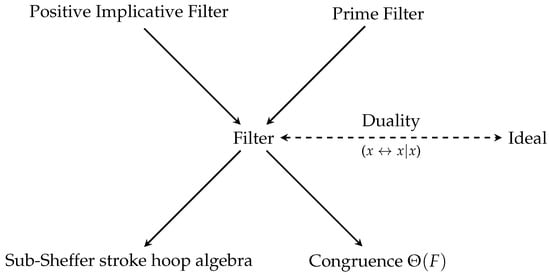
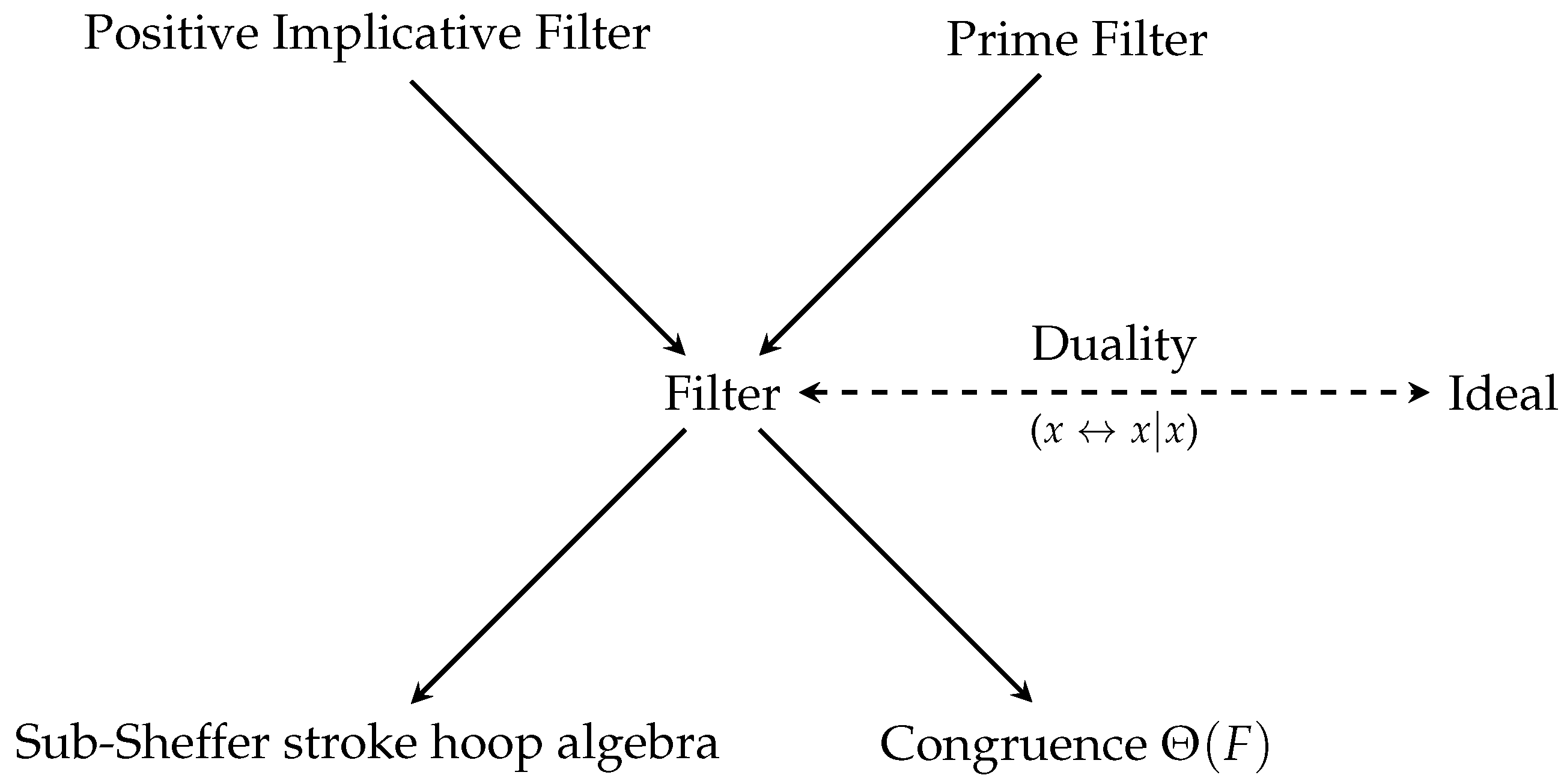
Now, we give the relation among these structures. By the help of the sub-algebra inclusion (Theorem 6), the structural hierarchy of implicative structures (Lemma 8), the duality principle (Lemma 9), and the generation of equivalence relations (Lemma 11), we can visually summarize the complete algebraic architecture of Sheffer stroke hoop algebras.
As rigorously proven, while filters serve as valid sub-algebras and direct generators of congruences, ideals maintain a dual relationship without inheriting the operational closure of a sub-algebra. This global structure is illustrated in the following diagram:
In Figure 1, the specific meaning of each connecting arrow is explicitly delineated as follows: The solid directed arrows between structural classes (e.g., from Positive Implicative Filters or Prime Filters to Filters, and from Filters to Sub-algebras) denote logical inclusion, indicating that one structure constitutes a subclass of another. The solid arrow directed from a Filter toward the Congruence represents the algebraic generation of an equivalence relation from a given filter. Finally, the dashed bidirectional arrow visually distinguishes the structural duality between filters and ideals, mapping elements via the relation .
Figure 1.
The structural hierarchy and duality relations of subsets in Sheffer stroke hoop algebras.
Definition 14.
Let and be two bounded Sheffer stroke hoop algebras. A mapping is called a homomorphism if it algebraically preserves the Sheffer stroke operation, meaning:
for all . The set is called the kernel of the homomorphism f.
Lemma 12.
Let be a homomorphism of bounded Sheffer stroke hoop algebras. Then the kernel, , is definitively a filter of .
Proof.
We must verify the formal filter conditions for . Since f is a structural homomorphism mapping between bounded algebras, it preserves the bounds, yielding . Thus, .
To verify operational closure , let , which rigorously means and . By applying the homomorphism property to the nested Sheffer operation, we obtain:
Substituting the kernel evaluations yields . In any bounded Sheffer stroke hoop algebra, the fundamental identities state and . Applying these sequentially evaluates the entire expression to . Thus, .
For upward closure , assume and . Applying the mapping f to both sides implies:
Since , we substitute , reducing the equation to . Utilizing the foundational identity , this simplifies directly to . Therefore, . Having satisfied all prerequisites, is validated as a proper filter. □
Theorem 10
(First Isomorphism Theorem). Let be a surjective homomorphism (epimorphism) of bounded Sheffer stroke hoop algebras. Then the quotient algebra is structurally isomorphic to , denoted formally by:
Proof.
Let . By Lemma 12, K is a valid filter of . Consequently, the quotient algebra is structurally well-defined. We define the mapping by:
First, we must prove that is well-defined. Suppose . By the formal definition of the induced congruence , this dictates that and . Translated through the kernel, this yields and . Distributing the homomorphism over the operations gives:
By the definition of the induced partial order in , these two equations signify and . Through the antisymmetry of the partial order, we definitively conclude . Thus, is completely independent of the choice of representative, proving it is well-defined.
Next, we establish that is injective (one-to-one). Assume . This structurally implies . Consequently, substituting for yields:
This deduction means , enforcing . An identical symmetric evaluation guarantees . Since both conditions are met, , confirming injectivity.
Because the initial homomorphism f is surjective by hypothesis, for any arbitrary element , there exists an such that . Therefore, , establishing that the mapping is surjective (onto).
Finally, we verify that preserves the Sheffer algebraic operation:
Since is a well-defined, bijective homomorphism, it establishes a perfect structural isomorphism. □
5. Conclusions
In this paper, we introduced and systematically investigated the theory of Sheffer stroke hoop algebras, providing a minimal and formal axiomatization of bounded hoop algebras utilizing a single binary operator. By constructing specific counter-models, we verified the logical independence of the proposed axioms. We rigorously established the induced partial order, proving that the structure forms a well-defined ∧-semilattice. A foundational result of this work is the bidirectional structural translation: we demonstrated that bounded hoop algebras satisfying the Double Negation Property (DNP) can be completely equivalently expressed as Sheffer stroke hoop algebras, and vice versa.
It is worth noting that this study introduces the concept of Sheffer stroke hoop algebras to the literature for the very first time. While the development of internal substructures such as filters, positive implicative filters, and quotients follows the classical milestones of universal algebra, their formalization within a single-operator environment represents a pioneered advancement in hoop theory. The complete reconstruction of the algebraic architecture entirely through the lens of the Sheffer stroke establishes a new paradigm for simplifying multi-valued logical systems, mathematically demonstrating that the entire universe of bounded hoops can be governed by a single binary connective without losing any structural granularity.
Furthermore, we developed the internal structural hierarchy of these algebras by defining sub-algebras, filters, positive implicative filters, and ideals. We highlighted a strict structural duality between filters and ideals within this framework. By proving that proper filters naturally induce full algebraic congruences, we successfully constructed quotient Sheffer stroke hoop algebras. The theoretical framework was ultimately solidified by establishing the Correspondence Theorem and the First Isomorphism Theorem, confirming that the classical algebraic isomorphism principles seamlessly transition into the Sheffer stroke setting.
The foundational nature of this algebraic construction opens several promising avenues for future research. First, the investigation of measure-theoretic extensions on these structures, specifically the behavior and existence of Bosbach and Riečan state operators on Sheffer stroke hoop algebras, remains an open problem. Second, extending these deterministic definitions into the realm of fuzzy logic—such as defining intuitionistic fuzzy filters or investigating the dominance properties of t-conorms within Sheffer stroke structures—presents a natural theoretical progression. Finally, bridging this pure algebraic theory with computational and data-driven methodologies offers an intriguing interdisciplinary challenge. Exploring how machine learning architectures (such as supervised classification algorithms or unsupervised clustering) can be applied to classify finite Sheffer stroke models or predict solutions to associated algebraic equations could significantly accelerate the computational analysis of non-classical algebraic structures.
Author Contributions
Conceptualization, A.S.A., T.O., R.K.B., I.S. and R.N.; Methodology, A.S.A., T.O., R.K.B., I.S. and R.N.; Writing—original draft, A.S.A., T.O., R.K.B., I.S. and R.N.; Writing—review and editing, T.O., R.K.B., I.S. and R.N.; Visualization, A.S.A., T.O., R.K.B., I.S. and R.N.; Supervision, T.O., R.K.B. and R.N. All authors have read and agreed to the published version of the manuscript.
Funding
This research is funded by Princess Nourah bint Abdulrahman University, Riyadh, Saudi Arabia under Researchers Supporting Project Number (PNURSP2026R231).
Data Availability Statement
The original contributions presented in this study are included in the article. Further inquiries can be directed to the corresponding author.
Acknowledgments
The authors extend their sincere gratitude to the anonymous reviewers for their insightful suggestions and constructive feedback, which have greatly enhanced the quality and clarity of this article. The first author extends her appreciation to Princess Nourah bint Abdulrahman University (PNU), Riyadh, Saudi Arabia, for funding this research under the Researchers Supporting Project, No. PNURSP2026R231.
Conflicts of Interest
The authors have no competing interests to declare that are relevant to the content of this article.
References
- Tarski, A. Ein beitrag zur axiomatik der abelschen gruppen. Fund. Math. 1938, 30, 253–256. [Google Scholar] [CrossRef] [Scilit]
- Sheffer, H.M. A set of five independent postulates for Boolean algebras, with application to logical constants. Trans. Am. Math. Soc. 1913, 14, 481–488. [Google Scholar] [CrossRef]
- McCune, W.; Veroff, R.; Fitelson, B.; Harris, K.; Feist, A.; Wos, L. Short single axioms for Boolean algebra. J. Autom. Reason. 2002, 29, 1–16. [Google Scholar] [CrossRef] [Scilit]
- Chajda, I.; Halaš, R.; Länger, H. Operations and structures derived from non-associative MV-algebras. Soft Comput. 2019, 23, 3935–3944. [Google Scholar] [CrossRef] [Scilit] [PubMed]
- Chang, C.C. Algebraic analysis of many valued logics. Trans. Am. Math. Soc. 1958, 88, 467–490. [Google Scholar] [CrossRef]
- ukasiewicz, J.; Tarski, A. Investigations into the sentential calculus. Logic Semant. Metamath. 1956, 38–59. [Google Scholar]
- Chajda, I.; Kolařík, M. Independence of axiom system of basic algebras. Soft Comput. 2009, 13, 41–43. [Google Scholar] [CrossRef] [Scilit]
- Oner, T.; Senturk, I. The Sheffer stroke operation reducts of basic algebras. Open Math. 2017, 15, 926–935. [Google Scholar] [CrossRef] [Scilit]
- Senturk, I.; Oner, T.; Borumand Saeid, A. Congruences of Sheffer stroke basic algebras. An. Ştiinţ. Univ. Ovidius Constanţa Ser. Mat. 2020, 28, 209–228. [Google Scholar] [CrossRef] [Scilit]
- Bosbach, B. Komplementäre Halbgruppen. Axiomatik und Arithmetik. Fundam. Math. 1969, 64, 257–287. [Google Scholar] [CrossRef] [Scilit]
- Bosbach, B. Komplementäre Halbgruppen. Kongruenzen und Quotienten. Fundam. Math. 1970, 69, 1–14. [Google Scholar] [CrossRef] [Scilit]
- Dvurečenskij, A.; Zahiri, O.; Aaly Kologani, M.; Borzooei, R.A. Hoop Algebras: An Introduction; Springer Nature: Berlin/Heidelberg, Germany, 2026. [Google Scholar]
- Esteva, F.; Godo, L.; Hájek, P.; Montagna, F. Hoops and fuzzy logic. J. Log. Comput. 2003, 13, 532–555. [Google Scholar] [CrossRef] [Scilit]
- Georgescu, G.; Leustean, L.; Preoteasa, V. Pseudo-hoops. J. Mult. Valued Logic Soft Comput. 2005, 11, 153–184. [Google Scholar]
- Kondo, M. Some types of filters in hoops. In 2011 41st IEEE International Symposium on Multiple-Valued Logic; IEEE: New York, NY, USA, 2011; pp. 50–53. [Google Scholar]
- Borzooei, R.A.; Aaly Kologani, M. On ideal theory of hoops. Math. Bohem. 2020, 145, 141–162. [Google Scholar]
- Borzooei, R.A.; Aaly Kologani, M. Stabilizer topology of hoops. Algebr. Struct. Their Appl. 2014, 1, 35–48. [Google Scholar]
- Cignoli, R.; D’Ottaviano, I.M.L.; Mundici, D. Algebraic Foundations of Many-Valued Reasoning; Kluwer Academic Publishers: Dordrecht, The Netherlands, 2000. [Google Scholar]
- Namdar, A.; Borzooei, R.A.; Borumand Saeid, A.; Aaly Kologani, M. Some results in hoop algebras. J. Intell. Fuzzy Syst. 2017, 32, 1805–1813. [Google Scholar] [CrossRef] [Scilit]
- Chajda, I.; Länger, H. Sheffer operation in relational systems. Soft Comput. 2022, 26, 89–97. [Google Scholar] [CrossRef] [Scilit] [PubMed]
- Chajda, I. Sheffer operation in ortholattices. Acta Univ. Palack. Olomuc. Fac. Rerum Natur. Math. 2005, 44, 19–23. [Google Scholar]

Disclaimer/Publisher’s Note: The statements, opinions and data contained in all publications are solely those of the individual author(s) and contributor(s) and not of MDPI and/or the editor(s). MDPI and/or the editor(s) disclaim responsibility for any injury to people or property resulting from any ideas, methods, instructions or products referred to in the content. |
© 2026 by the authors. Licensee MDPI, Basel, Switzerland. This article is an open access article distributed under the terms and conditions of the Creative Commons Attribution (CC BY) license.