


Abstract
The advent of large language models has reshaped the landscape of artificial intelligence, yet their learning dynamics remain constrained by rigid training strategies. Curriculum learning (CL), inspired by the human learning process, improves model performance over conventional randomly shuffled training while incurring no additional computational overhead. However, its competence-conservative mechanism often leads to diminished learning stimuli and suboptimal performance plateaus. Inspired by the flow theory in psychology, this study proposes in-batch hard sample injection curriculum learning (DACL), a learning strategy that dynamically balances stability and challenge. DACL regulates sample selection by aligning the model’s competence with the intrinsic complexity of the data, allocating the proportion of each batch to instances within the competence range and the remaining to higher-difficulty samples that stimulate adaptive learning. Experiments on the English–Vietnamese pair demonstrate that DACL achieves superior performance over curriculum learning baselines across multiple difficulty evaluation criteria. Further experiments reveal the effectiveness of the similarity-based difficulty standard, demonstrating the ability to capture task complexity with greater precision.
Keywords:
natural language processing; neural machine translation; curriculum learning; cognitive modeling MSC:
68T50; 68T07
1. Introduction
The advent of large language models has brought a paradigm shift in artificial intelligence, as their scalable architectures have advanced toward human-level linguistic competence while exhibiting unprecedented generalization capabilities [1,2,3]. These models are grounded in artificial neural network architectures that draw inspiration from the information-processing principles of biological neurons in the human brain. When extended into deep neural networks through hierarchical stacking, these architectures acquire the capacity to model complex nonlinear relationships and exhibit computational dynamics. Within this paradigm, curriculum learning (CL) is also one of the representative human-inspired learning strategies [4,5]. Rooted in educational psychology, CL is founded on the pedagogical principle that the learning effect increases when exposure proceeds from easy to hard examples. By ordering training samples according to estimated difficulty, CL emulates the developmental scaffolding by which humans gradually acquire complex conceptual structures [4,6]. Yet, curriculum learning remains fundamentally limited by its unidirectional and competence-conservative mechanism [7]. Most existing approaches constrain the model to examples that are consistently below its current competence level. As a result, the model repeatedly receives samples that are already solvable and encounters diminished learning stimulus. The training process becomes stable but stagnant, producing a suboptimal plateau that hinders continual improvement.
To address this limitation, this study introduces difficulty-aware curriculum learning (DACL), a novel model training strategy grounded in the principles of flow theory [8,9]. Flow theory posits that optimal learning, known as the flow state, arises when the level of challenge aligns precisely with the individual’s skill, fostering deep concentration and intrinsic engagement. Sustaining this state requires exposure to gradually increasing challenges that keep the learner motivated and prevent stagnation. Accordingly, DACL extends the classical CL framework by dynamically regulating the interaction between the model’s estimated competence and the intrinsic difficulty of training samples. Within each batch, a proportion of the data is drawn from samples that correspond to the model’s current competence range, ensuring alignment between task difficulty and capability. The remaining proportion consists of higher-difficulty samples. This design enables a dynamic interplay between flow and arousal states, wherein the former stabilizes representational learning and the latter elicits sustained engagement through increased task difficulty.
The experiments are conducted on the English–Vietnamese language pair under a limited-data scenario, which presents a stringent evaluation environment where the effectiveness of the learning strategy, rather than the abundance of data, serves as the primary determinant of performance. Experimental results demonstrate that DACL achieves significant improvements over curriculum learning baselines across both sentence-length and cosine-similarity-based difficulty standards. Further analysis demonstrates that our proposed cosine similarity-based difficulty criterion surpasses conventional sentence length-based measures in effectively distinguishing task complexity.
This study advances beyond the inherent limitations of conventional curriculum learning by integrating cognitive principles that capture the dynamic balance between stability and challenge. By integrating psychological theories of human immersion into a quantifiable machine learning process, DACL extends the scope of learning objectives beyond mere data fitting toward a cognitively motivated form of learning that promotes sustained engagement and adaptive growth.
2. Related Work
Curriculum learning (CL) is a training paradigm for language models inspired by the human educational process. It structures the learning trajectory in a way that the model is first exposed to easier examples and progressively advances toward more complex instances. Introduced by [4], this approach is first incorporated into machine translation by [10], after which a series of studies further explore its potential within machine translation [11,12,13]. Notably, ref. [7] defined a model’s competence and aligned it with the difficulty of the training data. The competence was then gradually expanded, enabling progressive exposure to increasingly challenging examples.
Difficulty estimation in CL has generally been based on two principal criteria: linguistically motivated metrics, such as sentence length, and model-based metrics, such as sentence uncertainty [14,15,16]. Building upon these ideas, ref. [17] further introduced a norm-based difficulty standard that selects training instances according to the norm of word vectors, capturing a more intrinsic representation of difficulty.
Efforts have also been made to extend curriculum learning to multilingual and multi-domain settings. In the multilingual context, ref. [18] designated a high-resource language competence score and incrementally incorporated low-resource languages through a thresholding mechanism. Similarly, ref. [19] prioritized high-resource language pairs during early training stages and integrated low-resource pairs that are more prone to overfitting. In the multi-domain context, ref. [20] introduced domain-related features at the example level and guided model training to progressively construct domain-relevant and noise-reduced batches. Ref. [21] proposed a denoised curriculum learning framework that filters out noisy data and facilitates a gradual transition from simpler to more complex tasks.
Unlike previous studies, this work departs from the assumption that the model should only be trained on data that match or fall below its current competence level, instead hypothesizing that controlled exposure to higher-difficulty samples evokes a beneficial state of cognitive arousal that enhances learning efficacy.
3. Background
3.1. Competence-Based Curriculum Learning
Competence-based curriculum learning proposed by [7] conceptualizes model training as a progressive exposure process in which the model incrementally learns from data whose difficulty is dynamically aligned with its evolving ability. We first describe the criterion used to rank sample difficulty and the evolution of model competence, followed by an explanation of how competence-based curriculum learning progresses over time steps.
3.1.1. Difficulty
The difficulty of each training instance is defined in terms of sentence length. For a source sentence , difficulty is computed as , where denotes the number of tokens in the sentence . Longer sentences generally exhibit higher syntactic and compositional complexity, which makes them more challenging to translate. Word rarity is also adopted as one of the difficulty criteria to estimate sentence complexity. The empirical frequency of each word is first computed in the training corpus. Then, the difficulty of a sentence is defined as the negative log-likelihood under a unigram distribution . Sentences composed of less frequent words yield higher difficulty scores, reflecting the increased linguistic sparsity associated with rare lexical items. Each sample is ranked according to the computed difficulty score, and these scores are then accumulated to form a cumulative difficulty distribution. The resulting values are subsequently normalized to the range .
3.1.2. Competence
Competence represents the progress of a model during training. It is a continuous variable in the range , where 0 indicates minimal initial competence and 1 corresponds to the fully competent state, at which the model has complete access to the dataset. To capture the nonlinear trajectory of learning, competence is modeled by a square-root growth function. Let denote the initial value and the training step at which full competence is reached. The competence function is defined as
The square-root formulation captures the nonlinear trajectory of learning, characterized by a phase of rapid competence expansion in the early stage and a gradual saturation phase as the model nears full competence. At , the model is considered capable of handling the full range of task difficulty, and the curriculum constraint is lifted, transitioning into full-data training.
3.1.3. Model Training
Given that both the difficulty and the competence are normalized to the range , training at each step t is constrained to data samples whose cumulative difficulty does not exceed the model’s current competence. Formally, the accessible training subset at step t is defined as
Batches are then randomly drawn from this subset . As training progresses and increases monotonically, the boundary of gradually expands to include samples of higher cumulative difficulty. This selection mechanism synchronizes the pacing of data exposure with the model’s evolving ability.
Consistent with prior work, our approach also models competence as a gradual progression over time steps based on a predefined competence point, rather than reflecting it at a fine-grained mini-batch level. Dynamically incorporating performance or loss at the mini-batch level introduces substantial stochastic noise, resulting in highly unstable difficulty estimates and ultimately leading to a suboptimal learning trajectory. In summary, our approach is designed to maintain a stable and smooth curriculum schedule by avoiding the direct coupling of the competence function with fine-grained performance signals during training.
3.2. Flow Theory
Flow refers to a state of optimal experience in which a person is fully immersed and engaged in an activity [22,23]. The state arises when the performer’s perceived skills align proportionally with the perceived challenges of the task, which serves as a central precondition for the flow experience. Ref. [24] further introduced the eight-channel model, which characterizes distinct affective states according to the relevance between perceived skills and task challenges. When challenges surpass skills, individuals typically experience anxiety or worry, whereas an excess of skill relative to challenge leads to relaxation or boredom. Flow manifests in the intermediate regime where these two dimensions are in balance, while a mild surplus of challenge induces a state of arousal, characterized by heightened alertness and focused engagement.
We focus on the point that flow embodies a growth principle. The sustained maintenance of flow typically requires exposure to progressively greater challenges [9,23]. This indicates that the maintenance of a flow state necessitates the gradual incorporation of increasingly challenging elements. Guided by this educational psychology insight, this work advances a human-inspired approach to curriculum design for machine learning. We propose constructing training batches whose overall difficulty is aligned with the model’s estimated competence to induce a flow state, while incorporating a small proportion of higher-difficulty instances to elicit cognitive arousal and sustain continuous engagement. It is important to note that our approach is inspired by the principles of flow theory as a source of motivation, rather than being a strict or complete implementation of it.
4. Difficulty-Aware Curriculum Learning
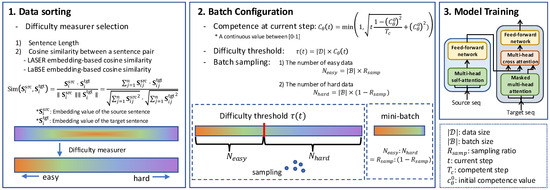
While competence-based curriculum learning achieves training stability by exposing the model exclusively to data below its current competence, this approach inherently restricts the model’s potential for adaptive growth. To address this limitation, we propose difficulty-aware curriculum learning (DACL), a learning paradigm designed to harmonize stability and stimulation. DACL constructs each training batch by mixing easier and challenging samples in proportions determined by the model’s current competence, allowing the model to alternate between flow and arousal states. This section outlines the key components of DACL, including difficulty standard, batch configuration, and model training. The overall process of DACL is illustrated in Figure 1.
Figure 1.
Overall architecture of the proposed difficulty-weighted curriculum learning framework. The training process consists of three stages. First, the dataset is sorted according to a chosen difficulty measurer. At each training step, a difficulty threshold is determined based on the model competence, and batches are sampled accordingly. The sampled batches follow an easy-to-hard ratio of and are subsequently used as inputs for model training.
4.1. Difficulty Criterion
Existing curriculum learning approaches typically define data difficulty in linguistic terms, often measured by sentence length. DACL extends this by incorporating a novel semantic perspective through a cosine similarity-based difficulty estimator. For each source–target pair , the corresponding sentence embeddings and are obtained, and their similarity is computed as
Embeddings are generated using LASER [25] or LaBSE [26] embedding models, both of which provide robust multilingual representations. Higher cosine similarity signifies stronger semantic alignment between source and target representations, indicating lower translational complexity. Conversely, lower similarity denotes semantic divergence and increased structural intricacy, which collectively contribute to higher translation difficulty. In other words, samples with higher difficulty often require the model to capture subtle semantic distinctions or to generate translations that appropriately reflect cultural nuances.
Sentences are cumulatively ordered from the easiest to the most challenging based on the scores. This cumulative mechanism constructs a continuous difficulty spectrum that facilitates gradual learning progression.
4.2. Batch Configuration
At each training step t, the competence score of the model is evaluated as a continuous variable within the range , representing the model’s relative learning progress. For a dataset of size sorted in ascending order of difficulty based on the defined criterion, the difficulty threshold at step t is defined as
This threshold corresponds to a cumulative percentile over the sorted dataset and defines the boundary between easy and challenging samples relative to the current level of model competence. Let be the batch size, and denote the proportion of easy samples included in a batch, while represents the fraction of challenging samples. The number of instances selected from each difficulty region is given by
where samples are drawn from the subset with difficulty scores that fall below , whereas samples are obtained from those exceeding this threshold, jointly constituting a composite batch. This batch design ensures that the model predominantly engages with competence-aligned examples while intermittently encountering more demanding instances that prevent stagnation and induce a state of arousal.
4.3. Model Training
Model training under DACL proceeds by dynamically modulating data exposure in accordance with the evolving competence of the model. At each training step t, the model is presented with a batch configured as described above and updates its parameters by minimizing the training loss on that batch. As training progresses, increases monotonically, expanding the accessible region of data toward higher difficulty levels. Once converges toward unity, the model attains a fully competent state, gaining unrestricted access to the complete dataset. At this stage, the curriculum constraint is released, wherein batches are randomly composed from the entire dataset to continue parameter refinement under unrestricted exposure.
5. Experiments and Results
This section presents the experimental setup and results that demonstrate the effectiveness of DACL. We describe the dataset, model configuration, baseline methods, and implementation details, followed by experimental results of model performance.
5.1. Experimental Setting
To rigorously evaluate DACL, model training is conducted on the English–Vietnamese (En–Vi) language pair, which represents a limited-data setting. The limited-data scenario is adopted as it provides a stringent evaluation environment in which the effectiveness of the learning strategy, rather than the volume of data, serves as the principal determinant of model performance. Nevertheless, the proposed method is inherently language-agnostic, as it does not rely on any language-specific features in defining difficulty or constructing training batches. Therefore, extending the framework to larger-scale datasets and more diverse language families is an important direction for future work. We utilize the IWSLT15 dataset [27], which comprises transcriptions and translations of TED talks. The dataset contains 133K sentence pairs for training, 768 pairs for validation, and 1268 pairs for testing. The maximum token lengths are 628 for English and 850 for Vietnamese, while the average token lengths are 20.3 and 24.7, respectively.
We train a Transformer model from scratch using the Fairseq framework [28]. Since pre-trained models already contain substantial parameterized knowledge, it becomes challenging to isolate the contribution of the proposed DACL strategy in an orthogonal manner. For this reason, we focus on a from-scratch setting where the effect of the curriculum design can be more clearly attributed. For subword segmentation, we employ SentencePiece [29] with a vocabulary size of 32 K. The model parameters are optimized with the Adam optimizer at a base learning rate of 5 × 10⁻⁴, following an inverse square-root learning rate schedule. Training is performed with a batch size of 32 and a gradient accumulation step of 2. To ensure reproducibility, the random seed is fixed to 42. Following the methodology adopted in [7], the fully competent point is determined empirically from the learning trajectory of the baseline Transformer model. We first conduct standard training and analyze the BLEU progression curve on the development set to identify the step corresponding to the model’s peak performance. The highest performance observed at approximately 13.8 K training steps is empirically designated as the full competence point. Additionally, we introduce the concept of a lagging point, defined as the step at which the model attains 90% of its maximal BLEU score, observed at roughly 4.7 K training steps. All experiments are executed on four NVIDIA RTX 8000 GPUs (48 GB memory). The total training time is approximately 2.5 h, with about 32 K training steps. The intermediate performance milestones (e.g., 4.7 K and 13.8 K steps) are identified based on this full training trajectory. For evaluation, we adopt the BLEU as the primary metric of translation quality and further use SacreBLEU to ensure reliability.
To establish a fair and systematic comparison, we evaluate DACL against both non-curriculum and curriculum-based baselines. The non-curriculum baselines include a standard Transformer model trained on the entire dataset without curriculum scheduling. In addition, we compare the following four competence-based curriculum learning baselines.
- SL-Linear: A sentence-length-based curriculum learning method where the data difficulty threshold increases linearly with model competence, following the original formulation of competence-based learning.
- SL-Sqrt: A variant of SL-Linear that employs a square-root competence progression to reflect nonlinear cognitive learning curves.
- SR-Linear: A word rarity-based curriculum learning method in which sentences containing rarer lexical items are regarded as more difficult, and the competence threshold expands linearly throughout training.
- SR-Sqrt: A word rarity-based curriculum learning variant that adopts a square-root competence trajectory.
These four curriculum learning strategies are implemented on both the RNN and Transformer architectures. We additionally consider two curriculum learning baselines: uncertainty-aware [16], a model-centric approach, and data-guided [13], a data-driven curriculum learning method. The former defines sample difficulty using model uncertainty, estimated from cross-entropy and parameter variance, and progressively introduces more uncertain samples as training proceeds. The latter adopts a data-centric, adaptive framework that dynamically adjusts the curriculum based on model performance, starting from easier samples and progressively incorporating more complex data. We also compare our method with an easy-only curriculum learning setting to evaluate the effect of difficulty-aware batch composition.
5.2. Main Results
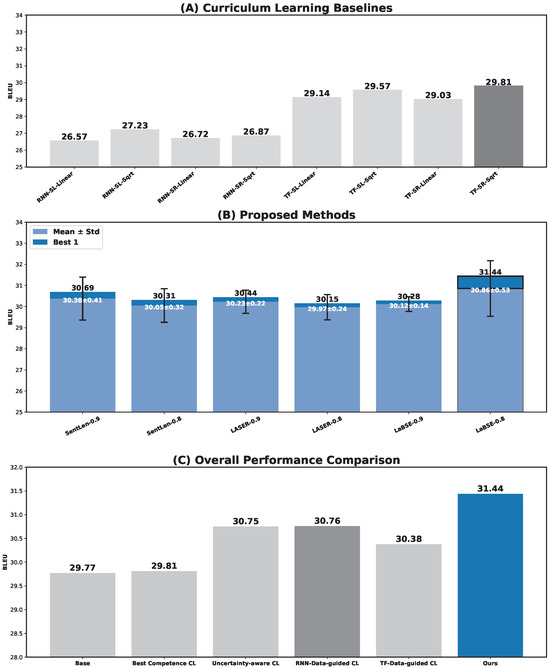
Figure 2 presents the quantitative results of the DACL experiments. Sub-figure (A) reports the performance of various curriculum learning baseline strategies. The results show that the Transformer architecture consistently outperforms the RNN counterpart under the curriculum learning framework. In particular, the Transformer model combined with word rarity as the difficulty metric and a square-root competence schedule (TF-SR-Sqrt) achieves the highest BLEU score of 29.81 among the curriculum learning baselines. This result indicates that gradually increasing task difficulty through a smooth competence schedule can effectively improve model performance.
Figure 2.
Experimental results of the curriculum learning approaches. (A) shows the performance of baseline models used for curriculum learning, (B) presents the performance of the proposed methods, and (C) compares the overall performance across models. We denote the sentence-length-based difficulty measure as SentLen, the cosine similarity-based measure using LASER embeddings as LASER, and the cosine similarity-based measure using LaBSE embeddings as LaBSE. For the proposed methods, we report the mean and standard deviation over three runs with different random seeds (Mean ± Std), along with the best-performing result (Best 1). Error bars denote 95% confidence intervals computed using the t-distribution.
Sub-figure (B) presents the results of the proposed DACL methods. Unlike conventional curriculum learning, which progressively increases the difficulty of training samples over time, DACL mixes easy and challenging samples within each batch, based on the flow theory. Empirically, the sentence length-based DACL with achieves a BLEU score of 30.69 (30.38 ± 0.41 over three runs), while the LaBSE-based difficulty metric further improves performance. In particular, the LaBSE-based DACL with achieves the highest BLEU score of 31.44, with a mean performance of 30.86 ± 0.53, among all evaluated methods.
Finally, sub-figure (C) summarizes the overall performance comparison, including results from both the model-centric and data-driven curriculum learning approaches. The standard training baseline achieves 29.77 BLEU, while the best-performing curriculum learning baseline reaches 30.76 BLEU. In contrast, the proposed DACL approach significantly outperforms both settings, achieving 31.44 BLEU. Even the average performance across multiple runs consistently surpasses that of the best-performing curriculum learning baseline. These results suggest that while curriculum learning provides measurable improvements, integrating both easy and difficult samples within each training batch further enhances learning effectiveness and overall model performance. These results further imply that DACL successfully introduces the flow state and induces an appropriate level of cognitive arousal.
5.3. Effect of Curriculum Duration
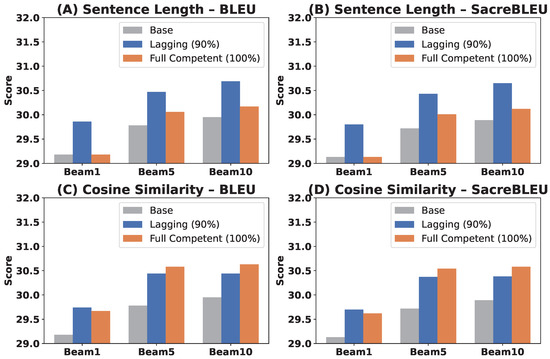
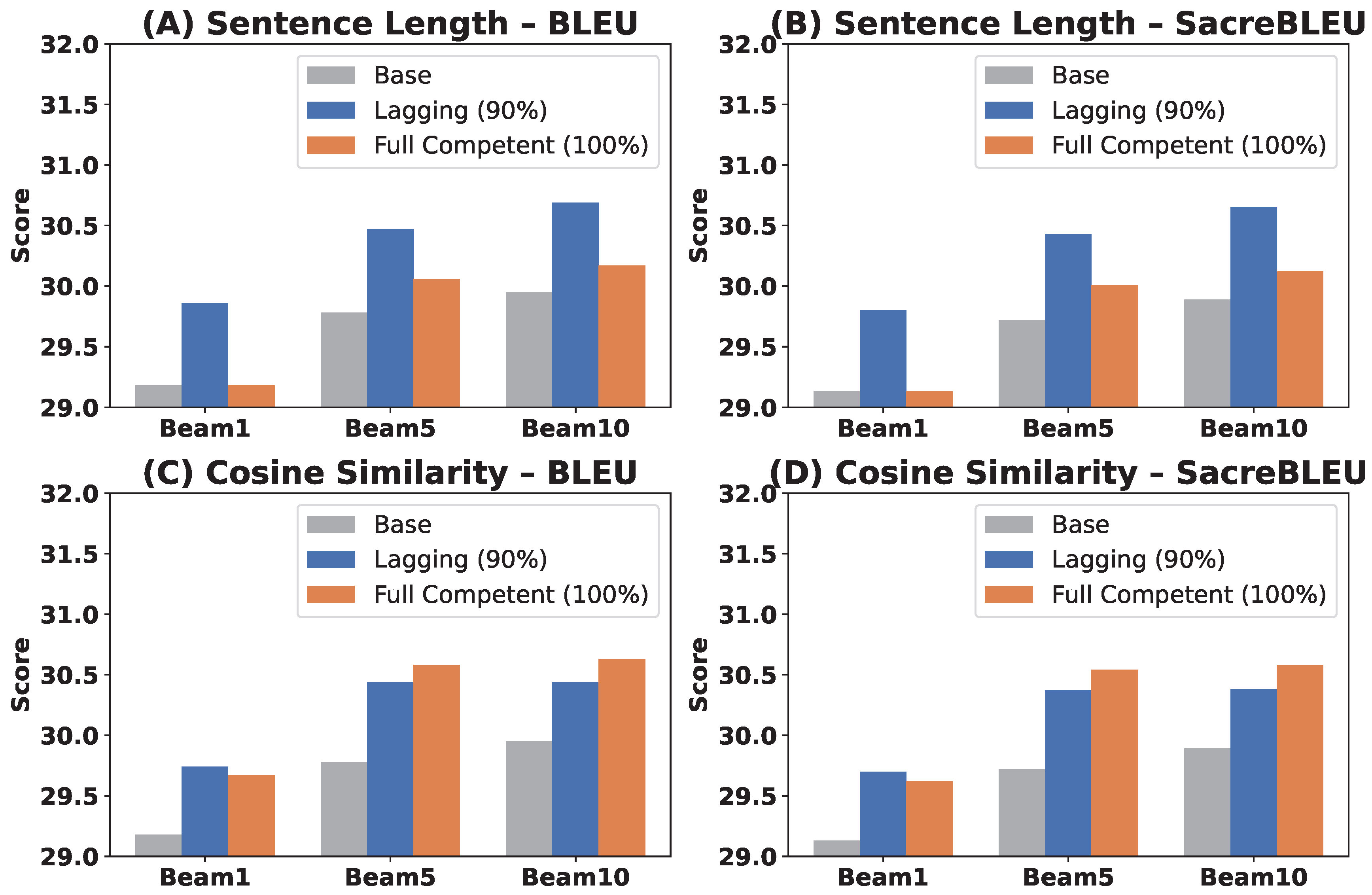
Figure 3 compares the performance differences observed when the curriculum learning process terminates at two distinct competence milestones: the lagging point (90%) and the full competence point (100%). The lagging point corresponds to the step 4.7k at which the base model achieves approximately 90% of its peak evaluation BLEU score, while the 100% competent point denotes the step 13k where the model reaches its maximum BLEU performance.
Figure 3.
Performance comparison of curriculum learning models under different difficulty measures at lagging and full competence points. We denote beam sizes from 1 to 10 as Beam 1, Beam 5, and Beam 10.
The analysis reveals a divergence in the effectiveness of difficulty criteria across these two regimes. At the lagging point, the curriculum based on sentence length yields the highest BLEU and SacreBLEU scores. Length-based ordering promotes a structured expansion of token distributions and syntactic representations, allowing the model to effectively internalize core structural regularities within a constrained training duration. This suggests that under limited training budgets, curricula grounded in structural difficulty provide a more effective solution.
In contrast, when training continues until the model reaches full competence, the cosine similarity-based curriculum consistently achieves the best performance across all beam settings. Compared to sentence length-based scheduling, semantic similarity-guided difficulty requires a gentler and more gradual learning progress, fostering steady improvements in lexical precision and contextual coherence over time. These findings suggest that the effectiveness of curriculum learning varies not only with the chosen difficulty criterion but also with the degree of training persistence throughout the learning process.
5.4. Effect of Difficulty Standard
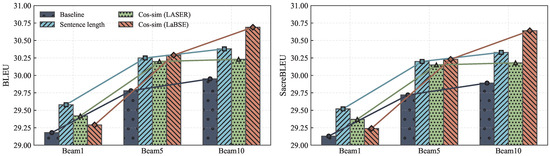
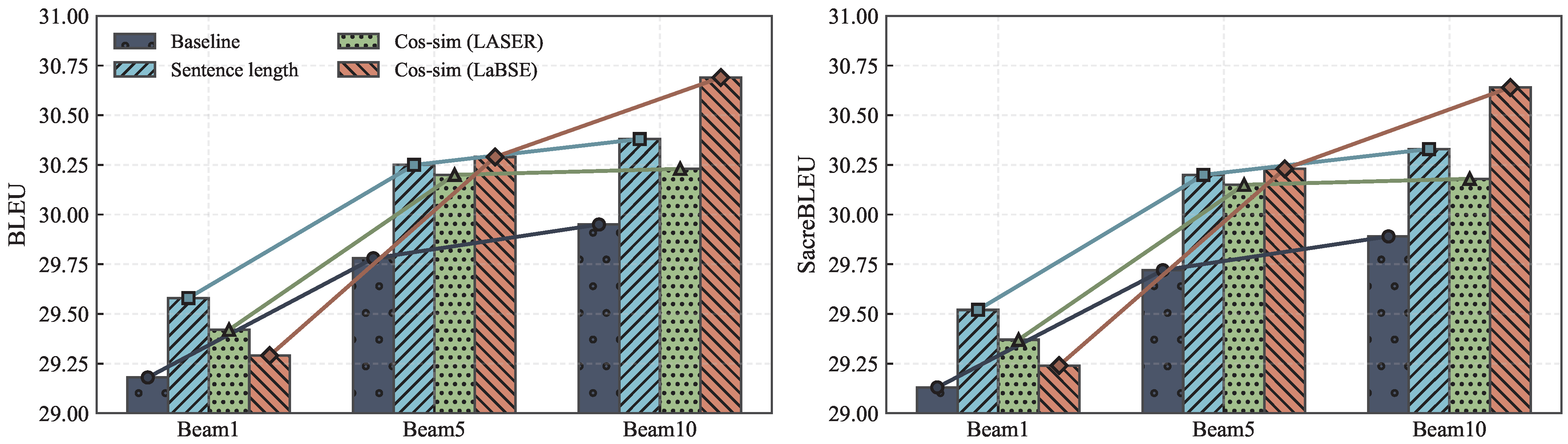
Figure 4 presents the averaged performance across three independent experiments, comparing the effectiveness of two difficulty-ordering strategies in curriculum learning of sentence length and cosine similarity. The results demonstrate that the LaBSE embedding-based cosine similarity yields the highest translation performance, highlighting the advantage of semantically informed difficulty estimation over purely structural metrics.
Figure 4.
Comparison of curriculum learning performance across different difficulty criterion.
This superior performance is attributed to the LaBSE embedding model, which is trained through multilingual pre-training on large-scale parallel corpora. Built upon a Transformer-based dual-encoder architecture, LaBSE enables semantically equivalent sentences across different languages to be precisely aligned within a shared embedding space, capturing fine-grained cross-lingual correspondences with high representational fidelity. Consequently, LaBSE forms more stable and semantically consistent representations than LASER, which relies primarily on sequence-to-sequence encoder representations. Collectively, these findings indicate that difficulty standards rooted in semantic alignment offer a more effective and discriminative foundation for curriculum design than heuristic indicators such as sentence length.
5.5. Effect of Batch Configuration
Table 1 provides an analysis of the impact of varying the proportion of easy and difficult samples within each batch on the overall effectiveness of curriculum learning. The proportion : indicates the proportion of easy and difficult data. For instance, a 0.9:0.1 configuration denotes that 90% of each batch consists of samples below the model’s current competence threshold, while the remaining 10% comprises more challenging examples. The easy and hard datasets used for batch construction are derived exclusively from the training split, and no validation or test data were involved.
Table 1.
Experimental results illustrating the impact of varying batch composition ratios between easy and difficult samples (easy:difficult) on translation performance under different difficulty criteria. Boldface indicates the best-performing results.
Across all difficulty measures, models trained with mixed batches outperform those trained with easy-only data (). Here, corresponds to an ablation setting of DACL, where all training samples are composed solely of easy examples. Compared to this easy-only setting, the mixed-batch strategy consistently yields superior performance, highlighting the benefit of incorporating a balanced level of difficulty during training. This result demonstrates that DACL provides richer and more productive training dynamics by exposing the model to a moderate level of challenge. This controlled variation in difficulty suggests that the model promotes both stability and stimulation. However, when the ratio of easy samples falls below 0.6, the advantage of curriculum learning deteriorates as excessive exposure to difficult instances disrupts the intended learning progression. Therefore, maintaining within the range of 0.8 to 0.9 achieves an optimal balance, introducing sufficient challenge to enhance overall batch difficulty while preserving the effectiveness of curriculum learning.
5.6. Effect of Learning Rate Scheduler
Table 2 presents the comparative results between DACL and DACL combined with a learning rate scheduler. Although both methods aim to enhance training stability, they operate on fundamentally distinct principles. Curriculum learning regulates what the model learns by structuring data exposure according to difficulty, whereas a learning rate scheduler controls how the model learns by adjusting the magnitude of parameter updates throughout the optimization process. Namely, in curriculum learning, the progression from easy to difficult examples enables a gradual expansion of representational capacity. Conversely, learning rate scheduling adjusts the optimization dynamics over time, employing a high learning rate for rapid exploration in early stages and a lower rate for fine-grained convergence later in training. We hypothesize that the two mechanisms operate in a complementary manner. To validate this assumption, we perform ablation experiments excluding the learning rate scheduler and analyze the resulting model behavior.
Table 2.
Comparative evaluation of DACL with and without learning rate scheduling across training steps. Boldface indicates the best-performing results.
As shown in the results, incorporating a learning rate scheduler into DACL leads to consistent improvements in BLEU and SacreBLEU scores, particularly during the early training phases (e.g., at 3000 steps). These findings indicate that curriculum learning and learning rate scheduling act synergistically. The interaction between the two mechanisms promotes smoother optimization dynamics and enables more effective learning of training data, ultimately contributing to stable model convergence.
The former guiding the progression of learning and the latter stabilizing its temporal dynamics, leading to more effective and robust model convergence.
6. Conclusions
This work introduced DACL, a cognitively grounded framework that aligns sample difficulty with the model’s evolving competence while injecting a controlled fraction of harder instances to sustain engagement. In English–Vietnamese translation under a limited-data setting, DACL consistently outperforms non-curriculum training and competence-based curricula across difficulty standards, with LaBSE-based cosine similarity criterion yielding the strongest gains. Analysis shows that the effectiveness of DACL depends on curriculum duration and batch composition. Sentence length criteria are more effective during shorter training, while semantic criteria become dominant at full competence. Moreover, mixing mostly competence-aligned examples with a small portion of difficult samples lead to the most stable improvements. In conclusion, this study represents a novel attempt to bridge curriculum learning with the psychological concept of flow theory, demonstrating the effectiveness and validity of this integrative approach. As an initial step toward validating a cognitively grounded difficulty-aware curriculum learning framework, this study paves the way for its expansion across a broader spectrum of language pairs, ultimately enhancing its generalization capability.
Author Contributions
Conceptualization, S.E. and C.P.; methodology, S.E. and C.P.; software, S.E.; validation, S.E.; visualization, C.P.; writing—original draft preparation, S.E.; writing—review and editing, S.E. and C.P. All authors have read and agreed to the published version of the manuscript.
Funding
This research received no external funding.
Informed Consent Statement
Not applicable.
Data Availability Statement
The original data presented in the study are openly available in nmt-en-vi at https://github.com/stefan-it/nmt-en-vi (accessed on 2 July 2025) or [27].
Conflicts of Interest
The authors declare no conflicts of interest.
References
- Brown, T.; Mann, B.; Ryder, N.; Subbiah, M.; Kaplan, J.D.; Dhariwal, P.; Neelakantan, A.; Shyam, P.; Sastry, G.; Askell, A.; et al. Language Models are Few-Shot Learners. In Proceedings of the Advances in Neural Information Processing Systems; Larochelle, H., Ranzato, M., Hadsell, R., Balcan, M., Lin, H., Eds.; Curran Associates, Inc.: Red Hook, NY, USA, 2020; Volume 33, pp. 1877–1901. [Google Scholar]
- Wei, J.; Tay, Y.; Bommasani, R.; Raffel, C.; Zoph, B.; Borgeaud, S.; Yogatama, D.; Bosma, M.; Zhou, D.; Metzler, D.; et al. Emergent Abilities of Large Language Models. arXiv 2022, arXiv:2206.07682. [Google Scholar] [CrossRef] [Scilit]
- Touvron, H.; Lavril, T.; Izacard, G.; Martinet, X.; Lachaux, M.A.; Lacroix, T.; Rozière, B.; Goyal, N.; Hambro, E.; Azhar, F.; et al. LLaMA: Open and Efficient Foundation Language Models. arXiv 2023, arXiv:2302.13971. [Google Scholar] [CrossRef] [Scilit]
- Bengio, Y.; Louradour, J.; Collobert, R.; Weston, J. Curriculum learning. In Proceedings of the 26th Annual International Conference on Machine Learning; Association for Computing Machinery: New York, NY, USA, 2009; pp. 41–48. [Google Scholar]
- Soviany, P.; Ionescu, R.T.; Rota, P.; Sebe, N. Curriculum learning: A survey. Int. J. Comput. Vis. 2022, 130, 1526–1565. [Google Scholar] [CrossRef] [Scilit]
- Wang, X.; Chen, Y.; Zhu, W. A Survey on Curriculum Learning. arXiv 2021, arXiv:2010.13166. [Google Scholar] [CrossRef] [Scilit]
- Platanios, E.A.; Stretcu, O.; Neubig, G.; Poczos, B.; Mitchell, T. Competence-based Curriculum Learning for Neural Machine Translation. In Proceedings of the 2019 Conference of the North American Chapter of the Association for Computational Linguistics: Human Language Technologies, Volume 1 (Long and Short Papers); Burstein, J., Doran, C., Solorio, T., Eds.; Association for Computational Linguistics: Minneapolis, MN, USA, 2019; pp. 1162–1172. [Google Scholar] [CrossRef] [Scilit]
- Csikszentmihalyi, M. Flow: The Psychology of Optimal Experience; Harper & Row: New York, NY, USA, 1990; Volume 1990. [Google Scholar]
- Hektner, J.M.; Csikszentmihalyi, M. A Longitudinal Exploration of Flow and Intrinsic Motivation in Adolescents; Annual Meeting of the American Educational Research Association: New York, NY, USA, 1996. [Google Scholar]
- Zou, W.Y.; Socher, R.; Cer, D.; Manning, C.D. Bilingual Word Embeddings for Phrase-Based Machine Translation. In Proceedings of the 2013 Conference on Empirical Methods in Natural Language Processing; Yarowsky, D., Baldwin, T., Korhonen, A., Livescu, K., Bethard, S., Eds.; Association for Computational Linguistics: Stroudsburg, PA, USA, 2013; pp. 1393–1398. [Google Scholar]
- Mohiuddin, T.; Koehn, P.; Chaudhary, V.; Cross, J.; Bhosale, S.; Joty, S. Data Selection Curriculum for Neural Machine Translation. In Proceedings of the Findings of the Association for Computational Linguistics: EMNLP 2022; Goldberg, Y., Kozareva, Z., Zhang, Y., Eds.; Association for Computational Linguistics: Abu Dhabi, United Arab Emirates, 2022; pp. 1569–1582. [Google Scholar] [CrossRef] [Scilit]
- Kuwanto, G.; Akyürek, A.F.; Tourni, I.C.; Li, S.; Jones, A.; Wijaya, D. Low-Resource Machine Translation Training Curriculum Fit for Low-Resource Languages. In PRICAI 2023: Trends in Artificial Intelligence: 20th Pacific Rim International Conference on Artificial Intelligence, PRICAI 2023, Jakarta, Indonesia, 15–19 November 2023; Proceedings, Part III; Springer: Berlin/Heidelberg, Germany, 2023; pp. 453–458. [Google Scholar] [CrossRef] [Scilit]
- Wang, J.; Yang, L.; Wang, J.; Guan, Y.; Bai, L.; Luo, H. A data-guided curriculum towards low-resource neural machine translation. Expert Syst. Appl. 2025, 283, 127673. [Google Scholar] [CrossRef] [Scilit]
- Zhang, X.; Kumar, G.; Khayrallah, H.; Murray, K.; Gwinnup, J.; Martindale, M.J.; McNamee, P.; Duh, K.; Carpuat, M. An empirical exploration of curriculum learning for neural machine translation. arXiv 2018, arXiv:1811.00739. [Google Scholar] [CrossRef] [Scilit]
- Kocmi, T.; Bojar, O. Curriculum Learning and Minibatch Bucketing in Neural Machine Translation. In Proceedings of the International Conference Recent Advances in Natural Language Processing, RANLP 2017; Mitkov, R., Angelova, G., Eds.; Association for Computational Linguistics: Varna, Bulgaria, 2017; pp. 379–386. [Google Scholar] [CrossRef] [Scilit]
- Zhou, Y.; Yang, B.; Wong, D.F.; Wan, Y.; Chao, L.S. Uncertainty-aware curriculum learning for neural machine translation. In Proceedings of the 58th Annual Meeting of the Association for Computational Linguistics; Association for Computational Linguistics: Stroudsburg, PA, USA, 2020; pp. 6934–6944. [Google Scholar]
- Liu, X.; Lai, H.; Wong, D.F.; Chao, L.S. Norm-Based Curriculum Learning for Neural Machine Translation. In Proceedings of the 58th Annual Meeting of the Association for Computational Linguistics; Association for Computational Linguistics: Stroudsburg, PA, USA, 2020; pp. 427–436. [Google Scholar]
- Zhang, M.; Meng, F.; Tong, Y.; Zhou, J. Competence-based Curriculum Learning for Multilingual Machine Translation. In Proceedings of the Findings of the Association for Computational Linguistics: EMNLP 2021; Moens, M.F., Huang, X., Specia, L., Yih, S.W.T., Eds.; Association for Computational Linguistics: Punta Cana, Dominican Republic, 2021; pp. 2481–2493. [Google Scholar] [CrossRef] [Scilit]
- Elbayad, M.; Sun, A.; Bhosale, S. Fixing MoE Over-Fitting on Low-Resource Languages in Multilingual Machine Translation. In Proceedings of the Findings of the Association for Computational Linguistics: ACL 2023; Association for Computational Linguistics: Toronto, ON, Canada, 2023; pp. 14237–14253. [Google Scholar]
- Wang, W.; Tian, Y.; Ngiam, J.; Yang, Y.; Caswell, I.; Parekh, Z. Learning a Multi-Domain Curriculum for Neural Machine Translation. In Proceedings of the 58th Annual Meeting of the Association for Computational Linguistics; Jurafsky, D., Chai, J., Schluter, N., Tetreault, J., Eds.; Association for Computational Linguistics: Stroudsburg, PA, USA, 2020; pp. 7711–7723. [Google Scholar] [CrossRef] [Scilit]
- Chen, K.; Zhuang, D.; Li, M.; Chang, J.M. Epi-curriculum: Episodic curriculum learning for low-resource domain adaptation in neural machine translation. IEEE Trans. Artif. Intell. 2024, 5, 6095–6108. [Google Scholar] [CrossRef] [Scilit]
- Csikszentmihalyi, M. Beyond Boredom and Anxiety; Jossey-Bass: San Francisco, CA, USA, 2000. [Google Scholar]
- Csikszentmihalyi, M.; Abuhamdeh, S.; Nakamura, J. Flow. In Flow and the Foundations of Positive Psychology: The Collected Works of Mihaly Csikszentmihalyi; Springer: Dordrecht, The Netherlands, 2014; pp. 227–238. [Google Scholar]
- Massimini, F.; Csikszentmihalyi, M.; Carli, M. The monitoring of optimal experience a tool for psychiatric rehabilitation. J. Nerv. Ment. Dis. 1987, 175, 545–549. [Google Scholar] [CrossRef] [Scilit] [PubMed]
- Artetxe, M.; Schwenk, H. Massively Multilingual Sentence Embeddings for Zero-Shot Cross-Lingual Transfer and Beyond. Trans. Assoc. Comput. Linguist. 2019, 7, 597–610. [Google Scholar] [CrossRef] [Scilit]
- Feng, F.; Yang, Y.; Cer, D.; Arivazhagan, N.; Wang, W. Language-agnostic BERT Sentence Embedding. In Proceedings of the 60th Annual Meeting of the Association for Computational Linguistics (Volume 1: Long Papers); Muresan, S., Nakov, P., Villavicencio, A., Eds.; Association for Computational Linguistics: Dublin, Ireland, 2022; pp. 878–891. [Google Scholar] [CrossRef] [Scilit]
- Tran, V.H.; Thong, H.V.; Van-Vinh, N.; Tien, T.L. The English-Vietnamese machine translation system for IWSLT 2015. In Proceedings of the 12th International Workshop on Spoken Language Translation: Evaluation Campaign, Da Nang, Vietnam, 3–4 December 2015; Federico, M., Stüker, S., Niehues, J., Eds.; Association for Computational Linguistics: Stroudsburg, PA, USA, 2015; pp. 80–83. [Google Scholar]
- Ott, M.; Edunov, S.; Baevski, A.; Fan, A.; Gross, S.; Ng, N.; Grangier, D.; Auli, M. fairseq: A Fast, Extensible Toolkit for Sequence Modeling. In Proceedings of the 2019 Conference of the North American Chapter of the Association for Computational Linguistics (Demonstrations); Ammar, W., Louis, A., Mostafazadeh, N., Eds.; Association for Computational Linguistics: Minneapolis, MN, USA, 2019; pp. 48–53. [Google Scholar] [CrossRef] [Scilit]
- Kudo, T.; Richardson, J. SentencePiece: A simple and language independent subword tokenizer and detokenizer for Neural Text Processing. In Proceedings of the 2018 Conference on Empirical Methods in Natural Language Processing: System Demonstrations; Blanco, E., Lu, W., Eds.; Association for Computational Linguistics: Brussels, Belgium, 2018; pp. 66–71. [Google Scholar] [CrossRef] [Scilit]

Disclaimer/Publisher’s Note: The statements, opinions and data contained in all publications are solely those of the individual author(s) and contributor(s) and not of MDPI and/or the editor(s). MDPI and/or the editor(s) disclaim responsibility for any injury to people or property resulting from any ideas, methods, instructions or products referred to in the content. |
© 2026 by the authors. Licensee MDPI, Basel, Switzerland. This article is an open access article distributed under the terms and conditions of the Creative Commons Attribution (CC BY) license.