


Abstract
This paper investigates a load-balanced pickup strategy for heterogeneous multi-UAV systems, where unmanned aerial vehicles (UAVs) with different flight speeds and payload capacities cooperatively collect spatially distributed parcels while avoiding no-fly zones. The goal is to minimize the maximum mission completion time among UAVs while ensuring balanced workload distribution according to their heterogeneous capabilities. The formulated problem is a mixed-integer nonlinear program that jointly optimizes pickup assignment, trajectory planning, and slot duration allocation under mobility, safety, and payload constraints. To address the nonconvexity of the optimization problem, the successive convex approximation and penalty convex–concave procedure are applied, leading to a two-stage iterative algorithm that efficiently derives practical UAV strategies for load-balanced parcel pickup. The first stage minimizes the maximum completion time, and the second stage further refines the trajectories to reduce the total travel distance. Simulation results demonstrate that the proposed scheme effectively adapts to UAV capability asymmetry and achieves superior time efficiency compared to benchmark schemes. The results also point to future research opportunities, such as incorporating energy models, communication constraints, or stochastic task dynamics to extend the applicability of the proposed framework.
Keywords:
convex optimization; drone routing; heterogeneous capability; load balancing; pickup strategy; unmanned aerial vehicle MSC:
90C26; 90C90
1. Introduction
Recent advancements in miniaturization, battery technology, and sensing capabilities have accelerated the development of cost-effective unmanned aerial vehicles (UAVs), significantly expanding their use across diverse applications such as surveillance, environmental monitoring, delivery services, and agriculture [1,2,3,4]. In particular, UAV-based delivery has emerged as one of the most promising and rapidly growing applications. Major logistics companies, including Amazon, UPS, and Uber, are actively deploying UAVs to provide fast and low-cost delivery over short distances. For instance, Amazon launched its UAV delivery service in the UK in December 2016, enabling parcels weighing up to five pounds to be delivered within 30 min.
This increasing interest has led to a growing body of research focusing on optimizing UAV-assisted parcel delivery strategies [5,6,7,8,9]. Specifically, ref. [5] formulated the drone delivery problem as a vehicle-routing task and proposed two approaches: one minimizing cost under delivery-time constraints and another minimizing time under budget limits. In addition, ref. [6] investigated stochastic task scheduling for on-demand meal delivery by optimizing UAV operations with random task arrivals and deadlines, while ref. [7] jointly optimized three-dimensional (3D) trajectories and pickup scheduling to minimize total delivery time under weight constraints. Considering the environmental and regulatory constraints that restrict UAV flight paths, ref. [8] integrated no-fly zone (NFZ) avoidance into joint trajectory and pickup design to maximize item value, and ref. [9] developed a continuous trajectory model guaranteeing complete NFZ avoidance.
More recent work has expanded toward cooperative multi-UAV systems [10,11,12,13,14]. For example, ref. [10] analyzed swarm-based UAV delivery operations and evaluated their efficiency across various logistical frameworks, while ref. [11] developed a distributed adaptive algorithm for formation-based UAV delivery tasks, enabling individual UAVs to make local decisions while maintaining group-level coordination to prevent conflicts and adapt to dynamic conditions. Ref. [12] addressed multi-UAV routing and scheduling with variable payloads and stochastic delays, using a hybrid genetic–simulated annealing approach for solution efficiency. Moreover, ref. [13] studied a multi-UAV pickup and delivery problem in urban settings and proposed a hybrid genetic algorithm to minimize maximum energy consumption while preserving reliable UAV–ground communication through a radio–map-based model. Finally, ref. [14] proposed a novel framework that integrates multi-visit drone sorties, time-dependent truck speeds, and synchronized pickup–delivery operations, demonstrating through optimization and computational analysis that coordinated truck–drone logistics can substantially improve last-mile efficiency and sustainability in urban environments.
Despite extensive progress in cooperative control and trajectory optimization for multi-UAV systems, many existing approaches treat UAV heterogeneity only in a limited manner, typically as feasibility constraints such as maximum speed or payload capacity, without modeling how these asymmetric capabilities should quantitatively influence workload distribution. Such simplifications limit their applicability in realistic settings, where differences in both flight speed and payload capacity can jointly induce severe load imbalance and significantly degrade overall mission efficiency. To address this limitation, this study proposes a load-balanced pickup strategy that explicitly incorporates this heterogeneity into the core optimization mechanism, ensuring that UAV capability asymmetry is reflected in both pickup assignment and trajectory design. In this study, the objective is to minimize the maximum mission completion time among all UAVs while ensuring balanced workload distribution across heterogeneous UAVs. A comprehensive mathematical model is established to jointly optimize the pickup indicators, 3D trajectories, and time-slot allocations of multiple UAVs under mobility, NFZ avoidance, and payload constraints. To handle the nonconvexity of the formulated problem, the successive convex approximation (SCA) and penalty convex–concave procedure (PCCP) are integrated into a two-stage iterative algorithm that efficiently produces practical UAV strategies for load-balanced parcel pickup. The proposed framework first minimizes the maximum completion time among UAVs and subsequently refines their trajectories to reduce the total travel distance, ensuring both fairness and efficiency. Simulation results verify that the proposed scheme achieves significant performance gains over baseline methods by adaptively distributing workloads according to heterogeneous UAV capabilities and maintaining efficient flight paths even under severe asymmetry conditions.
The remainder of this paper is organized as follows: Section 2 introduces the system model of heterogeneous multi-UAV systems and formulates the problem mathematically. Section 3 describes the proposed two-stage optimization framework for the load-balanced pickup strategy. Section 4 presents simulation results and performance comparisons with the baseline schemes under various system settings. Finally, Section 5 concludes the paper with a summary of the main findings.
2. System Model and Problem Statement
2.1. General Assumptions
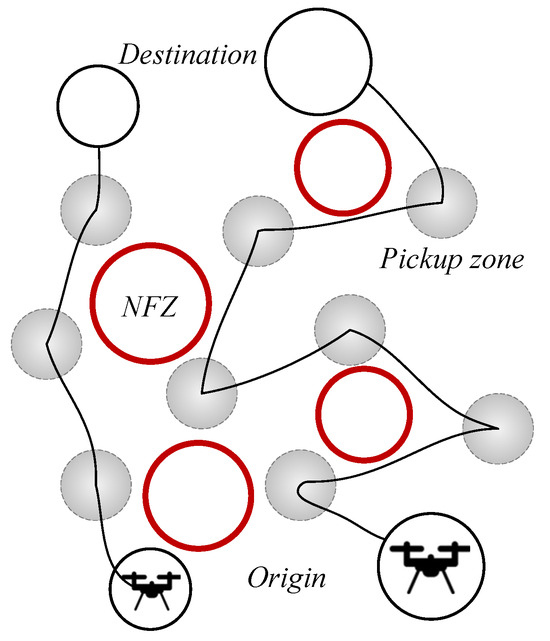
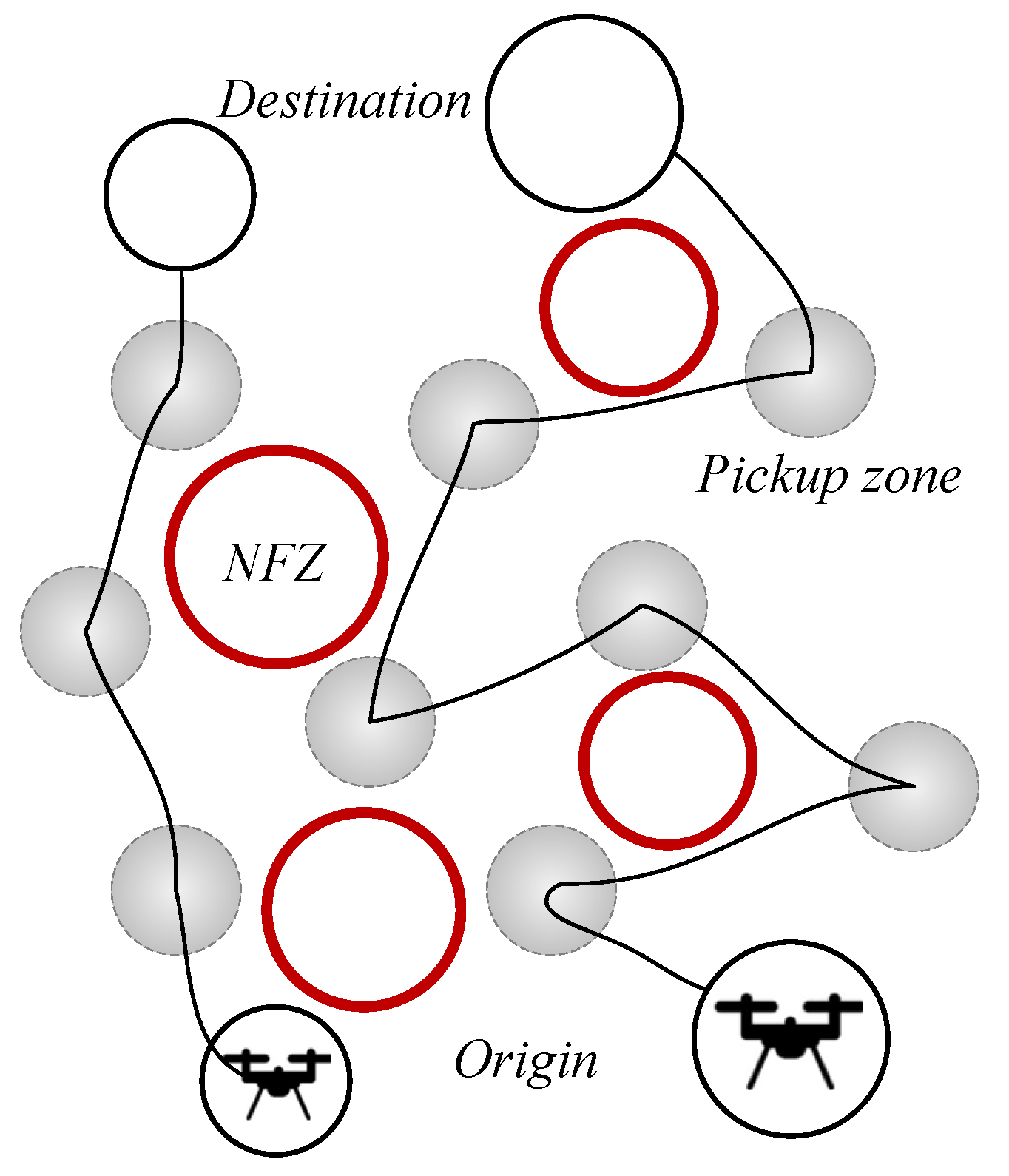
Figure 1 illustrates a heterogeneous multi-UAV pickup system, where M rotary-wing UAVs take off from their respective origins , collect K parcels, and finally return to their designated destinations . Each parcel has an associated weight . Since the UAVs are heterogeneous, each UAV possesses distinct performance characteristics, such as a maximum flight speed and a maximum payload capacity . These differences must be properly considered in the pickup scheduling and trajectory design to ensure efficient load-balancing. The flight duration of UAV m is denoted by , which is divided into N discrete time slots of variable lengths , such that , while N is fixed, the slot length is treated as an optimization variable [7,9].
Figure 1.
System model of heterogeneous multi-UAV systems.
2.2. Mobility Constraints
At each time slot , the 3D position of UAV m is represented by , where and denote its horizontal and vertical coordinates, respectively. The maximum flight speed of UAV m constrains its travel distance within slot n to . To prevent in-air collisions, the distance between any pair of UAVs , , must remain above the safety threshold . Given the predefined origin and destination , the UAV mobility constraints can be formulated as follows:
2.3. NFZ Constraints
In practice, the UAVs may encounter L non-overlapping cylindrical NFZs, where each NFZ is characterized by its center coordinate and radius . Since UAVs are prohibited from entering these regions, it is assumed that all parcels to be picked up are located outside the NFZs. Building on the concept of the expanded NFZ proposed in [9], we introduce the following additional constraint to ensure that the UAV completely avoids the NFZs along its continuous trajectory.
2.4. Pickup-Related Constraints
Let denote a binary variable indicating whether UAV m picks up parcel k at time slot n. Specifically, if parcel k is picked up by UAV m during slot n, and otherwise. Given that UAV m has a maximum payload capacity , the total carried weight at time slot n, represented by , must not exceed this limit, i.e., . Accordingly, the pickup-related constraints can be expressed as follows:
where constraint (6) ensures that each parcel is assigned to at most one UAV across all time slots, while constraint (7) restricts each UAV to pick up no more than one parcel per slot.
Each UAV is allowed to fly at a fixed altitude H, and descending below this level is permitted only during parcel pickup operations. Accordingly, the altitude constraint can be expressed as follows:
To pick up parcel k, the UAV must land within its designated pickup zone, defined as a circular area centered at where and radius ; this region, illustrated as a gray circle in Figure 1, represents the spatial tolerance for pickup operations. The UAV is required to remain within this zone not only at the moment of pickup but also during the descent and ascent phases associated with the operation. Hence, the spatial constraints can be expressed as
where constraint (11) is necessary to comply with the altitude constraint in (9), which allows the UAV to descend below only when performing a pickup. Without this constraint, the UAV could start descending prematurely while flying toward the pickup location, violating the prescribed altitude range and potentially compromising flight safety.
Finally, the mission completion constraint ensures that all parcels are picked up, which is expressed as
2.5. Problem Formulation
In line with objective of this study, the optimization is performed over the pickup assignment , the UAV trajectories , and the slot durations . Letting , the problem is formulated as
Problem (P1) is a mixed-integer nonlinear programming (MINLP) problem, since contains binary variables as defined in (5) and constraints (3), (4), (10), and (11) are nonconvex with respect to the corresponding optimization variables. As a result, obtaining a globally optimal solution in closed form is mathematically intractable.
3. Proposed Algorithm
To address the nonconvexity of (P1), the SCA technique is employed to transform the original problem into a convex form, which can be efficiently solved using standard convex solvers such as CVX [15]. In addition, the binary variables are relaxed to continuous ones, and the PCCP is adopted to maintain their binary characteristics. Finally, a two-stage low-complexity iterative algorithm is developed to obtain near-optimal solutions by repeatedly solving the relaxed convex problem.
To address the nonconvexity of constraint (3), it needs to be approximated by a convex form. Since the left-hand side (LHS) of (3) is convex with respect to , and any convex function can be lower-bounded by its first-order Taylor expansion at a given point [16], the original constraint can be conservatively replaced by the following linear lower-bound form:
where represents the approximated 3D position of UAV m at time slot n obtained from the previous SCA iteration.
Similarly, we can transform constraint (4) into the following convex set:
where denotes the approximated horizontal position of UAV m at time slot j obtained from the previous SCA iteration.
To handle the binary variable in (5), it can be equivalently expressed as
Here, is relaxed to a continuous variable in (16), while its binary property is preserved through (17). However, constraint (17) is nonconvex and tightly restricts the feasible region of . Since the LHS of (17) is concave in , and any concave function can be upper-bounded by its first-order Taylor expansion [16], the PCCP [17] is employed with a nonnegative slack variable to efficiently update while enlarging the feasible search space for optimization. Accordingly, (17) can be approximated by the following convex surrogate constraint:
where is the approximated pickup indicator of UAV m for parcel k at time slot n obtained from the previous SCA iteration.
To deal with the nonconvexity of constraint (10), we first reformulate it into the following expression:
where is a constant introduced to prevent division by zero. Although (19) is still nonconvex, the right-hand side (RHS) is convex with respect to . Hence, a convex approximation can be obtained by linearizing the RHS around a given local point , yielding the following lower-bound form:
Similarly, constraint (11) can be convexified in the same manner as
Based on these relaxed constraints, we can transform (P1) into the following convex optimization problem:
where and . Here, is a penalty function that enforces the binary property of the pickup indicator. The parameter adjusts the influence of this penalty on the objective of (P2). When is small, the optimization primarily focuses on minimizing the objective, allowing to take nonzero values and to deviate from strict binarity. As increases, the penalty effect dominates, driving toward zero and forcing to become binary, thereby recovering the original objective and diminishing the penalty term [17].
In problem (P2), the pickup completion time of all UAVs is optimized to be identical, since is defined as . Consequently, a UAV that finishes its assigned pickups earlier must wait for the others to complete theirs, leading to unnecessary trajectory extension and potential energy waste. To address this issue, the UAV trajectories are further optimized to minimize the total travel distance, defined as , while keeping the other variables fixed to the values obtained from (P2). The resulting problem is formulated as
It is noted that in (P3), the slot durations optimized in (P2) are fixed; hence, the pickup completion time remains unchanged, and only the trajectories of the UAVs are further refined for efficiency. Algorithm 1 describes the overall procedure for the proposed algorithm.
| Algorithm 1 Proposed Algorithm |
1Set and initialize , , , , , , and 2Calculate based on these initial values 3repeat 4 5 6Find by solving (P2) for given 7Update 8Calculate 9until 10Calculate 11repeat 12 13 14Find by solving (P3) for given 15Calculate 16until . |
Algorithm 1 begins with an initial feasible value and an initial penalty parameter , which is progressively increased by a multiplicative factor until it reaches the predefined upper bound . According to Theorem 1 in [18], there exists a finite value of that is sufficient to enforce the binary nature of the relaxed variables. Once the penalty parameter attains this upper limit, the resulting objective function becomes monotonically non-increasing, i.e.,
and, because the objective is also bounded below by a finite constant [19], the iterative procedure is guaranteed to converge.
Following the standard analysis of worst-case complexity for interior-point methods [16,20], the overall complexity of the proposed algorithm becomes , , where and denote the numbers of iterations required for the convergence of the first and second loops, respectively. Since the first loop dominates the total computational burden, the overall complexity exhibits polynomial-time growth with respect to , confirming the practicality of the proposed method for real-time implementation [21].
4. Performance Evaluation and Discussion
For performance evaluations, pickup zones and NFZs are randomly generated according to a uniform distribution in a square area of size 1000 m × 1000 m. The parameters listed in Table 1 were used as the default settings for our simulations. For performance comparison, the proposed scheme, determined by Algorithm 1, is evaluated against the following three baseline schemes.
Table 1.
Parameter Setup.
- Baseline 1 scheme: Heterogeneous multi-UAV strategy is optimized to minimize the average completion time of UAVs, .
- Baseline 2 scheme: Each UAV sequentially picks up the nearest parcel as it moves, while ensuring that its payload capacity is not exceeded.
- Baseline 3 scheme: Low-capability UAVs are assigned to pick up lighter parcels within their payload capacity, whereas high-capability UAVs collect the remaining heavier parcels.
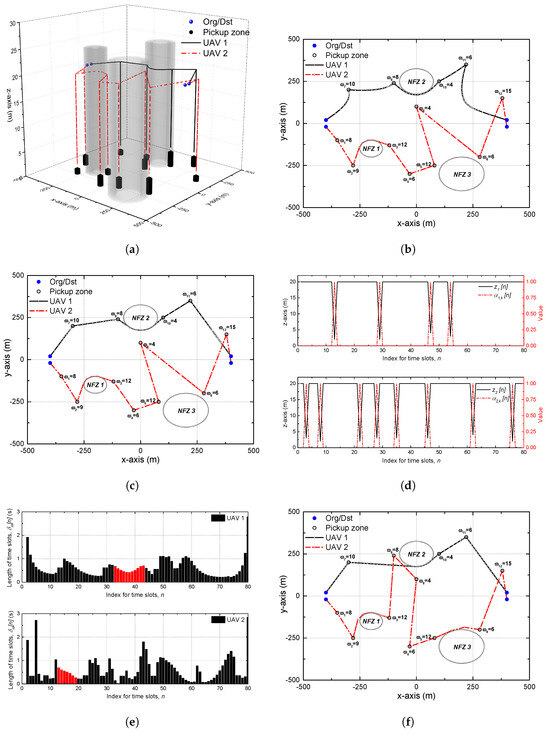
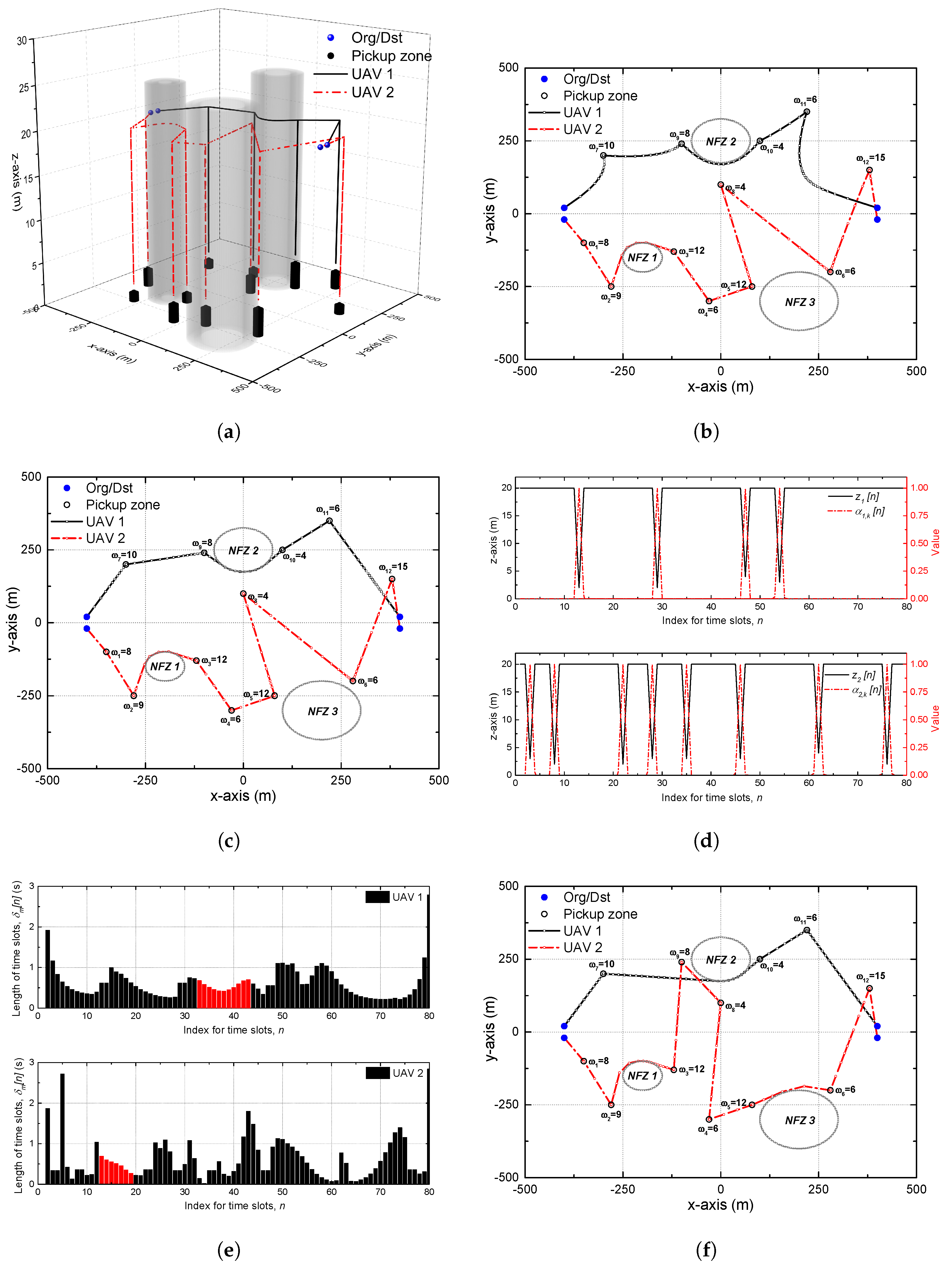
Figure 2 presents the trajectories and resource allocation of the proposed scheme. In Figure 2a, the pickup zones at different heights are indicated by black bars. Each UAV descends toward its assigned pickup zone while maintaining the tolerance constraint of = 1 m during parcel collection.
Figure 2.
Trajectory and resource allocation of the proposed scheme. (a) 3D trajectory solved for (P3). (b) 2D trajectory solved for (P2). (c) 2D trajectory solved for (P3). (d) Vertical trajectory and pickup indicator. (e) Length of time slots. (f) 2D trajectory solved for (P3) when = 20 m/s and = 20 kg.
To provide a clearer understanding of the spatial movement, the horizontal trajectories are separately illustrated in Figure 2b,c. The markers along each UAV trajectory represent the UAV’s position at each time slot, while the parcel weights () are indicated at their corresponding pickup zones. The objective of the original problem is to minimize the maximum pickup completion time among UAVs; thus, the control variables are optimized to balance their completion times as closely as possible. As a result, the low-capability UAV, constrained by its lower speed and limited payload, picks up fewer parcels and occasionally follows an inefficient path due to idle periods. In contrast, the high-capability UAV collects more parcels and naturally forms a more compact and time-efficient route. Consequently, as shown in Figure 2b, the low-capability UAV exhibits unnecessary detours because the objective in problem (P2) does not account for the individual travel distance of each UAV. In Figure 2c, when the trajectory control variable is further optimized in problem (P3) with the other parameters fixed from (P2), the trajectory of the low-capability UAV becomes more efficient, whereas that of the high-capability UAV remains nearly unchanged since it already follows the shortest path. This additional optimization reduces the total travel distance while maintaining fairness in completion times among UAVs.
Figure 2d shows that the pickup indicators are optimized to 1 when UAVs descend for parcel collection, demonstrating consistent synchronization between vertical trajectory and pickup assignment. This behavior also verifies that the PCCP-based update effectively drives the relaxed assignment variables toward binary values, ensuring that the final pickup decisions exhibit the intended discrete structure. Figure 2e shows the adaptive allocation of time slots. Red segments indicate UAV operations near NFZs, where the time slots are shortened for finer control, ensuring smooth and safe transitions along the trajectory. Finally, Figure 2f illustrates the horizontal trajectory under a more severe capability asymmetry condition, where = 20 m/s and = 20 kg. In this scenario, the high-capability UAV adaptively balances the workload by handling a larger number of parcels and establishing a time-efficient trajectory, highlighting the robustness of the proposed scheme in highly unbalanced environments.
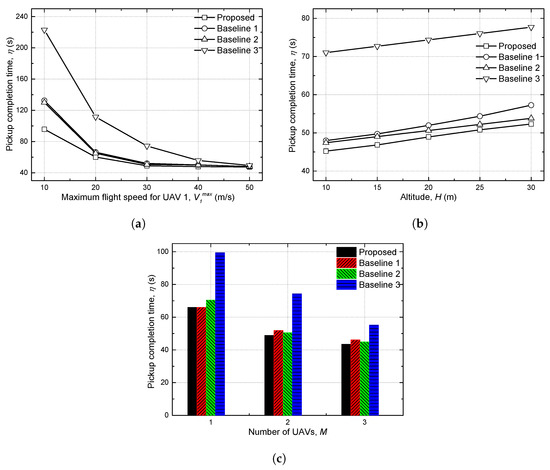
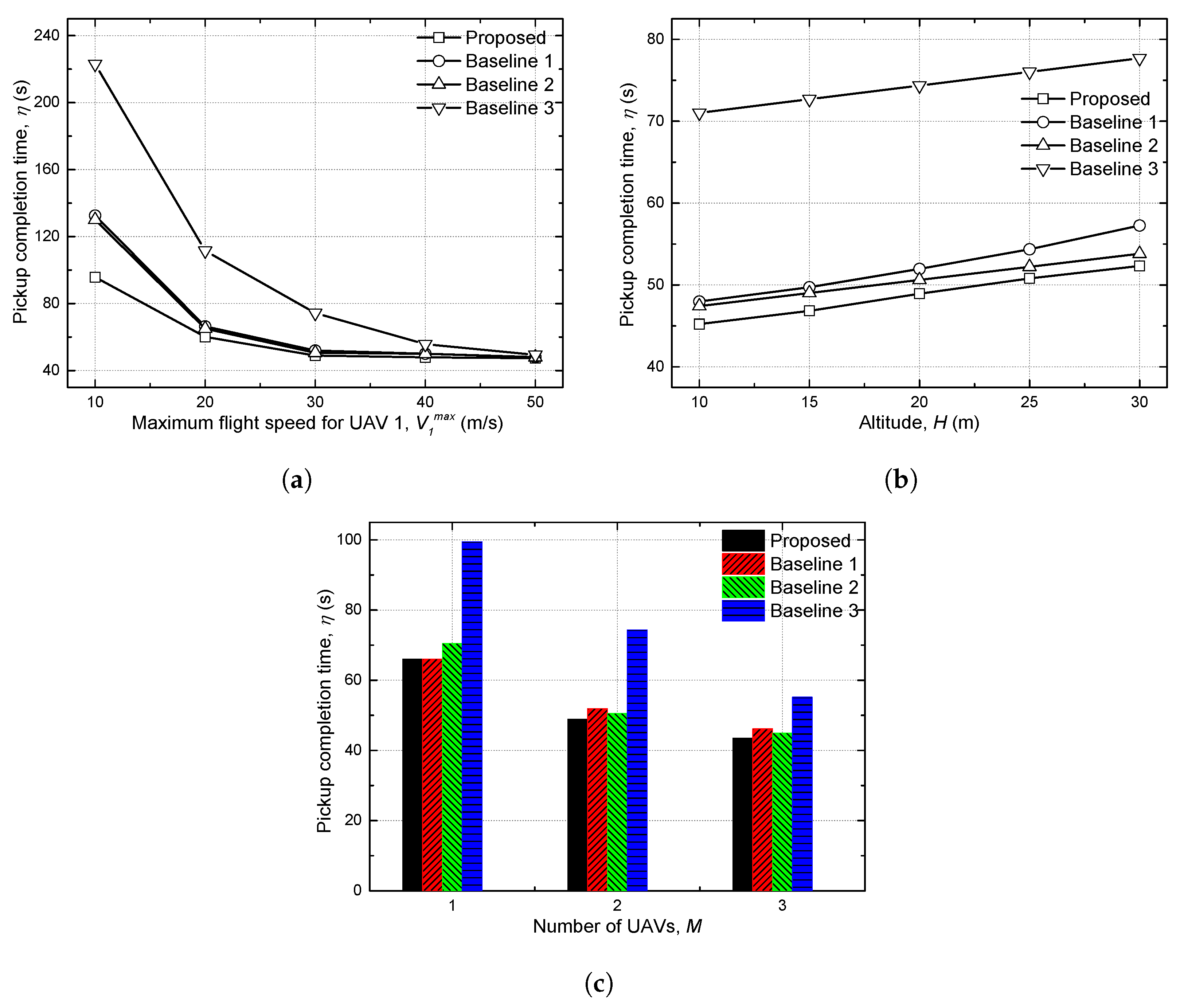
Figure 3 compares the pickup completion times of different schemes under various system parameters: (a) the maximum flight speed for UAV 1 , (b) the flight altitude H, and (c) the number of UAVs M. As shown in Figure 3a, a smaller intensifies the asymmetry between UAVs, forcing the high-capability UAV to undertake a heavier workload and consequently increasing the overall pickup completion time. The proposed scheme effectively mitigates this performance degradation by adaptively balancing the workload, leading to a smaller rise in and achieving higher performance gain under asymmetric conditions. Among the baselines, Baseline 1 minimizes the average completion time of all UAVs, focusing on overall efficiency rather than balancing individual workloads. Baseline 2, which sequentially picks up the nearest parcel during flight, implicitly achieves better load balance by considering spatial proximity. Consequently, both schemes show relatively good performance, as their strategies inherently reflect completion time and parcel distribution. In contrast, Baseline 3, which determines the pickup schedule solely based on parcel weights, performs poorly because it neglects spatial and temporal efficiency. Figure 3b illustrates that as the flight altitude increases, UAVs must traverse longer vertical distances to collect parcels, resulting in higher across all schemes. Conversely, as depicted in Figure 3c, increasing the number of UAVs reduces , since the same number of parcels can be divided among more UAVs, thereby alleviating individual workloads. Notably, as M increases, Baseline 2 achieves slightly better performance than Baseline 1 by implicitly balancing the load according to parcel proximity and spatial distribution. Across all parameter settings in Figure 3, the proposed method consistently outperforms every baseline scheme. This uniform superiority demonstrates that the proposed optimization framework not only adapts effectively to varying degrees of UAV capability asymmetry but also provides robust load-balancing performance under diverse environmental configurations. The results, therefore, validate the effectiveness of the joint optimization of pickup assignment, trajectory planning, and slot-duration allocation embodied in the proposed strategy.
Figure 3.
Performance comparisons. (a) versus . (b) versus H. (c) versus M.
5. Conclusions
Optimizing UAV strategies in heterogeneous multi-UAV systems is crucial for ensuring efficient, reliable, and balanced operations, particularly in urban environments where mobility constraints, asymmetric capabilities, and no-fly zones jointly influence mission performance. Accordingly, this paper presented a load-balanced pickup framework for heterogeneous multi-UAV systems, focusing on mitigating workload imbalance that arises when UAVs have different flight speeds and payload capacities. By formulating the joint pickup assignment and trajectory design as a mixed-integer nonlinear programming problem, the study explicitly incorporated mobility, NFZ avoidance, and payload constraints into a unified optimization model. The resulting two-stage algorithm first applies SCA and PCCP-based techniques to minimize the maximum mission completion time, thereby equalizing the completion times of heterogeneous UAVs as much as possible. In the second stage, with the completion times fixed, the UAV trajectories are further refined to reduce the total travel distance, improving operational efficiency without sacrificing fairness. Numerical simulations under various system configurations, including different flight speeds, altitudes, and numbers of UAVs, demonstrated that the proposed scheme consistently achieves shorter pickup completion times than representative benchmark strategies. In particular, the framework effectively adapts to severe capability asymmetry by assigning more pickups and more efficient routes to high-capability UAVs while preventing low-capability UAVs from becoming bottlenecks. These results confirm that the proposed method can provide robust performance in complex environments with NFZs and tight safety constraints, which frequently arise in practical logistics and urban air-mobility scenarios. Overall, the study shows that capability-aware load balancing combined with trajectory refinement is a promising approach for coordinating heterogeneous UAV fleets, and it lays a foundation for future extensions that may incorporate energy consumption models, communication constraints, or stochastic task arrivals.
Funding
This work was supported by the National Research Foundation of Korea (NRF) grant funded by the Korea government (MSIT) (RS-2025-16065671).
Institutional Review Board Statement
Not applicable.
Informed Consent Statement
Not applicable.
Data Availability Statement
The original contributions presented in this study are included in the article. Further inquiries can be directed to the corresponding author.
Conflicts of Interest
The author declares no conflicts of interest.
References
- Ghamari, M.; Rangel, P.; Mehrubeoglu, M.; Tewolde, G.S.; Sherratt, R.S. Unmanned Aerial Vehicle Communications for Civil Applications: A Review. IEEE Access 2022, 10, 102492–102531. [Google Scholar] [CrossRef] [Scilit]
- Dissanayaka, D.; Wanasinghe, T.R.; De Silva, O.; Jayasiri, A.; Mann, G.K.I. Review of Navigation Methods for UAV-Based Parcel Delivery. IEEE Trans. Autom. Sci. Eng. 2024, 21, 1068–1082. [Google Scholar] [CrossRef] [Scilit]
- Seo, J.; Choi, Y.; Jeon, S.-E.; Chae, S.H.; Hong, J.-P. Learning-Based Geographic Routing for Delay-Limited Multi-Hop Wireless Networks. IEEE Sens. J. 2024, 24, 42163–42171. [Google Scholar] [CrossRef] [Scilit]
- Adeleke, A.A. A Review of Plastic Contamination Challenges and Mitigation Efforts in Cotton and Textile Milling Industries. AgriEngineering 2023, 5, 193–217. [Google Scholar] [CrossRef] [Scilit]
- Dorling, K.; Heinrichs, J.; Messier, G.G.; Magierowski, S. Vehicle Routing Problems for Drone Delivery. IEEE Trans. Syst. Man Cybern. Syst. 2017, 47, 70–85. [Google Scholar] [CrossRef] [Scilit]
- Huang, H.; Hu, C.; Zhu, J.; Wu, M.; Malekian, R. Stochastic Task Scheduling in UAV-Based Intelligent On-Demand Meal Delivery System. IEEE Trans. Intell. Transp. Syst. 2022, 23, 13040–13054. [Google Scholar] [CrossRef] [Scilit]
- Park, G.; Lee, W.; Lee, K. 3D Multi-Trajectory and Pick-Up Optimization of UAV for Minimizing Delivery Time with Weight Restriction. IEEE Trans. Intell. Transp. Syst. 2024, 25, 17562–17573. [Google Scholar] [CrossRef] [Scilit]
- Wen, W.; Luo, K.; Liu, L.; Zhang, Y.; Jia, Y. Joint Trajectory and Pick-Up Design for UAV-Assisted Item Delivery under No-Fly Zone Constraints. IEEE Trans. Veh. Technol. 2023, 72, 2587–2592. [Google Scholar] [CrossRef] [Scilit]
- Heo, K.; Park, G.; Lee, K. Joint Optimization of UAV Trajectory and Communication Resources with Complete Avoidance of No-Fly-Zones. IEEE Trans. Intell. Transp. Syst. 2024, 25, 14259–14265. [Google Scholar] [CrossRef] [Scilit]
- Kuru, K.; Ansell, D.; Khan, W.; Yetgin, H. Analysis and Optimization of Unmanned Aerial Vehicle Swarms in Logistics: An Intelligent Delivery Platform. IEEE Access 2019, 7, 15804–15831. [Google Scholar] [CrossRef] [Scilit]
- Liu, Z.; Li, Y.; Wu, Y. Multiple UAV Formations Delivery Task Planning Based on a Distributed Adaptive Algorithm. J. Franklin Inst. 2023, 360, 3047–3076. [Google Scholar] [CrossRef] [Scilit]
- Sajid, M.; Mittal, H.; Pare, S.; Prasad, M. Routing and Scheduling Optimization for UAV-Assisted Delivery System: A Hybrid Approach. Appl. Soft Comput. 2022, 126, 109225. [Google Scholar] [CrossRef] [Scilit]
- Deng, Z.; Wu, F.; Xu, Y.; Luo, Y.; Yang, D.; Xiao, L. Multi-UAVs Pickup and Delivery Problem: Minimizing Maximum Energy Consumption. In Proceedings of the 2024 IEEE Global Communications Conference (GLOBECOM), Cape Town, South Africa, 9–13 December 2024; pp. 2027–2033. [Google Scholar] [CrossRef] [Scilit]
- Xiao, Q.; Gao, J. Resilient Last-Mile Logistics in Smart Cities Through Multi-Visit and Time-Dependent Drone–Truck Collaboration. Drones 2025, 9, 782. [Google Scholar] [CrossRef] [Scilit]
- Grant, M.; Boyd, S. CVX: Matlab Software for Disciplined Convex Programming, Version 2.1. Available online: http://cvxr.com/cvx (accessed on 11 December 2025).
- Boyd, S.; Vandenberghe, L. Convex Optimization; Cambridge University Press: Cambridge, UK, 2004. [Google Scholar] [CrossRef] [Scilit]
- Lipp, T.; Boyd, S. Variations and Extensions of the Convex–Concave Procedure. Optim. Eng. 2016, 17, 263–287. [Google Scholar] [CrossRef] [Scilit]
- Vu, Q.-D.; Nguyen, K.-G.; Juntti, M. Max–Min Fairness for Multicast Multigroup Multicell Transmission under Backhaul Constraints. In Proceedings of the 2016 IEEE Global Communications Conference (GLOBECOM), Washington, DC, USA, 4–8 December 2016; pp. 1–6. [Google Scholar] [CrossRef] [Scilit]
- Bertsekas, D.P. Nonlinear Programming; Athena Scientific: Belmont, MA, USA, 1999. [Google Scholar]
- Ben-Tal, A.; Nemirovski, A. Lectures on Modern Convex Optimization: Analysis, Algorithms, and Engineering Applications; SIAM: Philadelphia, PA, USA, 2001. [Google Scholar] [CrossRef] [Scilit]
- Cormen, T.H.; Leiserson, C.E.; Rivest, R.L.; Stein, C. Introduction to Algorithms, 2nd ed.; MIT Press: Cambridge, MA, USA, 2001. [Google Scholar]

Disclaimer/Publisher’s Note: The statements, opinions and data contained in all publications are solely those of the individual author(s) and contributor(s) and not of MDPI and/or the editor(s). MDPI and/or the editor(s) disclaim responsibility for any injury to people or property resulting from any ideas, methods, instructions or products referred to in the content. |
© 2025 by the author. Licensee MDPI, Basel, Switzerland. This article is an open access article distributed under the terms and conditions of the Creative Commons Attribution (CC BY) license.