


Abstract
Biophysical observations in different brain regions have displayed synchronous firing in inhibitory neural networks. Although inhibition reduces the postsynaptic neuron’s activity, coordinated synchronous rhythms could be predicted provided that inhibition delay is incorporated into the biophysical models. In this article, we study the local dynamics of two mutually coupled neurons connected via inhibitory synapses. The key assumption in the model is that the neurotransmitter release activates some secondary synaptic processes that give additional time to the postsynaptic neuron before it feels the inhibition. Stability conditions for synchrony are derived for this simple inhibitory network. Numerical experiments are presented that justify theoretical conclusions. The geometric singular perturbation theory is used as well as a variational argument.
Keywords:
local neural networks; mutually coupling; inhibition; synchronous oscillations; stability conditions MSC:
92B20; 34D06; 34D10; 34C15
1. Introduction
Inhibition is an essential mechanism for proper functioning of the brain and entire nervous system [1,2,3,4,5,6]. Inhibitory neural networks regulate the activity of excitatory neurons, control spike timing and play a central role in the behavior of the brain [7,8,9]. Inhibitory neural activities are related to functions such as locomotion [10,11] and to pathological brain states such as anxiety-driven behaviors [12,13]. Although it is still not fully understood how inhibitory neurons like GABAergic neurons modulate behavioral states, it is clear now that “in every single psychiatric disease, there is some kind of an inhibitory oscillation problem” [7].
Oscillations [14] are one of the main subjects, whose study aims to better understand the central nervous system. The types of dynamical behavior include synchronization [15,16], where each cell in the network becomes active simultaneously, clustering [17,18,19], where cells split into groups that have synchronization within each group but are not synchronized to cells of other groups, and more complicated behaviors, such as traveling waves [20,21].
After the pioneering works of Ermentrout, Kopell, Rinzel, Wang, and Terman [22,23,24,25,26,27,28], efforts have been focused on creating biophysical models to control the synchrony in inhibitory oscillations. While excitatory networks amplify electrical signals [29], inhibitory networks tend to suppress them, which makes synchronization a delicate problem [30]. Typically, inhibitory oscillation models exhibit chaotic behaviors [31,32,33,34]. In [35], the mechanisms of neural synchronization in hippocampal networks are explored, focusing on the role of spike doublets in inhibitory neurons. The study investigates how conduction delays between neurons affect synchronization and how the timing of spikes within doublets contributes to this process. The authors of [32] established two synchronization mechanisms in inhibitory neural networks: inhibition delay and high-frequency entrainment based on the neurotransmitter kinetics. In [36], synchronization of a two-cell neural network in the presence of multiple synaptic connections is examined. Analytical and numerical results are obtained regarding how synaptic strength changes and transmission delays between neurons impact synchronization.
Motivated by the above works, we consider a two-cell neural network mutually coupled by inhibitory synapses. The aim is to obtain stability conditions for synchronous oscillations. For this purpose, inhibition delay needs to be incorporated into the model. Using the framework in [27], but examined in a novel way utilizing a single parameter for the time and position estimations between the two neurons, we analytically obtain a new parameter set in which stable synchronization occurs. Precise sufficient conditions are presented for adequate timing in both silent and active phases of the neurons, for the delay from the time one oscillator activates until the time the other oscillator feels the inhibition and for the stable synchronization of the two cells. The delay is biologically relevant, as was pointed out above, and is crucial for the synchronization.
This paper is organized as follows. In Section 2, the problem is introduced, and using the geometric singular perturbation theory it is reduced to fast and slow subsystems in Section 3. In Section 4, general assumptions about the nonlinear functions in the model are stated and two lemmas are proved concerning properties of the jump-up curve. In Section 5 the problem is restated and the main stability conditions are listed. Section 6 contains preliminary results about the timing during the cycle. Section 7 contains the analytical results and an example in Section 8 illustrates them.
2. The Model
Following [27], we describe the dynamics of a single neuron without any coupling by the equation
known as the relaxation oscillator. Here v denotes the membrane potential of the cell while w is a relaxational variable, which evolves on a slow time scale since is chosen to be small. We assume that the v-nullcline is a cubic-shaped curve and the w-nullcline is a monotone increasing curve that intersects the cubic at a single point, denoted by . We suppose that is situated on the middle branch of the cubic nullcline. Also, we assume that () below (above) the cubic v-nullcline and () below (above) the w-nullcline. According to the Poincaré–Bendixson theorem, for sufficiently small, (1) has a limit cycle that approaches a singular limit cycle as .
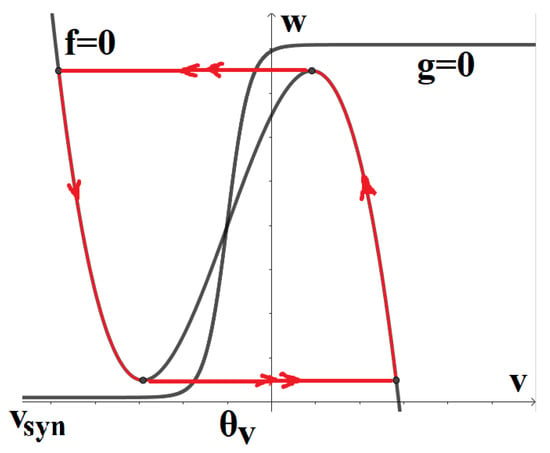
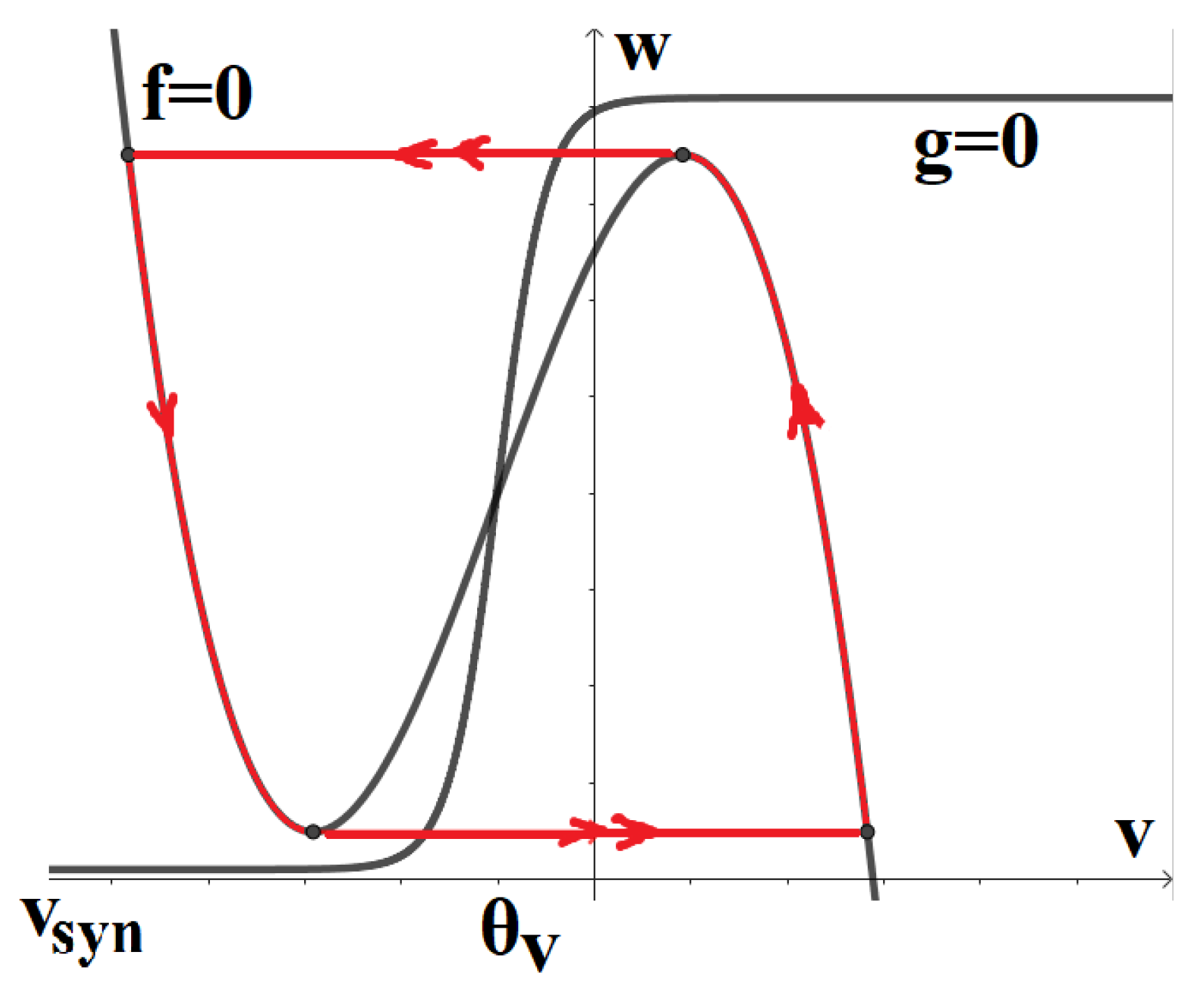
The singular limit cycle is shown in Figure 1. One part of the cycle lies along the left branch of the cubic nullcline and corresponds to the silent phase of the neuron. Another part lies along the right branch of the cubic nullcline and corresponds to the active phase of the neuron. The other two lie along horizontal lines in the phase plane v–w and connect the left and right branches. The “jump-up” to the active phase occurs at the minimum of the cubic and the “jump-down” occurs at the maximum.
Figure 1.
Nullclines and singular limit cycle (red) of a relaxation oscillator.
In our work, we consider a model of two mutually coupled inhibitory neurons, which, without coupling, are modeled by (1) ([27]):
Here and are the two oscillators, corresponds to the maximal conductance of the synapse and the reversal potential is such that along each bounded singular solution; thus the coupling term and the synapse is inhibitory. The functions give the synaptic strengths (the inhibitions). Note that synapses activate quickly and deactivate slowly. Here are rate constants, H is the Heaviside step function and and are threshold constants. The additional functions ensure a delay from the time one oscillator jumps up (the membrane potential rises up and crosses ) until the time the other oscillator feels the inhibition ( increases until it crosses ).
3. Reduced Systems—Fast and Slow Regimes
The reduction of problem (2)–(3) into fast and slow equations is given in [27]; we present it here for completeness and the reader’s convenience. Using the method of singular perturbation theory, we obtain fast equations from the above system by setting . In this regime, w is a constant along each solution. Fast equations determine the evolution of the trajectories of the two cells along the jump up and jump down.
The behavior of solutions near the cubic nullcline during the silent and active phases of the oscillators is governed by the slow equations. They are obtained by introducing the slow time scale into (2)–(3) and then setting in the resulting system. The derivative is denoted by . In what follows, only the slow equations are considered with respect to the slow time , since the jump up and jump down happen instantaneously with respect to . There are three slow regimes.
- i.
- The two cells are silent
From the first two equations in (2), it follows that trajectories lie on the left branch of the cubic-like surface
and since , in this regime
Equations (4) and (5) can be reduced further. If the left branch of (4) is given by , then substituting in (5) and denoting , we reach
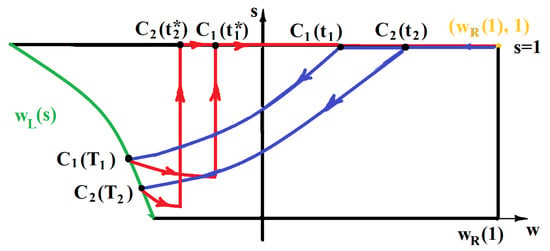
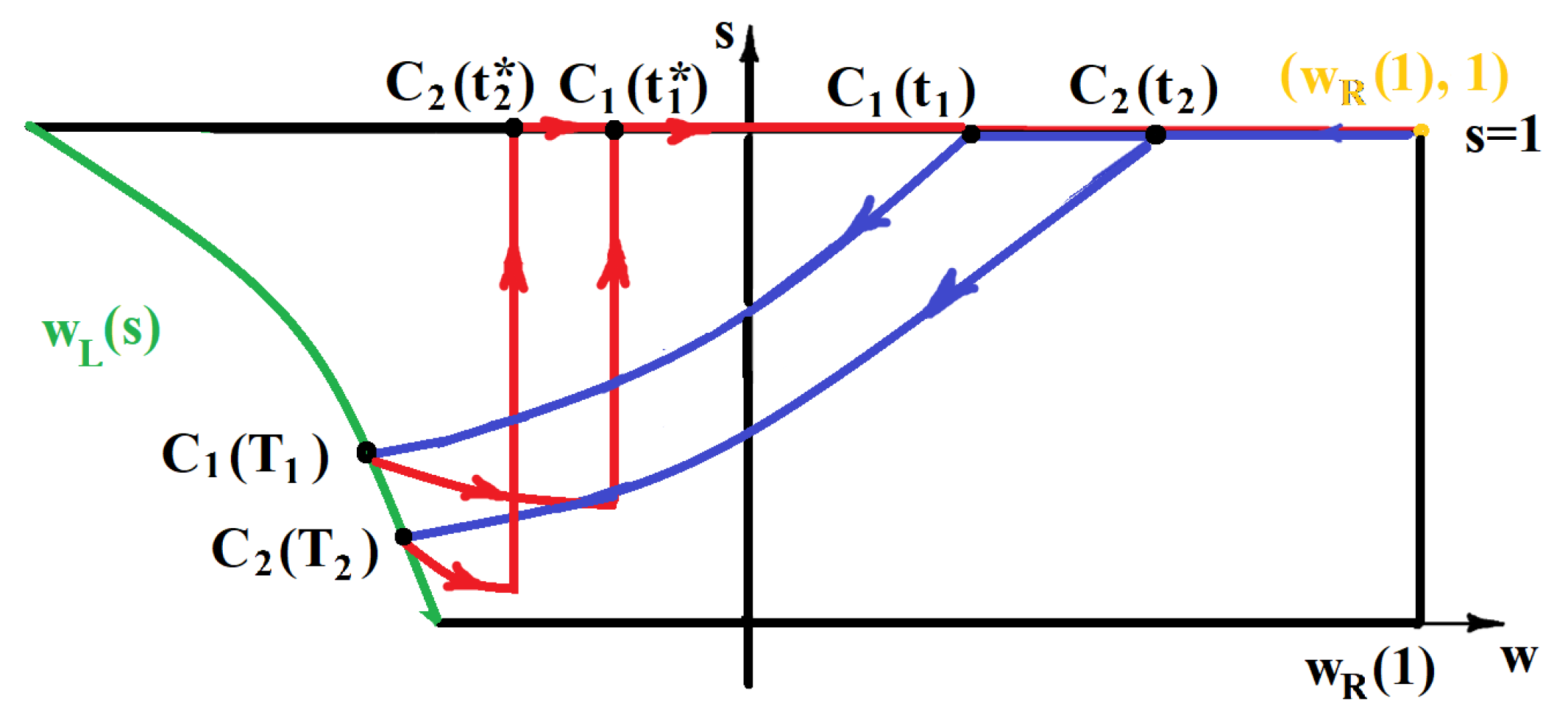
In this regime the two cells are not coupled. Coupling happens at the moment one of the cells reaches the jump-up point to the right branch on the cubic surface (4) in the active phase. The jump-up curve in the phase plane of the slow variables w–s (Figure 2) corresponds to the curve of minimums on the left branch of (4). Later, we will see that the (reciprocal) slope of the jump-up curve is negative,
for , which means the bigger the value of inhibition , the smaller the value to which must decrease to jump.
Figure 2.
The phase planes w–s both in the silent phase and in the active phase—one possibility. In the silent phase the trajectories of the two cells are given in blue (cell 1 starts at while cell 2 starts at ); in the active phase the trajectories are given in red. The jump-up curve is presented in green.
- ii.
- The two cells are active
In this regime the trajectories lie on the right branch of cubic surface (4),
with ; in this regime it follows that
We denote the right branch of (4) by and substituting in (5); then denoting , we reach
If the synapses were direct and initially the two cells were close to each other in their silent phases, the jump up of a cell to the active phase would switch on immediately for the other cell, setting the two cells wide apart from each other, and thus the synchronization would not be possible. In our case of indirect synapses, the jump up of cell 1 switches the inhibition with a delay due to the time necessary for to increase up to , as is clear from Equation (8). During that delay it is possible (within a parameter set) for cell 2 to reach the curve as well and to jump up before its inhibition is set to 1.
A cell leaves its active phase when its trajectory reaches the local maximum of cubic obtained from (4) with . Hence, cells jump down to their silent phases through the same point in the phase plane w–s, denoted by .
- iii.
- One cell is silent and the other cell is active—the equations in this case are presented below.
4. General Assumptions and Properties of the Jump-Up Curve
In this section we make assumptions on the nonlinear functions in (2) and (3) [27].
Suppose the following conditions are satisfied: is a cubic-like curve while is increasing and intersects the cubic nullcline at a single point that is situated on the middle branch. As before, we assume that below (above) the cubic -nullcline, below (above) the -nullcline and
H1.
near the v-nullcline.
H1’.
increases in v and decreases in w.
H2.
near the left branches of (4) for .
H3.
near the right branches of (4) for .
H4.
on the left branches of (4) for and .
H5.
.
As (H4) shows, the inhibition decay K must be small, which means that when the inhibition of the two oscillators is not maximal (), it nevertheless remains close to the maximum value. The next two lemmas concern properties of the jump-up curve. The following lemma is proved in [27], Remark 4; we present it here for the reader’s convenience.
Lemma 1
([27]). Suppose that condition (H1) is fulfilled. Let the curve of minimums on the left branch of the cubic surface (4) be denoted by . Then the (reciprocal) slope of the jump-up curve for .
Proof.
Let be the left-hand side of (4). Since the left branch of (4) is given by ,
Substituting into (4) and then differentiating with respect to s yields
On the other hand, since becomes unbounded at the points of minimum on the left branch of (4), it follows that along the jump-up curve. Then the last equation yields
The result follows from (H1) and the fact that synapses are inhibitory, , . □
The following lemma concerns a property of the jump-up curve under the backward flow of the differential equation during the phase when the two cells are silent. This lemma is the tool for proving the main results in the next section.
Lemma 2.
Suppose that conditions (H1), (H1’), (H2) and (H4) are satisfied. Consider the image of the jump-up curve under the backward flow of
Then the slope of the image of under the flow of (10) stays negative for all and .
Proof.
contradicting (14) and proving (13).
Consider the variational equations associated with (10). These equations are as follows:
(cf. Tancredi et al., 2001 [37]), where and are calculated along the solutions of (10). Denote . If we take , the slope of at some , then for represents the evolution of this slope along the backward flow of (10). From Lemma 1 it follows that .
From (11), the slope is governed by
Thus, using conditions (H1) and (H2), the definition of and the equations obtained in the proof of Lemma 1, we have
along the flow of (10). Here we used on the left branch of (4) and along the flow of (10), since the synapses are inhibitory. Also, condition (H4) ensures that along the flow of (10).
We prove that
For this, it is enough to show that
along the backward flow of (10) for all . Indeed, (12) and (14) imply that increases near . Now, arguing by contradiction we denote . By the definition of , we have , which is equivalent to
Finally, in order to prove (14) we note that from (9) it is equivalent to
where . The left-hand side of the last inequality reduces to
and the desired result follows since and is increasing in v and decreasing in w. □
Remark 1.
In [27] Lemma 3, the same property of the jump-up curve is proved for , given in the form
where and represent the maximal conductance and reversal potential, respectively ([27] (2.2)). Thus, (1) includes the well-known Morris–Lecar equations [38]. Although (15) does not satisfy (H1’), all the results below are still applied for (2)–(3), with given in (15) since we use the monotonicity of in v and w only for proving Lemma 2.
5. The Problem Within One Complete Cycle
In this section, we proceed with introducing notations for the important moments of time during the movement of the two cells along their trajectories within a complete cycle. Without loss of generality, we suppose cell 1 at is at the point of jump down in the phase plane w–s, while cell 2 at is still in its active phase on the right branch of (4), and the two cells are maximally inhibited, . Also, we assume
We denote by the time needed for cell 2 to reach the jump-down position and assume is small. Until that time, the variable increases according to (8). At , the membrane potential decreases rapidly and crosses the threshold ; thus starts to decrease according to (3) and (6).
Let be the moment at which crosses the threshold for the first time. Thus,
and cell i is in its silent phase. After , according to (6) the inhibition starts to decrease. Let be the time at which the trajectory of cell i reaches the jump-up curve (Figure 2, blue lines). At , the membrane potential rises up rapidly and crosses the threshold again. At that moment , the variable of the other cell j starts to increase according to (8). Let be the moment at which crosses the threshold for the second time. Thus,
At the time the inhibition is set to 1 (Figure 2, red lines).
After , cell i is in its active phase. Let denote the time at which cell i reaches the jump-down point , and min. At , the cycle completes.
Note that under assumptions (H1) and (H3), it follows that . Indeed, by definition , where denotes the right branch of (4); thus we have
Hence, the problem under consideration within one complete cycle is as follows.
Note that depends on the parameters and nonlinear functions, and in general is not a constant with respect to following cycles. Let us summarize conditions for the nonlinearities obtained by now. Since below (above) the -nullcline of (1), from Lemmas 1 and 2 we have
on the phase space ;
Suppose additionally that the following conditions are satisfied:
H6.
.
H7.
.
Note that inequality (H7) stays valid, replacing by a smaller .
H8.
.
with . Let us note that (H8) yields
H8’.
.
H9.
.
We note that (H8’) implies that the logarithm on the right-hand side of (H9) is positive. Indeed,
Again, (H8), (H8’) and (H9) are still true, replacing by a smaller .
H10.
.
Where . From (H6) we have . Let us note that (H10) yields (H7) for sufficiently small .
H11.
.
6. Preliminary Results
Proposition 1
(A priori estimates for and ). Denote . Then the following inequalities hold.
Proof.
From (19) and (26) we have . Integrating for and using (20), we obtain
On the other hand, from (22) and Lemma 1 we have ; thus
Similarly, (19) and (26) yield . Integrating for and using (20), we obtain
Now (22) and Lemma 1 give us ; thus
The first two inequalities follow as before. □
The next two propositions give sufficient conditions for and to cross the threshold both in the silent and in the active phases of the oscillators. From the point of view of (23), this means that the inhibition will switch off and on during the cycle.
Proposition 2.
Suppose that (H8’) is satisfied. Then
Proof.
From (16), (17), (24) and (25), we have
Now (H8’) and Proposition 1 give the result. □
The following proposition presents conditions that guarantee a delay from the time one oscillator jumps up until the time at which the inhibition of the other oscillator is set to .
Proposition 3.
Suppose that (H8’) and (H9) are satisfied. Then
Proof.
From (18) and (24) we have
By (17), (25), (H8’) and Proposition 2, it follows that and . Thus
On the other hand, from (16), (25) and Proposition 1, we have
Hence (H9) implies
The first inequality follows in a similar way. □
7. Main Results
In what follows, we impose additional restrictions on the initial conditions , i = 1, 2 and in order to obtain synchronization between the two oscillators. By synchronization we mean that the time between the two cells at the end of the cycle has to be less than the time between them at the beginning of the cycle (sometimes we call this compression), and each time one of the cells jumps up (down) the other cell has to do the same almost simultaneously with the leading cell. The next theorem shows the ordering of the two oscillators at the important moments along their trajectories within the cycle and estimates the time at jumps up and jumps down.
Theorem 1.
Suppose that conditions (H1)–(H6), (H1’), (H8) and (H9), (16) and
are satisfied. The following inequalities are fulfilled:
- i
- ;
- ii
- ;
- iii
- ;
- iv
- .
Proof.
(i) From (28) and (30) the inequalities follow. As (16), (17) and (23) show, inequality means that the inhibition of cell 1, , starts to decrease from 1 first, before the inhibition of cell 2, , starts decreasing.
(ii) First, we show that (Figure 2). From (19), (20) and (i), we have for , for , and . Then for , and in particular
since decreases in according to (26).
We consider the trajectories of , , starting from the initial points and in D. From (17), (23), (25), (27) and Proposition 3, we deduce that
(Figure 2, blue lines). From (i) we have for , and in particular . Thus, from (32) it follows that , and since decreases according to (23), we conclude that . Hence, cell 1 reaches the jump-up curve first, and cell 2 is behind.
(iii) In order to show compression in the silent phases of the oscillators, we consider the image of the jump-up curve along the backward flow of (10) at the point and denote by the time needed for that backward translation. Also, we denote by the time at which the trajectory crosses the translated backward curve . Thus is such that the point lies on the translated jump-up curve, and
Since we have . We denote by
the (reciprocal) slope of the straight line connecting the points and . From the mean value theorem, there is a point lying on the translated backward jump-up curve (between and such that the slope of the tangent line at that point is equal to . From Lemma 2 we have , where is the corresponding (reciprocal) slope obtained from under the forward flow of (10) at . Thus
From we have two possibilities, either or . In the first case it follows immediately from (i) that , and the proof of (iii) is complete. In the latter case, , (i), (26), (31) and the last inequality give us
Thus, the mean value theorem applied to the first and last terms yields
where .
On the other hand
and the mean value theorem gives
for some between and . Thus we obtain
where E is denoted by
Next we show that . For this, we need to show first that is satisfied. Indeed, from the definition of , (28), Proposition 1 and (H8), we have
Also, Proposition 2 yields . Now, from for , we have
Also, from for , it follows that
Thus, subtracting the last two equalities and using (31), we obtain
From (23) and (i) we have for ; thus
with , on a compact subset in the interior of D. Then the Gronwall inequality yields
Hence,
We denote
and note that and there is unique such that in and in . From (33), it follows that for sufficiently small.
From and (34), we conclude that .
(iv) From (21) and (22) we have
We show that . Indeed, from , (17), (23), (27), (32), Proposition 3 and the mean value theorem, we have
for some between and and some between and . Thus, (26) and condition (H6) yield
Inequality (37) shows that at the end of the cycle, the leading cell will be cell 1. The last inequality follows directly,
Thus, we obtain compression of the time between the two cells both in the silent and in the active phases of the oscillators. □
In view of synchronization, it is enough to show compression of the time at the end of the cycle, and for the next cycle, all the conditions of Theorem 1 are satisfied with the new initial values for . From (37) we have . Thus, we introduce notations for the new initial data as follows, , and . From (37) and (38) we have , so compression is available. Hence, it remains to show that the set
is invariant under the map
i.e., that
The following theorem presents conditions ensuring (16) and the left inequality of (30), with replaced by , respectively. As for the right inequality of (30), only a necessary condition is known by now.
Theorem 2.
Suppose (H1)–(H9), (H1’), (16) and (30) are fulfilled. Then
Moreover, (H10) is a sufficient condition for
and (H11) is a necessary condition for
Proof.
From (24) is clear that and .
Now, we show that . From (18), (24) and Proposition 3, it is enough to show that .
From (24), (25), (30) and , we have for ; thus and
From (22), (35) and Lemma 1, we have
From (25) and (29) we have
Thus (H7) and yield
Next, we see that
Indeed, from (24) we have
Also, (38) implies , and (42) follows from (41). We next prove (39). From (29) and (41) we have
Using the notation introduced in (H10), we rewrite (37) as
Hence
On the other hand, from (17), (25) and Theorem 1 (i), (ii), we have for . From in , it follows that , and combining this with (41) yields
for some .
Also, we have for . Indeed, from (38), (41) and (43), we have , thus . From
in , it follows that . Thus
for some . Hence
It is clear that (39) is equivalent to
which we are going to prove. From (42) and (46) we have
On the other hand, from (36) and (45) it follows that
Thus (43) yields
Hence
We denote . Thus, from (44) we have
Now, we need to estimate . From (29) and (35) we have
Thus,
Hence,
In order to prove (39), we need to show that
or equivalently,
According to (22), lies on the jump-up curve , and considering its negative slope we conclude that . Thus, (39) follows from (H10).
Finally, we note that
is a sufficient condition for , which proves the necessity of (H11) to (40). □
8. Example
The aim of this section is to demonstrate the consistency of all the Hypotheses (H1)–(H11). Secondly, we show the stability analysis proved in Theorems 1 and 2.
As was noted in the Remark, our results are applicable to problems (2)–(3), in which is given in the form (15). For numerical experiments of (2)–(3), we take ([27], Appendix A)
with
([27], Remark 5), such that all the assumptions are satisfied. Indeed, (H1)–(H11) can easily be verified using
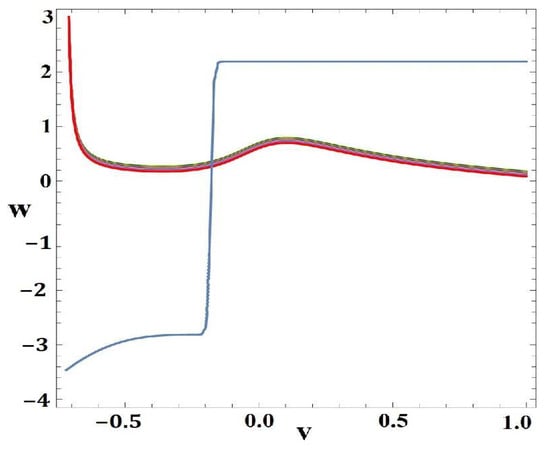
As is seen in Figure 3, for and define a relaxation oscillator for (2). The jump-up curve corresponding to the curve of minimums on the left branches of for is with , and the corresponding function is a constant. Thus, the slope for . The jump-down point corresponds to the local maximum of at , and . Note that is the threshold above which the neurons generate their action potentials. If mV, it is biologically plausible.
Figure 3.
are cubic-shaped curves for different values of (red, green and so on with different colors), and increases and intersects the middle branches of the cubics. This defines a relaxation oscillator for (2).
Condition (H1) is satisfied. Indeed, and , since for the inhibitory synapses. Again, if , it is biologically relevant. The condition means that the smaller the relaxational variable w is, the bigger the rate of change in the membrane potential v is.
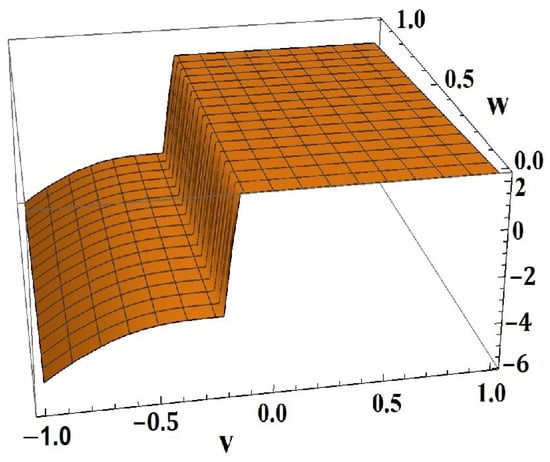
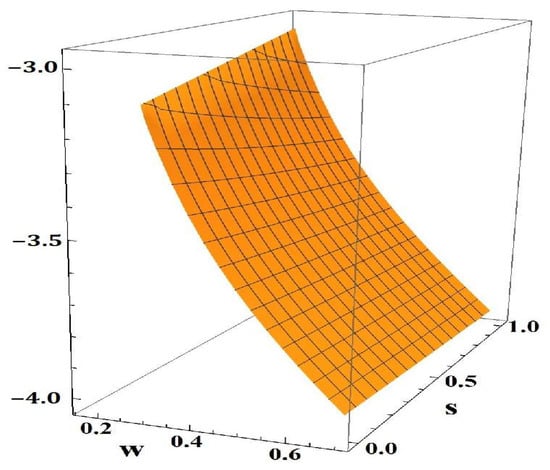
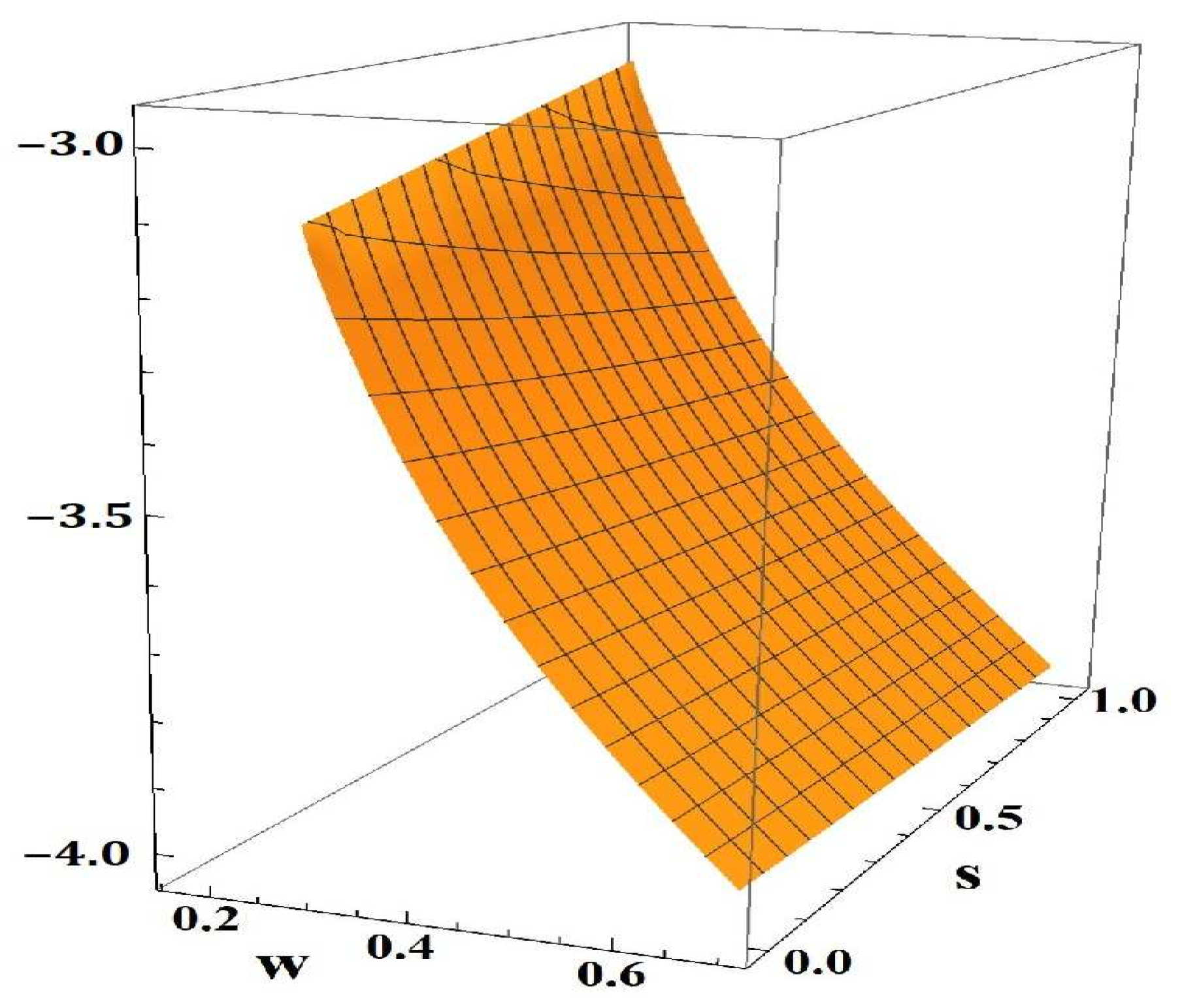
Conditions (H2) and (H3) can be checked explicitly and are confirmed graphically in Figure 4. In particular, (H3) means that the rate of change in the relaxational variables does not depend on the membrane potentials in the active phases of the oscillators. Since , condition (H4) is also satisfied.
Figure 4.
decreases in w and increases in v on the left branches of and is a constant in v on the right branches of .
The constant is the least upper bound for the auxiliary variables . So the inequality allows for to cross the threshold from above and from below during the cycles of the two oscillators. Alternatively, this means that the maximum inhibition will switch on and off according to (6) and (8) (or (23)) during the cycles. It is clear that (H5) is satisfied with the chosen values of above. All the remaining conditions (H6)–(H11) can also easily be verified.
In order to verify the stability analysis produced in Theorems 1 and 2, we found a computational solution of the system (19)–(25). That is why we needed to calculate the function , where represents the left branches of , on the phase space (Figure 5). On the other hand, the functions and are essential for conditions (H6)–(H11).
Figure 5.
on the phase space s.t. .
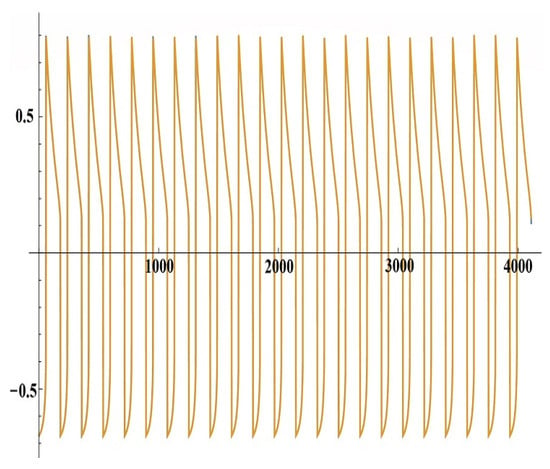
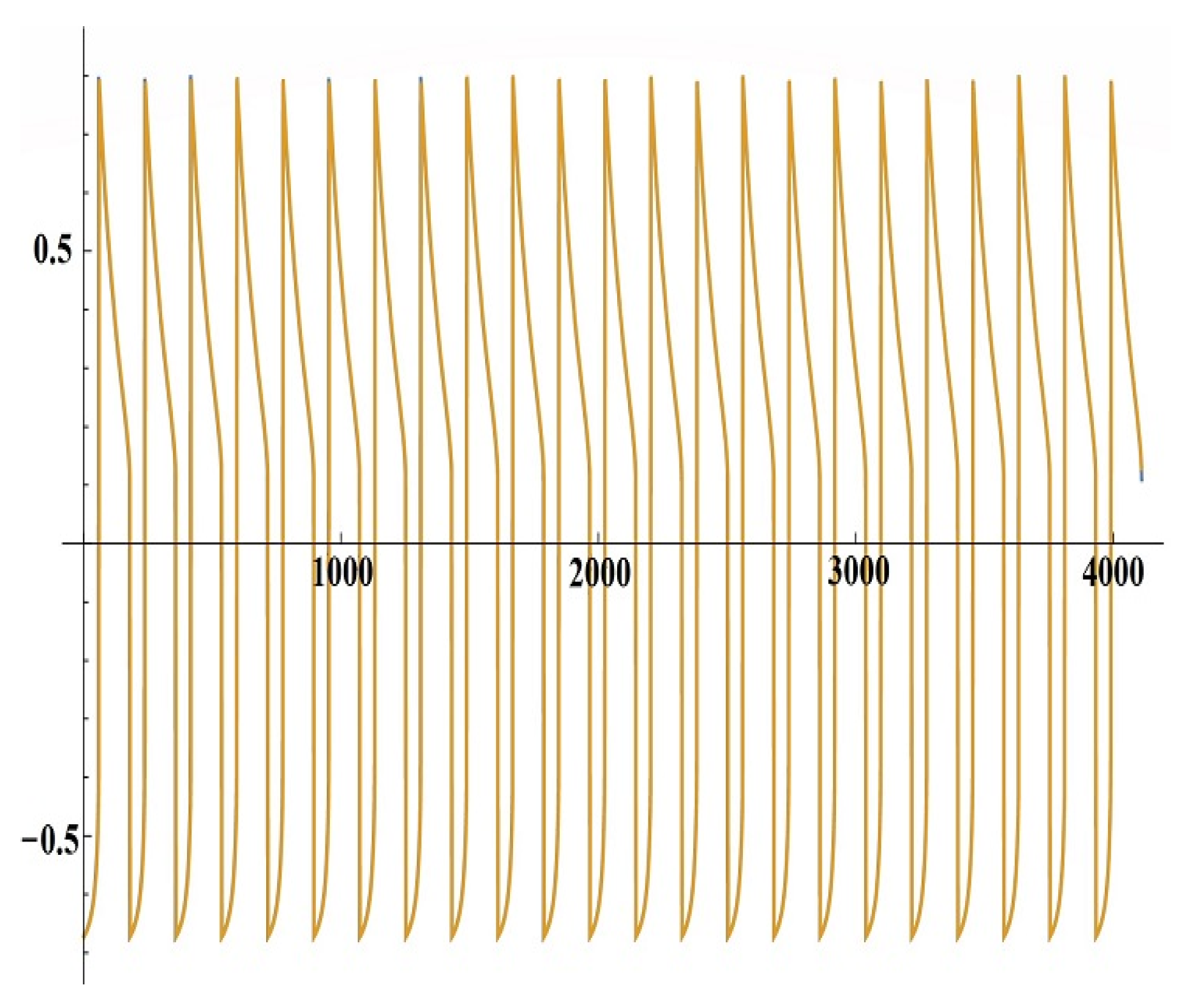
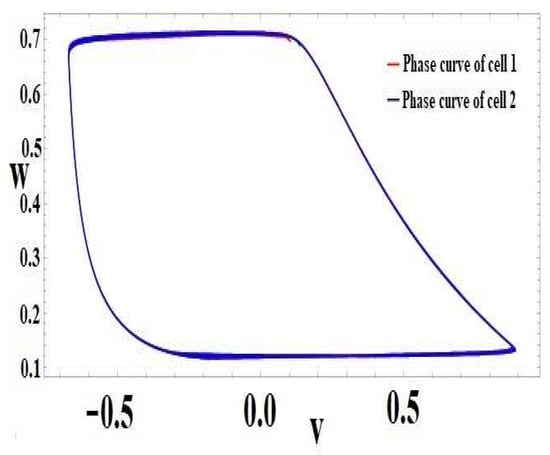
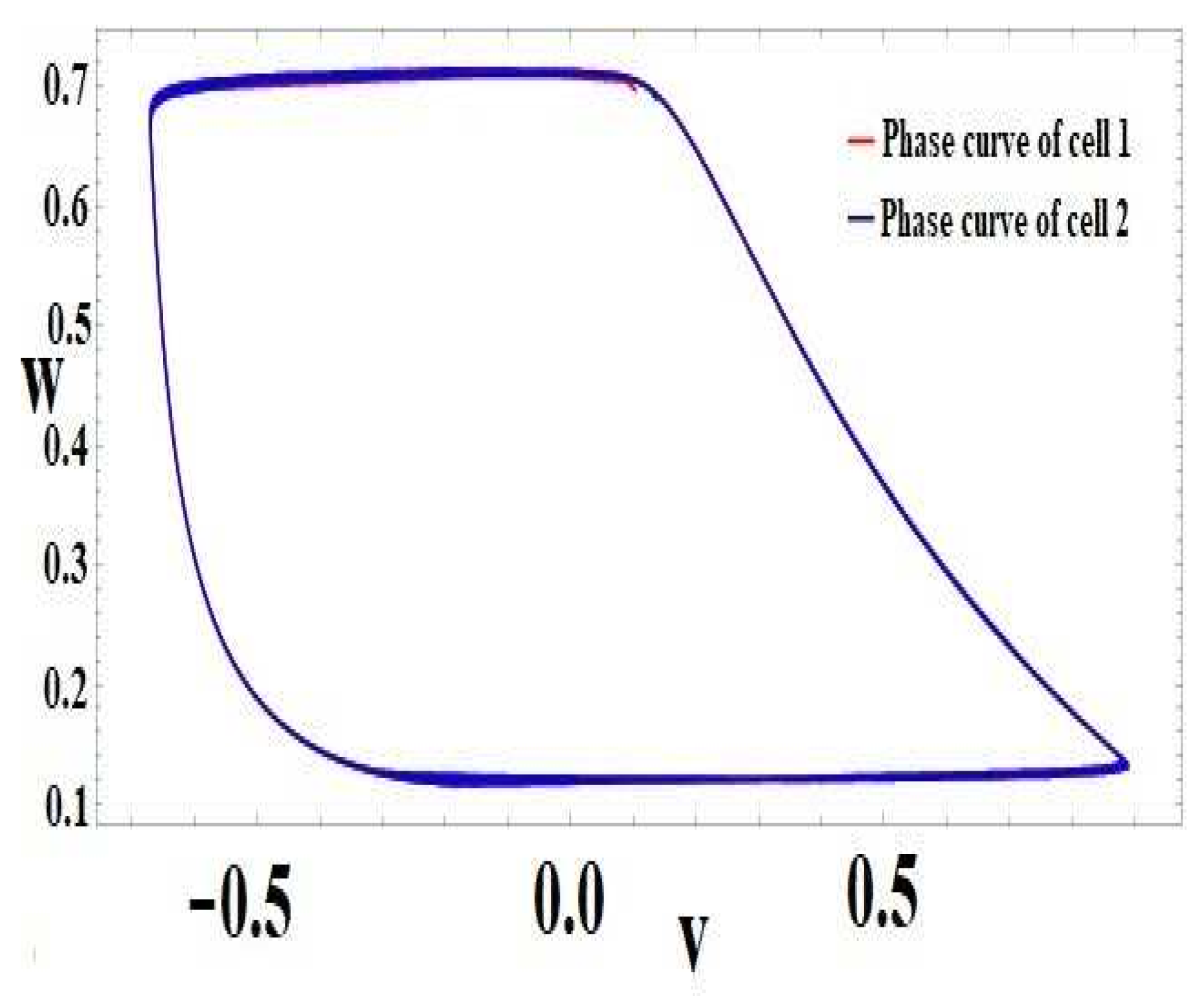
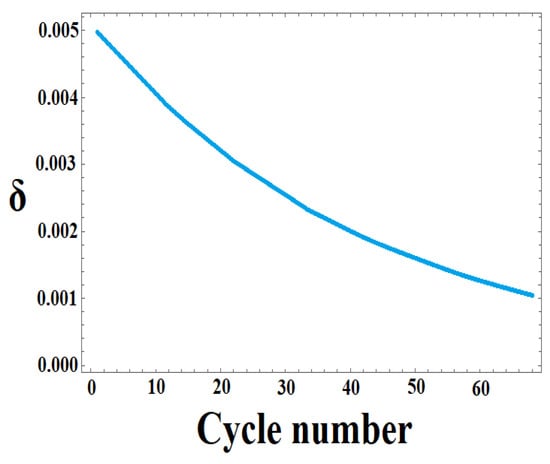
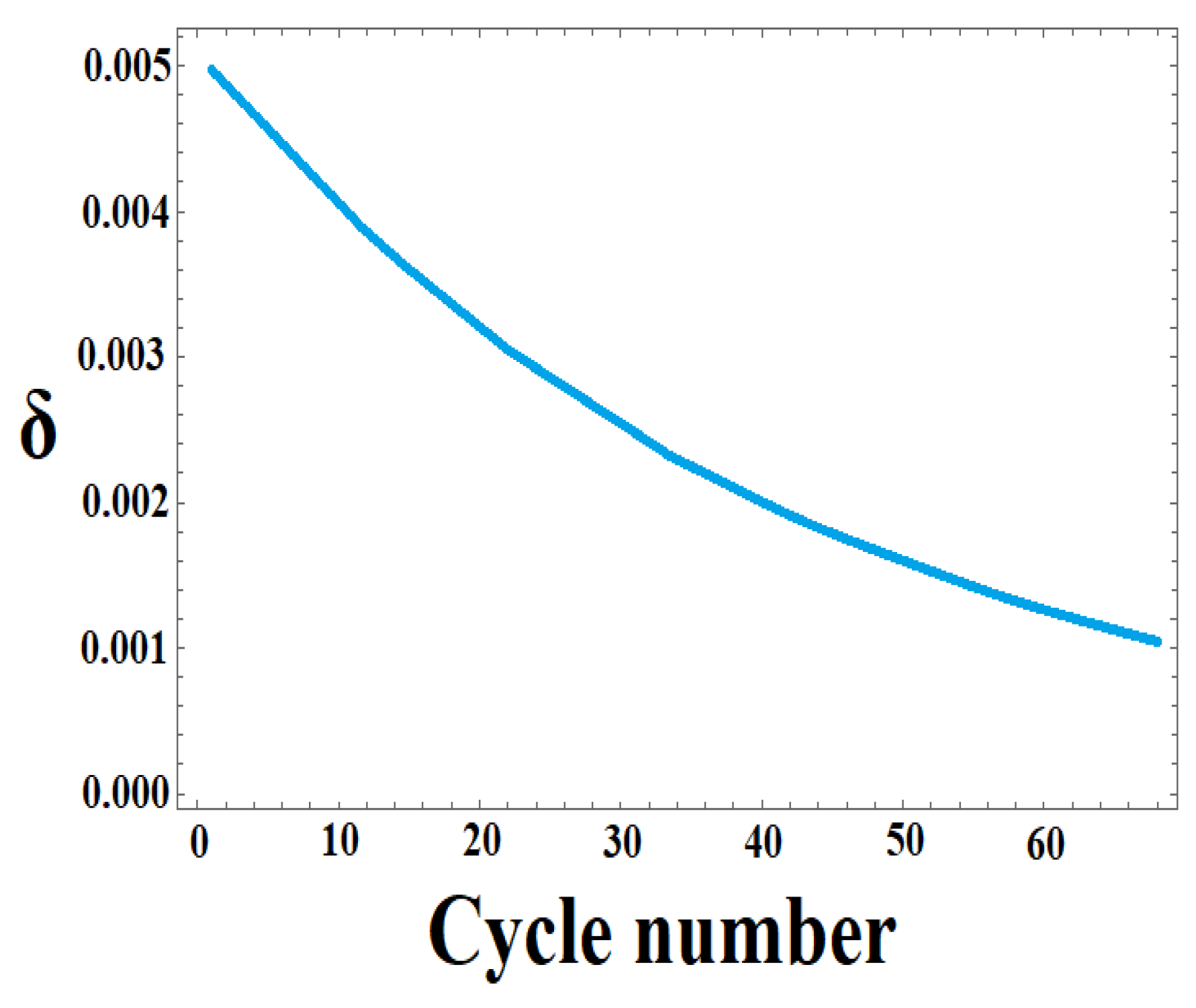
We take ; then , and it is easy to check that (16) and (30) are fulfilled. The advantage of solving (19)–(25) instead of (2)–(3) is obtaining the important moments of time of the two oscillators during the cycles. The graphs of the membrane potentials found from the solutions of (19)–(25) are presented in Figure 6, and a plot of the trajectory in the v–w phase space can be seen in Figure 7. Stable synchronization of the two cells during 23 cycles can be seen in Table 1, as predicted by Theorems 1 and 2. Moreover, the change in per cycle for 68 cycles (Figure 8) further confirms the stability.
Figure 6.
The graphs of the membrane potentials (blue), (orange) of the two neurons.
Figure 7.
A graph plotting the trajectories of the two cells in the v–w phase plane.
Table 1.
Relative times of the two oscillators.
Figure 8.
A graph depicting the variation in across successive cycles. The data for this figure is derived from the column in Table 1.
In Table 1, the relative times of the two oscillators at jumps up and jumps down with respect to the beginning of the cycles are given. First, note that cell 1 is the leading cell in all the cycles, since the numbers in columns and are all positive. Second, we notice that each time cell 1 jumps up (down), cell 2 immediately jumps up (down) because in each cycle , and numbers in columns and decrease, respectively. And finally, we observe compression both in silent phases and active phases of the oscillators in each cycle, as was predicted in Theorems 1 and 2. This is due to the fact that the numbers in columns and are all positive. Thus, we establish stable synchronization. Note that the trajectories of the two oscillators are not periodic but chaotic, since after the second cycle, numbers in column decrease while those in column increase.
9. Concluding Remarks
In this article, the dynamics of two mutually coupled inhibitory neurons is examined. A parameter regime for stable synchronous behavior is obtained analytically and verified numerically. In our study two factors play a crucial role in synchronization: the inhibition delay, as well as the inhibition decay; the latter must be small. These observations agree with those known in the literature [32,36] and, as was mentioned before, are applicable to a Morris–Lecar model [38].
Although only two cells are synchronized, which is a limitation of this study, the results obtained here could be relevant to neural clusters or synchronization of many more nerve cells with direct inhibition instead of synaptic inhibition [39]. On the other hand, the considered model is rather general, since it includes two nonlinear arbitrary functions. They only need to satisfy our conditions, which makes them useful not only for biological purposes.
Let us mention explicitly that the dynamics of (2)–(3) is much richer than that shown in Theorems 1 and 2. There are parameter regimes in which one oscillator fires several times while the other remains in its silent state; also antiphase solutions are possible [27]. In other inhibitory models such behavior is also described [31,34].
Author Contributions
Conceptualization, J.V.C.; methodology, J.V.C., D.R.C. and T.G.G.; investigation, J.V.C., D.R.C. and T.G.G.; resources, J.V.C., D.R.C. and T.G.G.; writing—original draft preparation, T.G.G.; writing—review and editing, J.V.C., D.R.C. and T.G.G.; visualization, D.R.C.; software, D.R.C.; validation, J.V.C., D.R.C. and T.G.G.; formal analysis, J.V.C., D.R.C. and T.G.G.; data curation, D.R.C.; project administration, J.V.C.; funding acquisition, J.V.C. All authors have read and agreed to the published version of the manuscript.
Funding
This study was financed by the European Union-NextGenerationEU through the National Recovery and Resilience Plan of the Republic of Bulgaria, project number BG-RRP-2.013-0001, and by the Scientific Research Fund of the University of Ruse “Angel Kanchev” under project 2025-FNSE-03.
Institutional Review Board Statement
Not applicable.
Informed Consent Statement
Not applicable.
Data Availability Statement
The original contributions presented in this study are included in the article. Further inquiries can be directed to the corresponding author.
Acknowledgments
The authors are very grateful to the anonymous reviewers, whose valuable comments and suggestions improved the quality of this paper.
Conflicts of Interest
The authors declare no conflicts of interest.
References
- Thayer, J.F. On the Importance of Inhibition: Central and Peripheral Manifestations of Nonlinear Inhibitory Processes in Neural Systems. Dose Response 2006, 4, 2–21. [Google Scholar] [CrossRef] [Scilit]
- Buzsáki, G.; Kaila, K.; Raichle, M. Inhibition and Brain Work. Dose Neuron 2007, 56, 771–783. [Google Scholar] [CrossRef] [Scilit] [PubMed]
- Lenin, D.; de la Paz, O.; Gulias-Cañizo, R.; D’Abril Ruíz-Leyja, E.; Sánchez-Castillo, H.; Parodí, J. The role of GABA neurotransmitter in the human central nervous system, physiology, and pathophysiology. Rev. Mex. Neurocienc. 2021, 22, 67–76. [Google Scholar]
- Papatheodoropoulos, C. Compensatory Regulation of Excitation/Inhibition Balance in the Ventral Hippocampus: Insights from Fragile X Syndrome. Biology 2025, 14, 363. [Google Scholar] [CrossRef] [Scilit] [PubMed]
- Young, G. Activation-Inhibition Coordination in Neuron, Brain, and Behavior Sequencing/Organization: Implications for Laterality and Lateralization. Symmetry 2022, 14, 2051. [Google Scholar] [CrossRef] [Scilit]
- Baldwin, K.T.; Giger, R.J. Insights into the physiological role of CNS regeneration inhibitors. Front. Mol. Neurosci. 2015, 8, 2015. [Google Scholar] [CrossRef] [Scilit]
- Buzsáki, G. Rhythms of the Brain; Oxford University Press: Oxford, UK, 2006. [Google Scholar]
- Mann, E.O.; Paulsen, O. Role of GABAergic inhibition in hippocampal network oscillations. Trends Neurosci. 2007, 30, 343–349. [Google Scholar] [CrossRef] [Scilit]
- Swanson, O.; Maffei, A. From Hiring to Firing: Activation of Inhibitory Neurons and Their Recruitment in Behavior. Front. Mol. Neurosci. 2019, 12, 168. [Google Scholar] [CrossRef] [Scilit]
- Giordano, N.; Alia, C.; Fruzzetti, L.; Pasquini, M.; Palla, G.; Mazzoni, A.; Micera, S.; Fogassi, L.; Bonini, L.; Caleo, M. Fast-Spiking Interneurons of the Premotor Cortex Contribute to Initiation and Execution of Spontaneous Actions. J. Neurosci. 2023, 43, 4234–4250. [Google Scholar] [CrossRef] [Scilit]
- Branson, K.; Freeman, J. Imaging the Neural Basis of Locomotion. Cell 2015, 163, 541–542. [Google Scholar] [CrossRef] [Scilit]
- Freund, T.F. Interneuron Diversity series: Rhythm and mood in perisomatic inhibition. Trends Neurosci. 2003, 26, 489–495. [Google Scholar] [CrossRef] [Scilit] [PubMed]
- Takagi, Y.; Sakai, Y.; Abe, Y.; Nishida, S.; Harrison, B.J.; Martínez-Zalacaín, I.; Soriano-Mas, C.; Narumoto, J.; Tanaka, S.C. A common brain network among state, trait, and pathological anxiety from whole-brain functional connectivity. NeuroImage 2018, 172, 506–516. [Google Scholar] [CrossRef] [Scilit] [PubMed]
- Stiefel, K.; Ermentrout, B. Neurons as oscillators. J. Neurophysiol. 2016, 116, 2950–2960. [Google Scholar] [CrossRef] [Scilit] [PubMed]
- Kopell, N.; Ermentrout, B. Chemical and electrical synapses perform complementary roles in the synchronization of interneuronal networks. Proc. Natl. Acad. Sci. USA 2004, 101, 15482–15487. [Google Scholar] [CrossRef] [Scilit]
- Ryu, H.; Campbell, S.A. Geometric analysis of synchronization in neuronal networks with global inhibition and coupling delays. Philos. Trans. R. Soc. A 2019, 377, 20180129. [Google Scholar] [CrossRef] [Scilit]
- Wang, Y.; Shi, X.; Si, B.; Cheng, B.; Chen, J. Synchronization and oscillation behaviors of excitatory and inhibitory populations with spike-timing-dependent plasticity. Cogn. Neurodynamics 2022, 17, 715–727. [Google Scholar] [CrossRef] [Scilit]
- Gelastopoulos, A.; Kopell, N. Interactions of multiple rhythms in a biophysical network of neurons. J. Math. Neurosci. 2020, 10, 19. [Google Scholar] [CrossRef] [Scilit]
- Miller, J.; Ryu, H.; Wang, X.; Booth, V.; Campbell, S.A. Patterns of synchronization in 2D networks of inhibitory neurons. Front. Mol. Neurosci. 2022, 16, 903883. [Google Scholar] [CrossRef] [Scilit]
- Haigh, Z.J.; Tran, H.; Berger, T.; Shirinpour, S.; Alekseichuk, I.; Koenig, S.; Zimmermann, J.; McGovern, R.; Darrow, D.; Herman, A.; et al. Modulation of motor excitability reflects traveling waves of neural oscillations. Cell Rep. 2025, 44, 115864. [Google Scholar] [CrossRef] [Scilit]
- Arbi, A. Novel traveling waves solutions for nonlinear delayed dynamical neural networks with leakage term. Chaos Solitons Fractals 2021, 152, 111436. [Google Scholar] [CrossRef] [Scilit]
- Kopell, N.; Ermentrout, G.B. Coupled oscillators and the design of central pattern generators. Math. Biosci. 1988, 90, 87–109. [Google Scholar] [CrossRef] [Scilit]
- Wang, X.J.; Rinzel, J. Alternating and synchronous rhythms in reciprocally inhibitory model neurons. Neural Comput. 1992, 4, 84–97. [Google Scholar] [CrossRef] [Scilit]
- Wang, X.J.; Rinzel, J. Spindle rhythmicity in the reticularis thalami nucleus: Synchronization among mutually inhibitory neurons. Neuroscience 1993, 53, 899–904. [Google Scholar] [CrossRef] [Scilit] [PubMed]
- Golomb, D.; Rinzel, J. Dynamics of globally coupled inhibitory neurons with heterogeneity. Phys. Rev. E 1993, 48, 4810–4814. [Google Scholar] [CrossRef] [Scilit] [PubMed]
- Skinner, F.K.; Kopell, N.; Marder, E. Mechanisms for oscillation and frequency control in reciprocally inhibitory model neural networks. J. Comput. Neurosci. 1994, 1, 69–87. [Google Scholar] [CrossRef] [Scilit]
- Terman, D.; Kopell, N.; Bose, A. Dynamics of Two Mutually Coupled Slow Inhibitory Neurons. Phys. D 1998, 117, 241–275. [Google Scholar] [CrossRef] [Scilit]
- Van, V.C.; Abbott, L.F.; Ermentrout, B. When Inhibition not Excitation Synchronizes Neural Firing. J. Comput. Neurosci. 1994, 1, 313–321. [Google Scholar] [CrossRef] [Scilit]
- Hansel, D.; Mato, G.; Meunier, C. Synchrony in Excitatory Neural Networks. Neural Comput. 1995, 7, 307–337. [Google Scholar] [CrossRef] [Scilit]
- Karbowski, J.; Kopell, N. Multispikes and synchronization in a large neural network with temporal delays. Neural Comput. 2000, 12, 1573–1606. [Google Scholar] [CrossRef] [Scilit]
- Pusuluri, K.; Ju, H.; Shilnikov, A. Chaotic dynamics in neural systems. In Synergetics; Encyclopedia of Complexity and Systems Science; Springer: New York, NY, USA, 2020; pp. 197–209. [Google Scholar] [CrossRef] [Scilit]
- Chauhan, A.S.; Taylor, J.D.; Nogaret, A. Dual Mechanism for the Emergence of Synchronization in Inhibitory Neural Networks. Sci. Rep. 2018, 8, 11431. [Google Scholar] [CrossRef] [Scilit]
- Brunel, N. Dynamics of Sparsely Connected Networks of Excitatory and Inhibitory Spiking Neurons. J. Comput. Neurosci. 2000, 8, 183–208. [Google Scholar] [CrossRef] [Scilit]
- Matveev, V.; Bose, A.; Nadim, F. Capturing the bursting dynamics of a two-cell inhibitory network using a one-dimensional map. J. Comput. Neurosci. 2007, 23, 169–187. [Google Scholar] [CrossRef] [Scilit] [PubMed]
- Ermentrout, G.B.; Kopell, N. Fine structure of neural spiking and synchronization in the presence of conduction delays. Proc. Natl. Acad. Sci. USA 1998, 95, 1259–1264. [Google Scholar] [CrossRef] [Scilit] [PubMed]
- Shavikloo, M.; Esmaeili, A.; Valizadeh, A.; Madadi, A.M. Synchronization of delayed coupled neurons with multiple synaptic connections. Cogn. Neurodynamics 2024, 18, 631–643. [Google Scholar] [CrossRef] [Scilit] [PubMed]
- Tancredi, G.; Sanchez, A.; Roig, F. A comparison between methods to compute Lyapunov exponents. Astron. J. 2001, 121, 1171–1179. [Google Scholar] [CrossRef] [Scilit]
- Morris, C.; Lecar, H. Voltage oscillations in the barnicle giant muscle fiber. Biophys. J. 1981, 35, 193–213. [Google Scholar] [CrossRef] [Scilit]
- Wnuk, A. How Inhibitory Neurons Shape the Brain’s Code. Available online: https://www.brainfacts.org/ (accessed on 6 October 2021).

Disclaimer/Publisher’s Note: The statements, opinions and data contained in all publications are solely those of the individual author(s) and contributor(s) and not of MDPI and/or the editor(s). MDPI and/or the editor(s) disclaim responsibility for any injury to people or property resulting from any ideas, methods, instructions or products referred to in the content. |
© 2025 by the authors. Licensee MDPI, Basel, Switzerland. This article is an open access article distributed under the terms and conditions of the Creative Commons Attribution (CC BY) license.