


Abstract
Rational difference equations have a wide range of applications in various fields of science. To illustrate, the equation , known as the Riccati difference equation, has been applied in the field of optics. In this study, the global asymptotic stability of the difference equation , is proved. The solutions of this difference equation are obtained by applying the standard iteration method, and the periodicity of these solutions is determined. Furthermore, this difference equation represents a generalisation of the results obtained in previous studies.
MSC:
39A10
1. Introduction
Our aim in this paper is to analyse the global behaviour of the non-negative equilibrium points of the difference equation
where , and C are non-negative real numbers, the initial conditions are non-negative, and k and j are non-negative integers. Also, we determined the solutions of some special cases of Equation (1).
The aim of our study of the difference equation, Equation (1), in this paper is to obtain a generalisation of many previous studies. With Equation (1), the general form of the difference equations in the references [1,2,3,4,5,6,7,8,9,10,11,12] has been reached. In addition, it will be possible to construct new difference equations with this equation. It is seen below how previous studies have reached difference equations.
In Equation (1), the following is obtained: when and , the equation studied in [1]; when , and , the equation studied in [2]; when , and , the equation studied in [3]; when , and , the equation studied in [4]; when , and , the equation studied in [5]; when , and , the equation studied in [6]; when , and , the equation studied in [7]; when and , the equation studied in [8]; when , and , the equation studied in [9]; when , and , the equation studied in [10]; when , and , the equation studied in [11]; when , and , the equation studied in [12]. In addition, with Equation (1), new difference equations similar to the difference equations in the above-mentioned studies can be obtained. Namely, when in Equation (1), the difference equation can be obtained.
In [1,6,12], solutions to second-order difference equations are presented. In this study, solutions of difference equations of order are obtained. In [2,3,4,5,9,10,11], the investigation of solutions of lower-order difference equations of order is conducted. The present study examines both the solutions of Equation (1) and the global behaviour of Equation (1). Furthermore, while [7,8] examine the dynamics of lower-order difference equations, this study focuses on the dynamics of a higher-order difference equation.
Studies on difference equations continue to increase day by day. The reason for this is that difference equations are used in modelling real-life problems in physics, biology, economics, statistics, etc. (see [1,2,3,4,5,6,7,8,9,10,11,12,13,14,15,16,17,18,19,20,21,22,23,24,25,26]).
2. Preliminaries
Let I be some interval of real numbers and let be a continuously differentiable function. Then, for every set of initial conditions the difference equation
has a unique solution
Definition 1.
An equilibrium point for Equation (2) is a point such that
Definition 2.
A sequence is said to be periodic with period p if for all
Definition 3.
The following theorem which is commonly referred to as the Linear Stability Theorem in the academic literature is presented for consideration.
Theorem 1 ([13]).
Assume that f is a function and let be an equilibrium point of Equation (2). Then, the following statements are true.
3. Dynamics of Equation (1)
In this section, we investigate the dynamics of Equation (1) under the assumptions that all parameters are non-negative real numbers, the initial conditions are non-negative real numbers, and k is a non-negative integer.
The change in the variables reduces Equation (1) to the difference equation
where We can see that is always an equilibrium point of Equation (5). When Equation (5) also possesses the unique positive equilibrium
Theorem 2.
The following statements are true:
- (i)
- If , then the equilibrium point of Equation (5) is locally asymptotically stable;
- (ii)
- If then the equilibrium points and are unstable.
Proof.
The linearized equation associated with Equation (5) about is
The characteristic equation associated with this equation is
Then, the linearized equation of Equation (5) about the equilibrium point is
The characteristic equation of Equation (5) about the equilibrium point is
So, The below information thus follows from the statement of Theorem 1:
If then for all roots and the equilibrium point is locally asymptotically stable.
If it follows that the equilibrium point is unstable.
The linearized equation of Equation (5) about the equilibrium point becomes
The characteristic equation of Equation (5) about the equilibrium point is
It is clear that this equation has a root in the interval . Then, the equilibrium point is unstable. □
Theorem 3.
Suppose that then the equilibrium point of Equation (5) is globally asymptotically stable.
Proof.
Let be a solution of Equation (5). As a result of Theorem 2, we know that the equilibrium point of Equation (5) is locally asymptotically stable. So, it is sufficient to show that
Since
we obtain
Then, it can be written for that
If then
and
The proof is complete. □
Corollary 1.
Assume that Then, every solution of Equation (5) is bounded.
Proof.
Then, in light of the proof of Theorem 3, we have for
So, every solution of Equation (5) is bounded from above by
□
3.1. The Difference Equation
When we take , , and the + sign between B and C as ∓ in Equation (1), we obtain the equation
where k is a positive integer and the initial conditions are non-zero real numbers with
Theorem 4.
Proof.
It is clear that for , the equation is satisfied. Now, suppose that and our claim is true for , then
It follows from Equation (6) and the above equalities that for
Hence, we have
Similarly, one can obtain
Now, we are going to show our claim for . We obtain from Equation (6) that
We have the below equalities
That is,
Similarly, one can obtain the other cases. Thus, the proof is complete. □
Corollary 2.
Assume that Then, every solution of Equation (6) is periodic with period
Proof.
In consideration of the solutions presented in Theorem 4 and the aforementioned assumption, the following can be written:
It is obvious that every solution of Equation (6) is periodic with period The proof is complete. □
Corollary 3.
Let be a solution of the equation Assume that and Then, and for
Proof.
This is evident from the proof presented in Theorem 4. □
3.2. The Difference Equation
In this section, we obtain a form of the solutions of the equation
where k is a positive integer and the initial conditions are non-zero real numbers with
Theorem 5.
Proof.
Similarly, someone can prove as the proof of Theorem 4. □
Corollary 4.
Assume that or Then, every solution of Equation (7) is periodic with period
Proof.
Firstly, let In view of Theorem 5 and from our assumption, we obtain and
Secondly, Then, we obtain and
Thus, every solution of Equation (7) is periodic with period □
4. Numerical Results
In this section, we give a few numerical results for some special values of the parameters.
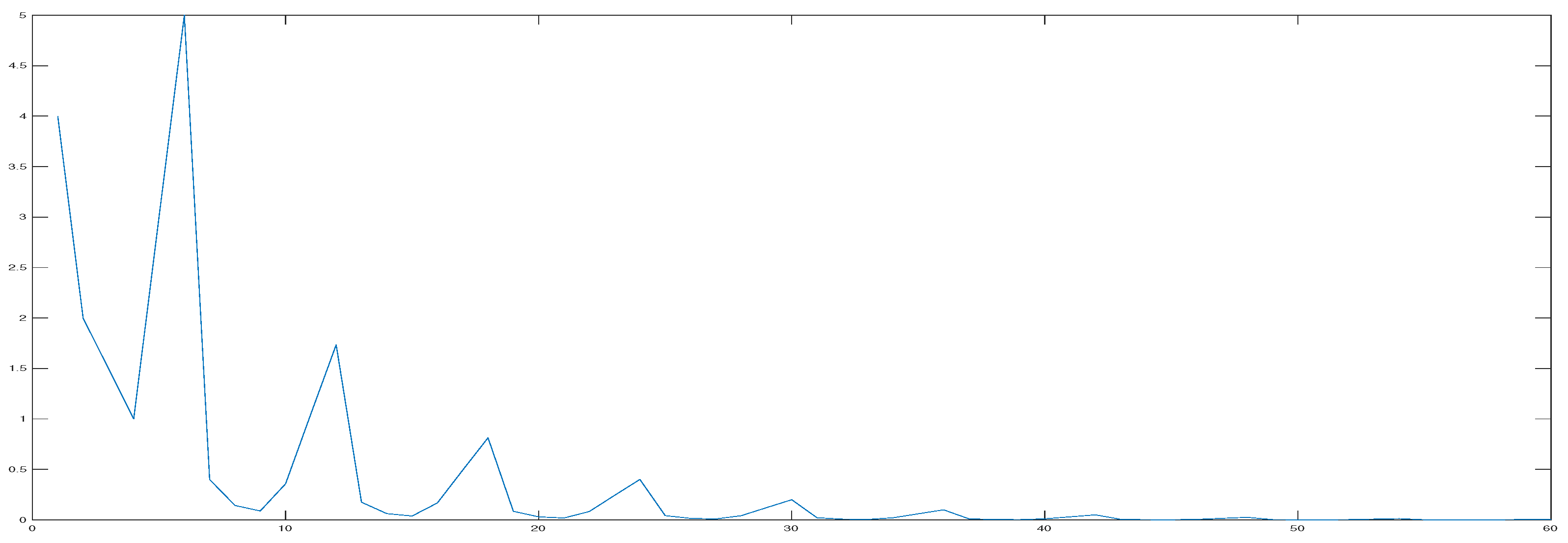
Example 1.
Figure 1.
The figure shows that the equilibrium of Equation (5) is globally asymptotically stable.
Example 2.
Figure 2.
The figure shows that the equilibrium of Equation (5) is unstable.
Example 3.
Figure 3.
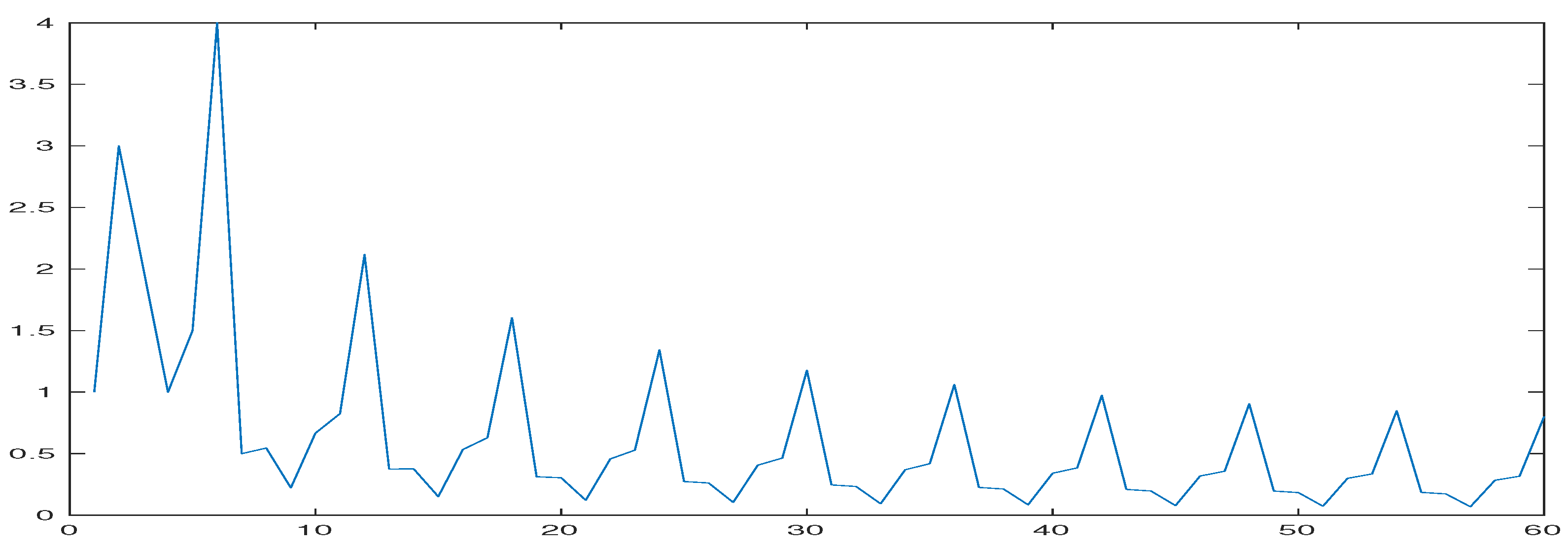
The figure shows that the solution of Equation (5) is bounded.
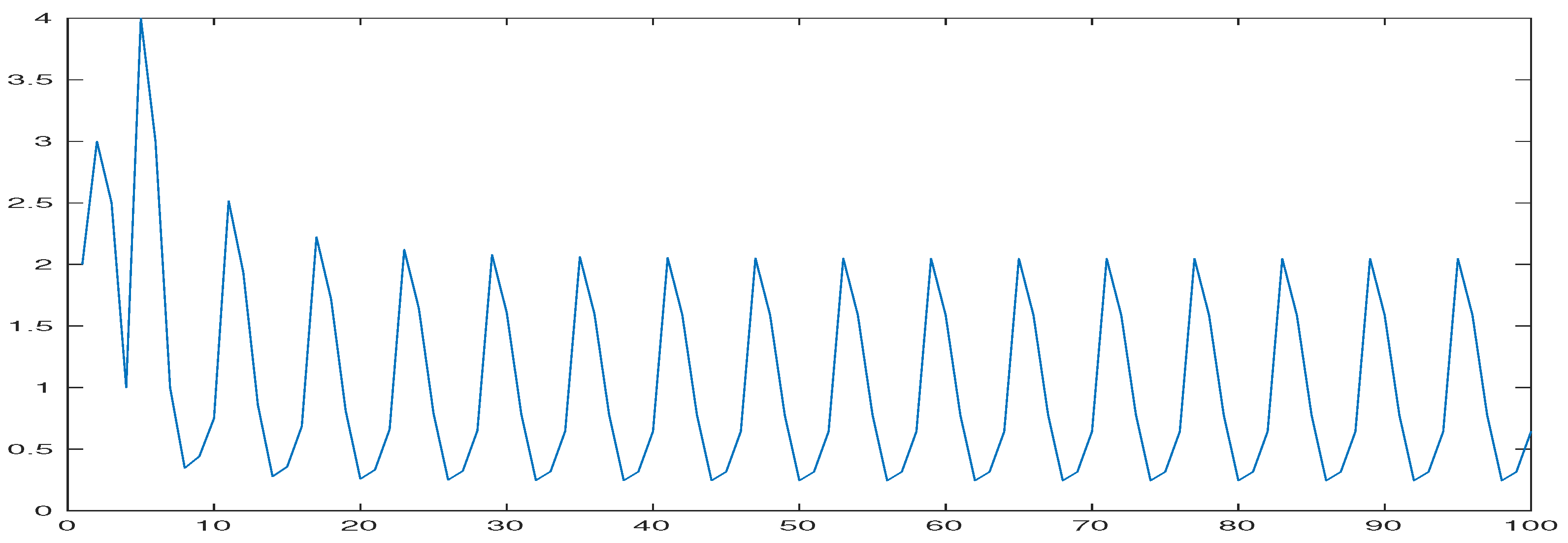
Example 4.
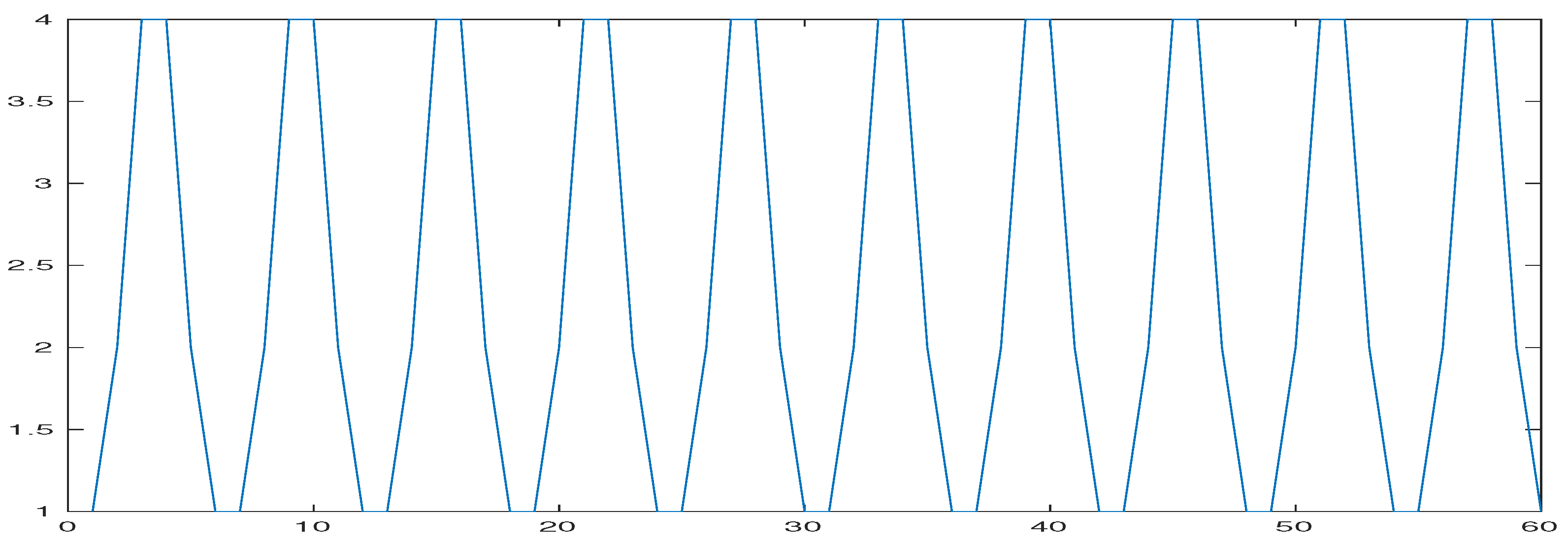
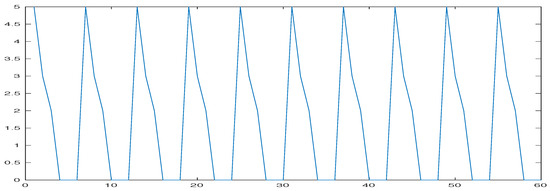
Figure 4.
The figure shows that the solution of Equation (6) is periodic with the period 6.
Example 5.
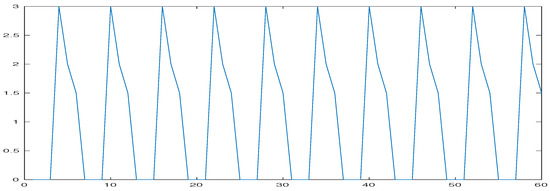
Figure 5.
The figure shows that the solution of Equation (7) is periodic with the period 6.
5. Conclusions
We defined the generalised difference equation . By the change in the variables , we obtained with . We showed that the equilibrium point was globally asymptotically stable when , and when , the equilibrium points and were unstable. If , every solution was bounded. Additionally, we investigated the special case of Equation (1) as We gave the explicit solutions of this equation. One may define more general forms of other difference equations and investigate their behaviour.
Author Contributions
Writing—original draft, R.K.; Methodology, R.K. and A.G.; Software, M.A.; Writing—review and editing, R.K., A.G. and M.A.; All authors have read and agreed to the published version of the manuscript.
Funding
This study received no external funding.
Data Availability Statement
Data are contained within the article.
Conflicts of Interest
The authors declare no conflicts of interest.
References
- Andruch-Sobilo, A.; Migda, M. Further properties of the rational recursive sequence . Opusc. Math. 2006, 26, 387–394. [Google Scholar]
- Elsayed, E.M. On the solutions of a rational recursive sequence of a big order. Folia Math. 2008, 15, 25–39. [Google Scholar]
- Elsayed, E.M. On the difference equation . Thai J. Math. 2009, 7, 1–8. [Google Scholar]
- Elsayed, E.M. Solutions of a recursive sequence of order ten. Gen. Math. 2011, 19, 145–162. [Google Scholar]
- Elsayed, E.M. On the solution of some difference equations. Eur. J. Pure Appl. Math. 2011, 4, 287–303. [Google Scholar]
- Aloqeili, M. Dynamics of a rational difference equation. Appl. Math. Comput. 2006, 176, 768–774. [Google Scholar] [CrossRef] [Scilit]
- Ghazel, M.; Elsayed, E.M.; Matouk, A.E.; Mousallam, A.M. Investigating dynamical behaviors of the difference equation . J. Nonlinear Sci. Appl. 2017, 10, 4662–4679. [Google Scholar] [CrossRef] [Scilit]
- Abo-Zeid, R. Global Behavior of the difference equation . Arch. Math. (Brno) 2015, 51, 77–85. [Google Scholar] [CrossRef] [Scilit]
- Karatas, R. On the solutions of the recursive sequence . Fasc. Math. 2010, 45, 37–45. [Google Scholar]
- Karatas, R. On positive solutions of the difference equation . Int. J. Contemp. Math. Sci. 2006, 1, 495–500. [Google Scholar] [CrossRef] [Scilit]
- Karatas, R. A solution form of a rational difference equation. Konuralp J. Math. 2023, 11, 20–23. [Google Scholar]
- Ibrahim, T.F. Dynamics of a rational recursive sequence of order two. Int. J. Math. Comput. 2009, 5, 98–105. [Google Scholar]
- Kocic, V.L.; Ladas, G. Global Behavior of Nonlinear Difference Equations of High Order with Applications; Kluwer Academic Publishers: Dordrecht, The Netherlands, 1993. [Google Scholar]
- Gelisken, A.; Karatas, R. On a solvable difference equation with sequence coefficients. Adv. Appl. Disc. Math 2022, 30, 27–33. [Google Scholar] [CrossRef] [Scilit]
- Ahmed, A.M. On the dynamics of a higher order rational difference equation. Discret. Dyn. Nat. Soc. 2011, 419789, 8. [Google Scholar] [CrossRef] [Scilit]
- Simsek, D.; Abdullayev, F. On the recursive sequence . J. Math. Sci. 2018, 234, 73–81. [Google Scholar] [CrossRef] [Scilit]
- Simsek, D.; Ogul, B.; Çınar, C. Solution of the rational difference equation . Filomat 2019, 33, 1353–1359. [Google Scholar] [CrossRef] [Scilit]
- Tollu, D.T.; Yazlık, Y.; Taşkara, N. Behavior of positive solutions of a difference equation. J. Appl. Math. Inf. 2017, 35, 217–230. [Google Scholar] [CrossRef] [Scilit]
- El-Metwally, H.; Grove, A.; Ladas, E.A.; Levins, G.; Radin, M. On the difference equation xn+1 = α + βxn−1e−xn. Nonlinear Anal. Theory Methods Appl. 2003, 47, 4623–4634. [Google Scholar] [CrossRef] [Scilit]
- Almatrafi, M.B.; Elsayed, E.M.; Alzahrani, F. Investigating some properties of a fourth order difference equation. J. Comput. Anal. Appl. 2020, 28, 243–253. [Google Scholar]
- Gümüş, M.; Soykan, Y. The dynamics of the positive solutions of a higher order fractional difference equation with arbitrary powers. J. Appl. Math. Inform. 2017, 35, 267–276. [Google Scholar] [CrossRef] [Scilit]
- Karatas, R. Global behavior of a higher order difference equation. Comput. Math. Appl. 2010, 60, 830–839. [Google Scholar] [CrossRef] [Scilit]
- Karatas, R. Global behavior of a rational recursive sequence. Ars Combinatoria 2010, 97A, 421–428. [Google Scholar]
- Ergin, S.; Karatas, R. On the solutions of the recursive sequence . Thai J. Math. 2016, 14, 391–397. [Google Scholar]
- Ergin, S.; Karatas, R. On the dynamics of a recursive sequence. Ars Comb. 2013, 109, 353–360. [Google Scholar]
- Saary, T.I. Modern Nonlinear Equations; McGraw Hill: New York, NY, USA, 1967. [Google Scholar]
Disclaimer/Publisher’s Note: The statements, opinions and data contained in all publications are solely those of the individual author(s) and contributor(s) and not of MDPI and/or the editor(s). MDPI and/or the editor(s) disclaim responsibility for any injury to people or property resulting from any ideas, methods, instructions or products referred to in the content. |
© 2024 by the authors. Licensee MDPI, Basel, Switzerland. This article is an open access article distributed under the terms and conditions of the Creative Commons Attribution (CC BY) license (https://creativecommons.org/licenses/by/4.0/).