


Abstract
“Linearly many faults” is a phenomenon observed by Cheng and Lipták in which a specific structure emerges when a graph is disconnected and often occurs in various interconnection networks. This phenomenon means that if a certain number of vertices or edges are deleted from a graph, the remaining part either stays connected or breaks into one large component along with smaller components with just a few vertices. This phenomenon can be observed in many types of graphs and has important implications for network analysis and optimization. In this paper, we first validate the phenomenon of linearly many faults for surviving graph of a burnt pancake graph when removing any edge subset with a size of approximately six times . For graph G, the ℓ-component edge connectivity denoted as (resp., the ℓ-extra edge connectivity denoted as ) is the cardinality of a minimum edge subset S such that is disconnected and has at least ℓ components (resp., each component of has at least vertices). Both and e are essential metrics for network reliability assessment. Specifically, from the property of “linearly many faults”, we may further prove that for ; and for .
Keywords:
burnt pancake graph; component edge connectivity; extra edge connectivity; linearly many faults; conditional connectivity MSC:
05C40; 05C75; 68R10
1. Introduction
Investigating interconnection networks and their intrinsic properties is crucial for developing efficient parallel and distributed computer systems. A simple undirected graph represents the underlying topology of such a system called an interconnection network, where vertices represent a processor, and edges represent communication links between processors. Therefore, a well-structured network topology can lead to higher benefits for the system operation, including fault-tolerant data transmission and system reliability. For convenience, the terms graphs and networks are used interchangeably.
1.1. Background
It is almost impossible to design a multiprocessor system without defects. Connectivity and edge connectivity are used to adjudicate a network’s reliability and fault tolerance. Usually, a fundamental property of an interconnection network is that it must possess regularity (i.e., every vertex in the network has the same degree). In particular, it is better if it meets the maximal connectivity (i.e., the connectivity equals the regularity of the graph). It is interesting to think about what would happen if we were to remove more than n vertices or edges from an n-regular graph. In such cases, two possible scenarios could arise. Either the resulting graph would remain connected, or it would split into several components, with the smaller component containing just a singleton. Further, one may wonder what exactly would happen if about or more vertices or edges were further removed. When multiple failures occur at the same time and the graph becomes disconnected, the best-case scenario is when a large component containing most of the remaining vertices is retained, along with some smaller components. This way, the subnetwork represented by the large component can continue to function effectively. In fact, this phenomenon of a disconnected graph caused by failures was first discovered in the pioneering work of Yang et al. [1]. Later, Cheng and Lipt’ak [2] popularized this concept and formally called this phenomenon the “linear many faults” property. Since then, this property has attracted much attention in the research for other networks, e.g., Cayley graphs generated by transposition trees [2], 2-tree [3], transposition triangle free unicyclic graphs [4], -star graphs [5], arrangement graphs [6], augmented cubes [7], and dual-cube-like networks [8]. Mainly, this property can export network metrics related to fault tolerance [9,10,11,12].
Regarding Cayley graphs generated by transposition trees, we let be a finite group and S a subset of . The Cayley digraph of Γ generated by S, denoted by Cay, is digraph with vertex set and arc set . If S does not include the identity and , then Cay is an undirected simple graph. We let , be the symmetric group on , and T be a set of transpositions of . Then, Cay is called the Cayley graphs generated by transposition tree T if is a tree with the vertex set such that edge if and only if the corresponding transposition .
To better understand the reliability of networks, Harary [13] proposed a concept called conditional connectivity which involves attaching certain conditions to connected components. Additionally, Fábrega and Fiol [14] introduced two generalizations of classical connectivity, namely extra connectivity and extra edge connectivity, which help to ensure the scale of each component. Later on, Sampathkumar [15] and Chartrand et al. [16] independently introduced a generalization of classical (edge) connectivity regarding the number of components for disconnected graphs, the former called general connectivity and the latter called generalized connectivity. Henceforth, we adopt appropriate terms called component connectivity and component edge connectivity, suggested by Hsu et al. [17] and Zhao et al. [18], respectively. For the recent results of interconnection networks, please refer to [19,20,21,22,23] for extra (edge) connectivity, [24,25,26,27,28,29] for component (edge) connectivity, and [12,30,31,32] for relationship between these two kinds of (edge) connectivity. In addition, for research on connectivity related to diverse graph indices (such as the Wiener index, the Zagreb index, the Randic index, etc.) with fuzzy information and their applications, please refer to [33,34,35,36].
This paper investigates the “linear many faults” property on a burnt pancake graph , which is the Cayley graph of the group of signed permutations generated by prefix reversals and defined by Gates and Papadimitriou in 1979 [37]. attracts the attention of researchers mainly because of another accompanying interesting definition called the pancake graph, which refers to the mathematic puzzle of sorting a pile of unordered pancakes in the size order. In this case, a spatula could be inserted anywhere in the pancake stack to flip all the pancakes above it. The minimum number of flips required to sort the given pancakes is called the pancake number. Hence, the operation of flips is called the prefix reversal when we treat the stack of pancakes as a sequence of symbols, and acquiring the pancake number is equal to obtaining the diameter of the pancake graph. Then, introduces the change in positive and negative signs, making this question more interesting. However, there has yet to be a general solution to the diameter problem of these two classes of graphs so far [38].
For burnt pancake graphs, the earliest research mainly pursued their diameters, while the current research focuses on exploring fault tolerance [39,40] and diagnosis [40,41]. In addition, many diverse connectivities have been investigated in the literature, including spanning connectivity [42], structure connectivity [43], neighbor connectivity [44,45], and component connectivity [25,28]. Following the direction of probing connectivity, this paper first proves that when removing any edge subset with a size of approximately six times , the surviving graph possesses the “linearly many faults” property. According to this characteristic, we obtain component edge connectivity and extra edge connectivity of for certain dimensions n, extending the results of [30]. Specifically, we prove that for ; and for .
1.2. Organization
Section 2 introduces definitions and necessary terminologies and notations. Also, burnt pancake graphs and related properties are given. Section 3 shows the existence of the “linearly many faults” property for the surviving graph of when the removal of an edge subset with a size of approximately six times . Section 4 obtains some relations between component edge connectivity and extra edge connectivity of through the derived property. Finally, we add concluding remarks in Section 5.
2. Preliminaries
2.1. Definitions and Terminologies
Let be a graph. Two vertices u and v are adjacent if they are joined by an edge, where u and v are called neighbors to each other. For vertex , let be the set of neighbors of u in G. For , the open neighborhood of U in G is defined as . The edge neighborhood of U in G, denoted as (or ), is the set of edges incident with at least one vertex of U in G. Also, denote the subgraph of G induced by U. For two disjoint subgraphs (or vertex sets) and , let be the set of edges with one end in and the other in . A cycle (resp., path) of length k is called a k-cycle (resp., k-path), denoted by (resp., ).
Let G be a graph. The connectivity (resp., edge connectivity) of G, denoted by (resp., ), is the minimum number of vertices (resp., edges) that need to be removed to disconnect G or become a trivial graph. For (resp., ), let be the graph that removes vertices (resp., edges) of S from G. Particularly, S is a vertex-cut (resp., edge-cut) of G provided is disconnected. In , the component with the largest number of vertices is called the large component, and a component that is not the largest one is called the smaller component.
Graph G is super h-vertex-connected (resp., super h-edge-connected) of order q if, after deleting at most h vertices (resp., h edges), the resulting graph is either connected or has one large component along with smaller components containing totally at most q vertices. In other words, the resulting graph has a component of size at least with . The following result is helpful throughout the paper.
Proposition 1
([9]). Let be an integer. If a connected graph G with at least vertices is super-m-vertex-connected of order q, then G is super-m-edge-connected of order q.
Definition 1
(see [17]). Let G be a connected graph and . If is disconnected and has at least ℓ components, then F is called anℓ-component edge-cut. The ℓ-component edge connectivity of G, denoted by , is the cardinality of a minimum ℓ-component edge-cut of G. Obviously, and for every positive integer ℓ.
Definition 2
(see [14]). Let G be a connected graph and . If is disconnected and every component of has at least vertices, then F is called an h-extra edge-cut. The h-extra edge connectivity of G, denoted by , is the cardinality of a minimum h-extra edge-cut, if it exists. Obviously, and .
Lemma 1
(see [30]). Let H be a connected graph and be an integer. Let
, and . If H fulfills the following:
- (i)
- For with , has a large component along with small components containing totally at most vertices;
- (ii)
- For with , has at most k components;
then .
2.2. Burnt Pancake Graphs
We put a negative sign on the top of a symbol for notational convenience, e.g., . We let and . A signed permutation of is an permutation of such that (each element takes the absolute value) forms a permutation of . For signed permutation of and integer , the ith prefix reversal of x is defined by .
Definition 3
(see [37]). An n-regular graph with vertices is called the n-dimensional burnt pancake network if every vertex of has a unique label from the signed permutation of such that if and only if for . The edge is called an i-dimensional edge and u is called the i-neighbor of v, and vice versa.
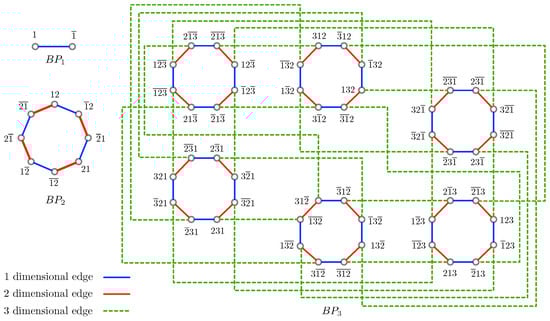
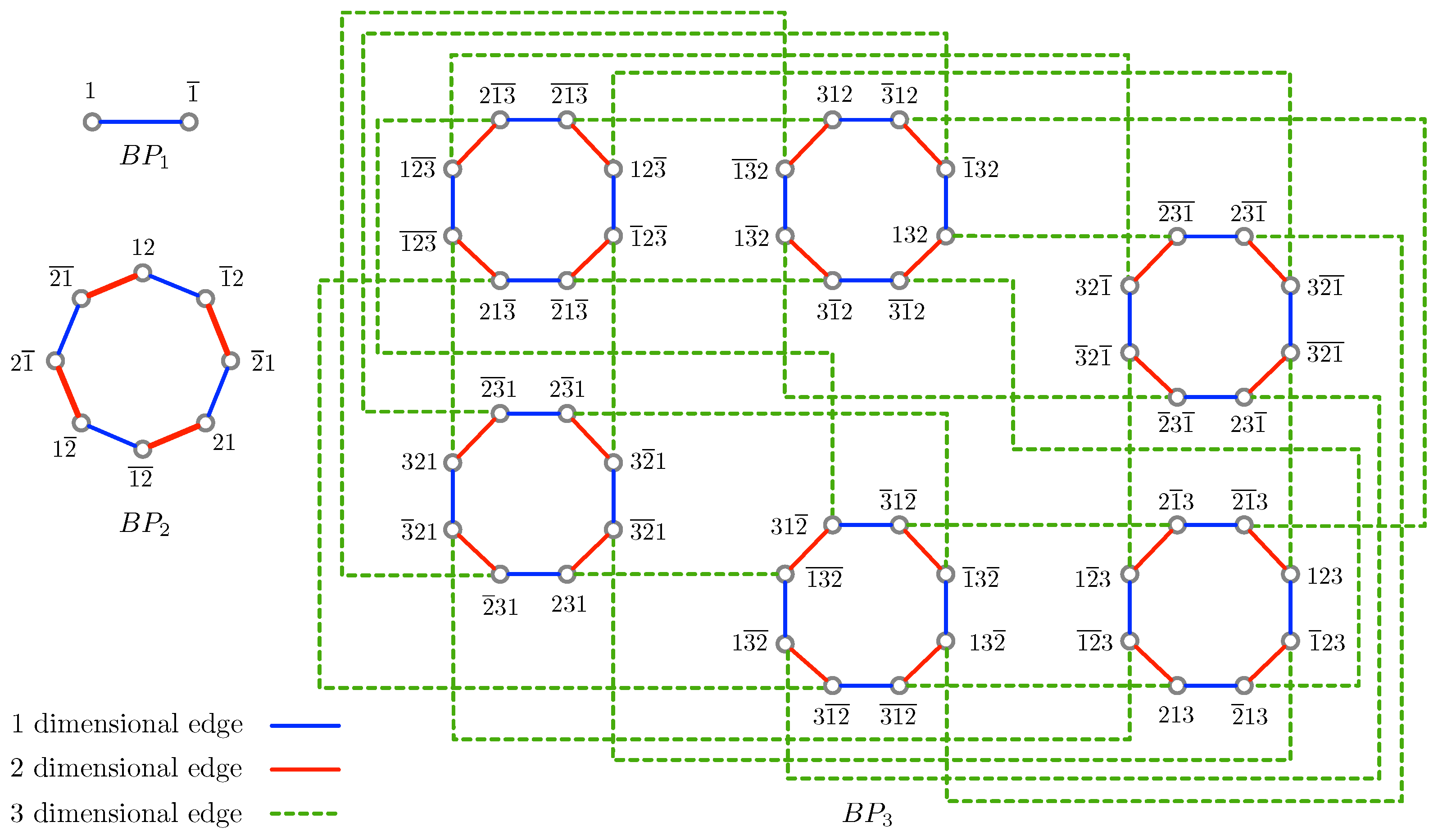
Figure 1 depicts for all , where we use different types of line to draw distinct dimensional edges. Clearly, every vertex of has a unique k-neighbor for . By definition, is decomposed into vertex-disjoint subgraphs for such that every vertex in a subgraph fixes the symbol k in the rightmost position. Clearly, is isomorphic to . An external edge of is one whose two ends are in distinct s. For , the unique neighbor outside is called the external neighbor of u. Indeed, an external edge is an n-dimensional edge. Also, denotes the set of edges between and for with .
Figure 1.
Burnt pancake graphs of small dimensions.
Lemma 2
(see [39,42,46]). For , the following properties hold:
- (1)
- is an n-regular graph with edges. if , and .
- (2)
- For , .
- (3)
- For , the girth of is .
Lemma 3
(see [40,41]). For , we let F be a vertex-cut of . The following properties hold:
- (1)
- If , has two components, one of which is a singleton or an edge. Furthermore, if the small component is an edge, then F is the neighborhood of this edge and .
- (2)
- If , has a large component along with smaller components containing totally at most two vertices.
- (3)
- If , has a large component along with smaller components containing totally at most three vertices.
Lemma 4
(see [28]). For , we let F be a vertex-cut of . If , contains a large component along with smaller components containing totally at most four vertices.
Lemma 5.
For , we let F be an edge-cut of . The following properties hold:
- (1)
- If , has two components, one of which is a singleton or an edge. Furthermore, if the small component is an edge, then F is the neighborhood of this edge and .
- (2)
- If , has a large component along with smaller components containing totally at most two vertices.
- (3)
- If , has a large component along with smaller components containing totally at most three vertices.
Proof.
By Lemma 3, is super--vertex-connected of order 1, -vertex-connected of order 2, and -vertex-connected of order 3, respectively. We note that (resp., and ) for . By Proposition 1, is super--edge-connected of order 1, -edge-connected of order 2, and -edge-connected of order 3, respectively. Thus, the lemma follows. □
Lemma 6.
For , we let F be an edge-cut of . If , has a large component along with smaller components containing totally at most four vertices.
Proof.
By Lemma 4, is super--vertex-connected of order 4. We note that for . By Proposition 1, is super--edge-connected of order 4, and the result holds. □
3. Linearly Many Faults in Burnt Pancake Graphs
In this section, we focus on the linearly many faults in burnt pancake graphs.
Lemma 7.
For with and , if , then and .
Proof.
Let . Note that has no k-cycle for . By Lemma 2, and .
If contains four singletons, then .
If contains two singletons and an edge, then and .
If contains (i) two edges or (ii) a 2-path and a singleton, then and .
If contains (i) a 3-path or (ii) a graph isomorphic to , then and .
Table 1 lists all cases of . Hence, and . □
Table 1.
All cases of for .
Lemma 8.
For with and , if , then and .
Proof.
Let . Note that has no k-cycle for . By Lemma 2, and .
If contains five singletons, then .
If contains three singletons and an edge, then and .
If contains (i) two edges and a singleton or (ii) a 2-path and two singletons, then (resp., ) and .
If contains (i) a 2-path and an edge, (ii) a 3-path and a singleton, or (iii) a graph isomorphic to and a singleton, then and .
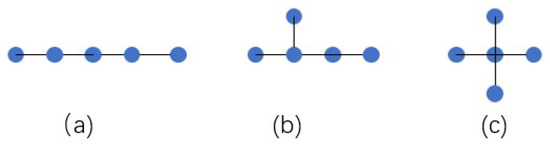
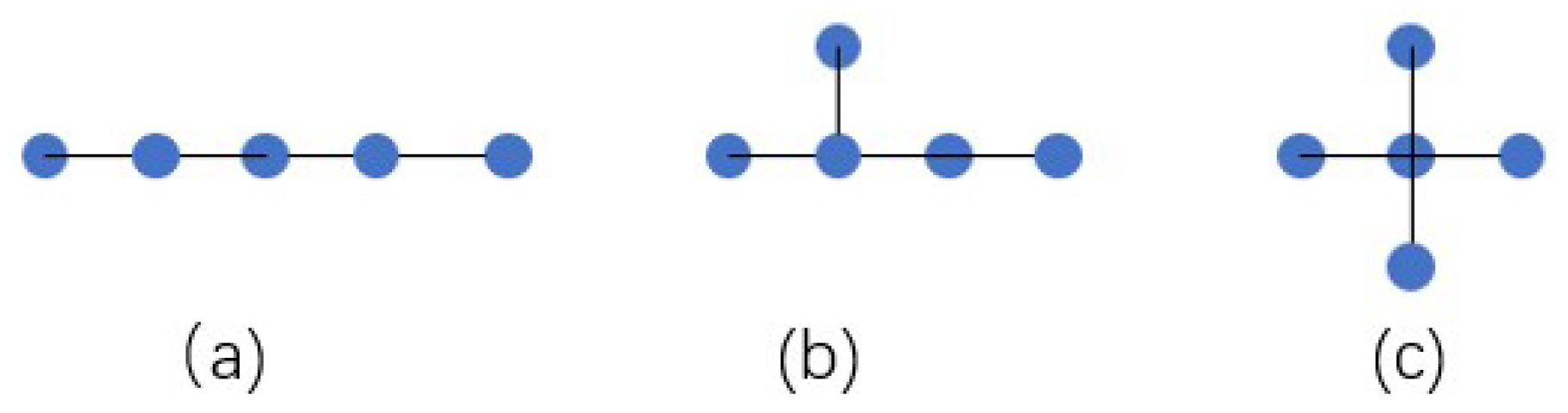
If contains (i) a 4-path, (ii) a graph isomorphic to , or (iii) a tree with five vertices, then and .
Table 2.
All cases of for .
Figure 2.
(a–c) Three trees with five vertices.
Lemma 9.
For with and , if , then and .
Proof.
Let . Note that has no k-cycle for . By Lemma 2, and .
If contains six singletons, then .
If contains four singletons and an edge, then and .
If contains (i) two edges and two singleton or (ii) a 2-path and three singletons, then (resp., ) and .
If contains (i) a 3-path and two singletons, (ii) three edges, or (iii) an edge, a 2-path and a singleton, then and .
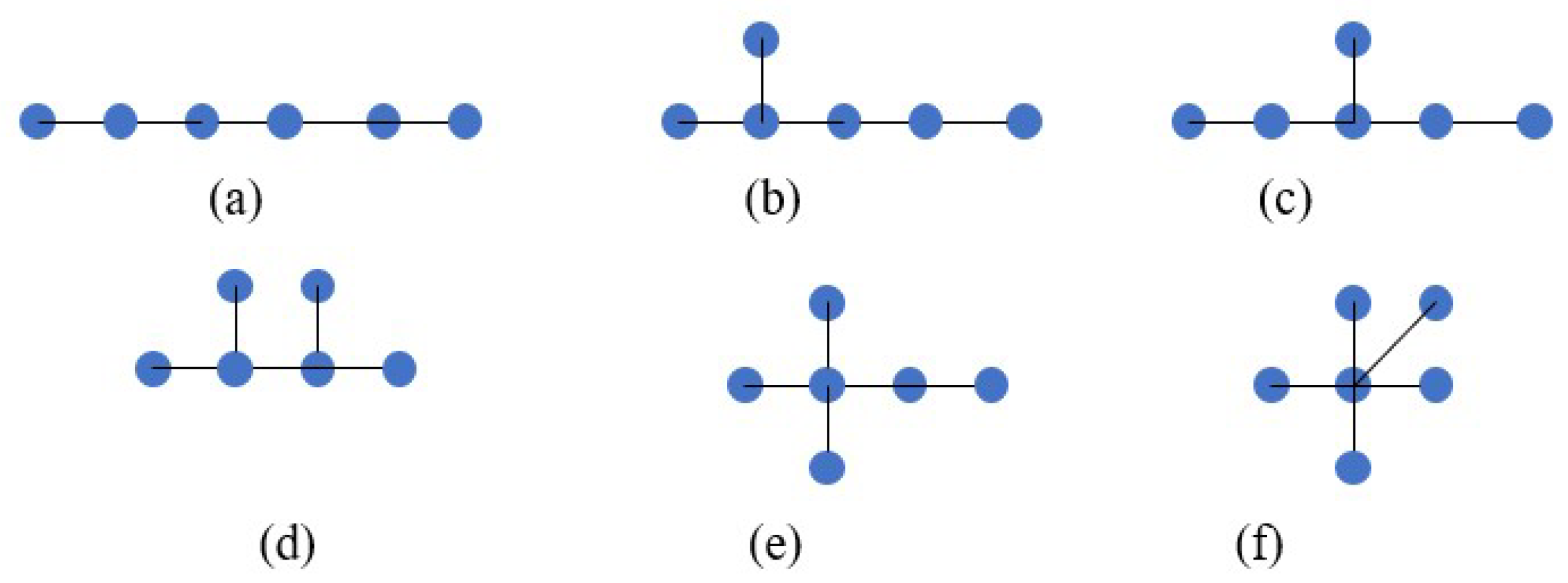
If contains (i) a singleton and a tree with five vertices Figure 2a–c, (ii) an edge and a 3-path or a graph isomorphic to , or (iii) two 2-paths, then and .
If contains (i) a 5-path, (ii) a graph isomorphic to , or (iii) a tree with 6 vertices, isomorphic to one of Figure 3b–d, then and .
Table 3.
All cases of for .
Figure 3.
(a–f) Six trees with six vertices.
Lemma 10.
For with and , if , then and .
Proof.
By Lemma 2, we have . We let H be a connected subgraph of that does not contain a 6-path. Then, any vertex can connect to at most one vertex in H; otherwise, the subgraph induced by produces a cycle of length of less than 8. Particularly, we consider H a component of , where X is a subset of with shown in Table 3. We let t be the number of components of and let , where . Clearly, and, from the above reasoning, x may connect to at most t vertices of X in , i.e., . By checking all sixteen cases in Table 3, we have and . Thus,
and
as desired. □
We recall that is decomposed into vertex-disjoint subgraphs for by fixing symbol i in the rightmost position for each vertex where each is isomorphic to . Henceforth, we consider F to be an edge-cut of and let and for each . We let and . We let and . Also, we define
Theorem 1.
For , we let be the n-dimensional burnt pancake graph and be an arbitrary edge set. If , then either is connected to or contains a large component along with smaller components containing totally at most five vertices.
Proof.
We suppose that is disconnected and let M be the union of smaller components of . By the definition of M, it suffices to show that . Since and for , we have . Then, when . For each , as each subgraph is isomorphic to , by Lemma 2(2), we have , and thus is connected. We claim that the following remark holds.
Remark 1.
is connected.
For and , by Lemma 2(1), we have when . Thus, is connected with through an external edge. Moreover, since , if , there exists such that is connected to each of and through external edges. Therefore, is connected.
We prove the theorem by induction on n, and the proof is separated into two parts: Part I for base case () and Part II for induction step ().
For base case, if , then . We note that can be decomposed into 10 vertex-disjoint subgraphs, denoted by , by fixing symbol i in the rightmost position of each vertex for . Obviously, is isomorphic to . As , we have ; otherwise, . By Remark 1, is connected. If , then is connected; the result holds. We now consider . For each , we let be the set of vertices that do not belong to the large component of . We consider the following cases.
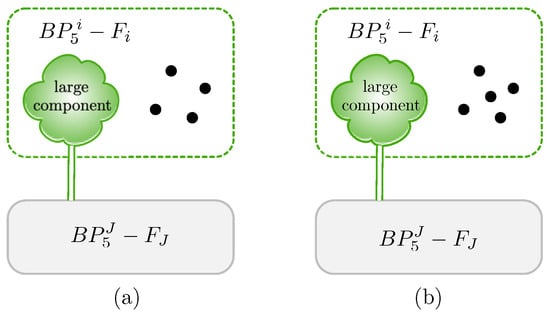
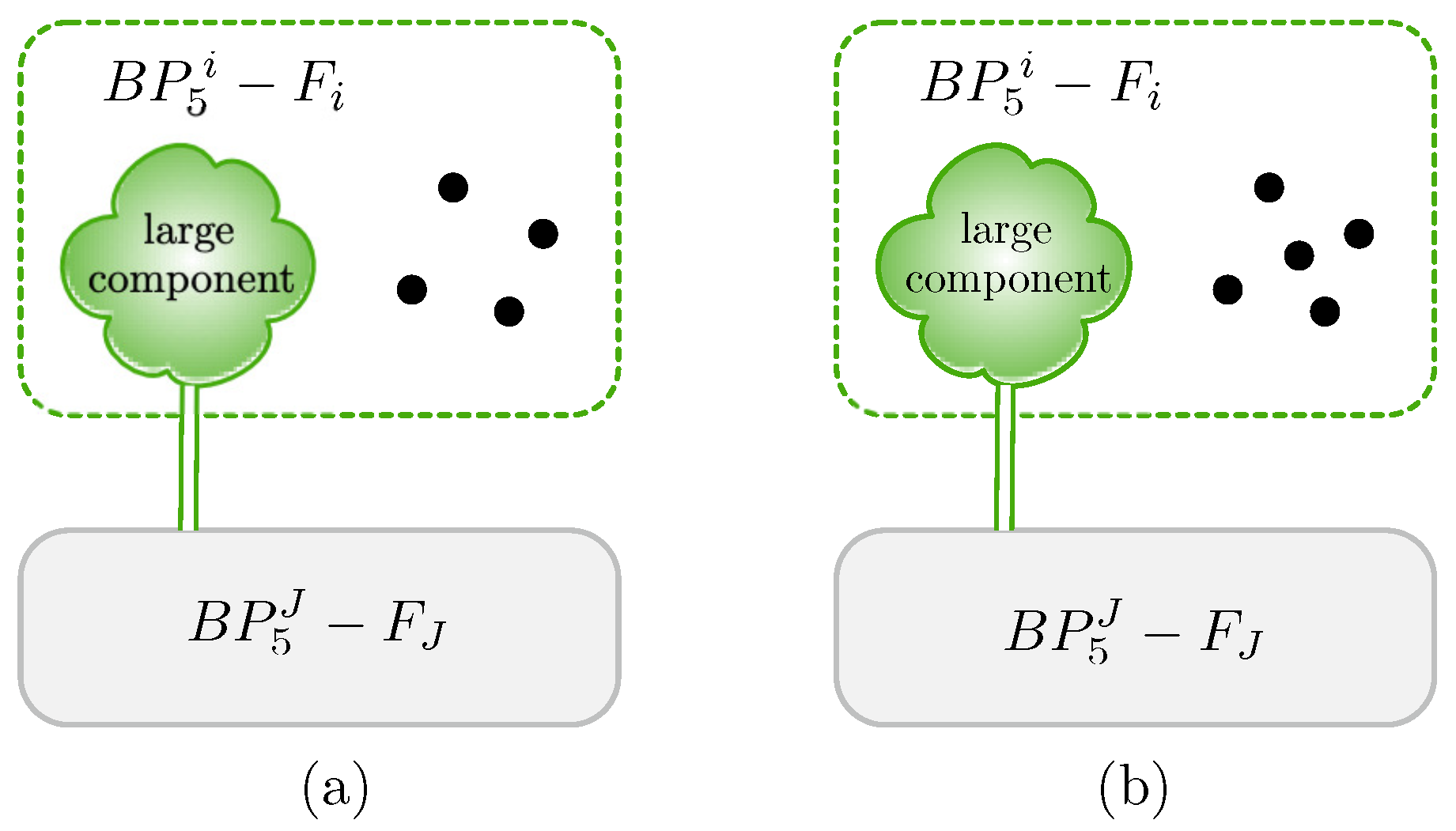
Case I-1. . We let . For , if is disconnected, by Lemma 6, it has a large component and is with . Since every vertex of has an external edge, there are edges between and . Also, since , the large component of is connected to . This implies that (see Figure 4a).
Figure 4.
A schematic concept to illustrate the proof of Case I-1: (a) when ; (b) when .
It remains to consider . In this case, we have . Since every vertex of M has exactly one external neighbor, we have . If , by Lemma 9, , a contradiction. Similarly, if , by Lemma 10, , a contradiction. This implies that (see Figure 4b).
Case I-2. . We let and, without loss of generality, we suppose . Since , we have ; otherwise, . We first consider . For each , as , by Lemma 5(3), if is disconnected, it has a large component and is with . Thus, . A proof similar to Case 1 shows that the large component of is connected to . If , by Lemma 9, , a contradiction. This implies that .
It remains to consider . In this situation, , which means that at most five faulty external edges. Since every vertex in M has exactly one external neighbor, we have .
Case I-3. . We let . Without loss of generality, we suppose . Since , we have . If , then , a contradiction. Thus, . We first consider . For each , if is disconnected, by Lemma 5(2), it has large components and is with . Thus, . A proof similar to Case 1 shows that the large component of is connected to . If , by Lemma 9, , a contradiction. This implies that .
It remains to consider . In this situation, , which means that at most three faulty external edges. Since every vertex in M has exactly one external neighbor, we have .
Case I-4. . We let . As for each , we have , which means that at most three faulty external edges. Since every vertex in M has exactly one external neighbor, we have .
For induction step, we assume and the result holds for . That is, for each , if , then either is connected or contains a large component and smaller components containing totally at most five vertices. We let be the set of vertices that do not belong to the large component of . Obviously, if , then is connected and the result holds. We consider the following cases:
Case II-1. . We let . There are two subcases depending on the range of .
Case II-1.1. .
Since is isomorphic to and , by induction hypothesis, we have . Since every vertex of has an external edge, there are edges between and . Also, since when , the large component of is connected to . As M is the union of smaller components of , this implies that .
Case II-1.2. .
In this case, we have , which means that F contains at most five faulty external edges. Since every vertex in M has exactly one external neighbor, we have .
Case II-2. . We let and, without loss of generality, we suppose . Since , we have . If , then for . Thus, it requires that . We consider the following two subcases.
Case II-2.1. .
In this case, we have . For each , if is disconnected; by Lemma 5(3), it contains a large component and is with . Then, via a proof similar to Case 1.1, we can show that the large component of is connected to . Thus, . If , by Lemma 9, , a contradiction. This implies that .
Case II-2.2. .
In this case, we have for . By Lemma 5(3), if is disconnected, it contains a large component and is with . For , if is disconnected, by Lemma 6, it contains a large component and is with . Since when , the large component of for is connected to . Thus, . If , by Lemma 9, , a contradiction. Similarly, if , by Lemma 10, when , a contradiction. This implies that .
It remains to consider . In this situation, since and , it follows that . Thus, at most three vertices in cannot connect to in , i.e., .
Case II-3. . We let . Without loss of generality, we suppose . Since , we have . If , then for . Thus, it requires that . We consider the following two subcases.
Case II-3.1. .
For each , if is disconnected, by Lemma 5(2), it contains a large component and is with . Then, via a proof similar to Case 1.1, we can show that the large component of is connected to . Thus, . If , by Lemma 9, , a contradiction. This implies that .
Case II-3.2.
For each , since , if is disconnected, by Lemma 5(2), it contains a large component and is with . For , if is disconnected, by Lemma 5(3), it contains a large component and is with . Then, via a proof similar to Case 1.1, we can show that the large component of for is connected to . Thus, . If , by Lemma 9, , a contradiction. Similarly, if , by Lemma 10, when , a contradiction. This implies that .
It remains to consider . In this situation, since and , it follows that . Thus, at most one vertex in cannot connect with in , i.e., .
Case II-4. . We let . Without loss of generality, we suppose . Since , we have . If , then for . Thus, it requires that . We consider the following two subcases.
Case II-4.1. .
For each , if is disconnected, by Lemma 5(1), it has two components, one of which is a singleton, i.e., . A proof similar to Case 1.1 shows that the large component of is connected to . Clearly, .
Case II-4.2. .
For each , since , if is disconnected, by Lemma 5(1), it contains a large component and is with . Since , if is disconnected, by Lemma 5(2), it contains a large component and is with . A proof similar to Case 1.1 shows that the large component of for is connected to . Thus, .
Case II-5. . We let . For each , we let be the set of vertices that do not belong to the large component of . Since , we have for . Since , if is disconnected, by Lemma 5(1), it has two components, one of which is a singleton, i.e., . A proof similar to Case 1.1 shows that the large component of is connected to . Clearly, . □
4. Applications to Extra Edge Connectivity and Component Edge Connectivity
As applications of Theorem 1, we determine the relation between and for .
4.1. Relation between and
Lemma 11.
For , let be the n-dimensional burnt pancake graph and be an arbitrary edge set. If , then has at most four components.
Proof.
Note that for . By Lemma 6, if is disconnected, it has a large component along with smaller components containing totally at most four vertices. Suppose that has five components, four of which are singletons. By Lemma 7, isolating these four singletons requires the removal of at least edges, which contradicts that . □
Theorem 2.
for .
Proof.
Let and and are connected subgraphs}. As and is connected, observe from Table 1 that is a 3-path or a . By Lemma 7, let and . Let F be an edge-cut of . By Lemma 5(3), if , then has a large component along with smaller components containing totally at most vertices. This fulfills the condition of Lemma 1(i). Also, by Lemma 11, if , then has at most components. This fulfills the condition of Lemma 1(ii). Therefore, by Lemma 1, have for . □
4.2. Relation between and
Lemma 12.
For , let be the n-dimensional burnt pancake graph and be an arbitrary edge set. If , then has at most five components.
Proof.
Note that for . By Theorem 1, if is disconnected, it has a large component and smaller components containing totally at most five vertices. Suppose that has six components, five of which are singletons. By Lemma 8, isolating these five singletons requires the removal of at least edges, which contradicts that . □
Theorem 3.
for .
Proof.
Let and and are connected subgraphs}. As and is connected, observe from Table 2 that is a 4-path or a tree with 5 vertices (including ). By Lemma 8, let and . Let F be an edge-cut of . By Lemma 6, if , then has a large component and smaller components containing totally at most vertices. This fulfills the condition of Lemma 1(i). Also, by Lemma 12, if , then has at most components. This fulfills the condition of Lemma 1(ii). Therefore, by Lemma 1, have for . □
4.3. Relation between and
Lemma 13.
For , let be the n-dimensional burnt pancake graph and be an arbitrary edge set. If , then has at most six components.
Proof.
Let M be the union of smaller components of and let be the such number of components in M. By the definition of M, it suffices to show that . Since and for , have . Then, when . With reasoning similar to Remark 1 in the proof of Theorem 1, it is shown that is connected for each and the following remark is further obtained.
Remark 2.
is connected.
Obviously, if , then is connected and the result holds. Now consider . For each , let be the set of vertices that do not belong to the large component of .
Case 1. . Let . There are two subcases depending on the range of .
Case 1.1. .
Since is isomorphic to , by Theorem 1, has a large component and is with . As every vertex of has an external edge, there are edges between and . Also, since when , the large component of is connected to . This implies that .
Case 1.2. .
In this case, there is , which means that F contains at most ten faulty external edges. Since every vertex in M has exactly one external neighbor, there is . If , it is clear that . If , by Lemma 9, , a contradiction. Similarly, if , by Lemma 10, , a contradiction. Now deal with the situations for as follows.
Case 1.2.1. . Let , where . By Lemma 10, . Clearly, and x may connect to at most 7 vertices in , i.e., . Thus,
when , a contradiction.
Case 1.2.2. . Let , where . By Case 1.2.1, . Clearly, and x may connect to at most 8 vertices in , i.e., . Thus,
when , a contradiction.
Case 1.2.3. . Let , where . By Case 1.2.1, . First, consider forms an edge in M. Then, and x (resp., y) may connect to at most eight vertices or vertices (if ) in . That is, and . Since and the girth of is 8, x and y cannot be adjacent to a vertex in simultaneously. Thus, and
when , a contradiction. Next, suppose x and y are singletons in M. Then, and . Thus,
when , a contradiction.
Based on the discussion of the above situations, conclude .
Case 2. . Let and, without loss of generality, suppose . Since , there is . Consider the following three subcases.
Case 2.1. .
In this case, there is . For each , if is disconnected, by Lemma 5(3), it contains a large component and is with . Then, via a proof similar to Case 1.1, it can be shown that the large component of is connected to . Thus, . If , by Lemma 9, , a contradiction. This implies that .
Case 2.2. .
In this case, there is . By Lemma 5(3), if is disconnected, it contains a large component and is with . For , if is disconnected, by Lemma 6, it contains a large component and is with . Then, via a proof similar to Case 1.1, it can be shown that the large component of for is connected to . Thus, . If , a contradiction can be acquired through an argument similar to Case 1.2. This implies that .
It remains to consider . In this situation, since , there is . Thus, at most eight vertices in cannot connect to in , i.e., . If ,a contradiction can be acquired through an argument similar to Case 1.2. Thus, .
Case 2.3. .
In this case, , which leads to . Note that . Thus, and at most two vertices in cannot connect with in , i.e., . It is clear that .
Case 3. . Let . Without loss of generality, suppose . Since , there is . If , then for . Thus, it requires that . Consider the following three subcases.
Case 3.1. .
For each , if is disconnected, by Lemma 5(2), it contains a large component and is with . Then, via a proof similar to Case 1.1, it can be shown that the large component of is connected to . Thus, . If , by Lemma 9, , a contradiction. This implies that .
Case 3.2. .
For each , since , if is disconnected, by Lemma 5(2), it contains a large component and is with . For , if is disconnected, by Lemma 5(3), it contains a large component and is with . Then, via a proof similar to Case 1.1, it can b shown that the large component of for is connected to . Thus, . If , a contradiction can be acquired through an argument similar to Case 1.2. Thus, .
It remains to consider . In this situation, since and , there is . Thus, at most six vertices in cannot connect with in , i.e., . If , by Lemma 9, , a contradiction. This implies that .
Case 3.3. .
In this case, , which leads to . Note that . Thus, and at most three vertices in cannot connect with in , i.e., . It is clear that .
Case 4. . Let . Without loss of generality, suppose . Since , there is . If , then for . Thus, it requires that . Also, if , then for . Thus, it requires that . Consider the following two subcases.
Case 4.1. , .
In this case, there is . If is disconnected, by Lemma 5(1), it has two components, one of which is a singleton, i.e., . For , since , if is disconnected, by Lemma 5(2), it contains a large component and is with . A proof similar to Case 1.1 shows that the large component of for is connected to . Thus, . If , a contradiction can be acquired through an argument similar to Case 1.2. Thus, .
Case 4.2. .
In this case, . Thus, at most two vertices in cannot connect with in , i.e., . It is clear that .
Case 5. . Let . Without loss of generality, suppose . Since , there is . If , then for . Thus, it requires that . Consider the following two subcases.
Case 5.1. .
For each , if is disconnected, by Lemma 5(1), has two components, one of which is a singleton, i.e., . A proof similar to Case 1.1 shows that the large component of is connected to . Thus, . This leads to .
Case 5.2. .
In this case, . Thus, at most two vertices in cannot connect with in , i.e., . It is clear that .
Case 6. . Let . Since , there is and . Since for , by Lemma 5(1), if is disconnected, then has two components, one of which is a singleton, i.e., . As , by Lemma 2(1), there exists such that . This implies that the large component of is connected to . Thus, . If , by Lemma 9, , a contradiction. This implies that . □
Theorem 4.
for .
Proof.
Let and and are connected subgraphs}. As and is connected, it can be observed from Table 3 that is a 5-path or a tree with 6 vertices (including ). By Lemma 9, let and . Let F be an edge-cut of . By Theorem 1, if , then has a large component along with smaller components containing totally at most vertices. This fulfills the condition of Lemma 1(i). Also, by Lemma 13, if , then has at most components. This fulfills the condition of Lemma 1(ii). Therefore, by Lemma 1, there is for . □
5. Concluding Remarks
For burnt pancake graph , this paper shows that when removing any edge subset with a size of approximately six times , the surviving graph possesses the “linearly many faults" property. Applying this property, we attain and . Specifically, we prove that for ; and for , as summarized in Table 4.
Table 4.
The comparison of and .
For ℓ-componen edge connectivity and h-extra edge connectivity with higher ℓ and h, e.g., and , since we showed in Lemma 10 that and for with , this prompts us to have the following conjecture:
Conjecture 1.
for .
Obviously, to affirm the above conjecture is equivalent to showing that the following two implications hold for and any edge set ): (i) If , then either is connected or contains a large component along with smaller components containing totally at most six vertices. (ii) if , then has at most seven components.
Similarly, as is n-regular and its girth is eight, we are easy to check that and . Based on the relationship of and for a regular graph G [30], we also have the following conjecture:
Conjecture 2.
for .
To prove this conjecture, we need to show that when removing any edge subset with a size approximately of eight times , the surviving graph still retains the “linearly many faults” property. With the increase in the removal of edges, the situation becomes more complex, and it is an interesting and challenging research topic.
We conclude this paper by discussing some of its limitations against real-world instances. Even though various interconnection networks have specific structural phenomena when a linear number of vertices or edges fail, do these phenomena occur frequently? Since most research considers vertex or edge failures in a network to be random and uncorrelated, it ignores possible events that cause components close to each other to fail simultaneously with a higher probability. In this case, is there a more reasonable evaluation measure combining h-extra edge connectivity or ℓ-component edge connectivity that can genuinely reflect this phenomenon?
Author Contributions
Conceptualization, methodology, writing—original draft preparation, funding acquisition, M.-M.G.; validation, formal analysis, visualization, H.-X.Y.; writing—review and editing, funding acquisition, J.-M.C. All authors have read and agreed to the published version of the manuscript.
Funding
This work was supported by the National Natural Science Foundation of China under Grant Nos. 12101610, 11971054, the Fundamental Research Funds for the Central Universities China, Innovation Foundation of CUPL for Youth No. 10823423, and National Science and Technology Council of Taiwan under Grant NSTC-112-2221-E-141-004.
Informed Consent Statement
Not applicable.
Data Availability Statement
The data used in the study are available with the authors and can be shared upon reasonable requests.
Acknowledgments
The authors would like to thank the anonymous reviewers and the editor for their careful reviews and constructive suggestions to help us improve the quality of this paper.
Conflicts of Interest
The authors declare that they have no conflict of interest.
References
- Yang, X.; Evans, D.J.; Chen, B.; Megson, G.M.; Lai, H. On the maximal connected component of hypercube with faulty vertices. Int. J. Comput. Math. 2004, 81, 515–525. [Google Scholar] [CrossRef] [Scilit]
- Cheng, E.; Lipták, L. Linearly many faults in Cayley graphs generated by transposition trees. Inf. Sci. 2007, 177, 4877–4882. [Google Scholar] [CrossRef] [Scilit]
- Cheng, E.; Lipták, L.; Sala, F. Linearly many faults in 2-tree-generated networks. Networks 2010, 55, 90–98. [Google Scholar] [CrossRef] [Scilit]
- Li, P.; Meng, X. Linearly many faults in Cayley graphs generated by transposition triangle free unicyclic graphs. Theor. Comput. Sci. 2020, 847, 95–102. [Google Scholar] [CrossRef] [Scilit]
- Yuan, A.; Cheng, E.; Lipták, L. Linearly many faults in (n, k)-star graphs. Int. J. Found. Comput. Sci. 2011, 22, 1729–1745. [Google Scholar] [CrossRef] [Scilit]
- Cheng, E.; Lipták, L.; Yuan, A. Linearly many faults in arrangement graphs. Networks 2013, 61, 281–289. [Google Scholar] [CrossRef] [Scilit]
- Angjeli, A.; Cheng, E.; Lipták, L. Linearly many faults in augmented cubes. Int. J. Parallel Emergent Distrib. Syst. 2013, 28, 475–483. [Google Scholar] [CrossRef] [Scilit]
- Angjeli, A.; Cheng, E.; Lipták, L. Linearly many faults in dual-cube-like networks. Theor. Comput. Sci. 2013, 472, 1–8. [Google Scholar] [CrossRef] [Scilit]
- Cheng, E.; Lipman, M.J.; Lipták, L. Matching preclusion and conditional matching preclusion for regular interconnection networks. Discret. Appl. Math. 2012, 160, 1936–1954. [Google Scholar] [CrossRef] [Scilit]
- Cheng, E.; Qiu, K.; Shen, Z. Connectivity results of complete cubic networks as associated with linearly many faults. J. Interconnect. Netw. 2015, 15, 155007. [Google Scholar] [CrossRef] [Scilit]
- Cheng, E.; Qiu, K.; Shen, Z. A strong connectivity property of the generalized exchanged hypercube. Discret. Appl. Math. 2017, 216, 529–536. [Google Scholar] [CrossRef] [Scilit]
- Gu, M.M.; Hao, R.X.; Cheng, E. Note on applications of linearly many faults. Comput. J. 2020, 63, 1406–1416. [Google Scholar] [CrossRef] [Scilit]
- Harary, F. Conditional connectivity. Networks 1983, 143, 346–357. [Google Scholar] [CrossRef] [Scilit]
- Fábrega, J.; Fiol, M.A. On the extra connectivity graphs. Discret. Math. 1996, 155, 49–57. [Google Scholar] [CrossRef] [Scilit]
- Sampathkumar, E. Connectivity of a graph—A generalization. J. Comb. Inf. Syst. Sci. 1984, 9, 71–78. [Google Scholar]
- Chartrand, G.; Kapoor, S.; Lesniak, L.; Lick, D.R. Generalized connectivity in graphs. Bull. Bombay Math. Colloq. 1984, 2, 1–6. [Google Scholar]
- Hsu, L.-H.; Cheng, E.; Lipták, L.; Tan, J.M.; Lin, C.-K.; Ho, T.-Y. Component connectivity of the hypercubes. Int. J. Comput. Math. 2012, 89, 137–145. [Google Scholar] [CrossRef] [Scilit]
- Zhao, S.; Yang, W.; Zhang, S.; Xu, L. Component edge connectivity of hypercubes. Int. J. Found. Comput. Sci. 2018, 29, 995–1001. [Google Scholar] [CrossRef] [Scilit]
- Yang, W.; Meng, J. Extraconnectivity of hypercubes. Appli. Math. Lett. 2009, 22, 887–891. [Google Scholar] [CrossRef] [Scilit]
- Hsieh, S.-Y.; Chang, Y.-H. Extraconnectivity of k-ary n-cube networks. Theor. Comput. Sci. 2012, 443, 63–69. [Google Scholar] [CrossRef] [Scilit]
- Chang, N.-W.; Hsieh, S.-Y. {2,3}-extraconnectivity of hypercube-like networks. J. Comput. Syst. Sci. 2013, 79, 669–688. [Google Scholar] [CrossRef] [Scilit]
- Li, P.; Xu, M. Fault-tolerant strong Menger (edge) connectivity and 3-extra edge-connectivity of balanced hypercubes. Theoret. Comput. Sci. 2018, 707, 56–68. [Google Scholar] [CrossRef] [Scilit]
- Li, X.; Fan, J.; Lin, C.-K.; Cheng, B.-L.; Jia, X. The extra connectivity, extra conditional diagnosability and t/k-diagnosability of the data center network DCell. Theor. Comput. Sci. 2019, 766, 16–29. [Google Scholar] [CrossRef] [Scilit]
- Chang, J.-M.; Pai, K.-J.; Ro, R.-Y.; Yang, J.-S. The 4-component connectivity of alternating group networks. Theor. Comput. Sci. 2019, 766, 38–45. [Google Scholar] [CrossRef] [Scilit]
- Gu, M.-M.; Hao, R.-X.; Tang, S.-M.; Chang, J.-M. Analysis on component connectivity of bubble-sort star graphs and burnt pancake graphs. Discret. Appl. Math. 2020, 279, 80–91. [Google Scholar] [CrossRef] [Scilit]
- Gu, M.-M.; Chang, J.-M.; Hao, R.-X. On computing component (edge) connectivities of balanced hypercubes. Comput. J. 2020, 63, 1311–1320. [Google Scholar] [CrossRef] [Scilit]
- Gu, M.-M.; Chang, J.-M.; Hao, R.-X. On component connectivity of hierarchical star networks. Int. J. Found. Comput. Sci. 2021, 31, 313–326. [Google Scholar] [CrossRef] [Scilit]
- Liu, J.; Zhou, S.; Zhang, H.; Chen, G. Vulnerability analysis of multiprocessor system based on burnt pancake networks. Discret. Appl. Math. 2022, 314, 304–320. [Google Scholar] [CrossRef] [Scilit]
- Zhao, S.; Yang, W. Conditional connectivity of folded hypercubes. Discret. Appl. Math. 2019, 257, 388–392. [Google Scholar] [CrossRef] [Scilit]
- Hao, R.-X.; Gu, M.-M.; Chang, J.-M. Relationship between extra edge connectivity and component edge connectivity for regular graphs. Theor. Comput. Sci. 2020, 833, 41–55. [Google Scholar] [CrossRef] [Scilit]
- Li, X.; Lin, C.-K.; Fan, J.; Jia, X.; Cheng, B.-L.; Zhou, J. Relationship between extra connectivity and component connectivity in networks. Comput. J. 2021, 64, 38–53. [Google Scholar] [CrossRef] [Scilit]
- Guo, L.; Zhang, M.; Zhai, S.; Xu, L. Relation of extra edge connectivity and component edge connectivity for regular networks. Int. J. Found. Comput. Sci. 2021, 32, 137–149. [Google Scholar] [CrossRef] [Scilit]
- Poulik, S.; Ghorai, G. Determination of journeys order based on graph’s Wiener absolute index with bipolar fuzzy information. Inform. Sci. 2021, 545, 608–619. [Google Scholar] [CrossRef] [Scilit]
- Poulik, S.; Ghorai, G. Connectivity concepts in bipolar fuzzy incidence graphs. Thai J. Math. 2022, 20, 1609–1619. [Google Scholar]
- Poulik, S.; Ghorai, G.; Xin, Q. Explication of crossroads order based on Randic index of graph with fuzzy information. Soft Comput. 2023. [Google Scholar] [CrossRef] [Scilit]
- Poulik, S.; Ghorai, G. First entire Zagreb index of fuzzy graph and its application. Axioms 2023, 12, 415. [Google Scholar]
- Gates, W.H.; Papadimitriou, C.H. Bounds for sorting by prefix reversal. Discret. Math. 1979, 27, 47–49. [Google Scholar] [CrossRef] [Scilit]
- Bulteau, L.; Fertin, G.; Rusu, I. Pancake flipping is hard. J. Comput. Syst. Sci. 2015, 81, 1556–1574. [Google Scholar] [CrossRef] [Scilit]
- Iwasaki, T.; Kaneko, K. Fault-tolerant routing in burnt pancake graphs. Inform. Process. Lett. 2010, 110, 535–538. [Google Scholar] [CrossRef] [Scilit]
- Song, S.; Li, X.; Zhou, S.; Chen, M. Fault tolerance and diagnosability of burnt pancake networks under the comparison model. Theor. Comput. Sci. 2015, 582, 48–59. [Google Scholar] [CrossRef] [Scilit]
- Song, S.; Zhou, S.; Li, X. Conditional diagnosability of burnt pancake networks under the PMC model. Comput. J. 2016, 59, 91–105. [Google Scholar]
- Chin, C.; Weng, T.-H.; Hsu, L.-H.; Chiou, S.-C. The spanning connectivity of the burnt pancake graphs. IEICE Trans. Inform. Syst. 2009, E92-D, 389–400. [Google Scholar] [CrossRef] [Scilit]
- Dilixiati, S.; Sabir, E.; Meng, J. Star structure connectivities of pancake graphs and burnt pancake graphs. Int. J. Parallel Emergent Distrib. Syst. 2021, 36, 440–448. [Google Scholar] [CrossRef] [Scilit]
- Wang, N.; Meng, J.; Tian, Y. Neighbor-connectivity of pancake networks and burnt pancake networks. Theor. Comput. Sci. 2022, 916, 31–39. [Google Scholar] [CrossRef] [Scilit]
- Gu, M.-M.; Chang, J.-M. Neighbor connectivity of pancake graphs and burnt pancake graphs. Discret. Appl. Math. 2023, 324, 46–57. [Google Scholar] [CrossRef] [Scilit]
- Compeau, P.E.C. Girth of pancake graphs. Discret. Appl. Math. 2011, 159, 1641–1645. [Google Scholar] [CrossRef] [Scilit]

Disclaimer/Publisher’s Note: The statements, opinions and data contained in all publications are solely those of the individual author(s) and contributor(s) and not of MDPI and/or the editor(s). MDPI and/or the editor(s) disclaim responsibility for any injury to people or property resulting from any ideas, methods, instructions or products referred to in the content. |
© 2024 by the authors. Licensee MDPI, Basel, Switzerland. This article is an open access article distributed under the terms and conditions of the Creative Commons Attribution (CC BY) license (https://creativecommons.org/licenses/by/4.0/).