


Abstract
In this paper, we discuss the hypothesis that an ordered -semigroup can be constructed on the M-left(right)-tri-basis. In order to generalize the left(right)-tri-basis using -semigroups and ordered semigroups, we examined M-tri-ideals from a purely algebraic standpoint. We also present the form of the M-tri-ideal generator. We investigated the M-left(right)-tri-ideal using the ordered -semigroup. In order to obtain their properties, we used M-left(right)-tri-basis. It was possible to generate a M-left(right)-tri-basis from elements and their subsets. Throughout this paper, we will present an interesting example of order , which is not a partial order of . Additionally, we introduce the notion of quasi-order. As an example, we demonstrate the relationship between M-left(right)-tri-basis and partial order.
Keywords:
left tri-ideal; right tri-ideal; M-left-tri-basis; M-right-tri-basis; quasi-order; partial order MSC:
06B10; 20M25; 16Y60
1. Introduction
Several applications of algebraic structures can be found in mathematics. Generalizing the ideals of algebraic structures and ordered algebraic structures plays an important role, making them available for further study and application. Mathematicians studied bi-ideals, quasi-ideals, and interior ideals during 1950–1980. However, during 1950–2019, it was only mathematicians who studied their applications. In fact, the notion of one-sided ideals of rings and semigroups can be regarded as a generalization of the notion of ideals of rings and semigroups, as is the notion of quasi-ideals of semigroups and rings. In general, semigroups are generalizations of rings and groups. In semigroup theory, certain band decompositions are useful for studying semigroup structure. A new field in mathematics could be opened up by this research, one that aims to use semigroups of bi-ideals of semirings with semilattices that are additively reduced. The many different ideals associated with -semigroups [1] and -semirings [2] have been described by several researchers. Partially ordered relation satisfies the conditions of reflexivity, antisymmetry, and transitivity. There are different classes of semigroups and -semigroups based on bi-ideals that have been described by researchers in [3,4,5,6]. Munir [7] introduced new ideals in the form of M-bi-ideals over semigroups in 2018. An ordered semigroup is a generalization of a semigroup with a partially ordered relation constructed on a semigroup, so that the relation fits with the operation. An algebraic structure such as the ordered -semigroup was introduced by Sen et al. in 1993 [8] and has been studied by several authors [9,10,11,12].
For an ordered semigroup and subsemigroup of , , where m is a positive integer. Clearly, for any subsemigroup of ordered semigroup , for all positive integers n, which are similarly right case. Hence, for all positive integers r and t, such that , but the converse is not true. As a generalization of the bi-ideal of semirings and semigroups, a tri-ideal of semirings and semigroups can be characterized as a generalization of the bi-ideal. In the context of -semigroups, an ordered -semigroup is an extension of the -semigroup. In contrast to the notion of the tri-ideal of semigroups, the notion of the tri-ideal of an ordered semigroup is a general form of the notion of the tri-ideal of semigroups. In semigroup theory, the M-tri-ideal is a generalization of the tri-ideal. Similarly, an ordered M-tri-ideal is a generalization of an ordered tri-ideal. In this paper, we describe the basic properties of the M-tri-basis from an algebraic standpoint. The fact that semigroups can be generalized to -semigroups and -semigroups to ordered -semigroups is a result of these facts. It was work by Jantanan et al. that introduced the concept of bi-basis of ordered -semigroups in 2022. We further describe the relationship between partial order and bi-basis [13]. As recently discussed in Palanikumar et al. [14,15,16], algebraic structures such as semigroups, semirings, ternary semigroups, and ternary semirings are all ideals and the generators of these structures are ideals. Rao introduced the tri-ideals of semigroups and semirings in [17,18]. Our paper extends a bi-basis of an ordered -semigroup into a M-bi-basis of an ordered -semigroup. We also generalize the tri-ideal of an ordered -semigroup to an M-tri-basis of an ordered -semigroup. The notion of almost bi-ideals and almost quasi-ideals of ordered semigroups is discussed in Sudaporn et al. [19]. The novel concept of M-bi-basis generators of an ordered -semigroup is introduced by Palanikumar et al. [20]. Susmita et al. have discussed some important properties of bi-ideals of an ordered semigroups [21].
This paper discusses several important classical results for M-tri-basis and -semigroups characterized by M-tri-ideals and M-tri-basis. Furthermore, we demonstrate how the elements and subsets of an ordered -semigroup yield the M-tri-ideal and basis. This paper extends the notion of -semigroup information into ordered -semigroup information. The paper is divided into five sections. Section 1 is the introduction. There is a brief description of an ordered -semigroup in Section 2, as well as relevant definitions and results. A numerical example of an M-left-tri-basis generator can be found in Section 3. As part of Section 4, a numerical example is given for the M-right-tri-basis generator concept. Our conclusions are provided in Section 5. In this paper, our purpose is to describe:
- The generator of the M-tri-ideal for an ordered -semigroup;
- To interact, the order relation based on the M-tri-basis should not be a partial order.
- For example, the subset of an M-tri-basis is not an M-tri-basis itself.
2. Basic Concepts
It is assumed throughout this article that denotes a -semigroup, unless stated otherwise.
Definition 1
([1]). Let and Γ be any two non-empty sets. Then, is called a Γ-semigroup from , which maps , satisfying the condition for all and .
Definition 2
([8]). The algebraic system is said to be an ordered Γ-semigroup if it satisfies the following conditions:
- 1.
- is a Γ-semigroup,
- 2.
- is a relation from a partially ordered set (poset) ,
- 3.
- If , then and for any and .
Remark 1
([8]). Let and be any two subsets of . Then, the following properties hold:
- 1.
- ,
- 2.
- ,
- 3.
- ,
- 4.
- If , then and .
Definition 3
([17]). Let be a Γ-semigroup and be a subset of called left-tri-ideal(right-tri-ideal) (or LTI and RTI, respectively) if it satisfies the following conditions:
- 1.
- is a Γ-subsemigroup,
- 2.
- ,
Lemma 1
([18]). Let be a Γ-semiring, a subset of , and . Then, the following statements hold:
- 1.
- is the smallest Γ-LTI of S containing ,
- 2.
- is the smallest Γ-RTI of containing ,
- 3.
- is the smallest Γ-LTI of containing ,
- 4.
- is the smallest Γ-RTI of containing .
Definition 4
([18]). (i) Let be an ordered semigroup. A subsemigroup of is called an M-left-ideal of if and , where M is a positive integer that is not necessarily one.
- (ii)
- A subsemigroup of is called a M-right-ideal of if and , where M is a positive integer that is not necessarily one.
Definition 5
([18]). Let be a subsemigroup of an ordered semigroup . Then,
- (i)
- The M-left-ideal generated by is .
- (ii)
- The M-right-ideal generated by is .
Definition 6
([7]). Let be a subset of , which is called an M-bi-ideal of semigroup S if it satisfies the following conditions:
- 1.
- is a Γ-subsemigroup,
- 2.
- , where M is a positive integer.
Definition 7
([13]). Let be a subset of that is called a bi-basis of if it satisfies the following conditions:
- 1.
- .
- 2.
- If such that , then .
Definition 8.
Let be the subset of that is called an M-bi-basis of if satisfies the following conditions:
- 1.
- .
- 2.
- If such that , then .
3. M-LTB Generator
In this paper, we present some results on the M-left-tri-ideal (M-LTI) generator, based on an ordered -semigroup.
Definition 9.
Let be the subset of called an M-LTI of if it satisfies the following conditions:
- 1.
- is a Γ-subsemigroup,
- 2.
- , where M is a positive integer,
- 3.
- If and such that , then .
Remark 2.
If and are positive integers, then the following statements hold:
- 1.
- 2.
Remark 3.
1. Every M-bi-ideal is an M-LTI.
- 2.
- Every LTI is an M-LTI.
Here is an example showing that the converse does not need to be true, as demonstrated by Example 1.
Example 1.
and Γ is a unit matrix. Now, we define the partial order relation ⪯ on : for any , , if and only if , for all i and j. Then, is an ordered Γ-semigroup of matrices over (non-negative integer) with the partial order relation .
(i) Clearly,
Although is an M-LTI, it is not an M-bi-ideal of .
(iii) Clearly,
Hence, is an M-LTI, but not an LTI of .
Theorem 1.
1. Let . The M-LTI generated by an element is and , where and M are positive integers.
- 2.
- Let be a subset of . The M-LTI generated by set is .
Definition 10.
Let be a subset of , known as an M-left-tri-basis (LTB) of if it meets the criteria listed below:
- 1.
- .
- 2.
- If such that , then .
Example 2.
Let and , where and are defined on with the following table:
. Clearly, is an ordered Γ-semigroup.
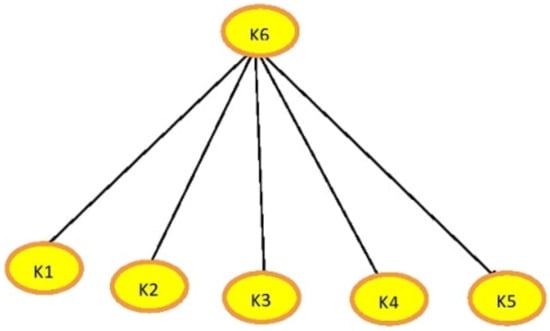
The covering relation is represented by Figure 1, since is a M-LTB of .
Figure 1.
Covering relation.
Theorem 2.
Let be the M-LTB of and . If , then .
Proof.
Assume that , and suppose that . Let . Obviously, since , . To show that , clearly, . Still, to prove that , let . By our hypothesis, , and hence, . We have for some . As a result, the following cases will be discussed.
Case-1:
Let . There are two subcases to examine:
Subcase-1:
Let , then .
Subcase-2:
Let . We have .
Case-2:
Let . Then, , for some and . In addition, there are four subcases to be considered.
Subcase-1:
Let and . Now,
Subcase-2:
Let and . Now,
Subcase-3:
Let and . Now,
Subcase-4:
Let , , and . Now,
Case-3:
Let . Then, for some , and . We will examine eight subcases.
Subcase-1:
Let , and . Now,
Subcase-2:
Let , and . Now,
Subcase-6:
Let , and . Now,
Subcase-8:
Let , , and . Now,
It is similar to prove other subcases. Hence, for all the cases, we have . Thus, , which is a contradiction. Hence . □
Lemma 2.
Let be the M-LTB of and . If , then or or .
Proof.
Theorem 2 leads to the proof. □
Definition 11.
For any , is called a quasi-order on .
Remark 4.
The order is not a partial order of .
Example 3.
By Example 2, and but . Hence, the relation is not a partial order on .
If is an M-LTB of , then . Let . Then, , and so, for some . This implies . Hence, .
Remark 5.
If is a M-LTB of then for any , there exists such that .
Lemma 3.
Let be an M-LTB of . If such that , then neither nor .
Proof.
Assume that , such that . Suppose that . Let . Then, . Let . By Remark 5, there exists , such that . We think about two cases to be discussed. If , then . Thus, . Hence, , which is a contradiction. If , then . Hence, , since . Hence, , which is a contradiction. A similar argument can be made for other cases. □
Lemma 4.
Let be the M-LTB of and and .
- 1.
- If, then or ,
- 2.
- If, then or or .
Proof.
(1) Assume that and suppose that and . Let . Clearly, , since and implies . To prove that , it suffices to determine that . Let if that , and hence, . If , then
Thus, . This implies , as is an M-LTB of and . Therefore, , which is a contradiction. Hence, or .
- (2)
- Assume that and suppose that and and . Let . Clearly, , since , , and imply that . To prove that , it remains to prove that . Let if that , and so, . Hence,
Thus, . This implies as is an M-LTB of and . Therefore, , which is a contradiction. Hence, or or . □
Lemma 5.
Let be an M-LTB of ,
- 1.
- If and , then .
- 2.
- If and , then , for , and , .
Proof.
(1) For any , let and . Suppose that and
By Lemma 4 (1), it follows that or , which is a contradiction.
- (2)
- For any , let , , and . Suppose that , we have
By Lemma 4 (2), it follows that , , or , which contradicts our assumption. □
Theorem 3.
Let be the M-LTB of , if and only if satisfies the following
- 1.
- For any ,(1.1) there exists such that (or),(1.2) there exists such that (or),(1.3) there exists such that ;
- 2.
- If and and , then , for any ;
- 3.
- If and and , then , for any and , .
Proof.
Assume that is an M-LTB of , then . To prove that (1), let , . As , we have for some , we think about the three following cases.
Case-1 :
Let . Then, for some . This implies . Hence, . As for some . To find out . Now, . We have . Thus, , and hence, .
Case-2 :
Let . Then, for some and . This implies . Hence, . As for some . We have . We determine that . Now, . Hence, . This implies . Hence, .
Case-3:
Let . Then, for some . This implies . Hence, . As for some . We have . To prove that . Now, . Hence, . This implies . Hence, . By Lemma 5(1) and Lemma 5(2), we have the proof of (2) and (3), respectively.
Conversely, assume that (1), (2), and (3) hold to prove that is an M-LTB of . To determine that , clearly, . By (1), and . It remains to be determined whether is a minimal subset of , . Suppose that for some . As , there exists . As and , it follows that . As , this implies for some . There are two cases to be observed.
Case-1:
Let . Then, for some and . We have . As , and . As , . Hence, . As for some , we have to prove that . Now, . Hence, . This implies . Hence, . This contradicts (2).
Case-2:
Let . Then, for some and , . We have . As , so and . As , . Hence, . Since for some , we have . We determine that . Now, . Hence, . This implies . Hence, , which is a contradiction to (3). Therefore, is an M-LTB of . □
Theorem 4.
Let be an M-LTB of . Then, is an ordered Γ-subsemigroup of , if and only if or , for any and .
Proof.
If is an ordered -subsemigroup of , then . As , it follows by Lemma 2 that or . □
4. M-RTB Generator
We present some results on the M-right-tri-ideal (RTI) generator based on an ordered -semigroup.
Definition 12.
Let be an ordered Γ- semigroup. is said to be an M-RTI of if it meets the criteria listed below:
- 1.
- is a Γ-subsemigroup,
- 2.
- ,
- 3.
- If and , such that , then .
Theorem 5.
1. For , the M-RTI generated by is and , where and M are positive integers;
- 2.
- For , the M-RTI generated by is .
Definition 13.
Let be a subset called a M-right tri-basis (RTB) of if it satisfies the following conditions:
- 1.
- .
- 2.
- If such that , then .
Theorem 6.
Let be an M-RTB of and . If , then .
Proof.
The proof is the same as in Theorem 2. □
Lemma 6.
Let be an M-RTB of and . If , then or or .
Proof.
Theorem 2 leads to the proof. □
Definition 14.
For any , is called a quasi-order on .
Remark 6.
The order is not a partial order of .
Example 4.
By Example 2, and but . Hence, the relation is not a partial order on .
If is an M-RTB of , then . Let . Then, and so for some . This implies . Hence, .
Remark 7.
If is an M-RTB of , then for any , there exists such that .
Lemma 7.
Let be an M-RTB of . If such that , then neither nor .
Proof.
The proof follows from Lemma 3. □
Lemma 8.
Let be the M-RTB of and and .
- 1.
- If , then or ;
- 2.
- If, then or or .
Proof.
The proof follows from Lemma 4. □
Lemma 9.
Let be the M-RTB of ,
- 1.
- If and , then .
- 2.
- If and , then , for , and , .
Proof.
The proof follows from Lemma 5. □
Theorem 7.
Let be the M-RTB of , if and only if the following conditions are met by .
- 1.
- For any ,(1.1) there exists , such that (or),(1.2) there exists , such that (or),(1.3) there exists , such that ;
- 2.
- If , , and , then , for any ,
- 3.
- If , , and , then , for any and , .
Proof.
Theorem 3 leads to the proof. □
Theorem 8.
Let be an M-RTB of . Then, is an ordered Γ-subsemigroup of , if and only if or , for any and .
Proof.
The proof is the same as Theorem 4. □
5. Conclusions
Several characterizations of the M-LTB (RTB) of an ordered -semigroup are described in this article. Our discussion has focused on some of their fundamental characteristics and has also examined some of them using the M-tri-ideal generator. We presented the M-LTB (RTB) of an ordered -semigroup, which was constructed from an ordered -semigroup element and subset. At the end of our discussion, we explored the relationship between partial order and the M-LTB (RTB). In the future, we plan to explore a few more types of tri-basis and tri-M-basis. Our study will examine their research on -hyper semigroups using bi-basis and M-bi-basis.
Author Contributions
Conceptualization, M.P. (M. Palanikumar); methodology, M.P. (Madhumangal Pal); writing original draft, M.P. (M. Palanikumar); conceptualization, C.J.; validation, C.J.; conceptualization, O.A.-S.; review and editing, O.A.-S. and writing—review and editing, M.P. (Madhumangal Pal). All authors have read and agreed to the published version of the manuscript.
Funding
This research received no external funding.
Informed Consent Statement
The article does not contain any studies with human participants or animals performed by the author.
Data Availability Statement
Not applicable.
Acknowledgments
The authors declare that the present work is a joint contribution to this paper and was not supported by any financial and material agency.
Conflicts of Interest
The authors declare no conflict of interest.
References
- Sen, M.K.; Saha. On Γ-semigroup. Bull. Cal. Math. Soc. 1996, 78, 180–186. [Google Scholar]
- Rao, M.M.K. Γ-semirings. Southeast Asian Bull. Math. 1995, 19, 49–54. [Google Scholar]
- Kapp, K.M. On bi-ideals and quasi-ideals in semigroups. Publ. Math. Debrecen. 1969, 16, 179–185. [Google Scholar] [CrossRef] [Scilit]
- Kapp, K.M. Bi-ideals in associative rings and semigroups. Acta Sci. Math. 1972, 33, 307–314. [Google Scholar]
- Kemprasit, Y. Quasi-ideals and bi-ideals in semigroups and rings. In Proceedings of the International Conference on Algebra and its Applications, Bangkok, Thailand, 18–22 March 2002; pp. 30–46. [Google Scholar]
- Kwon, Y.I.; Lee, S.K. Some special elements in ordered Γ-semigroups. Kyungpook Math. J. 1996, 35, 679–685. [Google Scholar]
- Munir, M. On M-bi-ideals in semigroups. Bull. Int. Math. Virtual Inst. 2018, 8, 461–467. [Google Scholar]
- Sen, M.K.; Seth, A. On po-Γ-semigroups. Bull. Cal. Math. Soc. 1993, 85, 445–450. [Google Scholar]
- Iampan, A.; Siripitukdet, M. On minimal and maximal ordered left ideals in ordered Γ-semigroups. Thai J. Math. 2004, 2, 275–282. [Google Scholar]
- Iampan, A. Characterizing ordered bi-ideals in ordered Γ-semigroups. Iran. J. Math. Sci. Inform. 2009, 4, 17–25. [Google Scholar]
- Iampan, A. Characterizing ordered Quasi-ideals of ordered Γ-semigroups. Kragujev. J. Math. 2011, 35, 13–23. [Google Scholar]
- Kwon, Y.I.; Lee, S.K. The weakly semi-prime ideals of ordered Γ-semigroups. Kangweon Kyungki Math. J. 1997, 5, 135–139. [Google Scholar]
- Jantanan, W.; Latthi, M.; Puifai, J. On bi-basis of ordered Γ-semigroups. Naresuan Univ. J. Sci. Technol. 2022, 30, 75–84. [Google Scholar]
- Palanikumar, M.; Arulmozhi, K. On new ways of various ideals in ternary semigroups. Matrix Sci. Math. 2020, 4, 6–9. [Google Scholar]
- Palanikumar, M.; Arulmozhi, K. On various tri-ideals in ternary semirings. Bull. Int. Math. Virtual Inst. 2021, 11, 79–90. [Google Scholar]
- Palanikumar, M.; Arulmozhi, K. On various almost ideals of semirings. Ann. Commun. Math. 2021, 4, 1–17. [Google Scholar]
- Rao, M.M.K. Tri-quasi ideals of Γ semigroups. Bull. Int. Math. Virtual Inst. 2021, 11, 111–120. [Google Scholar]
- Rao, M.M.K. Tri-ideals of Γ-semirings. Analele Univ. Oradea Fasc. Mat. Tom 2019, 2, 51–60. [Google Scholar]
- Suebsung, S.; Chinram, R.; Yonthanthum, W.; Hila, K.; Iampan, A. On almost bi-ideals and almost quasi-ideals of ordered semigroups and their fuzzifications. Icic Express Lett. 2022, 16, 127–135. [Google Scholar]
- Palanikumar, M.; Iampan, A.; Manavalan, L.J. M-bi-basis generator of ordered gamma-semigroups. Icic Express Lett. Part B Appl. 2022, 13, 795–802. [Google Scholar]
- Mallick, S.; Hansda, K. On the semigroup of bi-ideals of an ordered semigroup. Kragujev. J. Math. 2023, 47, 339–345. [Google Scholar]
Disclaimer/Publisher’s Note: The statements, opinions and data contained in all publications are solely those of the individual author(s) and contributor(s) and not of MDPI and/or the editor(s). MDPI and/or the editor(s) disclaim responsibility for any injury to people or property resulting from any ideas, methods, instructions or products referred to in the content. |
© 2023 by the authors. Licensee MDPI, Basel, Switzerland. This article is an open access article distributed under the terms and conditions of the Creative Commons Attribution (CC BY) license (https://creativecommons.org/licenses/by/4.0/).