


Abstract
Nowadays, entertainment is one of the biggest industries, which continues to expand. In this study, the problem of estimating the consolation prize as a fraction of the jackpot is dealt with, which is an important issue for each casino and gambling club. Solving the problem leads to the computation of multidimensional integrals. For that purpose, modifications of the most powerful stochastic quasi-Monte Carlo approaches are employed, in particular lattice and digital sequences, Halton and Sobol sequences, and Latin hypercube sampling. They show significant improvements to the classical Monte Carlo methods. After accurate computation of the arisen integrals, it is shown how to calculate the expectation of the real consolation prize, taking into account the distribution of time, when different numbers of players are betting. Moreover, a solution to the problem with higher dimensions is also proposed. All the suggestions are verified by computational experiments with real data. Besides gambling, the results obtained in this study have various applications in numerous areas, including finance, ecology and many others.
Keywords:
gambling; jackpot; multidimensional integrals; Monte Carlo methods; lattice sequences; digital sequences MSC:
62P30; 65C05; 68W20; 91A60
1. Introduction
The gambling industry plays a significant role in modern life [1,2]. It is one of the most profitable businesses worldwide with prognosed value more than USD 640 billion by 2027 [3]. In the recent years, there are more and more opportunities for everyone seeking such kind of joy. The most popular game machines are the slot machines [4], also called “fruit machines” or even “one-armed bandits” [5]. However, due to the competition, the payback rate (Return-to-Player, RTP) is as high, as it reaches 98% [6]. For every casino and gambling club, it is vital to plan its expenditures in a precise way in order to be both competitive and profitable.
1.1. General Framework
In this paper, we consider the gambling club systems with slot machines [7]. The revenues are formed entirely by the player’s bets. The greatest deal of the expenditures is composed by the direct ‘payline’ wins. Here, the bonuses and the standalone jackpots are also included. Then, it comes the linked progressive jackpot (hereinafter called jackpot). Its size is based on the size of the bets, so it constitutes a deterministic part of the expenses. This is not the case, though, for the consolation prize. Its upper limit is equal to the jackpot or a predefined part of it. However, its particular size depends on the player who won the jackpot and their bet, so its size is a stochastic variable. The aim of this paper is to propose a robust method to compute its expectation. For the sake of completeness, the other part of the costs concerns the drink and food in the casino as well as the staff salary, equipment and housing.
The consolation prize is divided between all the players except the one who won the jackpot. Everyone gets a share, proportional to their bet. So, basically, if is the expected bet share of the winner, is the expected size (in percentage) of the consolation prize. How the bet is placed is explained in the following subsection.
1.2. Bet Collection
Firstly, a player should deposit a cash amount in the machine. This is done directly via the bill validator or by the dealer with the «attendant» electronic key. Then, before choosing a game, the player selects how many credits he/she bets on every spin and sets the credit denomination, or the prize of one credit. After, the player can choose a particular game. From the game settings, the number of lines can be selected. Roughly speaking, 30 lines with bet of 30 credits means playing simultaneously 30 games, each of them with a bet of 1 credit.
The first slot machines had real mechanical reels, while the recent have screens with virtual reels. The player pushes a button, which activates the spinning of the reels. When they stop, the player wins a payline prize if there are the same symbols on an active line (which is in general a pattern rather than a straight line). Regardless of the outcome, the bet is collected for every spin.
Every game is characterized with volatility [8,9]. It is measured in a discrete scale between 1 and 5. An exact formula does not exist—it should be interpreted just as the higher the number, the more volatile the win size. A game has different settings for the RTP level [3,10,11,12], which often varies between 88% and 96%, but usually is higher than 91–92%. Every RTP level is associated with a different set of reels. It is preset by the owner of the machine and cannot be altered on the go.
1.3. Jackpot Winning
So, for every bet, a predefined amount is dedicated to compose the jackpot prize. When the event for hitting the jackpot comes, it is won by a single player. As we discussed earlier, the jackpot win probability of each player is proportional to their bet. The process of hitting is visualized as follows. On the screen, a tube following its perimeter appears (which, obviously, has a rectangular shape). The tube is partitioned such that each player is assigned a segment of the tube with proportional length. Then, a ball starts circulating over the tube with decreasing velocity. The segment it stops determines the jackpot winner. The others receive the consolation prize.
The main novelty of the study is the reformulation of the problem of finding the expectation of the consolation price into a multidimensional integral evaluation problem, and the design of an algorithm to obtain this value by employing advanced stochastic approaches and numerical techniques. The paper itself is organized as follows. The next Section 2 introduces the models of integral representations, the algorithms for point transformations and the stochastic methods used in the integral computation. Section 3 is devoted to the detailed presentation of the obtained results and their thorough explanation. In Section 4, a particular case study is considered with real data, where it is demonstrated how to derive the real consolation prize expected value. The paper is concluded with Section 5.
2. Algorithms and Methods
Before presenting the model, we reveal one more constraint which has to be taken care of. No matter how small a single bet is, the associated probability cannot be less than . This automatically suggests that the upper limit of a single player’s probability is , where N is the number of players participating in the play. Henceforward, we define and . Obviously, this setting is valid for, at most, players.
Let the probability for player to win the jackpot be defined with . By the aforementioned arguments, it is obvious that
and
Equality (1) suggests that the points should be drawn from the N-dimensional simplex. Inequalities (2), though, are more complicated to satisfy. In order to cope with it, we will present two approaches. However, to explain them better, firstly we present the expectation operator.
2.1. Integral Representation
Let us restate our aim to find the expected size of the consolation prize. If the first player wins the jackpot, the (relative) size of the consolation prize is . However, the probability of the first player to win the jackpot is exactly . Of course, this is true for all players. So, the size of the consolation prize (CP), given in a percentage, in the case of N players is
In this case, the expectation would look like
where is the standard -simplex, transformed according to (2).
Setting , then the integral would be
where is the space between standard -simplex and the coordinate hyperplanes in , again transformed according to (2).
For clarity purposes, we write the integrals with their respective limits for the first values of D:
- For :
- For :
- For :
- For :
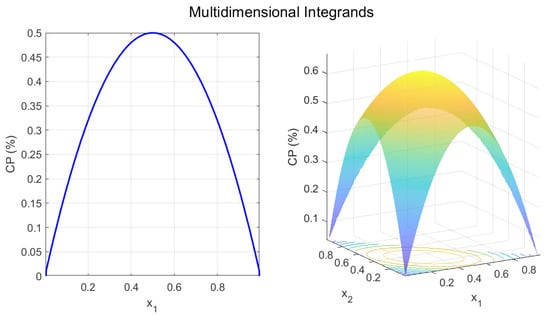
For and , the integrands are plotted on Figure 1.
Figure 1.
Integrands for and .
2.2. Algorithm for Drawing Point for (4)
This approach is rather simple. Firstly, we draw C D-dimensional points , uniformly distributed in the D-dimensional hypercube. Then, we sort the coordinates of every point, independently from the other points, and name the new points . Subsequently, we map to the points from the -dimensional hypercube as
and set
Now, we are sure that the coordinates of each point in are sorted and lie on the line , including the boundaries 0 and 1. If we take the difference between every two adjacent coordinates and in such a way define a new coordinate, we arrive at points in the -dimensional hypercube, which
The points indeed belong to the standard D-simplex.
2.3. Algorithm for Drawing Point for (6)
This algorithm is also not complicated. To begin with, we again draw C D-dimensional points , uniformly distributed in the D-dimensional hypercube. Now, it is enough to linearly scale the point coordinates as follows:
where, of course, the sum is equal to 0 for .
The points (8) satisfy
Thus, they truly belong to and satisfy the requirements to be used for the evaluation of (6).
Of course, for that purpose, we could use the former algorithm and truncate the last coordinate of (7). This operation is actually a projection of onto the D-dimensional hyperplane .
It is worth saying that we indeed use the first algorithm with the truncation of the last coordinate since the second one does not distribute the points in an optimal way.
2.4. Monte Carlo Algorithms
The Monte Carlo methods [13] come in handy when the deterministic methods fail [14,15,16]. They have tremendous applications in many areas, including financial derivatives evaluation [17] and even slot machines play [18] and reels reconstruction [19]. Now we mention some of the fundamental Monte Carlo approaches.
Plain (crude) Monte Carlo is the earliest and probably the most used Monte Carlo (MC) method to solve multidimensional integrals [14]. The MC quadrature formula lies on the probabilistic interpretation of the integral
Let the random variable be such that
where the random points are independent realizations of the random point with probability density function and . Then the plain MC approach for the integral I is defined as [14]
Latin hypercube sampling (LHS) is a type of stratified sampling (SS) [14]. In the case of SS, one must divide into disjoint subdomains, each of volume , and to sample one point at each subdomain. It is proved in [15] that the variance of a SS could never exceed the variance of a plain random sampling. LHS is a highly researched topic [20,21,22,23].
By definition, quasi-Monte Carlo (QMC) methods are based on quasi-random sequences that are built in such a way as to minimize a measure of their deviation from uniformity, called discrepancy [24,25].
Let The representation of in base is presented by the following formula [26]:
The radical inverse sequence is defined as [27]: and its discrepancy satisfies: The Van der Corput sequence [28] is obtained when
Halton sequence [29,30] is defined as
where , and denotes the ith prime, and : set of permutations on
Sobol sequence [17,31,32,33,34] is defined by
where : set of permutations on every subsequent points of the Van der Corput sequence. In binary, we have that: , where is a set of direction numbers [34].
To scramble the Halton sequence, we used a permutation of the radical inverse coefficients derived by applying a reverse-radix operation to all of the possible coefficient values. The algorithm is proposed in [35]. To scramble the Sobol sequence, we used a random linear scramble combined with a random digital shift. The algorithm is suggested in [36].
When the integrand is sufficiently regular, the lattice sequences, using special types of sequences with low discrepancy, generally outperform the basic MC methods. Sloan and Kachoyan [37], Niederreiter [38], Hua and Wang [39], Wang and Hickernell [40] and Sloan and Joe [41] provide comprehensive expositions on the theory of lattice sequences.
We constructed our lattice sequence with the optimal generating vector by using a special algorithmic [42,43,44,45] construction of rank-1 lattice rules with prime number of points and with product weights with points.
Niederreiter [27,46] introduced a special family of digital -nets over . Those nets are obtained from rational functions over finite fields [47,48,49]. We will use a special type of digital sequences, namely interlaced digital sequences [50,51,52,53], a special class of digital nets, a concept analogous to lattice sequences, but based on linear algebra over finite fields [54].
We will use the generating matrices for an implementation of the Sobol’ sequence from [55] with 21201 dimensions for the digital sequence, as well as the generating matrices for interlaced Sobol’ sequences with interlacing factor for the interlaced digital sequence.
3. Results and Discussion
In this section, we make an overview of the results, obtained by the aforementioned methods. We recall that C denotes the total number of points used in the integration.
For the 10-dimensional integral (Table 1), the best approach is the lattice sequence. It achieves the smallest error in 7 of 21 cases. The other suitable method is the interlaced digital sequence, producing the five smallest errors, but they are obtained for large values of C, and they are of one order better than the errors produced by the other methods.
Table 1.
The 10-dimensional integral absolute errors.
Regarding the 20-dimensional integral (Table 2), the best approach is the digital sequence with the five smallest errors. The other suitable approaches for large C are the scrambled versions of Halton and Sobol sequences, but the best errors are mostly of the same magnitude with the other errors.
Table 2.
The 20-dimensional integral absolute errors.
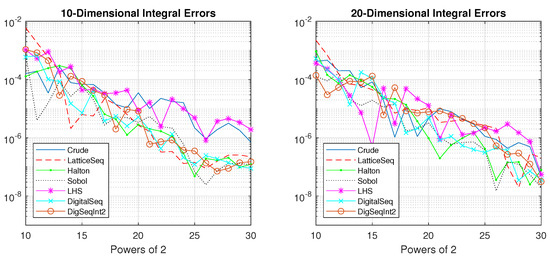
The results for the 10- and 20-dimensional integrals are visualized on Figure 2.
Figure 2.
The 10- (left) and 20-dimensional (right) integral absolute errors.
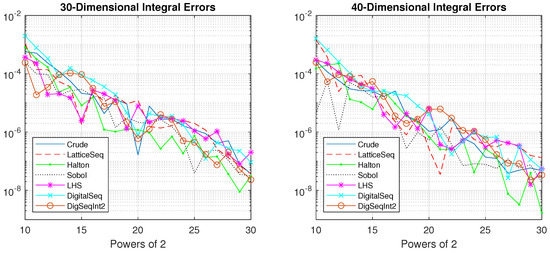
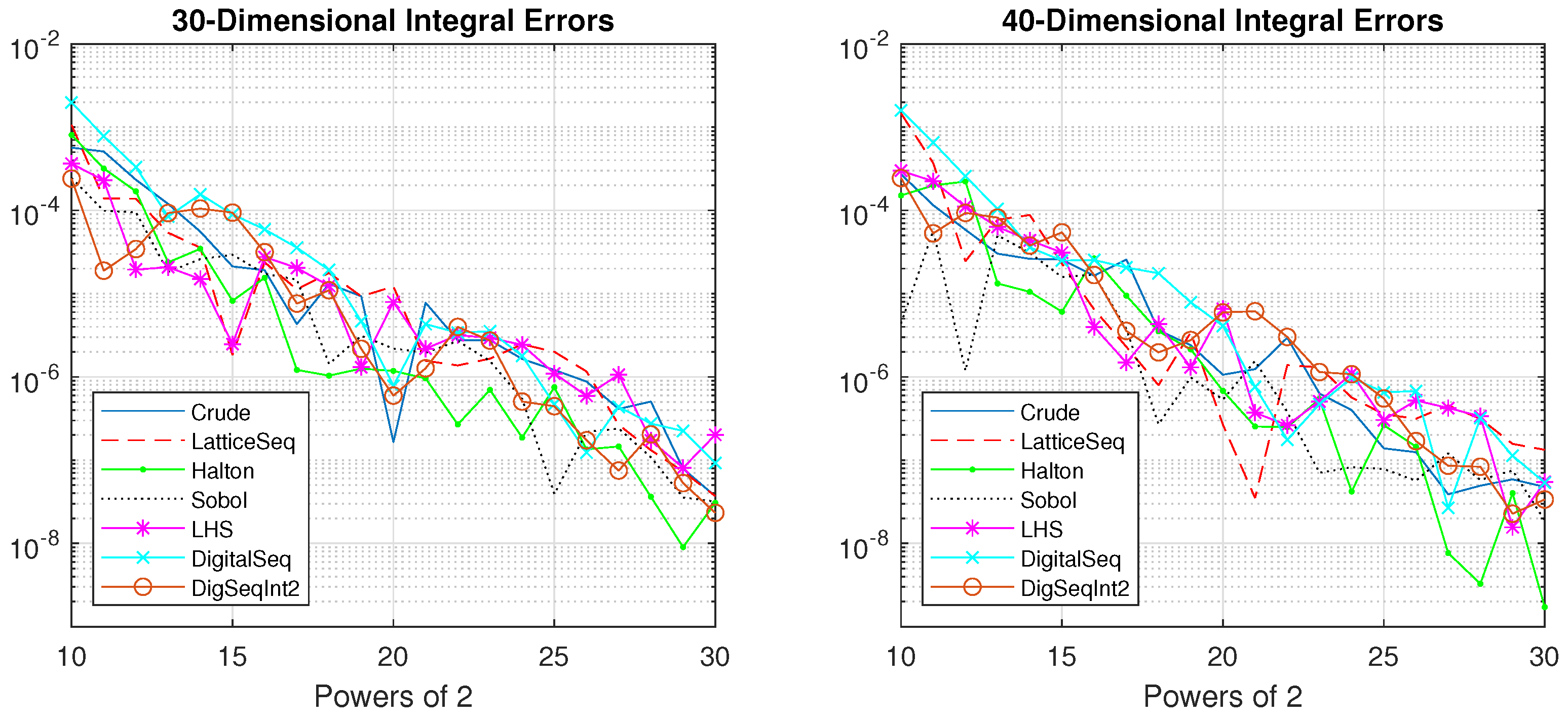
Considering the 30-dimensional integral (Table 3), the scrambled Halton sequence stands out with the 10 smallest errors. For large C, only the interlaced digital sequence produces comparable results.
Table 3.
The 30-dimensional integral absolute errors.
Similar is the situation with the 40-dimensional integral (Table 4), where the best methods are the scrambled versions of Halton and Sobol sequences with seven respective best errors. It makes an impression that the scrambled Halton sequences achieves order of error 1e-9 for both integrals.
Table 4.
The 40-dimensional integral absolute errors.
The results for them are displayed on Figure 3.
Figure 3.
The 30- (left) and 40-dimensional (right) integral absolute errors.
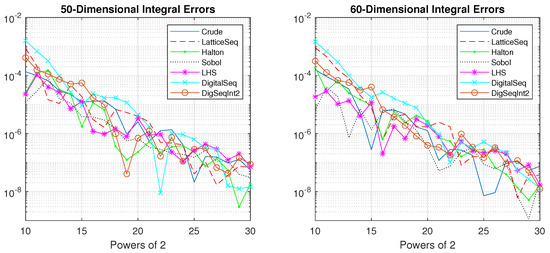
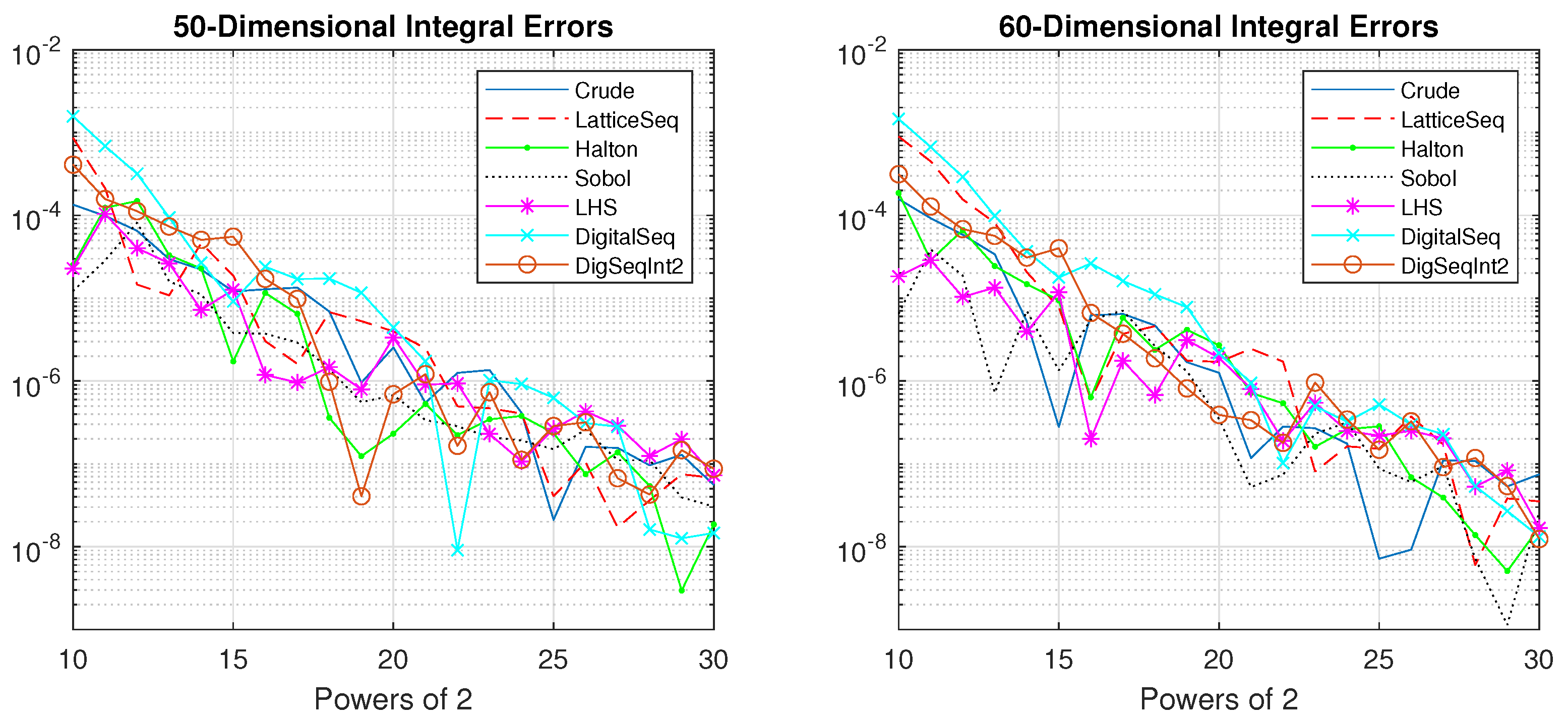
Going to higher dimensions, the best approach for the 50-dimensional integral (Table 5) is again the scrambled Halton sequences with five smallest errors. For the largest values of C, the Digital Sequence produces the best results. It is also noticeable that the former achieves an order of error 1e-9.
Table 5.
The 50-dimensional integral absolute errors.
For the last integral tested, the 60-dimensional one (Table 6), the most accurate approaches are the scrambled Sobol sequence and the Latin hypercube sampling, producing six respective best errors. The LHS is suitable for lower values of C, while the scrambled Sobol sequence and the lattice sequence perform well for larger values of C. Most of the methods achieve 1e-9 order of error, but staring at the order of convergence, it is obvious that this phenomenon is pure luck in the crude Monte Carlo approach.
Table 6.
The 60-dimensional integral absolute errors.
The result for the 50- and 60-dimensional integrals are plotted on Figure 4.
Figure 4.
The 50- (left) and 60-dimensional (right) integral absolute errors.
A number of conclusions could be drawn. Firstly, the achieved absolute errors are very small, even for the large-scale problems. Secondly, the lattice and digital sequences perform well for a lower number of dimensions, while the scrambled Halton and Sobol sequences are suitable for a larger number of dimensions. It is difficult to say in general, though, which method performs superior to the others.
There is a reason for this outcome. The integrand functions are smooth multivariate polynomials. Some of the adaptive methods, for example, Latin hypercube sampling, have advantages over irregular and non-smooth functions, which is not the case here. Therefore, the scrambled Halton sequence and the lattice sequence with a good generation vector are recommended for accurate evaluation of the studied integrals.
It is worth mentioning a couple of notes about the implementation of the stochastic algorithms. First of all, the two digital sequence (interlaced or not) are implemented in C++, mainly to gain performance, while the other methods and the rest of the operations are implemented in MATLAB®. Secondly, it is difficult to maintain in the RAM multidimensional points which coordinates are stored in the 8-byte ‘double’ type. Even for the 10-dimensional points, the required storage amounts to 80 GiB (gibibytes). However, after all, it is not needed. We have manually implemented a simple variant of a MapReduce model, where we evaluate the integrals over chunks of points, save the results, and eventually average again all the approximations. Some of the stochastic methods are suitable for parallel implementation, but the elements of other quasi-sequences depend on the previous elements in the sequence, which makes an effective parallelization impossible.
4. A Real Case Study
In this section, we apply the described algorithm for assessment of the consolation prize expectation to real data from gambling clubs in Bulgaria.
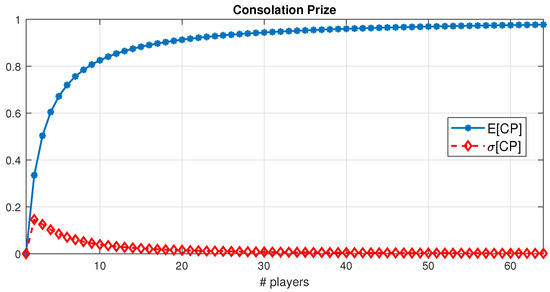
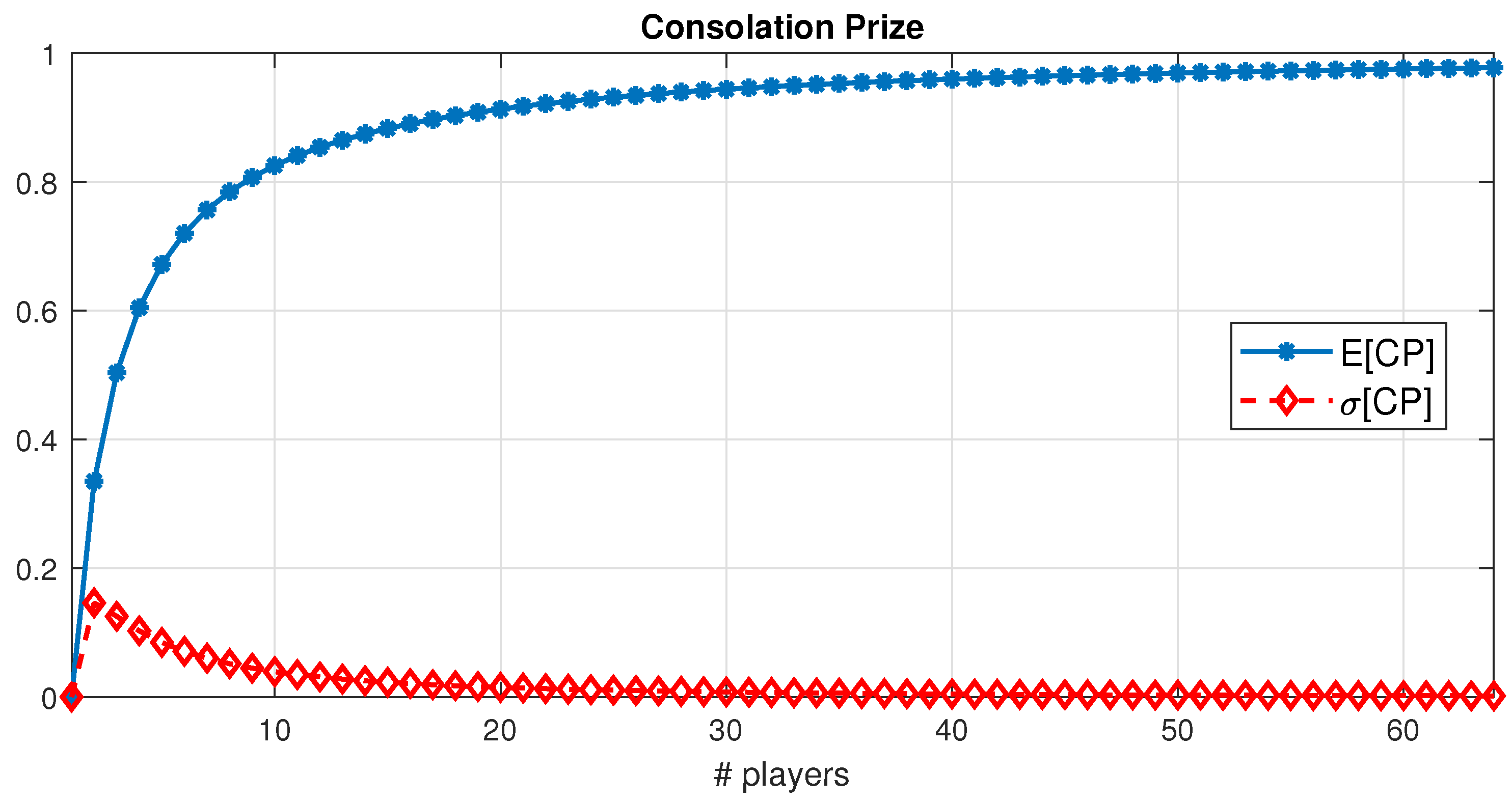
Let us also recall that D-dimensional integral denotes the consolation prize (CP) expectation in a game with players. In a game with one player, (s)he gets the jackpot and . Now, we plot the results for on Figure 5, showing the mathematical expectation and the standard deviation of the CP.
Figure 5.
Consolation prize statistics.
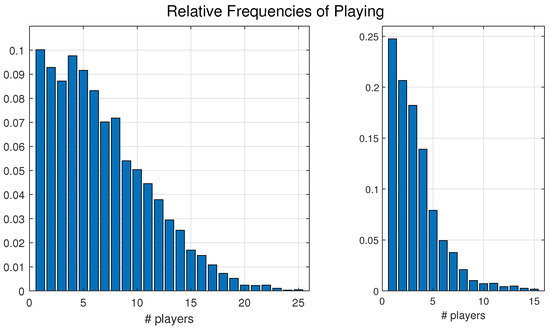
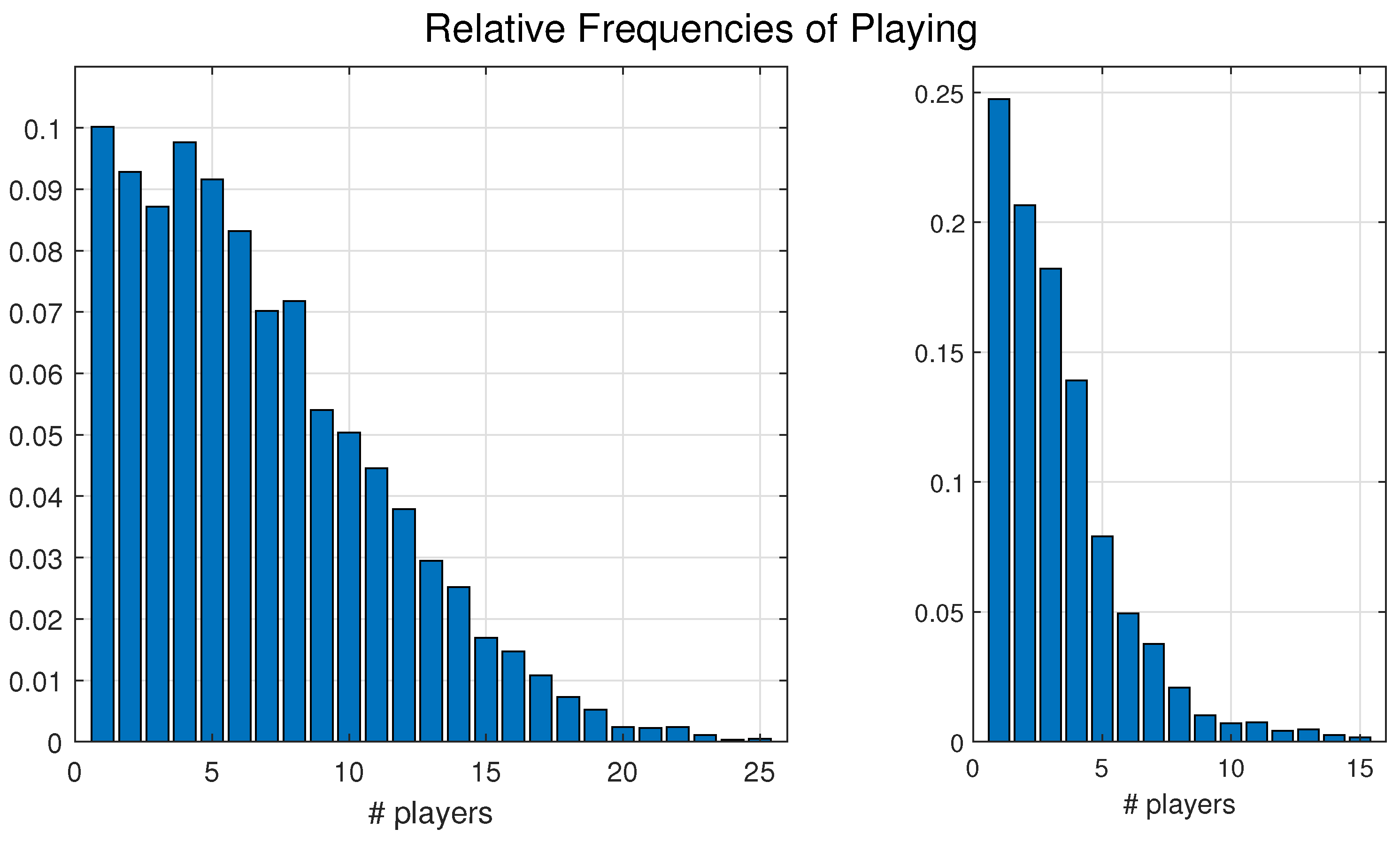
The value of represents the share of the jackpot that the casino expects to pay as a consolation prize if players play all the time. Of course, this is not the case. In particular, in the small gambling clubs, most of the time, low numbers of players are found. Furthermore, there is a day-and-night cyclicity in the attendance. The distribution could be even bimodal or multimodal. It is given for two gambling clubs in mid-sized city in Bulgaria for 2017 on Figure 6. In each club, there are 32 slot machines, but it appeared that never more than 25 attendants in the first club and 16 attendants in the second one were playing simultaneously.
Figure 6.
Distribution of simultaneous play.
The x-axis denotes the number of attendants playing, while the y-axis shows the relative portion of time. Now, we calculate the real consolation prize , which is defined as the CP expectation in the case of at least 1, and at most attendants played considering a predefined distribution. To compute the confidence intervals (CIs), we need to compute the standard deviation, using the standard formulae (9), assuming independence between the different numbers of attendants, playing simultaneously.
where , are the relative weights and must hold for every D.
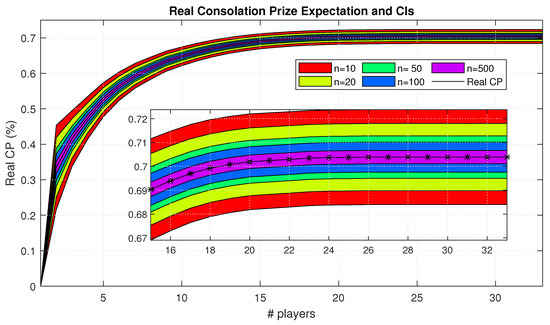
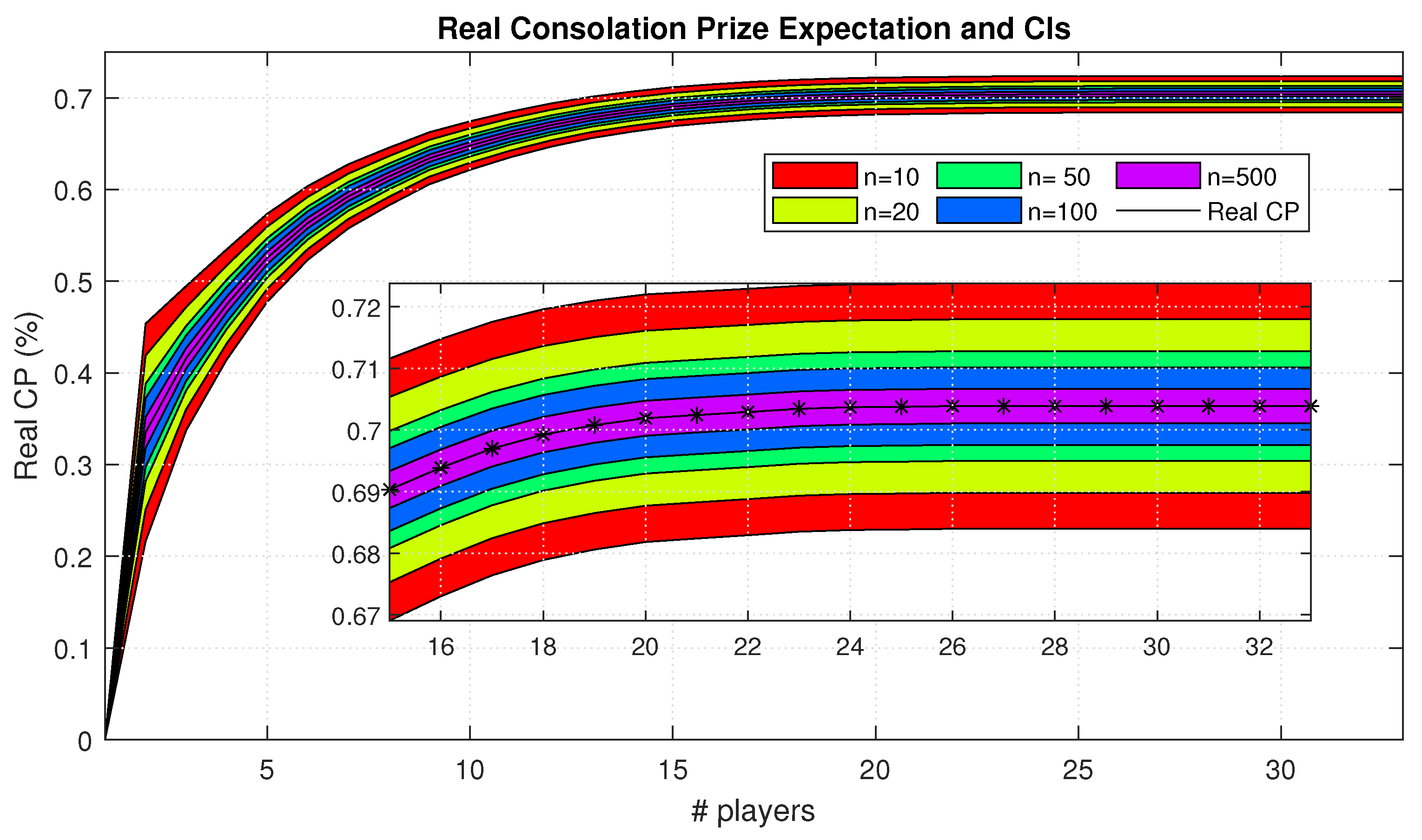
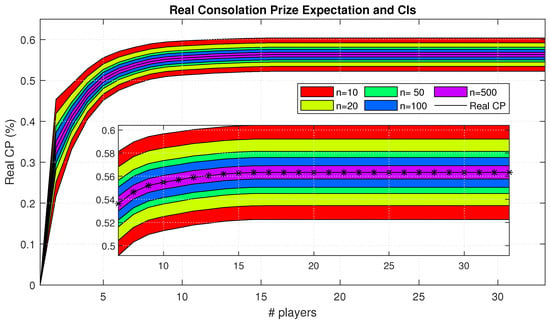
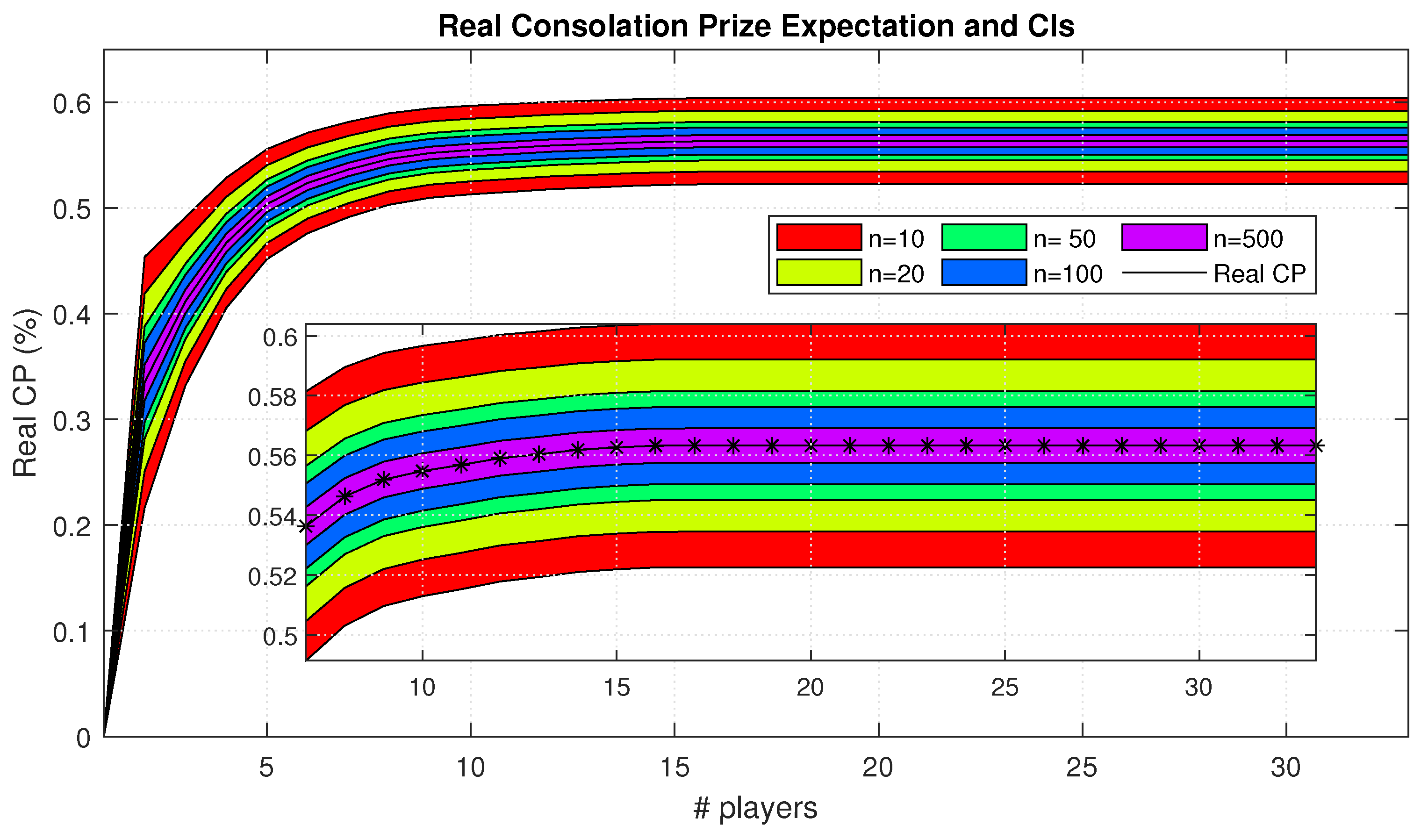
Finally, assuming the normality of the real CP for , its expectation and CIs are plotted for both distributions on Figure 7 and Figure 8, where n denotes the number of jackpot hits.
Figure 7.
Real consolation prize expectation and CIs (first gaming club/distribution).
Figure 8.
Real consolation prize expectation and CIs (second gaming club/distribution).
The real CP of the second gambling club has higher standard deviation and thus broader CIs because low numbers of attendants play for relatively more time; see Figure 6. The lower the number of players, the higher the deviation; see Figure 5. On the other hand, the usually low number of players has a lower expectation of the real CP.
The overall conclusion is that with 99% confidence (), the realized real consolation prize would not be farther than 1% from its expectation, in absolute units. This is true if the jackpot is hit on a daily basis, for less than two years ( days).
We conclude this section with a brief discussion about the bigger casinos. In the case of more machines and a time distribution of simultaneous play with low or even negative skew, the expectation of the real CP would be higher and closer to one. Of course, in this case, the jackpot would be hit more frequently, but also the absolute sizes of the jackpot and CP would be much greater compared to their counterparts of the small gambling clubs. So, the accurate computation of the CP expectation is also of a paramount importance for the big casinos.
Here arises the question for the calculation of integrals with hundreds of dimensions. The approaches, described in the paper, are robust and capable of dealing with large-scale problems, but when the number of dimensions gets huge, all methods become slow. A reasonable question is whether the CP values for large D could be extrapolated from CP values for lower D, which are already computed.
Our investigation shows that , see Figure 5, could be approximated by the functional form of the Michaelis–Menten saturation curve (10):
where the parameters are .
We fit the model (10) to only the first ten values for , , recalling . The fitted values of are called a nonlinear least-squares estimator and it is denoted with . Let us also define the least-squared error functional as .
The fit is indeed good since the norm of the step , the first-order optimality measure is and the error functional are very small. What is more, the variance of the residuals and the root mean squared error are very small and the coefficient of determination is practically .
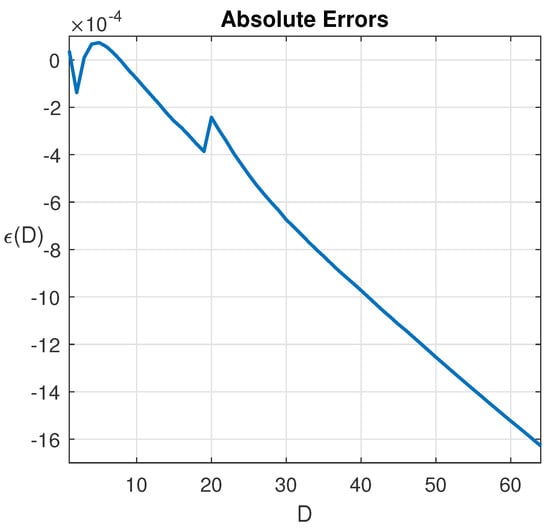
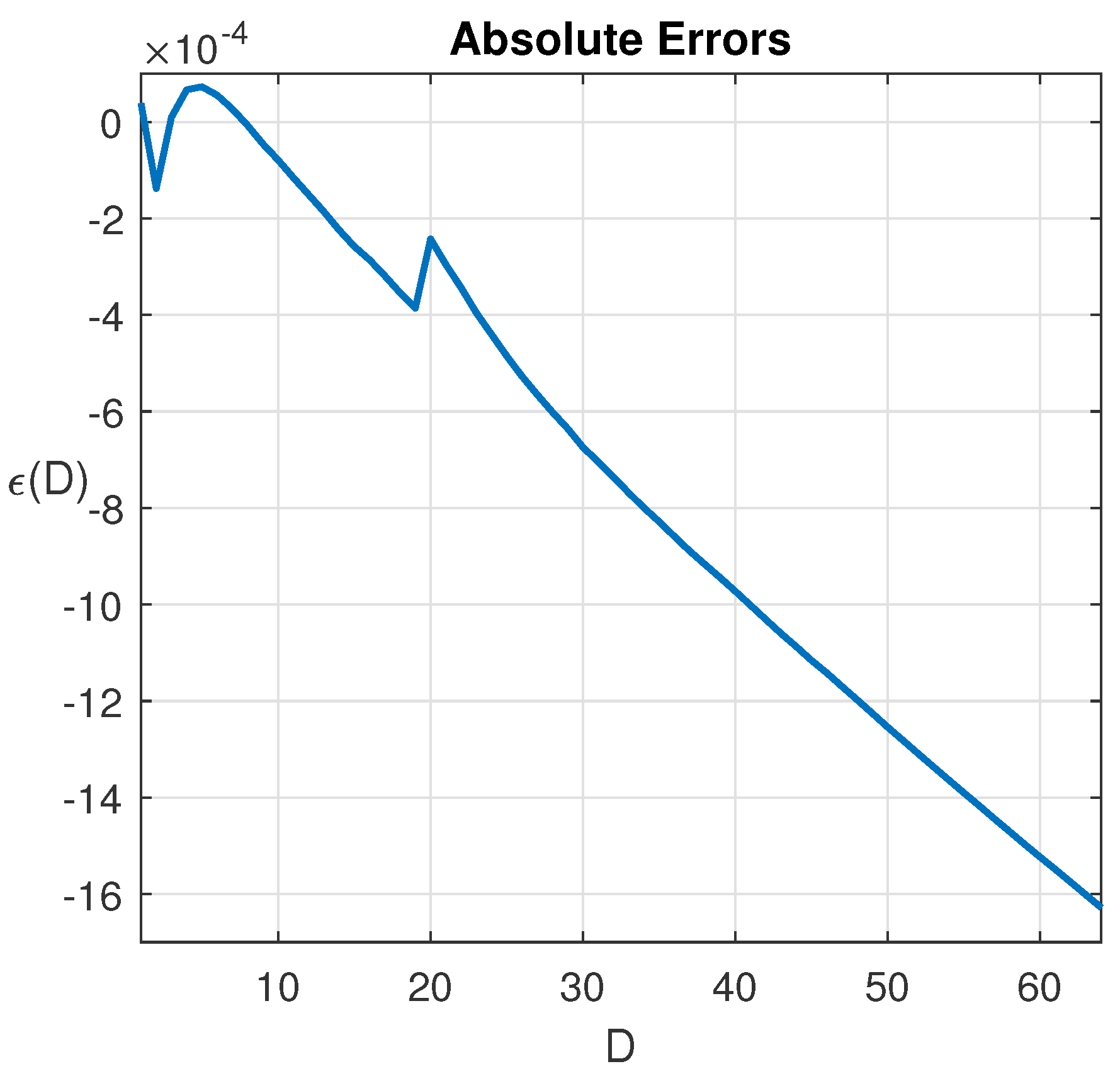
All the parameters are statistically significant, and their fitted values are . Finally, we evaluate for and plot the absolute error on Figure 9.
Figure 9.
Absolute error between the actual and extrapolated CP values.
The errors are of magnitude 1e-4, but the fit was performed only on the first ten values. If all known values are fitted, the errors will be negligible. This shows that one could use (10) to extrapolate the real consolation prize for higher values of D at low computational cost with acceptable error.
5. Conclusions
In this novel experimental study, for the first time, it is solved the problem of determining the expected value of the consolation prize as a fraction of the jackpot. This is extremely vital for each casino and gambling club, regardless of their size, due to the tight budget planning. This problem is formulated as multidimensional integral evaluations. Some of the most advanced quasi-Monte Carlo methods are used, in particular Sobol and Halton sequences with scrambling, lattice and digital sequences with interlacing, and Latin hypercube sampling. All of them are demonstrated to have superior performance compared to the basic Monte Carlo approaches.
The other novel element in the paper is the formulation of the expectation of the real consolation prize, taking into account the temporal distribution of the different number of playing attendants. Eventually, it is suggested an approach to cope with very high dimensions through extrapolation of the already calculated results.
The proposed algorithm is able to calculate the consolation prize not only for linked in-house jackpots, but also for wide area jackpots (which run across machines from multiple casinos). Another possible way to further develop this investigation is to optimize the stochastic approaches with respect to execution time, accuracy and largeness of number of dimensions.
The results, obtained in this investigation, could be used in many areas of life. They could play a significant role in the estimation of Sobol sensitivity indices for large-scale pollution models. Furthermore, such findings are heavily used in quantitative finance to evaluate and calibrate multidimensional financial derivatives. Finally, the results would help other scientists to perform demanding computations in diverse fields of knowledge.
- Disclaimer: This paper must not be understood as advice to play slot games or not to do so. Its aim is to propose an algorithm for practical and applied scientific purposes.
Author Contributions
All authors contributed equally. Conceptualization, S.G.; Methodology, V.T.; Software, S.G.; Validation, V.T.; Formal analysis, S.G.; Investigation, S.G.; Resources, V.T.; Writing—review & editing, V.T.; Supervision, V.T.; Funding acquisition, V.T. All authors have read and agreed to the published version of the manuscript.
Funding
Venelin Todorov is supported by the Bulgarian National Science Fund under the Bilateral Project KP-06-Russia/17 “New Highly Efficient Stochastic Simulation Methods and Applications” and by the Bulgarian National Science Fund under Project KP-06-N52/5 “Efficient methods for modeling, optimization and decision making”. Slavi Georgiev is supported by the Bulgarian National Science Fund under Project KP-06-M32/2—17.12.2019 “Advanced Stochastic and Deterministic Approaches for Large-Scale Problems of Computational Mathematics” and by the National Program “Young Scientists and Postdoctoral Researchers—2”—Bulgarian Academy of Sciences and by the Scientific Research Fund of University of Ruse under FNSE-03.
Data Availability Statement
Restrictions apply to the availability of these data.
Conflicts of Interest
The authors declare no conflict of interest. The funders had no role in the design of the study; in the collection, analyses, or interpretation of data; in the writing of the manuscript; or in the decision to publish the results.
Abbreviations
The following abbreviations are used in this manuscript:
| RTP | Return-To-Player |
| CP | Consolation prize |
| LHS | Latin hypercube sampling |
| SS | Stratified sampling |
| (Q)MC | (Quasi-) Monte Carlo |
| (F)CBC | (Fast) component-by-component |
| CI | Confidence interval(s) |
References
- Fitch, R.A.; Mueller, J.M.; Ruiz, R.; Rousse, W. Recreation matters: Estimating millennials’ preferences for native American cultural tourism. Sustainability 2022, 14, 11513. [Google Scholar] [CrossRef] [Scilit]
- Cooper, M. Sit and spin; How slot machines give gamblers the business. The Atlantic. 2005. Available online: https://www.theatlantic.com/magazine/archive/2005/12/sit-and-spin/304392/ (accessed on 28 December 2022).
- Kamanas, P.-A.; Sifaleras, A.; Samaras, N. Slot machine RTP optimization using variable neighborhood search. Math. Probl. Eng. 2021, 2021, 8784065. [Google Scholar] [CrossRef] [Scilit]
- Turner, N.; Horbay, R. How do slot machines and other electronic gamblingmachines actually work? J. Gambl. Issues 2004, 11, 11. [Google Scholar]
- Oses, N. Markov chain applications in the slot machine industry. Insight 2008, 21, 9–21. [Google Scholar] [CrossRef] [Scilit]
- Bărboianu, C. The Mathematics of Slots: Configurations, Combinations, Probabilities; INFAROM Publishing: Craiova, Romania, 2013. [Google Scholar]
- Epstein, R.A. The Theory of Gambling and Statistical Logic, 2nd ed.; Academic Press: Oxford, UK, 2012. [Google Scholar]
- Balabanov, T. Estimation of volatility based on the estimation of segmentation. Probl. Eng. Cybern. Robot. 2021, 77, 3–10. [Google Scholar]
- Balabanov, T. Volatility index estimation by reverse engineering. Proc. Int. Sci. Conf. UniTech 2021, 1, 229–234. [Google Scholar]
- Keremedchiev, D.; Tomov, P.; Barova, M. Slot machine base game evolutionary RTP optimization. In Proceedings of the International Conference on Numerical Analysis and Its Applications, Lozenetz, Bulgaria, 15–22 June 2016; Dimov, I., Faragó, I., Vulkov, L., Eds.; Springer: Cham, Switzerland, 2017; Volume 10187, pp. 406–413. [Google Scholar]
- Balabanov, T.; Zankinski, I.; Shumanov, B. Slot machine RTP optimization and symbols wins equalization with discrete differential evolution. In Large-Scale Scientific Computing (LSSC 2015); Lirkov, I., Margenov, S.D., Waśniewski, J., Eds.; Springer: Berlin, Germany, 2015; Volume 9374, pp. 210–217. [Google Scholar]
- Balabanov, T.; Zankinski, I.; Shumanov, B. Slot machines RTP optimization with genetic algorithms. In Numerical Methods and Applications (NMA 2014); Dimov, I., Fidanova, S., Lirkov, I., Eds.; Springer: Berlin, Germany, 2015; Volume 8962, pp. 55–61. [Google Scholar]
- Metropolis, N.; Ulam, S. The Monte Carlo Method. J. Amer. Stat. Assoc. 1949, 44, 335–341. [Google Scholar] [CrossRef]
- Dimov, I.T. Monte Carlo Methods For Applied Scientists; World Scientific: Singapore, 2007. [Google Scholar]
- Sobol, I.M. Monte Carlo Numerical Methods; Nauka: Moscow, Russia, 1973. (In Russian) [Google Scholar]
- Kalos, M.A.; Whitlock, P.A. Monte Carlo Methods, Volume 1: Basics; Wiley: New York, NY, USA, 1986. [Google Scholar]
- Paskov, S.H. Computing High Dimensional Integrals with Applications to Finance; Technical Report CUCS-023-94; Columbia University: New York, NY, USA, 1994. [Google Scholar]
- Barr, G.D.I.; Durbach, I.N. A Monte Carlo analysis of hypothetical multi-line slot machine play. Int. Gambl. Stud. 2008, 8, 265–280. [Google Scholar] [CrossRef] [Scilit]
- Tomov, P.; Zankinski, I.; Balabanov, T. Slot machine reels reconstruction with Monte-Carlo search. Proc. Int. Sci. Conf. UniTech 2017, 2, 384–387. [Google Scholar]
- McKay, M.D.; Beckman, R.J.; Conover, W.J. A comparison of three methods for selecting values of input variables in the analysis of output from a computer code. Technometrics 1979, 21, 239–245. [Google Scholar]
- Eglajs, V.; Audze, P. New approach to the design of multifactor experiments. Probl. Dyn. Strengths 1977, 35, 104–107. (In Russian) [Google Scholar]
- Minasny, B.; McBratney, B. A conditioned Latin hypercube method for sampling in the presence of ancillary information. J. Comput. Geosci. Arch. 2006, 32, 1378–1388. [Google Scholar] [CrossRef] [Scilit]
- Minasny, B.; McBratney, B. Conditioned Latin Hypercube Sampling for Calibrating Soil Sensor Data to Soil Properties. In Proximal Soil Sensing; Progress in Soil Science; Springer: Dordrecht, The Netherlands, 2010; pp. 111–119. [Google Scholar]
- Karaivanova, A.; Dimov, I.; Ivanovska, S. A quasi-monte carlo method for integration with improved convergence. In Large-Scale Scientific Computing (LSSC 2001); Lirkov, I., Margenov, S.D., Waśniewski, J., Eds.; Springer: Berlin, Germany, 2001; Volume 2179, pp. 158–165. [Google Scholar]
- Sobol, I.M. Distribution of points in a cube and approximate evaluation of integrals. USSR Comput. Math. Math. Phys. 1967, 7, 86–112. [Google Scholar] [CrossRef] [Scilit]
- Niederreiter, H. Existence of good lattice points in the sense of Hlawka. Monat. Math. 1978, 86, 203–219. [Google Scholar] [CrossRef] [Scilit]
- Niederreiter, H. Random Number Generation and Quasi-Monte Carlo Methods; CBMS-NSF Regional Conference Series in Applied Mathematics 63; SIAM: Philadelphia, PA, USA, 1992. [Google Scholar]
- van der Corput, J. Verteilungsfunktionen I & II. Nederl. Akad. Wetensch. Proc. 1935, 38, 813–820 & 1058–1066. [Google Scholar]
- Halton, J. On the efficiency of certain quasi-random sequences of points in evaluating multi-dimensional integrals. Numer. Math. 1960, 2, 84–90. [Google Scholar] [CrossRef] [Scilit]
- Halton, J.; Smith, G.B. Algorithm 247: Radical-inverse quasi-random point sequence. Commun. ACM 1964, 7, 701–702. [Google Scholar] [CrossRef] [Scilit]
- Antonov, I.; Saleev, V. An economic method of computing LPτ-sequences. USSR Comput. Math. Math. Phys. 1979, 19, 252–256. [Google Scholar] [CrossRef] [Scilit]
- Bratley, P.; Fox, B. Algorithm 659: Implementing Sobol’s Quasirandom Sequence Generator. ACM Trans. Math. Softw. 1988, 14, 88–100. [Google Scholar] [CrossRef] [Scilit]
- Fox, B. Algorithm 647: Implementation and relative effciency of quasirandom sequence generators. ACM Trans. Math. Softw. 1986, 12, 362–376. [Google Scholar] [CrossRef] [Scilit]
- Joe, S.; Kuo, F. Remark on Algorithm 659: Implementing Sobol’s quasirandom sequence generator. ACM Trans. Math. Softw. 2003, 29, 49–57. [Google Scholar] [CrossRef] [Scilit]
- Kocis, L.; Whiten, W.J. Computational investigations of low-discrepancy sequences. ACM Trans. Math. Softw. 1997, 23, 266–294. [Google Scholar] [CrossRef] [Scilit]
- Matousek, J. On the L2-discrepancy for anchored boxes. J. Complex. 1998, 14, 527–556. [Google Scholar] [CrossRef] [Scilit]
- Sloan, I.H.; Kachoyan, P.J. Lattice methods for multiple integration: Theory, error analysis and examples. SIAM J. Numer. Anal. 1987, 24, 116–128. [Google Scholar] [CrossRef] [Scilit]
- Niederreiter, H. Monte Carlo and Quasi-Monte Carlo Methods; Springer: Berlin/Heidelberg, Germany, 2002. [Google Scholar]
- Hua, L.K.; Wang, Y. Applications of Number Theory to Numerical Analysis; Springer: Beijing, China, 1981. [Google Scholar]
- Wang, Y.; Hickernell, F.J. An historical overview of lattice point sets. In Monte Carlo and Quasi-Monte Carlo Methods; Fang, K.-T., Hickernell, F.J., Niederreiter, H., Eds.; Springer: Berlin/Heidelberg, Germany, 2002; pp. 158–167. [Google Scholar]
- Sloan, I.H.; Joe, S. Lattice Methods for Multiple Integration; Oxford University Press: Oxford, UK, 1994. [Google Scholar]
- Kuo, F.Y.; Nuyens, D. Application of quasi-Monte Carlo methods to elliptic PDEs with random diffusion coefficients—A survey of analysis and implementation. Found. Comput. Math. 2016, 16, 1631–1696. [Google Scholar] [CrossRef] [Scilit]
- Nuyens, D.; Cools, R. Fast algorithms for component-by-component construction of rank-1 lattice rules in shift-invariant reproducing kernel Hilbert spaces. Math. Comp. 2006, 75, 903–920. [Google Scholar] [CrossRef] [Scilit]
- Nuyens, D.; Cools, R. Fast component-by-component construction of rank-1 lattice rules with a non-prime number of points. J. Complex. 2006, 22, 4–28. [Google Scholar] [CrossRef] [Scilit]
- Sloan, I.H.; Reztsov, A.V. Component-by-component construction of good lattice rules. Math. Comp. 2002, 71, 263–273. [Google Scholar] [CrossRef] [Scilit]
- Niederreiter, H. Finite fields, pseudorandom numbers, and quasirandom points. In Finite Fields, Coding Theory, and Advances in Communications and Computing; Mullen, G.L., Shiue, P.J.-S., Eds.; Marcel Dekker: New York, NY, USA, 1993; pp. 375–394. [Google Scholar]
- Lemieux, C.; L’ Ecuyer, P. Randomized polynomial lattice rules for multivariate integration and simulation. SIAM J. Sci. Comput. 2003, 24, 1768–1789. [Google Scholar] [CrossRef] [Scilit]
- Lidl, R.; Niederreiter, H. Introduction to Finite Fields and Their Applications, 1st ed.; Cambridge University Press: Cambridge, UK, 1994. [Google Scholar]
- Dick, J.; Pillichshammer, F. Digital Nets and Sequences: Discrepancy Theory and Quasi–Monte Carlo Integration; Cambridge University Press: Cambridge, UK, 2010. [Google Scholar]
- Goda, T. Good interlaced polynomial lattice rules for numerical integration in weighted Walsh spaces. J. Comput. Appl. Math. 2015, 285, 279–294. [Google Scholar] [CrossRef] [Scilit]
- Baldeaux, J.; Dick, J.; Greslehner, J.; Pillichshammer, F. Construction algorithms for higher order polynomial lattice rules. J. Complex. 2011, 27, 281–299. [Google Scholar] [CrossRef] [Scilit]
- Baldeaux, J.; Dick, J.; Leobacher, G.; Nuyens, D.; Pillichshammer, F. Efficient calculation of the worst-case error and (fast) component-by-component construction of higher order polynomial lattice rules. Numer. Algor. 2012, 59, 403–431. [Google Scholar] [CrossRef] [Scilit]
- Dick, J.; Pillichshammer, F. Strong tractability of multivariate integration of arbitrary high order using digitally shifted polynomial lattice rules. J. Complex. 2007, 23, 436–453. [Google Scholar] [CrossRef] [Scilit]
- Dick, J.; Kuo, F.Y.; Sloan, I.H. High dimensional integration: The quasi-Monte Carlo way. Acta Numer. 2013, 22, 133288. [Google Scholar] [CrossRef] [Scilit]
- Joe, S.; Kuo, F.Y. Constructing Sobol’ sequences with better two-dimensional projections. SIAM J. Sci. Comput. 2008, 30, 2635–2654. [Google Scholar] [CrossRef] [Scilit]

Disclaimer/Publisher’s Note: The statements, opinions and data contained in all publications are solely those of the individual author(s) and contributor(s) and not of MDPI and/or the editor(s). MDPI and/or the editor(s) disclaim responsibility for any injury to people or property resulting from any ideas, methods, instructions or products referred to in the content. |
© 2023 by the authors. Licensee MDPI, Basel, Switzerland. This article is an open access article distributed under the terms and conditions of the Creative Commons Attribution (CC BY) license (https://creativecommons.org/licenses/by/4.0/).