


Abstract
The aim of this paper is to approximate the fixed points of generalized -nonexpansive mappings using -iterative algorithm. We establish some weak and strong convergence results for generalized -nonexpansive mappings in uniformly convex Banach spaces. A numerical example is also given to show that the -iterative algorithm converges faster than some others algorithms for generalized -nonexpansive mappings. Lastly, using the -iterative algorithm, we approximate the weak solution of delay composite functional differential equation of the Volterra–Stieltjes type.
MSC:
47H10; 47H09
1. Introduction
Throughout this paper, denotes the set of all positive integers, B a Banach space, G a closed convex subset of a mapping and the set of all fixed points of .
A mapping is said to be
- (1)
- A contraction if, for all , there exists such that
- (2)
- A nonexpansive mapping ifholds for all
- (3)
- Quasi-non-expansive if, for all and , we have
Browder [1] showed that, if B is a uniformly convex Banach space and G is a nonempty closed convex subset of B, then a nonexpansive mapping on G has a fixed point.
In 2008, Suzuki [2] introduced a new type of mapping satisfying Condition (C). A self mapping on G satisfies Condition (C) if for with
we have
The mappings satisfying Condition (C) do not need to be continuous; hence, Condition (C) is weaker than the one depicting nonexpansive mappings. However, mappings satisfying Condition (C) were stronger than the one defining quasi-non-expansive mappings. Suzuki [2] studied the existence and convergence results for such mappings.
In 2011, Aoyama and Kohshaka [3] defined a new class of mappings known as -nonexpansive mappings on normed spaces and studied its fixed points.
A mapping is -nonexpansive if, for and , the following holds:
Clearly, for we have a class of nonexpansive mappings. An example of a discontinuous -nonexpansive mapping (with was given in [3], which shows that the class of -nonexpansive mappings was larger than the nonexpansive mappings (see also [4]).
Pant and Shukla [5] introduced a class of mapping (called the generalized -nonexpansive mapping) as follows:
For all there exists , such that
implies that
Many researchers studied the approximation of fixed points of such mappings in Banach spaces. For instance, we refer to [5,6,7,8].
The following example in [4] shows that the generalized -nonexpansive mapping needs not satisfy Condition (C).
Example 1.
Let set be equipped with usual norm . Define by:
φ satisfies Condition , but φ is not a nonexpansive mapping.
Banach [9] proved that fixed points of contraction mappings can be approximated with the Picard iterative algorithm [10]. The Picard sequence is defined as follows:
The above sequence generated by the Picard algorithm does not converge to a fixed point of nonexpansive mappings. For more details, we refer to [11].
In 1953, Mann [12] introduced a new iterative algorithm to approximate a fixed point for nonexpansive mappings. The sequence obtained by this algorithm is defined as follows:
where is an appropriate sequence in .
The Mann iteration failed to approximate the fixed point in the case of pseudocontractive mapping. To overcome this problem, Ishikawa [13] introduced a two-step iterative algorithm to approximate the fixed point of pseudocontractive mapping.
Sequence , obtained by Ishikawa algorithm, is given as follows:
where and are sequences in .
Noor [14] in 2000, Agarwal et al. [15] in 2007, Abbas and Nazir [16] in 2014, Thakur et al. [17] in 2017, and Ullah and Arshad [18] in 2018 proposed different iterative algorithms (see Table 1): let be an initial guess.
Table 1.
Different Iterative Algorithms.
Where , and are the sequences of parameters in .
Recently, Abbas et al. [19] introduced a new iterative algorithm known as the -iterative algorithm, which converges faster than the iterative algorithms mentioned above for the class of enriched contraction and contraction mapping. The sequence defined by this algorithm is given as follows:
where and are sequence in .
Using the Ishikawa algorithm, Phuengratta [20] in 2011 proved te convergence results for Suzuki-type generalized nonexpansive mappings. In 2019, Ali et al. [21] employed an iterative algorithm in [17] to prove the convergence results for Suzuki-type generalized nonexpansive mapping in uniformly convex Banach spaces. The fixed-point theorems for Suzuki-type generalized nonexpansive mapping and some other nonlinear mappings were studied by many researchers [22,23,24]. Hence, the approximation of the fixed point of a more general class of mappings in fewer steps has been a matter of great interest for many authors due to its theoretical and practical applications. This is the main motivation of this paper.
Motivated by the work in [20,21], we prove some strong and weak convergence results by using the -iterative algorithm (5) for the generalized -nonexpansive mappings in uniformly convex Banach spaces. Our work is more general and unifies the comparable results in the existing literature, for instance, the results given in [17,21].
2. Preliminaries
Definition 1
([21]). Let G be a nonempty closed convex subset of a Banach space B. A mapping is called demiclosed with respect to if, for each sequence in G and , converges weakly to a, and converges strongly to b, implying that .
Definition 2
([25]). A Banach space B satisfies Opial’s condition if, for each sequence converging weakly to , the following holds:
for for all with .
Sentor and Dotson [26] introduced the concept of mapping satisfying Condition (I), which is defined as follows:
Definition 3.
A mapping satisfies Condition (I) if there exists an increasing function with and for all , such that
where .
Definition 4.
Let be a bounded sequence in a Banach space B. Define a mapping by
For each , value is called the asymptotic radius of at a.
The asymptotic radius of relative to is defined as follows:
The asymptotic center of relative to G is the set
The asymptotic center of with respect to G is nonempty and convex whenever G is weakly compact [27,28]. Moreover, set is a singleton, provided that B is a uniformly convex Banach space [29].
Proposition 1
([5]). Every mapping satisfying Condition (C) is generalized α-nonexpansive mapping, but the converse does not hold in general.
Proposition 2
([5]). Let G be a nonempty subset of a Banach space B and a generalized α-nonexpansive mapping. Then, for all we have
Theorem 1
([2]). Let G be a weakly compact convex subset of a uniformly Banach space B and a mapping φ on G satisfies Condition (C). Then, φ has a fixed point.
Lemma 1
([30]). Let B be a uniformly convex Banach space and for all . Let and be the two sequences such that and holds for some then
Lemma 2
([5]). Let be a generalized nonexpansive mapping that satisfies Opial’s property. If converges weakly to c and , then , that is is demiclosed at zero, where I is an identity mapping on B.
Proposition 3
([31]). Let be a generalized α-nonexpansive mapping; then, the following holds.
- (i)
- If φ satisfies Condition (C), then φ satisfies Condition
- (ii)
- If φ satisfies Condition and , then φ is quasi-non-expansive.
3. Convergence Analysis
In this section, we prove some strong and weak convergence results using -iterative scheme (5) for generalized -nonexpansive mappings in a uniformly convex Banach space B, and all the results in this section generalize the corresponding results of Thakur et al. [17] and Ali et al. [21].
Lemma 3.
Let G be a nonempty closed convex subset of a uniformly convex Banach space B and a generalized α-nonexpansive mapping with . If is a sequence defined by -iterative algorithm (5), then exists for all .
Proof.
Let . Since satisfies Condition (), with Proposition 3, is quasi-nonexpansive mapping, that is,
Using Iterative Algorithm (5), we have
As is generalized nonexpansive mapping with , we have
If , then
Now,
In addition,
and
Now, take
and
Now,
and
This shows that is decreasing and bounded from the below sequence for each .
Hence, exists. □
Lemma 4.
Let G be a nonempty closed convex subset of a uniformly convex Banach space B and a generalized α-nonexpansive mapping. If is a sequence defined by -iterative algorithm (5), then if and only if is bounded and .
Proof.
With Lemma 3 above, exists, and is bounded. Put
It follows from (7) that
Thus,
By taking lim inf as , we obtain
From (33), we have
On taking lim inf as , we obtain that
In addition,
Hence,
, suppose is bounded and
Let . Through Proposition 2, we have
which implies that .
Since B is uniformly convex, is a singleton.
Hence, we have □
Theorem 2.
Let G be a nonempty closed convex subset of a uniformly convex Banach space B and a generalized α-nonexpansive mapping. If is a sequence defined by the -iterative algorithm , then converges weakly to a point of , provided that B satisfies Opial’s condition.
Proof.
Let . Through Lemma 3, exists. Now, we show that has a unique weak subsequential limit in .
Suppose a and b are weak limits of subsequences and of respectively. From Lemma 4, we have . Moreover, from Lemma 2 is demiclosed at zero.
This implies that that is, Similarly,
Now, we show the uniqueness. If , then by using Opial’s condition, we have
a contradiction; so, . Consequently, converges weakly to a point of □
Theorem 3.
Let G be a nonempty closed convex subset of a uniformly convex Banach space B and a generalized α-nonexpansive mapping. If is a sequence defined by -iterative algorithm (5) then converges to a point of if and only if or , where
Proof.
If converges to a fixed point then obviously, we have and .
suppose that . From Lemma 3,
exists for all Thus, by assumption,
We now show that is a Cauchy sequence in G. As , for given there exists , such that, for all
that is
In particular, . Therefore, there exists such that
Now, for
This shows that is a Cauchy sequence in G. As G is a closed subset of a Banach space B, there is a point , such that . Now, gives that Hence, □
Theorem 4.
Let G be a nonempty compact convex subset of a uniformly convex Banach space B and be a generalized α-nonexpansive mapping. If is a sequence defined with the -iterative algorithm (5), then converges strongly to a fixed point of
Proof.
From Theorem 1, ; so, via Lemma 4, we have
Since G is compact, there is a subsequence of , such that for some . Through Proposition 2, we have
On taking the limit to be we obtain This implies that , that is,
In addition, exists by Lemma (3). Thus, is the limit of a sequence □
Now, we prove a strong convergence result using Condition (I).
Theorem 5.
Let G be a nonempty closed and convex subset of a uniformly convex Banach space B and be generalized α-nonexpansive mapping satisfying Condition (I). Then, sequence , defined with -iterative Algorithm (5), converges strongly to a fixed point of
Proof.
As proven in Lemma 4,
Since is an increasing function satisfying
Hence, we have
Now, all the conditions of Theorem 3 are satisfied; therefore, converges strongly to a fixed point of □
In Banach spaces with an Opial condition, we had a weak convergence of our iterative algorithm. However, if the mapping satisfied Condition (I), then we obtained a strong convergence result.
4. Numerical Example
Example 2.
Let be endowed with usual norm . Let be defined by
φ does not satisfy Condition . Moreover, φ is generalized α-nonexpansive mapping.
Let and since we have , so,
In addition,
So,
but . Hence, φ does not satisfy Condition .
Now, taking , consider the following cases.
Case 1: If and , then
In addition,
Case 2: For and we have
and
Case 3: Let and . Then,
Hence, φ is generalized nonexpansive mapping.
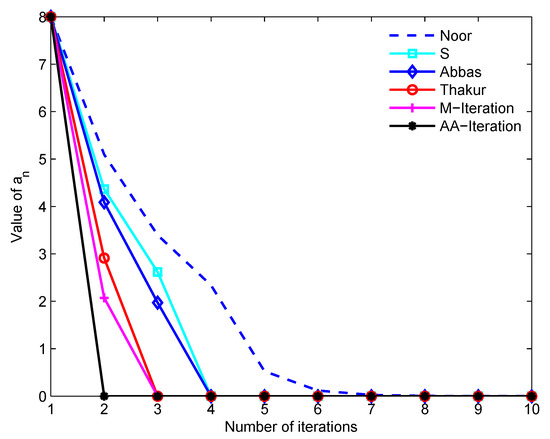
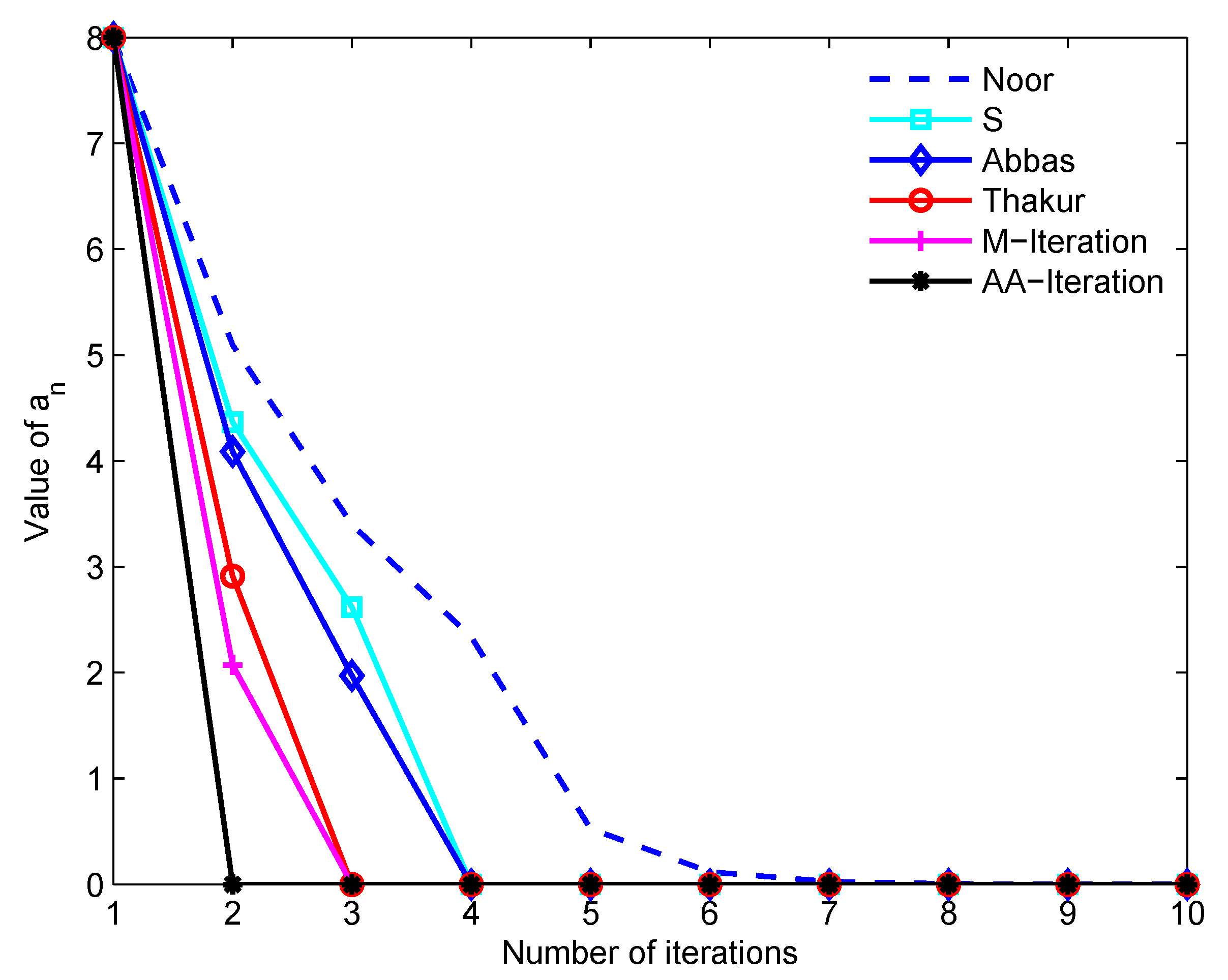
We now present an experiment to compare the convergence behavior of iteration (5). Take initial values and and . Iterative Algorithm (5) converged faster than the other schemes for generalized -nonexpansive mapping (Figure 1).
Figure 1.
Convergence behavior of iterative algorithms.
5. Application
In 2022, El-sayed and Omar [32] established the existence and uniqueness of the weak solution of a delay composite functional differential equation of the Volterra–Stieljes type. Many authors solved the delay composite functional differential equation of the Volterra–Stieljes type. For more details, we refer to [33,34]. In this section, we estimate the weak solution of a delay composite functional differential equation.
Let B be a reflexive Banach space with norm denotes the dual of B and denotes the class of continuous functions equipped with the following norm:
Consider the following delay composite functional differential equation of the Volterra–Stieltjes type:
with initial condition
Assume that
- (i).
- is continuous increasing with .
- (ii).
- is weakly continuous and satisfies the weak Lipschitz condition with Lipschitz constant , such that
- (iii).
- is weakly continuous and weakly satisfies the Lipschitz condition with Lipschitz constant such that
- (iv).
- Function is continuous with
- (v).
Finding the solution of (39) and (40) is equivalent to finding the solution of the following integral equation [32]:
In the following theorem, we obtain an approximation of the solution of (39) and (40) using -iterative Algorithm (5).
Theorem 6.
6. Conclusions
In this paper, we approximated the fixed points of generalized -nonexpansive mappings using an -iterative algorithm. We established some weak and strong convergence results for generalized -nonexpansive mappings in uniformly convex Banach spaces. A numerical example was given to show that -iterative algorithm converged faster than some existing algorithms for generalized -nonexpansive mappings. We approximated the weak solution of delay composite functional differential equation of the Volterra–Stieltjes type by -iterative scheme. In future work, we shall extend these results for some general class of mappings in some important abstract spaces, and try to extend the iterative scheme to approximate the solution of certain nonlinear problems, such as fixed-point and optimization problems in fewer steps.
Author Contributions
I.B., M.A. and M.W.A. contributed to the study conception, design, and computations. M.W.A. wrote the first draft of the manuscript, and all authors commented on it. All authors have read and approved the final manuscript.
Funding
This research received no external funding.
Institutional Review Board Statement
Not applicable.
Informed Consent Statement
Not applicable.
Data Availability Statement
Not applicable.
Acknowledgments
The authors are grateful to the reviewers for their useful comments, which helped to improve the presentation of this paper.
Conflicts of Interest
The authors declare that they have no conflict of interest.
References
- Browder, F.E. Nonexpansive nonlinear operators in a Banach space. Proc. Natl. Acad. Sci. USA 1965, 54, 1041–1044. [Google Scholar] [CrossRef] [Scilit] [PubMed]
- Suzuki, T. Fixed point theorems and convergence theorems for some generalized nonexpansive mappings. J. Math. Anal. Appl. 2008, 340, 1088–1095. [Google Scholar] [CrossRef] [Scilit]
- Aoyama, K.; Kohsaka, F. Fixed point theorem for α-nonexpansive mappings in Banach spaces. Nonlinear Anal. Theory Methods Appl. 2011, 74, 4387–4391. [Google Scholar] [CrossRef] [Scilit]
- Piri, H.; Daraby, B.; Rahrovi, S.; Ghasemi, M. Approximating fixed points of generalized α-nonexpansive mappings in Banach spaces by new faster iteration process. Numer. Algorithms 2019, 81, 1129–1148. [Google Scholar] [CrossRef] [Scilit]
- Pant, R.; Shukla, R. Approximating fixed points of generalized α-nonexpansive mappings in Banach spaces. Numer. Funct. Anal. Optim. 2017, 38, 248–266. [Google Scholar] [CrossRef] [Scilit]
- Ariza-Ruiz, D.; Linares, C.H.; Llorens-Fuster, E.; Moreno-Gálvez, E. On α-nonexpansive mappings in Banach spaces. Carpathian J. Math. 2016, 32, 13–28. [Google Scholar] [CrossRef] [Scilit]
- Chen, Y.-A.; Wen, D.-J. Convergence analysis of an accelerated iteration for monotone generalized α-nonexpansive mappings with a partial order. J. Funct. Spaces 2019, 2019, 2789819. [Google Scholar]
- Shukla, R.; Pant, R.; de la Sen, M. Generalized α-nonexpansive mappings in Banach spaces. Fixed Point Theory Appl. 2016, 2017, 4. [Google Scholar] [CrossRef] [Scilit]
- Banach, S. Surles operations dans les ensembles abstraites et leurs applications. Fundam. Math. 1922, 3, 133–187. [Google Scholar] [CrossRef] [Scilit]
- Picard, E. Memoire sur la theorie des equations aux derivees partielles et la methode des approximations successives. J. Math. Pures Appl. 1890, 6, 145–210. [Google Scholar]
- Berinde, V.; Takens, F. Iterative Approximation of Fixed Points; Springer: Berlin/Heidelberg, Germany, 2007. [Google Scholar]
- Mann, W.R. Mean value methods in iteration. Proc. Am. Math. Soc. 1953, 4, 506–510. [Google Scholar] [CrossRef]
- Ishikawa, S. Fixed points by a new iteration method. Proc. Am. Math. Soc. 1974, 44, 147–150. [Google Scholar] [CrossRef]
- Noor, M.A. New approximation schemes for general variational inequalities. J. Math. Anal. Appl. 2000, 251, 217–229. [Google Scholar] [CrossRef] [Scilit]
- Agarwal, R.; Regan, D.O.; Sahu, D. Iterative construction of fixed points of nearly asymptotically nonexpansive mappings. J. Nonlinear Convex Anal. 2007, 8, 61–79. [Google Scholar]
- Abbas, M.; Nazir, T. Some new faster iteration process applied to constrained minimization and feasibility problems. Mat. Vesn. 2014, 66, 223–234. [Google Scholar]
- Thakur, D.; Thakur, B.S.; Postolache, M. New iteration scheme for approximating fixed points of nonexpansive mappings. Filomat 2016, 30, 2711–2720. [Google Scholar] [CrossRef] [Scilit]
- Ullah, K.; Arshad, M. Numerical reckoning fixed points for Suzuki’s generalized nonexpansive mappings via new iteration process. Filomat 2018, 32, 187–196. [Google Scholar] [CrossRef] [Scilit]
- Abbas, M.; Asghar, M.W.; de la Sen, M. Approximation of the solution of delay fractional differential equation using AA-iterative scheme. Mathematics 2022, 10, 273. [Google Scholar] [CrossRef] [Scilit]
- Phuengrattana, W. Approximating fixed points of Suzuki-generalized nonexpansive mappings. Nonlinear Anal. Hybrid Syst. 2011, 5, 583–590. [Google Scholar] [CrossRef] [Scilit]
- Ali, J.; Ali, F.; Kumar, P. Approximation of fixed points for Suzuki’s generalized nonexpansive mappings. Mathematics 2019, 7, 522. [Google Scholar] [CrossRef] [Scilit]
- Dhompongsa, S.; Inthakon, W.; Kaewkhao, A. Edelstein’s method and fixed point theorems for some generalized nonexpansive mappings. J. Math. Anal. Appl. 2009, 350, 12–17. [Google Scholar] [CrossRef] [Scilit]
- García-Falset, J.; Llorens-Fuster, E.; Suzuki, T. Fixed point theory for a class of generalized nonexpansive mappings. J. Math. Anal. Appl. 2011, 375, 185–195. [Google Scholar] [CrossRef] [Scilit]
- Uddin, I.; Imdad, M.; Ali, J. Convergence theorems for a hybrid pair of generalized nonexpansive mappings in Banach spaces. Bull. Malays. Math. Sci. Soc. 2015, 38, 695–705. [Google Scholar] [CrossRef] [Scilit]
- Opial, Z. Weak convergence of the sequence of successive approximations for nonexpansive mappings. Bull. Am. Math. Soc. 1967, 73, 591–597. [Google Scholar] [CrossRef] [Scilit]
- Senter, H.; Dotson, W. Approximating fixed points of nonexpansive mappings. Proc. Am. Math. Soc. 1974, 44, 375–380. [Google Scholar] [CrossRef]
- Agarwal, R.P.; O’Regan, D.; Sahu, D. Fixed Point Theory for Lipschitzian-Type Mappings with Applications; Springer: Berlin/Heidelberg, Germany, 2009; Volume 6. [Google Scholar]
- Deimling, K. Nonlinear Functional Analysis; Courier Corporation: Chelmsford, MA, USA, 2010. [Google Scholar]
- Clarkson, J.A. Uniformly convex spaces. Trans. Am. Math. Soc. 1936, 40, 396–414. [Google Scholar] [CrossRef]
- Schu, J. Weak and strong convergence to fixed points of asymptotically nonexpansive mappings. Bull. Aust. Math. Soc. 1991, 43, 153–159. [Google Scholar] [CrossRef] [Scilit]
- Sadhu, R.; Nahak, C. Generalized α-nonexpansive multivalued mappings in Cat (0) space. J. Adv. Math. Stud. 2019, 12, 268–283. [Google Scholar]
- El-Sayed, A.; Omar, Y.M. On the weak solutions of a delay composite functional integral equation of Volterra-Stieltjes type in reflexive Banach space. Mathematics 2022, 10, 245. [Google Scholar] [CrossRef] [Scilit]
- Gripenberg, G.; Londen, S.-O.; Staffans, O. Volterra Integral and Functional Equations; Cambridge University Press: Cambridge, UK, 1990; Volume 34. [Google Scholar]
- Malique, M.A. Numerical Treatment of Oscillatory Delay and Mixed Functional Differential Equations Arising in Modelling; The University of Liverpool: Liverpool, UK, 2012. [Google Scholar]

Publisher’s Note: MDPI stays neutral with regard to jurisdictional claims in published maps and institutional affiliations. |
© 2022 by the authors. Licensee MDPI, Basel, Switzerland. This article is an open access article distributed under the terms and conditions of the Creative Commons Attribution (CC BY) license (https://creativecommons.org/licenses/by/4.0/).