


Abstract
Recent educational research has increasingly emphasized helping learners apply knowledge in new situations and translate it into judgment and action. In physical education, Game-Based Approaches (GBAs) have been widely adopted to promote tactical learning through representative game situations. Although previous reviews have generally reported positive effects on decision making, findings for tactical knowledge and skill execution have remained less consistent, suggesting a need to reconsider how tactical knowledge has been conceptualized and studied. This scoping review mapped the research structure of tactical knowledge in GBAs, including its conceptualization, theoretical foundations, research focus, methodological approaches, and learner perspectives. Following Arksey and O’Malley’s framework and PRISMA-ScR, 53 empirical studies were identified through database and supplementary searches. Tactical knowledge was predominantly conceptualized as decision making or action selection within an information-processing framework, and research focused mainly on quantitative evaluations of instructional effectiveness. This structure established a basis for visualizing, measuring, and comparing tactical learning, but offered limited explanation of how tactical knowledge, perception, decision making, and skill execution become functionally connected in game situations. Future research should therefore move beyond effectiveness evaluation toward mechanism-oriented studies that align in-game action with learners’ experiences and clarify how tactical knowledge contributes to action.
1. Introduction
One of the central goals of contemporary education is to help learners apply knowledge in unfamiliar situations and translate it into informed judgment and purposeful action. To apply knowledge effectively in unfamiliar contexts, learners need to understand not only general principles but also when and under what conditions that knowledge should be used (National Academies of Sciences, Engineering, and Medicine [NASEM], 2018). Similarly, the OECD Learning Compass 2030 identifies the ability to make informed judgments and take action in unfamiliar situations, rather than merely following predetermined instructions, as a key educational goal for the future (OECD, 2019).
Ball games in physical education provide a representative context in which these educational goals are enacted. During game play, learners are required to perceive continuously changing relationships among the ball, space, teammates, and opponents, interpret game situations, make appropriate judgments, and act accordingly (Gréhaigne et al., 2001; Kirk & MacPhail, 2002). Therefore, an important educational challenge in ball game learning is not only what learners know but also how their knowledge is used within game situations to support judgment and action. Game-Based Approaches (GBAs) represent one pedagogical response to this challenge.
The term Game-Based Approaches (GBAs) refers to a family of game-centered instructional approaches that originated with Teaching Games for Understanding (TGfU). Proposed by Bunker and Thorpe (1982), TGfU challenged traditional technique-based instruction by emphasizing learning through modified games and tactical problems, thereby linking game understanding, decision making, and skill execution. Since then, several game-centered pedagogical models have been developed, including Game Sense (Light, 2004), the Tactical Games Model (Mitchell et al., 2006), and Play Practice (Launder, 2001; Harvey & Jarrett, 2014). Despite their differences, these approaches share a common emphasis on helping learners understand tactical problems in game situations and connect decisions about what to do with the skill execution required to carry them out effectively (Kirk & MacPhail, 2002; Stolz & Pill, 2014).
Within GBAs, tactical understanding, decision making, and game performance have been regarded as key learning outcomes. In this context, tactical knowledge—understanding game principles and situational relationships that support appropriate action selection—has become a central focus of research because it underpins these learning outcomes (Gréhaigne et al., 2001; Kirk & MacPhail, 2002). Consequently, tactical knowledge is important not only for understanding the learning outcomes associated with GBAs but also for explaining how learners interpret game situations and translate their understanding into judgment and action.
However, tactical knowledge has not been treated as a uniform construct across studies. Some research has conceptualized tactical knowledge as sport-specific declarative and procedural knowledge and examined the relationships between the amount or structure of that knowledge and game performance (French & Thomas, 1987). Other studies have assessed tactical understanding and decision making through learners’ actions during game play (Oslin et al., 1998; Gréhaigne et al., 1997). Theoretical accounts have also examined how learners construct tactical concepts through game experience from the perspective of situated learning (Kirk & MacPhail, 2002). In addition, other perspectives have explained learning and action in ball games in terms of attunement to environmental information, the interaction of constraints, and perception–action relations (Renshaw et al., 2010). Thus, depending on how tactical knowledge is conceptualized, studies have adopted different theoretical foundations, research foci, and methods of measurement and analysis. Understanding tactical knowledge research therefore requires more than listing the findings of individual studies; it requires examining how conceptualizations of tactical knowledge, theoretical foundations, research foci, methodological approaches, and learner perspectives have interacted to shape the field.
Previous reviews have made important contributions by synthesizing research on GBAs and clarifying their educational significance. In addition to reviews mapping broader trends in GBA research, systematic reviews and meta-analyses have examined the effects of GBAs on decision making, tactical knowledge, skill execution, and game performance (Harvey & Jarrett, 2014; Miller, 2015; Abad Robles et al., 2020; Manninen et al., 2025). These reviews have generally reported positive effects on decision making, whereas findings for tactical knowledge and skill execution have been less consistent. This uneven pattern raises an important question about how tactical knowledge, decision making, and skill execution are related during game play.
Despite these contributions, previous reviews have primarily focused on synthesizing intervention effects and learning outcomes. They have not systematically examined how tactical knowledge has been conceptualized, which theoretical foundations have informed research, how research foci have been established, or how knowledge, decision making, and action have been investigated across the field. Furthermore, the learner perspective—how learners understand tactical knowledge and connect it to judgment and action—has not been sufficiently examined in previous reviews. Therefore, understanding the relationships among tactical knowledge, decision making, in-game action, and skill execution requires attention not only to what previous studies have found but also to the conceptualizations, theoretical foundations, research foci, methodological approaches, and learner perspectives that have shaped the field.
To address this gap, this review adopts the analytical concept of research structure to examine how the key elements of tactical knowledge research are related to one another. In the present review, research structure refers to the framework through which the conceptualization of tactical knowledge, theoretical foundations, research foci, methodological approaches, and learner perspectives interact to shape research questions, guide data collection and analysis, and influence knowledge production within a research field. This concept is not proposed as a new general theory; rather, it serves as an analytical framework specific to this review for examining tactical knowledge research in GBAs in an integrated manner.
Because the purpose of this study was not to further synthesize the effectiveness of particular interventions, but to map the conceptualizations, theoretical foundations, research foci, methodological approaches, and learner perspectives that have characterized tactical knowledge research, a scoping review was considered the most appropriate methodology (Arksey & O’Malley, 2005; Munn et al., 2018).
Accordingly, this study aimed to clarify the current research structure of tactical knowledge research in GBAs and identify its remaining limitations and future research directions. The following research questions guided the review:
- (1)
- How has tactical knowledge been conceptualized and theoretically positioned in GBA research?
- (2)
- What research foci and methodological approaches have been adopted in tactical knowledge research within GBAs?
- (3)
- How have learner perspectives been treated in studies examining tactical knowledge in relation to in-game action and learning processes?
2. Materials and Methods
2.1. Review Design
This study was designed as a scoping review to map how tactical knowledge has been conceptualized in GBA research, how it has been theoretically positioned, what research foci have been adopted, and how learner perspectives have been treated. The review also aimed to identify trends and issues in the field. The methodological framework proposed by Arksey and O’Malley (2005) was used to guide the review, and reporting followed the PRISMA Extension for Scoping Reviews (PRISMA-ScR; Tricco et al., 2018). The review protocol was not formally preregistered. Supplementary review materials, including the search strategy, data charting sheet, coding framework, PRISMA-ScR checklist, and PRISMA flow diagram, are available on the Open Science Framework (OSF): https://osf.io/e3gkw/ (accessed on 16 September 2026).
2.2. Search Strategy
The original literature search was conducted in ERIC, SPORTDiscus, PubMed, and Web of Science Core Collection, covering the period from the inception of each database to 2 August 2025, for ERIC and Web of Science Core Collection and to 3 August 2025, for SPORTDiscus and PubMed. To ensure consistency with the original search and identify recently published studies, an updated search was conducted in all four databases on 24 August 2026. The updated search covered the period from 3 August 2025, to 24 August 2026, for ERIC and Web of Science Core Collection and from 4 August 2025, to 24 August 2026, for SPORTDiscus and PubMed.
Search terms included GBAs and related instructional models (e.g., TGfU, Game Sense, Tactical Games Model, Play Practice, Invasion Games Competence Model [IGCM], Tactical-Decision Learning Model [TDLM], and Step-Game Approach), together with terms related to tactical knowledge (tactical knowledge, tactical understanding, decision making, and game understanding) and educational context (physical education, school sport, and PE class). Terms within each concept were combined using the Boolean operator OR, and the three concept groups were combined using AND. Search syntax was adapted to the requirements of each database.
In addition, supplementary searches were conducted through backward citation searching, forward citation searching, manual searching, and direct author contact. The complete database-specific search strategies, search dates, and search periods are provided in the Supplementary Materials.
2.3. Eligibility Criteria
Eligible studies were English-language, peer-reviewed empirical articles that met three criteria: (1) they applied GBAs in physical education contexts, (2) they involved learners from primary school to university, and (3) they examined tactical knowledge as a primary focus through learner data.
Studies conducted outside physical education contexts, studies focusing exclusively on technical skills, non-empirical studies, incomplete reports (e.g., conference abstracts), non-English publications, and gray literature were excluded.
2.4. Study Selection Procedure
Study selection was conducted in two stages based on the predefined eligibility criteria: title and abstract screening, followed by full-text eligibility assessment. For the original search, the first and second authors independently screened the titles and abstracts and assessed the full texts. The same independent procedure was applied to records identified through the original supplementary searches.
During the updated search, the first and second authors independently screened the 14 records remaining after duplicate removal. They agreed on all decisions, with three records included for further assessment and 11 excluded (100% agreement; Cohen’s κ = 1.000). Four additional records identified through backward citation searching were also independently screened, and both authors included all four. Cohen’s κ was not calculated for these records because there was no variation in the ratings. One additional full-text article was identified through direct author contact. The first and second authors independently assessed the article, and both judged it eligible; Cohen’s κ was not calculated because there was no variation in the ratings.
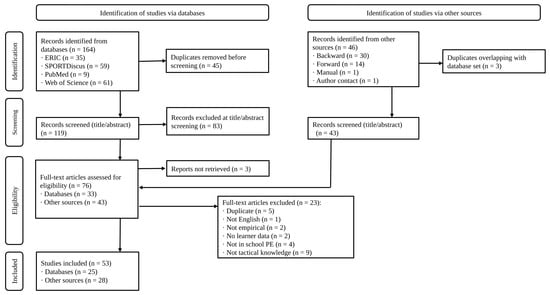
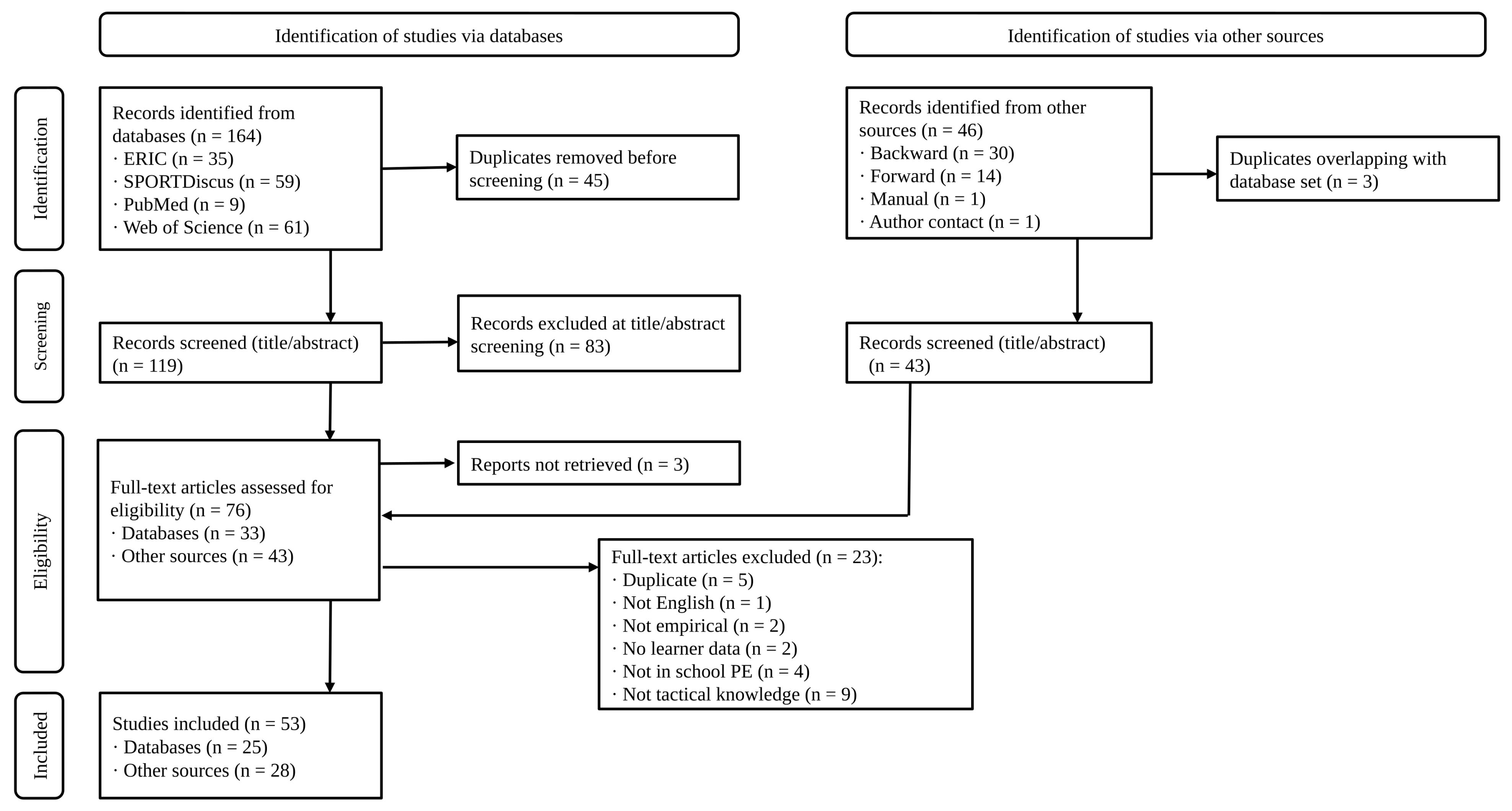
To verify the eligibility of the final study set, the second author independently reassessed all 49 studies included in the submitted manuscript and assessed six additional full-text candidate studies identified during the updated and supplementary searches. Across the resulting 55 full-text eligibility decisions, the two authors agreed on 54 (98.2% agreement; Cohen’s κ = 0.791). The single disagreement was discussed and resolved by consensus. Following the updated searches and eligibility assessment, 53 studies were included in the final review. The complete study-selection process is presented in the PRISMA flow diagram (Figure 1).
Figure 1.
PRISMA-ScR flow diagram of the study selection process.
2.5. Data Extraction and Coding
Data extraction was conducted using a data extraction sheet developed by the first author. All 53 included studies were coded by the first author using the final coding framework. The extracted items included author(s), year of publication, country, number of participants, the GBA model applied, game type, educational stage, research approach, data collection methods, analysis methods, and key findings. Among these items, year of publication, game type, educational stage, and research approach were summarized and reported as the basic characteristics of the selected studies.
In addition, each study was coded across five analytical dimensions: the conceptualization of tactical knowledge, theoretical orientation, methodological approach, research focus, and the treatment of learner perspectives.
The research-structure framework assigned a distinct analytical role to each dimension. Conceptualization identified what was treated as tactical knowledge; theoretical orientation identified the assumptions used to explain knowledge, learning, and action; methodological approach identified the forms of evidence produced and how they were analyzed; research focus identified the questions and outcomes prioritized; and learner perspective identified whose standpoint informed the data and the extent to which that standpoint was structured by the researchers. Each dimension was coded separately at the study level so that, for example, theoretical orientation was not inferred solely from methodological approach or learner perspective.
The conceptualization of tactical knowledge was classified, based on definitions, operationalization, and the data used, into declarative/procedural knowledge, decision making/action selection, conceptual/situated knowledge, and attunement to the environment.
Theoretical foundations were classified not only according to the theories explicitly named by the authors but also according to the theoretical assumptions reflected in the research questions, outcome measures, data collection and analysis methods, and the operationalization of tactical knowledge. Studies that primarily treated tactical knowledge in terms of correct or incorrect responses, knowledge tests, decision-making accuracy, or the application of tactical principles and rules were classified as reflecting an information-processing perspective. In contrast, studies that mainly analyzed learners’ experiences, narratives, meaning making, or understanding constructed within context were classified as reflecting a constructivist/situated perspective. Studies that foregrounded attunement to environmental information, constraints, or perception–action coupling were classified as reflecting an ecological perspective.
Research focus was classified according to the main purpose of each study. Learner perspectives were categorized according to whose perspective tactical knowledge-related data were obtained from and the extent to which the data were structured. Three categories were used: observer-centered/external, researcher-structured learner perspective, and learner-centered. Observer-centered/external studies were those in which game performance or decision making was externally assessed using observation categories established by the researchers. Studies with researcher-structured learner perspectives were those in which learners’ responses were captured within researcher-defined options or assessment frameworks, such as knowledge tests or video-based tests. Learner-centered studies were those in which learners’ own statements or meaning making related to tactical knowledge were analyzed inductively using interviews, think-aloud protocols, or similar methods. Studies were not classified as learner-centered if interviews or similar methods were used but tactical knowledge itself was not analyzed on the basis of learners’ own accounts.
For the descriptive synthesis, the categories for the conceptualization of tactical knowledge and theoretical orientation were treated as mutually exclusive primary categories, while recognizing that an individual study could contain characteristics of more than one category. The primary category for conceptualization was determined by how tactical knowledge was defined and operationalized and, in particular, by the type of data or measure used to represent it. The primary theoretical orientation was determined by the dominant assumptions organizing the research questions, operationalization of tactical knowledge, outcome measures, units of analysis, and interpretation of findings, rather than solely by theories explicitly named by the authors. When characteristics of multiple categories were present, the study was assigned to the category that most directly structured its research design and interpretation. Boundary cases were evaluated using decision rules specified in the codebook, and disagreements identified during independent coding were resolved through discussion and consensus.
Illustrative cases demonstrate how these decision rules were applied. The study by López et al. (2016) was classified as conceptualizing tactical knowledge as declarative/procedural knowledge because, although multiple outcomes were assessed, the principal knowledge outcome was procedural knowledge measured using a researcher-scored questionnaire. In contrast, the study by MacPhail et al. (2008) was classified as conceptual/situated knowledge because skill was understood relationally, as emerging through learners’ interactions with teammates, opponents, and space, rather than as an isolated component. Regarding theoretical orientation, the study by Salimin et al. (2020) was classified within constructivist/situated perspectives because the findings were interpreted in terms of knowledge construction through problem solving, peer interaction, and reflection. The study by Nathan et al. (2017), by contrast, was classified as reflecting an ecological perspective because nonlinear pedagogy and constraints-based assumptions guided the research design and interpretation. Regarding learner perspective, studies that evaluated game behavior using researcher-defined observational criteria, such as Oslin et al. (1998), were classified as observer-centered/external. The study by López et al. (2016) was classified as using a researcher-structured learner perspective because learners’ questionnaire responses were evaluated against researcher-defined correct answers, whereas the study by Gray and Sproule (2011) was classified as learner-centered because learners’ own accounts of tactical understanding were analyzed inductively rather than judged against predetermined correct answers or rubrics.
To assess the reliability of the coding process, the second author independently coded a purposively selected subset of 12 studies using the final coding framework. The subset was selected to reflect variation across the principal coding categories and methodological characteristics of the included studies. Before independent coding, the second author reviewed the codebook and completed a practice coding exercise. Agreement between the first and second authors was assessed for five dimensions—conceptualization of tactical knowledge, theoretical orientation, methodological approach, research focus, and learner perspective—using percentage agreement and Cohen’s kappa. Overall agreement across the 60 coding decisions was 85.0%. Dimension-specific agreement and kappa values were 75.0% and 0.538 for conceptualization, 83.3% and 0.571 for theoretical orientation, 100% and 1.000 for methodological approach, 83.3% and 0.600 for research focus, and 83.3% and 0.700 for learner perspective, respectively. All nine disagreements were reviewed and resolved through discussion and consensus, and the agreed classifications were incorporated into the final dataset.
2.6. Data Synthesis
The extracted data were synthesized descriptively and narratively in accordance with the research questions. First, year of publication, game type, educational stage, and research approach were tabulated to summarize the basic characteristics of the selected studies. Next, the five dimensions were summarized separately to map the distribution of categories across the included studies. The patterns identified across the dimensions were then brought together through narrative synthesis. Rather than treating the five dimensions as independent characteristics or combining them into a single score, we examined how their dominant patterns converged to form a broader research configuration—for example, how prevailing conceptualizations and theoretical orientations converged, at the field level, with dominant research foci, methodological approaches, and treatments of learner perspectives. This integrative interpretation was used to characterize the dominant research structure, assess what that structure had enabled researchers to visualize and compare, and identify what remained insufficiently explained. The analysis did not assume causal relationships among the five dimensions. Because the purpose of this review was to map research trends, no quality appraisal of individual studies was conducted.
2.7. Use of Generative AI and AI-Assisted Technologies
Generative AI and AI-assisted technologies were used during the preparation of this review to support idea development, review planning, manuscript organization, English-language refinement, and the preparation of Supporting Materials. All substantive research decisions—including study eligibility, data extraction, analytical criteria, coding framework, category development, quantitative synthesis, and interpretation of the findings—were made, critically reviewed, and finalized by the authors. The authors take full responsibility for the integrity and content of the work.
3. Results
3.1. Study Selection
The study-selection process is shown in Figure 1. Across the original and updated database searches, 164 records were identified: 35 from ERIC, 59 from SPORTDiscus, nine from PubMed, and 61 from Web of Science Core Collection. After 45 duplicate records were removed, 119 records were screened by title and abstract, of which 83 were excluded. Of the 36 reports sought for retrieval, three could not be retrieved, and 33 were assessed for full-text eligibility. Supplementary searches identified 46 records: 30 through backward citation searching, 14 through forward citation searching, one through manual searching, and one through direct author contact. After three records that overlapped with the database searches were removed, 43 reports were assessed for full-text eligibility. In total, 76 full-text reports were assessed, of which 23 were excluded because they did not meet the eligibility criteria. Finally, 53 studies were included in the review. The complete list of studies included in the review is provided in the Supplementary Materials.
3.2. Basic Characteristics of the Selected Studies
The basic characteristics of the 53 selected studies are presented in Table 1.
Table 1.
Study characteristics of the included studies (N = 53).
In terms of publication year, studies published between 2011 and 2020 were the most common (22 studies, 41.5%), followed by those published between 2021 and 2026 (14 studies, 26.4%) and those published between 2001 and 2010 (12 studies, 22.6%). Five studies were published in or before 2000 (9.4%). Regarding game type, invasion games accounted for the majority of studies (36 studies, 67.9%), followed by net/wall games (15 studies, 28.3%). One study focused on striking/fielding games, and one included multiple game types (1.9% each). No studies focused on target games.
In terms of educational stage, secondary education was the most common setting (30 studies, 56.6%), followed by elementary education (14 studies, 26.4%), university education (6 studies, 11.3%), and studies involving multiple educational stages (3 studies, 5.7%). Regarding research approach, quantitative studies accounted for the majority (42 studies, 79.2%), followed by mixed-methods studies (10 studies, 18.9%) and qualitative studies (1 study, 1.9%).
3.3. Conceptualization of Tactical Knowledge, Theoretical Foundations, Research Focus, and Learner Perspectives
Table 2 presents the conceptualization of tactical knowledge, theoretical foundations, research focus, and treatment of learner perspectives in the selected studies. The following sections describe each of these characteristics.
Table 2.
Analytical features of the included studies (N = 53).
3.3.1. Conceptualization of Tactical Knowledge and Theoretical Foundations
Regarding the conceptualization of tactical knowledge, studies that conceptualized it as decision making/action selection were the most common (34 studies, 64.2%), followed by declarative/procedural knowledge (13 studies, 24.5%) and conceptual/situated knowledge (6 studies, 11.3%). No studies conceptualized tactical knowledge as attunement to the environment (0.0%).
With regard to theoretical foundations, studies based on information-processing theory accounted for the majority (39 studies, 73.6%), followed by constructivist/situated perspectives (13 studies, 24.5%) and ecological perspectives (1 study, 1.9%).
3.3.2. Research Focus
Regarding research focus, studies focusing on instructional effectiveness were the most common (41 studies, 77.4%). In contrast, five studies focused on learning characteristics (9.4%), and three studies examined learning processes (5.7%). Studies focusing on knowledge structures/metacognition and learning support tools accounted for two studies each (3.8%).
3.3.3. Treatment of Learner Perspectives
Regarding the treatment of learner perspectives, 27 studies were observer-centered/external (50.9%), and 24 studies used researcher-structured learner perspectives (45.3%). In contrast, two studies were learner-centered, in that they inductively analyzed learners’ own statements or meaning making (3.8%).
4. Discussion
4.1. Overview of Main Findings
This review examined tactical knowledge research in GBAs by synthesizing how tactical knowledge has been conceptualized, the theoretical foundations on which studies have been based, their research foci and methodological approaches, and the ways in which learner perspectives have been addressed. The findings showed that tactical knowledge has been conceptualized primarily as knowledge manifested in decision making, and that most studies have been grounded in information-processing theory. In addition, much of the research consisted of quantitative effectiveness studies conducted at the secondary education level and focused on invasion games, with particular emphasis on evaluating the effectiveness of instructional approaches. In contrast, very few studies examined how learners themselves make sense of game situations or how they use knowledge to perceive situations, make decisions, and execute skills.
Taken together, these findings indicate that GBA research has made tactical understanding and decision making visible as important components of game performance and established them as central learning content in ball game instruction. However, the field has been dominated by a research structure in which these components are treated primarily as separate outcome indicators. Consequently, how tactical knowledge, perception, decision making, and skill execution become functionally connected within specific game situations remains insufficiently explained. This interpretation is consistent with previous reviews showing that GBA research has accumulated mainly around post-intervention learning outcomes (Harvey & Jarrett, 2014; Miller, 2015) and that tactical approaches produce significant benefits for decision making compared with technical approaches, while showing no clear advantage for skill execution (Abad Robles et al., 2020). In addition, TGfU scholarship has highlighted the need to integrate verbalized understanding with action during game play (Light & Fawns, 2003) and to provide a clearer theoretical explanation of how TGfU promotes learning (Tan et al., 2012). The following sections therefore examine the historical conditions under which this research structure developed and consider the contributions and limitations it has produced.
4.2. Historical Development of Tactical Knowledge Research in GBAs
Tactical knowledge research in GBAs developed in conjunction with the emergence of Teaching Games for Understanding (TGfU), which marked a shift in ball game instruction from traditional technique-centered teaching toward learning that emphasized understanding and decision making in relation to game situations (Bunker & Thorpe, 1982; Werner et al., 1996; Kirk & MacPhail, 2002). Traditional ball game instruction tended to view game performance primarily in terms of skill mastery developed separately from the game context. In contrast, TGfU placed understanding the structure of the game and its tactical problems, making appropriate decisions, and executing skills on the basis of those decisions at the center of ball game learning. The essence of this shift was the repositioning of skill as a means of solving tactical problems. This perspective broadened the conception of game performance from technical proficiency alone to an integrated capacity involving game understanding, tactical awareness, decision making, and skill execution, thereby establishing the starting point for tactical knowledge research in contemporary GBAs.
Against this background, the conceptualization and operationalization of tactical knowledge also expanded. In sport cognition research from the late 1980s to the mid-1990s, tactical knowledge was conceptualized primarily as declarative and procedural knowledge or as knowledge representations, and researchers examined the relationships between these knowledge bases, decision making, and sport performance (French & Thomas, 1987; McPherson, 1994; Gréhaigne & Godbout, 1995). Early GBA studies likewise assessed learners’ possession of declarative and procedural knowledge through knowledge tests (French et al., 1996a, 1996b). At the same time, research increasingly used decision making in video-based game situations and actual game play to examine tactical knowledge, bringing greater attention to the appropriateness of judgments made within game contexts (Oslin et al., 1998; M. T. Blomqvist et al., 2000; M. Blomqvist et al., 2005). Thus, alongside research that treated tactical knowledge as possessed or represented declarative and procedural knowledge, studies accumulated that sought to capture knowledge as it was used in context. The focus of research therefore gradually expanded from the possession of knowledge to decision making during game play.
This conceptual development was highly compatible with information-processing explanations that were gaining prominence in sport cognition and expertise research during the same period. Within an information-processing framework, players are understood to perceive game situations, refer to stored knowledge representations when selecting among possible solutions, and execute the selected response as motor action (French & Thomas, 1987; McPherson, 1994). In particular, the TGfU sequence of game understanding, decision making, and skill execution could be readily theorized and operationalized within this framework. Other perspectives were also present, including constructivist accounts that viewed tactical knowledge as constructed within dynamic game situations (Gréhaigne & Godbout, 1995) and attempts to reconceptualize TGfU through situated learning theory (Kirk & MacPhail, 2002). However, empirically examining learners’ meaning making and interactions from these perspectives required research designs sensitive to context and process. By contrast, information-processing frameworks enabled tactical knowledge and decision making to be operationalized as distinct components and were therefore well suited to comparative studies of instructional effectiveness. Consequently, information-processing assumptions may have become the dominant framework shaping the conceptualization and operationalization of tactical knowledge in subsequent research.
Against this historical background, empirical GBA research from its early stages examined the educational effects of different instructional approaches on tactical knowledge and game performance (French et al., 1996a, 1996b; Turner & Martinek, 1999; M. Blomqvist et al., 2001). Because GBAs were proposed as alternatives to traditional technique-centered instruction, the accumulation of such studies also corresponded with calls to establish the educational and scholarly legitimacy of TGfU through empirical evidence (Griffin et al., 2005). Research subsequently continued to evaluate diverse learning outcomes through pre–post comparisons and comparisons with traditional instruction, and later reviews synthesized the effects of GBAs by outcome domain, including knowledge, decision making, skill execution, and game performance (Harvey & Jarrett, 2014; Miller, 2015; Abad Robles et al., 2020; Silva et al., 2021). Taken together, the pedagogical shift introduced by TGfU, its theoretical compatibility with sport cognition research, and the demand to establish the legitimacy of a new instructional approach through empirical evidence appear to have jointly shaped the basic structure of contemporary GBA research: tactical knowledge, decision making, skill execution, and game performance have been treated as separate outcome indicators, and instructional effectiveness has been evaluated primarily in terms of improvements in each of these outcomes.
4.3. Contributions and Limitations of the Current GBA Research Structure
The basic structure of contemporary GBA research identified in this review has played an important role in advancing the study of tactical knowledge in ball game learning. Its first major contribution has been to broaden the conception of game performance beyond skill mastery to include game understanding, decision making, and skill execution within game contexts, thereby positioning its cognitive and tactical dimensions as explicit learning outcomes. The development of frameworks for assessing team-sport performance in authentic game contexts, including the Game Performance Assessment Instrument (GPAI), made decision making and skill execution during game play visible as objects of investigation and provided a foundation for treating tactical knowledge and decision making as assessable learning outcomes in ball game instruction (Gréhaigne et al., 1997; Oslin et al., 1998).
A second contribution has been the establishment of a methodological foundation for operationalizing tactical learning as an assessable construct and examining it empirically through multiple methods. Knowledge tests (French et al., 1996a, 1996b), game-understanding tests using video-based game situations (M. T. Blomqvist et al., 2000), and systematic observation of actual game play through the GPAI (Oslin et al., 1998) enabled researchers to assess the possession of knowledge, context-sensitive decision making, and skill execution from different perspectives. The subsequent accumulation and systematic organization of assessment approaches across criteria, tactical levels, indicators, units of observation, learner roles, and contexts of application also represented an important achievement in establishing tactical knowledge as an enduring and empirically examinable object of research (Barquero-Ruiz et al., 2020).
Third, this methodological foundation supported the accumulation of pre–post intervention studies and comparisons among instructional approaches, thereby creating a field in which the educational effects of GBAs could be examined empirically (Griffin et al., 2005; Harvey & Jarrett, 2014). Subsequent reviews and meta-analyses have shown positive effects for some outcomes, particularly decision making, while also indicating that effects vary across outcome domains, including knowledge and skill execution during game play, and that concerns remain regarding reporting quality and risk of bias (Miller, 2015; Abad Robles et al., 2020; Breed et al., 2025; Manninen et al., 2025). The contribution of this research structure, therefore, lies less in establishing the consistent superiority of GBAs than in creating a research foundation through which their educational value and limitations can be continually examined using empirical evidence.
At the same time, operationalizing these components separately also contributed to a research structure in which tactical knowledge, decision making, skill execution, and game performance were organized as distinct outcome domains and investigated primarily in terms of improvement in each indicator. Representative intervention studies illustrate this pattern. Turner and Martinek (1999) administered separate measures of knowledge, skill, and game performance and analyzed cognitive and skill outcomes independently, while Mesquita et al. (2012) evaluated decision making, skill execution, and overall game performance as distinct indicators. Other studies similarly examined changes in tactical knowledge, decision making, and skill execution as separate outcome variables (French et al., 1996a, 1996b; López et al., 2016). These designs were valuable for detecting outcome-specific effects; however, they did not directly investigate how a learner’s tactical knowledge oriented perception, informed decision making, and became enacted through skill execution within the same game situation. Indeed, subsequent reviews and meta-analyses have synthesized GBA effects by outcome domain, and Breed et al. (2025) noted that research designs centered on comparative studies may encourage the treatment of learning outcomes as separate domains (Miller, 2015; Abad Robles et al., 2020; Breed et al., 2025; Manninen et al., 2025). These findings do not imply that the components are unrelated. However, when interpreted alongside the findings of the present review, they indicate that demonstrating improvement in separate outcome indicators does not sufficiently explain how tactical knowledge, perception, decision making, and skill execution become functionally connected within the same game situation.
Furthermore, external observation and quantitative outcome measures can identify the decisions and skill executions displayed by learners, but they cannot, by themselves, directly explain how learners make sense of game situations, what knowledge they draw upon, or how they perceive situations, make decisions, and execute skills. TGfU scholarship has long emphasized the need to integrate verbalized understanding with action during game play (Light & Fawns, 2003), and subsequent work has called for phenomenological and context-sensitive research capable of capturing learners’ experiences and meaning making (Harvey & Jarrett, 2014; Jones et al., 2016). The need for clearer theoretical explanations of the mechanisms through which TGfU pedagogical principles promote learning has also been raised (Tan et al., 2012). Nevertheless, the findings of this review indicate that empirical studies examining the relationships among tactical knowledge, perception, decision making, and skill execution on the basis of learners’ own experiences remain limited.
The limitation of the current GBA research structure, therefore, does not lie in the act of distinguishing and assessing tactical knowledge, decision making, and related components. Rather, it lies in the insufficient development of research that reintegrates the knowledge made visible through those distinctions by examining the functional relationships among components in specific game situations and the learning processes through which those relationships emerge. The current research structure has substantially advanced the visualization, measurement, and comparison of tactical learning. However, it has made less progress in explaining how tactical knowledge, perception, decision making, and skill execution become functionally connected during game play and how those relationships are formed and transformed through learning. This limitation points to the need for future GBA research to investigate not only improvement in individual outcome indicators, but also the functional relationships among these components and the processes through which those relationships develop and change.
4.4. Future Research Directions
Building on the limitations identified in the previous section, future GBA research should be developed in four directions: functional connections among key components, learner perspectives, theoretical diversity, and the scope of applicability of existing findings.
First, future research should examine not only tactical knowledge, perception, decision making, and skill execution as separate outcome indicators, but also how these components interact within specific game situations and become connected to action. Research in sport cognition and motor learning has emphasized the need to understand decision making as a phenomenon that emerges through the relationship between the learner and the environment and is realized in actual action (Araújo et al., 2006). The importance of representativeness in experimental and learning-task design—particularly the preservation of the information and perception–action relations that characterize actual game play—has also been highlighted (Pinder et al., 2011), as has the need to integrate verbalized understanding with action (Light & Fawns, 2003). On this basis, future studies should align data on tactical knowledge, perception, decision making, and skill execution with the specific game situations in which actions occur.
Second, more research is needed to capture the experience and development of tactical learning from learner perspectives. External observation can assess the decisions and skill executions displayed by learners, but it cannot directly explain how they make sense of a situation, what they perceive, or what knowledge they use. GBA scholarship has therefore called for phenomenological and context-sensitive research that gives greater attention to learners’ individual experiences and meaning making (Harvey & Jarrett, 2014; Jones et al., 2016). For example, a mechanism-oriented study could longitudinally follow university students across a GBA unit by linking critical game episodes identified from video with episode-specific stimulated-recall interviews examining learners’ intentions, attended cues, tactical interpretations, and reasons for action. Time-ordered analysis of these data could clarify how functional connections among tactical knowledge, perception, decision making, and skill execution are formed and transformed through learning experiences, and the mechanisms identified could subsequently be examined through age-appropriate research designs in school contexts.
Third, the theoretical foundations of tactical knowledge research should be diversified. This does not mean excluding information-processing explanations or integrating theories with incompatible assumptions into a single framework. Constructivist and situated perspectives foreground learners’ prior experiences, participation, and meaning making (Gréhaigne & Godbout, 1995; Kirk & MacPhail, 2002), whereas ecological dynamics and nonlinear pedagogy emphasize learner–environment relations, constraints, and perception–action coupling (Tan et al., 2012; Renshaw et al., 2016). Future studies should make the assumptions and units of analysis of each theoretical perspective explicit, examine the function, development, and transformation of tactical knowledge from different perspectives, and compare findings across theoretical approaches. This direction is consistent with the recommendation by Memmert et al. (2015) that future TGfU research incorporate interdisciplinary scientific approaches and complexity thinking.
Fourth, the findings accumulated primarily in invasion games and secondary education should be extended to other game categories, developmental stages, and educational contexts in order to examine their scope of applicability. A recent review of comparative studies found that research has been concentrated heavily in invasion games and identified expansion to net/wall and striking/fielding games, comparisons across game categories, transfer of learning, and retention of learning outcomes as important future priorities (Breed et al., 2025). Clear reporting of intervention content, educational context, and implementation conditions is also necessary for judging the applicability of findings (Morales-Belando et al., 2022). Rather than simply transferring existing concepts and assessment indicators to other contexts, future research should examine how game-specific information, rules, technical demands, developmental stages, and educational cultures influence the function of tactical knowledge and the learning process.
Through these developments, GBA research can progress from asking whether individual outcomes improve to explaining for whom, in which game and educational contexts, and through what learning processes tactical knowledge functions and its relationships with perception, decision making, and skill execution are formed and transformed.
4.5. Limitations of This Review
This review has several limitations. First, the included literature was limited to English-language, peer-reviewed articles indexed in the selected databases. Consequently, studies published in other languages, gray literature such as books and dissertations, and studies indexed only in databases not searched in this review may have been missed. In addition, because this review focused on GBAs in school physical education, it does not directly reflect findings from tactical knowledge research conducted in competitive sport or coaching contexts.
Second, this study was a scoping review designed to map the conceptual, theoretical, and methodological characteristics of the field, and it did not systematically assess the methodological quality or risk of bias of individual studies. Therefore, no conclusions can be drawn regarding the certainty of the evidence or the effectiveness of specific instructional approaches. Furthermore, the classification of the conceptualization of tactical knowledge, theoretical foundations, research focus, and learner perspectives involved interpretive judgments by the review authors based on the descriptions provided in the included studies. Although explicit classification criteria were developed and applied, alternative classifications may be possible from different theoretical perspectives. Accordingly, the reported frequencies should be interpreted as indicating the dominant conceptualizations and theoretical orientations identified in each study, rather than as evidence that the studies were conceptually or theoretically exclusive. Finally, the included studies were heterogeneous in terms of game type, educational stage, research design, and assessment method; therefore, caution is required when directly comparing findings across studies or generalizing them beyond the contexts in which they were produced.
5. Conclusions
This review provided an integrated synthesis of tactical knowledge research in Game-Based Approaches (GBAs) in school physical education by examining its conceptualization, theoretical foundations, research focus, methodological approaches, and treatment of learner perspectives. The findings showed that tactical knowledge has predominantly been conceptualized as knowledge manifested in decision making during game play and that research has been grounded primarily in information-processing perspectives, with a strong emphasis on quantitatively evaluating improvements in tactical knowledge, decision making, skill execution, and game performance. This research structure has made the cognitive and tactical dimensions of game performance visible, established tactical learning as a measurable and comparable object of research, and provided an empirical foundation for evaluating the educational value of GBAs.
At the same time, because these components have largely been treated as separate outcome indicators, insufficient attention has been given to explaining how tactical knowledge, perception, decision making, and skill execution become functionally connected within specific game situations or how these relationships are formed and transformed through learning. In particular, research examining how learners make sense of game situations and use tactical knowledge to guide their actions from their own perspectives remains limited. Future research should therefore adopt more diverse theoretical and methodological perspectives while linking observations of game play with learners’ experiences in corresponding game situations to clarify the function of tactical knowledge and the processes through which tactical learning develops. By conceptualizing the conceptual, theoretical, and methodological characteristics of GBA research as an interconnected research structure, this review provides a framework for understanding both the achievements and the limitations of existing research and offers directions for future tactical knowledge research.
Supplementary Materials
Supplementary review materials, including the search strategy, data charting sheet, included study records, excluded records with reasons, coding framework, PRISMA-ScR checklist, PRISMA flow diagram, and README file, are available on the Open Science Framework (OSF): https://osf.io/utmxp/ (accessed on 16 September 2026).
Author Contributions
Conceptualization, S.Y.; Methodology, S.Y.; Formal Analysis, S.Y.; Investigation, S.Y. and S.S.; Data Curation, S.Y.; Writing—Original Draft Preparation, S.Y.; Writing—Review and Editing, S.Y., S.S., N.O. and Y.O.; Supervision, N.O. and Y.O.; Project Administration, S.Y. All authors have read and agreed to the published version of the manuscript.
Funding
This research received no external funding.
Institutional Review Board Statement
Not applicable.
Informed Consent Statement
Not applicable.
Data Availability Statement
Supplementary Materials related to the search strategy, data charting process, included study records, excluded records with reasons, coding framework, PRISMA-ScR checklist, and PRISMA flow diagram are available on the Open Science Framework (OSF): https://osf.io/utmxp/ (accessed on 16 September 2026).
Acknowledgments
During the preparation of this manuscript, the authors used ChatGPT (OpenAI, GPT-5.6 Pro) and Gemini (Google, Gemini 3.1 Pro) for idea development, manuscript organization, English-language refinement, and the preparation of supporting materials. The authors reviewed and edited all AI-assisted outputs and take full responsibility for the content of the publication.
Conflicts of Interest
The authors declare no conflicts of interest.
References
- Abad Robles, M. T., Collado-Mateo, D., Fernández-Espínola, C., Castillo Viera, E., & Giménez Fuentes-Guerra, F. J. (2020). Effects of teaching games on decision making and skill execution: A systematic review and meta-analysis. International Journal of Environmental Research and Public Health, 17(2), 505. [Google Scholar] [CrossRef] [Scilit] [PubMed]
- Araújo, D., Davids, K., & Hristovski, R. (2006). The ecological dynamics of decision making in sport. Psychology of Sport and Exercise, 7(6), 653–676. [Google Scholar] [CrossRef] [Scilit]
- Arksey, H., & O’Malley, L. (2005). Scoping studies: Towards a methodological framework. International Journal of Social Research Methodology, 8(1), 19–32. [Google Scholar] [CrossRef] [Scilit]
- Barquero-Ruiz, C., Arias-Estero, J. L., & Kirk, D. (2020). Assessment for tactical learning in games: A systematic review. European Physical Education Review, 26(4), 827–847. [Google Scholar] [CrossRef] [Scilit]
- Blomqvist, M., Luhtanen, P., & Laakso, L. (2001). Comparison of two types of instruction in badminton. European Journal of Physical Education, 6(2), 139–155. [Google Scholar] [CrossRef] [Scilit]
- Blomqvist, M., Vänttinen, T., & Luhtanen, P. (2005). Assessment of secondary school students’ decision-making and game-play ability in soccer. Physical Education and Sport Pedagogy, 10(2), 107–119. [Google Scholar] [CrossRef] [Scilit]
- Blomqvist, M. T., Luhtanen, P., Laakso, L., & Keskinen, E. (2000). Validation of a video-based game-understanding test procedure in badminton. Journal of Teaching in Physical Education, 19(3), 325–337. [Google Scholar] [CrossRef] [Scilit]
- Breed, R., Lindsay, R., Kittel, A., & Spittle, M. (2025). Content and quality of comparative tactical game-centered approaches in physical education: A systematic review. Review of Educational Research, 95(2), 293–336. [Google Scholar] [CrossRef] [Scilit]
- Bunker, D., & Thorpe, R. (1982). A model for the teaching of games in secondary schools. Bulletin of Physical Education, 18(1), 5–8. [Google Scholar]
- French, K. E., & Thomas, J. R. (1987). The relation of knowledge development to children’s basketball performance. Journal of Sport Psychology, 9(1), 15–32. [Google Scholar] [CrossRef] [Scilit]
- French, K. E., Werner, P. H., Rink, J. E., Taylor, K., & Hussey, K. (1996a). The effects of a 3-week unit of tactical, skill, or combined tactical and skill instruction on badminton performance of ninth-grade students. Journal of Teaching in Physical Education, 15(4), 418–438. [Google Scholar] [CrossRef] [Scilit]
- French, K. E., Werner, P. H., Taylor, K., Hussey, K., & Jones, J. (1996b). The effects of a 6-week unit of tactical, skill, or combined tactical and skill instruction on badminton performance of ninth-grade students. Journal of Teaching in Physical Education, 15(4), 439–463. [Google Scholar] [CrossRef] [Scilit]
- Gray, S., & Sproule, J. (2011). Developing pupils’ performance in team invasion games. Physical Education and Sport Pedagogy, 16(1), 15–32. [Google Scholar] [CrossRef] [Scilit]
- Gréhaigne, J.-F., & Godbout, P. (1995). Tactical knowledge in team sports from a constructivist and cognitivist perspective. Quest, 47(4), 490–505. [Google Scholar] [CrossRef] [Scilit]
- Gréhaigne, J.-F., Godbout, P., & Bouthier, D. (1997). Performance assessment in team sports. Journal of Teaching in Physical Education, 16(4), 500–516. [Google Scholar] [CrossRef] [Scilit]
- Gréhaigne, J.-F., Godbout, P., & Bouthier, D. (2001). The teaching and learning of decision making in team sports. Quest, 53(1), 59–76. [Google Scholar] [CrossRef] [Scilit]
- Griffin, L. L., Brooker, R., & Patton, K. (2005). Working towards legitimacy: Two decades of Teaching Games for Understanding. Physical Education and Sport Pedagogy, 10(3), 213–223. [Google Scholar] [CrossRef] [Scilit]
- Harvey, S., & Jarrett, K. (2014). A review of the game-centered approaches to teaching and coaching literature since 2006. Physical Education and Sport Pedagogy, 19(3), 278–300. [Google Scholar] [CrossRef] [Scilit]
- Jones, R., Harvey, S., & Kirk, D. (2016). Everything is at stake; yet nothing is at stake: Exploring meaning-making in game-centered approaches. Sport, Education and Society, 21(6), 888–906. [Google Scholar] [CrossRef] [Scilit][Green Version]
- Kirk, D., & MacPhail, A. (2002). Teaching games for understanding and situated learning: Rethinking the Bunker-Thorpe model. Journal of Teaching in Physical Education, 21(2), 177–192. [Google Scholar] [CrossRef] [Scilit]
- Launder, A. G. (2001). Play practice: The games approach to teaching and coaching sports. Human Kinetics. [Google Scholar]
- Light, R. (2004). Coaches’ experiences of Game Sense: Opportunities and challenges. Physical Education and Sport Pedagogy, 9(2), 115–131. [Google Scholar] [CrossRef] [Scilit]
- Light, R., & Fawns, R. (2003). Knowing the game: Integrating speech and action in games teaching through TGfU. Quest, 55(2), 161–176. [Google Scholar] [CrossRef] [Scilit]
- López, I., Práxedes, A., & del Villar, F. (2016). Effect of an intervention teaching program, based on TGfU model, on the cognitive and execution variables, in the physical education context. European Journal of Human Movement, 37, 88–108. [Google Scholar]
- MacPhail, A., Kirk, D., & Griffin, L. L. (2008). Throwing and catching as relational skills in game play: Situated learning in a modified game unit. Journal of Teaching in Physical Education, 27(1), 100–115. [Google Scholar] [CrossRef] [Scilit]
- Manninen, M., Magrum, E., Campbell, S., & Belton, S. (2025). The effect of game-based approaches on decision-making, knowledge, and motor skill: A systematic review and a multilevel meta-analysis. European Physical Education Review, 31(1), 18–32. [Google Scholar] [CrossRef] [Scilit]
- McPherson, S. L. (1994). The development of sport expertise: Mapping the tactical domain. Quest, 46(2), 223–240. [Google Scholar] [CrossRef] [Scilit]
- Memmert, D., Almond, L., Bunker, D., Butler, J., Fasold, F., Griffin, L., Hillmann, W., Hüttermann, S., Klein-Soetebier, T., König, S., Nopp, S., Rathschlag, M., Schul, K., Schwab, S., Thorpe, R., & Furley, P. (2015). Top 10 research questions related to Teaching Games for Understanding. Research Quarterly for Exercise and Sport, 86(4), 347–359. [Google Scholar] [CrossRef] [Scilit] [PubMed]
- Mesquita, I., Farias, C., & Hastie, P. A. (2012). The impact of a hybrid sport education–invasion games competence model soccer unit on students’ decision making, skill execution and overall game performance. European Physical Education Review, 18(2), 205–219. [Google Scholar] [CrossRef] [Scilit]
- Miller, A. (2015). Games centered approaches in teaching children & adolescents: Systematic review of associated student outcomes. Journal of Teaching in Physical Education, 34(1), 36–58. [Google Scholar] [CrossRef] [Scilit]
- Mitchell, S. A., Oslin, J. L., & Griffin, L. L. (2006). Teaching sport concepts and skills: A tactical games approach (2nd ed.). Human Kinetics. [Google Scholar]
- Morales-Belando, M. T., Kirk, D., & Arias-Estero, J. L. (2022). A systematic review of Teaching Games for Understanding intervention studies from a practice-referenced perspective. Research Quarterly for Exercise and Sport, 93(4), 670–681. [Google Scholar] [CrossRef] [Scilit] [PubMed]
- Munn, Z., Peters, M. D. J., Stern, C., Tufanaru, C., McArthur, A., & Aromataris, E. (2018). Systematic review or scoping review? Guidance for authors when choosing between a systematic or scoping review approach. BMC Medical Research Methodology, 18, 143. [Google Scholar] [CrossRef] [PubMed]
- Nathan, S., Salimin, N., & Shahril, M. I. (2017). A comparative analysis of badminton game instructions effect of non-linear pedagogy and linear pedagogy. Journal of Fundamental and Applied Sciences, 9(6S), 1258–1285. [Google Scholar] [CrossRef] [Scilit]
- National Academies of Sciences, Engineering, and Medicine (NASEM). (2018). How people learn II: Learners, contexts, and cultures. The National Academies Press. [Google Scholar] [CrossRef] [Scilit] [PubMed]
- OECD. (2019). OECD future of education and skills 2030: OECD learning compass 2030. OECD Publishing. Available online: https://www.oecd.org/content/dam/oecd/en/about/projects/edu/education-2040/concept-notes/OECD_Learning_Compass_2030_concept_note.pdf (accessed on 16 September 2026).
- Oslin, J. L., Mitchell, S. A., & Griffin, L. L. (1998). The game performance assessment instrument (GPAI): Development and preliminary validation. Journal of Teaching in Physical Education, 17(2), 231–243. [Google Scholar] [CrossRef] [Scilit]
- Pinder, R. A., Davids, K., Renshaw, I., & Araújo, D. (2011). Representative learning design and functionality of research and practice in sport. Journal of Sport & Exercise Psychology, 33(1), 146–155. [Google Scholar] [CrossRef] [Scilit] [PubMed]
- Renshaw, I., Araújo, D., Button, C., Chow, J. Y., Davids, K., & Moy, B. (2016). Why the constraints-led approach is not teaching games for understanding: A clarification. Physical Education and Sport Pedagogy, 21(5), 459–480. [Google Scholar] [CrossRef] [Scilit]
- Renshaw, I., Chow, J. Y., Davids, K., & Hammond, J. (2010). A constraints-led perspective to understanding skill acquisition and game play: A basis for integration of motor learning theory and physical education praxis? Physical Education and Sport Pedagogy, 15(2), 117–137. [Google Scholar] [CrossRef] [Scilit]
- Salimin, N., Minhat, N., Elumalai, G., Shahril, M. I., & Guntur, Y. S. U. (2020). Cognitive development based on the volleyball game play in physical education. International Journal of Physiotherapy, 7(1), 42–46. [Google Scholar] [CrossRef] [Scilit]
- Silva, R., Farias, C., Ramos, A., & Mesquita, I. (2021). Implementation of game-centered approaches in physical education: A systematic review. Journal of Physical Education and Sport, 21(Suppl. 6), 3246–3259. [Google Scholar] [CrossRef]
- Stolz, S., & Pill, S. (2014). Teaching games and sport for understanding: Exploring and reconsidering its relevance in physical education. European Physical Education Review, 20(1), 36–71. [Google Scholar] [CrossRef] [Scilit]
- Tan, C. W. K., Chow, J. Y., & Davids, K. (2012). “How does TGfU work?”: Examining the relationship between learning design in TGfU and a nonlinear pedagogy. Physical Education and Sport Pedagogy, 17(4), 331–348. [Google Scholar] [CrossRef] [Scilit]
- Tricco, A. C., Lillie, E., Zarin, W., O’Brien, K. K., Colquhoun, H., Levac, D., Moher, D., Peters, M. D. J., Horsley, T., Weeks, L., Hempel, S., Akl, E. A., Chang, C., McGowan, J., Stewart, L., Hartling, L., Aldcroft, A., Wilson, M. G., Garritty, C., … Straus, S. E. (2018). PRISMA extension for scoping reviews (PRISMA-ScR): Checklist and explanation. Annals of Internal Medicine, 169(7), 467–473. [Google Scholar] [CrossRef] [Scilit] [PubMed]
- Turner, A. P., & Martinek, T. J. (1999). An investigation into teaching games for understanding: Effects on skill, knowledge, and game play. Research Quarterly for Exercise and Sport, 70(3), 286–296. [Google Scholar] [CrossRef] [Scilit] [PubMed]
- Werner, P., Thorpe, R., & Bunker, D. (1996). Teaching Games for Understanding: Evolution of a model. Journal of Physical Education, Recreation & Dance, 67(1), 28–33. [Google Scholar] [CrossRef] [Scilit]

Disclaimer/Publisher’s Note: The statements, opinions and data contained in all publications are solely those of the individual author(s) and contributor(s) and not of MDPI and/or the editor(s). MDPI and/or the editor(s) disclaim responsibility for any injury to people or property resulting from any ideas, methods, instructions or products referred to in the content. |
© 2026 by the authors. Licensee MDPI, Basel, Switzerland. This article is an open access article distributed under the terms and conditions of the Creative Commons Attribution (CC BY) license.