


Abstract
The development of teachers’ digital competence has become a key issue in contemporary education systems, particularly in contexts where technology integration remains uneven. This study aims to profile teachers’ digital competence through a cluster analysis based on pedagogical digital competence, digital integration, and contextual conditions, and to examine its relationship with selected professional and demographic variables. A quantitative, non-experimental, cross-sectional design was employed with a sample of 299 teachers from Educational District 16-02 in the Dominican Republic. Data were collected using a questionnaire based on the DigCompEdu framework. The internal consistency of the instrument was assessed, and principal component analysis (PCA) with Varimax rotation was applied to the nine composite dimension scores for dimensionality reduction, yielding a three-component solution. Subsequently, cluster analysis (hierarchical and k-means) was conducted to identify differentiated teacher profiles. The results indicate the existence of three distinct profiles characterized by different levels of pedagogical digital competence, integration of technology in teaching, and contextual conditions. Statistically significant associations or differences were identified for educational level, teacher age, and student age, whereas no statistically significant associations or differences were identified for gender or duration of technology use in the classroom. Within the studied educational context, these findings highlight the heterogeneity of teachers’ digital competence profiles and suggest the potential value of considering both pedagogical and contextual factors when designing targeted professional development strategies. The study is limited to selected professional and demographic variables, which should be interpreted as contextual correlates rather than broad sociodemographic determinants.
1. Introduction
Rapid advances in digital technologies have profoundly redefined the social, economic, and educational dynamics of the 21st century, leading to the development of increasingly media-driven and hybrid learning ecosystems (Basantes-Andrade et al., 2020; Rodríguez-Jiménez et al., 2022; UNESCO, 2023). In education, this transformation requires that teachers are able to critically, ethically, and inclusively integrate digital technologies into the classroom, fostering equity and improving learning outcomes (Muñoz Martínez et al., 2025; OECD, 2021; Redecker, 2017; Zambrano Vélez et al., 2026). In this context, digital teaching competence (DTC) has become a central component of educational quality; that is, the ability of educators to make use of digital technologies in meaningful, inclusive, and transformative ways (Ghomi & Redecker, 2019; Kaiser et al., 2026; Rakhimbekova et al., 2026; Redecker, 2017). DTC involves not only technical skills but also pedagogical knowledge to redesign learning experiences and empower students, in line with the TPACK framework (Koehler et al., 2013) and recent developments in DTC assessment (Tzafilkou et al., 2023). International organisations such as UNESCO, the OECD, and the European Commission agree that strengthening digital teaching competence (DTC) is essential to guarantee inclusive, equitable, and quality education in the digital era, in line with SDG 4 (OECD, 2021; Redecker, 2017; UNESCO, 2023). The Global Education Monitoring Report 2023 highlights that merely creating technological infrastructure is insufficient unless accompanied by sustained policies for professional teacher development, data governance frameworks, and student-cantered pedagogical approaches (UNESCO, 2023). Additionally, the OECD (2021) emphasises that DTC must be a strategic priority, especially in technical and vocational education, where the transition to a digitalised economy demands innovative methods for teaching, learning, and certifying skills.
1.1. Literature Review
In this scenario, the European Framework for the Digital Competence of Educators (DigCompEdu) has become an international benchmark for conceptualising and measuring DTC (Redecker, 2017). DigCompEdu organises digital competence into six interrelated areas, ranging from professional engagement to empowering learners through technology, and offers a progressive model of six levels (A1–C2) which outlines pathways for professional development (Mattar et al., 2022; Redecker, 2017). This framework is operationalised using Likert-scale self-assessment questionnaires, widely used for individual and collective analysis across different educational levels (Cabero-Almenara et al., 2023; Ghomi & Redecker, 2019). These instruments permit the creation of comparable DTC profiles and provide a solid foundation for the design of professional development programs oriented towards the actual needs of educators (Ghomi & Redecker, 2019).
In recent years there has been a sustained increase in research on DTC, with special attention to the impact of COVID-19 on teaching practices (Acuña-Gamboa et al., 2023; Liberona et al., 2023; Smestad et al., 2023; Tzafilkou et al., 2023). Systematic reviews reveal intermediate levels of DTC: educators perceive themselves as competent in using digital resources and organisation but show weaknesses in the areas of advanced digital assessment, data protection, network collaboration and student empowerment (Smestad et al., 2023; UNESCO, 2023). In Latin America, comparative studies based on the DigCompEdu framework show average levels of digital competence in higher education, with differences by experience, ICT training, and pedagogical use (Alvarez-Huari, 2025; Cabero-Almenara et al., 2023).
In Latin America and the Caribbean, particularly in the Dominican Republic, gaps persist in the DTC at the pre-university level, with inequalities in the command of ICT by education levels and areas (Della Nina Gambi et al., 2025; Riquelme-Plaza & Marolla-Gajardo, 2026; UNESCO, 2023). Pre/post-COVID reviews confirm that scores for digital competence are average (M ≈ 3.0/5), with 30–40% scoring low in digital creation (Smestad et al., 2023). Regional analyses highlight disparities due to institutional connectivity (Alvarez-Huari, 2025; Della Nina Gambi et al., 2025). Most DigCompEdu studies use descriptive or factorial analyses, which may obscure multidimensional complexities (Cabero-Almenara et al., 2023; Smestad et al., 2023; Tzafilkou et al., 2023). In European contexts, intermediate education levels show strengths in resources and weaknesses in collaboration (Lillelien & Jensen, 2025; Smestad et al., 2023; Tzafilkou et al., 2023) while at the university level, integration is moderate but limited in the area of student empowerment (Cabero-Almenara et al., 2023). Given this scenario, there has been growing interest in the use of clusters to identify typologies (pioneers, advanced, intermediate, beginners), under 20% showing high scores (Kyriakou et al., 2026; Smestad et al., 2023; Verdú-Pina et al., 2026). This approach allows for differentiated training, which is currently limited in pre-university level education across Latin America (Alvarez-Huari, 2025; Della Nina Gambi et al., 2025).
Beyond estimating average levels of digital competence, recent research has increasingly emphasized the need to examine heterogeneity among teachers. A profile-based approach makes it possible to identify groups of educators who may obtain similar overall competence scores while displaying different configurations across specific digital-competence dimensions. Cluster analysis is particularly useful in this regard because it groups teachers according to multidimensional patterns rather than examining each competence dimension in isolation. Previous profile-oriented studies have identified differentiated groups ranging from less digitally developed profiles to more advanced or integrated profiles, suggesting that teachers’ digital competence does not necessarily develop uniformly across dimensions (Chahuán-Jiménez et al., 2025; Verdú-Pina et al., 2026). Such evidence supports the potential value of profile-based analyses for designing professional development strategies that respond to different combinations of strengths and training needs.
From a theoretical-methodological perspective, current approaches tend to ignore contextual interactions, thus limiting equity (Kyriakou et al., 2026; Smestad et al., 2023; UNESCO, 2023). Mixed studies which validate clusters are effective in the development of inclusive practices (Kyriakou et al., 2026), while TPACK/SAMR complement transformative integration (Koehler et al., 2013). Although previous studies have examined teachers’ digital competence, fewer have explored profile-based patterns through cluster analysis in pre-university contexts, particularly in the Dominican Republic. Against this background, an important gap remains in the profile-based analysis of digital competence among pre-university teachers in the Dominican Republic. While previous research has provided valuable evidence on overall competence levels and individual dimensions, less is known about how different dimensions of digital competence combine within distinct teacher profiles and how these profiles are associated with professional and demographic characteristics. To the authors’ knowledge, profile-based studies using cluster analysis in this specific educational context remain scarce. The present study addresses this gap by applying principal component analysis to the nine composite dimension scores as a dimensionality-reduction step, followed by cluster analysis to identify differentiated teacher profiles and examine their associations with selected professional and demographic variables. Likewise, the analysis focuses on selected professional and demographic variables that are theoretically and contextually relevant to digital competence development.
1.2. Research Objectives and Hypotheses
General Objective: To identify and characterise teacher typologies according to their DTC, integrating pedagogical dimensions, technological integration, and personal/contextual conditions, and to analyse their relationship with a limited set of professional and demographic variables.
Specific objectives:
- Identify cluster typologies of teachers based on component scores derived from the digital competence dimensions.
- Describe and characterise each teacher profile based on these dimensions.
- Analyse the association between teacher typologies and relevant professional and demographic variables.
- Derive implications for the design of teacher training programs and ICT integration policies in the educational field.
Previous research suggests that teachers’ digital competence may vary according to professional and demographic characteristics, including educational level, age, gender, and experience with digital technologies, although findings are not always consistent across educational contexts (Cabero-Almenara et al., 2023; Lucas et al., 2021; Tzafilkou et al., 2023). Accordingly, these variables were examined as potential differentiating factors of the teacher profiles identified in the present study. Students’ age was also considered because teaching learners at different developmental and educational stages may involve different pedagogical demands and opportunities for the integration of digital technologies. However, because students’ age is closely linked to the educational level taught, it was considered a contextual characteristic of the teaching setting rather than an independent determinant of teachers’ digital competence.
Based on the literature and the objectives of the study, the following hypotheses were formulated:
H1.
Teacher digital competence profiles will differ significantly according to educational level.
H2.
Teacher digital competence profiles will differ significantly according to teacher age.
H3.
Teacher digital competence profiles will differ significantly according to students’ age.
H4.
Teacher digital competence profiles will be significantly associated with gender.
H5.
Teacher digital competence profiles will differ according to the duration of digital technology use in the classroom.
2. Materials and Methods
This section describes the design of the study, the characteristics of the participants and context, the data collection instrument and procedures, the analytical strategies adopted, and the ethical considerations guiding the research.
2.1. Study Design
This study follows a quantitative approach, focusing on the measurement and statistical analysis of digital teaching competence (DTC) and its relationship with professional and demographic variables. A non-experimental design was adopted, as the variables were observed in their natural context without manipulation (Creswell & Creswell, 2018).
Furthermore, the study is cross-sectional, non-experimental since data were collected at a single point in time, providing a snapshot of the current state of teachers’ digital competence. The design is also descriptive–correlational, as it aims to both characterise competence levels and analyse associations between variables without establishing causal relationships.
In addition, a cluster analysis approach was incorporated to identify homogeneous groups of teachers based on their competence profiles. This multivariate technique allows for the detection of underlying patterns that are not observable through traditional descriptive analyses.
2.2. Participants and Context
The study context, Educational District 16-02 in the Dominican Republic, was intentionally selected based on its accessibility and relevance to the doctoral research. Within this context, however, no individual sampling of teachers was conducted. The eligible population comprised all 299 teachers working at the Early Childhood, Primary, and Secondary educational levels within the district, and all were invited to participate. All 299 eligible teachers completed the questionnaire, resulting in a 100% response rate. Accordingly, the procedure is more accurately described as an intentional selection of the educational context followed by a census-based approach to the eligible teacher population within that district, rather than as convenience sampling of individual teachers. The findings should therefore be interpreted as representative of the defined teacher population within Educational District 16-02 at the time of data collection, but they should not be generalized to teachers in other educational districts or to the Dominican Republic as a whole.
The sample was predominantly composed of female teachers (70.2%), with the majority aged between 30 and 49 years (64.2%). In terms of educational level, most participants were teaching at the primary (39.8%) and secondary (50.2%) levels. Additionally, the distribution between urban and rural contexts was relatively balanced (47.5% vs. 52.5%). Table 1 presents the main professional and demographic characteristics of the sample.
Table 1.
Professional and demographic characteristics of the sample (N = 299).
Regarding teaching experience, 34.1% of participants reported between 1 and 5 years of experience, followed by 20.7% with 6–10 years and 17.4% with 11–15 years. In terms of self-perceived digital competence, most teachers were positioned at intermediate levels, particularly at B1 (Integrator, 39.8%) and A2 (Explorer, 22.1%), while smaller proportions reached advanced levels such as C1 (8.7%) and C2 (8.7%).
With respect to the use of digital technologies in the classroom, 33.8% of teachers reported less than one year of experience, and 15.1% between one and three years. A smaller proportion indicated longer trajectories, such as 22.1% with 4–5 years and 12.0% with 6–9 years, while 8.7% reported not having used digital technologies in the classroom.
2.3. Data Collection Instrument
Data were collected using the questionnaire developed by Mora-Cantallops et al. (2022) within the JRC–CRUE project, which draws on the European DigCompEdu and OpenEdu frameworks. The questionnaire was administered in Spanish using the original items and dimensions of this instrument; no items were modified, added, or removed for the present study, and no additional expert review or pilot testing was conducted. The instrument includes the six competence areas derived from DigCompEdu—Professional Engagement, Digital Resources, Teaching and Learning, Assessment, Empowering Learners, and Facilitating Learners’ Digital Competence—together with a seventh area, Open Education, derived from the OpenEdu framework.
In addition to these seven areas, the questionnaire includes two complementary dimensions: Private Use of Technology and Work Environment. Private Use of Technology assesses the frequency of digital technology use in everyday personal activities, whereas Work Environment addresses contextual conditions related to technological infrastructure, technical support, students’ access to digital devices and Internet connectivity, and institutional support for teachers’ digital competence development. Thus, nine composite dimensions were considered in the present study.
The nine dimensions comprised 34 items in total: Professional Engagement (4 items), Digital Resources (3), Teaching and Learning (4), Assessment (3), Empowering Learners (3), Facilitating Learners’ Digital Competence (5), Open Education (3), Private Use of Technology (4), and Work Environment (5). The first seven dimensions were assessed using seven response categories (1–7), whereas Private Use of Technology and Work Environment used five response categories (1–5). Composite scores for each dimension were calculated from their corresponding items, with higher scores indicating higher levels on the respective dimension.
To examine the empirical structure of the nine composite dimension scores and reduce their dimensionality prior to cluster analysis, principal component analysis (PCA) with Varimax rotation was performed. The adequacy of the correlation matrix for PCA was assessed using the Kaiser–Meyer–Olkin (KMO) measure and Bartlett’s test of sphericity. Internal consistency of the nine dimensions was evaluated separately using Cronbach’s alpha coefficients. The PCA yielded a three-component solution explaining 77.99% of the total variance. This solution was used as a data-reduction step for the subsequent cluster analysis and was not intended as a validation of the latent factorial structure of the questionnaire.
2.4. Data Collection Procedure
The questionnaire was administered online through Google Forms between August and September 2025. Participation was voluntary, and teachers were previously informed about the objectives of the study, the confidentiality of the collected information, and the anonymous treatment of the data.
Prior to data collection, authorization to conduct the study was obtained from the Director of Educational District 16-02. The district coordinators responsible for the Early Childhood and Primary educational levels were also informed about the study and asked to facilitate teacher participation. School principals were subsequently informed through institutional WhatsApp groups about the doctoral research and the planned questionnaire administration. The researcher then visited the educational centers to coordinate and follow up on data collection. The Google Forms link was distributed to teachers primarily through WhatsApp. During the visits, technical assistance was provided to teachers who experienced difficulties accessing the online questionnaire; this assistance was limited to facilitating technological access and did not involve or influence participants’ responses.
Once data collection was completed, the database was reviewed, coded, and prepared for statistical analysis. Although all 299 eligible teachers completed the questionnaire, one participant had a missing response to an item belonging to the Empowerment dimension. Consequently, a composite score for this dimension could not be calculated for that participant. Because the principal component analysis (PCA) required complete data across the nine composite dimension scores, this case was excluded from the PCA and, consequently, from the subsequent cluster analysis based on the component scores. Thus, the descriptive analyses retained the full sample (N = 299), whereas the PCA and cluster analyses were conducted with 298 complete cases.
2.5. Data Analysis
All statistical analyses were conducted using IBM SPSS Statistics, version 29.0 (IBM Corp., Armonk, NY, USA). First, descriptive statistics were calculated, including frequencies, percentages, means, standard deviations, skewness, and kurtosis, in order to characterise the dimensions of digital teaching competence and the selected professional and demographic profile of the sample.
To reduce the dimensionality of the nine composite dimension scores prior to cluster analysis, principal component analysis (PCA) with Varimax rotation was performed. The suitability of the correlation matrix for PCA was assessed using the Kaiser–Meyer–Olkin (KMO) measure and Bartlett’s test of sphericity. Internal consistency of the nine questionnaire dimensions was evaluated separately using Cronbach’s alpha coefficients. The PCA was conducted on complete cases (N = 298), as one participant had a missing composite score in the Empowerment dimension.
Subsequently, a two-phase cluster analysis was conducted using the standardized component scores obtained from the PCA. First, hierarchical cluster analysis using Ward’s method and squared Euclidean distance was applied to explore the clustering structure and determine the number of clusters to retain. Based on this hierarchical solution, a three-cluster solution was selected and subsequently refined using non-hierarchical k-means clustering to optimize case classification and within-cluster homogeneity. As an additional assessment of internal cluster separation, the average silhouette width was calculated for the final k-means solution using the standardized component scores. This measure was used as a complementary diagnostic of the degree of separation among the identified teacher profiles. Because the cluster analysis was based on the PCA component scores, it was also conducted on the 298 complete cases.
To analyse the relationship between teacher typologies and selected professional and demographic variables, Pearson’s chi-square tests were applied for categorical variables, together with Cramer’s V as a measure of effect size. For ordinal variables, non-parametric Kruskal–Wallis tests were used, with epsilon-squared (ε2) reported as a measure of effect size, followed by pairwise comparisons with Bonferroni correction when statistically significant differences were identified.
Finally, analyses of variance (ANOVA) and effect size estimates (η2) were conducted to describe differences among the identified clusters across the dimensions of digital teaching competence.
2.6. Ethical Considerations
Formal approval by an Ethics Committee or Institutional Review Board was not required under the university regulations applicable to the doctoral research from which this study derives. Prior to data collection, formal authorization to administer the questionnaire in the Early Childhood, Primary, and Secondary educational centres of Educational District 16-02 was obtained from the district authorities.
This study complied with the ethical principles established for educational research involving human participants. Participation was voluntary, anonymous, and based on informed consent, which was obtained electronically prior to participation. Before completing the questionnaire, participants were informed about the objectives of the study, the confidential treatment of the information, and their right to withdraw at any time without consequences.
No personal identifiers were collected, and the data were used exclusively for academic and scientific purposes. The study respected the principles of confidentiality, privacy, and responsible data management in accordance with current ethical guidelines for educational research (American Psychological Association, 2020).
3. Results
This section presents the main empirical findings of the study, including descriptive statistics and reliability indices, the component structure obtained through PCA, the identification of teacher typologies through cluster analysis, and the relationships between these profiles and selected professional and demographic variables.
The first seven dimensions were rated on a 7-point Likert scale ranging from 1 = Strongly disagree to 7 = Strongly agree. Private Use of Technology and Work Environment were rated on a 5-point scale ranging from 1 to 5, with higher scores indicating more favourable perceptions.
3.1. Descriptive Statistics and Reliability
Table 2 presents the descriptive statistics (mean, standard deviation, skewness, and kurtosis) and internal reliability indices of the analysed dimensions. The mean scores ranged from 2.63 to 3.76, suggesting an overall moderate level of development of digital teaching competence within the analysed sample.
Table 2.
Descriptive statistics and reliability of the analysed dimensions.
The dimensions with the highest mean scores are Digital Resources, Professional Engagement, and Empowering Learners. However, it should be noted that the first seven dimensions were assessed on a seven-point scale (1–7), and none of them reached the theoretical midpoint value of 4. This suggests that, despite relative differences between dimensions, the overall level of development of digital teaching competence remains moderate and still below advanced levels. In contrast, the dimensions Private Use of Technology and Work Environment, assessed on a five-point scale (1–5), obtained values closer to the midpoint of their respective scale, indicating comparatively more positive perceptions in personal and contextual aspects related to technology use. Open Education presented the lowest mean score overall, suggesting that practices associated with educational openness remain less developed within the analysed sample.
Cronbach’s alpha coefficients show adequate and high values for internal reliability across all dimensions, with indices above 0.70 in most cases and particularly high values in the Work Environment and Private Use of Technology dimensions. These results indicate generally adequate internal consistency across the nine dimensions and support their use as composite scores in the subsequent PCA and cluster analyses.
Although the reliability coefficient for Professional Engagement was slightly below the conventional 0.70 threshold (α = 0.67), it remains acceptable for exploratory research and is consistent with values reported in previous studies using adapted versions of the DigCompEdu framework.
3.2. Principal Component Analysis and Component Structure
To reduce the nine composite dimension scores to a smaller set of components for subsequent cluster analysis, principal component analysis (PCA) with Varimax rotation was conducted on the 298 complete cases. The suitability of the correlation matrix for PCA was supported by a Kaiser–Meyer–Olkin value of 0.807 and a statistically significant Bartlett’s test of sphericity, χ2(36) = 1417.991, p < 0.001, indicating that the correlations among the nine composite dimensions were adequate for component extraction.
Three components with eigenvalues greater than 1 were retained, accounting jointly for 77.998% of the total variance. Before rotation, Component 1 had an eigenvalue of 4.213 and explained 46.806% of the variance, Component 2 had an eigenvalue of 1.581 and explained 17.562%, and Component 3 had an eigenvalue of 1.227 and explained 13.630%. After Varimax rotation, the variance was distributed more evenly across the three components, which explained 33.500%, 25.572%, and 18.926% of the variance, respectively. Extraction communalities ranged from 0.640 to 0.834, indicating that a substantial proportion of the variance in each of the nine composite dimensions was represented by the retained component solution. The complete rotated component loadings and communalities are presented in Table 3.
Table 3.
Rotated Component Loadings and Communalities for the Nine Composite Dimensions.
The rotated solution showed a clear and interpretable component structure (Table 3). Component 1 was primarily defined by Empowering Learners, Facilitating Learners’ Digital Competence, Assessment, and Open Education, and was therefore interpreted as Pedagogical Digital Competence. Component 2 was primarily defined by Professional Engagement, Digital Resources, and Teaching and Learning, and was interpreted as Digital Integration. Component 3 was strongly defined by Private Use of Technology and Work Environment and was interpreted as Contextual and Personal Conditions. These labels were used descriptively to facilitate interpretation of the component structure and the subsequent cluster profiles.
Overall, the PCA provided a parsimonious three-component representation of the nine composite dimensions for use in the subsequent cluster analysis. The standardized component scores derived from this solution were used as the classification variables in the hierarchical and k-means clustering procedures described in the following section. The PCA should therefore be interpreted as a dimensionality-reduction procedure within the present dataset rather than as a validation of the latent factorial structure of the questionnaire.
3.3. Identification of Teacher Typologies Through Cluster Analysis
A two-phase cluster analysis was conducted to identify teacher typologies based on digital competence profiles. First, hierarchical cluster analysis using Ward’s method and squared Euclidean distance was performed using the standardized component scores obtained from the PCA as classification variables. This procedure allowed the underlying clustering structure of the data to be explored and provided an empirical basis for determining the number of clusters to retain.
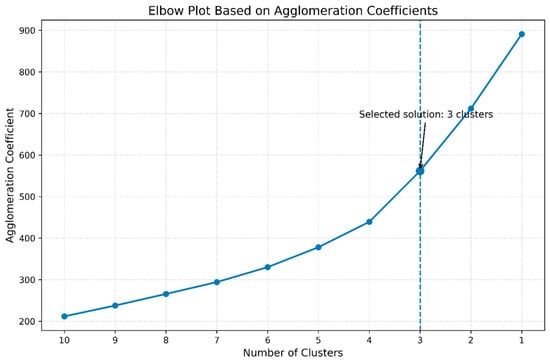
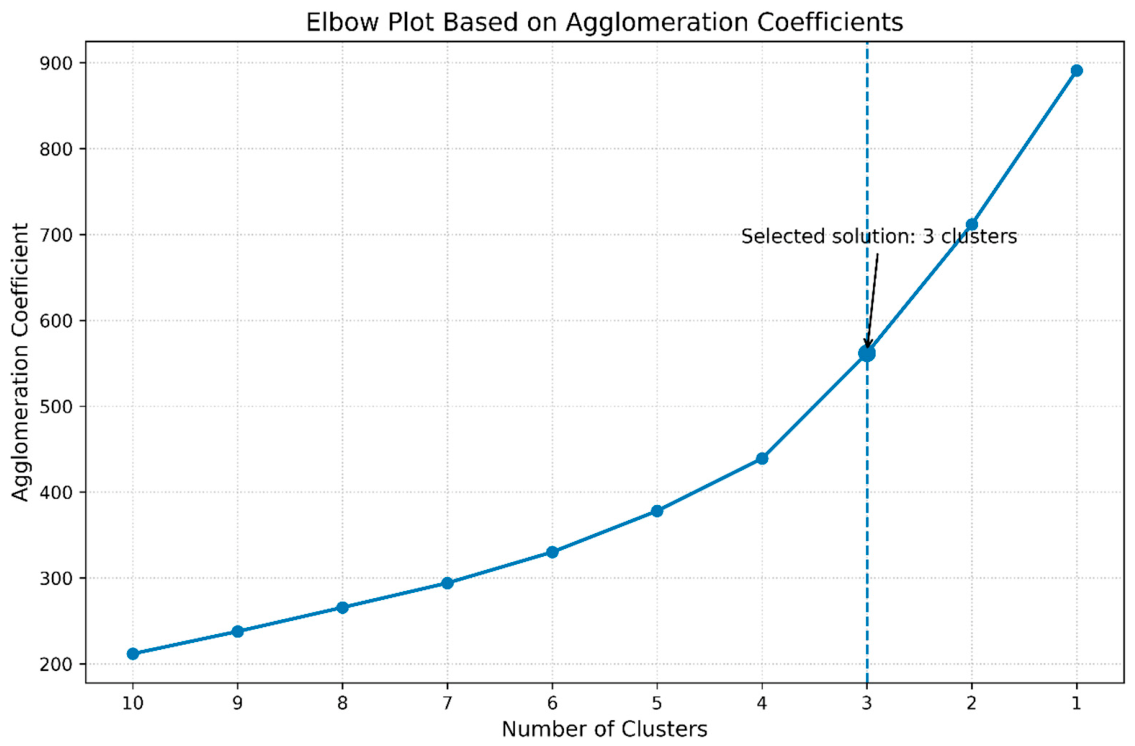
The number of clusters to retain was determined using the elbow criterion based on the agglomeration coefficients obtained from Ward’s hierarchical clustering procedure (Figure 1). A pronounced increase in the agglomeration coefficient was observed when the solution was reduced from three to two clusters, suggesting that further merging would combine heterogeneous groups. Consequently, the three-cluster solution was retained because it represented the most parsimonious and interpretable classification of the teachers’ digital competence profiles and served as the basis for the subsequent k-means cluster analysis.
Figure 1.
Elbow plot based on the agglomeration coefficients obtained from Ward’s hierarchical clustering procedure. The marked increase in the agglomeration coefficient after the three-cluster solution provided support for retaining three clusters as a parsimonious solution for the subsequent k-means analysis.
As an additional assessment of internal cluster separation, the average silhouette width was calculated for the final three-cluster k-means solution. The average silhouette coefficient was 0.233, indicating modest separation among the identified profiles. Accordingly, the three-cluster solution should be interpreted as an exploratory and parsimonious representation of the heterogeneity observed in this sample rather than as a uniquely optimal or strongly separated cluster structure.
Once the number of clusters was determined, a non-hierarchical cluster analysis (k-means) was performed to optimise the assignment of cases to each group and maximise the internal homogeneity of the clusters.
Analyses of variance (ANOVA) were used descriptively to characterize differences among the identified clusters across the dimensions of digital teaching competence. As expected from a clustering procedure designed to maximize between-group differentiation, substantial differences were observed across all analysed dimensions. Particularly high F values were observed for Professional Engagement (F(2, 295) = 87.44), Assessment (F(2, 295) = 89.17), Digital Resources (F(2, 295) = 83.72), and Facilitating Learners’ Digital Competence (F(2, 295) = 79.17), with notable differentiation also observed for Private Use of Technology (F(2, 295) = 55.15) and Work Environment (F(2, 295) = 53.02).
Effect-size estimates (η2) were also calculated descriptively to quantify the magnitude of between-cluster differentiation. The largest values were observed for Assessment (η2 = 0.377), Professional Engagement (η2 = 0.372), Digital Resources (η2 = 0.362), and Facilitating Learners’ Digital Competence (η2 = 0.349). Because the clusters were constructed to maximize differences between cases assigned to different groups, these ANOVA statistics and effect sizes should be interpreted as descriptive measures of cluster separation rather than as independent inferential tests.
As shown in Table 4, the final standardized cluster centres revealed three differentiated teacher typologies. Cluster 1 was characterised by comparatively lower levels of pedagogical digital competence, moderate scores in personal and contextual conditions for technology use, and comparatively higher levels of teacher digital integration, suggesting a profile of teachers in progressive stages of digital development. Cluster 2 presented the lowest scores across the three analysed components, reflecting a profile with generally limited levels of digital teaching competence and less favourable personal and contextual conditions. Finally, Cluster 3 included teachers with the highest levels of pedagogical digital competence and more favourable contextual conditions, representing the most advanced digital competence profile within the sample.
Table 4.
Final standardized cluster centres for the three-component solution.
Regarding the distribution of cases, Cluster 1 consisted of 64 teachers (21.5%), Cluster 2 of 128 teachers (43.0%), and Cluster 3 of 106 teachers (35.6%), showing an adequate distribution for subsequent comparative analyses.
The results of the cluster analysis show differentiated teacher typologies, illustrating heterogeneity in digital competence within the analysed sample and providing a basis for examining their relationships with selected professional and demographic variables.
3.4. Relationship Between Teacher Typologies and Selected Professional and Demographic Variables
To explore further the identified teacher typologies, their relationship with a limited set of professional and demographic variables was analysed using association and difference contrast tests. Pearson’s chi-square tests were applied for categorical variables and non-parametric Kruskal–Wallis tests for ordinal variables. The results of these analyses are presented in Table 5, summarising the obtained statistics and the general patterns of association.
Table 5.
Statistical Associations Between Teacher Typologies and Selected Professional and Demographic Variables.
Regarding gender, no statistically significant association was identified between teacher typologies and gender (χ2 = 1.228; df = 2; p = 0.541). The distribution of men and women across the identified clusters was relatively homogeneous, with no statistically significant association between gender and digital competence profiles identified within the present sample.
In terms of educational level, a statistically significant association with teacher typologies was observed (χ2 = 13.949; df = 4; p = 0.007). Primary education teachers were overrepresented in Cluster 2 (52.1%; RC = 2.6), while secondary education teachers showed significant overrepresentation in Cluster 3 (45.0%; RC = 3.4). These results indicate a statistically significant association between educational level and digital competence profiles within the present sample.
The relationship between teacher typologies and self-perceived digital competence level, according to the DigCompEdu framework, was statistically significant (χ2 = 30.798; df = 10; p < 0.001; Cramer’s V = 0.227). Adjusted standardized residuals indicated that teachers at the A1 and A2 levels were overrepresented in Cluster 2 (RC = 3.1 and 2.3, respectively), whereas B2 and C1 teachers were underrepresented in this cluster (RC = −3.0 and −2.1). Conversely, A1 and A2 teachers were underrepresented in Cluster 3 (RC = −2.3 and −2.1), while B2 and C1 teachers were overrepresented (RC = 2.2 and 2.5). This pattern is consistent with the differentiation between the lower and more advanced digital competence profiles identified in the cluster solution.
Regarding teacher age, the Kruskal–Wallis test showed statistically significant differences between teacher typologies (H = 9.678; df = 2; p = 0.008; ε2 = 0.026). Post hoc comparisons indicated that the differences were mainly concentrated between Cluster 3 and Cluster 2 (p = 0.010), with Cluster 3 grouping comparatively younger teachers. These findings suggest a greater presence of younger teachers within the more advanced digital competence profiles.
Significant differences were also identified according to the age of students taught (H = 7.403; df = 2; p = 0.025; ε2 = 0.018). Pairwise comparisons revealed statistically significant differences between Cluster 2 and Cluster 3 (p = 0.023), with teachers belonging to Cluster 3 tending to work with older students. However, this finding should be interpreted cautiously because student age is structurally related to the educational level taught; therefore, the associations observed for student age and educational level should not be considered independent effects.
Finally, no statistically significant differences were identified between teacher typologies and the time of use of digital technologies in the classroom (H = 2.612; df = 2; p = 0.271; ε2 = 0.002). Although some differences in technological experience were observed descriptively, these variations were not sufficiently consistent to establish differentiated patterns between the identified teacher profiles.
Overall, these results show that the identified teacher typologies are associated with certain professional and contextual variables, particularly educational level, self-perceived digital competence, and age-related variables. This convergence of findings supports the internal interpretability of the obtained typologies and highlights the usefulness of cluster analysis as a tool for understanding the heterogeneity of teacher digital competence profiles within the studied educational context.
4. Discussion
This section discusses the findings in light of previous research on teachers’ digital competence, highlighting the main theoretical and practical implications of the identified profiles and contextual patterns, as well as the contribution of the study to the existing literature.
The results of this study provide relevant insights into the heterogeneous nature of digital competence among teachers and highlight the importance of considering both individual and contextual factors when analyzing its development. The findings supported H1, H2, and H3, whereas H4 and H5 were not supported. From a multivariate perspective, the findings confirm that the existence of a group characterised by high pedagogical digital competence together with comparatively favourable contextual conditions is particularly relevant, as it suggests that both individual capabilities and supportive institutional environments are associated with more advanced profiles of digital competence. This finding reinforces previous research highlighting the importance of contextual and organisational factors in facilitating the pedagogical integration of technology (Cabero-Almenara et al., 2023; Chahuán-Jiménez et al., 2025). Conversely, the presence of a cluster with low competence across all dimensions highlights the need for targeted training strategies and stronger institutional support mechanisms, as suggested by previous research on digital competence gaps (Redecker, 2017; Riquelme-Plaza & Marolla-Gajardo, 2026; Vergara et al., 2026). Teaching staff cannot be understood as a homogeneous group, but rather as a set of differentiated profiles with distinct levels of competence and contextual conditions, in line with previous research emphasizing variability in teachers’ digital competence (Cabero-Almenara et al., 2023; Redecker, 2017).
First, the PCA provided a parsimonious three-component representation of the nine composite dimensions, facilitating their use in the subsequent cluster analysis. The resulting components reflected differentiated patterns related to pedagogical digital competence, digital integration, and contextual and personal conditions. This dimensional reduction provides an empirically useful and interpretable representation of the relationships among the analysed dimensions, consistent with previous studies reporting broader patterns within the DigCompEdu framework (Casillas-Martín et al., 2020; Ballester-Esteve et al., 2023). However, because PCA was applied as a dimensionality-reduction procedure to composite dimension scores, these components should not be interpreted as evidence of a validated latent factorial structure of the questionnaire. Rather, they should be understood as a context-specific representation derived from the present dataset. Further research using confirmatory approaches and independent samples would be needed to examine the stability and generalizability of this component structure across educational settings (Chifla-Villón et al., 2025).
Second, the identification of three differentiated teacher profiles through cluster analysis represents one of the main contributions of this study. These profiles reflect distinct combinations of pedagogical competence, digital integration, and contextual conditions, illustrating the multidimensional nature of digital competence development and the interaction between individual and institutional factors. This finding is consistent with previous literature highlighting the complex interaction between individual capabilities and institutional support in the development of digital competence (Cabero-Almenara et al., 2023; Chahuán-Jiménez et al., 2025; Howard & Tondeur, 2023; Lucas et al., 2021; Zambrano Vélez et al., 2026).
Additionally, descriptive comparisons across the analysed dimensions showed clear differentiation among the identified profiles. The corresponding effect-size estimates further indicated substantial between-cluster differentiation (Cohen, 1988); however, because these dimensions contributed to the construction of the clusters, these results should be interpreted descriptively rather than as independent evidence of cluster validity.
Interestingly, no significant differences were found according to technology-use time or gender. Within the present sample, no statistically significant differences in digital competence profiles were identified according to the duration of technology use. Previous research suggests that experience may primarily reflect frequency of use, whereas competence also depends on the quality, purpose, and pedagogical integration of technology (Gümüş et al., 2023; Hwu et al., 2026). Similarly, the lack of gender differences is consistent with studies reporting a gradual convergence in access to and use of digital technologies across gender groups (Owusu-Bempah et al., 2022; Simelane-Mnisi & Mthimunye, 2025). In contrast, the significant differences observed across educational levels may reflect variations in pedagogical demands, institutional digital culture, and opportunities for technology integration, highlighting the influence of educational context on teachers’ digital competence development (Fernandes et al., 2023; Salinas-Ibáñez et al., 2022). Collectively, these findings reinforce the view that effective digital competence development requires intentional professional learning and supportive institutional conditions rather than mere accumulated experience (Vergara et al., 2026).
From an applied perspective, these findings have important implications for teacher training and educational policy. Rather than adopting uniform training approaches, institutions should design differentiated strategies that respond to the specific needs of each profile. This aligns with current approaches to personalized professional development and competency-based teacher training (Cabero-Almenara et al., 2023; Grosseck et al., 2024; Osorio Vanegas et al., 2025; Yakobi, 2026). For example, teachers with lower levels of competence may benefit from structured training programs and mentoring, while those with higher competence could be engaged as agents of change and innovation within their institutions.
Finally, this study highlights the importance of contextual variables in the development of digital competence. Institutional conditions, access to resources, and organizational culture appear to be associated with teachers’ opportunities to integrate technology into their practice. These findings are consistent with the DigCompEdu framework, which emphasizes not only individual competence but also the influence of the educational ecosystem (Inamorato dos Santos, 2019; Redecker, 2017).
5. Conclusions
This section summarises the key conclusions of the study, outlines its main practical implications for teacher training and educational policy, and acknowledges the limitations of the research while suggesting directions for future work.
This study contributes to the understanding of teachers’ digital competence by providing empirical evidence of its multidimensional and heterogeneous nature within a specific educational context. The findings confirm that digital competence is not uniformly distributed among teachers, but rather organized into differentiated profiles that combine pedagogical, technological, and contextual dimensions in distinct ways.
The identification of three teacher typologies highlights the need to move beyond generalized approaches to teacher training. Instead, the results support the design of differentiated and context-sensitive professional development strategies that address the specific needs of each profile. In this sense, the three profiles suggest differentiated professional development needs. Teachers in Cluster 1 may particularly benefit from support aimed at strengthening the pedagogical application of their relatively high level of digital integration. Teachers in Cluster 2 may require more comprehensive and structured support across pedagogical, technological, and contextual dimensions. In contrast, teachers in Cluster 3 may benefit from advanced professional development opportunities and could potentially contribute to peer mentoring and the dissemination of effective digital practices within their institutions.
These profiles also appear to be associated with comparatively more favourable contextual conditions, suggesting that institutional support and working environments may be relevant to the development of advanced digital competence. The findings suggest that teacher digital competence is structured into differentiated profiles that require tailored professional development strategies rather than uniform training models.
From a methodological perspective, the study demonstrates the usefulness of combining principal component and cluster analyses to explore the structure and variability of digital competence. This approach allows for a more nuanced understanding of the phenomenon, complementing traditional descriptive analyses and offering a more comprehensive view of teacher profiles.
In addition, the results underline the relevance of contextual factors in relation to digital competence. Institutional conditions, access to technological resources, and organizational support appear to be associated with teachers’ opportunities to integrate digital technologies into their pedagogical practice. Therefore, improving digital competence should be addressed not only at the individual level but also through systemic and institutional strategies.
Despite its contributions, this study has several limitations that should be acknowledged. First, the use of self-reported data may have introduced biases associated with participants’ subjective perceptions of their own digital competence. Second, the cross-sectional design precludes causal inferences regarding the relationships among the variables examined. In addition, although the study achieved full coverage of the eligible teacher population within Educational District 16-02, the intentional selection of a single educational district limits the generalizability of the findings beyond this specific context. The three-cluster solution should also be regarded as exploratory and sample-dependent, as its stability was not assessed in an independent sample. Replication in other educational districts and populations would therefore be necessary to examine the stability and generalizability of the identified profiles.
Future studies should incorporate these factors to examine more structural determinants of digital competence. Likewise, future research should address these limitations by employing longitudinal and mixed-method designs, extending the study to multiple educational districts, and replicating the cluster solution in independent samples to assess its stability and generalizability across educational contexts.
Author Contributions
Conceptualization, L.A.G.C., J.M.M.-G., J.-D.C.-S.-d.-T. and E.B.-A.; Methodology, L.A.G.C., J.M.M.-G., J.-D.C.-S.-d.-T. and E.B.-A.; Formal analysis, L.A.G.C., J.M.M.-G. and J.-D.C.-S.-d.-T.; Investigation, L.A.G.C., J.M.M.-G., E.B.-A. and L.E.S.; Writing—original draft, L.A.G.C., J.M.M.-G., J.-D.C.-S.-d.-T., E.B.-A. and L.E.S.; Writing—review & editing, L.A.G.C., J.M.M.-G., J.-D.C.-S.-d.-T., E.B.-A. and L.E.S.; Supervision, L.A.G.C., J.M.M.-G., J.-D.C.-S.-d.-T., E.B.-A. and L.E.S. All authors have read and agreed to the published version of the manuscript.
Funding
This research received no external funding.
Institutional Review Board Statement
The research reported in the manuscript derives from the doctoral thesis entitled “Herramienta DigCompEdu para evaluar tipologías y niveles de competencia digital docente mediante autorreflexión en República Dominicana”, conducted within the Doctoral Program in Educational Sciences at Universidad Católica del Cibao (UCATECI), Dominican Republic. The research was therefore carried out within the academic and research framework established for a doctoral thesis.
Informed Consent Statement
Informed consent was obtained from all subjects involved in the study.
Data Availability Statement
The data presented in this study are available on request from the corresponding author.
Conflicts of Interest
The authors declare no conflicts of interest.
References
- Acuña-Gamboa, L.-A., Mérida-Martínez, Y., & Pons-Bonals, L. (2023). COVID-19, competencias digitales docentes y educación especial en México. Siglo Cero, 54(2), 29–51. [Google Scholar] [CrossRef] [Scilit]
- Alvarez-Huari, M. Y. (2025). Competencia digital docente en universidades latinoamericanas. Revista Docentes 2.0, 18(1), 146–157. [Google Scholar] [CrossRef] [Scilit]
- American Psychological Association. (2020). Publication manual of the American psychological association (7th ed.). American Psychological Association. [Google Scholar] [CrossRef] [Scilit]
- Ballester-Esteve, I., Parra-Camacho, D., Padilla-Bautista, L., & Fernández-Piqueras, R. (2023). Adaptation and validation of a scale to assess digital teaching competence in soccer coaches. Journal of Physical Education and Sport, 23(1), 112–121. Available online: https://bit.ly/46kCmpI (accessed on 4 August 2026).
- Basantes-Andrade, A., Cabezas-González, M., & Casillas-Martín, S. (2020). Digital competences in e-learning. Case study: Ecuador. In A. Basantes-Andrade, M. Naranjo-Toro, M. Zambrano Vizuete, & M. Botto-Tobar (Eds.), Technology, sustainability and educational innovation (TSIE) (Vol. 1110, pp. 85–94). Springer International Publishing. Available online: https://bit.ly/4AgTlHd (accessed on 4 August 2026).
- Cabero-Almenara, J., Gutiérrez-Castillo, J. J., Barroso-Osuna, J., & Rodríguez-Palacios, A. (2023). Digital teaching competence according to the DigCompEdu framework. Comparative study in different Latin American universities. Journal of New Approaches in Education Research, 12, 276–291. [Google Scholar] [CrossRef] [Scilit]
- Casillas-Martín, S., Cabezas-González, M., & García-Valcárcel Muñoz-Repiso, A. (2020). Análisis psicométrico de una prueba para evaluar la competencia digital de estudiantes de Educación Obligatoria. RELIEVE—Revista Electrónica De Investigación Y Evaluación Educativa, 26(2), 17611. [Google Scholar] [CrossRef] [Scilit]
- Chahuán-Jiménez, K., Lara-Yergues, E., Garrido-Araya, D., Salum-Alvarado, E., Hurtado-Arenas, P., & Rubilar-Torrealba, R. (2025). Cluster analysis of digital competencies among professors using DigCompEdu. Frontiers in Education, 10, 1499856. [Google Scholar] [CrossRef] [Scilit]
- Chifla-Villón, M. R., Chifla-Villón, M. P., Suárez-Guartamber, E. M., & Guevara-Viejó, F. (2025). Multidimensional assessment and validation of digital competencies in university teacher education: A confirmatory factor analysis. Frontiers in Education, 10, 1597095. [Google Scholar] [CrossRef] [Scilit]
- Cohen, J. (1988). Statistical power analysis for the behavioral sciences (2nd ed.). Lawrence Erlbaum Associates, Publishers. [Google Scholar]
- Creswell, J. W., & Creswell, J. D. (2018). Research design: Qualitative, quantitative, and mixed methods approaches (5th ed.). Sage. [Google Scholar]
- Della Nina Gambi, G., Forero Pabón, T., Soto Sira, V. G., Keuylian, M. L., & Ruiz García, M. J. (2025). Competencias digitales de docentes en América Latina. Inter-American Development Bank. [Google Scholar] [CrossRef] [Scilit]
- Fernandes, S., Araújo, A. M., Miguel, I., & Abelha, M. (2023). Teacher professional development in higher education: The impact of pedagogical training perceived by teachers. Education Sciences, 13(3), 309. [Google Scholar] [CrossRef] [Scilit]
- Ghomi, M., & Redecker, C. (2019). Digital competence of educators (DigCompEdu): Development and evaluation of a self-assessment instrument for teachers’ digital competence. In Proceedings of the 11th international conference on computer supported education—Volume 1: CSEDU (pp. 541–548). SciTePress. [Google Scholar] [CrossRef] [Scilit]
- Grosseck, G., Bran, R. A., & Țîru, L. G. (2024). Digital assessment: A survey of romanian higher education teachers’ practices and needs. Education Sciences, 14(1), 32. [Google Scholar] [CrossRef] [Scilit]
- Gümüş, M. M., Kayhan, O., Kukul, V., & Korkmaz, Ö. (2023). Preparing teachers to integrate technology in education according to SQD model: Scale development and validation. Education and Information Technologies, 28(7), 16017–16040. [Google Scholar] [CrossRef] [Scilit]
- Howard, S. K., & Tondeur, J. (2023). Digital competences for higher education teachers in a blended future. Educational Technology Research and Development, 71, 1–6. [Google Scholar] [CrossRef] [Scilit] [PubMed]
- Hwu, H. H., Foster, D., Ramsay, C., Dick, A., & Li, N. (2026). Identifying competencies of digitally fluent educators in higher education: A delphi study. Education Sciences, 16(2), 342. [Google Scholar] [CrossRef] [Scilit]
- Inamorato dos Santos, A. (2019). OpenEdu: Las diez dimensiones del marco europeo de educación abierta. Revista Mexicana de Bachillerato a Distancia, 11, 22. [Google Scholar] [CrossRef] [Scilit]
- Kaiser, T., Koch, T., Stebner, F., & Reintjes, C. (2026). Teachers’ digital competencies as a resource in the job demands-resources model. Education Sciences, 16(7), 1018. [Google Scholar] [CrossRef] [Scilit]
- Koehler, M. J., Mishra, P., Kereluik, K., Shin, T. S., & Graham, C. R. (2013). The technological pedagogical content knowledge framework. In J. M. Spector, M. D. Merrill, J. Elen, & M. J. Bishop (Eds.), Handbook of research on educational communications and technology (pp. 101–111). Springer. [Google Scholar] [CrossRef] [Scilit]
- Kyriakou, N., Eteokleous, N., Mitsiaki, M., Kadji-Beltran, C., & Sergiou, S. (2026). Teachers’ digital competence for supporting inclusive and quality education in multilingual and multicultural mainstream classrooms: A mixed-methods exploration. Sustainability, 18(2), 774. [Google Scholar] [CrossRef] [Scilit]
- Liberona, D., Kumaresan, A., Valenzuela, L., Tarazona, G., & Lonhinova, M. (2023). Virtual campuses with Social learning environments: A future alternative for traditional campuses. In L. Uden, & D. Liberona (Eds.), Learning technology for education challenges (Vol. 1830, pp. 30–41). Springer Nature. Available online: https://bit.ly/4r9lJ9N (accessed on 4 August 2026).
- Lillelien, K., & Jensen, M. T. (2025). Digital and digitized interventions for teachers’ professional well-being: A systematic review of work engagement and burnout using the Job Demands–Resources theory. Education Sciences, 15(7), 799. [Google Scholar] [CrossRef] [Scilit]
- Lucas, M., Bem-Haja, P., Siddiq, F., Moreira, A., & Redecker, C. (2021). The relation between in-service teachers’ digital competence and personal and contextual factors: What matters most? Computers & Education, 160, 104052. [Google Scholar] [CrossRef] [Scilit]
- Mattar, J., Santos, C. C., & Cuque, L. M. (2022). Analysis and comparison of international digital competence frameworks for education. Education Sciences, 12(12), 932. [Google Scholar] [CrossRef] [Scilit]
- Mora-Cantallops, M., Inamorato Dos Santos, A., Villalonga-Gómez, C., Lacalle Remigio, J. R., Camarillo Casado, J., Sota Eguizábal, J. M., Velasco, J. R., & Ruiz Martínez, P. M. (2022). Competencias digitales del profesorado universitario en España: Un estudio basado en los marcos europeos DigCompEdu y OpenEduThe digital competence of academics in Spain: A study based on the European frameworks DigCompEdu and OpenEdu, publications office of the European Union, Luxembourg. Available online: https://publications.jrc.ec.europa.eu/repository/handle/JRC129320 (accessed on 4 August 2026).
- Muñoz Martínez, C., Roger-Monzo, V., & Castelló Sirvent, F. (2025). IA generativa y pensamiento crítico en la educación universitaria a distancia: Desafíos y oportunidades. RIED-Revista Iberoamericana de Educación a Distancia, 28(2), 233–273. [Google Scholar] [CrossRef] [Scilit]
- OECD. (2021). Teachers and leaders in vocational education and training, OECD reviews of vocational education and training. OECD Publishing. [Google Scholar] [CrossRef] [Scilit]
- Osorio Vanegas, H. D., Segovia Cifuentes, Y. d. M., & Sobrino Morrás, A. (2025). Educational technology in teacher training: A systematic review of competencies, skills, models, and methods. Education Sciences, 15(8), 1036. [Google Scholar] [CrossRef] [Scilit]
- Owusu-Bempah, E., Opoku, D., & Sam-Mensah, R. (2022). Gender differences in e-learning success in a developing country context: A multi-group analysis. European Journal of Education and Pedagogy, 3(4), 61–69. [Google Scholar] [CrossRef] [Scilit]
- Rakhimbekova, A., Shora, N., Yessingeldinov, B., & Shilibekova, A. (2026). Teachers’ socio-emotional competencies in the digital era: Cross-cultural adaptation and psychometric validation of the BESSI in Kazakhstan. Education Sciences, 16(7), 1148. [Google Scholar] [CrossRef] [Scilit]
- Redecker, C. (2017). European framework for the digital competence of educators (DigCompEdu). Publications Office of the EU. [Google Scholar] [CrossRef]
- Riquelme-Plaza, I., & Marolla-Gajardo, J. (2026). Towards digital transformation in university teaching: Diagnosis of the level and profile of digital competence based on the DigCompEdu and OpenEdu frameworks among university lecturers in Chile. Education Sciences, 16(2), 174. [Google Scholar] [CrossRef] [Scilit]
- Rodríguez-Jiménez, F. J., Pérez-Ochoa, M. E., & Ulloa-Guerra, Ó. (2022). Competencias digitales docentes y retos durante la pandemia COVID-19. Magis, Revista Internacional de Investigación en Educación, 15, 1–23. [Google Scholar] [CrossRef] [Scilit]
- Salinas-Ibáñez, J., de Benito-Crosetti, B., Moreno-García, J., & Lizana Carrió, A. (2022). Nuevos diseños y formas organizativas flexibles en educación superior. Pixel-Bit. Revista de Medios y Educación, 63, 65–91. Available online: https://bit.ly/4Af54WI (accessed on 4 August 2026). [CrossRef] [Scilit]
- Simelane-Mnisi, S., & Mthimunye, J. M. (2025). Gender differences in lecturers’ competency and use of learning management systems at a university of technology in South Africa. Education Sciences, 15(12), 1595. [Google Scholar] [CrossRef] [Scilit]
- Smestad, B., Hatlevik, O. E., Johannesen, M., & Øgrim, L. (2023). Examining dimensions of teachers’ digital competence: A systematic review pre- and during COVID-19. Heliyon, 9(6), e16677. [Google Scholar] [CrossRef] [Scilit] [PubMed]
- Tzafilkou, K., Perifanou, M., & Economides, A. A. (2023). Assessing teachers’ digital competence in primary and secondary education: Applying a new instrument to integrate pedagogical and professional elements for digital education. Education and Information Technologies, 28(12), 16017–16040. [Google Scholar] [CrossRef] [Scilit] [PubMed]
- UNESCO. (2023). Global education monitoring report 2023: Technology in education—A tool on whose terms? UNESCO. [Google Scholar] [CrossRef] [Scilit]
- Verdú-Pina, M., Serrano, V., Grimalt-Álvaro, C., & Usart, M. (2026). Perfiles docentes según la competencia digital autopercibida y el uso de la tecnología: Un análisis de clústeres. Revista De Investigación Educativa, 44(1), 3-435. [Google Scholar] [CrossRef] [Scilit]
- Vergara, D., del Bosque, A., Fernández-Arias, P., Lampropoulos, G., & Antón-Sancho, Á. (2026). Bridging the digital divide among higher education faculty: The role of university type and faculty ICT expertise. Education Sciences, 16(4), 579. [Google Scholar] [CrossRef] [Scilit]
- Yakobi, K. (2026). Towards inclusive learning management systems integration in south african universities of technology. Education Sciences, 16(3), 358. [Google Scholar] [CrossRef] [Scilit]
- Zambrano Vélez, W. A., Delgado Cobeña, E. I., Molina Santana, C. L., & Lucas Mero, C. A. (2026). Digital teaching competencies and algorithmic ethics in learning assessments within virtual environments: A systematic review. Education Sciences, 16(7), 1066. [Google Scholar] [CrossRef] [Scilit]

Disclaimer/Publisher’s Note: The statements, opinions and data contained in all publications are solely those of the individual author(s) and contributor(s) and not of MDPI and/or the editor(s). MDPI and/or the editor(s) disclaim responsibility for any injury to people or property resulting from any ideas, methods, instructions or products referred to in the content. |
© 2026 by the authors. Licensee MDPI, Basel, Switzerland. This article is an open access article distributed under the terms and conditions of the Creative Commons Attribution (CC BY) license.