Teachers and Generative AI: A Systematic Review of Adoption, Competence, Professional Development, and Socio-Technical Experiences
 , , ,
, , ,  , , , and
Abstract
1. Introduction
2. Literature and Theoretical Foundations
2.1. AI in Teaching
2.2. Theoretical Frameworks in AI Implementations
2.3. Aims of Review
- (1)
- What are teachers’ perceptions of AI integration?
- (2)
- What is the role of AI competence and professional development in fostering/hindering AI adoption?
- (3)
- What are the psychological and ethical dimensions of AI implementation?
3. Methods
3.1. Search Protocol
3.2. Inclusion and Exclusion Criteria
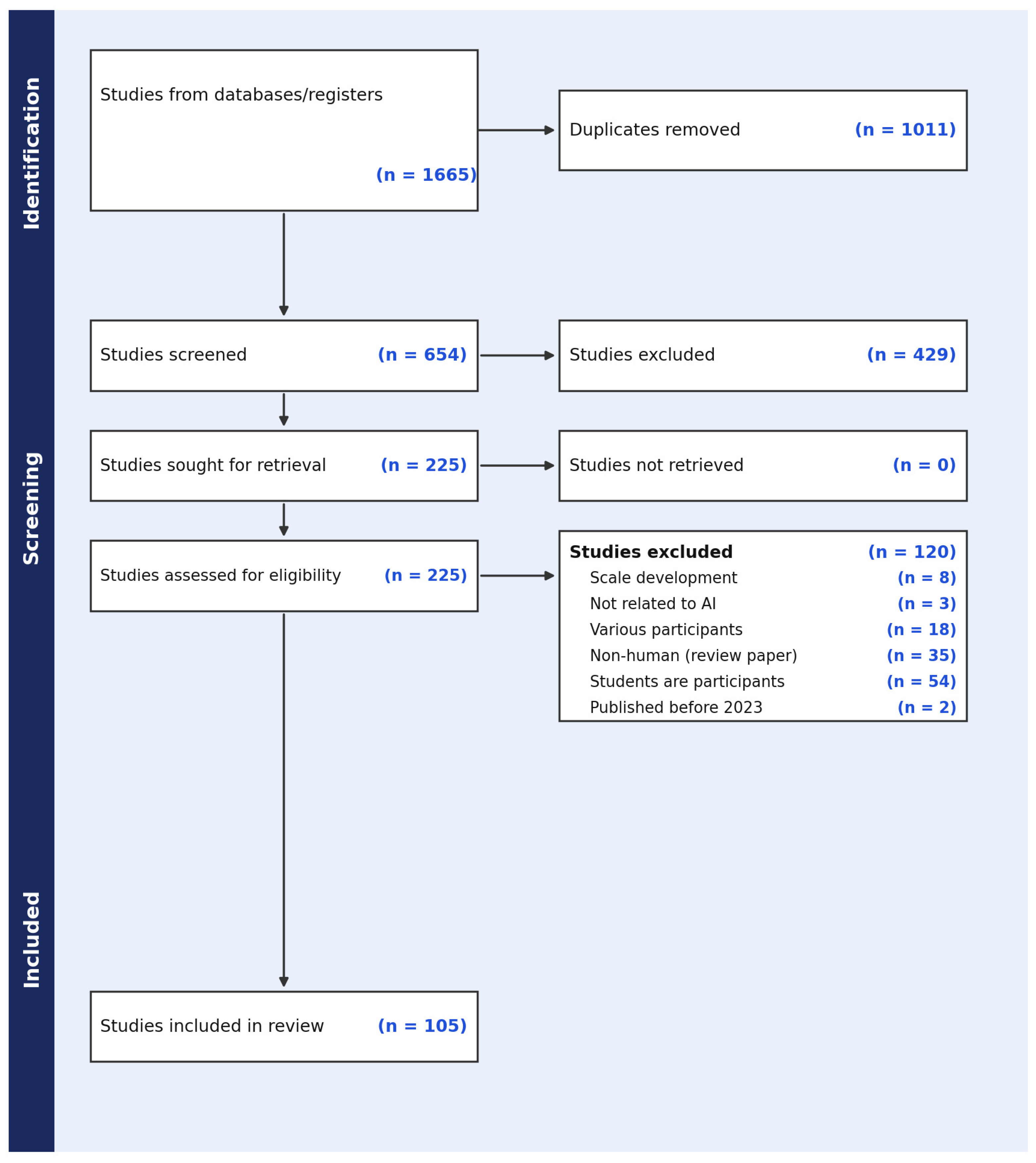
- Non-human (review records): Studies that did not report original empirical data, such as systematic literature reviews, conceptual papers, and review articles.
- Various participants: Studies involving mixed participant groups were excluded when teachers/faculty were not the sole participant group.
- Scale development: Papers developed an instrument or a scale.
- Research with students as the participants.
- Research not related to AI.
- Research conducted before 2023.
- Reporting on empirical data, using qualitative and/or quantitative methods.
- Written in English.
- Involved teacher/faculty participants at K-12 or university settings.
- Involved preservice teachers or teacher candidates enrolled in tertiary-level teacher-education programs (distinct from the general student populations excluded under criterion 4 above).
- Empirical studies published in peer-reviewed journals.
- No geographic restriction: studies were eligible regardless of the country or region in which they were conducted.
4. Findings
4.1. Descriptives
4.2. AI Acceptance, Attitudes, and Behavioral Intention
4.3. AI Competence and TPACK
4.4. Professional Development and Training
4.5. Instructional Practice and Classroom Pedagogy
4.6. Emotion, Anxiety, Trust, and Wellbeing
4.7. Ethics, Leadership, and Policy
5. Discussion
5.1. Geopolitical Gaps in Research Coverage
5.2. Understanding AI Acceptance Versus Classroom Realities
5.3. Pedagogical Competence and TPACK as Prerequisite Frameworks
5.4. Evolving Professional Development for Socio-Technical Support
5.5. Balancing Adaptive Personalization with Pedagogical Agency
5.6. Institutional Policy, Trust, and the Ethical Imperative
6. Limitations and Implications for Future Research
7. Conclusions
Author Contributions
Funding
Institutional Review Board Statement
Informed Consent Statement
Data Availability Statement
Conflicts of Interest
Appendix A

References
- Adawurah, M., & Buabeng-Andoh, C. (2025). Navigating the nexus: Unraveling the influence of changes in time, environmental patterns and psychosocial factors on students’ use of ChatGPT in learning. Education and Information Technologies, 30, 24109–24135. [Google Scholar] [CrossRef] [Scilit]
- Agarwal, K. (2026, May 15). U.S. strengths in science persist, but China’s momentum is growing. Association of American Universities. Available online: https://www.aau.edu/newsroom/leading-research-universities-report/us-strengths-science-persist-chinas-momentum-growing (accessed on 5 June 2026).
- Al-Abdullatif, A. M. (2024). Modeling teachers’ acceptance of generative artificial intelligence use in higher education: The role of AI literacy, intelligent TPACK, and perceived trust. Education Sciences, 14(11), 1209. [Google Scholar] [CrossRef] [Scilit]
- Alagöz Hamzaj, Y. (2025). Generative AI acceptance among future educators: Personality and behavioral insights. Education and Information Technologies, 30(16), 23165–23188. [Google Scholar] [CrossRef] [Scilit]
- Alanazi, A. S., Alqazlan, S., Rayan, A., & Benlaria, H. (2025). The impact of teacher characteristics on the effective use of AI for educating students with development disabilities in Saudi primary schools. Education and Information Technologies, 30(16), 24029–24056. [Google Scholar] [CrossRef] [Scilit]
- Alhaif, A. M., Aleidi, A. I., Ali, D. A., Besheir, M. A., Diab, H. M., & Ibrahem, U. M. (2025). The reality of implementing artificial intelligence apps in the special needs classroom, a teacher’s perspective. Education and Information Technologies, 30(16), 23619–23644. [Google Scholar] [CrossRef] [Scilit]
- Almuhanna, M. A. (2025). Teachers’ perspectives of integrating AI-powered technologies in K-12 education for creating customized learning materials and resources. Education and Information Technologies, 30(8), 10343–10371. [Google Scholar] [CrossRef] [Scilit]
- Alwaqdani, M. (2025). Investigating teachers’ perceptions of artificial intelligence tools in education: Potential and difficulties. Education and Information Technologies, 30(3), 2737–2755. [Google Scholar] [CrossRef] [Scilit]
- Al-Zahrani, A. M., & Alasmari, T. M. (2025). A comprehensive analysis of AI adoption, implementation strategies, and challenges in higher education across the Middle East and North Africa (MENA) region. Education and Information Technologies, 30(8), 11339–11389. [Google Scholar] [CrossRef] [Scilit]
- An, S., Zhang, S., Guo, T., Lu, S., & Zhang, W. (2025). Impacts of generative AI on student teachers’ task performance and collaborative knowledge construction process in mind mapping-based collaborative environment. Computers & Education, 227, 105227. [Google Scholar] [CrossRef] [Scilit]
- An, X., Chai, C. S., Li, Y., Zhou, Y., Shen, X., Zheng, C., & Chen, M. (2023). Modeling English teachers’ behavioral intention to use artificial intelligence in middle schools. Education and Information Technologies, 28(5), 5187–5208. [Google Scholar] [CrossRef] [Scilit]
- Ayubian, S., Shahsavari, V., Khamisani, N., Wiafe, E., & Clark, J. S. (in press). Teachers’ perceptions, adoption, and integration of AI: A content analysis. Educational Considerations. [CrossRef] [Scilit]
- Bao, R., Chen, J., & Ma, W. (2025). Generative artificial intelligence in middle school classroom: A longitudinal exploration of teacher attitudes, evolving practices, and challenges. Education and Information Technologies, 30(16), 22677–22708. [Google Scholar] [CrossRef] [Scilit]
- Baxter, G., & Sommerville, I. (2011). Socio-technical systems: From design methods to systems engineering. Interacting with Computers, 23(1), 4–17. [Google Scholar] [CrossRef] [Scilit]
- Bergdahl, N., & Sjöberg, J. (2025). Transformation, support needs and AI, in K-12 education. Education and Information Technologies, 31(1), 191–212. [Google Scholar] [CrossRef] [Scilit]
- Blundell, C., Mukherjee, M., & Nykvist, S. (2025). Adopting generative AI in K-12 teaching and learning: Australian teachers’ actions through the lens of innovation theory. Education and Information Technologies, 30(16), 24009–24028. [Google Scholar] [CrossRef] [Scilit]
- Bower, M., Torrington, J., Lai, J. W. M., Petocz, P., & Alfano, M. (2024). How should we change teaching and assessment in response to increasingly powerful generative artificial intelligence? Outcomes of the ChatGPT teacher survey. Education and Information Technologies, 29, 15403–15439. [Google Scholar] [CrossRef] [Scilit]
- Bozkuş, K., & Canoğulları, T. (2025). Exploring the mediating roles of self-control, management, and meaningful learning self-awareness in the relationship between academic self-discipline and GAI acceptance. Education and Information Technologies, 30(13), 18975–18995. [Google Scholar] [CrossRef] [Scilit]
- Cabero-Almenara, J., Palacios-Rodríguez, A., Loaiza-Aguirre, M. I., & Pugla-Quirola, D. R. (2025). A structural model of distance education teachers’ digital competencies for artificial intelligence. Education Sciences, 15(10), 1271. [Google Scholar] [CrossRef] [Scilit]
- Cabero-Almenara, J., Palacios-Rodríguez, A., Loaiza-Aguirre, M. I., & Rivas-Manzano, M. d. R. d. (2024). Acceptance of educational artificial intelligence by teachers and its relationship with some variables and pedagogical beliefs. Education Sciences, 14(7), 740. [Google Scholar] [CrossRef] [Scilit]
- Cambra-Fierro, J. J., Blasco, M. F., López-Pérez, M. E., & Trifu, A. (2025). ChatGPT adoption and its influence on faculty well-being: An empirical research in higher education. Education and Information Technologies, 30(2), 1517–1538. [Google Scholar] [CrossRef] [Scilit]
- Celik, I., Dindar, M., Muukkonen, H., & Järvelä, S. (2022). The promises and challenges of artificial intelligence for teachers: A systematic review of research. TechTrends, 66(4), 616–630. [Google Scholar] [CrossRef] [Scilit]
- Celik, I., Kontkanen, S., Laru, J., & Dalyanci, A. A. (2026). Co-constructing adaptive lesson plans with GenAI: Pre-service teachers’ intelligent-TPACK and prompt engineering strategies. Computers & Education, 241, 105485. [Google Scholar] [CrossRef] [Scilit]
- Chai, C. S., Liang, S., & Wang, X. (2024). A survey study of Chinese teachers’ continuous intentions to teach artificial intelligence. Education and Information Technologies, 29(11), 14015–14034. [Google Scholar] [CrossRef] [Scilit]
- Chang, W.-L., & Sun, J. C.-Y. (2026). Empowering bilingual teachers with dynamic GenAI: Adaptive design and implementation of multimodal instructional strategies. Computers & Education, 241, 105490. [Google Scholar] [CrossRef] [Scilit]
- Chegg, Inc. (2025, January 28). Chegg global student survey 2025: 80% of undergraduates worldwide have used GenAI to support their studies—But accuracy a top concern. Available online: https://investor.chegg.com/Press-Releases/press-release-details/2025/Chegg-Global-Student-Survey-2025-80-of-Undergraduates-Worldwide-Have-Used-GenAI-to-Support-their-Studies--But-Accuracy-a-Top-Concern/default.aspx (accessed on 5 June 2026).
- Chen, H., & Wang, Y. (2023). Computer science and non-computer science faculty members’ perception on teaching data science via an experiential learning platform. Education and Information Technologies, 28(4), 4093–4108. [Google Scholar] [CrossRef] [Scilit]
- Chen, R., & Lee, V. R. (2025). A cross-sectional look at teacher reactions, worries, and professional development needs related to generative AI in an urban school district. Education and Information Technologies, 30(11), 16045–16082. [Google Scholar] [CrossRef] [Scilit]
- Chen, X., Xie, H., & Hwang, G. J. (2020). A multi-perspective study on artificial intelligence in education: Grants, conferences, journals, software tools, institutions, and researchers. Computers and Education: Artificial Intelligence, 1, 100005. [Google Scholar] [CrossRef] [Scilit]
- Chiu, T. K. F., Falloon, G., Song, Y., Wong, V. W. L., Zhao, L., & Ismailov, M. (2024). A self-determination theory approach to teacher digital competence development. Computers & Education, 214, 105017. [Google Scholar] [CrossRef] [Scilit]
- Chiu, T. K. F., & Rospigliosi, P. A. (2025). Encouraging human-AI collaboration in interactive learning environments. Interactive Learning Environments, 33(2), 921–924. [Google Scholar] [CrossRef] [Scilit]
- Choi, S., Jeon, J., & Jang, Y. (2025). Exploring teacher intention to teach AI: Self-determination theory (SDT) and motivation-opportunity-ability (MOA) perspectives. Education and Information Technologies, 30, 24173–24200. [Google Scholar] [CrossRef] [Scilit]
- Cordero, J., Torres-Zambrano, J., & Cordero-Castillo, A. (2025). Integration of generative artificial intelligence in higher education: Best practices. Education Sciences, 15(1), 32. [Google Scholar] [CrossRef] [Scilit]
- Cruvinel Júnior, L., Orrillo Ascama, H. D., & Marques da Silva, M. (2025). AI ethics in higher education: A review of ethical challenges. In Ethical and social impacts of information and communication technology. Springer. [Google Scholar] [CrossRef] [Scilit]
- Dahri, N. A., Yahaya, N., Vighio, M. S., & Jumaat, N. F. (2025). Exploring the impact of ChatGPT on teaching performance: Findings from SOR theory, SEM and IPMA analysis approach. Education and Information Technologies, 30(13), 18241–18276. [Google Scholar] [CrossRef] [Scilit]
- Dann, C., O’Neill, S., Getenet, S., Chakraborty, S., Saleh, K., & Yu, K. (2024). Improving teaching and learning in higher education through machine learning: Proof of concept’ of ai’s ability to assess the use of key microskills. Education Sciences, 14(8), 886. [Google Scholar] [CrossRef] [Scilit]
- Darancik, Y., Kaçar, E., & Sezik, A. (2025). AI anxiety and awareness of German teacher candidates. Education and Information Technologies, 30(14), 20215–20235. [Google Scholar] [CrossRef] [Scilit]
- Davis, F. D. (1989). Perceived usefulness, perceived ease of use, and user acceptance of information technology. MIS Quarterly, 13(3), 319–340. [Google Scholar] [CrossRef] [Scilit] [PubMed]
- Dehghani, H., & Mashhadi, A. (2024). Exploring Iranian English as a foreign language teachers’ acceptance of ChatGPT in English language teaching: Extending the technology acceptance model. Education and Information Technologies, 29(15), 19813–19834. [Google Scholar] [CrossRef] [Scilit]
- Delello, J. A., Sung, W., Mokhtari, K., Hebert, J., Bronson, A., & De Giuseppe, T. (2025). AI in the classroom: Insights from educators on usage, challenges, and mental health. Education Sciences, 15(2), 113. [Google Scholar] [CrossRef] [Scilit]
- Demszky, D., Liu, J., Hill, H. C., Sanghi, S., & Chung, A. (2025). Automated feedback improves teachers’ questioning quality in brick-and-mortar classrooms: Opportunities for further enhancement. Computers & Education, 227, 105183. [Google Scholar] [CrossRef] [Scilit]
- Desveaud, K., & Bawack, R. (2026). Integrating the literature on AI adoption: A socio-technical framework. International Journal of Market Research, 68(2), 219–240. [Google Scholar] [CrossRef] [Scilit]
- Dexter, S., & Richardson, J. W. (2020). What does technology integration research tell us about the leadership of technology? Journal of Research on Technology in Education, 52(1), 17–36. [Google Scholar] [CrossRef] [Scilit]
- Ding, L.-J., Li, J.-M., & Hui, B.-H. (2025). Will teacher-AI collaboration enhance teaching engagement? Behavioral Sciences, 15(7), 866. [Google Scholar] [CrossRef] [Scilit] [PubMed]
- Egara, F. O., & Mosimege, M. (2024). Exploring the integration of artificial intelligence-based ChatGPT into mathematics instruction: Perceptions, challenges, and implications for educators. Education Sciences, 14(7), 742. [Google Scholar] [CrossRef] [Scilit]
- Elyakim, N. (2025). Bridging expectations and reality: Addressing the price-value paradox in teachers’ AI integration. Education and Information Technologies, 30(12), 16929–16968. [Google Scholar] [CrossRef] [Scilit]
- Fan, Y.-C., Kuo, B.-C., Wu, P.-C., & Liao, C.-H. (2025). A model for developing AI pedagogical and content knowledge in inservice and preservice non-STEM elementary teachers. Education and Information Technologies, 30(18), 26877–26897. [Google Scholar] [CrossRef] [Scilit]
- Filiz, O., Kaya, M. H., & Adiguzel, T. (2025). Teachers and AI: Understanding the factors influencing AI integration in K-12 education. Education and Information Technologies, 30, 17931–17967. [Google Scholar] [CrossRef] [Scilit]
- Fitas, R. (2025). Inclusive education with AI: Supporting special needs and tackling language barriers. AI and Ethics, 5, 5729–5757. [Google Scholar] [CrossRef] [Scilit]
- Fteiha, M., Al-Rashaida, M., & Ghazal, M. (2025). General and special education teachers’ readiness for artificial intelligence in classrooms: A structural equation modeling study of knowledge, attitudes, and practices in select UAE public and private schools. PLoS ONE, 20(9), e0331941. [Google Scholar] [CrossRef] [Scilit] [PubMed]
- Garzón, J., Patiño, E., & Marulanda, C. (2025). Systematic review of artificial intelligence in education: Trends, benefits, and challenges. Multimodal Technologies and Interaction, 9(8), 84. [Google Scholar] [CrossRef] [Scilit]
- Ghamrawi, N., Shal, T., & Ghamrawi, N. A. R. (2024). Exploring the impact of AI on teacher leadership: Regressing or expanding? Education and Information Technologies, 29(7), 8415–8433. [Google Scholar] [CrossRef] [Scilit]
- Ghiasvand, F., & Seyri, H. (2025). A collaborative reflection on the synergy of artificial intelligence (AI) and language teacher identity reconstruction. Teaching and Teacher Education, 160, 105022. [Google Scholar] [CrossRef] [Scilit]
- Giaouri, S., & Charisi, M. (2025). Enhancing IEP design in inclusive primary settings through ChatGPT: A mixed-methods study with special educators. Education Sciences, 15(8), 1065. [Google Scholar] [CrossRef] [Scilit]
- Government of Spain. (2020). National artificial intelligence strategy (ENIA). Available online: https://ai-watch.ec.europa.eu/countries/spain/spain-ai-strategy-report_en (accessed on 6 June 2026).
- Guo, S., Zheng, Y., & Zhai, X. (2024). Artificial intelligence in education research during 2013–2023: A review based on bibliometric analysis. Education and Information Technologies, 29(13), 16387–16409. [Google Scholar] [CrossRef] [Scilit]
- Habib, F. A. B. (2025). Unveiling the role of educators attitudes & intention toward artificial intelligence in teaching: A multi-dimensional analysis. Education and Information Technologies, 30, 12463–12487. [Google Scholar] [CrossRef] [Scilit]
- Hall, G. E., & Hord, S. M. (2020). Implementing change: Patterns, principles, and potholes (5th ed.). Pearson. [Google Scholar]
- Harakchiyska, T. (2025). Predictors of pre-service EFL teachers’ predisposition towards AI adoption in language teaching. Education Sciences, 15(9), 1112. [Google Scholar] [CrossRef] [Scilit]
- Hinojo-Lucena, F. J., Aznar-Díaz, I., Cáceres-Reche, M. P., & Romero-Rodríguez, J. M. (2019). Artificial intelligence in higher education: A bibliometric study on its impact in the scientific literature. Education Sciences, 9(1), 51. [Google Scholar] [CrossRef] [Scilit]
- Hoang, N. H. (2025). E-leadership in the AI era: Exploring Vietnamese EFL teachers’ digital leadership development in AI integration. Education and Information Technologies, 30(12), 16895–16928. [Google Scholar] [CrossRef] [Scilit]
- Hollan, J., Hutchins, E., & Kirsh, D. (2000). Distributed cognition: Toward a new foundation for human-computer interaction research. ACM Transactions on Computer-Human Interaction (TOCHI), 7(2), 174–196. [Google Scholar] [CrossRef] [Scilit]
- Holmes, W., & Tuomi, I. (2022). State of the art and practice in AI in education. European Journal of Education, 57, 542–570. [Google Scholar] [CrossRef] [Scilit]
- Hong, H.-Y., Chen, M.-J., Chang, C.-H., Tseng, L.-T., & Chai, C. S. (2025). AI-supported idea-developing discourse to foster professional agency within teacher communities for STEAM lesson design in knowledge building environment. Computers & Education, 229, 105241. [Google Scholar] [CrossRef] [Scilit]
- Hopcan, S., Türkmen, G., & Polat, E. (2024). Exploring the artificial intelligence anxiety and machine learning attitudes of teacher candidates. Education and Information Technologies, 29, 7281–7301. [Google Scholar] [CrossRef] [Scilit]
- Hord, S. M., Rutherford, W. L., & Hall, G. E. (1987). The concerns-based adoption model (CBAM): A model for change in individuals. Association for Supervision and Curriculum Development. [Google Scholar]
- Hu, L., Wang, H., & Xin, Y. (2025). Factors influencing Chinese pre-service teachers’ adoption of generative AI in teaching: An empirical study based on UTAUT2 and PLS-SEM. Education and Information Technologies, 30, 12609–12631. [Google Scholar] [CrossRef] [Scilit]
- Hu, Y., Xu, Y., & Wu, B. (2025). A dual-pathway model of teacher-AI collaboration based on the job demands-resources theory. Education and Information Technologies, 30, 15125–15146. [Google Scholar] [CrossRef] [Scilit]
- Huang, L., Zhan, Y., & Ba, S. (2025). Modeling student teachers’ self-regulated learning of complex professional knowledge: A sequential and clustering analysis with think-aloud protocols. Computers & Education, 233, 105310. [Google Scholar] [CrossRef] [Scilit]
- Huang, Y., Richter, E., Kleickmann, T., Scheiter, K., & Richter, D. (2023). Body in motion, attention in focus: A virtual reality study on teachers’ movement patterns and noticing. Computers & Education, 206, 104912. [Google Scholar] [CrossRef] [Scilit]
- Huertas-Abril, C. A., & Palacios-Hidalgo, F. J. (2023). New possibilities of artificial intelligence-assisted language learning (AIALL): Comparing visions from the east and the west. Education Sciences, 13(12), 1234. [Google Scholar] [CrossRef] [Scilit]
- Hwang, Y., Lee, S., & Jeon, J. (2025). Integrating AI chatbots into the metaverse: Pre-service English teachers’ design works and perceptions. Education and Information Technologies, 30(4), 4099–4130. [Google Scholar] [CrossRef] [Scilit]
- Jabali, O., Saeedi, M., & Alawneh, Y. (2025). Navigating anxiety in academia: The role of generative artificial intelligence. Education and Information Technologies, 30, 15529–15544. [Google Scholar] [CrossRef] [Scilit]
- Jatileni, C. N., Sanusi, I. T., Olaleye, S. A., Ayanwale, M. A., Agbo, F. J., & Oyelere, P. B. (2024). Artificial intelligence in compulsory level of education: Perspectives from Namibian in-service teachers. Education and Information Technologies, 29(10), 12569–12596. [Google Scholar] [CrossRef] [Scilit]
- Jeon, J., & Lee, S. (2023). Large language models in education: A focus on the complementary relationship between human teachers and ChatGPT. Education and Information Technologies, 28(12), 15873–15892. [Google Scholar] [CrossRef] [Scilit]
- Kang, L., Shi, X., & Zhu, K. (2025). Uncovering the mediation of disciplinary literacy in the effect of GAI prompt engineering on pre-service teachers’ instructional design. Education and Information Technologies, 30(16), 22779–22802. [Google Scholar] [CrossRef] [Scilit]
- Karataş, F., & Ataç, B. A. (2025). When TPACK meets artificial intelligence: Analyzing TPACK and AI-TPACK components through structural equation modelling. Education and Information Technologies, 30(7), 8979–9004. [Google Scholar] [CrossRef] [Scilit]
- Kashif, M., Ammar, M., Sellami, A., Chiu, T. K., Abbasi, S. A., & Ahmad, Z. (2025). Teachers’ perspectives on AI integration in K-12 education: Challenges, opportunities, and preliminary assessment model—A systematic review. Computers in the Schools, 1–27. [Google Scholar] [CrossRef] [Scilit]
- Kasneci, E., Seßler, K., Küchemann, S., Bannert, M., Dementieva, D., Fischer, F., Gasser, U., Groh, G., Günnemann, S., Hüllermeier, E., Krusche, S., Kutyniok, G., Michaeli, T., Nerdel, C., Pfeffer, J., Poquet, O., Sailer, M., Schmidt, A., Seidel, T., … Kasneci, G. (2023). ChatGPT for good? On opportunities and challenges of large language models for education. Learning and Individual Differences, 103, 102274. [Google Scholar] [CrossRef] [Scilit]
- Kaufman, J. H., Woo, A., Eagan, J., Lee, S., & Kassan, E. B. (2025). Uneven adoption of artificial intelligence tools among U.S. teachers and principals in the 2023–2024 school year (Research Report No. RR-A134-25). RAND Corporation. [CrossRef] [Scilit]
- Kelly, R. (2024, August 28). Survey: 86% of students already use AI in their studies. Campus Technology. Available online: https://campustechnology.com/articles/2024/08/28/survey-86-of-students-already-use-ai-in-their-studies.aspx (accessed on 5 June 2026).
- Khoo, W. C., & Jamaludin, K. (2025). Understanding school teachers’ acceptance of AI in education: Insights from the technology acceptance model (TAM). International Journal of Academic Research in Progressive Education and Development, 14(3), 564–579. [Google Scholar] [CrossRef] [Scilit] [PubMed]
- Kim, J. (2024a). Leading teachers’ perspective on teacher-AI collaboration in education. Education and Information Technologies, 28(7), 8693–8724. [Google Scholar] [CrossRef] [Scilit]
- Kim, J. (2024b). Types of teacher-AI collaboration in K-12 classroom instruction: Chinese teachers’ perspective. Education and Information Technologies, 29(14), 17433–17465. [Google Scholar] [CrossRef] [Scilit]
- Kohnke, L., Zou, D., & Xie, H. (2025). Microlearning and generative AI for pre-service teacher education: A qualitative case study. Education and Information Technologies, 30, 21221–21248. [Google Scholar] [CrossRef] [Scilit]
- Kökver, Y., Pektaş, H. M., & Çelik, H. (2025). Artificial intelligence applications in education: Natural language processing in detecting misconceptions. Education and Information Technologies, 30, 3035–3066. [Google Scholar] [CrossRef] [Scilit]
- Kölemen, E. B., & Yıldırım, B. (2025). A new era in early childhood education (ECE): Teachers’ opinions on the application of artificial intelligence. Education and Information Technologies, 30, 17405–17446. [Google Scholar] [CrossRef] [Scilit]
- Lan, G., Feng, X., Du, S., Song, F., & Xiao, Q. (2025). Integrating ethical knowledge in generative AI education: Constructing the GenAI-TPACK framework for university teachers’ professional development. Education and Information Technologies, 30(11), 15621–15644. [Google Scholar] [CrossRef] [Scilit]
- Lee, S. J., & Kwon, K. (2024). A systematic review of AI education in K-12 classrooms from 2018 to 2023: Topics, strategies, and learning outcomes. Computers and Education: Artificial Intelligence, 6, 100211. [Google Scholar] [CrossRef] [Scilit]
- Li, J., Bai, B., & Liu, H. (2025). When technology meets emotions: Exploring preschool teachers’ emotion profiles in technology use. Computers & Education, 236, 105355. [Google Scholar] [CrossRef] [Scilit]
- Lim, E. M. (2023). The effects of pre-service early childhood teachers’ digital literacy and self-efficacy on their perception of AI education for young children. Education and Information Technologies, 28(10), 12969–12995. [Google Scholar] [CrossRef] [Scilit]
- Lim, J., Lee, U., Koh, J., Jeong, Y., Lee, Y., Byun, G., Jung, H., Jang, Y., Lee, S., & Moon, J. (2025). Development and implementation of a generative artificial intelligence-enhanced simulation to enhance problem-solving skills for pre-service teachers. Computers & Education, 232, 105306. [Google Scholar] [CrossRef] [Scilit]
- Liu, X., & Yao, Y. (2025). Chinese university teachers’ engagement with generative AI in different stages of foreign language teaching: A qualitative enquiry through the prism of ADDIE. Education and Information Technologies, 30(1), 485–508. [Google Scholar] [CrossRef] [Scilit]
- López Costa, M. (2025). Artificial intelligence and data literacy in rural schools’ teaching practices: Knowledge, use, and challenges. Education Sciences, 15(3), 352. [Google Scholar] [CrossRef] [Scilit]
- Lucas, M., Zhang, Y., Bem-Haja, P., & Vicente, P. N. (2024). The interplay between teachers’ trust in artificial intelligence and digital competence. Education and Information Technologies, 29, 22991–23010. [Google Scholar] [CrossRef] [Scilit]
- Luckin, R. (2024). AI for schoolteachers. Routledge. [Google Scholar]
- Lyu, Y., Adnan, A. B. M., & Zhang, L. (2025). Influencing factors on NLP technology integration in teaching: A case study in Shanghai. Education and Information Technologies, 30, 6707–6740. [Google Scholar] [CrossRef] [Scilit]
- Macaro, E. (2022). English medium instruction: What do we know so far and what do we still need to find out? Language Teaching, 55, 533–546. [Google Scholar] [CrossRef] [Scilit]
- Manzoor, M., & Vimarlund, V. (2018). Digital technologies for social inclusion of individuals with disabilities. Health and Technology, 8(5), 377–390. [Google Scholar] [CrossRef] [Scilit] [PubMed]
- Martínez-Zarzuelo, A., Nolla, Á., Recio, T., Tolmos, P., Ariño-Morera, B., & Gallardo, A. (2025). An experience with pre-service teachers, using GeoGebra discovery automated reasoning tools for outdoor mathematics. Education Sciences, 15(6), 782. [Google Scholar] [CrossRef] [Scilit]
- Matschke, C., Kehrer, M., Nieder-Steinheuer, K., Thillosen, A., & Kimmerle, J. (2026). Instructions of digital media use in higher education: The impact of text abstractness on university teachers’ psychological distance, interest, and motivation to use digital media. Computers & Education, 241, 105477. [Google Scholar] [CrossRef] [Scilit]
- Mayer, S., & Schwemmle, M. (2023). Teaching university students through technology-mediated experiential learning: Educators’ perspectives and roles. Computers & Education, 207, 104923. [Google Scholar] [CrossRef] [Scilit]
- Milutinović, V. (2025). Unpacking the relationship between AI competences, intelligent ethical TPACK, and factors influencing AI adoption in pre-service teachers: A comprehensive model. Education and Information Technologies, 30, 26261–26299. [Google Scholar] [CrossRef] [Scilit]
- Ministry for Digital Transformation and Civil Service. (2024). Artificial intelligence strategy 2024. Government of Spain. [Google Scholar]
- Mishra, D., Gunasekaran, A., Papadopoulos, T., & Hazen, B. (2017). Green supply chain performance measures: A review and bibliometric analysis. Sustainable Production and Consumption, 10, 85–99. [Google Scholar] [CrossRef] [Scilit]
- Mishra, P., & Koehler, M. J. (2006). Technological pedagogical content knowledge: A framework for teacher knowledge. Teachers College Record, 108(6), 1017–1054. [Google Scholar] [CrossRef] [Scilit]
- Mittal, N., Batra, G., & Sijariya, R. (2026). Artificial intelligence in higher education: A bibliometric analysis of research trends (2015–2024). Artificial Intelligence in Education, 2(2), 199–225. [Google Scholar] [CrossRef] [Scilit]
- Mohamed, A. M. (2024). Exploring the potential of an AI-based chatbot (ChatGPT) in enhancing English as a foreign language (EFL) teaching: Perceptions of EFL faculty members. Education and Information Technologies, 29(3), 3195–3217. [Google Scholar] [CrossRef] [Scilit]
- Moher, D., Liberati, A., Tetzlaff, J., Altman, D. G., & The PRISMA Group. (2009). Preferred reporting items for systematic reviews and meta-analyses: The PRISMA statement. Annals of Internal Medicine, 151(4), 264–269. [Google Scholar] [CrossRef] [Scilit] [PubMed]
- National Artificial Intelligence Initiative Act. (2021). National Artificial Intelligence Initiative Act of 2020, H.R. 6213, 116th Cong. Available online: https://www.congress.gov/bill/116th-congress/house-bill/6213 (accessed on 5 June 2026).
- Nazaretsky, T., Ariely, M., Cukurova, M., & Alexandron, G. (2022). Teachers’ trust in AI-powered educational technology and a professional development program to improve it. British Journal of Educational Technology, 53(4), 914–931. [Google Scholar] [CrossRef] [Scilit]
- Ngongpah, G., & Oni, O. Y. (2025). Teachers’ readiness and competency in using AI in the classroom. Asian Journal of Education and Social Studies, 51(9), 742–757. [Google Scholar] [CrossRef] [Scilit]
- Novoa-Echaurren, A., Pavez, I., & Anabalon, M. E. (2025). Reflective practice and digital technology use in a university context: A qualitative approach to transformative teaching. Education Sciences, 15(6), 643. [Google Scholar] [CrossRef] [Scilit]
- OECD. (2025). Artificial intelligence and the future of education: Policy perspectives. OECD Publishing. [Google Scholar]
- Okolo, C. T. (2023, November 1). AI in the Global South: Opportunities and challenges towards more inclusive governance. Brookings Institution. Available online: https://www.brookings.edu/articles/ai-in-the-global-south-opportunities-and-challenges-towards-more-inclusive-governance/ (accessed on 5 June 2026).
- Omaar, H. (2024, August 26). How innovative is China in AI? Information Technology and Innovation Foundation. Available online: https://itif.org/publications/2024/08/26/how-innovative-is-china-in-ai/ (accessed on 5 June 2026).
- OpenAI. (2023). GPT-4 technical report. arXiv, arXiv:2303.08774. [Google Scholar] [CrossRef] [Scilit]
- Ouyang, F., Zheng, L., & Jiao, P. (2022). Artificial intelligence in online higher education: A systematic review of empirical research from 2011 to 2020. Education and Information Technologies, 27(6), 7893–7925. [Google Scholar] [CrossRef] [Scilit]
- Page, M. J., McKenzie, J. E., Bossuyt, P. M., Boutron, I., Hoffmann, T. C., Mulrow, C. D., Shamseer, L., Tetzlaff, J. M., Akl, E. A., Brennan, S. E., & Moher, D. (2021). The PRISMA 2020 statement: An updated guideline for reporting systematic reviews. BMJ, 372(71), n71. [Google Scholar] [CrossRef] [Scilit] [PubMed]
- Petticrew, M., & Roberts, H. (2008). Why do we need systematic reviews? In Systematic reviews in the social sciences: A practical guide (pp. 1–13). Blackwell Publishing. [Google Scholar] [CrossRef] [Scilit]
- Polat, M. (2025). Gamification meets AI: Deciphering science teachers’ adoption of gamified intelligent tutoring systems through a dual-theoretical lens. Education and Information Technologies, 30(17), 24429–24461. [Google Scholar] [CrossRef] [Scilit]
- Prestridge, S., Fry, K., & Kim, E. J. A. (2025). Teachers’ pedagogical beliefs for Gen AI use in secondary school. Technology, Pedagogy and Education, 34(2), 183–199. [Google Scholar] [CrossRef] [Scilit]
- Puentedura, R. (2006). Substitution, augmentation, modification, and redefinition (SAMR) model. Indonesian Journal of Informatics Education, 7, 8–17. [Google Scholar]
- Radu, C., Ciocoiu, C. N., Veith, C., & Dobrea, R. C. (2024). Artificial intelligence and competency-based education: A bibliometric analysis. Amfiteatru Economic, 26(65), 220–240. [Google Scholar] [CrossRef] [Scilit]
- Roshan, S., Iqbal, S. Z., & Qing, Z. (2024). Teacher training and professional development for implementing AI-based educational tools. Journal of Asian Development Studies, 13(2), 1972–1987. [Google Scholar] [CrossRef] [Scilit]
- Runge, I., Hebibi, F., & Lazarides, R. (2025). Acceptance of pre-service teachers towards artificial intelligence (AI): The role of AI-related teacher training courses and AI-TPACK within the technology acceptance model. Education Sciences, 15(2), 167. [Google Scholar] [CrossRef] [Scilit]
- Sanusi, I. T., Ayanwale, M. A., & Chiu, T. K. F. (2024). Investigating the moderating effects of social good and confidence on teachers’ intention to prepare school students for artificial intelligence education. Education and Information Technologies, 29(1), 273–295. [Google Scholar] [CrossRef] [Scilit]
- Segaran, M. K., & Moltudal, S. H. (2025). A qualitative descriptive study of teachers’ beliefs and their design thinking practices in integrating an AI-based automated feedback tool. Education Sciences, 15(7), 910. [Google Scholar] [CrossRef] [Scilit]
- Selwyn, N. (2024). AI and education: The realities, possibilities and limitations of artificial intelligence in schools and universities. Routledge. [Google Scholar]
- Shi, L., Ding, A.-C., & Choi, I. (2024). Investigating teachers’ use of an AI-enabled system and their perceptions of AI integration in science classrooms: A case study. Education Sciences, 14(11), 1187. [Google Scholar] [CrossRef] [Scilit]
- Shin, J., Balyan, R., Banawan, M. P., Arner, T., Leite, W. L., & McNamara, D. S. (2023). Pedagogical discourse markers in online algebra learning: Unraveling instructor’s communication using natural language processing. Computers & Education, 205, 104897. [Google Scholar] [CrossRef] [Scilit]
- Song, Y., Wang, J., Chen, Y., Zhang, J., & Xu, C. (2025). Exploring the potential of adopting an interactive mixed-reality tool in teacher professional development: Impact on teachers’ self-efficacy and practical competencies of dialogic pedagogy. Computers & Education, 238, 105390. [Google Scholar] [CrossRef] [Scilit]
- Sosa-Alonso, J. J., Hernández Rivero, V. M., Sanabria Mesa, A. L., & Bethencourt Aguilar, A. (2025). Adoption of digital educational resources by early childhood education teachers: A fad or a conviction? Computers & Education, 238, 105396. [Google Scholar] [CrossRef] [Scilit]
- Starks, A. C., & Reich, M. S. (2023). “What about special ed?”: Barriers and enablers for teaching with technology in special education. Computers & Education, 193, 104665. [Google Scholar] [CrossRef] [Scilit]
- State Council of the People’s Republic of China. (2017). New generation artificial intelligence development plan (Guofa [2017] No. 35). Available online: http://www.gov.cn/zhengce/content/2017-07/20/content_5211996.htm (accessed on 5 July 2026).
- Strzelecki, A., Cicha, K., Rizun, M., & Rutecka, P. (2024). Acceptance and use of ChatGPT in the academic community. Education and Information Technologies, 30(3), 2963–2984. [Google Scholar] [CrossRef] [Scilit]
- Stupurienė, G., Lucas, M., & Bem-Haja, P. (2024). Teachers’ perceptions of the barriers and drivers for the integration of informatics in primary education. Computers & Education, 208, 104939. [Google Scholar] [CrossRef] [Scilit]
- Sun, J., Ma, H., Zeng, Y., Han, D., & Jin, Y. (2023). Promoting the AI teaching competency of K-12 computer science teachers: A TPACK-based professional development approach. Education and Information Technologies, 28(2), 1509–1533. [Google Scholar] [CrossRef] [Scilit]
- Sun, Z., Xu, R., Deng, L., Jin, F., Song, Z., & Lin, C.-H. (2023). Beyond coding and counting: Exploring teachers’ practical knowledge online through epistemic network analysis. Computers & Education, 192, 104647. [Google Scholar] [CrossRef] [Scilit]
- Şimşek, N. (2025). Integration of ChatGPT in mathematical story-focused 5E lesson planning: Teachers and pre-service teachers’ interactions with ChatGPT. Education and Information Technologies, 30(8), 11391–11462. [Google Scholar] [CrossRef] [Scilit]
- Tan, L. Y., Hu, S., Yeo, D. J., & Cheong, K. H. (2025). Artificial intelligence-enabled adaptive learning platforms: A review. Computers and Education: Artificial Intelligence, 9, 100429. [Google Scholar] [CrossRef] [Scilit]
- Tang, K. Y., Chang, C. Y., & Hwang, G. J. (2023). Trends in artificial intelligence-supported e-learning: A systematic review and co-citation network analysis (1998–2019). Interactive Learning Environments, 31(4), 2134–2152. [Google Scholar] [CrossRef] [Scilit]
- Theodorio, A. O., Waghid, Z., Mataka, T. W., & Adegoke, O. (2024). Demystifying Lesotho, Rwandan and Nigerian educators’ viewpoints on smart technologies supporting AI in higher education. Education and Information Technologies, 29, 24285–24307. [Google Scholar] [CrossRef] [Scilit]
- Traga Philippakos, Z. A., & Rocconi, L. (2025). AI literacy: Elementary and secondary teachers’ use of AI-tools, reported confidence, and professional development needs. Education Sciences, 15(9), 1186. [Google Scholar] [CrossRef] [Scilit]
- UNESCO. (2023, June 1). UNESCO survey: Less than 10% of schools and universities have formal guidance on AI. UNESCO. Available online: https://www.unesco.org/en/articles/unesco-survey-less-10-schools-and-universities-have-formal-guidance-ai (accessed on 6 July 2026).
- UNESCO. (2024). Guidance for generative AI in education and research. UNESCO. [Google Scholar]
- U.S. Department of Education, Office of Educational Technology. (2023). Artificial intelligence and the future of teaching and learning: Insights and recommendations. U.S. Department of Education. Available online: https://www2.ed.gov/documents/ai-report/ai-report.pdf (accessed on 5 July 2026).
- Uygun, T., Sendur, A., Top, B., & Cosgun-Basegmez, K. (2025). Facilitating the development of preservice teachers’ geometric thinking through artificial intelligence (AI) assisted augmented reality (AR) activities: The case of platonic solids. Education and Information Technologies, 30(7), 8373–8411. [Google Scholar] [CrossRef] [Scilit]
- Velander, J., Taiye, M. A., Otero, N., & Milrad, M. (2024). Artificial intelligence in K-12 education: Eliciting and reflecting on Swedish teachers’ understanding of AI and its implications for teaching & learning. Education and Information Technologies, 29(4), 4085–4105. [Google Scholar] [CrossRef] [Scilit]
- Venkatesh, V., Morris, M. G., Davis, G. B., & Davis, F. D. (2003). User acceptance of information technology: Toward a unified view. MIS Quarterly, 27(3), 425–478. [Google Scholar] [CrossRef] [Scilit]
- Verano-Tacoronte, D., Bolívar-Cruz, A., & Sosa-Cabrera, S. (2025). Are university teachers ready for generative artificial intelligence? Unpacking faculty anxiety in the ChatGPT era. Education and Information Technologies, 30(14), 20495–20522. [Google Scholar] [CrossRef] [Scilit]
- Veritas Health Innovation. (2025). Covidence systematic review software [Computer software]. Available online: https://www.covidence.org (accessed on 5 June 2026).
- Vijaya, V., & Mathur, H. P. (2023). A decade of donation-based crowdfunding: A bibliometric analysis using the Scopus database. Purushartha, 15(2), 32–51. [Google Scholar] [CrossRef] [Scilit]
- Vygotsky, L. S. (1978). Mind in society: Development of higher psychological processes (M. Cole, V. Jolm-Steiner, S. Scribner, & E. Souberman, Eds.). Harvard University Press. [Google Scholar] [CrossRef] [Scilit]
- Wei, C. Y. (2025). Relationality, corporality, and care: Towards a meaningful teaching and learning of public speaking with an AI-coaching platform. Education and Information Technologies, 30, 23645–23663. [Google Scholar] [CrossRef] [Scilit]
- Williamson, B., & Eynon, R. (2024). Historical threads, missing links, and future directions in AI and education. Learning, Media and Technology, 49(1), 223–235. [Google Scholar]
- World Economic Forum. (2026). Shaping the future of learning: Education readiness for the age of AI. World Economic Forum. Available online: https://www.weforum.org/publications/shaping-the-future-of-learning-education-readiness-for-the-age-of-ai/ (accessed on 5 July 2026).
- Wut, T.-M., Sum, C. K.-M., & Wong, H. S.-M. (2025). Does perceived risk of AI matter? Teachers’ AI literacy and institutional support: Perspective from self-determination theory. Education and Information Technologies, 30, 23271–23293. [Google Scholar] [CrossRef] [Scilit]
- Xiao, J., Yang, Y., & Li, M. (2025). Empirical study on the feasibility of hybrid-flexible training model for developing teachers’ artificial intelligence competence. Education and Information Technologies, 30(12), 16835–16860. [Google Scholar] [CrossRef] [Scilit]
- Xu, G., Yu, A., Gao, A., & Trainin, G. (2025a). Developing an AI-TPACK framework: Exploring the mediating role of AI attitudes in pre-service TCSL teachers’ self-efficacy and AI-TPACK. Education and Information Technologies, 30, 22471–22495. [Google Scholar] [CrossRef] [Scilit]
- Xu, G., Yu, A., Xu, C., Liu, X., & Trainin, G. (2025b). Investigating pre-service TCSL teachers’ technology integration competency through a content-based AI-inclusive framework. Education and Information Technologies, 30, 4349–4380. [Google Scholar] [CrossRef] [Scilit]
- Yang, W. (2025). A three-phase professional development approach to improving robotics pedagogical knowledge and computational thinking attitude of early childhood teachers. Computers & Education, 231, 105282. [Google Scholar] [CrossRef] [Scilit]
- Yau, K. W., Chai, C. S., Chiu, T. K. F., Meng, H., King, I., & Yam, Y. (2023). A phenomenographic approach on teacher conceptions of teaching artificial intelligence (AI) in K-12 schools. Education and Information Technologies, 28(1), 1041–1064. [Google Scholar] [CrossRef] [Scilit]
- Yorulmaz, A., Okulu, H. Z., Muslu-Komurcu, N., & Cokcaliskan, H. (2025). Enhancing STEM lesson plans: Preservice primary teachers’ collaboration with ChatGPT. Education and Information Technologies, 30, 24543–24573. [Google Scholar] [CrossRef] [Scilit]
- Yue, M., Jong, M. S.-Y., & Ng, D. T. K. (2024). Understanding K–12 teachers’ technological pedagogical content knowledge readiness and attitudes toward artificial intelligence education. Education and Information Technologies, 29, 19505–19536. [Google Scholar] [CrossRef] [Scilit]
- Zawacki-Richter, O., Marín, V. I., Bond, M., & Gouverneur, F. (2019). Systematic review of research on artificial intelligence applications in higher education—Where are the educators? International Journal of Educational Technology in Higher Education, 16, 39. [Google Scholar] [CrossRef] [Scilit]
- Zhang, C., Hofmann, F., Plößl, L., & Gläser-Zikuda, M. (2024). Classification of reflective writing: A comparative analysis with shallow machine learning and pre-trained language models. Education and Information Technologies, 29, 21593–21619. [Google Scholar] [CrossRef] [Scilit]
- Zhang, C. M., Hu, M., Wu, W. D., Kamran, F., & Wang, X. N. (2025). Unpacking perceived risks and AI trust influences pre-service teachers’ AI acceptance: A structural equation modeling-based multi-group analysis. Education and Information Technologies, 30(1), 743–771. [Google Scholar] [CrossRef] [Scilit]
- Zhang, N., Ke, F., Dai, C.-P., Barrett, A., Bhowmik, S., Southerland, S. A., West, L. A., & Yuan, X. (2025). Enhancing responsive teaching through in-the-moment interpretations of student resources: A study in AI-supported virtual simulation. Computers & Education, 239, 105449. [Google Scholar] [CrossRef] [Scilit]
- Zhang, Z., Maeda, Y., Newby, T., Cheng, Z., & Xu, Q. (2023). The effect of preservice teachers’ ICT integration self-efficacy beliefs on their ICT competencies: The mediating role of online self-regulated learning strategies. Computers & Education, 196, 104673. [Google Scholar] [CrossRef] [Scilit]


Disclaimer/Publisher’s Note: The statements, opinions and data contained in all publications are solely those of the individual author(s) and contributor(s) and not of MDPI and/or the editor(s). MDPI and/or the editor(s) disclaim responsibility for any injury to people or property resulting from any ideas, methods, instructions or products referred to in the content. |
© 2026 by the authors. Licensee MDPI, Basel, Switzerland. This article is an open access article distributed under the terms and conditions of the Creative Commons Attribution (CC BY) license.
Share and Cite
Ayubian, S.; Aguilar Chávez, G.; Wiafe, E.; Shahsavari, V.; Khamisani, N.; Sohail Quidwai, N.u.S.; Simmons, D.; Rios, A.; Sadique, F.; Clark, J.S. Teachers and Generative AI: A Systematic Review of Adoption, Competence, Professional Development, and Socio-Technical Experiences. Educ. Sci. 2026, 16, 1501. https://doi.org/10.3390/educsci16091501
Ayubian S, Aguilar Chávez G, Wiafe E, Shahsavari V, Khamisani N, Sohail Quidwai NuS, Simmons D, Rios A, Sadique F, Clark JS. Teachers and Generative AI: A Systematic Review of Adoption, Competence, Professional Development, and Socio-Technical Experiences. Education Sciences. 2026; 16(9):1501. https://doi.org/10.3390/educsci16091501
Chicago/Turabian StyleAyubian, Sara, Génesis Aguilar Chávez, Ernestina Wiafe, Vajiheh Shahsavari, Nelofar Khamisani, Noor us Subah Sohail Quidwai, Dillon Simmons, Ambyr Rios, Farhan Sadique, and J. Spencer Clark. 2026. "Teachers and Generative AI: A Systematic Review of Adoption, Competence, Professional Development, and Socio-Technical Experiences" Education Sciences 16, no. 9: 1501. https://doi.org/10.3390/educsci16091501
APA StyleAyubian, S., Aguilar Chávez, G., Wiafe, E., Shahsavari, V., Khamisani, N., Sohail Quidwai, N. u. S., Simmons, D., Rios, A., Sadique, F., & Clark, J. S. (2026). Teachers and Generative AI: A Systematic Review of Adoption, Competence, Professional Development, and Socio-Technical Experiences. Education Sciences, 16(9), 1501. https://doi.org/10.3390/educsci16091501