


Abstract
This conceptual article responds to the growing need for universities to embed sustainability education within programs to develop graduates capable of addressing complex global challenges. Drawing on the literature relating to education for sustainable development, transdisciplinary work-integrated learning (TWIL), programmatic assessment, and the ethical use of generative artificial intelligence (GenAI), it explores how assessment can support the development and evaluation of capabilities required for sustainable development. TWIL is presented as a curriculum-based pedagogy in which students and academics from multiple disciplines collaborate with external partners to address authentic environmental, social, and economic sustainability challenges. The article argues for a programmatic approach to assessment that supports authentic, collaborative, and longitudinal capability development while addressing contemporary higher education challenges, including academic integrity and the ethical integration of GenAI as a learning partner. Its principal contribution is the integration of these complementary fields into a conceptual framework that guides the design of longitudinal capability development and assessment within TWIL. It further presents an illustrative programmatic assessment framework demonstrating how scaffolded learning experiences, authentic assessment, learner ownership, and multiple sources of evidence can be integrated across a program. It calls for further empirical research to support the programmatic design, implementation, and scalability of TWIL.
1. Introduction
Modern societies are facing a convergence of crises that threaten humanity’s existence, often related to climate, public health, energy, food and water. The Sustainable Development Goals (SDGs) offer a comprehensive approach to tackle these crises and outline strategies for prevention and management to enable large-scale societal transition. A sobering assessment of achievements in the 17 goals (United Nations, 2024) illustrates how conflict, climate change, the enduring repercussions of the COVID-19 pandemic, and other global challenges have all but derailed previous substantial advancements towards the SDGs. Ignoring these crises poses significant risks to global social and economic wellbeing, and systemic transitions involving complex systems and multiple actors are now needed to achieve sustainability (Leal Filho et al., 2018). Higher education (HE) institutions must unite stakeholders around the SDGs and support education for sustainable development (ESD), defined as “education that encourages changes in knowledge, skills, values and attitudes to enable a more sustainable and just society for all” (Leicht et al., 2018, p. 7). Guidance in the ESD for 2030 framework (UNESCO, 2026), for example, emphasises giving voice to diverse students and upskilling educators in embedding sustainability education.
Many recognise HE’s critical role in sustainable development (SD) (European Commission et al., 2023; Kligyte et al., 2025b), particularly in fostering students’ awareness of emerging challenges and developing the capabilities and knowledge needed to navigate and lead social transformation (Bohm et al., 2025; Mokhele & Pinfold, 2020). Increasingly, transdisciplinary learning is recognised as a valuable approach to enabling social change (Kligyte et al., 2025a), bringing together students from different disciplines to engage in co-creation, collaboration, and problem-based learning with diverse stakeholders to address contemporary global challenges (Allen et al., 2025; Loorbach & Wittmayer, 2024). Broadly, transdisciplinary approaches seek to generate new knowledge that transcends disciplinary boundaries. They build on multidisciplinary learning, in which students from different disciplines examine a topic in parallel, and interdisciplinary learning, which integrates diverse disciplinary knowledge and perspectives (McGregor, 2017).
Combining conventional work-integrated learning with the recognised benefits of transdisciplinary learning, including the development of personal agency, self-awareness, sustainability orientation, and capabilities in collaboration and innovation (Kligyte et al., 2025b; Lewis et al., 2025), offers a valuable approach to capability development. Transdisciplinary work-integrated learning (TWIL) extends conventional WIL by bringing together students from different disciplines and external partners to address complex, real-world challenges. In their review of transdisciplinary practice, Jackson et al. (2025) highlighted the value of students collaborating with community and industry stakeholders to address social or economic challenges through TWIL. They found that approaches such as ideation, reflective practice, and design thinking effectively foster capabilities that support social innovation, including critical thinking, problem-solving, and decision-making. TWIL also enhanced students’ confidence, creativity, and sense of agency, encouraging them to take risks and think beyond conventional solutions. Subsequent research by Jackson et al. (2026) explored TWIL practice in Australia, investigating how interdisciplinary student teams collaborate with external partners on projects addressing diverse social and economic challenges. These experiences provide valuable opportunities for students to develop capabilities such as adaptability, managing ambiguity, and working across boundaries, while building the relationships and knowledge needed to drive social transformation (Burton & O’Gorman, 2023; Purcell et al., 2019).
Despite the benefits, TWIL faces a range of barriers that can hinder implementation and limit opportunities to prepare graduates for SD. These include logistical challenges, such as timetabling across disciplines and access to suitable learning spaces (Jackson et al., 2025); the time and resources required to support students, educators, and external stakeholders in student-centred, boundary-spanning experiences; and resistance to shifting from discipline-based norms to more collaborative, co-created approaches to teaching and learning (Allen et al., 2025; Sørensen & Stenalt, 2025). A further challenge is evaluating the social impact of TWIL (Jackson et al., 2026) and transdisciplinary learning more broadly, where there remains a tendency to focus on the scale of activity rather than educational and societal outcomes (Lewis et al., 2025). Part of this challenge stems from the difficulty of assessing students’ development of cognitive, adaptive, and problem-solving capabilities (Suleman, 2018), and, in turn, their contribution to social transformation. Accordingly, further research is needed to understand how such capabilities develop longitudinally and can be effectively assessed, enabling institutions to better evaluate the impact of ESD on graduate employability and social change (Allen et al., 2025).
This conceptual article therefore asks: how can assessment within transdisciplinary contexts be designed to effectively evaluate students’ capabilities (e.g., skills, knowledge, attributes) for addressing complex environmental, social, and economic sustainability challenges? To address this question, the article draws on the literature relating to education for sustainable development, TWIL, programmatic assessment, and the ethical use of generative artificial intelligence (GenAI) to develop a conceptual framework for longitudinal capability development and assessment within TWIL. The article does not present a systematic review; rather, the relevant literature was purposefully selected and integrated to establish the theoretical foundations and connections among complementary areas of scholarship that informed the proposed framework.
The article first considers TWIL practice in HE, including challenges with assessment. It then examines contemporary assessment-related issues, including academic integrity and the ethical use of GenAI, which have disrupted traditional approaches to assessing student learning (Corbin et al., 2025). Finally, it proposes a programmatic approach to assessment within TWIL that supports capability development for SD and enables holistic, program-level judgements of learning outcomes.
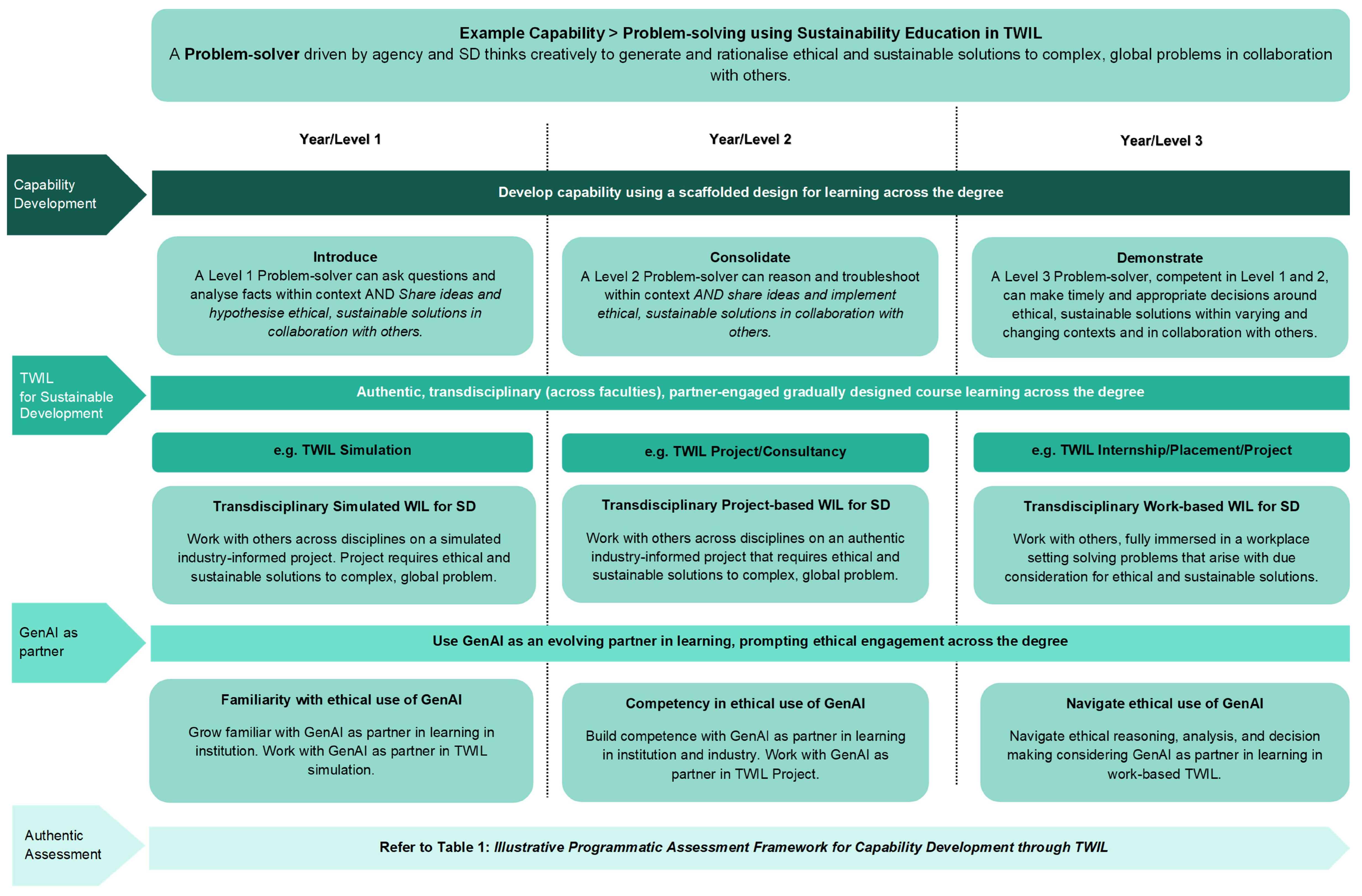
Drawing together the literature reviewed in the subsequent sections, we propose the conceptual model presented in Figure 1, which integrates TWIL, programmatic assessment, and GenAI as a partner in learning to support longitudinal capability development for sustainable development. Informed by Jackson et al.’s (2023) work on professional capability development, the model uses problem solving as an illustrative capability to demonstrate how capabilities can be progressively scaffolded across a three-year undergraduate program. Within the model, capability development progresses through three stages: introduce, where students first encounter and begin to apply a capability; consolidate, where they further develop and apply it across increasingly complex contexts; and demonstrate, where accumulated evidence supports a program-level judgement that the student has achieved the required level of capability aligned with the course learning outcomes.
Figure 1.
Conceptualising capability development for sustainable development through TWIL, programmatic assessment, and GenAI as a partner in learning.
Although problem solving is used as an illustrative example, the same developmental logic can be applied to other capabilities required for SD. For example, ethical decision-making may progress from introducing ethical principles and perspectives from different disciplines, to consolidating their application through engagement with competing disciplinary, stakeholder, and societal perspectives on sustainability challenges, and ultimately to demonstrating the capacity to make, justify, and reflect on ethical decisions in authentic TWIL contexts.
Table 1 complements Figure 1 by presenting an illustrative programmatic assessment framework that incorporates authentic TWIL experiences, learner ownership, multiple sources of evidence, the ethical use of GenAI, and program-level judgements of capability at each stage of the program. The article concludes by discussing the implications of these assessment strategies for educators, institutions, and external stakeholders.
Table 1.
Illustrative Programmatic Assessment Framework for Capability Development through TWIL.
2. TWIL in Contemporary Higher Education
TWIL builds on Work-Integrated Learning (WIL), a pedagogy that engages students with external partners through work-based experiences (e.g., internships), classroom-based activities, or virtual projects, consultancies, and competitions as part of the curriculum. International research demonstrates the value of WIL partnerships in supporting student learning and sustainability, while highlighting the importance of effective program design, personal and professional capabilities (e.g., effective communication, problem-solving, creativity, teamwork, self-confidence), and collaboration with external partners (Kassem et al., 2021). Within TWIL, this engagement takes a transdisciplinary form, bringing together students from diverse disciplines, external partners, academics, and, ideally, those with lived experience of the community or global challenge being addressed to identify pathways for improvement and social transformation. TWIL often combines project-based, collaborative, and problem-based learning, with small interdisciplinary student teams working alongside external stakeholders to investigate complex challenges and generate potential solutions within a defined timeframe (Jackson et al., 2026). As illustrated in Figure 1, these experiences can be scaffolded across a program, progressively increasing authentic engagement with external partners through intentionally designed TWIL activities. By integrating knowledge and capabilities from different disciplines with the perspectives of external stakeholders, including organisations, community, and government agencies, TWIL enables diverse approaches to addressing complex real-world challenges (Kligyte et al., 2023; Purcell et al., 2019).
The relevance of this approach is reinforced by broader WIL research highlighting the increasingly transdisciplinary nature of professional practice (Briant et al., 2023). Similarly, within sustainability education, transdisciplinary learning is recognised as an important approach to sustainability transformation, engaging learners with diverse societal actors and complex real-world challenges (Barth et al., 2023).
TWIL is increasingly recognised as a valuable approach through which HE institutions can contribute to social change and innovation. Encouraging students to engage with community-related issues helps them develop an understanding of authentic, open-ended problems and cultural awareness and empathy for those affected by social challenges (Baumber, 2022; Mokhele & Pinfold, 2020). Bringing together students from diverse backgrounds, disciplines, and cultures introduces multiple perspectives and encourages creative responses to complex social issues (Kligyte et al., 2022). Embedded reflective activities encourage participants to evaluate current practice, question the status quo, and explore new ways of working for social good (Kligyte et al., 2025b). Consequently, TWIL supports the development and application of capabilities required to operate effectively in transdisciplinary professional contexts (Brammar, 2023), where traditionally distinct professions increasingly share roles and responsibilities within multidisciplinary teams (Briant et al., 2023). This positions TWIL as an important mechanism for preparing students for work and enhancing graduate employability, a key indicator of HE success. At the same time, capability development represents only one, albeit important, dimension of employability.
While this body of the literature demonstrates the potential of TWIL for capability development, the evidence remains relatively emergent and largely focused on reported benefits and implementation experiences, with less attention given to how capabilities develop and are evidenced longitudinally across a program. In addressing our research question, it is important to consider not only the capabilities that support SD, but also how they develop and can be demonstrated through TWIL. Transdisciplinary learning is developmental rather than uniform, with students following different learning trajectories in both the extent and sequence of their development of transdisciplinary capabilities and their attitudes towards engaging meaningfully with diverse perspectives and forms of knowledge (Horn et al., 2024).
Within TWIL, capabilities required to address sustainability challenges include research, information management, and analytical skills, which are often developed during the investigation phase of TWIL experiences (Bammer et al., 2023). Creativity and risk-taking are important for ideation (Mokhele & Pinfold, 2020), while problem-solving and decision-making skills support the development of responses to complex challenges (Bammer et al., 2023; McGregor, 2017). Communication and collaboration are equally important, enabling students to engage effectively with external partners and peers in interdisciplinary teams (Bammer et al., 2023). Autonomy, accountability, flexibility, and the ability to manage uncertainty are also critical for SD and are fostered through the student-centred and often ambiguous nature of TWIL, which can enhance students’ confidence and personal agency (Bammer et al., 2023; Brammar, 2023; Gibson et al., 2022). Additional capabilities associated with both SD and TWIL include transdisciplinary know-how (Kligyte et al., 2025b), understanding and responding to difference (Brammar, 2023), and boundary expertise (e.g., McGregor, 2017). Collectively, these capabilities highlight the important role of transdisciplinary learning in preparing students for SD and for work in complex, dynamic professional contexts, underscoring its contribution to graduate employability (Brammar, 2023).
Student learning during TWIL is, however, contingent on high-quality design and implementation. The recent literature identifies several key principles that enable TWIL to effectively support students, educators, and external stakeholders in addressing sustainability-related challenges. For example, students and academics co-creating project briefs, learning activities, and assessments with external partners (ideally those with lived experience of the posed challenge) can help to establish authentic learning experiences, manage stakeholder expectations, and foster effective collaboration (Bilous et al., 2018; Gibson et al., 2022). Other important conditions include learning spaces that support collaboration, experimentation, and reflective practice (Jackson et al., 2025); policies and procedures that facilitate curriculum reform and collaboration across disciplines (Gibson et al., 2022); and infrastructure and resourcing that sustain partnerships involving multiple stakeholders and mutual learning (Kligyte et al., 2022; Mokhele & Pinfold, 2020).
Despite HE’s responsibilities for developing graduate employability and contributing to social transformation, implementing TWIL can be challenging. Known barriers include academics’ difficulties in moving beyond traditional pedagogical approaches towards co-created, solution-oriented forms of teaching and learning that emphasise collaboration and reflection, and with which they may be unfamiliar (Kligyte et al., 2022). Academics may also lack strong interest in SD or be reluctant to integrate it into the curriculum (Robinson et al., 2022). In addition, considerable time, resources, and governance are required to coordinate multiple internal and external stakeholders, including students from different disciplines and backgrounds, creating challenges for scalability (Jackson et al., 2025; Sørensen & Stenalt, 2025).
Collectively, the literature demonstrates the potential of TWIL to develop capabilities for addressing complex sustainability challenges while highlighting limited attention to how such capabilities develop and can be assessed longitudinally across a program. This gap provides the rationale for the conceptual framework proposed in this article and the subsequent exploration of programmatic assessment as an approach to supporting longitudinal capability development and assessment.
3. Assessing Capabilities in Contemporary Higher Education
We know that the capabilities for social transformation are complex. Kligyte et al. (2025b) describe these as “transdisciplinary future-making capabilities” (p. 2), which are “relational, dynamic, and context-dependent, emerging and being enacted in specific situations” (p. 2). Consistent with Lewis et al. (2025), we argue that evaluating students’ capabilities extends beyond what they possess to their “capacity to enact them in contexts of practice” (p. 1501). Importantly, knowledge and awareness of transdisciplinarity do not necessarily translate into the ability to enact transdisciplinary practice (Horn et al., 2024). This distinction reinforces the need for assessment that captures students’ application of capabilities in authentic contexts.
While not the primary focus of this article, students’ ability to apply and transfer these capabilities across different contexts is a critical yet challenging area of educational research (Jackson & Hancock, 2010). Their review highlights several factors that support transfer between university and workplace settings, including contextual similarity, reflection, collaborative learning, and socio-cultural influences such as peer support, industry partner support, and positive workplace cultures. Jackson et al. (2019) identified additional enablers of capability transfer, including experiential and authentic learning opportunities that incorporate feedback and reflection, together with learner attributes such as curiosity, agency, confidence, and a willingness to take risks. As core elements of TWIL, these enablers further highlight its potential to support the transfer of learning between university and professional contexts.
Assessing such capabilities presents several challenges for HE. First, assessment often adopts a tick-box approach, focusing on students’ “achievement” of targeted capabilities without recognising their evolving and context-dependent nature (Vlachopoulos & Pachni Tsitiridou, 2026). Second, capabilities for SD encompass complex cognitive and affective dimensions that are difficult to assess consistently, requiring carefully designed criteria and assessment approaches (Annelin & Boström, 2023; Crisp, 2012). Third, self- and peer-assessment can support reflection, learner engagement, and self-regulated learning, although concerns remain about the accuracy and reliability of student judgements, particularly when they contribute to formal assessment decisions (Fleckney et al., 2025; Yan et al., 2023).
Emerging responses include the use of standardised rubrics, authentic assessment, multiple perspectives on performance (e.g., students, peers, academics and external partners), and program-level portfolios that enable students to collect, reflect on, and synthesise evidence of capability development over time (Crisp, 2012; Harver et al., 2019; Sotiriadou et al., 2020).
Another more recent and profound challenge in assessing HE student capabilities is the accelerated uptake of GenAI, which has disrupted traditional assessment integrity and design at an unprecedented scale. The rapid evolution of GenAI has made it increasingly difficult for educators to reliably determine the authenticity of student work, with Australia’s Tertiary Education Quality and Standards Agency (TEQSA) identifying GenAI as an emergent and significant risk to the credibility of HE qualifications (Lodge et al., 2023). A recent TEQSA publication argues that it is now “all but impossible” (Lodge et al., 2025, p. 2) to detect GenAI use with certainty in many assessment contexts, requiring assessment reform across the sector.
In response to these risks, TEQSA has called for HE institutional action that emphasises systemic changes to assessment design, secures points of evidence of learning, and prepares students for ethical engagement with GenAI (e.g., Lodge, 2024; Lodge et al., 2023, 2025; TEQSA, 2024). Accordingly, numerous guidance documents have emerged on governance frameworks, principles for academic integrity, and sector-wide recommendations for embedding AI literacy and future-oriented assessment practices across the sector. While these national imperatives encourage innovation and redesign rather than simple prohibition of GenAI, some HE institutions have responded by expanding traditional invigilated exams, oral vivas, and other secure assessment forms to reduce GenAI-enabled misconduct. However, critics argue that such approaches lack authenticity and real-world relevance, offering limited opportunities for self-assessment and feedback, both essential for lifelong learning (e.g., French et al., 2024). These tensions highlight the need for assessment approaches that support authentic learning, academic integrity, and longitudinal development of student capabilities.
4. Effective Assessment in TWIL
In HE, assessment plays a central role in certifying levels of achievement, verifying learning outcomes, and evaluating student learning (French et al., 2024). As Baartman and Quinlan (2024) highlight, assessment and feedback practices are among the most significant factors shaping student learning in HE. This enduring influence is captured by Jessop and Tomas (2017), who argue that “assessment is the engine which powers student engagement and effort” (p. 991). The ways in which assessment is designed, implemented, and communicated can strongly direct students’ attention, determining what they prioritise and how deeply they engage with their studies. Effective assessment and feedback can promote critical thinking, self-regulation, and meaningful learning, while poorly designed practices may encourage surface learning or a narrow focus on grades (Dolmans et al., 2016; McMorran et al., 2017). Consequently, assessment should be viewed not only as a measure of learning but also as an integral part of the learning process.
This broader understanding is reflected in assessment for learning, which emphasises the role of assessment in supporting students’ ongoing development (Baartman & Quinlan, 2024; Schuwirth & van der Vleuten, 2011). Assessment for learning focuses on ensuring that students clearly understand the intended learning outcomes and assessment criteria, and that they engage in meaningful tasks aligned with those outcomes. Within this approach, assessment and feedback are intentionally designed to encourage students to take ownership of their learning, collaborate with peers as valuable learning resources, and actively seek, interpret, and apply feedback from multiple sources to enhance their progress (Schuwirth & van der Vleuten, 2011). However, many programs are structured around discrete modules or units designed by different educators, which can result in fragmented or siloed assessment practices and limited connections between individual assessments and broader program-level learning outcomes (Charlton & Newsham-West, 2024; Jessop et al., 2014). This fragmentation can constrain opportunities for students to integrate learning and progressively develop capabilities across a program. In response, greater attention has been given to program-level and programmatic approaches to assessment that connect assessment, feedback and learning across a program to support students’ ongoing development (Baartman & Quinlan, 2024; Charlton & Newsham-West, 2024).
4.1. A Programmatic Approach
Developing capabilities for SD requires curricula that move beyond isolated learning experiences to support sustained, coherent learning trajectories across an entire program. This is particularly important for transdisciplinary learning, where capabilities may develop through different trajectories and through the interplay between students’ capacity for action and their attitudes towards engaging with diverse perspectives and forms of knowledge (Horn et al., 2024). This shift calls for greater integration of learning, teaching, and assessment practices. A programmatic approach offers a valuable framework for achieving this transformation by integrating learning, feedback, reflection, and evidence of competency development across authentic practice contexts throughout the program, as illustrated in Figure 1.
Within the broader programmatic approach, it is important to distinguish between programmatic learning and programmatic assessment. Programmatic learning focuses broadly on the intentional sequencing of learning experiences across a program to progressively develop student capabilities, knowledge, and professional identity (Boud & Falchikov, 2006), while programmatic assessment systematically draws upon multiple sources of assessment evidence over time to support learning, feedback, and decision-making (Charlton & Newsham-West, 2024; van der Vleuten et al., 2012). Although both perspectives support longitudinal capability development, this article focuses primarily on programmatic assessment, drawing on its established scholarship to consider how students’ developing capabilities within TWIL can be progressively evidenced and evaluated across a program (Heeneman et al., 2021; van der Vleuten et al., 2012).
Unlike conventional assessment approaches that rely on isolated unit-based assessment tasks, programmatic assessment adopts a longitudinal perspective in which multiple sources of assessment evidence are collected over time to support learning and inform holistic judgements of learner development across a program (Schut et al., 2021; van der Vleuten et al., 2012). Continuous feedback, reflection and multiple evidence sources support learning ownership while enabling more robust judgements of graduate capability (Schuwirth & van der Vleuten, 2011). Consequently, assessment becomes a holistic developmental process that emphasises the integrated development of capabilities including critical thinking, creativity, ethical reasoning, and interdisciplinary problem-solving, rather than the accumulation of discrete skills (Baartman & Quinlan, 2024).
Programmatic assessment aligns closely with the goals of lifelong learning by enabling students to monitor their development over time while strengthening reflective and self-regulated learning (Boud & Falchikov, 2006; Charlton & Newsham-West, 2024). These principles also align with ESD, which emphasises capabilities such as interdisciplinary collaboration, systems thinking and developing innovative responses to complex societal challenges (Wiek et al., 2011).
The normative nature of SD shifts the focus beyond information transfer towards knowledge creation and sharing, values engagement, and the development of capabilities to critically reflect on and contribute to sustainable futures. Accordingly, rather than emphasising information or discrete skills, a more meaningful approach is to focus on the capabilities developed by learners (Giangrande et al., 2019). These capabilities cannot be cultivated through isolated disciplinary tasks but require integrated learning experiences across the entire program, with alignment between program-level outcomes and assessment design supporting a coherent learning trajectory that emphasises capability development (Baartman & Quinlan, 2024; van der Vleuten et al., 2012). Designing assessment around authentic knowledge creation encourages students to generate, apply and justify ideas in collaboration with others, positioning GenAI as a partner that supports learning rather than a repository of information. Programmatic assessment also provides a stronger foundation for the ethical integration of GenAI than traditional assessment models. Because judgements are based on multiple sources of evidence accumulated over time, including authentic projects, reflective activities, peer collaboration and workplace performance, learning is less dependent on single assessment tasks that may be susceptible to inappropriate GenAI use. Instead, GenAI can be used transparently as a learning partner to support inquiry, creativity, reflection and iterative improvement while preserving authentic evidence of students’ developing capabilities.
Within a programmatic assessment framework, TWIL experiences can be progressively integrated across the program. Early experiences may involve industry-informed case studies or simulations, while later stages may include collaborative projects with external partners or community organisations that provide increasing levels of student agency (Torre et al., 2020). This structured progression supports the longitudinal development of capabilities and enables students to receive ongoing, iterative feedback from both academic and industry mentors (Boud & Soler, 2016; van der Vleuten et al., 2012), aligning with research highlighting the importance of scaffolded, authentic learning experiences in developing graduate capability and employability (Ferns et al., 2014; Wright et al., 2026).
However, implementing programmatic assessment and TWIL requires both educator-led innovation and institutional support. Meaningful educational transformation begins with educators who embrace innovative approaches to teaching, learning, and assessment. At the same time, sustainable implementation across a program or institution requires policies, procedures, and governance structures that enable cross-module coordination, shared assessment responsibilities, and program-level decision-making (Jackson et al., 2025). Although such reform involves cost and complexity, universities already invest substantial resources in academic integrity processes and fragmented assessment systems. A programmatic approach may therefore offer a more coherent, sustainable, and pedagogically effective model for curriculum and assessment design.
4.2. A Programmatic Approach and GenAI
The rapid development of GenAI has prompted widespread debate about the role of universities and the future of assessment (Lodge et al., 2023). While concerns largely centred on academic integrity, GenAI also offers opportunities to transform learning when thoughtfully integrated into the curriculum (Bond et al., 2024; Francis et al., 2025; Nieminen et al., 2023; Perkins et al., 2024).
Within HE, while some scholars and practitioners view students as developing disciplinary ways of knowing, others emphasise that students enter learning environments with existing community and cultural knowledges, identities, values, and lived experiences, with learning understood as socially constructed through interactions with others and the world (Francis et al., 2025). Despite these differing ontological perspectives, the core pedagogical aim of HE remains student learning. Learning can be conceptualised as a dynamic relationship between the learner, teacher, and content. The introduction of GenAI adds a further dimension to this relationship, positioning it as a potential mediating partner that can support relational and socially constructed learning, as illustrated in Figure 1.
Furthermore, graduates are increasingly expected to use digital technologies critically and responsibly in professional contexts (Bond et al., 2024; Miao et al., 2021; Ng et al., 2021). TWIL provides an ideal context for embedding the ethical use of emerging technologies, including GenAI, helping students develop the skills needed to use these tools effectively in professional practice. Consequently, students develop not only technical proficiency but also the ethical judgement and reflective capability required for responsible technology use.
Accordingly, growing attention has been given to AI’s pedagogical potential, with Bond et al.’s (2024) systematic meta-review identifying personalised learning as a key benefit. This shift emphasises the learning process rather than students’ final outputs (Francis et al., 2025) and aligns with evidence that sustained dialogue between students and lecturers supports the development of metacognitive capabilities, including reflection and self-regulation, which are central to programmatic assessment (Baartman & Quinlan, 2024). It also highlights the need for a clear framework for AI use in HE to ensure the progressive development of AI literacy across a program (Corbin et al., 2025; Zhou & Schofield, 2024).
For example, early stages of a course may focus on developing critical thinking and understanding the limitations and biases of AI systems (Kasneci et al., 2023; Zhou & Schofield, 2024). Later stages may encourage students to use GenAI to support idea generation, research synthesis, and creative exploration while maintaining academic integrity and reflective judgement (Nieminen et al., 2023; Perkins et al., 2024; Zhou & Schofield, 2024).
Embedding AI literacy within programmatic assessment helps students critically evaluate AI-generated outputs while developing the ethical judgement required for professional practice (Ng et al., 2021; Nieminen et al., 2023; Torre et al., 2020). Rather than viewing GenAI solely as a threat, universities can position it as a learning ‘partner’ that supports creativity, innovation, and collaborative problem-solving, provided its use is guided by clear principles of academic integrity, ethical practice, and critical evaluation (Perkins et al., 2024; Zhai & Crippen, 2026; Zhou & Schofield, 2024).
At the same time, it is important to recognise that not all students readily accept the use of GenAI. Ethical concerns, including its environmental impact and broader sustainability implications, may influence students’ willingness to engage with these technologies (Nygren et al., 2026). This reinforces the need for educators to engage with GenAI purposefully and transparently, framing its use in ways that align with learning outcomes and sustainability principles. By creating opportunities for critical engagement, AI literacy can be developed not only through use but also through informed critique, equipping students to engage thoughtfully and responsibly with AI as part of sustainability-oriented practice.
Similarly, UNESCO urges policymakers to support students in understanding how AI works and its broader societal implications. This includes promoting the inclusive and equitable use of AI in education, leveraging AI to enhance teaching and learning, developing ‘skills for life’ in an AI-driven era, and ensuring the transparent and auditable use of education data (Miao et al., 2021).
Drawing these principles together, Table 1 illustrates how the conceptual framework presented in Figure 1 can be operationalised through an illustrative programmatic assessment framework for TWIL. It demonstrates how scaffolded authentic learning experiences, learner ownership, multiple sources of evidence, continuous feedback and ethical integration of GenAI can be incorporated across a program to support longitudinal capability development and holistic program-level judgements.
5. Implications
A central implication of this article is the need for a programmatic approach to curriculum and assessment design, in which the capabilities required for TWIL are intentionally scaffolded across the program. Rather than relying on isolated learning experiences or discrete assessment tasks, capability development should be progressively supported through authentic, transdisciplinary learning experiences, continuous feedback, and multiple sources of evidence collected over time (Schuwirth & van der Vleuten, 2011; Wright et al., 2026). Such an approach strengthens students’ development of sustainability capabilities, collaborative practice, systems thinking, and reflective judgement while supporting holistic, program-level assessment. It may also enable assessment to be redistributed across a program, shifting emphasis from numerous module-level tasks to fewer, more authentic and meaningful assessment experiences that support capability development, graduate employability, and lifelong learning (Brammar, 2023; Ferns et al., 2014; Jessop et al., 2014).
A second implication concerns educator practice. Designing assessment around authentic knowledge creation, rather than information reproduction, encourages students to collaboratively generate, justify, and apply ideas in response to complex sustainability challenges. Within this context, GenAI can be positioned as an ethical partner in inquiry, creativity, reflection, and decision-making, supporting learner agency while maintaining academic integrity. This requires educators to design assessments that value authentic engagement with industry and community partners, promote critical reflection and feedback, and draw on multiple sources of evidence to support holistic judgements of capability development. Equally important is the development of students’ AI and critical digital literacy, enabling them to evaluate the ethical, societal, and sustainability implications of emerging technologies within professional and sustainability-focused practice (Kasneci et al., 2023; Ng et al., 2021; Zhou & Schofield, 2024).
Successful implementation also requires institutional support alongside educator-led innovation. While meaningful educational transformation begins with educators embracing new approaches to curriculum and assessment, sustainable implementation at scale depends on institutional policies, governance structures, and curriculum processes that enable cross-disciplinary collaboration, longitudinal assessment, and coherent program design (Jackson et al., 2025; Sørensen & Stenalt, 2025). For curriculum leaders and institutional decision-makers, the proposed framework offers practical guidance for designing coherent program-level assessments that support longitudinal capability development, strengthen curriculum quality, and align assessment and graduate outcomes with the principles of education for sustainable development. Universities also play a critical role in sustaining partnerships with external stakeholders, ensuring that TWIL experiences remain authentic, mutually beneficial, and responsive to societal challenges (Ferns et al., 2014). Collectively, these conditions create an environment in which programmatic assessment can support both educational quality and sustainable curriculum renewal.
Future research should evaluate the implementation and impact of the proposed conceptual framework across diverse disciplinary, institutional, and cultural contexts. In particular, research is needed to examine how programmatic assessment supports students’ longitudinal capability development within TWIL, how multiple sources of evidence contribute to robust program-level judgements, and how the ethical integration of GenAI influences authentic assessment, learner agency and graduate preparedness for sustainable professional practice. Such research would strengthen the evidence base for designing curricula that prepare graduates to contribute meaningfully to sustainable societal transformation.
6. Conclusions
This article highlights the important role of HE in preparing graduates to address complex environmental, social, and economic sustainability challenges through authentic, transdisciplinary learning. It argues that TWIL, supported by programmatic assessment, provides a coherent approach to developing and evaluating the capabilities required for sustainable professional practice.
The article’s principal contribution is the integration of education for sustainable development, TWIL, programmatic assessment, and the ethical use of GenAI into a conceptual framework for longitudinal capability development and assessment. Through Figure 1 and the accompanying illustrative programmatic assessment framework (Table 1), the paper moves beyond conceptual advocacy to demonstrate how these complementary principles can be operationalised across a program to support authentic assessment, learner ownership, and holistic judgements of capability development.
As a conceptual article, the framework has not yet been empirically evaluated and should therefore be viewed as a theoretically informed guide for curriculum and assessment design rather than a prescriptive model. Its implementation and applicability across diverse disciplinary, institutional, and cultural contexts require further investigation. Overall, the proposed framework offers educators and curriculum leaders a practical foundation for designing programs that progressively develop and assess the capabilities required for sustainable professional practice and lifelong learning.
Author Contributions
Conceptualization, D.J.; Resources, C.L. and S.C.; Writing—Original Draft, D.J., C.L. and S.C.; Writing—Review and Editing, C.L. and S.C. All authors have read and agreed to the published version of the manuscript.
Funding
This research received no external funding.
Institutional Review Board Statement
Not applicable.
Informed Consent Statement
Not applicable.
Data Availability Statement
No new data were created or analyzed in this study. Data sharing is not applicable to this article.
Conflicts of Interest
The authors declare no conflicts of interest.
References
- Allen, L., Pratt, S., Le Hunte, B., Kligyte, G., Melvold, J., Doran, B., & Ross, K. (2025). Embodied learning for wicked problems and societal transitions: Perspectives from transdisciplinary higher education practitioners. Higher Education Research & Development, 44(6), 1462–1479. [Google Scholar] [CrossRef] [Scilit]
- Annelin, A., & Boström, G. O. (2023). An assessment of key sustainability competencies: A review of scales and propositions for validation. International Journal of Sustainability in Higher Education, 24(9), 53–69. [Google Scholar] [CrossRef] [Scilit]
- Baartman, L. K., & Quinlan, K. M. (2024). Assessment and feedback in higher education reimagined: Using programmatic assessment to transform higher education. Perspectives: Policy and Practice in Higher Education, 28(2), 57–67. [Google Scholar] [CrossRef] [Scilit]
- Bammer, G., Browne, C. A., Ballard, C., Lloyd, N., Kevan, A., Neales, N., Nurmikko-Fuller, T., Perera, S., Singhal, I., & van Kerkhoff, L. (2023). Setting parameters for developing undergraduate expertise in transdisciplinary problem solving at a university-wide scale: A case study. Humanities and Social Sciences Communications, 10(1), 208. [Google Scholar] [CrossRef] [Scilit]
- Barth, M., Jiménez-Aceituno, A., Lam, D. P., Bürgener, L., & Lang, D. J. (2023). Transdisciplinary learning as a key leverage for sustainability transformations. Current Opinion in Environmental Sustainability, 64, 101361. [Google Scholar] [CrossRef] [Scilit]
- Baumber, A. (2022). Transforming sustainability education through transdisciplinary practice. Environment, Development and Sustainability, 24(6), 7622–7639. [Google Scholar] [CrossRef] [Scilit] [PubMed]
- Bilous, R., Hammersley, L., Lloyd, K., Rawlings-Sanaei, F., Downey, G., Amigo, M., Gilchrist, S., & Baker, M. (2018). ‘All of us together in a blurred space’: Principles for co-creating curriculum with international partners. International Journal for Academic Development, 23(3), 165–178. [Google Scholar] [CrossRef] [Scilit]
- Bohm, N. L., Klaassen, R. G., den Brok, P., & van Bueren, E. (2025). Adaptive guidance for uncertainty: How teachers use scaffolding in transdisciplinary courses. Higher Education Research & Development, 44(6), 1444–1461. [Google Scholar] [CrossRef] [Scilit]
- Bond, M., Khosravi, H., De Laat, M., Bergdahl, N., Negrea, V., Oxley, E., Pham, P., Chong, S. W., & Siemens, G. (2024). A meta systematic review of artificial intelligence in higher education: A call for increased ethics, collaboration, and rigour. International Journal of Educational Technology in Higher Education, 21(4), 4. [Google Scholar] [CrossRef] [Scilit]
- Boud, D., & Falchikov, N. (2006). Aligning assessment with long-term learning. Assessment & Evaluation in Higher Education, 31(4), 399–413. [Google Scholar] [CrossRef] [Scilit]
- Boud, D., & Soler, R. (2016). Sustainable assessment revisited. Assessment & Evaluation in Higher Education, 41(3), 400–413. [Google Scholar] [CrossRef] [Scilit]
- Brammar, L. (2023). A three lenses approach to employability: Transdisciplinary approaches to TNE students’ careers education. Higher Education, Skills and Work-Based Learning, 13(6), 1204–1217. [Google Scholar] [CrossRef] [Scilit]
- Briant, S., Crowther, P., Clifton, J., & Burton, L. O. (2023). Work-integrated learning (WIL) as a part of quality education in architecture: The profession’s perspective. Archnet-IJAR: International Journal of Architectural Research, 17(3), 518–535. [Google Scholar] [CrossRef] [Scilit]
- Burton, L. O., & O’Gorman, L. (2023). Transforming engagement through authentic collaboration: Transdisciplinary learning for design students and preservice teachers. In Contemporary design education in Australia (pp. 112–132). Intellect. [Google Scholar]
- Charlton, N., & Newsham-West, R. (2024). Enablers and barriers to program-level assessment planning. Higher Education Research & Development, 43(5), 1074–1088. [Google Scholar] [CrossRef] [Scilit]
- Corbin, T., Dawson, P., Nicola-Richmond, K., & Partridge, H. (2025). ‘Where’s the line? It’s an absurd line’: Towards a framework for acceptable uses of AI in assessment. Assessment & Evaluation in Higher Education, 50(5), 705–717. [Google Scholar] [CrossRef] [Scilit]
- Crisp, G. (2012). E-assessment that enhances graduateness and employability skills. In M. Coetzee, J. A. Botha, N. Eccles, H. Nienaber, & N. Holzhausen (Eds.), Developing student graduateness and employability (pp. 529–548). Knowres Publishing. [Google Scholar]
- Dolmans, D. H., Loyens, S. M., Marcq, H., & Gijbels, D. (2016). Deep and surface learning in problem-based learning: A review of the literature. Advances in Health Sciences Education, 21(5), 1087–1112. [Google Scholar] [CrossRef] [Scilit] [PubMed]
- European Commission, Directorate-General for Research and Innovation, Dixson-Declève, S., Renda, A., & Schwaag Serger, S. (2023). Transformational education in poly-crisis. Publications Office of the European Union. [Google Scholar] [CrossRef] [PubMed]
- Ferns, S., Campbell, M., & Zegwaard, K. E. (2014). Work-integrated learning (pp. 1–6). Higher Education Research and Development Society of Australia (HERDSA Inc.). [Google Scholar]
- Fleckney, P., Thompson, J., & Vaz-Serra, P. (2025). Designing effective peer assessment processes in higher education: A systematic review. Higher Education Research & Development, 44(2), 386–401. [Google Scholar] [CrossRef] [Scilit]
- Francis, N. J., Jones, S., & Smith, D. P. (2025). Generative AI in higher education: Balancing innovation and integrity. British Journal of Biomedical Science, 81, 14048. [Google Scholar] [CrossRef] [Scilit] [PubMed]
- French, S., Dickerson, A., & Mulder, R. A. (2024). A review of the benefits and drawbacks of high-stakes final examinations in higher education. Higher Education, 88(3), 893–918. [Google Scholar] [CrossRef] [Scilit]
- Giangrande, N., White, R. M., East, M., Jackson, R., Clarke, T., Saloff Coste, M., & Penha-Lopes, G. (2019). A competency framework to assess and activate education for sustainable development: Addressing the UN sustainable development goals 4.7 challenge. Sustainability, 11(10), 2832. [Google Scholar] [CrossRef] [Scilit]
- Gibson, M., Keogh, C., Gallegos, D., & Evans, A. (2022). Building transdisciplinary professional practice capabilities in early childhood teacher education. In T. Bourke, D. Henderson, R. Spooner-Lane, & S. White (Eds.), Reconstructing the work of teacher educators: Finding spaces in policy through agentic approaches-Insights from a Research Collective (pp. 91–113). Springer Nature Singapore. [Google Scholar]
- Harver, A., Zuber, P. D., & Bastian, H. (2019). The capstone ePortfolio in an undergraduate public health program: Accreditation, assessment, and audience. Frontiers in Public Health, 7, 125. [Google Scholar] [CrossRef] [Scilit] [PubMed]
- Heeneman, S., de Jong, L. H., Dawson, L. J., Wilkinson, T. J., Ryan, A., & Schuwirth, L. (2021). Ottawa 2020 consensus statement for programmatic assessment-1. Agreement on the principles. Medical Teacher, 43(10), 1139–1148. [Google Scholar] [CrossRef] [Scilit] [PubMed]
- Horn, A., Visser, M. W., Pittens, C. A., Urias, E., Zweekhorst, M., & van Dijk, G. M. (2024). Transdisciplinary learning trajectories: Developing action and attitude in interplay. Humanities and Social Sciences Communications, 11(1), 149. [Google Scholar] [CrossRef] [Scilit]
- Jackson, D., Fleming, J., & Rowe, A. (2019). Enabling the transfer of skills and knowledge across classroom and work contexts. Vocations and Learning, 12(3), 459–478. [Google Scholar] [CrossRef] [Scilit]
- Jackson, D., & Hancock, P. (2010). Non-technical skills in undergraduate degrees in business: Development and transfer. Education Research and Perspectives, 37(1), 52–84. [Google Scholar] [CrossRef] [Scilit]
- Jackson, D., Lambert, C., & Coetzee, S. (2025). Transdisciplinary work-integrated learning’s contribution to societal transition: A scoping review. Higher Education Research & Development, 44(6), 1480–1496. [Google Scholar] [CrossRef] [Scilit]
- Jackson, D., Lambert, C., & Coetzee, S. (2026). Designing and evaluating quality transdisciplinary work-integrated learning: Insights into practice. Journal of Education and Work, 39(2), 144–163. [Google Scholar] [CrossRef] [Scilit]
- Jackson, D., Riebe, L., Meek, S., Ogilvie, M., Kuilboer, A., Murphy, L., Collins, N., Lynch, K., & Brock, M. (2023). Using an industry-aligned capabilities framework to effectively assess student performance in non-accredited work-integrated learning contexts. Teaching in Higher Education, 28(4), 802–821. [Google Scholar] [CrossRef] [Scilit]
- Jessop, T., El Hakim, Y., & Gibbs, G. (2014). The whole is greater than the sum of its parts: A large-scale study of students’ learning in response to different programme assessment patterns. Assessment & Evaluation in Higher Education, 39(1), 73–88. [Google Scholar] [CrossRef] [Scilit]
- Jessop, T., & Tomas, C. (2017). The implications of programme assessment patterns for student learning. Assessment & Evaluation in Higher Education, 42(6), 990–999. [Google Scholar] [CrossRef] [Scilit]
- Kasneci, E., Seßler, K., Küchemann, S., Bannert, M., Dementieva, D., Fischer, F., Gasser, U., Groh, G., Günnemann, S., Hüllermeier, E., Krusche, S., Kutyniok, G., Michaeli, T., Nerdel, C., Pfeffer, J., Poquet, O., Sailer, M., Schmidt, A., Seidel, T., … Kasneci, G. (2023). ChatGPT for good? On opportunities and challenges of large language models for education. Learning and Individual Differences, 103, 102274. [Google Scholar] [CrossRef] [Scilit]
- Kassem, H. S., Al-Zaidi, A. A., & Baessa, A. (2021). Effectiveness of work-integrated learning partnerships: Case study of cooperative education in agricultural tertiary education. Sustainability, 13(22), 12684. [Google Scholar] [CrossRef] [Scilit]
- Kligyte, G., Bowdler, B., Baumber, A., Pratt, S., Allen, L., Buck, A., Le Hunte, B., Melvold, J., & Key, T. (2023). Work-integrated professional learning: Shifting paradigms through transdisciplinary engagement. Studies in Continuing Education, 46(3), 396–413. [Google Scholar] [CrossRef] [Scilit]
- Kligyte, G., Buck, A., Le Hunte, B., Ulis, S., McGregor, A., & Wilson, B. (2022). Re-imagining transdisciplinary education work through liminality: Creative third space in liminal times. Australian Educational Researcher, 49(3), 617–634. [Google Scholar] [CrossRef] [Scilit] [PubMed]
- Kligyte, G., Melvold, J., Pratt, S., & Bowdler, B. (2025a). Educating for sustainable and equitable futures: A transdisciplinary future-making capability framework. Futures, 173, 103665. [Google Scholar] [CrossRef] [Scilit]
- Kligyte, G., Pratt, S., van der Bijl-Brouwer, M., & Baumber, A. (2025b). Educating for societal transitions. Higher Education Research & Development, 44(6), 1315–1329. [Google Scholar] [CrossRef] [Scilit]
- Leal Filho, W., Raath, S., Lazzarini, B., Vargas, V. R., de Souza, L., Anholon, R., Quelhas, O. L. G., Haddad, R., Klavins, M., & Orlovic, V. L. (2018). The role of transformation in learning and education for sustainability. Journal of Cleaner Production, 199, 286–295. [Google Scholar] [CrossRef] [Scilit]
- Leicht, A., Heiss, J., & Byun, W. J. (2018). Issues and trends in education for sustainable development (Vol. 5). UNESCO Publishing. [Google Scholar]
- Lewis, A., Kligyte, G., Melvold, J., & Salignac, F. (2025). Future-oriented capabilities impact framework: Measuring transdisciplinary higher education programmes’ contribution to societal transitions. Higher Education Research & Development, 44(6), 1497–1511. [Google Scholar] [CrossRef] [Scilit]
- Lodge, J. M. (2024). The evolving risk to academic integrity posed by generative artificial intelligence: Options for immediate action. Tertiary Education Quality and Standards Agency. Available online: https://online.op.ac.nz/assets/LearningTeachingDevelopment/TEQSA-2023-Evolving-risk-to-academic-integrity-posed-by-generative-artificial-intelligence.pdf (accessed on 30 August 2026).
- Lodge, J. M., Bearman, M., Dawson, P., Gniel, H., Harper, R., Liu, D., McLean, J., & Ucnik, L. (2025). Enacting assessment reform in a time of artificial intelligence. TEQSA. [Google Scholar]
- Lodge, J. M., Howard, S., Bearman, M., & Dawson, P. (2023). Assessment reform for the age of artificial intelligence. TEQSA. [Google Scholar]
- Loorbach, D. A., & Wittmayer, J. (2024). Transforming universities: Mobilizing research and education for sustainability transitions at Erasmus University. Sustainability Science, 19(1), 19–33. [Google Scholar] [CrossRef] [Scilit]
- McGregor, S. L. T. (2017). Transdisciplinary pedagogy in higher education: Transdisciplinary learning, learning cycles and habits of minds. In P. Gibbs (Ed.), Transdisciplinary higher education: A theoretical basis revealed in practice (pp. 3–16). Springer International Publishing. [Google Scholar]
- McMorran, C., Ragupathi, K., & Luo, S. (2017). Assessment and learning without grades? Motivations and concerns with implementing gradeless learning in higher education. Assessment & Evaluation in Higher Education, 42(3), 361–377. [Google Scholar] [CrossRef] [Scilit]
- Miao, F., Holmes, W., Huang, R., & Zhang, H. (2021). AI and education: Guidance for policymakers. Unesco Publishing. [Google Scholar]
- Mokhele, M., & Pinfold, N. (2020). Foundation for transdisciplinary education at Cape Peninsula University of Technology. The Journal for Transdisciplinary Research in Southern Africa, 16(1), a749. [Google Scholar] [CrossRef] [Scilit]
- Ng, D. T. K., Leung, J. K. L., Chu, K. W. S., & Qiao, M. S. (2021). AI literacy: Definition, teaching, evaluation and ethical issues. Proceedings of the Association for Information Science and Technology, 58(1), 504–509. [Google Scholar] [CrossRef] [Scilit]
- Nieminen, J. H., Bearman, M., & Ajjawi, R. (2023). Designing the digital in authentic assessment: Is it fit for purpose? Assessment & Evaluation in Higher Education, 48(4), 529–543. [Google Scholar] [CrossRef] [Scilit]
- Nygren, Å., Eriksson, A., Sjöberg, J., & Alégroth, E. (2026). Exploring student use of generative AI in higher education: A dual-institutional study. Education and Information Technologies, 1–28. [Google Scholar] [CrossRef] [Scilit]
- Perkins, M., Furze, L., Roe, J., & MacVaugh, J. (2024). The artificial intelligence assessment scale: A framework for ethical integration of generative AI in educational assessment. Journal of University Teaching and Learning Practice, 21(6), 49–66. [Google Scholar] [CrossRef] [Scilit]
- Purcell, W. M., Henriksen, H., & Spengler, J. D. (2019). Universities as the engine of transformational sustainability toward delivering the sustainable development goals. International Journal of Sustainability in Higher Education, 20(8), 1343–1357. [Google Scholar] [CrossRef] [Scilit]
- Robinson, J., Ariga, A., Cameron, S., & Wang, R. (2022). Reaching the rest: Embedding sustainability in undergraduate student learning. Journal of Integrative Environmental Sciences, 19(1), 171–187. [Google Scholar] [CrossRef] [Scilit]
- Schut, S., Maggio, L. A., Heeneman, S., van Tartwijk, J., van der Vleuten, C., & Driessen, E. (2021). Where the rubber meets the road-An integrative review of programmatic assessment in health care professions education. Perspectives on Medical Education, 10(1), 6–13. [Google Scholar] [CrossRef] [Scilit] [PubMed]
- Schuwirth, L. W., & van der Vleuten, C. P. M. (2011). Programmatic assessment: From assessment of learning to assessment for learning. Medical Teacher, 33(6), 478–485. [Google Scholar] [CrossRef] [Scilit] [PubMed]
- Sotiriadou, P., Logan, D., Daly, A., & Guest, R. (2020). The role of authentic assessment to preserve academic integrity and promote skill development and employability. Studies in Higher Education, 45(11), 2132–2148. [Google Scholar] [CrossRef] [Scilit]
- Sørensen, M. T., & Stenalt, M. H. (2025). Interdisciplinary collaboration for sustainability among students with different disciplinary backgrounds: A scoping review. Higher Education Research & Development, 44(6), 1396–1412. [Google Scholar] [CrossRef] [Scilit]
- Suleman, F. (2018). The employability skills of higher education graduates: Insights into conceptual frameworks and methodological options. Higher Education, 76(2), 263–278. [Google Scholar] [CrossRef] [Scilit]
- TEQSA. (2024). Gen AI strategies for Australian higher education: Emerging practice. TEQSA. Available online: https://www.teqsa.gov.au/guides-resources/resources/corporate-publications/gen-ai-strategies-australian-higher-education-emerging-practice (accessed on 25 May 2026).
- Torre, D. M., Schuwirth, L., & Van der Vleuten, C. P. M. (2020). Theoretical considerations on programmatic assessment. Medical Teacher, 42(2), 213–220. [Google Scholar] [CrossRef] [Scilit] [PubMed]
- UNESCO. (2026). Education for sustainable development: What you need to know. UNESCO. Available online: https://www.unesco.org/en/sustainable-development/education/need-know (accessed on 1 June 2026).
- United Nations. (2024). The sustainable development goals report 2024. United Nations. Available online: https://unstats.un.org/sdgs/report/2024/ (accessed on 1 June 2026).
- van der Vleuten, C. P., Schuwirth, L. W. T., Driessen, E. W., Dijkstra, J., Tigelaar, D., Baartman, L. K. J., & Van Tartwijk, J. (2012). A model for programmatic assessment fit for purpose. Medical Teacher, 34(3), 205–214. [Google Scholar] [CrossRef] [Scilit] [PubMed]
- Vlachopoulos, D., & Pachni Tsitiridou, O. (2026). Preparing university graduates for the labour market through employability skills development and university–industry collaboration: A systematic review. Education Sciences, 16(3), 426. [Google Scholar] [CrossRef] [Scilit]
- Wiek, A., Withycombe, L., & Redman, C. L. (2011). Key competencies in sustainability: A reference framework for academic program development. Sustainability Science, 6(2), 203–218. [Google Scholar] [CrossRef] [Scilit]
- Wright, E., Taffe, S., Luxton, S., & Wragg, N. (2026). Embedding authentic learning: A case study in curriculum transformation. Education Sciences, 16(3), 392. [Google Scholar] [CrossRef] [Scilit]
- Yan, Z., Wang, X., Boud, D., & Lao, H. (2023). The effect of self-assessment on academic performance and the role of explicitness: A meta-analysis. Assessment & Evaluation in Higher Education, 48(1), 1–15. [Google Scholar] [CrossRef] [Scilit]
- Zhai, X., & Crippen, K. (2026). The landscape of AI in science education: What is changing and how to respond. In Advancing AI in science education: Envisioning responsible and ethical practice (pp. 3–25). Springer Nature Switzerland. [Google Scholar]
- Zhou, X., & Schofield, L. (2024). Developing a conceptual framework for artificial intelligence (AI) literacy in higher education. Journal of Learning Development in Higher Education, (31). [Google Scholar] [CrossRef] [Scilit]

Disclaimer/Publisher’s Note: The statements, opinions and data contained in all publications are solely those of the individual author(s) and contributor(s) and not of MDPI and/or the editor(s). MDPI and/or the editor(s) disclaim responsibility for any injury to people or property resulting from any ideas, methods, instructions or products referred to in the content. |
© 2026 by the authors. Licensee MDPI, Basel, Switzerland. This article is an open access article distributed under the terms and conditions of the Creative Commons Attribution (CC BY) license.