


Abstract
Homeownership has become increasingly difficult for many college graduates in the United States. This quantitative study examines the conditional associations among undergraduate major, post-college income, student loan debt, and homeownership using restricted data from the 2021 College and Beyond II Alumni Survey. Grounded in Human Capital Theory and informed by Status Attainment Theory as a secondary interpretive perspective, the study analyzes a sample of 2513 college graduates approximately a decade after degree completion. Logistic regression models examine differences in the conditional odds of homeownership across undergraduate major categories while accounting for post-college economics, student loans, and demographic characteristics. The findings indicate that arts and humanities graduates had lower conditional odds of homeownership than graduates did in the STEM-health, business, education, and social science fields. Higher salary and other household income were associated with higher conditional odds of homeownership, whereas student loan default and higher monthly loan payments were associated with lower conditional odds. Ever borrowing was also positively associated with homeownership, although this relationship should not be interpreted as evidence that student borrowing causes or facilitates homeownership. The findings highlight the complex relationships among educational pathways, post-college economic circumstances, student loan experiences, and homeownership and underscore the need for further research on the long-term financial outcomes associated with higher education.
1. Introduction
For many decades, higher education has been regarded as one of the most reliable pathways to economic opportunity and upward social mobility (Hout, 2012; Shafiq & Toutkoushian, 2024). Individuals who earn a bachelor’s degree generally experience higher lifetime earnings, lower unemployment, and greater career stability than those without a college education (Barrow & Malamud, 2015; Carnevale et al., 2021; Tamborini et al., 2015). These advantages have generated the widely accepted view that a college degree yields substantial economic returns. However, as higher education has become more accessible and the costs of attendance have risen, teacher-scholars and advanced practitioners have begun to question whether income alone adequately captures the long-term benefits of a college education. Researchers and policymakers increasingly argue that understanding educational returns requires the examination of broader indicators of financial well-being, including the accumulation of personal wealth (Black et al., 2023; Blair et al., 2025).
Among the various measures of wealth, homeownership is particularly important in the United States (Ackert & Mazzotta, 2021). Purchasing a home or apartment is often the greatest financial investment individuals make and remains one of the primary mechanisms through which households build wealth, establish financial security, and transfer economic resources across generations (L. S. Goodman & Mayer, 2018). Homeownership also reflects more than purchasing power alone does. It is shaped by a combination of labor market opportunities, access to credit, accumulated savings, and broader structural conditions that influence an individual’s financial trajectory over time (Bleemer et al., 2021). Consequently, examining homeownership offers a valuable perspective on how educational experiences translate into long-term economic outcomes.
1.1. Problem Statement
Attending and pursuing higher education increasingly requires students to borrow, raising questions about whether educational debt delays wealth accumulation by reducing savings, limiting access to mortgage financing, or postponing major financial decisions such as those related to the purchase of a home (Bostic & Lee, 2008; Looney & Yannelis, 2015; Mueller & Yannelis, 2019; Velez et al., 2019). Prior research has established important links among educational attainment, student debt, and housing outcomes (Marx & Turner, 2019; Yannelis & Tracey, 2022). However, relatively little is known about how the undergraduate field of study, post-college earnings, and student loan experiences operate together in relation to homeownership (Muse & Muse, 2024). Much of the literature examines these factors independently, making it difficult to understand their combined influence on long-term wealth accumulation (Altonji et al., 2016). This limitation is particularly important because academic majors affect occupational opportunities and earnings, whereas student borrowing may simultaneously constrain financial flexibility.
Another important gap in the literature concerns racial disparities in homeownership. Despite decades of research documenting persistent differences in homeownership rates and household wealth across racial and ethnic groups, relatively few studies have investigated whether educational pathways contribute to these disparities among college graduates (Bhutta et al., 2025; Choi et al., 2019; Kopkin, 2018; Kuebler & Rugh, 2013; Myers et al., 2016). This study addresses these knowledge gaps by examining the associations among undergraduate majors, earnings, student loan experience, and homeownership approximately ten years after college graduation.
1.2. Purpose of the Study
Using restricted data from the College and Beyond II Alumni Survey (2021), Inter-university Consortium for Political and Social Research (ICPSR), this quantitative study investigates whether graduates from different academic fields differ in their conditional odds of homeownership after accounting for earnings, student loan characteristics, and demographic factors. This secondary observational analysis also examine whether these relationships vary across racial groups. By focusing on homeownership as an indicator of wealth accumulation rather than earnings alone, this study extends the literature on economic returns to higher education and contributes to a broader understanding of how educational experiences contribute to long-term financial well-being (Black et al., 2023; Dynarski, 2016; Hampole, 2024).
1.3. Research Questions
The research questions guiding this study are as follows:
- (1)
- How are undergraduate majors, post-graduation earnings, and student loan behaviors associated with homeownership among college graduates approximately ten years after degree completion?
- (2)
- How are these associations patterned across individuals from different racial and ethnic groups?
2. Theoretical Framework
2.1. Human Capital Theory and Status Attainment Theory
This study is grounded primarily in Becker’s (1993) Human Capital Theory and informed by Blau and Duncan’s (1967) Status Attainment Theory. Both perspectives provide a conceptual framework for understanding how educational experience is related to long-term economic outcomes among college graduates. Human Capital Theory explains how investments in education generate economic returns through enhanced productivity and labor market success, whereas Status Attainment Theory recognizes that these returns are embedded within broader social structures that influence opportunities and constrain economic mobility (Haller & Portes, 1973). Combining the two perspectives offers a more comprehensive explanation of how educational pathways may contribute to wealth accumulation, as reflected by homeownership approximately one decade after college completion.
Human Capital Theory views education as an investment that enables individuals to acquire knowledge, skills, and competencies that increase productivity and improve labor market outcomes (Becker, 1993; Schultz, 1961). Individuals who invest in higher education with the expectation that the benefits—including higher earnings, greater employment stability, and improved lifetime economic opportunities—will outweigh the financial and opportunity costs of obtaining a degree. Within this framework, educational decisions such as selecting an undergraduate major and financing colleges through student loans represent investments intended to enhance future economic well-being (Bloom et al., 2021). This theory provides a useful lens for understanding differences across academic disciplines. Labor market returns vary considerably across fields of study, with graduates from engineering, business, health professions, and many STEM disciplines generally earning higher incomes than graduates from education, arts, humanities, and many social service fields do (Andrews et al., 2022; Arcidiacono, 2004; Carnevale et al., 2024; Morris et al., 2025; U.S. Census Bureau, 2023). Higher earnings may also increase the capacity to accumulate savings, strengthen debt-to-income ratios, improve access to mortgage financing, and ultimately facilitate homeownership (Yannelis & Tracey, 2022). Human Capital Theory also offers a framework for understanding educational borrowing. Many students finance college through loans because they anticipate that the future benefits of earning a degree will exceed the immediate costs of borrowing (Carnevale et al., 2024; K. Long, 2022). However, loan repayment responsibilities may delay wealth accumulation by limiting savings, increasing debt burdens, and reducing mortgage affordability during the years immediately following graduation (Darolia et al., 2024; Denning & Jones, 2021). Educational borrowing, therefore, illustrates the dual nature of human capital investment: it may increase long-term economic opportunities while simultaneously creating shorter-term financial constraints that delay or prevent homeownership.
Status Attainment Theory provides an important complement to the human capital perspective by emphasizing that educational and occupational attainment is influenced by both achieved characteristics and ascribed social positions (Blau & Duncan, 1967). Family background, socioeconomic status, race, gender, and other structural factors are relevant to educational opportunities, career trajectories, and access to economic resources (Sharma, 2024). Educational attainment remains an important mechanism of social mobility, but the benefits associated with education are not distributed uniformly across individuals or groups (Bloom et al., 2021; Chakrabarti et al., 2020).
2.2. Conceptual Model
The conceptual framework that guides this study is illustrated in Figure 1, and the theoretical perspectives are translated into an empirical model. Post-college earnings represent one mechanism through which educational investments are associated with wealth accumulation, while student loan experiences—including borrowing, repayment obligations, and loan default—reflect the financial consequences of educational investment that may also be associated with homeownership (Mueller & Yannelis, 2022). Rather than depicting direct causal pathways, the model illustrates theoretically informed associations among these educational and financial experiences. Moreover, the framework recognizes that demographic characteristics represent contextual factors that explain differences in the ultimate outcome of homeownership. Accordingly, the primary analyses control for these demographic characteristics. Secondary analyses of racial and ethnic subgroup models examine whether the associations among undergraduate major, earnings, student loan experience, and homeownership differ across racial groups.
Figure 1.
Conceptual model: major, salary, student loans, and homeownership based on human capital theory and status attainment theory. Notes. This conceptual framework examines the conditional associations among undergraduate major, student loan experiences, salary, and homeownership. Gender, race, social class, highest degree level, and family structure were included as control variables in the logistic regression analyses.
3. Literature Review
3.1. Higher Education and Homeownership
Research on educational pathways and homeownership attainment is understudied and often overlooked in the field of higher education and, more broadly, education sciences. Numerous past studies on this topic have been published in economics journals or economics of education journals, with a focus on labor market outcomes such as jobs, earnings and salary (e.g., Ge et al., 2022; Mezza et al., 2020; J. J. Miller & Nikaj, 2018; Oswald-Egg & Renold, 2021; Velez et al., 2019). Homeownership in the United States has become an increasingly important outcome in studies of economic mobility because it represents one of the primary means through which households build wealth, achieve financial stability, and transfer assets across generations (L. S. Goodman & Mayer, 2018). Unlike annual earnings, which capture financial returns at a single point in time, homeownership may better reflect the cumulative effects of educational attainment, labor market experience, access to credit, savings behavior, and broader economic conditions. Interest in this relationship increased in the years following the Great Recession, when the collapse of the housing market coincided with rising college costs and unprecedented levels of student borrowing (Manturuk et al., 2012). During the same period, homeownership rates among younger adults declined while educational debt continued to increase, raising questions about whether the financial benefits traditionally associated with higher education remain sufficient to support wealth accumulation early in adulthood (Federal Reserve Bank of New York, 2025; U.S. Census Bureau, 2025).
Existing evidence consistently indicates that individuals with higher levels of education are more likely to become homeowners than those with less formal education are (Velez et al., 2019). Analyses using nationally representative datasets have shown that compared with individuals whose education ends with high school, bachelor’s and graduate degree holders experience substantially higher homeownership rates (Young, 2017). Nevertheless, educational attainment alone provides only a partial explanation for differences in financial outcomes among college graduates. Understanding homeownership, therefore, requires moving beyond educational attainment as a single indicator and considering the broader educational pathways through which wealth is accumulated over the life course.
3.2. Undergraduate Major and Post-College Economic Outcomes
A substantial body of research demonstrates that the economic returns to higher education vary considerably across academic disciplines because the knowledge, skills, and occupational opportunities they provide differ (Blair et al., 2025; Card, 1999; Hampole, 2024; Rothstein & Rouse, 2011; Zimmerman, 2014). National evidence consistently shows that graduates in engineering, business, computer science, health professions, and other STEM-related fields earn substantially higher salaries than graduates in education, arts, humanities, and many social service disciplines do (Morris et al., 2025; U.S. Census Bureau, 2023). Using longitudinal administrative data from Texas, Andrews et al. (2022) reported that graduates in engineering and business not only entered the labor market with higher earnings but also experienced stronger wage growth throughout their careers. Graduates from higher-paying disciplines generally experience greater employment stability, lower unemployment, and more favorable opportunities for career advancement than graduates from lower-paying fields do (Altonji et al., 2012; Andrews et al., 2022; Arcidiacono, 2004). These labor market advantages may, in turn, improve graduates’ capacity to accumulate savings, maintain favorable debt-to-income ratios, qualify for mortgage financing, and build household wealth over time (Bostic & Lee, 2008). Conversely, graduates from lower-paying fields may encounter greater financial constraints despite possessing comparable levels of educational attainment.
3.3. Student Loans, Debt Burden, and Homeownership
Student loan debt has become one of the defining financial features of contemporary higher education and an important focus of research on the long-term economic consequences of college attendance (Black et al., 2023; S. Goodman et al., 2021). Unlike most forms of consumer debt, educational borrowing occurs early in adulthood, often before individuals have established stable earnings, accumulated assets, or developed extensive credit histories. Students assume these financial obligations with the expectation that the economic returns to higher education will outweigh the costs of borrowing (Houle & Berger, 2015; Johnston & O’Brien, 2025). However, research has produced inconsistent conclusions regarding the relationship between student loan debt and homeownership. Many observational studies report that greater student loan balances are associated with delayed homeownership and lower levels of household wealth (Cooper & Wang, 2014; Mezza et al., 2020). These findings suggest that repayment obligations may reduce disposable income, increase debt-to-income ratios, and limit borrowers’ ability to save for a down payment or qualify for mortgage financing (Yannelis & Tracey, 2022). After accounting for differences in educational attainment, earnings, and household characteristics, other observational studies, however, find considerably weaker or statistically insignificant associations (Scott & Bloom, 2022; Velez et al., 2019).
An emerging body of quasiexperimental and policy-based research helps explain these seemingly conflicting findings by demonstrating that the consequences of educational borrowing depend on the conditions under which debt is incurred (Black et al., 2023; Marx & Turner, 2019). Studies examining expansions in federal student aid have shown that greater access to borrowing can increase college enrollment, degree completion, and subsequent labor market opportunities (Black et al., 2023; Looney & Yannelis, 2024). In these circumstances, the long-term economic benefits associated with higher educational attainment may offset, or even exceed, the financial costs of borrowing. For example, after holding tuition costs constant, S. Goodman et al. (2021) reported that expanded access to student loans was associated with improved long-term financial outcomes, including higher rates of homeownership.
A different pattern emerges when increases in student debt reflect rising college costs or greater repayment burdens rather than expanded educational opportunities. Bleemer et al. (2021), for instance, reported that increases in student debt attributable to higher tuition reduced homeownership after educational attainment was held constant. Similarly, Mueller and Yannelis (2022) and Herbst (2023) reported that larger monthly loan payments—such as those associated with less favorable repayment plans—can increase borrowers’ financial burdens and reduce their ability to purchase a home. Degree completion further illustrates the complexity of these relationships. Individuals who complete a college degree generally experience stronger labor market outcomes than those who leave college without graduating do, making it more likely that long-term returns to higher education will offset the costs of educational borrowing (Dynarski, 2016; J. J. Miller & Nikaj, 2018). From this perspective, student loan debt should not be considered independent of educational attainment, undergraduate major, or post-college earnings (Yannelis & Tracey, 2022). Building on this literature, the present study examines how these educational and financial experiences are jointly associated with homeownership approximately one decade after college completion.
3.4. Racial Differences in Educational and Financial Pathways to Homeownership
Racial disparities also exist in educational outcomes and, potentially, with homeownership. Although homeownership declined following the Great Recession because of tighter mortgage lending standards, rising housing prices, and a limited supply of affordable housing, these changes disproportionately affected historically marginalized populations (Bostic & Lee, 2008; Gerardi et al., 2023; Myers et al., 2019). Even after accounting for differences in educational attainment and income, Black and Hispanic households continue to experience substantially lower rates of homeownership than White households do (Bhutta et al., 2025; Choi & Pang, 2021; McCargo & Choi, 2020). Compared with White college graduates, Black graduates are more likely to finance their education through student loans, accumulate greater debt burdens, and experience higher rates of loan delinquency and default (Addo et al., 2016). Black and Hispanic graduates are likewise less likely to receive financial assistance from family members for down payments or other housing-related expenses, reflecting broader disparities in intergenerational wealth and access to financial resources (Choi et al., 2019; Hanson, 2024; Kopkin, 2018). These patterns underscore that educational borrowing occurs within broader social and financial contexts that extend beyond individual educational decisions (Charles & Hurst, 2002).
Other demographic characteristics have also been linked to differences in homeownership. Married households consistently exhibit higher rates of homeownership than single-adult households do, reflecting the advantages associated with pooled financial resources and household income (Hall & Crowder, 2011). Gender disparities likewise persist, with unmarried women generally reporting lower homeownership rates than unmarried men despite substantial gains in educational attainment over recent decades (Choi, 2023; Marino, 2023). Therefore, the present study incorporates key demographic characteristics as contextual factors while also estimating racial and ethnic subgroup models to examine whether the associations among undergraduate major, earnings, student loan experience, and homeownership vary across racial groups.
3.5. Summary of the Literature and Research Gap
In summary, existing research has demonstrated that higher education is associated with important long-term economic outcomes, including income, wealth accumulation, and homeownership (Ge et al., 2022; J. J. Miller & Nikaj, 2018; Oswald-Egg & Renold, 2021). Prior studies have also shown that an undergraduate major is related to labor market opportunities and earnings, whereas student loan debt and repayment experience may influence graduates’ financial capacity to purchase a home (Mezza et al., 2020; Velez et al., 2019). However, these factors are often examined separately, limiting the understanding of how undergraduate major, post-college economic resources, and student loan experiences are related to homeownership. Moreover, relatively limited research has examined these relationships across racial groups. Building on recent CBII research, the present study addresses this gap by examining the conditional associations among undergraduate major, income, student loan experience, and homeownership among college graduates approximately a decade after degree completion while also exploring patterns across racial groups.
4. Methods and Methodology
4.1. Research Design
To answer our research questions, we leveraged the College and Beyond II (CBII) restricted dataset from the Inter-university Consortium for Political and Social Research (ICPSR) housed at the University of Michigan, Ann Arbor, USA. The CBII dataset allows us to connect undergraduate major choice, student loan borrowing, and demographic factors to homeownership ten years later (Paulson et al., 2022). Specifically, the dataset offers information about college majors, which are strongly correlated with postgraduation earnings (Carnevale et al., 2011), as well as important demographic variables (such as belonging to a racially minoritized group) from graduates of similar institutions (i.e., a cohort of peers), which are not included in other datasets such as the Survey of Consumer Finance (SCF) (Courant et al., 2022). Stata 19 software was used to analyze the data. As discussed in the literature review and conceptual framework, these factors are essential; prior research has demonstrated their significant influence on both student loan debt and homeownership outcomes (Scott & Bloom, 2022). The CBII data also captured homeownership during the global pandemic, a unique scenario during which U.S. home prices substantially increased while mortgage rates decreased to historic lows of 2.5%, which allows us to assess homeownership during the distinctive COVID-era housing market (Meng & Xiao, 2026). Recent scholarship has increasingly used the CBII dataset to examine post-college outcomes, including relationships among student loan debt, civic engagement, and liberal arts education (Agbonlahor, 2025; Mou & Mitic, 2026; Simpfenderfer & Mitic, 2026). The contribution of the present study is therefore not based simply on the novelty of the dataset. Rather, this study jointly examines undergraduate major, post-college earnings, multiple student loan experiences, and homeownership within a common analytic framework and evaluates whether these conditional associations vary across racial groups.
4.2. Data Sources and Sample
This study used CBII data collected from a cohort of students (N = 2513) who graduated during the 2009–2010 academic year and subsequently completed an alumni survey in 2021, representing approximately a decade later after bachelor’s degree completion (Courant et al., 2022). This study is a retrospective observational analysis of a 2021 cross-sectional alumni survey linked to information about respondents’ prior undergraduate experience and conducted approximately 10–12 years after degree completion. The Alumni Survey contained data on individuals living in the U.S. who had earned a bachelor’s degree from one of 19 public colleges and universities nested within seven postsecondary systems participating in CBII. A self-administered online survey was sent during a 6-month period in 2021 (which coincided with the COVID-19 pandemic). Most respondents were in their early to mid-thirties at the time. The respondents were asked questions about their “demographic backgrounds, life course events, college experiences, and postcollege life outcomes” (Paulson et al., 2022, p. 22). Of approximately 15,000 alumni invited to participate, 2801 provided valid survey responses, yielding a response rate of approximately 19%. The complete-case analytical sample included 2513 respondents with non-missing data on all the variables used in the primary model (representing 89.7% of the 2801 survey respondents and approximately 16.8% of the full invited sample). We conducted a missing value analysis and compared respondents who were excluded because of missing data (n = 288) to those retained in the analytical sample (n = 2513) on key observed characteristics available from the survey. Compared with the excluded respondents, the retained respondents were slightly more likely to be married (73% vs. 65%) and had slightly higher reported salaries ($89,572 vs. $81,341), but the differences in gender, race, and undergraduate major composition were not statistically significant. The direction of these differences suggests that complete-case inclusion may be weakly associated with socioeconomic advantage, which could bias estimates if missingness is related to unobserved factors associated with homeownership. However, because the CBII data do not include comprehensive information on nonrespondents, we cannot assess whether the survey respondents differ from the full invited sample in terms of key characteristics. Missing data are likely not missing completely at random (MCAR); therefore, we interpret our findings as associations within the observed analytical sample rather than as estimates necessarily representative of all eligible alumni. We were unable to use multiple imputation because of data-use restrictions that prevented us from accessing auxiliary variables that would be needed for defensible imputation models. We therefore rely on complete-case analysis with the caution noted above.
4.3. Variables of Interest
To address RQ1, we included each respondent’s salary for 2020 and the outcome variable (i.e., OWNHOME_YESNO)—whether they owned a home in 2021. The respondents were coded 1 if they selected [YES] and 0 [NO] otherwise. Seventy-two percent of our sample reported being married, and combined income directly affects homebuying purchasing power. Therefore, we calculated a residual household income measure by subtracting the respondent’s reported salary from total household income. Because this residual may include income sources other than a spouse’s earnings, we refer to the measure as ‘other household income’ rather than ‘spousal salary.’ This residual includes all household income not attributable to the respondent’s salary and may include spousal earnings, investment income, or other sources. We interpret it as an approximate indicator of household financial resources beyond the respondent’s personal earnings. We included variables on student borrowing behavior, such as the individual ever having taken out a student loan, defaulted on a loan, and the monthly loan payment. Student loan experience was conceptualized as a distinct dimension rather than as an interchangeable indicator of debt burden. The first measure captured the extensive margin of borrowing (whether the respondent had ever borrowed). Default and monthly payment measures captured subsequent experiences among respondents with student loan histories. Because a zero monthly payment may reflect multiple states—including never borrowing, loan repayment completion, deferment, forbearance, or other repayment arrangements—we do not interpret zero values as equivalent levels of repayment burden and thus, the coefficient for monthly payment is not a pure measure of repayment burden. Borrowing status, default, and monthly repayment represent different dimensions of student loan experience. We estimated our primary models on the full analytical sample (N = 2513) including all three student loan measures simultaneously. While we initially considered estimating repayment-burden models on borrowers only, we ultimately retained the full-sample specification because the borrower-only subsample (n ≈ 1684) was substantially smaller and the results were consistent with the full-sample estimates. The full-sample approach also allows readers to compare associations across all respondents.
As discussed in the literature review, we controlled for undergraduate major. To identify majors, we consulted the National Center for Education Statistics (NCES) Classification of Instruction Programs (CIP) for 2020 (National Center for Education Statistics, 2020), along with internal institution documents. We classified the majors into broad categories: STEM and health professions, business, education, social science, and arts/humanities. In our analysis, we rotated the base (omitted) major category to explore all comparisons between majors.
In the literature review and conceptual framework, we controlled for demographic factors identified as contributing to differences in homeownership, specifically gender (Choi, 2023), race—as certain minority groups face discrimination in mortgage applications and homebuying (Meehan & Park, 2026; Sharma, 2024)—which is also influenced by racial gaps in educational opportunity (Bhutta et al., 2025; Choi & Pang, 2021; McCargo & Choi, 2020; Zhou & Pan, 2023), social class growing up, a proxy for familial wealth (Di & Liu, 2007; L. Goodman et al., 2025), and the highest degree of education, as advanced degree holders tend to have higher incomes and homeownership rates (Young, 2017). We also controlled for family composition, since married couples and households with children are more likely to pursue homeownership (Myers et al., 2019).
Table 1 displays our summary statistics and variable descriptions. We describe these data to provide an overview of the characteristics of our sample. Among the 2801 participants in the Alumni Survey, our empirical sample consisted of 2513 college graduates who had complete data on all the variables in our model. In our sample, 63% indicated that they currently owned a home or apartment (in 2021). The mean salary reported for 2020 was $88,572, and the mean other household income was $46,094. Sixty-seven percent reported ever taking out a student loan, whereas only 5% reported ever defaulting on a student loan. The mean monthly loan payment amount was $457. Undergraduate majors varied, with the highest proportion of alumni majoring in social science fields (32%), 28% majoring in STEM or health fields, 24% in arts or humanities, 13% in business, and 2% in education. The CBII race measure allows respondents to identify with more than one racial or ethnic category. Consequently, the race indicators are not mutually exclusive, and their percentages are not 100%. The highest degree level obtained was a bachelor’s degree or post-bachelor’s degree (48%), followed by a master’s degree (35%). Six percent of the sample had earned a Ph.D., an Ed.D., or a Psy.D., whereas 11% had earned a professional degree in law or medicine. We chose to separate Ph.D. holders from professional degree holders because the upper range of salaries for professional degrees is much higher than that for doctoral degrees (Carnevale et al., 2021).
Table 1.
CBII summary statistics: Variables of interest.
4.4. Analytical Strategy
To address our research questions, we conducted a logistic regression on our binary outcome variable of interest—whether the alumni respondent owned a home or apartment in 2021 (1 = yes). Our empirical model:
where the log odds of owning a home (Pi) in 2021 are relative to the baseline category of not owning a home (Pi) (J. S. Long & Freese, 2014). Grounded in the literature review and theoretical framework, we further included a series of independent variables (X1 to Xp) expected to relate to the outcome. Because each respondent contributed a single observation, clustering standard errors at the individual level was unnecessary. Therefore, the primary analysis used heteroskedasticity-robust standard errors. We assessed robustness to dependence among respondents from the same postsecondary institutions by estimating models with institution-level clustered standard errors (reported in Section 5.5). We interpret the clustered results cautiously because the CBII sample contains a limited number of higher-level institutional and system clusters.
For the race-stratified analyses, we assessed whether sparse data or separation affected estimation by examining the number of events (homeowners) and non-events in each subgroup. The event counts were: White: 1126 homeowners (67.3%), Black: 147 homeowners (59.0%), Latinx: 189 homeowners (62.4%), and Asian: 263 homeowners (65.8%). We did not detect complete or quasi complete separation in any of the models, likely because the outcome is relatively balanced within each subgroup. However, the small sample sizes in some subgroups mean that coefficients with large magnitudes may have wide confidence intervals and should be interpreted with caution. We have not used penalized estimation (e.g., Firth’s correction) because separation was not evident.
5. Results
5.1. Logistic Regression on Full Sample
Table 2 reports the logistic regression results from the analysis of the odds ratios of the independent variables on the outcome—owning a home or apartment—across the full sample of 2513 alumni. The resulting odds ratio (OR; exponentiated coefficient) represents the change in the odds of owning a home associated with a one-unit change in the independent variable, holding constant all other variables. An odds ratio greater than one indicates higher conditional odds of homeownership, whereas an odds ratio less than one indicates lower conditional odds, holding the other variables constant (Peng et al., 2002). Odds ratios should not be interpreted directly as changes in the probability of homeownership. In each of the five models, we used a different base category of major to display all the comparisons. The estimates for all the other variables are identical across the models since these variables remain the same.
Table 2.
Logistic regression results: Homeownership (odds ratios).
Because salary and other household income were modeled on the natural-log scale, their odds ratios represent the multiplicative change in the conditional odds of homeownership associated with a one-unit increase in the natural log of income. A one-unit increase in ln(income) corresponds to an approximately 2.718-fold (i.e., *e*1) increase in the original income variable, not a 1% increase. The odds ratio of 1.07 for other household income therefore indicates that a multiplicative increase in other household income by a factor of *e* (approximately 2.718) is associated with 7% higher conditional odds of homeownership, holding other variables constant. We do not interpret this as the effect of a 1% increase in income. For readers interested in the association between percentage changes in income and homeownership, we note that such interpretations require calculating the effect of ln(1.01) ≈ 0.00995 units on the log-income scale, which corresponds to a much smaller change in the log odds than a one-unit change.
The conditional odds of homeownership were 37% greater for respondents who reported ever borrowing than for otherwise similar respondents who reported never borrowing. This association should not be interpreted causally as evidence that borrowing itself promotes homeownership because borrowing is related to educational financing needs, institutional attendance, family resources, degree pathways, and other observed and unobserved characteristics. Among the 5% of individuals who had ever defaulted on a student loan, there was a 51% decrease (1 − 0.49 = 0.51) in the conditional odds of homeownership, suggesting that greater debt and corresponding financial stress are associated with the ability to purchase a home. High monthly student loan payments were associated with low conditional odds of homeownership. The odds ratio of 0.92 represents the change in conditional odds associated with a one-unit increase in ln(monthly payment), which corresponds to a multiplicative increase in the original payment amount by a factor of *e* (approximately 2.718), not a 1% increase. We note that monthly loan payments are coded as zero for respondents who never borrowed, which means that this variable captures the association between payment amount and homeownership among all respondents, with zero representing the absence of borrowing. This coding decision is appropriate for the full-sample specification but means that the monthly payment coefficient should not be interpreted solely as a repayment-burden effect among borrowers. One possible explanation is that borrowing may be associated with degree completion and other educational pathways that are themselves related to later economic outcomes; however, this mechanism was not examined in the present study. Respondents who had ever defaulted on a student loan had lower conditional odds of homeownership, although the observational design does not permit us to correspond with whether default itself reduced homeownership.
When the estimates regarding undergraduate major across all five models are reviewed, it is evident that arts/humanities majors had lower conditional odds of homeownership than several other major groups. Specifically, arts/humanities majors experienced 31% to 49% lower conditional odds of homeownership, depending on the comparison group. In contrast, there were no differences in homeownership between arts/humanities and education majors. Interestingly, we also found no differences in homeownership among students who majored in STEM-health, business, education, or social science, despite the literature suggesting greater earnings in the STEM, health, and business fields (Chow, 2023). Taken together, these findings suggest that an undergraduate major has a selective relationship with homeownership, even after adjustments are made for income, debt, and demographics.
5.2. Estimates on Demographic Control Variables
We found no differences in homeownership based on gender or social class (socioeconomic status), in contrast to what the literature suggests about familial wealth and assistance in the context of home purchases (Sodini et al., 2023). We also found no differences in the outcome according to the highest degree earned. Among the race indicators, respondents who identified as Black, Latina/o/x, or Asian had lower conditional odds of homeownership than respondents who did not identify with the respective racial or ethnic category, holding the other race indicators and covariates constant. Specifically, the conditional odds of homeownership were 37% lower for respondents identifying as Black, 33% lower for those identifying as Latina/o/x, and 49% lower for those identifying as Asian. Because respondents could select multiple racial and ethnic categories, these estimates should not be interpreted as direct comparisons between mutually exclusive racial groups or specifically as Black–White, Latina/o/x–White, or Asian–White differences. These findings are consistent with the literature on the Black/White and Latinx/White homeownership gap but are not consistent with the literature suggesting that Asians enjoy socioeconomic privileges similar to those of white individuals. The lower conditional odds observed among respondents identifying as Asian warrant further investigation, particularly because aggregate Asian American socioeconomic indicators can obscure substantial differences across ethnic, nativity, immigration, and socioeconomic groups (Museus & Truong, 2009). Alumni who were married were more than three times more likely to own a home, even after controlling for other household income. Each additional child in the household was associated with an 81% increase in the conditional odds of owning a home. That is, marriage and children (i.e., household composition) are the strongest demographic associations of homeownership.
5.3. Logistic Regression Disaggregated by Race
To address RQ2, we estimated separate logistic regression models for each racial subgroup rather than pooling all respondents and estimating interaction terms. This approach allows the associations among all the predictors and homeownership to vary freely across groups. However, we interpret the subgroup results with caution because differences in statistical significance across groups do not constitute formal evidence of coefficient heterogeneity. In Table 2, the ‘base category’ notation is used only for ease of interpretation and does not imply that race categories are mutually exclusive. Because respondents could identify with multiple racial categories, the coefficients represent the association between identifying with a given category (relative to not identifying with that category) and the conditional odds of homeownership, conditional on the other race indicators. For example, the coefficient for Black/African Americans compares respondents who identify as Black to those who do not, among respondents with the same values on other race indicators and covariates.
Table 3 shows ORs by race, controlling for socioeconomic and educational factors. Race was measured using self-identified racial and ethnic categories, and respondents could identify with more than one category. Accordingly, the percentages for the race indicators are not mutually exclusive and should not be interpreted as summing to 100%. For the pooled regression, race was represented using binary indicator variables rather than a single mutually exclusive categorical variable. Therefore, the reported coefficients represent associations for respondents identifying with each racial category relative to respondents not identifying with that category, conditional on the other race indicators and covariates.
Table 3.
Logistic regression results disaggregated by race: Homeownership (odds ratios).
While several independent variables were significant in the full model, they lost significance in the race-stratified analyses, likely in part because of reduced statistical power from smaller subgroup sample sizes. This underscores the need for larger, racial and ethnic subgroup datasets to examine relationships among salary, student debt, and major. Notably, the respondent’s salary was consistently positively associated with homeownership among all the racial groups, whereas the other household income was statistically significantly associated with homeownership for White and Asian alumni in the subgroup analyses. However, because we did not conduct formal interaction tests, we cannot conclude that these coefficients differ significantly across racial groups. These patterns should be interpreted as suggestive and warrant further investigation with larger, more diverse samples and formal tests of coefficient differences. The student loan debt variables were inconsistently significant. Taking out a student loan was statistically significantly positively related to homeownership for White individuals only, and higher monthly payments were negatively related to homeownership for White and Latinx individuals. However, defaulting on a student loan was associated with lower conditional odds of homeownership for Asian individuals only.
Notably, comparisons of statistical significance across separate subgroup models do not constitute formal evidence that coefficients differ across racial groups. The observed patterns may reflect differences in sample size and statistical power rather than true heterogeneity in the associations. Formal interaction tests or coefficient-equivalence tests would be needed to establish whether the relationships we observe differ significantly by race.
In all the models, we used arts/humanities major as the base category since the estimates in Table 2 show the greatest differences in homeownership between arts/humanities and other fields. An undergraduate degree in business was positively associated with homeownership compared with a degree in arts/humanities for White alumni and, to a greater extent, for Black alumni (nearly three times the odds). Moreover, compared with art/humanities majors, White degree holders who majored in STEM-health or social science majors had higher conditional odds of homeownership. Across all four racial groups, being married and having more children in the household were strongly associated with homeownership, with the greatest effect for married Asians (who were four times more likely to own a home when married). Therefore, marriage and family size are strongly associated with homeownership. Overall, these findings suggest that salary, student loan debt, and major are important but not consistently related to homeownership for all racial groups.
5.4. Robustness Analysis: Institution-Level Clustered Standard Errors
To assess whether dependence among respondents from the same postsecondary institutions influenced our inferential conclusions, we re-estimate the primary model (Model 1 from Table 2, with STEM-Health as the reference category for major) using institution-level clustered standard errors. The CBII sample includes respondents from 19 public colleges and universities nested within seven postsecondary systems, and individual-level clustering is not applicable because each respondent contributes a single observation.
The institution-clustered standard errors were generally similar to the heteroskedasticity-robust standard errors reported in the main tables. The statistical significance of the main predictors did not change substantively: salary (clustered *p* = 0.001 vs. robust *p* < 0.001), other household income (clustered *p* < 0.001 vs. robust *p* < 0.001), ever borrowed (clustered *p* = 0.012 vs. robust *p* = 0.011), default (clustered *p* = 0.002 vs. robust *p* = 0.002), and monthly loan payment (clustered *p* = 0.001 vs. robust *p* = 0.001) remained statistically significant. The primary difference was that the standard errors for some major coefficients were somewhat larger with clustering (e.g., arts/humanities vs. STEM-Health: clustered SE = 0.095 vs. robust SE = 0.090), but the substantive conclusions regarding major differences were unchanged. These robust results are available upon request and are reported here for transparency. We note that the limited number of institutional clusters (19) means that the clustered standard errors should be interpreted cautiously, as cluster-robust variance estimation with few clusters can be unreliable (Cameron & Miller, 2015).
5.5. Limitations
There are several limitations worth noting. First, the CBII data include data from only seven public research universities and cannot be generalized to other types of institutions (e.g., private colleges or community colleges) or to students who do not graduate from college. However, the universities included are geographically diverse, and comparisons with the nationally representative Baccalaureate and Beyond (B&B) study demonstrate similarities in terms of respondent characteristics. CBII data also offer advantages in that they capture homeownership during the COVID-19 pandemic, with a substantial time frame between graduation and follow-up (ten years). Second, while the CBII data measure homeownership as a dichotomous (yes/no) variable (OWNHOME_YESNO), omitting potentially influential details such as the purchase price, property size and type (e.g., apartment, condo, townhome), and location (urban, suburban, rural), the contemporary public narrative surrounding homeownership focuses more on the outcome as either an indicator or an indicator of economic success. Third, the findings should be interpreted as associations rather than causal relationships. While we control for a series of demographic variables, the available data and research design do not eliminate endogeneity; omitted variables simultaneously influence the observed variables (e.g., major, salary). Fourth, the dataset does not account for the timing of home purchases; salary and debt may not reflect levels at the moment of the purchase. Previously owning and selling a home is unaccounted for if the sale occurred before the survey was conducted in 2021. Future research should incorporate more granular homeownership data—such as insights into alumni purchasing behaviors—and examine contextual factors to better understand the long-term influences of educational and demographic factors on homeownership. Fifth, the race-stratified models are estimated on smaller samples, with particularly limited sample sizes for Black (n = 249), Latinx (n = 303), and Asian (n = 400) respondents. The reduced statistical power in these subgroups means that null findings should not be interpreted as evidence of no association. Moreover, the small sample sizes increase the influence of individual observations, and we cannot rule out that observed differences across groups reflect sampling variability rather than true differences in the relationships under study. Sixth, the CBII dataset is based on self-reported information, which involves social desirability bias (A. L. Miller, 2012) and potential inaccuracies in memory that can produce measurement errors. However, research using the first iteration of College and Beyond data (e.g., Ge et al., 2022) generally relies on its validity to draw conclusions. Finally, the CBII dataset does not include geographic housing market conditions, such as metropolitan home prices, the housing supply, mortgage market conditions, or geographic variation in the cost of living. Because homeownership opportunities depend partly on local market conditions, unmeasured geographic heterogeneity may contribute to the observed associations.
6. Discussion
The rising cost of homeownership and increasing student debt burdens have created significant financial challenges for many Americans. This study seeks to clarify how higher education choices among college graduates—including major selection and student loan borrowing behaviors—are associated with future homeownership prospects while considering demographic factors. Most notably, this study reveals that taking on student loan debt is positively associated with homeownership (OR = 1.37), which is consistent with the findings of Black et al. (2023) and S. Goodman et al. (2021) that student loan debt is generally valuable when it is conditional on college graduation. However, all the findings should be interpreted as conditional associations rather than evidence that undergraduate major, borrowing, or other observed characteristics causally relate to homeownership. The positive association between ever borrowing and homeownership does not establish that borrowing was correlated with homeownership; rather, it is consistent with multiple interpretations, including that borrowing are associated with degree completion, that borrowers and non-borrowers differ in unobserved characteristics related to homeownership, or that the association reflects the joint influence of other factors not fully captured in our models. Similarly, our results do not establish that the burden of student debt is exaggerated in public discourse, as we cannot compare the observed associations to any counterfactual scenario in which borrowing did not occur or repayment burdens differed exogenously. The results may nevertheless inform future research and institutional discussions about the financial pathways that connect educational experiences with longer-term wealth outcomes.
From the perspectives of human capital and status attainment, these findings are in line with existing research on degree attainment advancing economic mobility by increasing the likelihood of homeownership (Adamecz et al., 2025). The data were collected during a period of historically low mortgage rates (approximately 2.5%), which may have influenced homeownership decisions and should be considered when interpreting the observed associations. However, we caution readers that alumni who have defaulted on a student loan or those with a higher monthly loan payment may not reap those benefits, as defaulting on a student loan is associated with lower conditional odds of homeownership (OR = 0.49), and higher monthly loan payments are also associated with lower conditional odds of homeownership. Additionally, we were somewhat limited in our examination of differential effects across races, given the smaller sample sizes of racially minoritized respondents, and we hope to see further exploration of heterogeneity by race and by ethnicity.
6.1. Implications for Future Research
The findings demonstrate the importance of examining educational and financial experiences jointly and encourage future studies to use longitudinal data, more detailed measures of student debt and repayment, geographic housing market indicators, and stronger designs for examining causal pathways. Our results from this study suggest that, for the most part, a higher salary is associated with a higher conditional odds of owning a home and that certain undergraduate majors are related to homeownership, which is consistent with the findings of past studies (Altonji et al., 2012; Card, 1999). More research from higher education scholars and practitioners is needed to better understand the role of educational attainment and student borrowing behaviors in determining homeownership outcomes. Future research should explore the structural and cultural factors behind racial differences, particularly why certain predictors, such as taking out a student loan, are differentially associated with homeownership. Future research may also wish to examine structural constraints (e.g., mortgage discrimination, credit access, appraisal bias, and neighborhood segregation) that may limit how educational returns translate into wealth for Black, Latinx, and Asian graduates (Ray et al., 2021). Moreover, future studies could include indicators such as parental homeownership, intergenerational transfers (e.g., resources given by parents), or participation in public down payment assistance programs (Conley, 2001), which were not analyzed in this study. Longitudinal designs could further clarify whether differences reflect delayed homeownership rather than permanent exclusion. Finally, future work, both quantitative and qualitative, should disaggregate Asian and Latinx subgroups by ethnicity, nativity, or immigration status to better understand the diverse experiences within those populations (Museus & Truong, 2009), given that major and student loan borrowing is not related to homeownership in the same way across all racial groups.
6.2. Implications for Practice
The observed associations suggest that post-college economic resources and financial experience are important correlates of homeownership. Institutions and policymakers may benefit from considering how educational pathways intersect with longer-term financial outcomes while recognizing that the present findings do not establish that any particular major, income level, or borrowing decision causes homeownership. While various fields of study differ systematically in their labor market returns, this study illustrates that certain college majors are related to the likelihood of homeownership even when salary is controlled. Consequently, an implication for practice is a need for improved career guidance that provides students with transparent information about variation in occupational outcomes, earnings, debt burdens, and other career consequences across fields of study. Institutions might consider providing this information without advocating for particular majors, recognizing that students choose fields of study for diverse reasons that extend beyond economic returns. While we recognize that students attend college for a variety of reasons beyond increasing their employment prospects and earnings potential (Chan, 2016), many do in fact prioritize these factors (Clayton & Torpey-Saboe, 2021), especially when conceptualized within our theoretical framework of human capital and status attainment theories. College practitioners (e.g., academic advisors and first-year advisors) may want to communicate with students during major selection about job placement rates and earnings data among recent graduates. Furthermore, institutions should provide targeted financial counseling, including credit-building, loan repayment planning, and homebuyer education, especially for all students but especially for those in fields that generally provide lower economic returns (Argento et al., 2019). For instance, career services could integrate earnings transparency and long-term financial planning into advice to better prepare students for postcollege wealth-building.
Given that we find that compared with White individuals, racially minoritized individuals are less likely to own a home, additional research is warranted to determine and address the underlying reasons for these disparities. Researchers and policymakers may wish to explore options to help reduce racial disparities in the homebuying process. For example, Minority-Serving institutions (MSIs) that have a specific mission to serve racially minoritized and/or lower-income students (e.g., HSIs, HBCUs, AANAPISIs) could partner with community banks and nonprofits to provide race-conscious homeownership education and startup loans (Evensen et al., 2026). Moreover, policymakers may wish to consider the broader evidence base on student debt relief programs (e.g., Nilaj et al., 2025) when evaluating policies that could affect the financial trajectories of college graduates, although our study does not directly test the effects of such programs. By identifying key factors of homeownership, this study provides new insights for higher education scholars, practitioners, and policymakers working at the intersection of education, student debt, and economic mobility.
7. Conclusions
Using data from 2513 college graduates surveyed approximately a decade after degree completion, this study examined the conditional associations among undergraduate major, post-college income, student loan experience, and homeownership. The results indicate that these educational and financial characteristics are associated with differences in the conditional odds of homeownership, although the observational design does not support causal conclusions. Our analyses included measures of ever borrowing, default, and monthly loan payment, allowing us to examine these different dimensions of student loan experience simultaneously. We examined racial heterogeneity through race-stratified subgroup regressions, interpreting these results with caution because differences in statistical significance across groups do not constitute formal evidence of coefficient heterogeneity. Taken together, the findings contribute to research on the long-term financial correlates of higher education while underscoring the importance of local housing conditions, sample selection, debt measurement, and post-college pathways in future research.
Author Contributions
All authors contributed to components of this article including its conceptualization, data and methodology, and execution and writing of the findings. All authors have read and agreed to the published version of the manuscript.
Funding
This research received no external funding.
Institutional Review Board Statement
This study relies solely on restricted secondary data sources. No human participants, animals, or experimental interventions were involved; therefore, ethics approval and consent to participate were not needed.
Informed Consent Statement
Not applicable.
Data Availability Statement
The College and Beyond II (CBII) Alumni Survey [United States] 2021 (ICPSR 38299) dataset is available through the Inter-university Consortium for Political and Social Research (ICPSR) under a restricted-use data license at https://www.icpsr.umich.edu/web/ICPSR/studies/38299 (accessed on18 May 2026).
Acknowledgments
During the preparation of this manuscript/study, the authors used artificial intelligence (AI) solely to assist with language editing, grammar, and readability. All scientific content, data analysis, interpretation, and conclusions were developed independently by the authors. All AI-assisted outputs were critically reviewed, substantially revised where appropriate, and verified for accuracy. The authors accept full responsibility for the content of this manuscript.
Conflicts of Interest
The authors declare no conflicts of interest.
Abbreviations
The following abbreviations are used in this manuscript:
| B&B | Baccalaureate and Beyond |
| CBII | College and Beyond II |
| ICPSR | Interuniversity Consortium for Political and Social Research |
| MCAR | Missing Completely at Random |
| MSIs | Minority-Serving Institutions |
| NCES | National Center for Education Statistics |
| OR | Odds Ratio |
| STEM | Science, Technology, Engineering, and Mathematics |
References
- Ackert, L. F., & Mazzotta, S. (2021). Homeownership for all: An American narrative. Journal of Risk and Financial Management, 14(6), 240. [Google Scholar] [CrossRef] [Scilit]
- Adamecz, A., Dickson, M., & Shure, N. (2025). The labour market returns to graduation: Reconciling administrative and survey data estimates. Economics of Education Review, 108, 102701. [Google Scholar] [CrossRef] [Scilit]
- Addo, F. R., Houle, J. N., & Simon, D. (2016). Young, Black, and (still) in the red: Parental wealth, race, and student loan debt. Race and Social Problems, 8(1), 64–76. [Google Scholar] [CrossRef] [Scilit]
- Agbonlahor, O. (2025). The impact of student loan debt on civic engagement: Evidence from the college and beyond II dataset. Education Sciences, 15(6), 764. [Google Scholar] [CrossRef] [Scilit]
- Altonji, J. G., Blom, E., & Meghir, C. (2012). Heterogeneity in human capital investments: High school curriculum, college major, and careers. Annual Review of Economics, 4(1), 185–223. [Google Scholar] [CrossRef] [Scilit]
- Altonji, J. G., Kahn, L. B., & Speer, J. D. (2016). Cashier or consultant? Entry labor market conditions, field of study, and career success. Journal of Labor Economics, 34(S1), S361–S401. [Google Scholar] [CrossRef] [Scilit]
- Andrews, R., Imberman, S. A., Lovenheim, M., & Stange, K. (2022). The returns to college major choice: Average and distributional effects, career trajectories, and earnings variability. National Bureau of Economic Research. Available online: https://www.nber.org/system/files/working_papers/w30331/w30331.pdf (accessed on 18 January 2026).
- Arcidiacono, P. (2004). Ability sorting and the returns to college major. Journal of Econometrics, 121(1–2), 343–375. [Google Scholar] [CrossRef] [Scilit]
- Argento, R. B., Brown, L. M., Koulayev, S., Li, G., Myhre, M., Pafenberg, F., & Patrabansh, S. (2019). First-time homebuyer counseling and the mortgage selection experience in the United States. Cityscape, 21(2), 51–74. Available online: https://www.jstor.org/stable/26696376 (accessed on 18 May 2026).
- Barrow, L., & Malamud, O. (2015). Is college a worthwhile investment? Annual Review of Economics, 7, 519–555. [Google Scholar] [CrossRef] [Scilit]
- Becker, G. S. (1993). Human capital: A theoretical and empirical analysis, with special reference to education (3rd ed.). University of Chicago Press. [Google Scholar] [CrossRef] [Scilit]
- Bhutta, N., Hizmo, A., & Ringo, D. (2025). How much does racial bias affect mortgage lending? Evidence from human and algorithmic credit decisions. The Journal of Finance, 80(3), 1463–1496. [Google Scholar] [CrossRef] [Scilit]
- Black, S. E., Denning, J. T., & Rothstein, J. (2023). Winners and losers? The effect of gaining and losing access to selective colleges on education and labor market outcomes. American Economic Journal: Applied Economics, 15(1), 26–67. [Google Scholar] [CrossRef] [Scilit]
- Blair, P. Q., Debroy, P., & Heck, J. (2025). Skills, degrees, and labor market inequality. Economics of Education Review, 108, 102704. [Google Scholar] [CrossRef] [Scilit]
- Blau, P., & Duncan, O. D. (1967). The American occupational structure. Wiley. [Google Scholar] [CrossRef] [Scilit]
- Bleemer, Z., Brown, M., Lee, D., Strair, K., & Van der Klaauw, W. (2021). Echoes of rising tuition in students’ borrowing, educational attainment, and homeownership in postrecession America. Journal of Urban Economics, 122, 103298. [Google Scholar] [CrossRef] [Scilit]
- Bloom, E., Cadena, B. C., & Keys, B. J. (2021). Investment over the business cycle: Insights from college major choice. Journal of Labor Economics, 39(4), 1043–1082. [Google Scholar] [CrossRef] [Scilit]
- Bostic, R. W., & Lee, K. O. (2008). Mortgages, risk, and homeownership among low- and moderate-income Families. American Economic Review, 98(2), 310–314. [Google Scholar] [CrossRef] [Scilit]
- Cameron, A., & Miller, D. L. (2015). A practitioner’s guide to cluster-robust inference. Journal of Human Resources, 50(2), 317–372. [Google Scholar] [CrossRef] [Scilit]
- Card, D. (1999). The causal effect of education on earnings. In Handbook of labor economics (Vol. 3, pp. 1801–1863). Elsevier. [Google Scholar] [CrossRef] [Scilit]
- Carnevale, A. P., Cheah, B., & Wenzinger, E. (2021). The college payoff: More education doesn’t always mean more earnings. Georgetown University Center on Education and the Workforce. Available online: https://cew.georgetown.edu/cew-reports/collegepayoff2021/#resources (accessed on 15 June 2026).
- Carnevale, A. P., Strohl, J., Campbell, K. P., Gulish, A., Cheah, B., Nyhof, E., & Fix, L. (2024). Learning and earning by degrees. Georgetown University Center on Education and the Workforce. Available online: https://cew.georgetown.edu/wp-content/uploads/CEW-attainment-gains-full_report.pdf (accessed on 12 May 2026).
- Carnevale, A. P., Strohl, J., & Melton, M. (2011). What’s it worth? The economic value of college majors. Georgetown University Center on Education and the Workforce. Available online: https://cew.georgetown.edu/report/whats-it-worth-the-economic-value-of-college-majors/ (accessed on 24 July 2026).
- Chakrabarti, R., Gorton, N., & Lovenheim, M. F. (2020). State investment in higher education: Effects on human capital formation, student debt, and long-term financial outcomes of students (No. w27885). National Bureau of Economic Research.
- Chan, R. Y. (2016). Understanding the purpose of higher education: An analysis of the economic and social benefits for completing a college degree. Journal of Education Policy, Planning and Administration, 6(5), 1–40. [Google Scholar]
- Charles, K. K., & Hurst, E. (2002). The transition to home ownership and the black-white wealth gap. Review of Economics and Statistics, 84(2), 281–297. [Google Scholar] [CrossRef] [Scilit]
- Choi, J. H. (2023). Unmasking the real gender homeownership gaps. Urban Institute. Available online: https://www.urban.org/urban-wire/unmasking-real-gender-homeownership-gap (accessed on 19 April 2026).
- Choi, J. H., McCargo, A., Neal, M., Goodman, L., & Young, C. (2019). Explaining the black-white homeownership gap. Urban Institute. Available online: https://www.urban.org/sites/default/files/publication/101160/explaining_the_black-white_homeownership_gap_2.pdf (accessed on 18 May 2026).
- Choi, J. H., & Pang, D. (2021). More Asian Americans are becoming homeowners, but they still face barriers in the housing market. Urban Wire. Available online: https://www.urban.org/urban-wire/more-asian-americans-are-becoming-homeowners-they-still-face-barriers-housing-market (accessed on 22 June 2026).
- Chow, J. (2023, October 26). Myth or fact?: STEM majors are inherently more valuable than humanities majors. Forbes. Available online: https://www.forbes.com/sites/jinchow/2023/10/26/myth-or-fact-stem-majors-are-inherently-more-valuable-than-humanities-majors/ (accessed on 11 February 2026).
- Clayton, D., & Torpey-Saboe, N. (2021). Student outcomes beyond completion: National findings from the 2021 Strada alumni survey. Strada Education Foundation. Available online: https://www.strada.org/reports/student-outcomes-beyond-completion-national-findings-from-the-2021-strada-alumni-survey (accessed on 10 January 2026).
- Conley, D. (2001). Capital for college: Parental assets and postsecondary schooling. Sociology of Education, 74, 59–72. [Google Scholar] [CrossRef] [Scilit] [PubMed]
- Cooper, D., & Wang, C. (2014). Student loan debt and economic outcomes (Current policy perspective no. 14-7). Federal Reserve Bank of Boston. Available online: https://www.bostonfed.org/-/media/Documents/Workingpapers/PDF/economic/cpp1407.pdf (accessed on 18 July 2026).
- Courant, P. N., Flaster, A., Jekielek, S., Levenstein, M., McKay, T. A., & Stange, K. M. (2022). College and Beyond II (CBII) administrative data, [United States], 2000–2021. ICPSR. [Google Scholar] [CrossRef]
- Darolia, R., Monarrez, T., & Turner, L. J. (2024). Trends in student loan repayment. National Tax Journal, 77(3), 681–710. [Google Scholar] [CrossRef] [Scilit] [PubMed]
- Denning, J. T., & Jones, T. R. (2021). Maxed out?: The effect of larger student loan limits on borrowing and education outcomes. Journal of Human Resources, 56(4), 1113–1140. [Google Scholar] [CrossRef] [Scilit]
- Di, Z. X., & Liu, X. (2007). The importance of wealth and income in the transition to homeownership. Cityscape, 9(2), 137–151. Available online: http://www.jstor.org/stable/20868621 (accessed on 8 May 2026).
- Dynarski, S. M. (2016). The dividing line between haves and have-nots in home ownership: Education, not student debt. Brookings Institution. Available online: https://www.brookings.edu/articles/the-dividing-line-between-haves-and-have-nots-in-home-ownership-education-not-student-debt/ (accessed on 27 April 2026).
- Evensen, M., Schøne, P., & Umblijs, J. (2026). Home ownership start-up loans and school performance. Journal of Housing Economics, 72, 102142. [Google Scholar] [CrossRef] [Scilit]
- Federal Reserve Bank of New York. (2025). Quarterly report on household debt and credit: Q3 2025. Available online: https://www.newyorkfed.org/medialibrary/interactives/householdcredit/data/pdf/HHDC_2025Q3 (accessed on 16 June 2026).
- Ge, S., Isaac, E., & Miller, A. (2022). Elite schools and opting in: Effects of college selectivity on career and family outcomes. Journal of Labor Economics, 40(S1), S383–S427. [Google Scholar] [CrossRef] [Scilit]
- Gerardi, K., Willen, P. S., & Zhang, D. H. (2023). Mortgage prepayment, race, and monetary policy. Journal of Financial Economics, 147(3), 498–524. [Google Scholar] [CrossRef] [Scilit]
- Goodman, L., Tozer, T., & Zhu, J. (2025). Homeownership has fallen further out of reach for younger families with the lowest incomes. Urban Institute. Available online: https://www.urban.org/urban-wire/homeownership-has-fallen-further-out-reach-younger-families-lowest-incomes (accessed on 16 March 2026).
- Goodman, L. S., & Mayer, C. (2018). Homeownership and the American dream. Journal of Economic Perspectives, 32(1), 31–58. [Google Scholar] [CrossRef] [Scilit]
- Goodman, S., Isen, A., & Yannelis, C. (2021). A day late and a dollar short: Liquidity and household formation among student borrowers. Journal of Financial Economics, 142(3), 1301–1323. [Google Scholar] [CrossRef] [Scilit]
- Hall, M., & Crowder, K. (2011). Extended-family resources and racial inequality in the transition to homeownership. Social Science Research, 40(6), 1534–1546. [Google Scholar] [CrossRef] [Scilit] [PubMed]
- Haller, A. O., & Portes, A. (1973). Status attainment processes. Sociology of Education, 46(1), 51–91. [Google Scholar] [CrossRef] [Scilit]
- Hampole, M. V. (2024). Financial frictions and human capital investments. Yale University. Available online: https://menakahampole.com/Financial%20Frictions%20and%20Human%20Capital%20Investments%20-%20March%202024.pdf (accessed on 10 January 2026).
- Hanson, M. (2024, June 27). Student loan debt & homeownership. Education Data Initiative. Available online: https://educationdata.org/student-loan-debt-homeownership (accessed on 14 June 2026).
- Herbst, D. (2023). The impact of income-driven repayment on student borrower outcomes. American Economic Journal: Applied Economics, 15(1), 1–25. [Google Scholar] [CrossRef] [Scilit]
- Houle, J., & Berger, L. (2015). Is student loan debt discouraging homeownership among young adults? Social Science Review, 89, 589–621. [Google Scholar] [CrossRef] [Scilit] [PubMed]
- Hout, M. (2012). Social and economic returns to college education in the United States. Annual Review of Sociology, 38(1), 379–400. [Google Scholar] [CrossRef] [Scilit]
- Johnston, T., & O’Brien, E. (2025). Bad lessons: Policy feedback and the democratic costs of student loan debt. The Review of Higher Education, 48(3), 379–409. [Google Scholar] [CrossRef] [Scilit]
- Kopkin, N. (2018). The conditional spatial correlations between racial prejudice and racial disparities in the market for home loans. Urban Studies, 55(16), 3596–3614. [Google Scholar] [CrossRef] [Scilit]
- Kuebler, M., & Rugh, J. S. (2013). New evidence on racial and ethnic disparities in homeownership in the United States from 2001 to 2010. Social Science Research, 42(5), 1357–1374. [Google Scholar] [CrossRef] [Scilit] [PubMed]
- Long, J. S., & Freese, J. (2014). Regression models for categorical dependent variables using Stata (3rd ed.). Stata Press. Available online: https://www.stata.com/bookstore/regression-models-categorical-dependent-variables/ (accessed on 11 April 2026).
- Long, K. (2022). The homeownership gap in America: Do minorities still face discrimination? The Park Place Economist, 29(1), 10. Available online: https://digitalcommons.iwu.edu/parkplace/vol29/iss1/10 (accessed on 16 May 2026).
- Looney, A., & Yannelis, C. (2015). A crisis in student loans?: How changes in the characteristics of borrowers and in the institutions they attended contributed to rising loan defaults. Brookings Papers on Economic Activity, 2015(2), 1–89. [Google Scholar] [CrossRef] [Scilit]
- Looney, A., & Yannelis, C. (2024). What went wrong with federal student loans? Journal of Economic Perspectives, 38(3), 209–236. [Google Scholar] [CrossRef] [Scilit]
- Manturuk, K., Riley, S., & Ratcliffe, J. (2012). Perception vs. reality: The relationship between low-income homeownership, perceived financial stress, and financial hardship. Social Science Research, 41(2), 276–286. [Google Scholar] [CrossRef] [Scilit] [PubMed]
- Marino, F. A. (2023). Homeownership among never married adults, 2021 (Family profiles, FP-23-14). National Center for Family & Marriage Research. [Google Scholar] [CrossRef] [Scilit]
- Marx, B. M., & Turner, L. J. (2019). Student loan nudges: Experimental evidence on borrowing and educational attainment. American Economic Journal: Economic Policy, 11(2), 108–141. [Google Scholar] [CrossRef] [Scilit]
- McCargo, A., & Choi, J. H. (2020). Closing the gaps: Building Black wealth through homeownership. Urban Institute. Available online: https://www.urban.org/research/publication/closing-gaps-building-black-wealth-through-homeownership (accessed on 15 February 2026).
- Meehan, P., & Park, S. (2026). Racial disparities in the mortgage application process: Evidence from 2018 to 2024 national-level data. Race and Social Problems, 18(1), 12. [Google Scholar] [CrossRef] [Scilit]
- Meng, K., & Xiao, J. J. (2026). Household financial vulnerability before and during the COVID-19 pandemic: An exploration through machine learning approach. Social Indicators Research, 181, 45. [Google Scholar] [CrossRef] [Scilit]
- Mezza, A., Ringo, D., Sherlund, S., & Sommer, K. (2020). Student loans and homeownership. Journal of Labor Economics, 38(1), 215–260. [Google Scholar] [CrossRef] [Scilit]
- Miller, A. L. (2012). Investigating social desirability bias in student self-report surveys. Educational Research Quarterly, 3(1), 30–47. [Google Scholar] [CrossRef] [Scilit]
- Miller, J. J., & Nikaj, S. (2018). Student loan debt, educational attainment, and tenure choice. Education Economics, 26(4), 393–410. [Google Scholar] [CrossRef] [Scilit]
- Morris, C., Cheah, B., & Strohl, J. (2025). The major payoff: Evaluating earnings and employment outcomes across bachelor’s degrees. Georgetown University Center on Education and the Workforce. Available online: https://cew.georgetown.edu/major-payoff (accessed on 13 June 2026).
- Mou, L., & Mitic, R. R. (2026). The value of higher education in cultivating engaged citizens: Longitudinal evidence from the liberal arts model. Innovative Higher Education, 51, 1467–1490. [Google Scholar] [CrossRef] [Scilit]
- Mueller, H. M., & Yannelis, C. (2019). The rise in student loan defaults. Journal of Financial Economics, 131(1), 1–19. [Google Scholar] [CrossRef] [Scilit]
- Mueller, H. M., & Yannelis, C. (2022). Increasing enrollment in income-driven student loan repayment plans: Evidence from the Navient field experiment. The Journal of Finance, 77(1), 367–402. [Google Scholar] [CrossRef] [Scilit]
- Muse, W. B., & Muse, I. (2024). College selectivity, choice of major, and postcollege earnings. Journal of Economic Analysis, 3(2), 55. [Google Scholar] [CrossRef] [Scilit]
- Museus, S. D., & Truong, K. A. (2009). Disaggregating qualitative data from Asian American college students in campus racial climate research and assessment. New Directions for Institutional Research, 142, 17–26. [Google Scholar] [CrossRef] [Scilit]
- Myers, D., Painter, G., & Zissimopoulos, J. (2016). Education and the intergenerational transmission of homeownership. Fannie Mae. Available online: https://www.fanniemae.com/media/19546/display (accessed on 17 May 2026).
- Myers, D., Painter, G., Zissimopoulos, J., Lee, H., & Thunell, J. (2019). Simulating the change in young adult homeownership through 2035: Effects of growing diversity and rising educational attainment. Housing Policy Debate, 29(1), 126–142. [Google Scholar] [CrossRef] [Scilit]
- National Center for Education Statistics. (2020). CIPCode 2020. Available online: https://nces.ed.gov/ipeds/cipcode/resources.aspx?y=56 (accessed on 14 May 2026).
- Nilaj, E., Beamer, L., Fouzie, S., Landry, J., Pierce, M., Pinto, S., & Steinbaum, M. (2025). Student debt cancellation: Evidence from credit reporting panel data. Project Borrowers. Available online: https://protectborrowers.org/wp-content/uploads/2025/08/Nilaj-et-al-2025-Effect-of-Student-Debt-Cancellation-1-14-25.pdf (accessed on 22 August 2026).
- Oswald-Egg, M. E., & Renold, U. (2021). No experience, no employment: The effect of vocational education and training work experience on labour market outcomes after higher education. Economics of Education Review, 80, 102065. [Google Scholar] [CrossRef] [Scilit]
- Paulson, A., Courant, P. N., Flaster, A., Jekielek, S., Levenstein, M., McKay, T. A., & Stange, K. M. (2022). College and beyond II series user guide. Interuniversity Consortium for Political and Social Research. Available online: https://cms.icpsr.umich.edu/sites/default/files/College_and_Beyond_II_User_Guide.pdf (accessed on 1 August 2026).
- Peng, C. J., Therefore, T.-S. H., Stage, F. K., & St. John, E. P. (2002). The use and interpretation of logistic regression in higher education journals. Research in Higher Education, 43, 259–294. [Google Scholar] [CrossRef] [Scilit]
- Ray, R., Perry, A. M., Harshbarger, D., Elizondo, S., & Gibbons, A. (2021). Homeownership, racial segregation, and policy solutions to racial wealth equity. Brookings Institution. Available online: https://www.brookings.edu/articles/homeownership-racial-segregation-and-policies-for-racial-wealth-equity/ (accessed on 22 June 2026).
- Rothstein, J., & Rouse, C. E. (2011). Constrained after college: Student loans and early-career occupational choices. Journal of Public Economics, 95(1–2), 149–163. [Google Scholar] [CrossRef] [Scilit]
- Schultz, T. W. (1961). Investment in human capital. American Economic Review, 51(1), 1–17. [Google Scholar]
- Scott, R. H., III, & Bloom, S. (2022). Student loan debt and first-time home buying in USA. International Journal of Housing Markets and Analysis, 15(1), 80–93. [Google Scholar] [CrossRef] [Scilit]
- Shafiq, M. N., & Toutkoushian, R. K. (2024). Perceived returns and regrets among college graduates. Education Economics, 32(5), 686–702. [Google Scholar] [CrossRef] [Scilit]
- Sharma, M. (2024). Race/Ethnicity and homeownership in an emerging immigrant gateway of the US Southeast: A neighborhood scale analysis. Social Sciences, 13(11), 624. [Google Scholar] [CrossRef] [Scilit]
- Simpfenderfer, A. D., & Mitic, R. (2026). Belonging and balance: Institutional, socioeconomic, and external demands’ impact on racial variation in time-to-degree among college completers. Research in Higher Education, 67, 3. [Google Scholar] [CrossRef] [Scilit]
- Sodini, P., Nieuwerburgh, S. V., Vestman, R., & Lilienfeld-Toal, U. V. (2023). Identifying the benefits from homeownership: A Swedish experiment. American Economic Review, 113(12), 3173–3212. [Google Scholar] [CrossRef] [Scilit]
- Tamborini, C. R., Kim, C., & Sakamoto, A. (2015). Education and lifetime earnings in the United States. Demography, 52(4), 1383–1407. [Google Scholar] [CrossRef] [Scilit] [PubMed]
- U.S. Census Bureau. (2023). 2022 American community survey detailed field of degree and median annual earnings table package. Available online: https://www.census.gov/data/tables/2022/demo/educational-attainment/acs-detailed-tables.html (accessed on 15 December 2025).
- U.S. Census Bureau. (2025). Quarterly residential vacancies and homeownership, third quarter 2025. Available online: https://www.census.gov/housing/hvs/current/index.html (accessed on 18 January 2026).
- Velez, E., Cominole, M., & Bentz, A. (2019). Debt burden after college: The effect of student loan debt on graduates’ employment, additional schooling, family formation, and home ownership. Education Economics, 27(2), 186–206. [Google Scholar] [CrossRef] [Scilit]
- Yannelis, C., & Tracey, G. (2022). Student loans and borrower outcomes. Annual Review of Financial Economics, 14(1), 167–186. [Google Scholar] [CrossRef] [Scilit]
- Young, C. (2017, August 2). Housing by degree. Trulia. Available online: https://www.trulia.com/research/housing-by-degree/ (accessed on 14 February 2026).
- Zhou, X., & Pan, G. (2023). Higher education and the black-white earnings gap. American Sociological Review, 88(1), 154–188. [Google Scholar] [CrossRef] [Scilit]
- Zimmerman, S. D. (2014). The returns to college admission for academically marginal students. Journal of Labor Economics, 32(4), 711–754. [Google Scholar] [CrossRef] [Scilit] [PubMed]
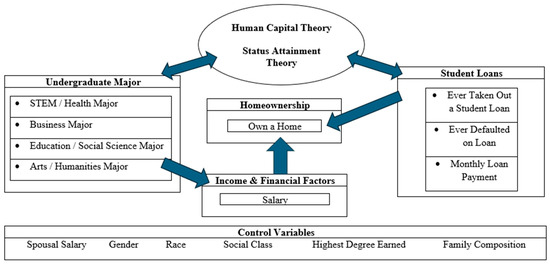
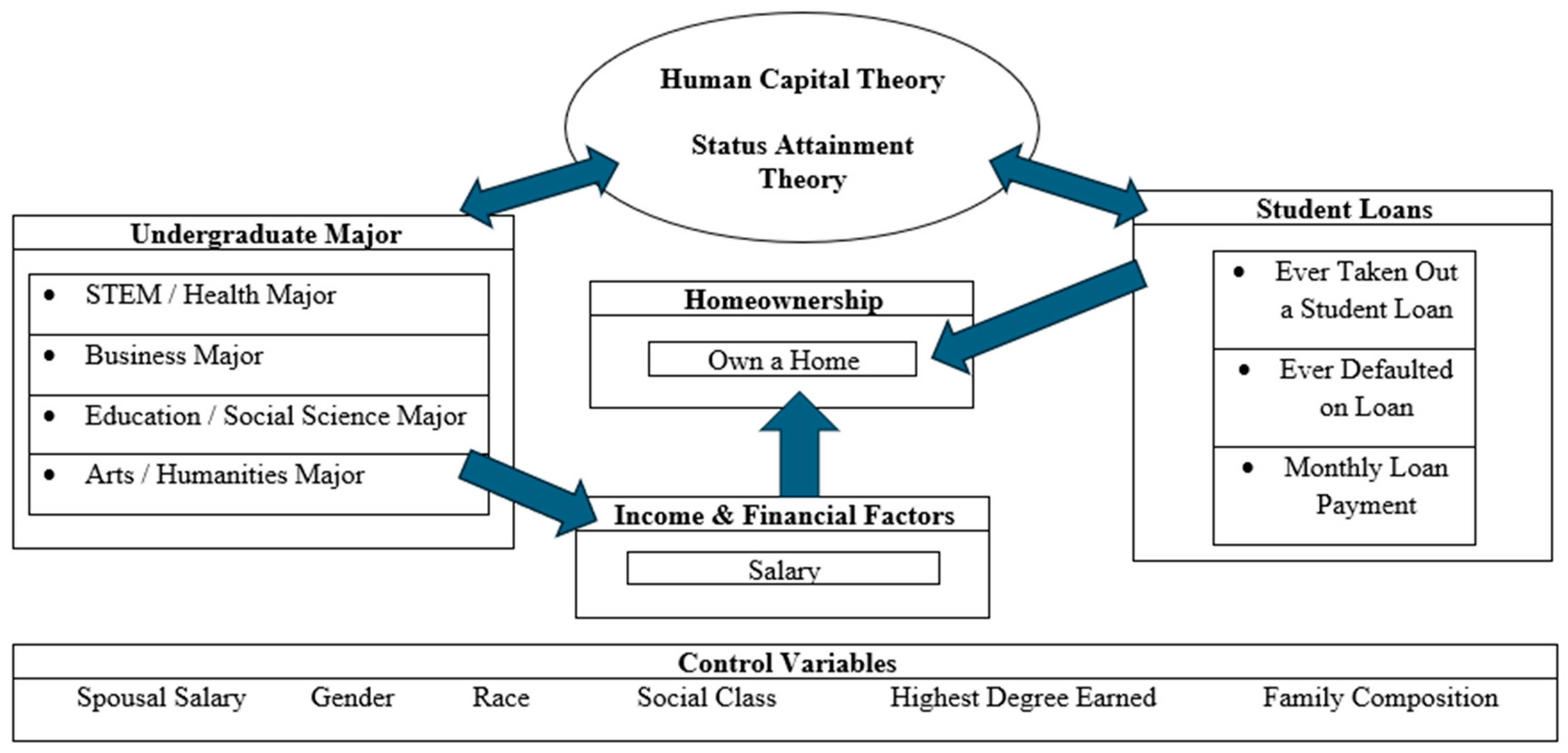

Disclaimer/Publisher’s Note: The statements, opinions and data contained in all publications are solely those of the individual author(s) and contributor(s) and not of MDPI and/or the editor(s). MDPI and/or the editor(s) disclaim responsibility for any injury to people or property resulting from any ideas, methods, instructions or products referred to in the content. |
© 2026 by the authors. Licensee MDPI, Basel, Switzerland. This article is an open access article distributed under the terms and conditions of the Creative Commons Attribution (CC BY) license.