Home Writing Environments of At-Risk and Typically Developing Children in Spain: Implications for Preventing Writing Difficulties

 , ,
, ,
Abstract
1. Introduction
1.1. The Home Writing Environment
1.2. Research on the Home Writing Environment: International Evidence and the Spanish Home Literacy Context
1.3. The Current Study
2. Materials and Methods
2.1. Participants
2.2. Instruments and Measures
2.2.1. Monitoring Measures to Detect Students At-Risk
2.2.2. Home Writing Environment Questionnaire
2.3. Procedure
2.4. Data Analysis
3. Results
3.1. Descriptive Analysis of Home Writing Practices and Support by Risk Status
3.1.1. Home Writing Practices
3.1.2. Home Writing Support
3.2. Comparative Analysis of Home Writing Practices and Support by Risk Status and Grade Level
4. Discussion
4.1. Home Writing Practices of Typically Developing and At-Risk Writers
4.2. Home Writing Support for Typically Developing and At-Risk Writers
4.3. Limitations and Future Research
5. Conclusions
Author Contributions
Funding
Institutional Review Board Statement
Informed Consent Statement
Data Availability Statement
Acknowledgments
Conflicts of Interest
Abbreviations
| CBM-W | Curriculum-Based Measures in Writing |
| HWE | Home Writing Environment |
| HWEQ | Home Writing Environment Questionnaire |
| ICT | Information and Communication Technologies |
| RtI | Response to Intervention |
| sDGs | Sustainable Development Goals |
| SES | Socioeconomic Status |
Appendix A
Appendix A.1

| Items |
|---|
| WRITING PRACTICES (whether linked to school assignments or not) |
|
|
|
|
|
|
|
|
|
|
|
|
|
|
|
|
|
Appendix A.2
| Items |
| CONTENT SUPPORT When parents collaborate with their child in writing activities, they help, teach or encourage to: |
|
|
|
|
|
|
|
|
|
|
|
| PROCEDURAL SUPPORT When helping the child with writing, how do parents provide assistance? |
|
|
|
|
|
| MOTIVATIONAL AND RESOURCE SUPPORT At home, parents: |
|
|
|
|
|
|
References
- Alex-Smith, R., Allen, A. A., & Alley, J. (2024). A literature synthesis of curriculum-based measurement in writing for English learners. Psychology in the Schools, 61(4), 1440–1457. [Google Scholar] [CrossRef] [Scilit]
- Algorri-Diez, L., Rodríguez, C., & Robledo, P. (2025). Family involvement in primary school children’s writing: A qualitative study with parent focus groups. Education Sciences, 15(12), 1711. [Google Scholar] [CrossRef] [Scilit]
- Alston-Abel, N. L., & Berninger, V. W. (2018). Relationships between home literacy practices and school achievement: Implications for consultation and home–school collaboration. Journal of Educational and Psychological Consultation, 28(2), 164–189. [Google Scholar] [CrossRef] [Scilit] [PubMed]
- Alsubaie, M. A. (2022). Factors affecting early literacy learning spaces of young children: The context of home literacy in Saudi Arabia. Education Sciences, 12(11), 791. [Google Scholar] [CrossRef] [Scilit]
- Anderson, J., Anderson, A., & Sadiq, A. (2017). Family literacy programmes and young children’s language and literacy development: Paying attention to families’ home language. Early Child Development and Care, 187(3–4), 644–654. [Google Scholar] [CrossRef] [Scilit]
- Aram, D., Abiri, S., & Elad, L. (2014). Predicting early spelling: The contribution of children’s early literacy, private speech during spelling, behavioral regulation, and parental spelling support. Reading and Writing, 27(4), 685–707. [Google Scholar] [CrossRef] [Scilit]
- Aram, D., Skibbe, L., Hindman, A., Bindman, S., Atlas, Y. H., & Morrison, F. (2020). Parent’s early writing support and its associations with parenting practices in the United States and Israel. Merril-Palmer Quarterly, 66(4), 392–420. [Google Scholar] [CrossRef] [Scilit]
- Arrimada, M., Torrance, M., & Fidalgo, R. (2018). Supporting first-grade writers who fail to learn: Multiple single-case evaluation of a response-to-intervention approach. Reading and Writing, 31(4), 865–891. [Google Scholar] [CrossRef] [Scilit]
- Arrimada, M., Torrance, M., & Fidalgo, R. (2022). Response-to-intervention in first-grade writing instruction: A large-scale feasibility study. Reading and Writing, 34, 1–27. [Google Scholar] [CrossRef] [Scilit]
- Axelsson, A., Lundqvist, J., & Sandberg, G. (2019). Influential factors of children’s reading and writing development: The perspective of parents in Swedish context. Early Child Development and Care, 190(16), 2520–2532. [Google Scholar] [CrossRef] [Scilit]
- Álvarez-Moreno, C., & Robledo, P. (under review). A systematic review of family involvement in school-aged children’s writing. Review of Educational Research. [Google Scholar] [CrossRef] [Scilit]
- Balade, J., Rodríguez, C., & Jiménez, J. E. (2024). Curriculum-based measurement for early writing struggles in Kindergarten: A systematic review. Psicologia Educativa, 30(2), 101–110. [Google Scholar] [CrossRef] [Scilit]
- Berninger, V. W., & Amtmann, D. (2003). Preventing written expression disabilities through early and continuing assessment and intervention for handwriting and/or spelling problems. In K. R. Harris, H. L. Swanson, & S. Graham (Eds.), Handbook of learning disabilities (pp. 345–363). Guilford Press. [Google Scholar]
- Berninger, V. W., & Winn, W. (2006). Implications of advancements in brain research and technology for writing development, writing instruction and educational evolution. In C. E. MacArthur, S. Graham, & J. Fitzgerald (Eds.), Handbook of writing research (pp. 96–114). Guilford Press. [Google Scholar]
- Bildfell, A. (2016). Maternal sensitivity and responsiveness: Parent teaching during shared writing activities and early literacy outcomes [Doctoral dissertation, Carleton University]. Available online: https://carleton.scholaris.ca/server/api/core/bitstreams/81ce5258-ddd2-41b9-b57a-da25d35779ab/content (accessed on 15 January 2026).
- Bindman, S. W., Skibbe, L. E., Hindman, A. H., Aram, D., & Morrison, F. J. (2014). Parental writing support and preschoolers’ early literacy, language, and fine motor skills. Early Childhood Research Quarterly, 29(4), 614–624. [Google Scholar] [CrossRef] [Scilit] [PubMed]
- Bozatlı, L., Aykutlu, H. C., Sivrikaya Giray, A., Ataş, T., Özkan, Ç., Güneydaş Yıldırım, B., & Görker, I. (2024). Children at risk of specific learning disorder: A study on prevalence and risk factors. Children, 11(7), 759. [Google Scholar] [CrossRef] [Scilit] [PubMed]
- Camacho, A., & Alves, R. A. (2017). Fostering parental involvement in writing: Development and testing of the program cultivating writing. Reading and Writing, 30(2), 253–277. [Google Scholar] [CrossRef] [Scilit]
- Coker, D. L., Ritchey, K. D., Uribe-Zarain, X., & Jennings, A. S. (2018). An analysis of first-grade writing profiles and their relationship to compositional quality. Journal of Learning Disabilities, 51(4), 336–350. [Google Scholar] [CrossRef] [Scilit] [PubMed]
- Dilnot, J., Hamilton, L., Maughan, B., & Snowling, M. J. (2017). Child and environmental risk factors predicting readiness for learning in children at high-risk of dyslexia. Development and Psychopathology, 20(1), 235–244. [Google Scholar] [CrossRef] [Scilit] [PubMed]
- Díaz-Tejedor, R., & Arrimada, M. (2025). Comprueba tu aprendizaje: ¡Vamos a por el reto! In C. Álvarez-Moreno, M. Arrimada, & R. Fidalgo (Eds.), Prevenir las dificultades de aprendizaje en escritura (pp. 278–285). Piramide. [Google Scholar]
- Erbeli, F., Hart, S. A., & Taylor, J. (2019). Genetic and environmental influences on achievement outcomes based on family history of learning disabilities status. Journal of Learning Disabilities, 52(2), 135–145. [Google Scholar] [CrossRef] [Scilit] [PubMed]
- Esmaeeli, S. (2023). A model of the home literacy environment and family risk of reading difficulty in relation to children’s preschool emergent literacy. Journal of Learning Disabilities, 57(3), 181–196. [Google Scholar] [CrossRef] [Scilit] [PubMed]
- Esmaeeli, Z., Kyle, F. E., & Lundetræ, K. (2019). Contribution on family risk, emergent literacy and environmental protective factors in children’s reading difficulties at the end of second grade. Reading and Writing, 32(9), 2375–2399. [Google Scholar] [CrossRef] [Scilit]
- Farry-Thorn, M., Treiman, R., & Robins, S. (2020). Letter teaching in parent-child conversations. Early Childhood Research Quarterly, 53, 161–170. [Google Scholar] [CrossRef] [Scilit] [PubMed]
- Fletcher, J. M., & Vaughn, S. (2009). Response to intervention: Preventing and remediating academic difficulties. Child Development Perspectives, 3(1), 30–37. [Google Scholar] [CrossRef] [Scilit] [PubMed]
- Foegen, A. (2008). Algebra progress monitoring and interventions for students with learning disabilities. Learning Disability Quarterly, 31(2), 65–78. [Google Scholar] [CrossRef] [Scilit]
- Foegen, A., Jiban, C., & Deno, S. (2007). Progress monitoring measures in mathematics. A review of the literature. The Journal of Special Education, 41(2), 121–139. [Google Scholar] [CrossRef] [Scilit]
- Frijters, J., Barron, R., & Brunello, M. (2000). Direct and mediated influences of home literacy and literacy interest on prereaders’ oral vocabulary and early written language skill. Journal of Educational Phychology, 92(3), 466–477. [Google Scholar] [CrossRef]
- Fuchs, D., & Fuchs, L. S. (2006). Introduction to response to intervention: What, why and how valid is it? Reading Research Quarterly, 41(1), 93–99. [Google Scholar] [CrossRef] [Scilit]
- Fuchs, L., Fuchs, D., Compton, D. L., Bryant, J., Hamlett, C. L., & Seethaler, P. M. (2007). Mathematics screening and progress monitoring at first grade: Implications for responsiveness to intervention. Exceptional Children, 73(3), 311–330. [Google Scholar] [CrossRef] [Scilit]
- Gardner, P. (2013). Writing in context: Reluctant writers and their writing at home and at school. English Australia, 48, 71–81. [Google Scholar]
- González-Pulido, H., Rodríguez-Ruiz, B., & Martínez-González, R. A. (2025). Literacy practices and reading motivation in families with children in early childhood education. Investigaciones Sobre Lectura, 20(1), 23–47. [Google Scholar] [CrossRef] [Scilit]
- Graham, S. (2018a). A revised writer(s)-within-community model of writing. Educational Psychologist, 53(4), 258–279. [Google Scholar] [CrossRef] [Scilit]
- Graham, S. (2018b). A writer(s)-within-community model of writing. In C. Bazerman, A. N. Applebee, V. Berninger, D. Brandt, S. Graham, J. V. Jeffery, & K. Campbell (Eds.), The lifespan development of writing (pp. 272–325). National Council of Teachers of English. [Google Scholar]
- Graham, S., & Harris, K. (2018). Evidence-based writing practices: A meta-analysis of existing meta-analyses. In M. Braaksma, K. R. Harris, & R. Fidalgo (Eds.), Design principles for teaching effective writing: Theoretical and empirical grounded principles (pp. 13–37). Brill Academic Publishers. [Google Scholar] [CrossRef] [Scilit] [PubMed]
- Graham, S., & Hebert, M. (2011). Writing to read: A Meta-analysis of the impact of writing and writing instruction on reading. Harvard Educational Review, 81(4), 710–744. [Google Scholar] [CrossRef] [Scilit]
- Graham, S., Liu, X., Aitken, A., Ng, C., Bartlett, B., Harris, K. R., & Holzapfel, J. (2018a). Effectiveness of literacy programs balancing reading and writing instruction: A meta-analysis. Reading Research Quarterly, 53(3), 279–304. [Google Scholar] [CrossRef] [Scilit]
- Graham, S., Liu, X., Bartlett, B., Ng, C., Harris, K. R., Aitken, A. A., Barkel, A., Kavanaugh, C., & Talukdar, J. (2018b). Reading for writing: A meta-analysis of the impact of reading and reading interventions on writing. Review of Educational Research, 88(2), 243–284. [Google Scholar] [CrossRef] [Scilit]
- Graham, S., & Perin, D. (2007). Writing next: Effective strategies to improve writing for adolescents in middle and high schools—A report Carnegie corporation of New York. Alliance for Excellent Education. [Google Scholar]
- Grigorenko, E. L., Compton, D. L., Fuchs, L. S., Wagner, R. K., Willcutt, E. G., & Fletcher, J. M. (2020). Understanding, educating, and supporting children with specific learning disabilities: 50 Years of science and practice. American Psychologist, 75(1), 37–51. [Google Scholar] [CrossRef] [Scilit] [PubMed]
- Hamilton, L. G., Hayiou-Thomas, M. E., Hulme, C., & Snowling, M. J. (2016). The home literacy environment as a predictor of the early literacy development of children at family-risk of dyslexia. Scientific Studies of Reading, 20(5), 401–419. [Google Scholar] [CrossRef] [Scilit] [PubMed]
- Hayes, J. R. (2012). Modeling and remodeling writing. Written Communication, 29(3), 369–388. [Google Scholar] [CrossRef] [Scilit]
- Herrera, D. D. A., & Guayana, T. G. F. (2022). As práticas lúdicas em família na aprendizagem da leitura e escrita em alunos do primeiro grau. Acta Scientiarum. Education, 44(1), e61343. [Google Scholar] [CrossRef] [Scilit]
- Janikowski, L. I., & Norvitilis, J. M. (2020). Parental perceptions of children with and without learning disabilities. Modern Psychological Studies, 25(1), 11. [Google Scholar]
- Kaizu, A., & Tamaki, M. (2024). Predicting reading achievement through progress monitoring in elementary school. Journal of Research in Childhood Education, 38(1), 14–29. [Google Scholar] [CrossRef] [Scilit]
- Kelso-Marsh, B., Abreu Malpique, A., & Davis, H. (2025a). “My mum sometimes helps me with my writing”: Parents’ and children’s perspectives of home-led writing. Teaching and Teacher Education, 165, 105174. [Google Scholar] [CrossRef] [Scilit]
- Kelso-Marsh, B., Abreu Malpique, A., Davis, H., & Similiena Valcan, D. (2025b). Motivation matters: The positive influence of parental involvement on children’s writing outcome. Journal of Writing Research, 17(2), 309–337. [Google Scholar] [CrossRef] [Scilit]
- Kim, Y.-S., Petscher, Y., Schatschneider, C., & Foorman, B. (2010). Does growth rate in oral reading fluency matter in predicting reading comprehension achievement? Journal of Educational Psychology, 102(3), 652–667. [Google Scholar] [CrossRef] [Scilit]
- Kim, Y.-S. G., & Graham, S. (2022). Expanding the direct and indirect effects model of writing (DIEW): Reading–writing relations, and dynamic relations as a function of measurement/dimensions of written composition. Journal of Educational Psychology, 114(2), 215–238. [Google Scholar] [CrossRef] [Scilit] [PubMed]
- Kline, R. B. (2011). Convergence of structural equation modeling and multilevel modeling. In M. Williams, & W. P. Vogt (Eds.), Handbook of methodological Innovation in social research methods. Sage. [Google Scholar]
- Krijnen, E., van Steensel, R., Meeuwise, M., Jongerling, J., & Severiens, S. (2020). Exploring a refined model of home literacy activities and associations with children’s emergent literacy skills. Reading and Writing, 33(1), 207–238. [Google Scholar] [CrossRef] [Scilit]
- Leyva, D., Reese, E., & Wiser, M. (2012). Early understanding of the functions of print: Parent-child interaction and preschoolers’ notating skills. First Language, 32(2), 301–323. [Google Scholar] [CrossRef] [Scilit]
- Lin, D., McBride-Chang, C., Aram, D., & Levin, I. (2011). Mother–child joint writing in Chinese kindergarteners: Metalinguistic awareness, maternal mediation and literacy acquisition. Journal of Research in Reading, 34(4), 426–442. [Google Scholar] [CrossRef] [Scilit]
- Lin, N. T., Molgaard, M., Wishard Guerra, A., & Cohen, S. (2023). Young children and families’ home literacy and technology practices before and during COVID-19. Journal of Early Childhood Research, 21(3), 341–354. [Google Scholar] [CrossRef] [Scilit]
- LOMLOE. (2020). Ley Orgánica 3/2020, de 29 de diciembre, por la que se modifica la Ley Orgánica 2/2006, de 3 de mayo, de Educación. Boletín Oficial del Estado, 340, 122868–122953. [Google Scholar]
- Moreno-Morilla, C., Guzmán-Simón, F., & García-Jiménez, E. (2018). Literacy practices of primary education children in Andalusia (Spain): A family-based perspective. British Educational Research Journal, 45(1), 117–136. [Google Scholar] [CrossRef] [Scilit]
- Neumann, M. M. (2018). Maternal scaffolding of preschoolers’ writing using tablet and paper-pencil tasks: Relations with emergent literacy skills. Journal of Research in Childhood Education, 32(1), 67–80. [Google Scholar] [CrossRef] [Scilit]
- Neumann, M. M., Hood, M., & Neumann, D. L. (2009). The scaffolding of emergent literacy skills in the home environment: A case study. Early Childhood Education Journal, 36, 313–319. [Google Scholar] [CrossRef] [Scilit]
- Neumann, M. M., & Neuman, D. L. (2010). Parental strategies to scaffold emergent writing skills in the pre-school child within the home environment. Early Years, 30(1), 79–94. [Google Scholar] [CrossRef] [Scilit]
- Ngorosho, D., & Lahtinen, U. (2010). The role of the home environment in phonological awareness and reading and writing ability in Tanzanian primary schoolchildren. Education Inquiry, 1(3), 211–234. [Google Scholar] [CrossRef] [Scilit][Green Version]
- Nkomo, S. A., Magxala, X. P., & Lebopa, N. (2023). Early literacy experiences of two children during COVID-19 lockdown in South Africa: A semi- ethnographic study. Journal of Early Childhood Literacy, 23(1), 141–174. [Google Scholar] [CrossRef] [Scilit]
- Nyhout, A., & O’Neil, D. K. (2013). Mothers’ complex talk when sharing books with their toddlers. First Language, 33(2), 115–131. [Google Scholar] [CrossRef] [Scilit]
- Park, S. Y. (2019). A study on Korean young children’s writing development and parents’ perception of writing education. International Journal of Innovation, Creativity and Change, 7(3), 275–285. [Google Scholar]
- Peterson, S. S., Grimes, A., & Sky, K. (2021). Rural and indigenous families’ support of young children’s writing. Texas Journal of Literacy Education, 9(1), 18–34. [Google Scholar]
- Puglisi, M. L., Hulme, C., Hamilton, L. G., & Snowling, M. J. (2017). The home literacy environment is a correlate, but perhaps not a cause, of variations in children’s language and literacy development. Scientific Studies of Reading, 21(6), 498–514. [Google Scholar] [CrossRef] [Scilit] [PubMed]
- Puranik, C. S., Phillips, B. M., Lonigan, C. J., & Gibson, E. (2018). Home literacy practices and preschool children’s emergent writing skills: An initial investigation. Early Childhood Research Quarterly, 42(1), 228–238. [Google Scholar] [CrossRef] [Scilit]
- Robins, S., & Treiman, R. (2009). Talking about writing: What we can learn from conversations between parents and their young children. Applied Psycholinguistics, 30(3), 463–484. [Google Scholar] [CrossRef] [Scilit] [PubMed][Green Version]
- Robledo, P., Arias-Gundín, O., & Algorri-Diez, L. (2026a). Psychometric validation of home writing practices and support questionnaires. Assessing Writing. [Google Scholar]
- Robledo, P., & García, J. N. (2013). Strategy instruction for writing composition at school and at home. Studies in Psychology, 34(2), 161–174. [Google Scholar] [CrossRef] [Scilit]
- Robledo, P., & Olivares, F. (2022). El tratamiento curricular de la escritura en España: Enfoque instruccional y preventivo. In M. Arrimada, R. Fidalgo, & M. Torrance (Eds.), ¿Cómo prevenir las dificultades de aprendizaje en la escritura? Pirámide. [Google Scholar]
- Robledo, P., Real Castelao, S., Rodríguez, C., & Álvarez-Fernández, M. L. (2026b). Spanish primary students’ writing attitudes and perceived family support: A socioemotional perspective. Frontiers in Psychology, 17, 1754157. [Google Scholar] [CrossRef] [Scilit] [PubMed]
- Schatschneider, C., Wagner, R. K., & Crawford, E. C. (2008). The importance of measuring growth in response to intervention models: Testing a core assumption. Learning and Individual Differences, 18(3), 308–315. [Google Scholar] [CrossRef] [Scilit] [PubMed][Green Version]
- Sénéchal, M. (2006). Testing the home literacy model: Parent involvement in kindergarten is differentially related to grade 4 reading comprehension, fluency, spelling and reading for pleasure. Scientific Studies of Reading, 10(1), 59–87. [Google Scholar] [CrossRef] [Scilit] [PubMed]
- Sénéchal, M., & LeFevre, J.-A. (2002). Parental involvement in the development of children’s reading skill: A five-year longitudinal study. Child Development, 73(2), 445–460. [Google Scholar] [CrossRef] [Scilit] [PubMed]
- Sénéchal, M., & LeFevre, J.-A. (2014). Continuity and change in the home literacy environment as predictors of growth in vocabulary and reading. Child Development, 85(4), 1552–1568. [Google Scholar] [CrossRef] [Scilit] [PubMed]
- Singamaneni, S. (2011). Exploring content validity, item level analysis and predictive validity for two algebra progress monitoring measures. Iowa State University. [Google Scholar]
- Skibbe, L. E., Bindmand, S. W., Hindman, A. H., Aram, D., & Morrison, F. J. (2013). Longitudinal relations between parental writing support and preschoolers’ language and literacy skills. Reading Research Quarterly, 48(4), 387–401. [Google Scholar] [CrossRef] [Scilit] [PubMed]
- Sonnenschein, S., Stites, M., & Ross, A. (2021). Home learning environments for young children in the U.S. during COVID–19. Early Education and Development, 32(6), 794–811. [Google Scholar] [CrossRef] [Scilit]
- Sparks, A., & Reese, E. (2013). From reminiscing to reading: Home contributions to children’s developing language and literacy in low-income families. First Language, 33(1), 89–109. [Google Scholar] [CrossRef] [Scilit]
- Swain, J. M., & Cara, O. (2017). Changing the home literacy environment through participation in family literacy programmes. Journal of Early Childhood Literacy, 19(4), 431–458. [Google Scholar] [CrossRef] [Scilit]
- Tichnor-Wagner, A., Garwood, J. D., Bratsh-Hines, M., & Vernon-Feagans, L. (2016). Home literacy environments and foundational literacy skills for struggling and nonstruggling readers in rural early elementary schools. Learning Disabilities Research & Practice, 31(1), 6–21. [Google Scholar] [CrossRef] [Scilit]
- Topping, K., Dekhinet, R., & Zeedyk, S. (2011). Hindrances for parents in enhancing child language. Educational Psychology Review, 23, 413–455. [Google Scholar] [CrossRef] [Scilit]
- United Nations. (2015). Transforming our world: The 2030 agenda for sustainable development. United Nations. [Google Scholar]
- Wollman-Bonilla, J. E. (2001). Family involvement in early writing instruction. Journal of Early Childhood Literacy, 1(2), 167–192. [Google Scholar] [CrossRef] [Scilit]


| At-Risk Group | Non-Risk Group | ||||
|---|---|---|---|---|---|
| Grade 1 | Grade 2 | Grade 1 | Grade 2 | Total | |
| N | 21 | 27 | 121 | 127 | 296 |
| Male | 14 | 17 | 61 | 58 | 150 |
| Female | 7 | 10 | 60 | 69 | 146 |
| Age mean (SD) | 6.66 (0.303) | 7.72 (0.269) | 6.61 (0.452) | 7.61 (0.289) | 7.14 (0.623) |
| Total | 48 | 248 | |||
| Parent 1 | Parent 2 | ||
|---|---|---|---|
| Age mean (SD) | 42.29 (5.16) | 44.86 (5.46) | |
| % Male | 0.4% | 99.2% | |
| Employment | Actively working | 89.2% | 95.3% |
| Unemployed/benefit claimant | 3.5% | 2% | |
| Homemaker | 2.8% | 0.8% | |
| Retired | 3.8% | 1.6% | |
| Studying | 0.7% | 0.4% | |
| Educational attainment | No qualifications | 0.7% | 0.8% |
| Compulsory education | 8% | 10% | |
| Vocational training | 12.5% | 19.2% | |
| Further education (Bachillerato) | 13.9% | 20.4% | |
| University degree | 64.8% | 49.6% | |
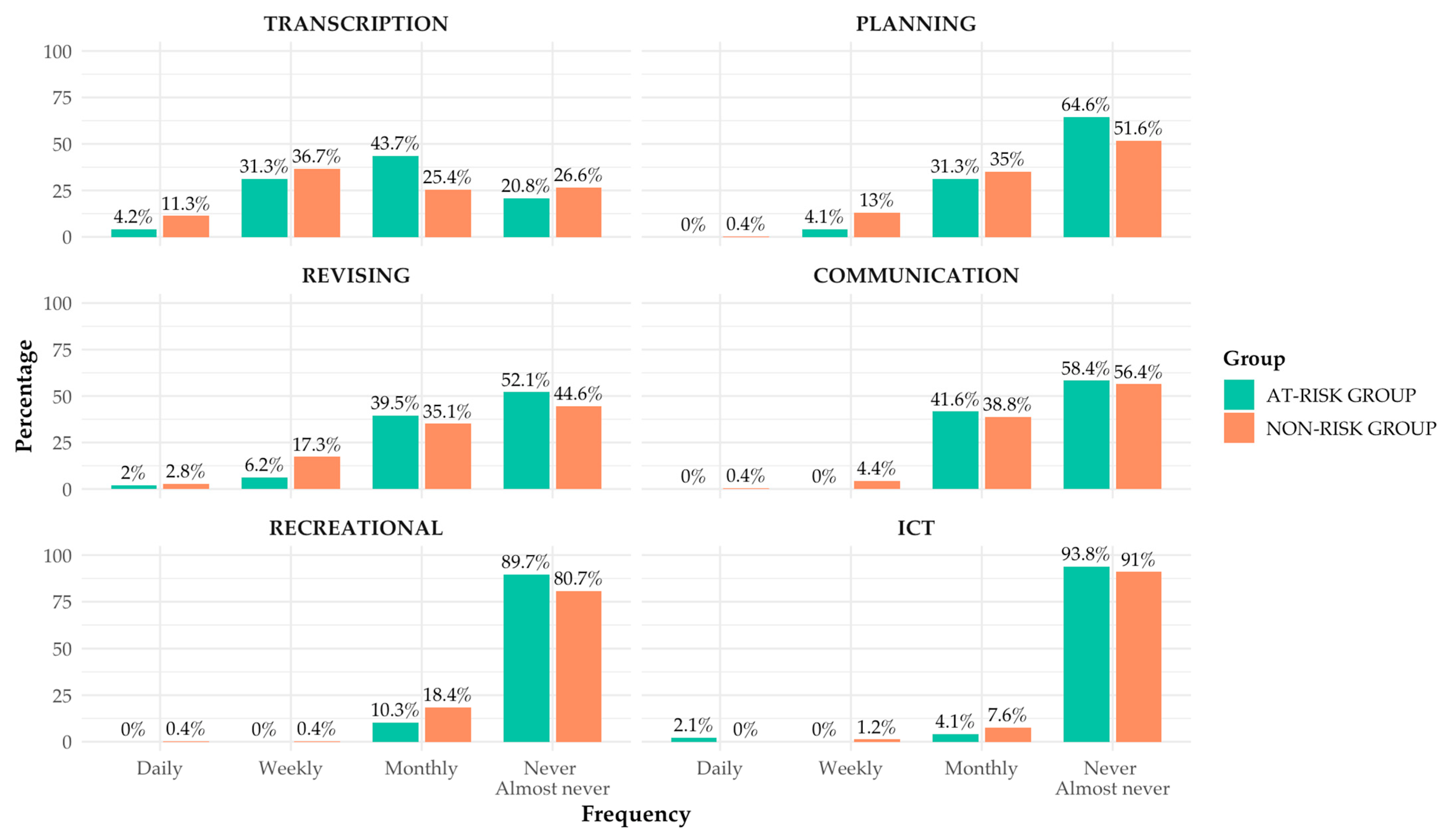
| Variable | Daily | Weekly | Monthly | Never/Almost Never |
|---|---|---|---|---|
| Transcription | 11.3% | 36.7% | 25.4% | 26.6% |
| Planning | 0.4% | 12.98% | 35% | 51.6% |
| Revising | 2.8% | 17.3% | 35.1% | 44.6% |
| Communication | 0.4% | 4.4% | 38.8% | 56.4% |
| Recreation | 0.4% | 0.4% | 18.4% | 80.7% |
| ICT | 0% | 1.2% | 7.6% | 91% |
| Variable | Daily | Weekly | Monthly | Never/Almost Never |
|---|---|---|---|---|
| Transcription | 4.2% | 31.3% | 43.7% | 20.08% |
| Planning | 0% | 4.1% | 31.3% | 64.6% |
| Revising | 2% | 6.2% | 39.5% | 52.1% |
| Communication | 0% | 0% | 41.6% | 58.4% |
| Recreation | 0% | 0% | 10.3% | 89.7% |
| ICT | 2.1% | 0% | 4.1% | 93.8% |
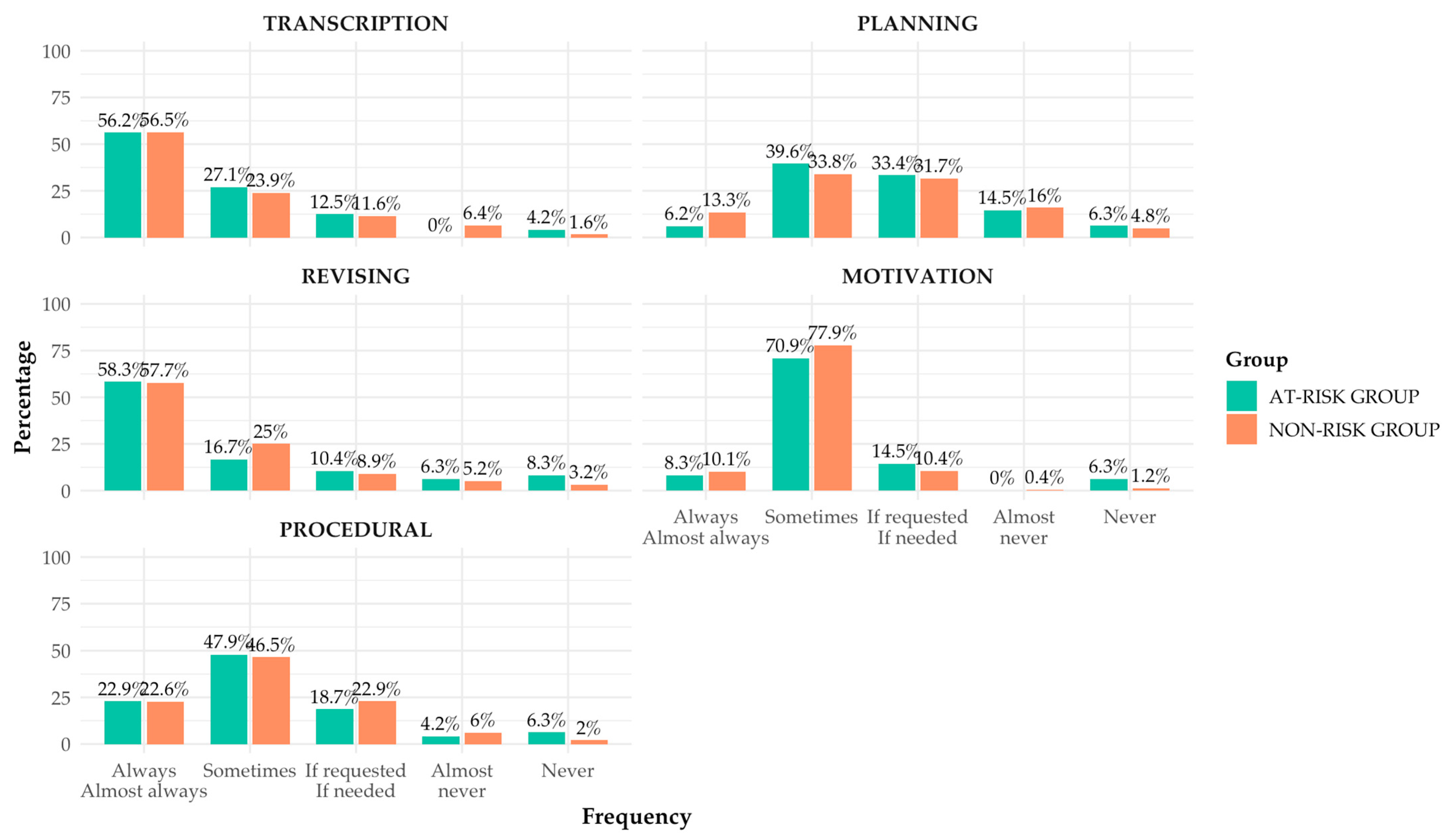
| Variable | Always/ Almost Always | Sometimes | If Requested/If Needed | Almost Never | Never |
|---|---|---|---|---|---|
| Transcription | 56.5% | 23.9% | 11.6% | 6.4% | 1.6% |
| Planning | 13.3% | 33.8% | 31.7% | 16% | 4.8% |
| Revising | 57.7% | 25% | 8.9% | 5.2% | 3.2% |
| Motivation | 10.1% | 77.9% | 10.4% | 0.4% | 1.2% |
| Procedural | 22.6% | 46.5% | 22.9% | 6% | 2% |
| Variable | Always/ Almost Always | Sometimes | If Requested/If Needed | Almost Never | Never |
|---|---|---|---|---|---|
| Transcription | 56.2% | 27.1% | 12.5% | 0% | 4.2% |
| Planning | 6.2% | 39.6% | 33.4% | 14.5% | 6.3% |
| Revising | 58.3% | 16.7% | 10.4% | 6.3% | 8.3% |
| Motivation | 8.3% | 70.9% | 14.5% | 0% | 6.3% |
| Procedural | 22.9% | 47.9% | 18.7% | 4.2% | 6.3% |
| U | p | M | SD | ||||
|---|---|---|---|---|---|---|---|
| At-Risk Group | Non-Risk Group | At-Risk Group | Non-Risk Group | ||||
| Total | Pr_Planning | 7304 | 0.006 | 2.438 | 3.064 | 1.398 | 1.424 |
| Pr_ICT | 6789 | 0.052 | 1.486 | 1.550 | 1.157 | 0.866 | |
| Sup_Item 12 | 4422 | 0.024 | 4.667 | 4.302 | 0.564 | 0.949 | |
| 1st Grade | Pr_Item 2 | 1303.5 | 0.013 | 2.333 | 3.103 | 0.907 | 1.310 |
| Pr_Item 4 | 1338 | 0.054 | 1.474 | 2.000 | 0.513 | 1.099 | |
| Pr_Planning | 1831 | 0.001 | 1.976 | 3.030 | 3.050 | 1.362 | |
| Pr_Item 10 | 1560.5 | 0.003 | 1.789 | 2.793 | 1.084 | 1.501 | |
| Pr_Item 11 | 1452 | 0.006 | 2.211 | 3.373 | 1.512 | 1.734 | |
| Pr_Item 12 | 1313.5 | 0.044 | 2.278 | 3.080 | 1.526 | 1.691 | |
| Pr_Revising | 1587 | 0.029 | 2.286 | 2.979 | 4.438 | 0.925 | |
| Pr_Item 14 | 1374 | 0.032 | 2.421 | 3.018 | 2.116 | 1.646 | |
| Sup_Item 12 | 815 | 0.035 | 4.789 | 4.325 | 0.419 | 0.889 | |
| 2nd Grade | Pr_ICT | 2121 | 0.022 | 1.333 | 1.672 | 0.795 | 0.958 |
| Pr_Item 15 | 1856 | 0.047 | 1.840 | 2.558 | 1.434 | 1.873 | |
Disclaimer/Publisher’s Note: The statements, opinions and data contained in all publications are solely those of the individual author(s) and contributor(s) and not of MDPI and/or the editor(s). MDPI and/or the editor(s) disclaim responsibility for any injury to people or property resulting from any ideas, methods, instructions or products referred to in the content. |
© 2026 by the authors. Licensee MDPI, Basel, Switzerland. This article is an open access article distributed under the terms and conditions of the Creative Commons Attribution (CC BY) license.
Share and Cite
Álvarez-Moreno, C.; Robledo, P.; Arias-Gundín, O.; Álvarez-Fernánzez, M.L.; Fidalgo, R. Home Writing Environments of At-Risk and Typically Developing Children in Spain: Implications for Preventing Writing Difficulties. Educ. Sci. 2026, 16, 1438. https://doi.org/10.3390/educsci16091438
Álvarez-Moreno C, Robledo P, Arias-Gundín O, Álvarez-Fernánzez ML, Fidalgo R. Home Writing Environments of At-Risk and Typically Developing Children in Spain: Implications for Preventing Writing Difficulties. Education Sciences. 2026; 16(9):1438. https://doi.org/10.3390/educsci16091438
Chicago/Turabian StyleÁlvarez-Moreno, Carmen, Patricia Robledo, Olga Arias-Gundín, Mª Lourdes Álvarez-Fernánzez, and Raquel Fidalgo. 2026. "Home Writing Environments of At-Risk and Typically Developing Children in Spain: Implications for Preventing Writing Difficulties" Education Sciences 16, no. 9: 1438. https://doi.org/10.3390/educsci16091438
APA StyleÁlvarez-Moreno, C., Robledo, P., Arias-Gundín, O., Álvarez-Fernánzez, M. L., & Fidalgo, R. (2026). Home Writing Environments of At-Risk and Typically Developing Children in Spain: Implications for Preventing Writing Difficulties. Education Sciences, 16(9), 1438. https://doi.org/10.3390/educsci16091438