


Abstract
This study leverages both Kolb’s experiential learning theory and technological pedagogical content knowledge (TPACK) to explore elementary school pre-service teachers’ experiences using generative artificial intelligence (GenAI) to provide ideas to differentiate instruction. Findings from this exploratory study indicate that pre-service teachers (PSTs) found GenAI tools helpful and aligned to research-based approaches taught in the course. Additionally, PSTs who had more robust background knowledge made more connections to differentiating mathematics strategies with reference to a progression of supports from concrete to pictorial to abstract activities. Implications from this study include the need for teacher educators to thoughtfully consider the use of GenAI and for scholars to systematically examine the potential benefits and drawbacks of these tools.
1. Introduction
1.1. Preparing Teachers and Pre-Service Teachers to Differentiate Instruction
Teachers have complex jobs that involve interpreting academic content standards and determining how to best support their students in meeting those standards (Ball & Forzani, 2009; Davis & Sumara, 2014; Fuchs et al., 2007; Tomlinson, 2014). In their large-scale meta-analysis, Hattie et al. (2016) identified differentiated instruction and formative assessment, the process of using data to determine future instructional activities, as research-based approaches that have a substantially positive influence on student learning outcomes. Approaches to effectively improve student outcomes, processes focused on formative assessment and differentiated instruction continue to be very promising (Am et al., 2023; Hattie et al., 2016; Palm et al., 2017).
In the case of elementary school mathematics, the effective use of differentiation strategies requires teachers to know mathematics concepts and pedagogies that can be leveraged to teach those concepts (Hill & Ball, 2009; Palm et al., 2017). These processes are challenging for teachers with the ongoing need to respond to data and determine future instructional activities (Polly et al., 2017; Wiliam, 2006). Specifically, some teachers require baseline knowledge about how to differentiate instruction with hands-on manipulatives, specific strategies, and choice of activities, while others possess the baseline knowledge but need more support with determining when to use specific approaches based on their students’ data (Martin et al., 2016). Regardless, teachers need and benefit from learning about specific differentiation strategies and how to use them to support their students (McNeill & Polly, 2023).
In teacher education with pre-service teachers (PSTs), who are earning their initial teacher license, there is more of a need to support their learning. PSTs require experiences that develop an understanding of mathematics concepts, research-based approaches to teaching those concepts, not to mention when they should use specific approaches (Association of Mathematics Teacher Educators, 2017; van den Kieboom & Groleau, 2022; van Es et al., 2026).
1.2. The Potential of Generative AI Tools to Support Differentiated Instruction
With all that PSTs need to learn, access to generative AI (GenAI) tools may be able to support the learning (Kalniņa et al., 2024). This includes the multiple aspects of differentiating mathematics instruction (Alwakid et al., 2025). Teachers can use GenAI by entering prompts and/or questions, and immediately receiving explanations to concepts, teaching pedagogies, and ideas for resources. Past projects have noted examples where PSTs have used GenAI tools to learn in general about pedagogies, ideas for instructional activities, assessments, and ways to support their learners (Alwakid et al., 2025; Belloula, 2025; Kalniņa et al., 2024). Pre-service teachers’ experiences include both positive confidence and skepticism about GenAI’s potential to create lesson plans based on the amount of detail and types of activities generated by their prompts (Kalenda et al., 2025). Specifically, in mathematics education, Yu et al. (2026) found that PSTs used GenAI tools for multiple reasons during the lesson planning process. They found that while PSTs in their study used GenAI tools and learned how to use these tools, the PSTs faced challenges adapting the ideas to their own contexts in ways that matched their students’ specific needs and developmental levels (Yu et al., 2026).
While GenAI tools have the potential to support teacher learning related to differentiating mathematics instruction, more work is needed in this area. Specifically, scholars have advanced recommendations that teacher education programs develop PSTs’ literacy in GenAI tools as well as their ability to discern when GenAI can and cannot help (Han, 2025; Guan et al., 2025; Lee & Bryan, 2025). To this end, most of the GenAI studies with PSTs continue to focus on experiences in which they are learning about how to use GenAI tools not how GenAI tools can help them generate ideas about specific pedagogies or teaching strategies to teach content (e.g., Salas-Pilco et al., 2022; van den Berg & Du Plessis, 2023). To this end, this exploratory study examined the research question, “What were the experiences of elementary school PSTs when using a GenAI tool to explore differentiation ideas in mathematics?”
2. Theoretical Frameworks
This exploratory study is grounded in the theoretical frameworks of experiential learning theory (Kolb, 2014; Kolb & Fry, 1975) and technological pedagogical content knowledge ([TPACK]; Mishra, 2019; Mishra & Koehler, 2006). In this section I describe the frameworks and make connections to the context of teacher education with PSTs.
2.1. Experiential Learning Theory
Kolb (2014) advanced the idea of experiential learning, which has roots back to Dewey’s notion of active learning (Dewey, 1938/1997). Kolb posited that “learning is the process whereby knowledge is created through the transformation of experience (p. 38).” Experiential learning has four distinct phases: (1) participating in a concrete experience (doing), (2) reflecting on the experience (watching/reflecting), (3) abstract conceptualization where the learner thinks about what they have learned (thinking), and (4) active experimentation where the learning is applied (applying). While Kolb named these four phases, he said that individuals may vary in terms of which phase or phases are most impactful on their own learning (Kolb & Fry, 1975).
Experiential learning is an intuitive approach in teacher education since nearly all teacher education programs teach PSTs new pedagogies through experiencing them as learners (Phase 1), and at some point trying them out in clinical practice or practicum settings (Phase 4). Where teacher education programs may not align fully with Kolb’s theory is the reflection about the learning experience (Phase 2), which in turn may impede the abstract conceptualization of their experience (Phase 3). In this study, PSTs’ learning was organized to align with all four phases of Kolb’s model. This is described later in the Section 3 of the paper.
2.2. Technological Pedagogical Content Knowledge (TPACK)
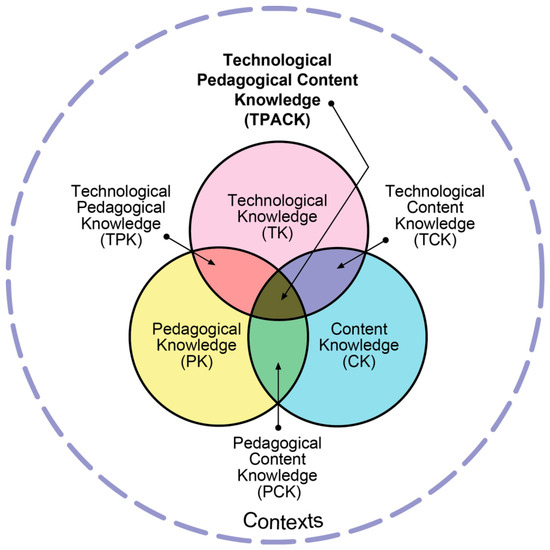
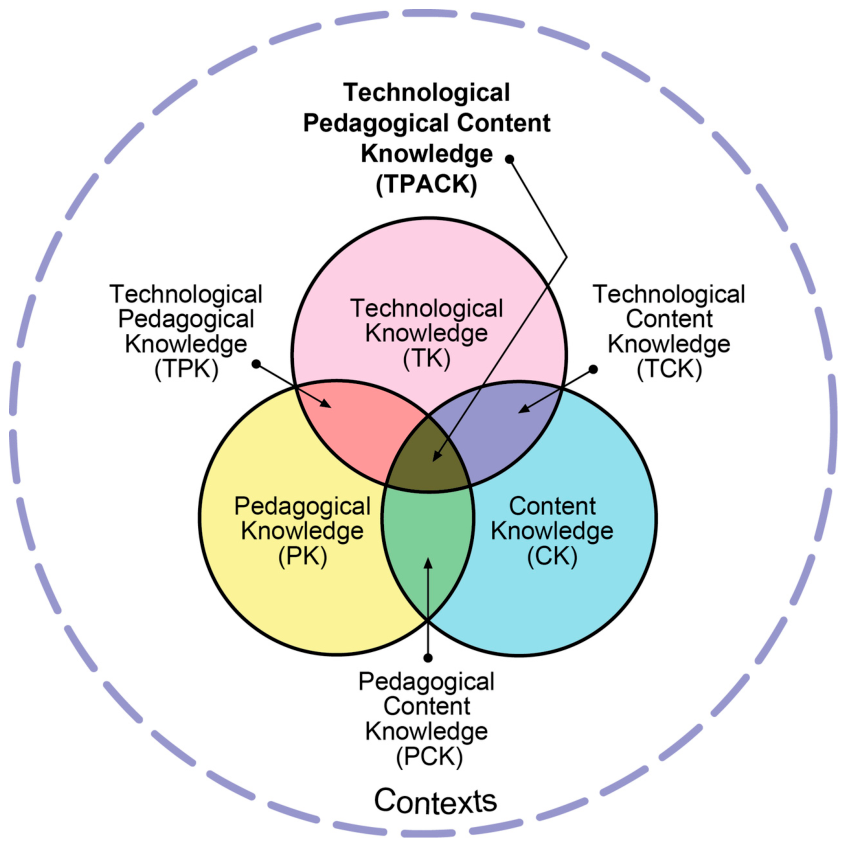
TPACK is a construct that explains the knowledge associated with teachers using technology in the work of teaching (Mishra, 2019; Mishra & Koehler, 2006). Figure 1 provides the seminal model of TPACK which shows the overlap between the three core elements of technological knowledge (TK), pedagogical knowledge (PK), and content knowledge (CK). The goal of teacher and PSTs’ learning differs based on their needs, but Mishra and Koehler posit that teachers need learning experiences that focus on the center of the Venn diagram, which is the intersection of knowledge related to technology, pedagogy, and content (Mishra & Koehler, 2006).
Figure 1.
TPACK model. “Reproduced by permission of the publisher, © 2012 by tpack.org”.
TPACK has been used in teacher education programs to explain PSTs’ learning and development of knowledge related to both teaching with technology (Tondeur et al., 2020) as well as using technology for non-instructional duties (Stinken-Rösner et al., 2023; Tschönhens et al., 2024). Those non-instructional duties could include creating a lesson plan, instructional materials, or finding background information about topics that individuals will teach soon.
Scholars have documented that TPACK development has occurred in multiple ways in the literature, including completing activities with content-specific digital tools (Niess et al., 2010), exploring tasks with digital tools as learners and discussing how to use those same tools in their own classroom (Orrill & Polly, 2016), and designing or planning activities with digital tools (Arya et al., 2020; Koh, 2019).
2.3. Synthesizing Frameworks in the Context of GenAI
In the context of supporting PSTs through the use of artificial intelligence tools in education (GenAI), Kolb’s experiential learning model with the four phases provides a framework to offer an explanation about what learning could look for PSTs and GenAI tools. Meanwhile, the TPACK framework provides a way to discuss what PSTs are learning during experiential learning about GenAI tools and how they can be used to support teaching and learning.
While GenAI has shown promise in helping PSTs to plan lessons and create instructional activities (van den Berg & Du Plessis, 2023; Celik et al., 2022), scholars have cited the need for further research to examine how teachers interact with GenAI tools as well as what the influence of these tools has on both teachers’ learning and student learning (Celik et al., 2022; Salas-Pilco et al., 2022). Therefore, this exploratory study was designed to examine PSTs’ experiences using a GenAI tool to support their learning about ways to differentiate instructional activities based on learners’ specific needs.
3. Methods
The purpose of this exploratory study is to examine the research question: what were the experiences of elementary school PSTs when using a GenAI tool to explore ways to differentiate mathematics lessons? This question was examined by qualitatively analyzing PSTs’ written reflections that were part of their course assignments.
3.1. Context and Participants
This study took place in two initial licensure mathematics pedagogy courses in two different teacher education programs housed at a large university near a major city in the southeastern United States. The first course included 34 undergraduates where PSTs were in an in-person bachelor’s degree program in elementary education. The second course included 26 graduate students is a 100% online program where PSTs earn their initial teaching license and a graduate degree in elementary education. Table 1 provides an overview of the context and participants.
Table 1.
Context and participants in the study.
Participants in both courses were at the beginning of their initial licensure program. In the undergraduate program most PSTs were juniors, with a few sophomores also participating in the course. In the graduate course, all PSTs held an undergraduate degree in a non-education related area and were working on their initial teaching license. Some PSTs in the graduate program had their own classrooms as resident (lateral entry) teachers, some worked as teacher assistants, and some were not working in an educational setting.
Participants ranged in their experiences of GenAI and AI tools for both personal and professional use. Some participants in both courses indicated that they had extensive experience using ChatGPT 5.6 for academic uses, such as writing emails or accessing background content for courses that they were taking, while others had not used GenAI tools at all professionally.
The study was granted exemption by the university’s Institutional Review Board since the study involved the post hoc analysis of course assignments from previous semesters.
3.2. Procedures
3.2.1. Procedures Before the Assignment with PSTs
During the creation of the activities the PSTs engaged with the author, who is a teacher education with expertise and experience in mathematics education, and spent time creating and testing the prompts that were included in the activities (Appendix A and Appendix B). These were done using Google Gemini, a general GenAI tool, as well as the mathematics-specific GenAI tool, CoTeach AI. The author entered the prompts from the assignments and confirmed that the output aligned with research-based instructional practices. Notably, the author confirmed that the ideas aligned to general ideas that teacher candidates had read about and explored in their class, including the use of manipulatives and/or pictorial representations to support students’ conceptual understanding. Based on the authors’ check of the GenAI output prior to providing the assignments to PSTs, there was confidence that the PSTs would be exploring research-based ideas when completing these assignments.
3.2.2. Procedures with PSTs
PSTs in both courses completed similar GenAI assignments that were specific for the content of their course. Appendix A shows the assignment from the primary grades’ mathematics course which focused on analyzing a lesson and generating differentiation ideas on first grade place value concepts. Appendix B is a lesson analysis and included using GenAI to generate ideas to differentiate a lesson on a fourth-grade lesson on equivalent fractions.
PSTs in both courses completed the assignment in an asynchronous manner during the first half of their respective courses. PSTs were given the assignment without any formal introduction to GenAI or using tools in their classroom. As indicated in both appendices, PSTs were given the option on which GenAI tool to use, with the suggestion to use Google Gemini, since that is the most common GenAI tool used by faculty in courses that PSTs will take later in their program. Based on PSTs’ reports, no one used the CoTeach AI mathematics-specific GenAI tool, and all of them used Google Gemini.
In terms of PSTs’ background with the mathematics content included in the assignment, the PSTs in the undergraduate course had engaged in activities as learners and had a previous mathematics course that had focused on place value, which made the content relatively familiar to them. Meanwhile, the PSTs in the graduate course had not completed any previous work on equivalent fractions prior to this activity, but had completed a foundational module on representations of fractions in the week prior to this activity. Still, though, since both of these concepts were elementary mathematics concepts taken in college-level mathematics pedagogy courses, it was assumed that each PST had some background with those mathematics concepts. Again, the purpose of the study was to explore PSTs’ experiences, and not conduct a direct comparison between the two groups of PSTs.
3.3. Data Sources and Data Analysis
The data sources used in this exploratory study were the written course assignments that PSTs in both courses completed which are included in Appendix A and Appendix B. While the content that the GenAI tools provided was examined, the primary data source was the PSTs’ responses and thoughts about the uses of GenAI tools. This decision was made due to the expected variance in PSTs’ thoughts and experiences about what the GenAI tools provided.
In order to address the purpose of this study and examine the research question, PSTs’ written work from the assignments were examined using a five-step inductive process (Bingham, 2023). First, PSTs’ responses were entered into a Google Sheet. Second, the responses were read and the author made memos about the data. Third, the data was coded using an open-coding process. Once a code was generated it was considered for future excerpts of data before considering a new code. For example, once the code visual supports were generated other data excerpts related to visuals were coded as visual supports. Table 2 shows the most frequent codes with definitions that were generated during the data analysis process.
Table 2.
Codes and descriptions from the open-coding process.
In the fourth step, the author developed and assessed themes or interpretations of the data. A common part of this step is data reduction (Nicmanis, 2024), where some data excerpts are used to generate themes and some excerpts are left in this stage. Themes were generated when codes had multiple data excerpts and were verified by confirming themes with the original data excerpts later in this process. The fifth step included representing the findings which are described in the next section of this paper.
Trustworthiness of the findings was established by verifying the themes with the original data during the fourth step and by providing detailed findings, including participants’ exact words (Stahl & King, 2020). Trustworthiness was also established through author/research reflexivity. This exploratory study is not intended to establish generalizations across content. The author as the researcher acknowledges their bias, as the course instructor, and as a result attempted to mitigate this bias through peer debriefing (Hail et al., 2011), where another course instructor read the findings and provided questions and topics in which the findings would benefit from additional clarity.
4. Findings
This exploratory study examined the research question, “What were the experiences of elementary school PSTs when using a GenAI tool to explore ways to differentiate mathematics lessons?” The findings are organized by six themes that were based off the coded data. The themes include: (1) helpfulness, (2) hands-on activities, (3) visuals, (4) language supports, (5) progression of supports, and (6) sharing student thinking. As a reminder, these themes are from PSTs’ reactions and thoughts and not from the actual GenAI output that was included in the assignment.
Table 3 provides the frequency of each of the themes. The frequency indicates the number of times the theme appeared, and they are organized by the specific course of PSTs. The number in parentheses reflects the average of that theme per student, which was determined by the number of excerpts divided by the number of students in that course.
Table 3.
Frequencies of each theme (average per PST).
4.1. Helpfulness
There were 68 comments in undergraduate PSTs’ reflections about the helpfulness of the GenAI tools, which is an average of two per PST. There were 62 (91.18%) comments about the GenAI tool providing helpful comments, five (7.35%) comments about it being not helpful, and one (1.47%) comment about the GenAI tool providing somewhat helpful comments. Students wrote about how the AI tools helped provided explanations such as “similar to what we learned in class”, “creative ideas”, and “ideas that could be done with students.”
Meanwhile the five students in the undergraduate course who did not find the GenAI output helpful made comments about the ideas being “too general”, “not specific enough”, and “oversimplified the complexity of teaching English learners.”
In the graduate course the data was more uniform, as all 26 comments, which is an average of one per PST, indicated that PSTs thought that the content was helpful. Explanations about why they thought it was helpful overlapped with other categories and included phrases such as “hands-on, engaging activities”, “easy to use ideas”, and “ideas that matched their experiences in classrooms.”
Overall, there was a preponderance of comments focused on the alignment of the GenAI output and course activities. One noteworthy comment from a PST in the graduate course talked about the GenAI tool learning about her preferences from previous searches which led her to find that GenAI outputs become increasingly more helpful. She wrote, “I used Copilot previously…This time I think Copilot is learning what I like and how I like to see the content even better than last time (G-5).” (Microsoft 365 Copilot).
4.2. Hands-On Activities
Another theme evident in the data were PSTs’ comments about hands-on activities as a way to differentiate mathematics lessons. There was one comment per PST about hands-on activities. In the undergraduate course comments focused on place-value manipulatives that included counters, base ten (place value) blocks, and unifix cubes. Undergraduate PSTs made a lot of comments about students using the hands-on activities such as “seeing ten” and “making a group of 10” when they referenced the output of the GenAI tool.
Data from PSTs in the graduate course, which focused on fractions, included a lot of comments about “fraction bars” and “paper folding” as the primary takeaways from the GenAI output. Most of the comments about hands-on activities from the graduate course were found in conjunction with visual supports and were briefly mentioned in reference to the progression from hands-on/concrete activities to pictures or semi-concrete activities to more abstract and symbolic activities.
4.3. Visual Supports
PSTs in the graduate course, where the activity focused on equivalent fractions, included more comments about visual supports (average of 1.5 coded excerpts per PST) than the undergraduate course focused on number sense (average of 0.74 coded excerpts per PST). PSTs in both courses paid attention to and commented about the alignment of visuals that the GenAI tools suggested and those that they saw in their course.
Specifically in the graduate course, the data included comments about fraction bars and number lines as the primary visuals. One PST wrote, “I like the idea that Gemini gave of using multiple visuals to support students and let them make connections about equivalent fractions.”
Meanwhile, in the undergraduate course the data focused on pictures of ten frames and letting students draw in them as a way to differentiate for students and focus on making a 10. It is worth noting that while there were 25 comments on visuals from the undergraduate course data there were 34 more comments on the use of manipulatives and hands-on activities. This could be due to the undergraduate course’s focus on place value and an activity focused on Grade 1 students who are typically 6–7 years old.
4.4. Progression of Supports
The data coded for progression of supports included the greatest variance between courses as there were only six coded excerpts (average of 0.18 coded excerpts per PST) from the undergraduate course data and 32 coded excerpts (average of 1.23 coded excerpts per PST) from the graduate course. In the undergraduate course the coded excerpts mentioned both hands-on activities with manipulatives and pictorial visuals, while the graduate course was more specific about the progression or movement between supports.
The data coded for the progression of supports from the graduate course included and the often-discussed progression in mathematics of concrete (hands-on) activities to semi-concrete or pictorial (visual) activities and then to abstract (numerical and symbolic). One graduate PST wrote the following:
While the undergraduate course provided fewer responses about a progression of supports, the comments that included progression of supports included reference to hands-on materials with place value blocks, then pictorial drawings of place value blocks with reference to writing the numbers represented with the block.I like how Gemini suggests we begin with physical manipulatives such as fraction tiles, fraction circles and paper strips. I think beginning there and slowly working towards more abstract ideas will benefit all learners and ensure all students get the basics first before diving into the bigger ideas (G-4).
The theme about the progression of supports that PSTs mentioned illustrates how the GenAI tools provided ideas to support differentiated instruction that PSTs perceived as research-based. The GenAI output aligned with concepts that PSTs had learned earlier in their course.
4.5. Language Support
Language support was another code that came up multiple times during the data analysis process. Similar to the code on helpfulness, this code was expected as the prompts that PSTs entered prompts into their GenAI tool about ideas to support English Language Learners (ELLs). The average number of coded excerpts per PST was once again greater for the graduate course, 1.92 coded excerpts compared to 1.41 coded excerpts for the undergraduate course.
In both courses PSTs shared that the GenAI tools included multiple references to “build students’ vocabulary” through “examples from real-life contexts”, anchor charts, and other strategies that can help students make connections between real-life objects and pictures to vocabulary words.
Sentence starters, also known as sentence frames, were mentioned in 70 of the coded excerpts (71.43%) in this theme as a strategy to support students’ communication and conversations about the mathematics concepts. Often sentence starters were paired with other differentiation strategies such as using hands-on manipulatives or pictorial visuals.
4.6. Sharing Student Thinking
The last theme evident in PSTs’ reflections focused on sharing students’ thinking. While this was loosely tied to differentiation, PSTs included comments about the benefit of the GenAI tool providing ideas like having students discuss their thinking with “think-pair-share activities”, “using focused questions”, and “seeing what students say” before moving forward with determining follow-up activities. Similar to the language supports theme, coded excerpts about sharing student thinking were found in combination with having students use manipulatives or pictures to complete mathematics activities. A lot of the comments in this theme though were content agnostic and could be interpreted as generally effective teaching practices in subjects other than just mathematics.
This theme had fewer coded excerpts than the other themes with an average of 0.29 coded excerpts per PST for the undergraduate course and 0.46 coded excerpts per PST for the graduate course. Part of this could be due to the fact that the prompts entered into the GenAI tool focused on supporting learners and teaching specific content. PSTs whose comments aligned to this theme provided evidence that they made connections from other course activities focused on creating opportunities for students to share their student thinking to differentiation.
4.7. Summary of Findings
While Table 3 provides the frequency of coded excerpts and the average number of coded excerpts per PST, the noteworthy findings focus on the content within the themes mentioned above. When PSTs entered into GenAI tools prompts about teaching specific learners they reported multiple takeaways related to differentiation in their reflections. These are discussed in the next section.
5. Discussion
As stated above, this exploratory study examined elementary PSTs’ experiences while using GenAI tools to get ideas about how to differentiate mathematics instruction. The findings are discussed in reference to the aspects of Kolb’s experiential learning theory: (1) participating in a concrete experience, (2) reflecting on the experience, (3) abstract conceptualization where the learner thinks about what they have learned, and (4) active experimentation where the learning is applied.
5.1. Connections to Kolb’s Experiential Learning Theory
In this study, the PSTs formally engaged in only the first two phases of Kolb’s experiential learning theory; they completed the assignment where they entered prompts into a GenAI tool and examined the output (Phase 1 concrete experiences) and then reflected on their experience (Phase 2 reflection on experiences). PSTs’ experiences, both detailed in the appendices, provided opportunities for them to use and explore ideas about differentiation in mathematics using GenAI tools while simultaneously developing ways to differentiate mathematics instruction. This study contributes to the literature as it examines PSTs’ experiences of using GenAI tools to learn content, rather than the multitude of published studies that focus on PSTs learning how to use GenAI tools.
While this study was an exploratory study that was not intended to provide a direct comparison between the undergraduate PSTs whose activity focused on first grade place value concepts and graduate PSTs whose activity focused on equivalent fractions, some differences were noted between groups. This is noteworthy, since both groups of PSTs’ experiences were similar, as the GenAI activity was done asynchronously outside of any formal class time for both groups of PSTs.
In terms of PSTs’ reflections, Table 3 indicates differences in the average number of coded excerpts between the courses, with the largest difference being between the progression of supports. This notion of how differentiation supports progress from one to another is a sophisticated and important aspect of both formative assessment and differentiated instruction in mathematics education (Am et al., 2023; Hattie et al., 2016; Martin et al., 2022; Wiliam, 2006). The PSTs in the graduate course had more background experiences with this progression and mentioned it more frequently in their reflections.
While this exploratory study is limited in the range of participants and the number of contexts, this finding about background experiences and background knowledge warrants further research about the extent to which PSTs’ takeaways from GenAI tools are influenced by their background knowledge. From a mathematics education standpoint there is a need for scholars to examine what background knowledge and experiences are needed for PSTs to make sense of learning about ideas for differentiation, which has been referred to as a sophisticated idea advanced for many beginning teachers. From a GenAI learning perspective, since PSTs were doing the activity on their own, scholars should continue to explore if there is a baseline minimum amount of knowledge needed for individuals to build upon when learning about concepts using GenAI tools asynchronously on their own.
5.2. Connections to PSTs’ TPACK
The TPACK construct can also be used in this as a way to make sense of PSTs’ experiences using the GenAI tools. In this exploratory study the data was solely in the form of PSTs’ reflections at the end of their GenAI course assignments. Evidence of their learning has plausible connections to technological knowledge (TK), pedagogical knowledge (PK), content knowledge (CK), and pedagogical content knowledge (PCK). Due to the methodology and the lack of a pre-assessment it is uncertain if teachers actually developed TPACK, in terms of the true intersection of knowledge about technology, pedagogy, and content. Future research should extend this work with more studies that examine TPACK growth from the beginning to the end of a learning experience (Koehler et al., 2012).
Consistent with prior studies on PSTs’ use with GenAI tools (Belloula, 2025; Chiu, 2025), PSTs reported gains in their technological knowledge (TK) through the use of GenAI tools, the suggested prompts, and learned about the process of posing initial and follow-up prompts about differentiation in mathematics. Evidence of pedagogical knowledge (PK) and pedagogical content knowledge (PCK) was the most obvious as PSTs received output from the GenAI tools about ways to support learners while teaching. PSTs deepened their PCK when they learned about mathematics-specific strategies, and some of those ideas were general (e.g., think–pair–share, anchor charts) which provide evidence of CK. In this present study, TPACK as the integration of all three elements of TK, PK, and CK simultaneously seems complex.
Most TPACK research in the two decades since scholars have been writing about the construct has focused on teaching with technology, which is different from using technology (e.g., GenAI tools) to explore content-specific pedagogies, such as this study. Future work should include more robust ways to examine and make sense of PSTS’ TPACK development and learning of pedagogy and content while using GenAI tools. Additionally, future studies could also delve into PSTs’ analysis and evaluation of the quality of GenAI outputs, since in this study the author who was the course instructor verified the quality of outputs prior to the PSTs beginning the activities.
Such work relates to information literacy, which Chiu has termed as i-TPACK, which Chiu has framed as a construct related to AI literacy and competency (Chiu, 2025). It is the responsibility of scholars moving forward to delineate whether or not TPACK is about knowledge associated with teaching with technology or simply using technology in their role as teachers.
6. Conclusions
This study contributes to the current literature by providing findings from an exploratory study where PSTs used GenAI tools to explore ideas about differentiation in elementary school mathematics and shared their perceptions of their experience through written reflections. Currently, studies on PSTs and GenAI tools have focused on how to use GenAI tools directly and not how they are using GenAI tools to explore specific pedagogies or teaching strategies. The paper overall supports PSTs’ positive experience using GenAI tools as well as the alignment between the GenAI tools’ output and research-based approaches that PSTs had learned in earlier coursework. Furthermore, the graduate PSTs who were in their second mathematics course showed more nuanced and specific reflections about a research-based progression to differentiating mathematics instruction.
The findings in this paper are limited by the data source of only using PSTs’ reflections across two different mathematics education courses, not objective measures of PSTs’ learning. As an exploratory study, the purpose of these findings is not to generalize to more broad contexts, but rather to spur scholars on to future studies in which GenAI tools are considered as learning tools for additional pedagogies and ideas on how to teach specific concepts. To that end, future studies should examine PSTs’ use of GenAI tools in contexts where they are learning novel or less familiar teaching strategies. The wondering of how PSTs’ background knowledge and familiarity with concepts may influence their experiences emerged with differences between both groups of PSTs. As a result, this idea should be examined in future studies.
Data for future studies could include PSTs’ reflections as well as applications of their knowledge (Phase 4 of Kolb’s experiential learning theory). Data sources could include PSTs’ lesson plans, recordings of their teaching, and their reflections after teaching where pedagogies or resources originated with GenAI tools. As GenAI tools continue to become more frequently used, there is a need for scholars to examine the use of GenAI as learning tools.
Lastly, GenAI literacy continues to be a factor in teacher education programs. As a result, while this study did not focus on fact checking and checking the accuracy and merit of the output from the GenAI tools, future research could include experiences in which PSTs examine and evaluate the GenAI output for accuracy, quality, and alignment to their understanding of research-based pedagogies.
Funding
This research was not supported by any funding.
Institutional Review Board Statement
This study was deemed to be exempt by the UNC Charlotte Institutional Review Board as it includes data from instructional activities naturally occurring during the author’s course.
Informed Consent Statement
Not applicable.
Data Availability Statement
The data for this study is not available.
Conflicts of Interest
The author declares no conflicts of interest.
Appendix A. Place Value Lesson Analysis (Undergraduate Course)
- Part 1: Let’s look at this lesson aligned to Kindergarten Place Value concepts.
- What are the goals of the lesson?
- What are the teachers’ actions related to Activities 1 and 2?
- What are the students’ actions in Activities 1 and 2?
- Why does Activity 2 include a “full 10 frame” already for students to use instead of having them build from zero?Hint: Think about counting on and counting strategies we have talked about!
- If you were to teach Activities 1 and 2 how would you include supports for English Language Learners?
- If you were to teach Activities 1 and 2 how would you include more rigor for those students who can already complete both activities independently?
- Part 2: Let’s Check Out AI Tools
Go to Google Gemini (gemini.google.com) or CoTeach, a mathematics-specific tool (https://coteach.ai/, accessed on 22 July 2026).
If you use CoTeach, a math-specific AI tool, use these prompts:
- i.
- Supports for oral communication during Kindergarten Unit 6, Lesson 8.
- ii.
- Supports for English Learners during Kindergarten Unit 6, Lesson 8.
- iii.
- Additional practice activities during Kindergarten Unit 6, Lesson 8.
**If you want an alternative to AI tools—it is fine to just use a search engine (Google. Bing, etc.)
Use this “Supports for ____ while teaching K.NBT.1 place value concepts.”
- Part 3: Record your work.
Prompt 1: I entered this prompt:
I got this response:
This was helpful/not helpful because …
Prompt 2: I entered this prompt:
I got this response:
This was helpful/not helpful because …
- How helpful were the ideas that you received from the GenAI tools?
Appendix B. Equivalent Fractions Lesson Analysis (Graduate Course)
- Part 1: Let’s look at this lesson on equivalent fractions.
At the end of the Explore section of the lesson use a different color font about whether or not that is enough structure or support for students. Provide an example about how you would modify the lesson plan.
- Part 2: Check out AI Tools
Now go to either gemini.google.com (Google Gemini AI tool) or a web browser if you prefer not to use AI and type in the following sentences- “I am working on teaching equivalent fractions to fourth-grade children. If they need support, what are the best research-based approaches to use?”
Paste that prompt and response in a different color font in the Explore section as well. If you want to print screen/clip/snag and insert that you can instead (Print Screen on PC or Command-Shift-4 on a Mac).
As a follow-up in Google Gemini search “Can you give me some ways to support fourth-grade students who are English Learners while teaching equivalent fractions?
- Part 3: Record what AI provided you
In the lesson plan file at the end of the Explore section in a different colored font paste what Google Gemini provided you and talk about your thoughts about the ideas that you received.
References
- Alwakid, W. N., Dahri, N. A., Humayun, M., & Alwakid, G. N. (2025). Exploring the role of AI and teacher competencies on instructional planning and student performance in an outcome-based education system. Systems, 13(7), 517. [Google Scholar] [CrossRef] [Scilit]
- Am, M. A., Hadi, S., Istiyono, E., & Retnawati, H. (2023). Does differentiated instruction affect learning outcome? Systematic review and meta-analysis. Journal of Pedagogical Research, 7(5), 18–33. [Google Scholar] [CrossRef] [Scilit]
- Arya, P., Christ, T., & Wu, W. (2020). Patterns of technological pedagogical and content knowledge in preservice-teachers’ literacy lesson planning. Journal of Education and Learning, 9(5), 1–14. [Google Scholar] [CrossRef] [Scilit]
- Association of Mathematics Teacher Educators. (2017). Standards for preparing teachers of mathematics. Available online: http://amte.net/standards (accessed on 1 July 2026).
- Ball, D. L., & Forzani, F. M. (2009). The work of teaching and the challenge for teacher education. Journal of Teacher Education, 60(5), 497–511. [Google Scholar] [CrossRef] [Scilit]
- Belloula, S. (2025). Empowering educators: Leveraging AI to revolutionize lesson planning. International Journal of Research in Education and Science, 11(2), 264–280. [Google Scholar] [CrossRef] [Scilit]
- Bingham, A. J. (2023). From data management to actionable findings: A five-phase process of qualitative data analysis. International Journal of Qualitative Methods, 22, 1–11. [Google Scholar] [CrossRef] [Scilit]
- Celik, I., Dindar, M., Muukkonen, H., & Järvelä, S. (2022). The promises and challenges of artificial intelligence for teachers: A systematic review of research. TechTrends, 66(4), 616–630. [Google Scholar] [CrossRef] [Scilit]
- Chiu, T. K. (2025). Developing intelligent-TPACK (I-TPACK) framework from unpacking AI literacy and competency: Implementation strategies and future research direction. Interactive Learning Environments, 33(7), 4189–4192. [Google Scholar] [CrossRef] [Scilit]
- Davis, B., & Sumara, D. (2014). Complexity and education: Inquiries into learning, teaching, and research. Routledge. [Google Scholar]
- Dewey, J. (1938). Experience and education. Macmillan. (Reprinted by Kappa Delta Pi, 1997). [Google Scholar]
- Fuchs, L. S., Fuchs, D., & Hollenbeck, K. N. (2007). Extending responsiveness to intervention to mathematics at first and third grades. Learning Disabilities Research & Practice, 22(1), 13–24. [Google Scholar] [CrossRef] [Scilit]
- Guan, L., Zhang, Y., & Gu, M. M. (2025). Pre-service teachers preparedness for AI-integrated education: An investigation from perceptions, capabilities, and teachers’ identity changes. Computers and Education: Artificial Intelligence, 8, 100341. [Google Scholar] [CrossRef] [Scilit]
- Hail, C., Hurst, B., & Camp, D. (2011). Peer debriefing: Teachers’ reflective practices for professional growth. Critical Questions in Education, 2(2), 74–83. [Google Scholar]
- Han, X. (2025). Improving pre-service teachers’ AI competencies: A quasi experimental study. Frontiers in Psychology, 16, 1642465. [Google Scholar] [CrossRef] [Scilit] [PubMed]
- Hattie, J., Fisher, D., Frey, N., Gojak, L. M., Moore, S. D., & Mellman, W. (2016). Visible learning for mathematics, grades K-12: What works best to optimize student learning. Corwin Press. [Google Scholar]
- Hill, H., & Ball, D. L. (2009). The curious—And crucial—Case of mathematical knowledge for teaching. Phi Delta Kappan, 91(2), 68–71. [Google Scholar]
- Kalenda, P. J., Rath, L., Abugasea Heidt, M., & Wright, A. (2025). Pre-service teacher perceptions of ChatGPT for lesson plan generation. Journal of Educational Technology Systems, 53(3), 219–241. [Google Scholar] [CrossRef] [Scilit]
- Kalniņa, D., Nīmante, D., & Baranova, S. (2024, November). Artificial intelligence for higher education: Benefits and challenges for pre-service teachers. In Frontiers in education (Vol. 9, p. 1501819). Frontiers. [Google Scholar]
- Koehler, M. J., Shin, T. S., & Mishra, P. (2012). How do we measure TPACK? Let me count the ways. In Educational technology, teacher knowledge, and classroom impact: A research handbook on frameworks and approaches (pp. 16–31). IGI Global Scientific Publishing. [Google Scholar]
- Koh, J. H. L. (2019). TPACK design scaffolds for supporting teacher pedagogical change. Educational Technology Research and Development, 67(3), 577–595. [Google Scholar] [CrossRef] [Scilit]
- Kolb, D. A. (2014). Experiential learning: Experience as the source of learning and development. FT press. [Google Scholar]
- Kolb, D. A., & Fry, R. E. (1975). Toward an applied theory of experiential learning. In C. Cooper (Ed.), Theories of group process (pp. 33–57). John Wiley. [Google Scholar]
- Lee, H., & Bryan, L. M. (2025). Integrating AI in teacher education: Exploring the impact on preservice teacher competencies. Professional Development in Education, 51(3), 478–494. [Google Scholar] [CrossRef] [Scilit]
- Martin, C. S., Mraz, M. E., & Polly, D. (2022). Examining elementary school teachers’ perceptions of and use of formative assessment in mathematics. International Electronic Journal of Elementary Education, 14(3), 417–425. [Google Scholar]
- Martin, C. S., Polly, D., Wang, C., Lambert, R. G., & Pugalee, D. K. (2016). Perspectives and practices of elementary teachers using an internet-based formative assessment tool: The case of Assessing Mathematics Concepts. International Journal for Technology in Mathematics Education, 23(1), 3–13. [Google Scholar] [CrossRef] [Scilit]
- McNeill, H., & Polly, D. (2023). Exploring primary grades teachers’ perceptions of their students’ mathematics self-efficacy and how they differentiate instruction. Early Childhood Education Journal, 51, 79–88. [Google Scholar] [CrossRef] [Scilit]
- Mishra, P. (2019). Considering contextual knowledge: The TPACK diagram gets an upgrade. Journal of Digital Learning in Teacher Education, 35(2), 76–78. [Google Scholar] [CrossRef] [Scilit]
- Mishra, P., & Koehler, M. J. (2006). Technological pedagogical content knowledge: A framework for teacher knowledge. Teachers College Record, 108(6), 1017–1054. [Google Scholar] [CrossRef] [Scilit]
- Nicmanis, M. (2024). Reflexive content analysis: An approach to qualitative data analysis, reduction, and description. International Journal of Qualitative Methods, 23, 1–12. [Google Scholar] [CrossRef] [Scilit]
- Niess, M. L., van Zee, E. H., & Gillow-Wiles, H. (2010). Knowledge growth in teaching mathematics/science with spreadsheets: Moving PCK to TPACK through online professional development. Journal of Digital Learning in Teacher Education, 27(2), 42–52. [Google Scholar]
- Orrill, C. H., & Polly, D. (2016). Developing teachers’ TPACK for mathematics through professional development: The case of InterMath. In M. Niess, S. Driskell, & K. Hollebrands (Eds.), Handbook of research on transforming mathematics teacher education in the digital age (pp. 433–462). IGI Global. [Google Scholar] [CrossRef] [Scilit]
- Palm, T., Andersson, C., Boström, E., & Vingsle, C. (2017). A review of the impact of formative assessment on student achievement in mathematics. NOMAD Nordic Studies in Mathematics Education, 22(3), 25–50. [Google Scholar] [CrossRef] [Scilit]
- Polly, D., Wang, C., Martin, C. S., Lambert, R. G., Pugalee, D. K., & Middleton, C. W. (2017). The influence of an internet-based formative assessment tool on primary grades students’ number sense achievement. School Science and Mathematics, 117(3–4), 127–136. [Google Scholar] [CrossRef] [Scilit]
- Salas-Pilco, S. Z., Xiao, K., & Hu, X. (2022). Artificial intelligence and learning analytics in teacher education: A systematic review. Education Sciences, 12(8), 569. [Google Scholar] [CrossRef] [Scilit]
- Stahl, N. A., & King, J. R. (2020). Expanding approaches for research: Understanding and using trustworthiness in qualitative research. Journal of Developmental Education, 44(1), 26–28. [Google Scholar]
- Stinken-Rösner, L., Hofer, E., Rodenhauser, A., & Abels, S. (2023). Technology implementation in pre-service science teacher education based on the transformative view of TPACK: Effects on pre-service teachers’ TPACK, behavioral orientations and actions in practice. Education Sciences, 13(7), 732. [Google Scholar] [CrossRef] [Scilit]
- Tomlinson, C. A. (2014). The differentiated classroom: Responding to the needs of all learners (2nd ed.). Association for Supervision and Curriculum Development. [Google Scholar]
- Tondeur, J., Scherer, R., Siddiq, F., & Baran, E. (2020). Enhancing pre-service teachers’ technological pedagogical content knowledge (TPACK): A mixed-method study. Educational Technology Research and Development, 68(1), 319–343. [Google Scholar] [CrossRef] [Scilit]
- Tschönhens, F., Backfisch, I., Fütterer, T., & Lachner, A. (2024). TPACK in action: Contextual effects of pre-service and in-service teachers’ knowledge structures for technology integration. Computers and Education Open, 7, 100219. [Google Scholar] [CrossRef] [Scilit]
- van den Berg, G., & Du Plessis, E. (2023). ChatGPT and generative AI: Possibilities for its contribution to lesson planning, critical thinking and openness in teacher education. Education Sciences, 13(10), 998. [Google Scholar] [CrossRef] [Scilit]
- van den Kieboom, L. A., & Groleau, S. V. (2022). Pre-service teacher planning for differentiation of instruction in mathematics classrooms. Educational Studies in Mathematics, 111(2), 225–252. [Google Scholar] [CrossRef] [Scilit]
- van Es, E. A., Rubin, E., & Guarino, J. (2026). Preparing preservice mathematics teachers to notice for ambitious and equitable instruction: A focus on design. In Innovations in initial mathematics teacher education: New developments and insights (pp. 161–185). Springer Nature Switzerland. [Google Scholar]
- Wiliam, D. (2006). Formative assessment: Getting the focus right. Educational Assessment, 11(3–4), 283–289. [Google Scholar]
- Yu, H. M., Lee, H., & Kim, S. H. (2026). Integrating ChatGPT in teacher education: Examining early childhood and elementary pre-service teachers’ experiences in AI-assisted math lesson planning. Journal of Research in Childhood Education, 40(1), 67–89. [Google Scholar] [CrossRef] [Scilit]

Disclaimer/Publisher’s Note: The statements, opinions and data contained in all publications are solely those of the individual author(s) and contributor(s) and not of MDPI and/or the editor(s). MDPI and/or the editor(s) disclaim responsibility for any injury to people or property resulting from any ideas, methods, instructions or products referred to in the content. |
© 2026 by the author. Licensee MDPI, Basel, Switzerland. This article is an open access article distributed under the terms and conditions of the Creative Commons Attribution (CC BY) license.