


Individual and System Factors Involved in First-Generation College Students’ Risk and Resilience: Qualitative Student Perspectives and Recommendations


Abstract
1. Introduction
2. Materials and Methods
2.1. Study Inception
2.2. Positionality Statement
2.3. University Setting and First-Generation Bridge Program
2.4. Participants
2.5. Study Design and Procedures
2.6. Measures
- Demographic and background questionnaire: This survey included questions about gender, race, grade, socioeconomic status/financial stability, means of paying for college, mental health treatment utilization, and background information regarding the participants’ nuclear family.
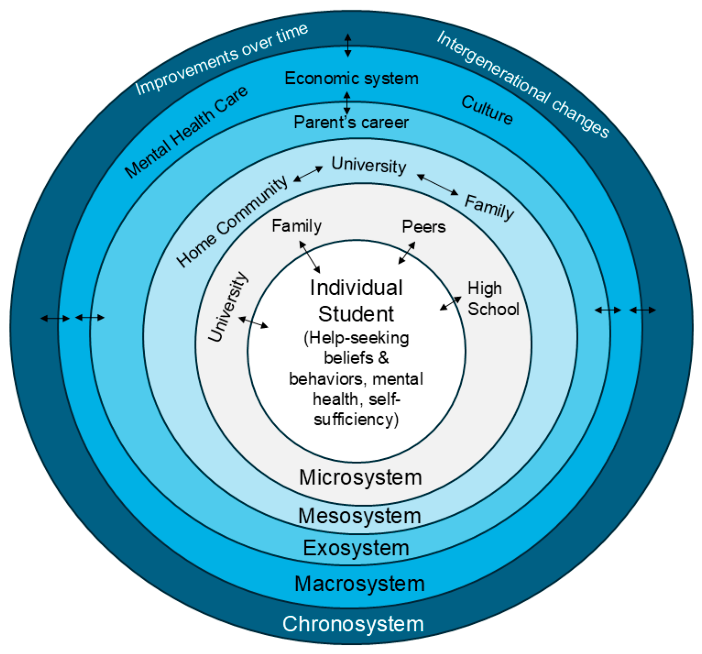
- Qualitative interview (Appendix A): The semi-structured qualitative interview was created for the current study using a deductive approach informed by the extant literature on first-generation college students. Although Bronfenbrenner’s ecological systems theory was a guiding theory in our coding and analysis process (see Section 2.7 below), it was not utilized to draft our qualitative interview. All students were asked a range of questions that covered topics like their first-generation college student identity, challenges and resilience factors influencing their adjustment and well-being before and during college, and recommendations for high school and university personnel. We also asked about how emotion and mental health were handled in their family of origin, their mental health, and their mental health treatment preferences. All interviews were conducted by a research staff member within a private interview room in the lab. Interviews were recorded using a combination of a small handheld audio recorder and typed notes (for backup in case of technical errors) for later transcription.
2.7. Qualitative Approach and Analysis
3. Results
3.1. Overview
3.2. Individual Factors
3.2.1. Theme 1: A Portion of Students Described Intersectional Identities That Emphasized the Salience of Their Family of Origin and Socioeconomic Status to Their Identity
- Participant:
- …I’m the oldest daughter in my family and obviously I’m a first-generation student and I’m also the first person in [my] family who wants to have a career in… health care….
- Interviewer:
- Is there any… important aspects from… your upbringing or… any ethnic background or the community you came from… that’s important to your identity?
- Participant:
- I came from a really small town… and I… grew up, I wouldn’t say in poverty, but we definitely didn’t have a lot of money, and neither did the school system I went to… So, …resources …and taking AP classes… was very limited…
- Participant:
- …I think the most important aspects of my identity, is …my family orientation….
- Interviewer:
- Can you tell me a little bit more about what your family orientation looks like?
- Participant:
- …well both my parents are immigrants from Haiti, so… I identify as a Haitian American. And… I’m also a Christian…
3.2.2. Theme 2: Students Most Often Reported Feeling Neutral or Proud of Their First-Generation Student Status and Typically Did Not Become Aware of the Term Until College Applications or Later
3.2.3. Theme 3: Students Reported a Range of Resilience Factors, Like Persistence in the Face of Adversity, Independence/Self-Sufficiency, Clarity of Career Goals, and Beliefs Around the Value of Education, That Supported Their Ability to Thrive in College
Thus, overall, in many of the students we interviewed, previous experience successfully coping with adverse childhood experiences set the stage for adulthood resilience and grit.…growing up, I hit a lot of…, roadblocks…. I’m dyslexic and so it was really hard growing up trying to… read anything. …every single night I would read some sort of book or story and just keep doing it until I got better at it, ‘cause I was just like ‘no, I am doing this.’ …a lot of stuff in my childhood kind of prepared me for it. Like alright ‘you failed the first time, that’s fine, just try to do this again…’ …And… ‘…keep moving, it’s fine, don’t worry.’ Same thing when I moved a lot. I moved around a lot and so moving here, there were a bunch of people that were so anxious and worried because they’re, ‘oh I’ve never lived on my own or shared a bedroom with someone.’ I’m like ‘pfff I share a bed… with my sisters and mom,’ so I’m like ‘this is nothing.’ I’m like, ‘you guys are complaining [about] this.’ I’m like, ‘this is easy for me.’
This student’s quote highlights how they became resourceful from having to apply to schools more independently due to being first-generation. From an academic perspective, many students mentioned positive beliefs around the value of education and clarity of career goals, and that a career necessitating a college degree was driving motivator for starting and finishing college.I feel like it made me more independent… definitely having to figure out what I’m doing… applying to schools and… figuring out how I’m gonna pay for it has made me a lot more independent. So, when I have a problem, I’m like, okay I can figure it out, …there’s a way to figure this out where I’ve seen other people like, ‘I don’t know what to do,’ and I’m like, ‘oh I don’t know you have to… look it up or something.’ …The answer is out there, you just have to find it. Cause… they are kind of used to the answer being given to them.
3.3. Microsystem Factors
3.3.1. Theme 1: Although Peers (e.g., Friends and Acquaintances from Classes, Clubs) Fostered Strong Belonging on Campus, Peer Relationships Also Came with Interconnected Challenges (e.g., Comparing Themselves to Others and Worrying About Being ‘Behind’)
- Interviewer:
- … what challenges have you faced … in the transition to college? I know you are super new and there might be more that come up, but anything so far?
- Participant:
- … I feel like so far, … being a first-generation student, I feel like sometimes I might be a bit behind my peers … they might know of things that I don’t know of … But then just in general as a college student … some people might be farther ahead. Or the constant worry that I’m not taking an initiative far enough than what my peers might be doing.
- Interviewer:
- Do you have any specific examples of … conversations or situations in which you’ve had this feeling that you’ve felt behind?
- Participant:
- … there could be a few different things … for example going to classes I feel like … you’ll hear … ‘oh blah blah blah, you might already know this,’ but you don’t already know it because … you don’t have that background experience … like a professor could be like ‘oh yeah you probably already know how to do this.’ Or you already know how to navigate this website because it’s a common website that’s used and I’m like oh well I’ve never used that before. So, I started feeling sort of behind … my peers when they already have an understanding of a website and I have to sit down and get to know it.
I was worried a little bit. So … during the first-generation students’ day here some of them already knew each other and I was like ‘oh my god people already know each other, I know no one’ and that made me cry. I cried my first day. Um, my mom was like ‘… you’re fine, … I can guarantee you the majority of people here do not know anyone.’ And I’m like ‘no, they all know each other.’ And so … it was a bad day for like an hour I cried right outside the library before I had to go for a meeting.
3.3.2. Theme 2: Most Students Had Not Taken Advantage of the First-Generation Bridge Program and Reported Several Key Reasons for Declining Participation
3.4. Mesosystem Factors
3.4.1. Theme 1: Students Missed Family, Friends, and the Comforts of Home, Even if Their Home Community Was Relatively Nearby
Despite missing family and friends, those who had strong family ties prior to college typically found various ways to maintain those ties during college (e.g., family visits, regular phone calls).… I feel like me and my mom were really connected over … cooking food that she… and I grew up with, so … I … miss that when I’m here because you don’t get that, like you eat at the dining hall. And the food is so different from what I ate growing up. But, I think that … stuff makes a big difference, so when I go home … it’s nice to go home because I … miss that.
3.4.2. Theme 2: Students Reported How Their Family Members Encouraged, Inspired, or Facilitated Their College Education, While Most Denied Family Pressure to Attend College
In sum, overall, students mostly reported positive ways their family supported their university pursuits.And … my parents are always like ‘oh we are really proud of you … we are living vicariously through you,’ but … sometimes that puts a little bit of pressure on me because I want to make sure I’m doing everything right and passing …. that’s another thing … not that they expect me to do good, but I want to make sure I’m keeping my grades up even though they can’t check my grades. … I want to make sure I’m making dean’s list and keeping grades up because everything I’m achieving, they are achieving too but through me.
3.5. Macrosystem and Chronosystem Factors
Theme 1: Regarding Both Attending College and Mental Health, Students Reported Intergenerational Changes
This exchange with another student focused on the impact they hope to make on future generations:… it’s pretty significant to me because I’m taking that first step vs. … my family. I’m making way for my younger brother who is … very excited to go to college in a few years. He’s currently … a freshman, so he’s very excited. I feel like by my going to college and taking that step, he’s now become a lot more interested. And by being here, I’m able to guide him in a way that my parents weren’t able to guide me. I can provide him with support like, oh you should do this versus that …
- Interviewer:
- … what does being a first-generation college student mean to you?
- Participant:
- I usually look at it as something that kind of like, [I] almost overcame. Like I said, I grew up very poor so I feel like the fact that I managed to get a higher education and that I’m actively … taking a higher step than … what my parents had, means a lot to me. And … for each generation it gets better and better.
- Interviewer:
- … So, you’re hoping to pave the path for maybe your kids ….
- Participant:
- Yeah.
… actually it’s very significant …, I would like to tell … my children one day that I’ve … completed college like my mother almost–she … tried to do it but then it wasn’t for her and she’s like ‘I can’t.’ So, she couldn’t finish it, and I just want to be like ‘I finished it, Mom, even though you couldn’t, I-I took the torch and I finished it.’ … so, I want to just … let them know that … even though she couldn’t fully finish her college degree, I did, and I hope one day that you can too, make yourself a better person, as well as the world.
- Participant:
- They were against it for a long time. I was begging them for years. … I also didn’t really tell them that I was struggling as much as I was. … and so I had to plead to my mom to let me get help or else she won’t have a daughter. Um, and that’s when she kind of … opened her eyes. Once I started outwardly saying … exactly what’s going to happen, that’s when they started realizing. But my dad thought that I was just being weak and so he really didn’t want to, so I started going to help behind my dad’s back.
- Interviewer:
- … So, you were sort of the trailblazer … in … seeking counseling for the first time. And it sounds like your mom has sort of followed suit later in life. Okay.
- Participant:
- Yes, same with my sisters.
3.6. Central Themes of How Interactions Between Individuals and Systems Conferred Risk or Resilience
3.6.1. Theme 1: Individual Risk Factors (e.g., Low Socio-Economic Status, Insufficient Guidance) Interacted with the High School Environment (e.g., Low Resource) and Economic Landscape of Higher Education to Confer Risk
- Interviewer:
- … what recommendations do you have for your high school teachers and counselors to better prepare other first-generation students prior to starting college?
- Participant:
- I think giving them … a lot more … advising specifically on … the financial aspect, that’s been the most challenging part …, it’s … very confusing trying to figure out all of your loans and scholarships and even at, … UNE there wasn’t a ton of guidance, …, on how to fill out all of these forms and these really complicated websites … Guidance on that has been the most challenging aspect … But, specifically … the whole financial and … logistics part, definitely could use a little more guidance and help …
I also think about the socioeconomic class that you are in before you come to college and before you … go to your career. … Some that are in a higher tax bracket may not see the importance of going to the classes and how much money you are spending here … Cause it might be on … the lower spectrum of how much your parents are making a year. Versus on the other hand when you are paying for college and you will be paying for all of it, … it’s … more important … for you to … get out of bed …. and go to class and use the resources that are there …
3.6.2. Theme 2: Individual Factors (e.g., Help-Seeking Beliefs and Behaviors, First-Generation Student Status) Interacted with Microsystems (e.g., Family, Friends, and University Resources) to Promote Resilience and Protect Against Risk Factors (e.g., Insufficient Guidance)
the library people are more than happy to show me how to do things … The people at the front desk in the Commons have been very accommodating when I’ve asked questions …. Everyone is very welcoming and open to answering questions which gives you a really nice chance of feeling like ‘oh I’m here, … I belong.’ And my [residential advisor]’s … always there when anyone has questions, so that kind of thing really gives you a feeling of belonging.
3.6.3. Theme 3: Students’ Help-Seeking Beliefs and Behaviors Were Influenced by Individual (e.g., Self-Sufficiency) and Microsystem (e.g., Family of Origin, Peers) Factors, and Either Functioned as a Barrier or Facilitator to Seeking Help, Resources, and Support People
- Interviewer:
- … so you said they … don’t believe mental illness is a thing at all … so did they have any … beliefs about causes …
- Participant:
- … for me anytime … I raised, … obviously mental illness is real, but they’d be like no you’re just sensitive like … it was just a no to all of it.
- Interviewer:
- … did they have any beliefs … surrounding seeking mental health treatment?
- Participant:
- No. [laughs]
- Interviewer:
- … have they had any experiences with mental health treatment in any of your family?
- Participant:
- Yes, … my dad was forced to go to therapy and anger management several times … Other than that … when I turned 18 I reached out and got help and then things started to change recently. So, two of my younger sisters have also gotten therapy now.
- Interviewer:
- … do you think that … experience with your family … deterred you from seeking … counseling …?
- Participant:
- … a little bit, yeah … I always knew I needed more help than I had but I definitely didn’t think I could get that help until I was old enough.
- Interviewer:
- … has anything gotten in the way of building relationships with support people at UNE?
- Participant:
- … probably myself … sometimes mentally … I like to push people away rather than going out. We’re getting better at that now, but … sometimes I definitely make it so I don’t think there’s resources but there are.
- Interviewer:
- Okay, and how comfortable would you say that you are asking for help? Whether it be academically or … mentally …?
- Participant:
- Probably in the middle, … -I’m not scared to ask help, I definitely think it’s important to ask help. Especially for … academics and I think it’s important to ask questions, … mentally it’s still scary and frustrating but I’m definitely more comfortable asking for help.
3.6.4. Theme 4: Many of the Interrelated Challenges Students Reported During College (e.g., Mental Health, Perceived Capability to Complete College, Time Management, Belonging) Improved over Time
When asked how their mental health has been in college so far, another student said: “Currently, pretty good … given the circumstances I think I am grounded with … good coping mechanisms. I mean compared to last year, I was all over the place, … doing very poorly, I actually ended up fainting in a lab … from stress, they couldn’t figure out any other reason … but right now, things are really good and I think [the Counseling Center], they kinda gave me those coping skills to … Get through things better…”Another student specifically reflected on how their study habits have improved, saying, “Um, studying mechanisms. I was always … repetitive and … would … re-read things all the time and I never really applied what I was learning. And so, … with psychology courses you apply a lot of what you’re talking [about] and at first that was just so conflicting in my mind I didn’t know what I was doing. So, learning to switch the way I study … that was something, now I have a better handle on it.” In contrast, another student reported feeling academically, but not socially, confident at the beginning of college, saying “… outside of classes … I don’t think I was that capable.” They reflected on how now they feel so confident and capable they are an ambassador for orientation, responsible for orienting new students to campus. Overall, most, but not all, students reported some level of self-doubt at the onset of college, which transitioned into current confidence in their ability to complete college.And then this year since I’m a sophomore … I have a stronger basis so … coming back here I kind of know what I’m doing, but … my first year was … really rough because I was so stressed out from managing college classes and also you have to make friends at the same time and then also, I was worried about money obviously, that feels like a major stressor. So, I feel like the first year was just very stressful … the whole year, but this year is better because I figured it out more.
4. Discussion
4.1. Risk and Resilience Factors Within First-Generation College Students and Systems
4.2. Recommendations for High School and University Personnel
4.3. Strengths, Limitations, and Future Directions
5. Conclusions
Author Contributions
Funding
Institutional Review Board Statement
Informed Consent Statement
Data Availability Statement
Acknowledgments
Conflicts of Interest
Abbreviations
| FGCS | First-Generation College Student |
| GPA | Grade Point Average |
| FAFSA | Free Application for Federal Student Aid |
| QR code | Quick Response |
| AI | Artificial Intelligence |
| REDCap | Research Electronic Data Capture |
Appendix A. Qualitative Interview
- General Overview:
- 2.
- Pressures and Influences:
- 3.
- Knowledge and Use of First-Generation Student Resources
- 4.
- Norms about mental illness and treatment-seeking
- 5.
- Mental Health Treatment
Appendix B. Additional Codes, Definitions, and Number of Associated Excerpts

| Codes and Categories 1 | Definition | Total Number of Excerpts |
| Individual Factors | ||
| Help-seeking Beliefs and Behaviors | Opinions, attitudes, and actions related to asking others for assistance, including both academic and mental health support. | 126 |
| Mental Health | Their own psychological well-being in the past or currently. | 86 |
| Insufficient Guidance | Gaps in knowledge due to a lack of support people or resources before or during college. | 80 |
| Self-Sufficiency/ Independence | Pattern of behavior involving the ability to navigate challenges (e.g., academic, adjustment, social) independently. | 62 |
| Emotional Suppression/ Expression | Their own or their family of origin’s tendency to withhold or share emotions during times of distress or joy. | 58 |
| Academic Pressures | Any comments about challenges or stress related to classes, grades, etc. | 52 |
| Financial Pressures | Any statement about personal finances either before or during college or worries about future financial capabilities. | 36 |
| Clarity of Career Goals | Career trajectory and/or long-term vision for their career. | 35 |
| First-Generation Term Meaning | How they define the term ‘first-generation college student,’ and how the term applies to them. | 33 |
| Pride in First-Generation Status | Positive feelings about being a first-generation college student. | 29 |
| First-Generation Term Awareness | How and when they came to learn about the term ‘first-generation college student.’ | 28 |
| Persistence in the Face of Adversity | Instances when student reports facing a stressor or traumatic life event that they navigated with strength. | 27 |
| Beliefs around the Value of Education | Any comments about personal values (or lack of) around education, learning, and/or academics. | 23 |
| Microsystem Factors | ||
| Family | Their nuclear family (i.e., parents, siblings). | 193 |
| Peers | Friends, classmates, romantic partners, or acquaintances from university or home with whom they have either age or education level in common. | 159 |
| University Resources | College-level resources, most likely about their current university, though if they attended another college institution prior, that would also apply. | 99 |
| University | Excerpts about the university setting or campus once they have started college except if the comment has to do with a more specific code, like belonging, a recommendation, resources, or support people. | 95 |
| High School | The setting or time period of high school. | 83 |
| University Support People | People who provide support during college (e.g., professors, advisors, staff, or friends). | 69 |
| Non-Academic, Unpaid Time Commitments | Activities outside of class and paid work, such as athletics and clubs. | 54 |
| Connectedness/Belonging within the University | The extent to which they feel like they fit in socially in college, including factors that contribute to belonging. | 51 |
| Pre-College Resources | Resources they received or lacked before college that were meant to support their college preparation. | 42 |
| Professors or Faculty | Any excerpts about professors and faculty members. | 29 |
| Mesosystem Factors | ||
| Impact of College on Connection to Home/Family of Origin | Excerpts describing how being in college has influenced their connection to their home community, including family or friends. | 43 |
| Family’s influence on going to university | Ways in which family impacted the student’s desire to apply for or ability to attend college. | 33 |
| Macrosystem Factors | ||
| Mental Health Care | Comments about mental health care, such as mental health utilization, the physical setting, barriers (e.g., access or waitlists) and treatment preferences. | 101 |
| Economic System | Larger economic systems, like the FAFSA, loans, scholarships, or the economic climate of their home community. | 64 |
| Culture | The culture of the individual, their family of origin, their home community, their nation of origin, or the university or classroom, such as language, religion, food, and values. | 37 |
| Chronosystem Factors | ||
| Childhood | Something that occurred during childhood, like beliefs or dreams they had or adverse childhood experiences. | 42 |
| Things that have improved since starting college | Factors that have changed for the better since starting college. | 35 |
| Intergenerational Changes | Actual or desired changes across generations (e.g., wanting to change for their future children, or the individual taking a different path from their parents’ or grandparents’ experiences). | 23 |
| 1 | When reporting participants’ direct quotes, given the small university setting and the sensitive nature of the interview questions, we are prioritizing protecting participant confidentiality, and we will not associate each participant’s response with a pseudonym. Rather, we will state something like “One student said …” when quoting them. When relevant with student quotes, we have replaced irrelevant speech (e.g., filler words such as ‘like’ and ‘um’) with “...” |
References
- Alvarado, A., Spatariu, A., & Woodbury, C. (2017). Resilience & emotional intelligence between first generation college students and non-first generation college students. FOCUS on Colleges, Universities & Schools, 11, 1–10. [Google Scholar]
- American Psychiatric Association. (2022). Diagnostic and statistical manual of mental disorders, fifth edition, text revision (DSM-5-TR) (5th ed.). American Psychiatric Association. [Google Scholar] [CrossRef] [Scilit]
- Azmitia, M., Sumabat-Estrada, G., Cheong, Y., & Covarrubias, R. (2018). “Dropping out is not an option”: How educationally resilient first-generation students see the future. New Directions for Child and Adolescent Development, 160, 89–100. [Google Scholar] [CrossRef] [Scilit] [PubMed]
- Bartholomew, T. T., Tsai, C., Valdivia-Jauregui, L., Alvarez Murillo, A., Molina, A., & Morales, A. (2025). First-generation college students’ hope for change through counseling: A comparative study. Cogent Mental Health, 4(1), 2449856. [Google Scholar] [CrossRef] [Scilit] [PubMed]
- Bonanno, G. A. (2005). Resilience in the face of potential trauma. Sage Journals, 14(3), 135–138. [Google Scholar] [CrossRef] [Scilit]
- Braun, V., & Clarke, V. (2006). Using thematic analysis in psychology. Qualitative Research in Psychology, 3(2), 77–101. [Google Scholar] [CrossRef] [Scilit]
- Braun, V., & Clarke, V. (2020). One size fits all? What counts as quality practice in (reflexive) thematic analysis? Qualitative Research in Psychology, 18(3), 328–352. [Google Scholar] [CrossRef] [Scilit]
- Braun, V., & Clarke, V. (2021). To saturate or not to saturate? Questioning data saturation as a useful concept for thematic analysis and sample-size rationales. Qualitative Research in Sport, Exercise and Health, 13(2), 201–216. [Google Scholar] [CrossRef] [Scilit]
- Bronfenbrenner, U. (1979). The ecology of human development. Harvard University Press. [Google Scholar]
- Bronfenbrenner, U., & Ceci, S. J. (1994). Nature-nurture reconceptualized in developmental perspective: A bioecological model. Psychological Review, 101(4), 568–586. [Google Scholar] [CrossRef] [PubMed]
- Bui, K. (2002). First-generation college students at a four-year university: Background characteristics, reasons for pursuing higher education, and first-year experiences. College Student Journal, 36, 3–11. [Google Scholar]
- Comer, R. J., & Comer, J. S. (2024). Psychopathology, science and practice (12th ed.). Worth Publishers. [Google Scholar]
- Council for Opportunity in Education. (2026). TRIO defines first-generation college student. Available online: https://coenet.org/first-generation-college-student/ (accessed on 23 January 2026).
- Glaser, B. G., & Strauss, A. L. (1967). Discovery of grounded theory strategies for qualitative research (1st ed.). Transaction Publishers. Available online: https://books.google.com/books/about/The_Discovery_of_Grounded_Theory.html?id=oUxEAQAAIAAJ (accessed on 14 July 2026).
- Hagler, M. A., Christensen, K. M., & Rhodes, J. E. (2024). A longitudinal investigation of first generation college students’ mentoring relationships during their transition to higher education. Journal of College Student Retention: Research, Theory & Practice, 25(4), 791–819. [Google Scholar] [CrossRef] [Scilit]
- Harris, P. A., Taylor, R., Minor, B. L., Elliott, V., Fernandez, M., O’Neal, L., McLeod, L., Delacqua, G., Delacqua, F., Kirby, J., & Duda, S. N. (2019). The REDCap consortium: Building an international community of software platform partners. Journal of Biomedical Informatics, 95, 103208. [Google Scholar] [CrossRef] [Scilit] [PubMed]
- Harris, P. A., Taylor, R., Thielke, R., Payne, J., Gonzalez, N., & Conde, J. G. (2009). Research electronic data capture (REDCap)—A metadata-driven methodology and workflow process for providing translational research informatics support. Journal of Biomedical Informatics, 42(2), 377–381. [Google Scholar] [CrossRef] [Scilit] [PubMed]
- House, L. A., Neal, C., & Kolb, J. (2020). Supporting the mental health needs of first generation college students. Journal of College Student Psychotherapy, 34, 157–167. [Google Scholar] [CrossRef] [Scilit]
- Jenkins, S. R., Belanger, A., Connally, M. L., Boals, A., & Durón, K. M. (2013). First-generation undergraduate students’ social support, depression, and life satisfaction. Journal of College Counseling, 16(2), 129–142. [Google Scholar] [CrossRef] [Scilit]
- Leebens, P. K., & Williamson, E. D. (2017). Developmental psychopathology: Risk and resilience in the transition to young adulthood. Child and Adolescent Psychiatric Clinics of North America, 26(2), 143–156. [Google Scholar] [PubMed]
- Maltby, J. (2024). Networking trait resilience: Unifying fragmented trait resilience systems from an ecological systems theory perspective. Journal of Personality, 93, 216–232. [Google Scholar] [CrossRef] [Scilit] [PubMed]
- Markle, G., & Stelzriede, D. D. (2020). Comparing first-generation students to continuing-generation students and the impact of a first-generation learning community. Innovative Higher Education, 45(4), 285–298. [Google Scholar] [CrossRef] [Scilit]
- National Center for Education Statistics. (n.d.). Parents’ highest education level by race/ethnicity and gender (National Postsecondary Student Aid Study: 2020 Undergraduates). U.S. Department of Education.
- Saunders, B., Sim, J., Kingstone, T., Baker, S., Waterfield, J., Bartlam, B., Burroughs, H., & Jinks, C. (2017). Saturation in qualitative research: Exploring its conceptualization and operationalization. Quality and Quantity, 52, 1893–1907. [Google Scholar] [CrossRef] [Scilit] [PubMed]
- Stebleton, M. J., & Jehangir, R. R. (2020). A call for career educators to recommit to serving first-generation and immigrant college students: Introduction to special issue. Journal of Career Development, 47(1), 3–10. [Google Scholar] [CrossRef] [Scilit]
- Stebleton, M. J., Soria, K. M., & Huesman, R. L., Jr. (2014). First-generation students’ sense of belonging, mental health, and use of counseling services at public research universities. Journal of College Counseling, 17(1), 6–20. [Google Scholar] [CrossRef] [Scilit]
- University of New England Office of Research and Data Analytics. (2025). Freshman profile trends. Available online: https://www.une.edu/sites/default/files/2025-10/2-9%202025%20Fall%20Trends%20in%20First-Generation.pdf (accessed on 9 May 2026).
- Urquhart, C. (2017). Grounded theory for qualitative research: A practical guide. Sage Research Methods. [Google Scholar] [CrossRef] [Scilit]
- U.S. Department of Education, Nunez, A.-M., & Cuccaro-Alamin, S. (2020). First-generation students: Undergraduates whose parents never enrolled in postsecondary education [Dataset]. National Center for Education Statistics.
- Watts, G. W., Garfield, T. A., & Davis, M. T. (2023). Experiences, supports, and strategies of first-generation college students. College Teaching, 71, 38–48. [Google Scholar] [CrossRef] [Scilit]
- Wilbur, T. G. (2021). Stressed but not depressed: A longitudinal analysis of first-generation college students, stress, and depressive symptoms. Social Forces, 100(1), 56–85. [Google Scholar] [CrossRef] [Scilit]
- Wildhagen, T. (2015). “Not your typical student”: The social construction of the “first-generation” college student. Qualitative Sociology, 38(3), 285–303. [Google Scholar] [CrossRef] [Scilit]
| Codes and Categories 1 | Definition | Total Number of Excerpts |
|---|---|---|
| Resilience Factors/Strengths | Potential resilience or protective factors, or strengths, that support their adjustment, well-being, and/or academic success in college. | 260 |
| Risk Factors/ Challenges | Potential challenges or barriers to adjustment, well-being, and/or academic success in college, or risk factors that could increase their likelihood of negative outcomes in college. | 257 |
| Individual Factors | Internal and external factors that are specific to the first-generation college student’s experience, feelings, beliefs, and/or behaviors. | 802 |
| Microsystem Factors | Closest relationships and immediate environments that the individual directly participates in. | 957 |
| Mesosystem Factors | Connections/interactions between two Microsystem factors. | 116 |
| Exosystem Factors 2 | Social settings and environments that indirectly impact the individual and in which they do not directly participate. | 13 |
| Macrosystem Factors | Cultural and societal influences on an individual’s development. | 255 |
| Chronosystem Factors | Changes over time. | 137 |
| Recommendations | Sample Quotes |
|---|---|
| Some students recommended introducing high school students to college-level procedures in high school (e.g., syllabi and college schedule course blocking). | “The syllabus was very helpful … having things listed out and a contract between the student and teacher … Some of my teachers in high school didn’t really help me prepare for some of the classes. So… have… something that both the student and teacher can stick to in high school instead of jumping around a lot.” |
| Multiple students recommended avoiding extreme messaging or scare tactics around needing to be a college graduate or how difficult college will be. | “… I got more pressure from the schools that I’ve gone to. … My high school had a lot more pressure. … One of my classes brought in this… person… to come talk to the class, and I went home crying that day because he sat there and scared the shit out of us being like ‘you can’t take a gap year, you have to go to college, you have to do this.’” “… definitely tell them to just see it through …, give it a chance. … I had this one teacher that [would say] ‘all this stuff won’t fly in college, … you can’t act a certain way.’ … But I kind of found out … I haven’t changed much, … I’m doing pretty well. … So don’t be so harsh on students … we’re all young, we all make mistakes … some classes are going to be better than others …” |
| One student recommended offering concrete application support, like offering to look over college essays. | “… ask … ‘what are your plans?’ early on, like end of junior year …, ask, … ‘what are your plans after school? Are you thinking about applying to colleges? Do you want me to look over your essay? … have you looked into application deadlines?’ … because those were all stuff that I had no clue and it was just like ‘oh, … I have to do this and I feel like I was rushed for time.’” |
| One student recommended identifying which students intend to be first-generation college students. | “… talk about it more at school…. I don’t think my counselor knew I was the first person in my family to go to college. So … opening that up as a question, … between the school and the student to figure out if there is a better way to support them.” |
| One student recommended having distinct programming based on first-generation student status. | “… definitely bring more attention to it … making sure students know that they’re a resource and that I know some schools do … a meeting where they talk about college life … but maybe doing … a separate meeting for students who want to know more, who are going to be a first-generation student.” |
| Many students recommended more support on navigating the financial aspects of college applications and affording college (e.g., FAFSA, scholarship applications, loans). One student also reported how helpful a first-generation scholarship has been to them, so making students aware of these scholarships, how early to apply, and perhaps even supporting them with applying would be helpful. | “Especially for scholarships, that was another big thing, … no one told me about scholarships and … make sure you need to apply to them. And … a lot of the big ones it seemed really were given out junior year which was weird. Um, or at least … the ones that my school sent out …, the most they gave us was a PDF with … links and … the bigger scholarships you had to be a junior and I was like ‘well I’m a senior so I can’t apply to those.’” “… I have a really amazing scholarship that’s helped me out. It’s a first-generation scholarship and … I could basically ask them for … any … advice or help and they’d be able to give it to me, which is amazing …, so it’s a 4 year scholarship and they cover … everything basically … I got it my junior year of high school and I did … zoom meetings to … prepare for the application process and we did zoom meetings on how to manage your time in college … And once I got here, there’s not as much contact, but I can reach out … whenever I need for anything.” “Yeah, I’d say we have … a …, financials class, … I thought it was very useful … Especially for … getting a job … down here and … making sure that you’re not spending it all, I guess.” |
| One student recommended hearing from people with lived experience (e.g., high school counselors who were first-generation). | “I’d say … sharing personal experiences if they are also a first-gen … that could be helpful.” |
| Recommendation | Sample Quotes |
|---|---|
| Some students felt that the Bridge Program was an ‘overload’ of material, so condensing the program may be helpful. | “in some ways, the information was a bit overloading … they gave you so much in a 3-day span while we were doing things all day to the point where it was a huge overload.” “… some of the activities were a little long …” |
| Several students wanted follow-up communication after the Bridge Program (e.g., via email or flyers about resources). | “reaching out with emails every so often on … useful things around the school would be helpful. Especially in the first few weeks when you’re already overloaded with … classes … Reaching out with … helpful emails of stuff to not forget about … specifically talk about [the Student Academic Success Center] (SASC) and TutorTrac … I got a pamphlet, but I don’t know how to access any of it …, following up with an email with specific links or guidelines on how to access it all would be a good idea. And not even just SASC, … the library, … all those … platforms where they’re essential to your college experience, but you might feel a little lost on how to get started with them.” |
| Many students wanted follow-up programming after the initial Bridge Program, like professional development events or social events aimed at maintaining connections with people with shared experiences. | “having professional development things because … fun activities is good but also … having … something to professional development I think is good …. Anything like resume or just … learning something …” “I think at least something … once a semester …, like a first-gen appreciation, I’m not … trying to say ‘appreciate me,’ but … to recognize that … we’re … the first in our family to go to college and it’s a big thing for a lot of people.” “I think the social aspect is really hard and … that program was … good at … helping you build connections and stuff, so maybe holding … future events for us all to get together.” “… there should be more programs … based on first-generational students and helping them …, navigate the way that college runs … I am super nervous about applying to grad school … so I honestly wish that there were more programs or events that are … informational … Or … groups who first-generational college students can get together and … talk about their experiences, because … there isn’t much of a community with that here.” |
| Some students thought having a more structured mentor program would be helpful. | “doing a peer mentor with either students that are … first-generation or … yes with other first-generation students, I think would be helpful.” |
Disclaimer/Publisher’s Note: The statements, opinions and data contained in all publications are solely those of the individual author(s) and contributor(s) and not of MDPI and/or the editor(s). MDPI and/or the editor(s) disclaim responsibility for any injury to people or property resulting from any ideas, methods, instructions or products referred to in the content. |
© 2026 by the authors. Licensee MDPI, Basel, Switzerland. This article is an open access article distributed under the terms and conditions of the Creative Commons Attribution (CC BY) license.
Share and Cite
Shaw, A.M.; Fortier, E.L.; Contarino, B.N.; Meek, M.A.E. Individual and System Factors Involved in First-Generation College Students’ Risk and Resilience: Qualitative Student Perspectives and Recommendations. Educ. Sci. 2026, 16, 1309. https://doi.org/10.3390/educsci16081309
Shaw AM, Fortier EL, Contarino BN, Meek MAE. Individual and System Factors Involved in First-Generation College Students’ Risk and Resilience: Qualitative Student Perspectives and Recommendations. Education Sciences. 2026; 16(8):1309. https://doi.org/10.3390/educsci16081309
Chicago/Turabian StyleShaw, Ashley M., Eva L. Fortier, Brooke N. Contarino, and Magdalene A. E. Meek. 2026. "Individual and System Factors Involved in First-Generation College Students’ Risk and Resilience: Qualitative Student Perspectives and Recommendations" Education Sciences 16, no. 8: 1309. https://doi.org/10.3390/educsci16081309
APA StyleShaw, A. M., Fortier, E. L., Contarino, B. N., & Meek, M. A. E. (2026). Individual and System Factors Involved in First-Generation College Students’ Risk and Resilience: Qualitative Student Perspectives and Recommendations. Education Sciences, 16(8), 1309. https://doi.org/10.3390/educsci16081309

