Scaling Professional Development with a Diverse Early Childhood Workforce
 , , , and
Abstract
1. Introduction
1.1. Teacher Professional Development
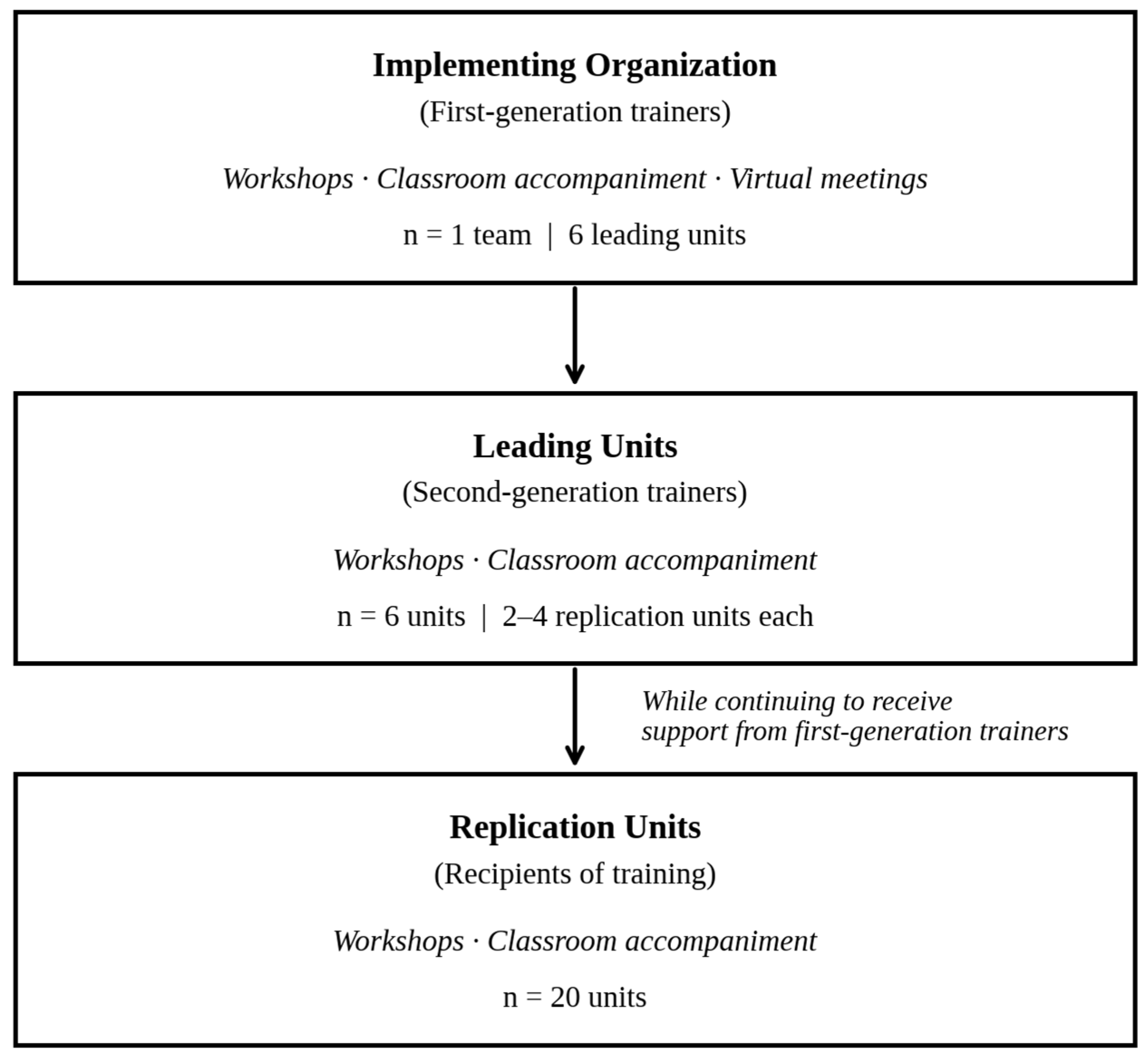
1.1.1. Cascade Models
1.1.2. Strength-Based Approaches
1.2. The Colombian Context
- -
- How did participants experience the implementation of the PD program?
- -
- What conditions facilitated or constrained participants’ engagement with the program?
2. Methods
2.1. Research Approach
2.2. Program and Study Context
2.3. Participants
2.4. Instruments
2.5. Ethical Considerations
2.6. Analysis
3. Results
3.1. Program Implementation
“[The trainer] was always very attentive, not only when she came, but she also wrote to me and called me to ask how I was doing. I consulted her whenever I had any questions. The process was easier with her”.(CDI Leading unit 1)
“I went there to [name of the model center] for an activity with them, a consultation, to get to know the spaces, learn about some methodologies, and […] I would like my classroom to be like that, I would like a science classroom […] because everything around us is science and we are unconsciously or consciously teaching [children] science”.(CDI Replication unit 2)
“Well, the truth is that I’ve learned a lot because what I’ve seen and what they’ve said is that they no longer want so many toys on the wall, but rather as low as possible so that they are within reach of the children. So, I imagine that by next year, we will be managing the classroom and organization well, with separate areas for games, literature, and art.”.(HCB Replication unit 5)
“They didn’t choose all [the community mothers], but they took a few. And those were the ones they focused on, and our colleagues were the ones who gave us the replicas”.(HCB Replication unit 5)
“I think those who were receiving the information directly learned more, because it’s not the same to be told directly by [first-generation trainers] as it is for me to go and give information […] It was easier in [name of the CDI] because here we received the information from the people who were conducting the project”.(CDI Leading unit 2)
“We haven’t met to carry out the replication session, but [the leader]… has given us some information at times. Brief information, but she has given us information”.(HCB Replication unit 1)
“She asked me: haven’t they arrived? [referring to the leading unit] And I said no, because we can’t communicate by phone because mine is broken”.(CDI Replication unit 2)
“Since I live nearby, I go to [the leader] and see the things they have done, and I think they are very good. The organization and the space are not yet completely organized, but I think it will be very nice”.(HCB Replication unit 1)
“They held Children’s Day, they held an activity, and, well, why didn’t they call the replication units? The activity was only with the four of them [the leading units], and they should have called the replication units because we are also part of the training”.(HCB Replication unit 2)
“No, no training. I don’t know if it’s because the journey is too far”.(CDI Replication unit 1)
3.2. Learning and Appropriation of the Pedagogical Model
“What caught my attention the most, first of all, was the child as a partner because it is a way of letting the child choose, express their feelings, and thus we can get to know them better. It is not an education where we are telling them to color within the lines […] That and positive discipline, which we were implementing, only… with some changes in terms of phrases and expressions”.(HCB Leading unit 1)
“I made all the changes, I removed drawers, I took away some of what they had for the space, and some of the toys that they said we shouldn’t have so many toys… because the truth is that they make a mess”.(HCB Replication unit 3)
“I realized that it has four pillars. It has art, literature, play, and exploration. So, I say, yes, I am working on the same thing. What… is that they have it all separate, in each little corner […] the table here, the consumables, the game materials, and my stories… my literature, I organize it this way”.(HCB Replication unit 4)
“When it comes to disposable items, there are so many things you can do and teach children. At the same time, this is also useful for the future, so you can teach parents as well”.(HCB Replication unit 5)
“Well, I think it’s easy [to apply what we’ve learned], because the information they provided was clear and […] quite applicable to each of the things […] we do in each service unit. So, yes, it can be applied, and yes, it can be learned”.(CDI Leading unit 2)
“Everything I’ve seen here seems good to me […] the tools you give us, the explanations we’ve had, the videos we’ve seen. Because this is more about reflecting on the experience […] and what we can give better”.(HCB Leading unit 1)
“Everything caught my attention, but as I told them: here we have certain parameters, but the ICBF and the standard tell us to use other parameters”.(CDI Replication unit 2)
“Right now, with the decoration I see they’re doing […] there are things that one has, things that one has had for a while, and you have to take them out and work with other things in an organized way. I have things here that… that I’ve had at home for years, and I see that I have to take them out”.(HCB Replication unit 1)
3.3. Engagement with the Program
“The truth is that I really liked it, and I hope that more workshops, more diploma courses, I will continue to come. Because you never forget it, and as long as you have it here, here, you never forget it”.(HCB Replication unit 5)
“They [ICBF] impose on us a way of decorating the classroom […] We don’t do it because we’ve turned a blind eye and we don’t have the door covered in paper. But their idea is that all the information for parents should be there, visible on the street door. But we tell them that we have a home inside and that the parents can meet with us here, but it is not necessary to put it there, because we do not have a store to advertise products”.(HCB Leading unit 1)
“Sometimes we meet, and they replicate the sessions for practically all 26 community mothers […] Then, each one explains their experience”.(HCB Replication unit 4)
“Yes, at least one of us won’t assign the activity [to the children], but will let them choose for themselves, working with recyclable materials, activities with nature. For example, with plants and things like that, which we have to teach them. A little while ago, I did some activities with them, working with dried plants, and it went really well! […] No, they didn’t actually do a formal replica, but I saw that [the leader] was doing it and it was very nice. I liked the activity and wanted to try it myself”.(HCB Replication unit 1)
“This year has been very tough for us, because at the same time, ICBF has been pressing us about some matters […] so they sent us to a diploma course, which lasted six or seven months. We have to send work online… and that has taken up a lot of our time. So that’s weekly. Some colleagues [tell me], ‘No, I can’t,’ because some of them still have children; they have husbands, so [they say], ‘No, I can’t attend’”.(HCB Leading unit 1)
“I was alone, but now my son-in-law’s mother is helping me. The truth is that I am alone; we don’t have an assistant. It’s difficult for her because she is helping me”.(HCB Replication unit 3)
“What [the leader] has learned, she hasn’t told me because we haven’t had the time either; she is also very busy. She coordinates six, I think six [CDIs]”.(CDI Replication unit 1)
“[Transportation] is very expensive, […] And it costs two thousand or two thousand five hundred [pesos that] they take from us”.(CDI Replication unit 1)
“[The leader] chose me for the replication, but […] the truth is that she is sick […] she hasn’t had time because she is always at the doctor’s; she had surgery, I think. So, we haven’t been able to do anything”.(HCB Replication unit 2)
4. Discussion
4.1. Implementation and Uneven Opportunities for Appropriation
4.2. The Interaction Between Program Design and Organizational Context
4.3. Individual and Relational Capacities Sustaining Implementation
4.4. Limitations and Future Research
5. Conclusions
Author Contributions
Funding
Institutional Review Board Statement
Informed Consent Statement
Data Availability Statement
Acknowledgments
Conflicts of Interest
Abbreviations
| CDI | Child Development Centers |
| PD | Professional Development |
| HCB | Community-based Community Welfare Homes |
| ICBF | Colombian Institute for Family Wellbeing |
| LMIC | Low-and-middle Income Countries |
References
- Andrew, A., Attanasio, O., Fitzsimons, E., Grantham-McGregor, S., Meghir, C., & Rubio-Codina, M. (2018). Impacts 2 years after a scalable early childhood development intervention to increase psychosocial stimulation in the home: A follow-up of a cluster randomised controlled trial in Colombia. PLoS Medicine, 15(4), e1002556. [Google Scholar] [CrossRef] [Scilit]
- Andrew, A., Attanasio, O. P., Bernal, R., Sosa, L. C., Krutikova, S., & Rubio-Codina, M. (2024). Preschool quality and child development. Journal of Political Economy, 132(7), 2304–2345. [Google Scholar] [CrossRef] [Scilit]
- Attanasio, O. P., Fernández, C., Fitzsimons, E. O. A., Grantham-McGregor, S. M., Meghir, C., & Rubio-Codina, M. (2014). Using the infrastructure of a conditional cash transfer program to deliver a scalable integrated early child development program in Colombia: Cluster randomized controlled trial. BMJ, 349, g5785. [Google Scholar] [CrossRef] [Scilit] [PubMed]
- Bax, S. (2002). The social and cultural dimensions of trainer training. Journal of Education for Teaching, 28(2), 165–178. [Google Scholar] [CrossRef] [Scilit]
- Berger, R. (2015). “Now I see it, now I don’t”: Researcher’s position and reflexivity in qualitative research. Qualitative Research, 15(2), 219–234. [Google Scholar] [CrossRef] [Scilit]
- Braun, V., & Clarke, V. (2006). Using thematic analysis in psychology. Qualitative Research in Psychology, 3(2), 77–101. [Google Scholar] [CrossRef] [Scilit]
- Braun, V., & Clarke, V. (2022). Conceptual and design thinking for thematic analysis. Qualitative Psychology, 9(1), 3–26. [Google Scholar] [CrossRef] [Scilit]
- Bronfenbrenner, U., & Morris, P. A. (1998). The ecology of developmental processes. In W. Damon, & R. M. Lerner (Eds.), Handbook of child psychology: Theoretical models of human development (5th ed., Vol. 1., pp. 993–1028). Wiley. [Google Scholar]
- Bruns, J., Hagena, M., & Gasteiger, H. (2023). Professional development enacted by facilitators in the context of early mathematics education: Scaling up or dilution of effects? Teaching and Teacher Education, 132, 104270. [Google Scholar] [CrossRef] [Scilit]
- Brunsek, A., Perlman, M., McMullen, E., Falenchuk, O., Fletcher, B., Nocita, G., Kamkar, N., & Shah, P. (2020). A meta-analysis and systematic review of the associations between professional development of early childhood educators and children’s outcomes. Early Childhood Research Quarterly, 53(4), 217–248. [Google Scholar] [CrossRef] [Scilit]
- Buccini, G., Kofke, L., Case, H., Katague, M., Pacheco, M. F., & Pérez-Escamilla, R. (2023). Pathways to scale up early childhood programs: A scoping review of reach up and care for child development. PLoS Global Public Health, 3(8), e0001542. [Google Scholar] [CrossRef] [Scilit] [PubMed]
- Buchely, L. (2014). Indicators as a form of resistance. Colombian community mothers: An example of the Global South’s use of indicators as a counter-hegemonic global dominance technique. International Law: Revista Colombiana de Derecho Internacional, 12(25), 225–266. [Google Scholar]
- Buchely, L. (2015). El activismo burocrático y la vida mundana del Estado. Las madres comunitarias como burócratas callejeras y el programa de cuidado de niños Hogares Comunitarios de Bienestar. Revista Colombiana de Antropología, 51(1), 137–159. [Google Scholar] [CrossRef] [Scilit]
- Burchinal, M. (2018). Measuring early care and education quality. Child Development Perspectives, 12(1), 3–9. [Google Scholar] [CrossRef] [Scilit]
- Campbell-Barr, V. (2018). Quality early childhood education and care: The role of attitudes and dispositions in professional development. Early Child Development and Care, 188(12), 1774–1789. [Google Scholar] [CrossRef] [Scilit]
- Cavadel, E., Aikens, N., Moiduddin, E., Straske, D., Matthais, H., & Blesson, E. (2022). A study of coaching practices in early care and education settings (SCOPE) in 2019: Understanding coaching structures and processes (OPRE Report 2023-137). Office of Planning, Research and Evaluation, Administration for Children and Families, U.S. Department of Health and Human Services. Available online: https://files.eric.ed.gov/fulltext/ED666119.pdf (accessed on 5 October 2025).
- de Barros, A., Henry, J., & Mathenge, J. W. (2024). What drives teachers to change their instruction? A mixed-methods study from Zambia. Comparative Education Review, 68(4), 562–585. [Google Scholar] [CrossRef] [Scilit] [PubMed]
- Early, D. M., Maxwell, K. L., Ponder, B. D., & Pan, Y. (2017). Improving teacher-child interactions: A randomized controlled trial of making the most of classroom interactions and my teaching partner professional development models. Early Childhood Research Quarterly, 38(1), 57–70. [Google Scholar] [CrossRef] [Scilit]
- Edwards, S., & Nuttall, J. (2009). Introduction. In S. Edwards, & J. Nuttall (Eds.), Professional learning in early childhood settings (pp. 1–8). Sense. [Google Scholar]
- Egert, F., Dederer, V., & Fukkink, R. G. (2020). The impact of in-service professional development on the quality of teacher-child interactions in early education and care: A meta-analysis. Educational Research Review, 29, 100309. [Google Scholar] [CrossRef] [Scilit]
- Elek, C., & Page, J. (2018). Critical features of effective coaching for early childhood educators: A review of empirical research literature. Professional Development in Education, 45(4), 567–585. [Google Scholar] [CrossRef] [Scilit]
- El-Hamamsy, L., Monnier, E., Avry, S., Chessel-Lazzarotto, F., Liégeois, G., Bruno, B., Dehler, J., & Mondada, F. (2024). An adapted cascade model to scale primary school digital education curricular reforms and teacher professional development programs. Education and Information Technologies, 29(9), 10391–10436. [Google Scholar] [CrossRef] [Scilit]
- Eynon, B., Iuzzini, J., Keith, H. R., Loepp, E., & Weber, N. (2024). Realizing the promise of professional learning for teaching, equity, and change. Change: The Magazine of Higher Learning, 56(1), 55–64. [Google Scholar] [CrossRef] [Scilit]
- Fenton, A., & McFarland-Piazza, L. (2014). Supporting early childhood pre-service teachers in their work with children and families with complex needs: A strengths approach. Journal of Early Childhood Teacher Education, 35(1), 22–38. [Google Scholar] [CrossRef] [Scilit]
- Gómez, R., & Rendón, T. (2019). Early childhood policy and its impact on the field: Historical and contemporary perspectives. In C. P. Brown, M. B. McMullen, & N. File (Eds.), The Wiley handbook of early childhood care and education (pp. 491–514). Wiley. [Google Scholar] [CrossRef] [Scilit]
- Hardy, J. K., Grifenhagen, J., McLeod, R. H., Marcoulides, K. M., & Hemmeter, M. L. (2025). Correlations between coaching quality and teacher change in social-emotional teaching practices. Early Childhood Research Quarterly, 71(2), 183–192. [Google Scholar] [CrossRef] [Scilit]
- Hemmeter, M. L., Snyder, P. A., Fox, L., & Algina, J. (2016). Evaluating the implementation of the pyramid model for promoting social-emotional competence in early childhood classrooms. Topics in Early Childhood Special Education, 36(3), 133–146. [Google Scholar] [CrossRef] [Scilit]
- Hsueh, J., Taylor, H., Maier, M., & Roach, S. (2024). Influences on the recruitment, retention, and advancement of the child care and early education workforce (OPRE Report 2023-191). Office of Planning, Research, and Evaluation, Administration for Children and Families, U.S. Department of Health and Human Services. Available online: https://www.acf.hhs.gov/opre/project/building-and-sustaining-early-care-and-education-workforce-base (accessed on 17 September 2025).
- Hussey, L., & Campbell-Meier, J. (2021). Are you mentoring or coaching? Definitions matter. Journal of Librarianship and Information Science, 53(3), 510–521. [Google Scholar] [CrossRef] [Scilit]
- Instituto Colombiano de Bienestar Familiar (ICBF). (2019). Guía orientadora para la implementación del fortalecimiento a los servicios de atención a la primera infancia (Institutional document). ICBF. Available online: https://www.icbf.gov.co/sites/default/files/procesos/g17.pp_guia_orientadora_para_la_implementacion_del_fortalecimiento_a_los_servicios_de_atencion_a_la_primera_infancia_v1_0.pdf (accessed on 17 September 2025).
- Instituto Colombiano de Bienestar Familiar (ICBF). (2024). Manual técnico: Modalidad institucional para la atención a la primera infancia. Available online: https://www.icbf.gov.co/system/files/procesos/mt1.pp_manual_tecnico_modalidad_institucional_para_la_atencion_a_la_primera_infancia_v1.pdf (accessed on 28 August 2025).
- Instituto Colombiano de Bienestar Familiar (ICBF). (2025). ¿Quiénes son las madres comunitarias? Available online: https://www.icbf.gov.co/programas-y-estrategias/primera-infancia/acerca-de/madres-comunitarias (accessed on 29 September 2025).
- Jackson, J. (2023). Developing early childhood educators with diverse qualifications: The need for differentiated approaches. Professional Development in Education, 49(5), 812–826. [Google Scholar] [CrossRef] [Scilit]
- Josephson, K., Guerrero, G., & Coddington, C. (2017). Supporting the early childhood workforce at scale: The Cuna Más home visiting program in Peru. Early Childhood Workforce Initiative. Available online: https://grade.org.pe/en/publicaciones/supporting-the-early-childhood-workforce-at-scale-the-cuna-mas-home-visiting-program-in-peru/ (accessed on 5 July 2026).
- Kraft, M. A., Blazar, D., & Hogan, D. (2018). The effect of teacher coaching on instruction and achievement: A meta-analysis of the causal evidence. Review of Educational Research, 88(4), 547–588. [Google Scholar] [CrossRef] [Scilit]
- Lang, S. N., Tebben, E., Odean, R., Wells, M. B., & Huang, H. (2024). Inequities in coaching interventions: A systematic review of who receives and provides coaching within early care and education. Child & Youth Care Forum, 53(1), 141–171. [Google Scholar] [CrossRef] [Scilit]
- Lincoln, Y. S., Lynham, S. A., & Guba, E. G. (2018). Paradigmatic controversies, contradictions, and emerging confluences, revisited. In N. K. Denzin, & Y. S. Lincoln (Eds.), The SAGE handbook of qualitative research (5th ed., pp. 108–150). SAGE. [Google Scholar]
- Lipscomb, S. T., Chandler, K. D., Abshire, C., Jaramillo, J., & Kothari, B. (2022). Early childhood teachers’ self-efficacy and professional support predict work engagement. Early Childhood Education Journal, 50(4), 675–685. [Google Scholar] [CrossRef] [Scilit] [PubMed]
- LoCasale-Crouch, J., DeCoster, J., Cabell, S., Pianta, R., Hamre, B., Downer, J., Hatfield, B., Larsen, R., Burchinal, M., Howes, C., LaParo, K., Scott-Little, C., & Roberts, A. (2016). Unpacking intervention effects: Teacher responsiveness as a mediator of perceived intervention quality and change in teaching practice. Early Childhood Research Quarterly, 36, 201–209. [Google Scholar] [CrossRef] [Scilit]
- Luan, Y., Hodgkin, D., Behrman, J., Stein, A., Richter, L., Cuartas, J., & Lu, C. (2024). Global development assistance for early childhood care and education in 134 low- and middle-income countries, 2007–2021. BMJ Global Health, 9(11), e015991. [Google Scholar] [CrossRef] [Scilit] [PubMed]
- Lucey, C., & van Nieuwerburgh, C. (2021). ‘More willing to carry on in the face of adversity’: How beginner teachers facing challenging circumstances experience positive psychology coaching. An interpretative phenomenological analysis. Coaching: An International Journal of Theory, Research and Practice, 14(1), 62–77. [Google Scholar] [CrossRef] [Scilit]
- Maldonado-Carreño, C., Escallón, E., González-Beltrán, O., & Rojas, L. (2026). “Se sembró esa semilla que debe germinar” Facilitadore y barreras para la implementación de un programa para el mejoramiento de la calidad de la educación inicial: La experiencia del programa “Río, juego y aprendo” en el departamento de Caquetá, Colombia [Manuscript in preparation]. Facultad de Educación, Centro de Evaluación, Universidad de los Andes. [Google Scholar]
- Maldonado-Carreño, C., Yoshikawa, H., Escallón, E., Ponguta, A., Nieto, A., Kagan, S., Rey-Guerra, C., Cristancho, J., Mateus, A., Caro, L., Aragón, C., Rodríguez, A., & Motta, A. (2022). Measuring the quality of early childhood education: Associations with children’s development from a national study with the IMCEIC tool in Colombia. Child Development, 93(1), 254–268. [Google Scholar] [CrossRef] [Scilit] [PubMed]
- Ministerio de Educación Nacional (MEN). (2022a). Decreto 1411 de 2022. Available online: https://www.funcionpublica.gov.co/eva/gestornormativo/norma.php?i=191187 (accessed on 21 May 2025).
- Ministerio de Educación Nacional (MEN). (2022b). La educación inicial en el marco de la atención integral: Etapa esencial para promover trayectorias educativas completas (Nota técnica). Corocora, RBT. Available online: https://siteal.iiep.unesco.org/bdnp/4329/educacion-inicial-marco-atencion-integral-etapa-esencial-promover-trayectorias-educativas/ (accessed on 15 September 2025).
- Mormina, M., & Pinder, S. (2018). A conceptual framework for training of trainers (ToT) interventions in global health. Globalization and Health, 14, 100. [Google Scholar] [CrossRef] [Scilit] [PubMed]
- Moss, P. (2006). Structures, understandings and discourses: Possibilities for re-envisioning the early childhood worker. Contemporary Issues in Early Childhood, 7(1), 30–41. [Google Scholar] [CrossRef] [Scilit]
- Noonan, J. (2018). An affinity for learning: Teacher identity and powerful professional development. Journal of Teacher Education, 70(5), 526–537. [Google Scholar] [CrossRef] [Scilit]
- Nores, M., Maldonado-Carreño, C., Sánchez, M. J., Escallón, E., & Frede, E. (2023). Paths 2 play: Teacher’s play facilitation in Colombia. Frontiers in Education, 8, 1185698. [Google Scholar] [CrossRef] [Scilit]
- Pearson, E., Rao, N., Siraj, I., Aboud, F., Horton, C., & Hendry, H. (2023). Workforce preparation for delivery of nurturing care in low- and middle-income countries: Expert consensus on critical multisectoral training needs. Child: Care, Health and Development, 50(1), e13180. [Google Scholar] [CrossRef] [Scilit] [PubMed]
- Pianta, R. C., Lipscomb, D., & Ruzek, E. (2022). Indirect effects of coaching on pre-K students’ engagement and literacy skill as a function of improved teacher–student interaction. Journal of School Psychology, 91, 65–80. [Google Scholar] [CrossRef] [Scilit] [PubMed]
- Rivas, A., Mooss, A., Pontier, C. H., Romillo, J., & Muñoz, E. (2023). The effect of Universal Teacher–Child Interaction Training on Hispanic teachers’ sense of self-efficacy in early childhood education and care settings. International Journal of Child Care and Education Policy, 17(12), 12. [Google Scholar] [CrossRef] [Scilit] [PubMed]
- Rogoff, B. (2003). The cultural nature of human development. Oxford University Press. [Google Scholar]
- Schachter, R. E., Knoche, L. L., Lu, J., Goldberg, M. J., Wernick, P. D., Piasta, S. B., & Lancaster, H. S. (2025). A meta-analysis of the effectiveness of coaching and the contribution of coaching processes to learning outcomes for early childhood teachers and children. Early Childhood Research Quarterly, 72(3), 156–169. [Google Scholar] [CrossRef] [Scilit]
- Sheridan, S., Pope, C., Marvin, C., & Knoche, L. (2009). Professional development in early childhood programs: Process issues and research needs. Early Education and Development, 20(3), 377–401. [Google Scholar] [CrossRef] [Scilit] [PubMed]
- Snyder, P. A., Hemmeter, M. L., & Fox, L. (2015). Supporting implementation of evidence-based practices through practice-based coaching. Topics in Early Childhood Special Education, 35(3), 133–143. [Google Scholar] [CrossRef] [Scilit]
- Teherani, A., Martimianakis, T., Stenfors-Hayes, T., Wadhwa, A., & Varpio, L. (2015). Choosing a qualitative research approach. Journal of Graduate Medical Education, 7(4), 669–670. [Google Scholar] [CrossRef] [Scilit] [PubMed]
- The World Bank. (2019). Selected drivers of education quality: Pre- and in-service teacher training. Independent Evaluation Group, World Bank. [Google Scholar]
- The World Bank & UNESCO. (2024). Education finance watch 2024. Available online: https://documents.worldbank.org/en/publication/documents-reports/documentdetail/099102824144527868 (accessed on 9 July 2025).
- Urban, M., Vandenbroeck, M., Van Laere, K., Lazzari, A., & Peeters, J. (2012). Towards competent systems in early childhood education and care: Implications for policy and practice. European Journal of Education, 47(4), 508–526. [Google Scholar] [CrossRef] [Scilit]
- VERBI Software. (2025). MAXQDA (Version 24.10.0) [Computer software]. Available online: https://www.maxqda.com.
- Vygotsky, L. S. (1978). Mind in society: The development of higher psychological processes (M. Cole, V. John-Steiner, S. Scribner, & E. Souberman, Eds.). Harvard University Press. [Google Scholar]
- Weiland, C., McCormick, M., Mattera, S., Maier, M., & Morris, P. (2018). Preschool curricula and professional development features for getting to high-quality implementation at scale: A comparative review across five trials. AERA Open, 4(1), 1–16. [Google Scholar] [CrossRef] [Scilit]
- Yang, W., Huang, R., Su, Y., Zhu, J., Hsieh, W. Y., & Li, H. (2022). Coaching early childhood teachers: A systematic review of its effects on teacher instruction and child development. Review of Education, 10(1), e3343. [Google Scholar] [CrossRef] [Scilit]


| Community Mothers (n = 6) | CDI Teachers (n = 4) | |
|---|---|---|
| Role in cascade | 1 leading unit, 5 replication units | 2 leading units, 2 replication units |
| Age range | 53–59 years | 40–49 years |
| Mean years of experience | 30.3 years | 15.75 years |
| Educational background | Primary education to vocational technical certificate in early childhood care | Vocational technical certificate to postgraduate specialization |
| Analytical Theme | Definition | Dimension | Definition |
|---|---|---|---|
| Program implementation | Experiences and perceptions of how the training process unfolded. | Facilitators | Conditions that participants identified as supporting program implementation (e.g., clear communication with trainers). |
| Obstacles | Conditions that participants identified as limiting their participation (e.g., resources constraints). | ||
| Learning and appropriation of the pedagogical model | Understanding and applying the principles of the program in practice. | Facilitators | Conditions that participants identified as supporting the incorporation of new learning into their practice (e.g., including the integration of program content with their prior knowledge and experience). |
| Obstacles | Conditions that participants identified as limiting their appropriation of content. (e.g., emotional challenges linked to changes in practice). | ||
| Engagement with the program | Conditions that characterized participants’ engagement with the program. | Resources | Personal and professional capacities participants drew on during the program (e.g., motivation, agency) |
| Constraints | Conditions participants described as limiting their participation (e.g., time workload) |
Disclaimer/Publisher’s Note: The statements, opinions and data contained in all publications are solely those of the individual author(s) and contributor(s) and not of MDPI and/or the editor(s). MDPI and/or the editor(s) disclaim responsibility for any injury to people or property resulting from any ideas, methods, instructions or products referred to in the content. |
© 2026 by the authors. Licensee MDPI, Basel, Switzerland. This article is an open access article distributed under the terms and conditions of the Creative Commons Attribution (CC BY) license.
Share and Cite
Maldonado-Carreño, C.; Gonzalez-Beltrán, O.L.; Escallón, E.; Rojas, L.; Sánchez, J.; Jiménez, T.; Galvis, E. Scaling Professional Development with a Diverse Early Childhood Workforce. Educ. Sci. 2026, 16, 1310. https://doi.org/10.3390/educsci16081310
Maldonado-Carreño C, Gonzalez-Beltrán OL, Escallón E, Rojas L, Sánchez J, Jiménez T, Galvis E. Scaling Professional Development with a Diverse Early Childhood Workforce. Education Sciences. 2026; 16(8):1310. https://doi.org/10.3390/educsci16081310
Chicago/Turabian StyleMaldonado-Carreño, Carolina, Olga Lucía Gonzalez-Beltrán, Eduardo Escallón, Laura Rojas, Juliana Sánchez, Tiffany Jiménez, and Esteban Galvis. 2026. "Scaling Professional Development with a Diverse Early Childhood Workforce" Education Sciences 16, no. 8: 1310. https://doi.org/10.3390/educsci16081310
APA StyleMaldonado-Carreño, C., Gonzalez-Beltrán, O. L., Escallón, E., Rojas, L., Sánchez, J., Jiménez, T., & Galvis, E. (2026). Scaling Professional Development with a Diverse Early Childhood Workforce. Education Sciences, 16(8), 1310. https://doi.org/10.3390/educsci16081310