


Abstract
Introductory biology courses play a pivotal role in shaping students’ exposure to STEMM disciplines and in influencing persistence along life science pathways, yet relatively little is known about who teaches these gateway courses at a national scale. The collective effort to cultivate inclusive experiences for STEMM students relies on the professional and political structures within which instructors of this key course operate in. This study examines the distribution of faculty appointment types in introductory biology across several hundred U.S. colleges and universities sampled to approximate the national landscape by geographic region and institutional type. Using a large, multi-sheet dataset of class sections, we systematically coded instructor titles into contingent (non-tenure-track), ladder (tenure-track/tenured), and other categories and generated both section-level and institution-level estimates of faculty assignment. We then addressed three questions: (a) whether contingent or ladder faculty teach the majority of introductory biology sections nationally; (b) how the distribution of faculty types varies by institutional characteristics; and (c) how estimates of faculty representation differ when each course section versus each institution is weighted equally. Results indicate that, in this sample, ladder faculty teach a majority of introductory biology sections, although there is substantial variability across institutions and clear contrasts by institutional type and context. Comparisons of section-level and institution-level estimates further show that conclusions about “who teaches” introductory biology depend on the analytic lens, with section-weighted analyses emphasizing the typical student experience and institution-weighted analyses emphasizing typical institutional practice. These findings contribute discipline-specific evidence to broader conversations about how the academic workforce is constituted, and by extension creates inclusive environments and provide methodological guidance for studying faculty roles in gateway STEM education.
1. Introduction
Introductory biology courses are a critical gateway to STEMM pathways, shaping students’ academic trajectories, identity development, and persistence in science majors (e.g., Dewsbury et al., 2022; Freeman et al., 2014; Graham et al., 2013). These courses often enroll large numbers of first- and second-year undergraduates and serve both intended STEMM majors and non-majors fulfilling general education requirements. The ability of institutions to support student success in these courses increases long-term diverse participation in the life sciences (AAAS, 2011; Graham et al., 2013). Accordingly, national concerns about student success and representation in STEM have increasingly turned attention to the instructional conditions in gateway science courses, including who teaches them, how instruction is organized, and whether these structures reproduce or mitigate inequities (Kanim & Cid, 2020; Malcom et al., 2016).
Over the past several decades, U.S. colleges and universities have experienced a substantial shift in faculty hiring patterns, with some studies showing a growing reliance on contingent, non-ladder appointments and a relative decline in tenure-line positions (Irwin et al., 2021; Kezar et al., 2019). Contingent faculty—including adjuncts, lecturers, and other non-tenure-track instructors—now account for a large share of undergraduate teaching, particularly in high-enrollment introductory courses, while ladder faculty (tenure-track and tenured) occupy a shrinking proportion of instructional roles (Kezar et al., 2019; Seeber et al., 2015). This restructuring raises fundamental questions about instructional quality, faculty working conditions, and students’ experiences in foundational science courses, especially given evidence that institutional status, job security, and workload can affect the nature of the instructor’s pedagogy, availability for mentoring, and engagement with evidence-based teaching practices (Eagan et al., 2015; Umbach, 2007). Yet, despite robust discussion of the “adjunctification” of higher education, and knowledge that appointment structures can be predictive of whether instructors can engage in effective pedagogies, relatively little empirical work has focused specifically on who teaches introductory biology courses nationwide and how those instructional assignments vary across institutional contexts.
Introductory biology has been identified as both a key entry point into several STEMM disciplines and careers, and unfortunately also a potential “gatekeeper” that can either support or discourage diverse students’ progression into advanced coursework (AAAS, 2011; Graham et al., 2013). Prior research on gateway STEM courses has linked course structure, assessment practices, and active-learning implementation to student performance gaps and differential retention by race/ethnicity, gender, and first-generation status (Freeman et al., 2014; Kanim & Cid, 2020). Other studies have shown that the ability to implement the strategies needed to address outcome gaps require time, professional development support, political capital, and a labor appointment that is consistent with the aforementioned requirements. However, much less is known about how faculty appointment type is distributed in biology, including whether contingent or ladder faculty are more likely to staff the courses that shape students’ early experiences in the discipline (Kezar et al., 2019; Seeber et al., 2015). Understanding the distribution of faculty types in introductory biology is therefore essential. Interpreting course outcomes and designing departmental, institutional, and policy interventions aimed at improving equity in student attainment is likely to be more successful when the instructional personnel has the bandwidth to fully engage in the process (AAAS, 2011; Malcom et al., 2016). The assumption here is not that instructional innate ability to engage in inclusive practices is directly correlated with their appointment type, but that their appointment type creates conditions that impact their ability to fully create that environment.
A methodological complication that impedes our ability to fully understand this distribution, is that institutional practices and job titles vary widely: a “Lecturer” at one university may hold a renewable, long-term appointment with substantial security and teaching support, while the same title at another institution may denote part-time, semester-by-semester employment (Kezar et al., 2019). In addition, institutions differ dramatically in the number of introductory biology sections they offer, such that large, high enrollment research universities contain many more course sections than small liberal arts colleges or regional institutions (Irwin et al., 2021; Lakens, 2022). These realities raise important questions about how to best summarize who teaches introductory biology—including, whether to weight every course section equally, thereby emphasizing the typical student’s experience, or to weight every institution equally, thereby emphasizing typical institutional practice (Lakens, 2022). Clarifying these analytic choices is crucial for drawing credible national inferences about faculty assignment patterns in gateway biology courses (Ahmed, 2024; Lakens, 2022).
The present study addresses these gaps by analyzing a large, multi-institutional dataset of introductory biology course sections drawn from several hundred U.S. colleges and universities, sampled to approximate the national distribution of institutions by geographic region and type (Ahmed, 2024; Lakens, 2022). Using detailed, multi-sheet institutional records, we systematically coded instructor titles (e.g., adjunct, lecturer, assistant professor, associate professor, full professor) and aggregated them into contingent, ladder, and other faculty categories to examine who primarily teaches introductory biology. We focus on three core questions: (a) whether contingent or ladder faculty teach the majority of introductory biology sections nationally; (b) how the distribution of faculty types varies across institutional characteristics such as sector and Carnegie classification; and (c) how estimates of faculty representation differ when calculated at the section level versus the institution level. By disentangling these patterns and analytic choices, this study provides an empirically grounded description of the instructional landscape in introductory biology, implications for how institutions should collective think about instructor labor structures, and offers methodological guidance for future work on faculty roles in gateway STEM education (Ahmed, 2024; Lakens, 2022; Malcom et al., 2016).
2. Literature Review
Introductory undergraduate biology has been a central focus of national reform efforts that emphasize transforming gateway courses to improve learning, persistence, and equity in STEM (AAAS, 2011; Malcom et al., 2016). The Vision and Change report and subsequent initiatives call for introductory biology to support students’ development of core disciplinary concepts and competencies through student-centered, evidence-based instructional practices (AAAS, 2011; Malcom et al., 2016). In response, many institutions have undertaken course and curriculum redesigns, particularly in large-enrollment introductory biology sequences and associated laboratories, to better align pedagogy with these national recommendations (Bauer et al., 2020; Killpack & Popolizio, 2023).
A substantial body of research demonstrates that active learning and other student-centered strategies in introductory STEM courses increase performance and reduce failure rates compared with traditional lecturing, with especially pronounced benefits for students from groups historically underrepresented in STEM (Freeman et al., 2014; Theobald et al., 2020). Meta-analytic and multi-course studies show that replacing even a modest proportion of lecture time with structured in-class activities can narrow achievement gaps and improve exam outcomes in biology and related disciplines (Freeman et al., 2014; Theobald et al., 2020). More recent work within introductory biology specifically highlights equity-focused redesigns of lecture and laboratory experiences that integrate authentic research, deliberate practice with core skills, and attention to classroom climate to promote more consistent and equitable outcomes across diverse student populations (Bauer et al., 2020; Killpack & Popolizio, 2023). Together, this literature underscores that how introductory biology is taught—and by extension, who teaches it—has meaningful implications for student learning, belonging, and progression into advanced coursework (AAAS, 2011; Malcom et al., 2016).
Parallel to these pedagogical reforms, U.S. higher education has experienced pronounced structural shifts in the academic workforce, often described as the “adjunctification” of undergraduate instruction (Kezar & Sam, 2013; Umbach, 2007). Over recent decades, the proportion of non-tenure-track and contingent faculty has grown substantially, particularly in lower-division and general education courses, while tenure-line appointments have declined or remained flat (Ehrenberg & Zhang, 2005; Kezar & Sam, 2013). Contingent faculty often teach a high share of introductory and service courses under conditions that may include lower pay, reduced access to professional development, and limited participation in departmental decision-making, with implications both for instructors’ work lives and for students’ experiences in gateway classes (Kezar & Sam, 2013; Umbach, 2007).
Empirical studies examining the relationship between contingent faculty employment and student outcomes suggest a complex picture that depends on institutional context, support structures, and course level (Ehrenberg & Zhang, 2005; Umbach, 2007). Some research links higher institutional reliance on part-time or non-tenure-track faculty to lower graduation rates or reduced likelihood that students will persist in a given discipline, particularly when institutions provide little support or integration for these instructors (Ehrenberg & Zhang, 2005). Other work finds that, when controlling for working conditions and professional development opportunities, non-tenure-track faculty can be as effective or more effective than their tenured counterparts in engaging students and supporting learning (Umbach, 2007). These mixed findings indicate that faculty appointment type alone does not determine quality; rather, organizational policies, resources, and expectations surrounding contingent roles are key mediators of their impact on undergraduate education (Kezar & Sam, 2013; Umbach, 2007).
Despite extensive discussion of contingent labor in higher education, relatively few studies have focused specifically on who teaches introductory biology and how instructional roles are distributed across faculty types in this gateway discipline (Bauer et al., 2020; Killpack & Popolizio, 2023). Existing work on introductory biology often foregrounds pedagogy, course structure, and curricular design but treats instructor appointment type as background context, if it is reported at all (AAAS, 2011; Malcom et al., 2016). At the same time, research on contingent faculty and student outcomes typically aggregates across disciplines or focuses on general education and first-year seminars, making it difficult to infer discipline-specific patterns in fields like biology that are central to STEM degree pathways (Ehrenberg & Zhang, 2005; Umbach, 2007). This gap is consequential because course-level reforms in introductory biology may interact with who is teaching—for example, whether contingent or ladder faculty are more likely to lead sections implementing high-intensity active learning or equity-driven redesigns (Freeman et al., 2014; Killpack & Popolizio, 2023; Theobald et al., 2020).
Methodological considerations further complicate efforts to characterize who teaches introductory biology at scale. Institutional job titles and appointment structures vary widely, such that labels like “lecturer” or “adjunct” can encompass roles with very different degrees of security, workload, and institutional support (Kezar & Sam, 2013; Umbach, 2007). In addition, institutions differ markedly in size and in the number of introductory biology sections they offer, raising the question of whether analyses should weight every course section equally—emphasizing the typical student’s experience—or weight every institution equally—emphasizing typical institutional practice. Recent methodological guidance in educational research stresses the importance of transparent sampling frames, explicit justification of weighting strategies, and alignment between analytic choices and the level of inference, whether about students’ experiences or institutional norms (Ahmed, 2024; Lakens, 2022). Applying these principles to the study of faculty assignment in introductory biology requires clear coding of faculty categories, careful treatment of multi-instructor courses, and parallel reporting of section-level and institution-level estimates when feasible.
Building on these conceptual and methodological insights, the present study provides a large-scale, discipline-specific analysis of faculty assignment patterns in introductory biology across a diverse set of U.S. institutions. We focus on three interrelated questions: who primarily teaches introductory biology nationally, how faculty type distributions vary across institutional characteristics, and whether different analytic lenses (section-level vs. institution-level) yield different pictures of “who teaches” gateway biology. By systematically coding instructor titles into contingent, ladder, and other categories and by contrasting section-level with institution-level estimates, the study addresses a key empirical gap in understanding how the changing academic workforce is manifested in introductory biology. In doing so, it offers a needed bridge between research on pedagogical reform in introductory biology and scholarship on academic labor, providing evidence that can inform departmental planning, institutional policy, and future work on the intersection of faculty roles, course design, and equity in STEM (AAAS, 2011; Bauer et al., 2020; Malcom et al., 2016; Killpack & Popolizio, 2023).
Research Questions and Hypotheses
1. Who primarily teaches introductory biology courses at U.S. colleges—contingent (non-ladder) or ladder (tenure-track/tenured) faculty?
Hypothesis 1.
A higher proportion of introductory biology course sections across the nation are taught by contingent faculty than by ladder (tenure-track/tenured) faculty.
2. Does the distribution of faculty types teaching introductory biology courses differ by institutional characteristics (e.g., institutional type or region)?
Hypothesis 2.
The proportion of contingent and ladder faculty teaching introductory biology courses varies significantly by institutional category, such as research university vs. liberal arts college, or across geographic regions.
3. Does the method of analysis (section-level vs. institution-level weighting) affect estimates of faculty type representation in introductory courses?
Hypothesis 3.
The percentage of introductory courses taught by contingent faculty is higher when calculated at the section level than when averaged at the institution level.
3. Method
This study employed a cross-sectional descriptive design to investigate faculty teaching assignments in introductory college courses across the United States, with a primary focus on the distinction between contingent (non-ladder) and ladder (tenure-track/tenured) faculty appointments. We use the term ‘ladder’ to represent faculty who have access to the traditional tenure system in the United States. While there is some (welcome) change to this landscape, where more institutions are creating similar pathways for teaching-focused faculty, this movement has not reached critical mass, largely due to the rise in contingent faculty (Colby, 2023). For this reason, we will make this distinction (ladder vs non-ladder) for the purposes of this manuscript. In the larger gateway-course project, data were collected from 140 institutions, purposively sampled to approximate the national distribution of U.S. higher education institutions by geographic region and institutional type. Data were collected in 2024. For each institution we scanned course catalogs and department webpages to determine the biology courses taught at the introductory level. We then used www.coursicle.com (accessed on 1 April 2026) to identify the individual who teaches that course and then returned to the departmental webpage to identify the faculty type of that individual. The sampling strategy followed best practices in educational research and sample-proportionality assurance, with the goal of mirroring the national institutional landscape as reported in datasets such as the Integrated Postsecondary Education Data System (IPEDS; Ahmed, 2024; Lakens, 2022).
3.1. Sampling
Institutions in the full gateway dataset were categorized using standard Carnegie-type labels (e.g., Research I, Research II, master’s universities, baccalaureate/comprehensive, liberal arts colleges, community colleges, and tribal colleges). The 140 institutions included 50 Research I universities, 20 Research II universities, 23 four-year baccalaureate/comprehensive institutions, 15 master’s institutions (M1/M2/M3), 21 community colleges, 6 liberal arts colleges, and 5 tribal colleges, distributed across six U.S. regions (New England, Mid-Atlantic, Midwest, South, Southwest, and West). Within this broader sample, 68 institutions offered introductory biology courses that met the study’s criteria, yielding 621 distinct introductory biology sections for analysis. These biology-offering institutions spanned 16 Research I universities, 10 Research II universities, 28 baccalaureate/comprehensive institutions, 11 community colleges, 3 liberal arts colleges, and 1 master’s institution, providing coverage across institutional sectors commonly implicated in discussions of faculty staffing and gateway STEM education.
The sampling frame for the larger project focused on high-enrollment, lower-division “gateway” courses, with inclusion criteria designed to capture introductory courses that are typically taken early in students’ academic careers and that often fulfill degree or general education requirements. For this study we only focused on introductory biology. Although the dataset includes both public and private institutions, institutional control was not explicitly coded, and analyses therefore emphasize Carnegie-type and regional variation rather than public–private differences. Regional representation was reasonably balanced, with 37 institutions in New England, 22 in the Mid-Atlantic, 22 in the Midwest, 22 in the South, 27 in the West, and 10 in the Southwest, supporting stratified coverage of major U.S. higher education regions (Ahmed, 2024; Lakens, 2022). The full gateway sample included 140 institutions and 12,762 course sections, with 68 institutions offering a total of 621 introductory biology sections (see Table 1).
Table 1.
Institutional Sampling Frame: Distribution by Carnegie Classification and Region.
3.2. Data Sources and Variables
Data were sourced from a multi-sheet Excel workbook curated for the larger gateway-course project, which contained detailed class-section records for introductory courses across four broad disciplinary groupings: Natural and Physical Sciences, Math/Computer Science, Humanities/Social Sciences, and Business. Each row represented a single course section and included variables such as institution name, region, discipline, course title, institution type, semester, instructor name, and an instructor title/code indicating appointment type. For the present study, we focused on the Natural and Physical Sciences sheets and identified introductory biology sections using course-title filters. Specifically, biology courses were defined as those with course titles beginning with the prefixes “BIO” or “BIOL,” which yielded 621 sections across 68 institutions after excluding biostatistics, biomath, and other courses where biology appeared only as a contextual term (e.g., “Mathematics for the Biological Sciences”).
Instructor appointments were initially recorded using institution-specific codes that reflected titles such as adjunct, lecturer, instructor, assistant professor, associate professor, full professor, graduate assistant, teaching assistant, staff, visiting faculty, and related roles. For analytic clarity, these codes were recoded into three mutually exclusive categories based on commonly used distinctions in the literature on academic labor (Kezar & Sam, 2013; Umbach, 2007). Contingent faculty included codes corresponding to adjuncts, lecturers, and instructors (e.g., A, L, I, and closely related designations), representing non-tenure-track instructional roles. Ladder faculty included codes for professorial ranks (e.g., assistant, associate, and full professor, plus other tenure-line codes such as PA, PB, PC, PD, and F). The Other category included graduate assistants, teaching assistants, and other non-faculty instructional roles, as well as staff, visiting, and clinical titles that did not clearly fit into the contingent or ladder groups. This three-category scheme allowed for a consistent national summary while acknowledging underlying variation in how institutions define particular titles (Ahmed, 2024; Kezar & Sam, 2013). Descriptive characteristics of the biology subset and overall institutional sampling frame are summarized in Table 1.
3.3. Analytical Procedures
Analyses were conducted at two complementary levels—section level and institution level—to align with current methodological guidance emphasizing explicit connections between analytic weighting and target inferences (Ahmed, 2024; Lakens, 2022). At the section level, each biology course section was treated as a unit, and we computed the total number and percentage of sections taught by contingent, ladder, and Other instructors across the 621 biology sections. This approach weights institutions in proportion to the number of introductory biology sections they offer and therefore approximates the typical student’s exposure to different faculty types in introductory biology. Section-level analyses were further disaggregated by institutional characteristics, including simplified Carnegie-type categories (Research I, Research II, baccalaureate/comprehensive, master’s, liberal arts, and community college) and region (New England, Mid-Atlantic, Midwest, South, Southwest, West), to describe how faculty distributions vary across institutional contexts.
At the institution level, we first computed, for each of the 68 biology-offering institutions, the proportion of its biology sections taught by each faculty category (contingent, ladder, Other). We then summarized these institutional proportions by calculating the mean, median, and standard deviation across institutions for each faculty category, treating each institution as one unit regardless of how many sections it offered. This institution-weighted perspective emphasizes common patterns in institutional practice and prevents large institutions with many sections from dominating aggregate estimates, thereby complementing the student-centered, section-level view (Ahmed, 2024; Lakens, 2022). Institution-level summaries were similarly disaggregated by simplified Carnegie-type and region to examine how typical institutional patterns vary across sectors and geographic areas.
For the full gateway dataset (all disciplines), parallel descriptive analyses were conducted to situate biology within the broader Natural and Physical Sciences group and to compare the biology-specific faculty distribution with that of all natural science and STEM gateway courses combined. These comparisons allowed us to assess whether introductory biology was more or less reliant on contingent or ladder faculty than gateway courses in related disciplines. Where applicable, we planned inferential follow-up analyses (e.g., chi-square tests of independence) to examine whether observed differences in faculty distributions by institutional type or region were statistically significant; however, the present manuscript focuses on descriptive patterns and effect magnitudes as a foundation for future analytic work (Lakens, 2022).
Throughout, we attended to transparency in coding and weighting decisions, including clear documentation of how biology sections were identified, how faculty titles were aggregated into three analytic categories, and how section-level and institution-level estimates were derived. This approach aligns with current recommendations for rigorous sample description and analytic justification in educational research and supports cautious generalization to the national landscape of introductory biology instruction (Ahmed, 2024; Lakens, 2022).
4. Results
The following section presents findings for each research question using both section-level and institution-level perspectives. We first describe who teaches introductory biology overall, then examine how faculty assignment patterns vary by institutional type and region, and finally compare results obtained under different weighting schemes (section-level vs. institution-level; see Table 2, Table 3 and Table 4 and Figure 1).
Table 2.
Faculty Type Distribution in Introductory Biology: Section-Level and Institution-Level Estimates.
Table 3.
Faculty Type Distribution by Institutional Characteristics: Section-Level Percentages.
Table 4.
Institution-Level Faculty Type Proportions by Carnegie Classification.
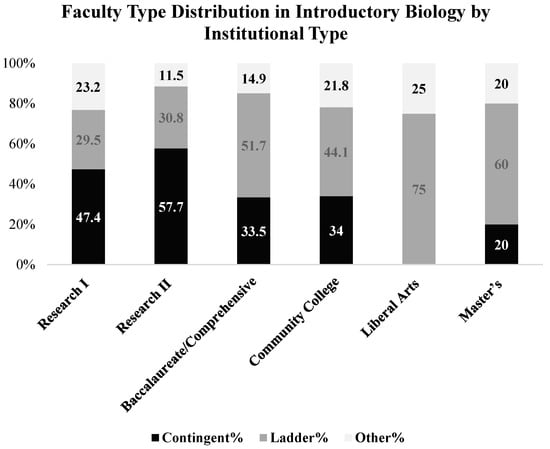
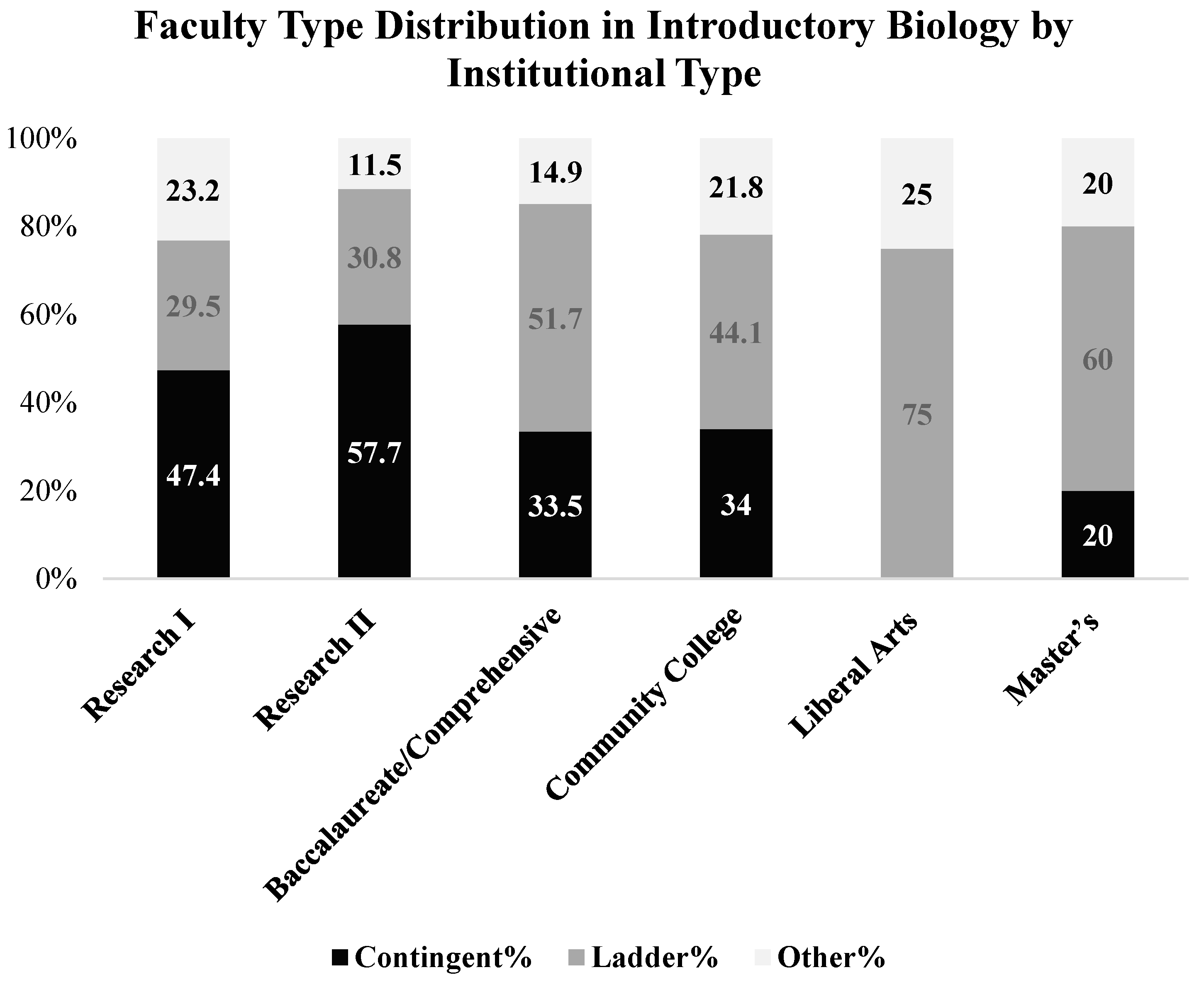
Figure 1.
Section-level distribution of contingent, ladder, and Other faculty teaching introductory biology, by institutional type.
- Research Question 1: Who primarily teaches introductory biology courses at U.S. colleges—contingent (non-ladder) or ladder (tenure-track/tenured) faculty?
To address Research Question 1, we analyzed faculty appointments across 621 introductory biology course sections drawn from 68 institutions in the national sample. At the section level, ladder faculty taught 278 sections (44.8%), contingent faculty taught 230 sections (37.0%), and instructors coded as Other (including graduate students, teaching assistants, staff, and visiting faculty) taught 113 sections (18.2%). Thus, in contrast to Hypothesis 1—which proposed that a higher proportion of introductory biology sections would be taught by contingent faculty—ladder faculty comprised the largest share of instructors for these gateway courses. A parallel institution-level analysis, in which each institution contributed equally regardless of the number of sections offered, yielded a similar pattern: on average, 42.2% of biology sections per institution were taught by ladder faculty, 35.6% by contingent faculty, and 22.2% by instructors classified as Other. Taken together, these results indicate that, in this sample, ladder faculty rather than contingent faculty are most likely to teach introductory biology, and Hypothesis 1 is not supported. These overall section-level and institution-level patterns are summarized in Table 2. To assess whether the observed difference between ladder and contingent faculty in introductory biology was greater than would be expected by chance, we conducted a chi-square goodness-of-fit test on the section-level counts for these two categories (278 ladder, 230 contingent). Under a null model where there is equal representation of ladder and contingent faculty, the distribution was statistically significant, χ2 (1) = 4.54, p = 0.033, indicating ladder faculty teach a significantly larger share of introductory biology sections than contingent faculty. This result reinforces our descriptive conclusion that ladder faculty are more likely than contingent faculty to teach gateway biology courses.
- Research Question 2: Does the distribution of faculty types teaching introductory biology courses differ by institutional characteristics (e.g., institutional type or region)?
Section-level and institution-level analyses revealed substantial variation in faculty assignment patterns across institutional types and geographic regions, supporting Hypothesis 2. When biology sections were grouped by simplified Carnegie-type categories, contingent faculty taught a majority of sections at research universities, whereas ladder faculty dominated at liberal arts and comprehensive institutions. At Research I institutions, 47.4% of biology sections were taught by contingent faculty, 29.5% by ladder faculty, and 23.2% by instructors in the Other category (n = 95 sections). Research II institutions exhibited an even stronger reliance on contingent instructors, with 57.7% of sections taught by contingent faculty, 30.8% by ladder faculty, and 11.5% by Other (n = 52). In contrast, at baccalaureate/comprehensive institutions, ladder faculty taught a majority of sections (51.7%), followed by contingent (33.5%) and Other (14.9%) faculty (n = 269). Community colleges showed a more balanced pattern: 44.1% of biology sections were taught by ladder faculty, 34.0% by contingent faculty, and 21.8% by Other instructors (n = 188). Liberal arts colleges were distinctive in assigning all biology sections to ladder or Other faculty (75.0% ladder, 25.0% Other; 0% contingent; n = 12), and the small number of master’s institutions in the biology subset also relied primarily on ladder appointments (60.0% ladder, 20.0% contingent, 20.0% Other; n = 5). Section-level distributions of faculty type by Carnegie classification are presented in Table 3, and institution-level mean proportions by Carnegie classification are reported in Table 4.
Regional patterns likewise showed meaningful differences in faculty assignment. In the Mid-Atlantic region, contingent faculty taught a majority of introductory biology sections (55.1% contingent, 34.8% ladder, 10.1% Other; n = 158). By comparison, all other regions exhibited ladder-faculty majorities: in New England, 50.0% of sections were taught by ladder faculty, 26.3% by contingent, and 23.7% by Other (n = 76); in the South, 50.9% ladder, 23.6% contingent, and 25.5% Other (n = 106); in the Southwest, 54.9% ladder, 29.6% contingent, and 15.5% Other (n = 71); in the West, 46.2% ladder, 34.0% contingent, and 19.9% Other (n = 156); and in the Midwest, 37.0% ladder, 44.4% contingent, and 18.5% Other (n = 54). These patterns indicate that both institutional type and region are associated with distinct mixes of contingent, ladder, and other instructors in introductory biology, with research-intensive institutions and some regions (e.g., Mid-Atlantic) relying more heavily on contingent faculty than others. Regional section-level percentages by faculty category are also summarized in Table 3.
At the institution level, the distribution of faculty types also varied widely across colleges and universities, even within the same Carnegie category or region. Across the 68 institutions offering biology, the mean institutional proportion of biology sections taught by contingent faculty was 35.6% (median = 33.3%, SD = 32.3%), compared with 42.2% for ladder faculty (median = 41.4%, SD = 29.5%) and 22.2% for Other instructors (median = 16.7%, SD = 26.7%). Some institutions assigned all introductory biology sections to ladder faculty, whereas others relied almost exclusively on contingent instructors, underscoring the heterogeneity of faculty assignment practices in gateway biology courses. Collectively, these results align with Hypothesis 2 by demonstrating that faculty type distributions in introductory biology differ systematically by institutional category and region while also varying considerably from institution to institution.
To formally test whether faculty type distributions differed by institutional category (Hypothesis 2), we conducted chi-square tests of independence using section-level counts. A three-by-six chi-square test including all three faculty categories (Contingent, Ladder, Other) across the six institutional types was statistically significant, χ2 (10) = 33.63, p < 0.001, indicating that the joint distribution of faculty types varies by institutional classification. A more focused two-by-six test comparing only contingent and ladder faculty was also significant, χ2 (5) = 6.06, p < 0.001 confirming that the balance between contingent and ladder instructors in introductory biology differs systematically across Research I, Research II, baccalaureate/comprehensive, master’s, liberal arts, and community college sectors. These results provide statistical support for Hypothesis 2, complementing the descriptive patterns shown in Table 3 and Figure 1.
- Research Question 3: Does the method of analysis (section-level vs. institution-level weighting) affect estimates of faculty type representation in introductory courses?
To address Research Question 3, we compared section-level and institution-level estimates of faculty representation in introductory biology. Section-level analyses, which weight each course section equally and thus approximate the typical student’s experience, indicated that 44.8% of biology sections were taught by ladder faculty, 37.0% by contingent faculty, and 18.2% by Other instructors. Institution-level analyses, which weight each college or university equally regardless of the number of sections offered, yielded slightly lower estimates for ladder faculty (42.2%) and contingent faculty (35.6%) and a somewhat higher estimate for Other instructors (22.2%), averaged across institutions. Although these differences (on the order of 2–3 percentage points) are modest, they illustrate that inferences about “who teaches” introductory biology depend on whether analyses emphasize course exposure at the national level or typical institutional practice. The contrast between section-weighted and institution-weighted estimates for each faculty category is also reported in Table 2.
The relatively small discrepancy between section-weighted and institution-weighted estimates for this biology subset contrasts with the large variability observed across institutions (standard deviations near 30 percentage points for both ladder and contingent categories), suggesting that analytic weighting choices primarily influence how this underlying heterogeneity is summarized rather than reversing the overall pattern. In both analytic frames, ladder faculty remain the largest instructional group in introductory biology, and contingent faculty constitute a substantial—but not predominant—share of instructional assignments. These findings are consistent with Hypothesis 3 in that section-level and institution-level analyses yield different numeric estimates of faculty representation, even though the substantive conclusion regarding ladder faculty’s majority role in introductory biology is robust across weighting methods.
5. Discussion
This study provides a large-scale, discipline-specific view of who teaches introductory biology in U.S. higher education and how instructional roles vary across institutional contexts. In contrast to widespread concerns that introductory courses are increasingly staffed primarily by contingent faculty, our analyses indicate that ladder (tenure-track and tenured) faculty teach the largest share of introductory biology sections in this sample, both when weighting each section equally and when weighting each institution equally. At the same time, the results reveal substantial variation by institutional type and region, with research universities and some regions relying heavily on contingent instructors, while liberal arts and comprehensive institutions employ predominantly ladder faculty in gateway biology courses. These patterns complicate common narratives about “adjunctification” and suggest that discipline-specific, context-sensitive evidence is essential for understanding how national workforce trends play out in particular gateway disciplines such as biology (Kezar & Sam, 2013; Umbach, 2007).
5.1. Interpretation of Faculty Distribution Patterns
The finding that ladder faculty teach a majority of introductory biology sections appears, at first glance, to run counter to national summaries documenting the growth of non-tenure-line appointments across undergraduate education (Irwin et al., 2021; Kezar & Sam, 2013). One plausible interpretation is that biology, as part of the natural and physical sciences, remains comparatively protected from adjunctification in some institutional sectors, particularly at liberal arts colleges and baccalaureate/comprehensive institutions where ladder faculty staff most introductory biology sections. This pattern aligns with prior work suggesting that staffing models and faculty roles vary systematically across institutional types and that research-intensive institutions may be more likely to segment teaching and research responsibilities through expanded use of contingent appointments (Ehrenberg & Zhang, 2005; Kezar & Sam, 2013). At the same time, the high contingent shares in Research I and Research II universities in our sample—up to 57.7% of introductory biology sections at Research II institutions—underscore that even within a single discipline, institutional context substantially shapes who teaches gateway courses.
These results also highlight the importance of examining the “Other” category of instructors, which includes graduate teaching assistants and staff or visiting faculty. In research-intensive settings, this group accounts for more than one-fifth of introductory biology sections, reflecting a distributed instructional model in which graduate students and non-ladder professionals play a visible role in teaching (Umbach, 2007). From an equity and reform perspective, this suggests that efforts to align introductory biology with Vision and Change recommendations and active-learning practices must extend beyond tenure-line faculty to encompass the full instructional team (AAAS, 2011; Theobald et al., 2020). Departments that focus exclusively on ladder faculty development may miss a substantial portion of those who actually staff introductory courses in research-intensive universities.
5.2. Alignment with Prior Research on Contingent Faculty and Student Outcomes
Our results resonate with and nuance prior scholarship on the changing academic workforce. National-level analyses have documented that non-tenure-track faculty now make up a majority of instructional staff in U.S. higher education, raising concerns about job security, compensation, and integration into academic life (Kezar & Sam, 2013; Slaughter & Rhoades, 2004). Studies examining the impact of contingent faculty on student outcomes have reported mixed findings, with some evidence that heavy reliance on part-time or non-tenure-track faculty can depress graduation rates or reduce student engagement when institutions do not provide adequate support (Ehrenberg & Zhang, 2005; Umbach, 2007). Other work, however, suggests that when contingent faculty are well supported, their teaching effectiveness can match or exceed that of tenured colleagues, particularly in teaching-focused roles (Kezar & Sam, 2013; Umbach, 2007).
Within this broader literature, our biology-specific findings indicate that introductory biology is not uniformly dominated by contingent appointments and that the balance between contingent and ladder faculty depends strongly on institutional type and region. This suggests that conclusions about the impact of contingent faculty in STEM cannot be generalized from institutional-level aggregates alone; discipline-level and course-level analyses are needed to capture variation in who teaches critical gateway sequences like introductory biology. Moreover, given strong evidence that active learning and structured course designs can improve performance and narrow equity gaps in introductory biology and other STEM fields (Bauer et al., 2020; Freeman et al., 2014; Theobald et al., 2020), an important next step is to investigate whether the adoption of these practices differs by faculty appointment type within biology. For example, ladder faculty may have greater access to pedagogical training and departmental support for course redesign, while contingent instructors may face time and resource constraints that limit their ability to implement intensive active-learning structures (Kezar & Sam, 2013; Killpack & Popolizio, 2023).
5.3. Section-Level Versus Institution-Level Perspectives
By comparing section-level and institution-level estimates of faculty representation, this study clarifies how different analytic choices shape interpretations of “who teaches” introductory biology. Section-level analyses, in which each course section contributes equally, emphasize the typical student’s experience and show that students in this sample are most likely to encounter ladder faculty in introductory biology, followed by contingent and then Other instructors. Institution-level analyses, in which each college or university is weighted equally, yield slightly lower estimates for ladder faculty and higher estimates for the Other category, but the overall pattern—ladder faculty as the largest group—remains stable. The modest numerical differences between these two perspectives suggest that, for this dataset, analytic weighting does not reverse the substantive conclusion, even though it does alter the exact proportions.
However, the substantial variability across institutions (standard deviations around 30 percentage points for both ladder and contingent categories) indicates that averages may obscure the extent of heterogeneity in local practice. Some institutions in the sample assign all introductory biology sections to ladder faculty, while others rely almost exclusively on contingent instructors or teaching assistants. In light of methodological guidance emphasizing explicit justification of sample design and weighting strategies (Ahmed, 2024; Lakens, 2022), these findings underscore the value of reporting both section-weighted and institution-weighted estimates when the goal is to inform both student-centered and institution-centered inferences. For policy discussions, institution-level distributions may be more relevant, whereas for student experience and equity analyses, section-level patterns are likely paramount.
5.4. Implications for Departments and Policy
Taken together, the patterns identified here have several implications for departmental planning and institutional policy in biology and related STEM disciplines. First, departments seeking to align introductory biology with Vision and Change priorities and equity-focused redesigns should explicitly consider the full instructional mix—including contingent faculty, teaching assistants, and staff instructors—when designing professional development, mentoring, and evaluation systems (AAAS, 2011; Bauer et al., 2020; Killpack & Popolizio, 2023). In research universities where contingent and Other instructors teach a majority of sections, reform efforts that target only ladder faculty may have limited reach. Ensuring that all instructors who teach introductory biology have access to stable appointments, pedagogical resources, and pathways for meaningful participation in departmental decision-making aligns with recommendations for institutionalizing more equitable policies for non-tenure-track faculty (Kezar & Sam, 2013).
Second, the strong institutional and regional variation we observe suggests that local context should inform conversations about staffing models and their consequences. For example, research-intensive institutions with high contingent shares may wish to examine whether their staffing patterns align with their goals for undergraduate STEM education, student success, and graduate training, particularly in light of evidence that faculty working conditions can influence availability for mentoring and engagement in evidence-based teaching practices (Umbach, 2007; Theobald et al., 2020). Conversely, liberal arts and baccalaureate institutions where ladder faculty dominate introductory biology may face different challenges, such as balancing research expectations with the time and support needed to sustain high-quality, student-centered instruction across multiple sections.
Finally, this study illustrates the value of discipline-specific monitoring of faculty assignment in gateway courses. Institutional dashboards and accreditation reports often aggregate faculty composition at the campus level, obscuring patterns in high-stakes introductory sequences. By disaggregating faculty roles within biology, institutions can better align hiring, workload, and professional development policies with their stated goals for STEM equity and success (Malcom et al., 2016; Theobald et al., 2020). Such monitoring could also inform strategic decisions about where incremental tenure-line hires, conversion of contingent roles to longer-term appointments, or enhanced support for non-tenure-track faculty might have the greatest impact on students’ early experiences in biology.
5.5. Limitations and Future Directions
Several limitations of this study should be acknowledged. First, the dataset, while large and stratified by region and institutional type, does not explicitly distinguish public from private control or capture all possible institutional classifications, which may constrain some types of generalization. Second, faculty appointment categories were derived from institution-specific titles and recoded into contingent, ladder, and Other groups; although this approach follows common practice, variation in how institutions define roles such as “lecturer” means that some heterogeneity remains within categories (Kezar & Sam, 2013). Third, the analysis does not link faculty type directly to student outcomes, course structures, or the use of active learning, which limits our ability to make claims about the educational consequences of the observed staffing patterns. Future research that integrates faculty appointment data with course design, pedagogy, and student performance measures would more fully illuminate how staffing models intersect with efforts to improve equity and success in introductory biology (Bauer et al., 2020; Freeman et al., 2014; Theobald et al., 2020).
Additionally, while this study distinguishes between section-level and institution-level perspectives, it does not exhaust the range of possible weighting schemes or multilevel models that could be used to disentangle student-, course-, and institution-level effects. Subsequent work might employ hierarchical modeling to estimate the extent to which variation in faculty type explains differences in course outcomes after accounting for student demographics, institutional resources, and course design. Qualitative studies of departmental decision-making and instructor experiences across institution types would also complement these quantitative findings by clarifying how and why particular staffing patterns emerge, and how they are perceived by faculty, administrators, and students (Kezar & Sam, 2013; Umbach, 2007).
Despite these limitations, this study offers a detailed descriptive account of faculty assignment in introductory biology across a diverse set of U.S. institutions and demonstrates that ladder faculty, not contingent faculty, currently teach the largest share of these gateway courses in our sample. The results underscore both the persistence of tenure-line involvement in foundational biology instruction and the substantial presence of contingent and other instructors, particularly in research-intensive and regionally specific contexts. By making visible who teaches introductory biology and how that varies across institutional landscapes, this work lays a foundation for more targeted, evidence-based conversations about faculty roles, course reform, and equity in undergraduate STEM education.
6. Conclusions
This study offers a discipline-specific, empirically grounded picture of who teaches introductory biology across a diverse set of U.S. institutions and clarifies how faculty appointment patterns vary by institutional type, region, and analytic lens. Contrary to a common expectation informed by broader narratives of adjunctification, ladder (tenure-track and tenured) faculty taught the largest share of introductory biology sections in this sample, both when weighting each section equally and when weighting each institution equally. At the same time, contingent and other instructors—including graduate teaching assistants and staff—constituted a substantial proportion of introductory biology teaching, particularly in research-intensive institutions and in specific regions, underscoring that national workforce trends manifest unevenly within the biology gateway curriculum (Kezar & Sam, 2013; Umbach, 2007).
These findings contribute nuance to the broader literature on the changing academic workforce by showing that introductory biology cannot be characterized simply as a domain dominated by contingent faculty, nor as one insulated from the growth of non-tenure-line appointments. Instead, staffing patterns reflect a layered configuration in which ladder faculty remain central in many institutional sectors, while contingent and other instructors play especially prominent roles in research universities and certain regional contexts. Given compelling evidence that course structure and active-learning practices can improve learning and reduce equity gaps in introductory biology and related STEM courses (Bauer et al., 2020; Freeman et al., 2014; Theobald et al., 2020), these results suggest that reform efforts must consider the full instructional team—across appointment types—if institutions are to realize the aims of Vision and Change and similar initiatives (AAAS, 2011; Malcom et al., 2016).
Methodologically, the comparison of section-level and institution-level estimates demonstrates that analytic choices influence the precise proportions attributed to different faculty groups, even when they do not overturn the central conclusion that ladder faculty currently teach a plurality of introductory biology sections in this dataset. Consistent with recent guidance on sample justification and weighting in educational research (Ahmed, 2024; Lakens, 2022), the study highlights the value of reporting both perspectives when the goal is to inform inferences about students’ typical experiences as well as institutional practices. The substantial heterogeneity across institutions also illustrates why discipline-level and course-level analyses are essential complements to campus-wide faculty composition statistics, particularly for gateway courses that shape students’ early trajectories in STEM.
Looking ahead, the results point to several priorities for research and practice. Future work should link faculty appointment type in introductory biology to course design, use of evidence-based teaching practices, and student outcomes to better understand how staffing structures intersect with efforts to promote equity and persistence in STEM (Freeman et al., 2014; Theobald et al., 2020). Qualitative studies of departmental decision-making and instructor experiences across institution types would further clarify how local policies, cultures, and resource environments shape who teaches gateway biology and under what conditions (Kezar & Sam, 2013; Umbach, 2007). For departments and institutions, routinely monitoring faculty assignments to introductory biology and integrating that information into decisions about hiring, workload, and professional development can help align staffing models with articulated goals for student success and equity in the life sciences (AAAS, 2011; Malcom et al., 2016). This study represents a one-time snapshot of faculty profiles and the courses they teach. The analysis here does not represent if changes have taken place over time at the institutions sampled with respect to individuals teaching the courses and their associated rank. However, by making visible the patterns and variability in who teaches introductory biology, this study provides a foundation for more targeted, evidence-informed conversations about faculty roles in gateway STEM education and the structural conditions that support high-quality, equitable undergraduate learning.
Author Contributions
Conceptualization, B.D.; Methodology, T.G. and B.D.; Validation, T.G., A.T. and B.D.; Formal analysis, T.G., A.T. and B.D.; Investigation, A.T. and B.D.; Resources, B.D.; Writing—original draft, T.G.; Writing—review & editing, A.T. and B.D.; Supervision, B.D.; Project administration, A.T. and B.D.; Funding acquisition, B.D. All authors have read and agreed to the published version of the manuscript.
Funding
This research was funded by The Gates Foundation.
Institutional Review Board Statement
Ethical review and approval were waived for this study due to the fact that this study here describes publicly available data scraped from the websites and course pages of universities and thus no humans needed to be consented for the data. According to our IRB rules this not only falls under exempt, but many times the IRB office wouldn’t even review it.
Informed Consent Statement
Not applicable.
Data Availability Statement
Data is contained within the article.
Conflicts of Interest
The authors declare no conflict of interest.
References
- Ahmed, S. K. (2024). How to choose a sampling technique and determine sample size for research: A simplified guide for researchers. Oral Oncology Reports, 12, 100662. [Google Scholar] [CrossRef] [Scilit]
- American Association for the Advancement of Science (AAAS). (2011). Vision and change in undergraduate biology education: A call to action. AAAS. Available online: https://www.aaas.org/resources/vision-change-undergraduate-biology-education-call-action (accessed on 5 July 2026).
- Bauer, A. C., Coffield, V. M., Crater, D., Lyda, T., Segarra, V. A., Suh, K., Vigueira, C. C., & Vigueira, P. A. (2020). Fostering equitable outcomes in introductory biology courses through use of a dual domain pedagogy. CBE—Life Sciences Education, 19(4), ar4. [Google Scholar] [CrossRef] [Scilit] [PubMed]
- Colby, G. (2023). Data snapshot: Tenure and contingency in US higher education. American Association of University Professors. [Google Scholar]
- Dewsbury, B. M., Swanson, H. J., Moseman-Valtierra, S., & Caulkins, J. (2022). Inclusive and active pedagogies reduce academic outcome gaps and improve long-term performance. PLoS ONE, 17(6), e0268620. [Google Scholar] [CrossRef] [Scilit] [PubMed]
- Eagan, M. K., Jaeger, A. J., & Grantham, A. (2015). Supporting the academic majority: Policies and practices related to part-time faculty’s job satisfaction. The Journal of Higher Education, 86(3), 448–483. [Google Scholar] [CrossRef] [Scilit]
- Ehrenberg, R. G., & Zhang, L. (2005). Do tenured and tenure-track faculty matter? The Journal of Human Resources, 40(3), 647–659. [Google Scholar] [CrossRef] [Scilit]
- Freeman, S., Eddy, S. L., McDonough, M., Smith, M. K., Okoroafor, N., Jordt, H., & Wenderoth, M. P. (2014). Active learning increases student performance in science, engineering, and mathematics. Proceedings of the National Academy of Sciences, 111(23), 8410–8415. [Google Scholar] [CrossRef] [Scilit] [PubMed]
- Graham, M. J., Frederick, J., Byars-Winston, A., Hunter, A.-B., & Handelsman, J. (2013). Increasing persistence of college students in STEM. Science, 341(6153), 1455–1456. [Google Scholar] [CrossRef] [Scilit] [PubMed]
- Irwin, V., Zhang, J., Wang, X., Hein, S., Wang, K., Roberts, A., York, C., Barmer, A., Bullock Mann, F., Dilig, R., & Parker, S. (2021). Report on the condition of education 2021 (NCES 2021-144). U.S. Department of Education. National Center for Education Statistics. Available online: https://nces.ed.gov/pubs2021/2021144.pdf (accessed on 5 July 2026).
- Kanim, S., & Cid, X. C. (2020). Demographics of physics education research. Physical Review Physics Education Research, 16(2), 020106. [Google Scholar] [CrossRef] [Scilit]
- Kezar, A., DePaola, T., & Scott, D. T. (2019). The gig academy: Mapping labor in the neoliberal university. Johns Hopkins University Press. [Google Scholar] [CrossRef] [Scilit]
- Kezar, A., & Sam, C. (2013). Institutionalizing equitable policies and practices for contingent faculty. The Journal of Higher Education, 84(1), 56–87. [Google Scholar] [CrossRef] [Scilit]
- Killpack, T. L., & Popolizio, T. R. (2023). An equity-focused redesign of an introductory organismal biology laboratory course. Journal of Microbiology & Biology Education, 24(1), e00213-22. [Google Scholar] [CrossRef] [Scilit] [PubMed]
- Lakens, D. (2022). Sample size justification. Collabra: Psychology, 8(1), 33267. [Google Scholar] [CrossRef] [Scilit]
- Malcom, S., Feder, M., Committee on Barriers and Opportunities in Completing 2-Year and 4-Year STEM Degrees, Board on Science Education, Division of Behavioral and Social Sciences and Education, Board on Higher Education and Workforce, Policy and Global Affairs, National Academy of Engineering & National Academies of Sciences, Engineering, and Medicine (Eds.). (2016). Barriers and opportunities for 2-year and 4-year STEM degrees: Systemic change to support students’ diverse pathways. National Academies Press (US). [Google Scholar] [CrossRef] [Scilit] [PubMed]
- Seeber, M., Lepori, B., Montauti, M., Enders, J., de Boer, H., Weyer, E., Bleiklie, I., Hope, K., Michelsen, S., Mathisen, G. N., Frølich, N., Scordato, L., Stensaker, B., Waagene, E., Dragsic, Z., Kretek, P., Krücken, G., Magalhães, A., Ribeiro, F. M., … Reale, E. (2015). European universities as complete organizations? Understanding identity, hierarchy and rationality in public organizations. Public Management Review, 17(10), 1444–1474. [Google Scholar] [CrossRef] [Scilit]
- Slaughter, S., & Rhoades, G. (2004). Academic capitalism and the new economy: Markets, state, and higher education. Johns Hopkins University Press. [Google Scholar]
- Theobald, E. J., Hill, M. J., Tran, E., Agrawal, S., Arroyo, E. N., Behling, S., Chambwe, N., Cintrón, D. L., Cooper, J. D., Dunster, G., Grummer, J. A., Hennessey, K., Hsiao, J., Iranon, N., Jones, L., Jordt, H., Keller, M., Lacey, M. E., Littlefield, C. E., … Freeman, S. (2020). Active learning narrows achievement gaps for underrepresented students in undergraduate science, technology, engineering, and math. Proceedings of the National Academy of Sciences, 117(12), 6476–6483. [Google Scholar] [CrossRef] [Scilit] [PubMed]
- Umbach, P. D. (2007). How effective are they? Exploring the impact of contingent faculty on undergraduate education. The Review of Higher Education, 30(2), 91–123. [Google Scholar] [CrossRef] [Scilit]

Disclaimer/Publisher’s Note: The statements, opinions and data contained in all publications are solely those of the individual author(s) and contributor(s) and not of MDPI and/or the editor(s). MDPI and/or the editor(s) disclaim responsibility for any injury to people or property resulting from any ideas, methods, instructions or products referred to in the content. |
© 2026 by the authors. Licensee MDPI, Basel, Switzerland. This article is an open access article distributed under the terms and conditions of the Creative Commons Attribution (CC BY) license.