


Abstract
Manipulative materials are widely considered valuable resources in geometry education because they may support visualization, spatial reasoning, and conceptual understanding when implemented within appropriate instructional contexts. However, many existing resources focus on isolated concepts and provide limited opportunities for connecting geometric relationships through transformation and decomposition. This study presents Geomaniguras, a manipulative material designed for upper primary and lower secondary education. The research adopts a design and development approach focused on pedagogical design and expert-based validation rather than measuring student learning outcomes. The study combined prototype construction, expert evaluation, and iterative refinement. Twelve specialists in mathematics education assessed the material using a structured validation guide addressing pedagogical usefulness, conceptual coherence, usability, visual design, and classroom applicability. Results indicate that experts perceived Geomaniguras as a potentially valuable resource for exploring polygon classification, area relationships, geometric decomposition, circumference, and the Pythagorean theorem. The findings provide preliminary evidence regarding the pedagogical plausibility and classroom applicability of the material, although no direct conclusions can yet be drawn about instructional effectiveness. The originality of the proposal lies in its integrated conceptual framework, which connects multiple geometric learning experiences within a single manipulative system.
1. Introduction
Mathematics constitutes a fundamental discipline for understanding and interpreting the world and plays a central role in scientific and technological development. Mathematical reasoning is involved in numerous everyday situations, including measurement, interpretation of graphical information, spatial orientation, and problem-solving. As Acharya (2017) argues, mathematics plays a central role in science and technology development. Nevertheless, mathematics continues to represent one of the areas in which students experience the greatest learning difficulties throughout compulsory education.
Research has consistently shown that these difficulties frequently emerge during primary education and may persist over time if students fail to develop meaningful conceptual understanding (Mangarin & Caballes, 2024). Geometry has been identified as one of the most challenging areas of mathematics learning. According to Clements and Battista (1992), many students develop only superficial knowledge of geometric concepts, relying on the visual appearance of shapes rather than on their properties and relationships. Consequently, misconceptions regarding the classification of figures, spatial relationships, and geometric reasoning are common, largely due to traditional instructional approaches that emphasize memorization and procedural tasks over conceptual understanding. These difficulties often limit students’ progression towards higher levels of geometric thinking. In response, recent research has argued that geometry instruction should move beyond the passive learning of definitions and properties towards activities that promote spatial reasoning through composing, decomposing, transforming, and manipulating geometric figures (Sinclair & Bruce, 2015). Similarly, Clements (2003) reported a progressive decline in students’ motivation and achievement in geometry, often associated with instructional practices focused on formulas and routine procedures rather than on reasoning and conceptual development.
These findings have led researchers to advocate for learning environments that promote active exploration and spatial reasoning from the earliest years of schooling. Clements and Battista (1992) argue that geometry instruction should provide opportunities for students to manipulate geometric objects, compare their properties, and progressively construct increasingly sophisticated geometric concepts. Sinclair and Bruce (2015) argue that spatial reasoning should become a central component of primary geometry, encouraging students to actively explore geometric relationships rather than simply identify and classify figures. Likewise, Fujita (2012) showed that students’ understanding of hierarchical relationships between quadrilaterals improves when they are encouraged to investigate, compare, and justify geometric properties instead of relying solely on visual prototypes. These studies collectively suggest that inquiry-based and hands-on experiences may provide favourable conditions for the development of conceptual understanding compared with predominantly procedural instruction.
Recent studies in mathematics education further emphasize the importance of promoting meaningful learning through active and exploratory experiences (Koskinen & Pitkäniemi, 2022). Within this framework, manipulative materials have been widely recognized as valuable educational resources because they facilitate visual, tactile, and constructive interaction with mathematical concepts (Carbonneau et al., 2013; Ponte et al., 2023). Previous research has shown that hands-on activities can support the transition from concrete experiences to abstract reasoning, enhance students’ spatial reasoning, and improve engagement and conceptual understanding (Clements & Sarama, 2011; Fujita, 2012; Bartolini & Martignone, 2020; Matos et al., 2023; Milenković et al., 2025). In particular, Clements and Sarama (2011) argue that mathematical learning is strengthened when students actively construct knowledge through carefully designed instructional experiences, rather than simply manipulating objects without pedagogical guidance. Accordingly, the educational value of manipulative materials depends not only on their physical characteristics but also on the quality of the tasks and teacher mediation that accompany their use (Arnal-Bailera & Arnal-Palacián, 2023). In geometry education, several manipulative materials have traditionally been employed, including tangrams, geoboards, logical blocks, and geometric pattern blocks (Larbi & Mavis, 2016; Sibiya, 2020). These materials contribute to the development of spatial reasoning, classification skills, visualization, and geometric composition. However, many of these resources tend to address isolated concepts and do not always provide an integrated framework connecting geometric transformations, measurement, decomposition, and area reasoning.
This perspective is closely related to Van Hiele’s theory of geometric thinking, one of the most influential theoretical frameworks in geometry education (Burger & Shaughnessy, 1986; Van Hiele, 1986). According to Van Hiele, students progress through different levels of geometric understanding, evolving from simple visual recognition of shapes toward analytical, relational, and deductive reasoning. Educational experiences involving manipulation, visualization, and exploration are particularly important for facilitating these transitions.
More recent research has also emphasized the importance of embodied cognition and visuospatial reasoning in mathematics learning. Physical interaction with geometric representations may support students’ ability to mentally transform figures, identify invariant properties, and coordinate multiple representations during problem-solving (Fujita et al., 2022; Jablonski & Ludwig, 2023). From this perspective, manipulative materials may function not only as motivational resources but also as mediational tools supporting conceptual abstraction.
In recent years, digital tools such as GeoGebra and augmented reality applications have also been incorporated into geometry teaching (Ibili et al., 2019; Rodríguez et al., 2019). Although these technologies offer important advantages for visualization, physical manipulatives continue to provide unique opportunities for embodied learning and direct interaction with geometric properties.
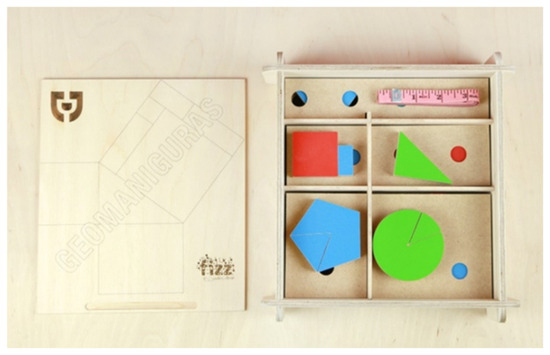
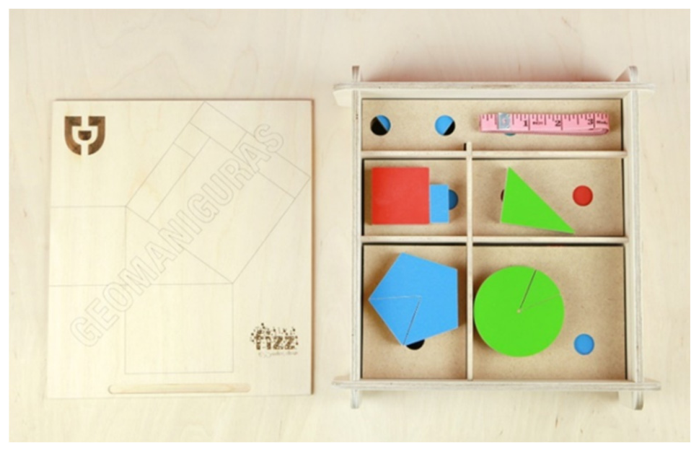
Within this context, the present study introduces Geomaniguras, a manipulative material designed primarily to support geometry learning in upper primary and lower secondary education. The contribution of the material lies mainly in the integration of multiple geometric concepts into a coherent manipulative system rather than in the creation of entirely novel geometric forms. The material was subsequently registered in Spain as a protected utility model, reflecting the originality of its structural configuration. Figure 1 shows an overview of the Geomaniguras set.
Figure 1.
Overview of the Geomaniguras set.
Specifically, the objectives of this study are as follows:
- To present the conceptual and pedagogical foundations underlying the design of Geomaniguras.
- To describe its educational applications for geometry instruction.
- To report the expert validation process used to refine the material.
Importantly, the study does not attempt to evaluate the effectiveness of Geomaniguras on student achievement or geometric reasoning development. Instead, it focuses on the design rationale, expert-based pedagogical validation, and refinement process of the material as a preliminary stage prior to future classroom intervention studies.
2. Geomaniguras: Structure and Educational Applications
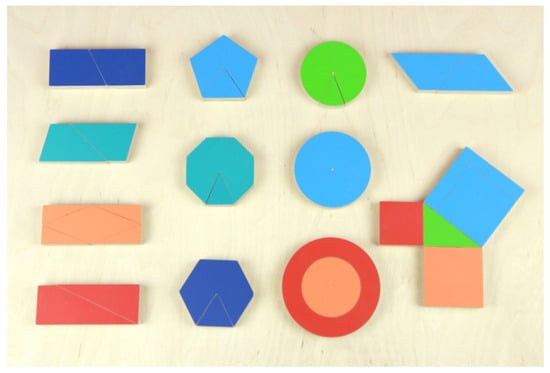
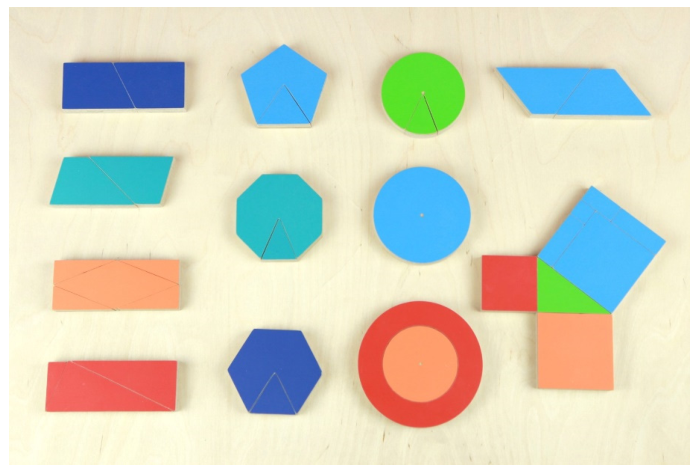
Geomaniguras consists of 33 geometric pieces made of laminated birch wood with embedded magnets that allow pieces to be combined and separated easily. The pieces are coated with erasable acrylic paint to facilitate annotations during classroom activities. Figure 2 shows a complete set of Geomaniguras.
Figure 2.
Complete set of Geomaniguras.
The approximate dimensions of the pieces range from 4 cm to 18 cm depending on the geometric family, allowing manipulation both individually and in small-group classroom settings. The use of laminated birch wood was selected to ensure durability, moderate weight, and safe handling during repeated educational use.
For organizational purposes, the material is divided into six groups of pieces, each oriented toward specific geometric concepts and reasoning processes.
2.1. Group F1: Triangles and Area Relationships
This group includes acute and right triangles designed to support the study of the following:
- Comparison of different triangle types.
- Composition of figures.
- Area relationships between triangles and parallelograms.
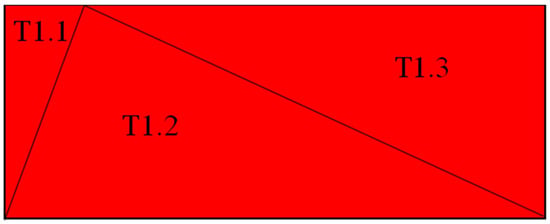
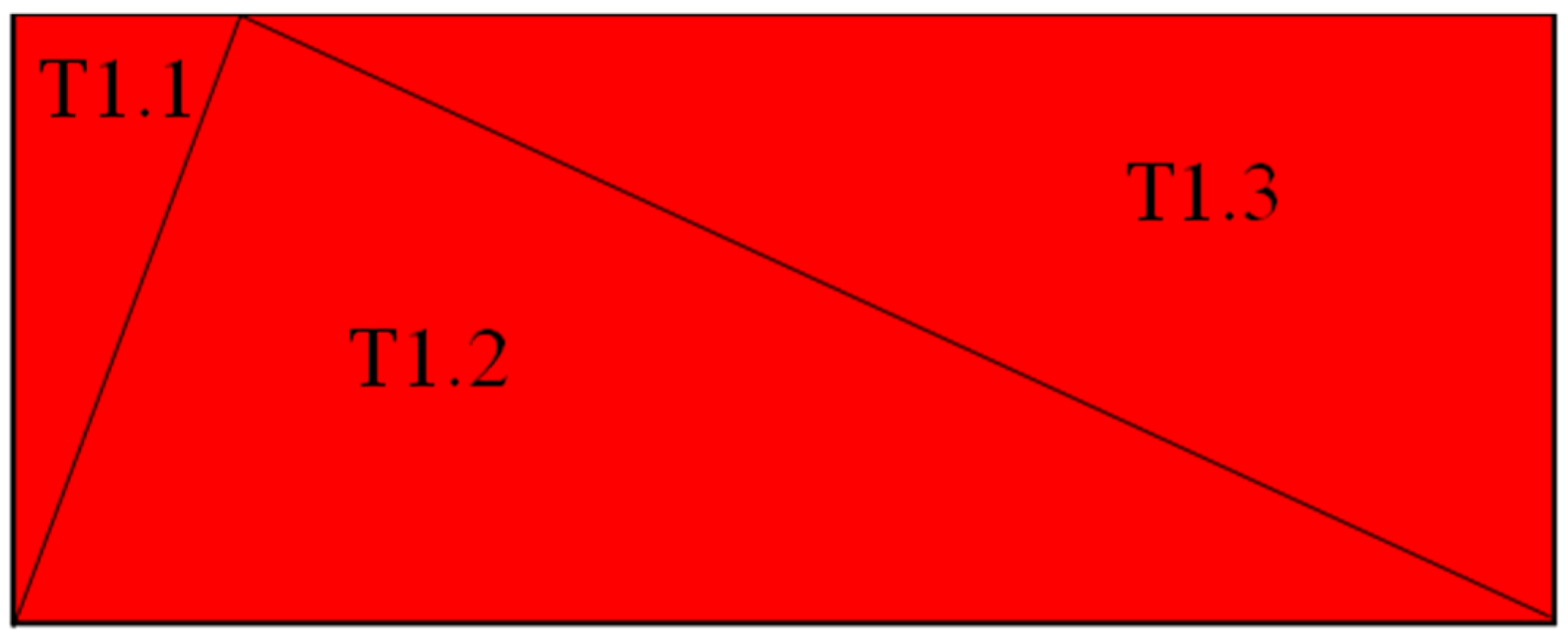
The material was designed to allow students to visually explore how two congruent triangles form a parallelogram and deduce the formula for the area of a triangle. Figure 3 shows the pieces of Group F1.
Figure 3.
Composition of triangles into a parallelogram.
Example classroom task:
Students are asked to construct different parallelograms using congruent triangles and compare resulting areas. Teachers may guide discussion through questions such as “What remains invariant when the triangles are rearranged?” and “How can the area formula of a triangle be derived from the area of a parallelogram?”
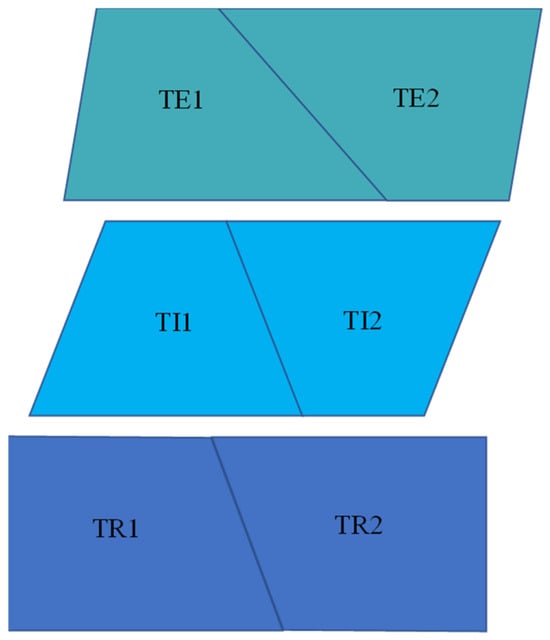
2.2. Group F2: Rectangles, Rhombuses, and Triangles
The second group supports the exploration of the following:
- Properties of rhombuses.
- Derivation of the area formula for rhombuses.
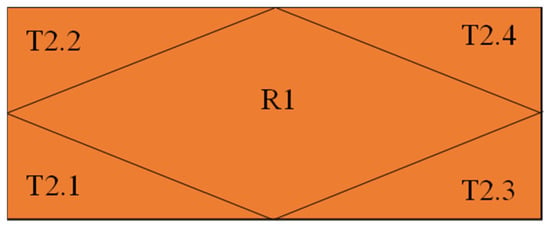
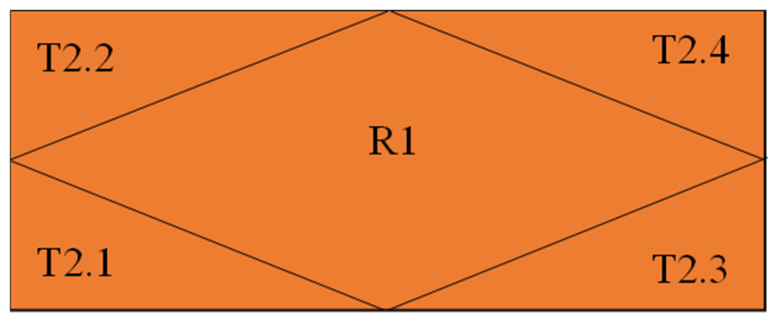
The manipulative transformations are intended to help students establish relationships between rectangles, rhombuses, and triangles. Figure 4 shows the pieces of Group F2.
Figure 4.
Formation of a rhombus from triangles.
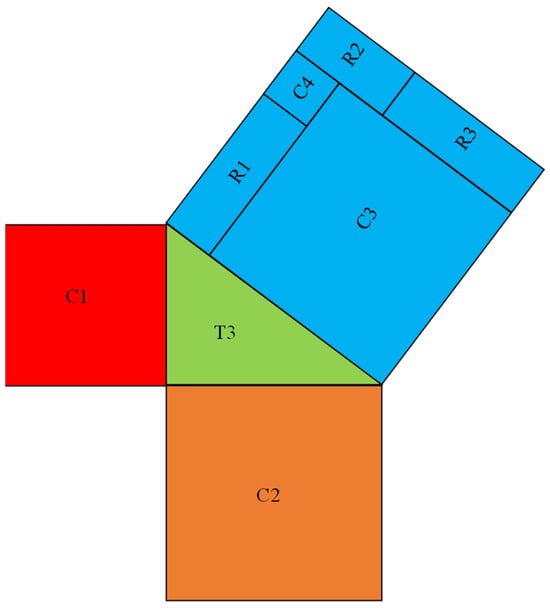
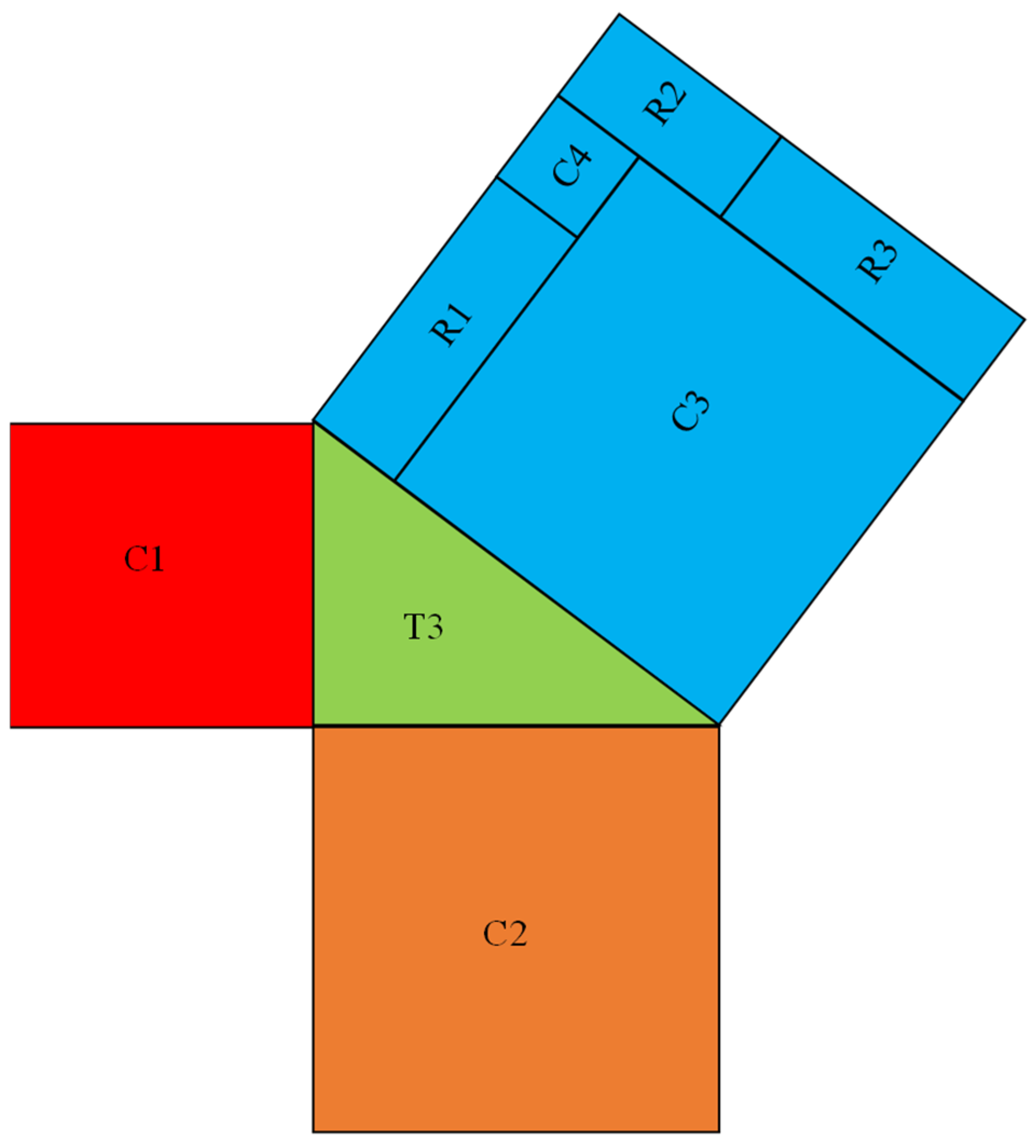
2.3. Group F3: Pythagorean Theorem and Area Measurement
This group was specifically designed to facilitate the following:
- Geometric demonstration of the Pythagorean theorem.
- Understanding of area measurement.
- Derivation of rectangle and square area formulas.
Students may manipulate squares and rectangles to verify visually that the area of the square on the hypotenuse equals the sum of the areas of the squares on the legs of a right triangle. Figure 5 shows the pieces of Group F3.
Figure 5.
Visual proof of the Pythagorean theorem.
The activities associated with this group are to be designed primarily according to target transitions between Van Hiele Levels 1 and 2 by encouraging students to move from visual recognition toward analysis of geometric relationships and area equivalence.
2.4. Group F4: Trapezoids
This set includes scalene, isosceles, and right trapezoids. The pieces are designed to support the following:
- Classification of trapezoids.
- Comparison between quadrilaterals.
- Derivation of the trapezoid area formula through composition.
These activities were designed to encourage students to develop a deeper conceptual understanding of trapezoid properties and their relationships with other quadrilaterals. Figure 6 shows the pieces of Group F4.
Figure 6.
Derivation of trapezoid area by composition.
2.5. Group F5: Regular Polygons
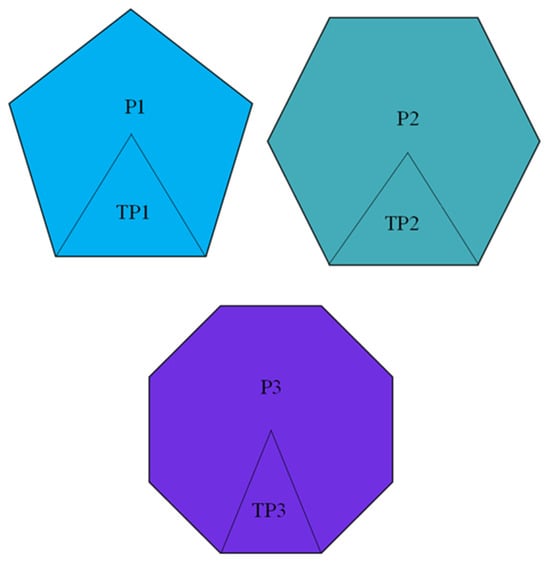
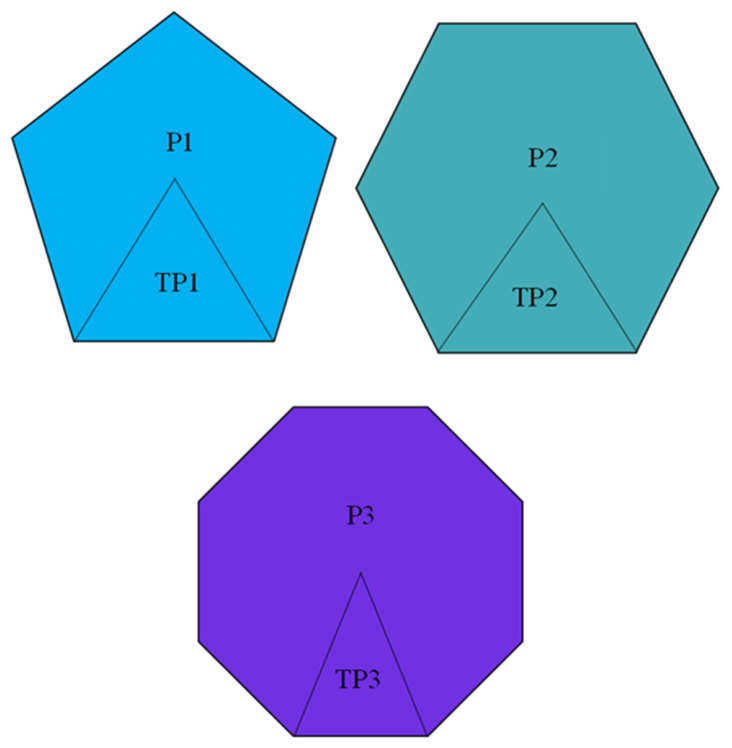
This group contains regular polygons sharing the same radius, namely a pentagon (pieces P1 and TP1), a hexagon (P2 and TP2), and an octagon (P3 and TP3), allowing students to explore the following:
- Polygon classification.
- Central and interior angles.
- Relationships between the radius and side length.
- Derivation of the area formula for regular polygons.
These activities are intended to support reasoning about polygon decomposition into congruent triangles. Figure 7 shows the pieces of Group F5.
Figure 7.
Decomposition of a regular polygon.
2.6. Group F6: Circular Figures
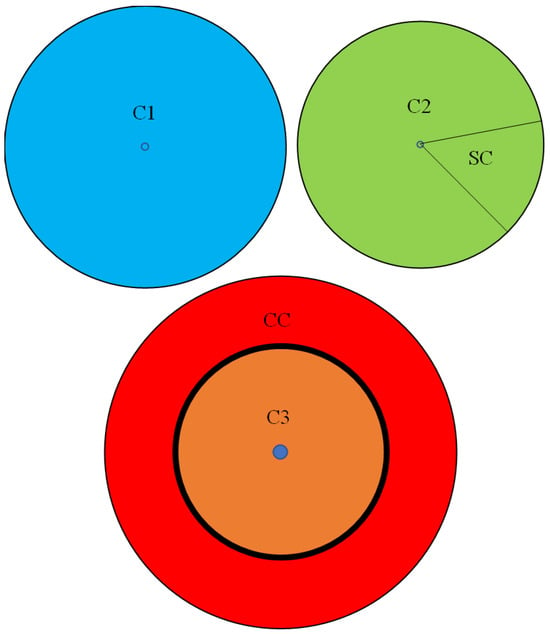
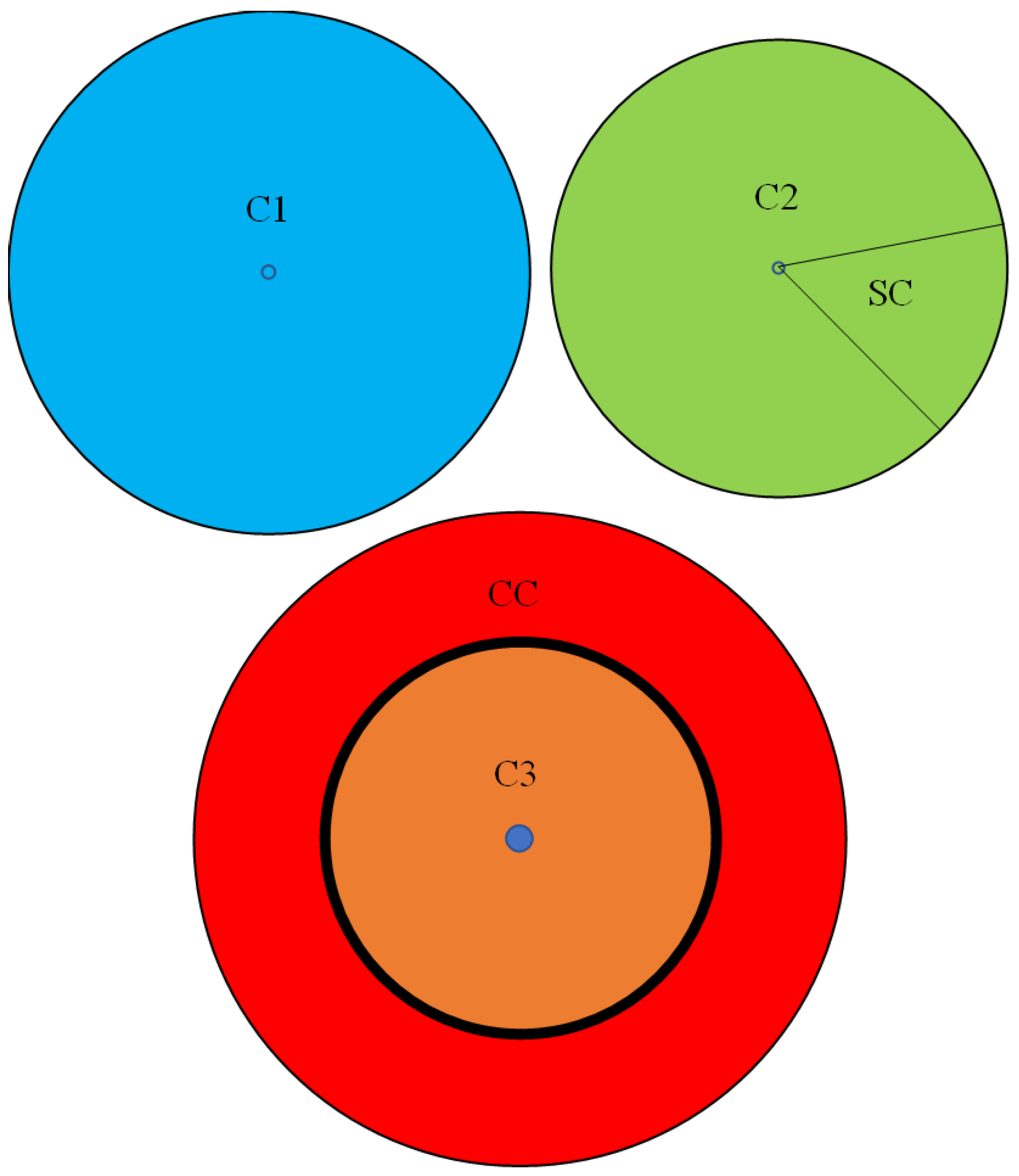
The final group focuses on circles and related figures, including sectors and circular annuli. Educational applications include the following:
- Circumference and arc length.
- Estimation of the value of π.
- Deduction of circumference formulas.
- Conceptual derivation of the area of a circle.
The connection between regular polygons and circles enables students to reason about the circle as the limiting case of polygons. Figure 8 shows the pieces of Group F6.
Figure 8.
Circular figures.
3. Methodology
This study adopts a design and development research approach focused on the creation and pedagogical validation of a manipulative material for geometry instruction. Design and development research is particularly appropriate for studies aimed at generating educational innovations through iterative cycles of design, expert review, and refinement (Richey & Klein, 2007).
The research process consisted of three main stages: conceptual design, expert validation, and refinement of the final material.
3.1. Design Phase
The initial design of Geomaniguras was guided by three pedagogical principles:
- Promotion of conceptual understanding through manipulation.
- Integration of multiple geometric concepts within a unified system.
- Facilitation of geometric reasoning through decomposition and transformation.
The material was designed to support activities related to polygon classification, area reasoning, geometric composition, circumference, and the Pythagorean theorem.
The design process involved several iterative prototype versions developed between 2023 and 2025. The initial prototype consisted of unfinished wooden pieces without colour differentiation, polarity indicators, or enlarged F3 components. These characteristics were subsequently modified following expert feedback. Early prototypes were tested internally by the research team through simulated classroom tasks to identify usability issues related to size, magnet placement, and manipulation. These preliminary iterations informed the version subsequently presented to the expert panel.
3.2. Participants
The validation phase involved 12 experts in mathematics education selected through purposive sampling. The panel included the following:
- Six university lecturers specialized in mathematics education.
- Four secondary mathematics teachers with experience in geometry instruction.
- Two curriculum specialists in secondary mathematics education.
Participants had between 8 and 27 years of professional experience (M = 16.4). All experts had previous experience using manipulative materials in mathematics teaching. Although Geomaniguras is intended for both upper primary and lower secondary education, the expert panel was intentionally composed of specialists with extensive experience in geometry instruction, curriculum design, and mathematics education research. Future validation studies should include primary school teachers. None of the experts involved in the validation process participated in the design or development of Geomaniguras, nor had they collaborated previously with the authors in this project. Selection criteria required participants to meet at least two of the following conditions:
- Published research in mathematics education.
- A minimum of five years of geometry teaching experience.
- Experience in curriculum development.
- Prior use of manipulative resources in mathematics instruction.
The expert panel included professionals from different educational institutions in Castilla-La Mancha and Madrid, ensuring diversity in teaching contexts and educational perspectives.
3.3. Validation
A structured validation guide was specifically designed for the study. The instrument consisted of 24 items organized into five dimensions:
- Pedagogical usefulness (6 items): This dimension assesses the material’s capacity to facilitate the teaching–learning process, achieve specific geometric curricular goals, and foster cognitive development, spatial reasoning, and geometric thinking in students.
- The material facilitates the visualization of geometric relationships.
- The instrument helps students effectively identify the core properties of various geometric shapes.
- The use of this material enables active learning and student engagement during geometry lessons.
- The resource is suitable for introducing geometric concepts in an intuitive manner.
- The material encourages mathematical communication, reasoning, and discussion among peers.
- The tool provides a clear pedagogical advantage compared to abstract or traditional 2D representations.
- Conceptual coherence (5 items): This dimension measures the scientific and mathematical rigor of the resource, ensuring that the pieces, shapes, and structures accurately represent theoretical geometric concepts without inducing misconceptions.
- The manipulative system supports reasoning through decomposition and recomposition.
- The terminology and mathematical foundations underlying the material are accurate and scientifically rigorous.
- The geometric attributes of the pieces (e.g., angles, proportions, symmetry) are mathematically precise and consistent.
- The design of the resource is fully aligned with the geometric standards of the current.
- The material allows for a logical progression from basic geometric properties to advanced spatial orientation.
- Usability and manipulation (5 items). This dimension analyses the user experience, ergonomics, physical durability, and how intuitive the manual handling of the pieces is for students during autonomous or guided activities.
- The components of the material are easy to handle and manipulate by the target student age group.
- The physical connection, coupling, or assembly mechanism between the pieces functions smoothly.
- Students can independently use the manipulative system without requiring constant technical intervention from the teacher.
- The materials are durable, robust, and safe enough to withstand frequent handling in an everyday educational setting.
- The physical storage, sorting, and organization of the pieces are practical and intuitive for classroom routines.
- Visual and material design (4 items): This dimension focuses on the aesthetic, sensory, and structural characteristics of the resource, evaluating whether the selection of colours, textures, sizes, and finishes is appealing, functional, and safe for its educational purpose.
- The colour scheme used in the pieces effectively helps to distinguish, contrast, and categorize different geometric elements.
- The texture, weight, and finish of the material are visually appealing, ergonomic, and pleasant to touch.
- The visual layout of the components minimizes cognitive overload and enhances student focus on the geometric task.
- The material used is safe, non-toxic, and maintains high visual clarity for all students.
- Classroom applicability (4 items): This dimension evaluates the practical feasibility of integrating the resource into actual classroom dynamics, considering time constraints, space management, inclusivity, and adaptability to various teaching methodologies.
- The dimensions and physical characteristics of the pieces are appropriate for classroom use.
- The learning activities involving the material can be realistically completed within a standard school session.
- The resource is versatile enough to be seamlessly integrated into individual, small-group, or whole-class dynamics.
- The material can be easily adapted or differentiated to accommodate students with diverse learning needs and paces.
Each item was evaluated using a 5-point Likert scale ranging from 1 (strongly disagree) to 5 (strongly agree).
Examples of evaluation items included the following:
- “The material facilitates the visualization of geometric relationships.”
- “The manipulative system supports reasoning through decomposition and recomposition.”
- “The dimensions and physical characteristics of the pieces are appropriate for classroom use.”
Additionally, experts were invited to provide qualitative comments and suggestions for improvement.
The internal consistency of the instrument was assessed using Cronbach’s alpha, obtaining a coefficient of 0.89. Although this value suggests satisfactory internal consistency for the purposes of the present exploratory study, the relatively small number of experts requires these results to be interpreted as preliminary evidence rather than as definitive psychometric validation of the instrument.
Each expert participated in an individual evaluation session lasting approximately 60–75 min. During the sessions, participants were first introduced to the pedagogical objectives of Geomaniguras and subsequently engaged in guided manipulation tasks involving polygon composition, area transformation, and geometric decomposition activities.
Experts were encouraged to explore the material freely after the guided tasks and to evaluate both pedagogical affordances and practical usability aspects. Written evaluations were completed individually at the end of each session.
Content validity was established through iterative review by three university researchers with expertise in mathematics education and educational measurement, who independently examined the relevance, clarity, and alignment of each item with the intended validation dimensions. Minor wording revisions were introduced before the instrument was administered to the expert panel. Given the limited sample size, exploratory or confirmatory factor analyses were intentionally not conducted. Consequently, the construct validity of the instrument should be regarded as preliminary. Additional studies involving larger and more diverse samples will be necessary to further examine its psychometric properties.
3.4. Data Analysis
Quantitative responses were analysed descriptively using means and standard deviations for each dimension of the validation guide. The material obtained an overall mean score of 4.63 out of 5.
In addition to descriptive statistics, item-level analyses were conducted to identify strengths and weaknesses associated with specific pedagogical and usability dimensions of the material. Mean scores above 4.50 were interpreted as indicators of substantial convergence of expert opinions regarding the educational suitability of the corresponding feature, whereas values below 4.00 were considered indicators requiring revision or redesign.
To examine the internal consistency of the validation instrument, Cronbach’s alpha coefficients were calculated both globally and by dimension. The overall instrument obtained an alpha coefficient of 0.89, suggesting satisfactory internal consistency within the context of the present exploratory expert-validation study. Given the limited sample size, these coefficients should be interpreted cautiously and regarded as preliminary indicators rather than definitive evidence of the instrument’s psychometric quality. Dimension-specific coefficients ranged from 0.78 to 0.91, suggesting satisfactory consistency across categories.
Inter-item correlations were also examined to identify possible redundancies among indicators. Correlation values remained within acceptable ranges (r = 0.41–0.76), supporting the conceptual coherence of the instrument while avoiding excessive overlap between items.
Given the exploratory nature of the study and the relatively small expert sample, inferential statistical analyses were not conducted. Nevertheless, dispersion measures were carefully examined to identify dimensions showing lower consensus among participants. In particular, the usability and manipulation dimension obtained the highest standard deviation (SD = 0.71), indicating greater variability in expert perceptions regarding the handling of smaller components.
To facilitate interpretation of results, percentage distributions were additionally calculated for each response category. Across all dimensions, 83.4% of responses corresponded to scores of 4 or 5, suggesting generally positive evaluations of the material. Negative evaluations (scores 1 or 2) represented less than 4% of all responses.
Qualitative comments were analysed through thematic coding.
The qualitative analysis followed an inductive thematic approach inspired by Braun and Clarke (2008). The coding process involved three stages:
- Initial open coding of all written comments.
- Grouping of codes into broader conceptual categories.
- Review and refinement of themes by two members of the research team.
A total of 67 individual comments were extracted from the expert reports. During the first coding cycle, 21 preliminary codes were identified. These codes were subsequently grouped into four broader thematic categories related to usability, visual organization, conceptual affordances, and classroom implementation.
To improve analytical trustworthiness, two researchers independently coded the qualitative data and later compared categorizations. Intercoder agreement reached 87% prior to consensus discussions. Disagreements were resolved through negotiated interpretation until full agreement was achieved.
Frequency analysis of qualitative themes revealed that the most recurrent category involved comments concerning conceptual integration and geometric reasoning (31.3% of coded excerpts), followed by usability and manipulation issues (28.4%), visual organization and colour differentiation (22.4%), and classroom implementation considerations (17.9%).
Thematic analysis also revealed differences in emphasis depending on professional profile. University researchers more frequently highlighted theoretical coherence and alignment with Van Hiele’s framework, whereas secondary teachers emphasized classroom management issues, manipulation speed, and student accessibility.
Representative excerpts illustrating each thematic category were selected to strengthen interpretive transparency and connect quantitative tendencies with expert narratives. This integration of descriptive statistical analysis and qualitative thematic interpretation allowed for a more comprehensive understanding of the pedagogical affordances and limitations identified during the validation process.
4. Results
This section presents the quantitative evaluation results together with the qualitative themes identified during expert validation. The integration of both sources of evidence provides a comprehensive overview of the strengths and limitations identified during the evaluation process.
The highest-rated dimension was pedagogical usefulness (M = 4.78), followed by classroom applicability (M = 4.67) and conceptual coherence (M = 4.59). The lowest scores were associated with manipulation of smaller pieces in the original prototype (M = 3.92), leading to subsequent redesign modifications.
These findings should be interpreted as indicators of experts’ perceptions of the pedagogical plausibility and usability of the material rather than as evidence of educational effectiveness.
Table 1 presents the descriptive results obtained in the expert validation process. Beyond the generally high quantitative ratings obtained across all five dimensions, the results suggest that the experts perceived Geomaniguras as a pedagogically coherent resource whose different design features work together to support geometry teaching. The consistently positive evaluations indicate that the experts did not identify isolated strengths but rather recognized a balance between conceptual accuracy, educational usefulness, classroom applicability, and technical design. This convergence is particularly relevant because it suggests that the material was considered feasible for classroom implementation. At the same time, the qualitative comments reveal that the experts critically examined the resource and proposed specific improvements, particularly regarding the size of some pieces, the magnetic system, colour coding, and instructional guidance. Therefore, the combination of high quantitative ratings and constructive qualitative feedback supports the usefulness of the expert validation process for refining the final version of Geomaniguras.
Table 1.
Descriptive statistics of expert validation results.
Interestingly, the highest ratings were associated with the pedagogical and mathematical dimensions of the material, suggesting that the experts particularly valued its potential to establish conceptual connections among different geometry topics. This finding is consistent with the design rationale of Geomaniguras, which seeks to integrate concepts that are frequently taught separately into a single manipulative system. Consequently, the quantitative results provide preliminary support for the internal coherence of the proposed design, while the qualitative evidence identifies practical aspects that should be refined before large-scale classroom implementation.
Item-level analyses showed that the highest-rated indicators corresponded to the material’s capacity to support visualization of geometric relationships (M = 4.91), facilitate decomposition and recomposition processes (M = 4.83), and promote exploratory learning (M = 4.79). In contrast, lower scores were associated with manipulation of smaller triangular components (M = 3.76) and rapid assembly during simulated classroom demonstrations (M = 3.89).
Although the quantitative results indicate a high degree of agreement among the participating experts, these findings should be interpreted within the methodological scope of the study. Because the validation relied on a relatively small purposive sample, the descriptive statistics should be considered preliminary evidence supporting the pedagogical plausibility of the material rather than definitive confirmation of the measurement properties of the validation instrument.
Analysis of response distributions revealed substantial consensus among experts in the pedagogical dimensions of the material. More than 90% of participants assigned scores of 4 or 5 to items related to conceptual coherence and educational applicability. Conversely, the manipulation dimension displayed greater variability, reflecting differing perceptions regarding the ergonomic suitability of some prototype components.
Comparison of responses according to professional profile suggested slight differences in evaluative emphasis. University lecturers tended to assign higher scores to theoretical coherence and integration of geometric concepts, whereas secondary teachers expressed greater concern regarding classroom practicality and manipulation efficiency during real instructional situations. However, both groups converged in their overall positive assessment of the material’s educational potential.
Qualitative comments revealed four major themes:
- Need for clearer identification of magnets and polarity.
- Improvement of manipulability of smaller components.
- Enhancement of visual organization through colour differentiation.
- Perceived potential for supporting conceptual geometry learning.
Thematic coding further revealed that experts consistently valued the integrated nature of the material. Several participants emphasized that Geomaniguras enables connections between concepts that are commonly taught separately in conventional geometry instruction, particularly between area reasoning, polygon decomposition, and geometric transformation.
Another recurrent theme concerned the role of manipulation in supporting mathematical discourse. Experts noted that the material appeared especially suitable for collaborative exploration activities in which students justify geometric relationships verbally while manipulating figures physically.
Comments associated with usability focused mainly on the dimensions of some pieces and the need for clearer visual cues to support rapid assembly. These observations directly informed the redesign process described in the following section.
Representative expert comments included observations such as the following:
- “The material allows students to visualize area equivalence in ways that are difficult to achieve through traditional textbook explanations.”
- “Some pieces are initially difficult to manipulate quickly during demonstrations, particularly the smaller triangular components.”
- “The integrated nature of the system may help students connect different geometric concepts that are often taught separately.”
- “The possibility of physically transforming figures may encourage richer mathematical discussion among students.”
Overall, the integration of quantitative and qualitative findings suggests that experts perceived Geomaniguras as a pedagogically coherent and potentially valuable educational resource while simultaneously identifying practical aspects requiring refinement before broader classroom implementation.
5. Design Refinement
Based on the expert feedback, several modifications were introduced into the final version of Geomaniguras.
First, coloured acrylic paint was added to improve visual differentiation between groups of pieces and facilitate classroom interaction through erasable annotations.
Second, the polarity of the embedded magnets was indicated on the reverse side of each piece to simplify manipulation and reduce assembly errors.
Third, several pieces from Group F3 (Pythagorean Theorem and Area Measurement) were enlarged by approximately 50% because experts reported difficulties manipulating the smaller prototype components during classroom simulations.
Finally, the centres of circular figures were marked explicitly to facilitate measurement activities involving radius and diameter.
The refinement process therefore functioned as an iterative pedagogical optimization stage intended to improve both usability and conceptual accessibility.
After implementing these modifications, the final version of Geomaniguras was registered as a utility model in Spain. These modifications improved both the usability and pedagogical functionality of the material.
6. Educational Potential of Geomaniguras
The educational contribution of Geomaniguras lies not only in its physical design but also in the conceptual relationships it enables students to establish between geometric representations.
Unlike manipulative materials designed for isolated tasks, Geomaniguras was designed to integrate multiple geometric concepts within a single coherent framework. Geomaniguras has been designed with the intention of enabling students to progress from visual recognition of shapes toward analytical reasoning involving transformations, area relationships, decomposition, and measurement.
This progression aligns with Van Hiele’s model of geometric thinking. In particular, the material is theoretically intended to support the following:
- Visualization of geometric properties.
- Analysis of relationships between figures.
- Reasoning through decomposition and recomposition.
- Empirical verification of geometric relationships.
The use of manipulatives may also contribute to the development of spatial reasoning processes such as mental rotation, visualization, and relational reasoning, although these aspects were not empirically examined in the present study.
The use of magnets and movable pieces is intended to facilitate experimentation and may encourage active student participation during mathematical exploration.
7. Discussion
The findings of the present study reinforce previous research highlighting the educational value of manipulative materials in mathematics learning, particularly within geometry education (Sowell, 1989; Carbonneau et al., 2013). Consistent with earlier studies, physical manipulatives may provide favourable conditions for supporting students’ understanding of abstract geometric concepts by encouraging visual and tactile interaction (Byrne et al., 2023). Such interaction is particularly relevant in geometry, where students frequently rely on visual prototypes rather than on the defining properties of geometric figures, leading to persistent misconceptions and difficulties in developing property-based geometric reasoning (Fujita, 2012).
Traditional manipulative resources, including tangrams, geoboards, and logical blocks, have long been recognized as valuable tools for promoting geometric exploration and supporting students’ mathematical thinking (Tchoshanov, 2011; Larbi & Mavis, 2016; Sibiya, 2020). These materials provide rich opportunities for students to manipulate figures, explore geometric relationships, and construct mathematical ideas through active engagement. However, they have generally been developed to address relatively specific concepts or sets of learning objectives within the geometry curriculum.
For example, tangrams primarily support spatial visualization, geometric composition, and transformations; geoboards facilitate the exploration of shapes, perimeter, area, and coordinate geometry; pattern blocks are particularly useful for investigating tessellations, symmetry, fractions, and basic geometric relationships; and construction systems such as Polydron mainly promote the understanding of three-dimensional geometry and polyhedral structures. Each of these resources has demonstrated considerable educational value and continues to occupy an important place within mathematics education.
By contrast, Geomaniguras was conceived as an integrated manipulative system intended to bring together a broad range of geometry topics within a single coherent instructional framework. Rather than proposing a replacement for existing manipulatives, the originality of the material lies in its attempt to connect polygon classification, geometric transformations, decomposition and recomposition of figures, area relationships, derivation of area formulas, the Pythagorean theorem, regular polygons, circumference, and the conceptual development of the area of the circle through the same set of manipulative pieces. Consequently, the principal contribution of Geomaniguras is pedagogical rather than technological, since its innovation does not reside in the individual components themselves but in the integrated conceptual framework that they collectively support.
An important distinction therefore concerns the continuity of students’ learning experiences. In many educational settings, different manipulatives are introduced independently as new curricular contents are addressed, requiring students to repeatedly adapt to different representations, materials, and forms of interaction. Geomaniguras was designed with the intention of reducing this fragmentation by providing a unified manipulative environment through which multiple geometry topics may be explored progressively. From this perspective, the material seeks to facilitate conceptual connections between ideas that are frequently taught separately within school geometry curricula.
This integrated design may also represent a practical advantage for teachers. Instead of introducing several different manipulative resources throughout a geometry unit, teachers may potentially address multiple curricular objectives using the same material. Although this possible advantage was not empirically examined in the present study, several experts emphasized during the qualitative evaluation that the coherence and versatility of the resource constituted one of its principal strengths. These observations should nevertheless be interpreted as expert perceptions regarding the pedagogical potential of the material rather than as evidence of its effectiveness in authentic classroom settings.
The originality of the proposal therefore lies primarily in its integrated conceptual framework rather than in the physical novelty of the material itself. Through manipulative transformations, students may establish relationships between geometric figures and progressively construct more advanced forms of geometric reasoning. However, within the methodological scope of the present study, these learning processes should be understood as intended pedagogical affordances of the design rather than as empirically demonstrated educational outcomes. Although the experts consistently perceived Geomaniguras as a coherent and potentially valuable educational resource, further classroom-based research will be required to determine whether these anticipated benefits are reflected in measurable improvements in students’ learning.
From a theoretical perspective, the material was intentionally designed to align with constructivist approaches to mathematics learning and with Van Hiele’s theory of geometric thinking (Burger & Shaughnessy, 1986). Activities involving composition, decomposition, comparison, and transformation were incorporated with the intention of encouraging students to progress from predominantly visual recognition of geometric figures towards more analytical reasoning based on the properties and relationships that define them. In this respect, the design of Geomaniguras attempts to provide learning opportunities that are theoretically consistent with the progression described by Van Hiele. Nevertheless, whether the use of the material contributes to students’ progression through these levels remains an empirical question that was beyond the scope of the present study.
The present findings are also consistent with recent literature emphasizing the importance of visualization and spatial reasoning in geometry education (Fujita et al., 2022; Jablonski & Ludwig, 2023). In particular, the development of spatial reasoning skills, including mental rotation, visualization, and property-based reasoning, has been identified as a key component of students’ ability to understand and solve geometric problems. Similarly, Sinclair and Bruce (2015) argue that geometry instruction should move beyond the simple identification and classification of shapes by promoting opportunities for students to manipulate, transform, and explore geometric figures while discussing the mathematical relationships they observe.
Within this theoretical context, the experts participating in the present study consistently perceived Geomaniguras as a pedagogically coherent resource whose integrated design may provide favourable conditions for this type of mathematical exploration. However, these perceptions should not be interpreted as evidence that the material improves students’ conceptual understanding, spatial reasoning, mathematical communication, or progression through Van Hiele levels, since none of these variables were directly examined. Consequently, the educational potential identified in the present study should be understood as theoretically grounded and supported by expert judgement rather than as empirically demonstrated through classroom intervention.
Nevertheless, the conclusions of this study must be interpreted cautiously because the research relied exclusively on expert-based validation procedures. No direct evidence regarding student learning, motivation, classroom interaction, or instructional effectiveness was collected. Consequently, the study cannot establish causal relationships between the use of Geomaniguras and improvements in conceptual understanding, spatial reasoning, mathematical communication, or geometric reasoning. Instead, the findings should be interpreted as preliminary evidence supporting the pedagogical coherence and educational plausibility of the proposed design.
The expert panel was intentionally selected for its disciplinary expertise rather than for statistical representativeness. Consequently, the findings should not be generalized beyond educational contexts comparable to those considered during the evaluation process. Expert validation constitutes an important initial phase within design and development research (Richey & Klein, 2007), allowing researchers to identify strengths, weaknesses, and opportunities for refinement before undertaking more demanding classroom-based investigations. Nevertheless, it cannot replace empirical evaluation involving teachers and students working under authentic educational conditions.
Furthermore, although the validation instrument demonstrated satisfactory internal consistency and the qualitative analysis revealed coherent patterns across expert comments, these findings were obtained from a relatively small purposive sample. Accordingly, the psychometric evidence reported in this study should be regarded as preliminary rather than definitive. Future research involving substantially larger and more diverse expert samples will be necessary to further examine the dimensional structure, stability, and broader validity of the evaluation instrument.
A further limitation concerns the conditions under which the expert evaluation was conducted. All experts participated in researcher-guided demonstration sessions in which the intended educational use of Geomaniguras was explained before they completed the evaluation. Although this procedure ensured that all participants assessed the same pedagogical proposal, it remains unknown how teachers unfamiliar with the material would independently integrate it into their own instructional practice or how students would interact with the resource during ordinary classroom activities without researcher guidance. Consequently, the educational affordances identified by the experts should be interpreted as potential characteristics of the material that require confirmation through authentic classroom implementation.
An additional limitation concerns the absence of classroom observation data and analyses of teacher implementation. The present study therefore provides no evidence regarding the forms of instructional scaffolding that teachers may require when using Geomaniguras, the classroom management strategies associated with the material, or the challenges that may emerge during its integration into regular teaching practice. These aspects constitute important areas for future investigation.
Future research should therefore move beyond expert-based validation by implementing Geomaniguras in authentic educational settings involving students and teachers from different educational stages and contexts. Such studies should investigate not only students’ conceptual understanding, spatial reasoning, mathematical communication, motivation, and problem-solving abilities, but also teachers’ instructional decisions, fidelity of implementation, and the forms of pedagogical scaffolding required for the material to achieve its intended educational purposes. Longitudinal studies incorporating appropriate comparison groups and validated learning measures will be particularly valuable for determining whether the theoretical and pedagogical potential identified during the present design and validation study is reflected in measurable improvements in students’ learning and progression across different levels of geometric reasoning, as described by Van Hiele’s model.
8. Conclusions
This study has presented Geomaniguras, a manipulative resource designed to support the teaching and learning of geometry through an integrated approach that combines visualization, manipulation, decomposition, transformation, and mathematical reasoning. Rather than proposing a new geometric manipulative in terms of its individual components, the main contribution of the resource lies in bringing together a broad range of geometric concepts within a single coherent pedagogical system. This integrated design was conceived to enable teachers to establish meaningful connections between topics that are often addressed independently in school geometry curricula, including polygon classification, area relationships, derivation of area formulas, the Pythagorean theorem, regular polygons, circumference, and the conceptual development of circle area.
The expert validation process provided preliminary evidence regarding the pedagogical coherence, usability, and perceived classroom applicability of the material. The feedback obtained from the expert panel also guided several improvements to the original prototype, illustrating the value of iterative design and refinement within a design and development research framework. Consequently, the study contributes not only by introducing a new educational resource but also by documenting a systematic process for its pedagogical development and validation.
Nevertheless, the findings should be interpreted within the methodological scope of the study. The evidence presented is based exclusively on expert evaluation and therefore does not allow conclusions to be drawn regarding the effectiveness of Geomaniguras in improving students’ conceptual understanding, spatial reasoning, or progression through levels of geometric thinking. Similarly, although the design of the material is theoretically consistent with frameworks such as Van Hiele’s theory of geometric thinking and current research on manipulation-based learning, these theoretical assumptions remain to be empirically examined in authentic educational contexts.
Future research should therefore focus on classroom implementation studies involving students and teachers from different educational stages and contexts. Such studies should investigate the effects of Geomaniguras on geometry learning, spatial reasoning, mathematical communication, and problem-solving, while also comparing its educational contribution with that of other widely used manipulative materials. Evidence obtained through classroom interventions will make it possible to determine whether the theoretical and pedagogical potential identified during the present design and validation study is reflected in measurable improvements in students’ learning.
Overall, this study should be understood as a first step in the development and validation of an integrated manipulative resource for geometry education. The findings suggest that Geomaniguras constitutes a pedagogically coherent educational resource with the potential to support geometry instruction, although its educational effectiveness remains to be established through classroom-based empirical research.
Theoretically, this study contributes to geometry education by proposing and validating the pedagogical plausibility of an integrated manipulative system that connects multiple geometric concepts within a coherent instructional framework. Practically, Geomaniguras has the potential to provide teachers with a resource for promoting hands-on exploration and conceptual connections across geometry topics. From a research perspective, the study establishes a basis for future classroom interventions examining the impact of the material on students’ geometric reasoning, conceptual understanding, and spatial thinking.
9. Patents
The manipulative material Geomaniguras is protected as a utility model in Spain (Application No. U202132475; Publication No. ES1284695), granted to the University of Castilla-La Mancha. The application was filed on 16 December 2021, and the utility model was granted on 21 March 2022, with a protection period of ten years from the filing date.
Author Contributions
Conceptualization, J.A.N.-L., D.M.-G. and J.L.G.-F.; methodology, J.A.N.-L., D.M.-G. and J.L.G.-F.; investigation, J.A.N.-L., D.M.-G. and J.L.G.-F.; writing—original draft preparation, J.A.N.-L.; writing—review and editing, J.A.N.-L., D.M.-G. and J.L.G.-F.; supervision, J.L.G.-F. All authors have read and agreed to the published version of the manuscript.
Funding
The Department of Mathematics at the University of Castilla-La Mancha has funded the production of 100 units of the educational material Geomaniguras, and the University of Castilla-La Mancha has covered the costs associated with securing the material’s utility model protection. No additional funds or grants were received.
Institutional Review Board Statement
Not applicable.
Informed Consent Statement
Not applicable.
Data Availability Statement
The dataset is available upon request from the authors. Tutorials and instructional resources for the educational use of Geomaniguras can be accessed through the Fizz Wooden Ideas website (https://fizzideas.com).
Acknowledgments
The authors would like to extend their gratitude to Marta López and Jorge Ferrero of Fizz Wooden Ideas for their invaluable assistance and support in the conceptualization and production of Geomaniguras.
Conflicts of Interest
The authors declare that one of the outcomes of this research is protected by a utility model owned by the University of Castilla-La Mancha. The authors receive no personal financial benefit from the commercialization of the material. The inclusion of the manufacturer’s website is intended solely to facilitate access to supplementary educational resources.
Abbreviations
The following abbreviations are used in this manuscript:
| M | Mean |
| SD | Standard deviation |
| r | Correlation coefficient |
References
- Acharya, B. (2017). Factors affecting difficulties in learning mathematics by mathematics learners. International Journal of Elementary Education, 6(2), 8–15. [Google Scholar] [CrossRef] [Scilit]
- Arnal-Bailera, A., & Arnal-Palacián, M. (2023). Pre-service teachers develop their mathematical knowledge for teaching using manipulative materials in mathematics. Eurasia Journal of Mathematics, Science and Technology Education, 19(9), 2318. [Google Scholar] [CrossRef] [Scilit] [PubMed]
- Bartolini, M. G., & Martignone, F. (2020). Manipulatives in mathematics education. In Encyclopedia of mathematics education (pp. 394–487). Springer. [Google Scholar] [CrossRef] [Scilit]
- Braun, V., & Clarke, V. (2008). Using thematic analysis in psychology. Qualitative Research in Psychology, 3(2), 77–101. [Google Scholar] [CrossRef] [Scilit]
- Burger, W. F., & Shaughnessy, J. M. (1986). Characterizing the Van Hiele levels of development in geometry. Journal for Research in Mathematics Education, 17(1), 31–48. [Google Scholar] [CrossRef] [Scilit] [PubMed]
- Byrne, E. M., Jensen, H., Thomsen, B. S., & Ramchandani, P. G. (2023). Educational interventions involving physical manipulatives for improving children’s learning and development: A scoping review. Review of Education, 11, 3400. [Google Scholar] [CrossRef] [Scilit]
- Carbonneau, K. J., Marley, S. C., & Selig, J. P. (2013). A meta-analysis of the efficacy of teaching mathematics with concrete manipulatives. Journal of Educational Psychology, 105(2), 380–400. [Google Scholar] [CrossRef] [Scilit]
- Clements, D. H. (2003). Teaching and learning geometry. In J. Kilpatrick, W. G. Martin, & D. Schifter (Eds.), A research companion to principles and standards for school mathematics (pp. 151–178). National Council of Teachers of Mathematics. [Google Scholar]
- Clements, D. H., & Battista, M. T. (1992). Geometry and spatial reasoning. In D. A. Grouws (Ed.), Handbook of research on mathematics teaching and learning (pp. 420–464). Macmillan. [Google Scholar]
- Clements, D. H., & Sarama, J. (2011). Early childhood mathematics intervention. Science, 333(6045), 968–970. [Google Scholar] [CrossRef] [Scilit] [PubMed]
- Fujita, T. (2012). Learners’ level of understanding of the inclusion relations of quadrilaterals and prototype phenomenon. Journal of Mathematical Behavior, 31(1), 60–72. [Google Scholar] [CrossRef] [Scilit]
- Fujita, T., Kondo, Y., Kumakura, H., Miyawaki, S., Kunimune, S., & Shojima, K. (2022). Identifying Japanese students’ core spatial reasoning skills by solving 3D geometry problems: An exploration. Asian Journal for Mathematics Education, 1(4), 437–454. [Google Scholar] [CrossRef] [Scilit]
- Ibili, E., Çat, M., Resnyansky, D., Şahin, S., & Billinghurst, M. (2019). An assessment of geometry teaching supported with augmented reality teaching materials to enhance students’ 3D geometry thinking skills. International Journal of Mathematical Education in Science and Technology, 51(2), 224–246. [Google Scholar] [CrossRef] [Scilit]
- Jablonski, S., & Ludwig, M. (2023). Teaching and learning of geometry: A literature review on current developments in theory and practice. Education Sciences, 13(7), 682. [Google Scholar] [CrossRef] [Scilit]
- Koskinen, R., & Pitkäniemi, H. (2022). Meaningful learning in mathematics: A research synthesis of teaching approaches. International Electronic Journal of Mathematics Education, 17(2), 0679. [Google Scholar] [CrossRef] [Scilit] [PubMed]
- Larbi, E., & Mavis, O. (2016). The use of manipulatives in mathematics education. Journal of Education and Practice, 7(1), 53–61. [Google Scholar]
- Mangarin, R. A., & Caballes, D. O. (2024). Difficulties in learning mathematics: A systematic review. International Journal of Research and Scientific Innovation, 11(9), 401–405. [Google Scholar] [CrossRef] [Scilit]
- Matos, A., Santos, V. A., & Neto, T. (2023). Poly-universe resource for solving geometric tasks by Portuguese basic education students. Open Education Studies, 5, 20220181. [Google Scholar] [CrossRef] [Scilit]
- Milenković, A., Stevanić, J., & Zdravković, N. (2025). The impact of discovery-based learning with physical manipulatives in teaching the area of triangles and quadrilaterals on students’ achievement. Journal of Pedagogical Research, 9(3), 102–115. [Google Scholar] [CrossRef] [Scilit]
- Ponte, R., Viseu, F., Neto, T., & Aires, A. (2023). Revisiting manipulatives in the learning of geometric figures. Frontiers in Education, 8, 1217680. [Google Scholar] [CrossRef] [Scilit]
- Richey, R. C., & Klein, J. D. (2007). Design and development research: Methods, strategies, and issues. Lawrence Erlbaum Associates. [Google Scholar]
- Rodríguez, J. L., Morga, G., & Cangas-Moldes, M. (2019). Geometry teaching experience in virtual reality with NeoTrie VR. Psychology, Society & Education, 11(3), 355–366. [Google Scholar] [CrossRef] [Scilit]
- Sibiya, M. R. (2020). A reconsideration of the effectiveness of using geoboard in teaching Euclidean geometry. Eurasia Journal of Mathematics, Science and Technology Education, 16(9), 1876. [Google Scholar] [CrossRef] [Scilit] [PubMed]
- Sinclair, N., & Bruce, C. D. (2015). New opportunities in geometry education at the primary school. ZDM Mathematics Education, 47(3), 319–329. [Google Scholar] [CrossRef] [Scilit]
- Sowell, E. J. (1989). Effects of manipulative materials in mathematics instruction. Journal for Research in Mathematics Education, 20(5), 498–505. [Google Scholar] [CrossRef] [Scilit]
- Tchoshanov, M. (2011). Building students’ mathematical proficiency: Connecting mathematical ideas using the tangram. Learning and Teaching Mathematics, 10(1), 16–23. [Google Scholar]
- Van Hiele, P. M. (1986). Structure and insight: A theory of mathematics education. Academic Press. [Google Scholar]

Disclaimer/Publisher’s Note: The statements, opinions and data contained in all publications are solely those of the individual author(s) and contributor(s) and not of MDPI and/or the editor(s). MDPI and/or the editor(s) disclaim responsibility for any injury to people or property resulting from any ideas, methods, instructions or products referred to in the content. |
© 2026 by the authors. Licensee MDPI, Basel, Switzerland. This article is an open access article distributed under the terms and conditions of the Creative Commons Attribution (CC BY) license.