


Abstract
This study examines the characteristics of abstract language use in gifted preschool children during natural free-play activities and compares them with those of typically developing children. The aim is to enhance our awareness of characteristics of gifted children language use and support them in everyday conversations and activities. Abstract language refers to expressions that describe decontextualized situations or that convey causal reasoning and prediction. It is closely related to the development of children’s language, cognition, and thinking. A total of 16 gifted children (10 boys and 6 girls; M = 73.06 months) were identified using two standardized instruments, the Combined Raven’s Test (Chinese revised version) and the Test of Nonverbal Intelligence, Second Edition (TONI-2). All identified children completed both assessments and scored at or above the 99th percentile on the Combined Raven’s Test and the 98th percentile on the TONI-2. Another 16 typically developing children (10 boys and 6 girls; M = 72.81 months) from the same classes were selected as matched controls based on teacher reports and their typical developmental performance. Drawing on corpus analysis, the study analyzed 2778 utterances produced by the gifted children and 2879 utterances produced by the typically developing children during 30-min free-play sessions. The results showed that, as the level of abstract language increased, both groups displayed a similar declining trend in the frequency of language use. However, a cumulative logit mixed-effects model showed that gifted children had significantly higher odds of producing language at higher levels of abstraction than typically developing children. In addition, gifted children demonstrated higher levels of abstract language during educator–child and peer interactions, whereas their private speech was more concentrated at lower levels of abstraction than that of typically developing children. Based on these findings, the study proposes educational recommendations in three areas: recognising children’s advanced thinking, addressing their specific language needs, and leveraging their communicative strengths. These recommendations may help create a more supportive educational environment for gifted children and better foster their developmental potential.
1. Introduction
Gifted children are generally defined as those who demonstrate elevated potential in one or more domains, including intellectual, academic, creative, leadership, artistic, or psychomotor abilities, often accompanied by a strong capacity for creativity and a high level of task commitment (Renzulli, 1978; Demir, 2022; Johnsen, 2021; Kaya, 2020). In the present study, gifted children are specifically conceptualised as those who exhibit significantly higher intellectual abilities compared to age-based norms, a definition widely adopted in the literature (Vaivre-Douret, 2011). Children are often identified as gifted if they scored at least 130 on an IQ test, equivalent to approximately two standard deviations above the norm. This threshold corresponds to roughly the top 2–3% of the age group (Wellisch & Brown, 2013; Renati et al., 2025). In China, it has been estimated that approximately 3% of children display intellectual functioning that is markedly above the average for their age group (Wan & Feng, 2009).
As a group with distinctive developmental trajectories, gifted children often differ from typically developing peers across multiple domains, including language development. Research has consistently shown that developmental advantages in gifted children emerge early, with language being one of the most salient domains in which these differences can be observed (Attoni et al., 2020). Gifted children tend to demonstrate more advanced and precise vocabulary, earlier use of temporal and spatial expressions, greater syntactic complexity, and flexible pragmatic use (Vaivre-Douret, 2011). They are also reported to organise language more flexibly and articulate causal relationships more clearly, reflecting advanced language processing and reasoning abilities (Hymer, 2003). These characteristics align with Vygotsky’s (2012) perspective that language and thought are closely interconnected, with language serving as a key medium through which cognitive processes are expressed and developed.
Despite these insights, much of the existing research has been conducted in home environments or controlled experimental settings (Bildiren, 2018; Vaivre-Douret, 2011). Comparatively little is known about how gifted children use language in naturalistic early childhood education contexts, where interactions with peers and educators shape everyday communication. Addressing this gap, the present study focuses on children’s use of abstract language, a language type that refers to decontextualised ideas, generalisations, and causal relationships, and is often associated with higher-order thinking processes. This focus is motivated by two considerations. First, abstract language reflects children’s ability to reason beyond the immediate context and is regarded as an important indicator of higher-order thinking, representing both a distinguishing characteristic of gifted children and a key milestone in language and cognitive development for all children. Research has shown that both exposure to and use of abstract language during the early years are associated with children’s language development, cognitive development, and later academic achievement (Chaparro-Moreno et al., 2023; Uccelli et al., 2019). Second, although previous studies have examined the development of abstract language in typically developing preschool children, relatively little is known about how gifted children use abstract language in everyday classroom interactions. Existing research has shown that children’s use of abstract language develops progressively with age, with five-year-old children producing significantly more decontextualized and inferential language than three- and four-year-olds (Q. Zhang et al., 2025). However, whether gifted preschool children demonstrate more advanced abstract language than their typically developing peers remains largely unexplored. Examining abstract language use in authentic preschool interactions can provide a more nuanced understanding of gifted children’s communicative and cognitive characteristics. Such insights are essential for supporting educators in recognising and responding to gifted children’s language abilities, and for fostering more effective and meaningful interactions in early childhood settings.
2. Language Development of Gifted Children
Language development has been widely regarded as one of the earliest and most observable domains in which gifted children differ from their typically developing peers. A frequently reported feature of this difference is advanced vocabulary development. Gifted children are often described as acquiring words early, using a wider range of vocabulary before the age of three, using less frequent words, and selecting words more precisely than their age peers (Porath, 1996; Clark, 2002; Silverman, 2004). For example, Bildiren’s (2018) study, based on parental observations of 112 gifted children identified through the Wechsler Intelligence Scale for Children–Revised (WISC-R), found that early walking and talking was the most frequently reported characteristic in the 0–2 age period. Parents also reported that these children used more words appropriately, had a larger vocabulary, understood spoken language early, and responded effectively to requests. In the 2–4 age period, they were described as having a much greater vocabulary than peers, using long and meaningful sentences, and asking interesting questions. This suggests that gifted children’s lexical advantage is not merely quantitative; rather, vocabulary provides them with richer linguistic resources for describing, classifying, explaining, and questioning the world around them.
Gifted children’s language advantage is also reflected in syntactic and semantic development. They may use longer and more complex utterances to express spatial and temporal relations, organise narratives, and communicate more elaborated meanings (Gross, 2002; Vaivre-Douret, 2011). Hoh’s (2005) longitudinal study of a gifted bilingual child further suggests that gifted language development may involve distinctive uses of language, including complex syntax, modality, metaphor, humour, and semantic–syntactic logic. More recent evidence from Spit and Rispens (2019) shows that gifted children aged 8–13 performed significantly better than their typically developing peers in understanding object relative clauses, indicating an advantage in complex syntactic comprehension. Taken together, these findings indicate that gifted children may use language not only as a means of communication, but also as a flexible tool for reasoning, conceptual organization, and the expression of complex meanings.
The connection between language and reasoning is especially evident in gifted children’s questioning behaviour. Gifted children are often described as highly curious and persistent in seeking explanations, and their questions frequently go beyond simple object naming or factual clarification. They may ask about causes, rules, possibilities, fairness, abstract concepts, or the meanings behind events. For example, Sousa (2009) describes linguistically gifted students as having an exceptional talent for reasoning and arguing at abstract and hypothetical levels in both spoken and written language. This close relationship between language and reasoning is also reflected in their responses to educators’ questions. In a naturalistic preschool shared reading study, Walsh et al. (2017) found that the cognitive challenge of educators’ questions influenced the quality of gifted children’s responses. Although higher-order questions generally elicited more sophisticated responses and lower-order questions tended to produce simpler responses, gifted children responded differently when presented with questions that substantially exceeded their current level of understanding. Rather than offering superficial or low-quality answers, they frequently responded with “I don’t know,” suggesting that they were sensitive to the cognitive demands of the interaction and reluctant to provide unsupported explanations. These findings indicate that gifted children’s language is closely linked to inquiry, explanation, and meaning-making, while also demonstrating a high level of sensitivity to the quality and complexity of linguistic input during interaction (Azzalini, 2023).
In terms of pragmatics, gifted children may also differ in how they use language during social interaction. Their advanced verbal ability may allow them to sustain conversations, negotiate meanings, seek clarification, and participate in more intellectually demanding exchanges, especially with adults. Early speech gives gifted children opportunities to express their thoughts and obtain information through questions before many peers have reached the same level of verbal interaction (Bildiren, 2018). However, this pragmatic strength may also create social complexity, as gifted children’s interests, vocabulary, or reasoning may not always align with those of their same-age peers.
At the same time, advanced language development should not be treated as a universal or linear marker of giftedness. Some gifted children show asynchronous development, where one area of language or literacy develops earlier than another. For example, Ateş and Afat’s (2018) case study of a gifted early reader illustrates this complexity. Their participant, a fourth-grade boy identified as gifted by RAM, was able to read at around 3.5 years old. However, his spoken language development was slower than that of his peers, and he entered the two-word stage at around age three. In addition, some gifted children may use richer vocabulary at home than at school, or may hide their verbal ability in order to adapt to peer expectations. These findings suggest that gifted children’s language development can be uneven, context-dependent, and shaped by both cognitive and social factors.
Although existing studies have documented advanced language characteristics in gifted children, much of this evidence comes from parental reports, developmental observations, or structured assessment contexts. Relatively fewer studies have examined gifted children’s language use as situated social interaction in natural preschool contexts. In particular, there is limited evidence on how gifted children use language pragmatically during free play, where they need to negotiate roles, explain rules, respond to peers, and interact with educators. Given that the preschool years represent a critical period for children’s language and cognitive development, and that an increasing proportion of young children spend substantial time in early childhood education settings, understanding children’s everyday language experiences in preschool has become increasingly important. Therefore, the present study shifts attention to gifted children’s language development in kindergarten free-play contexts, with a particular focus on how their language use is shaped by spontaneous interaction with peers, educators, and play situations.
3. The Conceptual Framework of Abstract Language
The concept of abstract language is closely associated with language use that involves higher-order thinking, particularly across two dimensions: decontextualized information and causal explanation (Blank et al., 1978; van Kleeck et al., 1997; Chaparro-Moreno et al., 2023). Decontextualized language refers to language that extends beyond the immediate “here and now” context, including references to past or future events (e.g., “My parents took me to the zoo last weekend”), objects or situations that are not physically present (e.g., “My dad also has a car”), descriptions of mental states (e.g., “I like red apples”), and general characteristics or properties of objects and events (e.g., “Apples have juice”) (Chaparro-Moreno et al., 2023). Compared with language grounded in immediate contexts and concrete objects, decontextualized language requires speakers to represent, organize, and communicate meanings beyond what is directly perceptible. It is therefore regarded as a cognitively demanding and linguistically sophisticated form of language use.
Another important dimension of abstract language is causal talk. In the literature, causal talk has been referred to by various terms, including explanatory talk, reasoning talk, and inferential language (Liu et al., 2021; Read et al., 2023). Regardless of the terminology, these forms of language share a common function: they establish logical relationships between ideas by expressing causal and conditional meanings, such as reason (e.g., “The floor is wet because someone had a shower”), purpose (e.g., “I need to read this book in order to prepare for the exam”), result (e.g., “Other people can see the screen if you sit down”), positive condition (e.g., “Mary will come as long as Mike also comes”), and negative condition (e.g., “He has to run otherwise he will be late”) (Halliday & Matthiessen, 2022). This type of language requires speakers to establish logical connections between events, ideas, and conditions, and therefore reflects advanced cognitive and linguistic processing. Through causal talk, children are encouraged not only to describe experiences, but also to explain relationships, predict outcomes, and justify reasoning, all of which are closely linked to the development of higher-order thinking skills.
More specifically, researchers found that children typically begin to use abstract language involving non-immediate contexts at around two years of age. Over the following two months, children gradually begin to demonstrate inferential forms of abstract language in everyday conversation (Halliday, 1993). This finding suggests that the development of abstract language is both staged and hierarchical; inferential language is typically acquired later than other forms of abstract language. Based on these notions, abstract language in the present study was conceptualized as a continuum with two dimensions and four levels: Level 1 (L1), non-inferential and contextualized language; Level 2 (L2), non-inferential and decontextualized language; Level 3 (L3), inferential and contextualized language; and Level 4 (L4), inferential and decontextualized language. Among the four levels, L1 does not actually include any “abstract element”. However, for the convenience of language analysis, we include this level. The specific categories and examples are presented in Table 1.
Table 1.
Levels of Abstract Language.
It should be noted that the present definition of abstract language captures important aspects of children’s higher-order thinking; however, it does not encompass all forms of language associated with higher-order thinking, such as metacognitive language or projected language. This definition is grounded in semantic functions, focusing on how speakers construe and communicate their experiences through language. This perspective differs from studies that examine children’s language development primarily in terms of vocabulary size or syntactic complexity. Rather than analysing linguistic form, the present study is concerned with the meanings that children express through language, particularly their ability to represent decontextualized ideas, infer causal relationships, and construct abstract meanings. Nevertheless, semantic meaning is realised through lexicogrammatical resources. As children’s vocabulary and grammatical knowledge develop, they acquire increasingly sophisticated linguistic resources for expressing abstract and complex meanings (Halliday & Matthiessen, 2022). In addition, the ability to select language forms that are appropriate to the communicative context and interactional demands reflects children’s developing pragmatic competence (Junquera & Zubiauz, 2024). In this sense, abstract language should not be regarded as a purely linguistic phenomenon. Rather, it reflects the integrated development of children’s semantic, lexical, grammatical, cognitive, and pragmatic abilities, enabling them to construct, communicate, and negotiate increasingly abstract meanings across a range of social contexts.
As stated above, the developmental progression of abstract language reflects children’s growing capacity for higher-order thinking, communication and social understanding. The present study adopts the above framework of abstract language to examine the characteristics of gifted children’s language use in comparison with their typically developing peers. By analyzing differences across varying levels of abstract language, this study aims to provide a more nuanced understanding of the linguistic and cognitive characteristics associated with giftedness in early childhood. Such findings may contribute to the early recognition of gifted preschool children and offer practical implications for educators and parents in supporting children’s advanced thinking and communication through everyday interactions.
4. Research Questions
The present study examines the language use of gifted preschool children from the perspective of abstract language during free play, a naturalistic and open-ended interactive context. Previous research suggests that gifted children are highly sensitive to the quality and cognitive demands of linguistic input during social interaction, with their language and reasoning shaped by opportunities to engage in explanation, inquiry, and meaning making (Walsh et al., 2017). Consistent with sociocultural perspectives on language development, children’s language use is influenced by their communication partners because different interlocutors provide distinct linguistic models, communicative purposes, and cognitive challenges (Nikolaus & Fourtassi, 2023). In preschool settings, children’s principal communication partners are educators, peers, and themselves through private speech, each of whom provides distinct interactional opportunities and linguistic resources. Accordingly, this study compares the performance of gifted children with that of their typically developing classmates and further explores how children use abstract language when interacting with different communication partners, including educators, peers, and themselves through private speech. Specifically, this study addresses the following research questions:
- (1)
- How do gifted and typically developing children use abstract language during free play, as reflected in the distribution of the four levels of abstract language, and do the two groups differ in their patterns of use?
- (2)
- How do gifted and typically developing children use abstract language when interacting with different communication partners (educators, peers, and themselves in private speech), and do the two groups differ in their patterns of abstract language use across these interaction contexts?
5. Materials and Methods
5.1. Participants
This study included 16 gifted preschool children (10 boys and 6 girls; M = 73.06 months, SD = 3.04) and 16 typically developing children (10 boys and 6 girls; M = 72.81 months, SD = 3.17) selected from the same classrooms and matched by gender.
Gifted children were identified using two standardized nonverbal intelligence measures: the Chinese revised version of the Combined Raven’s Test (CRT) and the Test of Nonverbal Intelligence, Second Edition (TONI-2). These two instruments are widely used professional intelligence assessments and are suitable for children aged 5 years and above (N. Zhang et al., 2023). The Combined Raven’s Test is a figural reasoning test that does not rely on literacy skills, making it particularly appropriate for assessing preschool children’s cognitive abilities. Previous studies have shown that the version designed for kindergarten children demonstrates good reliability and validity (Zhen & Xin, 2004). The TONI-2 is also a figural reasoning test, but is more difficult than the CRT. In the present study, TONI-2 was used to verify and supplement the results of the Raven test. Children were identified as gifted if they scored at or above the 99th percentile on the Combined Raven’s Test and at or above the 98th percentile on the TONI-2.
It should be noted that the Raven’s Progressive Matrices primarily assess fluid intelligence and abstract reasoning, whereas the TONI-2 measures nonverbal problem-solving ability using a graphic matching format. Although both are nonverbal intelligence tests, they differ in task format and cognitive demands. Using both assessments provides a more comprehensive evaluation of the cognitive characteristics of gifted children and reduces the likelihood of misclassification associated with a single measure. There is currently no universally accepted criterion for identifying gifted children. In the literature, percentile cut-offs typically range from the top 3% to 5% of the population, with some studies adopting thresholds of up to the top 10%. The present study adopted relatively stringent selection criteria, using the top 1% on the Raven’s Progressive Matrices and the top 2% on the TONI-2, rather than the conventional 3–5% threshold. This conservative approach was intended to minimize false positives while maintaining reasonable sensitivity in identifying gifted children.
Using these criteria, approximately 500 preschool children were screened from three preschools located in a district where parents generally had relatively high educational backgrounds and socioeconomic status. Previous studies have suggested that gifted children are more likely to be identified in families with relatively well-educated backgrounds (Quan et al., 1994). Accordingly, the selected kindergartens provided a suitable context for identifying children with advanced cognitive abilities. Sixteen children who met the selection criteria were identified as gifted. According to their educators’ developmental assessments, all selected children demonstrated typical development across all developmental domains and did not present with any identified developmental disorders or additional developmental needs.
All assessments were administered by one of the researchers, who has expertise in gifted education and educational psychology. Prior to data collection, two postgraduate research assistants in psychology received training in standardized test administration, scoring procedures, and inter-rater reliability to ensure the consistency and reliability of the assessment process.
After the gifted children had been identified, the typically developing children were selected according to the following criteria. First, each child was from the same classroom as a participating gifted child. Second, the child was matched with the gifted child by gender. Third, based on teachers’ observations and previous assessment records, the child was considered to be developing typically and performing at an average level within the classroom. Finally, the child did not demonstrate a strong interest in completing the CRT or TONI-2 assessments and, like most children, chose not to complete one or both assessments.
5.2. Research Context and Data Collection
This study focuses on children’s language use during free play. Free play is widely regarded as one of the most autonomous and open-ended forms of activity for preschool children. During free play, children are able to independently choose their play content, materials, play partners, and modes of interaction based on their own interests. As a result, their language use is more likely to reflect spontaneous and natural communication.
Data were collected through video recordings. Each matched pair of gifted and typically developing children was filmed on the same day. Prior to the formal data collection, the researchers communicated with educators to coordinate the recording procedures and minimize disruption to the classroom routine. During the recording sessions, each focal child wore a vest containing a Bluetooth audio device hidden in a pocket so that the child’s speech could be captured more clearly. The recordings covered the entire morning session, including free play, mealtimes, group activities, and book-reading sessions. For the present study, the selected data consisted of a continuous 30-min segment of free play during which children were most actively engaged and had the greatest freedom to choose activities and interaction partners. The data collection procedures were informed by relevant studies on children’s language use and interaction (Degotardi et al., 2023; Hu et al., 2019; Li et al., 2024).
This study was reviewed and approved by the Ethics Committee of Zhejiang Normal University. Informed consent was obtained from all relevant participants, including preschool educators, the parents of the participating children, the parents of the other children in the same classrooms, and the participating preschools. The consent forms provided detailed information regarding the purpose of the study, as well as the procedures for data collection, storage, and analysis. Participation was voluntary, and all data were treated confidentially and anonymized prior to analysis.
5.3. Data Coding Scheme
Following data collection, all speech samples were transcribed verbatim to create the dataset for analysis. In accordance with linguistic conventions, the transcripts were segmented into the smallest semantic unit, the clause, defined as a unit containing an explicit or implicit subject and a clearly identifiable verb (Halliday & Matthiessen, 2022). A single sentence may contain multiple clauses. For example, the sentence “We went to the zoo and saw three tigers” comprises two clauses: “We went to the zoo” and “(We) saw three tigers” Minor clauses, including greetings and evaluative expressions such as “It’s okay” and “You are great,” were excluded from the analysis.
All participating children spoke Mandarin Chinese, and the analyses were based on transcriptions of the children’s spoken Mandarin. Only verbal language was coded in the present study. Although nonverbal behaviours (e.g., gestures and body language) occurred during interactions, they were used only to assist in interpreting the intended meaning of children’s verbal utterances and were not included in the coding.
Coding was conducted at the clause level. Each clause was coded for its level of abstraction according to the coding framework presented in Table 1. It should be noted that inferential relations typically involve two or more clauses. Therefore, when an inferential relation was identified, all clauses contributing to that relation were coded as inferential-level clauses.
With regard to communication partners, children’s speech was classified into three categories according to the intended recipient: self, educator, and peer. All coding procedures were completed using Microsoft Excel for Microsoft 365 (Version 2606).
5.4. Coding Reliability
Coding was conducted independently by two researchers in two rounds. Upon completion of the coding process, inter-coder reliability was assessed using Cohen’s kappa. The kappa coefficients exceeded 0.90 for all abstraction-level categories and reached 1.00 for communication-partner categories, indicating excellent inter-coder agreement and a high level of reliability in the corpus coding.
5.5. Data Analysis
To address the first research question, descriptive statistics were first used to summarize the distribution of the four levels of abstract language within each child group. Subsequently, a cumulative logit mixed-effects model was conducted to examine whether gifted and typically developing children differed in their overall abstract language levels. Abstract language level was treated as an ordinal outcome variable, with child group included as a fixed effect and child identity included as a random intercept to account for repeated clause-level observations within children.
To address the second research question, descriptive statistics were used to examine patterns of abstract language use across three communication partner categories: private speech, educator–child interaction, and peer interaction. A cumulative logit mixed-effects model was then conducted to investigate whether differences in abstract language use between gifted and typically developing children varied across communication contexts. The model included child group, communication partner, and their interaction as fixed effects, with child identity included as a random intercept. When a significant interaction effect was identified, simple effects analyses were conducted to further examine group differences within each communication context. All analyses were conducted using SPSS Statistics 23.0.
6. Results
Both gifted and typically developing children were actively engaged in interactions during free play and produced substantial amounts of language. Overall, typically developing children produced slightly more language than their gifted peers (2879 vs. 2778 clauses). In both cohorts, the frequency of language use decreased as the level of abstraction increased, indicating that lower-level abstract language was used more frequently than higher-level abstract language. The results are presented according to the research questions.
6.1. The Distribution of Abstract Language Use by Gifted and Typically Developing Children
6.1.1. The Distribution of Abstract Language Use Within Each Cohort
The distribution of the four levels of abstract language used by gifted and typically developing children is presented in Table 2.
Table 2.
Distribution of Abstract Language Levels by Child Group.
Among gifted children, Level 1 language accounted for the largest proportion of all clauses (62.0%), followed by Level 2 (22.0%), Level 3 (11.1%), and Level 4 language (4.9%). This pattern indicates that gifted children predominantly relied on lower-level abstract language during free play, while higher levels of abstraction occurred less frequently. Nevertheless, the presence of Level 3 and Level 4 language suggests that gifted children also engaged in more advanced forms of abstract language involving inferential and decontextualized meanings.
A similar decreasing pattern was observed among typically developing children. Level 1 language constituted the majority of all clauses (74.7%), followed by Level 2 (16.1%), Level 3 (7.1%), and Level 4 language (2.1%). These findings indicate that typically developing children also primarily used lower-level abstract language, with progressively fewer clauses produced at higher levels of abstraction.
Overall, both groups demonstrated a hierarchical distribution of abstract language use, with language frequency decreasing as abstraction level increased.
6.1.2. The Comparison of Abstract Language Use Between the Two Cohorts
To further examine whether gifted and typically developing children differed in their abstract language use, a cumulative logit mixed-effects model was conducted. The model treated abstract language level as an ordinal outcome and included child identity as a random intercept to account for repeated clause-level observations within children and individual differences in abstract language use. The results are presented in Table 3.
Table 3.
Cumulative Logit Mixed-Effects Model for the Effect of Child Group on Abstract Language Level.
As shown in Table 3, child group significantly predicted abstract language level, F(1, 5653) = 6.06, p = 0.014. Compared with typically developing children, gifted children showed higher odds of producing higher levels of abstract language (B = 0.519, OR = 1.68), indicating that they were approximately 1.68 times more likely to produce clauses at higher abstraction levels.
Consistent with the descriptive distribution presented in Table 2, gifted children produced a lower proportion of Level 1 language than typically developing children (62.0% vs. 74.7%), while producing higher proportions of Level 2 (22.0% vs. 16.1%), Level 3 (11.1% vs. 7.1%), and Level 4 language (4.9% vs. 2.1%). This pattern suggests that gifted children were more likely to engage in higher levels of abstract language during free play.
The difference was particularly pronounced for Level 4 language, the highest level of abstraction. Gifted children produced more than twice the proportion of Level 4 clauses compared with typically developing children (4.9% vs. 2.1%). Overall, these findings indicate that although both groups relied primarily on lower-level abstract language during free play, gifted children demonstrated a greater tendency to engage in higher-level abstract language, particularly language involving inference and decontextualized reasoning.
The following extract illustrates how a gifted child used abstract language while discussing the English term for “checkmate” in chess with the educator:
[Extract 1]Gifted child: Ms. Zhang, I found that the English word for jiangsha (checkmate) is not “chismit”; it is “checkmate.” (L2)Educator: Right, checkmate. (correcting pronunciation)Gifted child: Checkmate. (L1)Educator: I think English is helpful for you when you play chess.Gifted child: Yes, because if you want to compete, you have to go abroad. (L4)
In this interaction, the gifted child demonstrates both advanced domain-specific knowledge and higher-order reasoning. By correcting the English term checkmate, the child displays familiarity with chess terminology as well as metalinguistic awareness of language accuracy. More notably, when explaining the value of English for chess, the child extends the conversation beyond the immediate context by linking English proficiency to participation in international competitions. This response reflects decontextualized and inferential thinking, as the child integrates knowledge from multiple domains and reasons about the future requirements of competitive chess.
6.2. Abstract Language Use Across Different Communication Partners
6.2.1. Distribution of Communication Contexts and Abstract Language Levels Across Different Communication Partners
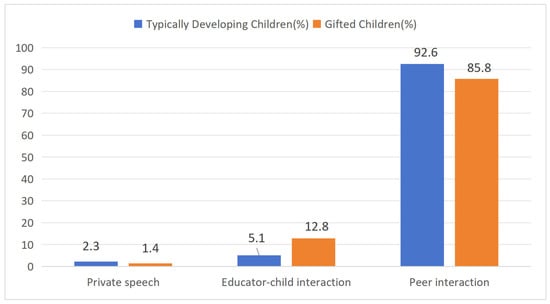
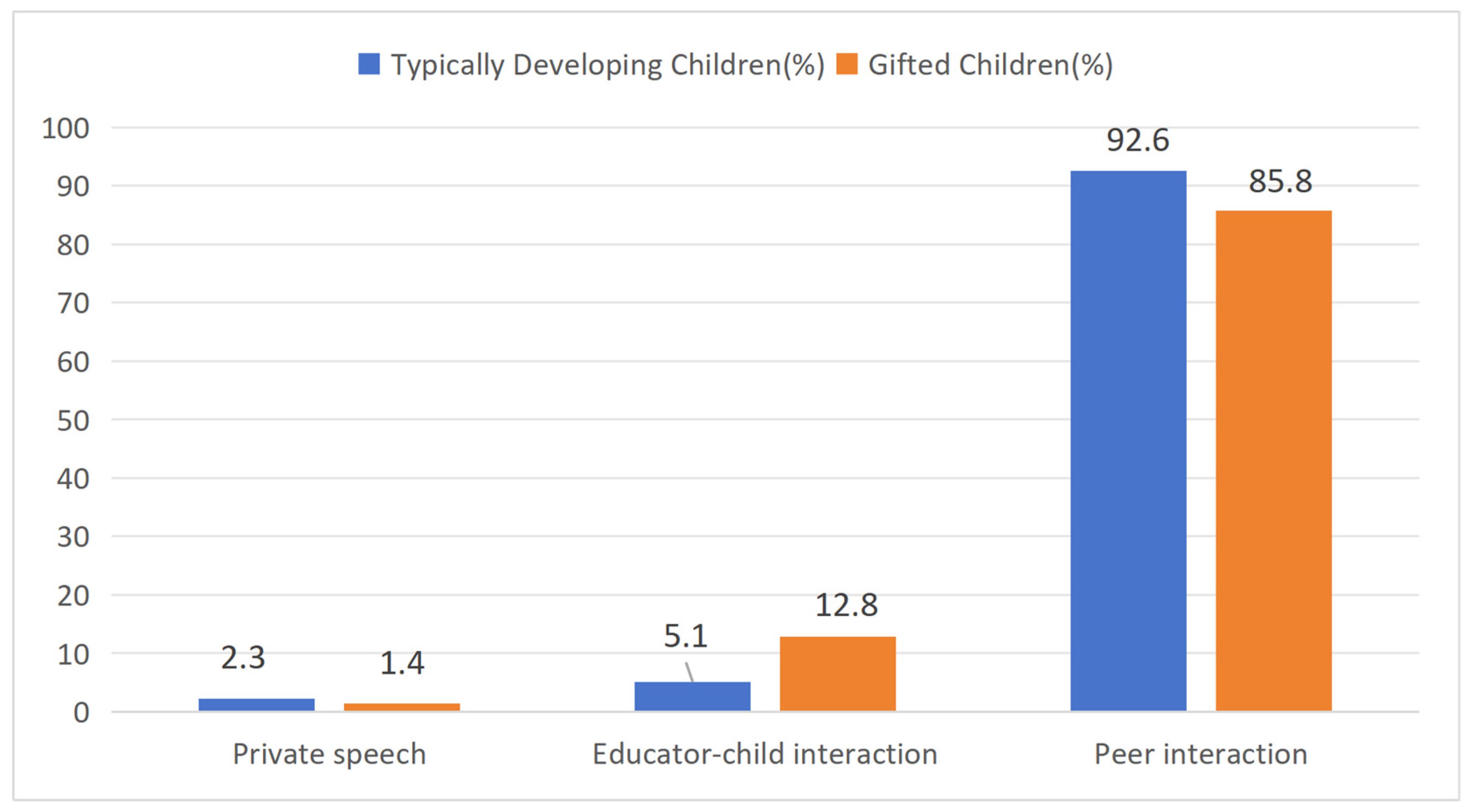
Figure 1 presents the percentage distribution of clauses across the three communication contexts for gifted and typically developing children. As shown in Figure 1, for both gifted and typically developing children, peer interaction accounted for the largest proportion of language use, followed by educator–child interaction, with private speech occurring least often. Among gifted children, 1.4% of clauses were produced in private speech, 12.8% in educator–child interaction, and 85.8% in peer interaction. The corresponding proportions for typically developing children were 2.3%, 5.1%, and 92.6%, respectively. Notably, gifted children devoted a larger proportion of their language to educator–child interactions than typically developing children, whereas typically developing children showed a slightly higher proportion of private speech.
Figure 1.
Gifted and Typically Developing Children’s Abstract Language Use Across Different Communicative Partners.
Table 4 further illustrates the distribution of abstract language levels across the three communication partner categories. Across all interaction contexts, Level 1 language accounted for the largest proportion of clauses in both gifted and typically developing children, indicating that lower-level abstract language was the most frequently used form of language during free play. Overall, higher levels of abstract language occurred less frequently than lower levels of abstraction. However, differences between the two groups varied across communication contexts.
Table 4.
Descriptive Distribution of Abstract Language Levels by Child Group and Communication Partner.
The most pronounced differences were observed during educator–child interactions. In this context, gifted children produced a substantially lower proportion of Level 1 language than typically developing children (47.9% vs. 75.5%), while producing higher proportions of Level 2 (21.7% vs. 10.9%), Level 3 (13.0% vs. 6.8%), and Level 4 language (17.5% vs. 6.8%). These differences suggest that interactions with educators provided an important context in which gifted children demonstrated more advanced abstract language, particularly language involving inference and decontextualized reasoning.
Differences were also evident during peer interactions. Compared with typically developing children, gifted children produced a lower proportion of Level 1 language (63.7% vs. 74.7%) and higher proportions of Level 2 (22.2% vs. 16.3%), Level 3 (11.0% vs. 7.1%), and Level 4 language (3.1% vs. 1.9%). This pattern indicates that gifted children were more likely to use higher levels of abstract language during peer communication.
In contrast, private speech showed a different pattern. Although both groups primarily relied on Level 1 language during self-directed speech, gifted children produced a higher proportion of Level 1 language than typically developing children (82.5% vs. 70.1%), while producing lower proportions of Level 2 (15.0% vs. 19.4%) and Level 3 language (2.5% vs. 10.4%). This suggests that the function of private speech may differ from socially directed communication, with gifted children showing a greater concentration of language closely related to immediate self-regulation during independent activity.
6.2.2. Differences in Abstract Language Use Across Different Communication Partners
A cumulative logit mixed-effects model was conducted to examine whether differences in abstract language use between gifted and typically developing children varied across communication contexts. The model included child group, communication partner, and their interaction as fixed effects, with child identity included as a random intercept to account for individual differences among children.
The model revealed a significant interaction effect between child group and communication partner, F(2, 5649) = 7.409, p = 0.001. This finding indicates that the relationship between child group and abstract language level differed depending on the communication context. Specifically, gifted and typically developing children showed different patterns of abstract language use across private speech, educator–child interactions, and peer interactions. To further interpret this interaction effect, simple effects analyses were conducted to examine group differences within each communication context. The results are presented in Table 5.
Table 5.
Simple Effects of Child Group Across Communication Contexts.
The results revealed distinct patterns of group differences depending on the interaction context. For private speech, gifted children showed significantly lower odds of producing higher levels of abstract language than typically developing children (B = −1.128, OR = 0.324, p = 0.041). Consistent with the descriptive distribution in Table 4, gifted children’s private speech was more concentrated at Level 1 language (82.5% vs. 70.1%) and included smaller proportions of Level 2 (15.0% vs. 19.4%) and Level 3 language (2.5% vs. 10.4%). This suggests that, in self-directed speech, gifted children tended to rely more heavily on language closely connected to their immediate actions or ongoing activities.
A different pattern was observed during peer interactions. Gifted children showed significantly higher odds of producing more abstract language than typically developing children (B = 0.475, OR = 1.608, p = 0.021). Thus, their odds of producing language at a higher abstraction level were approximately 1.61 times those of typically developing children. Gifted children also produced a lower proportion of Level 1 language (63.7% vs. 74.7%) and higher proportions of Level 2 (22.2% vs. 16.3%), Level 3 (11.0% vs. 7.1%), and Level 4 language (3.1% vs. 1.9%). These findings suggest that gifted children were more likely to extend beyond immediate contextual descriptions and engage in more abstract forms of communication during peer interactions.
The strongest group difference emerged in educator–child interactions. Gifted children were significantly more likely to produce higher levels of abstract language than typically developing children (B = 0.975, OR = 2.651, p = 0.001), with odds approximately 2.65 times as high. This was the largest effect observed across the three communication contexts. The descriptive results showed the same pattern: gifted children produced a substantially lower proportion of Level 1 language (47.9% vs. 75.5%) and higher proportions of Level 2 (21.7% vs. 10.9%), Level 3 (13.0% vs. 6.8%), and Level 4 language (17.5% vs. 6.8%). The difference was especially pronounced at Level 4, where the proportion for gifted children was approximately 2.57 times that of typically developing children.
Taken together, the simple effects results revealed a context-dependent pattern of abstract language use. Gifted children showed higher levels of abstraction during peer and educator–child interactions, whereas the opposite pattern was observed in private speech, suggesting a greater tendency to engage in inferential and decontextualized reasoning during social interactions. Extract 2 provides an illustration of a gifted child’s use of higher-level abstract language during peer interaction.
[Extract 2]Gifted child: Mum’s birthday is coming soon, (L4-talk with peer1)so we need to pick some flowers, (L4-talk with peer1)then we can give them to her. (L4-talk with peer1)Peer1: We need to collect some medicineGifted child: Mum has a task, (L4-talk with peer1)she is sick, (L4-talk with peer1)she needs us to collect some medicinal herbs. (L4-talk with peer1)But Mum’s birthday is also coming soon, (L4-talk with peer1)shall we give her the medicinal herbs we collect as a birthday present? (L4-talk with peer1)Peer1: Okay. A birthday present should also include a big cake. You two need to go and collect medicinal herbs. (talk with gifted child and peer2)Gifted child: Then I’ll take you with me. (L4-talk with peeer2)But it might be dangerous, (L4-talk with peer2)You must not leave my sight. (L4-talk with peer2)
This episode illustrates the gifted child’s sophisticated use of abstract language during peer interaction. The child moved beyond describing the immediate play materials by constructing a decontextualized pretend scenario involving a mother’s illness, an upcoming birthday, and the collection of medicinal herbs. The child connected these imagined events through causal and inferential reasoning, as the mother’s illness created a need for medicinal herbs, while her approaching birthday allowed the child to reconceptualise the herbs as a birthday gift. In this way, the child integrated two distinct play themes into a coherent shared narrative and plan. The child also coordinated the joint activity by deciding to take a peer along, anticipating that the task might involve danger, and establishing a rule that the peer should remain within sight. Overall, the episode demonstrates the child’s ability to connect causes and consequences, combine multiple imagined circumstances, anticipate potential problems, and use abstract language to organise and regulate collaborative play with peers.
7. Discussion
This study contributes to the growing literature on gifted preschool children’s language development by examining their use of abstract language and comparing it with that of typically developing peers. It makes three important contributions. First, unlike many previous studies conducted in home environments or experimental settings, this study investigated children’s spontaneous language use in authentic preschool free-play contexts, providing ecologically valid evidence of how gifted children communicate in everyday educational practice. Second, it examined children’s abstract language across interactions with different communicative partners, including educators, peers, and themselves through private speech, an aspect that has received little attention in research on gifted preschool children despite its importance for understanding children’s language use in social contexts. Third, this study examined children’s language use from a semantic perspective, extending current understandings of gifted children’s language beyond vocabulary size and syntactic complexity, highlighting the close relationship between language, reasoning, and meaning making during early childhood.
The findings revealed that both groups actively engaged in verbal interactions during play and exhibited a similar overall distribution of abstract language. Specifically, the frequency of language use decreased progressively from lower to higher levels of abstraction, with Level 1 language accounting for the largest proportion of clauses and Level 4 language the smallest. This pattern is consistent with developmental theories suggesting that children’s language gradually progresses from context-bound and experience-based forms toward increasingly decontextualized and abstract forms. In early childhood, much communication occurs in relation to the immediate environment, ongoing activities, and shared experiences. Consequently, non-inferential and contextualized language is expected to dominate children’s everyday interactions (Halliday, 1993; Tomasello, 2003). By contrast, higher levels of abstract language require children to move beyond the here-and-now, draw inferences, consider hypothetical situations, and connect ideas across contexts. Such language places greater demands on cognitive processes including causal reasoning, perspective-taking, and abstract thinking (Rowe, 2013; Chaparro-Moreno et al., 2023). The decreasing frequency of language across successive levels of abstraction therefore reflects a developmental progression in children’s cognitive and representational abilities.
Despite these shared developmental characteristics, gifted children differed significantly from their typically developing peers in their use of abstract language. In particular, gifted children produced substantially more higher-level abstract language, especially inferential and decontextualized language (L4). This finding is consistent with previous research suggesting that gifted children possess advanced cognitive abilities and demonstrate greater flexibility in language use and reasoning (Clark, 2002; Silverman, 2004). Because the gifted children in the present study were identified primarily on the basis of their advanced logical thinking, it is unsurprising that they were more likely to engage in language that required inference, hypothetical reasoning, and the integration of knowledge beyond the immediate context. The observational data also suggested that gifted children tended to use a broader and more sophisticated vocabulary, including relatively infrequent words such as checkmate, reflecting richer lexical knowledge and domain-specific understanding. While this finding is consistent with previous research showing that gifted children often demonstrate more advanced vocabulary development than their typically developing peers (Bildiren, 2018), the present study provides further evidence that gifted children’s higher-order thinking is closely reflected in their use of more advanced vocabulary. In other words, their advanced logical reasoning is supported by broader knowledge and a richer vocabulary, enabling them to express ideas that extend beyond those typically observed among their peers. From a Vygotskian perspective, language and thought develop through a process of mutual mediation: language supports the development of higher mental functions, while increasingly sophisticated thinking enables the use of more advanced forms of language (Vygotsky, 1934/1986). The present study illustrates this reciprocal relationship through gifted children’s spontaneous language use, suggesting that educators can gain valuable insights into children’s higher-order thinking by paying close attention to the sophistication of their everyday language.
A unique finding of this study is that educator–child interactions provide an especially valuable context for eliciting and extending gifted preschool children’s higher-level abstract language. Compared with typically developing children, gifted children devoted a larger proportion of their language to interactions with educators and produced particularly high levels of abstract language in these interactions. Educators are often able to provide richer linguistic input, pose cognitively challenging questions, and sustain conversations on topics that extend beyond the knowledge and interests of same-age peers (Sanchez & Blanc, 2022; Walsh et al., 2017). For example, in Extract 1, the gifted child initiated a discussion about international chess competitions and the importance of English proficiency, topics that were likely beyond the knowledge and experience of most peers. The educator was able to respond to the child’s ideas, extend the conversation, and encourage future-oriented reasoning. This finding highlights the unique educational value of high-quality educator–child interactions for gifted children. It suggests that educators can nurture gifted children’s higher-order thinking and language development through intellectually stimulating, responsive, and spontaneous conversations embedded in everyday classroom activities.
In terms of peer interactions, both gifted and typically developing children produced the largest proportion of their language during play with peers. Previous research has shown that, as children’s social and linguistic abilities develop, peers become increasingly important partners for emotional and informational exchange (Wang et al., 2023). Moreover, peer conversations become richer, more sustained, and cognitively more sophisticated with age (Azmitia, 2013; Blum-Kulka et al., 2004). Given that all participating children were over five years of age, it is unsurprising that peer interactions constituted a major context for language use. Although gifted children produced fewer utterances than their typically developing peers during peer interactions, they generated a substantially higher proportion of higher-level abstract language. Their conversations frequently involved planning, problem-solving, and reflecting on play activities. As illustrated in Extract 2, gifted children demonstrated rich imagination by using inferential and decontextualized language to negotiate ideas, coordinate shared play, and extend the play scenario. This finding is consistent with previous research showing that gifted children tend to engage in more complex, imaginative, and intellectually challenging play than their typically developing peers (Garrett, 2015; Shore, 2021; Porter, 2020). It also suggests that providing opportunities for gifted children to engage in collaborative imaginative play with peers may further promote their higher-order thinking, creativity, and abstract language development.
An equally noteworthy finding concerns children’s private speech. Although both groups produced only a small proportion of self-directed speech during free play, gifted children produced significantly less private speech (1.4%) than their typically developing peers (2.3%). Interestingly, typically developing children produced a greater proportion of Level 2 and Level 3 abstract language during private speech than in other interaction contexts. From a Vygotskian perspective, private speech serves as a mechanism for self-regulation, planning, problem-solving, and the internalization of thinking (Vygotsky, 1934/1986). By verbalizing their thoughts, children are able to organise their actions and regulate their cognitive processes. One possible explanation for the lower frequency of private speech among gifted children is that they may rely less on overt verbal self-guidance, with some of these regulatory processes becoming internalized earlier. However, this interpretation remains speculative and warrants further investigation.
8. Limitations, Implications and Conclusions
This study has several limitations. First, the sample size was relatively small and was drawn from a single region of China, which may limit the generalizability of the findings to other populations and educational contexts. In addition, the gifted children were identified primarily on the basis of advanced logical thinking and were recruited from families with relatively favorable educational backgrounds. Family socioeconomic status and parental educational practices may also have influenced children’s language development and opportunities to engage in abstract conversations. Consequently, caution is needed when generalizing these findings to the broader population of gifted children.
Second, because giftedness is a multidimensional construct, the sample may represent only one subgroup of gifted children and may not reflect the characteristics of children with other forms of giftedness, such as artistic, creative, or leadership abilities.
Third, the play context may have influenced children’s language use. Although matched pairs of gifted and typically developing children were observed in the same classroom on the same day, they naturally engaged in different play activities and interacted with different communication partners, which may have affected their language production. Furthermore, this study examined children’s language only during free play. As language use may vary across other contexts, such as teacher-led activities, shared reading, scientific exploration, and daily routines, future research should investigate abstract language in a wider range of educational settings.
Finally, although the observations were conducted during routine classroom activities, the participating children were aware that they were being video-recorded and wore Bluetooth microphones during data collection. This may have influenced some children’s language use and interaction behaviors. Although the observations were designed to minimize this observer effect, it cannot be completely ruled out. Future studies could use repeated observations over longer periods to further enhance the naturalness of children’s behavior.
Despite these limitations, the study offers several implications for supporting young, gifted children. First, educators should pay closer attention to children’s language use as a window into their thinking. As language reflects thought, gifted children’s advanced reasoning is often evident in the complexity of their verbal expressions. For example, an utterance such as, “This is an exploding machine. If the little figure walks here, it will lose its balance, fall down, and then explode,” demonstrates inferential and decontextualized thinking that extends beyond immediate observation. Paying attention to such language may help educators better understand children’s cognitive abilities and provide timely opportunities to extend their reasoning and higher-order thinking through responsive interactions.
Second, educators can support gifted children by engaging them in intellectually stimulating, open-ended, and appropriately challenging conversations. The finding that gifted children produced more language, especially higher-level abstract language during educator–child interactions highlight the important role of educators in fostering language and cognitive development. Rather than focusing solely on factual questions, educator can encourage children to explain, predict, justify, and hypothesize, thereby promoting deeper reflection and more sophisticated reasoning. As illustrated in Extract 1, thoughtful prompts may extend children’s thinking and transform everyday interactions into rich opportunities for language and cognitive development.
Third, educators can create opportunities for gifted children to engage in imaginative play with peers. The findings suggest that peer play provides an important context in which gifted children express, negotiate, and extend their ideas through higher-level abstract language. Educators can support this process by providing open-ended materials, designing play scenarios that encourage imagination and collaborative problem-solving, and allowing sufficient time for children to develop and elaborate their play narratives. Rather than directing the play, educators can observe children’s interactions and provide timely prompts or introduce new ideas to extend children’s imagination and reasoning. Such experiences not only foster gifted children’s language and cognitive development but also enrich the quality of collaborative play and shared meaning making among all children.
In conclusion, this study examined the use of abstract language by gifted preschool children in free-play contexts and compared their language patterns with those of typically developing peers, providing naturalistic evidence for the early identification and educational support of gifted children. The findings showed that, in both groups, the frequency of language use decreased as the level of abstraction increased. However, gifted children produced substantially more higher-level abstract language, particularly language involving inference and decontextualized reasoning. Furthermore, gifted children’s higher-level abstract language occurred more frequently in both educator–child interactions and peer interactions, whereas typically developing children’s language was more concentrated in self-talk. These findings do not suggest that gifted children are necessarily more advanced than their peers in everyday conversations. Rather, they indicate that children’s spontaneous use of abstract language may serve as a valuable indicator of advanced cognitive abilities and provide educators with meaningful opportunities to identify, understand, and further extend children’s thinking through responsive interactions and appropriate educational support.
Author Contributions
Conceptualization, L.G. and J.H.; methodology, L.G., S.H. and Y.C.; software, Y.F.; validation, Y.F.; formal analysis, S.H.; investigation, Y.F. and H.Z.; resources, L.G., J.H. and H.Z.; data curation, L.G.; writing—original draft preparation, S.H.; writing—review and editing, J.H. and Y.C.; supervision, J.H., H.Z. and Y.C.; project administration, L.G. and Y.C. All authors have read and agreed to the published version of the manuscript.
Funding
This research received no external funding.
Institutional Review Board Statement
The study was conducted in accordance with the Declaration of Helsinki, and approved by the Human Research Ethics Committee of Zhejiang Normal University (protocol code: ZSDR2019004; date of approval: 30 April 2019).
Informed Consent Statement
Informed consent was obtained from the teachers and parents or legal guardians of all the children involved in the study.
Data Availability Statement
The original contributions presented in this study are included in the article. Further inquiries can be directed to the corresponding author.
Acknowledgments
During the preparation of this manuscript, the authors used ChatGPT (GPT-5.5) to assist with reviewing and improving the English language expression of the manuscript, as English is not the authors’ first language. The authors have reviewed and edited the output and take full responsibility for the content of this publication.
Conflicts of Interest
The authors declare no conflicts of interest.
References
- Ateş, H. K., & Afat, N. (2018). A case study investigating the language development process, early literacy experiences and educational problems of a gifted child. Journal for the Education of Gifted Young Scientists, 6(4), 36–71. [Google Scholar] [CrossRef] [Scilit]
- Attoni, T., Coelho, R., Martins, R., Lemos, L., Fernandes, L., Francis, T., Fernandes, S., & Fideles, K. (2020). The language aspects of children with high abilities/giftedness: An integrative literature review. Revista CEFAC, 22(6), e9320. [Google Scholar] [CrossRef] [Scilit]
- Azmitia, M. (2013). Peer interactive minds: Developmental, theoretical, and methodological issues. In Learning relationships in the classroom (pp. 207–233). Routledge. [Google Scholar]
- Azzalini, A. (2023). Critical thinking, questioning and reasoning as inclusive teaching methods for English language learning with gifted students. Educazione Linguistica Language Education, 12(3), 449–464. [Google Scholar]
- Bildiren, A. (2018). Developmental characteristics of gifted children aged 0–6 years: Parental observations. Early Child Development and Care, 188(8), 997–1011. [Google Scholar] [CrossRef] [Scilit]
- Blank, M., Rose, S. A., & Berlin, L. J. (1978). The language of learning: The preschool years. Grune & Stratton. [Google Scholar]
- Blum-Kulka, S., Huck-Taglicht, D., & Avni, H. (2004). The social and discursive spectrum of peer talk. Discourse Studies, 6(3), 307–328. [Google Scholar] [CrossRef] [Scilit]
- Chaparro-Moreno, L. J., Lin, T. J., Justice, L. M., Mills, A. K., & Uanhoro, J. O. (2023). The influence of context on the abstraction level of children’s conversations in the preschool classroom. Early Education and Development, 34(3), 705–724. [Google Scholar] [CrossRef] [Scilit]
- Clark, B. (2002). Growing up gifted: Developing the potential of children at home and at school (6th ed.). Merrill–Prentice Hall. [Google Scholar]
- Degotardi, S., Han, F., & Hu, J. (2023). Infant educators’ use of mental-state talk in Australia and China: A cross-cultural comparative study. In Young children’s language in context (pp. 87–105). Routledge. [Google Scholar]
- Demir, S. (2022). Effectiveness of the leadership skills development program for gifted children: Leadership skills development program for gifted children. International Journal of Curriculum and Instruction, 14(1), 693–718. [Google Scholar]
- Garrett, L. (2015). Significant social-emotional influences on the motivation of gifted students: How can teachers foster healthy ‘hearts’ and ‘minds’? University of Auckland, Faculty of Education. [Google Scholar]
- Gross, M. U. (2002). Exceptionally gifted children. Routledge. [Google Scholar]
- Halliday, M. A. K. (1993). Towards a language-based theory of learning. Linguistics and Education, 5(2), 93–116. [Google Scholar] [CrossRef] [Scilit]
- Halliday, M. A. K., & Matthiessen, C. M. I. M. (2022). Halliday’s introduction to functional grammar (5th ed.). Routledge. [Google Scholar]
- Hoh, P. S. (2005). The linguistic advantage of the intellectually gifted child: An empirical study of spontaneous speech. Roeper Review, 27(3), 178–185. [Google Scholar] [CrossRef] [Scilit]
- Hu, J., Torr, J., Degotardi, S., & Han, F. (2019). Educators’ use of commanding language to direct infants’ behaviour: Relationship to educators’ qualifications and implications for language learning opportunities. Early Years, 39(2), 190–204. [Google Scholar]
- Hymer, B. (2003). “If you think of the world as a piece of custard…”: Gifted children’s use of metaphor as a tool for conceptual reasoning. Gifted Education International, 17(2), 151–164. [Google Scholar] [CrossRef] [Scilit]
- Johnsen, S. K. (2021). Definitions, models, and characteristics of gifted students. In Identifying gifted students (pp. 1–32). Routledge. [Google Scholar]
- Junquera, C., & Zubiauz, B. (2024). Protocol for the assessment of the development of pragmatic competencies in early childhood (PDP-PI). Frontiers in Psychology, 15, 1368321. [Google Scholar] [CrossRef] [Scilit] [PubMed]
- Kaya, N. G. (2020). Supporting of gifted children psychosocial developments in preschool period. Psychology Research on Education and Social Sciences, 1(1), 25–29. [Google Scholar]
- Li, H., Lu, Z., Liu, Y., Han, F., & Hu, J. (2024). A cross-cultural comparative study between Chinese and Japanese preschool educators’ use of mental state language in interactions with children. Research Square (Preprint). [Google Scholar] [CrossRef] [Scilit] [PubMed]
- Liu, L., Zheng, F., Sheng, L., Hao, Y., & Hu, J. (2021). Reasoning talk at Chinese families’ dinner table: Across three generations and different communicative contexts. Frontiers in Psychology, 12, 763625. [Google Scholar] [CrossRef] [Scilit] [PubMed]
- Nikolaus, M., & Fourtassi, A. (2023). Communicative feedback in language acquisition. New Ideas in Psychology, 67, 100985. [Google Scholar] [CrossRef] [Scilit]
- Porath, M. (1996). Narrative performance in verbally gifted children. Journal for the Education of the Gifted, 19(3), 276–292. [Google Scholar] [CrossRef] [Scilit]
- Porter, L. (2020). Gifted young children: A guide for teachers and parents. Routledge. [Google Scholar]
- Quan, Y. L., Liu, Z. H., & Xu, P. F. (1994). The correlation analysis influence factors on intelligence development of supernormal children. Chinese Social Medicine, 1994(3), 5–9. [Google Scholar]
- Read, K., Rabinowitz, S., & Harrison, H. (2023). It’s the talk that counts: A review of how the extra-textual talk of caregivers during shared book reading with young children has been categorized and measured. Journal of Early Childhood Literacy, 25(3), 801–837. [Google Scholar] [CrossRef] [Scilit]
- Renati, R., Pfeiffer, S., & Bonfiglio, N. S. (2025). Predictors of parental stress in families with gifted children: The role of cognitive and emotional challenges. Gifted Education International, 41(1), 112–136. [Google Scholar]
- Renzulli, J. S. (1978). What makes giftedness? Reexamining a definition. Phi Delta Kappan, 60(3), 180. [Google Scholar]
- Rowe, M. L. (2013, November). Decontextualized language input and preschoolers’ vocabulary development. In Seminars in speech and language (Vol. 34, No. 04, pp. 260–266). Thieme Medical Publishers. [Google Scholar]
- Sanchez, C., & Blanc, N. (2022). Abstract graphic creativity, feelings about school, and engagement in the school environment: What are the interindividual differences between gifted and non-gifted children? Journal of Intelligence, 11(1), 2. [Google Scholar] [CrossRef] [Scilit] [PubMed]
- Shore, B. M. (2021). Context matters in gifted education. Education Sciences, 11(8), 424. [Google Scholar] [CrossRef] [Scilit]
- Silverman, L. K. (2004). Characteristics of giftedness scale: A review of the literature. Gifted Development Center. [Google Scholar]
- Sousa, D. A. (Ed.). (2009). How the gifted brain learns. Corwin Press. [Google Scholar]
- Spit, S., & Rispens, J. (2019). On the relation between procedural learning and syntactic proficiency in gifted children. Journal of Psycholinguistic Research, 48(2), 417–429. [Google Scholar] [PubMed]
- Tomasello, M. (2003). Constructing a language: A usage-based theory of language acquisition. Harvard University Press. [Google Scholar]
- Uccelli, P., Demir-Lira, Ö. E., Rowe, M. L., Levine, S., & Goldin-Meadow, S. (2019). Children’s early decontextualized talk predicts academic language proficiency in midadolescence. Child Development, 90(5), 1650–1663. [Google Scholar] [CrossRef] [Scilit] [PubMed]
- Vaivre-Douret, L. (2011). Developmental and cognitive characteristics of “high-level potentialities” (highly gifted) children. International Journal of Pediatrics, 2011(1), 420297. [Google Scholar] [CrossRef] [Scilit] [PubMed]
- van Kleeck, A., Gillam, R. B., Hamilton, L., & McGrath, C. (1997). The relationship between middle-class parents’ book-sharing discussion and their preschoolers’ abstract language development. Journal of Speech, Language, and Hearing Research, 40(6), 1261–1271. [Google Scholar] [CrossRef] [Scilit] [PubMed]
- Vygotsky, L. S. (1986). Thought and language (A. Kozulin, Trans.). MIT Press. (Original work published 1934). [Google Scholar]
- Vygotsky, L. S. (2012). Thought and language (Vol. 29). MIT press. [Google Scholar]
- Walsh, R., Bowes, J., & Sweller, N. (2017). Why would you say goodnight to the moon? Response of young intellectually gifted children to lower and higher order questions during storybook reading. Journal for the Education of the Gifted, 40(3), 220–246. [Google Scholar] [CrossRef] [Scilit]
- Wan, S. N., & Feng, W. (2009). Main problems and countermeasures in the education of supernormal children in China. Basic Education Research, 2009(19), 3–5. [Google Scholar]
- Wang, R. Y., Hu, J. B., & Zhao, F. F. (2023). Decontextualized language use of preschool children: In different activity contexts referring to different people. Early Childhood Education, 2023(18), 14–19. [Google Scholar]
- Wellisch, M., & Brown, J. (2013). Many faces of a gifted personality: Characteristics along a complex gifted spectrum. Talent Development & Excellence, 5(2), 43–58. [Google Scholar]
- Zhang, N., Tang, K., & Li, M. (2023). Building an identification system for gifted children: International experience and local reflections. Chinese Journal of Special Education, 2023(2), 88–96. [Google Scholar]
- Zhang, Q., Torr, J., Han, F., Dong, W., & Hu, J. (2025). A comparison between preschool children’s verbal participation during the shared reading of a wordless and a text-based rendition of Aesop’s fable The Lion and the Mouse. Early Years, 45(5), 817–831. [Google Scholar] [CrossRef] [Scilit]
- Zhen, W., & Xin, A. (2004). Combined Raven’s Test (CRT) Report among children of cities. Theory and Practice of Education, 2004(20), 59–62. [Google Scholar]

Disclaimer/Publisher’s Note: The statements, opinions and data contained in all publications are solely those of the individual author(s) and contributor(s) and not of MDPI and/or the editor(s). MDPI and/or the editor(s) disclaim responsibility for any injury to people or property resulting from any ideas, methods, instructions or products referred to in the content. |
© 2026 by the authors. Licensee MDPI, Basel, Switzerland. This article is an open access article distributed under the terms and conditions of the Creative Commons Attribution (CC BY) license.