


Abstract
This study relates to the growing recognition of the school–family relationship as a key factor in equity, inclusion, and educational success, highlighting the need to strengthen teacher education in this area. The aim was to design and content validate a specific instrument for identifying teachers’ training needs in relation to the promotion of this relationship. The EVANEFEF questionnaire was developed from a prior qualitative study and subsequently subjected to content validation by an expert panel of eleven specialists, followed by a pilot study. The final instrument, comprising 114 items on prior training and the self-assessment of competencies related to the school–family relationship, showed adequate content validity. The findings indicate that the questionnaire enables the assessment of teachers’ perceptions and the identification of training needs in key areas such as communicative, digital, socio-emotional, and multicultural competencies. In conclusion, EVANEFEF is a useful tool for guiding the design of teacher-training programmes that are more closely aligned with actual needs, thereby strengthening school–family collaboration and, ultimately, improving educational quality.
1. Introduction
The school–family relationship is a structural feature of contemporary education systems, as it constitutes the interface between students’ two main contexts of socialisation (Lorence-Lara et al., 2024). Schools that foster effective family participation achieve better indicators of equity, well-being, and academic performance, especially in contexts of social and cultural diversity (OECD, 2021). In addition, UNESCO emphasises that family involvement is a key factor in advancing inclusive and equitable education aligned with the principles of social justice and the Sustainable Development Goals (SDGs), particularly SDG 4, which aims to ensure quality education for all (UNESCO, 2022).
Schools that consolidate sustainable relationships with families integrate participation and transparency as pillars of their institutional culture (Shen, 2025), showing an explicit commitment to democratising the involvement of the school community (Ceballos-Vacas & Morillo-Lesme, 2026). In other words, collaboration is not incidental; rather, it permeates the entire teaching–learning process (Dor, 2024; Jung & Sheldon, 2020). When this occurs, schools organise spaces and schedules to facilitate family participation and recognise it as an essential value (Myende & Nhlumayo, 2022; Willemse et al., 2018). This type of institutional culture generates an educational environment in which relationships with families are built on trust and mutual respect, shared responsibility, and a commitment to continuous improvement (Conus & Fahrni, 2019; Epstein & Boone, 2022; Hernández-Prados & Álvarez-Muñoz, 2023; Lorence-Lara et al., 2024).
Despite broad consensus regarding the benefits of the relationship between schools and families, various studies underline the complexity of moving towards a school culture that is favourable to collaboration with families (Bueno-Villaverde et al., 2023; Ceballos-López & Saiz-Linares, 2021; Ceballos-Vacas et al., 2023), an aspect that cannot be developed without taking teachers and their needs into account (Galián-Nicolás et al., 2023). In this regard, shortcomings have been identified that condition teachers’ ability to establish strong and sustainable ties with families and to build full collaboration between both educational agents (Alemán-Falcón et al., 2023; Ceballos-Vacas et al., 2025b). Identifying these shortcomings points to the need to design training initiatives aimed at both teachers and families (Hernández-Prados et al., 2019), although with priority given to equipping teachers as key agents in promoting collaboration with families. To this end, it is essential to listen to teachers’ voices and explore which training needs they perceive as fundamental and which they reject because they do not consider them part of their professional remit (Ceballos-Vacas et al., 2025a, 2026; Galián-Nicolás et al., 2023).
For these reasons, it is pertinent to develop tools capable of identifying teachers’ training needs, drawing on findings from educational research without losing sight of their perceived needs. Throughout this article, the importance of having an instrument specifically designed for this purpose is substantiated. The instrument was subjected to expert review and a pilot study, thus enabling a more in-depth examination of teachers’ training needs and progress towards more inclusive, participatory, and diversity-sensitive training models capable of responding effectively to current educational challenges.
2. Teacher Training in the School–Family Relationship
The current educational regulatory framework has, in recent years, driven significant progress in recognising the importance of family involvement, consolidating it as a fundamental axis in the configuration of education systems (OECD, 2021; UNESCO, 2022). The family is conceived as a relevant agent in the construction and strengthening of schools oriented towards the principles of inclusion, equity, and democratic participation, which implies family participation in decision-making, support in educational processes, and the full recognition of shared responsibility for students’ holistic development (Lago et al., 2021). However, family participation in school life, as a basic principle of the education system, is still far from being fully achieved (Ceballos-Vacas et al., 2025b), underscoring the urgency of consolidating policies and practices that materialise it effectively.
Initial teacher education and continuing professional development (European Commission, 2021; UNESCO, 2022) are essential for strengthening teachers’ capacity to work effectively with families (Jones, 2020; Kambouri et al., 2022). Scientific evidence shows that families, particularly those from socioeconomically disadvantaged or culturally diverse contexts, face structural and symbolic barriers that limit their participation in school life: lack of knowledge about how the education system works, work–life balance difficulties, insufficient competencies to support learning at home, and experiences of exclusion or ineffective communication in schools (Gomila-Grau et al., 2018; OECD, 2020). In this scenario, schools must adopt a proactive role in strengthening and empowering families by articulating intentional and planned strategies that foster authentic, shared, and meaningful participation (Housel, 2021; Lohman et al., 2018; Marschall & Shah, 2020).
In this regard, the need is emphasised for initial teacher-education programmes to systematically incorporate competencies linked to school–family collaboration to foster positive attitudes towards families and provide basic tools for managing their diversity (Galián-Nicolás et al., 2023). However, teachers report that their initial preparation in this area was insufficient (Lindqvist, 2019; Smith & Sheridan, 2019; Thompson et al., 2018; Vallespir-Soler & Morey-López, 2019). In fact, the limited content offered tends to have a marked theoretical component and to focus on risk and vulnerability factors (Jarauta-Borrasca & Medina-Moya, 2023), leading to a deficit-based view of families, who are assumed to possess limited or negative competencies to support their children’s educational process. From this perspective, families are conceived mainly as recipients of guidance and intervention rather than as collaborators with their own knowledge and resources. Consequently, the school–family relationship is conceived from an asymmetrical logic that limits the possibility of building more horizontal forms of collaboration (Willis & Exley, 2022).
This unfavourable view may be reinforced if the practicum period takes place in schools with a culture opposed to participation (Gomila-Grau & Pascual-Barrio, 2015; G. E. Miller et al., 2018), thereby losing a valuable opportunity to understand the complexity and diversity of families and to learn how to promote collaboration with them (Benito-Ambrona et al., 2022). The 2018 TALIS Report (Ministerio de Educación y Formación Profesional, 2019) highlights continuing professional development, understood as an ongoing process of updating, specialisation, and critical reflection on teaching practice, as a key driver of such collaboration (Santamarina-Sancho & Núñez-Delgado, 2023). However, it also points out that only 43% of Primary Education teachers have participated in training on cooperation between schools and families. Moreover, such content tends to be shaped by a bureaucratic and administrative emphasis, far removed from teachers’ actual needs when it comes to encouraging democratic participation in schools (Escudero-Muñoz, 2020; Willemse et al., 2018).
Consequently, both initial teacher education and continuing professional development tend to adopt a theoretical and bureaucratised approach, often permeated by a negative bias towards families (Ceballos-Vacas et al., 2025a), while overlooking the competencies needed to promote community participation, multicultural communication, and the management of family diversity (Epstein & Sheldon, 2016). These competencies become even more significant when working with culturally diverse families, whose diversity should be regarded as a source of cultural capital for the community (Bernad-Cavero & Llevot-Calvet, 2025; Ceballos-Vacas & Trujillo-González, 2021). It should also be borne in mind that these families often face additional logistical barriers to approaching the school, such as poor transport provision or limited digital literacy (Rodríguez-Ruiz et al., 2016).
In this sense, the importance of fostering specific competencies to enhance relationships with families is highlighted (Alemán-Falcón et al., 2023; Bartau-Rojas et al., 2019). The Family Engagement Core Competencies developed by the National Association for Family, School, and Community Engagement (NAFSCE, 2022) comprehensively outline essential practices, including valuing families, promoting equity, building trust, and co-constructing learning opportunities. This framework emphasises the multidimensional nature of family involvement and underscores the need for structured, competency-based teacher education programmes.
Moreover, communication should be continuous, meaningful, and bidirectional, enacted through multiple channels, aligned with the interests of all families (Macià-Bordalba, 2019), and oriented towards mutual understanding and the co-construction of educational expectations and practices (Epstein & Boone, 2022). However, shortcomings in this area often result in predominantly one-way communication practices (Ceballos-López & Saiz-Linares, 2021; Houri et al., 2019), focused mainly on bureaucratic and academic matters, especially when problems arise. This undermines the development of closer and genuinely collaborative school–family relationships (Bueno-Villaverde et al., 2023; Willemse et al., 2018). In addition, the gap in digital competence affecting part of the teaching profession, particularly older teachers, further limits communication with families through digital communication tools (Hernández-Prados & Álvarez-Muñoz, 2023).
At the same time, teachers face complex situations daily with colleagues, students, and families, often without the training required to address them (Cárcamo-Vásquez & Garreta-Bochaca, 2020; Cárcamo-Vásquez & Gubbins-Foxley, 2023). This highlights the need to include the development of socio-emotional competencies in teacher education in order to promote positive relationships (Cabral et al., 2024; González-Herrera et al., 2017; López-Larrosa et al., 2019; Vallespir-Soler & Morey-López, 2019), which is particularly important with families that are more culturally distant or when dealing with sensitive issues such as behavioural difficulties or children’s academic failure (Smith & Sheridan, 2019). Unfortunately, previous experiences with problematic families constitute an important source of stress for teachers and may lead to widespread rejection of family participation (K. Miller, 2022; Rodríguez-Ruiz et al., 2024). Hence the importance of training in competencies geared towards assertive conflict management, which entails sensitivity to understanding others’ emotions and self-regulating one’s own (Ceballos-Vacas et al., 2025a; Jones, 2020; Lindqvist, 2019).
In this context, it is crucial to analyse the training needs perceived by Early Childhood and Primary Education teachers regarding collaborative relationships with families, considering their perceptions, experiences, and emotions (Ceballos-Vacas et al., 2026; Rodríguez-Ruiz & Hervella-Fariñas, 2023). Identifying explicit training needs serves as a vital prerequisite for designing teacher education curricula that effectively align with the contemporary demands of school and family environments (Cabral et al., 2024).
3. Assessing Teachers’ Training Needs to Improve the School–Family Relationship
Despite the growing evidence on the importance of family involvement in students’ academic success (Day et al., 2024; Epstein & Sheldon, 2019), a gap persists between the theoretical recognition of this relationship and teachers’ actual preparedness to manage it effectively (Alemán-Falcón et al., 2023). Therefore, the importance of identifying teachers’ training needs as a prior step in programme design is emphasised, also considering their beliefs and feelings regarding the school–family relationship. In this line, the design of specific instruments for assessing training needs emerges as a necessary condition for improving teacher education.
To this end, various tools have been developed, mainly questionnaires that gather teachers’ views on general aspects of the school–family relationship. For example, the Family–School Relationship Survey (Adams & Christenson, 2000) explores teachers’ views of factors that hinder or facilitate relationships with families through 17 items distributed across three dimensions: the frequency and nature of teacher–family relationships, trust, and trust-building. The Parent–Teacher Relationship Scale–II (Dawson & Wymbs, 2016) examines teachers’ perspectives on relationships with families through 24 items distributed across two dimensions: communication and partnership. Along similar lines, López-Larrosa et al. (2019) developed a 22-item questionnaire to explore teachers’ beliefs about collaboration, subordination, and delegation, with one item to measure their perceived self-efficacy in relating to families.
Some instruments have focused more thoroughly on the self-assessment of competencies for school–family relationships. For example, De Coninck et al. (2018) used video recordings of teacher–family interaction situations accompanied by open-ended questions to explore teachers’ self-assessment of their communicative competence, thereby enabling a more experience-based analysis. Likewise, the “Training School Professionals to Engage Families Questionnaire” (Bartels & Eskow, 2010) explores, through one of three open-response items, the competencies acquired from a teacher professional development programme on family involvement. Additionally, Peterson and Ladky (2007) designed the questionnaire “A Survey of Teachers’ and Principals’ Practices and Challenges in Fostering New Immigrant Parent Involvement” with 18 items designed to identify effective practices and challenges in promoting the participation of migrant families.
However, these self-assessments provide only a partial picture, as they do not capture the full range of competencies required to foster effective school–family relationships. A more comprehensive approach is represented by the Family Engagement Efficacy Beliefs of Educators (FEEB-E) survey, which examines educators’ self-efficacy beliefs regarding their ability to collaborate with families (Bachman & Beard, 2025a, 2025b). Grounded in social cognitive theory and aligned with ecological models, this 20-item instrument is based on the NAFSCE core competencies and assesses five dimensions of educator efficacy: collaborating for learning, communicating, partnering, honouring all families, and embracing equity (Bachman & Beard, 2025b).
In the same vein, the QFIS-TP (“Questionnaire on Family Involvement in School, Teacher-Promoter”; Gomariz-Vicente et al., 2022) addresses teachers’ perceptions of families’ relationships with the school through 91 items corresponding to seven dimensions: communication with the school, participation in school activities, sense of belonging, involvement at home, involvement in the parents’ association and the school council, community participation, and training. This final dimension is of particular note, with two items examining willingness to receive training aimed at promoting school–family relationships. Nevertheless, only few other instruments assess teachers’ self-perceived training needs in this area and, even then, they tend also to adopt a limited approach. For example, one of the nine dimensions of the “Questionnaire on the training needs of future secondary-school teachers” (Yanes-Cabrera & Ries, 2013), entitled “Working with Families”, assesses some general aspects of teacher education, and one item measures perceptions of initial teacher education: “I consider that my previous academic training has provided me with the appropriate competencies”.
This brief and non-exhaustive review shows that, although the school–family relationship has been widely addressed, the assessment of training needs for acquiring the competencies that foster it is superficial and has received far less attention. Therefore, the development of an instrument capable of identifying these training gaps could constitute a key tool for designing training plans grounded in the real needs of teachers and families.
4. Development and Validation of the “Assessment of Teachers’ Training Needs to Promote the School–Family Relationship” Questionnaire (EVANEFEF)
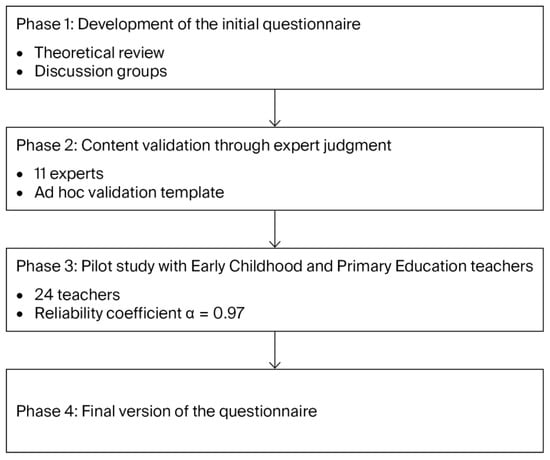
The EVANEFEF questionnaire seeks to examine the training challenges faced by teachers in this field to contribute to teacher education aimed at strengthening the school–family bond. In this sense, as noted above, it is pertinent to analyse competencies for fostering school–family collaboration, as well as teachers’ communicative, digital, socio-emotional, and multicultural competencies. The design and construction of the EVANEFEF questionnaire is described below in four phases (see Figure 1).
Figure 1.
Phases in the process of developing and content validating the questionnaire.
4.1. Phase 1: Development of the Initial Questionnaire
The initial questionnaire was developed based on a review of the literature and existing instruments, in line with the considerations outlined above. In addition, a prior exploratory, phenomenological study was conducted through three focus groups with Early Childhood and Primary Education teachers, allowing their perceptions and experiences to be recorded (Ceballos-Vacas et al., 2025a, 2025b; Rodríguez-Ruiz & Hervella-Fariñas, 2023). Group interaction fostered the emergence of holistic narratives and the co-construction of meanings regarding teaching practice (Flick, 2022; Kuckartz & Rädiker, 2023) in a climate of trust, which made it possible to obtain sincere responses and the verbalisation of sensitive experiences (Ceballos-Vacas et al., 2026; Ibarra-Sáiz et al., 2023; Onwuegbuzie et al., 2009). The information was analysed through deductive and inductive procedures using stepwise content analysis (Corbin & Strauss, 2015). Transparency in the coding process was ensured so that the discursive material could be transformed into robust and reliable categories (Cofie et al., 2022; Kuckartz & Rädiker, 2023). Specifically, transparency was operationalized through three interconnected actions: (1) developing an initial codebook based on the literature, which was subsequently refined inductively during transcript analysis; (2) using research memos within ATLAS.ti (Version 7.5.10) to document and justify all category modifications; and (3) conducting independent, blind double-coding on the text. To this end, two expert reviewers reached 95% agreement in assigning excerpts to the 40 categories resulting from the dimensions of initial teacher education, teacher placements, continuing professional development, communicative competencies, digital communication competencies, socio-emotional competencies, and multicultural competencies.
Based on these dimensions and categories, a first version of the questionnaire, “Assessment of Teachers’ Training Needs to Promote the School–Family Relationship” (EVANEFEF), was developed. This version contained 143 items distributed across three sections. The first section comprised teacher identification data (13 items), information on students’ academic achievement (one item), and perceptions of relationships with families in the current school (four items). The second section focused on teacher education through four dimensions: (1) school–family relationship (17 items; e.g., “I consider that my school facilitates the relationship with families”, “I encourage families to participate in school activities (workshops, translation work, parties…)”); (2) initial teacher education (20 items; e.g., “The initial training I received regarding the school–family relationship was of high quality”); (3) teacher placements during university training (20 items; e.g., “My university placement regarding the school–family relationship was sufficient”); and (4) continuing professional development (22 items; e.g., “My school offers high-quality training on the relationship between schools and families”). The third section addressed competencies for the school–family relationship through four further dimensions: (1) communicative competencies (15 items; e.g., “I communicate with the families of my students”); (2) digital competencies (11 items; e.g., “The educational administration’s training provision on digital competencies to promote the school–family relationship is sufficient”); (3) socio-emotional competencies (10 items; e.g., “I have the knowledge to respond to the emotional needs of families”); and (4) multicultural competencies (10 items; e.g., “Family multiculturalism is a teaching–learning opportunity”).
A 12-point Likert-type scale was selected, grouped into four response bands: 0–2 not at all in agreement; 3–5 slightly in agreement; 6–8 moderately in agreement; and 9–11 strongly in agreement. This format was chosen instead of the traditional 5-point scale to mitigate the social desirability bias and ceiling effects that are likely to occur in self-assessments of competencies, thereby enhancing the reliability and validity of the instrument (Preston & Colman, 2000). Furthermore, a broad-response scale allows for greater nuance in participants’ ratings and provides respondents with more flexibility to select the option that most accurately reflects their views, rather than merely the closest one (Joshi et al., 2015). Finally, psychometric research suggests that the use of seven or more response categories may make it more defensible to treat the resulting data as approximately continuous interval variables (Rhemtulla et al., 2012), thereby potentially facilitating future psychometric analyses and validation studies.
4.2. Content Validation by an Expert Panel
Content validity concerns the extent to which the content of an assessment instrument appropriately reflects the domain of the construct it is designed to measure within a particular assessment context (Yusoff, 2019). Thus, the study followed the phases proposed by Caballero-Rodríguez et al. (2025) for questionnaire content validation, including expert reviews, defined as “an informed opinion from individuals with experience in the field, regarded by others as qualified experts and capable of providing information, evidence, judgments, and evaluations” (Escobar-Pérez & Cuervo-Martínez, 2008, p. 29). Expert input is essential for clarifying, refining, and, when necessary, modifying the instrument’s content, and provides high-quality feedback generating rich information on the subject under study (Fernández-Gómez et al., 2020). Moreover, the quality of content validation depends on appropriate expert selection, the number of judges involved, and the instruments used. Because experts play a key role in refining and improving an instrument, they should be selected because of their academic expertise, professional experience, and knowledge of the subject matter (Escobar-Pérez & Cuervo-Martínez, 2008).
Hence, the panel of experts was selected through expert purposive sampling (Singh, 2007) according to the following criteria: (a) being university faculty members; (b) belonging to fields linked to education; (c) having teaching or research experience in the area of school–family relationships; and (d) having teaching or research experience in the construction of information-gathering instruments in the social sciences. The decision regarding the number of experts required was based on the methodological criteria established by Llamas (2020), who indicates a minimum of ten people to guarantee the validity of expert judgement in instrument-evaluation processes. Accordingly, eleven experts participated: nine female and two male Spanish lecturers from universities across different regions of Spain (Asturias, Galicia, Balearic Islands, Andalusia, Murcia and Canary Islands), ten of whom held tenured positions, whereas one did not. All participants had teaching and research experience in the field; five were experts in Research Methods and Assessment in Education, while the remaining experts represented other education-related disciplines (Sociology and Psychology).
The experts were contacted by email and were provided with the questionnaire together with an ad hoc validation template (Supplementary Materials File S1), following the methodological guidelines proposed by Reyes and Hernández-Moncada (2021). During the process, experts rated the different dimensions and provided qualitative feedback. Thus, expert judgement incorporates both a quantitative and a qualitative assessment of each section of the questionnaire and its corresponding items, in accordance with the recommendations of Pedrosa et al. (2013), allowing the strengths and weaknesses of the instrument to be identified (Fernández-Gómez et al., 2020).
The analysis considered the following criteria: (a) sufficiency (the items belonging to the same dimension are enough to measure it); (b) clarity (the item has adequate syntax and semantics, and it is understandable and comprehensible); (c) coherence (the item is logically related to the dimension and not to another, and it is coherent and related to the other items included in the same dimension); (d) relevance (the item is essential or important and should therefore be included); and (e) precision (the item measures what it claims to measure). For sufficiency, clarity, coherence, and relevance, a four-point Likert-type scale was used (1 = does not meet the criterion; 2 = low level; 3 = moderate level; 4 = high level), whereas for precision a rubric with four options was used (1 = delete; 2 = change; 3 = improve; 4 = keep). In addition, this analysis was complemented by qualitative evaluation of the dimensions and items, ensuring content validity, the appropriateness of wording, the removal of ambiguities, and cultural relevance (Escobar-Pérez & Cuervo-Martínez, 2008).
The results obtained show ratings clustered around moderate-to-high levels for sufficiency (M = 3.76; SD = 0.51), clarity (M = 3.44; SD = 0.43), coherence (M = 3.89; SD = 0.16), and relevance (M = 3.91; SD = 0.09). Likewise, for precision, scores across all sections of the questionnaire tended towards retaining the unchanged items (M = 3.71; SD = 0.36). Agreement in the responses, assessed through Kendall’s W and calculated with SPSS 28, showed a positive evaluation of the instrument as a whole (W = 0.18), as well as of its different dimensions, especially Initial Training (W = 0.18), Teacher Placements (W = 0.15), and Communicative Competencies (W = 0.12), although with a weak degree of agreement. This may be attributable to the greater difficulty of achieving consensus among a larger number of experts providing independent assessments, compared with face-to-face approaches, which tend to minimise discrepancies. Nevertheless, the non-face-to-face approach was adopted to reduce the time demands associated with the validation process (Yusoff, 2019). However, this pointed to the need to pay particular attention to the qualitative comments to improve the quality of the instrument. As a result, we removed the dimension “School–family relationship”, since the experts claimed that it was focused on general attitudinal perceptions, which diverged from the central objective of the study, namely the analysis of training dimensions.
Considering the item-level results, we decided to refine the instrument according to the following criteria: (1) when redundant items were identified, those with the highest mean score in the expert review were retained, thereby avoiding unnecessary duplication. For example, the item “I consider that I have the competencies to communicate effectively with families” was retained, whereas the items “I consider that I have communicative competencies to understand families” and “I consider that I have communicative competencies to generate trust in families” were removed; (2) items addressing overly general issues or contributing no relevant content to the established analytical dimensions were removed (e.g., “I consider that a more specific regulation of the school–family relationship is necessary”). This refinement strengthened content validity by ensuring that the final instrument maintained greater theoretical unidimensionality; and (3) items whose wording lacked the clarity required to guarantee unambiguous interpretation were removed (e.g., “I consider the Tutorial Action Plan to be a key element”).
Additionally, the analysis of the qualitative information enabled the refinement of the questionnaire items, resulting in clearer and more direct wording (Galicia-Alarcón et al., 2017). The improvements introduced included the correction of typographical errors and the simplification of wording (for example, “provided me with the competencies needed to involve families in their children’s teaching–learning process” was replaced by “trained me in strategies to involve families in their children’s teaching–learning process”), as well as greater linguistic precision (for example, “I communicate digitally and effectively with families” was replaced by “I use digital applications and technological resources effectively to communicate information to families”).
4.3. Pilot Study with Teachers
The revised version of the instrument was subjected to pilot testing to incorporate suggestions that would improve the wording and content of the items, thus contributing to a more precise definition of the construct to be assessed (Galicia-Alarcón et al., 2017; Kang et al., 2024) and obtain an initial estimate of its reliability (Sandoval-Perdomo & Juárez-Hernández, 2026). Twenty-four teachers (13 men and 11 women) participated in the pilot study; they had a mean age of 49.8 years, worked predominantly in Primary Education (75%), and were selected by convenience sampling. They were asked to assess whether the wording of the items was correct and understandable (Yes/No) (Supplementary Materials File S2). As in Phase 1, the ethical principles of voluntariness, confidentiality, and anonymity were guaranteed.
The reliability coefficient of the instrument was α = 0.97. Regarding the wording of the items, we concluded that the need for improvement was estimated from a percentage value above 13%, identifying three items in the Continuing Training dimension, which were modified to achieve clearer wording.
We also verified that the wording met the criteria established by Palou (2011), ensuring: (a) clarity and precision through unambiguous formulations; (b) item unidimensionality, by focusing each item on a single construct; (c) the use of accessible, non-specialised language; (d) the absence of bias and negatively worded items, thereby avoiding interpretative ambiguities; and (e) balance in the response options, favouring an even distribution across response categories.
In addition, the pilot study indicated that participants experienced no difficulties in completing the scale and made it possible to calculate the time required to complete the questionnaire, which was estimated at 15 min.
4.4. Final Version of the Questionnaire
After completing the validation process, the number of items in the final version of the instrument was reduced to 114, compared with the 143 items in the initial questionnaire (see Table 1). In addition, while the initial questionnaire consisted of three sections, we decided to organise the final questionnaire into four, since Section 1 of the initial questionnaire, “Identification data, information on academic achievement, and perceptions of relationships with families in the current school”, was subdivided into two separate sections in order to improve thematic organisation. This included “Teacher identification data and school context” and a brief contextual section on “Perceptions of relationships with families in the current school”, although the total 18 items across both sections remained the same as in the initial Section 1.
Table 1.
Initial and final questionnaires with their respective sections, dimensions, and number of items.
In the new Section 3, “Teacher training”, we removed the 17 items corresponding to “School–family relationship”, although the dimensions of “Initial training”, “Teacher placements”, and “Continuing professional development” were retained, with slight variations in the corresponding number of items as a result of the previous phases. Thus, the items in this section reduced from 77 to 63. Finally, the new Section 4 was entitled “Self-assessment of specific competencies”, as this was considered a more conceptually precise description of its content than the more generic “Competencies for the school–family relationship”. In this section, the number of items in its four dimensions (communicative, digital, socio-emotional, and multicultural) was also reduced, from the initial 46 to 33 in the final version. This refinement process strengthened content validity and optimised the technical precision of the final instrument.
5. Description of the Final “Assessment of Teachers’ Training Needs to Promote the School–Family Relationship” Questionnaire (EVANEFEF)
In accordance with the above, the final version of the questionnaire entitled “Assessment of Teachers’ Training Needs to Promote the School–Family Relationship” (EVANEFEF) was finalised. The questionnaire is structured as follows. The first page begins by explaining the objective of the questionnaire, informing respondents of its confidential nature, and requesting informed consent, in accordance with Regulation (EU) 2016/679 of the European Parliament and Organic Law 3/2018 of 5 December on Personal Data Protection and the Guarantee of Digital Rights.
The instructions are then provided, followed by the four sections already described, whose items are specified in greater detail below:
- Teacher identification data and school context: This section comprises 15 items covering sex (male; female; prefer not to say), age, degree completed (teacher diploma in Early Childhood Education; bachelor’s degree in Early Childhood Education; teacher diploma in Primary Education; bachelor’s degree in Primary Education; another education-related degree), specialisation (hearing and language [HL]; therapeutic pedagogy [TP]; English/French; physical education; music; other), years of professional experience, school sector (public; publicly funded private; private), province, municipality, and school setting (urban; semi-urban; rural), years of teaching experience in Early Childhood and Primary Education (1 to 5; 6 to 10; 11 to 15; 16 to 20; 21 to 25; more than 25), years of professional experience in the current school (1 to 5; 6 to 10; 11 to 15; 16 to 20; 21 to 25; more than 25), number of classes per year group in the current school (one-stream; two-stream; three-stream; four-stream; five or more streams), status as a form tutor (Are you a form tutor? yes; no), membership of the school leadership team (Are you part of your school’s leadership team? yes; no), and general information about students (during the current academic year, the proportion of your students who achieved academic success [were promoted] was… above 25%; above 50%; above 75%; 100%).
- Perceptions of relationships with families in the current school: This section includes three items on general perceptions of relationships with families in the current school: (1) How important do you think family participation in the school should be? (not at all; little; somewhat; a lot); (2) indicate the percentage of your students’ families with whom you maintain a positive relationship (0–24%; 25–49%; 50–74%; 75–100%); and (3) indicate the percentage of your students’ families with whom you maintain frequent contact (whether positive or negative) (0–24%; 25–49%; 50–74%; 75–100%).
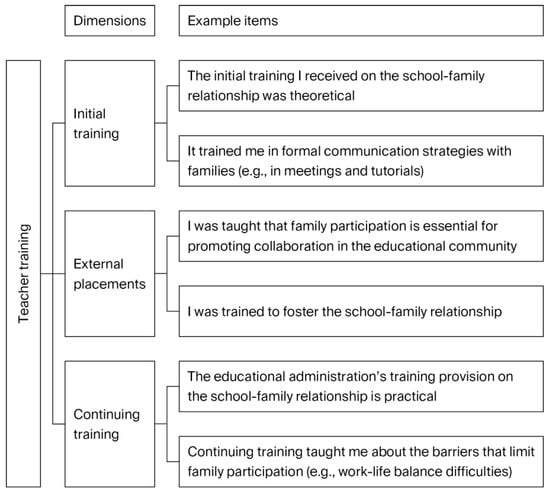
- Teacher training: This section comprises 63 items grouped into the following dimensions: initial teacher education, understood as university preparation for the teaching profession (19 items); teacher placements, understood as training experiences undertaken in schools during university studies (19 items); and continuing professional development, understood as the in-service updating of practising teachers (25 items). The items in each dimension are answered using a 12-point Likert-type scale grouped into four response bands: 0–2 not at all in agreement; 3–5 slightly in agreement; 6–8 moderately in agreement; and 9–11 strongly in agreement (see Figure 2).Figure 2. Dimensions with example items from the “Teacher training” section.
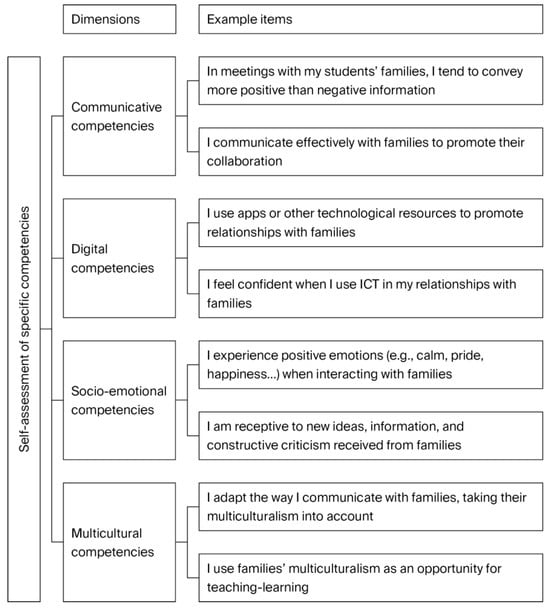
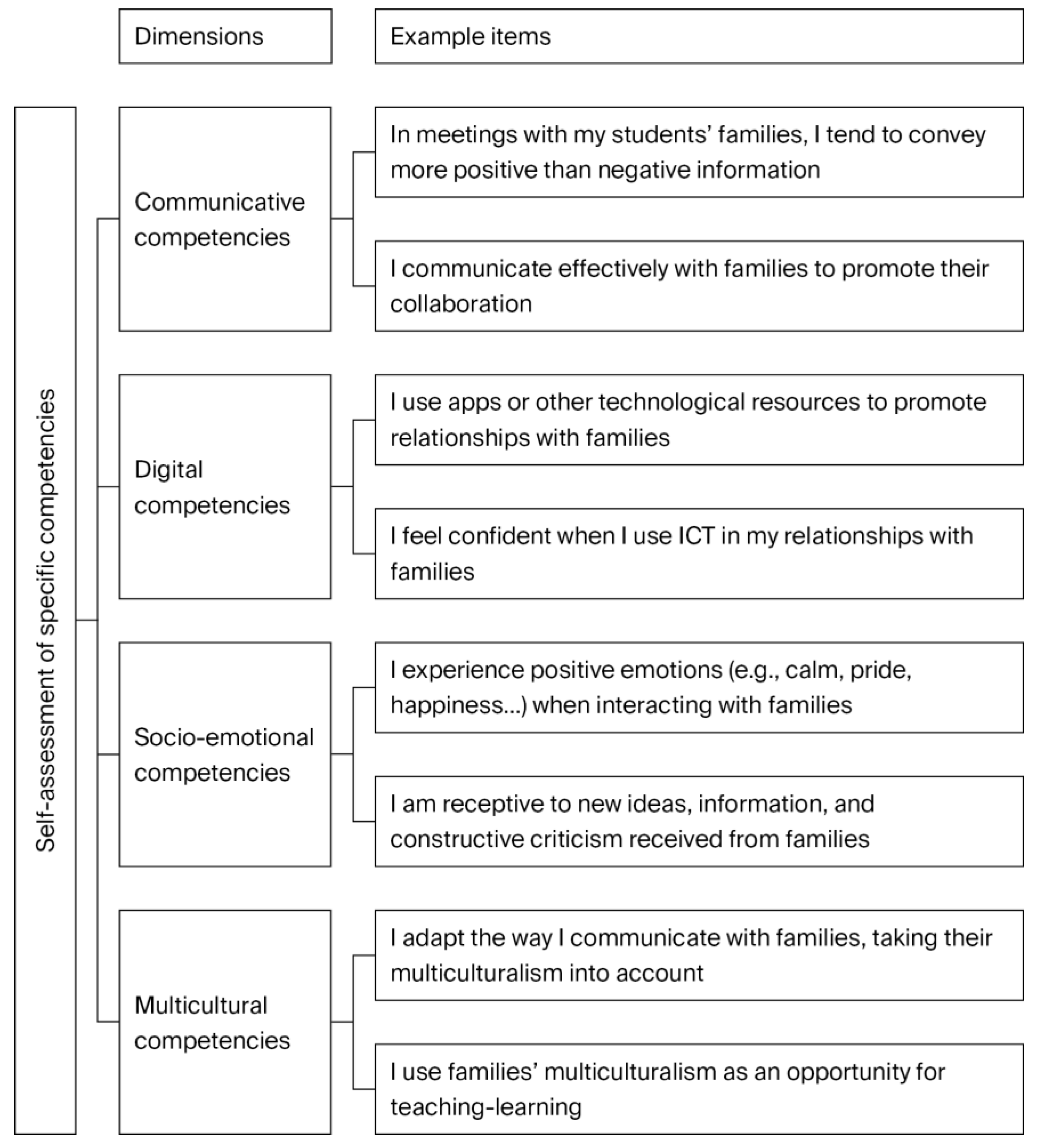
- Self-assessment of specific competencies: This section comprises 33 items distributed across the following dimensions: communicative competencies, understood as the skills required to establish and maintain ongoing, meaningful, and bidirectional interactions (13 items); digital competencies, understood as the skills required to use technological tools critically, safely, and pedagogically (6 items); socio-emotional competencies, understood as emotional-management and conflict-resolution skills (8 items); and multicultural competencies, understood as the skills needed to include, respect, and value cultural diversity (6 items). The same response scale is used as in the previous section (see Figure 3).Figure 3. Dimensions with example items from the “Self-assessment of specific competencies” section.
6. Discussion
The school–family relationship constitutes a strategic pillar for moving towards more equitable and inclusive education systems oriented towards students’ well-being and improved educational quality (OECD, 2021; Shen, 2025; UNESCO, 2022). Nevertheless, a significant gap persists between the formal recognition of this relationship and its effective implementation in school practice (Bueno-Villaverde et al., 2023; Ceballos-López & Saiz-Linares, 2021; Ceballos-Vacas et al., 2023). Findings in this regard show that teacher education continues to be the critical link in strengthening this relationship (Alemán-Falcón et al., 2023; Galián-Nicolás et al., 2023). Both initial teacher education and continuing professional development display theoretical and bureaucratic approaches, limited practical orientation, and, not infrequently, a negatively biassed view of families, all of which clearly indicate the need to revise the design of current training provisions (Bartels & Eskow, 2010; European Commission, 2021; Jarauta-Borrasca & Medina-Moya, 2023; Jones, 2020; Kambouri et al., 2022). At the same time, teachers engage with families in an increasingly complex context in which communicative, digital, socio-emotional, and multicultural competencies emerge as critical training dimensions (Ceballos-Vacas et al., 2025a).
Although the school–family relationship has been widely researched, there are few instruments aimed at systematically identifying teachers’ training needs, even though this is essential for designing training plans that are aligned with the real demands of teachers and families. Consequently, the development of rigorous instruments for identifying training needs emerges as a necessary contribution to guiding more coherent professional development policies and optimising the resources devoted to improving the school–family relationship. For this reason, an instrument was developed with the aim of exploring teachers’ training needs based on their own perceptions.
In this way, EVANEFEF was developed based on a previous qualitative study (Ceballos-Vacas et al., 2025a, 2025b, 2026). It was subsequently content validated through an expert panel, combining quantitative and qualitative assessment to ensure content validity and transparency (Escobar-Pérez & Cuervo-Martínez, 2008) and obtaining optimal results in sufficiency, clarity, coherence, and relevance. In addition, the subsequent pilot study helped to further refine the appropriateness of the wording. The result is a valuable tool that identifies the possible strengths and weaknesses of the training received by teachers, as well as their self-assessment of the key competencies required to promote positive attitudes towards families and to recognise them as active agents with their own knowledge (Galián-Nicolás et al., 2023; Willis & Exley, 2022).
Despite the merits of the instrument, the robustness of its internal structure and the dimensionality of its constructs have not yet been empirically established. Accordingly, further construct validation is warranted through exploratory factor analysis (EFA) and confirmatory factor analysis (CFA) within the framework of Classical Test Theory. In addition, future research should continue to provide further evidence of its validity, reliability, and generalizability across relevant participant characteristics, including sex, educational level, and professional experience.
Thus, the relevance of the instrument lies in its content-validated design, which is intended to comprehensively capture teachers’ perceptions of the teacher-education process, including initial preparation, teacher placements, and continuing professional development, within a single framework. This design provides a basis for examining perceived strengths, competency gaps, and patterns across teachers’ professional trajectories. In addition, it explicitly links teachers’ training needs with specific professional competencies required to manage relationships with families. Following further psychometric validation, the instrument may help inform the development of teacher-training programmes that incorporate key competencies—communicative, digital, socio-emotional, and multicultural—as pillars for fostering collaborative and democratic relationships with families.
Furthermore, EVANEFEF focuses on assessing the professional competencies required to remove the structural barriers faced by families, particularly vulnerable ones (Epstein & Sheldon, 2016). Specifically, the Multicultural Competencies section directly addresses the assessment of teachers’ ability to view diversity as cultural capital and to adapt their communication practices accordingly. At the same time, the Communicative and Digital Competencies dimensions explicitly assess teachers’ readiness to establish two-way, horizontal, and flexible channels of communication that adapt to diverse socioeconomic situations and logistical constraints, such as work–life balance difficulties or limited digital literacy. Finally, the Socio-emotional Competencies dimension addresses assertive conflict management and emotional self-regulation, which are crucial for mitigating teacher biases and fostering trust while fully accounting for family diversity (Cabral et al., 2024; González-Herrera et al., 2017; López-Larrosa et al., 2019; Vallespir-Soler & Morey-López, 2019).
EVANEFEF is intended to characterise the training received and to identify teachers’ training needs by differentiating between levels of competence and establishing training priorities in a well-founded manner (Tejada-Fernández, 2009). Following further psychometric validation, it may facilitate comparative analyses across educational stages, schools, and regions. In this respect, it is important to explore differences in the training background of teachers working at different educational stages, bearing in mind that family-participation outcomes decline as students progress through educational stages (Rodríguez-Ruiz et al., 2016), which points to the need to intensify training efforts at more advanced stages. Since school cultures regarding democratic participation differ according to educational stage, it may be pertinent to adapt teacher education to the magnitude of these needs. EVANEFEF therefore offers the possibility of designing tailor-made training that combines the competencies required in each case. Likewise, the instrument may provide support for a longitudinal evaluation of the impact of implemented training interventions, thereby verifying the effectiveness of the actions undertaken.
These points should be considered without losing sight of the fact that training must always be practical and contextualised, grounded in teachers’ experiences and reflections on their own actions (Bartau-Rojas et al., 2019). To this end, training based on an experiential model is particularly useful, as it allows teachers to reflect on the educational practices to be implemented in each case, taking real critical incidents as a reference and recognising themselves in them. In this experiential model, the role of trainers is less that of experts and more that of facilitators of discussion among participants. The credibility of training increases when it is delivered by teachers from schools with previous successful experiences who can also provide a range of intervention alternatives that can be adapted to the reality of each school.
Likewise, it should be remembered that the training of teachers and families is usually developed in parallel, without shared spaces for dialogue between the two groups. In response to this situation, joint training emerges as an innovative opportunity to foster dialogue, mutual recognition, and the shared construction of collaborative proposals (Hernández-Prados et al., 2019). Along these lines, the experiences of schools that have achieved effective collaboration with families show that the transformation of teaching practices constitutes a key element in driving changes in school culture (Ceballos-Vacas et al., 2023).
7. Conclusions
Advancing towards effective collaboration between schools and families requires moving beyond merely declarative, normative, and bureaucratised approaches (Willemse et al., 2018) to promote competency-based and diversity-sensitive teacher education (Galián-Nicolás et al., 2023). The complexity and heterogeneity of contemporary educational realities highlight that initial teacher education, although indispensable, is insufficient to respond to the challenges involved in establishing an effective and sustainable school–family relationship over time (Housel, 2021; Lohman et al., 2018; Marschall & Shah, 2020). Only through the intentional strengthening of teachers’ professional capacities will it be possible to consolidate truly participatory school cultures and respond to the educational challenges of today’s society.
To achieve this, it is necessary to start from the actual needs of teachers and families, considering teachers’ perceptions, experiences, and emotions. EVANEFEF was developed through a content validation process that began by incorporating teachers’ perspectives and was subsequently supported by expert review, providing evidence of its content validity. The resulting instrument represents a promising tool for the systematic collection of data on teacher education in competencies related to the school–family relationship. Once its psychometric properties were established through empirical validation, it will provide a sound basis for generating robust evidence in this area and support future research and practice. Unlike other scales that primarily analyse administrative aspects or general attitudes, EVANEFEF makes an epistemological contribution by assessing the training needs that teachers themselves perceive during their initial training and throughout their professional careers. Furthermore, a key contribution of the instrument is the explicit integration of socio-emotional and multicultural competences. By focusing on these dimensions, EVANEFEF goes beyond deficit-based models and enables the assessment of cultural diversity, as well as aspects of socio-emotional well-being, in line with the principles of equity and inclusion within the context of the school–family relationship (Bachman & Beard, 2025a, 2025b).
Moreover, and in applied terms, EVANEFEF may make it possible to establish training priorities and to design training proposals tailored to the specific needs of different educational contexts and stages. This is especially relevant considering the decline in family participation at higher educational levels. In sum, it is expected that the results obtained through the instrument will help teacher education move beyond theoretical and bureaucratic approaches by incorporating these competencies in a practical manner, thereby strengthening effective educational collaboration (Santamarina-Sancho & Núñez-Delgado, 2023). Mastery of these capacities can transform schools into a welcoming space for effective collaboration, mitigating the gap between institutions and families to ensure students’ holistic development and a move towards a more inclusive, participatory, and socially responsive education system (Epstein & Boone, 2022).
Supplementary Materials
The following supporting information can be downloaded at: https://www.mdpi.com/article/10.3390/educsci16071124/s1.
Author Contributions
E.M.C.-V.: Conceptualization, Methodology, Writing, Review, Supervision, and Journal correspondence. D.H.-F.: Original draft preparation, Methodology (focus group), References, and idiomatic revision. B.R.-R.: Conceptualization, Methodology Analysis, Writing, Formatting, Review and Edit (Figures and Tables). All authors have read and agreed to the published version of the manuscript.
Funding
Project PID2020-113505RB-I00 funded by the Spanish Ministry of Science and Innovation.
Institutional Review Board Statement
The study was conducted in accordance with the Declaration of Helsinki and was approved by the University of La Laguna (CEIBA2023-3326).
Informed Consent Statement
Informed consent was obtained from all subjects involved in the study.
Data Availability Statement
The original contributions presented in this study are included in the article/Supplementary Materials. Further inquiries can be directed to the corresponding author.
Conflicts of Interest
The authors declare no conflicts of interest. The funders had no role in the design of the study; in the collection, analyses, or interpretation of data; in the writing of the manuscript; or in the decision to publish the results.
References
- Adams, K. S., & Christenson, S. L. (2000). Trust and the family–school relationship examination of parent–teacher differences in elementary and secondary grades. Journal of School Psychology, 38(5), 477–497. [Google Scholar] [CrossRef] [Scilit]
- Alemán-Falcón, J. A., Martín-Quintana, J. C., Alonso-Sánchez, J. A., & Calcines-Piñero, M. A. (2023). Percepción del profesorado sobre la participación de las familias en la escuela: Factores que predicen la participación. Educaçao e Sociedade, 44, 1–19. [Google Scholar] [CrossRef] [Scilit]
- Bachman, H. F., & Beard, K. S. (2025a). Family engagement efficacy beliefs: Exploring educators’ mindsets for building relationships with parents using the FEEB-E survey. School Community Journal, 35(1), 137–168. [Google Scholar] [CrossRef] [Scilit]
- Bachman, H. F., & Beard, K. S. (2025b). Family engagement efficacy beliefs of educators: Confirming a new measure. Teachers and Teaching, 1–18. [Google Scholar] [CrossRef] [Scilit]
- Bartau-Rojas, I., Azpillaga-Larrea, V., & Aierbe-Barandiarán, A. (2019). Colaboración familia-escuela-comunidad según los equipos directivos de centros de Secundaria. Revista de Investigación en Educación, 17(2), 86–102. [Google Scholar]
- Bartels, S. M., & Eskow, K. G. (2010). Training school professionals to engage families: A pilot university/state department of education partnership. School Community Journal, 20(2), 45–71. [Google Scholar]
- Benito-Ambrona, T., Messina-Albarenque, C., Andrés-Viloria, C., & Fernandes-Procópio, L. (2022). Evaluación de la Competencia Emocional docente del alumnado de magisterio en prácticas: Aprender a regular emociones a partir de la escritura de un “emociodiario”. Revista Electrónica Interuniversitaria de Formación del Profesorado, 25(2), 145–157. [Google Scholar] [CrossRef] [Scilit]
- Bernad-Cavero, O., & Llevot-Calvet, N. (2025). Escuela y familias de origen extranjero: Propuestas para una comunicación fluida y eficaz. European Public & Social Innovation Review, 10, 1–23. [Google Scholar] [CrossRef] [Scilit]
- Bueno-Villaverde, A., Monge-López, C., & Torrego-Seijo, J. C. (2023). Estado de la convivencia escolar en centros prácticas exitosas en participación familiar: Percepciones de alumnos y profesores. Bordón, Revista de Pedagogía, 75(2), 87–103. [Google Scholar] [CrossRef] [Scilit]
- Caballero-Rodríguez, K., Mula-Falcón, J., & García Jiménez, E. (2025). Validación de un cuestionario sobre la percepción y satisfacción del profesorado universitario con los sistemas de evaluación profesional. Relieve, 31(1), 2. [Google Scholar] [CrossRef] [Scilit]
- Cabral, S., Mata, L., & Peixoto, F. (2024). Preparing pre-service teachers for family engagement: Insights from the initial teacher education syllabus. Education Sciences, 14, 674. [Google Scholar] [CrossRef] [Scilit]
- Cárcamo-Vásquez, H., & Garreta-Bochaca, J. (2020). Representaciones sociales de la relación familia-escuela desde la formación inicial del profesorado. Revista Electrónica de Investigación Educativa, 22(e11), 1–14. [Google Scholar] [CrossRef] [Scilit]
- Cárcamo-Vásquez, H., & Gubbins-Foxley, V. (2023). Future primary school teachers’ conceptions about parents’ participation in school. Revista Electrónica Educare, 27(1), 242–260. [Google Scholar] [CrossRef] [Scilit]
- Ceballos-López, N., & Saiz-Linares, A. (2021). Un proyecto educativo común: La relación familia y escuela. Revisión de investigaciones y normativas. Educatio Siglo XXI, 39(1), 305–326. [Google Scholar] [CrossRef] [Scilit]
- Ceballos-Vacas, E. M., Hervella-Fariñas, D., & Rodríguez-Ruiz, B. (2025a). ¿La formación docente contribuye a la promoción de la colaboración centro escolar-familia? La perspectiva del profesorado de Educación Infantil y Primaria. Educatio Siglo XXI, 43(1), 77–100. [Google Scholar] [CrossRef] [Scilit]
- Ceballos-Vacas, E. M., Hervella-Fariñas, D., & Rodríguez-Ruiz, B. (2025b). ¿Qué necesitan los centros y las familias para poder forjar una alianza? La perspectiva del profesorado de Educación Infantil y Primaria. Revista Complutense de Educación, 36(1), 43–52. [Google Scholar] [CrossRef] [Scilit]
- Ceballos-Vacas, E. M., Hervella-Fariñas, D., & Rodríguez-Ruiz, B. (2026). Relación escuela-familia: Análisis cualitativo mediante grupos de discusión. New Trends in Qualitative Research (NTQR), 22(2), e1362. [Google Scholar] [CrossRef] [Scilit]
- Ceballos-Vacas, E. M., & Morillo-Lesme, T. C. (2026). La escuela democrática no es posible sin (la participación de) las familias y el alumnado. In M. I. Fernández-Esteban, C. V. Becerra-Brito, A. L. Sanabria-Mesa, & A. Bethencourt-Aguilar (Eds.), Escuelas democráticas para la educación del siglo XXI (pp. 79–93). Octaedro. [Google Scholar]
- Ceballos-Vacas, E. M., & Trujillo-González, E. (2021). Dificultades y apoyos emocionales del alumnado migrante: Un estudio de caso en un instituto multicultural. Aula Abierta, 50(4), 767–776. [Google Scholar] [CrossRef] [Scilit]
- Ceballos-Vacas, E. M., Trujillo-González, E., Fernández-Esteban, I., & González-Delgado, M. (2023). El estudio de caso en la investigación del cambio en la cultura escolar. REICE: Revista Iberoamericana sobre Calidad, Eficacia y Cambio en Educación, 21(3), 193–209. [Google Scholar] [CrossRef] [Scilit]
- Cofie, N., Braund, H., & Dalgarno, N. (2022). Eight ways to get a grip on intercoder reliability using qualitative-based measures. Canadian Medical Education Journal/Revue Canadienne de l’éducation Médicale, 13(2), 73–76. [Google Scholar] [CrossRef] [Scilit] [PubMed]
- Conus, X., & Fahrni, L. (2019). Routine communication between teachers and parents from minority groups: An endless misunderstanding? Educational Review, 71(2), 234–256. [Google Scholar] [CrossRef] [Scilit]
- Corbin, J., & Strauss, A. (2015). Basics of qualitative research: Techniques and procedures for developing grounded theory. SAGE Publishing. [Google Scholar] [CrossRef] [Scilit]
- Dawson, A. E., & Wymbs, B. T. (2016). Validity and utility of the parent–teacher relationship scale–II. Journal of Psychoeducational Assessment, 34(8), 751–764. [Google Scholar] [CrossRef] [Scilit]
- Day, C., Edwards, D., Hill-Jackson, V., Cardinal, T., & Craig, C. J. (2024). Engagement matters: Reimagining family, school, and community relations in teacher education to improve student outcomes. Journal of Teacher Education, 75(4), 365–368. [Google Scholar] [CrossRef] [Scilit]
- De Coninck, K., Valcke, M., & Vanderlinde, R. (2018). A measurement of student teachers’ parent-teacher communication competences: The design of a video-based instrument. Journal of Education for Teaching, 44(3), 333–352. [Google Scholar] [CrossRef] [Scilit]
- Dor, A. (2024). Exploring parent-teacher communication: Understanding mutual perspectives and support during the transition to first grade. Journal of Educational and Developmental Psychology, 14(2), 29–38. [Google Scholar] [CrossRef] [Scilit]
- Epstein, J. L., & Boone, B. J. (2022). State leadership to strengthen family engagement programs. Phi Delta Kappan, 103(7), 8–13. [Google Scholar] [CrossRef] [Scilit]
- Epstein, J. L., & Sheldon, S. B. (2016). Necessary but not sufficient: The role of policy for advancing programs of school, family, and community partnerships. Russell Sage Foundation Journal of the Social Sciences, 2(5), 202–219. [Google Scholar] [CrossRef] [Scilit]
- Epstein, J. L., & Sheldon, S. B. (2019). The importance of evaluating programs of school, family and community partnerships. Aula Abierta, 48(1), 31–42. [Google Scholar] [CrossRef] [Scilit]
- Escobar-Pérez, J., & Cuervo-Martínez, A. (2008). Validez de contenido y juicio de expertos: Una aproximación a su utilización. Avances en Medición, 6, 27–36. [Google Scholar]
- Escudero-Muñoz, J. M. (2020). Un cambio de paradigma en la formación continuada del profesorado: Escenario, significados, procesos y actores. Qurriculum—Revista de Teoría, Investigación y Práctica Educativa, (33), 97–125. [Google Scholar] [CrossRef] [Scilit]
- European Commission. (2021). Education and training 2020 highlights from the ET 2020 working groups 2018–2020. Publications Office of the European Union. [Google Scholar]
- Fernández-Gómez, E., Martín-Salvador, A., Luque-Vara, T., Sánchez-Ojeda, M. A., Navarro-Prado, S., & Enrique-Mirón, C. (2020). Content validation through expert judgement of an instrument on the nutritional knowledge, beliefs, and habits of pregnant women. Nutrients, 12(4), 1136. [Google Scholar] [CrossRef] [Scilit] [PubMed]
- Flick, U. (2022). Introducción a la investigación cualitativa. Morata. [Google Scholar]
- Galián-Nicolás, B., Hernández-Prados, M. A., & Álvarez-Muñoz, J. S. (2023). Smart schools and the family-school relationship: Teacher profiles for the promotion of family involvement. Journal of Intelligence, 11(3), 51. [Google Scholar] [CrossRef] [Scilit] [PubMed]
- Galicia-Alarcón, L.-A., Balderrama-Trápaga, J. A., & Edel-Navarro, R. (2017). Validez de contenido por juicio de expertos: Propuesta de una herramienta virtual. Apertura, 9(2), 42–53. [Google Scholar] [CrossRef] [Scilit]
- Gomariz-Vicente, M. A., Parra-Martínez, J., García-Sanz, M. P., & Hernández-Prados, M. A. (2022). Teaching facilitation of family participation in educational institutions. Frontiers in Psychology, 12, 748710. [Google Scholar] [CrossRef] [Scilit] [PubMed]
- Gomila-Grau, M. A., & Pascual-Barrio, B. (2015). La participación de las familias en el sistema educativo: La percepción del profesorado en formación. Revista Electrónica Interuniversitaria de Formación del Profesorado, 18(3), 99–112. [Google Scholar] [CrossRef] [Scilit]
- Gomila-Grau, M. A., Pascual-Barrio, B., & Quincoces, M. (2018). Family-school partnership in the Spanish education system. Journal of Education for Teaching, 44(3), 309–320. [Google Scholar] [CrossRef] [Scilit]
- González-Herrera, A. I., León-Rodríguez, C., Márquez-Domínguez, Y., & García-Mesa, M. E. (2017). Los procesos de mejora de la relación familia-escuela: Una experiencia de trabajo colaborativo en la comunidad escolar. European Journal of Alternative Education Studies, 2(2), 70–91. [Google Scholar] [CrossRef]
- Hernández-Prados, M. A., & Álvarez-Muñoz, J. S. (2023). Relación familia-escuela: La comunicación en contextos rurales y urbanos. Revista Electrónica Interuniversitaria De Formación Del Profesorado, 26(2), 219–232. [Google Scholar] [CrossRef] [Scilit]
- Hernández-Prados, M. A., García-Sanz, M. P., Galián-Nicolás, B., & Belmonte-Almagro, M. L. (2019). Implicación de familias y docentes en la formación familiar. Revista Electrónica Interuniversitaria de Formación del Profesorado, 22(3), 61–75. [Google Scholar] [CrossRef] [Scilit]
- Houri, A. K., Thayer, A. J., & Cook, C. R. (2019). Targeting parent trust to enhance engagement in a school–home communication system: A double-blind experiment of a parental wise feedback intervention. School Psychology, 34(4), 421–432. [Google Scholar] [CrossRef] [Scilit] [PubMed]
- Housel, D. A. (2021). Supporting the engagement and participation of multicultural, multilingual immigrant families in public education in the United States: Some practical strategies. School Community Journal, 30(2), 185–209. [Google Scholar]
- Ibarra-Sáiz, M. S., González-Elorza, A., & Rodríguez-Gómez, G. (2023). Aportaciones metodológicas para el uso de la entrevista semiestructurada en la investigación educativa a partir de un estudio de caso múltiple. Revista de Investigación Educativa, 41(2), 501–522. [Google Scholar] [CrossRef] [Scilit]
- Jarauta-Borrasca, B., & Medina-Moya, J. L. (2023). Contenidos y procesos de aprendizaje en la formación inicial del profesorado de educación primaria. Bordón, Revista de Pedagogía, 75(3), 103–118. [Google Scholar] [CrossRef] [Scilit]
- Jones, C. (2020). Don’t forget the parents: Preparing trainee teachers for family-school partnership. Practice, 2(1), 68–85. [Google Scholar] [CrossRef] [Scilit]
- Joshi, A., Kale, S., Chandel, S., & Pal, D. (2015). Likert scale: Explored and explained. British Journal of Applied Science & Technology, 7, 396–403. [Google Scholar] [CrossRef] [Scilit]
- Jung, S. B., & Sheldon, S. (2020). Connecting dimensions of school leadership for partnerships with school and teacher practices of family engagement. The School Community Journal, 30(1), 9–32. [Google Scholar]
- Kambouri, M., Wilson, T., Pieridou, M., Quinn, S. F., & Liu, J. (2022). Making partnerships work: Proposing a model to support parent-practitioner partnerships in the early years. Early Childhood Education Journal, 50, 639–661. [Google Scholar] [CrossRef] [Scilit] [PubMed]
- Kang, M. G., Tablante, G. I., Mendoza, K., Bandong, A. N., Guisihan, R., Lim, A. A., & Palad, Y. (2024). Content validation and pilot testing of the promoting active lifestyle among children with disability questionnaire in Filipino and English. Journal of Physical Activity and Health, 21(10), 1046–1053. [Google Scholar] [CrossRef] [Scilit] [PubMed]
- Kuckartz, U., & Rädiker, S. (2023). Qualitative content analysis: Methods, practice and software. SAGE Publications. [Google Scholar]
- Lago, R., Morcillo, V., & Menacho, I. (2021). Estrategias para favorecer la relación familia-escuela. In C. Delgado, E. Aragón, & J. I. Navarro (Eds.), Colaboración familia-escuela. Manual para docentes (pp. 105–120). Pirámide. [Google Scholar]
- Lindqvist, H. (2019). Strategies to cope with emotionally challenging situations in teacher education. Journal of Education for Teaching, 45(5), 540–552. [Google Scholar] [CrossRef] [Scilit]
- Llamas, C. J. (2020). Diseño y validación de un cuestionario sobre la usabilidad y la calidad técnica de un software deportivo [Design and validation of a questionnaire on the usability and technical quality of a sport software]. Retos, 37, 386–392. [Google Scholar] [CrossRef] [Scilit]
- Lohman, M. J., Hathcote, A. R., & Boothe, K. A. (2018). Adressing the barriers to family school collaboration: A brief review of the literature and recommendations for practice. International Journal of Early Childhood Special Education, 10(10), 25–31. [Google Scholar] [CrossRef] [Scilit]
- Lorence-Lara, B., Nieto, M., & Sánchez-Hidalgo, J. (2024). Barreras en la cooperación entre familias y escuelas: Una revisión sistemática. Profesorado, Revista de Currículum y Formación del Profesorado, 28(1), 125–148. [Google Scholar] [CrossRef] [Scilit]
- López-Larrosa, S., Richards, A., Morao-Rodríguez, S. A., & Gómez-Soriano, L. (2019). Teachers and trainee teachers’ beliefs about family-school relationships. Aula Abierta, 48(1), 59–66. [Google Scholar] [CrossRef] [Scilit]
- Macià-Bordalba, M. (2019). Principales canales para la comunicación familia-escuela: Análisis de necesidades y propuestas de mejora. Revista Complutense de Educación, 30(1), 147–165. [Google Scholar] [CrossRef] [Scilit]
- Marschall, M. J., & Shah, P. R. (2020). Linking the process and outcomes of parent involvement policy to the parent involvement gap. Urban Education, 55(5), 699–729. [Google Scholar] [CrossRef] [Scilit]
- Miller, G. E., Coleman, J., & Mitchell, J. (2018). Towards a model of interprofessional preparation to enhance partnering between educators and families. Journal of Education for Teaching, 44(3), 353–365. [Google Scholar] [CrossRef] [Scilit]
- Miller, K. (2022). Teachers’ reflections on supporting social and emotional learning: Desires, practices, and tensions in fostering family-school ties. Journal of Online Learning Research, 8(1), 37–65. [Google Scholar] [CrossRef] [Scilit]
- Ministerio de Educación y Formación Profesional. (2019). TALIS 2018: Estudio internacional de la enseñanza y del aprendizaje. Ministerio de Educación y Formación Profesional.
- Myende, P. E., & Nhlumayo, B. S. (2022). Enhancing parent–teacher collaboration in rural schools: Parents’ voices and implications for schools. International Journal of Leadership in Education, 25(3), 490–514. [Google Scholar] [CrossRef] [Scilit]
- National Association for Family, School, and Community Engagement. (2022). Family engagement core competencies: A body of knowledge, skills, and dispositions for family-facing professionals. NAFSCE. Available online: https://nafsce.org/page/corecompetencies (accessed on 21 March 2026).
- OECD. (2020). TALIS 2018 results (Volume II): Teachers and school leaders as valued professionals. OECD Publishing. [Google Scholar] [CrossRef] [Scilit]
- OECD. (2021). Teachers getting the best out of their students: From primary to upper secondary education. TALIS. OECD Publishing. [Google Scholar] [CrossRef] [Scilit]
- Onwuegbuzie, A., Dickinson, W., & Leech, N. (2009). A qualitative framework for collecting and analyzing data in focus group research. International Journal of Qualitative Methods, 8(3), 1–21. [Google Scholar] [CrossRef] [Scilit]
- Palou, B. (2011). Análisis de los elementos configurativos de la ciudadanía como condición para la integración de la juventud de origen magrebí en Cataluña. Revista de Investigación Educativa, 30(1), 181–195. [Google Scholar] [CrossRef] [Scilit]
- Pedrosa, I., Suárez-Álvarez, J., & García-Cueto, E. (2013). Evidencias sobre la validez de contenido: Avances teóricos y métodos para su estimación. Acción Psicológica, 10(2), 3–18. [Google Scholar] [CrossRef] [Scilit]
- Peterson, S. S., & Ladky, M. (2007). A survey of teachers’ and principals’ practices and challenges in fostering new immigrant parent involvement. Canadian Journal of Education, 30(4), 881–910. [Google Scholar] [CrossRef] [Scilit]
- Preston, C. C., & Colman, A. M. (2000). Optimal number of response categories in rating scales: Reliability, validity, discriminating power, and respondent preferences. Acta Psychologica, 104(1), 1–15. [Google Scholar] [CrossRef] [Scilit] [PubMed]
- Reyes, O., & Hernández-Moncada, M. C. (2021). Formato: Validación de contenido por juicio de expertos. Instrumentos cuantitativos [Not published manuscript]. University of Celaya. [Google Scholar] [CrossRef]
- Rhemtulla, M., Brosseau-Liard, P. É., & Savalei, V. (2012). When can categorical variables be treated as continuous? A comparison of robust maximum likelihood and diagonally weighted least squares estimation. Psychological Methods, 17(3), 354–373. [Google Scholar] [CrossRef] [Scilit] [PubMed]
- Rodríguez-Ruiz, B., Ceballos-Vacas, E. M., & Martínez-González, R. A. (2024). La participación colectiva de las familias en la encrucijada: El reto de la participación democrática de las AMPA en los centros escolares. Revista Internacional de Organizaciones, 32, 81–101. [Google Scholar] [CrossRef] [Scilit]
- Rodríguez-Ruiz, B., & Hervella-Fariñas, D. (2023). ¿Qué siente y cómo percibe el profesorado la relación con las familias? In Bienestar psicológico en la escuela y la familia: Una visión postpandemia (F. Alcantud Marín, & Y. Alonso Esteban, Coord.; pp. 195–204). Síntesis. [Google Scholar]
- Rodríguez-Ruiz, B., Martínez-González, R. A., & Rodrigo-López, M. (2016). Dificultades de las familias para participar en los centros escolares. Revista Latinoamericana de Educación Inclusiva, 10(1), 79–98. [Google Scholar] [CrossRef] [Scilit]
- Sandoval-Perdomo, K., & Juárez-Hernández, L. G. (2026). Designing an instrument to evaluate critical thinking in generative AI-mediated higher education. RELIEVE, 32(1). [Google Scholar] [CrossRef] [Scilit]
- Santamarina-Sancho, M., & Núñez-Delgado, M. P. (2023). Concepciones de los docentes de Educación Infantil sobre su formación inicial y permanente: Estudio de caso colectivo. Educatio Siglo XXI, 41(2), 39–60. [Google Scholar] [CrossRef] [Scilit]
- Shen, L. (2025). The role of family-school relationship in promoting preschoolers’ classroom engagement. Frontiers in Psychology, 16, 1615150. [Google Scholar] [CrossRef] [Scilit] [PubMed]
- Singh, K. (2007). Quantitative social research methods. SAGE Publications. [Google Scholar]
- Smith, T. E., & Sheridan, S. M. (2019). The effects of teacher training on teachers’ family engagement practices, attitudes, and knowledge: A meta-analysis. Journal of Educational and Psychological Consultation, 29(2), 128–157. [Google Scholar] [CrossRef] [Scilit]
- Tejada-Fernández, J. (2009). Competencias docentes. Profesorado, Revista de Currículum y Formación del Profesorado, 13(2), 1–15. [Google Scholar] [CrossRef] [Scilit]
- Thompson, I., Willemse, M., Mutton, T., Burn, K., & de Bruïne, E. (2018). Teacher education and family-school partnerships in different contexts: A cross-country analysis of national teacher education frameworks across a range of European countries. Journal of Education for Teaching, 44(3), 258–277. [Google Scholar] [CrossRef] [Scilit]
- UNESCO. (2022). Reimaginar juntos nuestros futuros. Un nuevo contrato social para la educación. UNESCO y Fundación SM. [Google Scholar]
- Vallespir-Soler, J., & Morey-López, M. (2019). La formación del profesorado de educación primaria respecto a la participación de las familias. Revista Electrónica Interuniversitaria de Formación del Profesorado, 22(3), 77–92. [Google Scholar] [CrossRef] [Scilit]
- Willemse, T. M., Thompson, I., Vanderlinde, R., & Mutton, T. (2018). Family-school partnerships: A challenge for teacher education. Journal of Education for Teaching, 44(3), 252–257. [Google Scholar] [CrossRef] [Scilit]
- Willis, L. D., & Exley, B. (2022). Pedagogies, practices, and processes for engaging parents and communities in children’s learning and wellbeing: EPIC 2022 final report. Independent Schools Queensland. Available online: https://www.isq.qld.edu.au/media/bekdcnve/pedagogies-practices-and-processes_epic-2022-report.pdf (accessed on 25 March 2026).
- Yanes-Cabrera, C., & Ries, F. (2013). Liderando el cambio: Estudio sobre las necesidades formativas de los futuros docentes de Secundaria. Revista Fuentes, 14, 105–124. [Google Scholar]
- Yusoff, M. S. B. (2019). ABC of content validation and content validity index calculation. Education in Medicine Journal, 11(2), 49–54. [Google Scholar] [CrossRef] [Scilit]

Disclaimer/Publisher’s Note: The statements, opinions and data contained in all publications are solely those of the individual author(s) and contributor(s) and not of MDPI and/or the editor(s). MDPI and/or the editor(s) disclaim responsibility for any injury to people or property resulting from any ideas, methods, instructions or products referred to in the content. |
© 2026 by the authors. Licensee MDPI, Basel, Switzerland. This article is an open access article distributed under the terms and conditions of the Creative Commons Attribution (CC BY) license.