Teachers’ Digital Competencies as a Resource in the Job Demands-Resources Model



Abstract
1. Introduction
2. Literature Review and Hypothesis Development
2.1. Job Demands-Resources Model
2.2. Job Demands and Resources in Digital Work Contexts
2.3. Digital Competencies as Domain-Specific Personal Resources
2.4. Hypothesis Development
3. Data and Methods
3.1. Data Source and Study Design
3.2. Measures
3.3. Statistical Methods
4. Results
4.1. Descriptive Results
4.1.1. Multivariate Results

| Exogenous Variables | Indirect Effects | Mediating Variables | Std. Est. | BC-Bootstrap CI, 95% (LL, UL) |
|---|---|---|---|---|
| Student behavior | Total indirect | −0.36 | [−0.42, −0.29] | |
| Specific indirect 1 | Motivation | −0.15 | [−0.34, −0.07] | |
| Specific indirect 2 | Strain | −0.21 | [−0.33, −0.03] | |
| Administrative tasks | Total indirect | −0.15 | [−0.20, −0.09] | |
| Specific indirect 1 | Motivation | −0.09 | [−0.19, −0.04] | |
| Specific indirect 2 | Strain | −0.06 | [−0.17, −0.00] | |
| Collegial support | Total indirect | 0.12 | [0.03, 0.19] | |
| Specific indirect 1 | Motivation | 0.03 | [−0.04, 0.14] | |
| Specific indirect 2 | Strain | 0.09 | [0.02, 0.18] | |
| School management support | Total indirect | 0.26 | [0.16, 0.35] | |
| Specific indirect 1 | Motivation | 0.06 | [0.01, 0.29] | |
| Specific indirect 2 | Strain | 0.20 | [0.00, 0.30] | |
| Autonomy | Total indirect | 0.03 | [−0.05, 0.12] | |
| Specific indirect 1 | Motivation | 0.05 | [−0.00, 0.11] | |
| Specific indirect 2 | Strain | −0.03 | [−0.07, 0.01] | |
| Self-efficacy | Total indirect | 0.16 | [0.10, 0.22] | |
| Specific indirect 1 | Motivation | 0.07 | [0.02, 0.15] | |
| Specific indirect 2 | Strain | 0.10 | [0.01, 0.14] | |
| Digital competencies | Total indirect | 0.06 | [0.00, 0.13] | |
| Specific indirect 1 | Motivation | 0.02 | [−0.03, 0.07] | |
| Specific indirect 2 | Strain | 0.04 | [0.01, 0.10] |

4.1.2. Robustness Checks
5. Discussion
5.1. Limitations and Future Directions
5.2. Conclusions
Author Contributions
Funding
Institutional Review Board Statement
Informed Consent Statement
Data Availability Statement
Conflicts of Interest
Appendix A
| Measurement Model | ||||
|---|---|---|---|---|
| Latent Variables | Items | Estimate | S.E. | p-Value |
| Motivation | Motivation_1 | 0.80 | 0.02 | p < 0.001 |
| Motivation_2 | 0.81 | 0.02 | p < 0.001 | |
| Motivation_3 | 0.87 | 0.02 | p < 0.001 | |
| Motivation_4 | 0.81 | 0.02 | p < 0.001 | |
| Motivation_5 | 0.81 | 0.02 | p < 0.001 | |
| Motivation_6 | 0.60 | 0.03 | p < 0.001 | |
| Motivation_7 | 0.82 | 0.02 | p < 0.001 | |
| Motivation_8 | 0.76 | 0.02 | p < 0.001 | |
| Motivation_9 | 0.78 | 0.02 | p < 0.001 | |
| Org. Commitment | OrgCommitment_1 | 0.68 | 0.03 | p < 0.001 |
| OrgCommitment_2 | 0.83 | 0.02 | p < 0.001 | |
| OrgCommitment_3 | 0.77 | 0.03 | p < 0.001 | |
| OrgCommitment_4 | 0.44 | 0.04 | p < 0.001 | |
| OrgCommitment_5 | 0.74 | 0.02 | p < 0.001 | |
| OrgCommitment_6 | 0.85 | 0.02 | p < 0.001 | |
| OrgCommitment_7 | 0.54 | 0.03 | p < 0.001 | |
| OrgCommitment_8 | 0.76 | 0.02 | p < 0.001 | |
| OrgCommitment_9 | 0.60 | 0.03 | p < 0.001 | |
| OrgCommitment_10 | 0.80 | 0.02 | p < 0.001 | |
| OrgCommitment_11 | 0.68 | 0.03 | p < 0.001 | |
| OrgCommitment_12 | 0.62 | 0.04 | p < 0.001 | |
| OrgCommitment_13 | 0.79 | 0.02 | p < 0.001 | |
| OrgCommitment_14 | 0.79 | 0.02 | p < 0.001 | |
| OrgCommitment_15 | 0.80 | 0.03 | p < 0.001 | |
| Collegial Support | CollegialSupport_1 | 0.89 | 0.01 | p < 0.001 |
| CollegialSupport_2 | 0.92 | 0.02 | p < 0.001 | |
| CollegialSupport_3 | 0.85 | 0.02 | p < 0.001 | |
| CollegialSupport_4 | 0.78 | 0.03 | p < 0.001 | |
| School Management Support | SchoolMgmtSupport_1 | 0.90 | 0.01 | p < 0.001 |
| SchoolMgmtSupport_2 | 0.87 | 0.01 | p < 0.001 | |
| SchoolMgmtSupport_3 | 0.88 | 0.01 | p < 0.001 | |
| SchoolMgmtSupport_4 | 0.75 | 0.02 | p < 0.001 | |
| SchoolMgmtSupport_5 | 0.76 | 0.02 | p < 0.001 | |
| SchoolMgmtSupport_6 | 0.88 | 0.01 | p < 0.001 | |
| SchoolMgmtSupport_7 | 0.81 | 0.02 | p < 0.001 | |
| Autonomy | Autonomy_1 | 0.82 | 0.02 | p < 0.001 |
| Autonomy_2 | 0.83 | 0.02 | p < 0.001 | |
| Autonomy_3 | 0.87 | 0.02 | p < 0.001 | |
| Autonomy_4 | 0.60 | 0.03 | p < 0.001 | |
| Autonomy_5 | 0.76 | 0.03 | p < 0.001 | |
| Self-Efficacy | SelfEfficacy_1 | 0.58 | 0.04 | p < 0.001 |
| SelfEfficacy_2 | 0.68 | 0.03 | p < 0.001 | |
| SelfEfficacy_3 | 0.64 | 0.03 | p < 0.001 | |
| SelfEfficacy_4 | 0.62 | 0.03 | p < 0.001 | |
| SelfEfficacy_5 | 0.77 | 0.02 | p < 0.001 | |
| SelfEfficacy_6 | 0.81 | 0.02 | p < 0.001 | |
| SelfEfficacy_7 | 0.78 | 0.02 | p < 0.001 | |
| SelfEfficacy_8 | 0.76 | 0.02 | p < 0.001 | |
| SelfEfficacy_9 | 0.79 | 0.02 | p < 0.001 | |
| SelfEfficacy_10 | 0.79 | 0.02 | p < 0.001 | |
| Strain | Strain_1 | 0.84 | 0.02 | p < 0.001 |
| Strain_2 | 0.81 | 0.02 | p < 0.001 | |
| Strain_3 | 0.68 | 0.03 | p < 0.001 | |
| Strain_4 | 0.79 | 0.02 | p < 0.001 | |
| Digital Competencies | DigitalCompetencies_1 | 0.70 | 0.02 | p < 0.001 |
| DigitalCompetencies_2 | 0.73 | 0.02 | p < 0.001 | |
| DigitalCompetencies_3 | 0.75 | 0.02 | p < 0.001 | |
| DigitalCompetencies_4 | 0.69 | 0.02 | p < 0.001 | |
| DigitalCompetencies_5 | 0.72 | 0.02 | p < 0.001 | |
| DigitalCompetencies_6 | 0.65 | 0.03 | p < 0.001 | |
| DigitalCompetencies_7 | 0.73 | 0.02 | p < 0.001 | |
| DigitalCompetencies_8 | 0.70 | 0.02 | p < 0.001 | |
| DigitalCompetencies_9 | 0.71 | 0.02 | p < 0.001 | |
| DigitalCompetencies_10 | 0.71 | 0.02 | p < 0.001 | |
| DigitalCompetencies_11 | 0.78 | 0.02 | p < 0.001 | |
| DigitalCompetencies_12 | 0.73 | 0.02 | p < 0.001 | |
| DigitalCompetencies_13 | 0.73 | 0.02 | p < 0.001 | |
| DigitalCompetencies_14 | 0.75 | 0.02 | p < 0.001 | |
| DigitalCompetencies_15 | 0.75 | 0.02 | p < 0.001 | |
| DigitalCompetencies_16 | 0.58 | 0.03 | p < 0.001 | |
| DigitalCompetencies_17 | 0.57 | 0.03 | p < 0.001 | |
| DigitalCompetencies_18 | 0.62 | 0.03 | p < 0.001 | |
| DigitalCompetencies_19 | 0.61 | 0.03 | p < 0.001 | |
| DigitalCompetencies_20 | 0.67 | 0.03 | p < 0.001 | |
| DigitalCompetencies_21 | 0.71 | 0.03 | p < 0.001 | |
| DigitalCompetencies_22 | 0.74 | 0.02 | p < 0.001 | |
| DigitalCompetencies_23 | 0.69 | 0.02 | p < 0.001 | |
| DigitalCompetencies_24 | 0.64 | 0.03 | p < 0.001 | |
| DigitalCompetencies_25 | 0.57 | 0.03 | p < 0.001 | |
| DigitalCompetencies_26 | 0.64 | 0.03 | p < 0.001 | |
| DigitalCompetencies_27 | 0.63 | 0.03 | p < 0.001 | |
| DigitalCompetencies_28 | 0.50 | 0.03 | p < 0.001 | |
| DigitalCompetencies_29 | 0.53 | 0.03 | p < 0.001 | |
| Residual Correlations | ||||
| Variable 1 | Variable 2 | |||
| Motivation_2 | Motivation_1 | 0.84 | 0.02 | p < 0.001 |
| Motivation_4 | Motivation_3 | 0.57 | 0.04 | p < 0.001 |
| Motivation_9 | Motivation_8 | 0.60 | 0.03 | p < 0.001 |
| DigitalCompetencies_2 | DigitalCompetencies_1 | 0.58 | 0.04 | p < 0.001 |
| DigitalCompetencies_10 | DigitalCompetencies_9 | 0.64 | 0.03 | p < 0.001 |
| DigitalCompetencies_10 | DigitalCompetencies_11 | 0.60 | 0.03 | p < 0.001 |
| DigitalCompetencies_11 | DigitalCompetencies_9 | 0.41 | 0.04 | p < 0.001 |
| DigitalCompetencies_15 | DigitalCompetencies_14 | 0.34 | 0.04 | p < 0.001 |
| DigitalCompetencies_17 | DigitalCompetencies_16 | 0.65 | 0.02 | p < 0.001 |
| DigitalCompetencies_17 | DigitalCompetencies_18 | 0.62 | 0.03 | p < 0.001 |
| DigitalCompetencies_18 | DigitalCompetencies_16 | 0.49 | 0.03 | p < 0.001 |
| DigitalCompetencies_27 | DigitalCompetencies_26 | 0.65 | 0.03 | p < 0.001 |
| DigitalCompetencies_29 | DigitalCompetencies_28 | 0.81 | 0.02 | p < 0.001 |
| SelfEfficacy_2 | SelfEfficacy_1 | 0.34 | 0.04 | p < 0.001 |
| SelfEfficacy_2 | SelfEfficacy_3 | 0.33 | 0.04 | p < 0.001 |
| SelfEfficacy_5 | SelfEfficacy_4 | 0.36 | 0.04 | p < 0.001 |
| DigitalCompetencies_7 | DigitalCompetencies_6 | 0.50 | 0.04 | p < 0.001 |
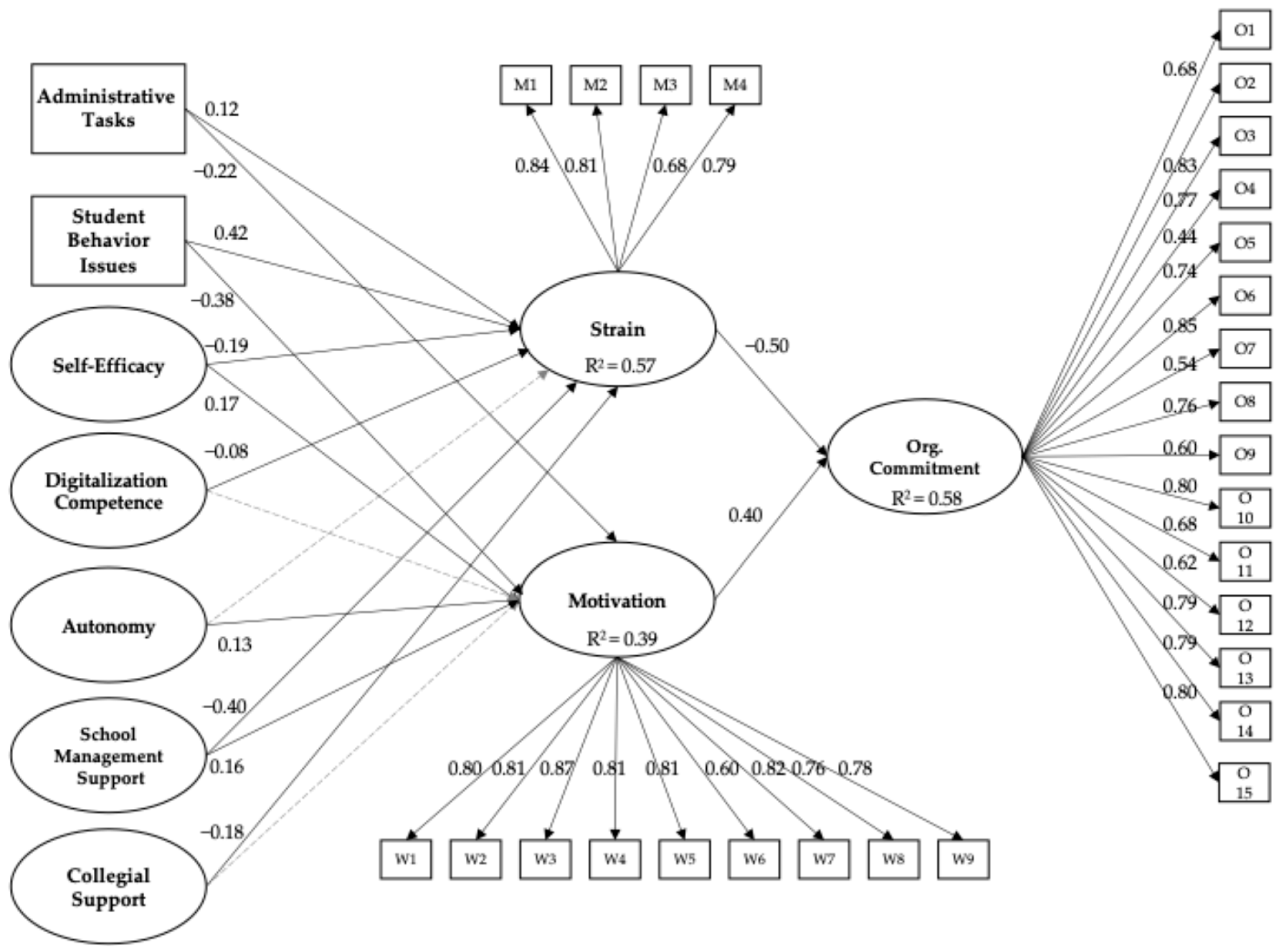
| Dependent Variables | Independent Variables | Estimate | BC-Bootstrap CI, 95% (LL, UL) |
|---|---|---|---|
| Strain | Collegial Support | −0.18 | [−0.31, −0.05] |
| School Management Support | −0.40 | [−0.52, −0.07] | |
| Autonomy | 0.05 | [−0.10, −0.13] | |
| Digital Competencies | −0.08 | [−0.17, −0.01] | |
| Self-Efficacy | −0.19 | [−0.30, −0.08] | |
| Student Behavior | 0.42 | [0.29, 0.55] | |
| Administrative Tasks | 0.12 | [0.02, 0.27] | |
| Work Experience | 0.01 | [−0.08, 0.10] | |
| Sex | 0.06 | [−0.03, 0.15] | |
| Motivation | Collegial Support | 0.08 | [−0.05, 0.02] |
| School Management Support | 0.16 | [0.04, 0.40] | |
| Autonomy | 0.13 | [0.03, 0.25] | |
| Self-Efficacy | 0.17 | [0.09, 0.31] | |
| Digital Competencies | 0.05 | [−0.03, 0.16] | |
| Student Behavior | −0.38 | [−0.44, −0.32] | |
| Administrative Tasks | −0.22 | [−0.30, −0.13] | |
| Work Experience | 0.01 | [−0.06, 0.08] | |
| Sex | 0.11 | [0.03, 0.18] | |
| Org. Commitment | Motivation | 0.40 | [0.20, 0.72] |
| Strain | −0.50 | [−0.64, −0.04] | |
| Work Experience in Years | 0.04 | [−0.04, 0.12] | |
| Sex | 0.04 | [−0.03, 0.12] | |
| R2 | |||
| Motivation | 0.39 | ||
| Org. Commitment | 0.58 | ||
| Strain | 0.57 |
| 1 | Consistent with standard terminology in structural equation modeling (SEM) research (Bollen, 2014), the terms ‘(direct) effects’ and ‘indirect effects’ are used throughout this study to describe the associations within the theoretical model. It should be noted that these terms refer to statistical associations and do not imply causal relationships, which would be beyond the scope of the present cross-sectional design. Accordingly, all interpretations are made with caution to avoid causal claims. |
References
- Adil, A., & Kamal, A. (2020). Authentic leadership and psychological capital in job demands-resources model among Pakistani University teachers. International Journal of Leadership in Education, 23(6), 734–754. [Google Scholar] [CrossRef] [Scilit]
- Aesaert, K., Voogt, J., Kuiper, E., & van Braak, J. (2017). Accuracy and bias of ICT self-efficacy: An empirical study into students’ over-and underestimation of their ICT competences. Computers in Human Behavior, 75, 92–102. [Google Scholar] [CrossRef] [Scilit]
- Avola, P., Soini-Ikonen, T., Jyrkiäinen, A., & Pentikiäinen, V. (2025). Interventions to teacher well-being and burnout. A scoping review. Educational Psychology Review, 37, 11. [Google Scholar] [CrossRef] [Scilit]
- Bakker, A. B., & Demerouti, E. (2007). The Job Demands–Resources model: State of the art. Journal of Managerial Psychology, 22(3), 309–328. [Google Scholar] [CrossRef] [Scilit]
- Berger, W., Grommé, E., Stebner, F., Koch, T., Reintjes, C., & Nonte, S. (2025). Students’ well-being in digital learning environments: A multilevel analysis of sixth-graders in comprehensive schools. Education Sciences, 15(8), 1034. [Google Scholar] [CrossRef] [Scilit]
- Bollen, K. A. (2014). Structural equations with latent variables. John Wiley & Sons. [Google Scholar]
- Brown, T. A. (2015). Confirmatory factor analysis for applied research. Guilford publications. [Google Scholar]
- Carretero Gomez, S., Vuorikari, R., & Punie, Y. (2017). DigComp 2.1: The digital competence framework for citizens with eight proficiency levels and examples of use. Publications Office. Available online: https://data.europa.eu/doi/10.2760/38842 (accessed on 10 June 2026).
- Cheng, S. L., Chen, S. B., & Chang, J. C. (2021). Examining the multiplicative relationships between teachers’ competence, value, and pedagogical beliefs about technology integration. British Journal of Educational Technology, 52(2), 734–750. [Google Scholar] [CrossRef] [Scilit]
- Cheng, Z., Yang, F., & Zhu, C. (2026). Understanding teacher workload in blended learning: Insights through the Job Demands-Resources model. Electronic Journal of e-Learning, 24(1), 125–137. [Google Scholar] [CrossRef] [Scilit]
- Cohen, J. (1988). Statistical power analysis for the behavioral sciences (2nd ed.). Routledge. [Google Scholar] [CrossRef] [Scilit]
- Colbert, A., Yee, N., & George, G. (2016). The digital workforce and the workplace of the Future. Academy of Management Journal, 59, 731–739. [Google Scholar] [CrossRef] [Scilit]
- Demerouti, E., Bakker, A. B., Nachreiner, F., & Schaufeli, W. B. (2001). The job demands-resources model of burnout. Journal of Applied Psychology, 86(3), 499–512. [Google Scholar] [CrossRef]
- Dexter, S., & Richardson, J. W. (2020). What does technology integration research tell us about the leadership of technology? Journal of Research on Technology in Education, 52(1), 17–36. [Google Scholar] [CrossRef] [Scilit]
- DiCiccio, T. J., & Efron, B. (1996). Bootstrap confidence intervals. Statistical Science, 11(3), 189–228. [Google Scholar] [CrossRef] [Scilit]
- Dicke, T., Stebner, F., Linninger, C., Kunter, M., & Leutner, D. (2018). Testing the Job-Demands Resources model as a whole: Validating its assumptions and core variables of teachers’ well-being. Journal of Occupational Health Psychology, 23, 262–277. [Google Scholar] [CrossRef] [Scilit] [PubMed]
- Eickelmann, B., & Gerick, J. (2020). Lernen mit digitalen medien. In D. Fickermann, & B. Edelstein (Eds.), “Langsam vermisse ich die Schule …”. Schule während und nach der Corona-Pandemie (pp. 153–162). Waxmann. [Google Scholar]
- European Commission. (2019). Key competences for lifelong learning. European Commission. [Google Scholar]
- Fey, C. F., Hu, T., & Delios, A. (2023). The measurement and communication of effect sizes in management research. Management and Organization Review, 19(1), 176–197. [Google Scholar]
- Galanakis, M. D., & Tsitouri, E. (2022). Positive psychology in the working environment. Job demands-resources theory, work engagement and burnout: A systematic literature review. Frontiers in Psychology, 13, 1022102. [Google Scholar] [CrossRef] [Scilit] [PubMed]
- Galindo-Domínguez, H., Delgabo, N., Campo, L., & Losada, D. (2024). Relationship between teachers’ digital competence and attitudes towards artificial intelligence in education. International Journal of Educational Research, 126, 102381. [Google Scholar] [CrossRef] [Scilit]
- Godhe, A.-L. (2019). Digital literacies or digital competence: Conceptualizations in Nordic curricula. Media and Communication, 7(2), 25–35. [Google Scholar] [CrossRef] [Scilit]
- Hayes, A. F. (2013). Introduction to mediation, moderation, and conditional process analysis: A regression-based approach. Guilford Press. [Google Scholar]
- He, Y., Shuai, C., & Li, X. (2026). A panel network approach to preschool teachers’ burnout: The Job Demands-Resources model perspective. European Journal of Education, 61(1), 70514. [Google Scholar] [CrossRef] [Scilit]
- Hein, V., & Urban, K. (2025). The relationship between perceived leader support and autonomous motivation to learn in the workplace. Vocations and Learning, 18, 16. [Google Scholar] [CrossRef] [Scilit]
- Hu, Y., Xu, Y., & Wu, B. (2025). A dual-pathway model of teacher-AI collaboration based on the Job Demands-Resources theory. Education and Information Technologies, 30(11), 5125–15146. [Google Scholar] [CrossRef] [Scilit]
- Huong, T. T., Vy, P. N. T., Minh, L. H., & Linh, N. T. (2025). Primary school teacher educators’ digital competence: Perceived confidence and continuing needs for 21st-century teaching. Educational Process: International Journal, 15, 2025147. [Google Scholar] [CrossRef] [Scilit]
- International ICT Literacy Panel. (2002). Digital transformation: A framework for ICT literacy. Available online: https://www.ets.org/Media/Research/pdf/ICTREPORT.pdf (accessed on 10 June 2026).
- Ismail, S. N., Omar, M. N., & Raman, A. (2021). The authority of principals’ te chnology leadership in empowering teachers’ self-efficacy towards ICT use. International Journal of Evaluation and Research in Education, 10(3), 878–885. [Google Scholar] [CrossRef] [Scilit]
- Keller-Schneider, M. (2014). Psychosoziale ressourcen und Beanspruchung im lehrerberuf. Zeitschrift für Entwicklungspsy Chologie und Pädagogische Psychologie, 46(2), 63–74. [Google Scholar]
- Kieschke, U., & Schaarschmidt, U. (2007). Kapitel 2: Arbeits-Bewertungs-Check für Lehrkräfte (ABC-L). Ein Instrument für schulische Gestaltungsmaßnahmen. In U. Schaarschmidt, & U. Kieschke (Eds.), Gerüstet für den Schulalltag. Psychologische Unterstützungsangebote für Lehrerinnen und Lehrer. [Google Scholar]
- KMK. (2016). Bildung in der digitalen welt. Strategie der Kultusministerkonferenz [Education in a digital world. Strategy of the conference of the ministers of education and cultural affairs the Federal Republic of Germany]. Available online: https://www.kmk.org/fileadmin/pdf/PresseUndAktuelles/2018/Digitalstrategie_2017_mit_Weiterbildung.pdf (accessed on 10 June 2026).
- KMK. (2021). Lehren und Lernen in der digitalen Welt. Die ergänzende Empfehlung zur Strategie „Bildung in der digitalen Welt”. Available online: https://www.kmk.org/fileadmin/veroeffentlichungen_beschluesse/2021/2021_12_09-Lehren-und-Lernen-Digi.pdf (accessed on 10 June 2026).
- Knezek, G., & Christensen, R. (2016). Extending the will, skill, tool model of technology integration: Adding pedagogy as a new model construct. Journal of Computing in Higher Education, 28(3), 307–325. [Google Scholar] [CrossRef] [Scilit]
- Koys, D. J., & DeCotiis, T. A. (1991). Inductive measures of psychological climate. Human Relations, 44(3), 265–285. [Google Scholar] [CrossRef] [Scilit]
- Krumsvik, R. J. (2011). Digital competence in Norwegian teacher education and schools. Högre Utbildning, 1(1), 39–51. [Google Scholar] [CrossRef] [Scilit]
- La Torre, G., Esposito, A., Sciarra, I., & Chiappetta, M. (2019). Definition, symptoms and risk of technostress: A systematic review. International Archives of Occupational and Environmental Health, 92(1), 13–35. [Google Scholar] [PubMed]
- Li, S., Liu, Y., & Su, Y.-S. (2022). Differential analysis of teachers’ Technological Pedagogical Content Knowledge (TPACK) abilities according to teaching stages and educational levels. Sustainability, 14(12), 7176. [Google Scholar] [CrossRef] [Scilit]
- Lillelien, K., & Jensen, M. T. (2025). Digital and digitized interventions for teachers’ professional well-being: A systematic review of work engagement and burnout using the Job Demands–Resources theory. Education Sciences, 15(7), 799. [Google Scholar] [CrossRef] [Scilit]
- Maier, G. W., & Woschée, R. (2008). Deutsche fassung des Organizational Commitment Questionnaire (OCQ-G). GESIS. [Google Scholar] [CrossRef] [Scilit]
- Marsh, H. W., Pekrun, R., Parker, P. D., Murayama, K., Guo, J., Dicke, T., & Arens, A. K. (2019). The murky distinction between self-concept and self-efficacy: Beware of lurking jingle-jangle fallacies. Journal of Educational Psychology, 111, 331–353. [Google Scholar] [CrossRef] [Scilit]
- Mattar, J., Ramos, D. K., & Margarida Rocha, L. (2022). DigComp-based digital competence assessment tools: Literature review and instrument analysis. Education and Information Technologies, 27, 10843–10867. [Google Scholar] [CrossRef] [Scilit]
- McCarthy, D., & Dragouni, M. (2021). Managerialism in UK business schools: Capturing the interactions between academic job characteristics, behaviour and the ‘metrics’ culture. Studies in Higher Education, 46(11), 2338–2354. [Google Scholar] [CrossRef] [Scilit]
- Molino, M., Ingusci, E., Signore, F., Manuti, A., Giancaspro, M. L., Russo, V., Zito, M., & Cortese, C. G. (2020). Wellbeing costs of technology use during COVID-19 remote working: An investigation using the Italian translation of the technostress creators scale. Sustainability, 12(15), 5911. [Google Scholar] [CrossRef] [Scilit]
- Muthén, B., & Muthén, L. (2017). Mplus user’s guide (8th ed.). Muthén & Muthén. [Google Scholar]
- Najmudin, D., Susanti, L., & Pebrian, I. (2025). Digital transformation in education: Challenges and opportunities in the age of AI. Pedagogia Jurnal Ilmu Pendidikan, 23(1), 71–86. [Google Scholar] [CrossRef] [Scilit]
- Ng, D. T. K., Leung, J. K. L., Su, J., Ng, R. C. W., & Chu, S. K. W. (2023). Teachers’ AI digital competencies and twenty-first century skills in the post-pandemic world. Education Technology Research and Development, 71, 137–161. [Google Scholar] [CrossRef] [Scilit] [PubMed]
- Nieminen, P. (2022). Application of standardized regression coefficient in meta-analysis. BioMedInformatics, 2(3), 434–458. [Google Scholar] [CrossRef] [Scilit]
- Nonte, S., Berger, W., Koch, T., Kunze, I., Reintjes, C., Stebner, F., Tönsing, C., & Veber, M. (2026). Digitales, eigenverantwortliches und selbstreguliertes Lernen an Gesamtschulen nach der COVID-19-Pandemie. In C. Fischer, C. Fischer-Ontrup, S. Schulte ter Hardt, F. Käpnick, S. Mathijsen, N. Neuber, M. Nührenbörger, C. Reintjes, F. Strübbe, K. Urton, & P. Zwitserlood (Eds.), Potenziale entwickeln—Schule transformieren—Zukunft gestalten: Beiträge aus der Begabungsforschung (pp. 201–209). Waxmann. [Google Scholar]
- OECD. (2025a). Policies for the digital transformation of school education: Evidence from the polica survey on school education in the digital age. OECD. [Google Scholar] [CrossRef] [Scilit]
- OECD. (2025b). Preparing teachers for digital education: Continuing professional learning on digital skills and pedagogies. OECD education policy perspectives, 122. OECD. [Google Scholar] [CrossRef] [Scilit]
- Pansini, M., Buonomo, I., De Vincenzi, C., Ferrara, B., & Benevene, P. (2023). Positioning technostress in the JD-R model perspective: A systematic literature review. Healthcare, 11(3), 446. [Google Scholar] [CrossRef] [Scilit] [PubMed]
- Podsakoff, P. M., MacKenzie, S. B., Lee, J.-Y., & Podsakoff, N. P. (2003). Common method biases in behavioral research: A critical review of the literature and recommended remedies. Journal of Applied Psychology, 88(5), 879–903. [Google Scholar] [CrossRef] [Scilit] [PubMed]
- Quast, J., Rubach, C., & Porsch, R. (2023). Professional digital competence beliefs of student teachers, pre-service teachers and teachers: Validating an instrument based on the DigCompEdu framework. European Journal of Teacher Education, 48(4), 698–721. [Google Scholar] [CrossRef] [Scilit]
- Reintjes, C., Kaiser, T., Winter, I., & Bellenberg, G. (2025a). Buffer or boost? The role of job resources in predicting teacher work engagement and emotional exhaustion in different school types. Education Sciences, 15(6), 708. [Google Scholar] [CrossRef] [Scilit]
- Reintjes, C., Kaiser, T., Winter, I., & Bellenberg, G. (2025b). Resilient teachers in a strained system: Mental health and resilience amidst school transformation processes. Education Sciences, 15(9), 1251. [Google Scholar] [CrossRef] [Scilit]
- Reis-Anderson, J. (2023). Leading the digitalisation process in K–12 schools—The school leaders’ perspective. Education and Information Technologies, 29, 2585–2603. [Google Scholar] [CrossRef] [Scilit] [PubMed]
- Rubach, C. (2024). Jingle-Jangle in the measurement of digital competencies: An attempt at clarification using (prospective) teachers as an example. Medien Pädagogik: Zeitschrift für Theorie und Praxis der Medienbildung, 57, 75–102. [Google Scholar] [CrossRef] [Scilit]
- Rubach, C., & Lazarides, R. (2021). Bedingungen für die Umsetzung motivationsförderlicher Unterrichtsstrategien durch digitale Medien. In R. Lazarides, & D. Raufelder (Eds.), Motivation in unterrichtlichen fachbezogenen Lehr-Lernkontexten: Perspektiven aus pädagogik, psychologie und fachdidaktiken (pp. 427–453). Springer. [Google Scholar] [CrossRef] [Scilit]
- Saifullah, I., Abbas, H., & Purwanto, A. (2025). The role of professional leadership and learning motivation in shaping citizenship behavior. Social Sciences & Humanities Open, 12, 102105. [Google Scholar] [CrossRef] [Scilit]
- Schaufeli, W., & Bakker, A. (2003). UWES. Utrecht work engagement scale: Preliminary manual. Utrecht University. Available online: http://www.beanmanaged.com/doc/pdf/arnoldbakker/articles/articles_arnold_bakker_87.pdf (accessed on 10 June 2026).
- Scheiter, K. (2021). Lernen und Lehren mit digitalen Medien: Eine Standortbestimmung. Zeitschrift für Erziehungswissenschaft, 24(5), 1039–1060. [Google Scholar] [CrossRef] [Scilit] [PubMed]
- Scholze, A., & Hecker, A. (2023). Digital job demands and resources: Digitization in the context of the Job Demands-Resources model. International Journal of Environmental Research and Public Health, 20(16), 6581. [Google Scholar] [CrossRef] [Scilit] [PubMed]
- Scholze, A., & Hecker, A. (2024). The job demands-resources model as a theoretical lens for the bright and dark side of digitization. Computers in Human Behavior, 155, 108177. [Google Scholar] [CrossRef] [Scilit]
- Schwarzer, R., & Schmitz, G. S. (2002). WirkLehr. Skala Lehrer-Selbstwirksamkeit [Verfahrensdokumentation, Autorenbeschreibung und Fragebogen]. ZPID. [Google Scholar] [CrossRef]
- Schwarzmüller, T., Prisca, B., Duman, D., & Welpe, I. M. (2018). How does the digital transformation affect organizations? Key themes of change in work design and leadership. Management Revue, 29(2), 114–138. [Google Scholar] [CrossRef] [Scilit]
- Sharma, S., & Sengupta, S. (2025). From pressure to progress: Examining teaching demands and resources in Private Higher Education Institutes of India. Higher Education Research & Development, 44(7), 1742–1756. [Google Scholar] [CrossRef] [Scilit]
- Skaalvik, E. M., & Skaalvik, S. (2018). Job demands and job resources as predictors of teacher motivation and well-being. Social Psychology of Education: An International Journal, 21(5), 1251–1275. [Google Scholar] [CrossRef] [Scilit]
- Stegmann, S., van Dick, R., Ullrich, J., Charalambous, J., Menzel, B., Egold, N., & Tai-Chi Wu, T. (2010). Der Work Design Questionnaire. Vorstellung und erste Validierung einer deutschen Version. Zeitschrift für Arbeits- und Organisationspsychologie, 54(1), 1–28. [Google Scholar] [CrossRef] [Scilit]
- SWK. (2025). Kompetenzen für den erfolgreichen Übergang von der Sekundarstufe I in die berufliche Ausbildung sichern. SWK. [Google Scholar] [CrossRef]
- Tarafdar, M., Cooper, C. L., & Stich, J.-F. (2019). The technostress trifecta—Techno eustress, techno distress and design. Information Systems Journal, 29(1), 6–42. [Google Scholar]
- Tarafdar, M., Tu, Q., Ragu-Nathan, B. S., & Ragu-Nathan, T. (2007). The impact of technostress on role stress and productivity. Journal of Management Information Systems, 24, 301–328. [Google Scholar] [CrossRef] [Scilit]
- Tinmaz, H., Lee, Y.-T., Fanea-Ivanovici, M., & Baber, H. (2022). A systematic review on digital literacy. Smart Learning Environments, 9, 21. [Google Scholar] [CrossRef] [Scilit] [PubMed]
- UNESCO. (2023). Guidance for generative AI in education and research. UNESCO. Available online: https://unesdoc.unesco.org/ark:/48223/pf0000386693 (accessed on 10 June 2026).
- Vuorikari, R., Kluzer, S., & Punie, Y. (2022). DigComp 2.2: The digital competence framework for citizens—With new examples of knowledge, skills and attitudes. Available online: https://op.europa.eu/en/publication-detail/-/publication/50c53c01-abeb-11ec-83e1-01aa75ed71a1/language-en (accessed on 10 June 2026). [CrossRef]
- Windlinger, R., & Züger, L. (2021). Job demands, job resources and well-being of staff in extended education services in Switzerland: A longitudinal study. International Journal for Research on Extended Education, 9(2), 250–267. [Google Scholar] [CrossRef] [Scilit]
- Wu, D., Yu, L., Zhu, S., & Wang, Q. (2021). Teachers’ profiles of ICT-related dispositions and relations to secondary school students’ information literacy: A latent profile analysis. Journal of Educational Technology Development and Exchange, 14(2), 21–40. [Google Scholar] [CrossRef] [Scilit]
- Xanthopoulou, D., Bakker, A. B., Demerouti, E., & Schaufeli, W. B. (2007). The role of personal resources in the Job Demands-Resources model. International Journal of Stress Management, 14, 121–141. [Google Scholar] [CrossRef] [Scilit]
- Zhang, Z., Li, L., & Deeprasert, J. (2026). The impact of technostress and role overload on innovative work behavior among higher vocational teachers: The mediating role of emotional exhaustion and intrinsic motivation. African Educational Research Journal, 14(1), 39–54. [Google Scholar] [CrossRef] [Scilit]

| Variables | Mean/Percent | SD | Range | N | Skewness | Kurtosis | Cronbach’s α |
|---|---|---|---|---|---|---|---|
| Motivation (scale) | 4.90 | 0.93 | 1.6–7 | 546 | 0.86 | 3.40 | α = 0.92 |
| Strain (scale) | 2.68 | 1.10 | 1–6.75 | 546 | 0.73 | 3.80 | α = 0.86 |
| Org. commitment (scale) | 4.93 | 1.08 | 1.2–7 | 544 | −0.58 | 3.03 | α = 0.93 |
| Digital competencies (scale) | 3.45 | 0.64 | 1–5 | 402 | −0.23 | 3.45 | α = 0.95 |
| Self-efficacy (scale) | 5.03 | 0.86 | 1.3–7 | 543 | −0.52 | 3.59 | α = 0.90 |
| Autonomy (scale) | 5.23 | 1.01 | 1–7 | 546 | −0.74 | 3.90 | α = 0.85 |
| Collegial support (scale) | 5.66 | 0.97 | 2–7 | 548 | −0.74 | 3.44 | α = 0.88 |
| School management support (scale) | 4.74 | 1.33 | 1–7 | 543 | −0.37 | 2.61 | α = 0.94 |
| Administrative tasks | 4.38 | 1.47 | 1–7 | 550 | −0.04 | 2.45 | - |
| Student behavior issues | 4.27 | 1.57 | 1–7 | 550 | 0.02 | 2.06 | - |
| Work experience in years | 12.34 | 8.63 | 1–41 | 550 | 0.78 | 2.86 | - |
| Sex (female) | 67.1% | - | - | 550 | - | - | - |
| 1 | 2 | 3 | 4 | 5 | 6 | 7 | 8 | 9 | |
|---|---|---|---|---|---|---|---|---|---|
| (1) Motivation | 1.00 | ||||||||
| (2) Strain | −0.36 | 1.00 | |||||||
| (3) Org. Commitment | 0.53 | −0.31 | 1.00 | ||||||
| (4) Dig. Comp. | 0.18 | −0.27 | 0.09 | 1.00 | |||||
| (5) Self-Efficacy | 0.38 | −0.39 | 0.27 | 0.32 | 1.00 | ||||
| (6) Autonomy | 0.34 | −0.20 | 0.26 | 0.10 | 0.44 | 1.00 | |||
| (7) Colleg. Support | 0.24 | −0.28 | 0.42 | 0.16 | 0.20 | 0.18 | 1.00 | ||
| (8) School Management Support | 0.27 | −0.25 | 0.61 | 0.14 | 0.24 | 0.31 | 0.50 | 1.00 | |
| (9) Adm. Tasks | −0.25 | 0.09 | −0.30 | −0.09 | −0.17 | −0.24 | −0.14 | −0.38 | 1.00 |
| (10) Student Behavior | −0.36 | 0.27 | −0.46 | −0.13 | −0.24 | −0.18 | −0.20 | −0.30 | 0.27 |
Disclaimer/Publisher’s Note: The statements, opinions and data contained in all publications are solely those of the individual author(s) and contributor(s) and not of MDPI and/or the editor(s). MDPI and/or the editor(s) disclaim responsibility for any injury to people or property resulting from any ideas, methods, instructions or products referred to in the content. |
© 2026 by the authors. Licensee MDPI, Basel, Switzerland. This article is an open access article distributed under the terms and conditions of the Creative Commons Attribution (CC BY) license.
Share and Cite
Kaiser, T.; Koch, T.; Stebner, F.; Reintjes, C. Teachers’ Digital Competencies as a Resource in the Job Demands-Resources Model. Educ. Sci. 2026, 16, 1018. https://doi.org/10.3390/educsci16071018
Kaiser T, Koch T, Stebner F, Reintjes C. Teachers’ Digital Competencies as a Resource in the Job Demands-Resources Model. Education Sciences. 2026; 16(7):1018. https://doi.org/10.3390/educsci16071018
Chicago/Turabian StyleKaiser, Till, Tobias Koch, Ferdinand Stebner, and Christian Reintjes. 2026. "Teachers’ Digital Competencies as a Resource in the Job Demands-Resources Model" Education Sciences 16, no. 7: 1018. https://doi.org/10.3390/educsci16071018
APA StyleKaiser, T., Koch, T., Stebner, F., & Reintjes, C. (2026). Teachers’ Digital Competencies as a Resource in the Job Demands-Resources Model. Education Sciences, 16(7), 1018. https://doi.org/10.3390/educsci16071018