


Abstract
The selection of educational technology (EdTech) tools by teachers remains a poorly systematized process, frequently disconnected from their pedagogical and technological competencies. This paper proposes a computational system that integrates teacher profiling based on the Technological Pedagogical Content Knowledge (TPACK) framework with unsupervised learning techniques and a cosine similarity-based recommendation mechanism. Using data collected through an adapted TPACK instrument administered to 303 secondary and higher education teachers, four structurally distinct profiles were identified using hierarchical clustering and K-means analysis. These profiles were used to generate personalized EdTech tool recommendations by matching them to the TPACK feature space. The system was evaluated using Recall@K, Mean Average Precision (MAP), Structural Alignment Index (SAI), and comparison with baseline models, using an expert-validated ground truth. The results show values of Recall@10 = 0.805, MAP = 0.777, and SAI = 0.998, with a Precision@1 improvement of 0.340 over the cosine baseline, suggesting that structural profiling of teacher knowledge improves the quality of the generated recommendations under expert-defined relevance conditions. The results obtained suggest that operationalizing the TPACK framework as a computational representation constitutes a promising basis for developing pedagogically contextualized recommendation systems in educational analytics environments.
1. Introduction
The rapid expansion of educational technology (EdTech) tools in academic settings has expanded the range of tools available for instructional design and classroom implementation. However, the selection and integration of these tools remain a poorly systematized process, frequently determined by the teacher’s personal preferences, familiarity with certain platforms, or informal peer recommendations, rather than by defined pedagogical criteria. This empirical approach limits the ability to identify technologies that align with the teacher’s knowledge profile and the learning objectives of each educational context. As a result, technological integration in the classroom responds more to circumstantial factors than to a structured correspondence between the teacher’s competencies and the pedagogical characteristics of the available tools.
Theoretical frameworks for analyzing teacher knowledge have primarily focused on measuring and evaluating competencies, with limited exploration of their implementation as a basis for developing intelligent systems. In the absence of structured teacher profiling mechanisms within computational environments, generating EdTech tool recommendations that coherently align with teachers’ capabilities and practices is challenging. This limitation is exacerbated by the continuous expansion of the available digital resource ecosystem, making it difficult to make informed decisions about their integration into the classroom.
The Technological Pedagogical Content Knowledge (TPACK) framework offers a solid theoretical foundation for addressing this need by conceptualizing teacher knowledge as the interaction between technological (TK), pedagogical (PK), and subject-matter (CK) dimensions, along with their intersections (Mishra & Koehler, 2006). This framework has been widely used to analyze teacher competencies in various educational contexts (Chai et al., 2010; Fakhriyah et al., 2022; Koh et al., 2010) and allows for the multidimensional and quantifiable representation of teacher knowledge. However, its application has remained focused on the measurement and evaluation of competencies, with little exploration of its potential in developing intelligent systems geared toward personalized instruction. This gap between the representational richness of the TPACK framework and its limited implementation in computer systems represents an unexplored research opportunity.
Systems designed to support teachers’ decision-making in selecting EdTech tools remain limited compared to those geared toward students (Siafis et al., 2024; Zangana et al., 2026). These systems rarely incorporate theoretical models of teacher knowledge as the structural basis for the recommendation process, primarily relying on interaction data or general user preferences. No proposals have been identified that explicitly integrate the dimensions of the TPACK framework within a computational recommendation model for teachers. This absence constitutes a significant methodological gap, given that the multidimensionality of the TPACK framework makes it an ideal structured basis for building teacher profiles that can be processed by intelligent systems.
To address this gap, a computational system is proposed that integrates teacher profiling based on the TPACK framework with unsupervised learning techniques and a similarity-based recommendation system. Using the framework’s dimensions, vector representations of teacher knowledge are constructed, allowing teachers to be grouped into homogeneous profiles through clustering algorithms. These profiles form the basis for generating EdTech tool recommendations through cosine similarity in the TPACK feature space, improving the alignment between teachers’ pedagogical competencies and the suggested technologies. This approach provides a structured and reproducible mechanism for decision-making in the selection of digital educational resources, with potential applications in institutional educational analytics contexts.
The main contributions of this work are threefold. The first is the operationalization of the TPACK framework as a structured computational representation for teacher profiling. The second is the development of a recommendation model that incorporates the teacher’s pedagogical profile as a central element of the process. The third is the empirical evaluation of the system using standard recommendation system metrics, complemented by a comparative analysis against baseline models and system performance indicators that allow for examining its stability, catalog coverage, and structural dispersion of the TPACK feature space. To guide these contributions, the following research questions were formulated: whether TPACK dimensions can be used to identify structurally differentiated teacher profiles through unsupervised learning techniques; whether these profiles can be operationalized as a feature space for personalized EdTech recommendation; and to what extent profile-based recommendation improves offline ranking metrics compared with direct cosine similarity and random baselines under expert-defined relevance conditions.
2. Literature Review
The analysis of teachers’ knowledge in contexts of technological integration has been extensively addressed through the TPACK framework, which has allowed for the study of how teachers articulate technological, pedagogical, and disciplinary dimensions in their educational practice. Several studies have used this framework to evaluate teachers’ competencies and analyze their development in different educational contexts (Chai et al., 2010; Fakhriyah et al., 2022; Koh et al., 2010). Other studies have delved deeper into the interpretation of TPACK as an integrated construct of teacher knowledge (Olofson et al., 2016), as well as its evolution and application in different disciplines (Hsu, 2015). Subsequent research has advanced the validation of the TPACK construct using psychometric instruments, consolidating its use as a tool for measuring teacher knowledge (Pamuk et al., 2015; Schmid et al., 2020). However, most of these studies have focused on descriptive and evaluative approaches, with limited exploration of computational systems that could leverage this information in decision-making processes.
Recommendation systems have been widely used in education as mechanisms to personalize access to learning content and resources. Traditional approaches have proven effective in identifying behavioral patterns and generating user-specific recommendations (Adomavicius & Tuzhilin, 2005; Ricci et al., 2021). Recently, applications focused on teacher professional development have been proposed, particularly in the creation of personalized learning pathways (Siafis et al., 2024; Zangana et al., 2026). Parallel to this, profile analysis based on TPACK dimensions has been used to categorize teachers into differentiated knowledge groups for descriptive and instructional purposes (Jin & Schmidt-Crawford, 2022; Li & Bai, 2025). However, these two lines of research have evolved, largely independently: profiling approaches have not been connected to recommendation mechanisms, and existing recommendation systems for teachers have not incorporated theoretically grounded knowledge representations such as TPACK as a computational feature space. The systematic review by Siafis et al. (2024) on recommender systems for teachers between 2011 and 2023 indicates that existing proposals have primarily relied on interaction logs or general competency frameworks, with limited exploration of structured pedagogical knowledge representations as the basis for recommendation generation.
Unsupervised learning techniques allow for the identification of latent structures in complex data without the need for prior labeling, making them especially useful tools for profile analysis in educational contexts. Clustering algorithms have proven effective in segmenting data based on similarity, facilitating the identification of patterns across different domains (Jain, 2010; Papadogiannis et al., 2024; Wani, 2024). The quality of these clusters has been evaluated using various metrics, such as the silhouette coefficient and the Davies-Bouldin index, as an internal validation measure that allows for the analysis of the coherence of the generated clusters (Chicco et al., 2025; Ikotun et al., 2025). In the educational field, these techniques have been primarily applied to the analysis of student data, with their application in teacher profiling based on theoretical knowledge models remaining limited.
The reviewed literature shows notable progress in modeling teacher knowledge, developing recommendation systems, and applying machine learning techniques in education. However, these lines of research have evolved largely independently, without proposals that explicitly integrate them. This lack of integration limits the ability to generate recommendations aligned with teachers’ pedagogical characteristics. This situation highlights the need for approaches that articulate these components, integrating theoretical foundations of teacher knowledge with advanced data analysis techniques to strengthen personalization in educational contexts.
3. Methodology
3.1. Research Design
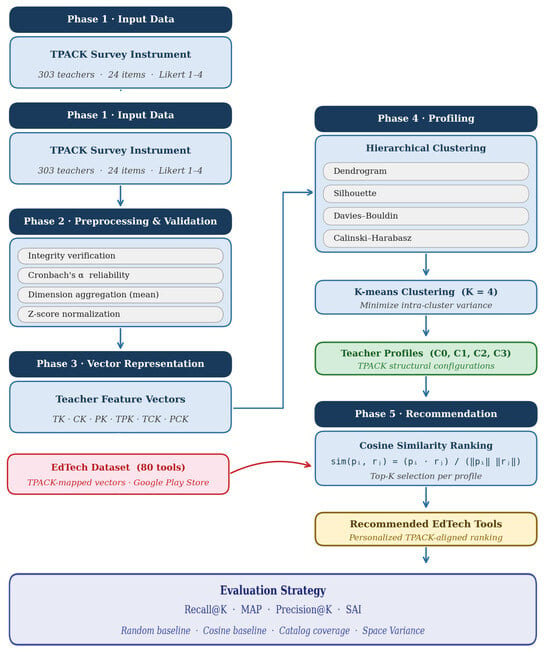
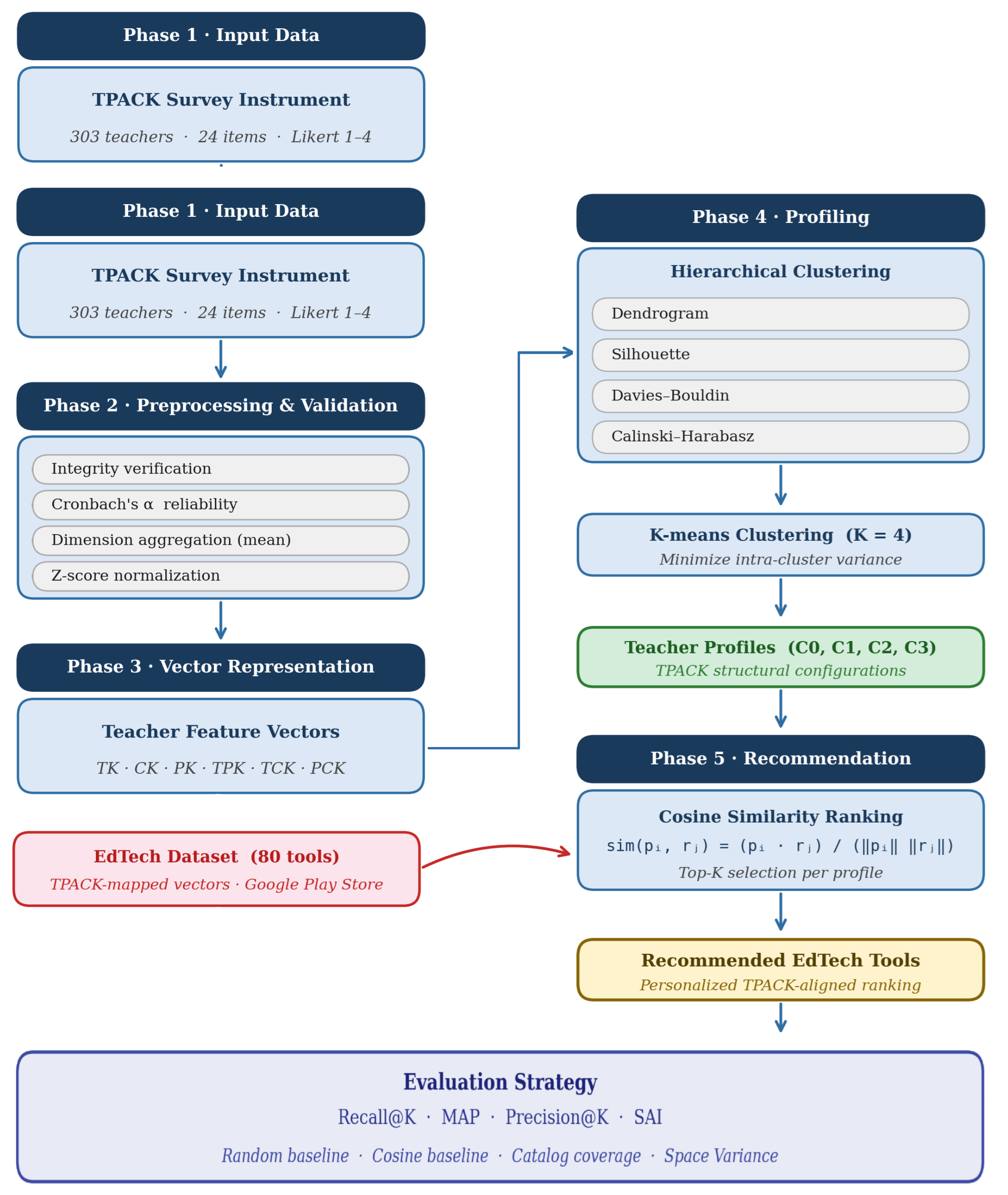
The research adopts a quantitative system-development and offline evaluation approach, focused on the construction and assessment of a personalized EdTech recommendation framework based on teacher TPACK profiles. The system-development component involved the creation of computational representations for teacher profiles and educational applications through clustering procedures and TPACK operationalization techniques. The offline evaluation component assessed recommendation behavior using expert-validated relevance annotations and internal ranking metrics, including Precision@K, Recall@K, and Mean Average Precision. Since no real interaction logs were available, recommendation performance was evaluated under controlled offline conditions using expert-defined relevance information. The system is structured as a computational pipeline that integrates stages of data processing, unsupervised learning, and similarity-based recommendation. Figure 1 presents the general architecture of the proposed system, a detailed description of which is developed in the following sections.
Figure 1.
Proposed architecture of the TPACK-based teacher profiling and recommendation system.
3.2. Participants and Data Collection
The teacher profiling process was developed using a sample of 303 secondary and higher education teachers. Participants were selected through non-probability, voluntary sampling, including active teachers involved in teaching processes. Data were collected during the 2025-02 academic period using a self-administered online questionnaire, ensuring participant anonymity and informed consent.
Teacher knowledge was measured using an adapted version of the TPACK instrument developed by Schmid et al. (2020), which conceptualizes teacher knowledge across six dimensions: TK, CK, PK, TPK, TCK, and PCK. The original instrument was adapted to align with the recommendation context and the computational representation required for teacher profiling. Items PK5, PK6, and PCK5 were incorporated to strengthen the coverage of pedagogical dimensions in technology integration contexts, while item TK4 was excluded due to conceptual redundancies with other items in the same dimension. Table 1 presents the complete structure of the adapted instrument, including item descriptions, sources, and adaptation status.
Table 1.
Structure of the adapted TPACK instrument used in this study.
Internal consistency was assessed through Cronbach’s alpha (Cronbach, 1951), while profile stability and recommendation validity were additionally evaluated through clustering validation metrics and expert-based annotation procedures.
where k represents the number of items on the scale, corresponds to the variance of each item, and represents the total variance of the sum of the items.
Internal consistency of the adapted instrument was initially assessed using Cronbach’s alpha. However, because internal consistency alone does not provide complete evidence regarding instrument suitability, additional validation procedures were incorporated. These complementary analyses included clustering validation metrics (Silhouette, Davies–Bouldin, Calinski–Harabasz), cluster stability analysis through the Adjusted Rand Index, and expert-based agreement procedures using ICC and Fleiss’ Kappa. Together, these analyses provided complementary evidence supporting the consistency and practical applicability of the proposed framework.
3.3. Data Processing and Feature Engineering
The representative variables for each dimension of the TPACK model were constructed by aggregating the items associated with each construct. Each dimension was represented by the average of its corresponding items, transforming individual responses into structured quantitative characteristics. This type of aggregation is common in the analysis of psychometric instruments, where composite scores allow for the operational representation of latent constructs for statistical and computational analysis (Pamuk et al., 2015). Equal weighting was applied to all items within each dimension, consistent with standard practice in TPACK instrument scoring, where no theoretical basis exists for assigning differential weights to individual items (Pamuk et al., 2015; Schmid et al., 2020). Formally, the value of each dimension was calculated as
where represents the aggregate score of the dimension d, corresponds to the number of items associated with that dimension, and represents the participant’s response to item i. This procedure allows each teacher to be represented as a feature vector within a multidimensional space, facilitating its analysis using machine learning techniques (Bishop & Nasrabadi, 2006).
The variables were standardized using Z-score normalization to ensure comparability between dimensions and prevent larger variables from dominating the similarity calculation. The transformation is defined as
where represents the original value of the variable, corresponds to the mean, and to the standard deviation. This type of normalization is widely used in machine learning and data analysis methods, especially in distance-based algorithms, as it allows all features to contribute equally to the analysis. This procedure generated a standardized representation of teacher knowledge suitable for the profiling and recommendation stages.
3.4. Teacher Profiling and Recommendation Model
Teacher profiling was performed using unsupervised learning techniques, which allow for the identification of latent structures in the data without requiring prior labeling (Jain, 2010). Each teacher was characterized using a vector derived from the dimensions of the TPACK model, placing them within a multidimensional knowledge space. From these representations, clustering algorithms were applied to identify groups of teachers with similar knowledge patterns. This approach follows established practices in educational data mining for identifying latent knowledge structures (Bishop & Nasrabadi, 2006).
In the first stage, hierarchical clustering was used as an exploratory technique to analyze the clustering structure without requiring a prior definition of the number of clusters. This method constructs a hierarchy of clusters based on the similarity between observations, allowing the visualization of relationships between data using dendrograms (Jain, 2010). The distance between two observations and is generally defined as
where and represent the feature vectors corresponding to two teachers within the dataset. This exploratory phase allowed us to identify initial clustering configurations and guide the selection of an appropriate partition.
To assess the quality of the clusters, internal validation metrics widely used in clustering were employed. In particular, the Silhouette coefficient was used (Rousseeuw, 1987), defined as
where represents the average distance between observation i and the elements of its same cluster, while corresponds to the minimum average distance between i and the elements of other clusters. Additionally, the Davies–Bouldin index was considered as a complementary measure of cluster separation and compactness (Davies & Bouldin, 1979). These metrics allow for the evaluation of cluster coherence and the selection of configurations that maximize separation between groups and minimize internal dispersion.
In the final profiling phase, the K-means algorithm was applied to obtain a defined partition of the dataset. This algorithm seeks to minimize the internal variability of the clusters by optimizing the sum of the squared distances between observations and their centroids (MacQueen, 1967). The algorithm’s objective function is defined as
where represents the set of observations of cluster k, is the feature vector of observation i, and corresponds to the centroid of the cluster. This algorithm is widely used in data analysis due to its efficiency and ability to identify compact structures in multidimensional spaces (Jain, 2010).
The number of clusters K was determined through analysis of the Silhouette coefficient and the Davies–Bouldin index. Since these metrics did not yield a conclusive result, the dendrogram from hierarchical clustering was also analyzed. This process yielded differentiated teacher profiles that represent structural configurations of teacher knowledge.
The identified profiles formed the basis of the recommendation model, which links teacher characteristics with available technological resources. To achieve this, a dataset of technological resources was generated, and its characteristics were mapped onto the dimensions of the TPACK model, thereby enabling its integration into this representational space. This type of modeling is common in recommendation systems, where correspondences are established between users and resources based on structured representations (Adomavicius & Tuzhilin, 2005).
EdTech–TPACK Mapping Procedure
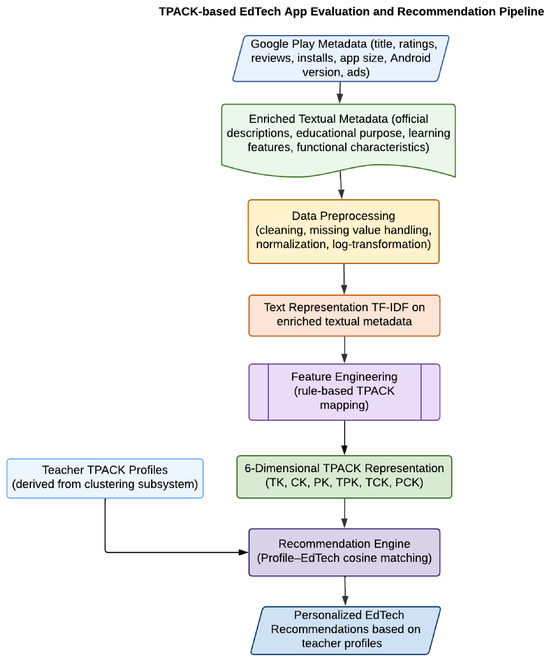
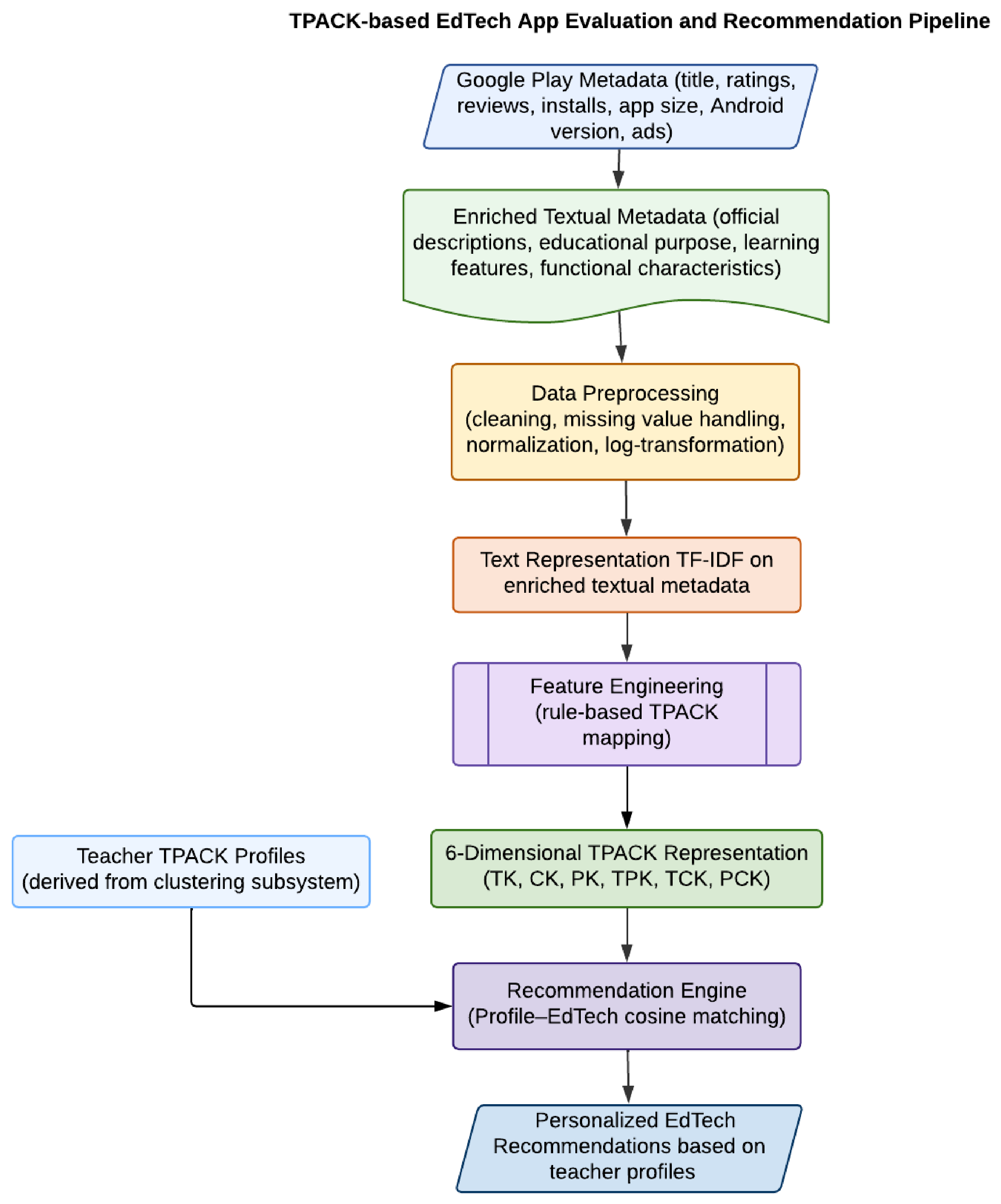
The proposed framework transforms educational application metadata into a structured TPACK representation to support personalized recommendation generation. Figure 2 presents the general architecture of the proposed EdTech–TPACK pipeline, comprising seven sequential stages: Google Play metadata extraction, enriched textual metadata integration, data preprocessing, TF–IDF text representation, rule-based feature engineering for TPACK mapping, construction of the six-dimensional TPACK representation (TK, CK, PK, TPK, TCK, PCK), and personalized recommendation generation through cosine matching between teacher profiles derived from the clustering subsystem and EdTech applications.
Figure 2.
TPACK-based EdTech App Evaluation and Recommendation Pipeline.
Application metadata were extracted using the google-play-scraper library (Jo, 2021), which provides programmatic access to official Google Play information, including title, ratings, reviews, installation counts, application size, Android compatibility, and advertising indicators. To enrich the semantic representation, official application descriptions and functional characteristics were additionally incorporated, including educational purposes, learning functionalities, and descriptive information available in application profiles. The collected information underwent preprocessing through data cleaning, missing-value handling, normalization, and logarithmic transformation. Since variables such as installation counts and review counts exhibit highly skewed distributions, logarithmic scaling was applied to reduce variance and improve comparability among applications. Textual representations were generated using TF–IDF vectorization applied to the enriched textual metadata, transforming educational descriptions into quantifiable semantic representations. Subsequently, a rule-based feature engineering procedure was employed to operationalize the six dimensions of the TPACK framework: Technological Knowledge (TK), Content Knowledge (CK), Pedagogical Knowledge (PK), Technological Pedagogical Knowledge (TPK), Technological Content Knowledge (TCK), and Pedagogical Content Knowledge (PCK). Table 2 defines the explicit operationalization rules used to map application metadata into each TPACK dimension, providing methodological transparency to the representation process.
Table 2.
Rule-based rubric for EdTech–TPACK operationalization.
The operationalization of TPACK dimensions was performed through normalized indicators derived from the available metadata. The base dimensions TK, CK, and PK were operationalized from direct indicators extracted from each application’s metadata, while the intersectional dimensions TPK, TCK, and PCK were computed as combinations of the base dimensions, following the TPACK framework conceptualization that defines these dimensions as the integration of fundamental knowledge domains (Mishra & Koehler, 2006). It should be noted that the indicators employed in this operationalization—such as ratings, engagement indicators, advertisement penalties, update recency, and application size—constitute metadata-derived proxy indicators rather than direct measures of pedagogical quality. These features serve as functional approximations within the TPACK representational space, and their interpretation should be understood accordingly.
The six-dimensional TPACK representation of each application is therefore defined as , constituting the feature space used for recommendation generation. Personalized recommendations were generated through cosine similarity between teacher TPACK profiles and EdTech application TPACK vectors, defined as
where represents the vector of the teacher profile and the technological resource vector. For each teacher profile, similarity was computed with respect to each application in the catalog, and a Top-K selection mechanism was applied to identify the most relevant resources and generate personalized recommendations aligned with the teacher’s pedagogical characteristics.
3.5. Evaluation System
The evaluation of the proposed system was designed considering multiple dimensions related to the quality, consistency, and generalizability of the recommendations. This strategy incorporates metrics of accuracy and structural alignment to evaluate both the precision of the recommendations and their alignment with user characteristics, since both aspects directly influence the system’s usefulness in real-world scenarios (Adomavicius & Tuzhilin, 2005). In this regard, the adopted strategy integrates standard ranking metrics along with additional indicators focused on analyzing the system’s overall performance.
To provide a pedagogically meaningful relevance reference for offline evaluation, an expert-based annotation protocol was implemented, following established practices in offline evaluation of recommendation systems when real interaction data are unavailable (Zangerle & Bauer, 2023). A panel of three evaluators independently assessed the relevance of the EdTech tools for each of the four identified teacher profiles (C0, C1, C2, and C3), using a five-point Likert scale (1 = not relevant, 5 = highly relevant). The instrument was organized into five sections: the first collected general information about the participants; sections two through five presented the 30 tools grouped by profile. The 30 tools represented six functional categories: general learning platforms, online courses and professional development, language learning, LMS and classroom support, STEM education, and academic support. Inter-rater agreement was quantified using Fleiss’ Kappa and the Intraclass Correlation Coefficient (ICC). Ratings were binarized using a predefined threshold (≥4.0), classifying each tool as relevant or not relevant for each profile, thus constituting the reference ground truth.
Since relevance evaluations were conducted at the profile level, annotations were propagated to individual teachers according to their cluster assignment. Each teacher inherited the relevance set corresponding to the profile assigned during the clustering stage. This procedure is consistent with the architecture of the proposed system, in which recommendations are generated from aggregated teacher knowledge representations and subsequently applied at the individual level. In this way, the offline evaluation operates over the 303 teachers individually, preserving the correspondence between the model structure and the evaluation process.
The system’s ability to retrieve and prioritize relevant resources was evaluated using metrics widely used in recommendation systems. Recall@K was used to measure the proportion of relevant items retrieved within the first K ranking positions, defined as
where represents the set of relevant resources and the set of K recommended resources. Additionally, the MAP metric was used to evaluate the overall quality of the ordering of relevant resources within the generated ranking, considering the relative position of the relevant elements (Zangerle & Bauer, 2023). The Structural Alignment Index (SAI) was used as an internal alignment indicator to assess the degree of correspondence between teacher TPACK profiles and the TPACK representation of recommended applications. Because both the recommendation mechanism and the alignment computation operate within the same TPACK feature space, this metric should not be interpreted as independent evidence of recommendation effectiveness, but rather as an internal consistency indicator describing how closely recommended resources match the theoretical structure of teacher profiles. The SAI is defined as
where represents the vector of the teacher profile and the vector of the technological resource.
To analyze the system’s robustness, additional metrics related to its overall behavior were incorporated. Ranking stability (Ranking Stability Coefficient, RSC) was assessed by measuring the average variation in the position of recommended items in response to controlled disturbances in the input profiles. Catalog coverage was defined as the proportion of unique recommended resources relative to the total number of available resources:
Additionally, the dispersion of the TPACK space of the recommended resources was analyzed using the variance in the feature space, with the purpose of evaluating the structural diversity of the generated recommendations:
Two baseline models were implemented: one based on direct cosine similarity, which generates recommendations without structural profiling processes, and a random baseline as a lower reference. The performance of the proposed model was compared with both approaches by measuring the relative improvement in terms of the Precision@K metric, defined as
The direct cosine similarity baseline was implemented using the same TPACK feature space employed by the proposed system. Unlike the profile-based approach, the baseline computed similarity directly between individual teacher vectors and EdTech tool representations, without profile abstraction. To ensure fair comparison, teacher-level relevance sets were generated by propagating profile-level expert annotations to all teachers belonging to the corresponding cluster, ensuring that both models were evaluated under the same granularity conditions. This design ensured that performance differences originated from the recommendation mechanism rather than from differences in annotation granularity.
3.6. Proposed System
The proposed system aims to identify structural profiles of teacher knowledge and generate personalized EdTech tool recommendations based on these profiles. The system integrates three main components: measurement of teacher knowledge using the TPACK model, unsupervised learning techniques for teacher profiling (Bishop & Nasrabadi, 2006; Jain, 2010), and a similarity-based recommendation mechanism for selecting technological resources (Adomavicius & Tuzhilin, 2005). The overall system architecture is presented in Figure 1, which illustrates the complete flow from data acquisition to recommendation generation.
The system is implemented as an analytical pipeline that transforms data derived from the TPACK instrument into personalized technology recommendations. The process begins with the acquisition of data from the questionnaire administered to teachers, from which vector representations of teacher knowledge are constructed. These representations undergo cleaning, normalization, and psychometric validation procedures to ensure the quality and comparability of the variables before computational analysis (Pamuk et al., 2015). Unsupervised learning techniques are then applied to these representations to identify structural profiles of teacher knowledge. These profiles serve as the basis for a cosine similarity-based recommendation mechanism that generates a ranking of EdTech tools aligned with the pedagogical characteristics of each teacher profile.
4. Results
4.1. Instrument Reliability, Data Quality and Descriptive Statistics
The results presented in this section correspond to the validation of the measurement instrument and the descriptive analysis of the teacher dataset, both of which constitute the empirical basis of the proposed system. The integrity verification confirmed that all responses corresponded to valid values within the range defined for the Likert scale used (1–4), with no missing values, incomplete records, or outliers. This validation process was carried out systematically on all collected records, examining both the completeness of the responses and the consistency of the values recorded for each item of the instrument. No record presented inconsistencies that could compromise the quality of the subsequent analysis; therefore, the dataset retained all the original observations.
The results of the internal consistency analysis show adequate levels of reliability across all dimensions of the model. The TK dimension registered an value of 0.712, indicating an acceptable level of consistency among its items, while CK obtained , demonstrating high internal consistency. The PK and PCK dimensions reached the highest values with , reflecting high coherence among the items that comprise these constructs. TCK obtained , and TPK registered , both within ranges considered adequate for psychometric instruments of this type. These values support the use of these dimensions as representative variables of teacher knowledge in subsequent analyses.
The descriptive statistics for the six dimensions are presented in Table 3. The means for all dimensions ranged from 2.548 to 2.655, reflecting moderate levels of self-perceived teacher knowledge among the participants. The TK dimension had the highest mean (, ), followed by PK (, ) and PCK (, ). The CK dimension had the lowest mean (, ), although the differences between dimensions were small, suggesting a homogeneous distribution of teacher perceptions in the model.
Table 3.
Descriptive statistics of the dimensions of the TPACK model.
Analysis of data distribution reveals moderate dispersion across all dimensions. The 25th percentile ranges from 2.0 to 2.333, indicating that a quarter of the teachers report low levels on the scale. Medians range from 2.500 to 2.800, reflecting a central tendency close to the midpoint of the scale. The 75th percentile reaches 3.0 in all dimensions, suggesting that a quarter of the participants report relatively high levels of perceived teacher knowledge. Maximum values reach 4.0 in most dimensions, except for PCK (3.800) and TCK (3.500), indicating that these dimensions have a slightly lower ceiling in the analyzed sample.
The observed distribution suggests that the sample exhibits sufficient structural variability to support subsequent clustering analysis. The absence of extreme concentrations in response values and the comparable dispersion across dimensions indicate that the participating teachers represent a broad spectrum of TPACK knowledge configurations, a necessary condition for the clustering process to identify structurally differentiated profiles.
4.2. Teacher Profile Identification
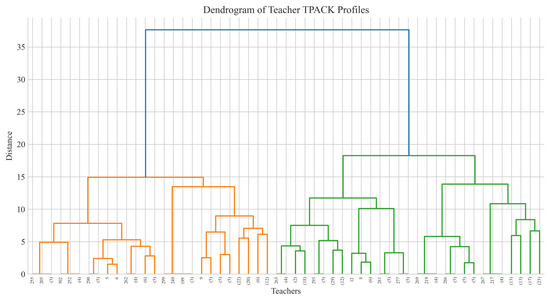
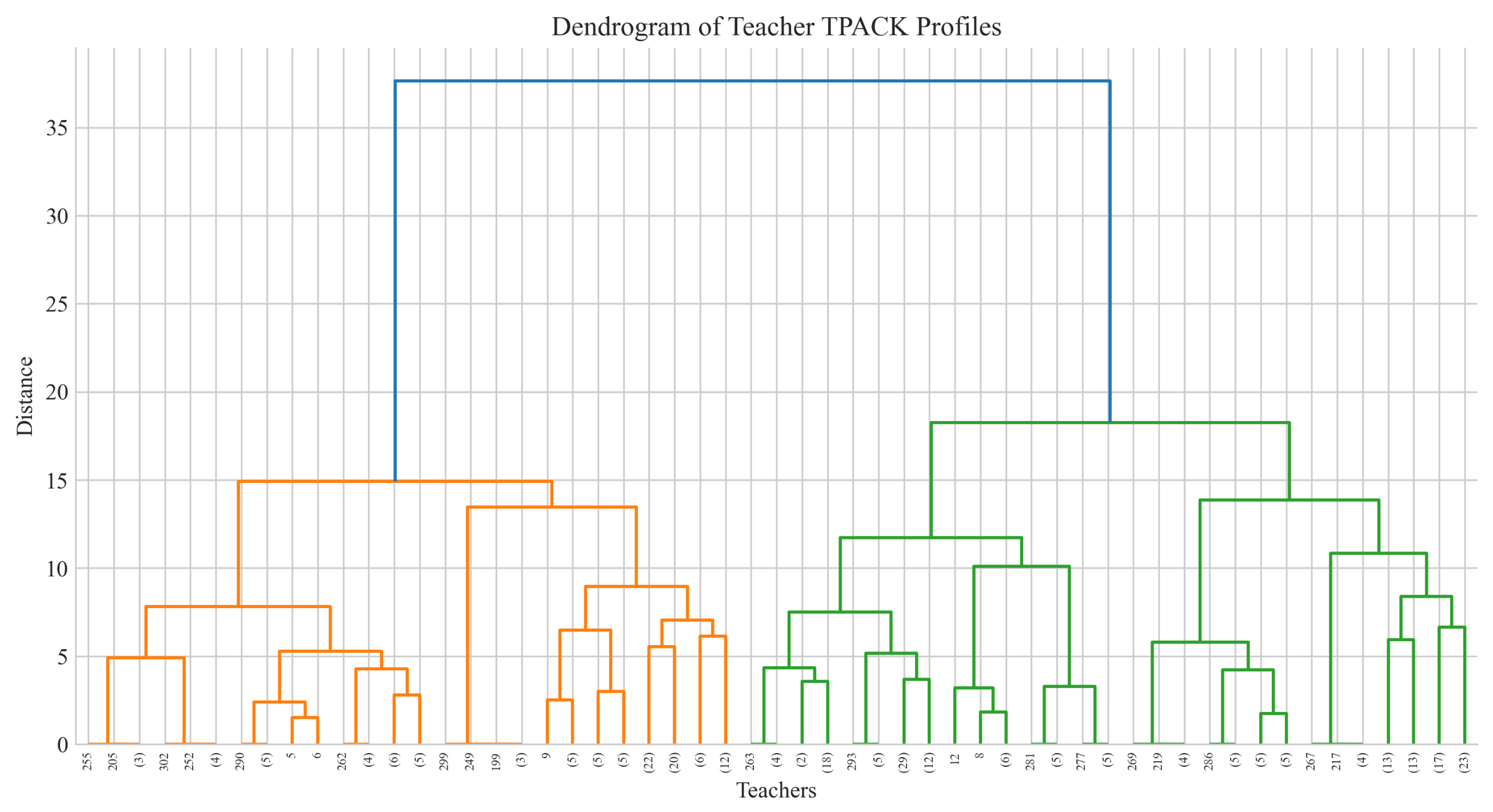
The hierarchical analysis of the multidimensional space defined by the TPACK dimensions allowed for the exploration of the clustering structure of the teacher dataset. Figure 3 presents the resulting dendrogram, which visualizes the relative proximity between teachers based on their knowledge configurations in the feature space, allowing for the identification of similarity levels between observations and the detection of clustering structures without imposing prior restrictions on the dataset’s structure.
Figure 3.
Dendrogram of hierarchical grouping of TPACK teacher profiles.
The dendrogram reveals the formation of two main macro-groups, evidenced by a clear separation at the upper levels of the hierarchy, with an approximate merging distance of 37. This initial partitioning differentiates teachers with relatively elevated levels of TPACK knowledge integration from those with more limited levels of articulation between their technological, pedagogical, and disciplinary dimensions. Each macro-group contains internal subdivisions that merge at smaller distances, indicating that the dataset does not present a homogeneous structure but rather multiple differentiated configurations of teacher knowledge. The presence of these differences in merging heights suggests that the variability among teachers is not reducible to a binary distinction but rather reflects a continuum of pedagogical and technological configurations within the analyzed sample.
Detailed analysis of the dendrogram reveals four well-defined clusters before the final merging of the main branches, each grouping teachers with similar patterns across the TPACK dimensions. This structure indicates that a segmentation based solely on two groups would be too general to represent the diversity of configurations present in the dataset. Identifying four clusters allows for a more accurate capture of the observed variations among teacher profiles, balancing the granularity of the segmentation with the interpretability of the resulting groups. This finding guided the selection of the K value in the partitioning clustering stage, establishing an empirical reference for subsequent quantitative evaluation.
To quantitatively evaluate these configurations, different K values were analyzed using internal validation metrics, the results of which are presented in Table 4. The K value of 2 obtained the highest Silhouette Score (0.363) and the highest Calinski–Harabasz index (192.252), with the lowest Davies–Bouldin index (1.103), indicating a strong overall separation between the two large groups. However, this solution only captures the most general division of the dataset and does not represent the internal subdivision observed in the dendrogram, which limits its ability to describe the diversity of teacher knowledge configurations present in the sample.
Table 4.
Clustering validation metrics for different values of K (Ward method).
To complement internal validation metrics, a cluster stability analysis was performed through repeated resampling procedures. Multiple bootstrap samples were generated and clustering consistency was quantified using the Adjusted Rand Index (ARI). The results are presented in Table 5.
Table 5.
Cluster stability analysis using the Adjusted Rand Index (ARI) across bootstrap samples.
As expected, exhibited the highest stability (ARI = 1.000, SD = 0.000), given that it represents a very coarse partition separating broad teacher groups. produced acceptable stability values (ARI = 0.699, SD = 0.145), maintaining reasonable consistency while preserving a richer internal structure and pedagogically interpretable profile distinctions. For higher values of K, stability does not show substantial improvements, reinforcing that increasing the number of clusters does not contribute greater structural coherence.
The selection of K = 4 for the final segmentation of teacher profiles was not based on statistical superiority over K = 2, but rather on a theoretically interpretable and pedagogically useful compromise. Although K = 2 achieved the strongest internal validation metrics and perfect cluster stability (ARI = 1.000), inspection of the hierarchical dendrogram showed that this solution represented only the broadest separation of the teacher population into two macro-groups. A second hierarchical level revealed a clear subdivision of these groups into four coherent substructures.
The solution aligned with this natural hierarchical organization, preserving additional heterogeneity in teacher knowledge configurations while maintaining acceptable stability (ARI = 0.699). Furthermore, the four identified profiles correspond to theoretically meaningful configurations within the TPACK framework: a profile with high integration across all dimensions (C0), a profile with incipient development across all dimensions (C1), a technologically oriented profile (C2), and a pedagogically oriented profile (C3), reflecting the differentiated combinations of technological, pedagogical, and content knowledge described in the literature (Mishra & Koehler, 2006). In contrast, produced an intermediate partition that did not fully follow the observed hierarchical structure and offered less conceptual interpretability for profile construction. Therefore, was selected not because it maximized a single clustering metric, but because it balanced statistical quality, stability, hierarchical structure, and pedagogical usefulness for recommendation purposes.
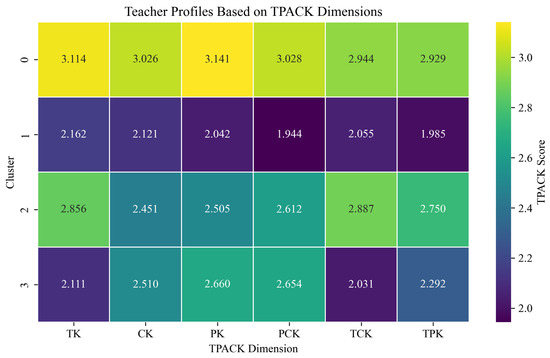
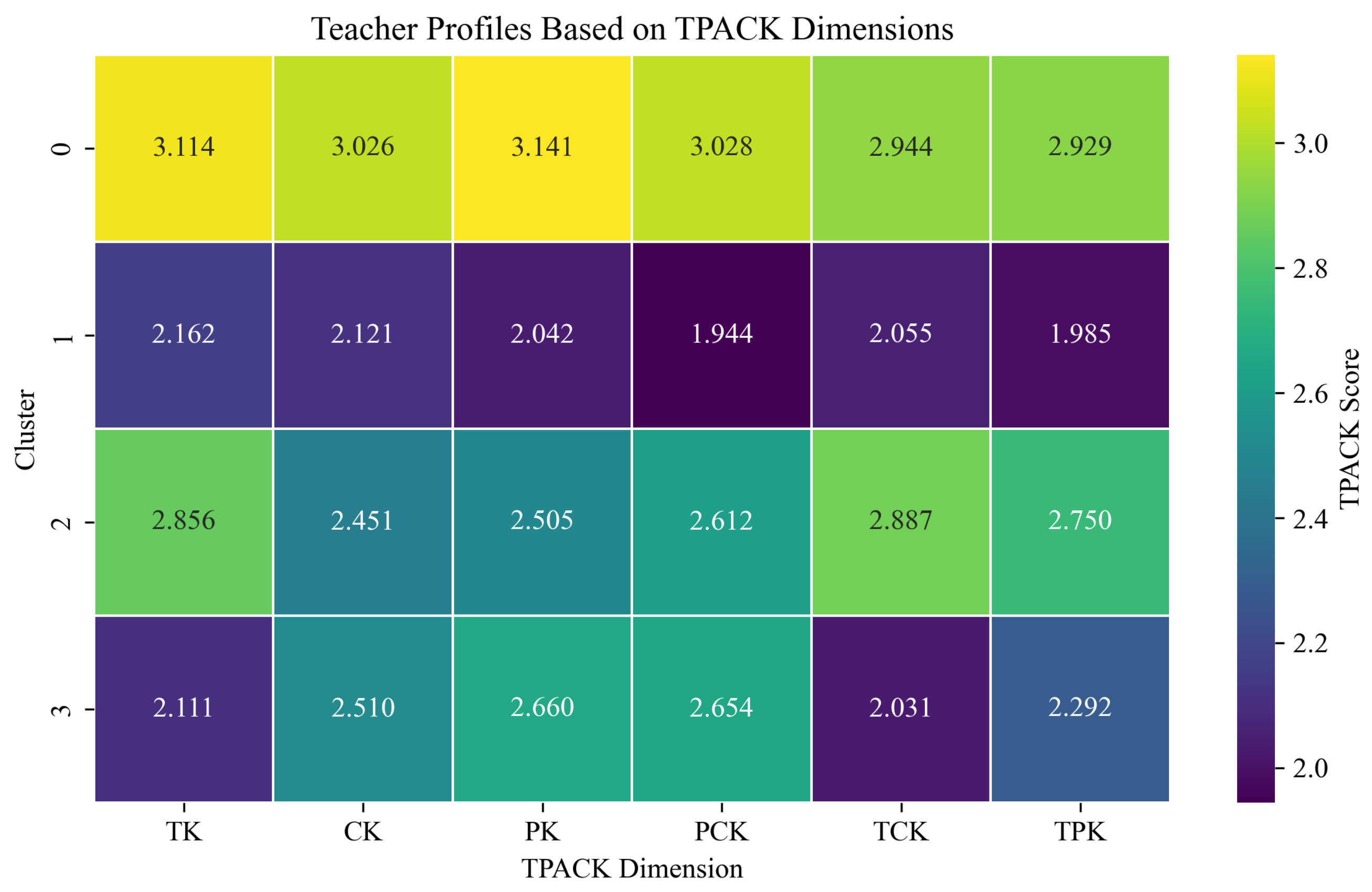
Figure 4 presents the heat map of the centroid values of each cluster across the six TPACK dimensions, facilitating comparison between profiles. Cluster C0 exhibits the highest values in all dimensions, with scores above 2.9 in TK (3.114), PK (3.141), and CK (3.028), characterizing it as a profile with high integration of the TPACK model. Cluster C1 exhibits the lowest values in all dimensions, with scores below 2.2 in all constructs, corresponding to a profile with reduced levels of integration between technology, pedagogy, and subject-matter content. The distance between these two extreme clusters demonstrates that the sample encompasses a wide range of teacher knowledge configurations, from highly integrated profiles to profiles with incipient development in all dimensions of the model.
Figure 4.
Heat map of centroid values per cluster in the dimensions of the TPACK model.
Cluster C2 shows intermediate values with a more pronounced technological orientation, evidenced by high scores in TK (2.856), TCK (2.887), and TPK (2.750), suggesting teachers with greater proficiency in integrating digital tools into their pedagogical practices. Cluster C3 presents a differentiated pedagogical orientation, with high scores in PK (2.660) and PCK (2.654) in contrast to lower scores in TK (2.111) and TCK (2.031), reflecting a profile with strengths in pedagogical strategies but less technological integration. These four structurally distinct profiles form the basis of the recommendation model, since each identified configuration of teacher knowledge guides the selection of EdTech tools aligned with their specific pedagogical and technological characteristics.
4.3. EdTech Dataset Analysis
The EdTech tools dataset used by the recommendation system was built from a public dataset that compiles statistics on educational applications available on the Google Play Store (Sharma, 2023). Eighty educational tools were selected from this repository, each characterized by six variables corresponding to the TK, CK, PK, TPK, TCK, and PCK dimensions of the TPACK model. This representation allows the EdTech tools to be integrated within the same feature space used for teacher profiling, enabling the calculation of similarity between both types of entities.
Table 6 presents a set of representative records from the final dataset. Each row corresponds to an individual EdTech tool, and each column reflects the relative degree to which that tool is associated with a specific dimension of the TPACK model. The observed values show that educational tools exhibit heterogeneous configurations within the feature space, indicating that the applications are not uniformly distributed in terms of their pedagogical and technological properties. This variability is particularly relevant to the recommendation system, as it enables the identification of tools with distinct functional profiles that can address diverse types of teaching needs. The complete feature matrix for all 80 EdTech tools, including scores across all six TPACK dimensions, is provided as Supplementary Material (Table S1).
Table 6.
Representative sample of the EdTech dataset with scores per TPACK dimension.
The differences in feature vectors demonstrate that EdTech tools exhibit heterogeneous functional configurations within the constructed representation space, covering a broad spectrum of pedagogical and technological orientations across dimensions such as PK and TPK. This structural diversity allows the recommendation system to identify tools that precisely match the different teacher profiles identified through the clustering process, establishing the necessary correspondence between teacher knowledge configurations and the pedagogical and technological characteristics of the available educational resources.
4.4. Recommendation Performance
The performance of the recommendation system was evaluated using a set of metrics that examine both the structural alignment between teacher profiles and EdTech tools and the model’s ability to retrieve and prioritize relevant resources within the generated ranking. Expert-based relevance annotations provided a structured offline evaluation reference for comparing recommendation approaches. The results are organized into three levels of analysis: structural alignment using the SAI, ranking accuracy using Recall@K and MAP, and comparison with baseline models using Precision@K. Results should be interpreted as performance under expert-defined relevance conditions.
Expert ground truth validation yielded a Fleiss’ Kappa of , indicating substantial agreement among evaluators (Landis & Koch, 1977). Intraclass correlation coefficients confirmed high absolute consistency: ICC(1, 1) = 0.866 (95% CI [0.82, 0.90], , ) and ICC(1, k) = 0.951 (95% CI [0.93, 0.96]). Of the 120 profile–tool combinations evaluated, 77 were classified as relevant (64.2%) and 43 as not relevant (35.8%), with 21 relevant tools for C0, 14 for C1, 23 for C2, and 19 for C3.
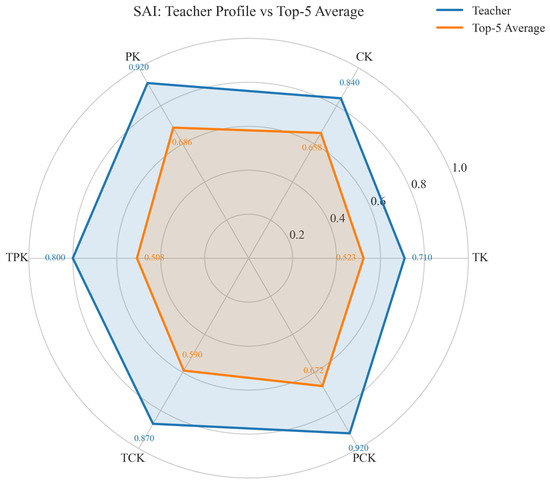
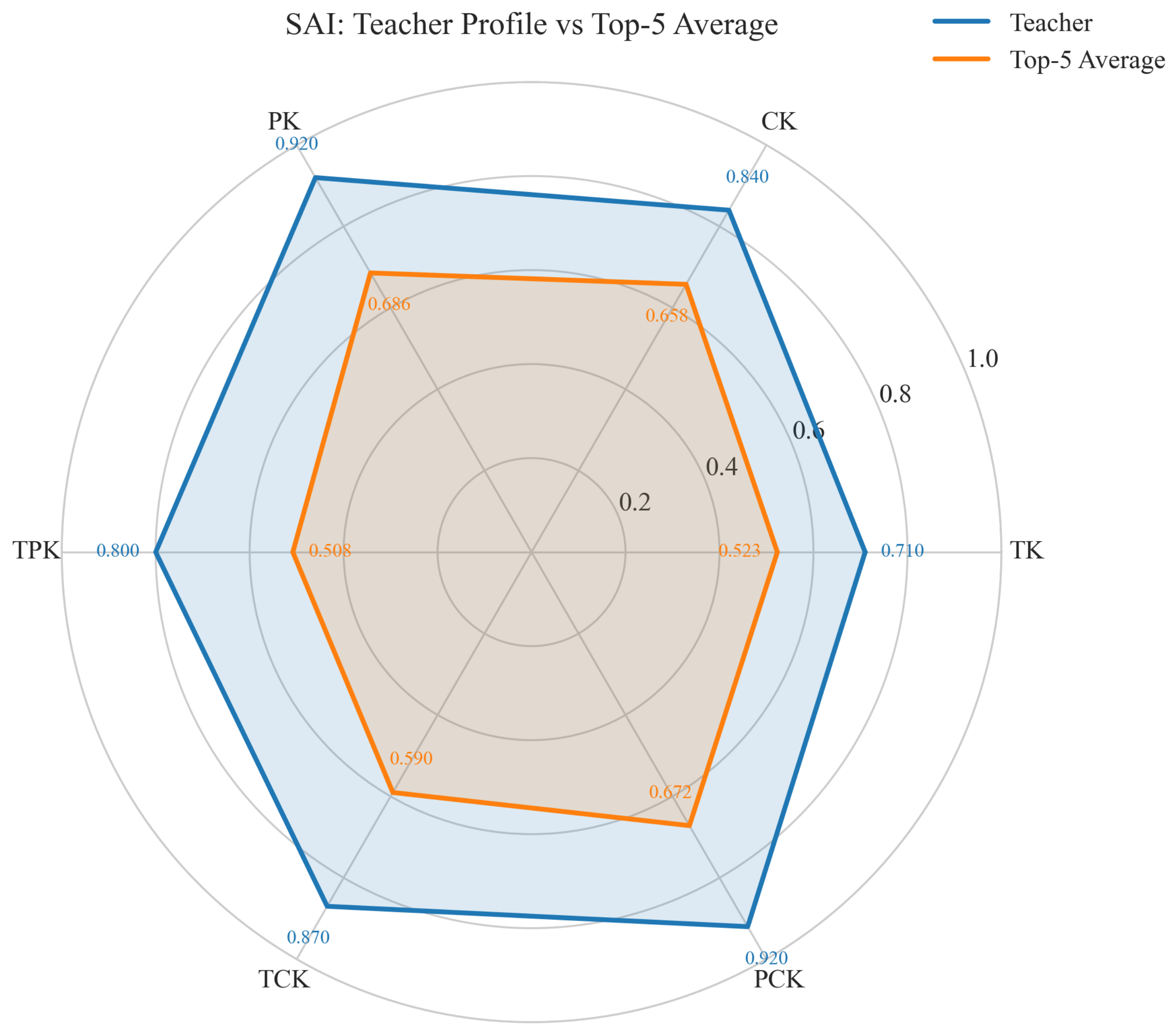
The Structural Alignment Index (SAI) was computed as an internal consistency indicator to assess the degree of correspondence between teacher TPACK profiles and the TPACK representation of recommended applications. The SAI value obtained was 0.998, indicating strong internal alignment between teacher profiles and recommended educational tools within the shared TPACK feature space. Figure 5 illustrates this relationship using a radar chart that compares the TPACK profile of a representative teacher with the average of the five tools recommended by the system. The observed pattern shows that the PK and CK dimensions have the highest values in the teacher profile, a pattern that is consistently reproduced in the average of the recommended tools. The TK and TCK dimensions show intermediate levels in both profiles, while TPK has the lowest value for both the teacher and the suggested tools, demonstrating that the system preserves the relative proportions between dimensions when generating recommendations.
Figure 5.
Comparison of the TPACK profile of a representative teacher with the average of the five recommended EdTech tools (SAI = 0.998).
The results for Recall@K and MAP show values of Recall@3 = 0.455, Recall@5 = 0.638, and Recall@10 = 0.805, while MAP reaches 0.777. The Recall@10 value indicates that the system retrieves more than 80% of the relevant resources within the top ten recommendations under the evaluated conditions. The MAP value reflects that relevant resources not only appear within the ranking but also tend to be positioned higher, indicating that the model maintains a consistent ordering of the most suitable resources for each teacher profile.
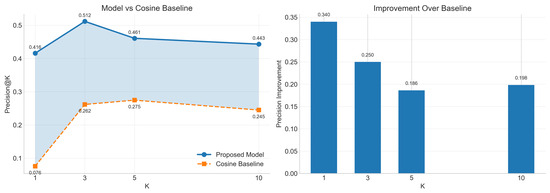
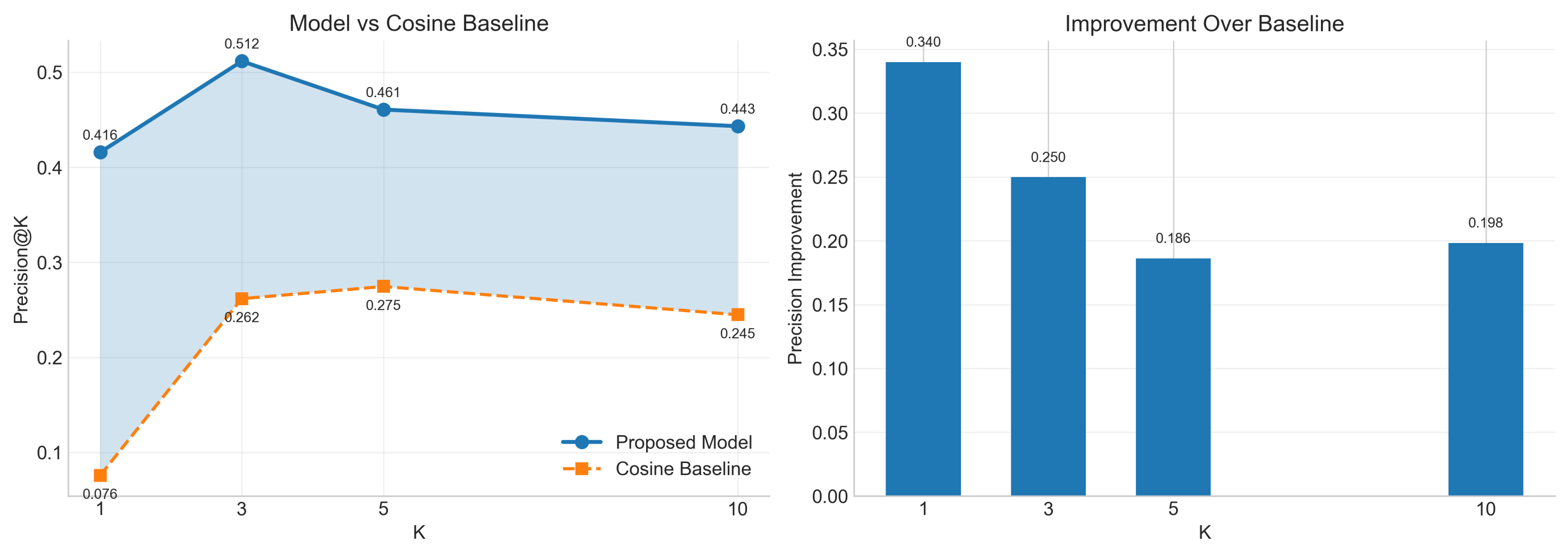
Figure 6 presents the comparison between the proposed model and the cosine baseline using Precision@K, along with the relative improvement across values of K. The proposed model outperforms the cosine baseline at all evaluated values, with Precision@K values between 0.416 and 0.512 compared to cosine baseline values between 0.076 and 0.275. The relative improvement reaches its maximum at with Improvement@1 = 0.340, followed by with 0.250, with 0.198, and with 0.186. These results suggest that the clustering profiling process contributes to the system’s performance under expert-defined relevance conditions, with consistent improvements over direct cosine similarity without prior structural profiling across all evaluated K values.
Figure 6.
Comparison of Precision@K between the proposed model and the cosine baseline, and Improvement@K of the proposed model over the cosine baseline.
4.5. Recommendation Behavior Analysis
The analysis of the system’s overall behavior examines indicators that complement the ranking’s accuracy metrics. These indicators are designed to assess model stability, the exploration of the educational tool catalog, and the structural dispersion of the TPACK feature space. They allow for an examination of the consistency of the recommendations generated across different teacher profiles and the structural variability of the dataset used by the model.
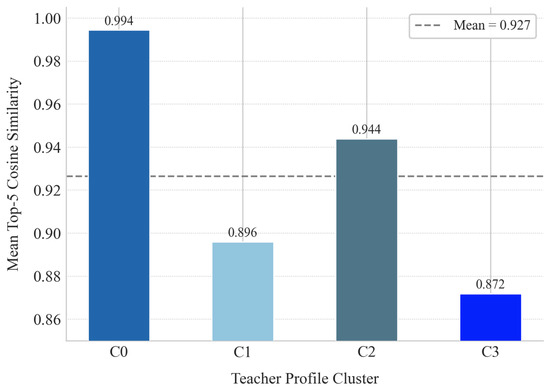
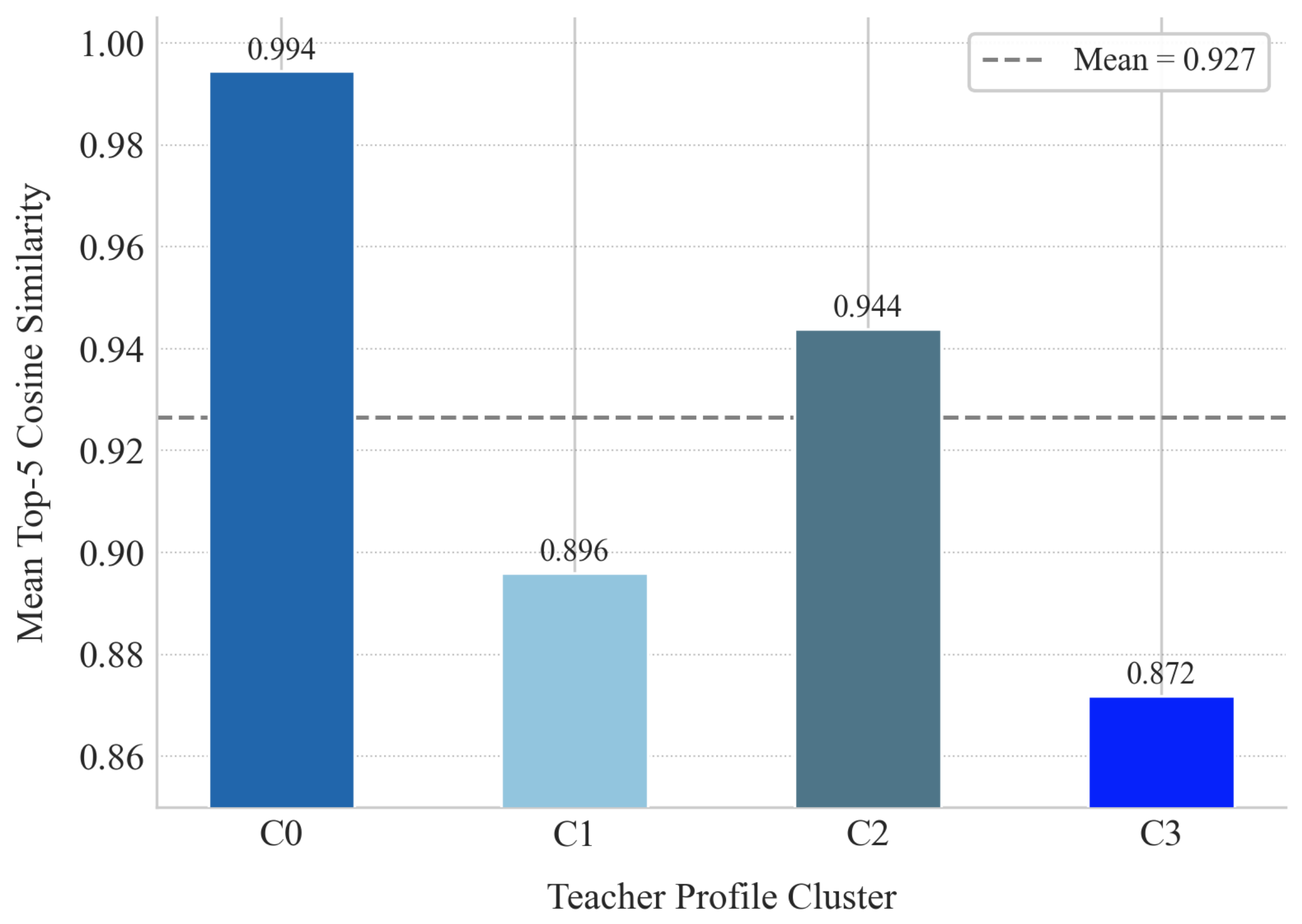
System stability was assessed using Top-5 similarity scores calculated on the four centroids of identified teacher profiles. The results show an average similarity value of 0.927, with variations among profiles reflecting differences in the knowledge structure of each cluster. Cluster C0, corresponding to the high-integration TPACK profile, obtained the highest similarity (0.994), while C3 registered the lowest value (0.872), followed by C1 (0.896) and C2 (0.944). This pattern indicates that the system generates recommendations with greater structural accuracy for profiles with more developed knowledge configurations, a behavior consistent with the distribution of the TPACK feature space.
The catalog coverage shows that 37% of the 80 available applications were recommended at least once during the evaluation process, corresponding to approximately 30 different tools. This result indicates that the model does not concentrate its recommendations on a small subset of resources but rather explores a relevant portion of the available catalog. Moderate coverage is desirable in educational recommendation systems, as it allows for a balance between the relevance of the recommendations and the diversity of suggested tools, avoiding the recurring recommendation of a limited set of resources.
Figure 7 presents the average Top-5 similarity by teaching cluster. C0 notably exceeds the system average (0.927), demonstrating that profiles with high TPACK integration receive structurally more aligned recommendations. C2 is slightly above the average at 0.944, while C1 and C3 are below, with values of 0.896 and 0.872, respectively. This variability between clusters suggests that the system’s ability to generate accurate recommendations is partially conditioned by the level of TPACK integration of the evaluated teaching profile.
Figure 7.
Top-5 average cosine similarity by teaching cluster, evaluated on the centroids of the four identified profiles. The dashed line indicates the overall mean (0.927).
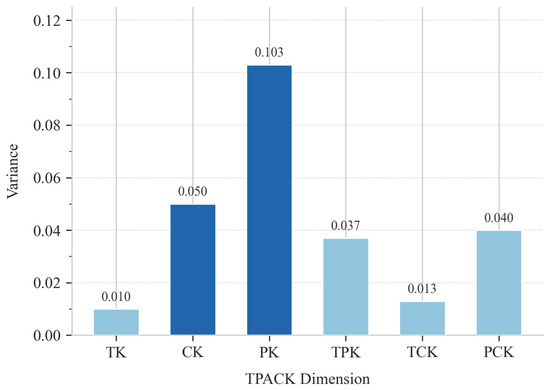
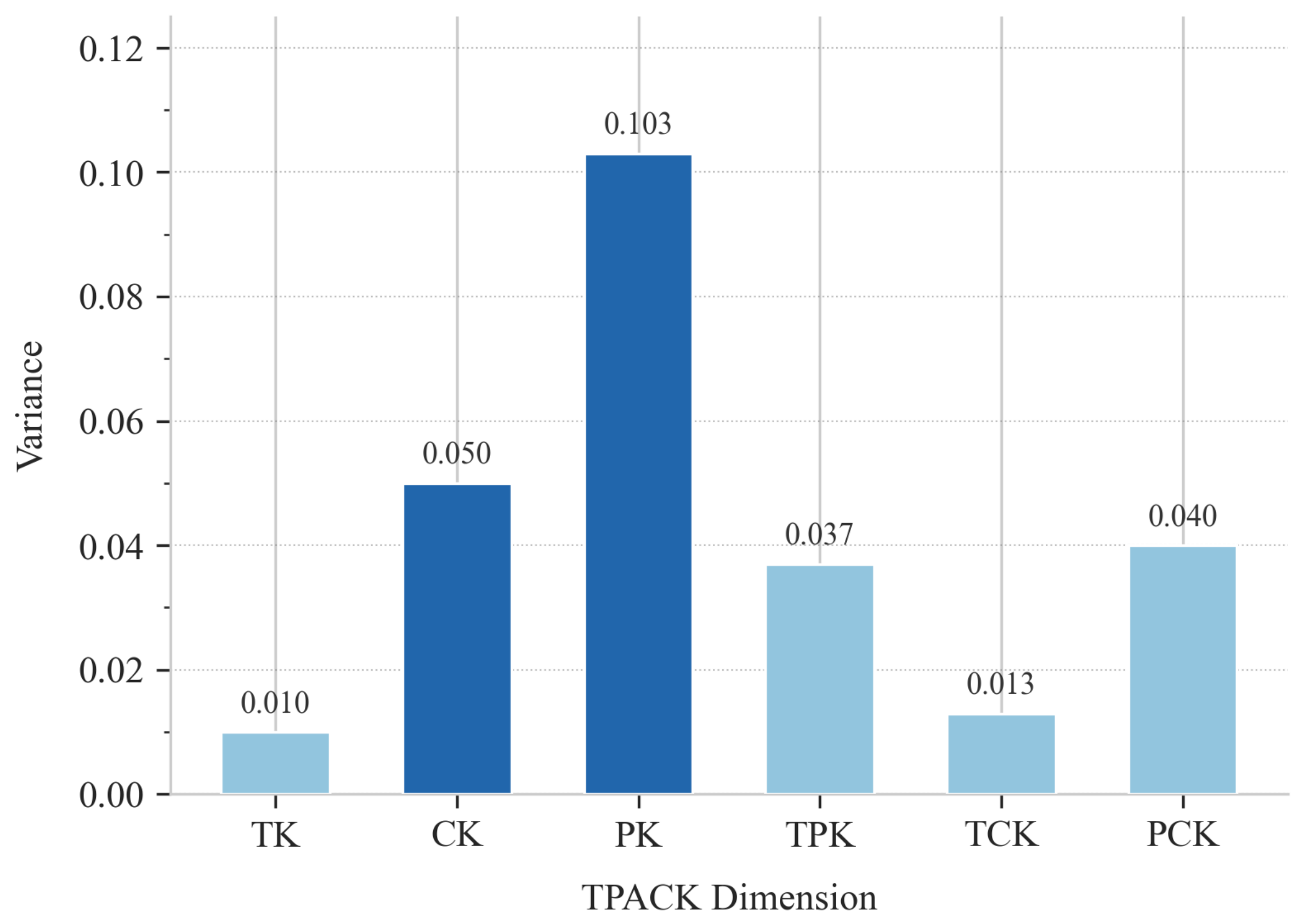
The dispersion of the feature space was analyzed using the variance values for each dimension, presented in Figure 8. The PK dimension exhibits the highest level of variability (variance = 0.103), indicating that pedagogical differences between tools constitute the main differentiating factor within the EdTech catalog. The TK and TCK dimensions show lower variance levels, reflecting less dispersion in the technological characteristics of the catalog. The aggregate measure, Global Space Variance, reached a value of 0.042, suggesting that the structural variability of the dataset remains within a moderate range that allows for the identification of consistent correspondences between teacher profiles and EdTech tools without compromising the discriminative capacity of the model.
Figure 8.
Variance per TPACK dimension in the feature space of the EdTech dataset.
5. Discussion
The results of the clustering process reveal the existence of four structurally distinct teacher profiles within the knowledge space defined by the TPACK model, suggesting that teachers’ technological, pedagogical, and subject-matter knowledge is not homogeneously distributed but rather organized into latent configurations with specific integration patterns. Cluster C0 presents the highest values in all dimensions, especially in TK (3.114), PK (3.141), and CK (3.028), characterizing a teacher profile with high integration of subject-matter, pedagogical, and technological knowledge. This type of configuration reflects a consolidated capacity to incorporate digital technologies into pedagogical strategies consistent with learning objectives, a characteristic identified in the literature as a key indicator of effective technological integration (Chai et al., 2013; Mishra & Koehler, 2006).
Cluster C1 groups teachers with the lowest scores across all dimensions, below 2.2, suggesting profiles in the initial stages of TPACK competency development or with sporadic use of digital tools in their teaching processes. The intermediate clusters present specific configurations of teacher knowledge that reflect differentiated orientations. C2 shows high values in TK (2.856), TCK (2.887), and TPK (2.750), suggesting a profile with greater proficiency in integrating digital tools into the teaching process of the subject matter. C3 shows higher values in PK (2.660) and PCK (2.654) with less development in the technological dimensions, reflecting a stronger pedagogical orientation in the design of teaching strategies related to the subject matter. These results are consistent with the use of unsupervised learning techniques as a useful strategy for identifying structural patterns in multidimensional educational data (Bishop & Nasrabadi, 2006; Jain, 2010). The differentiated profile structure identified here aligns with findings reported in prior TPACK profiling studies: Li and Bai (2025) identified analogous configurations in early childhood education teachers using multilevel latent profile analysis, while Jin and Schmidt-Crawford (2022) observed similar technologically- and pedagogically-oriented clusters among preservice teachers in an EdTech course, suggesting that these structural patterns may reflect stable configurations of teacher knowledge across different educational levels and contexts.
The results of the recommendation system indicate that incorporating TPACK-based teacher profiles improves the model’s ability to identify relevant EdTech resources under expert-defined relevance conditions. Comparison with the baselines shows that the proposed model outperforms all evaluated configurations, particularly in the top rankings. The system achieves Precision@3 = 0.512 compared to 0.262 for the cosine baseline, suggesting that the clustering profiling process contributes structurally beyond what is obtained through direct cosine similarity without prior profiling. The performance gap between both approaches is consistent with the profile abstraction mechanism underlying the proposed model: by operating on cluster centroids rather than individual teacher vectors, the system reduces response-level variability and produces more stable TPACK representations, which in turn improve alignment with the expert-annotated relevance sets.
These results align with recent research highlighting the potential of AI-based recommendation systems to support personalized teacher professional development (Siafis et al., 2024; Zangana et al., 2026). Incorporating structural representations of teacher knowledge within the recommendation model suggests that the TPACK framework may serve as a useful foundation for building context-specific systems, supporting more principled integration of digital tools into instructional contexts.
From an applied perspective, the system has potential implications for academic management and curriculum planning. At the institutional level, it can be used as a support tool for academic leaders in identifying appropriate EdTech tools for specific training programs, facilitating the systematic integration of educational technologies within academic syllabi. At the individual level, the system can serve as a pedagogical support mechanism for teachers, allowing them to identify technological tools aligned with their knowledge profile and the specific needs of their teaching practice.
The system has limitations that must be considered when interpreting the results. The EdTech tool catalog is based on applications available on the Google Play Store, which restricts the representation of other digital resources used in formal educational settings, such as institutional learning platforms or educational management systems. The evaluation was conducted using an expert-validated ground truth, which, while providing pedagogically meaningful relevance judgments, represents offline conditions that may not fully capture real-world teacher interaction patterns with EdTech tools. Furthermore, the expert ground truth was defined at the profile level and subsequently propagated to individual teachers according to their cluster assignment. Since the proposed model also operates on aggregated profile representations, this structural correspondence may favor its performance relative to the individual-level direct cosine baseline. This condition does not invalidate the comparative analysis, but should be considered when interpreting performance differences between the two approaches. Additionally, the TPACK representation of EdTech tools was constructed from metadata-derived proxy indicators, meaning that aspects such as actual pedagogical quality are not directly captured but rather approximated within the model’s representational space.
6. Conclusions
The structural analysis of teachers’ knowledge using the TPACK model identified four distinct profiles that reflect specific configurations of integration between technological, pedagogical, and disciplinary knowledge. The presence of clusters with asymmetrical distributions across their dimensions suggests that teachers’ knowledge is not organized homogeneously but rather adopts identifiable structural patterns within the TPACK framework. The application of unsupervised learning techniques showed consistent results as a useful strategy for capturing this heterogeneity, providing an empirical basis for segmenting teachers according to their pedagogical and technological competencies.
The recommendation system developed showed that incorporating TPACK-based teacher profiles improves the model’s ability to identify relevant EdTech tools under expert-defined relevance conditions. The results suggest that the clustering profiling process contributes structurally to the system’s performance, with consistent improvements over the cosine baseline across all analyzed K values. The Recall@10 and MAP values obtained suggest that the system retrieves a high proportion of relevant resources and tends to rank them in higher positions under the evaluated conditions.
The system’s behavior analysis reveals that the recommendations generated maintain a differentiated structural consistency across profiles, with variations between clusters reflecting that the system generates more accurate recommendations for profiles with a higher level of TPACK integration. The 37% coverage of the available catalog indicates that the model balances relevance and diversity in the generated recommendations, avoiding concentration on a small subset of resources.
Operationalizing the TPACK framework as a computational feature space allows for establishing correspondence between teacher profiles and EdTech resources that incorporate the pedagogical and technological dimensions of teacher knowledge as a central element of the recommendation process. As a line of future work, validating the system in real-world institutional implementation scenarios, expanding the catalog to learning platforms with broader coverage, exploring advanced representation techniques such as semantic embeddings or neural collaborative filtering, and conducting controlled implementation studies comparing teacher groups with and without system-guided recommendations to assess whether profile-based EdTech selection translates into measurable improvements in student outcomes, will collectively strengthen the generalizability and pedagogical validity of the results obtained.
Supplementary Materials
The following supporting information can be downloaded at: https://www.mdpi.com/article/10.3390/educsci16060950/s1, Table S1: Complete EdTech–TPACK Feature Matrix (80 Educational Applications).
Author Contributions
Conceptualization, J.G.-O. and J.-F.P.; methodology, J.G.-O.; software, J.G.; validation, J.G.-O.; formal analysis, J.G.-O.; investigation, J.-F.P.; data curation, J.G. and J.-F.P.; writing—original draft preparation, J.G.-O.; writing—review and editing, J.G.-O.; visualization, J.-F.P.; supervision, J.G.-O. All authors have read and agreed to the published version of the manuscript.
Funding
This research received no external funding.
Institutional Review Board Statement
Ethical approval was not required for this study because it involves anonymous educational surveys and expert evaluations without sensitive variables or participant interventions. No personal data were collected, no interventions were performed on participants, and no sensitive or identifiable information was used. According to the Reglamento Sustitutivo del Reglamento para la Aprobación y Seguimiento de Comités de Ética de Investigación en Seres Humanos (CEISH), published in the Registro Oficial No. 118 on 2 August 2022, and specifically under Article 43, this study qualifies as a minimal-risk research project and is exempt from requiring CEISH approval. All participants were informed about the objectives and procedures of the study and provided informed consent prior to participation. Participation was voluntary and all collected information was fully anonymized before analysis. The research adhered to ethical principles including informed consent, confidentiality, and respect for autonomy, and was conducted in accordance with the Declaration of Helsinki and applicable national data protection regulations. The studies were conducted in accordance with local legislation and institutional requirements.
Informed Consent Statement
Informed consent was waived due to the same reason above.
Data Availability Statement
This study uses two datasets. The TPACK survey data collected from teachers at the participating institution are not publicly available due to privacy and ethical restrictions; interested readers may contact the corresponding author at joselinsofia.garcia@udla.edu.ec to request access. The EdTech tools dataset was derived from a publicly available resource: the EDTech Dataset compiled by Sharma (2023), accessible at https://www.kaggle.com/datasets/akshatsharma0610/edtech-dataset/data (accessed on 10 May 2026). The source code and the complete operationalized EdTech–TPACK feature matrix generated in this study are publicly available at https://github.com/Jossgarciao/tpack-teacher-profiling-edtech (accessed on 10 May 2026). The complete EdTech–TPACK feature matrix (80 tools × 6 TPACK dimensions) is additionally provided as Supplementary Material (Table S1).
Conflicts of Interest
The authors declare no conflicts of interest.
References
- Adomavicius, G., & Tuzhilin, A. (2005). Toward the next generation of recommender systems: A survey of the state-of-the-art and possible extensions. IEEE Transactions on Knowledge and Data Engineering, 17(6), 734–749. [Google Scholar] [CrossRef] [Scilit]
- Bishop, C. M., & Nasrabadi, N. M. (2006). Pattern recognition and machine learning (Vol. 4). Springer. Available online: https://link.springer.com/book/9780387310732 (accessed on 20 April 2026).
- Chai, C. S., Koh, J. H. L., & Tsai, C.-C. (2010). Facilitating preservice teachers’ development of technological, pedagogical, and content knowledge (TPACK). Journal of Educational Technology & Society, 13(4), 63–73. [Google Scholar]
- Chai, C. S., Koh, J. H. L., & Tsai, C.-C. (2013). A review of technological pedagogical content knowledge. Journal of Educational Technology & Society, 16(2), 31–51. [Google Scholar]
- Chicco, D., Campagner, A., Spagnolo, A., Ciucci, D., & Jurman, G. (2025). The silhouette coefficient and the Davies-Bouldin index are more informative than Dunn index, Calinski-Harabasz index, Shannon entropy, and gap statistic for unsupervised clustering internal evaluation of two convex clusters. PeerJ Computer Science, 11, e3309. [Google Scholar] [CrossRef] [Scilit]
- Cronbach, L. J. (1951). Coefficient alpha and the internal structure of tests. Psychometrika, 16(3), 297–334. [Google Scholar] [CrossRef] [Scilit]
- Davies, D. L., & Bouldin, D. W. (1979). A cluster separation measure. IEEE Transactions on Pattern Analysis and Machine Intelligence, 1(2), 224–227. [Google Scholar] [CrossRef] [Scilit]
- Fakhriyah, F., Masfuah, S., Hilyana, F. S., & Mamat, N. (2022). Analysis of technological pedagogical content knowledge (TPACK) ability based on science literacy for pre-service primary school teachers in learning science concepts. Jurnal Pendidikan IPA Indonesia, 11(3), 399–411. [Google Scholar] [CrossRef] [Scilit]
- Hsu, Y.-S. (2015). Development of science teachers’ TPACK. Springer. [Google Scholar] [CrossRef] [Scilit]
- Ikotun, A. M., Habyarimana, F., & Ezugwu, A. E. (2025). Cluster validity indices for automatic clustering: A comprehensive review. Heliyon, 11(2), e41953. [Google Scholar] [CrossRef] [Scilit]
- Jain, A. K. (2010). Data clustering: 50 years beyond K-means. Pattern Recognition Letters, 31(8), 651–666. [Google Scholar] [CrossRef] [Scilit]
- Jin, Y., & Schmidt-Crawford, D. (2022). Preservice teacher cluster memberships in an EdTech course: A study of their TPACK development. Computers and Education Open, 3, 100089. [Google Scholar] [CrossRef] [Scilit]
- Jo, M. (2021). Google-play-scraper. PyPI. Available online: https://pypi.org/project/google-play-scraper/ (accessed on 20 April 2026).
- Koh, J. H. L., Chai, C. S., & Tsai, C.-C. (2010). Examining the technological pedagogical content knowledge of Singapore pre-service teachers with a large-scale survey. Journal of Computer Assisted Learning, 26(6), 563–573. [Google Scholar] [CrossRef] [Scilit]
- Landis, J. R., & Koch, G. G. (1977). The measurement of observer agreement for categorical data. Biometrics, 33(1), 159–174. [Google Scholar] [CrossRef] [Scilit]
- Li, J., & Bai, B. (2025). Profiling TPACK in early childhood education: A multilevel latent profile analysis of teachers and preschools. Education and Information Technologies, 30, 26827–26855. [Google Scholar] [CrossRef] [Scilit]
- MacQueen, J. (1967). Multivariate observations. In Proceedings of the 5th berkeley symposium on mathematical statistics and probability (Vol. 1, pp. 281–297). University of California Press. Available online: https://books.google.com.ec/books?hl=es&lr=&id=IC4Ku_7dBFUC&oi=fnd&pg=PA281&dq=multivariate+observations+hoboken+macqueen&ots=nQZhK0LftR&sig=CWlHcX7wa1vFGgY4jNCJ6ytRIjk&redir_esc=y#v=onepage&q&f=false (accessed on 20 April 2026).
- Mishra, P., & Koehler, M. J. (2006). Technological pedagogical content knowledge: A framework for teacher knowledge. Teachers College Record, 108(6), 1017–1054. [Google Scholar] [CrossRef] [Scilit]
- Olofson, M. W., Swallow, M. J. C., & Neumann, M. D. (2016). TPACKing: A constructivist framing of TPACK to analyze teachers’ construction of knowledge. Computers & Education, 95, 188–201. [Google Scholar] [CrossRef] [Scilit]
- Pamuk, S., Ergun, M., Cakir, R., Yilmaz, H. B., & Ayas, C. (2015). Exploring relationships among TPACK components and development of the TPACK instrument. Education and Information Technologies, 20(2), 241–263. [Google Scholar] [CrossRef] [Scilit]
- Papadogiannis, I., Wallace, M., & Karountzou, G. (2024). Educational data mining: A foundational overview. Encyclopedia, 4(4), 1644–1664. [Google Scholar] [CrossRef] [Scilit]
- Ricci, F., Rokach, L., & Shapira, B. (2021). Recommender systems: Techniques, applications, and challenges. In Recommender systems handbook (pp. 1–35). Springer. [Google Scholar] [CrossRef] [Scilit]
- Rousseeuw, P. J. (1987). Silhouettes: A graphical aid to the interpretation and validation of cluster analysis. Journal of Computational and Applied Mathematics, 20, 53–65. [Google Scholar] [CrossRef] [Scilit]
- Schmid, M., Brianza, E., & Petko, D. (2020). Developing a short assessment instrument for technological pedagogical content knowledge (TPACK.xs) and comparing the factor structure of an integrative and a transformative model. Computers & Education, 157, 103967. [Google Scholar] [CrossRef] [Scilit]
- Schmidt, D. A., Baran, E., Thompson, A. D., Mishra, P., Koehler, M. J., & Shin, T. S. (2009). Technological Pedagogical Content Knowledge (TPACK): The development and validation of an assessment instrument for preservice teachers. Journal of Research on Technology in Education, 42(2), 123–149. [Google Scholar] [CrossRef] [Scilit]
- Sharma, A. (2023). EDTech dataset. Kaggle. Available online: https://www.kaggle.com/datasets/akshatsharma0610/edtech-dataset/data (accessed on 20 April 2026).
- Siafis, V., Rangoussi, M., & Psaromiligkos, Y. (2024). Recommender systems for teachers: A systematic literature review of recent (2011–2023) research. Education Sciences, 14(7), 723. [Google Scholar] [CrossRef] [Scilit]
- Wani, A. A. (2024). Comprehensive analysis of clustering algorithms: Exploring limitations and innovative solutions. PeerJ Computer Science, 10, e2286. [Google Scholar] [CrossRef] [Scilit]
- Zangana, H. M., Omar, M., Nobles, C., & Vitianingsih, A. V. (2026). Personalized professional learning paths using AI recommendation systems. In Harnessing AI for teacher support and professional development (pp. 1–32). IGI Global Scientific Publishing. [Google Scholar] [CrossRef] [Scilit]
- Zangerle, E., & Bauer, C. (2023). Evaluating recommender systems: Survey and framework. ACM Computing Surveys, 55(8), 170. [Google Scholar] [CrossRef] [Scilit] [PubMed]

Disclaimer/Publisher’s Note: The statements, opinions and data contained in all publications are solely those of the individual author(s) and contributor(s) and not of MDPI and/or the editor(s). MDPI and/or the editor(s) disclaim responsibility for any injury to people or property resulting from any ideas, methods, instructions or products referred to in the content. |
© 2026 by the authors. Licensee MDPI, Basel, Switzerland. This article is an open access article distributed under the terms and conditions of the Creative Commons Attribution (CC BY) license.