


Abstract
Using counterstories as a lens to center the experiences of K-12 arts educators of color, this study argues that professional learning communities are unique and useful sites for collaboration. Counterstories amplify storis that are commonly overlooked and challenge harmful stereotypes. Solórzano and Yosso use counterstories to “identify, analyze and transform those structural and cultural aspects of education that maintain subordinate and dominant racial positions in and out of the classroom.” This research combines survey data from the Strategic National Arts Alumni Project (SNAAP) and vignettes to foreground the experiences of arts educators of color. The outcome of this inquiry emphasizes communication, democracy and collective participation as the foundation for collaboration and outlines the identification of resources, activities, and outputs as a strategy to engage with these concepts. This research extends the understanding of collaboration efforts and centers on the experiences of arts educators of color.
1. Introduction
Using counterstories as a lens, this study argues that professional learning communities are unique sites for collaboration. The research combines survey data from the Strategic National Arts Alumni Project (SNAAP) and vignettes to foreground the experiences of arts educators of color. According to the SNAAP definition, arts educators include visual arts, musical arts, film, theater, and dance-based arts. The article begins with a grounding of counternarratives as it relates to educators and arts-based educators of color. Next, the authors offer professional learning communities as a site for collaboration, and we emphasize communication, democracy, and collective participation as a conceptual framework for collaboration. We then present SNAAP data to highlight arts educators of color collaboration efforts and use a vignette to reflect an arts-based collaborative experience between two different arts-based educators in order to contextualize the data. This inquiry concludes with support for teaching and student achievement with particular implications for arts educators of color.
Collaboration for K-12 arts educators of color can provide many benefits to educators and students. Through working together, educators can build relationships, learn new insights in and outside of their discipline, and engage in cross-disciplinary opportunities. Additionally, collaborative learning spaces for students can provide enriching environments filled with community building (Kee et al., 2016). Arts educators, including visual art teachers, music teachers, and creative writing teachers, can choose to collaborate within or outside of their specific disciplines for a multitude of reasons. They may choose to collaborate to expand the breadth of knowledge they provide to their students. As in the case of Sharon and Sue, a visual arts teacher may be able to provide decorations for a performance that a music teacher is coordinating. Music teachers may choose to collaborate with the art teacher to deepen understanding or enrich the interdisciplinary artistic experience. Sharon and Sue may not be unusual in collaborating based on relationships formed in professional development experiences, given that the professional development experiences bring teachers out of their classrooms and into connection with each other.
Professional learning communities (PLCs) are a type of professional development that can provide opportunities for educators to gain new knowledge and experiences to best support student learning and growth (Hord, 2009; Stoll et al., 2006). Professional learning communities engage in the creation of community, and collaboration is an essential component of their development. Although collaboration may have points of discomfort, it is through collaboration that teachers can be better supported to improve student learning.
This study examines how K-12 arts teachers of color take advantage of cross-disciplinary, collaborative opportunities and emphasizes PLCs as a site for these collaborative opportunities. Specifically, it explores data from K-12 arts teachers who identify as people of color using a counternarrative lens to emphasize the experience of teachers that other research may overlook. This article recognizes arts educators of color as people of the racial global majority. This article draws on data from the Strategic National Arts Alumni Project (SNAAP), which “gathers, analyzes and reports on survey data from graduates of arts and design schools and colleges to understand the professional success, educational satisfaction, and personal fulfillment of arts” (SNAAParts, 2026). This survey provides a unique perspective on arts educators and educators of color related to collaboration and teacher experience. Additionally, the article offers a logic model, informed by SNAAP data, as a tool for teachers to use when creating and implementing collaborative projects. The logic model is a visual tool that demonstrates the relationship among resources to implement programming, the programming or activity and the expected changes one hopes to achieve. This study outlines resources and expected outcomes that teachers can take advantage of to clarify pedagogical approaches and accountability to support arts educators of color. This research uses counterstories to analyze survey results and vignettes to magnify the collaborative experiences of arts teachers of color and offers a logic model as a tool to support future collaborative efforts.
The study employs counternarratives as an analytical tool to emphasize experiences that could otherwise be overlooked. The literature explores how counternarratives can be a useful tool to highlight uncommon stories as well as a useful tool for arts educators. Next, scholars detail collaboration through professional development with an emphasis on Black affinity spaces and conclude the literature review by establishing collaboration as the conceptual framework for the study.
This study serves arts educators, policy makers, and administrators by providing additional perspectives on the collaborative efforts of arts teachers of color. This understanding can expand perspectives for program and curricular change and development. This study addresses the following research questions:
- In what ways do K-12 arts teachers of color participate in cross-disciplinary, collaborative opportunities?
- How can counternarratives as an analytical tool be useful to arts teachers of color?
1.1. Counterstories
Solórzano and Yosso (2002) use counterstories to “identify, analyze and transform those structural and cultural aspects of education that maintain subordinate and dominant racial positions in and out of the classroom” (p. 25). By centering counterstories, researchers and educators can challenge harmful stereotypes. By highlighting SNAAP survey data of arts educators of color in conjunction with the opening vignette, the study incorporates counterstories to center stories and experiences of those who are commonly overlooked.
Counternarratives, a central tenet of critical race theory (which encompasses a large breadth of scholarship originating from critical legal studies), provide a strong foundation for centering stories and experiences that are not commonly told. Solórzano and Yosso (2002, p. 36) provide four main functions for the use of counternarratives:
- Build community among those at the margins of society by putting a human and familiar face to educational theory and practice
- Challenge the perceived wisdom of those at society’s center by providing a context to understand and transform established belief systems
- Open new windows into the reality of those at the margins of society by showing possibilities beyond the ones they live and demonstrating that they are not alone in their position
- Teach others that by combining elements from both the story and the current reality, one can construct another world that is richer than either the story or the reality alone.
Additionally, the article employs the following three types of counterstories to detail often overlooked experiences: composite, personal, and other people’s stories (Solórzano & Yosso, 2002). The composite counterstory is based on a combination of rigorous data and fictional characters and stories based on that data. Personal counternarratives represent lived experiences from those who are telling the story. The third type of counterstories expands and explains experiences from personal accounts. Other people’s counterstories or counternarratives “reveal experiences with and responses to racism and sexism as told in a third-person voice” (Solórzano & Yosso, 2002, p. 33). The opening vignette represents a personal counternarrative from a lived experience.
Storytelling is an important component of counterstories. Warren (2021) emphasizes storytelling to Black educators. He states,
Learners and educators alike need to make connections between the stories of generations past and the stories we are writing for the generations to come. Young people need to see those connections. It could make all the difference for the lives that they lead beyond the classroom.(p. 54)
Music education researchers use counternarratives as a lens to highlight the stories and experiences of students of color. Hess (2018) uses counternarratives as a foundation for a songwriting class for students living in Detroit. These students, who mostly identify as Black, created songs that represented their love and experiences of living in Detroit. As they reflected on the content of their songs and the experience of creating their songs, they shared how much they value the experience of depicting Detroit in a positive light.
Counterstories and counternarratives can be powerful tools for both research analysis and practice in the classroom. In this article, counternarratives are a framework to intentionally center data that represents the experience of arts educators of color by separating SNAAP data according to racial demographics and exploring professional learning communities. Professional development opportunities are a site for collaboration and support for the pedagogical growth of arts educators of color.
1.2. Collaboration Through Professional Development
Professional development opportunities, including PLCs, provide a space for educators to experience collaboration and seed future collaborative opportunities. Research on professional development covers a range of different subject areas across early-career, mid-career, and late-career educators. Professional development provides opportunities for educators to reflect upon and improve instruction in a collaborative format. In a review of professional development studies, Holland (2005) described two waves in the research. The first wave, which emerged in the 1960s, focused on helping educators to build generic skills related to assessment and the use of instructional time. The second wave of professional development research highlights the importance of subject-specific content in professional development settings. Subject-specific content entails different disciplines or age ranges. For example, professional development opportunities began to arise for social studies in particular or elementary school specifically.
Professional learning communities (PLCs) are a facet of professional development for educators that continue to develop as a way to improve schools, teaching, and student achievement (Goff, 2025; Martin et al., 2020). Although no singular definition for a PLC exists, many researchers highlight the importance of collective learning with peers as a way to describe PLC settings, according to Stoll et al. (2006).
There seems to be broad, international consensus that PLCs suggest a group of people sharing and critically interrogating their practice in an ongoing, reflective, collaborative, inclusive, learning-oriented, growth-promoting way (Mitchell & Sackney, 2000; Toole & Louis, 2002), operating as a collective enterprise (King & Newmann, 2001, p. 223).
Additionally, according to Stoll et al. (2006), effective PLCs have five common characteristics: shared values and vision, collective responsibility, reflective professional inquiry, collaboration, and promotion of group and individual learning. Hord’s (2009) PLC description places emphasis on learning together with peers: “The professional learning community models the self-initiating learner working in concert with peers” (p. 41). PLCs provide an opportunity for educators to collaboratively learn and grow in a way that positively affects both themselves and their students. This type of collaboration builds relationships that can expand to additional collaborative opportunities.
PLCs provide an opportunity for educators to learn and grow together. Louis and Marks (1998) state, “it is reasonable to expect that teachers who extend themselves professionally and work in concert with others to improve their practice will become ‘better teachers’ in the sense of being more effective with pupils” (p. 534). They cite multiple research studies (Byrk & Driscoll, 1988; Darling-Hammond, 1984; Rosenholz, 1989) that show how effective schools maintain “professionally enriching workgroups as a major facilitator of commitment and effort with the potential to improve student learning” (p. 533). Similarly, Holland (2005) suggests that “participating in professional learning communities optimizes the time spent on professional development” (p. 4). PLCs provide a space where educators can learn with their peers on subject-specific content so that students benefit from improved student learning. In CRT, storytelling is a critical component for sharing and reflecting on experiences that are commonly overlooked. In discussing race, racism, and equity, a PLC can provide an opportunity for participants to share their stories, personal reflections, and to embrace vulnerability on a sensitive topic to be able to recognize and challenge racism and racist practices.
1.3. Black Affinity Spaces
A PLC focused on race and racism provides a space for teachers to interrogate how they contribute to racist systems, paving the way for them to challenge racism to meet the needs of students who are most affected by racism. Black affinity spaces allow educators to connect with each other in meaningful ways. Stovall and Sullivan (2022) discuss the importance of Black affinity groups as spaces of survival and collaboration. Many Black educators in Stovall and Sullivan’s research cited the importance of Black teacher affinity spaces. Their participants described these spaces as powerful, healing gatherings, in which Black teachers could have the “time and space to talk and be in community” as they “come together and support each other.” In such spaces, they could reflect with other Black colleagues on their teaching experiences and struggles without worrying about white colleagues’ reactions. Within their research, they highlight how teachers respond to these affinity spaces. They state,
Layla mentioned that affinity spaces are necessary because other spaces—both within and outside education—are not safe from anti-Black racism. For the teachers we spoke to, affinity spaces were seen as a buttress against the harms perpetuated in majority-white spaces. Affinity groups gave them an avenue to talk about their experiences with anti-Blackness within the school district.(p. 20)
Black affinity spaces are a type of potential PLC where the “sense of community” is the overarching feature. These spaces allow connection and collaboration inside and outside of the classroom.
Professional development, such as a PLC centered for the arts specifically, gives arts educators an opportunity to focus on learning with fellow arts educators across their disciplines, which can both be an example of collaboration and create the opportunity for future collaboration. Music education scholars, for example, describe the importance of having content-specific professional development opportunities with fellow music educators focused on music education, lamenting the lack of professional development options in districts for arts educators specifically (Blair, 2008; Conway et al., 2005; Kastner, 2012; Lewis, 2021). Due to a lack of funding or the academic structure within the school district, music educators often do not have peers in their building and sometimes in the district, and thus they may be overlooked for professional development (Blair, 2008; Conway et al., 2005; Kastner, 2012). Professional development opportunities can be a space where arts educators can both learn from each other and collaborate with each other. Professional development provides opportunities for arts educators to learn within and across their disciplines.
PLCs are spaces for collaborative learning and collaboration due to their collective nature. The learning within PLCs takes place through instruction, dialogue, and community building. Members of the PLC bring their knowledge, experience, and interpretations of the topics discussed. Through these types of communities, educators can potentially create cross-disciplinary collaborative opportunities that benefit both themselves and their students. Using counterstories as a lens, this study argues that professional learning communities are unique sites for collaboration and offer communication, collective participation, and democracy as components of a collaborative framework for arts educators of color to consider.
1.4. Framework for Collaboration
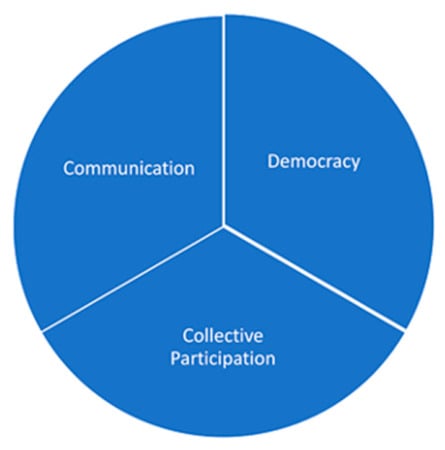
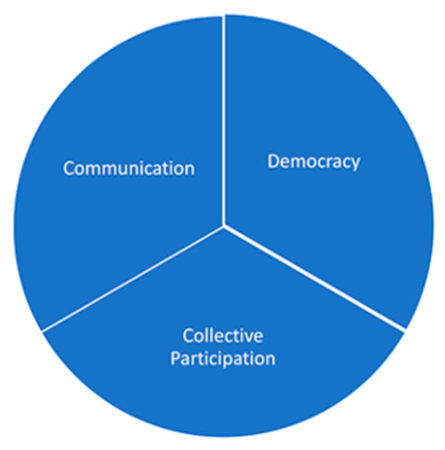
In establishing a framework for collaboration, the study draws on Desimone (2009), Kee et al. (2016), Doerr-Stevens and Woywod (2018), and Heath (2007) to detail three key elements of collaboration: communication, collective participation, and democracy as seen in Figure 1. These elements provide a foundation to build an understanding of collaboration. Although this article focuses on these key scholars for the development of a collaborative framework, many scholars have developed or explored the concept. Other scholars who have offered perspectives on collaboration include Bourdieu (1997), Bresler (2002), Brown (1992), Costa et al. (2004), Diener and Anderson (2009), and Gran (2017).
Figure 1.
Conceptual Framework.
The foundation of this framework is communication. Heath’s (2007) description of good communication focuses on both reciprocity and symmetry: “Good communication allows for reciprocity and symmetry between participants. Reciprocity allows all claims in the context of the speech situation. Symmetry ensures each participant has equal ability to contest claims that are raised in the discourse” (p. 150). Cheney and Cloud (2006) argued that democracy is a “contested term” that at times refers to processes that are related to practice, voice, and decision-making but is also interpreted as an outcome that emphasizes equal access to resources and representation (p. 512). Through collaboration literature, democracy mediates and is an outcome of collaboration, although different scholars give it varying emphasis (Heath, 2007, p. 148). Lastly, collective participation is the final element of the framework. Collective participation encourages a sense of togetherness and connectiveness with teachers from similar disciplines, grades, schools, etc. (Desimone, 2009). It ensures that educators collaborate in intentional ways through professional development and collaborative activities. These three elements create the conceptual framework for our understanding of how educators may experience collaboration.
2. Materials and Methods
Since 2011, Indiana University has administered the surveys that generate the SNAAP data, which tracks arts alumni from all over the United States and Canada (SNAAParts, 2026). According to the SNAAP website,
For the first time, alumni of all ages were surveyed, and over 36,000 arts alumni from 66 institutions in the United States and Canada responded in fall 2011. The average institutional response rate was more than 20%. Participating institutions received their confidential data in April 2012, and SNAAP issued its second annual report of national findings.(SNAAParts, 2026)
As the desire for arts alumni data increased, in 2015, SNAAP expanded to include over 40,000 arts alumni. By the end of the three-year survey cycle, in 2017, the grand total of respondents was 80,000 alumni. As the circumstances for higher education and the artistic and creative fields have been dramatically impacted over the last several years and continue to adapt and push forward for more change, SNAAP has been embarking on a process to refresh and take even deeper stock of the information and data needs of post-secondary institutions providing training in arts, design, arts administration and related creative fields.(SNAAParts, 2026)
The researchers received both qualitative and quantitative SNAAP data for this project. We chose to only use the quantitative data because there were more quantitative data points. Within the questionnaire, participants were given the following options regarding race: White, Black, Latinx, and Asian. We analyzed all participants who identified as global majority (n = 674) separately from those who identified as white (n = 4639). By analyzing the differences between the two groups, we were able to draw our conclusions and create the counternarrative details below.
Quantitative chi-square analysis with additional evidence and support from counternarratives was used to answer the research questions. Chi-square analysis was completed to obtain a p-value from the Mantel-Haenszel test. This test is used to investigate the relationship between ordinal and dichotomous variables. It is similar to the Mann–Whitney U, a non-parametric test used to compare median scores of two independent groups. As there are four a priori comparisons of interest related to ways global majority K-12 teachers participate in cross-disciplinary, collaborative opportunities, the p-value used to determine statistical significance for these tests was 0.05. For all other comparisons, a p-value less than 0.0036 (0.05 divided by 14 [# of other skills queried in either question 15 or 31]) was required. Adjustment of the p-values per the Bonferroni methodology ensures an overall error rate (α) of 5%.
3. Results
Among the 675 respondents classified as people of color, 35.1% identified afs Latino, 24.9% as Black or African American, and 16.15% as Asian (Table 1). People of color respondents (M = 41.0 years) were slightly younger than their white counterparts (M = 43.7 years). Similarly, white respondents were both more likely to be 50 years of age or older (35.6% vs. 25.3% and less likely to be less than 30 years of age (16.6% vs. 22.2%) than people of color respondents. Likewise, people of color participants were more likely to report more recent graduation years than white respondents (Table 2).
Table 1.
Race/ethnicity of participants classified as global majority for the purpose of analyses.
Table 2.
Cross-disciplinary, collaborative opportunities and their importance.
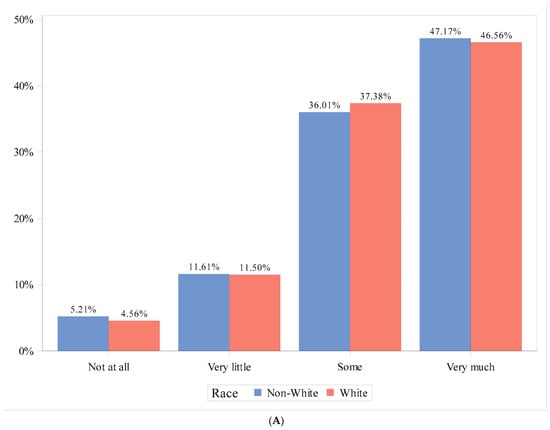
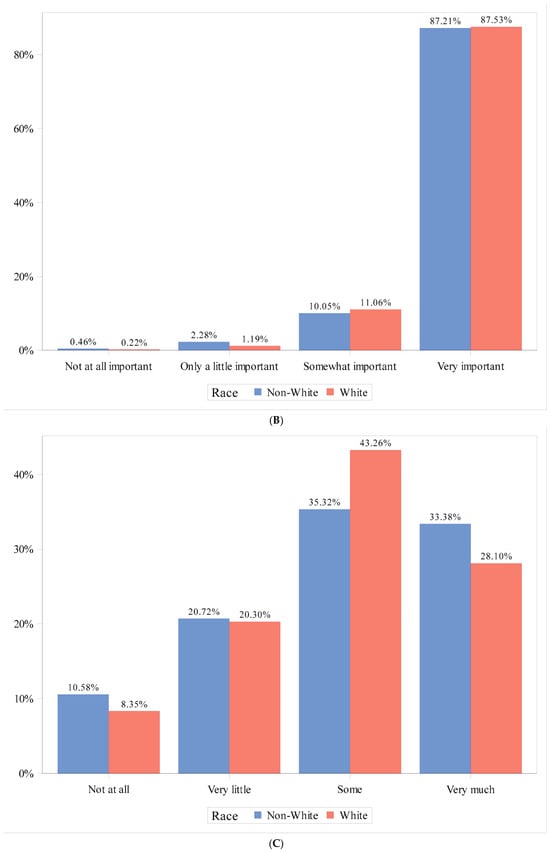
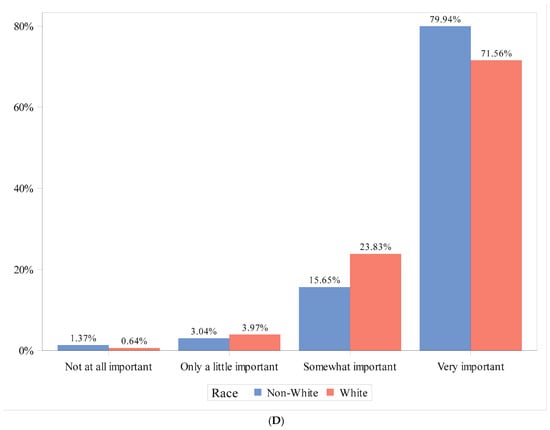
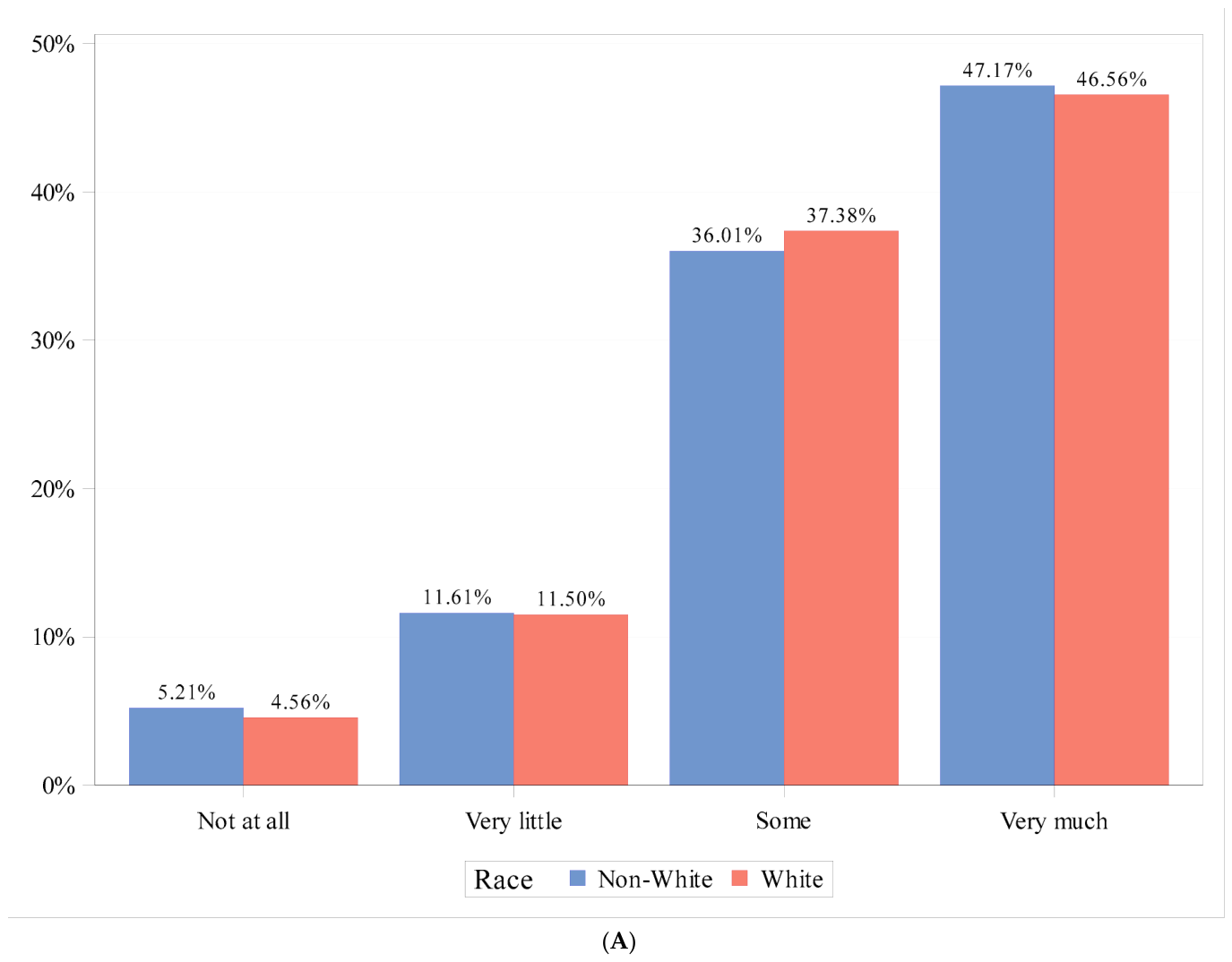
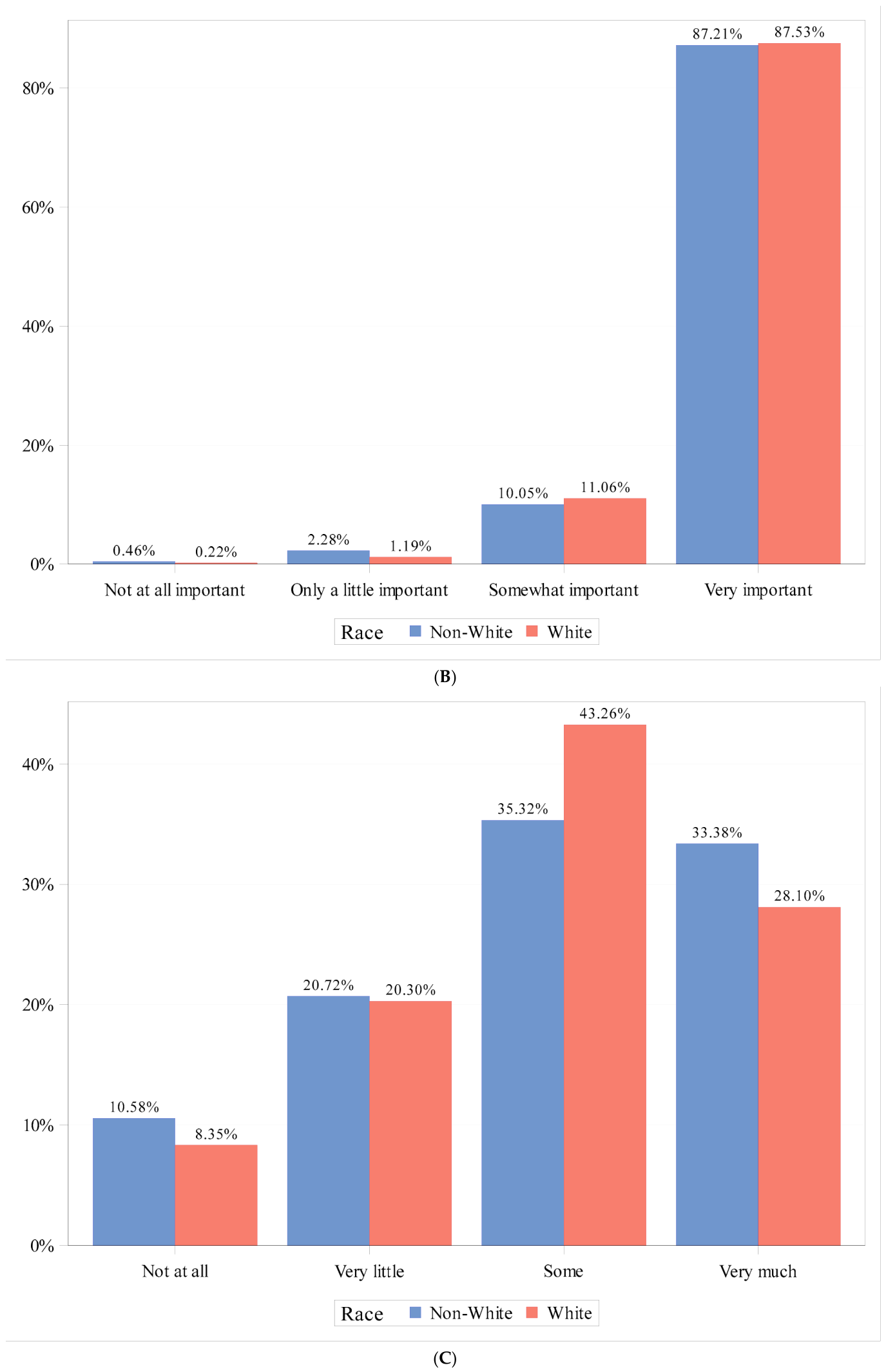
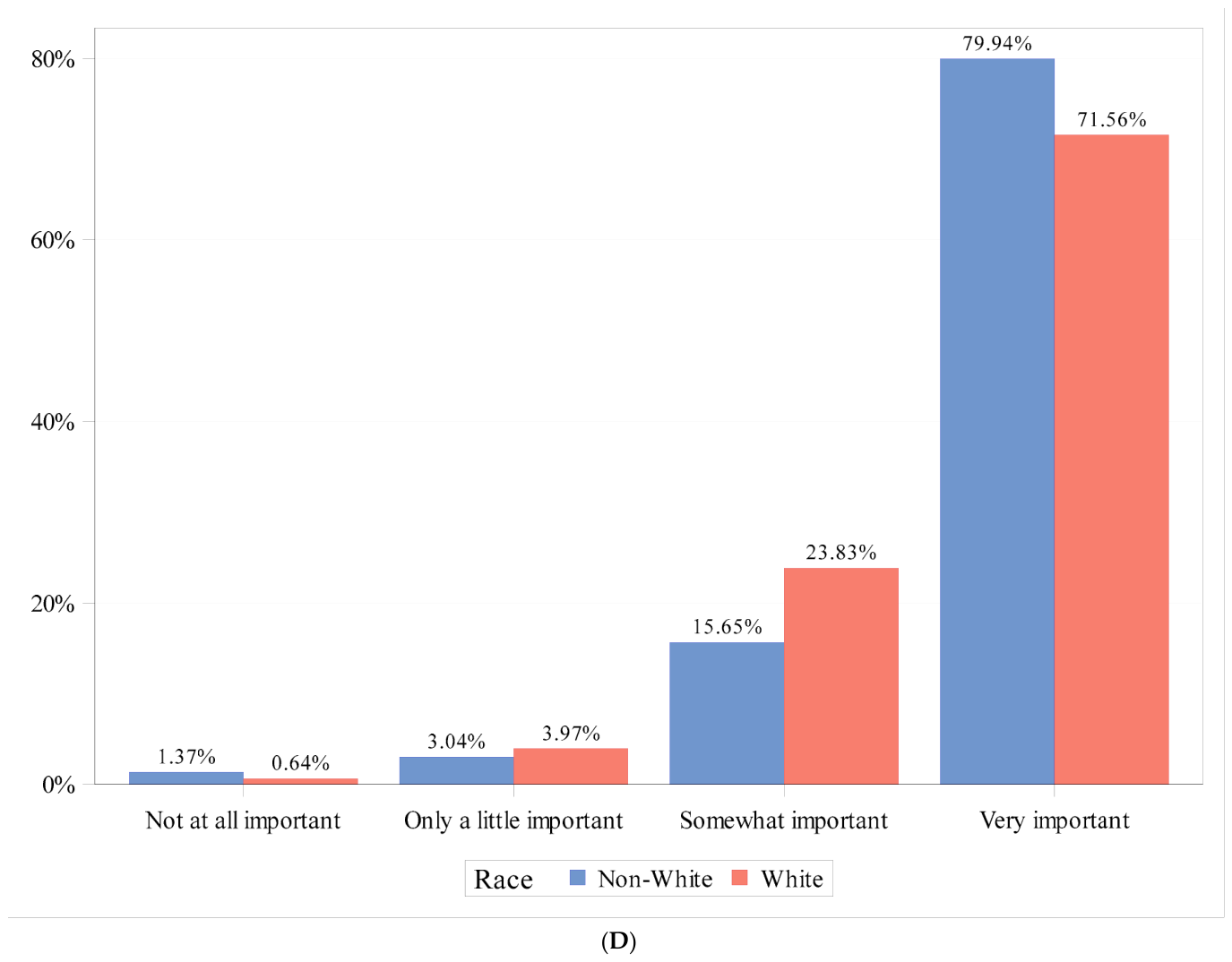
When asked about the acquisition and importance of interpersonal relations and working collaboratively, nearly 90% of respondents in each racial group felt that the development of interpersonal relations and working collaboratively was very important (Figure 2; Panel B). There were, however, significant differences in the responses of each racial group when asked about acquiring and the importance of networking and relationship-building skills (Table 2). The largest differences when asked about acquisition/development of these skills were observed in the “Some” versus “Very much” response options (Figure 2: Panel C). The white participants were more likely to respond with “Some,” while people of color participants were more likely to respond with “Very much.” A similar yet not as pronounced difference was observed when participants were asked about the importance of networking and relationship-building skills.
Figure 2.
(Panels (A–D)): Cross-disciplinary, collaborative opportunities and their importance among white and people of color arts teachers. Panel (A): Acquisition/development of interpersonal relations and working skills collaboratively. Panel (B): Importance of interpersonal relations and working collaboratively. Panel (C): Acquisition/development of networking and relationship-building skills. Panel (D): Importance of networking and relationship building.
4. Discussion
The findings from the SNAAP data provide some information about how people of color and white arts teachers engage with collaboration, specifically by analyzing responses related to interpersonal skills and collaboration. There is a significant difference in the responses based on race when participants were asked about the acquisition and importance of networking and relationship-building skills. Although there was no difference between groups when asked explicitly about collaboration, networking and relationship building are elements for effective collaboration and fit within the framework for collaboration and from the data, we can surmise that the desire to network and build relationships is very important to arts educators of color. Additionally, communication and networking are related through the activities required in each action. Dialogue is essential for both communication and networking. Relationship building and democracy are related through connection and power dynamics. There is reciprocity between individuals or groups that allows for the development of relationships and democracy.
The following vignette describes a music educator’s experience who began a collaborative relationship with the visual art teacher out of necessity and was then able to expand the relationship into something sustainable.
Vignette.
“It’s the biggest music show of the year and we cannot use these damaged decorations!” exclaimed Sharon, a Black elementary music teacher who teaches in a midwestern suburb. Sharon was preparing 200 students to perform in the holiday showcase the next week, and she had just learned that the decorations she was planning to use to turn the school stage into a winter wonderland were damaged. As she was in the process of obtaining tenure as a public-school teacher, she felt a lot of pressure to make this performance as strong as possible. Sharon decided to share her predicament with Sue, visual arts teacher, a white woman, in hopes of brainstorming different possibilities of how to transform the performance stage into a winter snowscape. Sharon had connected with Sue during their professional development training earlier that school year, and she felt they had a healthy collegial relationship. But she was in a heightened state of trepidation about the problem. Thankfully, Sue was able to solicit students in the art club to create different decorations for the showcase and together, Sue and Sharon made the show’s decorations a success. It was the start of a collaborative relationship that would continue through multiple performance and academic projects.
Sharon’s experience highlights the value of collaborating with a fellow arts educator. This example of a counterstory, the perspective of a person from an underrepresented group, reflects SNAAP data in particular ways. The survey results demonstrate that both arts educators of color and white arts educators strongly believe that relationship building and working collaboratively are important. The vignette described how both the music teacher and the art teacher were able to work together to create a collaborative winter showcase, in addition to valuing the continued efforts by collaborating on the winter showcase for years to come. Additionally, this vignette connects to this specific experience of teachers of color, which, according to survey data, is only around 14.5% of respondents. According to Solórzano and Yosso (2002), highlighting experiences that are commonly overlooked creates an opportunity to challenge stereotypes. The survey data provides an opportunity to highlight the experiences of non-white people. With 674 respondents of arts educators identifying as people of color and over 4500 respondents of art educators identifying as white, it reinforces the need to highlight the data and experiences of the global majority. This work adds to perspectives on educators of color and their experiences in the classroom. The way the counterstory functions in this research is by amplifying the voices of those 674 respondents and exploring collaboration and interpersonal skills. There are multiple ways these educators can create a supportive environment in order to gain the benefits of collaboration, connection, and community. To extend the scholarly reach of the research, the study offers a logic model as an effective tool that illustrates essential components of collaboration that can be created during PLCs to support teacher development.
Connecting to the Conceptual Framework for Collaboration
Within this research, survey data and vignettes explore collaboration for teachers of color. To support collaborative efforts, teachers should have access to tools and frameworks that reflect a conceptual framework that centers communication, democracy and collective participation. This study asserts that arts educators of color can embrace this conceptual framework to be used as a foundational tool to support teachers in their collaboration efforts. It can highlight curricular expectations and potential learning outcomes that are established by the teachers and state standards. By using this framework as a foundation, teachers have an implementable tool to plan their work together that indicates possible impacts. This tool can be implemented during PLCs to deepen or create collaborative relationships.
Funds, individuals, and spaces generally represent inputs within a logic model; for the purposes of this inquiry, inputs expand to include elements like supplies and time. These elements are essential to the creation and implementation of the arts educational experiences. A necessary component of collaboration is a common understanding of the goals and impacts. This includes a clear plan that highlights resources as well as intended outcomes. A logic model provides the opportunity to understand how collaboration can occur because it provides a framework. The framework for collaboration can be diverse because each collaborator will provide unique perspectives on the shared project. The logic model is a platform to share that perspective and could be helpful in understanding how people would like to work together. As it relates to expected outcomes and resources, a logic model can provide clarity and space for consensus amongst educators. Arts educators can have limited access to funds, supplies and networks that are needed to create a collaborative project. This framework can be a road map that teachers can use for a variety of experiences because it is a visual representation of the project, program, or curriculum. The creation of this visual representation ensures that a collaborative process occurs in the beginning because input and consensus are required from participating educators.
5. Conclusions
This article argues that professional learning communities are unique sites for collaboration and can serve as an instrument to support teaching. Using counterstories as a justification to center experiences of arts educators of color, the survey data and vignettes highlight unique experiences of arts teachers of color. Although the data showed little difference between white and arts educators of color, by highlighting the experiences of global majority educators, we amplify the experiences of educators of color. The current K-12 general education teaching population in the United States is 81% white (Billingsley et al., 2019). This percentage shows the need to ensure that the experiences of educators of color are centered and not overlooked, and to emphasize their cross-disciplinary experiences.
This study compares the experiences of people of color through a counternarrative lens in order to challenge assumptions and expand the reach of the SNAAP data. Also, it highlighted how a logic model could be used as a potential tool to support collaboration. In recognizing how counternarratives can highlight information commonly overlooked, future research can include additional mixed methods approaches to center and highlight qualitative, experiential data that examines arts educators of color in K-12 educational settings.
Author Contributions
Conceptualization, T.B.; Methodology, G.M.; Formal analysis, T.B. and G.M.; Data curation, A.L.; Writing—original draft, T.B. and A.L.; Writing—review and editing, T.B. and A.L.; Funding acquisition, T.B. All authors have read and agreed to the published version of the manuscript.
Funding
The research was funded by the SNAAP Research Fellowship, with no specific number.
Institutional Review Board Statement
Not applicable.
Informed Consent Statement
Not applicable.
Data Availability Statement
No new data were created or analyzed in this study.
Conflicts of Interest
The authors declare no conflicts of interest.
References
- Billingsley, B. S., Bettini, E. A., & Williams, T. O. (2019). Teacher racial/ethnic diversity: Distribution of special and general educators of color across schools. Remedial and Special Education, 40(4), 199–212. [Google Scholar] [CrossRef] [Scilit]
- Blair, D. V. (2008). Mentoring novice teachers: Developing a community of practice. Research Studies in Music Education, 30(2), 99–117. [Google Scholar] [CrossRef] [Scilit]
- Bourdieu, P. (1997). The logic of practice. Polity Press. [Google Scholar]
- Bresler, L. (2002). Out of the trenches: The joys (and risks) of cross-disciplinary collaborations. Bulletin-Council for Research in Music Education, 152, 17–39. [Google Scholar]
- Brown, N. C. M. (1992). Art education curriculum praxis: A time for collaboration. Australian Art Education, 16(1), 45–52. [Google Scholar]
- Bryk, A. S., & Driscoll, M. E. (1988). The high school as community: Contextual influences and consequences for students and teachers. National Center on Effective Secondary Schools. [Google Scholar]
- Cheney, G., & Cloud, D. L. (2006). Doing democracy, engaging the material: Employee participation and labor activity in an age of market globalization. Management Communication Quarterly, 19, 501–540. [Google Scholar] [CrossRef] [Scilit]
- Conway, C. M., Hibbard, S., Albert, D., & Hourigan, R. (2005). Voices of music teachers regarding professional development. Arts Education Policy Review, 107(1), 11–14. [Google Scholar] [CrossRef] [Scilit]
- Costa, J. A., Leite, A., & Mata, G. (2004). Music education in context: The construction of the teacher’s identity within cross-disciplinary collaboration in the arts. Bulletin of the Council for Research in Music Education, (161/162), 181–188. Available online: https://www.jstor.org/stable/40319252 (accessed on 13 March 2022).
- Darling-Hammond, L. (1984). Beyond the commission reports: The coming crisis in teaching. Rand Corporation. [Google Scholar]
- Desimone, L. M. (2009). Improving impact studies of teachers’ professional development: Toward better conceptualizations and measures. Educational Researcher, 38(3), 181–199. [Google Scholar] [CrossRef] [Scilit]
- Diener, L., & Anderson, J. A. (2009). A cross-disciplinary collaboration. Journal of Chemical Education, 86(2), 156–157. [Google Scholar] [CrossRef] [Scilit]
- Doerr-Stevens, C., & Woywod, C. (2018). Stepping onto fertile ground: Urban teachers’ preparation for interdisciplinary inquiry. Pedagogies, 13(2), 164–180. [Google Scholar] [CrossRef] [Scilit]
- Goff, M. G. (2025). Supporting beginning rural educators through online professional learning communities: Addressing early career challenges through virtual collaboration. The New Educator, 22, 170–197. [Google Scholar] [CrossRef] [Scilit]
- Gran, D. (2017). A culture of collaboration. School Arts, 117(3), 22. [Google Scholar]
- Heath, R. G. (2007). Rethinking community collaboration through a dialogic lens: Creativity, democracy, and diversity in community organizing. Management Communication Quarterly, 21(2), 145–171. [Google Scholar] [CrossRef] [Scilit]
- Hess, J. (2018). Detroit youth speak back: Rewriting deficit perspectives through songwriting. Bulletin of the Council for Research in Music Education, 216, 7–30. [Google Scholar] [CrossRef] [Scilit]
- Holland, H. (2005). Teaching teachers: Professional development to improve student achievement. AERA Research Points, 3(1), 1–4. [Google Scholar]
- Hord, S. M. (2009). Professional learning communities. Journal of Staff Development, 30(1), 40–43. [Google Scholar]
- Kastner, J. D. (2012). Exploring informal music pedagogy in a professional development community of elementary music teachers (UMI no. 3548741) [Doctoral dissertation, Michigan State University]. ProQuest Dissertations & Theses Database. Available online: https://d.lib.msu.edu/etd/663/datastream/OBJ/view (accessed on 11 May 2022).
- Kee, J. B., Bailey, C., Horton, S., Kelly, K., McClue, J., & Thomas, L. (2016). Art at ashé: Collaboration as creative assemblage. Art Education, 69(5), 14–19. [Google Scholar] [CrossRef] [Scilit]
- King, M. B., & Newmann, F. M. (2001). Building school capacity through professional development: Conceptual and empirical considerations. International Journal of Educational Management, 15(2), 86–94. [Google Scholar] [CrossRef] [Scilit]
- Lewis, A. B. (2021). “Am I racist or are my actions racist?”: Experiences of four music educators who learn about critical race theory [Unpublished dissertation, Michigan State University]. [Google Scholar]
- Louis, K. S., & Marks, H. M. (1998). Does professional community affect the classroom? Teachers’ work and student experiences in restructuring schools. American Journal of Education, 106(4), 532–575. [Google Scholar] [CrossRef] [Scilit]
- Martin, R., O’Hara, S., Bookmyer, J., & Newton, R. (2020). Identifying high-impact practices of learning communities that foster collective professional growth. The New Educator, 16(4), 296–312. [Google Scholar] [CrossRef] [Scilit]
- Mitchell, C., & Sackney, L. (2000). Profound improvement: Building capacity for a learning community. Swets & Zeitlinger. [Google Scholar]
- Rosenholz, S. J. (1989). Teachers’ workplace: The social organization of schools. Longman. [Google Scholar]
- Solórzano, D. G., & Yosso, T. J. (2002). Critical race methodology: Counter-storytelling as an analytical framework for education research. Qualitative Inquiry, 8(1), 23–44. [Google Scholar] [CrossRef] [Scilit]
- Stoll, L., Bolam, R., McMahon, A., Wallace, M., & Thomas, S. (2006). Professional learning communities: A review of the literature. Journal of Educational Change, 7(4), 221–258. [Google Scholar] [CrossRef] [Scilit]
- Stovall, J. L., & Sullivan, T. R. (2022). ‘Grant us the sun’: What Black teachers need. Phi Delta Kappan, 104(1), 18–21. [Google Scholar] [CrossRef] [Scilit]
- Strategic National Arts Alumni Project. SNAAP. (2026). Available online: https://snaaparts.org/ (accessed on 13 March 2022).
- Toole, J. C., & Louis, K. S. (2002). The role of professional learning communities in international education. In Second international handbook of educational leadership and administration (pp. 245–279). Springer. [Google Scholar]
- Warren, C. A. (2021). About centering possibility in black education. Teachers College Press. [Google Scholar]

Disclaimer/Publisher’s Note: The statements, opinions and data contained in all publications are solely those of the individual author(s) and contributor(s) and not of MDPI and/or the editor(s). MDPI and/or the editor(s) disclaim responsibility for any injury to people or property resulting from any ideas, methods, instructions or products referred to in the content. |
© 2026 by the authors. Licensee MDPI, Basel, Switzerland. This article is an open access article distributed under the terms and conditions of the Creative Commons Attribution (CC BY) license.