Self-Efficacy of Pre-Service Educators in Facilitating Youth Civic Engagement for the Environment

Abstract
1. Introduction
Theoretical Framework
- How do PSEs perceive their ability to facilitate youth-led civic engagement projects?
- How does a professional development workshop impact the self-efficacy of PSEs towards civic action project facilitation and their understanding of civic engagement?
- PSEs would report an increase in self-efficacy following the civic engagement workshop.
2. Methods
2.1. Study Context
2.2. Survey Development
2.3. Data Collection and Analysis
3. Results
3.1. Participants
3.2. Self-Efficacy
3.3. Understanding of Civic Engagement
3.4. Educator Perceptions
4. Discussion
4.1. Limitations
4.2. Directions and Implications for Future Research
5. Conclusions
Author Contributions
Funding
Institutional Review Board Statement
Informed Consent Statement
Data Availability Statement
Conflicts of Interest
Appendix A
Pre-Service Educator Efficacy for Facilitating Civic Engagement for the Environment
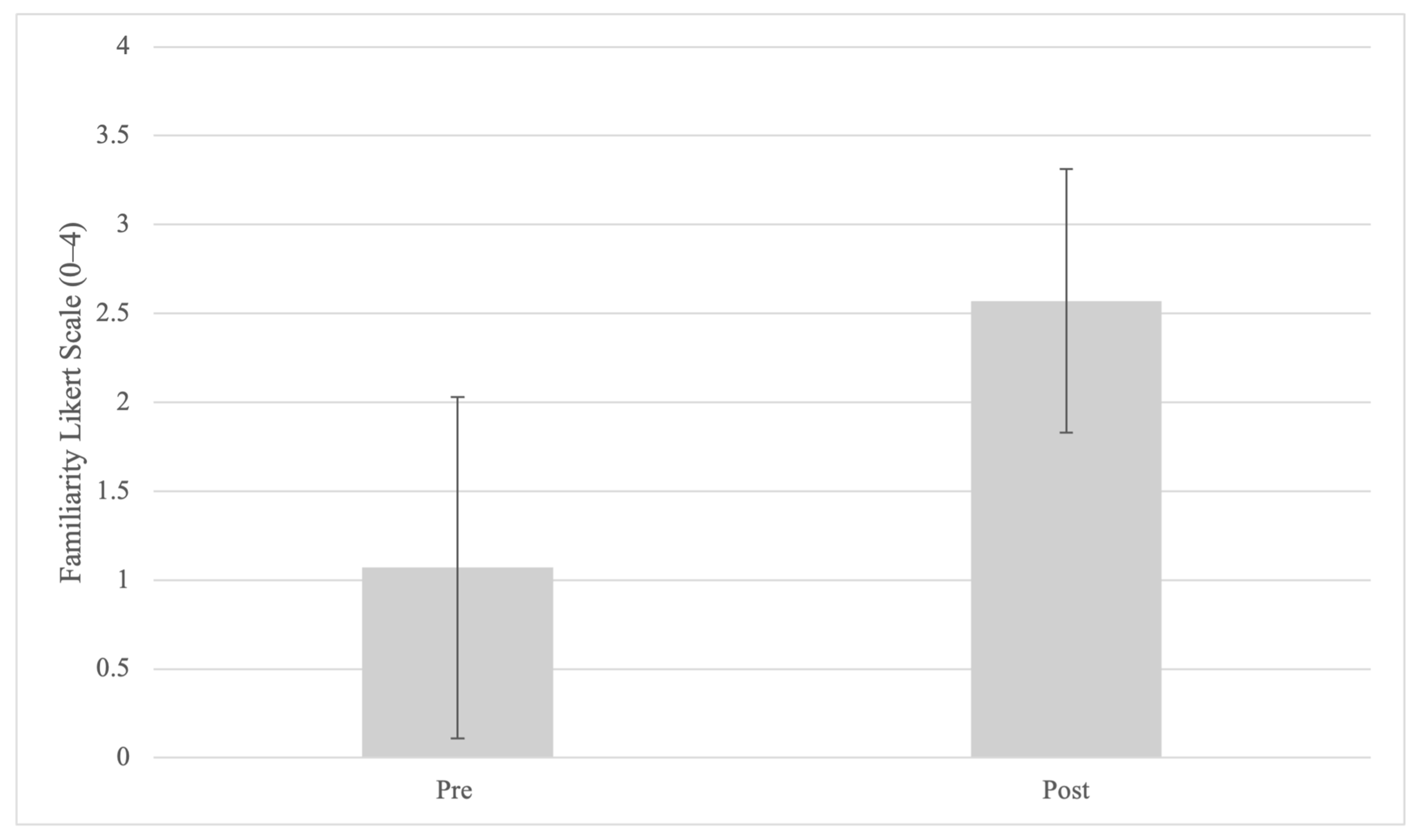
- How familiar are you with civic action projects for the environment?
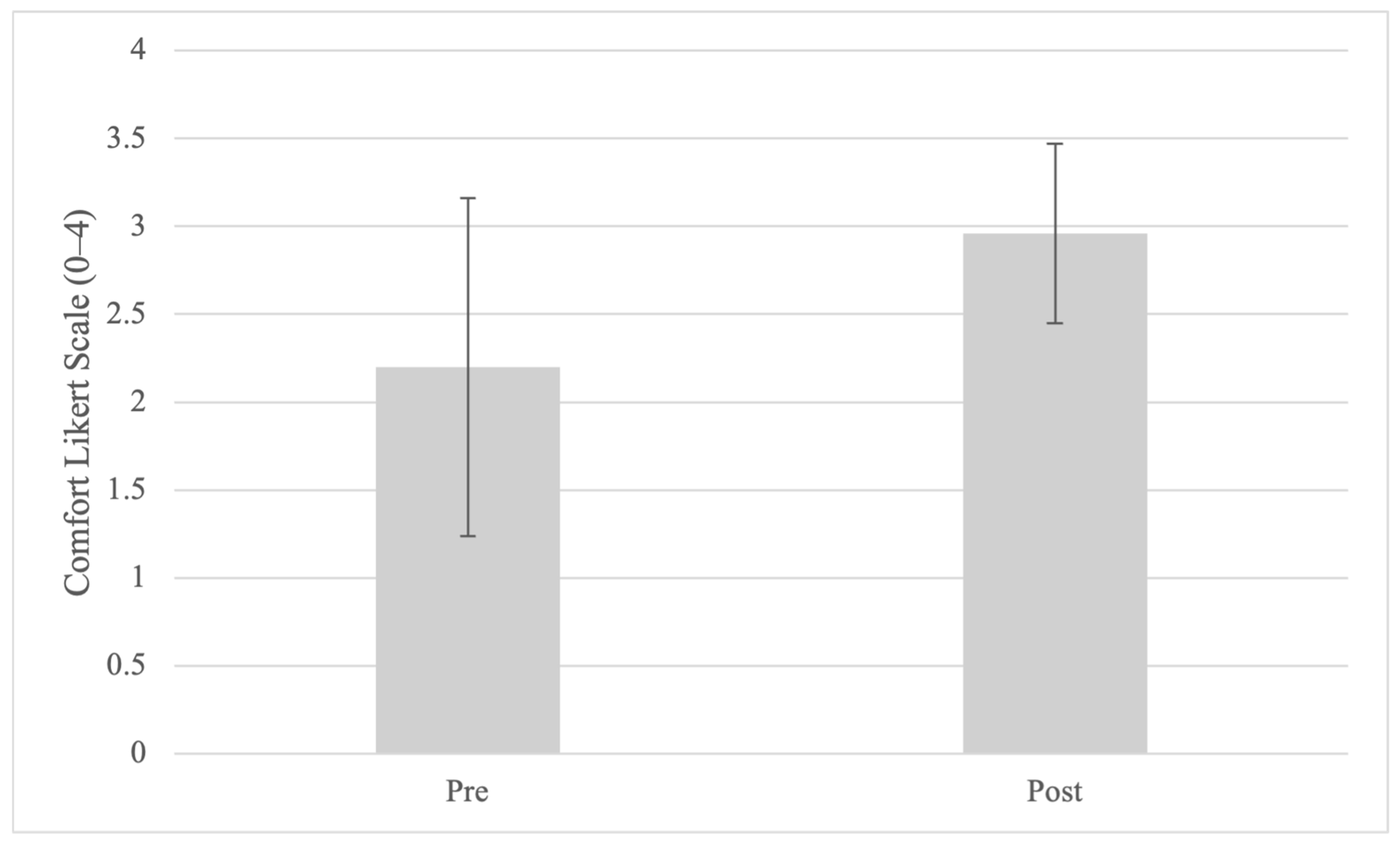
- How comfortable would you feel implementing a civic action project for the environment with students?
- I believe that having an impact on community problems is within the reach of the students I teach.
- I am knowledgeable about strategies to implement a project that improves or supports the community.
- I am confident in my ability to plan and embed civic engagement projects in my lessons.
- I know how to increase students’ desire to become a member of a school or community group that is working to improve the community.
- I know strategies that help students examine and discuss possible solutions to current social issues.
- Through my lessons, I can help students feel that they can make a positive difference in their communities.
- I am confident in my ability to get community groups to engage with my students.
- I am confident in my ability to get local businesses to engage with my students.
- I am confident in my ability to get local universities or colleges to engage with my students.
- How would you describe a youth-led civic action project?
- Do you think educators should engage their students in civic action projects for the environment? Why/not?
- How would you describe a youth-led civic action project?
- Do you think educators should engage their students in civic action projects for the environment? Why/not?
- What challenges do you anticipate if you were to engage your students in a civic action project?
- What resources do you anticipate you would need to help you facilitate a civic action project with your students?
References
- Arthurs, S. G. (2018). Now more than ever: Why youth organizing work belongs in schools and what that means in theory and practice. The High School Journal, 102(1), 46–71. [Google Scholar] [CrossRef]
- Bandura, A. (1977). Self-efficacy: Toward a unifying theory of behavioral change. Psychological Review, 84(2), 191. [Google Scholar] [CrossRef] [PubMed]
- Bandura, A. (2006). Guide for constructing self-efficacy scales. In F. Pajares, & T. Urdan (Eds.), Self-efficacy beliefs of adolescents (pp. 307–337). IAP. [Google Scholar] [CrossRef]
- Barnason, S., Li, C. J., Hall, D. M., Stanis, S. A. W., & Schulz, J. H. (2022). Environmental action programs using positive youth development may increase civic engagement. Sustainability, 14(11), 6781. [Google Scholar] [CrossRef]
- Barouki, R., Kogevinas, M., Audouze, K., Belesova, K., Bergman, A., Birnbaum, L., Boekhold, S., Denys, S., Desseille, C., Drakvik, E., Frumkin, H., Garric, J., Destoumieux-Garzon, D., Haines, A., Huss, A., Jensen, G., Karakitsios, S., Klanova, J., Koskela, I.-M., & HERA-Covid-19 Working Group. (2021). The COVID-19 pandemic and global environmental change: Emerging research needs. Environment International, 146, 106272. [Google Scholar] [CrossRef]
- Basche, A., Genareo, V., Leshem, A., Kissell, A., & Pauley, J. (2016). Engaging middle school students through locally focused environmental science project-based learning. Natural Sciences Education, 45(1), 1–10. [Google Scholar] [CrossRef]
- Boland, J. (2010). Teaching and learning through civic engagement: Prospects for sustainability in teacher education. Issues in Educational Research; Special Edition on Service Learning, 20(1), 1–20. [Google Scholar] [CrossRef]
- Campbell, J. L., Quincy, C., Osserman, J., & Pedersen, O. K. (2013). Coding in-depth semistructured interviews: Problems of unitization and intercoder reliability and agreement. Sociological Methods & Research, 42(3), 294–320. [Google Scholar] [CrossRef]
- Chan, D. (2010). So why ask me? Are self-report data really that bad? In Statistical and methodological myths and urban legends (pp. 329–356). Routledge. [Google Scholar]
- Chan, W. Y., Ou, S. R., & Reynolds, A. J. (2014). Adolescent civic engagement and adult outcomes: An examination among urban racial minorities. Journal of Youth and Adolescence, 43(11), 1829–1843. [Google Scholar] [CrossRef]
- Chawla, L. (2020). Helping students cope with environmental change and take constructive civic action. Green Schools Catalyst Quarterly, 2(1), 44–57. [Google Scholar]
- Craiutu, S., & Ngalande, J. (2024). State civics requirements in 2024. Hoover Institution. Available online: https://www.hoover.org/research/state-civics-requirements-2024 (accessed on 3 August 2025).
- DeJarnette, N. K., & Sudeck, M. (2016). Advocating for a cause: Civic engagement in the elementary classroom. Journal of Social Studies Education Research, 7(1). [Google Scholar] [CrossRef]
- Ennes, M., & Henson, E. (2025). Informal educators’ self-efficacy for facilitating youth civic engagement for the environment. Journal of Museum Education, 1–14. [Google Scholar] [CrossRef]
- Flanagan, C., Gallay, E., & Pykett, A. (2022). Urban youth and the environmental commons: Rejuvenating civic engagement through civic science. Journal of Youth Studies, 25(6), 692–708. [Google Scholar] [CrossRef]
- Genc, M. (2015). The project-based learning approach in environmental education. International Research in Geographical and Environmental Education, 24(2), 105–117. [Google Scholar] [CrossRef]
- Habibullah, M. S., Din, B. H., Tan, S.-H., & Zahid, H. (2022). Impact of climate change on biodiversity loss: Global evidence. Environmental Science and Pollution Research International, 29(1), 1073–1086. [Google Scholar] [CrossRef]
- Haines, S., & McClure, C. (2020). Preparing preservice teachers using a civic engagement model: The effect of field experience on preservice teacher knowledge, skills, and attitude. Science Education and Civic Engagement, 12(2), 91–105. [Google Scholar]
- Hampel, N., Sassenberg, K., Scholl, A., & Ditrich, L. (2024). Enactive mastery experience improves attitudes towards digital technology via self-efficacy—A pre-registered quasi-experiment. Behaviour & Information Technology, 43(2), 298–311. [Google Scholar] [CrossRef]
- Levy, B. (2016). Advising a Model United Nations club: A scaffolded youth-adult partnership to foster active participation and political engagement. Journal of Teaching and Teacher Education, 59, 13–27. [Google Scholar] [CrossRef]
- Li, C. J., Monroe, M. C., Oxarart, A., & Ritchie, T. (2019). Building teachers’ self-efficacy in teaching about climate change through educative curriculum and professional development. Applied Environmental Education & Communication, 20(1), 34–48. [Google Scholar] [CrossRef]
- Lowenstein, E., & Facing History and Ourselves. (2007). Teaching for informed civic engagement efficacy belief inventory. Ethan Lowenstein & Facing History and Ourselves National Foundation, Inc. [Google Scholar]
- Maravé-Vivas, M., Salvador-Garcia, C., Gil-Gómez, J., Valverde-Esteve, T., & Martín-Moya, R. (2022). How can service-learning shape the political perspectives of pre-service teachers? A program in the field of physical education. International Journal of Environmental Research and Public Health, 19(15), 9175. [Google Scholar] [CrossRef] [PubMed]
- Menon, D., & Sadler, T. D. (2016). Preservice elementary teachers’ science self-efficacy beliefs and science content knowledge. Journal of Science Teacher Education, 27(6), 649–673. [Google Scholar] [CrossRef]
- Monroe, M., Odom, A., & Ennes, M. (2026). Climate action projects connect youth to communities. In A. Sezen-Barrie, & S. Tolbert (Eds.), The Palgrave handbook of climate change research in transdisciplinary education (Vol. I). Springer Nature-Palgrave MacMillan. [Google Scholar]
- Monroe, M., Salazar, G., Odom, A., Ennes, M., Sullivan, G., & Ireland, J. (2023). CAPE: Community action projects for the environment. Curriculum guide. Available online: https://cape.ifas.ufl.edu (accessed on 3 August 2025).
- Morris, D. B., Usher, E. L., & Chen, J. A. (2017). Reconceptualizing the sources of teaching self-efficacy: A critical review of emerging literature. Educational Psychology Review, 29, 795–833. [Google Scholar] [CrossRef]
- Moya, J. (2017). Examining how youth take on critical civic identities across classroom and youth organizing spaces. Critical Questions in Education, 8(4), 457–475. [Google Scholar]
- Olsen, E. K., Lawson, D. F., McClain, L. R., & Plummer, J. D. (2024). Heads, hearts, and hands: A systematic review of empirical studies about eco/climate anxiety and environmental education. Environmental Education Research, 30(12), 2131–2158. [Google Scholar] [CrossRef]
- Pham, N. M., Huynh, T. L. D., & Nasir, M. A. (2020). Environmental consequences of population, affluence and technological progress for European countries: A Malthusian view. Journal of Environmental Management, 260, 110143. [Google Scholar] [CrossRef]
- Reichert, F., Lange, D., & Chow, L. (2021). Educational beliefs matter for classroom instruction: A comparative analysis of teachers’ beliefs about the aims of civic education. Journal of Teaching and Teacher Education, 98, 103248. [Google Scholar] [CrossRef]
- Schusler, T. M., & Krasny, M. E. (2010). Environmental action as context for youth development. The Journal of Environmental Education, 41(4), 208–223. [Google Scholar] [CrossRef]
- Shahid, S., Wang, X., Harun, S. B., Shamsudin, S. B., Ismail, T., & Minhans, A. (2016). Climate variability and changes in the major cities of Bangladesh: Observations, possible impacts and adaptation. Regional Environmental Change, 16, 459–471. [Google Scholar] [CrossRef]
- Shapiro, S., & Brown, C. (2018). A look at civics education in the United States. American Educator, 42(2), 10–13. Available online: https://eric.ed.gov/?id=EJ1182087 (accessed on 1 May 2026).
- Sia, A. P. (1992). Preservice elementary teachers’ perceived efficacy in teaching environmental education: A preliminary study (pp. 1–17). Available online: https://eric.ed.gov/?id=ED362487 (accessed on 1 May 2026).
- Slavkova, L., & Kurilić, M. (2023). Great expectations: Demands and realities of civic education in Europe. THE CIVICS Innovation Hub. Available online: https://thecivics.eu/wp-content/uploads/2023/03/Mapping-CE-in-Europe_Documentation.pdf (accessed on 3 August 2025).
- Small, R. M., Larson, L. R., Green, G. T., & Shenk, A. M. (2012). Effects of an environmental educator training workshop on environmental knowledge, awareness, and teaching self-efficacy. Illuminare, 10. Available online: https://scholarworks.iu.edu/journals/index.php/illuminare/article/view/1912 (accessed on 4 August 2025).
- Smith, R. (2012). Set charge about change: The effects of a long-term youth civic engagement program. Journal of Community Engagement & Scholarship, 5(2), 48–60. [Google Scholar] [CrossRef]
- Strife, S. J. (2012). Children’s environmental concerns: Expressing ecophobia. The Journal of Environmental Education, 43(1), 37–54. [Google Scholar] [CrossRef]
- Task Force on Active Citizenship. (2007). Report of the taskforce on active citizenship. Task Force on Active Citizenship. [Google Scholar]
- Teed, R., & Franco, S. (2014). Increasing teachers’ confidence and pedagogical content knowledge through a workshop and follow-up program on climate change. Journal of Geoscience Education, 62(4), 587–597. [Google Scholar] [CrossRef]
- Tschannen-Moran, M., & McMaster, P. (2009). Sources of self-efficacy: Four professional development formats and their relationship to self-efficacy and implementation of a new teaching strategy. The Elementary School Journal, 110(2), 228–245. [Google Scholar] [CrossRef]
- Vicente-Serrano, S. M., Quiring, S. M., Peña-Gallardo, M., Yuan, S., & Domínguez-Castro, F. (2019). A review of environmental droughts: Increased risk under global warming? Earth-Science Reviews, 201, 102953. [Google Scholar] [CrossRef]
- Weinberg, J. (2022). Civic education as an antidote to inequalities in political participation? New evidence from English secondary education. British Politics, 17(2), 185–209. [Google Scholar] [CrossRef]




| Question | Mean (SD) | Test Statistic | p-Value | |
|---|---|---|---|---|
| Pre | Post | |||
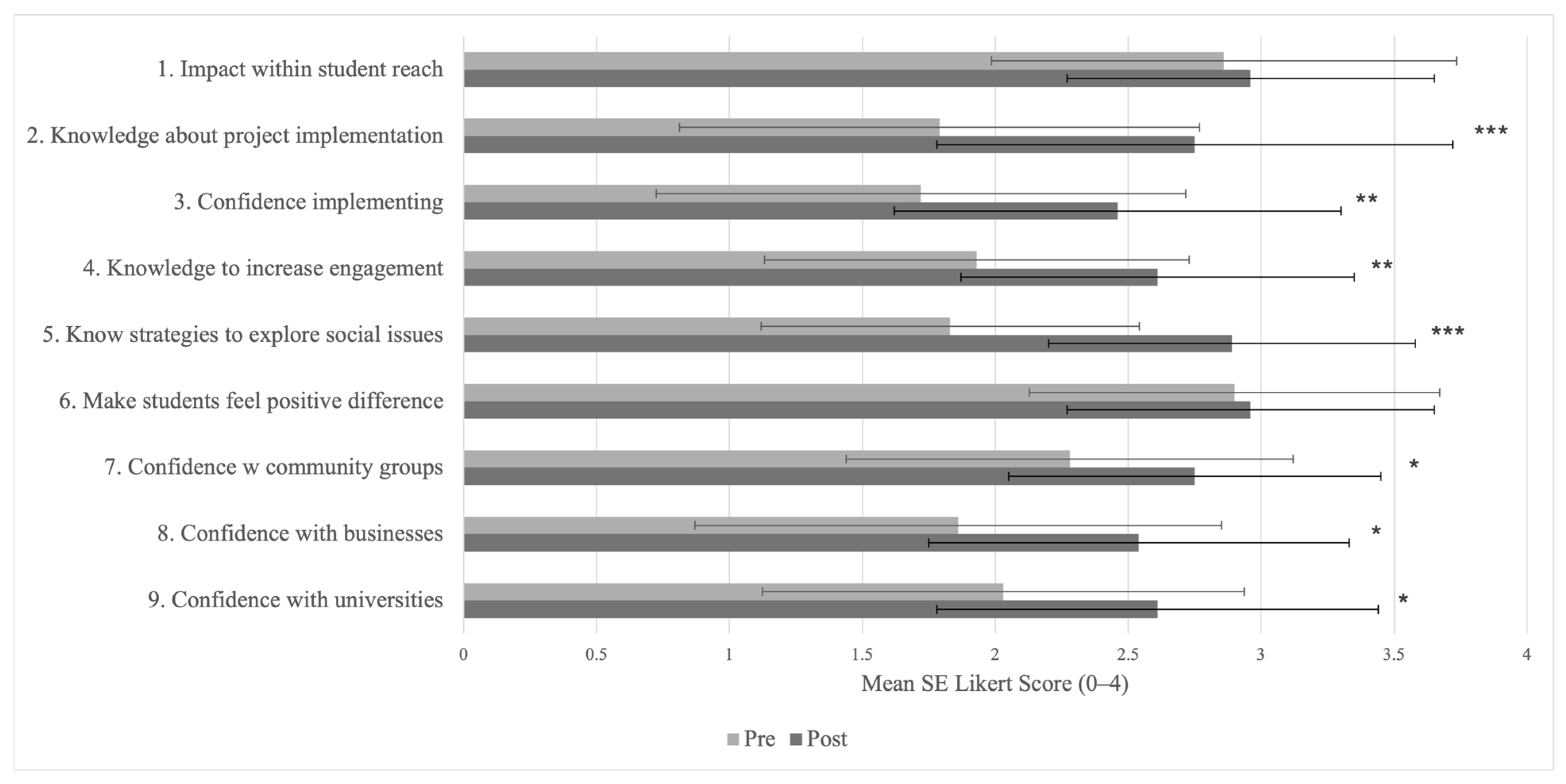
| 1. Impact within student reach | 2.86 (0.875) | 2.96 (0.693) | 429.5 | 0.679 |
| 2. Knowledge about project implementation | 1.79 (0.978) | 2.75 (0.967) | 610 | <0.001 *** |
| 3. Confidence implementing civic action | 1.72 (0.996) | 2.46 (0.838) | 562.5 | 0.009 ** |
| 4. Knowledge to increase engagement | 1.93 (0.799) | 2.61 (0.737) | 577.5 | 0.003 ** |
| 5. Know strategies to explore social issues | 1.83 (0.711) | 2.89 (0.685) | 689 | <0.001 *** |
| 6. Make students feel positive difference | 2.90 (0.772) | 2.96 (0.693) | 427.5 | 0.700 |
| 7. Confidence with community groups | 2.28 (0.841) | 2.75 (0.701) | 528.5 | 0.034 * |
| 8. Confidence with businesses | 1.86 (0.990) | 2.54 (0.793) | 552.5 | 0.014 * |
| 9. Confidence with universities | 2.03 (0.906) | 2.61 (0.832) | 534 | 0.031 * |
| Overall | 2.133 (0.874) | 2.726 (0.771) | 617 | <0.001 *** |
| Pre | Post | Examples | |
|---|---|---|---|
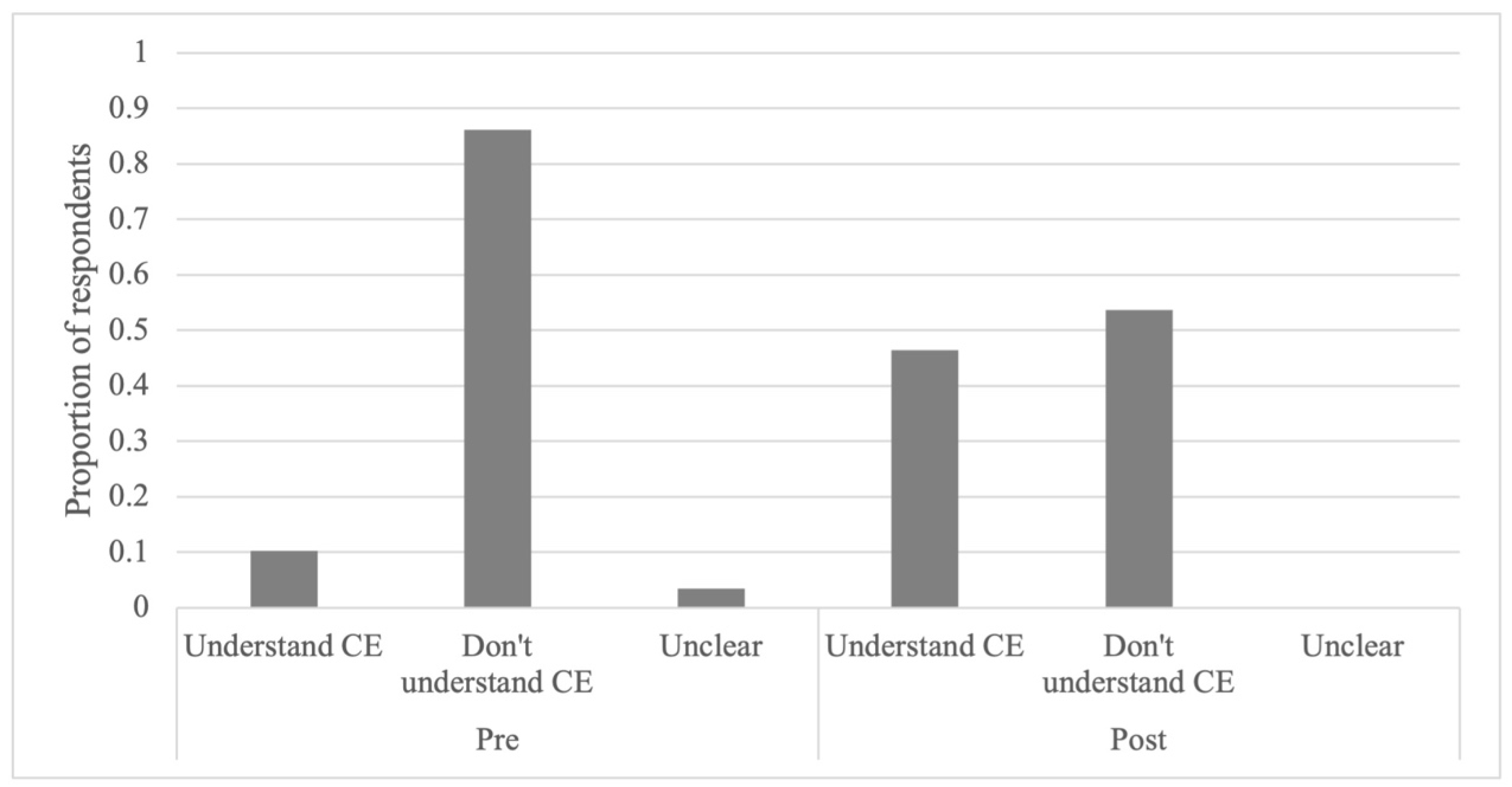
| Proportion who understood civic engagement | 0.103 | 0.464 |
|
| Proportion who did not understand civic engagement | 0.862 | 0.536 |
|
| Educators who were unclear in their description | 0.0345 | 0 |
|
| Code | Pre-Survey (n) | Post-Survey (n) | Examples |
|---|---|---|---|
| Learning experience | 12 | 10 | “By involving students in civic action projects, students will gain a better understanding of the environment, become more connected with their community, and can help people that the projects benefit” (pre-survey). |
| Inspires youth | 6 | 12 | “It shows students that they have the ability to make a difference and can inspire them to do more in the future” (pre-survey). |
| Gets kids involved | 4 | 6 | “It is important for youth to be involved in what they are passionate about” (post-survey). |
| Good for youth | 4 | 5 | “It would help create more active and educated students (pre-survey). |
| Good for community | 1 | 3 | “Environmental/community issues affect everyone, therefore, if we want change in the future, we need to teach young students how to start getting involved so that they can create more change in the future” (post-survey). |
| Code | n | Examples |
|---|---|---|
| Youth engagement | 9 | “Getting them to believe they can make a difference in their community.” |
| Community support | 8 | “I think getting community support would be difficult if you lack connections.” |
| Choosing an issue | 5 | “Finding local problems that are realistic to be able to make change.” |
| Success | 4 | “Making a change actually happen.” |
| Conflict of belief | 3 | “Cultural differences and differences of belief (political or environmental).” |
| Parents | 2 | “For parents to help their students.” |
| Lack of resources | 2 | “I feel as though time and organization would be the two hardest parts.” |
| Youth stress | 1 | “Push back from parents, stress on students.” |
| Code | n | Examples |
|---|---|---|
| Community support | 14 |
|
| More knowledge/materials | 11 |
|
| Resources | 8 |
|
Disclaimer/Publisher’s Note: The statements, opinions and data contained in all publications are solely those of the individual author(s) and contributor(s) and not of MDPI and/or the editor(s). MDPI and/or the editor(s) disclaim responsibility for any injury to people or property resulting from any ideas, methods, instructions or products referred to in the content. |
© 2026 by the authors. Licensee MDPI, Basel, Switzerland. This article is an open access article distributed under the terms and conditions of the Creative Commons Attribution (CC BY) license.
Share and Cite
Henson, E.; Ennes, M.; Cayton, E. Self-Efficacy of Pre-Service Educators in Facilitating Youth Civic Engagement for the Environment. Educ. Sci. 2026, 16, 916. https://doi.org/10.3390/educsci16060916
Henson E, Ennes M, Cayton E. Self-Efficacy of Pre-Service Educators in Facilitating Youth Civic Engagement for the Environment. Education Sciences. 2026; 16(6):916. https://doi.org/10.3390/educsci16060916
Chicago/Turabian StyleHenson, Elle, Megan Ennes, and Emily Cayton. 2026. "Self-Efficacy of Pre-Service Educators in Facilitating Youth Civic Engagement for the Environment" Education Sciences 16, no. 6: 916. https://doi.org/10.3390/educsci16060916
APA StyleHenson, E., Ennes, M., & Cayton, E. (2026). Self-Efficacy of Pre-Service Educators in Facilitating Youth Civic Engagement for the Environment. Education Sciences, 16(6), 916. https://doi.org/10.3390/educsci16060916