


Abstract
This systematic review examined empirical studies on in-service professional development (PD) aimed at fostering inclusive pedagogy-related practices in mainstream primary and secondary schools, focusing specifically on research employing quantitative pre–post teacher-level outcome designs. The review addressed three areas: (1) the core content and design features of such PD programmes; (2) their reported effects on teacher-, student-, and classroom-related outcomes; (3) factors associated with broader or more sustained forms of change. Searches of ERIC, Web of Science Core Collection, and Scopus identified 1915 records, of which 16 studies met the inclusion criteria. Most programmes reported short-term improvements in teacher knowledge, beliefs, self-efficacy, and, in some cases, instructional practice. To interpret programme heterogeneity, this review applied an alignment framework derived from inclusive pedagogy theory to examine the pedagogical assumptions reflected in PD programmes. Programmes varied substantially in their degree of alignment, and those showing stronger alignment more often reported broader and, in some cases, more sustained teacher-, classroom-, or participation-related changes. However, these patterns should be interpreted cautiously given the methodological limitations of the evidence base. More uniformly positive findings were concentrated in weaker single-group studies relying largely on self-report, whereas studies with comparison group designs reported more mixed, modest, or less sustained effects. Overall, the review suggests that inclusion-oriented PD may support meaningful forms of teacher learning, although evidence regarding sustained classroom transformation and longer-term student-level impact remains limited.
1. Introduction
1.1. Inclusive Education and the Role of Mainstream Teachers
Inclusive education has become a central priority in global educational reform, shaped by landmark international frameworks such as the Salamanca Statement, the United Nations Convention on the Rights of Persons with Disabilities, and Sustainable Development Goal 4 (UNESCO, 1994). Across these developments, a core principle has remained consistent: all learners should have meaningful opportunities to participate in common educational settings, regardless of disability, difficulty, or difference.
In many countries, this commitment has been formalised in national policy and legislation, including the Special Educational Needs and Disability Act 2001 in the United Kingdom (UK Parliament, 2001), the Individuals with Disabilities Education Act 2004 in the United States, and the Disability Standards for Education 2005 in Australia (Australian Government, 2005). However, the realisation of inclusive education depends not only on policy commitment but also on how inclusion is enacted in everyday classroom practice. In this review, “mainstream” refers broadly to ordinary general education classrooms in which most learners are educated together. Mainstream teachers’ beliefs, professional knowledge, and instructional decision making shape whether learner diversity is supported through shared participation in common classroom activities or through practices that perpetuate marginalisation and separation. Research has consistently shown that teachers’ attitudes, self-efficacy, and pedagogical capacity are closely associated with the quality of inclusive classroom practice (Wray et al., 2022; Yang & Yu, 2021). Conversely, inadequate preparation and low instructional confidence may constrain effective implementation.
1.2. Professional Development for Inclusive Pedagogy
Because inclusive practice cannot be assumed to emerge automatically from policy change, teacher professional development (PD) has become a central strategy for advancing inclusive schooling. The preparation of teachers was already emphasised in the Salamanca Statement as essential to the development of inclusive schools (UNESCO, 1994), and subsequent scholarship has continued to underscore the importance of both pre-service and in-service learning for inclusive education. In-service PD is especially important because teachers must work within the complexity of existing classrooms, institutional structures, and curriculum demands while responding to diverse learner needs.
A growing body of empirical research has examined the effects of PD programmes related to inclusive pedagogy. The studies discussed below are intended to illustrate recurring patterns in the existing literature rather than provide a comprehensive synthesis. Some studies report positive outcomes, including gains in teachers’ policy knowledge, inclusive self-efficacy, differentiated instruction, and classroom support practices (Chao et al., 2016; Bradshaw et al., 2025; Montalbano et al., 2024). Other studies, however, report more limited, mixed, or short-lived effects, including weak translation into classroom practice, insufficient long-term follow-up, and challenges associated with limited school-level support or reliance on narrow evaluation measures (Main et al., 2016; Prast et al., 2018; Opoku et al., 2021). Taken together, the literature suggests that PD may support teacher learning, but its effects vary considerably in focus, depth, and sustainability.
Previous reviews of inclusion-related teacher education and professional development have primarily examined teacher attitudes, self-efficacy, implementation barriers, or programme effectiveness (Kurniawati et al., 2014; Lautenbach & Heyder, 2019; Wray et al., 2022). Less attention has been given to the pedagogical assumptions underpinning programme design.
A further challenge is conceptual. Programmes described as “inclusive” do not necessarily reflect the same pedagogical assumptions. In this review, inclusive pedagogy is understood not simply as a set of strategies, but as a pedagogical orientation concerned with widening participation in ordinary classroom learning and responding to learner variability through shared pedagogical activity rather than categorical separation (Florian & Black-Hawkins, 2011; Florian & Spratt, 2013; Florian, 2015). From this perspective, the question is not only whether PD produces positive outcomes, but also how inclusion is conceptualised and enacted through programme design.
1.3. Limitations of Existing Reviews
Several reviews have examined inclusive teacher training and professional development, but important gaps remain. Earlier reviews have often focused on pre-service teachers, attitudinal outcomes, or training in specific educational phases or domains. For example, Kurniawati et al. (2014) reviewed primary teacher training programmes and reported generally positive effects on attitudes, knowledge, and skills. Lautenbach and Heyder (2019) focused primarily on changing attitudes toward inclusion among pre-service teachers, while Khamzina et al. (2024) examined pre-service inclusive education training and highlighted the influence of programme duration and delivery mode. Other reviews have focused on cultural diversity, technology integration, or broader professional learning rather than on in-service PD for inclusive pedagogy in mainstream K–12 classrooms (Civitillo et al., 2018; Ahadi et al., 2024).
At the same time, the broader teacher professional development literature has increasingly emphasised collaborative, practice-based, and classroom-embedded forms of professional learning. Over the past two decades, research on effective PD has shifted away from short-term transmission-oriented training models toward approaches emphasising coaching, active learning, collaborative inquiry, sustained duration, and situated enactment within teachers’ everyday classroom practice (Desimone, 2009; Darling-Hammond et al., 2017; Kraft et al., 2018). These developments have contributed to growing interest in how professional learning supports not only teacher knowledge acquisition but also pedagogical enactment, instructional change, and sustained classroom implementation.
Despite these advances, three gaps remain in the review literature on inclusive education PD. First, many earlier reviews have paid less attention to how collaborative and classroom-embedded professional learning supports inclusive pedagogy in PD programmes. Second, many reviews focus on pre-service rather than in-service teachers, even though mainstream in-service teachers are the primary actors responsible for enacting inclusive education in ordinary school settings. Third, prior reviews seldom distinguish between programmes that redesign ordinary classroom teaching and those that retain subgroup-oriented or parallel forms of provision.
1.4. The Present Review
In response to these gaps, the present study conducts a systematic review of empirical studies on in-service professional development aimed at fostering inclusive pedagogy-related practices in mainstream primary and secondary schools. The review focuses specifically on programmes that report quantitative pre–post teacher-level outcomes and examines not only what outcomes were reported, but also how programme design reflects different underlying pedagogical logics of inclusion. The review addresses three questions:
RQ1. What are the core content components and design features of in-service professional development programmes aimed at fostering inclusive pedagogy-related practices in mainstream primary and secondary schools?
RQ2. What effects are reported on teacher-, student-, and classroom/school-level outcomes?
RQ3. Which programme design and contextual features appear to be associated with more favourable reported outcomes?
To examine variation across programmes, the review applies an alignment framework derived from inclusive pedagogy theory. The framework examines how programmes conceptualised participation, learner variability, and classroom teaching. The review aims to contribute both an updated synthesis of the evidence base and a conceptually grounded account of how inclusive pedagogy is being translated into professional development for mainstream teachers.
2. Conceptual Framework
2.1. Inclusive Pedagogy as a Pedagogical Logic
In this review, inclusive pedagogy is understood as a pedagogical logic for designing and enacting ordinary classroom teaching in ways that widen access to shared learning. Drawing primarily on the work of Florian and colleagues, inclusive pedagogy positions learner variability as an ordinary feature of classrooms and emphasises that mainstream teachers are responsible for extending what is ordinarily available to all learners, rather than creating separate or parallel provision for some (Florian & Black-Hawkins, 2011; Florian & Spratt, 2013; Florian, 2015).
From this perspective, exclusion is not located solely in individual learners but can be produced through pedagogical decisions about tasks, participation structures, and expectations. Inclusive pedagogy therefore shifts attention away from deficit-oriented categorisation and toward how classroom activity is organised. The central question is whether teaching is redesigned so that learner variability no longer becomes a routine trigger for pedagogical separation, reduced entitlement, or fixed hierarchies of ability.
Inclusive pedagogy therefore emphasises redesigning ordinary classroom teaching, supporting participation within shared learning contexts, and using reflective professional judgement to respond to learner variability (Florian & Black-Hawkins, 2011; Florian & Spratt, 2013; Florian & Graham, 2014; Florian & Camedda, 2020).
2.2. Translating Inclusive Pedagogy into an Analytical Framework
To examine programme variation systematically, this review used an interpretive framework derived primarily from Florian’s work on inclusive pedagogy. Rather than classifying programmes by labels alone, the framework examined how programmes organised classroom teaching, participation, and responses to learner variability.
The framework focused on four principles. The first principle examined whether programmes sought to redesign ordinary classroom teaching by extending what is ordinarily available to all learners, rather than relying on add-on provision for identified subgroups (Florian & Black-Hawkins, 2011; Florian & Spratt, 2013). The second principle examined whether programmes organised learning around shared participation in common classroom activity, rather than parallel, withdrawn, or stratified arrangements (Florian & Beaton, 2018). The third principle examined whether learner variability was addressed without relying primarily on fixed categorical or diagnostic labels, so that pedagogical decisions were justified by task, subject, and classroom context rather than by learner category alone (Florian, 2014, 2015). The fourth principle examined whether programmes supported teachers’ reflective and context-sensitive professional judgement in adapting instruction within ordinary classroom activity (Florian & Graham, 2014; Florian & Camedda, 2020). These principles guided the coding and comparison of programmes across studies.
Although adjacent traditions such as Universal Design for Learning (UDL), differentiated instruction, culturally responsive pedagogy, and collaborative professional learning may share some pedagogical assumptions associated with inclusive pedagogy, the present review did not classify programmes on the basis of labels alone (Brennan & King, 2022; Brennan et al., 2021, 2025; Bray et al., 2024; Heng & Lu, 2026; Lepore et al., 2025; Tan & Chong, 2025). Instead, programmes were examined in terms of their underlying pedagogical logic: whether they widened access to shared classroom activity or relied primarily on categorical, parallel, or supplementary forms of provision.
While inclusive pedagogy has been influential in reframing inclusion beyond deficit-oriented and categorical approaches, scholars have also highlighted tensions and debates within the broader inclusive education literature. Inclusive education itself remains a contested and variably defined concept, with differing interpretations concerning the meaning of participation, inclusion, and educational equity across research traditions and policy contexts (Göransson & Nilholm, 2014). Florian (2015) similarly acknowledges that inclusive pedagogy emerges in response to substantial variability in classroom practice and educational systems, and that approaches to inclusion may be enacted differently across institutional and national contexts. More critical perspectives have further argued that tensions between special education structures and inclusive reform remain unresolved in many systems, particularly where accountability mechanisms, categorisation practices, and segregated provision continue to shape educational decision making (Slee, 2011). Given the international scope of this review, inclusive pedagogy is used here as an interpretive lens rather than a universally standardised evaluative model.
2.3. Alignment Coding Framework
During full-text screening and data extraction, it became evident that programmes described as “inclusive” varied substantially in their assumptions about learner difference and the mechanisms through which access was to be widened. To retain conceptual clarity while accommodating this variation, the review applied an alignment coding framework to examine the extent to which programme designs reflected the four principles outlined above. This framework was used as an interpretive device rather than as a formal evaluative scale.
For each principle, programmes were interpretively coded using a three-point scale. A score of 0 was assigned when the principle was absent, only minimally mentioned, or contradicted by the programme’s main design features. For example, a programme received 0 for participation-first design if access was organised primarily through withdrawal, fixed ability grouping, or parallel provision rather than shared classroom activity. A score of 1 was assigned when the principle was partially evident, implicit, or inconsistently reflected. This included programmes that contained some inclusive features, such as flexible materials or collaborative activities, but also retained categorical, add-on, or ability-based assumptions. A score of 2 was assigned when the principle was clearly and consistently reflected in the programme rationale, training content, and implementation arrangements. For example, a programme received 2 when it explicitly supported teachers to redesign ordinary whole-class teaching, widen shared participation, avoid label-driven decision rules, or use professional judgement through reflective inquiry and iterative classroom enactment.
The numerical indicators were used as descriptive coding aids. Coding was based on the overall pattern of intervention-level evidence rather than isolated statements. Concrete implementation arrangements, pedagogical activities, and reported instructional expectations were prioritised over general aspirational claims about inclusion.
Programmes were then grouped into stronger, partial, or limited alignment categories based on the pattern of evidence across the four principles. Stronger alignment was assigned when most principles were clearly represented and when the programme’s dominant pedagogical logic centred on redesigning ordinary teaching and supporting shared participation. Programmes categorised as stronger alignment demonstrated clear evidence across most principles, whereas limited alignment programmes demonstrated little or inconsistent evidence across them. Partial alignment was assigned when some principles were evident, but the programme also retained mixed, inconsistent, or partly categorical assumptions. Limited alignment was assigned when few principles were evident, or when the programme mainly relied on add-on, compensatory, ability-grouped, or label-driven approaches. Overall categorisation was therefore based on holistic interpretation of the dominant pedagogical logic rather than fixed quantitative thresholds or summed numerical scores.
Indicative features used to guide this interpretive coding are summarised in Table 1.
Table 1.
Indicative features of alignment with inclusive pedagogy principles.
3. Methods
3.1. Search Procedure and Inclusion Criteria
This study employed a systematic review methodology to identify empirical research on teacher professional development related to inclusive pedagogy in mainstream primary and secondary education. Literature searches were conducted in ERIC, Web of Science Core Collection, and Scopus, covering all records available up to February 2026. The search was limited to peer-reviewed journal articles published in English.
Search terms combined concepts related to inclusive pedagogy and teacher professional development. Broader phrases such as “inclusive education” or “inclusive practices” were omitted because they yield an unmanageable volume of macro-policy or systemic literature. To maintain precision and avoid excessive search noise, the search string instead prioritized concrete instructional vehicles used by mainstream teachers, such as Universal Design for Learning (UDL), differentiated instruction, and culturally responsive teaching. Given the conceptual heterogeneity of the field, incorporating these specific sub-frameworks was essential to maximize search sensitivity. However, these constituent approaches were not treated as conceptually equivalent to inclusive pedagogy; rather, the included programmes were subsequently evaluated and interpreted through the theoretical alignment framework described in Section 2. Finally, terms related to professional development included teacher training, professional development, professional learning, in-service teacher, and teacher workshop, with the full search strategies for ERIC, Web of Science Core Collection, and Scopus provided in Table S2.
Studies were included if they met the following criteria:
- (1)
- Participants were in-service teachers working in mainstream primary or secondary school settings; studies involving paraprofessionals with direct instructional roles in inclusive classrooms were also eligible. In studies involving mixed professional groups, general education teachers had to account for more than 50% of the sample.
- (2)
- The study examined a teacher training or professional development programme related to inclusive pedagogy or inclusion-oriented classroom practice.
- (3)
- The study reported quantitative pre–post data on teacher-level outcomes, such as beliefs, knowledge, self-efficacy, or instructional practices. Any of the following forms was considered sufficient: means (standard deviations not required), percentages, frequencies/proportions, or non-parametric test statistics (Wilcoxon z-values). Mixed-methods studies were included if their quantitative component contained a pre–post comparison reported in any of the above forms.
Studies were excluded if they met any of the following exclusion criteria:
- (1)
- Focused on pre-service teachers or non-instructional populations;
- (2)
- Were conducted in special school or segregated educational settings;
- (3)
- Were non-empirical (e.g., theoretical papers, policy analyses, or reviews);
- (4)
- Did not employ a quantitative pre–post design or did not report teacher-level outcome data.
3.2. Screening and Study Selection
This systematic review was conducted and reported in accordance with the Preferred Reporting Items for Systematic Reviews and Meta-Analyses (PRISMA) 2020 statement. The search yielded 1915 records. After removal of 606 duplicates, 1309 records remained for title and abstract screening. Of these, 1249 were excluded as irrelevant, meaning they did not address inclusive pedagogy teacher professional development, were non-empirical, or were clearly out of scope (e.g., pre-service teacher populations, special school settings, or non-educational topics). This left 60 articles for full-text review. At the full-text stage, 44 articles were excluded for the following reasons: not conducted in mainstream primary or secondary education (n = 8), not involving in-service teachers (n = 2), not focused on teacher professional development in inclusive pedagogy (n = 3), non-empirical (n = 2), not using a quantitative pre–post design (n = 27), cross-sectional design (n = 1), and no pre–post teacher-level outcome data reported (n = 1). A total of 16 studies were included in the final review. The study selection process is presented in Figure 1.
Figure 1.
PRISMA flow diagram of the study selection process.
3.3. Data Extraction
For each included study, data were extracted on study characteristics, participant characteristics, educational setting, programme content and duration, implementation arrangements, outcome domains, and reported findings. Additional information relevant to programme enactment, classroom or school-level supports, and patterns of reported outcomes was also extracted to support cross-study comparison and narrative synthesis.
3.4. Alignment Coding Procedure
In addition to extracting descriptive study characteristics, each intervention was coded using the alignment framework described in Section 2. This coding was conducted to examine the extent to which programme designs reflected four principles derived from inclusive pedagogy theory:
- (1)
- Extending ordinary teaching;
- (2)
- Participation-first design;
- (3)
- Non-categorical decision rules;
- (4)
- Professional judgement.
Coding was based on intervention-level evidence drawn from programme rationale, training content, learning activities, implementation arrangements, and reported expectations for classroom practice. Each programme was first coded at the principle level across the four dimensions of the framework using the interpretive three-point coding approach described in Section 2.3. The principle-level coding was then reviewed holistically to determine the programme’s overall alignment category: stronger, partial, or limited alignment.
Overall classification was based on the dominant pedagogical logic reflected across programme design and implementation features rather than on summed numerical scores. The alignment coding was used as an interpretive lens to support comparison across studies and to contextualise variation in programme design. Alignment coding was conducted independently of methodological quality appraisal because it examined programme design rather than methodological rigor. Indicative features used to guide this coding are summarised in Table 1, and study-level coding outcomes are presented in Table S1.
3.5. Quality Appraisal
Quality appraisal was conducted to support interpretation of the overall strength, credibility, and limitations of the evidence base included in the review. Systematic reviews in education commonly incorporate methodological appraisal to contextualise confidence in reported findings and identify potential sources of bias across studies (Gough et al., 2017). In the present review, quality appraisal was used to inform interpretation of the evidence rather than to generate weighted synthesis.
Because the included studies varied substantially in methodological design, design-appropriate appraisal tools were used rather than a single unified instrument.
For the single randomised controlled trial (n = 1), version 2 of the Cochrane Risk-of-Bias tool (RoB 2) was applied (J. A. C. Sterne et al., 2019). RoB 2 yields domain-level and overall judgments of “low risk of bias”, “some concerns”, or “high risk of bias”, with assessments covering five core domains: the randomisation process, deviations from intended interventions, missing outcome data, measurement of outcomes, and selection of the reported result.
For quasi-experimental studies with a comparison group, the Risk of Bias in Non-randomized Studies of Interventions (ROBINS-I) tool was employed (J. A. Sterne et al., 2016). ROBINS-I classifies risk of bias as “low risk of bias”, “moderate risk of bias”, “serious risk of bias”, or “critical risk of bias”, and the evaluated domains comprise bias due to confounding, selection of participants, classification of interventions, deviations from intended interventions, missing data, measurement of outcomes, and selection of the reported result.
The remaining single-group pre–post designs (n = 11) were assessed using the Joanna Briggs Institute (JBI) Critical Appraisal Checklist for Quasi-Experimental Studies (Tufanaru et al., 2020). This checklist consists of nine items—including clarity of cause and effect, similarity of participants, presence of a control group, multiple pre- and post-intervention measurements, reliability of outcome measurement, and appropriateness of statistical analysis—each rated as “yes”, “no”, “unclear”, or “not applicable”. Because the JBI checklist does not produce a single risk-of-bias category, the pattern of responses was examined item by item to identify methodological strengths and limitations relevant to the interpretation of study findings.
Because the included studies differed substantially in design and appraisal structure, no attempt was made to aggregate appraisal outcomes into unified methodological quality categories across tools. Instead, appraisal findings were interpreted within the terminology and logic of each instrument and used to contextualise confidence in the evidence during narrative synthesis.
3.6. Inter-Rater Reliability (IRR)
To strengthen the reliability of the review process, two reviewers independently participated in screening, coding, and appraisal procedures. During title and abstract screening (n = 1309), inter-rater agreement reached 96.7%. At the full-text screening stage (n = 60), agreement was 97.5%. For data extraction and alignment coding, the first reviewer coded all included studies, while the second reviewer independently coded a randomly selected 50% of the sample. Inter-rater reliability for this stage was assessed using Cohen’s kappa, yielding substantial agreement (κ = 0.88). All discrepancies across screening, data extraction, quality appraisal, and alignment coding were resolved through iterative, joint discussion until a 100% consensus was achieved. In cases where implementation arrangements or alignment categories were conceptually ambiguous, the reviewers systematically returned to the full primary text and implementation details to re-examine the evidence against the four foundational alignment principles.
3.7. Effect Measures and Synthesis Methods
Owing to substantial heterogeneity across the included studies in intervention design, participant groups, outcome constructs, and statistical reporting, the review did not conduct a meta-analysis and instead adopted a structured narrative synthesis approach. For each outcome, effect information was extracted and presented in the form reported by the original studies. Where available, standardised effect sizes (e.g., Cohen’s d) were recorded. Where such indices were not reported, the review extracted the summary statistics and effect indicators provided in the primary studies, including pre–post means and standard deviations, correlations (r), regression coefficients (β), and inferential test statistics such as t, F, and p values.
No conversion of findings into a single common effect metric was attempted, as the included studies differed markedly in methodological design and reporting conventions. When summary data were incomplete, results were reported descriptively based on the information available in the original articles. For presentation, findings were organised into structured tables and grouped by outcome domain, including teacher-level, student-level, and classroom/school-level outcomes. These tabulated results informed the subsequent narrative synthesis of patterns across studies. Detailed outcome data and reported effect indicators extracted from the included studies are presented in Table S4.
Materials and documentation related to this systematic review are available on the Open Science Framework (OSF) project page: https://osf.io/a8rb5 (accessed on 9 April 2026).
4. Results
4.1. Quality Evaluation and IRR
Two independent researchers conducted the appraisal, achieving 90% inter-rater reliability for rating decisions and 100% agreement after consensus. Overall, the evidence base was methodologically uneven, with relatively few studies employing control groups, observational outcome measures, or long-term follow-up. The single RCT, Bradshaw et al. (2025), was rated as low risk of bias on RoB 2, reflecting rigorous randomisation, allocation concealment, and long-term follow-up. Four quasi-experimental studies with comparison groups were evaluated using ROBINS-I, and all four were judged to be at moderate risk of bias, primarily due to potential confounding or selection bias.
The remaining 11 studies employed single-group designs without a comparison condition and were appraised using the JBI checklist. Among the JBI-appraised single-group studies, six showed a pattern of methodological limitations particularly relevant to interpreting the overall positive findings: absence of an independent comparison group, reliance largely or entirely on teacher-reported knowledge, belief, self-efficacy, or perceived practice outcomes, and no longitudinal follow-up. These studies were Alshaikhi and Khasawneh (2025), Barrio and Hollingshead (2017), Chao et al. (2016), Courtney (2023), Devenish et al. (2023), and Montalbano et al. (2024). Other JBI-appraised studies also lacked comparison groups but reported more mixed implementation findings or included student- or school-level outcomes, making them less central to the specific upward-bias pattern discussed in Section 5.1. Overall, the appraisal indicates that the apparent consistency of positive teacher-level outcomes should be interpreted cautiously, particularly where findings derive from single-group, self-report, and short-term evaluation designs.
4.2. Study Characteristics
Of the included studies, 15 were published between 2016 and 2025, and one (Arámbula-Greenfield & Feldman, 1997) was published in 1997. This study was not included in the review by Kurniawati et al. (2014). However, given that it employed a quasi-experimental design, reported pre- and post-test quantitative data at the teacher level, and focused on professional development for inclusive pedagogy, it met our inclusion criteria and was therefore retained. Including earlier studies helps to avoid publication bias and provides a more comprehensive reflection of the long-term development of intervention research in this field.
The 16 included studies were conducted across nine countries, with the largest number from the United States (n = 8). Additional studies were undertaken in China, Seychelles, Sweden, the Netherlands, Saudi Arabia, Thailand, Australia, and Türkiye. Seven studies focused exclusively on primary school teachers, two on secondary school teachers, and seven included teachers across both primary and secondary levels. Across the 15 studies that reported sample sizes, the total analysable sample comprised 2150 teachers.
Among the 16 studies included in this review, participants in 14 studies were general education teachers; in one study, general education teachers accounted for 78.1%, 75%, and 78.3% of participants, respectively, across three schools (Larios & Zetlin, 2023). The study by Barrio and Hollingshead (2017) involved paraprofessionals. Considering that paraprofessionals take on direct instructional support roles in inclusive education classrooms, and that the professional development they received was entirely focused on inclusive pedagogy (e.g., the UDL framework), including this study aligns with the aims of this review.
The 16 included studies fell into two broad categories: those with a comparison group and those without. Studies with a comparison group comprised one randomised controlled trial (Bradshaw et al., 2025) and four quasi-experimental designs that included a comparison or control condition (Prast et al., 2018; Craig et al., 2022; İlik & Sarı, 2017; Arámbula-Greenfield & Feldman, 1997). The remaining 11 studies lacked a comparison group and employed single-group designs. These included quasi-experimental studies without a comparison condition (Terrazas-Arellanes et al., 2016; Prayai et al., 2025), repeated-measures designs (Montalbano et al., 2024; Devenish et al., 2023), pre–post designs (Main et al., 2016; Courtney, 2023; Alshaikhi & Khasawneh, 2025), and mixed-methods studies incorporating a quantitative pre–post component (Larios & Zetlin, 2023; Chao et al., 2016; Barrio & Hollingshead, 2017; Lelinge & Alwall, 2022). Taken together, the included studies represent a diverse but methodologically uneven body of research on professional development (PD) related to inclusive pedagogy in mainstream schools.
4.3. Distribution of Conceptual Alignment
Drawing on the alignment framework described in Section 2, programmes were examined in relation to four principles of inclusive pedagogy: extending ordinary teaching, participation-first design, non-categorical decision rules, and professional judgement. Based on the overall pattern of alignment across these principles, three programmes were classified as showing stronger alignment, seven as partial alignment, and six as limited alignment.
Alignment was determined from observable intervention features rather than programme labels alone. Terms such as inclusive education, UDL, and differentiated instruction appeared across all three categories, indicating that programme terminology did not necessarily correspond to a shared pedagogical logic. For example, programmes labelled as UDL or inclusive education were distributed across stronger, partial, and limited alignment categories (Craig et al., 2022; Montalbano et al., 2024), while differentiated instruction-oriented programmes also varied in alignment (Prast et al., 2018; Alshaikhi & Khasawneh, 2025).
For example, the programme described by Bradshaw et al. (2025), which was categorised as showing stronger alignment, emphasised collaborative inquiry, whole-class participation structures, and reflective adaptation of ordinary teaching practices rather than separate provision for identified learner groups. These features reflected stronger alignment with the inclusive pedagogical orientation underpinning the framework. In contrast, the programme examined by Chao et al. (2016), categorised as showing limited alignment, focused more heavily on disability-specific knowledge and specialised intervention strategies linked to identified learner categories, reflecting more limited alignment with non-categorical approaches and shared classroom participation. Programmes categorised as showing partial alignment, such as Montalbano et al. (2024), incorporated inclusion-oriented practices including UDL, co-teaching, differentiation, and classroom accommodations, but focused primarily on structured knowledge delivery with more limited evidence of collaborative inquiry or sustained classroom enactment. Together, these examples illustrate a broader pattern across the reviewed studies: programmes sharing similar surface labels (e.g., “inclusive education” or “differentiated instruction”) could nonetheless reflect substantially different pedagogical logics when examined against the four alignment principles. Detailed coding for each study is provided in Table S1.
4.4. Reported Effects on Professional Development
Across the 16 studies, reported outcomes fell into three broad domains: teacher-level outcomes, student-level outcomes, and classroom/school-level outcomes. Teacher-level outcomes were reported in all studies, whereas student-level and classroom/school-level outcomes were less frequently examined. Overall, most programmes reported positive short-term change in at least one teacher-level outcome, but evidence for sustained change, classroom transformation, or downstream student outcomes was more limited (Chao et al., 2016; Devenish et al., 2023; Bradshaw et al., 2025; Prast et al., 2018).
Table 2 provides a synthesis overview of the included studies, including programme focus, study design, outcome domains, and overall patterns of reported findings across teacher-, student-, and classroom/school-level outcomes. The table is intended to support cross-study comparison of programme characteristics and reported outcome patterns rather than to provide a formal quantitative ranking of programme effectiveness.
Table 2.
Summary of included studies and reported outcome patterns.
4.4.1. Teacher-Level Outcomes
Teacher-level outcomes were grouped into four constructs: beliefs, knowledge, self-efficacy, and instructional practice. Belief-related constructs were examined in nine studies, knowledge in ten, self-efficacy in eleven, and instructional practice in thirteen.
Beliefs: Belief-related outcomes generally showed positive change. Across studies, these outcomes included attitudes toward inclusion, shared responsibility, collaboration beliefs, and job satisfaction. Quantitative evidence from Main et al. (2016) showed a large pre–post improvement in attitudes toward inclusion, as indicated by a Cohen’s d effect size of 0.75 (with values of 0.2, 0.5, and 0.8 conventionally representing small, medium, and large effects, respectively). Lelinge and Alwall (2022) documented notable percentage-point gains, with mutual support rising from 11% to 46% and job satisfaction from 31% to 43%. Prast et al. (2018) reported positive expectations for differentiated instruction, reflected in mean ratings above 3.4 on a 5-point scale for perceived impact on student motivation and achievement. A small-to-medium but statistically non-significant (p > 0.05) improvement was observed in culturally responsive outcome expectancy beliefs, with Cohen’s d = 0.32 (Courtney, 2023). Alshaikhi and Khasawneh (2025) found a near-zero and non-significant correlation between perceived intervention usefulness and actual competence gains (r = −0.04, p = 0.831), where r represents the strength and direction of the linear relationship. Qualitative findings indicated a shift in teachers’ attitudes from “I can’t” to “how can we?”, reflecting increased shared responsibility (Larios & Zetlin, 2023); coaching relationships were perceived as non-threatening, safe, and effective (Craig et al., 2022); and the importance of communication, inclusion (Barrio & Hollingshead, 2017), and the necessity of IEP processes were affirmed (İlik & Sarı, 2017). No study reported a clear overall negative effect at the level of global beliefs, although the constructs and instruments used varied considerably.
Knowledge: Knowledge was the most consistently improved teacher-level domain across the reviewed studies, covering inclusive education policy, UDL, differentiated instruction, co-teaching, disability-specific knowledge, gender equity knowledge, and IEP-related knowledge. Large and significant quantitative gains were observed in policy knowledge (d = 1.15; Chao et al., 2016), disability-specific knowledge (r = 0.68–0.71; Devenish et al., 2023), UDL (d = 1.57) and accommodations (d = 1.16) knowledge (Montalbano et al., 2024). Multilevel models also confirmed significant growth in co-teaching and differentiation knowledge (ps < 0.001; Montalbano et al., 2024), and self-reported differentiated instruction competence rose significantly (t = −9.64, p < 0.001; Alshaikhi & Khasawneh, 2025). Prast et al. (2018) further reported uniformly positive knowledge scores. Declining professional development needs provided indirect evidence of knowledge improvement (e.g., training needs in behaviour management dropped from 16% to 3%; Lelinge & Alwall, 2022). However, UDL knowledge (F = 0.231, p = 0.633; Craig et al., 2022) and gender equity content knowledge (Arámbula-Greenfield & Feldman, 1997) did not improve significantly. Qualitatively, paraprofessionals reported gains in knowledge of assessment, technology, and curriculum standards (Barrio & Hollingshead, 2017), whereas interviews revealed persistent gaps in IEP-related knowledge (İlik & Sarı, 2017). Overall, despite a few non-significant results, the evidence points to consistent, pronounced knowledge gains following inclusive PD.
Self-efficacy: Findings for self-efficacy were broadly positive but less uniform than those for knowledge. Large quantitative gains emerged for culturally responsive teaching self-efficacy (d = 0.86; Courtney, 2023), culturally responsive classroom management self-efficacy (d = 0.59; Courtney, 2023), and inclusive classroom self-efficacy (r = 0.62; Devenish et al., 2023). IEP-related self-efficacy also improved significantly (post-test t = 9.1, p < 0.05; İlik & Sarı, 2017). Small-to-medium effects were reported for teaching confidence (d = 0.55) and collaboration efficacy (d = 0.52; Chao et al., 2016). Bradshaw et al. (2025) found significant post-test gains in culturally responsive teaching self-efficacy that became marginal at follow-up (p = 0.064); no effects emerged for multicultural or behaviour management efficacy. Coach barriers were negatively associated with efficacy gains (Bradshaw et al., 2025). Behaviour management efficacy results were mixed: while some indicators improved (Lelinge & Alwall, 2022), Main et al. (2016) reported a significant decrease (r = 0.88) alongside gains in collaboration efficacy (r = 0.92). Qualitatively, 89.5% of participants felt more prepared (Larios & Zetlin, 2023), and greater UDL confidence (Craig et al., 2022) and empowerment (Barrio & Hollingshead, 2017) were reported. Overall, self-efficacy improved notably in culturally responsive and inclusive domains, though behaviour management efficacy was inconsistent and sustainability remained uncertain.
Instructional practice: Reported improvements in instructional practice were more variable. Significant quantitative gains were found for differentiated instruction competence (t = −9.64, p < 0.001; Alshaikhi & Khasawneh, 2025) and teaching competency across all four dimensions assessed (zs = 3.74–4.12, ps < 0.01; Prayai et al., 2025). Bradshaw et al. (2025) reported significant immediate gains on all four CLASS dimensions, with emotional and instructional support sustained through follow-up, but no effects on ASSIST dimensions and a counterintuitive decline in disruptive behaviour in the control group. Prast et al. (2018) noted that 6–77% of teachers applied differentiation strategies. However, coaching effects on UDL practice were non-significant (self-report: p = 0.921; observation: η2 = 0.164, p = 0.096; Craig et al., 2022). Mixed patterns also emerged in collaborative practices: peer feedback to colleagues rose from 22% to 50%, yet peer observation declined from 29% to 16% (Lelinge & Alwall, 2022); designing learning tasks improved while collaboration decreased (Main et al., 2016). Qualitatively, 100% of teachers reported growth in differentiation and technology integration (Terrazas-Arellanes et al., 2016), and classroom observations showed a shift toward hands-on instruction (Arámbula-Greenfield & Feldman, 1997). However, IEP assessment practices were described as largely procedural and superficial (İlik & Sarı, 2017), and some gains reflected intended rather than observed behaviour (Devenish et al., 2023). Overall, instructional practice improved in specific areas, but the effects were inconsistent across measures, observation method, and time.
Taken together, the teacher-level findings suggest that inclusive pedagogy-related PD most commonly supported short-term gains in knowledge, beliefs, and self-efficacy, whereas evidence for deeper or more durable changes in instructional practice was more uneven. Much of the current evidence remains concentrated at the level of self-reported teacher perceptions rather than independently observed pedagogical change or sustained student-level outcomes.
4.4.2. Student-Level Outcomes
Only five studies reported student-level outcomes. These outcomes included academic achievement, online research or inquiry skills, classroom engagement and behaviour, and understanding of cultural diversity. Prast et al. (2018) reported short-term gains in mathematics achievement during the first year of implementation, but these effects were not sustained. Terrazas-Arellanes et al. (2016) documented improvements in online research skills for both students with learning disabilities and their peers. Arámbula-Greenfield and Feldman (1997) reported positive changes in students’ science-related attitudes, while Bradshaw et al. (2025) found improvements in student behaviour and classroom engagement indicators. Prayai et al. (2025) reported positive shifts in students’ understanding of cultural diversity. Overall, however, the student-level evidence was too sparse and heterogeneous to support strong conclusions. Student-level findings therefore suggest possible downstream benefits of PD, but they remain comparatively underdeveloped in the existing literature.
4.4.3. Classroom- and School-Level Outcomes
Three studies reported outcomes extending beyond teacher self-report to classroom-observed or school-level indicators. Bradshaw et al. (2025) reported classroom-observed interaction outcomes using CLASS-S, including emotional support, instructional support, classroom organisation, and student engagement. Emotional support and instructional support showed sustained improvement at follow-up, whereas ASSIST behavioural indicators were not significant. Lelinge and Alwall (2022) and Larios and Zetlin (2023) described gains in collaboration culture, school-level professional responsibility, and aspects of school climate. These findings suggest that some programmes were associated with changes extending beyond individual teacher perceptions to more collective, environmental, or observed classroom indicators. However, this evidence base was small, uneven, and often measured indirectly. As a result, conclusions about broader classroom or school transformation should be treated cautiously.
4.4.4. Sustainability and Outcome Measurement
Sustainability of implementation outcomes: Among the reviewed studies, only a limited number employed longitudinal designs that tracked changes in teachers’ actual classroom implementation across multiple time points. The most methodologically rigorous example was Bradshaw et al. (2025), who collected classroom-observed interaction and behaviour data using the CLASS-S and ASSIST instruments at baseline, post-test, and one-year follow-up. This design allowed the authors to examine both immediate changes in observed classroom interaction quality and the sustainability of those changes after coaching support was withdrawn. Their findings showed that improvements in CLASS-S emotional and instructional support were maintained at follow-up, whereas gains in ASSIST behavioural indicators were not significant.
A small number of other studies included pre- and post-intervention observations of teacher practice (Craig et al., 2022, who used the UDL Implementation Fidelity Tool), but these did not extend beyond the immediate end of the intervention. The majority of included studies relied exclusively on single-time-point post-intervention surveys or on pre-to-post comparisons of teacher self-report measures, which capture perceived rather than observed implementation. No study in this review combined longitudinal observations of implementation with a follow-up beyond one year. Consequently, evidence on how changes in teachers’ inclusive practices evolve, stabilise, or fade over extended periods remains scarce in the current literature.
Self-report and observational outcome divergence: Of the 16 reviewed studies, all 15 that included teacher self-report measures reported statistically significant pre–post improvements in at least one domain, including perceived knowledge, self-efficacy, or attitudes toward inclusive practices (İlik & Sarı, 2017; Terrazas-Arellanes et al., 2016; Montalbano et al., 2024; Courtney, 2023; Devenish et al., 2023).
However, among the four studies that also collected independent observational or objective student outcome data, a consistent divergence emerged: teacher self-reported gains were not reliably corroborated by objective measures. Bradshaw et al. (2025) found that significant teacher self-reported improvements in culturally responsive teaching self-efficacy were accompanied by no significant changes on any ASSIST observational measure. Craig et al. (2022) reported no statistically significant between-group differences in observed UDL implementation (p = 0.096), despite qualitatively positive teacher interview data. Prast et al. (2018) found a small significant effect of professional development on student mathematics achievement in Year 1 (β = 0.15, p = 0.007), but this effect failed to replicate in Year 2, even though approximately 76% of teachers self-reported applying the strategies. Only Arámbula-Greenfield and Feldman (1997) reported converging evidence, with teacher self-reported confidence gains corroborated by observed increases in student on-task behaviour.
4.5. Programme Variation Across Studies
The following dimensions were identified through narrative synthesis and iterative cross-study comparison of programme design features, alignment coding outcomes, implementation arrangements, and reported teacher- and classroom-level outcomes. Rather than representing predetermined analytical categories, these dimensions emerged as recurring synthesis themes across the included interventions. Although informed by the four principles of the alignment framework, they represent higher-level interpretive patterns rather than direct extensions of the principle-level coding itself. Whereas the four principles were used to guide study-level alignment coding, the dimensions discussed below were developed to synthesise broader patterns of programme variation across the included studies.
Across the reviewed studies, differences in reported outcomes appeared to coincide with variation in how professional development programmes conceptualised pedagogical change, organised professional learning, and supported classroom enactment. The following sections therefore examine programme variation through three interrelated dimensions: (a) the pedagogical locus of change, (b) the organisational structure of professional learning, and (c) the enactment processes through which instructional change was supported.
4.5.1. Redesigning Ordinary Teaching
A key distinction concerned whether programmes treated learner variability as a prompt to redesign ordinary classroom teaching or as a trigger for supplementary provision. Programmes more clearly oriented toward redesign of shared classroom activity more frequently reported changes extending beyond teacher attitudes or knowledge to classroom processes or student participation, as seen in studies such as Bradshaw et al. (2025), Craig et al. (2022), and Prayai et al. (2025). By contrast, programmes organised more around subgroup-targeted strategies or stratified arrangements, such as those presented by Prast et al. (2018), Alshaikhi and Khasawneh (2025), and İlik and Sarı (2017), tended to report narrower gains, often concentrated in self-reported competence or strategy use.
4.5.2. Collaborative Structures and Professional Learning
A second pattern concerned how PD was organised. Programmes embedded in collaborative professional learning communities, cross-role teams, or school-based inquiry more often described changes in school culture, collegial responsibility, or classroom practice (Lelinge & Alwall, 2022; Larios & Zetlin, 2023; Prayai et al., 2025). More individualised or workshop-based formats more often reported gains in knowledge or attitudes, with less consistent evidence of sustained changes in practice (Chao et al., 2016; Montalbano et al., 2024). This pattern tentatively suggests that collaborative structures may play a role not only in supporting professional learning contexts but also in sustaining reported changes over time.
4.5.3. Coaching, Feedback, and Classroom Enactment
A third dimension concerned enactment intensity. Programmes incorporating modelling, coaching, observation, feedback, or iterative redesign more often reported practice-related change than one-off or exposure-based training (Bradshaw et al., 2025; Craig et al., 2022). Delivery mode alone did not appear sufficient to explain variation in reported outcomes: both online and face-to-face programmes were associated with positive outcomes when they supported active and contextualised engagement with classroom practice, as illustrated by Montalbano et al. (2024), Devenish et al. (2023), and Terrazas-Arellanes et al. (2016). Considered alongside the overall alignment coding, these co-occurrences tentatively suggest that broader or more sustained change was more often reported in programmes that more clearly reorganised ordinary teaching, supported shared participation, and embedded professional learning in collaborative structures. However, given the predominance of single-group pre–post designs and variation in measurement quality, these patterns represent interpretive associations rather than causal links, and should be interpreted cautiously as descriptive tendencies within the current literature.
5. Discussion
5.1. Overall Patterns in Reported Outcomes
This systematic review synthesised 16 professional development (PD) programmes targeting in-service teachers in mainstream primary and secondary education, with the scope restricted to empirical studies reporting quantitative pre–post teacher-level outcomes. Overall, inclusion-oriented PD was commonly associated with positive short-term changes in teacher knowledge, beliefs, and self-efficacy. However, these findings should be interpreted cautiously given the methodological unevenness of the evidence base, including the predominance of single-group pre–post designs and the limited use of observational measures and long-term follow-up.
At the teacher level, knowledge emerged as the most consistently improved domain. Studies reported gains in policy knowledge, disability-related knowledge, UDL, differentiated instruction, co-teaching, and other inclusive practice-related content (Chao et al., 2016; Devenish et al., 2023; Montalbano et al., 2024; Alshaikhi & Khasawneh, 2025; Arámbula-Greenfield & Feldman, 1997; Terrazas-Arellanes et al., 2016). By contrast, changes in beliefs and self-efficacy were generally positive but less uniform, with some studies reporting mixed findings or declines in specific dimensions such as behaviour management efficacy (Main et al., 2016) or non-significant effects in domains such as UDL-related self-efficacy (Craig et al., 2022). Evidence of change in instructional practice was more limited and less consistent, and relatively few studies incorporated observational evidence or long-term follow-up. Gains in teacher knowledge and self-efficacy do not reliably translate into observable changes in classroom practice. Among four studies that included both self-report and observational or student outcome measures, three—including the RoB 2-appraised RCT and two ROBINS-I-appraised studies—found that self-report gains were only partially corroborated by observational findings or student outcomes (Bradshaw et al., 2025; Craig et al., 2022; Prast et al., 2018). Only one study, a JBI-appraised single-group pre–post design, reported converging evidence (Arámbula-Greenfield & Feldman, 1997). This may reflect the sequential nature of teacher change, where shifts in beliefs precede but do not guarantee practice reorganisation.
The consistent reporting of knowledge gains across studies raises a critical concern about what such outcomes actually mean for school practice. Knowledge is often the easiest outcome to influence and measure through PD, yet if these gains do not translate into observable classroom change or improved student outcomes, their practical significance remains uncertain. The gap between self-reported and observed change evident in this review points to a risk of conflating “knowing more” with “teaching differently”. This also has important implications for evaluation. Reliance on knowledge assessments may overestimate PD effectiveness and divert attention from the more difficult process of changing everyday classroom practice. Several factors help explain why knowledge gains remain more prominent than documented practice change in the reviewed studies. First, PD may succeed in increasing knowledge and confidence, but translating this into classroom practice requires additional supports and conducive school conditions that are often absent (Prast et al., 2018). Second, self-report measures are susceptible to social desirability and response shift bias, particularly when participants reassess their prior knowledge or competence after exposure to training (Drennan & Hyde, 2008; Lam & Bengo, 2003). This concern is compounded by the fact that the broader training literature has relied heavily on self-report evaluation and course instructors as evaluators (Civitillo et al., 2018). In the context of PD related to inclusive pedagogy, increases in reported confidence or perceived competence may therefore reflect shifts in participants’ frames of reference rather than corresponding changes in observable classroom practice. Third, even theoretically well-designed programmes show no consistent advantage for any particular format in producing measurable behavioural change (Khamzina et al., 2024). These factors caution against treating knowledge gains as sufficient proxies for practice change.
A critical methodological concern is the scarcity of studies that have measured implementation longitudinally. The majority of included studies relied on single-time-point post-intervention surveys or on pre-to-post comparisons of teacher self-report measures, which capture perceived rather than observed change. Only one study—the single RCT rated as low risk of bias—used repeated observations across three time points (Bradshaw et al., 2025); a small number of others incorporated pre- and post-observations (Craig et al., 2022) but did not extend measurement beyond the immediate end of the intervention. This heavy reliance on self-report data introduces the risk of conflating changes in teachers’ knowledge or confidence with actual behavioural change and may explain why self-report measures tend to show larger and more consistent gains than observational measures (Craig et al., 2022).
This review systematically contrasted study quality and reported effects across the included studies, revealing a clear quality–outcome pattern. Among the studies with comparison group designs or lower risk-of-bias profiles (Arámbula-Greenfield & Feldman, 1997; Bradshaw et al., 2025; Craig et al., 2022; İlik & Sarı, 2017; Prast et al., 2018), none reported uniformly positive outcomes across all measured domains. Instead, effects in these studies were more often modest, mixed, partially non-significant, or not sustained where follow-up evidence was available. By contrast, among the six studies identified as having multiple methodological limitations on the JBI checklist (Alshaikhi & Khasawneh, 2025; Barrio & Hollingshead, 2017; Chao et al., 2016; Courtney, 2023; Devenish et al., 2023; Montalbano et al., 2024), five reported broadly positive teacher-level outcomes, relying largely or entirely on self-report measures. The exception within this weaker category was Larios and Zetlin (2023), which documented predominantly negative or neutral implementation findings, including persistent teacher readiness deficits, systemic time pressures, and collaboration barriers. Importantly, all six of these JBI-appraised studies lacked an independent comparison group and did not include longitudinal follow-up. The apparent consistency of positive short-term outcomes should therefore be interpreted cautiously, as more uniformly positive findings were concentrated in weaker single-group studies relying largely on self-report, whereas stronger or comparison group designs reported more mixed, modest, or less sustained effects.
Student-level and classroom/school-level findings were promising but comparatively sparse. A small number of studies reported gains in student engagement, behaviour, skills, or achievement (Bradshaw et al., 2025; Prast et al., 2018; Terrazas-Arellanes et al., 2016; Prayai et al., 2025; Arámbula-Greenfield & Feldman, 1997), and several studies suggested changes in classroom or school conditions such as emotional support, collaboration culture, or job satisfaction (Bradshaw et al., 2025; Lelinge & Alwall, 2022; Larios & Zetlin, 2023). However, the evidence base remains too limited and methodologically uneven to support strong conclusions about sustained student-level or whole-school effects.
5.2. Interpreting Variation Through Inclusive Pedagogy
Using the alignment framework, programmes were categorised as showing stronger (n = 3), partial (n = 7), or limited (n = 6) alignment with inclusive pedagogy principles. These categories indicate how interventions varied in their pedagogical logic, not definitive quality ratings.
From the perspective adopted in this review, inclusive pedagogy is concerned less with providing additional support for selected learners than with reorganising ordinary classroom teaching so that access to shared learning is widened for all students (Florian & Black-Hawkins, 2011; Florian & Spratt, 2013; Florian, 2015). The relevant question is therefore not simply whether a programme used inclusive terminology, but how inclusion was pedagogically organised within ordinary classroom teaching.
Across the reviewed studies, programmes showing stronger alignment tended to be described in the primary studies as associated with broader reported outcomes, including changes in classroom practice, participation, or school processes, whereas programmes showing partial or limited alignment more often reported gains concentrated in knowledge, attitudes, or self-efficacy (Bradshaw et al., 2025; Craig et al., 2022; Prayai et al., 2025; Chao et al., 2016; Alshaikhi & Khasawneh, 2025; İlik & Sarı, 2017). These patterns are broadly consistent with theoretical expectations from inclusive pedagogy, but they should be interpreted as suggestive associations rather than causal links (Florian & Black-Hawkins, 2011; Florian & Spratt, 2013).
The review further suggests that variation in reported outcomes may be interpreted through three interrelated dimensions: the pedagogical locus of change, the organisational structure of professional learning, and the enactment processes supporting classroom implementation. Programmes that treated learner variability as a prompt to redesign ordinary classroom teaching tended to be associated with reporting of broader outcomes (Bradshaw et al., 2025; Craig et al., 2022; Prayai et al., 2025; Arámbula-Greenfield & Feldman, 1997), whereas programmes retaining subgroup-targeted or stratified elements were more often associated with narrower, knowledge-focused outcomes (Prast et al., 2018). Similarly, programmes embedded in collaborative inquiry, school-based professional learning communities, or cross-role collaboration more often described changes extending beyond individual learning to classroom or school culture (Lelinge & Alwall, 2022; Larios & Zetlin, 2023). Programmes incorporating coaching, observation, modelling, feedback, or iterative redesign were also more often associated with practice-related change than exposure-based training alone (Bradshaw et al., 2025; Craig et al., 2022). This pattern suggests that reported inclusive pedagogical changes may be linked to how pedagogical, organisational, and enactment processes are concurrently configured. At present, however, due to the limited controlled evidence available, this connection should be treated as a plausible association rather than a verified causal dependency. Nevertheless, this conceptual intersection offers a valuable heuristic framework for the field, highlighting the need to shift from isolated professional development components toward integrated implementation models.
5.3. Contributions of the Review
In relation to prior review literature, the present findings are broadly consistent with Kurniawati et al. (2014), who found that teacher training for inclusion was generally associated with positive changes in knowledge, attitudes, and skills. However, by incorporating studies published up to 2026 and focusing specifically on in-service teachers in mainstream K–12 settings, the present review captures more recent developments in PD design, including coaching, blended and virtual delivery, collaborative inquiry, and classroom-embedded enactment. It also complements prior reviews focused mainly on pre-service teachers or attitudinal outcomes (Lautenbach & Heyder, 2019; Khamzina et al., 2024). The findings suggest that in-service PD operates under conditions of greater classroom complexity and institutional constraint, which may partly explain why gains in knowledge are more consistently reported than sustained changes in practice. Compared with findings from pre-service reviews, the in-service literature showed greater difficulty in translating gains in knowledge and attitudes into observable classroom practice. This likely reflects the greater classroom complexity and institutional constraints under which in-service PD operates, underscoring that in-service professional learning must go beyond the approaches commonly used in initial teacher education by directly addressing the organisational and contextual barriers that impede practice change.
A key contribution of this review is the use of an alignment framework derived from inclusive pedagogy theory. Rather than treating inclusion as a matter of programme terminology, the framework examines how learner variability is pedagogically organised within PD design. In this sense, the review contributes not only an updated synthesis of programme outcomes, but also a conceptually grounded way of interpreting heterogeneity across interventions. At the same time, the framework should be seen as an interpretive device rather than a definitive classification system. The framework is intended to make underlying pedagogical assumptions more explicit rather than to function as a definitive evaluative tool.
The present findings offer tentative implications for the design of future professional development. Embedding collaborative inquiry, classroom-embedded coaching, and sustained feedback appears more promising for practice change than one-off workshops (Bradshaw et al., 2025). The persistent gap between knowledge gains and observable practice further suggests that PD should explicitly plan for bridging this knowing–doing gap through structural supports and enabling school conditions (Craig et al., 2022; Prast et al., 2018). The limited evidence for sustained change, however, cautions against endorsing any single model as definitively superior.
For the field, this review points to a necessary shift in evaluation standards. Because gains in knowledge alone can be misleading indicators of PD success, future research should prioritise independent observational measures, student-level outcomes, and longer follow-up periods over self-report alone (Craig et al., 2022; Bradshaw et al., 2025). These implications apply to both in-service and pre-service contexts, yet the greater classroom complexity of in-service settings makes the integration of enactment support especially critical (cf. Prast et al., 2018).
5.4. Limitations, Implications, and Future Directions
Several limitations of the review should be acknowledged. First, the evidence base was methodologically uneven. Of the 16 studies, only one was an RCT (rated as low risk of bias on RoB 2), four were quasi-experimental studies with a comparison group (all rated as moderate risk of bias on ROBINS-I), and 11 were single-group pre–post designs assessed with the JBI checklist. Among these 11, five exhibited multiple methodological limitations on the JBI criteria, including lack of a control group, exclusive reliance on self-report, and high attrition. This composition severely limits the strength of causal inference that can be drawn from the overall synthesis. Second, the geographical distribution of the evidence was narrow, with a large proportion of studies from the United States and very limited representation from other regions, especially Africa and South America. Third, the outcome base was heavily weighted toward teacher self-report, with fewer studies examining observed classroom practice, student outcomes, or long-term change. Relatedly, the near-absence of longitudinal measurement of implementation constitutes a critical gap: without repeated observational measures across multiple time points, it is difficult to determine whether reported changes in practice represent transient responses to training or genuine, sustained improvement. The limited existing evidence (Bradshaw et al., 2025) suggests that some aspects of inclusive practice may be maintained after coaching ends while others may not, but the generalisability of this finding remains uncertain. Furthermore, although the alignment framework offered a useful way of interpreting programme variation, its application depended on the quality and specificity of intervention descriptions reported in the primary studies. Finally, a conceptual limitation stems from the specific scope of the search string. While omitting generalized terms like “inclusive education” successfully prevented the initial corpus from being overwhelmed by irrelevant macro-policy literature, this restrictive lexical choice may have omitted some relevant evaluations. Specifically, high-quality professional development interventions that evaluated general inclusive classroom practices, but did not explicitly index the concrete pedagogical sub-frameworks selected in our search string, might not have been captured.
Despite these limitations, the review has several implications for research and practice. For PD design, the findings suggest that effective support for inclusive pedagogy may require more than transmitting knowledge or promoting positive attitudes. Programmes may be more likely to support meaningful change when they help teachers rethink ordinary teaching, redesign participation structures, and engage in collaborative, practice-oriented inquiry. For PD providers and policymakers, the absence of longitudinal implementation evidence means that decisions about programme duration, booster sessions, and follow-up coaching are often made without an empirical understanding of how long support is needed to produce lasting change. For evaluation, the review highlights the need for stronger and more varied evidence—moving beyond the self-report and single-group pre–post designs that characterised the majority of JBI-appraised studies in this review—including classroom observations, artefact analysis, student-level indicators, and longer follow-up periods. Future research should prioritise independent observational and student outcome measures over self-report alone when assessing PD effectiveness (Bradshaw et al., 2025; Civitillo et al., 2018), and professional development programmes should incorporate sustained coaching and structural supports that address, rather than ignore, the tensions inherent in translating inclusive knowledge into inclusive practice. For future research, there is a need for more rigorous designs, greater contextual diversity, and more explicit examination of how different PD models conceptualise learner difference and organise pedagogical change. Critically, future studies should prioritise multi-wave observational designs capable of tracking implementation trajectories over time, including follow-up measurements beyond the immediate post-intervention period, ideally accompanied by qualitative data to explain why certain practices are sustained while others are not.
Claims about effectiveness, particularly the suggestion that stronger alignment is frequently accompanied by broader or more sustained changes, should be carefully scaled to the strength of the available data, which—as documented in Section 4.1—derive predominantly from single-group pre–post designs and studies assessed as being at moderate or higher risk of bias.
6. Conclusions
This review examined empirical studies on in-service professional development (PD) related to inclusive pedagogy in mainstream primary and secondary schools, with a specific focus on quantitative pre–post teacher-level outcomes. Across the 16 included studies, most programmes reported positive short-term changes in teacher knowledge, beliefs, self-efficacy, and, in some cases, instructional practice. However, this apparent consistency should be interpreted cautiously. More uniformly positive findings were concentrated in weaker single-group studies relying largely on self-report measures, without independent comparison groups or longitudinal follow-up. In contrast, studies with comparison group designs or lower risk-of-bias profiles, including the only randomised controlled trial and the appraised quasi-experimental studies, reported more modest, mixed, partially non-significant, or less sustained effects. These patterns suggest that the overall positive trend in the literature may be partly shaped by methodological limitations, including self-report bias, lack of control groups, and limited follow-up evidence.
Using an alignment framework derived from inclusive pedagogy theory, the review found substantial variation in how programmes conceptualised inclusion and organised pedagogical change. Although causal claims cannot be made, programmes showing stronger alignment with inclusive pedagogy principles more often reported broader or more sustained changes related to classroom participation, collaborative practice, or instructional enactment. At the same time, the review also suggests that improvements in teacher knowledge or self-reported confidence do not necessarily translate into durable changes in classroom practice.
Several implications for PD design emerge from these findings. Programmes appeared more consistent with inclusive pedagogy when they supported collaborative inquiry, reflective professional judgement, and the redesign of ordinary classroom teaching rather than relying primarily on procedural training or subgroup-targeted provision. More classroom-embedded and practice-oriented forms of professional learning may therefore be important for supporting inclusive pedagogical enactment in mainstream schools.
Future research would benefit from more rigorous longitudinal designs, greater use of observational and student-level outcome measures, and closer examination of how inclusive pedagogy is enacted across different institutional and cultural contexts. Overall, the review suggests that inclusion-oriented PD may support meaningful professional learning, but stronger evidence is still needed regarding the conditions under which such learning contributes to sustained inclusive classroom transformation.
Supplementary Materials
The following supporting information can be downloaded at: https://www.mdpi.com/article/10.3390/educsci16060910/s1, Table S1: Study-level alignment coding; Table S2: Search strategies; Table S3: Detailed outcome data and effect indicators; Table S4: Detailed evidence extraction record for outcome data across included studies.
Author Contributions
Conceptualization, W.F., W.F., Y.W., and Q.P.; methodology, W.F., W.F., and Y.W.; validation, W.F., Y.W., and Q.L.; formal analysis, Y.W. and Q.L.; investigation, Y.W. and Q.L.; data curation, Y.W. and Q.L.; writing—original draft preparation, Y.W. and Q.L.; writing—review and editing, W.F. and Q.P.; visualization, Y.W. and Q.L.; supervision, W.F. and Q.P.; project administration, W.F. and Q.P.; funding acquisition, W.F. and Q.P. All authors have read and agreed to the published version of the manuscript.
Funding
This research was funded by the China Disabled Persons’ Federation Hearing and Speech Program (中国残联听语专项), grant number 2024CDPFHS-15, and the Ministry of Education of the People’s Republic of China Humanities and Social Sciences Research Youth Fund Project (中国教育部人文社会科学研究青年基金项目), grant number 24YJCZH072.
Institutional Review Board Statement
Not applicable.
Informed Consent Statement
Not applicable.
Data Availability Statement
The data presented in this study are available upon request from the first and the corresponding author. The data is not publicly available due to privacy and ethical restrictions.
Acknowledgments
The authors declare that there are no acknowledgments. During the preparation of this manuscript, the authors used [ChatGPT (GPT-5.4 Thinking)] to assist with grammar checking and language polishing. The authors reviewed and revised the output as necessary and take full responsibility for the content of this publication.
Conflicts of Interest
The authors declare no conflicts of interest.
References
- Ahadi, A., Bower, M., Lai, J., Singh, A., & Garrett, M. (2024). Evaluation of teacher professional learning workshops on the use of technology—A systematic review. Professional Development in Education, 50(1), 221–237. [Google Scholar] [CrossRef] [Scilit]
- Alshaikhi, T., & Khasawneh, M. A. S. (2025). Enhancing teacher competence in differentiated instruction for English language learners with disabilities: A professional development intervention. World Journal of English Language, 15(1), 101–115. [Google Scholar] [CrossRef] [Scilit]
- Arámbula-Greenfield, T., & Feldman, A. (1997). Improving science teaching for all students. School Science and Mathematics, 97(7), 377–387. [Google Scholar] [CrossRef] [Scilit]
- Australian Government. (2005). Disability standards for education 2005 (Cth). Available online: https://www.legislation.gov.au/F2005L00767/latest/text (accessed on 1 March 2026).
- Barrio, B. L., & Hollingshead, A. (2017). Reaching out to paraprofessionals: Engaging professional development aligned with universal design for learning framework in rural communities. Rural Special Education Quarterly, 36(3), 136–145. [Google Scholar] [CrossRef] [Scilit]
- Bradshaw, C. P., Ma, J., Pas, E. T., DeCoster, J., Kaihoi, C. A., & Debnam, K. (2025). Exploring sustained impacts of double check coaching on teacher and student outcomes: Findings from a randomized controlled trial. Journal of Educational and Psychological Consultation, 1–30. [Google Scholar] [CrossRef] [Scilit]
- Bray, A., Devitt, A., Banks, J., Sanchez Fuentes, S., Sandoval, M., Riviou, K., Byrne, D., Flood, M., Reale, J., & Terrenzio, S. (2024). What next for Universal Design for Learning? A systematic literature review of technology in UDL implementations at second level. British Journal of Educational Technology, 55(1), 113–138. [Google Scholar] [CrossRef] [Scilit]
- Brennan, A., & King, F. (2022). Teachers’ experiences of transformative professional learning to narrow the values practice gap related to inclusive practice. Cambridge Journal of Education, 52(2), 175–193. [Google Scholar] [CrossRef] [Scilit]
- Brennan, A., King, F., & Travers, J. (2021). Supporting the enactment of inclusive pedagogy in a primary school. International Journal of Inclusive Education, 25(13), 1540–1557. [Google Scholar] [CrossRef] [Scilit]
- Brennan, A., Pennycook, C., & Barr, L. (2025). ‘It didn’t feel like something extra we had to do; it was something we all looked forward to’–How School-Based professional learning communities can reimagine teacher professional learning for inclusive practice. Teachers and Teaching, 31(8), 1337–1350. [Google Scholar] [CrossRef] [Scilit]
- Chao, C. N. G., Forlin, C., & Ho, F. C. (2016). Improving teaching self-efficacy for teachers in inclusive classrooms in Hong Kong. International Journal of Inclusive Education, 20(11), 1142–1154. [Google Scholar] [CrossRef] [Scilit]
- Civitillo, S., Juang, L. P., & Schachner, M. K. (2018). Challenging beliefs about cultural diversity in education: A synthesis and critical review of trainings with pre-service teachers. Educational Research Review, 24, 67–83. [Google Scholar] [CrossRef] [Scilit]
- Courtney, M. B. (2023). Nurturing self-efficacy for culturally responsive teaching through online language immersion. Journal for Multicultural Education, 17(4), 419–426. [Google Scholar] [CrossRef] [Scilit]
- Craig, S. L., Smith, S. J., & Frey, B. B. (2022). Effects of coaching on universal design for learning implementation. International Journal of Mentoring and Coaching in Education, 11(4), 414–433. [Google Scholar] [CrossRef] [Scilit]
- Darling-Hammond, L., Hyler, M. E., & Gardner, M. (2017). Effective teacher professional development. Learning Policy Institute. Available online: https://eric.ed.gov/?id=ED606743 (accessed on 1 March 2026).
- Desimone, L. M. (2009). Improving impact studies of teachers’ professional development: Toward better conceptualizations and measures. Educational Researcher, 38(3), 181–199. [Google Scholar] [CrossRef] [Scilit]
- Devenish, B. D., Mantilla, A., Bussey, K., McGillivray, J., & Rinehart, N. J. (2023). Preliminary effectiveness of professional learning about disability-specific evidence-based classroom practices for education support staff. Education Sciences, 13(9), 911. [Google Scholar] [CrossRef] [Scilit]
- Drennan, J., & Hyde, A. (2008). Controlling response shift bias: The use of the retrospective pre-test design in the evaluation of a master’s programme. Assessment and Evaluation in Higher Education, 33(6), 699–709. [Google Scholar] [CrossRef] [Scilit]
- Florian, L. (2014). What counts as evidence of inclusive education? European Journal of Special Needs Education, 29(3), 286–294. [Google Scholar] [CrossRef] [Scilit]
- Florian, L. (2015). Inclusive Pedagogy: A transformative approach to individual differences but can it help reduce educational inequalities? Scottish Educational Review, 47(1), 5–14. [Google Scholar] [CrossRef] [Scilit]
- Florian, L., & Beaton, M. (2018). Inclusive pedagogy in action: Getting it right for every child. International Journal of Inclusive Education, 22(8), 870–884. [Google Scholar] [CrossRef] [Scilit]
- Florian, L., & Black-Hawkins, K. (2011). Exploring inclusive pedagogy. British Educational Research Journal, 37(5), 813–828. [Google Scholar] [CrossRef] [Scilit]
- Florian, L., & Camedda, D. (2020). Enhancing teacher education for inclusion. European Journal of Teacher Education, 43(1), 4–8. [Google Scholar] [CrossRef] [Scilit]
- Florian, L., & Graham, A. (2014). Can an expanded interpretation of phronesis support teacher professional development for inclusion? Cambridge Journal of Education, 44(4), 465–478. [Google Scholar] [CrossRef] [Scilit]
- Florian, L., & Spratt, J. (2013). Enacting inclusion: A framework for interrogating inclusive practice. European Journal of Special Needs Education, 28(2), 119–135. [Google Scholar] [CrossRef] [Scilit]
- Gough, D., Oliver, S., & Thomas, J. (Eds.). (2017). An introduction to systematic reviews (2nd ed.). SAGE Publications. [Google Scholar]
- Göransson, K., & Nilholm, C. (2014). Conceptual diversities and empirical shortcomings—A critical analysis of research on inclusive education. European Journal of Special Needs Education, 29(3), 265–280. [Google Scholar] [CrossRef] [Scilit]
- Heng, T. T., & Lu, N. (2026). International students’ experiences of technology-enhanced differentiated instruction in higher education: Promises, pitfalls, propositions. Teaching in Higher Education, 31(2), 191–210. [Google Scholar] [CrossRef] [Scilit]
- İlik, S. S., & Sarı, H. (2017). The training program for individualized education programs (IEPs): Its effect on how inclusive education teachers perceive their competencies in devising IEPs. Educational Sciences: Theory & Practice, 17(5), 1547–1572. [Google Scholar] [CrossRef] [Scilit]
- Khamzina, K., Stanczak, A., Brasselet, C., Desombre, C., Legrain, C., Rossi, S., Guirimand, N., & Cilia, F. (2024). Designing effective pre-service teacher training in inclusive education: A narrative review of the effects of duration and content delivery mode on teachers’ attitudes toward inclusive education. Educational Psychology Review, 36(1), 13. [Google Scholar] [CrossRef] [Scilit]
- Kraft, M. A., Blazar, D., & Hogan, D. (2018). The effect of teacher coaching on instruction and achievement: A meta-analysis of the causal evidence. Review of Educational Research, 88(4), 547–588. [Google Scholar] [CrossRef] [Scilit]
- Kurniawati, F., De Boer, A. A., Minnaert, A. E. M. G., & Mangunsong, F. (2014). Characteristics of primary teacher training programmes on inclusion: A literature focus. Educational Research (Windsor), 56(3), 310–326. [Google Scholar] [CrossRef] [Scilit]
- Lam, T. C. M., & Bengo, P. (2003). A comparison of three retrospective self-reporting methods of measuring change in instructional practice. The American Journal of Evaluation, 24(1), 65–80. [Google Scholar] [CrossRef] [Scilit]
- Larios, R. J., & Zetlin, A. (2023). Challenges to preparing teachers to instruct all students in inclusive classrooms. Teaching and Teacher Education, 121, 103945. [Google Scholar] [CrossRef] [Scilit]
- Lautenbach, F., & Heyder, A. (2019). Changing attitudes to inclusion in preservice teacher education: A systematic review. Educational Research (Windsor), 61(2), 231–253. [Google Scholar] [CrossRef] [Scilit]
- Lelinge, B., & Alwall, J. (2022). School improvement and teachers’ collaborative professional development for inclusive education: A Swedish case. International Journal of Whole Schooling, 18(2), 28–54. [Google Scholar]
- Lepore, T., Hlusko, L. J., Armstrong, L., Frank, T., Tseng, Z. J., Schmitt, C. A., Rizk, O., & Baranger, A. M. (2025). The tangible benefits of disability and accessibility awareness in evolutionary biology college courses centered in universal design for learning (UDL). CBE Life Sciences Education, 24(3), ar34. [Google Scholar] [CrossRef] [Scilit]
- Main, S., Chambers, D. J., & Sarah, P. (2016). Supporting the transition to inclusive education: Teachers’ attitudes to inclusion in the Seychelles. International Journal of Inclusive Education, 20(12), 1270–1285. [Google Scholar] [CrossRef] [Scilit]
- Montalbano, C., Lang, J., Coviello, J. C., McQueston, J. A., Hogan, J. A., Nissley-Tsiopinis, J., Ciotoli, F., & Buglione, F. (2024). Inclusive education virtual professional development: School-based professionals’ knowledge of best practices. Education Sciences, 14(9), 1030. [Google Scholar] [CrossRef] [Scilit]
- Opoku, M. P., Rayner, C. S., Pedersen, S. J., & Cuskelly, M. (2021). Mapping the evidence-based research on Ghana’s inclusive education to policy and practices: A scoping review. International Journal of Inclusive Education, 25(10), 1157–1173. [Google Scholar] [CrossRef] [Scilit]
- Prast, E. J., Van de Weijer-Bergsma, E., Kroesbergen, E. H., & Van Luit, J. E. H. (2018). Differentiated instruction in primary mathematics: Effects of teacher professional development on student achievement. Learning and Instruction, 54, 22–34. [Google Scholar] [CrossRef] [Scilit]
- Prayai, N., Luecha, R., Suwansantisuk, W., & Daeng-udom, C. (2025). Enhancing teachers’ competency through school as learning communities and psychological capital to foster cultural diversity in students. Education Process: International Journal, 19(1), 2025564. [Google Scholar] [CrossRef] [Scilit]
- Slee, R. (2011). The irregular school: Exclusion, schooling and inclusive education (pp. 1–220). Routledge. [Google Scholar] [CrossRef] [Scilit]
- Sterne, J. A., Hernán, M. A., Reeves, B. C., Savović, J., Berkman, N. D., Viswanathan, M., Henry, D., Altman, D. G., Ansari, M. T., Boutron, I., Carpenter, J. R., Chan, A.-W., Churchill, R., Deeks, J. J., Hróbjartsson, A., Kirkham, J., Jüni, P., Loke, Y. K., Pigott, T. D., … Higgins, J. P. (2016). ROBINS-I: A tool for assessing risk of bias in non-randomised studies of interventions. BMJ (Online), 355, i4919. [Google Scholar] [CrossRef] [Scilit]
- Sterne, J. A. C., Savović, J., Page, M. J., Elbers, R. G., Blencowe, N. S., Boutron, I., Cates, C. J., Cheng, H.-Y., Corbett, M. S., Eldridge, S. M., Emberson, J. R., Hernán, M. A., Hopewell, S., Hróbjartsson, A., Junqueira, D. R., Jüni, P., Kirkham, J. J., Lasserson, T., Li, T., … Higgins, J. P. T. (2019). RoB 2: A revised tool for assessing risk of bias in randomised trials. BMJ (Online), 366, l4898. [Google Scholar] [CrossRef] [Scilit] [PubMed]
- Tan, J. H. L., & Chong, W. H. (2025). Perspectives on differentiated instruction in Singapore preschools: Implications for practice. Early Childhood Education Journal, 54, 3081–3093. [Google Scholar] [CrossRef] [Scilit]
- Terrazas-Arellanes, F. E., Knox, C., Strycker, L. A., & Walden, E. (2016). A face-to-face professional development model to enhance teaching of online research strategies. Journal of Information Technology Education, 15(2016), 335–367. [Google Scholar] [CrossRef] [Scilit] [PubMed]
- Tufanaru, C., Munn, Z., Aromataris, E., Campbell, J., & Hopp, L. (2020). Checklist for quasi-experimental studies (non-randomized experimental studies) [Critical appraisal tool]. Joanna Briggs Institute. Available online: https://jbi.global (accessed on 1 March 2026).
- UK Parliament. (2001). Special educational needs and disability act 2001 (c. 10). Available online: https://www.legislation.gov.uk/ukpga/2001/10 (accessed on 1 March 2026).
- UNESCO. (1994). The Salamanca statement and framework for action on special needs education. Available online: https://unesdoc.unesco.org/ark:/48223/pf0000098427.locale=en (accessed on 1 March 2026).
- Wray, E., Sharma, U., & Subban, P. (2022). Factors influencing teacher self-efficacy for inclusive education: A systematic literature review. Teaching and Teacher Education, 117, 103800. [Google Scholar] [CrossRef] [Scilit]
- Yang, M., & Yu, C. (2021). A review of teachers’ sentiments and attitudes in inclusive education in China. Frontiers in Psychology, 12, 760115. [Google Scholar] [CrossRef] [Scilit] [PubMed]
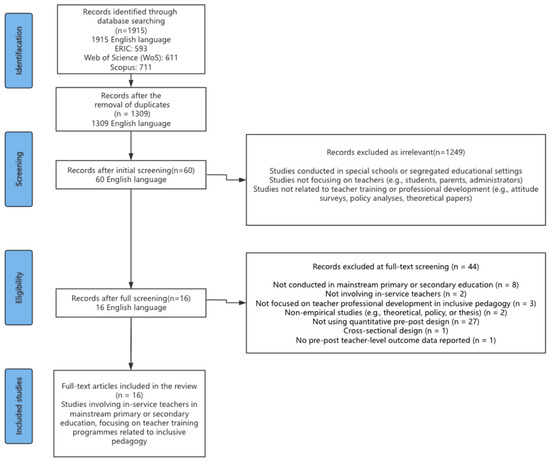
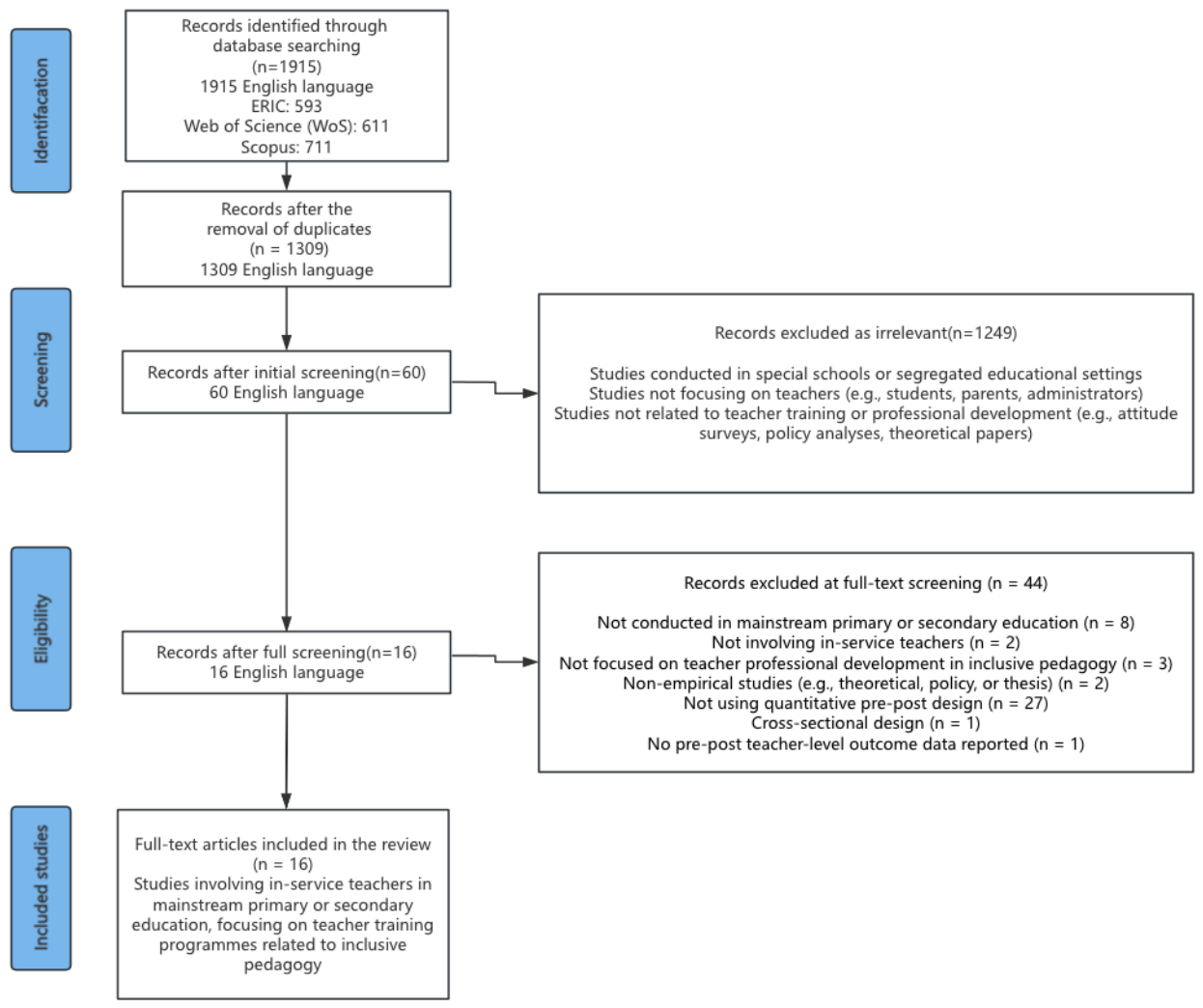

Disclaimer/Publisher’s Note: The statements, opinions and data contained in all publications are solely those of the individual author(s) and contributor(s) and not of MDPI and/or the editor(s). MDPI and/or the editor(s) disclaim responsibility for any injury to people or property resulting from any ideas, methods, instructions or products referred to in the content. |
© 2026 by the authors. Licensee MDPI, Basel, Switzerland. This article is an open access article distributed under the terms and conditions of the Creative Commons Attribution (CC BY) license.