1. Introduction
In modern and contemporary societies, science plays a central role in citizens’ lives. This role is so significant that researchers in Science Education are specifically dedicated to studying how young people engage with Science (e.g.,
Vilia & Candeias, 2020). Physics is one of the disciplines encompassed by STEM, which stands for Science, Technology, Engineering, and Mathematics. Many students perceive Physics as a difficult, inaccessible, impersonal, and irrelevant subject (
Cottar, 2012). In the specific case of Physics, research teams around the world (
Abraham & Barker, 2023;
Fernandes et al., 2025;
Francis et al., 2017;
Hazari et al., 2017;
Zohar & Bronshtein, 2005) are concerned about the existing gender gap and are seeking ways to mitigate it and attract more girls to this field of study. In particular, Physics has been the field that attracts and retains the fewest women (
Carreño et al., 2022) unlike areas such as Biology or Chemistry (
Abraham & Barker, 2023). It should be noted, however, that not all scientific fields show a gender gap: health sciences such as medicine, nursing, and biology attract more women than men (
European Commission, 2021). This pattern has been linked to vocational motivations, specifically the tendency for women to prioritize careers that allow them to work with and help others, a phenomenon described in the literature as “communal goal orientation” (
Diekman & Benson-Greenwald, 2018). Physical sciences such as Physics, by contrast, are frequently perceived as less aligned with these communal goals, which may partly explain women’s lower participation in these fields.
1.1. The Gender Gap in Physics: Scope and Prevalence
The literature indicates that the cause of this gender gap, which is particularly persistent in fields such as Physics, Engineering, or Computing (
Wilson & Low, 2016), is a combination of a wide range of factors that go beyond classroom dynamics. Historical and sociocultural aspects closely influence the way girls feel less identified with Science and Technology fields (
Brickhouse et al., 2000). These factors are broad and range from the types of play encouraged for girls (even before entering school, they are socially and culturally encouraged to play, for example, with dolls rather than building blocks) to the differentiated expectations of parents, teachers, and peers regarding boys and girls, who often perceive Science—and especially Physics—as masculine (or not very feminine), competitive, objective, and impersonal (
Buckley et al., 2022).
No evidence has been found that girls have lower intrinsic aptitude compared to boys in Science and Mathematics, which leads to the belief that the cause is sociocultural (
Li et al., 2017;
Rippon, 2023). Sociocultural explanations have gained ground in research in recent years, and
Stoet and Geary (
2018) argue that advances in contemporary Social Neuroscience reveal how negative social experiences, such as rejection or exclusion, can inhibit engagement and negatively affect self-esteem and performance, in addition to other factors such as the country of residence or ethnicity. The feeling of not belonging or the anticipation of being treated unequally affects career decisions and future success.
Although the issue of stereotypes is central to the underrepresentation of girls and women in STEM, it should be noted that in countries with high levels of gender equality, such as the Scandinavian countries, there is a significant gap between the number of boys and girls choosing these fields in secondary and higher education (
Hazari et al., 2010). This phenomenon is referred by researchers as the “gender equality paradox”. Researchers would expect the opposite, but the paradox suggests that in nations with greater equality, women have more freedom to pursue their personal preferences, which often leads them to choose fields outside of STEM. In less egalitarian countries, the same authors note that women may view STEM as an opportunity for social and economic mobility, which increases their presence in these areas. This fact leads the authors to address other causes of the gender gap, which will be explained below. Before proceeding, it is worth clarifying two concepts used throughout this paper. Gender equality refers to the formal equal treatment of boys and girls: identical access, rules, and resources. Gender equity, by contrast, refers to the fair adjustment of conditions and practices to account for different needs and starting points, with the goal of achieving equitable outcomes. The girl-friendly strategies examined in this study are grounded in the principle of equity rather than mere equality.
The gender stereotype and the cultural bias are currently the most frequently cited causes in the literature for the low participation of girls in Physics at the secondary school level, and subsequently in the pursuit of further studies. In fact, the literature shows that not choosing Physics as a subject is directly associated with not choosing a Physics degree at the higher education level. In addition to the gender stereotype, self-efficacy also plays a role; this refers to the belief in one’s ability to succeed in a particular activity or subject (
Malespina & Singh, 2022).
Lower self-efficacy appears to be higher among women (
Agra et al., 2018;
Rippon, 2023). “Physics anxiety”, characterized by apprehension regarding Science or Mathematics concepts, also seems to be linked to the lower performance of girls compared to boys (
Docktor et al., 2008). This difference is small at early ages but becomes more pronounced throughout secondary and higher education (
Docktor et al., 2008). Student performance, in fact, is a key indicator to be considered when defining educational policies and interventions at the curriculum and classroom levels (
Vilia & Candeias, 2020).
1.2. Sociocultural and Psychological Factors
According to
Hazari et al. (
2017), the gendering of science, associating the abstraction of physical concepts with the male gender and Biological Sciences with the female gender, ultimately reproduces traditional curricular practices that enhance lower performance by girls in the Physical Sciences.
Henderson et al. (
2017), in their study conducted with first-year university Physics students, reveal that boys obtained better results than girls in electricity and magnetism. However, these authors suggest that the discrepancy is not associated with psychological factors, but rather with factors related to prior knowledge from secondary education. Additionally, the authors report a greater difference between boys and girls in test results involving graph analysis in kinematics (one of the topics covered in Physics), favouring boys. International studies such as TIMSS, in its 2015 version, reveal that boys had higher Physics scores than girls in several countries including France, Italy, Russia, Sweden, the USA, Slovenia, Norway, and Portugal.
1.3. Classroom Dynamics and Teacher Practices
Dreves and Jovanovic (
1998) contend that male dominance within the classroom shapes girls’ perceptions of their own scientific abilities, especially as they advance through their education. This dynamic underscore the importance of bolstering girls’ self-confidence prior to their participation in science classes. Creating an environment where girls can openly engage in group discussions and collaborative problem-solving promotes a less competitive atmosphere. Such an approach allows them to validate their ideas and, as a result, enhances their performance in the subject (
Cwik & Singh, 2022;
Eickerman & Rifkin, 2020;
Harskamp et al., 2008).
On the other hand, teachers often fail to provide girls with the necessary encouragement to pursue Physics, instead emphasizing the challenges they may encounter in the subject (
Fernandes et al., 2024;
Zohar & Bronshtein, 2005). This dynamic is reflected in various aspects of the classroom environment.
Murphy and Whitelegg (
2006) note the disproportionate attention teachers give to boys, to the detriment of girls, as boys tend to be more participative and often dominate classroom interactions (
Oliveira, 2018). As a result, girls become accustomed to not being the main protagonists, perceiving that space as reserved for boys (
Due, 2014;
Oliveira, 2018).
Murphy and Whitelegg (
2006) further observes that boys participate in a more competitive manner, while girls tend to avoid conflict. Consequently, boys receive more feedback, both positive and negative. Moreover, since the teacher-student relationship is more significant for girls than for boys, this factor also becomes a disadvantage for girls. Additionally, teachers often hold higher expectations for boys, which constitutes an additional constraint for girls.
Idin et al. (
2017) emphasize the importance of enhancing teacher preparation in relation to gender-equitable practices in science education. In a study conducted by the authors with Portuguese Physics and Chemistry teachers, teachers perceive that boys and girls participate at similar levels, and that girls’ participation has either remained stable or increased (
Fernandes et al., 2025).
Outside the classroom, and regarding family expectations, parents play a direct role in their daughters’ education and socialization. Girls have less access to technological toys, hobbies, and games. On the other hand, boys are more likely to play football, ride bicycles, and build toys with circuits and mechanical components compared to girls. In this way, boys seem to develop a richer foundational knowledge and display more positive attitudes toward Physics. This perception is reinforced not only by parents but also by other family members, friends, books, films, and the media.
Sáinz et al. (
2012) reveal that parents’ perceptions of gender differences constitute another barrier to girls’ participation in STEM, and specifically in Physics. Many parents still consider certain professions and academic fields, such as Technology, to be more suitable for boys.
Zohar and Bronshtein (
2005) also note that parents view Physics as a male domain.
1.4. Girl-Friendly Strategies in Physics Education
With regard to classroom-specific factors, gender-inclusive education (often referred to as “girl-friendly” strategies) can positively influence girls’ interest and achievement in science disciplines, with effects that are often more pronounced than those observed among boys (
Dare et al., 2017). These strategies may take various forms, including curricular adaptations, changes in assessment practices, the inclusion of role models, student-centred teaching approaches, and the promotion of peer communication.
Dare and Roehrig (
2016) argue that STEM-oriented approaches may positively influence girls’ perceptions of Physics, particularly when grounded in student-centred pedagogy, collaborative work, communication, and discussion, while highlighting the social dimension of science. The integration of Physics concepts related to the human body, especially when framed around engineering design solutions to real-world problems, also appears to enhance girls’ engagement. Similarly,
Sagala et al. (
2019) suggest that STEM-based instruction may support girls’ conceptual understanding in Physics. The Science–Technology–Society (STS) approach further contributes to this process by incorporating socio-scientific issues into learning contexts (
Hughes, 2000). In addition,
Smith (
2012) emphasizes the relevance of human-body contexts and the use of storytelling as strategies to inspire and motivate girls in Physics.
One factor teachers also need to consider is the type of language used in physics classes.
Stadler et al. (
2000) argue that girls tend to rely on everyday language for longer than boys, which can make it more difficult for them to appropriate abstract scientific concepts. The same authors note that the frequent use of anthropomorphic expressions to explain physical phenomena can also have differentiated effects on understanding. They report that boys and girls appear to make sense of physics in distinct ways: boys are more likely to accept and work with the internal coherence of formal concepts, whereas girls tend to engage more readily when these concepts can be anchored in broader, familiar everyday contexts.
Eliasson et al. (
2017) further show that boys answer most of the teachers’ questions, which are predominantly closed questions that can be addressed with short responses. A possible strategy, therefore, is to pose more open and cognitively demanding questions to the whole class, requiring longer chains of reasoning and inviting broader student participation.
1.5. The Portuguese Context and Research Gap
Despite the scarcity of studies addressing this specific topic, data from Portugal also indicate that the gender gap persists in STEM fields. A recent study involving 190 12th grade students in Portugal found that interest in pursuing studies in engineering and technology was significantly higher among boys compared to girls (
Ribeirinha et al., 2024). According to PORDATA (
Fundação Manuel dos Santos, 2026) in 2025, the number of female students enrolled in higher education courses related to Engineering, Industry, and Construction in Portugal was 27.8% of the total student population. According to the same source, the data reveal an even more persistent pattern, as the proportion of female students enrolled in Higher Education in the field of “Sciences, Mathematics and Informatics” was 39.4% in 2025, compared to 64.1% in 1991, representing a progressive decline over time. This persistent gender gap highlights the importance of addressing gender issues as a mean to pave the way for women to acquire the skills necessary to pursue careers in STEM fields (
Huffman, 1998). To effectively promote gender equity in these areas, it is essential to understand what occurs within the classroom from the perspective of students, particularly from the viewpoint of female students, and their teachers.
Given the evidence presented above, and particularly the well-documented scarcity of research on the gender gap in secondary-level physics education in Portugal, this study addresses the following research questions, specifically in this underexplored context: Drawing on the literature reviewed, it is guided by the expectation that classes in which teachers implement a wider range of girl-friendly strategies may display comparatively higher levels of female student engagement, autonomy, and performance than classes where fewer such strategies are adopted. RQ1: What barriers do female students in 10th-grade secondary Physics perceive as most constraining to their learning, and how do these barriers manifest in classroom interactions? RQ2: To what extent do girl-friendly strategies implemented by teachers co-occur with differences in female students’ engagement, autonomy, and diagnostic test performance across classes? RQ3: What are teachers’ beliefs and self-reported practices regarding gender-inclusive pedagogy, and how do these relate to observed classroom dynamics? By articulating these dimensions, the study intends to develop a holistic understanding of the phenomenon within the context of this multiple case study.
2. Materials and Methods
This study adopts a convergent parallel mixed-methods observational and cross-sectional design (
Creswell & Clark, 2017), employing multiple data collection strategies, including testing, non-participant naturalistic observation, questionnaire surveys administered to collaborating teachers, and semi-structured interviews conducted with participating female students, aiming to provide a more comprehensive and nuanced understanding of the phenomenon under study. The choice of this methodological approach reflects the intention to examine, in an integrated manner, the processes of teaching and learning as a unified act. In this regard, Paulo Freire argues, in his Letter to Teachers, that “there is no teaching without learning”; in other words, “the act of teaching requires the existence of both those who teach and those who learn” (
Freire, 2001, p. 1). This perspective aligns with the rejection of a strict dichotomy between qualitative and quantitative approaches (
Kumar, 2011), supporting instead their complementarity within a coherent research framework.
This multiple case study was preceded by a request for authorization from the Portuguese Directorate-General for Education, to which the methodological note and the data collection and analysis instruments were attached. Prior to this, a request for collaboration had also been submitted to the school administration board, which was returned to the researcher with a positive decision. Because the participants were minors, informed consent was sent to the students’ parents/guardians: one for classroom observations and the administration of the diagnostic test, and another for conducting interviews with the female students. Both were signed prior to the start of the study. The identities of the interviewed female students and teachers were replaced with random codes to ensure the anonymity of participants and to comply with national data protection legislation.
2.1. Participants
Three teachers who taught 10th grade Physics and Chemistry, along with their respective classes, were selected from a secondary school located on the outskirts of Lisbon, as participants. In Portugal, Physics and Chemistry are taught together as a single subject, commonly referred to as “Physics and Chemistry,” up until the 11th grade. In the Science Course, Physics and Chemistry A [Física e Química A] is an optional subject in the 10th and 11th grades.
Sampling was non-probabilistic and based on convenience. In the case of the students, this decision was guided by practical and contextual considerations, particularly the use of pre-existing class groups to which the researcher had access. Such approach is consistent with case study research, where sampling is often determined by feasibility and the in-depth exploration of a bounded context rather than by representativeness (
Coutinho, 2011). Of the three collaborating teachers who participated in the study, two were female and belonged to the school’s permanent staff, while one was male and part of the pedagogical zone staff. The three teachers were selected based on convenience sampling criteria: availability to participate, access granted by the school administration, and teaching of the 10th-grade Physics and Chemistry A curriculum during the study period. None of the three teachers had received formal prior training in gender-inclusive pedagogy before the informational session described in Stage 1; the session therefore constituted the sole professional development input on this topic within the scope of the study
1. The characteristics of the participants (teachers and the students’ gender distribution of each class) are presented in
Table 1. Seven female students from the three classes who completed the study were also interviewed. These students volunteered to participate, representing approximately 30% of the female students involved.
The study began with an informational session for the collaborating teachers about the barriers faced by girls in STEM fields, particularly in Physics, and the girl-friendly strategies that can be used to overcome them. It should be noted that this session constituted a contextual briefing rather than a controlled instructional intervention regarding language, classroom interaction, assessment, and instructional approaches. During this session, the data collection instruments to be implemented were explained and the teachers were encouraged to implement them. During this moment, there was also collaborative work between the researcher and the teachers, which resulted in a laboratory worksheet and a group-work guide on the contribution of Madame du Châtelet to Science (
Von Baeyer, 2007). The laboratory activity integrated STEM education and was framed within the context of a skate park, where students used finger skateboards and were encouraged to think about the construction of a skate ramp, applying the concepts of kinetic, potential, and mechanical energy.
2.2. Data Collection Instruments
All instruments were previously validated and pilot-tested by a panel of five experts, including secondary Physics teachers and education researchers, and consisted of a diagnostic test, the observation of a practical lesson, and semi-structured interviews. Content validity was confirmed by the expert panel through iterative review of the instruments prior to data collection. For the qualitative data, inter-rater reliability was established through independent double-coding of a 10% subset of the interview and observation data by a second researcher, followed by discussion and consensus. The first author then proceeded with full coding of the remaining data. The students from the three 10th-grade classes participated, completing a previous diagnostic test through a LimeSurvey platform. The diagnostic test was administered prior to the teaching of the 10th-grade unit on “Energy and its conservation” to assess potential differences between classes and gender at the outset of the study. It should be noted that students had previously acquired foundational knowledge in this domain during lower secondary education. The test consisted of ten dichotomous-choice items related to the main alternative conceptions about forces and energy (
Valadares, 1995). Care was taken in the wording of the questions to avoid ambiguity, as unclear or imprecise language has been identified as a factor that may disadvantage female students in assessment contexts (
Malik, 2021).
The main objective of the diagnostic test was to analyze possible differences in the number of alternative conceptions with respect to gender and between classes. The analysis of alternative conceptions in Physics, particularly in topics such as light, heat, mechanics, or electricity, has been extensively studied by Education specialists over the past two decades (
DeFigueredo, 1994), and these misconceptions are found to be more frequent among girls (
Abdul & Akhilesh, 2008). According to a previous study, students, regardless of gender, show a preference for laboratory classes (
Fernandes et al., 2024). Therefore, a 150-min laboratory session was observed, in which the activity involved the variation in kinetic energy on an inclined plane. The observation focused mainly on the students’ behaviour, the participation of female students, and the teacher’s intervention. An open protocol was used: the researcher attended the lesson, took notes, and did not interfere with the class. Classroom observation made it possible to analyze teaching practices in detail, as well as the participation of female and male students, providing important insights into the effectiveness and challenges of inclusive pedagogical approaches. Three practical lessons (one session) from each of the teachers’ classes were observed, considering the female students’ preference for experimental lessons (
Fernandes et al., 2024), each lasting 150 min with a 5-min break. Only field notes recorded by the researcher were collected.
The presential interviews with the female students aimed to understand how the girls perceived the strategies implementation. The interviews with the female students were conducted after the classroom observations had been completed and included those students who had volunteered to participate. Of the seven female students interviewed, two were from class 1, two from class 2, and three from class 3. The six questions were designed to guide the conversation from broad themes to more specific ones (and also across time, so that the interviewees could reflect retrospectively on their experiences and project themselves into the future. The questions were organized into three domains, as shown in
Table 2: teaching strategies used by teachers and their relevance for female students; perceptions of Physics teaching; the impact of the strategies used on learning and future perspectives.
An initial and a final questionnaire were administered to the teachers, both online, using the LimeSurvey platform. The initial questionnaire consisted of three questions, addressing essentially two domains: teachers’ views of girls in STEM and the implementation of girl-friendly strategies, as shown in
Table 3.
A final questionnaire was also administered to the collaborating teachers to determine which girl-friendly practices they had or had not implemented. The questionnaire included two types of items: closed-ended and open-ended. The first part, comprising 12 items, aimed to identify the practices carried out in the classroom (with only two response options: “yes” and “no”). The second part, consisting of three items, included two open-ended questions regarding the most significant practices, the reasons for not implementing girl-friendly strategies, and teachers’ perspectives on continuing to apply such strategies, as shown in
Table 4.
2.3. Data Analysis Instruments
The SPSS® software (Statistical Package for the Social Sciences), version 29, was used for the statistical analysis of the quantitative data obtained in this study. Descriptive statistics was employed to analyze the results of the diagnostic test. Given the small sample size, inferential statistics were not applied, as the assumptions required for parametric tests (e.g., normality, adequate cell frequencies) could not be met. The descriptive analysis focused on measures of central tendency (mean, median) and dispersion (standard deviation, minimum, maximum), disaggregated by gender and by class, to allow contextual comparison of performance across the three groups.
The interviews, conducted using a survey technique, were analyzed through qualitative content analysis (
Bardin, 2024). This approach allowed for the identification of two main types of data: categories and subcategories. Complementarily, a quantitative analysis was carried out using a frequency table, which helped to illustrate the distribution and recurrence of themes across students’ responses and teachers’ questionnaires.
This study employed both quantitative and qualitative approaches to provide a comprehensive understanding of students’ and teachers’ perspectives. Together, these complementary methods enabled a more robust interpretation of the findings, which are presented in the following section.
3. Results
3.1. Diagnostic Test
Regarding the diagnostic test, when analyzing the data, considering all students, and taking into account that this test assessed knowledge acquired in lower secondary education, the girls achieved, on average, better results than the boys, as shown in
Table 5. It should be noted that both boys and girls obtained positive average scores, for a total of 10 points.
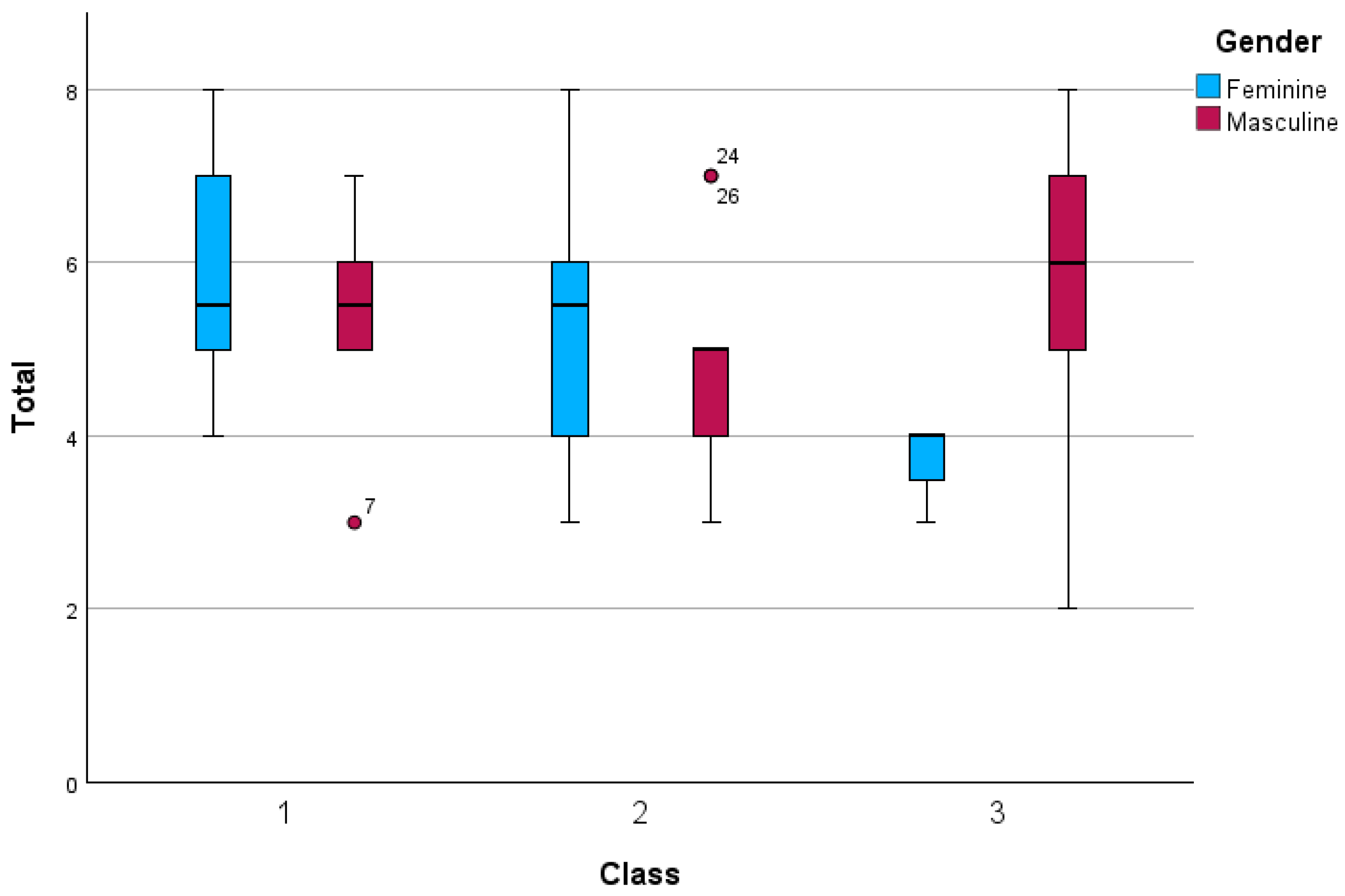
On the other hand, when the analysis is carried out by class, the results provide a different type of information.
Figure 1 shows the boxplot of the data disaggregated by classes. This figure shows that in classes 1 and 2, the median score obtained in the diagnostic test is equal to or higher for the girls. The same does not occur in class 3. However, in classes 1 and 2 the maximum values also belong to the girls, which is not the case in class 3. It can also be observed that Class 3 is the only one in which the girls’ median score falls within the negative range (<5 points).
3.2. Observation of Practical Lessons
The classroom observations revealed marked differences between classes regarding teacher intervention, female participation, and student autonomy. Results are organized according to three observation categories: (i) teacher attention distribution; (ii) female student participation and autonomy; and (iii) classroom management and disruptive behaviour. Regarding teacher attention distribution and student participation: in class 1, the teacher integrated the story’s context into the activity and interacted closely with all students, with girls and boys showing similar initiative in handling the equipment, and students displaying a high level of autonomy. In class 2, the teacher distributed attention evenly across groups, checking measurements and clarifying doubts, but it was mostly the boys who manipulated the equipment, while the girls tended to focus on writing the report, although the class remained generally autonomous. In contrast, in class 3 the teacher spent more time with the boys’ groups, girls were largely assigned to report-writing while boys operated the equipment, and the class was noisier and less autonomous.
Regarding behaviour, several disruptive behaviours were observed in class 3, indicating a lack of interest on the part of the boys, who nevertheless ended up monopolizing the teacher’s attention. These students did not carry out the tasks, laughed and talked among themselves, and did not hold back even in the presence of another teacher in the classroom. It was also noted that the boys showed enjoyment of the practical components, often with a playful attitude, as described in the literature.
3.3. Semi-Structured Interview to the Female Students
This section outlines the results obtained from the semi-structured interviews conducted with female students. Two main categories were identified, related to “barriers” and “implementation of girl-friendly strategies”. The categories and subcategories are described in
Table 3, along with some examples for each of them.
The results (
Table 3) indicate that the main barriers to girls’ learning in Physics are related primarily to the complexity of the subject and to classroom interactions. Discipline complexity was mentioned by all seven participants (18 references), highlighting students perceived difficulties with the multiple skills required to understand Physics concepts. Peer-related factors were also prominent (6 participants; 19 references), suggesting that interactions with male classmates may constrain learning, for example through reduced confidence or limited participation. This barrier can be manifested at the level of “noise”, as reported by one of the students: “in the 9th, 8th and 7th grades, they [boys] were very noisy.” Another student stated: “it was confusing, I won’t lie.” Some students reported that this behaviour of their male classmates ended up affecting their learning: “it was very noisy… and that didn’t help (…) it ends up being [a barrier]. Not that it is only their fault… but it ends up hindering things a bit.” Another student added: “I believe so. Because everyone who tries to do an exercise… I, for example, need silence to concentrate on the questions. And since the boys were always talking, I couldn’t concentrate properly. And then, sometimes, someone would say something and it would turn into something else instead of the exercise. And that really affects things”.
The teacher’s role as a constraining factor was less frequently reported (4 participants; 6 references), indicating that while teaching practices may influence learning, they were not perceived as the principal source of difficulty when compared with subject-related demands and peer dynamics. One of the students stated: “Last year’s teacher was all about memorising, memorising; if we didn’t, then it was our problem”. The teacher’s role as a barrier to learning can be illustrated by the statements of the students from class 3. The monotony of the lessons, described as “boring”, the lack of diversity in teaching strategies, and the teacher’s unclear explanations (“I think it is just a matter of the teacher explaining better”), as well as the absence of alternative explanations, were identified as constraining factors. Students also referred to the lack of classroom examples or materials related to situations of personal interest and to lessons not being “fun”. In addition, a lack of trust in the teacher was reported, as one student stated: “because I may have a doubt that seems very silly, and I don’t ask.”
Regarding the implementation of girl-friendly strategies, the most frequently reported practices were those that promoted active engagement and practical learning. Active participation, supported by teachers’ availability to answer questions and encourage student involvement, was mentioned by six participants (6 references). Hands-on activities were also considered beneficial (4 participants; 7 references), reinforcing the importance of experiential learning. Other strategies, such as video lessons (2 participants; 8 references) and Socratic dialogue (2 participants; 5 references), were mentioned by fewer students but still contributed to perceived learning support. Strategies involving alternative explanations, contextualisation through every day-life example, and peer support were reported only sporadically (1 participant each), suggesting that although present, they played a less central role in the students’ accounts (
Table 6).
Video lessons (class 1) appear to be the distinguishing factor in terms of girl-friendly strategies for these girls who prefer Physics because they understand it better. One of the students stated: “I think Physics is a bit more demanding. A bit more demanding, but in a good way, not in a bad way. I think I am enjoying Physics more, for now.” Another student added: “I prefer Physics. Yes, Physics, maybe yes. I think it is easier than Chemistry (…) I think it is more enjoyable because I understand how things work and you can see… ‘Oh, this works like this because this happens like this’. Regarding the teacher’s role, this was one of the most frequently mentioned strategies by the students. One of them stated: “I think so, she often asks us if we have any questions; of course, there are doubts… we say we do, and she tries to help” (class 1). Another student added: “Yes, yes. The teacher explains everything” (class 2).
Of the seven girls interviewed, it was mainly the students from classes 1 and 2 who reported the implementation of girl-friendly strategies. The teacher of class 1 implemented a system of video lessons, which was highly appreciated by the students.
3.4. Teachers Questionnaires
The initial questionnaire administered to the teachers was conducted immediately after the clarification session. The results of the questionnaires completed by the three teachers who continued in the main study are presented in
Table 7.
Regarding the results of the final questionnaires, particularly the self-assessment of the strategies implemented in the classroom, the results differ, as shown in
Table 8, with the teacher of Class 3 being the one who implemented the fewest strategies in their lessons.
On the other hand, when indicating the most and least significant strategies, it becomes clear that, in the case of the teacher of class 2, the strategies not implemented were those considered least significant. “Lack of time” to implement them was one of the reasons mentioned by the teachers of classes 2 and 3. The teacher of class 2 did not apply the “complex questions addressed to girls”, as she considered them less relevant, nor the “group problem solving” activity. The teacher of class 3 stated, “I did not use everyday language because my goal was to employ scientific language”, which suggests that the girl-friendly strategy was not fully understood. Finally, all teachers agreed to continue using girl-friendly strategies in future school years, indicating a certain level of concern regarding the issue under study.
4. Discussion
In this study, the combined analysis of the diagnostic test, classroom observations, teacher questionnaires, and interviews with female students allowed for a consistent triangulation of findings, strengthening the interpretation of how teaching practices shape girls’ experiences in Physics. Rather than treating each data source separately, the convergence between quantitative and qualitative evidence revealed coherent patterns across classes.
Differences in initial performance between classes were not uniform. In classes 1 and 2, girls’ median results were equal to or higher than those of boys, suggesting comparable or higher performance among girls in those classes. In contrast, in class 3, predominantly male, girls showed lower median results, including some negative scores. This quantitative pattern was reinforced by observational and interview data: in class 3, a lower proportion of girls and more disruptive classroom dynamics were observed, alongside lower female participation and confidence. Although international studies frequently report lower performance among girls, in this case the disparity was contextual rather than generalized. Overall, the results appear to contradict the literature on the gender gap in physics performance. While
Burkholder and Salehi (
2022) found a gender difference in students’ initial physics performance using the Force and Motion Conceptual Evaluation,
Hedgeland et al. (
2018) reported no gender bias in formative assessments administered to first-year physics students. In this study, as in theirs, multiple-choice questions used in a formative context showed no disadvantage for female students.
Burkholder and Salehi (
2022) also noted higher test anxiety among girls, a factor that may have been mitigated here since students knew the assessment was formative only.
Triangulation was particularly evident in the analysis of technical skill development. In classes 1 and 2, observations showed a more balanced distribution of experimental tasks, which interviews confirmed as contributing to greater autonomy and confidence among girls. In class 3, however, girls were often relegated to data-recording roles while boys handled technical equipment. This gendered division of labour, observed directly in class and corroborated by girls’ reports of insecurity, limited their opportunities to develop technical competencies, and was compounded by boys’ cumulatively disruptive behaviour, which led the teacher to invest even less time in supporting the girls, as also reported by
Fernandes et al. (
2024). By contrast, even when interested, the girls seemed more focused on the formal completion of the task, remaining organized and concentrated on data collection and analysis, as highlighted in the literature (
Hasse, 2002).
Pregaldini et al. (
2020) highlight that the gender composition of classes can directly influence students’ performance and learning environment, particularly in male-dominated subjects like physics. Classes with a higher proportion of girls tend to be less competitive and more collaborative, benefiting overall learning outcomes and classroom dynamics. In such settings, both girls and boys perform better and experience fewer disruptions, as greater group cohesion encourages participation and interaction. Conversely, male-dominated classes may foster competitiveness that can discourage girls’ engagement in STEM subjects.
Importantly, across all classes, interviewed girls identified the perceived difficulty of the subject and structural barriers such as textbook organization as obstacles, echoing previous findings (
Fernandes et al., 2024).
The implementation of girl-friendly strategies also varied across contexts, and again the three data sources converged. Class 1 experienced the most comprehensive application of inclusive strategies, including contextualized laboratory materials, socio-scientific group work, and deliberate equitable teacher support. This class not only showed stronger female performance in the diagnostic test but also higher reported interest and engagement. In class 2, although some inclusive practices were observed (e.g., use of the socratic method), limitations such as the absence of socio-scientific tasks were noted, with the teacher citing time constraints. According to
Lestari and Deta (
2021), the socratic method (originally developed by Socrates) is a questioning-based approach that fosters critical thinking. In this strategy, the teacher acts as a facilitator, guiding students through reflective questioning to examine scientific concepts, recognize inconsistencies, and build evidence-based explanations. The authors argue that this metacognitive technique enhances students’ problem-solving skills in physics. In class 3, fewer inclusive strategies were implemented, scientific language was prioritized over everyday language, and socio-scientific dimensions were largely absent. Observational data and student testimonies consistently indicated that this environment contributed to greater passivity among girls.
Notably, everyday contextual activities such as the skate-ramp task, emphasized by teachers, were not highlighted by any interviewed girl, suggesting a possible mismatch between intended and perceived impact, contrary to what the literature seems to illustrate about the importance of STEM education in fostering girls’ motivation and performance. This finding warrants closer attention: context-based tasks are only effective if the chosen context resonates with students’ own frames of reference (
Wheeler & Blanchard, 2019). The skate-ramp scenario, while designed to be engaging, may not have been perceived as personally relevant by the interviewed girls. Furthermore, the data suggest that relational factors—specifically, teacher accessibility and the quality of teacher–student interaction—may be more salient to girls than specific task designs, consistent with the literature on the importance of teacher–student relationships for girls in Physics (
Murphy & Whitelegg, 2006).
It is also important to acknowledge that not all research on girl-friendly strategies reports positive effects. Some studies indicate that context-based tasks may be ineffective or even counterproductive when poorly designed or implemented without awareness of students’ actual interests (
Abraham & Barker, 2023). Similarly, research suggests that collaborative group work is only beneficial for girls when group composition and task structure are carefully managed (
Harskamp et al., 2008). The present study, while observing positive associations in classes 1 and 2, does not claim that girl-friendly strategies are universally effective; rather, it suggests that their effectiveness depends critically on implementation quality, teacher beliefs, and the relational context in which they are deployed.
Across both upper and lower secondary levels, girls consistently reported limited diversification of teaching strategies, reinforcing patterns already identified in the exploratory study. Teacher–student relationships also emerged as a critical mediating factor. In classes 1 and 2, the teacher fostered a welcoming environment and actively supported girls’ participation, whereas in class 3 the teacher was described as less accessible and more aligned with traditional approaches. In contexts where gender stereotypes may be more salient, such as predominantly male classrooms, teacher practices become even more significant. Although this study did not directly examine the role of female teachers as role models, it highlighted the importance of concrete pedagogical actions in shaping participation and confidence. Empirical evidence consistently shows that role models play a crucial role in shaping STEM academic and career trajectories, particularly for women. As empathy, encouragement, and inspiration are especially impactful in early career stages, helping students envision success as attainable and reinforcing their sense of belonging in STEM fields (
Tal et al., 2024). However,
Cheryan et al. (
2011) indicates that the impact of a teacher as a role model in STEM is not determined by their gender per se, but by the extent to which they embody or challenge prevailing stereotypes associated with these fields. Both male and female teachers who reinforce narrow, “geek” stereotypes can reduce women’s anticipated success and sense of belonging, whereas non-stereotypical role models, regardless of gender, can foster greater interest and perceived compatibility with STEM.
None of the teachers used group problem-solving strategies. One possible teaching approach is the Think–Pair–Share strategy. According to
Gok (
2018), this method involves three main stages: (1) Think: the teacher presents a question or problem, and students reflect on it individually; (2) Pair; students form pairs (or small groups, if preferred) to share their answers and ideas, reaching a consensus. During this stage, the teacher moves around the classroom, observes discussions, and addresses questions; (3) Share: students present their responses or conclusions to the whole class, with the teacher leading a collective discussion. According to the same author, this strategy has significant positive effects on conceptual learning compared to traditional teacher-centred methods.
Regarding the results of the final questionnaires, the teacher of class 3 was the one who implemented the fewest strategies in his lessons. These data are consistent with the impressions gathered by the researcher during the debriefing session. This teacher believed that gender differences in STEM are due to biological causes rather than socialization processes, unlike the other two teachers. His questionnaire responses consistently framed gender differences as innate rather than contextual: he reported no concern about girls’ STEM participation, attributed lower female performance to intrinsic factors, and explicitly stated that boys have “greater competence in STEM.” These beliefs appear to have directly shaped his pedagogical choices, prioritizing scientific language over accessible language, avoiding socio-scientific tasks, and focusing attention predominantly on male students. While the data do not allow causal conclusions, the coherence between this teacher’s beliefs and his observed practices is consistent with research showing that teachers’ epistemic beliefs about gender shape their classroom behaviour (
Zohar & Bronshtein, 2005;
Idin et al., 2017). On the other hand, the teachers’ responses to the initial questionnaire, these reveal a certain lack of knowledge concerning some concepts. This is the case of gender equity, which is distinct from gender equality (as mentioned by the teacher of class 2). On the other hand, the concept of coeducation (mentioned by the teacher of class 1)—the term used to describe an educational system in which boys and girls attend the same institutions and share the same learning spaces (
Aragonés-González et al., 2020)—is also not applicable in this context, since girl-friendly strategies can be implemented regardless of the educational system. As for concerns about girls’ academic success, there is a notable difference between the responses of the teacher of class 3 and those of the teachers of classes 1 and 2. While the former explicitly refers to boys having “greater competence in STEM” compared to girls, the teachers of classes 1 and 2 show greater awareness of the gender gap in STEM fields, along with other factors that may contribute to its widening, such as ethnic or economic issues.
Overall, the triangulated evidence suggests that girl-friendly strategies, such as inclusive language and analogies, equitable feedback and time allocation, socio-scientific tasks highlighting women’s contributions to science, and supportive teacher–student relationships, are associated, within this group, with improved performance and interest among girls in Physics. Conversely, in contexts where such strategies were limited, girls’ participation, autonomy, and confidence were reduced.
Teacher resistance, often framed as time constraints or the perception that no gender gap exists, may obscure the subtle but significant impact of classroom environment and pedagogical choices. The Class 3 teacher’s biologically deterministic beliefs merit particular attention in this regard. His questionnaire responses consistently framed gender differences in STEM as innate rather than contextual: he attributed lower female performance to intrinsic factors, expressed no concern about girls’ participation, and explicitly stated that boys have greater competence in STEM. These beliefs appear coherent with his profile as the only male teacher in the study, with the least teaching experience and without a permanent position at the school, factors that may be associated with reduced exposure to collaborative professional reflection and continuous professional development. While no causal explanation can be drawn from the data, the coherence between his beliefs and his observed practices—prioritizing scientific language, avoiding socio-scientific tasks, and attending predominantly to male students—is consistent with research showing that teachers’ essentialist beliefs about gender tend to translate into less equitable classroom behaviour (
Zohar & Bronshtein, 2005;
Idin et al., 2017). More broadly, as
Mulhall and Gunstone (
2008) note, ‘old beliefs die hard’ when referring to teachers’ resistance to changing methodologies, even in subjects such as Physics. This phenomenon may result from several factors, such as limited professional development, rigid curricula, or conceptions of the subject as being highly mathematical, leading teachers to resist adopting strategies that emphasize more qualitative or exploratory aspects. The findings thus highlight the need for greater awareness and professional reflection regarding the role of teaching practices—and the beliefs that underpin them—in promoting gender equity in Physics education.
5. Conclusions
This case study highlights the decisive role of classroom practices in shaping girls’ learning experiences and participation in secondary Physics. The triangulation of diagnostic test data, classroom observations, and interviews revealed that girl-friendly strategies, such as equitable interaction, diversified pedagogical approaches, contextualized examples, and socio-scientific tasks, are associated with higher autonomy, confidence, and achievement among female students. In classes where these practices were implemented consistently, girls demonstrated greater engagement and stronger results. Conversely, in the class with fewer inclusive strategies, girls were relegated to peripheral roles, expressed lower confidence, and obtained weaker test scores, suggesting that pedagogical decisions may contribute to reinforcing or reducing gender disparities within this context.
Teachers’ beliefs emerged as a critical factor. Most strikingly, the teacher who held biologically deterministic views of gender differences, attributing boys’ perceived STEM advantage to innate rather than sociocultural factors, implemented the fewest inclusive practices and presided over the class in which girls showed the lowest diagnostic test results, the most passive roles, and the lowest reported confidence. This contrast with the other two teachers, who showed greater awareness of gender inequities and adopted broader and more equitable strategies, suggests that initial teacher education in Physics and Chemistry may benefit from explicitly addressing gender beliefs, their epistemological basis, and their classroom consequences. These findings reinforce the need for targeted teacher education on gender-equitable pedagogies.
A key implication is the importance of considering the integration of gender-inclusive pedagogy into initial teacher education and continuous professional development. The findings of this study, consistent with the broader theoretical and empirical literature on gender equity in Physics education, suggest that providing teachers with structured training, practical tools, and reflection opportunities may be a productive avenue for reducing the gender gap. Specifically, the following policy recommendations are proposed: (1) include mandatory modules on gender-inclusive pedagogy in initial teacher education programmes for Physics and Chemistry; (2) promote structured peer observation with gender-focused feedback as part of continuous professional development. Larger-scale studies are needed to test and refine these recommendations. Notably, the contrast between the Class 3 teacher, whose biologically deterministic beliefs co-occurred with markedly fewer inclusive practices and poorer female student outcomes, and the other two teachers, underscores the role of teacher beliefs as a proximal factor in gender-equitable pedagogy and stands as a primary argument for reform in initial teacher education.
Despite the small sample size, this study offers important insights into how classroom-level interventions can contribute to reducing the gender gap in Physics. Future work will expand the sample to understand teachers’ knowledge, beliefs, and use of girl-friendly strategies on a broader scale. Future research could also adopt a longitudinal design to track the sustained impact of girl-friendly strategies on female students’ attitudes, performance, and STEM career intentions, and examine whether the mismatch observed between teacher-valued contextualized tasks and student-reported strategies can be reduced through more participatory curriculum design processes.
Limitations. Several limitations should be acknowledged when interpreting these findings. First, the small sample size (three teachers and their respective classes from a single school on the outskirts of Lisbon) restricts the transferability of the results; these findings are not intended to be statistically generalizable, but rather to offer analytical generalisability within the case study framework. Second, the cross-sectional design does not allow for causal inferences; all associations reported should be understood as co-occurrences within a specific context. Third, the study lacks longitudinal follow-up, meaning that any longer-term impact of the observed teaching practices on female students’ Physics attitudes or academic trajectories cannot be assessed. Fourth, the interview sample was self-selected (students who volunteered), which may introduce a response bias, as more engaged or confident students may have been more likely to participate. Fifth, the data collection instruments were validated by an expert panel but inter-rater reliability for the coding of observations and interviews, while applied, was not systematically reported in the original submission and has been addressed in the revision. Sixth, some questions in the interview guide were formulated as semi-structured probes rather than fully open-ended questions (e.g., “Does the teacher encourage you to ask questions?”), which may have introduced a degree of acquiescence bias in participants’ responses. In future studies, these questions should be reformulated in a more open-ended format to reduce the risk of response bias and allow for richer, less directed accounts. These limitations are compensated in part by the triangulation of multiple data sources and the depth of the qualitative analysis, which together provide a coherent and internally consistent account of the phenomena observed.