Essay

Designing Resilient STEM Trajectories: An Ecological Framework for Sustained Participation

1
Educational Psychology and Research on Excellence, Friedrich-Alexander University Erlangen-Nuremberg, 91054 Erlangen, Germany
2
Department of Educational Sciences, University of Regensburg, 93053 Regensburg, Germany
*
Author to whom correspondence should be addressed.
Educ. Sci. 2026, 16(5), 790; https://doi.org/10.3390/educsci16050790

Submission received: 18 December 2025 / Revised: 17 April 2026 / Accepted: 13 May 2026 / Published: 18 May 2026
(This article belongs to the Topic Organized Out-of-School STEM Education)

Abstract

STEM learning unfolds over many years. It is shaped by changing contexts, transitions, and occasional breaks. However, much of the existing work still focuses on single stages or isolated factors. This article introduces the E3 Framework. Its purpose is to provide a language for examining why some STEM trajectories endure, why others fade, and what kinds of ecological alignment allow learning to remain viable in the flow of real life. Based on a systemic approach, we aim to explain how STEM participation is preserved over time. This framework describes stability as the result of interactions among three ecological domains: resources, regulation, and time. We identify five key functions—robustness, regulatory re-alignment, renewal, informational persistence, and environmental fit. These functions show how engagement holds steady or recovers as circumstances shift. The E3 Framework offers a way to analyze how supports, feedback loops, and time-related structures either come together or fall apart. We provide simple design guidelines and matrices to show how educators and policymakers can better support STEM trajectories.

1. Introduction

Sustaining STEM engagement over time remains a major challenge (Archer et al., 2015; Stoeger et al., 2024; Subotnik et al., 2011). This paper offers a new look at how such participation is maintained, conceptualizing resilience as an emergent property of coherent developmental ecologies.
To examine how stability unfolds, we focus on the concept of a STEM trajectory. We define a STEM trajectory as a non-linear sequence emerging from the coordination between learner dynamics and contextual affordances. Rather than describing a smooth progression, a STEM trajectory reflects how participation stabilizes, adapts, or disintegrates in response to change—be it internal or external, expected or abrupt.

The Fragility of STEM Trajectories

Even in early childhood, learners accumulate first experiences with numbers, natural phenomena, and technical artifacts (Alexander et al., 2019; Çolakoğlu et al., 2023; Hussim et al., 2024). Institutions such as preschool or kindergarten frequently build on these early encounters (OECD, 2017).
Formal STEM education continues in schools and universities (Freeman et al., 2014; Lynch et al., 2019); however, extracurricular and informal learning environments continue to play a vital role (Allen et al., 2019; Ludwig et al., 2024). In some cases, learners collect thousands of hours of practice (Ericsson et al., 1993; Macnamara et al., 2014). Following patterns of deliberate practice described in the expertise literature (Miller et al., 2021), they might even develop after years of sustained effort “international expertise.” However, the term refers to an analytical upper bound of trajectory development, not to a normative developmental goal. The framework applies equally to locally embedded forms of sustained STEM engagement. Interest and identity are not prerequisites in these contexts. They emerge as developmental outcomes of boundary-crossing experiences.
However, even when such advanced levels of performance are not the goal, STEM learning remains a lifelong endeavor. Simply keeping pace with the integration of new technologies into daily life or participating in conversations about scientific insights that gradually enter the public domain requires at least a basic level of interest in and engagement with STEM (Feinstein et al., 2013; Sharon & Baram-Tsabari, 2020; Skrentny & Lewis, 2022).
To understand why some learners sustain growth while others do not, we introduce resilience. However, in our understanding, resilience is not a personal trait. It is rather the system’s capacity to sustain or regain developmental direction amid shifting conditions. Of central interest are the conditions under which STEM trajectories stall, fragment, or flatten. These departure points reveal systemic vulnerabilities—moments where developmental direction falters, and resilience is most needed.
Since only a small number of those involved in STEM fully realize their learning potential and achieve international expertise, this suggests that almost everyone stops learning in STEM at some point before fully developing their potential (Gao et al., 2025; van den Hurk et al., 2019). Formal institutional transitions frequently coincide with significant drops in STEM participation (Raabe et al., 2019; Saw & Agger, 2021). Within those institutions, curricular choices such as dropping elective science or technology courses further erode sustained engagement.
Outside formal schooling, the end of structured formats—such as summer camps or outreach programs—can disrupt learners’ continuity of engagement with STEM (Atteberry & McEachin, 2021). Social shifts—such as a decline in everyday science conversations with peers or losing sight of role models—represent additional inflection points that pull learners away from STEM trajectories (Dou et al., 2019; Gladstone & Cimpian, 2021).
Everyday life can have a significant impact on STEM trajectories. Examples include moving to an area that lacks adequate STEM resources, health challenges, family caregiving duties, or a temporary break from work (Cech & Blair-Loy, 2019; Champaloux & Young, 2015). Even interruptions to learners’ digital engagement—such as disengaging from online STEM communities or switching digital platforms—can contribute to the breakdown of a STEM trajectory (Shaikh & Asif, 2022; van den Hurk et al., 2019).
Many learners stay within STEM pathways, yet their work becomes largely routine. They maintain performance, but do not improve (Ericsson & Harwell, 2019).
The many points at which learning stagnates or participation declines show that stability in STEM development cannot be achieved through interventions limited to specific stages of education. The factors that limit progress—whether they lead to disengagement or to continued participation without growth—are diverse and interdependent. Efforts that address a single transition or setting can only reach those who are still present at that point. Few systems provide ways for learners to re-enter or regain momentum—highlighting the need for models that capture not just participation but also its recovery and resilience. This paper addresses that need by introducing the E3 Framework (“E cubed”)—an ecological model for understanding how stability emerges and is sustained across complex, real-life STEM learning environments.

2. The Ecological Turn in STEM Learning

The understanding of why trajectories become fragile requires more than a focus on individual ability or motivation (Fletcher & Sarkar, 2013; Ungar, 2011). It calls for a view that situates learners within the systems that enable, constrain, and sometimes destabilize their development (Honey et al., 2014; Videla et al., 2021). This shift from isolated factors to interconnected conditions marks an ecological turn in STEM education research (Basham et al., 2010).

2.1. Learning as Embedded Development

The basic assumption of ecological approaches is that learning never occurs in isolation. Each learner is part of a web of relationships that connect people, places, tools, and ideas. Bronfenbrenner’s (1994, 2000) ecological systems theory described development as the outcome of reciprocal exchanges between individuals and the layered environments that surround them. Barron (2006) extended this reasoning to learning ecologies. Learning opportunities arise when these environments intersect—when what students encounter in one context becomes meaningful in another.
In STEM education, this insight has been repeatedly confirmed. Access to resources and learning is a relational process. It spans classrooms, families, peer networks, and digital spaces. Trajectories lose coherence when the links between their elements weaken (Bevan, 2016).

2.2. Multilevel Structure: Nested Systems of STEM Opportunity

A learner’s world is layered (Peng et al., 2025). Bronfenbrenner (1994, 2000) described these nested layers as micro-, meso-, exo-, and macrosystems—each influencing development through its specific structures and rules. Building on this logic, systemic theories on STEM learning (Stoeger et al., 2024) conceptualize learning as a co-regulated process between the individual and their environment. Similarly, the science capital framework (Archer et al., 2015) situates individual engagement within the larger social and cultural economies that determine what kinds of knowledge and participation are recognized as valuable.
Together, these perspectives show that learning systems extend beyond classrooms. Everyday learning grows out of the environments that surround it. A learner’s chances of staying in STEM depend on many surroundings—what a school offers, what a community can provide, and how cultural expectations shape everyday experience. When these conditions differ in the support or recognition they provide, it becomes difficult for a trajectory to remain steady (Stoeger et al., 2022).

2.3. Reciprocity and Co-Evolution: Learners and Contexts in Motion

Ecological thinking assumes that learning is not a one-way process of adaptation (Spours, 2024). Learners act on their environments as much as they are shaped by them. This reciprocity is central to systemic accounts of development. They describe STEM learning as a co-regulated process (Stoeger et al., 2024).
Recent research in the humanizing STEM tradition has made similar points from a sociocultural perspective. Vossoughi et al. (2016) show how participants and contexts co-construct each other through iterative acts of recognition, negotiation, and redesign. Calabrese Barton and Tan (2018) trace how youth and educators co-evolve STEM spaces over time. And Videla et al. (2021) frame learning as an enactive–ecological process in which cognition emerges through reciprocal interaction with sociocultural and material environments. When the loop of mutual adaptation breaks—when learners can no longer influence or interpret their context—trajectories tend to stall. Co-evolution, by contrast, allows learning to remain dynamic yet coherent.

2.4. Dynamics and Temporality: Continuity Under Change

STEM trajectories are the product of countless adjustments. For example, Barron (2006) and Falk and Dierking (2018) have shown that meaningful STEM engagement grows out of sequences of experiences. These stretch across settings and time. Each reinforces or reinterprets the last.
Ecological approaches emphasize how continuity is achieved (Clements & Sarama, 2025; Wheaton et al., 2024). Resilience is the property of systems that can reorganize without losing direction. Short episodes of disconnection—an uninspiring course, a shift in context—do not necessarily end a trajectory if other elements of the ecology absorb the disturbance and keep the trajectory intact.
Together, these principles have made the ecological perspective one of the most generative ways of thinking about STEM learning. However, the metaphor has also become diffuse. Scholars have pointed to several conceptual tensions that limit its explanatory power—especially when it comes to understanding inequity, agency, and change over time (Archer et al., 2025).

2.5. Emerging Critiques and Conceptual Limits

The ecological perspective has become one of the most generative ways to understand STEM learning. However, this generativity has also sparked conceptual critique that we will summarize in the following sections.
Idealised Balance. Ecological frameworks often portray systems as self-stabilizing and harmonious. This imagery of balance has helped researchers describe coherence across contexts, but it can obscure the role of disruption, competition, or breakdown. In real learning systems, disequilibrium is not an exception but a condition for growth. Resilience, then, is not the ability to return to balance, but the capacity to reorganize in the face of disruption (Briske et al., 2017).
Descriptive Limits. Ecological research has documented a wide range of connections among learners, materials, and environments. However, it rarely clarifies the processes that keep these connections functional (Yao et al., 2023). Addressing this gap requires an explicit model of regulation, related to how feedback, resource flow, and interaction jointly sustain learning trajectories (Érdi, 2024).
Regulatory Asymmetries. A third line of critique has been voiced in sociocultural and equity-oriented work. This research has documented numerous equity gaps within STEM. These are rooted in broader historical and social structures and cannot be explained simply by shortcomings in instruction. From a systemic perspective, however, such asymmetries also have regulatory consequences. They shape whose goals are taken seriously and whose contributions influence subsequent decisions (Rodriguez & Suriel, 2022). In this sense, regulation contributes to our understanding of how unequal conditions become stabilized—or challenged—within everyday learning interactions (Vakil & Ayers, 2019). The second digital divide offers a concrete illustration (Ziegler & Stoeger, 2023). Even when schools provide similar access to technology, their use varies.
Competing Ecologies and the Selective Fragility of STEM Trajectories. STEM trajectories also depend on their ability to maintain directional priority amidst competing ecologies of action (Calabrese Barton & Tan, 2018). These alternatives—such as sports, peer networks, or digital leisure—can form equally robust systems of engagement. Some alternatives offer quick feedback and fit naturally into everyday routines. When STEM instruction becomes tightly scheduled or heavily assessment-driven, it can feel difficult to enter or stay with the work (Carless, 2019).

3. The E3 Framework: A Systemic Model of Resilient Learning

The limitations outlined above point to a missing layer in current ecological models: they describe how learning is embedded in systems but not how such systems remain viable over time. To capture this capacity, we propose the E3 Framework, a refined ecological model.
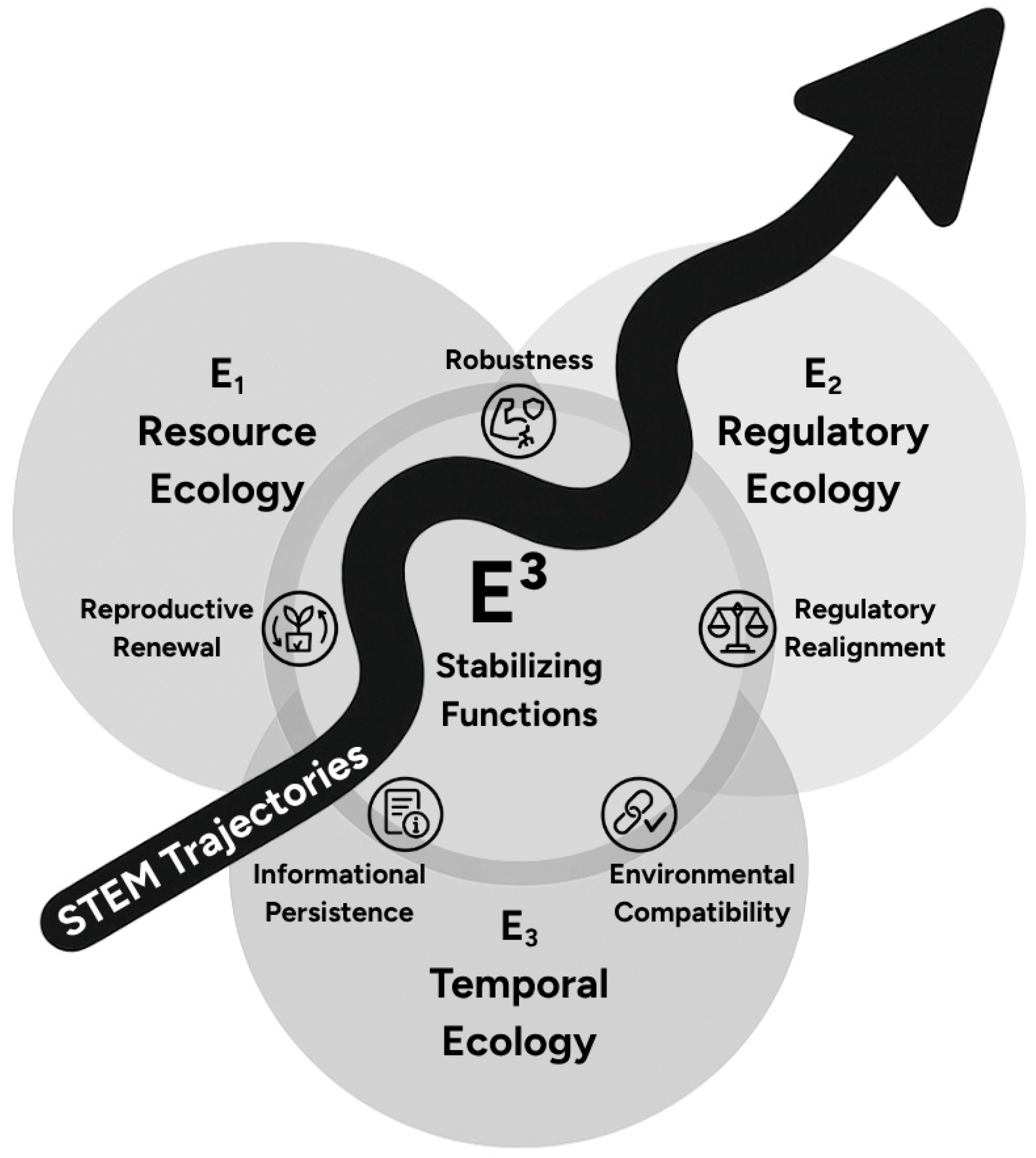
This section begins by outlining five stabilizing functions that characterize resilient systems across biological, cognitive, and educational domains. These functions— robustness, regulatory re-alignment, reproductive renewal, informational persistence, and environmental compatibility—serve as cross-cutting principles that clarify what learning systems must do to remain viable. We then develop the E3 Framework, distinguishing three ecological dimensions (see Figure 1):
  • The Resource Ecology, concerned with how learners perceive and access supportive elements,
  • The Regulatory Ecology, which captures how action and feedback are flexibly coordinated; and
  • The Temporal Ecology, focusing on how continuity is maintained or restored over time.
Together, the five functions and the three ecological dimensions describe how resilient learning systems take shape, persist, and adapt over time. The section concludes with a synthesis of how the three ecological dimensions interact to support a resilient STEM trajectory, highlighting the integrative logic that underpins the E3 Framework.

3.1. The Five Stabilizing Functions of Learning Systems

Resilient STEM pathways depend on systemic capacities that enable learners and their environments to absorb disruption and maintain a sense of direction. As Greve (2023) and Thelen and Smith (1994) emphasize, stability in systems theory is never mere stasis; it is the dynamic ability to preserve coherence as conditions change. We outline five stabilizing functions that help explain how STEM engagement can persist or recover despite fluctuations in motivation, access, or context:
  • Robustness: Redundancy helps a learning system to buffer against perturbations (Trypke et al., 2024; Yazdi, 2024). In STEM learning, this may include backup access to laboratory equipment or open-source software. However, robustness may also arise from the intrinsic strength, durability, or intensity of key resources—for example, highly stable motivation, reliable mentoring, or technically robust equipment.
  • Regulatory Re-Alignment: Setbacks and uncertainty are integral to the learning process. Thus, the capacity for realigning developmental direction is essential. For example, adaptive tutoring systems (Villegas-Ch et al., 2025) and collaborative inquiry scaffolds (Van Hoe et al., 2024) provide dynamic support.
  • Reproductive Renewal: Stability depends on the system’s ability to regenerate key elements such as skills, motivations, and learning supports (Bonghawan & Macalisang, 2024; Shin et al., 2019). In STEM learning, this may include rebuilding self-efficacy or reconnecting learners to meaningful content (Han et al., 2021; Wu et al., 2023).
  • Informational Persistence: For learning to accumulate meaningfully over time, knowledge, routines, and values must be retained across changing contexts and actors (Goh, 2025). In STEM trajectories, this may be achieved through tools and practices that make learning visible and transportable—such as reflective journals or cumulative project work that carry insights forward despite transitions in setting. Equally important are identity-bearing structures—such as STEM identity and a sense of belonging. As Hansen et al. (2024) show, domain-specific belonging predicts persistence more strongly than general affiliation. Kandiko Howson and Kingsbury (2024) further demonstrate how identity scaffolds support continuity across institutional boundaries.
  • Environmental compatibility refers to how well a learning pathway fits with the broader conditions in which a learner moves (European Commission Joint Research Centre, 2025; Jones et al., 2024). In STEM settings, this can mean that a learner’s developing skills make sense in relation to the expectations around them—for instance, when classroom tasks draw on interests they already have (Acut, 2024).
Table 1 provides an overview of the five stabilizing functions, their guiding questions, and typical mechanisms through which they operate in resilient STEM trajectories. Together, these five functions provide a functional backdrop for understanding how long-term engagement in STEM can be stabilized. While each function targets a different facet of viability, they rarely operate in isolation. In the following sections, we introduce the E3 Framework to specify how Resource, Regulatory, and Temporal ecologies interact to enact these stabilizing functions in practice.

3.2. Resource Ecology

By Resource Ecology, we mean the set of personal and environmental resources that sustain a STEM trajectory over time. They can take many forms, for example, material access, social ties, or the learner’s own physical and cognitive resources (Stoeger et al., 2024; Ziegler & Stoeger, 2023). Resilience, in this perspective, comes from how these resources can be brought into use and reshaped as conditions change, rather than from any single element alone.
A Resource Ecology qualifies as an ecology in its own right because the resources involved are neither isolated nor static. Their effect depends on interaction: how supports are combined, accessed, regenerated, or substituted in context (Videla et al., 2021). What matters is the functional usability within a coherent configuration—and how this configuration adapts over time (Peng et al., 2025).
This perspective is grounded in models of educational and learning capital (Ziegler & Baker, 2013), which describe how various forms of capital—such as didactic, infrastructural, cultural, or social—become functionally available through situated interaction. What persists across a trajectory is a dynamic ecology that allows learners to mobilize what they need when they need it. Empirical studies show that STEM engagement is unequally distributed across social and institutional contexts. Gaps in participation often stem from differences in access and the continuity of resource ecologies (Archer et al., 2025; Boekhoven et al., 2021). From this perspective, the resilience of a STEM trajectory also depends on how well a learning system is resourced and how flexibly it can adapt to change. Importantly, resource ecologies do not exist in isolation. STEM learning must often hold its own against alternative domains of activity and their resource landscapes that may offer easier access (Calabrese Barton & Tan, 2018).
Robustness. A Resource Ecology becomes more robust when its capital configuration can absorb perturbations (Lengnick-Hall et al., 2011; Pearson et al., 2025). Such robustness depends on both the intrinsic strength of key resources and redundancy (e.g., multiple ways to access materials, mentors, or feedback). Each capital type contributes (Stroink, 2020). For example, trust cushions social disruptions and infrastructure endures material stress.
Regulatory Re-Alignment. Regulatory re-alignment refers to regulatory loops that sense deviations and help the system recover its developmental path—maintaining homeorhesis rather than equilibrium (Shafi et al., 2020). In STEM learning, formative assessment, peer collaboration, and metacognitive reflection fulfill this function (Kaldaras et al., 2024). These mechanisms enable adaptive reconfiguration: learners and mentors recognize when resources or strategies drift out of alignment and re-synchronize before degradation occurs.
Reproductive Renewal. In any long learning trajectory, parts of the system age at different speeds. What keeps a STEM trajectory going is the system’s ability to replace or reshape these elements when they no longer perform their intended function (Kleinschmit et al., 2023). Materials are updated, mentoring relationships change, and earlier knowledge can take on new value when it is taken up in different situations. Stability, then, is less about preserving what is already there and more about keeping the system able to renew the functions on which it depends (Engeström, 2001; Society of Women Engineers, 2024).
Informational Persistence. STEM trajectories remain coherent when the informational threads that connect experiences over time are kept intact (Ho et al., 2025). What endures are the patterns that make action meaningful—shared models, symbolic shortcuts, ways of framing problems (Roehrig et al., 2021). These anchors are carried forward through documentation, habitual storytelling, and steady communication routines (Merino-Fernández et al., 2025).
Environmental Compatibility. A Resource Ecology remains stable when it fits into its environment (Bronfenbrenner, 2000; Videla et al., 2021). Policy timelines and funding rhythms, for example, shape how reliably resources can be accessed and used (Jambor & Haack, 2025). When these conditions drift apart, learning trajectories become more vulnerable (Ziegler & Stoeger, 2023).
In essence, the stability of a STEM trajectory grows out of many forms of coordination—how resources hold up under strain, how they adjust when needed, how they are renewed, how well they stay connected across settings, and how well they are aligned with the environment.

3.3. Regulatory Ecology

A regulatory ecology captures the ways a learning system steers itself over time. It includes the everyday practices through which learners, educators, and institutions make adjustments that preserve a workable direction (Hadwin et al., 2018): noticing when progress stalls, renegotiating a goal, or re-establishing a working routine that has started to fray (Järvelä et al., 2013).
What makes regulation ecological is not just the presence of control mechanisms, but how these mechanisms operate across multiple levels and actors, forming a web of interdependent adjustments (Panadero & Järvelä, 2015). A Regulatory Ecology, in this sense, integrates these distributed processes into a functional whole: disturbances are not eliminated, but registered and acted upon before they grow. Stability emerges when small shifts—whether detected by individuals or by the surrounding system—prompt timely and proportionate responses (Isohätälä et al., 2017).
The ideas behind this perspective build on research in self-regulation (Panadero, 2017), feedback and control (Hattie & Timperley, 2007), and models of regulation in educational settings (Hadwin et al., 2018). Empirical research gives this a more concrete shape. Many STEM trajectories come under strain not simply because resources are missing, but because learners cannot easily read the signals they receive or struggle to decide how to act when demands pull in different directions (Lin et al., 2024).
As with resource dynamics, regulatory ecologies must often compete with one another. Time spent dealing with mixed messages or conflicting expectations can pull regulatory energy away from STEM learning. Other areas of a student’s life may provide more explicit cues or quicker reinforcement, making them easier to invest in. To understand resilience, we therefore also need to examine how regulatory demands in different domains support or interfere with one another.
Robustness. Relational robustness depends on whether learners have multiple points of contact in their environment. A STEM trajectory is less likely to stall when several people know the learner’s work and can stay involved. In this way, overlapping ties reduce the chance that small changes in participation disrupt the broader developmental path (Hill et al., 2024).
Regulatory Re-Alignment. Regulatory re-alignment of a STEM trajectory can take many forms—for example, when a mentor notices hesitation, when peers comment on a draft, or when an informal conversation highlights a misunderstanding. Such moments help redirect the STEM trajectory before difficulties grow. In this way, coordination can continue even when conditions shift, allowing the trajectory to move forward (Dou et al., 2019).
Reproductive Renewal. Regulation itself requires renewal. Monitoring routines, feedback structures, and coordination practices can lose effectiveness when contexts shift or demands increase. For a Regulatory Ecology to remain functional, these processes need periodic adjustment—sometimes through new forms of guidance, sometimes through updated tools, and sometimes through shifts in how learners and educators coordinate their work (Engeström, 1987).
Informational Persistence. Stable collaboration relies on shared tools and ways of representing the work. These help maintain consistency in meaning as people join, leave, or shift roles. They also anchor a sense of belonging: shared practices and symbols give learners ways to see themselves as part of a STEM community (Akkerman & Bakker, 2011).
Environmental Compatibility. Interactional stability depends on how well social learning fits with the wider institutional and cultural setting. When mentoring or teamwork is squeezed out by tight schedules, grading pressures, or competitive structures, the regulatory ecology becomes harder to maintain. Policies that give collaboration time, visibility, and legitimacy create conditions in which social learning can take hold and persist. OECD (2023) shows that policy rhythms and institutional logics shape the viability of collaborative regulation.
In summary, the stability of Regulatory Ecologies lies in their capacity for responsive coherence, or, in other words, in their ability to adapt social configurations without losing collective orientation. STEM trajectories keep their direction when relationships can adjust, when feedback reaches learners in usable ways, and when shared understandings hold across changing situations.

3.4. Temporal Ecology

A Temporal Ecology describes how STEM learning unfolds over longer stretches of time—how earlier experiences relate to later ones, how learners find their way back after interruptions, and how involvement can extend across different phases of development. It highlights the conditions that allow a trajectory to keep going during transitions or moments of pressure (McCrone & Kingsbury, 2024). A STEM trajectory is temporally stable when it maintains coherence not by avoiding change, but by integrating it.
This counts as an ecology in its own right because temporal conditions introduce pressures that neither resources nor regulation can resolve on their own. Temporal stability depends on whether learners can move from one stage of participation to the next without losing their orientation (Yelland, 2021). It relies on structures that allow work to continue, for example, through planned follow-up options or recurring project formats. When such points of continuation are missing, even well-designed experiences can remain isolated episodes that do not accumulate into a longer pattern of development (Corcoran et al., 2009).
This view draws on systemic accounts of development (Bronfenbrenner, 1994), on research into how learning settles into workable time patterns (Li, 2025), and on conceptual depth (Shafi et al., 2020; Waddington, 1957) for homeorhesis in learning, i.e., growth that stays roughly on course while adjusting to new circumstances. These perspectives treat resilience not as a stable quality but as the ability to regain one’s direction when roles, expectations, or contexts shift.
Empirically, interruptions in STEM learning are common, e.g., due to illness, relocation, changing motivation, or external pressures. Whether a trajectory can resume after a break depends on the temporal conditions surrounding it (Bakker & Akkerman, 2019). Learners need some indication that re-engagement is possible, structures that can tolerate delays, and enough continuity in the record of earlier work to help them reorient. Evidence from longitudinal studies (e.g., Calabrese Barton & Tan, 2018; Dou et al., 2019) suggests that sustained trajectories often feature precisely such conditions: recognizable milestones, supportive re-entry points, and a narrative of progress that can resume after a pause.
Finally, temporal ecologies do not operate in isolation (Akkerman & Bakker, 2011). Alternative activities and domains form their own coherent temporal structures—settings that offer clear routines and steady social contact, sometimes accompanied by very rapid forms of feedback. Understanding STEM resilience thus requires attention not only to what sustains momentum, but to what competes for it, i.e., how alternative temporal ecologies gain priority and permanence.
Robustness. Temporal robustness exists when a learning system possesses protected and predictable rhythms. Regular project cycles, secure learning slots, and foreseeable milestones prevent the erosion of developmental flow (Corcoran et al., 2009). Even when individual sessions falter, the trajectory persists because the temporal framework provides re-entry points.
Regulatory Re-Alignment. Regulatory re-alignment unfolds through adaptive pacing and micro-feedback loops that keep learning processes aligned with evolving conditions (Carless & Boud, 2018). For example, formative assessments, reflective pauses, and micro-deadlines help learners and mentors detect temporal drift. The aim is less to return to an earlier timetable and more to help the trajectory find a workable pace again.
Reproductive Renewal. A sustainable temporal ecology includes periods in which activity can build, settle, and be absorbed. In STEM settings, this can occur through recurring design cycles, deliberate spacing of practice, or annual events that invite learners to revisit and extend earlier efforts (National Academies of Sciences, Engineering, and Medicine, 2017). What keeps a trajectory stable is the pattern of return and renewal, rather than constant activity.
Informational Persistence. Temporal continuity depends on ways of carrying earlier experiences forward so that later work can connect to them (Trevitt & Perera, 2020). Tools such as portfolios, brief progress notes, or milestone reflections help create a record that learners can return to, making their development easier to see and to resume after interruptions.
Environmental Compatibility. Temporal stability also depends on how educational time fits with the broader rhythms of learners’ lives (Kahu & Nelson, 2018; Thomas & Tight, 2022). When school calendars, assessment cycles, or institutional expectations move out of sync with the pace at which learners can develop, trajectories can begin to break apart.

3.5. The Integrative Logic of the E3 Framework: Achieving Stability Across Ecologies

A STEM trajectory gains its stability from the way the three ecologies work together. When resource, regulatory, and temporal conditions shape one another in supportive ways, development can continue even as circumstances change. The following section outlines the principles—cross-ecological dependence, homeorhetic compensation, and coherence over control—that explain how this interdependence takes shape and is sustained. Table 2 provides specific examples.
  • Cross-Ecological Dependence
The three ecologies rely on one another. When one is weakened—e.g., when key mentors leave (E1), when routines collapse (E3), or when feedback loops are disrupted (E2)—the entire system can lose its coherence (Järvelä et al., 2013; Kezar & Gehrke, 2017). The resilience of a STEM trajectory, therefore, depends on the relational stability among ecologies, not the strength of any one in isolation.
2.
Mechanism: Homeorhetic Coupling and Compensation
This integration works through homeorhetic coupling. Unlike homeostasis, which preserves sameness, homeorhesis refers to a system’s capacity to maintain direction through adaptive adjustment (Waddington, 1957).
In practical terms, a shortfall in one ecology can be offset by increased activity in another (Shafi et al., 2020). For example, when learning materials become inaccessible (E1), well-developed self-regulation (E2) and adaptive pacing (E3) may help preserve direction. However, this compensation only works within certain stability windows. When temporal and organizational demands fall out of sync with what learners can manage, participation can waver. Some reduce their involvement, others shift to a different pathway, and some simply stop progressing.
3.
Design Implication: Coherence over Control
This systemic perspective also shapes how interventions need to be designed. Adding a resource or introducing a new tool helps only when these changes connect with existing regulatory practices and fit the timing of a learner’s activity (Shafi et al., 2020). A mentor program without reflection time (E3), or feedback without motivational support (E1), is unlikely to stabilize a trajectory.
These design implications become especially tangible when examined through the lens of the five stabilizing functions. Each function—robustness, regulatory re-alignment, reproductive renewal, informational persistence, and environmental compatibility—emerges from the interplay of all three ecologies. The following matrix illustrates how different integrative principles—cross-ecological dependence, homeorhetic compensation, and coherence over control—support these functions in concrete ways (see Table 2).
These integrative examples lay the groundwork for a more reflective design practice. In the next section, we examine how these ideas can be translated into practical heuristics for educators and system designers.

3.6. Design Implications—From Theory to Reflective Practice

The E3 Framework provides a systemic way of thinking about how resilient STEM trajectories can be supported. It draws attention to how environments become coherent: how learners, teachers, families, peers, and learning settings shape one another over time, and how these interactions influence whether momentum is sustained or lost.
Design, in this view, is a matter of arranging conditions so that the parts of the ecology work together. It involves ensuring that resources can be used when needed (E1), that regulatory practices can respond to shifts in understanding or circumstance (E2), and that the timing of activities supports continued engagement (E3). Systems maintain their direction not through tight control, but because they are able to adjust when something changes (Folke et al., 2010). Thinking about design ecologically means attending to how these interactions are set up and how they evolve.
STEM participation develops alongside other domains of activity that may draw learners in with clearer routines or quicker rewards (Archer et al., 2025). Trajectories are not threatened only by internal gaps or failures—they are outcompeted when other ecologies (e.g., digital leisure, peer affiliation) offer more attractive rhythms or rewards. Designing for STEM thus means designing for relevance, accessibility, and temporal anchoring in learners’ lived realities.
The ecological conditions that make learning possible are also the ones in which inequities can take shape. Many patterns of social or cultural disadvantage are rooted in deep-seated historical and structural injustices. In everyday learning, these structural inequities often manifest as profound differences in ecological coherence: marginalized learners face uneven access to resource configurations that hold over time, fewer opportunities for regulatory influence, or the absence of stable pathways that allow them to maintain direction through transitions (Ziegler & Stoeger, 2023). From this perspective, inequity is not only a matter of how much capital learners possess, but of the ecological conditions that determine whether that capital becomes usable, renewable, and temporally anchored. This reframing links the E3 Framework to equity-oriented research by showing how power, recognition, and opportunity are exercised through arrangements that either support or restrict the viability of STEM trajectories.

3.7. From Philosophy to Practice: Five Lines of Implementation

  • Ecological Alignment Over Component Quality
    Interventions work when they are integrated into the broader ecology. A new resource supports learning only when learners can make use of it and when there is time and opportunity to bring it into practice. Thinking in ecological terms means attending to how supports connect with one another and how they fit into learners’ rhythms of life.
  • Reflective Heuristics Grounded in Stability Functions
    The five stabilizing functions offer a simple set of prompts for examining how a learning environment works. They draw attention to what continues to function when circumstances shift, to the sources that sustain participation, and to the practices that help learners stay connected after a break.
  • Temporal Structuring for Directional Continuity
    STEM learning often stretches across phases marked by changes, pauses, and restarts. Environments that support continuity provide learners with regular points of orientation—predictable times for work, small rituals that mark the start or end of phases, or clear chances to return after a break. Designing for continuity means arranging time so that learning can move with the rhythms of a learner’s life rather than in conflict with them.
  • Distributed Agency as a Stabilizing Resource
    Sustained engagement does not depend on learners acting alone. Their ability to regulate learning is shaped by what others make possible, such as teachers who adjust expectations, peers who help to steady routines, or families who create space for work. Effective ecological design spreads regulatory responsibility across the people involved, without assuming that everyone can respond equally at all times.
  • Contextual Tuning Over Rigid Fidelity
    STEM interventions must be re-anchored, not replicated. A program that works well in one setting may not work as well in another when the surrounding ecology is different. Designing with this in mind means adjusting interventions to the local mix of resources, regulatory habits, and time arrangements. What matters is whether an intervention fits the ecology in which it is placed.

4. Conclusions and Outlook

This article introduced the E3 Framework as a systemic lens for understanding how STEM trajectories gain stability—or fragment—over time. We treat resilience as something that arises from the interaction of three ecologies: resource, regulatory, and temporal. Their interplay shapes the conditions under which developmental momentum can continue even when situations shift.
This view builds on a long line of ecological work in educational research, while trying to give it a clearer functional and developmental focus. Ecological approaches—most notably Bronfenbrenner’s—have infused the field with a powerful sense of contextuality, embeddedness, and dynamic interaction. The ecological perspective carries considerable promise. However, its development has been slowed by the absence of a well-articulated regulatory dimension and by the lack of practical design guidance. The E3 Framework addresses this gap by offering a clearer language for describing how coherence across ecological conditions can support sustained participation in STEM.
It also brings something into view that often remains unnoticed: STEM trajectories do not only weaken from within; they are frequently overtaken by other activity systems that are more coherent and easier to sustain. In this light, designing for STEM sustainability means not just supplying resources. The E3 framework emphasizes that the use of resources needs to be regulatable and temporally integrated into learners’ lived realities. This highlights a central point of our framework: Trajectories do not fragment because learners run out of talent, but because the underlying STEM ecologies lack the stability to sustain them.
A further implication concerns longstanding equity critiques of ecological approaches. The E3 Framework describes why some learners face persistent barriers even when formal opportunities appear equal. Even a single deficit across resources, regulation, and time, or their coherence, can cause serious disturbances in STEM learning trajectories. Members of vulnerable groups are offered fewer stable pathways, especially across transitions. In this sense, the E3 framework provides a way to examine equity not as an external critique of ecological models, but as something that becomes visible through them.

Author Contributions

A.Z. and H.S. conceptualized and wrote the manuscript together. They were both involved in the critical review and approved the final manuscript. All authors have read and agreed to the published version of the manuscript.

Funding

The authors declare that the research was supported by the German Federal Ministry for Education, Family Affairs, Senior Citizens, Women and Youth (BMBFSFJ) under project grant numbers 16DWMQP02A and 16DWMQP02B. The responsibility for the content of this publication lies with the authors.

Institutional Review Board Statement

Not applicable.

Informed Consent Statement

Not applicable.

Data Availability Statement

This article is a theoretical/conceptual contribution. No new data were created or analyzed in this study. Therefore, data sharing is not applicable to this article.

Conflicts of Interest

The authors declare no conflicts of interest.

References

  1. Acut, D. P. (2024). From classroom learning to real-world skills: An autoethnographic account of school field trips and STEM work immersion program management. Disciplinary and Interdisciplinary Science Education Research, 6, 20. [Google Scholar] [CrossRef]
  2. Akkerman, S. F., & Bakker, A. (2011). Boundary crossing and boundary objects. Review of Educational Research, 81(2), 132–169. [Google Scholar] [CrossRef]
  3. Alexander, J. M., Johnson, K. E., & Neitzel, C. (2019). Multiple points of access for supporting interest in science. In K. A. Renninger, & S. E. Hidi (Eds.), The Cambridge handbook of motivation and learning (pp. 312–352). Cambridge University Press. [Google Scholar] [CrossRef]
  4. Allen, P. J., Chang, R., Gorrall, B. K., Waggenspack, L., Fukuda, E., Little, T. D., & Noam, G. G. (2019). From quality to outcomes: A national study of afterschool STEM programming. International Journal of STEM Education, 6(1), 37. [Google Scholar] [CrossRef]
  5. Archer, L., Dawson, E., DeWitt, J., Seakins, A., & Wong, B. (2015). “Science capital”: A conceptual, methodological, and empirical argument for extending the notion of ‘capital’ in science education. Journal of Research in Science Teaching, 52(7), 922–948. [Google Scholar] [CrossRef]
  6. Archer, L., Freedman, E., Nag Chowdhuri, M., DeWitt, J., Gonzalez, F. G., & Liu, Q. (2025). From STEM learning ecosystems to STEM learning markets: Critically conceptualizing relationships between formal and informal STEM learning provision. International Journal of STEM Education, 12, 22. [Google Scholar] [CrossRef]
  7. Atteberry, A., & McEachin, A. (2021). School’s out: The role of summers in understanding achievement disparities. American Educational Research Journal, 58(2), 239–282. [Google Scholar] [CrossRef]
  8. Bakker, A., & Akkerman, S. (2019). The learning potential of boundary crossing in the vocational curriculum. In The Wiley handbook of vocational education and training (pp. 349–372). Wiley. [Google Scholar] [CrossRef]
  9. Barron, B. (2006). Interest and self-sustained learning as catalysts of development: A learning ecology perspective. Human Development, 49(4), 193–224. [Google Scholar] [CrossRef]
  10. Basham, J. D., Israel, M., & Maynard, K. (2010). An ecological model of STEM education: Operationalizing STEM for all. Journal of Special Education Technology, 25(3), 9–19. [Google Scholar] [CrossRef]
  11. Bevan, B. (2016). STEM learning ecologies: Relevant, responsive, and connected. Connected Science Learning, 1(1), 12420446. [Google Scholar] [CrossRef]
  12. Boekhoven, M., de Vries, S., & Volman, M. (2021). STEM learning ecologies: Unequal participation and the role of resource configurations. In S. Sjøberg, & M. de Jong (Eds.), Equity and inclusion in STEM education (pp. 87–104). Springer. [Google Scholar]
  13. Bonghawan, R. G. G., & Macalisang, D. S. (2024). Teachers’ learning reinforcement: Effects on students’ motivation, self-efficacy, and academic performance. International Journal of Scientific Research and Management, 12(2), 3218–3228. [Google Scholar] [CrossRef]
  14. Briske, D. D., Illius, A. W., & Anderies, J. M. (2017). Nonequilibrium ecology and resilience theory. In D. D. Briske (Ed.), Rangeland systems: Processes, management and challenges (pp. 197–227). Springer. [Google Scholar] [CrossRef]
  15. Bronfenbrenner, U. (1994). Ecological models of human development. International Encyclopedia of Education, 3(2), 37–43. [Google Scholar]
  16. Bronfenbrenner, U. (2000). Ecological systems theory. In Encyclopedia of psychology (Vol. 3, pp. 129–133). American Psychological Association. [Google Scholar] [CrossRef]
  17. Calabrese Barton, A., & Tan, E. (2018). A longitudinal study of equity-oriented STEM-rich making among youth from historically marginalized communities. American Educational Research Journal, 55(4), 761–800. [Google Scholar] [CrossRef]
  18. Carless, D. (2019). Feedback loops and the longer-term: Towards feedback spirals. Assessment & Evaluation in Higher Education, 44(5), 705–714. [Google Scholar] [CrossRef]
  19. Carless, D., & Boud, D. (2018). The development of student feedback literacy: Enabling uptake of actionable feedback. Assessment & Evaluation in Higher Education, 43(8), 1315–1325. [Google Scholar] [CrossRef]
  20. Cech, E. A., & Blair-Loy, M. (2019). The changing career trajectories of new parents in STEM. Proceedings of the National Academy of Sciences, 116(10), 4182–4187. [Google Scholar] [CrossRef]
  21. Champaloux, S. W., & Young, D. R. (2015). Childhood chronic health conditions and educational attainment: A social ecological approach. Journal of Adolescent Health, 56(1), 98–105. [Google Scholar] [CrossRef] [PubMed]
  22. Clements, D. H., & Sarama, J. (2025). Systematic review of learning trajectories in early mathematics. ZDM—Mathematics Education, 57, 637–650. [Google Scholar] [CrossRef]
  23. Corcoran, T., Mosher, F. A., & Rogat, A. (2009). Learning progressions in science: An evidence-based approach to reform (CPRE Research Report RR-63). Consortium for Policy Research in Education. Available online: https://www.cpre.org/sites/default/files/researchreport/829_lpsciencerr63.pdf (accessed on 9 December 2025).
  24. Çolakoğlu, J., Steegh, A., & Parchmann, I. (2023). Reimagining informal STEM learning opportunities to foster STEM identity development in underserved learners. Frontiers in Education, 8, 1082747. [Google Scholar] [CrossRef]
  25. Dou, R., Hazari, Z., Dabney, K., Sonnert, G., & Sadler, P. (2019). Early informal STEM experiences and STEM identity: The importance of talking science. Science Education, 103(3), 623–637. [Google Scholar] [CrossRef]
  26. Engeström, Y. (1987). Learning by expanding: An activity-theoretical approach to developmental research. Orienta-Konsultit. [Google Scholar]
  27. Engeström, Y. (2001). Expansive learning at work: Toward an activity-theoretical reconceptualization. Journal of Education and Work, 14(1), 133–156. [Google Scholar] [CrossRef]
  28. Ericsson, K. A., & Harwell, K. W. (2019). Deliberate practice and proposed limits on the effects of practice on the acquisition of expert performance: Why the original definition matters and recommendations for future research. Frontiers in Psychology, 10, 2396. [Google Scholar] [CrossRef]
  29. Ericsson, K. A., Krampe, R. T., & Tesch-Römer, C. (1993). The role of deliberate practice in the acquisition of expert performance. Psychological Review, 100(3), 363–406. [Google Scholar] [CrossRef]
  30. European Commission Joint Research Centre. (2025). STEM and STEAM education, and disciplinary integration: A guide to informed policy action. Available online: https://publications.jrc.ec.europa.eu/repository/bitstream/JRC141438/JRC141438_01.pdf (accessed on 11 December 2025).
  31. Érdi, P. (2024). Feedback control in biological systems. In Computational systems biology (pp. 31–54). Springer. [Google Scholar] [CrossRef]
  32. Falk, J. H., & Dierking, L. D. (2018). Learning from museums: Visitor experiences and the making of meaning (2nd ed.). Rowman & Littlefield. [Google Scholar]
  33. Feinstein, N. W., Allen, S., & Jenkins, E. (2013). Outside the pipeline: Reimagining science education for nonscientists. Science, 340(6130), 314–317. [Google Scholar] [CrossRef]
  34. Fletcher, D., & Sarkar, M. (2013). Psychological resilience: A review and critique of definitions, concepts, and theory. European Psychologist, 18(1), 12–23. [Google Scholar] [CrossRef]
  35. Folke, C., Carpenter, S. R., Walker, B., Scheffer, M., Chapin, T., & Rockström, J. (2010). Resilience thinking: Integrating resilience, adaptability, and transformability. Ecology and Society, 15(4), 20. [Google Scholar] [CrossRef]
  36. Freeman, S., Eddy, S. L., McDonough, M., Smith, M. K., Okoroafor, N., Jordt, H., & Wenderoth, M. P. (2014). Active learning increases student performance in science, engineering, and mathematics. Proceedings of the National Academy of Sciences, 111(23), 8410–8415. [Google Scholar] [CrossRef]
  37. Gao, Y., Eccles, J. S., & Dicke, A. L. (2025). Not a pipeline but a highway: Men’s and women’s STEM career trajectories from age 13 to 25. Journal of Vocational Behavior, 156, 104067. [Google Scholar] [CrossRef]
  38. Gladstone, J. R., & Cimpian, A. (2021). Which role models are effective for which students? A systematic review and four recommendations for maximizing the effectiveness of role models in STEM. International Journal of STEM Education, 8, 59. [Google Scholar] [CrossRef]
  39. Goh, T.-T. (2025). Learning management system log analytics: The role of persistence and consistency of engagement behaviour on academic success. Journal of Computers in Education, 12(1), 283–306. [Google Scholar] [CrossRef]
  40. Greve, W. (2023). Adaptation across the lifespan: Towards a processual evolutionary explanation of human development. Integrative Psychological and Behavioral Science, 57, 1119–1139. [Google Scholar] [CrossRef]
  41. Hadwin, A. F., Järvelä, S., & Miller, M. (2018). Self-regulation, co-regulation, and socially shared regulation of learning. In D. H. Schunk, & J. A. Greene (Eds.), Handbook of self-regulation of learning and performance (2nd ed., pp. 83–106). Routledge. [Google Scholar]
  42. Han, J., Kelley, T., & Knowles, J. G. (2021). Factors influencing student STEM learning: Self-efficacy and outcome expectancy, 21st century skills, and career awareness. Journal for STEM Education Research, 4, 117–137. [Google Scholar] [CrossRef]
  43. Hansen, M. J., Palakal, M. J., & White, L. (2024). The importance of STEM sense of belonging and academic hope in enhancing persistence for low-income, underrepresented STEM students. Journal for STEM Education Research, 7, 155–180. [Google Scholar] [CrossRef]
  44. Hattie, J., & Timperley, H. (2007). The power of feedback. Review of Educational Research, 77(1), 81–112. [Google Scholar] [CrossRef]
  45. Hill, P. W., Kelly, G. M., McQuillan, J., Ledesma, J., Melson, M., & Gauthier, G. R. (2024). Exploring the associations of after-school science participation and friendships with science identities. Research in Science Education, 54(6), 1155–1172. [Google Scholar] [CrossRef]
  46. Ho, K., Chen, A., & Clark, D. B. (2025). Fostering STEM identity through storytelling: Links to belonging, self-efficacy, classroom climate, and lab performance. Chemistry Education Research and Practice, 27, 291–303. [Google Scholar] [CrossRef]
  47. Honey, M., Pearson, G., & Schweingruber, H. (Eds.). (2014). STEM integration in K–12 education: Status, prospects, and an agenda for research. National Academies Press. [Google Scholar] [CrossRef]
  48. Hussim, H., Rosli, R., Nor, N. A. Z. M., Maat, S. M., Mahmud, M. S., Iksan, Z., Rambely, A. S., Mahmud, S. N., Halim, L., Osman, K., & Lay, A. N. (2024). A systematic literature review of informal STEM learning. European Journal of STEM Education, 9(1), 7. [Google Scholar] [CrossRef] [PubMed]
  49. Isohätälä, J., Järvenoja, H., & Järvelä, S. (2017). Socially shared regulation of learning and participation in collaborative learning groups. International Journal of Educational Research, 81, 11–24. [Google Scholar] [CrossRef]
  50. Jambor, T. N., & Haack, M. (2025). Sustainability education in STEM curricula of the German education system. In M. E. Auer, & T. Rüütmann (Eds.), Futureproofing engineering education for global responsibility (pp. 529–541). Springer. [Google Scholar] [CrossRef]
  51. Järvelä, S., Järvenoja, H., Malmberg, J., Isohätälä, J., & Sobocinski, M. (2013). Exploring socially shared regulation in the context of collaboration. Journal of Cognitive Education and Psychology, 12(3), 267–286. [Google Scholar] [CrossRef]
  52. Jones, M., Geiger, V., Falloon, G., Fraser, S., Beswick, K., Holland-Twining, B., & Hatisaru, V. (2024). Learning contexts and visions for STEM in schools. International Journal of Science Education, 47(3), 337–357. [Google Scholar] [CrossRef]
  53. Kahu, E. R., & Nelson, K. (2018). Student engagement in the educational interface: Understanding the mechanisms of student success. Higher Education Research & Development, 37(1), 58–71. [Google Scholar] [CrossRef]
  54. Kaldaras, L., Haudek, K., & Krajcik, J. (2024). Employing automatic analysis tools aligned to learning progressions to assess knowledge application and support learning in STEM. International Journal of STEM Education, 11, 1157. [Google Scholar] [CrossRef]
  55. Kandiko Howson, C., & Kingsbury, M. (Eds.). (2024). Belonging and identity in STEM higher education. UCL Press. [Google Scholar] [CrossRef]
  56. Kezar, A., & Gehrke, S. (2017). Sustaining communities of practice for STEM reform. Journal of STEM Education, 18(2), 5–14. [Google Scholar] [CrossRef]
  57. Kleinschmit, A. J., Rosenwald, A., Ryder, E. F., Donovan, S., Murdoch, B., Grandgenett, N. F., Pauley, M., Triplett, E., Tapprich, W., & Morgan, W. (2023). Accelerating STEM education reform: Linked communities of practice promote creation of open educational resources and sustainable professional development. International Journal of STEM Education, 10, 16. [Google Scholar] [CrossRef]
  58. Lengnick-Hall, C. A., Beck, T. E., & Lengnick-Hall, M. L. (2011). Developing a capacity for organizational resilience through strategic human resource management. Human Resource Management Review, 21(3), 243–255. [Google Scholar] [CrossRef]
  59. Li, Y. (2025). Balanced time perspective, time management disposition, and resilience: A moderated mediation model of academic performance. Frontiers in Psychology, 16, 1484152. [Google Scholar] [CrossRef] [PubMed]
  60. Lin, C.-J., Wang, W.-S., Lee, H.-Y., Huang, Y.-M., & Wu, T.-T. (2024). Recognition of image and speech to improve learning diagnosis on STEM collaborative activity for precision education. Education and Information Technologies, 29, 13859–13884. [Google Scholar] [CrossRef]
  61. Ludwig, C. M., Howsmon, R. A., Stromholt, S., Valenzuela, J. J., Calder, R., & Baliga, N. S. (2024). Consequential insights for advancing informal STEM learning and outcomes for students from historically marginalized communities. Humanities and Social Sciences Communications, 11, 351. [Google Scholar] [CrossRef]
  62. Lynch, K., Hill, H. C., Gonzalez, K. E., & Pollard, C. (2019). Strengthening the research base that informs STEM instructional improvement efforts: A meta-analysis. Educational Evaluation and Policy Analysis, 41(3), 260–293. [Google Scholar] [CrossRef]
  63. Macnamara, B. N., Hambrick, D. Z., & Oswald, F. L. (2014). Deliberate practice and performance in music, games, sports, education, and professions: A meta-analysis. Psychological Science, 25(8), 1608–1618. [Google Scholar] [CrossRef]
  64. McCrone, L., & Kingsbury, M. (2024). An ecological approach to understanding transitions and tensions in complex learning contexts. npj Science of Learning, 9, 267. [Google Scholar] [CrossRef]
  65. Merino-Fernández, M. Á., Obregón Cuesta, A. I., Alonso-Centeno, A., Mínguez Mínguez, L. A., Varlamis, I., Sofianopoulou, C., Aykuş, S., Rousoulioti, C., Vrantzas, A., Siakavaras, I., & Papaioannou, G. (2025). Theoretical and practical coherence of integrated STEM education and educational robotics. In G. Lampropoulos, & S. Papadakis (Eds.), Social robots in education (pp. 427–462). Springer. [Google Scholar] [CrossRef]
  66. Miller, K., Callaghan, K., McCarty, L. S., & Deslauriers, L. (2021). Increasing the effectiveness of active learning using deliberate practice: A homework transformation. Physical Review Physics Education Research, 17(1), 010129. [Google Scholar] [CrossRef]
  67. National Academies of Sciences, Engineering, and Medicine. (2017). Undergraduate research experiences for STEM students: Successes, challenges, and opportunities. The National Academies Press. [Google Scholar] [CrossRef]
  68. OECD. (2017). Starting Strong 2017: Key OECD indicators on early childhood education and care. OECD Publishing. [Google Scholar] [CrossRef]
  69. OECD. (2023). Education policy outlook 2023. OECD Publishing. Available online: https://www.oecd.org/en/publications/education-policy-outlook-2023_f5063653-en.html (accessed on 9 December 2025).
  70. Panadero, E. (2017). A review of self-regulated learning: Six models and four directions for research. Frontiers in Psychology, 8, 422. [Google Scholar] [CrossRef]
  71. Panadero, E., & Järvelä, S. (2015). Socially shared regulation of learning: A review. European Psychologist, 20(3), 190–203. [Google Scholar] [CrossRef]
  72. Pearson, E., Sharp, L., & Hampton, L. (2025). Resilience in context: A synthesis of theories and practices for educational psychologists. Educational Psychology in Practice, 41(4), 439–456. [Google Scholar] [CrossRef]
  73. Peng, Y., Zhao, F., & Zheng, Y. (2025). Promoting equitable and high-quality STEM education in China from an ecological perspective. Disciplinary and Interdisciplinary Science Education Research, 7, 8. [Google Scholar] [CrossRef]
  74. Raabe, I. J., Boda, Z., & Stadtfeld, C. (2019). The social pipeline: How friend influence and peer exposure widen the STEM gender gap. Sociology of Education, 92(2), 105–123. [Google Scholar] [CrossRef]
  75. Rodriguez, A. J., & Suriel, R. L. (Eds.). (2022). Equity in STEM education research: Advocating for equitable attention. Springer. [Google Scholar] [CrossRef]
  76. Roehrig, G. H., Dare, E. A., Ring-Whalen, E., & Wieselmann, J. R. (2021). Understanding coherence and integration in integrated STEM curriculum. International Journal of STEM Education, 8, 2. [Google Scholar] [CrossRef]
  77. Saw, G. K., & Agger, C. A. (2021). STEM pathways of rural and small-town students: Opportunities to learn, aspirations, preparation, and college enrolment. Educational Researcher, 50(9), 593–600. [Google Scholar] [CrossRef]
  78. Shafi, A. A., Middleton, T., Millican, R., & Templeton, S. (2020). Reconsidering resilience in education: An exploration using the Dynamic Interactive Model of Resilience (DIMoR). Springer. [Google Scholar] [CrossRef]
  79. Shaikh, U. U., & Asif, Z. (2022). Persistence and dropout in higher online education: Review and categorization of factors. Frontiers in Psychology, 13, 902070. [Google Scholar] [CrossRef]
  80. Sharon, A. J., & Baram-Tsabari, A. (2020). Can science literacy help individuals identify misinformation in everyday life? Science Education, 104(5), 873–894. [Google Scholar] [CrossRef]
  81. Shin, D.-J. D., Lee, H. J., Lee, G., & Kim, S.-I. (2019). The role of curiosity and interest in learning and motivation. In K. A. Renninger, & S. E. Hidi (Eds.), The Cambridge handbook of motivation and learning (pp. 443–464). Cambridge University Press. [Google Scholar] [CrossRef]
  82. Skrentny, J. D., & Lewis, K. (2022). Beyond the “STEM pipeline”: Expertise, careers, and lifelong learning. Minerva, 60(1), 1–28. [Google Scholar] [CrossRef]
  83. Society of Women Engineers. (2024). Mentoring module: Why STEM mentoring matters—A systematic review. Available online: https://swe.org/wp-content/uploads/2024/05/Mentoring-Module-Why-STEM-Mentoring-Matters-1.pdf (accessed on 10 December 2025).
  84. Spours, K. (2024). From learning ecologies to a social ecosystem model for learning and skills. Systems, 12(9), 324. [Google Scholar] [CrossRef]
  85. Stoeger, H., Almulhim, N., & Ziegler, A. (2022). Correspondence heuristic and filter-empowerment heuristic: Investigating the reversed gender achievement gap in a sample of secondary school students in Saudi Arabia within the framework of educational and learning capital. Education Sciences, 12, 811. [Google Scholar] [CrossRef]
  86. Stoeger, H., Luo, L., & Ziegler, A. (2024). Attracting and developing STEMM talent toward excellence and innovation. Annals of the New York Academy of Sciences, 1533(1), 89–98. [Google Scholar] [CrossRef]
  87. Stroink, M. L. (2020). The dynamics of psycho-social-ecological resilience in the urban environment: A complex adaptive systems theory perspective. Frontiers in Sustainable Cities, 2, 31. [Google Scholar] [CrossRef]
  88. Subotnik, R. F., Olszewski-Kubilius, P., & Worrell, F. C. (2011). Rethinking giftedness and gifted education: A proposed direction forward based on psychological science. Psychological Science in the Public Interest, 12(1), 3–54. [Google Scholar] [CrossRef]
  89. Thelen, E., & Smith, L. B. (1994). A dynamic systems approach to the development of cognition and action. MIT Press. [Google Scholar]
  90. Thomas, L., & Tight, M. (2022). Student retention and success in higher education: A temporal perspective. Journal of Higher Education Policy and Management, 44(2), 123–138. [Google Scholar]
  91. Trevitt, C., & Perera, C. J. (2020). Portfolios for learning and assessment: Developing and sustaining student learning. Higher Education Research & Development, 39(5), 1005–1019. [Google Scholar]
  92. Trypke, M., Stebner, F., & Wirth, J. (2024). The more, the better? Exploring the effects of modal and codal redundancy on learning and cognitive load. Education Sciences, 14(8), 872. [Google Scholar] [CrossRef]
  93. Ungar, M. (2011). The social ecology of resilience: Addressing contextual and cultural ambiguity of a nascent construct. The American Journal of Orthopsychiatry, 81(1), 1–17. [Google Scholar] [CrossRef]
  94. Vakil, S., & Ayers, R. (2019). The racial politics of STEM education in the USA: Interrogations and explorations. Race, Ethnicity, and Education, 22(4), 449–458. [Google Scholar] [CrossRef]
  95. van den Hurk, A., Meelissen, M., & van Langen, A. (2019). Interventions in education to prevent STEM pipeline leakage. International Journal of Science Education, 41(2), 150–164. [Google Scholar] [CrossRef]
  96. Van Hoe, A., Wiebe, J., Rotsaert, T., & Schellens, T. (2024). Peer assessment as a scaffold during computer-supported collaborative inquiry learning in secondary STEM education. International Journal of STEM Education, 11, 3. [Google Scholar] [CrossRef]
  97. Videla, R., Aguayo, C., & Veloz, T. (2021). From STEM to STEAM: An enactive and ecological continuum. Frontiers in Education, 6, 709560. [Google Scholar] [CrossRef]
  98. Villegas-Ch, W., Buenano-Fernandez, D., Maldonado Navarro, A., & Mera-Navarrete, A. (2025). Adaptive intelligent tutoring systems for STEM education: Analysis of learning impact and effectiveness of personalized feedback. Smart Learning Environments, 12, 41. [Google Scholar] [CrossRef]
  99. Vossoughi, S., Hooper, P. K., & Escudé, M. (2016). Making through the lens of culture and power: Toward transformative visions for educational equity. Harvard Educational Review, 86(2), 206–232. [Google Scholar] [CrossRef]
  100. Waddington, C. H. (1957). The strategy of the genes. Allen & Unwin. [Google Scholar]
  101. Wheaton, M., Ardoin, N. M., Bowers, A. W., & Kannan, A. (2024). Sociocultural learning theories for social-ecological change. Environmental Education Research, 30(8), 1193–1210. [Google Scholar] [CrossRef]
  102. Wu, T.-T., Lee, H.-Y., Wang, W.-S., Lin, C.-J., & Huang, Y.-M. (2023). Leveraging computer vision for adaptive learning in STEM education: Effect of engagement and self-efficacy. International Journal of Educational Technology in Higher Education, 20, 53. [Google Scholar] [CrossRef]
  103. Yao, C., Follmer Greenhoot, A., Mack, K., Myrick, C., Poolaw, J., Powell, L., & Yarger, L. (2023). Humanizing STEM education: An ecological systems framework for educating the whole student. Frontiers in Education, 8, 1175871. [Google Scholar] [CrossRef]
  104. Yazdi, M. (2024). Reliability-centered design and system resilience. In Advances in computational mathematics for industrial system reliability and maintainability (pp. 79–103). Springer. [Google Scholar] [CrossRef]
  105. Yelland, N. (2021). STEM learning ecologies: Productive partnerships supporting transitions from preschool to school. In C. Cohrssen, & S. Garvis (Eds.), Embedding STEAM in early childhood education and care (pp. 237–254). Springer. [Google Scholar] [CrossRef]
  106. Ziegler, A., & Baker, J. (2013). Talent development as adaptation: The role of educational and learning capital. In S. Phillipson, H. Stoeger, & A. Ziegler (Eds.), Exceptionality in East-Asia: Explorations in the Actiotope model of giftedness (pp. 18–39). Routledge. [Google Scholar]
  107. Ziegler, A., & Stoeger, H. (2023). Talent denied: Equity and excellence gaps in STEMM. Annals of the New York Academy of Sciences, 1530(1), 32–45. [Google Scholar] [CrossRef] [PubMed]
Figure 1. The E3 Framework: Interacting ecologies of resilient STEM trajectories.
Education 16 00790 g001
Table 1. Core Stabilizing Functions in Resilient STEM Trajectories.
Stabilizing FunctionKey Reflective QuestionIllustrative Mechanisms
RobustnessWhat endures under disruption?Redundancy, fallback options, durable routines
Regulatory Re-AlignmentHow are deviations detected and corrected?Feedback loops, formative assessment, reflection
Reproductive RenewalHow are motivation and resources regenerated?Cycles, rituals, rotating roles, inputs
Informational PersistenceHow does meaning persist through change?Documentation, narratives, standards, STEM identity
Environmental CompatibilityHow well does the system match its broader context?Institutional pacing, policy alignment, culture
Table 2. Illustrative Contributions of Integrated Ecologies to the Stabilizing Functions of Resilient STEM Trajectories.
Stabilizing FunctionCross-Ecological DependenceHomeorhetic Coupling and CompensationEcological Coherence over Control
RobustnessA STEM pathway remains steadier when basic resources (E1), simple forms of guidance or feedback (E2), and a predictable time for working on tasks (E3) support one another. Together, they prevent minor interruptions from halting progress.If a lab session is canceled, the teacher uses the next short advisory period (E3) to help students sort their notes (E2) and identify parts of the work they can continue at home with the materials they already have (E1).A community makerspace runs smoothly not because each step is prescribed but because access to tools (E1), staff assistance (E2), and regular opening hours (E3) fit together well enough so that participants can continue without extra coordination.
Regulatory Re-AlignmentQuick tips from peers or mentors (E2) only work if learners have the right gear (E1) and the time to actually think (E3). This mix allows for real “on-the-fly” adjustments.When a team gets stuck, the mentor adds a quick fix-it block (E2), steals a few minutes from the next session (E3), and offers fresh hints (E1) to get everyone back on track.Instead of monitoring every detail, the instructor and the students agree on a few fixed moments during the week for progress checks (E3). Students bring whatever materials or notes they have (E1) and discuss what should be revised (E2), keeping things moving.
Reproductive RenewalLonger STEM trajectories stay energetic when new tools or materials (E1), shifts in roles or working styles (E2), and recurring events—such as an annual challenge (E3)—reinforce one another.If interest dips midway through a course, a brief practical task (E2) can help students get back into the work. The teacher makes room for it in the schedule (E3), and the group uses whatever materials are already on hand (E1).Student groups stay active when newcomers can join at several points (E3), veterans take on light coaching roles (E2), and projects stay low-cost (E1). This creates a natural cycle of passing the torch.
Informational PersistenceContinuity grows when old records (E1) fuel short reflection talks (E2) and when the jump to the next phase is clearly marked (E3). This helps learners see how today’s work builds on yesterday’s.If supervision shifts mid-project, a short handover meeting (E2), a concise and up-to-date project record (E1), and a set point for resuming the work (E3) make it easier to continue without losing direction.A program displays old project “relics” (E1) to anchor the start of new planning cycles (E3). Groups talk through their plan (E2), helping new kids see where they fit in the story.
Environmental CompatibilityA STEM trajectory feels easier when gear access (E1), school rules (E2), and the rhythms of life (E3) do not pull in different directions. Alignment cuts the friction.If the schedule gets messy, the program offers “bite-sized” tasks (E1), allows for flexible timing (E3), and sends out short nudges (E2) to keep everyone connected.A local STEM path is built with partners who know the seasonal crunch (E3). They name a go-to person for help (E2) and open their doors to daily tools (E1). Learners then see the path as one coherent line (E1). As a result, learners experience the pathway as a single, coherent line of development.
Disclaimer/Publisher’s Note: The statements, opinions and data contained in all publications are solely those of the individual author(s) and contributor(s) and not of MDPI and/or the editor(s). MDPI and/or the editor(s) disclaim responsibility for any injury to people or property resulting from any ideas, methods, instructions or products referred to in the content.