


Abstract
Introduction: Declines in children’s fine motor skills (FMS) are increasingly reported across UK primary education, raising concerns for school readiness, independence, and long-term health. This study examined whether structured classroom-based cooking activities could enhance FMS in children aged 7–8 years. Methodology: Informed by physical literacy and experiential learning, a six-week intervention (n = 30) used progressive pizza-making sessions to target effective pincer grip, consistent hand-eye coordination, and control over hand and wrist motions, a mixed-methods design that combined curriculum-aligned observational assessments with qualitative field notes. Results: Statistically significant progressive increases were observed across effective pincer grip, consistent hand-eye coordination, and hand and wrist control (χ2, p < 0.001), suggesting improvements in fine motor competence within this sample. Performance increased from 30–40% skill demonstration in session one to 70–85% by session five. Qualitative data indicated enhanced confidence, task persistence, and independence. Discussion: In this sample, authentic, goal-directed cooking tasks were associated with improvements in FMS, reinforcing links to cognitive and academic outcomes. Cooking offers a low-cost, inclusive approach that integrates movement, learning, and health priorities. Embedding structured cooking within the curriculum may provide a scalable strategy to support FMS development and health equity, establishing a strong foundation for future controlled research.
1. Introduction
In recent years, a growing body of evidence has highlighted a troubling trend in children’s motor development across the UK. Teachers are increasingly reporting that more pupils struggle with basic tasks, such as holding a pencil, cutting paper, or buttoning their coats (Turner, 2025). One Year 1 teacher, for instance, described frustration during scissor-based activities, noting that even seemingly simple cutting tasks can cause distress among children. National survey data corroborate these observations: with an estimated 77% of UK primary school teachers noticing a decline in pupils’ ability to perform precise movements, including holding a pencil or using scissors (The Times, 2025b). Similar concerns echoed across England and Wales, where reports suggest some children start school unable to climb stairs, lacking core strength, or struggling with basic self-care (The Guardian, 2025; The Times, 2025a). These patterns not only reveal widespread challenges in children’s fine motor competence but also point to a critical gap in current educational practice. Taken together, such findings fuel growing concern about children’s motor development, underscoring the need for fine motor skill (FMS) development to be explicitly embedded within early years and primary curricula (Vaughan et al., 2025). This decline in FMS development highlights a critical gap in current educational practice. It also represents an under-recognised dimension of children’s long-term health and development. The development of foundational motor competence during early childhood lays the essential groundwork for learning, physical literacy, and functional independence, enabling children to engage in everyday activities at school and at home and to support overall wellbeing.
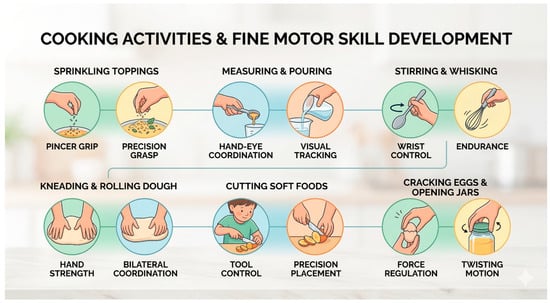
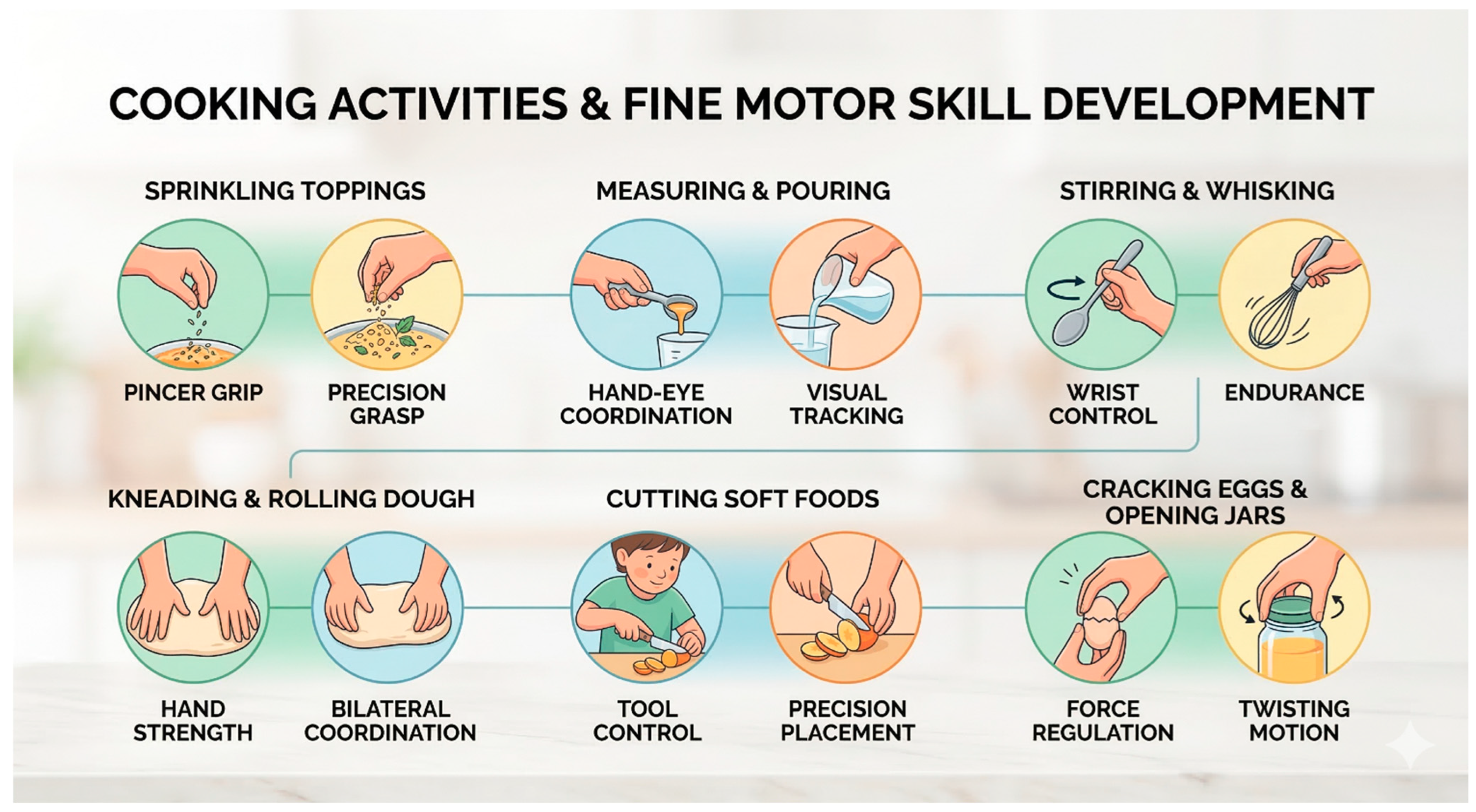
Notably, FMS are closely linked to school readiness, physical literacy, physical activity, equity, and overall wellbeing (Jones et al., 2021). For example, cooking tasks, such as pouring, spreading, kneading, and cutting (see Figure 1), require repeated, purposeful hand use and offer a natural classroom context for practising fine motor control alongside broader learning objectives. To address the evident gap and maximise benefits for children’s learning and health, educators and policymakers must prioritise classroom-based interventions that intentionally embed FMS development through practical, curriculum-aligned activities, such as cooking. This study extends current literature by positioning cooking not simply as a nutritional or life-skill activity, but as a structured motor learning intervention capable of producing measurable developmental gains.
Figure 1.
Cooking skills associated with FMS development.
1.1. The Public Health Importance of Fine Motor Skill Development
FMS development plays a pivotal role in children’s physical, cognitive, and psychosocial growth (Jonah, 2023). These skills, which involve coordination of the small muscles in the hands and fingers, are critical not only for educational success but also for long-term health and functional independence. A clear example is pencil grip: the ability to grasp and control a pencil during the early years creates the foundation for forming letters and developing fluent handwriting. This, in turn, influences later literacy outcomes (Lincolnshire Research School, 2025). Research further suggests that improvements in FMS, such as pencil grip, lay the groundwork for executive functions, including planning, attention, and self-regulation, all of which are central to academic achievement and daily problem-solving (Carlson, 2013). Empirical studies from the UK (Cameron et al., 2012) and the USA demonstrate that early FMS proficiency strongly predicts later achievement in literacy and mathematics academic outcomes (Dinehart & Manfra, 2013). The close neurodevelopmental relationship between motor and cognitive domains has been articulated by Diamond (2000), who highlights the interdependence of the cerebellum and prefrontal cortex in supporting both motor planning and higher-order thinking. Consequently, children with higher FMS, balance, and locomotor scores are significantly more likely to achieve a strong level of school readiness (Cameron et al., 2012; Dinehart & Manfra, 2013). Considering these findings, teachers are shaping more than just academic skills; they actively support health outcomes by undertaking daily routine fine-motor activities (Osman et al., 2024). Enhancing FMS development in both the early and primary educational settings is, therefore, more than an educational priority; it represents a core preventive public health intervention with potential long-term implications for cognitive trajectories.
1.2. Critical Perspectives: Equity and Rethinking Physical Literacy
Beyond their immediate impact on school readiness, FMS are powerful predictors of longer-term developmental outcomes and need to be viewed as a key social determinant of health (Józsa et al., 2023). Access to sensory-rich, hands-on motor practice (Harmon et al., 2025) is not evenly distributed; socioeconomic status is a significant predictor of motor competence, meaning children from lower-income families frequently face compounded disparities that can lead to lifelong educational underachievement and poorer health outcomes.
Nonetheless, access to opportunities for motor development is not evenly distributed, demanding a critical rethinking of how movement education is delivered to diverse learners. In the UK, approximately 29–31% of primary school children are classified as living in poverty, highlighting the sheer scale of children whose motor development may be at risk due to constrained resources and opportunities (House of Commons Library, 2025). Socioeconomic status remains a significant predictor of motor competence (Kwon & O’Neill, 2020), as children from lower-income households have fewer opportunities for hands-on play, fine-motor practice, and sensory-rich environments. These developmental disparities can compound over time, leading to persistent educational underachievement and poorer health outcomes in adulthood (Morley et al., 2015). Furthermore, FMS underpins independence in daily activities such as feeding, dressing, and basic hygiene, meaning that early deficits can lead to prolonged caregiver dependency and, ultimately, contribute to a greater health system burden (Case-Smith, 1996; Mancini et al., 2015). The Marmot Review (2010) similarly identifies early education as a determinant with lifelong consequences for health equity.
Addressing these disparities requires a critical shift away from exclusive or resource-heavy pedagogical models toward inclusive movement education approaches that foster lifelong habits in all learners (Howells, 2012). By explicitly embedding FMS development into accessible, relevant, and enjoyable everyday tasks such as cooking and pizza-making, educators can directly support health equity. These authentic activities are purposefully designed to use low-cost materials, ensuring they are easy for educators to replicate and fully inclusive for all children, regardless of socioeconomic background. Ultimately, rethinking physical literacy through the lens of everyday classroom cooking transforms a standard curriculum requirement into a scalable, preventive public health intervention, bridging the gap between educational trajectories and lifelong health equity.
Current debates in physical education question the limitations of traditional, sport-based curricula and isolated motor interventions (such as pegboards or bead-threading) (Pini et al., 2023). To advance physical literacy, educators must look beyond isolated exercises and embrace inclusive movement education approaches that foster lifelong activity habits in diverse learners. Meaningful, real-world tasks (Edwards, 2025) allow children to experience purposeful movement (Almond & Lambden, 2016), thereby directly operationalising physical literacy as learning through movement within an authentic context.
1.3. Cooking as a Multimodal Pedagogical Framework
Cooking provides a highly engaging, inclusive environment where developmental, educational, and health-related priorities intersect (Lavelle et al., 2023), perfectly aligning with the four multidimensional pillars of physical literacy.
- Physical: Tasks such as pouring ingredients, cutting soft vegetables, grating cheese, or kneading dough demand complex tactile perception, visual motor integration, proprioceptive feedback, and bilateral coordination. Moreover, introducing tools such as child-safe knives (to support controlled slicing), graters (requiring bilateral and wrist coordination), rolling pins (to promote uniform hand pressure and range of motion), and measuring cups and spoons (to foster grip accuracy and visual motor integration) presents differentiated challenges that scaffold dexterity, spatial awareness, grip adaptation and force modulation (Piek et al., 2008).
- Cognitive: The sequence of measuring, mixing, and executing recipes requires children to plan, remember, and execute actions. These goal-directed processes are deeply intertwined with working memory, executive function, and cognitive flexibility (Diamond, 2000; Cameron et al., 2012).
- Affective: Unlike isolated classroom exercises, cooking yields a concrete, edible outcome that children can consume and share. This authentic mastery connection between effort and reward fosters higher levels of concentration, task satisfaction, intrinsic motivation, persistence, and self-efficacy (Garcia et al., 2000). In turn, this sense of ownership and accomplishment supports neuroplasticity and sustained motor learning (Diamond, 2000).
- Social: Food preparation is a socially shared, culturally relevant experience that not only improves food literacy and nutritional behaviours but can also promote teamwork, inclusion, cultural diversity, and health equity (Chu et al., 2013; Vaughan et al., 2022; DfE, 2024). It also intersects cross-disciplinary learning, applying FMS to science (exploring changes in materials), mathematics (measuring and counting), as well as personal, social, health, and economic (PSHE) education.
By integrating FMS development with nutrition education (Charlton et al., 2021), classroom-based cooking activities align closely with preventive public health objectives, including childhood nutrition, obesity prevention, and the United Nations (2025) Sustainable Development Goals (SDGs) 2, 3, and 10. Successful motor skill acquisition depends not only on repetition but also on the variability of the practice. Cooking naturally embeds both: while the core motor tasks remain consistent (e.g., stirring, grasping, pinching), the variability of ingredients, tools, and recipes ensures that children adapt and generalise these movements to different contexts. This variability is highly beneficial for establishing adaptive motor schemas and supports more generalised motor proficiency compared to static tasks (Schmidt & Lee, 2011).
In previous cooking research, a quasi-experimental study found that 4–5-year-olds who participated in cooking activities made greater FMS progress than those in the control group (Maranatha & Briliany, 2023). Observational studies also reveal that preschoolers who excel at tasks such as stirring, mashing, and spreading tend to score higher on FMS assessments. Moreover, expert guidelines connect cooking tasks directly to age-appropriate motor skills, providing a framework for early interventions (Hersch et al., 2014). Hands-on cooking has also been shown to increase children’s willingness to try new foods, strengthen their understanding of nutritional concepts, and encourage the development of lifelong healthy eating habits (Chu et al., 2013). These activities offer a practical way to support multiple dimensions of child health, physical, cognitive, social, and dietary, within an engaging classroom context.
1.4. The Research Gap, Systemic Constraints, and Empirical Clarity
In the English National Curriculum (DfE, 2025), cooking is widely adopted in the Early Years Foundation Stage (ages 3–5). Cooking activities contribute to Physical Development, one of three prime areas of learning, by helping children “develop their small motor skills so that they can use a range of tools competently, safely and confidently” (DfE, 2025, p. 10), as well as to Understanding the World by fostering awareness about healthy food choices (DfE, 2025, p. 11). For practitioners, clear examples of how specific cooking tasks align with early learning goals can make curriculum links more actionable. Cutting and spreading soft cheese on crackers, for instance, directly supports the Physical Development goal of using tools competently, safely, and confidently, while also opening discussion about healthy eating. Similarly, making a fruit salad enables children to practise FMS with a child-safe knife and explore nutrition and cultural diversity.
Cooking activities also help children relate to their personal life experiences and appreciate diversity by exposing them to a wide range of foods (DfE, 2024). As children grow, they are encouraged to use appropriate vocabulary for ingredients, FMS, and movements involved in cooking (DfE, 2024). Mathematical skills are developed through weighing and counting ingredients, enhancing understanding of quantity. During this phase, cooking supports sensory exploration, fine motor coordination, hygiene routines, and the ability to follow instructions, all of which are central to school readiness. Recent DfE guidance for early years providers specifically highlights cooking as an effective context for supporting FMS, alongside activities like gardening, sewing, weaving, fixing, mark-making, threading, and scissor use (DfE, 2024). Notably, curriculum guidance suggests that meaningful, real-life experiences, like cooking, can help motivate children who are less engaged by activities that focus solely on hand strength or coordination.
Cooking holds a statutory requirement within Design and Technology (D&T), specifically under the Cooking and Nutrition strand. At both Key Stages 1 and 2, teaching cooking is a statutory requirement, reflecting the growing recognition of this skill not only as a practical necessity but also a means of fostering health literacy from an early age. Importantly, the curriculum frames cooking as more than simply preparing food; it weaves together nutrition, healthy eating, and the development of vital life skills (DfE, 2013, see Table 1). Guidance highlights cooking’s potential to inspire creativity, self-expression, and a genuine passion for food. Although some elements are not compulsory in all schools, the curriculum acknowledges cooking as a cornerstone life skill (DfE, 2013).
Table 1.
The National Curriculum (DfE, 2013) guidance for Cooking.
Compared to the EYFS framework (DfE, 2025), the primary National Curriculum (DfE, 2013) is less explicit about links between cooking and FMS. Cooking is situated within D&T, with an emphasis on food preparation and, more broadly, diet and health education. The following image illustrates the range of cooking skills associated with FMS development.
Beyond D&T, cooking intersects with other curriculum areas, underscoring its interdisciplinary value. In Science, children investigate changes in materials (mixing, melting) or explore nutrition. Mathematics lessons incorporate ingredient measuring, counting, and proportional reasoning. Cooking also connects to PSHE by supporting health, hygiene, and teamwork, while in English, it encourages literacy through reading and following recipes. Art and Design lessons may use cooking to inspire creativity and presentation skills. In this way, cooking in the English primary curriculum acts as a unique educational vehicle that simultaneously develops FMS, supports academic learning, and advances public health priorities by promoting nutritional awareness and independence from the earliest years (Vaughan et al., 2024).
However, its potential as a vehicle for embodied movement learning is frequently constrained by systemic challenges. Limited curriculum time, minimal continuing professional development (CPD) focused on physical and health literacy, and low teacher confidence in nutrition and FMS severely restrict effective delivery. Initiatives like “Licence to Cook” have been critiqued for narrowing the subject matter and reducing opportunities for technical learning (Rutland, 2008). Survey data indicate that only 38% of food teachers feel they have enough time to deliver their curriculum thoroughly, highlighting the pressure to balance cooking with other teaching priorities (Food Teachers Centre, 2023). More worryingly, recent research found that just 17% of surveyed 16–18-year-olds met recommended nutritional guidelines, and 90% did not view school as a place that promoted healthy lifestyles (Howells & Coppinger, 2023). This suggests that even future educators may lack confidence and competence in nutrition, cooking, and FMS, potentially due to limited physical education training during teacher preparation (Randall, 2022). Consequently, while cooking is recognised as a life skill, a significant empirical gap remains in evaluating its specific efficacy as a mechanism for targeted fine motor skill acquisition in early and primary school settings.
To address this gap and respond to the need for rigorous evaluations of practical applications of physical literacy, this study evaluates a structured short-term scheme of work designed to bridge theoretical curriculum content and practical classroom application, as Charlton et al. (2021) suggest that well-designed schemes can be crucial for overcoming barriers to effective cooking education and enhancing children’s learning. The central research question guiding this study was whether structured, classroom-based cooking activities were associated with changes in FMS in children aged 7–8 years, a developmental stage during which age-related expectations may still be variable. Based on evidence of declining motor competence, we hypothesised that implementing a targeted series of progressive cooking sessions would result in measurable, statistically significant gains in the three core fine motor themes:
- Effective pincer grip
- Consistent hand-eye coordination
- Control over hand and wrist motions
2. Materials and Methods
2.1. Research Design: Experiential Learning and Physical Literacy
To critically examine the translation of physical literacy into practical early-years education, this study adopted a mixed-methods, practice-based methodology, grounded in experiential learning and developmental assessment (Kolb, 1984; Shonkoff & Phillips, 2000). Qualitative and quantitative methods were selected to capture improvements in the FMS and the richness and nuance of children’s experiences, offering teachers deeper insights into how pupils engage, what motivates them, and how classroom environments shape skill development. For practitioners, these mixed methods allow for insights to extend beyond simple outcome measurement; they shed light on the processes underlying engagement and learning, ultimately guiding more responsive and effective teaching.
The intervention itself was designed to both support and assess the development of FMS in early childhood through a structured, cooking-based curriculum. This approach is closely aligned with public health perspectives, which emphasise the importance of early intervention for long-term physical, cognitive, and social benefits (The Marmot Review, 2010). This study also builds on prior work with the same participant cohort, which identified existing FMS delays and informed the development of a subsequent, more structured intervention. Traditional fine motor interventions often rely on repetitive or isolated tasks, such as pegboards or bead threading, which can lack meaningful context. In contrast, this research explicitly positioned cooking as an authentic goal-directed vehicle (Edwards, 2025; Health Service Executive, Ireland, 2025) for embodied learning through movement (Whitehead, 2010). By aligning both educational and public health frameworks, the design aimed to capture how holistic, sensory-rich environments not only support physical motor capabilities while also advancing cognitive, social, and emotional development, thereby echoing the core principles of early intervention and health equity (The Marmot Review, 2010).
2.2. Aims and Objectives
The primary objective of this study was to explore changes in FMS across three overarching themes:
- Effective pincer grip (e.g., sprinkling toppings, using measuring spoons)
- Consistent hand-eye coordination (e.g., applying sauce, slicing vegetables)
- Control over hand and wrist motions (e.g., rolling out dough, stirring mixtures)
These motor competency themes serve as critical indicators of both school readiness and broader developmental health (Cameron et al., 2012). Recognising that fine motor delays correlate strongly with reduced engagement in lifelong physical activity and independence in self-care (Bart et al., 2008), the study evaluated cooking not merely as a life skill but as a preventive public health intervention.
2.3. Setting, Participants, and Equity Context
In a rural, faith-based (Church of England) primary school situated in the Southeast of England, this research was undertaken in a Year 3 classroom. The group consisted of 30 pupils, including 14 girls and 16 boys; 11 were aged 7, and 19 were aged 8. This stage is recognised as an important period for the development of fundamental movement skills (Case-Smith, 1996). It is important to consider the socioeconomic mix of the class and wider school community when exploring equity in physical literacy. The school’s catchment includes both a gated community and a nearby social housing area. Around 60% of pupils lived in the gated community, while 40% came from the social housing area, and 28% were eligible for free school meals. Including children from diverse socioeconomic backgrounds offered a valuable opportunity to explore cooking as an inclusive and accessible approach to supporting development.
The intervention was embedded organically into daily classroom practice to maintain robust ecological validity. The lead researcher, who functioned as the class teacher and Head of Physical Education, Health, and Wellbeing, taught the sample group. This dual role reflects a practitioner-researcher model, enabling insight into naturally occurring classroom behaviours. This meant the research was embedded within everyday classroom practice, ensuring the intervention reflected the class’s natural composition rather than an artificially selected cohort. The second author, the school’s cook and nutrition expert, led the cooking activities, ensuring that lessons reflected best practice in both food education and skill development. Using the familiar classroom environment and building on the children’s existing rapport with the cook minimised disruption, reduced potential research bias, and fostered a collaborative, inclusive community. Planning the scheme of work was a collaborative process between the class teacher and the cook to tailor activities for maximum impact. Ethical approval for the study was granted by the by the Institutional Review Board (Ethics Committee) of Canterbury Christ Church University (ETH2425-0020, 10 September 2025). Informed consent was obtained from the headteacher, who acted as the gatekeeper and permitted the cooking scheme of work to be evaluated for research purposes.
2.4. Pedagogical Intervention Framework
The intervention was carefully scaffolded (Vygotsky, 1978) around five progressive pizza-making activities, explicitly mapped to developmental learning theory to integrate motor, cognitive, and sensory themes. Activities were carefully sequenced, moving intentionally from abstract representations to concrete multimodal tasks. The sequence supported sensory integration and complex motor planning, starting with paper-based design and culminating in preparing real dough and making pizza.
This progression enabled children to gradually build sensory integration and motor planning skills, with foundational stages (such as cutting and assembling paper ingredients) paving the way for more complex, multisensory actions (like kneading dough or slicing real toppings) (Ayres, 2005). This stepwise approach allowed each child to scaffold skills before facing the full demands of practical food preparation. As one pupil enthusiastically remarked, “Cutting out my pretend mushrooms made it less scary to use the real knife; it felt just like making my pizza picture come true!” Each activity was deliberately linked to one of the intervention’s developmental principles, pincer grip, hand-eye coordination, or hand and wrist control, to help consolidate and generalise learning at each stage. The five activities were:
- Designing the pizza (paper-based cutting and sticking)
- Making playdough (measuring, mixing, and kneading)
- Playdough pizza design (sensory shaping and decorating)
- Preparing real ingredients (cutting, slicing, grating)
- Making and baking real pizza (dough kneading, and precise topping arrangement)
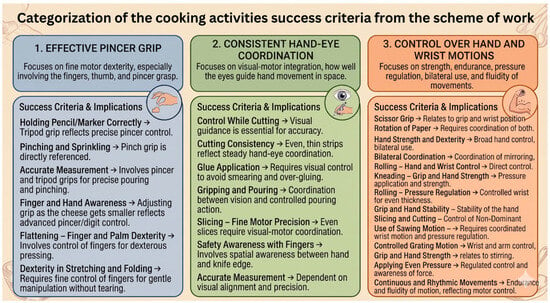
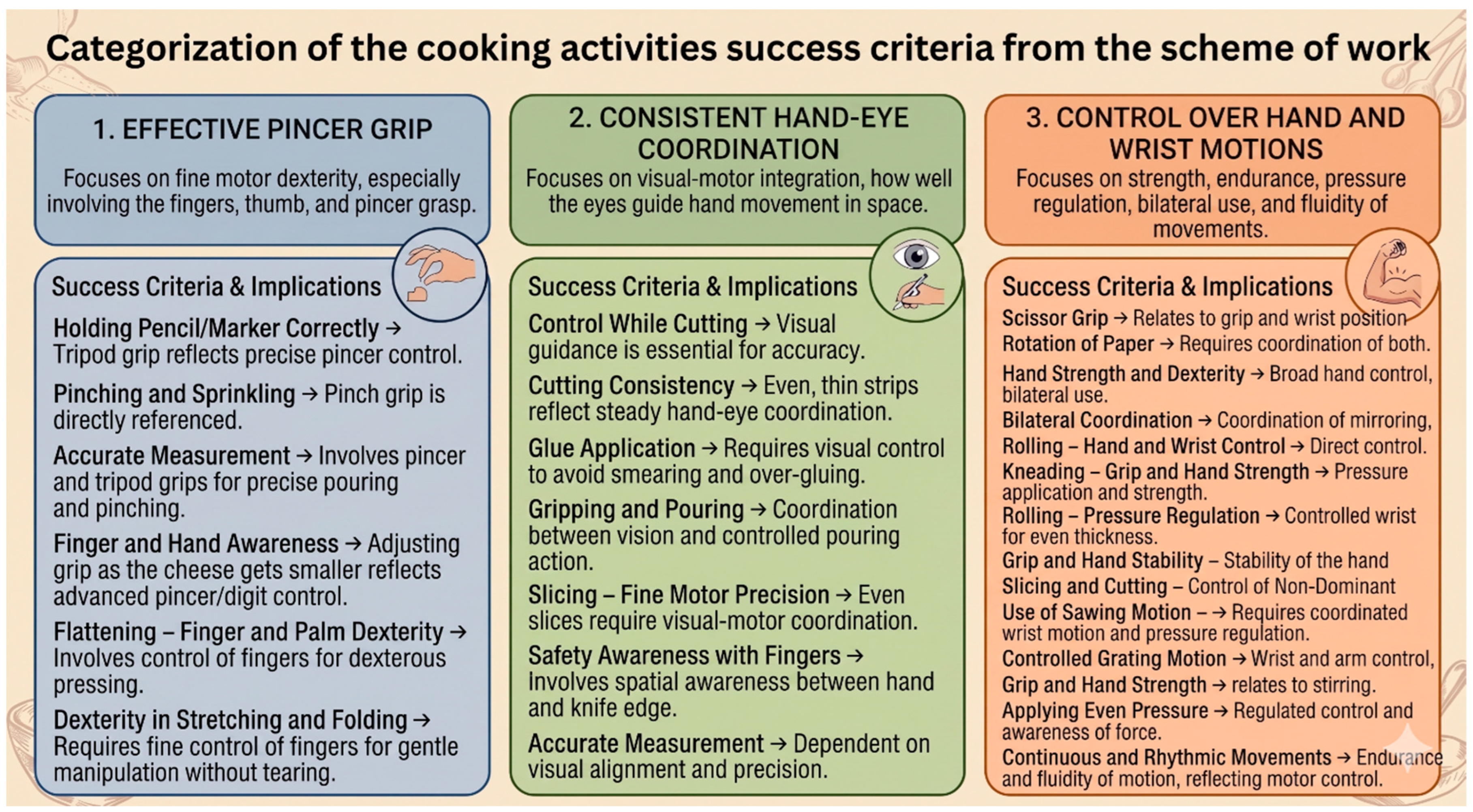
This progressive framework allowed each child to consolidate their foundational skills before encountering the more comprehensive sensory and cognitive demands of real food preparation. Each activity was cross-referenced to specific success criteria tied to the three overarching motor themes, e.g., slicing corresponded to visual-motor integration, and each activity was mapped to one or more assessment categories: effective pincer grip, consistent hand-eye coordination, and control over hand/wrist motions. (See Figure 2 for the categorisation of the cooking activities success criteria from the scheme of work to each of the 3 core themes.).
Figure 2.
Categorisation of the cooking activities success criteria from the scheme of work for effective pincer grip, consistent hand-eye coordination, and control over hand and wrist motions.
Instructional Procedures
All sessions followed a consistent instructional structure: (1) teacher demonstration, (2) verbal explanation using age-appropriate cues, (3) guided practice, and (4) independent task engagement. Demonstrations were delivered by the same instructor (researcher), ensuring consistency in modelling. Instructions were standardised through pre-planned lesson scripts and consistent task sequencing across sessions.
2.5. Data Collection
Due to the ecological and curriculum-embedded nature of the intervention, session 1 functioned as a structured initial reference point, capturing children’s starting performance under authentic classroom conditions. Prior research had been conducted with the same cohort of children, providing important contextual insight into their baseline fine motor competence. This earlier study (Huggett & Howells, 2024) identified that children were not meeting age-related expectations in FMS and identified the need for tailored interventions. This dataset was collected independently of the present study and does not constitute a formal baseline for the current analysis; it provides valuable developmental context for interpreting the cohort’s starting point and supports the rationale for further intervention in the present study.
Children’s fine motor performance was assessed in real time using an observation-based rubric adapted from the National Curriculum (DfE, 2024) criteria. Observations were conducted by the class teacher, within an embedded practitioner–researcher role, ensuring consistent application of the observational rubric across all sessions. This approach enabled a high level of contextual familiarity with pupils’ typical motor behaviours, thereby supporting sensitive, developmentally informed assessment. The established teacher–pupil relationship may have supported a more natural performance, helping to reduce any anxiety and reactivity that the children could have experienced from a non-familiar researcher. The practitioner-researcher role may have enabled more natural behaviour to be observed, reducing the likelihood of underperformance or self-conscious responses during assessment. While this approach enhances real-world validity and scoring consistency, it also introduces the potential for observer bias due to the absence of independent raters; this is acknowledged and addressed through cautious interpretation of findings.
Each skill was scored on a binary scale (Yes = 1, No = 0), indicating whether the target movement was independently demonstrated according to predefined success criteria. ‘Independently demonstrated’ was defined as the completion of the movement without physical prompting or corrective intervention, ensuring consistent scoring across sessions. While binary scoring limits sensitivity to partial proficiency, it was selected to ensure reliability and feasibility within a real-time classroom context (Gajewska et al., 2025).
Qualitative field notes were used to capture gradations in performance, thereby complementing the quantitative data. These notes captured nuances in movement fluency, spatial awareness, responsiveness to feedback, and levels of affective engagement. Before implementation, the rubric underwent pilot testing with a small focus group to ensure the criteria were sensitive enough to distinguish among diverse ability levels accurately.
2.6. Data Analysis
To ensure robust scholarly evaluation, a mixed-methods data analysis was employed. The quantitative binary assessment scores were summed across participants for each session and motor theme and converted into percentage scores, representing the proportion of children demonstrating the three motor themes (effective pincer grip, consistent hand-eye coordination and control over hand and wrist motions). Analysis focused on group-level trends rather than individual trajectories.
Given the repeated-measures structure across five sessions, within-group changes over time were analysed using Friedman’s ANOVA, with Kendall’s W reported as the effect size. While variation in task demands across sessions limits strict comparability, this reflects principles of motor learning, where varied practice supports skill development and transfer (Schmidt & Lee, 2011).
As such, the repeated-measures structure reflects within-group change over time, rather than individual-level longitudinal modelling. Friedman’s ANOVA was selected as a non-parametric test suitable for repeated measures on ordinal or non-normally distributed data, enabling detection of overall differences in skill demonstration across sessions.
Concurrently, the qualitative field notes were thematically coded according to Braun and Clarke’s (2006) framework. To maintain theoretical consistency with affective and cognitive dimensions of physical literacy, these themes were cross-referenced with children’s verbal reflections gathered during group-sharing sessions, utilising a ‘child-voice’ approach (Clark & Moss, 2001), to deepen understanding of perceived effort, intrinsic motivation, and task mastery. This analytical approach prioritises the extent to which findings generalise to real-world contexts and sensitivity to authentic classroom practice, while enabling robust detection of group-level trends in FMS development over time.
3. Results
3.1. Fine Motor Skill Progression
Across the five cooking sessions, children demonstrated highly significant improvements in all targeted fine motor themes. The quantitative binary assessment scores were aggregated to track group-level proficiency, revealing robust developmental and skill-refinement trajectories across the three core themes of the intervention. While group-level trends were strong, individual variability was observed and is reflected in the qualitative data.
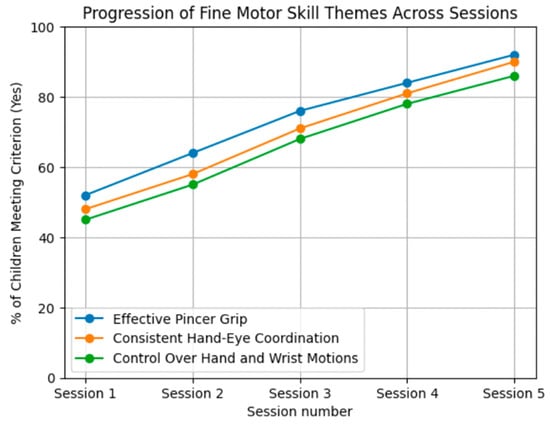
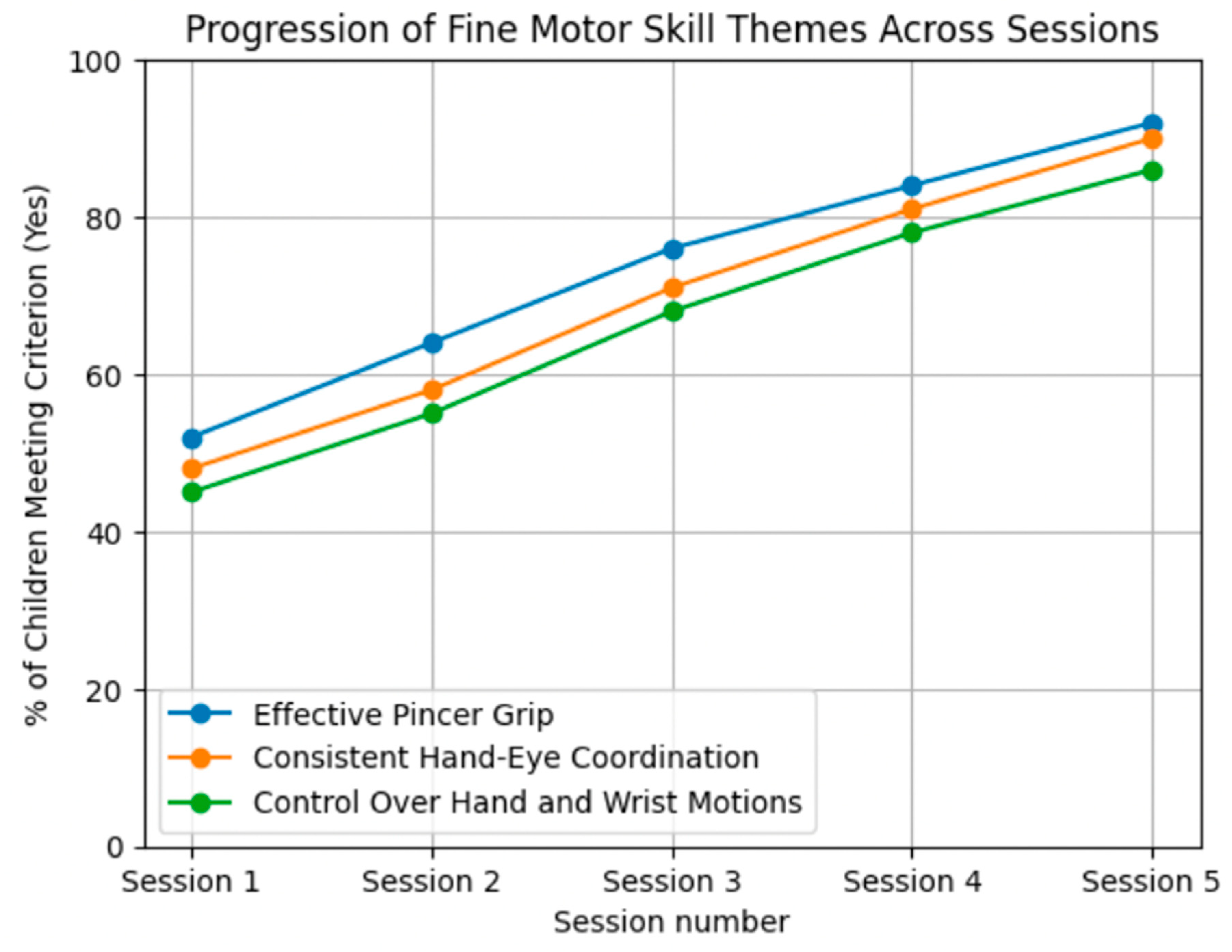
For Effective Pincer Grip, mean aggregated scores increased consistently throughout the intervention (χ2(4) = 83.10, p < 0.001, Kendall’s W = 0.67). This indicates a strong effect size reflecting substantial gains in pincer grip strength and control through repeated, hands-on practice (see Figure 3 and Table 2). In practical classroom terms, children who initially fumbled when picking up small toppings or had difficulty pinching the dough were, by the end of the intervention, confidently grasping, sprinkling, and pinching ingredients.
Figure 3.
Progression of fine motor themes across all sessions.
Table 2.
Session-level means: Percentage of children who scored ‘yes’ for each theme, per session.
Consistent Hand-Eye Coordination also showed marked progression (χ2(3) = 55.66, p < 0.001, W = 0.60), reflecting a strong effect and demonstrating reliable classroom-wide gains in visual-motor integration (see Figure 3 and Table 2). Observational data confirmed that children who previously struggled with cutting along a curved pizza crust or with guiding a spoon accurately could, post-intervention, cut smooth lines and spread sauce with enhanced precision.
Finally, Control Over Hand and Wrist Motions improved substantially (χ2(4) = 62.83, p < 0.001, W = 0.51). This moderate-to-strong effect size indicates that the group achieved more than half of the potential improvement in control over hand and wrist motions during the short-term intervention. The teacher and cook observed that pupils who once dropped rolling pins or became quickly fatigued by kneading dough were confidently rolling and kneading with steady, even pressure by the final session. Table 2 illustrates the steady upward trend in session-by-session proficiency across these themes.
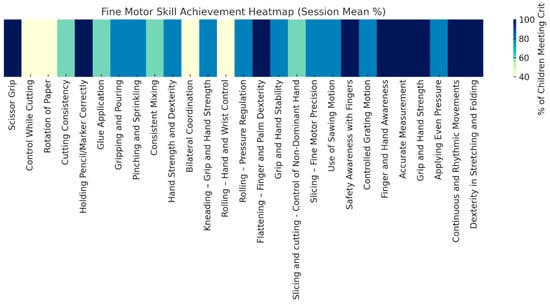
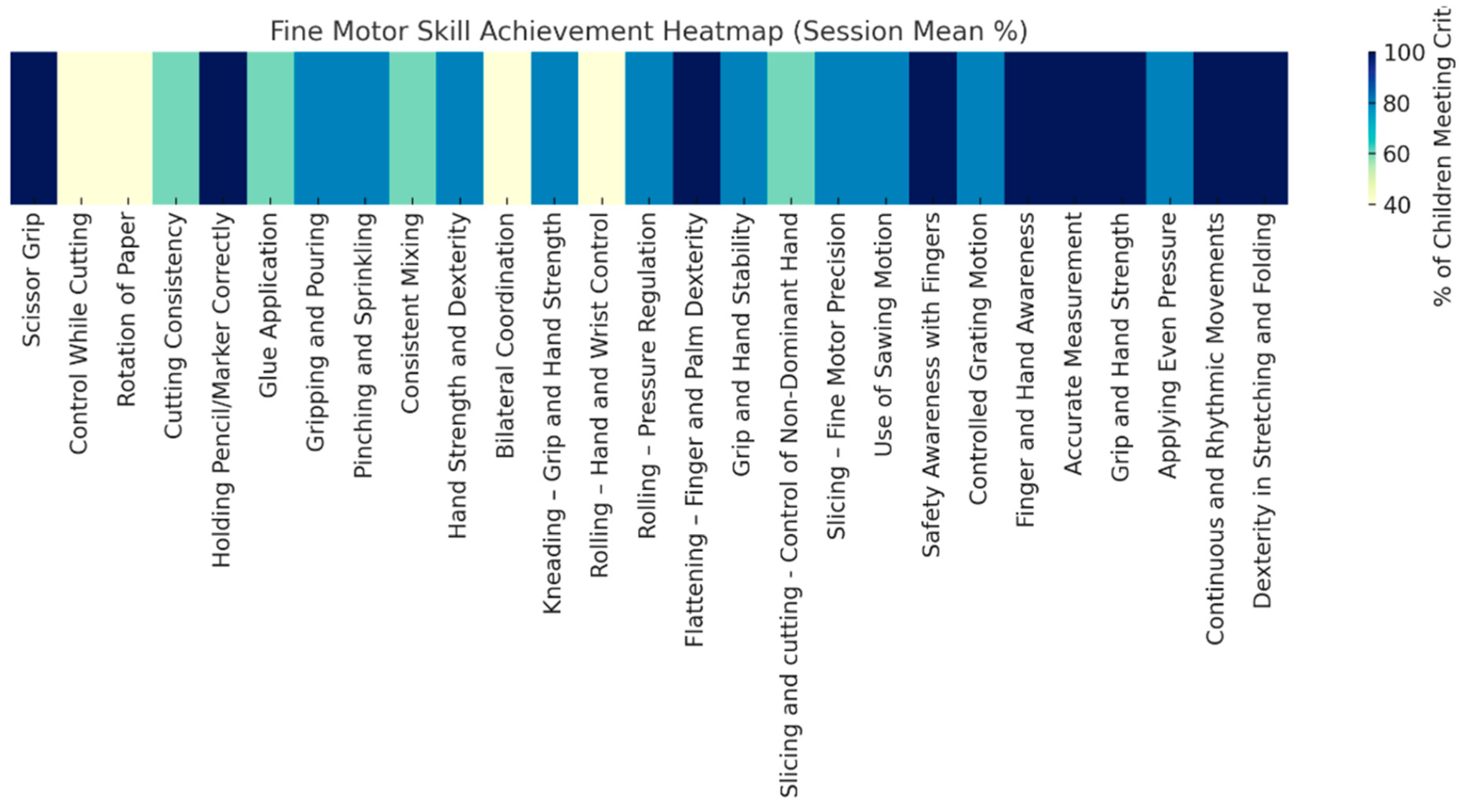
Visual representations of these trajectories (Figure 3 and Figure 4) further highlight the progressive skill consolidation across all themes.
Figure 4.
Fine Motor Skill Achievement Heatmap (Session Mean %).
3.2. Nuanced Skill Acquisition: Lead and ‘Emergent’ Skills
Looking more closely at the data, a clear improvement was observed in several “lead skills” (as the children called them, their “hero skills”). Within Consistent Hand-Eye Coordination skills, such as Cutting Consistency and Control While Cutting, progress was rapid, demonstrating the children’s ability to transfer visual-motor coordination into successful food-preparation tasks seamlessly. For Control Over Hand and Wrist Motions, early progression was underpinned by improvements in Scissor Grip and Rotation of Paper, with later sessions highlighting children’s ability to manage more demanding tasks such as Rolling, Hand and Wrist Control, and Kneading. Within Effective Pincer Grip, children demonstrated strong and rapid competence in Pinching and Sprinkling, while Holding a Pencil Correctly remained consistently high, indicating a ceiling effect.
Conversely, the analysis highlighted specific actions that remained challenging, which we have critically reframed as “emergent and next-step skills.” Tasks requiring complex bilateral coordination and graded force control, such as Applying Even Pressure (when using a rolling pin), Use of Sawing Motion, and Controlled Grating Motion, were less consistently mastered. Additionally, tasks demanding exceptionally high levels of visual-motor integration, including Accurate Measurement and Fine Motor Precision, during slicing, remained ongoing challenges for many children.
By identifying these actions not as fixed deficits, but as emergent progression targets, this framework intentionally supports a culture of possibility. This pedagogical reframing invites educators to view advanced strength-dependent actions as opportunities for continued skill building, encouraging persistence and motivation as children journey toward full motor competence.
4. Discussion
4.1. Overview and Interpretation of Findings
It is acknowledged that, given the absence of a control group, randomisation, and a formal within-study baseline, the findings were interpreted as exploratory and descriptive. While statistically significant changes were observed, these cannot be attributed solely to the intervention, and causal inferences cannot be made.
Within the broader context of movement education and physical literacy, this study’s findings highlight the distinctive contribution of cooking-based learning as a practical, authentic, and accessible way to advance children’s movement competence. This study set out to evaluate structured improvements in fine motor competencies within three themes: effective pincer grip, consistent hand-eye coordination and control over hand and wrist motions, through a sequential progressive cooking intervention. The results revealed statistically significant gains across all three themes (Kendall’s W ranging from 0.51 to 0.67, p < 0.001). These findings extend beyond documenting generic motor improvement by suggesting that structured cooking activities may function as a targeted mechanism for skill development within authentic classroom contexts.
While FMS are often considered to be broadly established by ages 7–8, developmental trajectories remain highly variable, and continued refinement and acquisition of more complex, task-specific motor competencies occur throughout middle childhood (Cameron et al., 2012; Dinehart & Manfra, 2013). Applied, strength-dependent and precision-based skills, such as controlled slicing, graded pressure, and bilateral coordination, continue to develop in response to structured practice and environmental demands.
Within this context, the present findings can be understood not only as refinement but also as evidence of ongoing developmental progression in functional, real-world motor competence. This is especially relevant given that prior research undertaken with the same case study group (Huggett & Howells, 2024) found that the children were below age-related expectations in these areas, reinforcing the need for targeted, context-rich interventions.
A unique critical insight from this study lies in the detailed skill-level analysis, which revealed both the strengths and limitations of the intervention. The rapid development of specific ‘lead skills’ such as Cutting Consistency and Control While Cutting, underscores the capacity of practical cooking contexts to advance visual-motor integration and bilateral coordination, a nuance often overlooked in studies focusing on isolated fine motor tasks. Furthermore, identifying persistent challenges in strength-dependent or high-precision actions, such as Applying Even Pressure and Controlled Grating points, is necessary for future scaffolding. By mapping progression targets in this way, this pedagogical model allows practitioners to frame motor challenges not as deficits but as ‘emergent’ opportunities for continued growth within real-world tasks, reinforcing a strengths-based approach.
4.2. Mechanisms of Learning: Operationalising Physical Literacy
To understand the efficacy of this approach, it is essential to highlight possible explanations for the observed improvements. Grounded in Kolb’s (1984) model of experiential learning, the cooking sessions offered cyclical opportunities for active experimentation, reflection, and consolidation. From a motor learning perspective, the variability of tools and repetition of core movements across sessions enabled a deeper understanding and generalisation of adaptive motor schemas (Schmidt & Lee, 2011).
Crucially, these mechanisms may reflect the multidimensional nature of physical literacy. Cooking provided a multisensory, socially shared experience with a tangible, edible outcome. Because the children could see, taste, touch, and share their work, the intervention engaged the affective domain heavily, fostering intrinsic motivation, self-efficacy, and positive emotion, all of which support neuroplasticity and sustained skill development (Diamond, 2000). This authentic, functional context stands in stark contrast to the repetition of contrived classroom exercises, suggesting that children learn best when the movement has a meaningful purpose (Pini et al., 2023).
4.3. Implications for Practice, Policy, and Public Health
Collectively, these findings position structured, classroom-based cooking activities as more than supplemental enrichment: they may have potential relevance for public health and educational practice that bridges health, education, and wellbeing. Embedding cooking into the curriculum yields a scalable, low-cost, culturally adaptable method for supporting health equity among diverse learners.
Importantly, there is an urgent need for policy action to address the rising demand for public services caused by delayed motor development. Estimates suggest that improving children’s self-care independence through early school-based motor interventions could generate long-term savings of up to £1500 per child for the NHS by reducing demand for occupational therapy and additional educational support (Royal College of Occupational Therapists, 2023).
For educators seeking to implement these findings, strengthening essential FMS immediately is highly achievable through targeted cooking activities. Three concrete actions to embed in future lessons include:
- Focused cutting sessions: guiding children to use scissors or child-safe knives with explicit attention to bilateral coordination (both hands working together).
- Pinching and sprinkling tasks: using activities such as topping pizzas or crackers to develop pincer grip and precision rapidly.
- Dough manipulation: providing regular opportunities to roll playdough or real dough, encouraging consistent hand and wrist motions to build foundational strength and pressure regulation.
4.4. Limitations and Methodological Considerations
Several methodological limitations should be acknowledged. Variation in activity type across the five sessions limited strict session-to-session comparability; conversely, it reflected authentic classroom practice and enhanced real-world applicability.
The researcher’s dual role as teacher and data collector introduces potential observer bias, and the absence of independent inter-rater reliability limits verification of scoring consistency. While this embedded practitioner-researcher approach supports ecological validity, future research should incorporate independent raters and formal reliability measures to strengthen objectivity. The use of the embedded practitioner-researcher ensured consistent application of assessment criteria across sessions and supported contextually informed evaluation within authentic classroom conditions. The use of an expert cook to deliver the session further standardised instructional input.
Although prior research involving the same cohort identified FMS challenges, alongside ongoing curriculum-linked teacher observations conducted throughout the academic year, these data were collected independently and therefore cannot be integrated as a formal pre-intervention baseline for the present study. This limits the ability to quantify within-study change against a controlled baseline, despite providing valuable contextual justification for the intervention design. Accordingly, session 1 was used as an initial reference point rather than a formal pre-intervention baseline.
The absence of a control group limits causal attribution, as maturation, prior experience, or contextual factors may have influenced the observed changes. The classroom-embedded design prioritised real-world applicability and alignment with authentic educational practice; however, this limited the implementation of experimental controls. Future research will incorporate controlled or comparison group designs to strengthen causal inference and further evaluate the effectiveness of cooking-based interventions for FMS development.
4.5. Future Directions
Moving forward, longitudinal follow-up studies are required to track whether the improved dexterity observed in cooking contexts transfers to other fine motor competence areas, such as handwriting quality, self-care skills, and ongoing participation in physical activity. To strengthen future research, studies should continue to implement mixed methods designs that combine repeated quantitative assessments (e.g., standardised motor skill measures) with in-depth qualitative approaches to capture children’s perspectives on confidence and engagement. It is also proposed that future studies should adopt scaled or rubric-based assessments to capture incremental motor development. There is also a clear need to evaluate how this pedagogical model can be adapted for children with specific developmental coordination challenges.
5. Conclusions
To truly rethink physical literacy, educators and policymakers must expand movement education beyond traditional physical education settings and isolated exercises. This study suggests that cooking-based learning offers a highly practical, low-cost, and scalable pedagogical model that aligns educational practice with broader public health and equity objectives. By embedding FMS practice within authentic, meaningful, and socially engaging tasks, educators can nurture not only children’s physical dexterity but also their confidence, motivation, and agency, which are required for holistic physical literacy. Positioning everyday tasks, such as cooking, as an educational innovation reframes movement education as a vital, inclusive vehicle for advancing capability, equity, and lifelong wellbeing.
Author Contributions
Conceptualization, E.H., L.S. and K.H.; methodology, E.H. and L.S.; software, E.H.; validation, E.H. and K.H.; formal analysis, E.H. and K.H.; resources, E.H.; data curation, E.H.; writing—original draft preparation, E.H.; writing—review and editing, K.H.; visualization, E.H. and K.H.; supervision, K.H.; project administration, E.H. All authors have read and agreed to the published version of the manuscript.
Funding
This research received no external funding.
Institutional Review Board Statement
The study was conducted in accordance with the Declaration of Helsinki and approved by the Institutional Review Board (or Ethics Committee) of Canterbury Christ Church University (ETH2425-0020, 10 September 2025), for studies involving humans.
Informed Consent Statement
Informed consent was obtained from all subjects involved in the study.
Data Availability Statement
Dataset available on request from the authors.
Acknowledgments
The authors wish to express their heartfelt gratitude to Lorraine Spalding for her unwavering support, creativity, and passion throughout this research. Lorraine’s enthusiasm in anything creative brought joy and inspiration to the children, and her ability to make cooking both fun and meaningful left a lasting impression on everyone involved. We hope this article stands as a tribute to her dedication and encourages others to use cooking as a tool to support children’s fine motor development. We also wish to acknowledge Lorraine’s deeply sad and far too early passing. Her legacy lives on not only in the children she taught but in the continued work of those inspired by her approach. Thank you, Lorraine, for everything you have given to this project and to the wider school community. During the preparation of this manuscript/study, the authors used Nano Banana Pro, Gemini Flash 3.2 to develop, edit and make Figure 1 to act as a visual image to illustrate the range of cooking skills associated with FMS development. Grammarly (https://app.grammarly.com/) was used to check grammar, spelling and punctuation. The University Turnitin tool within Blackboard, the virtual learning environment, was used to run a similarity report, which reported a 2 result when checked. The authors have reviewed and edited the output and take full responsibility for the content of this publication.
Conflicts of Interest
The authors declare no conflicts of interest.
Abbreviations
The following abbreviations are used in this manuscript:
| DfE | Department for Education |
| D&T | Design and Technology |
| FMS | Fine Motor Skills |
| PSHE | Personal Social Health and Economic Education |
| SDG | Sustainable Development Goals |
References
- Almond, L., & Lambden, K. (2016). Promoting purposeful physical play in the early years through physical literacy. A self-learning programme for early years settings and their practitioners. Step into Purposeful Play. [Google Scholar]
- Ayres, A. J. (2005). Sensory integration and the child: Understanding hidden sensory challenges. Western Psychological Services. [Google Scholar]
- Bart, O., Hajami, D., & Bar-Haim, Y. (2008). Predicting school adjustment from motor abilities in kindergarten. Infant and Child Development, 16(6), 597–615. [Google Scholar] [CrossRef] [Scilit]
- Braun, V., & Clarke, V. (2006). Using thematic analysis in psychology. Qualitative Research in Psychology, 3(2), 77–101. [Google Scholar] [CrossRef] [Scilit]
- Cameron, C. E., Brock, L. L., Murrah, W. M., Bell, L. H., Worzalla, S. L., Grissmer, D., & Morrison, F. J. (2012). Fine motor skills and executive function both contribute to kindergarten achievement. Child Development, 83(4), 1229–1244. [Google Scholar] [CrossRef] [Scilit] [PubMed]
- Carlson, A. (2013). Fine motor skills and executive function: Two non-academic predictors of academic achievement. Available online: https://integrative.gmu.edu/defenses/663 (accessed on 4 March 2026).
- Case-Smith, J. (1996). Fine motor outcomes in preschool children who receive occupational therapy services. American Journal Occupational Therapy, 50(1), 52–61. [Google Scholar] [CrossRef] [Scilit] [PubMed]
- Charlton, K., Comerford, T., Deavin, N., & Walton, K. (2021). Characteristics of successful primary school-based experiential nutrition programmes: A systematic literature review. Public Health Nutrition, 24(14), 4642–4662. [Google Scholar] [CrossRef] [Scilit]
- Chu, Y. L., Farmer, A., Fung, C., Kuhle, S., & Storey, K. E. (2013). Involvement in home meal preparation is associated with food preference and self-efficacy among Canadian children. Public Health Nutrition, 16(1), 108–112. [Google Scholar] [CrossRef] [Scilit]
- Clark, A., & Moss, P. (2001). Listening to young children: The mosaic approach. National Children’s Bureau Enterprise Ltd. [Google Scholar]
- Department for Education. (2013). The national curriculum in England. Key stages 1 and 2 framework document. Available online: https://assets.publishing.service.gov.uk/media/5a81a9abe5274a2e8ab55319/PRIMARY_national_curriculum.pdf (accessed on 4 March 2026).
- Department for Education. (2024). Help for early years providers. Fine motor skills. Available online: https://help-for-early-years-providers.education.gov.uk/areas-of-learning/physical-development/fine-motor-skills (accessed on 4 March 2026).
- Department for Education. (2025). Early years foundation stage statutory framework. For groups and school-based providers. Setting the standards for learning, development, and care for children from birth to five. Available online: https://assets.publishing.service.gov.uk/media/68c024cb8c6d992f23edd79c/Early_years_foundation_stage_statutory_framework_-_for_group_and_school-based_providers.pdf.pdf (accessed on 4 March 2026).
- Diamond, A. (2000). Close interrelation of motor development and cognitive development and of the cerebellum and prefrontal cortex. Child Development, 71(1), 44–56. [Google Scholar] [CrossRef] [Scilit]
- Dinehart, L. H., & Manfra, L. (2013). Associations between low-income children’s fine motor skills in preschool and academic performance in second grade. Early Education and Development, 24(2), 138–161. [Google Scholar] [CrossRef] [Scilit]
- Edwards, A. (2025). Knowledge for a future-orientated pedagogy. Oxford Review of Education, 51(6), 919–935. [Google Scholar] [CrossRef] [Scilit]
- Food Teachers Centre. (2023). Results of two surveys: The future of food education and ingredients for success. Available online: https://foodteacherscentre.co.uk/food-teachers-centre-may-2023-newsletter/ (accessed on 4 March 2026).
- Gajewska, E., Surowińska, J., Chałupka, A., Moczko, J., Michalak, M., & Sobieska, M. (2025). The qualitative motor assessment at three months allows a better prognosis than the traction test. Scientific Reports, 15, 15035. [Google Scholar] [CrossRef] [Scilit]
- Garcia, A. L., Brown, E., Goodale, T., McLachlan, M., & Parrett, A. (2000). A nursery-based cooking skills programme with parents and children reduced food fussiness and increased willingness to try vegetables: A quasi-experimental study. Nutrients, 12(9), 2623. [Google Scholar] [CrossRef] [Scilit] [PubMed]
- Harmon, R., Beerse, M., & Catellanos, D. C. (2025). Association between fine motor function and fundamental cooking skills in preschool-aged children. Human Movement Science, 101, 103340. [Google Scholar] [CrossRef] [Scilit]
- Health Service Executive, Ireland. (2025). Cooking and baking as sensory play. Available online: https://www2.hse.ie/babies-children/disabilities/play/cooking-baking/ (accessed on 4 March 2026).
- Hersch, D., Perdue, L., Ambroz, T., & Boucher, J. L. (2014). The impact of cooking classes on food-related preferences, attitudes, and behaviors of school-aged children: A systematic review. Preventing Chronic Disease 11, 140267. [Google Scholar] [CrossRef] [Scilit]
- House of Commons Library. (2025). Which children are most likely to be in poverty in the UK? UK Parliament. Available online: https://commonslibrary.parliament.uk/which-children-are-most-likely-to-be-in-poverty-in-the-uk/ (accessed on 4 March 2026).
- Howells, K. (2012). Chapter 13, ‘Placing an importance on health and physical activity’. In G. Griggs (Ed.), An introduction to primary physical education (pp. 207–220). Routledge. [Google Scholar]
- Howells, K., & Coppinger, T. (2023). The forgotten age phase of healthy lifestyle promotion? A preliminary study to examine the potential call for targeted physical activity and nutrition education for older adolescents. International Journal of Environmental Research and Public Health, 19(10), 5970. [Google Scholar] [CrossRef] [Scilit] [PubMed]
- Huggett, E., & Howells, K. (2024). Supporting young children’s physical development through tailored motor competency interventions within school settings. Children. Special Issue Movement Behaviors and Motor Skills in Early Years Children, 11(9), 1122. [Google Scholar] [CrossRef] [Scilit]
- Jonah, S. M. (2023). Development of early children’s fine motor ability through colouring activities. European Union Digital Library. [Google Scholar] [CrossRef] [Scilit]
- Jones, D., Innerd, A., Giles, E. L., & Azevedo, L. B. (2021). The association between physical activity, motor skills, and school readiness in 4-5-year-old children in the northeast of England. International Journal of Environmental Research and Public Health, 18(22), 11931. [Google Scholar] [CrossRef] [Scilit]
- Józsa, K., Oo, T. Z., Borbélyovά, D., & Zentai, G. (2023). Exploring the growth and predictors of fine motor skills in young children aged 4-8 years. Education Sciences, 13(9), 939. [Google Scholar] [CrossRef] [Scilit]
- Kolb, D. A. (1984). Experiential learning: Experience as the source of learning and development. Prentice Hall. [Google Scholar]
- Kwon, S., & O’Neill, M. (2020). Socioeconomic and Familial factors associated with gross motor skills among US children aged 3-5 years: The 2012 NHANES national youth fitness survey. International Journal of Environmental Research and Public Health, 17(12), 4491. [Google Scholar] [CrossRef] [Scilit]
- Lavelle, F., Mooney, E., Coffey, S., Lydon, R., Dean, M., & McCloat, A. (2023). Fun with food—A parent-child community cooking intervention reduces parental fear and increases children’s perceived competence. Appetite, 180, 106347. [Google Scholar] [CrossRef] [Scilit]
- Lincolnshire Research School. (2025). Handwriting readiness in the EYFS (Part 1). Available online: https://researchschool.org.uk/lincolnshire/news/handwriting-readiness-in-the-eyfs-part-1 (accessed on 4 March 2026).
- Mancini, V. O., Licari, M. K., Alvares, G. A., McQueen, M. C., McIntyre, S., Reynolds, J. E., Reid, S. L., Spittle, A. J., & Williams, J. (2015). Psychosocial wellbeing, parental concerns, and familial impact of children with developmental coordination disorder. Research in Developmental Disabilities, 145, 104659. [Google Scholar] [CrossRef] [Scilit] [PubMed]
- Maranatha, J. R., & Briliany, N. (2023). Enhancing fine motor skills in early childhood through fun cooking activities: A quasi-experimental study in Purwakarta, Indonesia. Golden Age: Jurnal Ilmiah Tumbuh Kembang Anak Usia Dini, 8(4), 203–212. [Google Scholar] [CrossRef] [Scilit]
- Morley, D., Till, K., Ogilvie, P., & Turner, G. (2015). Influences of gender and socioeconomic status on the motor proficiency of children in the UK. Human Movement Science, 44, 150–156. [Google Scholar] [CrossRef] [Scilit]
- Osman, S., Hirsch, C., Jalal, Z., & Paudyal, V. (2024). Collaborative approaches to health education: Perspectives of parents and teachers on self-care and managing health issues in UK primary schools. BMC Health Services Research, 24(1), 1315. [Google Scholar] [CrossRef] [Scilit] [PubMed]
- Piek, J. P., Dawson, L., Smith, L. M., & Gasson, N. (2008). The role of early fine and gross motor development on later motor and cognitive ability. Human Movement Science, 27(5), 668–681. [Google Scholar] [CrossRef] [Scilit] [PubMed]
- Pini, S., Goodman, W., Raby, E., McGinley, C., Perez-Cornago, A., Johnson, F., & Beeken, R. J. (2023). Development and initial qualitative evaluation of a novel school-based nutrition intervention—COOKKIT (Cooking Kit for Kids). BMC Public Health, 23(1), 1742. [Google Scholar] [CrossRef] [Scilit]
- Randall, V. (2022). ‘We want to, but we can’t: Pre-service teachers’ experiences of learning to teach primary physical education. Oxford Review of Education, 49(2), 209–228. [Google Scholar] [CrossRef] [Scilit]
- Royal College of Occupational Therapists. (2023). Cost-of-living crisis impacting access to vital therapists for children and young people. Available online: https://www.rcot.co.uk/latest-news/cost-living-crisis-impacting-access-vital-therapists-children-and-young-people (accessed on 4 March 2026).
- Rutland, M. (2008). Licence to cook: The death knell for food technology? Available online: https://repository.lboro.ac.uk/articles/online_resource/Licence_to_Cook_the_death_knell_for_food_technology_/9345773?file=16954817 (accessed on 4 March 2026).
- Schmidt, R. A., & Lee, T. D. (2011). Motor control and learning: A behavioural emphasis. Human Kinetics. [Google Scholar]
- Shonkoff, J. P., & Phillips, D. A. (2000). From neurons to neighborhoods: The science of early childhood development. National Academy Press. [Google Scholar]
- The Guardian. (2025). Some children starting school unable to climb staircase, finds England and Wales teacher survey. Available online: https://www.theguardian.com/education/2025/jan/30/some-children-starting-school-unable-to-climb-staircase-finds-england-and-wales-teacher-survey (accessed on 18 March 2026).
- The Marmot Review. (2010). London: The marmot review. Available online: https://www.instituteofhealthequity.org/resources-reports/fair-society-healthy-lives-the-marmot-review (accessed on 18 March 2026).
- The Times. (2025a). Children starting school aren’t ready, say teachers. Available online: https://www.thetimes.com/uk/article/children-starting-school-arent-ready-say-teachers-kq8tgz539 (accessed on 18 March 2026).
- The Times. (2025b). Children struggle to hold pencils as motor skills decline in primary school. Available online: https://www.thetimes.com/uk/education/article/children-struggle-to-hold-pencils-motor-skills-decline-primary-school-kpgw7wqpl (accessed on 18 March 2026).
- Turner, C. (2025, May 13). Three-quarters of primary teachers report declining fine motor skills. TES Magazine. Available online: https://www.tes.com/magazine/news/primary/most-primary-teachers-report-declining-fine-motor-skills-pupils (accessed on 4 March 2026).
- United Nations. (2025). Sustainable development goals (SDGs) the 17 goals. Available online: https://sdgs.un.org/goals (accessed on 4 March 2026).
- Vaughan, K. L., Cade, J. E., Hetherington, M. M., Cockroft, J. E., Heinen, M. M., Ripping, H., & Evans, C. E. L. (2022). Evaluation of the PhunkyFoods intervention of food literacy and cooking skills of children aged 7–9 years: A cluster randomized controlled trials in Yorkshire Primary Schools UK. Trials, 23(1), 618. [Google Scholar] [CrossRef] [Scilit]
- Vaughan, K. L., Cade, J. E., Hetherington, M. M., Webster, J., & Evans, C. E. L. (2024). The impact of school-based cooking classes on vegetable intake, cooking skills, and food literacy of children aged 4–12 years: A systematic review of the evidence 2001–2021. Appetite, 195, 107238. [Google Scholar] [CrossRef] [Scilit]
- Vaughan, K. L., Vidal, M., Cade, J. E., Hetherington, M. M., & Evans, C. E. L. (2025). Evaluation of the school-based ‘PhunkyFoods’ intervention: A cluster randomised controlled trial in the UK. Public Health Nutrition, 28(1), e86. [Google Scholar] [CrossRef] [Scilit]
- Vygotsky, L. S. (1978). Mind in society: The development of higher psychological processes. Harvard University Press. [Google Scholar]
- Whitehead, M. E. (Ed.). (2010). Physical literacy: Throughout the lifecourse. Routledge. [Google Scholar]

Disclaimer/Publisher’s Note: The statements, opinions and data contained in all publications are solely those of the individual author(s) and contributor(s) and not of MDPI and/or the editor(s). MDPI and/or the editor(s) disclaim responsibility for any injury to people or property resulting from any ideas, methods, instructions or products referred to in the content. |
© 2026 by the authors. Licensee MDPI, Basel, Switzerland. This article is an open access article distributed under the terms and conditions of the Creative Commons Attribution (CC BY) license.