


Abstract
Self-efficacy—one’s belief in their ability to take the actions necessary to succeed—is a critical determinant of student success and retention, particularly during the transitional first two years of undergraduate study. Learning communities that incorporate peer mentors have been identified as promising structures for fostering self-efficacy, yet the mechanisms by which intentional peer mentoring within structured career development contexts shapes students’ self-efficacy beliefs remain underexplored. This study examined the following research questions: (1) How does participation in a career-focused Learning community course shape first- and second-year STEM students’ sense of self-efficacy regarding academic and career decision-making? (2) In what ways do peer mentors and peer support networks within the learning community contribute to students’ self-efficacy development? (3) How do students describe feeling empowered—or not—to pursue their career goals as a result of this experience? Using a mixed-methods design that combined pre- and post-course surveys, semi-structured focus groups, and phenomenological one-on-one interviews, we investigated the self-efficacy development of first- and second-year STEM students (N = 53) enrolled in a semester-long learning community course at a large, predominantly White public institution in the Midwest. Of these, 25 students completed both the pre- and post-course Career Self-Efficacy surveys and were included in matched statistical analyses. Three major findings emerged: (1) the learning community class environment created a space where self-efficacy was prioritized and developed; (2) peer support groups and peer mentors positively impacted students’ self-efficacy; and (3) students felt empowered by the experience in pursuing their chosen career goals. These findings have practical implications for the design of learning communities in STEM, highlighting the value of intentional peer mentoring structures and career-focused activities as tools for promoting student confidence, retention, and long-term academic success.
1. Introduction
Supporting students and promoting student success are core goals of institutions of higher education. A critical determinant of student success is their sense of self-efficacy, a belief in oneself and in one’s ability to take necessary actions to succeed (Bandura, 1977). This study focuses on the intersection of two evidence-based approaches to supporting undergraduate students: learning communities and peer mentoring. Learning communities are structured academic programs that enroll cohorts of students in linked or coordinated courses, creating intentional spaces for collaborative learning and community building (Smith et al., 2009). Peer mentoring, by contrast, refers to the practice of pairing students with slightly more senior peers who can provide guidance, model academic behaviors, and offer relatable support (Collier, 2017). While both approaches have been studied independently in relation to student success, this study examines what happens when peer mentoring is intentionally embedded within the structured context of a learning community course—a combination that remains understudied in the literature. Through the learning communities, it is important for students to develop a strong sense of self-efficacy early on in their undergraduate experience, so that they feel capable of making the most informed decisions at transitional moments in their career. Such transitional moments are likely to occur within students’ first two years at an institution: as they shift their focus from adjusting to undergraduate life and settling into their declared major, students start to evaluate their potential career options (Ishitani, 2016). These are also the years with the highest attrition rates (“Learning slope”, 1991), so our findings are relevant to discussions of how to improve student retention at institutions of higher education. For example, students in the Fall 2023 New Direct from High School (NDHS) community cohort had a one-year retention rate that was 5.0 percentage points higher than their peers (88.0% vs. 83.0%) who did not participate in a learning community (Iowa State University, Office of Institutional Research, 2024).
Our study focused on an experiential learning community course with an emphasis on career exploration that enrolled students in their first and third semesters at a large, predominantly white public institution (PWI) in the Midwest. This course was primarily aimed at Biology and Genetics majors but was open to all students with an interest in STEM. The course objective was to create an academic space that would foster a sense of community and provide the personal mentoring opportunities that are not traditionally available in the large entry- or lower-division courses of STEM curricula. Through the intentional use of peer mentors within the context of structured activities, the course aimed to help students develop feelings of self-efficacy in regard to identifying a career path in their chosen fields. The research question that guided this study was “How has students’ self-efficacy changed through their participation in the learning community?” While prior work has documented the benefits of learning communities and peer mentoring separately (e.g., Collier, 2017; Freeman et al., 2008; Solanki et al., 2019), the intentional integration of peer mentors within the structured context of a career development-focused learning community course—and the specific effects of this integration on students’ sense of self-efficacy—has received limited empirical attention. While some studies have examined learning communities and peer mentoring in combination (e.g., Solanki et al., 2019; Carrino & Gerace, 2016), fewer have focused specifically on how intentional near-peer mentoring within a career development-focused learning community shapes self-efficacy beliefs during the critical first two years of undergraduate study, which this study addresses.
2. Literature Review and Theoretical Framework
Involvement in learning communities that utilize peer mentors improves retention. National one-year retention rates for 4-year public institutions were 81.2% for the 2021–22 academic year (National Center for Education Statistics, 2023). At our Institution, where >90% of students are in learning communities, one-year retention rates for entering students in learning communities (2022–23 and 2023–24 academic years) were 88.0%, both years (Iowa State University, Office of Institutional Research, 2024). Students not in learning communities had one-year retention rates of 80.9% and 83.0% (2022–23 and 2023–24 academic years) (Iowa State University, Office of Institutional Research, 2024). This study assessed whether peer mentoring, within the context of targeted career development activities in a learning community course, was effective in promoting a sense of self-efficacy in participating students. Orientation courses are widely used at universities to facilitate students’ transition into college life, thus improving their overall experience (e.g., Hendel, 2007; Schnell & Doetkott, 2003; Smith et al., 2009). Their effectiveness in promoting student success as measured by retention and graduation rates is particularly well-documented in STEM fields (e.g., Carrino & Gerace, 2016; Dagley et al., 2016; Freeman et al., 2008; Solanki et al., 2019; Zhao & Kuh, 2004). One of the factors driving the success of these courses is their ability to enhance participating students’ sense of self-efficacy (e.g., Cambridge-Williams et al., 2013; Carrino & Gerace, 2016).
Self-efficacy, as described by Bandura (1977), refers to a belief in oneself and in one’s ability to take necessary actions to succeed. Bandura identified four major sources of self-efficacy information, i.e., mechanisms through which an individual’s sense of self-efficacy may be modulated: (1) performance accomplishments (i.e., previous experiences of success or failure); (2) vicarious experiences (i.e., observation of others’ performance, especially when they can see themselves in similar situations); (3) verbal persuasion or encouragement from others; and (4) physiological or emotional arousal. One’s sense of self efficacy can explain wide-ranging behavioral and even physiological differences in responses to novel and/or challenging situations. Other studies have confirmed the importance of these four areas in influencing self-efficacy (e.g., Bleeker & Jacobs, 2004; Charleston & Leon, 2016; Vekiri & Chronaki, 2008; Zeldin & Pajares, 2000). Bandura (2006) also developed scales to assess the level, generality, and strength of perceived academic self-efficacy across activities and contexts. In terms of academic functioning, “level” refers to variations in self-efficacy across different difficulties of tasks, such as increasingly complex math problems; “generality” pertains to the transfer of self-efficacy beliefs across activities, such as different academic subject matters; and “strength” of perceived self-efficacy is measured by degrees of certainty that one can perform given tasks.
Self-efficacy affects individuals’ motivation, effort level, and how they react to challenges. It is causally correlated with better coping mechanisms, which lead to improved performance and decreased negative emotional arousal (Bandura, 1982). Self-efficacy is therefore highly relevant to discussions of student performance and retention as it predicts both level of motivation to perform a task and performance in that task (Bandura & Locke, 2003) and is therefore a critical determinant of student success (Cambridge-Williams et al., 2013; Caprara et al., 2008; Devonport & Lane, 2006; Robbins et al., 2004). In fact, academic self-efficacy has been found to be a strong and significant predictor of academic goals and academic performance starting from the first year of post-secondary education (e.g., Chemers et al., 2001).
In this study, we focused on the intentional use of peer mentors in a learning community course as peer mentors can play important roles in modeling, encouraging, and scaffolding experiences that improve participating students’ sense of self-efficacy. For example, peer mentors have been found to be more effective mentors in the development of students’ sense of identity—an important step in acquiring a sense of self-efficacy—as they share a common and near-peer perspective on their role in the academic institution (Collier, 2017). The intentional use of peer mentors in this study is further grounded in Social Cognitive Career Theory (SCCT; Lent et al., 2008), which posits that individuals’ career-related interests, goals, and actions are shaped by their self-efficacy beliefs and outcome expectations, both of which are themselves influenced by learning experiences and environmental supports. Within the SCCT framework, peer mentors function as proximal social supports who can activate multiple sources of self-efficacy simultaneously: they model career-relevant behaviors (vicarious experience), offer encouragement and normalization (verbal persuasion), and create low-stakes opportunities for students to rehearse academic and professional identities (performance accomplishment). Near-peer mentors, those who are only slightly more advanced than their mentees, are especially well-positioned to fulfill this role, as their perceived similarity makes their success feel attainable rather than aspirational. The potential of learning communities to create a space of validation (Réndon Linares & Muñoz, 2011) and sense of belonging (Strayhorn, 2022) distinguishes them from the experiences that students have in their core major courses.
Peer mentors may be particularly effective in STEM fields, as they provide the opportunity for students to learn vicariously by observing others perform tasks. Observing these tasks may strengthen students’ beliefs in their own ability to succeed at these tasks, especially when the modeler is perceived as being similar to the observer (Sawtelle et al., 2012; Seymour, 1995; Thiry, 2019; Zeldin & Pajares, 2000). The STEM-career-related activities implemented in the class further promoted participating students’ sense of self-efficacy, as they implied a belief on the part of the instructors and peer mentors that the students had the potential to pursue these careers. Again, such belief in students’ abilities has been found to be an important influence on students’ educational and professional pursuits, particularly in STEM (Charleston & Leon, 2016; Lent et al., 2008; Rittmayer & Beier, 2009).
3. Methods
This mixed-methods study took place at a large PWI in the Midwest. Participants in this study were first-year, second-year, or recently transferred Biology and Genetics students enrolled in an elective semester-long learning community course. Students could choose to participate in one of three course sections based on their interest in healthcare, cell biology, or genetics. This study was approved by the Institutional Review Board (IRB). Per the IRB, participating students voluntarily responded to anonymous pre- and post-course surveys that assessed their sense of self-efficacy around choice of majors and careers (Betz et al., 1996) and examined their social network to understand who they turned to for information and advice when making important decisions regarding their academic and professional careers. Additionally, the students had the option to participate in a focus group and in individual one-on-one interviews. At the end of the semester, quantitative and qualitative data were gathered through these online surveys, section-specific focus groups, and individual semi-structured interviews to provide information about the impacts of the interventions.
3.1. Learning Community Context
The learning community in this study consisted of students who were interested in careers in STEM and opted to enroll in a non-required learning community experience. Each section was led by 1–2 faculty members, assisted by 2–5 peer mentors. The sections included one focused on health care careers (Helping People: The Health Care Career Spectrum), a second with a cell biology emphasis (Exploring the Secret Life of Cells), and a third on aging (Decoding the Genetic Mechanisms of Metabolism and Aging). The cell biology and aging sections emphasized research experiences and included hands-on faculty- and peer mentor-guided research projects as well as visits to laboratories and research facilities on campus. The health care career section explored a range of health care careers through visiting speakers, both in person and virtual, followed by student questions, team discussions with the peer mentors, and post-class written reflections. Classes met once weekly for 1.5 to 3 h for a full semester.
Peer mentors in this study were undergraduate students who had themselves navigated the same or similar academic pathways as the participating students. Peer mentors were recruited from students who had been enrolled in the learning community in prior years and/or were undergraduate students in the laboratories of the faculty leading the research-based sections. Critically, they occupied a unique relational position: more advanced than the students they mentored but close enough in their academic journey to serve as credible, relatable models; a ‘near-peer’ role (Collier, 2017). Peer mentors took a 2-day peer mentor training led by a university-wide learning communities unit in the Division of Student Affairs prior to the start of the semester. Peer mentors also participated in weekly section-specific course preparation training sessions. Learning teams of between 6 and 10 students, each with a designated peer mentor, were assigned by the instructors. While teams were assigned, the peer mentors interacted with students across the entire section and students would seek advice from multiple peer mentors. Peer mentors were part of the instructional team and would develop and lead class learning activities on topics such as career fair preparation, how to register for classes, and effective study strategies in addition to facilitating small group discussions with their teams.
3.2. Data Collection
The data collection methods were (1) pre-/post-surveys, (2) semi-structured focus groups, and (3) phenomenological semi-structured one-on-one interviews.
The first pre-/post-survey was developed based on the Career Decision Self-Efficacy Scale (Betz et al., 1996) and asked students to assess their overall sense of self-efficacy in regard to making informed choices about their major and career options. The students were asked to indicate how much confidence they had that they could accomplish 24 different tasks related to their academic and professional goals, on a scale of 0 = no confidence at all, to 4 = complete confidence. Examples included “choose a career that will fit your preferred lifestyle”, “find information about graduate or professional schools”, and “successfully manage the job interview process”. The second survey investigated the students’ social networks and asked them how helpful their relationships were at providing support in decisions related to their courses and their careers. This survey asked students to identify by name and relationship to them the individuals with whom they had discussed issues relating to course support (Q1) and to choosing a career (Q2). They were also asked to rate on a scale of 0 = “not at all” to 10 = “extremely” how helpful these individuals had been at providing support and who, of the individuals listed, had been the most helpful. Lastly, they were asked how satisfied they were with the relationships they had built at ISU, again on a scale of 0 = “not at all” to 10 = “extremely” (Q3). Both surveys were distributed to the students through Qualtrics, and they were asked to complete them once at the beginning and once at the end of the semester. Some of the students completed the surveys during class time, while others took them on their own time. Not all students completed all surveys. Cronbach’s α = 0.93 for the pre-semester Career Self-Efficacy Survey, and 0.94 for the post-semester version of the survey (6/35 respondents did not answer all the questions in the post-semester survey and were removed from this calculation). Cronbach’s α = 0.78 for the pre-semester Social Network Survey and 0.63 for the post-semester survey (5/47 students did not answer all the questions in the pre-survey, and 3/30 did not answer all the questions in the post-survey—they were removed from this calculation). The lower α for the Social Network Survey was expected, as it contained only three quantitative items (Cortina, 1993). Moreover, one of the questions addressed a slightly different construct, as it focused on relationships built at the institution rather than on students’ whole support network, which included pre-existing relationships (e.g., their parents).
Students were asked to provide their names in each survey, which allowed the team to match pre- and post-course responses. The number of students who completed each survey and the learning community section they were in are presented in Table 1.
Table 1.
Survey Respondents.
The focus groups and individual interviews utilized a qualitative phenomenological approach (Moustakas, 1994) to explore how the students’ sense of self-efficacy had developed through their participation in the learning community. This approach gave us a deeper understanding of students’ lived experiences as they navigated the course and allowed us to gain a perspective on the development of self-efficacy through their individual experiences as students. The focus groups served as a collective data collection method conducted for students who preferred this method over individual interviews. They allowed students to surface shared experiences and common themes in a low-stakes peer setting, which in turn informed the semi-structured protocol used in the one-on-one interviews. The focus group data were particularly generative in identifying the themes of community and belonging that recur across the findings.
The first author conducted three voluntary semi-structured focus groups, one per course section. Focus Group 1 had seven participants, Focus Group 2 had six participants, and Focus Group 3 had six participants. Each focus group was conducted during an open time in their elective course without their peer mentors or instructors present, to facilitate an open dialogue. The students within these focus groups shared their experiences in this learning community and what they had learned through the course. The goal of the focus groups and one-on-one interviews was to assess their sense of self-efficacy as they navigated their undergraduate experience and made important academic and career-related decisions. Some sample questions from the semi-structured interview protocol included: How do you measure your success? How do you navigate goal setting? What process do you have in making these goals? In what ways do you feel people and services (advisors, peer mentors, faculty, staff) could do more to support you?
Once these focus groups ended, participants could sign up for voluntary one-on-one Zoom interviews to further the discussion. Seven students were interviewed (Table 2 provides more information on the participants). Each interview lasted between 25 and 45 min and was digitally recorded. The audio files were then transcribed verbatim by professional transcribers at Rev (www.rev.com), and the transcribed interviews were analyzed by the first author with Dedoose, a software coding system (www.dedoose.com). These phenomenological individual in-depth interviews (Seidman, 2006) allowed us to further understand the effects of the learning community on the students’ experiences and the development of their self-efficacy.
Table 2.
Students who participated in one-on-one interviews. Student names have been changed to protect their privacy.
3.3. Data Analysis
The survey answers were exported from Qualtrics and then analyzed using SPSS (v.29). The pre- and post-course survey data were compared using related-samples Wilcoxon Signed Rank tests. Only the matched responses of students who completed both the pre- and post-course version of the surveys are included in the statistical analyses examining the changes in students’ sense of self-efficacy and social network support between the beginning and the end of the semester, as required by the non-parametric statistical analysis used. As such, they may reflect a biased sample in that only those students who felt particularly positive about the course may have decided to answer the second survey. To analyze the interviews and focus groups, the authors engaged in a four-step data analysis process consistent with the phenomenological approach (Moustakas, 1994). First, the authors theorized to understand the essence of self-efficacy that emerged from this learning community by reviewing memos and literature on self-efficacy (Bandura, 1977, 1982, 2006). Second, we read the verbatim transcripts and developed analytical memos to highlight essential information that was provided in the interviews. These analytic memos consist of the research questions, student demographic information, connections to theoretical frameworks, strong quotes, recommendations and a synthesis section. Third, from these core pieces, we identified the broader themes that emerged from individual experiences and phenomena that occurred in the context of this learning community and that influenced the students’ sense of self-efficacy. Lastly, we utilized inductive coding and analysis to integrate and define these themes while using the raw data to confirm the proper themes were verified.
To ensure consistency and inter-observer reliability throughout the study, the authors all reviewed the transcripts, exchanged ideas on emerging themes and coding, and engaged in memoing as we navigated reading and understanding the depth of data, and drew connections between the pre/post surveys, the focus groups, and the individual interviews. Additionally, we each explored our individual positionalities as they relate to this study. Dr. Espino is a researcher and educator in higher education. She has worked to broaden participation in various STEM fields and experienced being “weeded out” of a STEM degree in her educational journey. Dr. Coffman is an associate professor with a doctoral degree in biology and many years in biology education and education research. He has been involved with this learning community since its inception and is a first-generation college graduate. Dr. Most is a junior faculty member in a non-tenure track position with a doctoral degree in biological anthropology, a discipline that combines both social and biological sciences. She has been involved in this learning community since her appointment as faculty in 2018.
4. Findings/Results
The Career Self-Efficacy survey results revealed that, across the board, students had greater confidence in their ability to accomplish tasks related to the achievement of their academic and career goals at the end of the semester than they did at the beginning (see Table 3). For example, 18.5% (10/53) of all the students who completed the pre-course survey expressed very little confidence in being able to make a plan of their goals for the next five years. This number decreased to 8.6% (3/35) at the end of the semester. The qualitative data revealed three major findings related to our research questions “How does participation in a career-focused learning community course shape first- and second-year STEM students’ sense of self-efficacy regarding academic and career decision-making? In what ways do peer mentors and peer support networks within the learning community contribute to students’ self-efficacy development? How do students describe feeling empowered—or not—to pursue their career goals as a result of this experience?:
Table 3.
Career Self-Efficacy Survey questions and results.
- The class environment created a space where self-efficacy was prioritized and developed;
- The peer support groups and the peer mentors positively impacted self-efficacy;
- The students felt empowered by this experience in pursuing their chosen career goals.
Below, we provide qualitative and quantitative evidence in support of these findings.
4.1. The Class Environment Created a Space Where Self-Efficacy Was Prioritized and Developed
This first finding centers the unique experience that the learning community created at this large PWI in the Midwest. This course provided a space where students felt supported in their efforts to integrate into the campus community, deliberately co-constructed by faculty and peer mentors working together as an instructional team. The peer mentors’ presence within the classroom environment was not incidental; they were the relational bridge between the institutional structure and students’ individual experiences. In the interviews, students shared that having this learning community and small class environment provided space for the development of self-efficacy and personal growth. The qualitative data extend these quantitative patterns by highlighting why and how students experienced this growth, specifically, they point to the role of the small class structure and peer mentor presence as the conditions that made this development possible in ways the survey alone cannot capture. For example, Annie mentioned that asking the students what they wanted from the class and then building the syllabus around them meant that the students were prioritized and their needs met on an individual basis. Rosalia further shared,
Rosalia’s comment shows how important it was for her to have the opportunity to communicate with and develop connections to other participants and peer mentors in the learning community. She also shared how important it is to have your voice heard in these small class environments compared to the larger class sizes. Cecilia grew up in a very racially and ethnically homogenous community, and after coming to this PWI and major she realized that making friends with peers in her learning community provided her insight to understand the climate at the university. She felt that her peers and community allowed her to advocate and gain self-efficacy by empowering her and pushing back against negative experiences she may endure. She shared that:In some of my classes, not really, because it’s a big class, big lecture halls, so it’s not really individualized. But, in the class we’d spoken yesterday, that class I feel like does a good job because it’s very small. I think there’s 17 people in it and we have three peer mentors and they’re all really nice and talk to us individually.
Fiona had a very similar experience as she integrated into the learning community and developed her sense of self-efficacy.I feel [that] I’m learning a lot [from my peers in this class]. So coming from a place where I was just like everybody else, I’ve never realized that there’s a lot of things that might have happened because of the way you look. So it’s really interesting that, to have support from every other person that understands what you’re going through. And it’s nice to have friends from diverse backgrounds to teach you that some things are just not okay. And you have to realize and advocate for that, and be strong about it, and not let everyone get in your way, because they might. And it was really interesting for me coming here because I would never expect that to happen.
These words of affirmation and support allowed Fiona to feel prioritized. She was able to voice her needs and connect with peer mentors and professors when they checked in on her progress in a way that positively influenced her self-efficacy. Bobby’s reflection captures how peer mentors and faculty together created a culture of affirmation and practical guidance that directly shaped his sense of what he could accomplish. Bobby also emphasized how his self-efficacy increased:Specifically [in] this class, I think specifically the professor and peer mentors are always stressing, “How are we doing? We’re doing okay? Remember sometimes it’s just a class that you got to get through, it’s a hurdle. You’ll get through it, it’s fine.” So now they definitely try to help in that factor for, “What do you like to do? Focus on that,” kind of thing.
Bobby provided insight into how his confidence and sense of self-efficacy were increasing through his participation in the learning community. This classroom environment allowed him to integrate himself into the classroom and find the support needed to be able to advocate for himself.I think [my self-efficacy] increased. They’re [peer-mentors] good at making us feel confident about ourselves and being like, “You guys can get a position. All you got to be is just go in and talk to the professors and get to know them. And then ask if they have an opening.” They’ve been really helpful in boosting confidence I think in the classroom.
These interview quotes all provide qualitative context to the findings that students reported greater confidence in their ability to make a plan of their goals for the next five years (Q2: Z = 2.836, p = 0.005), determine the steps to take if they are having trouble with an aspect of their chosen major (Q3: Z = 3.095, p = 0.002), and to determine the steps they need to take to successfully complete their chosen major (Q6: Z = 3.477, p < 0.001). Moreover, there was an increase in students’ confidence in their ability to define the type of lifestyle they would like to lead (Q21: Z = 2.577, p = 0.010), which suggests that the increase in self-efficacy affected not just their academic experience but their life more broadly (Bandura, 1977; Zimmerman, 1995).
Combined, our data suggest an association between students’ experiences in this course and gains in their sense of self-efficacy regarding their assertion of their individual identity within the broader institutional community, their academic career, and, more broadly, their confidence in making decisions in their everyday life.
4.2. The Peer Support Groups and the Peer Mentors Positively Impacted Self-Efficacy
The interviews highlighted the positive influence of peer support and of peer mentors, and the impact that they had on students’ sense of self-efficacy. All the students interviewed shared that having a peer mentor and supportive classmates increased their confidence as they navigated this challenging transitional time in their academic career. For Brett, for example, being able to connect with classmates from this learning community and from organic chemistry (“O-Chem”) was important for him to succeed in a “grueling path”:
Bobby shared a similar appreciation for having peers and peer mentors who have already had research experiences and can share their knowledge with him:Like in O-Chem, I have a group of people, we do our homework together and if one of us struggles, we try to guide the other person. So it’s the same way in this class, just forming a group. A lot of the professionals that have come through, they say it’s a long, grueling path but find people you can mesh with. And I think that works for me. I have a couple buddies, couple friends and they’re all in different, some of them are in Physical Therapy, some of them are in Pre-med like me. But just forming a group like that I think is really rewarding and really good for the path that we’re on.
Participating in this learning community gave Brett the opportunity to connect with peers who were also taking difficult classes and to support each other in a challenging career path, and for Bobby it was an opportunity to connect with peers, peer mentors, and professionals that are conducting research. These connections appeared to contribute to the organic development of a support network associated with greater self-efficacy among participating students.It feels good that I can also talk to somebody or a couple people in the class that have already done research and can figure out and ask them how they got into research. And where they do their research at.
The presence of peer mentors is a fundamental component of this learning community, as they are slightly more advanced peers who can serve as models for the very next phase in the students’ academic path, and can share relevant and timely knowledge with the participating students. For example, Brett shared how impactful it was for him to have his peer mentor from the course also be a student in his O-Chem class.
Another example that arose from the interviews is the experiences that Janet had as she reached out and connected with peer mentors.My peer mentor, found out two weeks ago they’re also in O-Chem so we’re all going through the same thing. But they probably just have a little more experience because they’re a junior and I’m a sophomore, so if I need to ask them questions about things, they’re there to help. They’re good at guiding us in the direction we’re supposed to go. So it’s good just to have them there and guide us.
For Janet, having a mentor close to her age allowed her to feel more comfortable when reaching out for advice that was relevant to her specific needs. She further shared that her peer mentor provided her the opportunity to apply for summer internships:I definitely feel heard by them because it’s not the same as you are asking a question to a teacher as to a current ISU student right now… They [peer mentors] have more unique responses if you have any specific questions. And they can relate to you more. That’s really nice.
These interviews clearly highlight how important these small courses are in helping students develop strong peer networks that will support them in their academic career (and that may become lifelong connections). The peer mentors were also a crucial component of this learning community experience, as they provided precious mentorship and modeled “appropriate” behavior as more experienced peers.One thing I’m thankful [is] my peer mentor. She provided this camp that it’s during the summer. It’s about healthcare professions. SHPE I think it’s called. She’s also, all the peer mentors that I’ve gotten recently, they’re able to answer most of the questions I have.
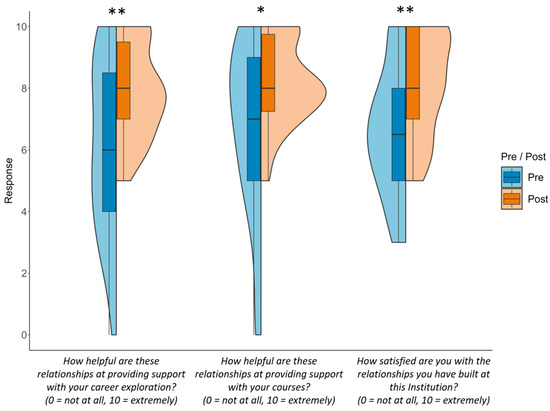
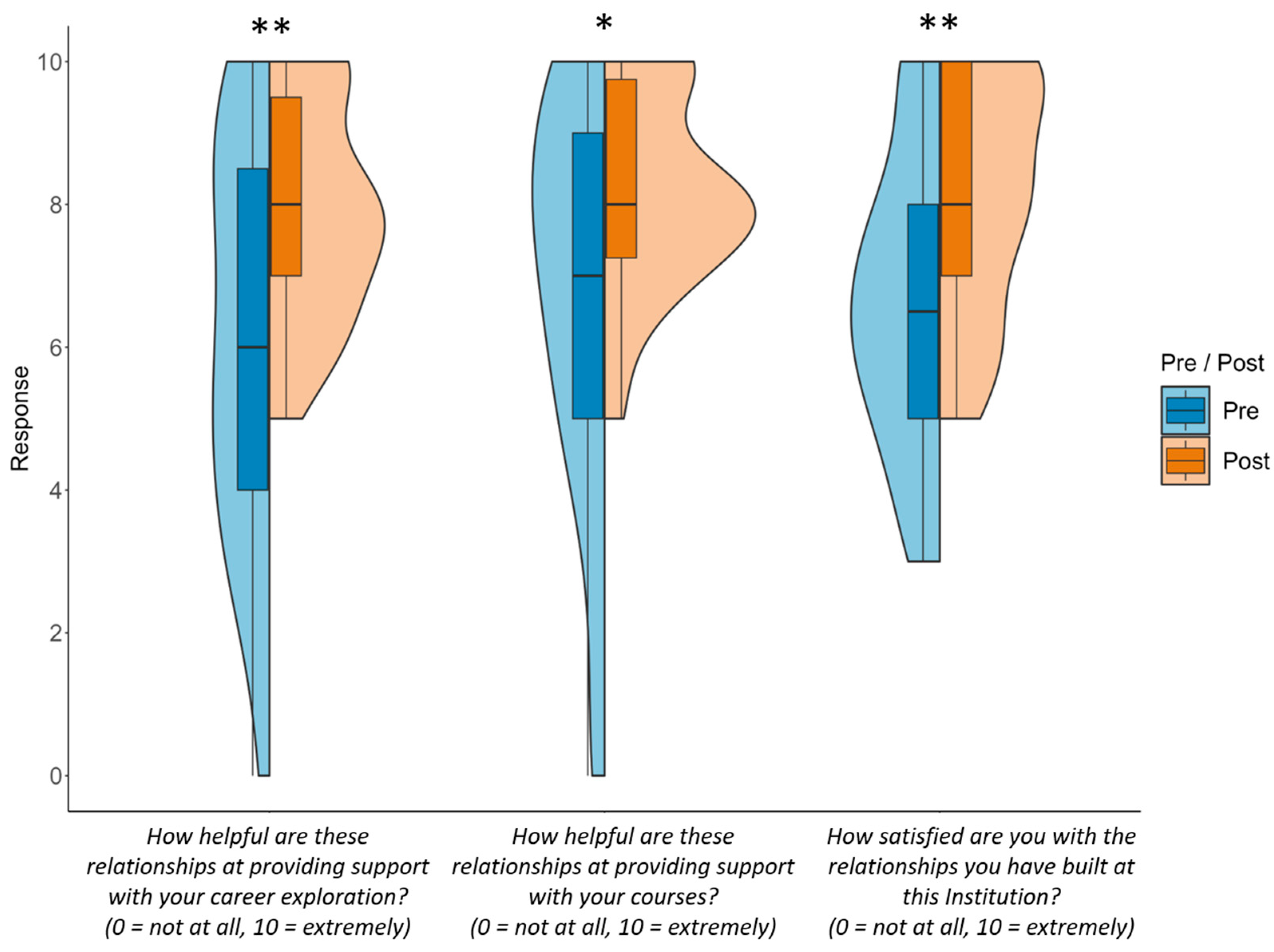
The value that participating students placed on the relationships formed during the course of the semester—both within and outside of the learning community—is reflected in the results of the Social Network Analysis survey. The results indicate that the relationships students had at the end of the semester were significantly more helpful with academic and career decisions compared to the ones they had at the beginning of the semester (Related-samples Wilcoxon Signed Rank Test: Help with career exploration: N = 23, median: Pre = 6; Post = 8; Z = 3.177, p = 0.001; Help with courses: N = 22, median: Pre = 7; Post = 8; Z = 2.374, p = 0.018), and they also reported significantly greater overall satisfaction with the relationships formed at this Institution (Satisfaction: N = 24, median: Pre = 6.5, Post = 8; Z = 3.076, p = 0.002) (Figure 1). Moreover, when asked if participating in the learning community had helped them develop new relationships and, if so, with whom, of the 32 students who completed the post-course survey, 23 reported they had developed relationships with peers, 22 with peer mentors, and 20 with faculty. When asked what these relationships had been helpful for or might be useful for in the future, 24 of the students answered “academic decisions”, 22 said “career choices”, and 19 said “community-building.” While the survey data establish that relationships became significantly more helpful over the semester, the interview data help explain the mechanism: students did not simply accumulate more relationships, they developed relationships characterized by relevance, relatability, and near-peer knowledge that directly addressed their specific academic and career uncertainties. These results again emphasize the important role this learning community played in helping participating students develop relationships that will guide and support them as they make important decisions at this crucial time in their academic careers.
Figure 1.
Results of the Social Network Analysis survey administered to the students in the learning community at the beginning and at the end of the course, which asked students to rate how helpful their relationships were on a scale from 0 = not at all to 10 = extremely. Students reported their social network as being significantly more helpful with courses and career exploration at the end of the semester, and they also reported significantly greater satisfaction with the relationships built at the Institution. Only the responses of the students who completed both the pre- and post-survey were included in the analysis. This combined box and split-violin plot displays the frequency of each response, the median, and the interquartile range of these data. It is noticeable that all student responses were ≥5 at the end of the course. * p < 0.05; ** p < 0.005.
4.3. The Students Felt Empowered by This Experience in Pursuing Their Chosen Career Goals
The data revealed the positive impact on students of the exposure to career exploration and opportunities provided by the course. The Career Self-Efficacy survey results (Table 3) reveal students’ increased confidence in their ability to select an occupation from a list of potential careers they are considering (Q5: Z = 3.626, p < 0.001), as well as their ability to prepare a good resume (Q11: Z = 3.014, p = 0.003), change majors if they did not like their first choice (Q12: Z = 3.209, p = 0.001), decide what they value most in an occupation (Q13: Z = 2.977, p = 0.003), make a career decision and then not worry whether it was right or wrong (Q15: Z = 2.586, p = 0.010), find information about graduate or professional schools (Q22: Z = 3.586, p < 0.001), successfully manage the job interview process (Q23: Z = 3.625, p < 0.001), and to identify some reasonable major or career alternatives if they are unable to get their first choice (Q24: Z = 2.858, p = 0.004). The interviews provide explanatory depth to these numerical gains, showing that increased confidence in career-related tasks was tied to concrete experiences (i.e., lab visits, speaker panels, peer mentor guidance) that made previously inaccessible pathways feel within reach.
The interviews also indicated that students felt that the learning community had increased their exposure to career paths. For example, Fiona described how she was introduced to various research labs on campus and how excited she was to explore different labs and meet people to understand the various opportunities that are open to her as a Biology major on a Pre-Med track.
Moreover, she shared that:Going and visiting labs was a big one that I was like, “I want to go explore, I want to go see.” And so they’ve actively tried to get a different array of labs and people that we can talk to or go visit, which has been very nice in order to see everything.
This quote shows that this learning community opened up the opportunity for Fiona to go into research and have access to spaces she otherwise would not have, which is crucial to her sense of self-efficacy and her confidence in what she can achieve. Bobby also shared that this experience in the learning community was “very helpful, especially with exploring my career opportunities. I think it’s been very helpful.” The learning community’s structured exposure to research environments gave students like Rosalia a concrete window into professional scientific work. Rosalia added that learning about what goes on “behind the scenes” has increased her interest in research:…the biggest thing is I’ve started to get into the idea that I could potentially go do research. So that’s been a huge help with this class specifically being able to go visit different labs and see how they run, how they work, how you get into these types of labs. Which has been nice because then it’s like, “Okay, so this is what I need to expect of myself and others in terms of what you need to do, how you act, how things work,” which has been very helpful. Just because it’s not something that you necessarily can do just by yourself. You could, but I don’t know how.
The interviews also show that students felt that the learning community and the collaboration between faculty and peer mentors supported them in translating their current experiences into networking opportunities and job application preparation. Brett shares:I feel like it gives me a little insight into what working in a lab would be. My teacher, she tells us a lot about her experiences working in a lab and will show us the behind the scenes, take us into the back part of her lab and show us what she works on and stuff, which is really interesting to see. It gives me an idea of what maybe I could be doing in the future.
Anonymous comments solicited in the post-course surveys also reiterated this important aspect of the course experience, with students submitting statements such as “I’ve wanted to be a vet for a very long time but now I have taken an interest in biological research,” “This class opened my options up and gave me some career pathways I never thought of,” and “I feel more confident in my ability to figure out what I want to do in healthcare.”The class material is really just, in my opinion, it’s making connections, it’s getting to know people. We have speakers come and you just asking them questions about what we have. Last week we had a nurse come, nurse practitioner and just finding out their experiences and what they went through is a good thing to help with. And then two weeks ago we had a Student Board come talk about the application process, the resume process, stuff like that. It really just helps reaffirm ideas or establish some, just letting us know what we need to do in some spots and if we’re prepared but not a 100% there in others, it allows us to take a deep breath in some spots.
Overall, our data show that this course provided access to information and people in a way that increased the students’ belief in themselves, their confidence, and their sense of self-efficacy in the context of their potential career. This experience provided them the exposure to practitioners and researchers that students want to engage with and can potentially aim to become.
5. Discussion
The purpose of this study was to understand how biology and genetics undergraduate students’ sense of self-efficacy changes based on their participation in a learning community focused on career exploration. Three major themes emerged from this investigation: (1) the class environment created a space where self-efficacy was prioritized and developed; (2) the peer support groups and the peer mentors positively impacted self-efficacy; and (3) the students felt empowered by this experience in pursuing their chosen career goals. These results expand on the work on learning communities and the importance of having these intentional spaces to support students in developing their career aspirations early in their undergraduate career (Solanki et al., 2019). We distinguish, where possible, between effects attributable to the broader learning community structure (i.e., the small cohort, career-focused curriculum, and intentional course design) and those more specifically connected to the peer mentoring component, recognizing that in practice these elements are mutually reinforcing.
By taking a mixed methods approach that combined pre/post-course surveys, interviews, and focus group data, this study adds nuance to our understanding of how learning communities are particularly critical in STEM majors because of the different nature of a small and individualized learning community setting compared to the traditionally large and anonymous STEM classes (Solanki et al., 2019).
Our findings extend the importance of learning communities and their impact on student self-efficacy and social integration into STEM. Having access to spaces that are intentionally structured around career exploration, personal development, and mentorship allows students to build connections within and between majors and produces a holistic experience for students that promotes exploration and inclusivity.
In finding one, the learning community course environment itself served as a catalyst for self-efficacy development, which is consistent with prior work documenting the psychosocial benefits of small, cohort-based learning structures in STEM. Carrino and Gerace (2016) identified the development of self-efficacy as a core psychosocial mechanism underlying the success of STEM learning communities, arguing that the social interactions enabled by these environments activate Bandura’s (1977) sources of self-efficacy in ways that large lecture courses cannot. Importantly, while peer mentors were embedded in the classroom environment that characterizes Finding 1, the self-efficacy gains described here appear to be driven primarily by structural features of the learning community rather than by near-peer mentoring per se, which is examined more specifically in Finding 2. Our findings extend this argument by showing that students experienced these gains through deliberate course design including structured activities, intentional check-ins with peer mentors and instructors, and an explicit prioritization of students’ individual needs, as reflected in students’ descriptions of having the syllabus built around them. This aligns with Cambridge-Williams et al. (2013), who found that orientation courses and living-learning communities boosted self-efficacy and self-regulated learning precisely when they were intentionally structured around student development. The validation students described also resonates with Réndon Linares and Muñoz’s (2011) validation theory, which holds that students, particularly those from underrepresented backgrounds, benefit from both academic and interpersonal validation that affirms their belonging and capability in higher education spaces.
In finding two, the positive impact of peer mentors on students’ self-efficacy corroborates and extends a growing body of literature on near-peer mentoring in undergraduate education. Collier (2017) argues that peer mentors are uniquely effective because they share a common institutional perspective with their mentees. They recently navigated the same academic terrain and can offer guidance that feels immediately relevant rather than abstract. Our data reflect this dynamic clearly: students like Janet explicitly noted that peer mentors could “relate to you more” and offer “more unique responses” to specific questions than faculty could. This is consistent with Bandura’s (1977) account of vicarious experience as a source of self-efficacy. Sawtelle et al. (2012) documented this mechanism in the context of introductory physics, finding that students who perceived greater similarity to their peers showed stronger gains in self-efficacy and higher retention rates. The Social Network Analysis results in our study further support this interpretation: students reported significantly greater satisfaction with their relationships and rated those relationships as more helpful for both academic and career decisions by the end of the semester, suggesting that the peer connections formed in this learning community were meaningful beyond the course itself. Taken together, these findings underscore that peer mentoring is not simply a supplemental feature of learning communities; it is a theoretically grounded mechanism through which self-efficacy is actively constructed.
Lastly, our third finding centers on the empowerment that students described in relation to career exploration, which aligns closely with the predictions of SCCT (Lent et al., 2008). SCCT posits that self-efficacy beliefs and outcome expectations jointly shape individuals’ career interests and goal-directed behavior. The career-focused activities embedded in this learning community are consistent with the kinds of proximal learning experiences that SCCT identifies as self-efficacy-enhancing; they gave students performance-relevant information, broadened their awareness of attainable outcomes, and signaled institutional belief in their potential. Fiona’s account of how lab visits shifted her sense of what she could achieve (“I could potentially go do research”) vividly highlights this process. This finding also connects to Lent et al.’s (2008) emphasis on social supports as moderators of the relationship between self-efficacy and career goal pursuit. The fact that 22 of 32 students who completed the post-course survey reported that new relationships formed in the learning community would be useful for future career decisions suggests that this course succeeded not only in building confidence but in expanding students’ sense of what career pathways were open to them.
Limitations
Several limitations of this study should be noted when interpreting its findings. First, this study was conducted at a single large, predominantly White public institution in the Midwest, which limits the generalizability of the findings to other institutional contexts, student populations, or learning community models. Second, the matched sample available for statistical analysis was small (N = 25), as not all students who completed the pre-course survey also completed the post-course survey. While we report data from the full sample where appropriate, the matched analyses on which our quantitative conclusions rest should be interpreted with caution, given this sample size. Third, as noted in the Data Analysis section, the students who completed both surveys may represent a self-selected group with more positive orientations toward the course, introducing potential response bias into the quantitative findings. A control group of students not enrolled in the learning community would have strengthened causal claims about the course’s effects on self-efficacy; the absence of such a group means that observed pre-to-post gains cannot be attributed to the intervention with certainty. Given the absence of a control group and the small matched sample, all interpretations in this discussion are offered as associations and patterns rather than causal claims. Fourth, the qualitative sample is a small subset of an already modest overall sample: only seven students participated in one-on-one interviews, and while their accounts are rich and consistent with the quantitative findings, they cannot be taken as representative of all students’ experiences. Future research should seek to replicate these findings with larger and more diverse samples, across multiple institutions, and ideally with comparison conditions that allow for stronger causal inference.
6. Recommendations for Practice
Through the findings of our study, we have three main recommendations for practice to better support learning communities. First, we highlight the importance of prioritizing the development of student self-efficacy in these communities, based on a full understanding of each of its four major components (accomplishments, vicarious experiences, verbal persuasion, physiological/emotional arousal (Bandura, 1977). Building upon what is already present or creating a class environment that prioritizes self-efficacy by intentionally structuring activities and discussions around these different components will empower students in their learning journey. It is crucial to emphasize the importance of believing in one’s own capabilities in order to succeed and to provide support for that growth. Self-efficacy is not just a skill that will support student success and retention within an institutional framework; it is an ability that will enable them to become independent, lifelong learners and successful members of society.
Second, it is important to promote active engagement by the students in the learning community, to recruit and train effective peer mentors, and to enhance peer support groups. Active engagement involves having intentional activities and discussions around students’ chosen majors and career paths and promoting self-efficacy so that students learn how to advocate for themselves and gain confidence as they progress through their program. Strengthening the peer connections in the learning community will further boost participating students’ self-efficacy, as students will be able to support one another while developing their career aspirations, sharing challenges and receiving constructive feedback. Interacting with peer mentors who represent and model early university career and personal growth is key.
Lastly, integrating career goal alignment was a crucial component of this learning community. As mentioned in the findings, a major outcome of this experience for participating students was that it allowed them to explore careers they were interested in. It is critical to connect the learning community’s activities to students’ career goals to enhance their self-efficacy and empower them to explore various opportunities in their chosen majors. Being able to explore can help inspire and motivate students to continue to find their best major and career fit.
7. Conclusions
This mixed-methods study contributes to our understanding of what makes learning communities effective by foregrounding the role of intentional peer mentoring as a theoretically grounded mechanism for self-efficacy development among STEM undergraduates. Our findings show that when near-peer mentors are embedded within a structured, career-focused learning community course, students, particularly those in the critical first two years of their undergraduate experience, develop greater confidence in their ability to make informed academic and career decisions. Peer mentors functioned not as supplemental supports but as central agents in creating the relational conditions through which self-efficacy was built: through vicarious learning, verbal encouragement, and access to relevant, timely knowledge from someone who had recently navigated the same path. The learning community structure amplified these effects by providing a small, intentional, and psychologically safe environment in which near-peer relationships could form and develop. Together, these findings suggest that institutions seeking to improve STEM retention and student confidence should invest specifically in the recruitment, training, and meaningful integration of peer mentors within those communities. Future research should examine these effects with larger and more diverse samples, across institutional contexts, and with designs that allow for stronger causal inference about the distinct contributions of peer mentoring within learning community settings.
Author Contributions
Conceptualization, M.L.E., C.R.C. and C.A.M.; methodology, M.L.E., C.R.C. and C.A.M.; formal analysis M.L.E., C.R.C. and C.A.M.; investigation, M.L.E. and C.A.M.; data curation M.L.E., C.R.C., and C.A.M.; writing—original draft preparation, M.L.E., C.R.C. and C.A.M.; writing—review and editing, M.L.E., C.R.C. and C.A.M.; visualization, C.A.M.; funding acquisition, C.R.C. and C.A.M. All authors have read and agreed to the published version of the manuscript.
Funding
This research was funded by the Miller Faculty Fellowship at Iowa State University.
Institutional Review Board Statement
This study was conducted in accordance with Iowa State University and the Institutional Review Board (IRB ID 22-282) 10 November 2022.
Informed Consent Statement
Informed consent was obtained from all participants involved in the study.
Data Availability Statement
Data can be made available by the authors upon request.
Conflicts of Interest
The authors declare no conflict of interest.
References
- Bandura, A. (1977). Self-efficacy: Toward a unifying theory of behavioral change. Psychological Review, 84(2), 191–215. [Google Scholar] [CrossRef]
- Bandura, A. (1982). Self-efficacy mechanism in human agency. American Psychologist, 37(2), 122–147. [Google Scholar] [CrossRef]
- Bandura, A. (2006). Guide for constructing self-efficacy scales. In F. Pajares, & T. Urdan (Eds.), Self-efficacy beliefs of adolescents (Vol. 5, pp. 307–337). Information Age Publishing. [Google Scholar]
- Bandura, A., & Locke, E. A. (2003). Negative self-efficacy and goal effects revisited. Journal of Applied Psychology, 88(1), 87–99. [Google Scholar] [CrossRef] [Scilit] [PubMed]
- Betz, N. E., Klein, K. L., & Taylor, K. M. (1996). Evaluation of a short form of the career decision self-efficacy scale. Journal of Career Assessment, 4(1), 47–57. [Google Scholar] [CrossRef] [Scilit]
- Bleeker, M. M., & Jacobs, J. E. (2004). Achievement in math and science: Do mothers’ beliefs matter 12 years later? Journal of Educational Psychology, 96(1), 97–109. [Google Scholar] [CrossRef] [Scilit]
- Cambridge-Williams, T., Winsler, A., Kitsantas, A., & Bernard, E. (2013). University 100 orientation courses and living-learning communities boost academic retention and graduation via enhanced self-efficacy and self-regulated learning. Journal of College Student Retention: Research, Theory & Practice, 15(2), 243–268. [Google Scholar] [CrossRef] [Scilit]
- Caprara, G. V., Fida, R., Vecchione, M., Del Bove, G., Vecchio, G. M., Barabarnelli, C., & Bandura, A. (2008). Longitudinal analysis of the role of perceived self-efficacy for self-regulated learning in academic continuance and achievement. Journal of Educational Psychology, 100(3), 525–534. [Google Scholar] [CrossRef] [Scilit]
- Carrino, S. S., & Gerace, W. J. (2016). Why STEM learning communities work: The development of psychosocial learning factors through social interaction. Learning Communities: Research & Practice, 4(1), 3. [Google Scholar]
- Charleston, L., & Leon, R. (2016). Constructing self-efficacy in STEM graduate education. Journal for Multicultural Education, 10(2), 152–166. [Google Scholar] [CrossRef] [Scilit]
- Chemers, M. M., Hu, L., & Garcia, B. F. (2001). Academic self-efficacy and first-year college student performance and adjustment. Journal of Educational Psychology, 93(1), 55–64. [Google Scholar] [CrossRef]
- Collier, P. J. (2017). Why peer mentoring is an effective approach for promoting college student success. Student Peer Mentoring, 28(3), 9–19. [Google Scholar] [CrossRef] [Scilit] [PubMed]
- Cortina, J. M. (1993). What is coefficient alpha? An examination of theory and applications. Journal of Applied Psychology, 78(1), 98–104. [Google Scholar] [CrossRef]
- Dagley, M., Georgiopoulos, M., Reece, A., & Young, C. (2016). Increasing retention and graduation rates through a STEM learning community. Journal of College Student Retention: Research, Theory & Practice, 18(2), 167–182. [Google Scholar] [CrossRef] [Scilit]
- Devonport, T. J., & Lane, A. M. (2006). Relationships between self-efficacy, coping, and student retention. Social Behavior and Personality, 34(2), 127–138. [Google Scholar] [CrossRef] [Scilit]
- Freeman, K. E., Alston, S. T., & Winborne, D. G. (2008). Do learning communities enhance the quality of students’ learning and motivation in STEM? The Journal of Negro Education, 77(3), 227–240. Available online: https://www.jstor.org/stable/pdf/25608689.pdf?casa_token=MvrVnMGbKpYAAAAA:gVfH6sPdEv-s9h-hmKOXse1vGMJq6jDSM32-k-fo_GroVM4T_Z3lpl0E8hPJkzSCnjgw0oLd6LYiTqJb3jR1cQzCoDHJG9dbG104Uo9a_L9OQg5nbAg (accessed on 3 April 2026).
- Hendel, D. D. (2007). Efficacy of participating in a first-year seminar on student satisfaction and retention. Journal of College Student Retention: Research, Theory & Practice, 8(4), 413–423. [Google Scholar] [CrossRef] [Scilit]
- Iowa State University, Office of Institutional Research. (2024). Institutional research fact book. Fact book 2024–2025. Learning communities retention and graduation rates. Available online: http://www.ir.iastate.edu/files/documents/factbook/archive/FactBook-24-25.pdf (accessed on 3 April 2026).
- Ishitani, T. T. (2016). Time-varying effects of academic and social integration on student persistence for first and second years in college: National data approach. Journal of College Student Retention: Research, Theory & Practice, 18(3), 263–286. [Google Scholar] [CrossRef] [Scilit]
- “Learning slope”. (1991). Pew higher education research program. Policy Perspectives, 4(1), 1A–8A. [Google Scholar]
- Lent, R. W., Lopez, A. M., Jr., Lopez, F. G., & Sheu, H. (2008). Social cognitive career theory and the prediction of interests and choice goals in the computing disciplines. Journal of Vocational Behavior, 73(1), 52–62. [Google Scholar] [CrossRef] [Scilit]
- Moustakas, C. E. (1994). Phenomenological research methods. Sage Publications, Inc. [Google Scholar]
- National Center for Education Statistics. (2023). Digest of education statistics. Available online: https://nces.ed.gov/programs/digest/d23/tables/dt23_326.30.asp (accessed on 5 June 2024).
- Réndon Linares, L. I., & Muñoz, S. M. (2011). Revisiting validation theory: Theoretical foundations, applications, and extensions. Enrollment Management Journal, 5(2), 12–33. [Google Scholar]
- Rittmayer, M. A., & Beier, M. E. (2009). Self-efficacy in STEM. In B. Bogue, & E. Cady (Eds.), Applying research to practice (ARP) resources. Available online: https://www.researchgate.net/publication/242589949_Overview_Self-Efficacy_in_STEM (accessed on 19 August 2024).
- Robbins, S. B., Lauver, K., Le, H., Davis, D., Langley, R., & Carlstrom, A. (2004). Do psychosocial and study skill factors predict college outcomes? A meta-analysis. Psychological Bulletin, 130(2), 261–288. [Google Scholar] [CrossRef] [Scilit] [PubMed]
- Sawtelle, V., Brewe, E., & Kramer, L. H. (2012). Exploring the relationship between self-efficacy and retention in introductory physics. Journal of Research in Science Teaching, 49(9), 1096–1121. [Google Scholar] [CrossRef] [Scilit]
- Schnell, C. A., & Doetkott, C. D. (2003). First year seminars produce long-term impact. Journal of College Student Retention: Research, Theory & Practice, 4(4), 377–391. [Google Scholar] [CrossRef] [Scilit]
- Seidman, I. (2006). Interviewing as qualitative research: A guide for researchers in education and the social sciences. Teachers College Press. [Google Scholar]
- Seymour, E. (1995). The loss of women from science, mathematics, and engineering undergraduate majors: An explanatory account. Science Education, 79(4), 437–473. [Google Scholar] [CrossRef] [Scilit]
- Smith, B. L., MacGregor, J., Matthews, R., & Gabelnick, F. (2009). Learning communities: Reforming undergraduate education. Jossey-Bass. [Google Scholar]
- Solanki, S., McPartlan, P., Xu, D., & Sato, B. K. (2019). Success with EASE: Who benefits from a STEM learning community? PLoS ONE, 14(3), e0213827. [Google Scholar] [CrossRef] [Scilit]
- Strayhorn, T. L. (2022). Exploring ethnic minority first-year college students’ well-being and sense of belonging: A qualitative investigation of a brief intervention. American Journal of Qualitative Research, 6(1), 42–58. [Google Scholar] [CrossRef] [Scilit]
- Thiry, H. (2019). What enables persistence? In E. Seymour, & A.-B. Hunter (Eds.), Talking about leaving revisited (pp. 399–436). Springer. [Google Scholar] [CrossRef] [Scilit]
- Vekiri, I., & Chronaki, A. (2008). Gender issues in technology use: Perceived social support, computer self-efficacy and value beliefs, and computer use beyond school. Computers & Education, 51(3), 1392–1404. [Google Scholar] [CrossRef] [Scilit]
- Zeldin, A. L., & Pajares, F. (2000). Against the odds: Self-efficacy beliefs of women in mathematical, scientific, and technological careers. American Educational Research Journal, 37(1), 215–246. [Google Scholar] [CrossRef]
- Zhao, C., & Kuh, G. D. (2004). Adding value: Learning communities and student engagement. Research in Higher Education, 45, 115–138. [Google Scholar] [CrossRef] [Scilit]
- Zimmerman, B. J. (1995). Self-efficacy and educational development. In A. Bandura (Ed.), Self-efficacy in changing societies (pp. 202–231). Cambridge University Press. [Google Scholar] [CrossRef] [Scilit]

Disclaimer/Publisher’s Note: The statements, opinions and data contained in all publications are solely those of the individual author(s) and contributor(s) and not of MDPI and/or the editor(s). MDPI and/or the editor(s) disclaim responsibility for any injury to people or property resulting from any ideas, methods, instructions or products referred to in the content. |
© 2026 by the authors. Licensee MDPI, Basel, Switzerland. This article is an open access article distributed under the terms and conditions of the Creative Commons Attribution (CC BY) license.