


Abstract
The reorganization of academic work following the COVID-19 pandemic has intensified debate regarding the effects of work modality on faculty well-being, particularly in Latin American contexts characterized by structural inequalities and digital divides. This study examines the influence of work modality on the integrated well-being of university faculty in Peru. A quantitative, non-experimental explanatory design was employed with a sample of 448 faculty members from public and private universities. Occupational well-being and quality of life were assessed using validated instruments and subsequently integrated into a higher-order construct due to the absence of discriminant validity. Structural relationships were analyzed using Partial Least Squares Structural Equation Modeling (PLS-SEM) with bootstrapping (5000 resamples). The results indicate that work modality significantly predicts integrated well-being (β = 0.823; p < 0.001), although the model explains a limited proportion of variance (R2 = 0.168). Comparative analysis revealed that faculty in in-person modality report significantly higher levels of well-being and quality of life than those in virtual modality. These findings suggest that work modality operates as a structural condition shaping faculty well-being and highlight the need for institutional policies that promote balanced and human-centered work designs in higher education.
1. Introduction
Over recent decades, structural transformations in educational systems have substantially redefined the organization of academic work, positioning work modality as a key determinant of quality of life and occupational well-being among university faculty. This process was considerably intensified by the COVID-19 pandemic, which compelled higher education institutions to adopt remote and hybrid work arrangements, profoundly altering traditional dynamics of teaching, research, and academic management, as well as the boundaries between professional and personal life (International Labour Organization, 2021; Chan et al., 2023).
In this evolving context, the post-pandemic university is characterized by the consolidation of multiple work modalities, including in-person, remote, and hybrid formats, which have redefined the organization of academic work and teaching practices. These modalities are not merely operational adjustments but represent structural transformations that influence faculty autonomy, workload distribution, digital engagement, and work–life boundaries.
In this context, work modality emerges as a structural factor with significant potential to influence the psychological well-being, job satisfaction, and quality of life of faculty. Recent studies have emphasized that changes in teaching modality—particularly the shift to online and hybrid formats—have significant implications for faculty well-being, including increased workload, digital fatigue, and challenges in work–life balance (Wang et al., 2021; Mascarenhas et al., 2024; Mosquera et al., 2022).
In this sense, understanding the post-pandemic university requires analyzing how these differentiated work modalities shape faculty well-being, rather than treating higher education transformation as a homogeneous process.
The international literature consistently identifies faculty well-being as a critical factor for the sustainability of educational systems, the quality of the teaching–learning process, and institutional performance (Kinman & Johnson, 2019; World Health Organization, 2022). Academic work is characterized by high cognitive demands, pressure for scholarly productivity, growing administrative requirements, and—in many contexts—contractual precariousness or instability, all of which heighten exposure to occupational stress, emotional exhaustion, and life dissatisfaction (Watts & Robertson, 2011; Winefield et al., 2014; Carranza-Esteban et al., 2023).
From a psychosocial and organizational perspective, occupational well-being is conceptualized as a multidimensional construct that integrates positive emotional experiences, a sense of purpose, autonomy, recognition, and quality work relationships (Warr, 2007; Seligman, 2014). Complementarily, quality of life is defined as the individual’s perception of their position in life in relation to their cultural context, value system, expectations, health conditions, social relationships, and work environment (WHOQOL Group, 1998; Sen, 1999). In the university context, both constructs are closely interrelated and are particularly sensitive to organizational conditions and the work modality adopted by institutions.
For conceptual clarity, this study distinguishes between quality of life, well-being, and work modality as related but analytically distinct constructs. Quality of life is understood as an individual’s subjective evaluation of their overall life conditions within their socio-cultural context (WHOQOL Group, 1998; Sen, 1999). In line with subjective well-being theory, well-being encompasses individuals’ cognitive and affective evaluations of their lives, including life satisfaction and emotional experiences (Diener, 2000).
Recent perspectives also highlight the role of optimism and contextual conditions in shaping life satisfaction, particularly in educational settings (Richițeanu-Năstase et al., 2019). In this regard, occupational well-being is conceptualized as a multidimensional construct integrating emotional, cognitive, and motivational experiences associated with work (Warr, 2007; Seligman, 2014).
Finally, work modality is defined as the mode of delivery through which academic activities are conducted—such as in-person, online, or hybrid formats—rather than solely as employment status. This distinction is particularly relevant in post-pandemic higher education contexts, where digital and hybrid teaching models have redefined academic work structures (Richițeanu-Năstase et al., 2022).
Several contemporary perspectives argue that well-being in organizational contexts should not be fragmented into isolated dimensions, but rather understood as an interdependent system of work and life experiences. Drawing on the capability approach (Sen, 1999) and psychosocial models of well-being (Warr, 2007), working conditions simultaneously influence perceptions of quality of life and occupational well-being, constituting a systemic framework that is difficult to disentangle empirically. Consequently, although they may be analytically distinguished as separate constructs, they conceptually belong to a broader category of integrated well-being.
Recent empirical evidence indicates that in-person, remote, and hybrid modalities generate differentiated experiences in terms of workload, time control, social interaction, and work–life boundaries, with heterogeneous effects on mental health and subjective well-being (Eurofound, 2020; Fan & Moen, 2023; Kröner & Müller, 2023). Studies conducted in higher education show that telework may promote flexibility and autonomy, but may also intensify risks associated with isolation, permanent availability, and boundary blurring when adequate institutional regulation is absent (Wang et al., 2021; Allen et al., 2015). In addition, recent studies focusing on online teaching contexts highlight that the rapid transition to virtual education has increased cognitive demands, adaptation challenges, and digital fatigue among faculty, with implications for their overall well-being (Mosquera et al., 2022; Răducu & Stănculescu, 2021).
Furthermore, recent research indicates that the effects of work modalities are not uniform but depend on contextual factors such as organizational support, technological infrastructure, institutional leadership, and work–life balance practices (Ahmad & Solomon, 2022; Mascarenhas et al., 2024). In the university setting, remote work and hybrid arrangements have reconfigured pedagogical and organizational conditions, generating both opportunities for innovation and tensions associated with the intensification of academic work (Andersson & Mešić, 2024; Gonçalves et al., 2024).
In Latin America, these dynamics are particularly salient given the coexistence of structural gaps in digital infrastructure, contractual inequalities, and limited institutional policies oriented toward faculty well-being. Regional reports and empirical studies indicate that university faculty face high levels of occupational stress, academic overload, and limited organizational support—conditions that may be amplified or attenuated depending on the work modality in place (Economic Commission for Latin America and the Caribbean [ECLAC], 2020; UNESCO, 2021). These challenges are not exclusive to the region, as studies in other educational contexts also document structural difficulties associated with the implementation of remote work in higher education (Bai, 2023).
In the Peruvian context specifically, several studies note that structural problems such as occupational stress, administrative overload, and academic performance pressure were already present before the pandemic and were exacerbated by the transition to remote and hybrid work (Quiñones et al., 2022; Méndez et al., 2023). Despite growing interest in faculty well-being, however, the empirical evidence that integrates work modality as a determinant of both quality of life and occupational well-being among Peruvian university faculty remains limited. Moreover, a significant proportion of existing studies have focused on descriptive or correlational analyses without developing explanatory models that would allow for a deeper understanding of how work modality influences faculty well-being and quality of life.
This gap constrains the formulation of evidence-based educational policies aimed at promoting healthy and sustainable working conditions in higher education. In response to this problem, the present study aims to analyze the influence of work modality on the quality of life and occupational well-being of university faculty in Peru. By adopting a quantitative and explanatory approach, this research seeks to contribute relevant empirical evidence to the field of higher education and to inform the design of institutional strategies oriented toward the strengthening of faculty well-being and the improvement of educational quality.
With respect to the state of the art on the study variables, Rojas-Torres et al. (2022) and González Ayala and López García (2021) argue that quality of working life is affected by a range of occupational and sociodemographic factors, including working hours, seniority, and role integration. Their findings indicate that institutional support and job security are directly associated with high levels of job satisfaction, whereas satisfaction decreases in the presence of heavy workloads, deficient time management conditions, and low job satisfaction. Similarly, De Jesús Álvarez and Santiago Bautista (2021) analyzed occupational well-being factors among university faculty, highlighting that the attainment of goals, recognition, perceived value of work, responsibility, and promotion opportunities are critical for occupational well-being.
Kaltiainen and Hakanen (2022) examined the evolution of occupational well-being in the Finnish population before and during the COVID-19 outbreak, considering factors such as age, gender, educational level, living alone, and telework. Their results indicated a slight improvement in occupational well-being in spring 2020, followed by a return to pre-pandemic levels in autumn 2020, with an increase in work-related boredom through summer 2021. Well-being deteriorated most notably among young individuals and those living alone, as well as among women, persons with lower educational attainment, and non-teleworkers. Telework was found to benefit most those with lower educational levels.
Saleem and Malik (2023) investigated quality of life among university faculty and proposed organizational flexibility as a determining factor in employees’ and organizations’ quality of life. Their findings reveal that quality of life is a complex variable integrating multiple interrelated dimensions, and that organizational flexibility can become a strategy for fostering healthy lifestyles within organizations.
Sanchez et al. (2019) examined the impact of health on quality of life (QoL) and quality of working life (QWL) among 284 university faculty from diverse fields, finding that those who engaged in physical activity and were older reported better QoL, QWL, and sleep quality. In contrast, those who used medications, had unbalanced diets, or did not engage in leisure activities showed lower QoL and QWL. Kitagawa et al. (2021) evaluated the impact of the COVID-19 pandemic on productivity, finding that teleworkers experienced greater productivity declines due to poor work configurations and communication difficulties, though they demonstrated better mental health outcomes. Additionally, Stempel and Siestrup (2022) explored how the abrupt transition to telework affected job characteristics and employee well-being, identifying both advantages and disadvantages. Their findings showed changes in all job characteristics for new teleworkers and highlighted the importance of job crafting activities that enhance structural and social resources to improve working conditions and well-being.
Sato et al. (2023) investigated how working conditions and work modalities can substantially affect the occupational well-being of university faculty when favorable ergonomic environments are not provided to support optimal academic performance.
The following sections present a theoretical review providing the conceptual foundations for the study variables.
Regarding occupational well-being, it is essential to acknowledge that socio-occupational conditions constitute a critical factor in organizations for sustaining the productivity of their employees and generating organizational commitment. In this regard, occupational well-being is understood as the degree of satisfaction that individuals experience in relation to the tasks assigned in the workplace, encompassing emotional, personal, vocational, and motivational processes associated with their professional functions (Barboza et al., 2023). According to Buonomo et al. (2017), occupational well-being must be analyzed as a complex construct comprising cognitive, affective, behavioral, and vocational dimensions, and must be aligned with working conditions at the workplace, thereby contributing to greater employee commitment. However, when organizations fail to provide appropriate and ergonomically sound spaces, this can generate negative responses to workers’ occupational well-being (Fiorilli et al., 2019).
Occupational well-being has been studied across multiple fields—including psychological, cognitive, and occupational perspectives—and therefore cannot be reduced to a single concept; rather, it must be understood from a multidimensional standpoint that allows for its comprehension within the organizational domain (Seligman, 2014; Anderson et al., 2011; Warr, 2007). Accordingly, organizations must ensure appropriate conditions interconnected with the skills, abilities, and competencies of their employees in order to generate satisfaction and productivity, thereby contributing to the retention of motivated and engaged talent (Kaplan & Norton, 2008).
According to Ryff and Keyes (1995), occupational well-being can be understood in terms of an individual’s self-acceptance within the workplace, encompassing vocational commitment, professional identity, and intrinsic motivation. It further includes positive interpersonal relationships with colleagues, autonomy exercised within the work environment, and the professional competencies acquired, connected with the individual’s life purpose and the career growth opportunities offered by the organization. Occupational well-being, as a conceptual category, thus requires a multidimensional, complex, and integrative analysis that encompasses not only the individual but also working conditions, ergonomic factors, and the professional development pathway offered by the organization.
With respect to the variable quality of life, it is conceptualized as the subjective evaluation that individuals make of their life circumstances, taking into account the social norms and values that influence them. It is essential to recognize the importance of evaluating personal goals, expectations, reference points, and concerns at the individual level (Garay Lillo, 1996). Sen (1999) emphasizes that quality of life should not be equated solely with wealth or material possessions, but rather with individuals’ capacity to lead autonomous and fulfilling lives.
Quality of life encompasses multiple interrelated dimensions that collectively determine an individual’s overall well-being (Wilkinson & Marmot, 2003). Psychological well-being—which includes mental health and life satisfaction—is essential as it affects a person’s capacity to manage stress and enjoy life (Ryff, 2013). Independence, understood as the ability to perform everyday tasks autonomously, is crucial for maintaining self-esteem and personal autonomy (Becker, 2002). Social relationships, including bonds with family, friends, and the community, provide emotional support and a sense of belonging (Whyte, 1980). The environment—encompassing both the domestic setting and the natural and social context—also substantially influences quality of life, as a safe and enriching environment can enhance overall well-being (Marelich & Erger, 2004). Finally, spirituality, defined as a connection with a higher entity, can provide inner peace, purpose, and meaning, complementing the other dimensions in the pursuit of comprehensive and harmonious well-being (Pargament, 1997).
Human needs theory deepens the understanding of the motivations that drive human behavior in the pursuit of fulfillment and well-being (Maslow, 1970). These can be classified into two main categories: fundamental needs, encompassing physiological and safety requirements, and higher-order needs, which include affection, esteem, and self-actualization. The capability approach, developed by Sen (1999), suggests that the assessment of quality of life should not focus exclusively on economic aspects or material prosperity, but should also consider individuals’ real capacities to lead meaningful and self-directed lives. Likewise, utility theory and subjective well-being posit that individual well-being can be measured through personal perceptions and subjective experiences of life satisfaction and positive affect (Diener, 2000).
Collectively, these theoretical frameworks provide a comprehensive structure for understanding the diverse dimensions of human well-being and quality of life. The study of quality of life is a field that integrates diverse methodologies that have evolved over time to incorporate environmental, psychological, physical, and social dimensions, thereby offering a holistic perspective on human well-being (Sakip et al., 2023). This field has undergone a notable transition toward subjective measures emphasizing individual well-being and happiness, with significant contributions from the fields of psychology and positive psychology (Ferriss, 2004). Research on quality of life is of paramount importance given its influence on the development of policies aimed at improving living standards, eradicating poverty, and optimizing resource utilization (Guliyeva, 2022). Moreover, sophisticated analytical techniques—such as classification analysis and SWOT analysis—have emerged to design prescriptive strategies that refine quality of life measurement methodologies and promote more effective interventions (Lebedeva & Leontiev, 2022).
From this perspective, both occupational well-being and quality of life represent factors that are integrated as systemic processes in the lives of faculty members and therefore cannot be studied in isolation; rather, they must be understood as part of an integrated vision that enables comprehensive understanding of the phenomenon under study (Reiman & Väyrynen, 2018). This integration calls for a conceptual approach grounded in the construct of integrated well-being, conceived as a set of branching elements in constant interaction that enable faculty to occupy work environments characterized by respect, peace, harmony, and motivation—in addition to favorable social and economic conditions—with positive repercussions on faculty quality of life.
Finally, with regard to the independent variable of work modality, it is conceptualized in this study as the mode of delivery of academic work—namely in-person, virtual, or hybrid—rather than as employment status or contractual conditions. This distinction is particularly relevant in post-pandemic higher education contexts, where teaching modalities have redefined the structure and experience of academic work (Richițeanu-Năstase et al., 2022).
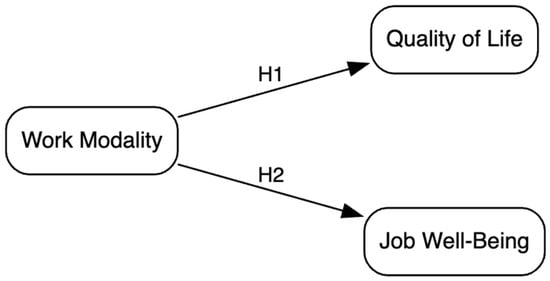
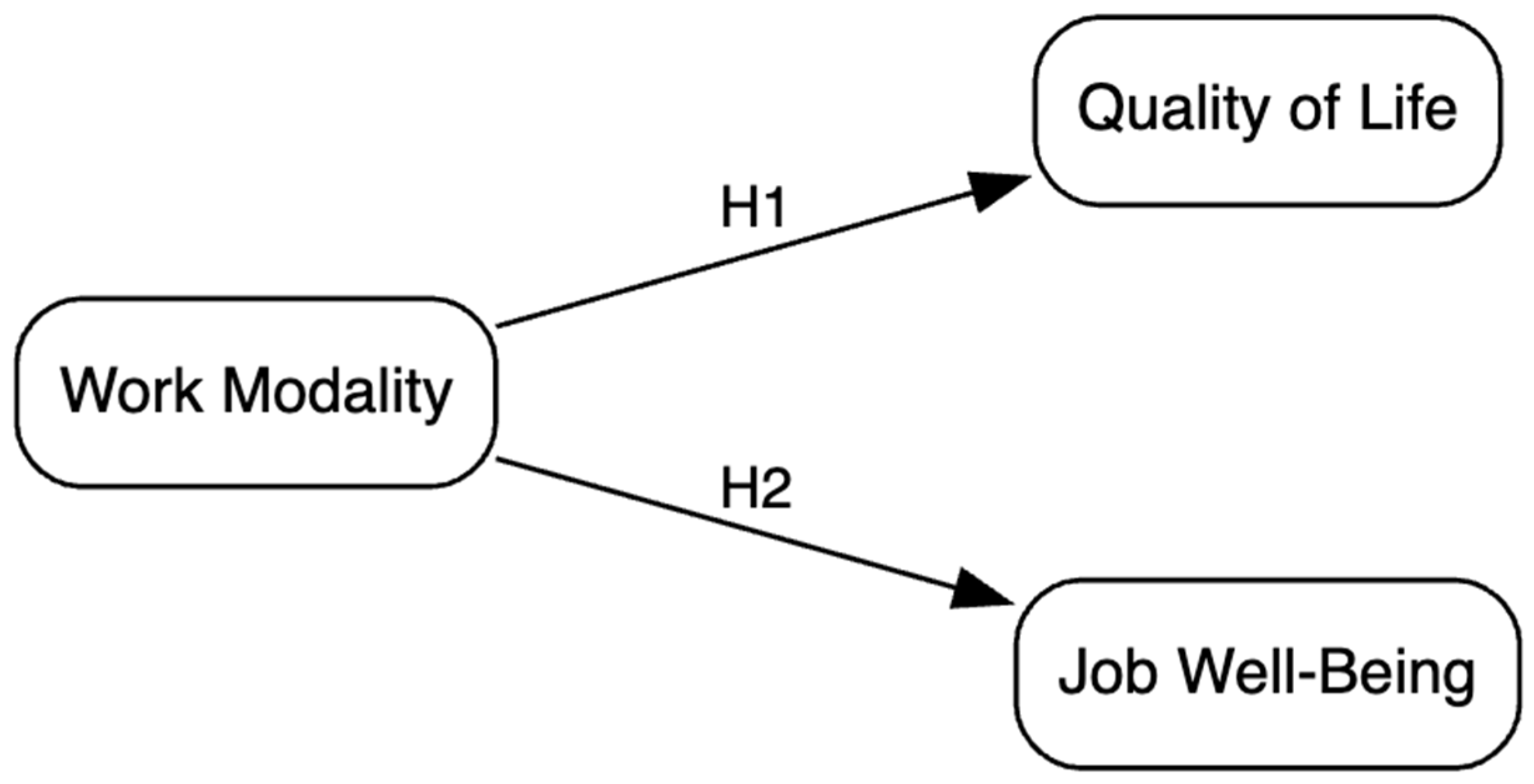
Based on the foregoing, the following hypotheses are proposed:
H1.
Work modality exerts a significant effect on the quality of life of university faculty.
H2.
Work modality exerts a significant effect on the occupational well-being of university faculty.
Figure 1 presents the proposed theoretical model.
Figure 1.
Proposed theoretical model of the influence of work modality on faculty quality of life and occupational well-being.
2. Materials and Methods
The present study was developed under a quantitative approach, collecting numerical data through the administration of questionnaires, which were processed using descriptive and inferential statistics to test the proposed hypotheses (Creswell & Creswell, 2018). The research was basic in nature and explanatory in scope—that is, designed to explain how the variables are related, in this case the role of work modality in shaping integrated well-being (Maxwell, 2004). A non-experimental design was employed, as the study did not manipulate or modify any of the variables under investigation; data were collected as they naturally occurred in the field.
The study population comprised all university faculty members in Peru teaching at both public and private universities, estimated at 66,767 individuals according to Santiago (2022). The sample consisted of 448 faculty members from various Peruvian universities, with the inclusion criterion being active employment during the 2025 academic period. Coordination was established with faculty from public and private institutions across the country to obtain their informed consent prior to participation. It should be noted that no specific institution is named in this study, which therefore did not require formal institutional authorization. Given the explanatory nature of the study, data were collected through individually administered questionnaires in a virtual format using tablet devices, enabling the immediate recording of participant responses via Google Forms. Data collection was conducted between March and November 2025.
The occupational well-being variable was assessed using the Questionnaire of General Labor Well-Being (qBLG), developed by Blanch et al. (2010). The instrument consists of 55 items organized into two dimensions and six scales: psychosocial well-being (affect, competence, and expectations) and collateral effects (somatization, burnout, and alienation). Studies have confirmed its adequate factor structure and high internal consistency. The quality of life variable was measured using the World Health Organization Quality of Life questionnaire (WHOQOL-BREF) in its Spanish-language adaptation by Huerta et al. (2017). The version used comprises 26 items distributed across four domains: physical health, psychological well-being, social relationships, and environment. Each item included five response options and was treated as an observable variable, while the aforementioned domains were considered latent variables in the confirmatory factor analysis. The work modality variable was operationalized using a dichotomous item that classified modality as in-person or virtual (telework).
The statistical analysis employed Partial Least Squares Structural Equation Modeling (PLS-SEM) using SmartPLS 4 software, Oststeinbek, Germany (SmartPLS GmbH, 2023), following the guidelines proposed by Hair et al. (2022). This method was selected for its capacity to manage complex models involving multiple variables and interrelationships. A structural model was specified to address the research objectives, describing the theoretical connections among the latent constructs of work modality, quality of life, and occupational well-being. A comparative analysis of results by work modality was subsequently conducted using IBM SPSS Statistics version 26, facilitating a comprehensive understanding of how work modality is associated with faculty quality of life and well-being.
Throughout the study, the rights of all participants were fully respected. Informed consent was obtained prior to data collection, with the study’s purpose clearly explained to all participants. The collected data were used exclusively for the stated research purposes. The study was approved by the Ethics Committee of Universidad César Vallejo, which certified the ethically responsible conduct of the research.
Drawing on the theoretical perspectives of psychosocial well-being (Warr, 2007), the capability approach (Sen, 1999), and empirical evidence on remote and in-person work in higher education (Eurofound, 2020; Wang et al., 2021), work modality is conceptualized as a structural factor that influences the psychosocial outcomes of faculty.
Although work modality was operationalized as a dichotomous variable, its inclusion in the structural model enables the simultaneous estimation of latent relationships, the control of measurement error, and the assessment of standardized effect sizes—advantages that go beyond the limitations of a purely comparative analysis of means. The PLS-SEM approach further allows the examination of the structural weight of work modality within an explanatory theoretical framework.
3. Results
3.1. Sample Characteristics
The sample consisted of 448 university faculty members from Peru who were employed during the 2025 academic semester. The mean age was 47 years (SD = 13.07), indicating a predominance of middle-aged adults. The gender distribution was 51% male and 49% female. With respect to work modality, 201 faculty members worked in the virtual modality and 247 in the in-person modality.
3.2. Evaluation of the Measurement Model
3.2.1. Reliability and Convergent Validity
Internal consistency reliability was assessed using Cronbach’s alpha, rho_A, and composite reliability (CR), while convergent validity was evaluated using the average variance extracted (AVE). Adequate internal consistency reliability was identified, as all constructs reported values exceeding the recommended thresholds (α, rho_A, CR ≥ 0.70) (Table 1). Regarding convergent validity, AVE values were slightly below the suggested criterion. Given the consistently high reliability values obtained, convergent validity was deemed acceptable, in accordance with the guidelines established by Hair et al. (2019) for studies involving complex constructs. Although AVE values fell marginally below the recommended threshold of 0.50, Hair et al. (2019) note that in models with complex constructs and high composite reliability, convergent validity may be considered acceptable when composite reliability substantially exceeds 0.70. In this study, the high composite reliability values (CR > 0.90) support the internal consistency of the constructs, reducing the risk of substantive convergence problems.
Table 1.
Internal reliability and convergent validity of the constructs.
It should also be considered that the constructs under evaluation represent complex and multidimensional phenomena, which may reduce AVE values without necessarily compromising model validity—particularly when composite reliability substantially exceeds the recommended thresholds.
3.2.2. Factor Loadings
Based on the established theoretical model, the factor structure was calculated in a first phase, revealing that all factor loadings exceeded the recommended minimum threshold. Subsequently, in accordance with the conceptual rationale of the global construct, a unified reflective model was estimated, incorporating all indicators as a single construct. In the unified model, factor loadings ranged between 0.564 and 0.688, values that exceed the minimum acceptance threshold and support the convergent validity of the global construct (integrated well-being). Factor loading results for both the initial and unified models are reported in Appendix A (Table A1 and Table A2).
3.2.3. Discriminant Validity
Discriminant validity was analyzed using the heterotrait–monotrait (HTMT) ratio and the Fornell–Larcker criterion. In a preliminary analysis, it was observed that quality of life and occupational well-being yielded an HTMT value of 1.027, indicating that the two constructs lacked discriminant validity. Accordingly, the structural model was re-specified on the basis of both theoretical and statistical grounds, integrating both constructs into a second-order construct termed integrated well-being. This result indicates that quality of life and occupational well-being are not discriminable from each other and effectively measure the same underlying phenomenon. The second analysis yielded an HTMT value of 0.406—well below the threshold of 0.90—confirming that the two constructs in the revised model are distinct. Furthermore, in accordance with the Fornell–Larcker criterion, the square root of the AVE for integrated well-being exceeded its correlation with work modality, confirming the discriminant validity of the final model (Table 2).
Table 2.
Discriminant validity of the model.
3.3. Evaluation of the Structural Model
3.3.1. Collinearity Assessment
Collinearity among predictor variables was examined using the Variance Inflation Factor (VIF). All observed values fell below the threshold of 3.3 (Table 3), indicating the absence of multicollinearity and confirming that each variable provides independent information. The structural model is therefore reliable and appropriate.
Table 3.
Collinearity (VIF).
3.3.2. Structural Relationships and Total Effects
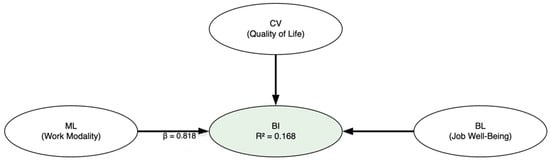
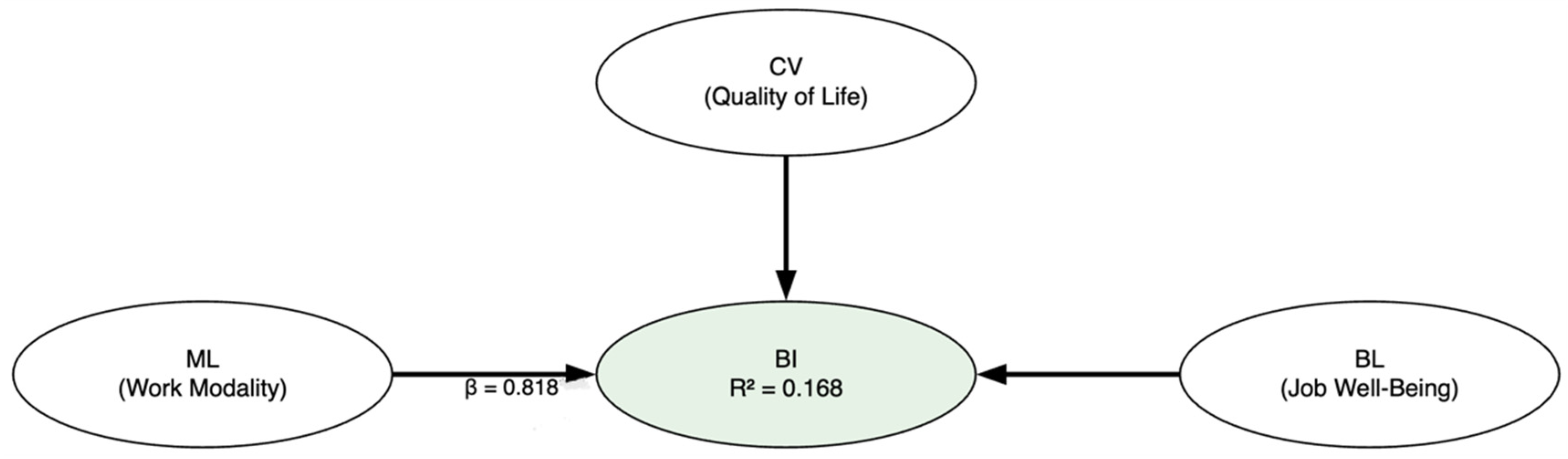
The significance of the hypothesized relationships was examined using bootstrapping with 5000 resamples. The results show that work modality—operationalized as a dichotomous variable (virtual/in-person)—significantly and positively predicts integrated well-being (β = 0.818; t = 11.361; p < 0.001). Furthermore, the effect size, evaluated using the f2 statistic, reached a value of 0.201, indicating a moderate magnitude of effect according to the criteria proposed by Cohen (1988). These findings support the study’s hypothesis that work modality constitutes a relevant explanatory factor of university faculty’s integrated well-being (Table 4).
Table 4.
Path coefficients, statistical significance, and effect sizes of the structural model.
3.3.3. Coefficient of Determination (R2)
The coefficient of determination indicates that the exogenous variable (work modality) accounts for 16.8% of the variance in the integrated well-being construct (Table 5). These results suggest that the explanatory capacity of the model is weak, yet statistically meaningful, in accordance with the criteria proposed by Hair et al. (2019).
Table 5.
Coefficient of determination of the model (R2).
Figure 2 presents the estimated structural model, displaying the coefficients of determination (R2) and the standardized path coefficients for the endogenous variable.
Figure 2.
Structural model results. Note. Standardized path coefficients (β) and coefficient of determination (R2) for the endogenous construct are presented. All relationships shown are statistically significant (p < 0.05), estimated via bootstrapping with 5000 resamples.
3.3.4. Predictive Relevance (Q2)
The predictive relevance (Q2) of the model was evaluated through blindfolding (d = 7). The integrated well-being construct yielded a Q2 value of 0.159, indicating that the unified model possesses moderate predictive relevance for the integrated well-being construct of faculty members (Table 6).
Table 6.
Predictive Relevance (Q2).
3.3.5. Global Model Fit (SRMR)
Global model fit was examined using the Standardized Root Mean Square Residual (SRMR), yielding a value of 0.0541—below the recommended threshold of 0.08 (Table 7)—thereby confirming an acceptable overall model fit.
Table 7.
Model Fit (SRMR).
3.4. Predictive Capacity of the Model (PLS-Predict)
The predictive capacity of the model was assessed using the PLS-Predict procedure, comparing prediction errors of the PLS model against those obtained from a naïve benchmark model. The results show that the integrated well-being construct yielded a Q2_predict = 0.161—a value greater than zero—indicating that the model possesses out-of-sample predictive relevance. Furthermore, the prediction error values for the estimated model (RMSE = 0.9152; MAE = 0.7384) were lower than those of the naïve model (RMSE = 0.9989; MAE = 0.7998), demonstrating that the PLS model offers superior predictive accuracy over the benchmark. Collectively, these results indicate that the model exhibits a moderate level of predictive capacity, consistent with the criteria proposed in the PLS-SEM literature (Table 8).
Table 8.
PLS-Predict—Out-of-Sample.
3.5. Comparative Analysis by Work Modality
The results reveal that university faculty working in the in-person modality exhibit higher mean levels of quality of life (M = 53.17, SD = 10.57) and occupational well-being (M = 4.16, SD = 0.63) compared to those in the virtual modality, who reported lower values for both quality of life (M = 43.27, SD = 10.09) and occupational well-being (M = 3.64, SD = 0.60). The independent samples Student’s t-test confirmed that these differences are statistically significant for both variables (p < 0.001). Moreover, effect sizes estimated using Cohen’s d indicate large magnitudes for both quality of life (d = 0.96) and occupational well-being (d = 0.85), suggesting that work modality is substantively associated with higher levels of quality of life and occupational well-being among university faculty in the Peruvian context in 2025 (Table 9).
Table 9.
Comparison of quality of life and occupational well-being among university faculty by work modality.
4. Discussion
The results of the present study provide empirical support for the proposed hypotheses. Specifically, Hypothesis 1 (H1), which posited that work modality exerts a significant effect on the quality of life of university faculty, was supported. Likewise, Hypothesis 2 (H2), which proposed that work modality significantly influences occupational well-being, was also supported.
These findings are consistent with the structural model results, which showed that work modality significantly predicts integrated well-being (β = 0.818; p < 0.001). This indicates that the way academic work is organized—whether in-person or virtual—constitutes a relevant structural factor in shaping faculty well-being.
The socio-occupational and productive dynamics of human life are shaped by multiple dimensions, including social context, professional experience, and individuals’ capacity to adapt to complex environments (De Jesús Álvarez & Santiago Bautista, 2021). This reality requires that organizations ensure their employees experience job security, motivation, satisfaction, professional vocation, ethical conduct, and a strong sense of organizational belonging—conditions that collectively support workers’ comprehensive well-being both at the personal and organizational levels (González Ayala & López García, 2021). In the specific context of university faculty in Peru, institutions must ensure academic, productive, and participatory spaces within the university community—spaces in which all human talent feels motivated to fulfill its functions, to be competitive and productive, and to contribute meaningfully to society, while also guaranteeing occupational security (Kaltiainen & Hakanen, 2022; Lebedeva & Leontiev, 2022). These considerations imply that Peruvian universities must establish continuous professional development plans tailored to the technical–professional and personal competencies of each faculty member, offering training programs that align with the social demands imposed by contemporary society (Rojas-Torres et al., 2022; González Ayala & López García, 2021).
However, when examining the influence of work modality on faculty quality of life and occupational well-being in Peru, although the structural coefficient was high and statistically significant (β = 0.823), the overall explanatory power of the model was limited (R2 = 0.168). This suggests that while work modality is a relevant determinant, it is not the sole factor shaping faculty well-being; rather, well-being must be understood within a broader organizational system encompassing institutional support, professional relationships, and contextual conditions. From this perspective, Peruvian universities must internalize faculty quality of life as a transversal axis of university governance, ensuring academic environments in which faculty can develop their functions, remain productive, and contribute to societal development (Saleem & Malik, 2023). Human talent represents the most critical asset that universities possess—both for training new generations of professionals and for responding to an increasingly complex and uncertainty-laden society (Sanchez et al., 2019).
In this regard, quality of life and occupational well-being are conceptualized in the present study within a broader category, integrated well-being (Reiman & Väyrynen, 2018), acknowledging that these two constructs cannot be studied in a fragmented manner but must be approached systemically. This perspective reflects the understanding of the human being as a bio-psychosocial, spiritual, and ecological entity. Accordingly, work modality and integrated well-being in the context of Peruvian universities must constitute a transversal, systemic, and holistic pillar of university governance—one that interprets the everyday reality of the university and the complexity of contemporary society, and that fosters a transformative vision of the institution as a space for divergent thinking in which faculty members are active participants in their own processes of social transformation.
The comparative analysis revealed statistically significant differences in quality of life and occupational well-being between in-person and virtual faculty. Those working in the in-person modality reported significantly higher levels across both variables, with large effect sizes (d = 0.96; d = 0.85). These findings suggest that work modality is not a neutral factor but a structural condition that shapes the everyday experience of academic work. These results are consistent with prior research documenting that telework in higher education can generate ambivalent effects: while it offers flexibility and autonomy, it can also intensify digital overload, permanent availability, and the blurring of boundaries between professional and personal life (Eurofound, 2020; Fan & Moen, 2023). In the university context, this situation has been associated with higher levels of emotional exhaustion and lower overall satisfaction (Mascarenhas et al., 2024).
Nevertheless, these results must be interpreted in dialogue with the structural model’s estimates. Although work modality significantly predicted integrated well-being (β = 0.823, p < 0.001), the explanatory power of the model was weak (R2 = 0.168) according to the criteria of Hair et al. (2019). This indicates that work modality only partially explains faculty well-being and does not determine it exclusively. Consequently, its effect must be understood within a broader network of organizational variables—such as institutional support and psychosocial climate—as highlighted by Mascarenhas et al. (2024). Within the Job Demands–Resources (JD-R) framework, in-person modality may facilitate access to social resources—including peer interaction, immediate feedback, and greater institutional visibility—that buffer occupational demands and foster psychological well-being (Warr, 2007; Seligman, 2014). In contrast, when remote work lacks adequate organizational support mechanisms, it may intensify cognitive and emotional demands.
In the Latin American context, these findings are particularly significant. Regional reports have documented that the transition to remote work during and after the pandemic exposed substantial digital divides and significant institutional limitations (Economic Commission for Latin America and the Caribbean [ECLAC], 2020; UNESCO, 2021). In this scenario, the virtual modality may amplify pre-existing inequalities rather than reduce them. The absence of discriminant validity between quality of life and occupational well-being—which led to their integration into the construct of integrated well-being—reinforces the systemic nature of the phenomenon. This result aligns with Sen’s (1999) perspective, which argues that working conditions can expand or restrict individuals’ real capabilities to lead fulfilling lives. In this sense, occupational experiences extend beyond the organizational domain and directly impact individuals’ global life satisfaction.
Finally, while the results demonstrate a clear advantage for in-person modality in the Peruvian context evaluated, it cannot be concluded that remote work is inherently detrimental. The evidence suggests that its effects depend on institutional preparedness, organizational regulation, and the availability of technological and psychosocial resources (Mascarenhas et al., 2024). Therefore, rather than positing a dichotomy between modalities, the findings underscore the need for institutional university policies that adequately regulate and support the diverse forms of academic work organization.
5. Conclusions
The present study sought to determine the extent to which the work modality of university faculty constitutes a structural factor shaping integrated well-being within the Peruvian higher education system. The findings revealed that faculty working in the in-person modality exhibited notably higher levels of quality of life and job satisfaction compared to those in virtual environments, with statistically robust differences confirming a significant gap between the two groups. These findings support the conclusion that the manner in which academic work is organized is not merely a matter of operational or logistical criteria; rather, it functions as a structural condition that profoundly shapes the psychosocial experiences of faculty and their capacity to sustain their professional engagement over time.
Although work modality was found to have a meaningful influence on faculty integrated well-being, the fact that the model accounted for only a limited proportion of this variance indicates that faculty well-being is not determined by a single factor. Rather, it appears to be embedded within a more complex network involving institutional elements, personal relationships, and environmental conditions. This finding highlights the multifaceted and intertwined nature of well-being in the academic sphere, reinforcing the need to adopt holistic perspectives that address—in an articulated manner—institutional support, equitable task distribution, available technological infrastructure, and the quality of everyday interactions as components of a single integrated system.
From a theoretical standpoint, this study advances the understanding of faculty well-being in Latin American post-pandemic contexts by integrating quality of life and occupational well-being into a systemic structure. It also contributes empirical evidence from a country characterized by significant digital divides, enriching the international debate on occupational sustainability in higher education.
In Latin American systems characterized by structural inequalities and significant digital divides, this study contributes theoretically to the post-pandemic literature on work transformations in higher education. By integrating quality of life and occupational well-being into a unified construct, the results promote a holistic perspective aligned with capability and psychosocial resource frameworks. In practical terms, the findings underscore the need to safeguard the well-being of university faculty through institutional support mechanisms that design balanced and regulated hybrid models, rather than relying solely on flexibility narratives.
This study presents several limitations that should be considered. First, the cross-sectional design precludes the establishment of definitive causal relationships. Second, work modality was measured as a dichotomous variable, which does not capture nuances in hybrid configurations or varying degrees of flexibility. Finally, the model accounted for a limited proportion of the variance in integrated well-being (R2 = 0.168), suggesting the existence of additional organizational and psychosocial variables not included in the present study.
Additionally, the present study does not differentiate between specific types of academic activities, such as lectures, seminars, or administrative tasks, which may involve distinct cognitive, emotional, and organizational demands. Future research should consider these differences in order to better understand how various teaching formats may moderate the relationship between work modality and faculty well-being.
Future research should adopt longitudinal designs, explore mediating variables such as organizational climate and work demands–resources balance, and differentiate between hybrid configurations in order to capture the evolving complexity of academic work. Ultimately, the sustainability of higher education depends not only on innovation in teaching modalities, but also on institutional commitment to human-centered work design that preserves the well-being of those who sustain the system.
Future research should extend the present findings by incorporating qualitative approaches, such as in-depth or semi-structured interviews, in order to capture the lived experiences of university faculty across different work modalities. This would provide a more nuanced understanding of how organizational conditions shape well-being beyond quantitative indicators.
Additionally, comparative studies across different national and institutional contexts—particularly within Latin America and between developing and developed countries—would help assess the generalizability of the present findings and identify context-specific dynamics influencing faculty well-being.
Author Contributions
Conceptualization, M.A.C.-P. and N.P.-L.; methodology, F.C.-Y.; software, G.J.-L.; validation, M.A.C.-P. and N.P.-L.; formal analysis, N.P.-L.; investigation, N.P.-L.; resources, G.J.-L. and F.C.-Y.; data curation, M.A.C.-P., N.P.-L., G.J.-L. and F.C.-Y.; writing—original draft preparation, M.A.C.-P., N.P.-L., G.J.-L. and F.C.-Y.; writing—review and editing, N.P.-L.; visualization, M.A.C.-P., N.P.-L., G.J.-L. and F.C.-Y.; supervision, M.A.C.-P.; project administration, M.A.C.-P.; funding acquisition, M.A.C.-P. All authors have read and agreed to the published version of the manuscript.
Funding
The authors declare that financial support was received for the research and publication of this article. This research was funded by Universidad César Vallejo, grant number RVI N° P-2024-110-VI-UCV.
Institutional Review Board Statement
The study was conducted in accordance with the Declaration of Helsinki, and approved by the Research Ethics Committee of the School of Management of Universidad César Vallejo (RVI N° P-2024-110-VI-UCV; date of approval: 14 November 2024).
Informed Consent Statement
Informed consent was obtained from all subjects involved in the study.
Data Availability Statement
The data presented in this study are openly available on Figshare at https://doi.org/10.6084/m9.figshare.31439929 (accessed on 28 February 2026).
Conflicts of Interest
The authors declare no conflicts of interest.
Abbreviations
The following abbreviations are used in this manuscript:
| ML | Modalidad laboral |
| CV | Calidad de vida |
| BL | Bienestar laboral |
| BI | Bienestar integral |
| SRMR | Standardized Root Mean Square Residual |
Appendix A. Measurement Model Details
Appendix A.1. First-Order Factor Loadings
Table A1.
First-order factor loadings of the theoretical measurement model.
Appendix A.2. Second-Order Factor Loadings
Table A2.
Second-order factor loadings of the unified model.
References
- Ahmad, Y., & Solomon, D. (2022). Teachers’ job satisfaction in instructional delivery modalities, and the role of school leaders: A study among selected private schools in the UAE. International Journal of Educational Administration, Management, and Leadership, 3(2), 105–122. [Google Scholar] [CrossRef] [Scilit]
- Allen, T. D., Golden, T. D., & Shockley, K. M. (2015). How effective is telecommuting? Assessing the status of our scientific findings. Psychological Science in the Public Interest, 16(2), 40–68. [Google Scholar] [CrossRef] [Scilit]
- Anderson, P., Jané-Llopis, E., & Cooper, C. (2011). The imperative of wellbeing. Stress and Health, 27, 353–355. [Google Scholar] [CrossRef] [Scilit]
- Andersson, J., & Mešić, N. (2024). Remote work environment—A qualitative study of student teachers’ and university teachers’ experiences of changed educational conditions during the COVID-19 pandemic. Higher Education, 14(1), 59–73. [Google Scholar] [CrossRef] [Scilit]
- Bai, N. (2023, August 4). Educational challenges in the Philippines. Broken Chalk. Available online: https://brokenchalk.org/educational-challenges-in-the-philippines/ (accessed on 15 January 2025).
- Barboza, J., Sánchez-Aguirre, F., Andrade-Díaz, E., Vásquez-Pajuelo, L., Chiscul, M., & Córdova, G. (2023). Psychological well-being and technostress: Challenges in health and job performance among English teachers. Salud, Ciencia y Tecnología, 3, 618. [Google Scholar] [CrossRef] [Scilit]
- Becker, L. C. (2002). A new stoicism. Southwest Philosophy Review, 18(2), 169–171. [Google Scholar] [CrossRef] [Scilit]
- Blanch, J. M., Sahagún, M., Cantera, L., & Cervantes, G. (2010). Cuestionario de bienestar laboral general (qBLG): Estructura y propiedades psicométricas. Revista de Psicología del Trabajo y de las Organizaciones, 26(2), 157–170. [Google Scholar] [CrossRef] [Scilit]
- Buonomo, I., Fatigante, M., & Fiorilli, C. (2017). Teachers’ burnout profile: Risk and protective factors. The Open Psychology Journal, 10(1), 190–201. [Google Scholar] [CrossRef] [Scilit]
- Carranza-Esteban, R. F., Mamani-Benito, O., Turpo-Chaparro, J. E., Romero, A. A., & Castillo-Blanco, R. W. (2023). Social support at work and workload as predictors of satisfaction with life of Peruvian teachers. South African Journal of Education, 43(3), 1–10. [Google Scholar] [CrossRef] [Scilit]
- Chan, R. Y., Lin, X., & Bista, K. (Eds.). (2023). Rethinking hybrid and remote work in higher education: Global perspectives, policies, and practices after COVID-19. Star Scholars Press. [Google Scholar]
- Cohen, J. (1988). Statistical power analysis for the behavioral sciences (2nd ed.). Lawrence Erlbaum Associates. [Google Scholar]
- Creswell, J. W., & Creswell, J. D. (2018). Research design: Qualitative, quantitative, and mixed methods approaches (5th ed.). SAGE. [Google Scholar]
- De Jesús Álvarez, J. N., & Santiago Bautista, M. d. C. (2021). Bienestar laboral en docentes de una institución pública. Vinculatégica, 7(2), 964–980. [Google Scholar] [CrossRef] [Scilit]
- Diener, E. (2000). Subjective well-being: The science of happiness and a proposal for a national index. American Psychologist, 55(1), 34–43. [Google Scholar] [CrossRef] [PubMed]
- Economic Commission for Latin America and the Caribbean [ECLAC]. (2020). Education in the time of COVID-19. United Nations. Available online: https://www.cepal.org/en/publications/45905-education-time-covid-19 (accessed on 15 January 2025).
- Eurofound. (2020). Living, working and COVID-19. Publications Office of the European Union. Available online: https://www.eurofound.europa.eu/en/publications/all/living-working-and-covid-19 (accessed on 15 January 2025).
- Fan, W., & Moen, P. (2023). Ongoing remote work, returning to working at work, or in between during COVID-19: What promotes subjective well-being? Journal of Health and Social Behavior, 64(1), 152–171. [Google Scholar] [CrossRef] [Scilit] [PubMed]
- Ferriss, A. L. (2004). The quality of life concept in sociology. The American Sociologist, 35(3), 37–51. [Google Scholar] [CrossRef] [Scilit]
- Fiorilli, C., Benevene, P., De Stasio, S., Buonomo, I., Romano, L., Pepe, A., & Addimando, L. (2019). Teachers’ burnout: The role of trait emotional intelligence and social support. Frontiers in Psychology, 10, 2743. [Google Scholar] [CrossRef] [Scilit] [PubMed]
- Garay Lillo, J. (1996). Calidad de vida. Geriatrika, 12(4), 35–43. [Google Scholar] [CrossRef] [Scilit]
- Gonçalves, R. D. S., Simões-Zenari, M., Camargo, A., & Nemr, K. (2024). Brazilian teachers’ voices: The impact of the first two years of the pandemic. Journal of Voice, advance online publication. [Google Scholar] [CrossRef] [Scilit]
- González Ayala, M. T., & López García, M. d. C. (2021). Calidad de vida en el trabajo de personal de enfermería en clínicas de servicios de salud. Revista Colombiana de Salud Ocupacional, 9(1), 18–24. [Google Scholar] [CrossRef] [Scilit]
- Guliyeva, A. (2022). Methodological approaches to measuring quality of life. Brazilian Journal of Political Economy, 42(2), 364–377. [Google Scholar] [CrossRef] [Scilit]
- Hair, J. F., Hult, G. T. M., Ringle, C. M., & Sarstedt, M. (2022). A primer on partial least squares structural equation modeling (PLS-SEM) (3rd ed.). Sage. [Google Scholar]
- Hair, J. F., Risher, J. J., Sarstedt, M., & Ringle, C. M. (2019). When to use and how to report the results of PLS-SEM. European Business Review, 31(1), 2–24. [Google Scholar] [CrossRef] [Scilit]
- Huerta, J. A. L., Romo, R. A. G., & Tayabas, J. M. T. (2017). Propiedades psicométricas de la versión en español de la escala de calidad de vida WHOQOL-BREF en una muestra de adultos mexicanos. Revista Iberoamericana de Diagnóstico y Evaluación Psicológica, 2(44), 105–115. [Google Scholar] [CrossRef] [Scilit]
- International Labour Organization. (2021). Working from home: From invisibility to decent work. ILO. Available online: https://www.ilo.org/publications/major-publications/working-home-invisibility-decent-work (accessed on 16 January 2025).
- Kaltiainen, J., & Hakanen, J. (2022). Changes in occupational well-being during COVID-19: The impact of age, gender, education, living alone, and telework in a Finnish four-wave population sample. Scandinavian Journal of Work, Environment and Health, 48(6), 457–467. [Google Scholar] [CrossRef] [Scilit]
- Kaplan, R. S., & Norton, D. P. (2008). The execution premium: Linking the strategy to operations for competitive advantage. Harvard Business Review Press. [Google Scholar]
- Kinman, G., & Johnson, S. (2019). Special section on well-being in academic employees. International Journal of Stress Management, 26(2), 159–161. [Google Scholar] [CrossRef] [Scilit]
- Kitagawa, R., Kuroda, S., Okudaira, H., & Owan, H. (2021). Working from home and productivity under the COVID-19 pandemic: Using survey data of four manufacturing firms. PLoS ONE, 16(12), e0261761. [Google Scholar] [CrossRef] [Scilit]
- Kröner, F., & Müller, A. (2023). Development of well-being after moving to telework: A longitudinal latent class analysis. Frontiers in Psychology, 14, 1098336. [Google Scholar] [CrossRef] [Scilit]
- Lebedeva, A. A., & Leontiev, D. A. (2022). Contemporary approaches to the quality of life: From objective contexts to subjective ones. Social Psychology and Society, 13(4), 142–162. [Google Scholar] [CrossRef] [Scilit]
- Marelich, W. D., & Erger, J. S. (2004). The social psychology of health: Essays and readings. Pearson Education. [Google Scholar]
- Mascarenhas, M., Carvalho, V. S., Moretto, C. F., & Chambel, M. J. (2024). Boundary violations and university teachers’ well-being during mandatory telework: Recovery’s role and gender differences. BMC Public Health, 24, 18178. [Google Scholar] [CrossRef] [Scilit] [PubMed]
- Maslow, A. H. (1970). Motivation and personality. Harper & Row. [Google Scholar]
- Maxwell, J. A. (2004). Causal explanation, qualitative research, and scientific inquiry in education. Educational Researcher, 33(2), 3–11. [Google Scholar] [CrossRef] [Scilit]
- Méndez, M. T., Solís, I. R., & Gonzalez, J. C. (2023). Análisis comparativo enseñanza-aprendizaje virtual y enseñanza-aprendizaje presencial 2019–2022: Universidad Ricardo Palma, Lima-Perú. In N. Callaos, J. Horne, E. F. Ruiz-Ledesma, B. Sánchez, & A. Tremante (Eds.), Memorias de la décima tercera conferencia iberoamericana de complejidad, informática y cibernética (CICIC) (pp. 72–78). International Institute of Informatics and Cybernetics. [Google Scholar] [CrossRef] [Scilit]
- Mosquera, P., Albuquerque, P. C., & Picoto, W. N. (2022). Is online teaching challenging faculty well-being? Administrative Sciences, 12, 147. [Google Scholar] [CrossRef] [Scilit]
- Pargament, K. I. (1997). The psychology of religion and coping: Theory, research, practice. Guilford Press. [Google Scholar]
- Quiñones, D., Cervera, M., Porro, L., Reynel, K., & De La Cruz, J. (2022). Correlation between stress and lifestyle in teachers at some schools in Lima, Peru, during telework in 2020. Work, 72(2), 409–419. [Google Scholar] [CrossRef] [Scilit] [PubMed]
- Răducu, C.-M., & Stănculescu, E. (2021). Adaptability to online teaching during COVID-19 pandemic: A multiple mediation analysis based on kolb’s theory. International Journal of Environmental Research and Public Health, 18(15), 8032. [Google Scholar] [CrossRef] [Scilit]
- Reiman, A., & Väyrynen, S. (2018). Holistic well-being and sustainable organisations: A review and argumentative propositions. International Journal of Sustainable Engineering, 11(5), 321–329. [Google Scholar] [CrossRef] [Scilit]
- Richițeanu-Năstase, E.-R., Stăiculescu, C., & Lăcătuș, M. L. (2019). The relationship between optimism and life satisfaction: Case study. In E. Soare, & C. Langa (Eds.), Education facing contemporary world issues (Vol. 67, pp. 1023–1028). Future Academy. [Google Scholar] [CrossRef] [Scilit]
- Richițeanu-Năstase, E.-R., Stăiculescu, C., & Păduraru, M.-E. (2022). Online teaching, learning and evaluation in time of COVID-19: Lessons learned at the university level. In Proceedings of the 20th international scientific conference “strategies XXI” (pp. 395–404). Carol I National Defence University Publishing House. Available online: https://www.ceeol.com/search/chapter-detail?id=1339260 (accessed on 17 January 2025).
- Rojas-Torres, A. C., Tiga-Loza, D. C., & Bello-Pinto, W. (2022). Calidad de vida laboral en empleados de una empresa distribuidora de bebidas de Santander, Colombia. Medicina y Seguridad del Trabajo, 67(265), 253–265. [Google Scholar] [CrossRef] [Scilit]
- Ryff, C. D. (2013). Psychological well-being revisited: Advances in the science and practice of eudaimonia. Psychotherapy and Psychosomatics, 83(1), 10–28. [Google Scholar] [CrossRef] [Scilit] [PubMed]
- Ryff, C. D., & Keyes, C. L. M. (1995). The structure of psychological well-being revisited. Journal of Personality and Social Psychology, 69(4), 719–727. [Google Scholar] [CrossRef] [PubMed]
- Sakip, S. R. M., Zukri, A. Z. M., & Rahim, P. R. M. A. (2023). Assessing the relationship between environmental, psychological, physical, and social factors toward the quality of life. International Journal of Sustainable Construction Engineering and Technology, 14(2), 256–265. [Google Scholar] [CrossRef] [Scilit]
- Saleem, F., & Malik, M. I. (2023). Technostress, quality of work life, and job performance: A moderated mediation model. Behavioral Sciences, 13(12), 1014. [Google Scholar] [CrossRef] [Scilit]
- Sanchez, H. M., Sanchez, E. G. M., Barbosa, M. A., Guimarães, E. C., & Porto, C. C. (2019). Impact of health on quality of life and quality of working life of university teachers from different areas of knowledge. Ciência & Saúde Coletiva, 24(11), 4111–4123. [Google Scholar] [CrossRef] [Scilit]
- Santiago, E. (2022, August 11). En Perú hay más de 66 mil docentes universitarios. LinkedIn. Available online: https://es.linkedin.com/pulse/en-per%C3%BA-hay-m%C3%A1s-de-66-mil-docentes-universitarios-y-santiago (accessed on 18 January 2025).
- Sato, S. N., Condes Moreno, E., Villanueva, A. R., Orquera Miranda, P., Chiarella, P., Bermudez, G., Aguilera, J. F. T., & Clemente-Suárez, V. J. (2023). Psychological impacts of teaching models on Ibero-American educators during COVID-19. Behavioral Sciences, 13(12), 957. [Google Scholar] [CrossRef] [Scilit]
- Seligman, M. E. P. (2014). Flourish: A visionary new understanding of happiness and well-being. Free Press. [Google Scholar]
- Sen, A. (1999). Development as freedom. Oxford University Press. [Google Scholar]
- SmartPLS GmbH. (2023). SmartPLS (Version 4.0) [Computer software]. SmartPLS GmbH. Available online: https://www.smartpls.com (accessed on 20 November 2025).
- Stempel, C. R., & Siestrup, K. (2022). Suddenly telework: Job crafting as a way to promote employee well-being? Frontiers in Psychology, 12, 790862. [Google Scholar] [CrossRef] [Scilit]
- UNESCO. (2021). Reimagining our futures together: A new social contract for education. UNESCO. Available online: https://unesdoc.unesco.org/ark:/48223/pf0000379381 (accessed on 20 January 2025).
- Wang, B., Liu, Y., Qian, J., & Parker, S. K. (2021). Achieving effective remote working during the COVID-19 pandemic: A work design perspective. Applied Psychology, 70(1), 16–59. [Google Scholar] [CrossRef] [Scilit]
- Warr, P. (2007). Work, happiness, and unhappiness. Lawrence Erlbaum Associates. [Google Scholar]
- Watts, J., & Robertson, N. (2011). Burnout in university teaching staff: A systematic literature review. Educational Research, 53(1), 33–50. [Google Scholar] [CrossRef] [Scilit]
- WHOQOL Group. (1998). Development of the World Health Organization WHOQOL-BREF Quality of Life Assessment. Psychological Medicine, 28(3), 551–558. [Google Scholar] [CrossRef] [Scilit]
- Whyte, W. H. (1980). The social life of small urban spaces. Project for Public Spaces. [Google Scholar]
- Wilkinson, R., & Marmot, M. (2003). Social determinants of health: The solid facts (2nd ed.). World Health Organization. Available online: https://www.euro.who.int/en/publications/abstracts/social-determinants-of-health.-the-solid-facts (accessed on 15 January 2025).
- Winefield, A. H., Boyd, C., & Winefield, H. R. (2014). Work-family conflict and well-being in university employees. The Journal of Psychology, 148(6), 683–697. [Google Scholar] [CrossRef] [Scilit]
- World Health Organization. (2022). Guidelines on mental health at work. WHO. Available online: https://www.who.int/publications/i/item/9789240053052 (accessed on 15 January 2025).

Disclaimer/Publisher’s Note: The statements, opinions and data contained in all publications are solely those of the individual author(s) and contributor(s) and not of MDPI and/or the editor(s). MDPI and/or the editor(s) disclaim responsibility for any injury to people or property resulting from any ideas, methods, instructions or products referred to in the content. |
© 2026 by the authors. Licensee MDPI, Basel, Switzerland. This article is an open access article distributed under the terms and conditions of the Creative Commons Attribution (CC BY) license.