


Abstract
Internationally, there are increased pressures for primary schools to meet academic curriculum outcomes primarily driven by performance metrics and targets. Sitting alongside this context are competing concerns for the decline in children’s play opportunities to bolster their overall health and wellbeing. Adopting play-based pedagogies in primary schools can infuse more play into children’s lives whilst meeting curriculum outcomes. Despite the perceived importance of play during childhood, play-based pedagogies are still mostly positioned as legitimate pedagogical approaches in prior to school settings. Given this landscape, this research seeks to understand contemporary educational research of play-based pedagogies in primary schools by conducting a scoping review. Through presenting a narrative account of the literature, and synthesising these ideas into broader themes, the research identified that there remains international interest in play-based pedagogies in the primary years of school but despite this, questions surrounding its legitimacy remain. This review and subsequent discussion surface potential next steps including a recommendation to increase empirical research on the adoption of play-based pedagogies in schools with consideration of using a ’Mosaic approach’ to data collection, as well as research focusing on the active and intentional role of the teacher. Lastly, as a way forward, the research brings to light the potential of creating a ‘space’ for the merging of two knowledge systems from two often siloed approaches to education—early childhood and primary—to create a new pathway. Such a pathway has potential to support continuity of learning, student engagement, children’s health, and wellbeing.
1. Introduction
Consistently, interdisciplinary research over multiple decades has produced empirical studies outlining the benefits of play for child development (Colliver et al., 2022; Zosh et al., 2022). For example, a report from the American Academy of Paediatrics (Yogman et al., 2018, p. 1) outlined many of the benefits of play for children including its ability to enhance brain structure and functions and promote executive functioning. Against this backdrop, the Canadian Paediatric Society posits that play—especially risk-taking and experimentation—is an integral component of childhood as they seek to understand and navigate their environment (Beaulieu & Beno, 2024). These paediatricians advocated for the importance of both unstructured play as well as ‘playful learning as an important complement to didactic learning’ (Yogman et al., 2018, p. 2). From an educational perspective, research has found the pivotal role of play in assisting the development of qualities highly valued in our current society. In essence, these include attributes such as problem-solving, creativity, inventiveness, emotional intelligence, confidence, personal happiness, and identity (O’Connor, 2017; Sahlberg & Doyle, 2019).
In addition, evidence-based research shows that when children learn through play in its many forms, they can experience meaningful, joyful and iterative learning experiences (Zosh et al., 2018). From a psychoanalytical perspective, Winnicott’s work associated play with relaxation, which is related to its ‘formless qualities’ (àBecket, 2017). In Winnicott’s work, the formlessness and opportunities for relaxation during play engender trust between adults and children as they engage in play. From this viewpoint, it could be deduced that tense, structured interactions could diminish a sense of formlessness and a sense of relaxation. Winnicott’s work demonstrates how important it is for children to have opportunities to play. Building on this, from the work of Whitlock (2022), learning through play facilitates higher-order thinking skills and allows children to make sense of their learning in meaningful and integrated ways. This acknowledgement of the benefits of children’s play from diverse perspectives is matched with concern regarding the demise in opportunities for children to play across parts of the globe (Gray, 2011; Yogman et al., 2018). Murray (2018) proposes three issues that may have contributed to fewer opportunities to play. These are undervaluing of children’s play, policy maker’s interference and lack of trust in children. As discussed above, play is widely recognised as critical for children’s cognitive, social, emotional, and physical development, yet we know there is a decline in opportunities for children to play (Gray, 2011). Given these benefits, schools have been identified as key environments where play opportunities can be enriched, providing children with regular opportunities to engage in meaningful play experiences alongside their educational activities (O’Connor, 2017; Hirsh-Pasek & Hadani, 2020; Sahlberg & Doyle, 2019). In this study, we adopt the following definition of learning through play, learning opportunities that are ‘joyful, meaningful, iterative, socially interactive and actively engaging, focused on fostering cognitive, social, emotional, creative and physical skills’ (Parker et al., 2022).
Play-based pedagogies have largely been positioned as foundational pedagogies to be used in prior to school settings. Their uptake in both the early childhood and primary context has been influenced by policy and discourse at an international and national level. In this context, the expansion of school, state, national and international competition drawing on standardised assessments has led to the identification of national targets. When viewed in this light, these targets may place downward pressure on the early years context (Ang, 2014) to impart this knowledge onto children. Moreover, the perceived value of play may have been concealed by these external pressures to meet more narrowly defined academic outcomes (Rogers, 2010). Schools are held accountable to achieve these outcomes, which often prioritise literacy and numeracy, and as a result, the curriculum has considerably narrowed (Hirsh-Pasek & Hadani, 2020).
Collectively, these have implications in the pedagogical decisions of educators and educational leaders. The re-emergence of standardised tests and a ‘back to basics’ approach has resulted in public discourse about what is lacking in primary schools and how it can be fixed. This public discourse is then intertwined with perceived conceptualisations of play and learning. The increased political pressure shaped by the dominance in the education bureaucracies of neoliberalism and globalisation has resulted in play often being overlooked as an interruption to the serious learning required at school (Peters & Swadener, 2019). As a result, over time, we have seen an emergence of a false dichotomy between ‘learning and play’.
Some researchers have begun to explore the perceived relationship between play, teaching and learning. Thomas et al. (2011) have identified that discussions of play-based pedagogies often silence or disguise the term ‘teaching’. This was extended by the work of Walsh et al. (2010) who state that the terms teaching and play have, over time, been constructed as ‘fundamentally incompatible concepts’ (p. 1162). Pramling Samuelsson and Johansson (2006) found that play and learning are often separated in the literature on teacher practice. Meanwhile, McArdle and McWilliam (2005) note that incorporating play is to ‘teach without teaching’ and Walsh et al. (2010) note that ‘it’s teaching… but not as we know it’. From research undertaken in New Zealand, Hedges (2007) proposes that it has been the dominance of free play that has resulted in decreased attention on the positive role of the teacher in a play-based context. Meanwhile, Mao et al. (2022) reinforced the active role of a teacher in a play-based context ranging from guide, supervisor, teammate and/or onlooker. This conundrum was also raised by Grieshaber (2008) who states that teachers in a play context have been positioned as facilitators, which has resulted in a general reluctance to intentionally interfere and/or instruct during play. Despite research demonstrating the benefits of play for children’s learning and development, it appears there is still considerable work to be done in connecting the dots between play-based pedagogies, teaching, learning and development in the education context.
The curriculum plays an important role in how play and intentional teaching are constructed (Thomas et al., 2011). Across different parts of the globe, play-based pedagogies are strongly foregrounded in the early years curriculum. In Australia, like other countries around the world, the inclusion of play beyond the early childhood context is pressured by the demands on educators to achieve set curriculum outcomes that can be easily assessed and captured in data for comparison and competition (Bodrova & Leong, 2005; O’Connor, 2017; Weisberg et al., 2013). Klenowski and Wyatt-Smith (2012) note that the political push for high-stakes testing is motivated by the need to ‘meet public accountability, demonstrate transparency and maintain public confidence in the standards of schooling’ (p. 65). Confidence in our education system is imperative. However, there is a growing movement to change the discourse surrounding what is viewed as a ‘successful education system’, from one that is based solely on the narrowly defined curriculum standards, to an education system that values the development and growth of the whole child (Sahlberg & Doyle, 2019). The concept of learning through play and the well-established benefits of this approach sit well within this view of education. For Johnson and Dong (2018), curriculum and play effectively collide when there are communication and coordination of both the teacher and children’s perspectives.
This begs the question, how has the application of play-based pedagogies in schools been conceptualised? Several researchers have begun to theorise the application of play in primary school contexts. Walsh et al. (2010) identified the term ‘playful structure’ (p. 108) as a concept of attempting to bridge the established binary of play/work or play/learning. In their research, Walsh et al. (2010) note the broad agreement that formal approaches to teaching are not appropriate in the early years of primary school. With this motivation, Walsh et al. (2010) identified playful structure as a concept that invites the infusion of playfulness throughout the day and in turn avoids pressure on children whilst fostering positive engagement. Other researchers frame play along a continuum with the variability ranging from open-ended or free play to modelled or structured and finally to purposely framed play or adult-directed play (Edwards, 2007; Wood & Attfield, 2005). Based on this premise, Edwards (2007) developed the ‘Pedagogical Play Framework’. The Pedagogical Play Framework consists of three play types, open-ended play, modelled play and purposely framed play. The framework is guided by two underpinning principles; firstly, that all play types are of equal pedagogical value, and secondly, that play types can be used in multiple combinations. The framework is also grounded in intentionality. Edwards’ ‘Pedagogical Play Framework’, posited predominantly in the early childhood context, is important in this context as it extends existing constructs of play and teaching with intent.
Whilst educators may articulate an appreciation of the value of play philosophically, there appears to be a gap between their philosophical beliefs and their practice. In 2011, research in Scotland found that whilst play-based learning (known as active learning in Scotland) is met with enthusiasm by educators, there are a range of understandings regarding the purpose and structure of the pedagogy of play (Martlew et al., 2011). In addition, play-based pedagogy was found to be problematic for educators in an era of rigid curricular structure, increased accountability, and increased pressure to attain targets (Martlew et al., 2011). In 2018, a study in the United Kingdom, exploring the pedagogical tensions of transitioning from a play-based context to a content-based curriculum, found that as the children enter a content-based curriculum, the learning environment favours pedagogical decisions that facilitate the transmission of knowledge, which can be easily assessed and accounted for (Nicholson, 2019). These are representative of the emerging pressures that are contested within the educational context.
Considering the factors relating to the current policy context, gaps and issues identified in the research, the underlying aim of this research is to understand and explore the more recent international research landscape of play-based pedagogies in the primary school context. To do this, we conducted a scoping review of research published between 2012 and 2022. Previous reviews have been conducted on play-based pedagogies; however, these were largely focused on early education. For example, Pyle et al. (2017) summarise the literature on play-based learning in the ‘kindergarten’ context, that is, 4–5-year-olds, whilst Bubikova-Moan et al. (2019) have a particular focus on early childhood practitioner views on play-based learning with children in the 0–6 years age bracket. This scoping review provides new insight by answering the following research question: What types of research have been conducted on play in primary schools (lower primary) from 2012 to 2022 and what were the main findings? The lower primary years, in this context, are defined as 5–8-year-olds.
2. Materials and Methods
A scoping review was utilised as a method to identify and map the breadth of research available on this topic (Arksey & O’Malley, 2005; Levac et al., 2010). This scoping review adopts the original multi-stepped approach framed by Arksey and O’Malley (2005). This five-step process involves (1) identifying the research question, (2) identifying relevant studies, (3) selecting the studies, (4) charting the data and (5) summarising and finally reporting the results. The optional sixth step of Arksey and O’Malley’s framework was not applied for this research project. This sixth step provides an option for consultation with an opportunity for experts in the field to provide additional references for considerations and discuss the broader findings (Arksey & O’Malley, 2005). We did not utilise this step as two of the authors individually have over 30 years’ experience in the field of play and learning so we decided that, for now, their expertise could satisfy the opportunity to add potential references and discuss the broader findings. For the fifth step, this research included elements of Levac et al.’s (2010) recommended advancements to the scoping review methodology, adding greater detail to analyse, report and apply the meaning process. Levac et al.’s (2010, p. 6) recommendations included a recommendation for ‘three distinct steps’ to be included in the summarising and reporting step. Firstly, when analysing the data, the research team included a descriptive numerical analysis alongside thematic analysis. Secondly, results were analysed in accordance with the overall research purpose. Thirdly, findings were considered as they relate to the overall research question and implications for future research were explicitly discussed. This review was reported in accordance with the PRISMA-ScR reporting guidelines (Tricco et al., 2018). See Supplementary File Table S1.
Review Questions
- (1)
- Identifying the research question
The research was guided by the following research questions:
What types of research have been conducted on play in primary schools from 2012 to 2022?
What were the broad aims of the research projects?
What were the findings?
Where are the gaps?
- (2)
- Identifying Relevant Studies
As shown in Table 1, this scoping review included peer-reviewed articles, available in full text, English, and published from 2012 to 2022. In addition, articles written for children/settings prior to the first year of school (before five years of age) or after the second year of school (eight years of age) were excluded. Given the recommendation from Johnson and Dong (2018) for further empirical research to join the vast body of conceptual research on play and learning, this scoping review sought to include empirical research only.
Table 1.
Inclusion and exclusion criteria.
To cover the broad range of research, key words ‘play-based pedagogy’, ‘play-based’ and ‘playful learning’ were paired with ‘primary school’ and ‘school’ as the main search terms in the following education journal databases: ERIC, Education Research Complete and APA Psych Info. These search terms were implemented consistently across all databases along with search filters for the year and full-text/language availability.
- (3)
- Selecting the Studies
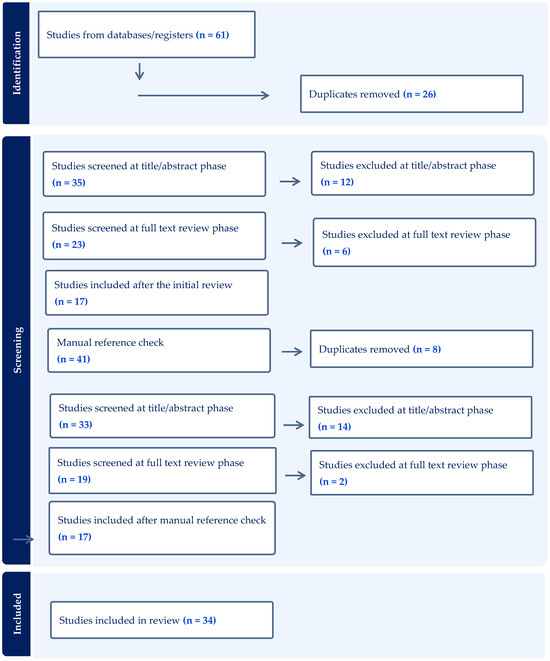
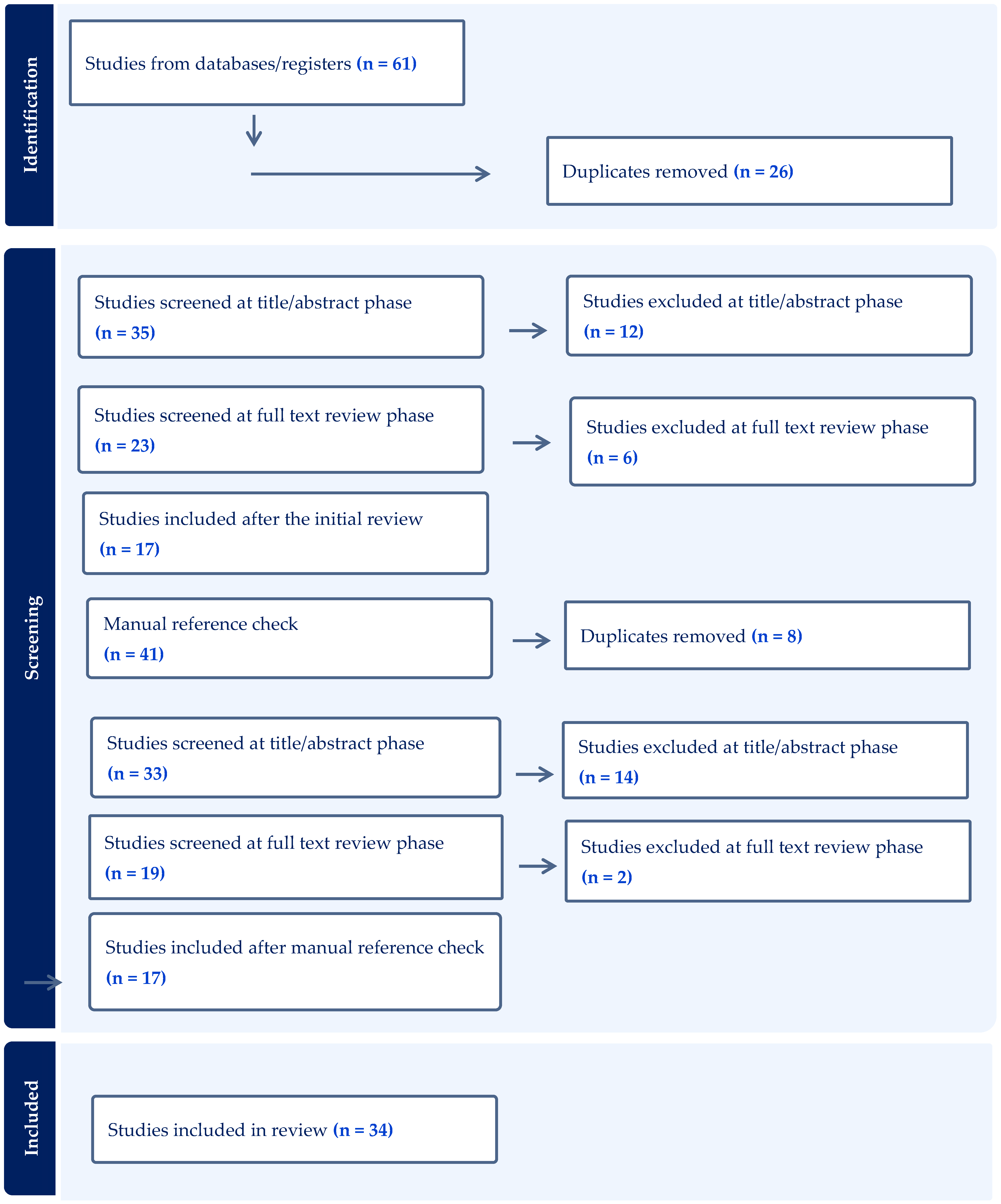
After the initial search, titles and abstracts were read and assessed for relevance against the inclusion and exclusion criteria. The search resulted in articles imported into the Covidence softwarefrom the three search databases (N = 61). Covidence removed duplicates (N = 26). The three chief researchers conducted a title and abstract search of the remaining articles (N = 35) against the inclusion/exclusion criteria. From this, 12 articles were deemed irrelevant. To be deemed as irrelevant, two or more of the three research members had to agree on the decision. A full-text review was then conducted of the remaining articles (N = 23), resulting in the final articles ready for extraction (N = 17). A manual search of these articles’ reference list resulted in additional articles to fit within the scope of the review (N = 41). From this list, duplicates were removed (N = 8), leaving 33 remaining potential articles. Title and abstract reviewing of the 33 articles left 19 possible articles for review. Of these 19 articles, the research team removed two articles from full-text review, for not meeting the inclusion criteria, and the remaining 17 were added to this list. This overall process resulted in 34 articles to include in the scoping review. The search results are presented in a ‘Preferred Reporting Items for Systematic Reviews and Meta-Analyses’ PRISMA flow diagram. See Figure 1: Flow chart of the search strategy and study selection.
Figure 1.
Flow chart of the search strategy and study selection.
- (4)
- Charting the Data
The PCC (population, concept and context) framework guided the process of charting and collating the data (Pollock et al., 2023). The PCC framework is a proposed guide ‘to construct clear and meaningful objectives and eligibility criteria for a scoping review’ (Pollock et al., 2023, p. 22). Using the PCC framework, the following sub-headings were used to chart the data from the 33 research articles in an Excel spreadsheet: theoretical framework, method/data collection, location, context of play/school/age, participants, purpose, research question/study aims, summary of findings and additional comments. Given that the purpose of this review is to scope the existing literature rather than assess its effectiveness, no formal critical appraisal of included sources was undertaken.
- (5)
- Summarising and Reporting the Results
This research sought to answer the following research questions: What types of research have been conducted on play in primary schools from 2012 to 2022? What were the broad aims and findings of the research projects? Where are the gaps? With that in mind, the final stage of the research method involved presenting a descriptive numerical analysis alongside a thematic analysis of the results (Arksey & O’Malley, 2005; Levac et al., 2010). When reporting the results, the research team were driven by the overall research aims, to present a narrative account of the existing literature. To summarise and report the results, we present a descriptive analysis of the data collection methods, research participants, geographical distribution of research and research aims along with a thematic analysis driven by both the data and the overall research questions (Dixon-Woods et al., 2005; Levac et al., 2010). Guided by the overarching research question, the research team read and re-read the charted data to collectively identify the recurring themes. Once consensus was reached, we reorganised the data under the thematic headings. The following themes were identified: (1) the academic benefits; (2) the non-academic benefits; (3) the role of the teacher; and finally (4) the research gaps. A scoping review does not seek to evaluate the quality or the weighting of evidence; instead, a scoping review seeks to present a ‘narrative account of existing literature’ (Arksey & O’Malley, 2005, p. 27).
Finally, as guided by Levac et al. (2010), the overall findings were considered as they relate to the overall research aims and implications for future research. After collectively reviewing the narrative account of the existing literature, reading, and reading again, we enkindled the following themes for discussion and considerations in moving forward (Levac et al., 2010): the legitimacy of play in meeting curriculum outcomes; privileging the role of the teacher; moving beyond the construct of free play; the ultimate goal of education and forging new ways forward. Under these themes, the findings were woven into the eventual discussion of the results.
3. Results
3.1. Data Collection Methods
A diverse range of data collection methods were used to study play in educational contexts within the scope of the study, as shown in Table 2. Within the articles reviewed, thirteen studies adopted single data collection methods (Allee-Herndon et al., 2021; Barblett et al., 2016; Baker, 2014; Cheung et al., 2022; Fesseha & Pyle, 2016; Hunter, 2019; Hunkin, 2014; Hood, 2013; P. C. Keung & Fung, 2021; Pyle et al., 2017; Randolph et al., 2016; Yin et al., 2022; Yahya, 2016). The remaining studies (N = 21) adopted two or more methods of data collection (see, for example, Russo (2013) and Cremin et al. (2015) who used greater than five data collection methods). Howe (2016) framed their data collection as a ‘Mosaic’-type approach, drawing on the work of Clark and Moss (2001) to prioritise diverse perspectives represented in their study.
Table 2.
Data collection methods.
3.2. Research Participants
Of the research projects within this scoping review, teachers were the main participants (Barblett et al., 2016; DeLuca et al., 2020; Baker, 2014; Fesseha & Pyle, 2016; Jay & Knaus, 2018; P. C. Keung & Cheung, 2019; Lynch, 2015; Miller, 2018; Nolan & Paatsch, 2017; Pyle & DeLuca, 2017; Pyle et al., 2018; Pyle & Danniels, 2017; Pyle et al., 2017; Yin et al., 2022; Hood, 2013; Hunkin, 2014; Russo, 2013). After teachers, children were the next most common participant group (Allee-Herndon et al., 2021; Randolph et al., 2016; Hood, 2013; Howe, 2016; Russo, 2013). Less common participants in the articles reviewed were parents (Yahya, 2016; Russo, 2013), school administration (Jay & Knaus, 2018), principals (P. C. Keung & Cheung, 2019) and pre-service teachers (Sherwood & Reifel, 2013).
3.3. Geographical Distribution of Research
Of the articles within the scoping review (N = 34), research on play-based learning in primary schools was conducted in a range of countries, as shown in Table 3. This included Canada (N = 11) (Danniels & Pyle, 2022; DeLuca et al., 2020; Fesseha & Pyle, 2016; Miller, 2018; Pyle & DeLuca, 2017; Pyle et al., 2017, 2018, 2020; Pyle & Danniels, 2017; Pyle & Bigelow, 2015; Yahya, 2016), England (N = 5) (Cremin et al., 2015; Nicholson & Hendry, 2022; Nicholson, 2019; Hood, 2013; Howe, 2016), Hong Kong Special Administrative Region (N = 5) (Cheung et al., 2022; P. C. Keung & Fung, 2021; C. Keung & Fung, 2020; P. C. Keung & Cheung, 2019; Yin et al., 2022), United States of America (N = 5) (Allee-Herndon et al., 2021; Cavanaugh et al., 2017; Lynch, 2015; Russo, 2013; Sherwood & Reifel, 2013), Australia (N = 4) (Barblett et al., 2016; Jay & Knaus, 2018; Nolan & Paatsch, 2017; Hunkin, 2014), People’s Republic of China (N = 1) (Vong, 2012), New Zealand (N = 1), United Arab Emirates (N =1) (Baker, 2014) and Finland/Netherlands (N = 1) (Randolph et al., 2016).
Table 3.
Geographic distribution of studies.
3.4. Research Aims of Reviewed Studies
Of the reviewed articles, many had broad aims related to the perception, importance and/or definition of play-based learning in the primary context (Baker, 2014; Cheung et al., 2022; Fesseha & Pyle, 2016; Lynch, 2015; Pyle et al., 2020; Pyle & Bigelow, 2015, Vong, 2012). Other articles researched play for its impact on academic achievement (e.g., Randolph et al., 2016) or more specifically academic achievement in the area of numeracy (Miller, 2018) or literacy (Allee-Herndon et al., 2021; Cavanaugh et al., 2017; Pyle et al., 2018). Other research, whilst still pedagogically focused, narrowed in on the issues associated with its implementation (Barblett et al., 2016; Jay & Knaus, 2018; Nolan & Paatsch, 2017) or its implementation more broadly (Nicholson & Hendry, 2022; Pyle & Danniels, 2017). A smaller portion of the research papers reviewed sought to better understand play and assessment (DeLuca et al., 2020), the support needed from teachers to implement play-based learning (Hunter, 2019), play and pedagogical content knowledge (P. C. Keung & Fung, 2021) and the educational discontinuity for children as they transition from play-based learning to more ‘formalised’ learning contexts (Hunkin, 2014; Nicholson, 2019). Lastly, studies sought to listen to different viewpoints. For example, Howe (2016) and P. C. Keung and Fung (2021) looked at children’s perspectives, whilst Yahya (2016) worked to understand mothers’ and children’s positions and Sherwood and Reifel (2013) the understanding of pre-service teachers.
3.5. Research Findings
3.5.1. The Benefits: ‘Academic’ Benefits
Of the articles reviewed, three had a specific focus on ‘academic learning’ in the traditional, discipline knowledge-related construct. Allee-Herndon et al. (2021) identified that play-based learning was at least partially responsible for a positive impact on literacy learning in a play-based context. Similarly, Cavanaugh et al. (2017) identified a positive impact on literacy-rich guided play, highlighting that the playful context itself creates opportunities for practising literacy skills. Miller (2018) found small gains in mathematics achievement with a focus on using interactive technology in a play-based context.
3.5.2. The Benefits: ‘Non-Academic’ Benefits
Within the research articles reviewed, benefits of incorporating play that could be categorised as ‘non-academic’ benefits were found. These include excitement and motivation (Cavanaugh et al., 2017), as well as problem-solving, critical thinking and agents of their own learning (Russo, 2013).
3.5.3. The Role of the Teacher
Twelve of the studies were concerned with the teacher’s implementation of play-based learning. Several studies called for increased professional dialogue and targeted engagement with professional learning on play-based learning (Baker, 2014; Barblett et al., 2016; Cheung et al., 2022; Hunter, 2019). Hunkin (2014), in an exploration of the discontinuity between early childhood and primary school contexts in Australia, drawing on the work of Bronfenbrenner (1979, p. 210 cited in Hunkin, 2014, p. 33), calls for a promotion of ‘intersetting’ knowledge. In their work, Hunkin calls for the merging of two knowledge bases of the two grounded ‘ways of doing’ in early childhood and primary. Pyle et al. (2020), in unpacking the perspective of teachers as well as media portrayals of play-based learning in kindergarten, found that the role of the teacher was often ignored (p. 68) when discussing play-based learning. From Pyle et al.’s (2020) perspective, the continuous omission of the role of the teacher in play stems from a perceived ‘narrow view of play’, which does not see the connection between play and learning. Furthermore, Pyle et al.’s (2020) research identified that teachers were often put in a position where they had to justify their decision to incorporate play-based approaches. Similarly, Nolan and Paatsch (2017), in their research interviewing teachers, also found that teachers felt the need to validate their work through the lens of accountability and legitimacy of their pedagogical choices.
Nicholson and Hendry (2022) highlighted a noteworthy question in the apparent conundrum within the research ‘How can targets be met through a pedagogy which is child directed?’ Pyle et al. (2018) also identified this challenge, framing it as needing to provide ‘a balance between implementing play-based approaches to learning and ensuring that all children met curriculum standards’ p. 124. In their work, Pyle et al. (2018) call for additional research on supporting teachers to best negotiate this balance. To address this issue, Lynch (2015) advocated for more research on mechanisms to support teachers to implement play rather than research focused simply on proving its benefits as a pedagogical tool.
This might include how to assess ‘learning’ in a play-based context. In this light, DeLuca et al. (2020) found that when teachers had more progressive understandings of assessment and play in the lower primary context, they were more likely to implement playful pedagogies. Yin et al. (2022) looked beyond the role of the teacher to explore the effects of the organisational and instructional leadership and its influence on teachers’ intentions to implement play-based learning. This study found that instructional leadership can positively develop teachers’ efficacy along with trust in teachers for enhancing self-efficacy and overall effectiveness. Furthermore, in line with increased trust, Yin et al. (2022) argue for increased presence of the voices of teachers (their ideas, plans) along with a conducive organisational climate to positively influence the implementation of play-based learning.
3.5.4. The Research Gaps
In acknowledging the necessity to build the legitimacy of play, Fesseha and Pyle (2016) recommended further research on how best to integrate play-based pedagogy and curriculum expectations. More specifically, Lynch (2015) argued for more research on how to implement play rather than its benefits. Vong (2012) believed further research is needed to study play-orientated activities and their value in children’s concept formation as well as parental views on play. This was further supported by Yahya (2016) who also saw value in providing information and evidence to parents on the value of play as a pedagogical tool.
4. Discussion
The following section will discuss the results by synthesising the ideas into broader themes and locating these themes within the literature context. This is consistent with the framework provided by Arksey and O’Malley (2005) who note that the purpose of a scoping review is to present a thematic construction of the existing literature. The process of thematic analysis enkindled the following themes and future directions: the legitimacy of play in meeting curriculum outcomes, privileging the role of the teacher and moving beyond the construct of free play, the ultimate goal of education and forging new ways moving forward.
4.1. The Legitimacy of Play in Meeting Curriculum Outcomes
Despite recognition of the educational benefits of play, some studies highlight that its legitimacy as a pedagogical approach still requires justification. This suggests that within primary classrooms, play-based learning continues to be an area where advocacy and evidence-based support are needed to ensure its consistent integration (see Nolan & Paatsch, 2017; Pyle et al., 2020). This remains an issue for teachers who seek to implement play-based approaches to learning beyond the preschool years. Research that seeks to understand the range of benefits of a play-based approach—both academic and non-academic—continues paving the way to building the legitimacy of this pedagogical approach beyond the preschool years.
4.2. Privileging the Role of the Teacher—Moving Beyond the Construct of ‘Free Play’
When researching play, the critical examination of teachers remains a central focus. Of the selected research studies included, teachers were overwhelmingly the main research participants. When mapping out research findings, twelve studies were focused on the teacher’s implementation of play-based learning. The predominance of teacher-focused studies identified in this review suggests a potential imbalance in how and what knowledge is generated. This raises questions about whose voices are represented in the literature and how these shape understandings of play-based pedagogies. When teacher perspectives dominate the research base, interpretations of children’s experiences may be filtered through adult assumptions, potentially obscuring children’s own meanings, priorities, and forms of participation. To address this imbalance, further research is needed by prioritising child-centred and participatory methodologies that enable children to contribute directly to knowledge production. Such approaches do not merely extend methodological diversity but serve as a corrective to the adult-centric imbalance evident in the existing literature.
Additionally, results noted ‘ignoring’ or silencing the role of the teacher when discussing play-based learning (Pyle et al., 2020, p. 68). This is consistent with research conducted nine years earlier by Thomas et al. (2011) who identified that discussions of play-based pedagogies often silence or disguise the term ‘teaching’. As previously noted, from the work of Pyle et al. (2020), the continued absence of the role of the teacher fails to see the connection between play and learning. This view perpetuates the dichotomy of ‘play and learning’. Such a dichotomy continues to disconnect play and learning, or worse, reinforces views of play as an interruption to serious learning.
A stronger perceived connection between play and learning brings to the foreground the important role of the teacher. Perhaps future research may draw on theoretical frameworks that work to tease out the constructed binary of play and learning, and instead, conceptualise play along a continuum (see, for example, Edwards, 2007; Wood & Attfield, 2005). For example, Edwards’s (2007) ‘Pedagogical Play Framework’ unpacks three distinct play types: open-ended play, modelled play and purposefully framed play. Guided by two principles, all play types are of equal pedagogical value and can be used in a variety of combinations. This framework has potential to be used in the primary context as a tool to break down perceived binaries of play and learning. Importantly, this framework would see teachers move beyond the construct of play-based learning in a primary school context being limited to ‘free play’.
4.3. But What Is the Ultimate Goal of Education? Academic v ‘Non-Academic’
Before we consider a new way forward, it is important to consider the previously discussed increased demands on educators to achieve set curriculum outcomes that can be easily assessed and captured for reporting and comparing. Such demands may narrow views on the purpose of education and decisions regarding the uptake of particular pedagogical tools. Taking a broader view on the purpose of education as one which values the development and growth of the whole child (see, for example, Sahlberg & Doyle, 2019) provides a perspective and an associated appetite for future research to provide equal weighting on both the academic and non-academic outcomes (Cavanaugh et al., 2017).
4.4. Forging ‘A New Way Forward’
When mapping out the recommendations for future research from studies included in this review, there was a call for increased attention on the integration of play and curriculum expectations. This is of course particularly important in a curriculum context that prioritises academic achievement. In addition, there were calls for more research on how to implement play in the primary context to complement the existing literature regarding its academic and non-academic benefits. As discussed earlier, play-based pedagogies have, for the most part, been positioned as foundational pedagogies to be used in prior to school settings. In the early childhood field, a rich tapestry of research history in understanding and applying play-based pedagogies has raised awareness and legitimacy of the pedagogical value of this approach. Drawing on the work of Hunkin (2014), perhaps there is a case for advocating for ‘intersetting knowledge’ (Bronfenbrenner, 1979, p. 210 cited in Hunkin, 2014) whereby a space is provided for the merging of two knowledge bases of the two grounded ‘ways of doing’ in both early childhood and primary. This ‘intersetting knowledge’ has potential to create a new pathway whereby ‘the best of both worlds’, i.e., early childhood and primary schools, can be drawn upon to pave the way forward for discussions and research regarding this pedagogical approach. By breaking down the two siloed approaches to education, perhaps we might provide an avenue for continuity of learning for children.
A myriad of data collection methods were adopted within the selected research studies. Of the 33 research articles, 21 utilised two or more data collection methods. This aspect is an important consideration for future research. Multimethods are a preferred vehicle to capture the complexity of play, especially if the richness of the data is a primary concern. Perhaps one way to achieve this is to continue to expand on the emerging landscape of research that draws on a ‘Mosaic’-type approach to data collection to capture the diverse perspectives and indeed benefits of a play-based approach. From the work of Moss and Clark (2017), a Mosaic approach is a multimethod approach to capture different perspectives. Situated within methods of participatory research, children’s perspectives are valued. This approach adopts a strength-based perspective that views children as experts in their own lives, skilled communicators, active right holders, and meaning-makers (Moss & Clark, 2017). A Mosaic approach provides an opportunity to continue to research the benefits of a play-based approach through a new lens. This lens, which prioritises a range of voices including those of children, has the potential to expand upon traditional single methods of data collection and presents an alternative way to capture the richness of play from diverse perspectives.
Lastly, in the context of international recognition in the decline in children’s opportunities to play (Gray, 2011; Yogman et al., 2018), Murray (2018) posits that we need to carefully consider the role of policy and its profound contribution to this rapid decline. This review focuses specifically on research concerning children’s play in educational contexts from five years onwards. Given this parameter, it is worthwhile examining the geographical distribution of research and the prevalence in particular locations. For example, further inquiry may be warranted on the policy initiatives including starting school age and curriculum foci in the Canadian context given that 11/33 research articles are Canadian-centric. This begs the question why does Canada lead in the play-based pedagogical landscape within the context of the parameters of the study.
It is also worth considering the absence of some countries from the summary of the geographical distribution of research, for example, the Republic of Singapore and Denmark. Perhaps there is a call for a better understanding of the language used throughout the globe to discuss play-based learning (for instance, learning through play, active learning, play-based learning, playful learning). This increased understanding of the varied nuanced language used to discuss play in schools may then better inform our collective discourse on play-based pedagogies from five years onwards. Also, in terms of future research, a better consideration of the wide-ranging search terms utilised for ‘play-based learning’ needs to be incorporated.
4.5. Limitations
Limitations of this scoping review should be acknowledged. The review only included studies in English; this could have potentially excluded research published in other languages in this area. Differences in education systems across countries may have influenced the generalisability of findings. The search strategy implemented in this review used narrow search terms to ensure alignment with the specific focus of the research question and relevant evidence set. This approach improved search specificity by prioritising studies that explicitly mentioned ‘play’ rather than other titles, e.g., active learning, inquiry-based learning or experiential learning. Whilst this was implemented strategically to refine the focus, it also represents a limitation, as relevant studies using alternative terminology such as those suggested may not have been captured, meaning the review may not represent the full breadth of the literature on the topic. Additionally, although systematic procedures were utilised during the scoping review process, the data charting and summarising/reporting of results involved interpretive judgement. This may have influenced the grouping and reporting of the results process.
Internationally, both the age at which children begin formal schooling and the positioning of ‘kindergarten’ vary considerably. In some countries, kindergarten forms part of the early childhood education phase (e.g., Canada and Singapore) whereas in others, it represents the first year of formal schooling (e.g., Germany and Japan). Even within countries, the starting age and structure of kindergarten can vary across regions and states, adding further complexity. These inconsistencies create challenges for global research. Consequently, studies examining play-based approaches are limited in their generalisability since they may also be influenced by structural/curriculum differences. To address this, we adopted an exclusion criterion for research involving children under five years of age; however, these cross-national and intra-national variations still present challenges. Future research could address this limitation by clearly defining the educational stage under investigation and exploring how international and intra-national variations in both the starting age and positioning of kindergarten influence children’s learning experiences and outcomes.
5. Conclusions
This scoping review sought to understand the landscape of international empirical research conducted on play-based learning in schools over the last decade. Guided by the following research questions, what types of research have been conducted on play-based approaches in primary schools and what were the broad aims, findings/gaps, the scoping review summarised the existing literature. The research scope shows that there remains an international interest in the adoption of play-based pedagogies in the primary school years. But despite this, the ever-prevailing issue of their legitimacy in meeting curriculum outcomes remains.
Some potential ways forward have been identified in the thematic account of the existing literature. Firstly, a recommendation for continued empirical research on the academic and non-academic benefits of play is important in the current climate of primary school education. One way to achieve this may be to draw upon a ‘Mosaic’-type approach to research, to capture the myriad benefits of play-based learning approaches. Secondly, future research should prioritise the active and intentional role of the teacher when adopting play-based pedagogies. This may be supported by adopting play frameworks that seek to add complexity and depth to an often narrow view of play as ‘free play’.
The future directions above need to be situated in a context whereby each child’s wholistic development is valued in our international quest to understand engaging and powerful pedagogical approaches. Importantly, this research has discussed the opportunity to break down the often siloed approaches to early childhood and primary education, and instead, provide a space for the merging of the two knowledge systems to create a new pathway that adopts ‘the best of both worlds’. Such an approach not only supports continuity of learning for children as they transition from one educational context to another, but it also facilitates an increase in opportunities for children to play beyond five years of age. Regrettably, whilst childhood extends well beyond the age of five, the international starting age of school and the associated shift toward a more didactic approach to learning disrupt a child’s most natural instinct, that is, to play.
Supplementary Materials
The following supporting information can be downloaded at: https://www.mdpi.com/article/10.3390/educsci16040633/s1, Table S1: Preferred Reporting Items for Systematic reviews and Meta-Analyses extension for Scoping Reviews (PRISMA-ScR) Checklist.
Author Contributions
All authors contributed to the study conception, design and implementation. Literature review, charting the data and reporting the results were performed by J.B., T.G. and C.W. All authors were involved in drafting and finalising the versions of the manuscript. All authors have read and agreed to the published version of the manuscript.
Funding
This research received no external funding.
Institutional Review Board Statement
Not applicable.
Informed Consent Statement
Not applicable.
Data Availability Statement
No new data were created or analysed in this study.
Conflicts of Interest
The authors declare no conflicts of interest.
References
- Allee-Herndon, K., Killingswood Roberts, S., Hu, B., Clark, M., & Stewart, M. (2021). Let’s talk play! Exploring the possible benefits of play-based pedagogy on language and literacy learning in two title I kindergarten classrooms. Early Childhood Education Journal, 50(1), 119–132. [Google Scholar] [CrossRef] [Scilit]
- Ang, L. (2014). Preschool or prep school? Rethinking the role of early years education. Contemporary Issues in Early Childhood, 15(2), 185–199. [Google Scholar] [CrossRef] [Scilit]
- Arksey, H., & O’Malley, L. (2005). Scoping studies: Towards a methodological framework. International Journal of Social Research Methodology, 8(1), 19–32. [Google Scholar] [CrossRef] [Scilit]
- àBecket, C. (2017). Making life worth living: Theories of play enlivened through the work of donald winnicott. In S. Lynch, D. Pike, & C. àBecket (Eds.), Multidisciplinary perspectives on play from birth and beyond (pp. 25–37). Springer. [Google Scholar] [CrossRef] [Scilit]
- Baker, F. S. (2014). Teachers’ views on play-based practice in Abu Dhabi kindergartens. International Journal of Early Years Education, 22(3), 271–286. [Google Scholar] [CrossRef] [Scilit]
- Barblett, L., Knaus, M., & Barratt-Pugh, C. (2016). The pushes and pulls of pedagogy in the early years: Competing knowledges and the erosion of play-based learning. Australasian Journal of Early Childhood, 41(4), 36–43. [Google Scholar] [CrossRef] [Scilit]
- Beaulieu, E., & Beno, S. (2024). Healthy childhood development through outdoor risky play: Navigating the balance with injury prevention. Canadian Paediatric Society, 29(4), 255–261. Available online: https://cps.ca/en/documents/position/outdoor-risky-play (accessed on 6 April 2026). [CrossRef] [Scilit] [PubMed]
- Bodrova, E., & Leong, D. (2005). The importance of play: Why children need to play. Early Childhood Today, 20(1), 6–7. [Google Scholar]
- Bubikova-Moan, J., Næss Hjetland, H., & Wollscheid, S. (2019). ECE teachers’ views on play-based learning: A systematic review. European Early Childhood Education Research Journal, 27(6), 776–800. [Google Scholar] [CrossRef] [Scilit]
- Cavanaugh, D. M., Clemence, K. J., Teale, M. M., Rule, A. C., & Montgomery, S. E. (2017). Kindergarten scores, storytelling, executive function, and motivation improved through literacy rich guided play. Early Childhood Educational Journal, 45(6), 831–843. [Google Scholar] [CrossRef] [Scilit]
- Cheung, A., Keung, C., & Tam, W. (2022). Developing kindergarten teacher capacity for play-based learning curriculum: A mediation analysis. Teachers and Teaching, Theory and Practice, 28(5), 618–632. [Google Scholar] [CrossRef] [Scilit]
- Clark, A., & Moss, P. (2001). Listening to young children: The mosaic approach. Routledge Falmer. [Google Scholar]
- Colliver, Y., Harrison, L. J., Brown, J. E., & Humburg, P. (2022). Free play predicts self-regulation years later: Longitudinal evidence from a large Australian sample of toddlers and preschoolers. Early Child Research Quarterly, 59, 148–161. [Google Scholar] [CrossRef] [Scilit]
- Cremin, T., Glauert, E., Craft, A., Compton, A., & Stylianidou, F. (2015). Creative little scientists: Exploring pedagogical synergies between inquiry-based and creative approaches in early years science. Education 3–13, 43(4), 404–419. [Google Scholar] [CrossRef] [Scilit]
- Danniels, E., & Pyle, A. (2022). Inclusive play based learning: Approaches from enacting kindergarten teachers. Early Childhood Education Journal, 51(7), 1169–1179. [Google Scholar] [CrossRef] [Scilit] [PubMed]
- DeLuca, C., Pyle, A., & Lapointe-McEwan, A. (2020). New directions for kindergarten education: Embedding assessment in play-based learning. The Elementary School Journal, 120(3), 455–479. [Google Scholar] [CrossRef] [Scilit]
- Dixon-Woods, M., Agarwal, S., Jones, D., Young, B., & Sutton, A. (2005). Synthesising qualitative and quantitative evidence: A review of possible methods. Journal of Health Services Research & Policy, 10(1), 45–53. [Google Scholar] [CrossRef] [Scilit] [PubMed]
- Edwards, S. (2007). Play based learning and intentional teaching: Forever different? Australasian Journal of Early Childhood, 42(2), 4–11. [Google Scholar] [CrossRef] [Scilit]
- Fesseha, E., & Pyle, A. (2016). Conceptualising play-based learning from kindergarten teachers’ perspectives. International Journal of Early Years Education, 24(3), 361–377. [Google Scholar] [CrossRef] [Scilit]
- Gray, P. (2011). The decline of play and the rise of psychopathology in children and adolescents. American Journal of Play, 3(4), 443–463. [Google Scholar]
- Grieshaber, S. J. (2008). Interrupting stereotypes: Teaching and the education of young children. Early Education and Development, 19(3), 505–518. [Google Scholar] [CrossRef] [Scilit]
- Hedges, H. (2007). Funds of knowledge in early childhood communities of enquiry [Unpublished Ph.D. thesis, Massey University]. [Google Scholar]
- Hirsh-Pasek, K., & Hadani, H. (2020). A new path to education reform: Playful learning promotes 21st century skills in schools and beyond. Brookings Institute. [Google Scholar]
- Hood, P. (2013). The development of high-quality interaction and thinking alongside the extension of child-initiated learning into key stage one: A whole school initiative. Early Childhood Development and Care, 183(8), 1181–1196. [Google Scholar] [CrossRef] [Scilit]
- Howe, S. (2016). What play means to us: Exploring children’s perspectives on play in an English Year 1 classroom. European Early Childhood Education Research Journal, 24(5), 748–759. [Google Scholar] [CrossRef] [Scilit]
- Hunkin, E. (2014). We’re offering true play-based learning: Teacher perspectives on educational dis/continuity in the early years. Australasian Journal of Early Childhood, 39(2), 30–35. [Google Scholar] [CrossRef] [Scilit]
- Hunter, J. (2019). Supporting teachers to successfully implement a play-based learning approach. Kairaranga, 20(2), 16–29. [Google Scholar] [CrossRef] [Scilit]
- Jay, J., & Knaus, M. (2018). Embedding play-based learning into junior primary (year 1 and 2) curriculum in WA. The Australian Journal of Teacher Education, 43(1), 112–126. [Google Scholar] [CrossRef] [Scilit]
- Johnson, J., & Dong, P. (2018). Methods of studying play. In P. Smith, & J. Roopnarine (Eds.), Play: Developmental and disciplinary perspectives. Cambridge University Press. [Google Scholar] [CrossRef]
- Keung, C., & Fung, C. (2020). Exploring kindergarten teachers’ pedagogical content knowledge in the development of play-based learning. Journal of Education for Teaching JET, 46(2), 244–247. [Google Scholar] [CrossRef] [Scilit]
- Keung, P. C., & Cheung, C. K. (2019). Towards holistic supporting of play-based learning implementation in kindergartens: A mixed method study. Early Childhood Education Journal, 47(5), 627–640. [Google Scholar] [CrossRef] [Scilit]
- Keung, P. C., & Fung, K. H. (2021). Pursuing quality early education experiences for young children through learning in play: How do children perceive play? Early Child Development and Care, 191(4), 583–597. [Google Scholar] [CrossRef] [Scilit]
- Klenowski, V., & Wyatt-Smith, C. (2012). The impact of high stakes testing: The Australian story. Assessment in Education: Principles, Policy & Practice, 19(1), 65–79. [Google Scholar] [CrossRef] [Scilit]
- Levac, D., Colquhoun, H., & O’Briend, K. (2010). Scoping studies, advancing the methodology. Implementation Science, 5(1), 69. [Google Scholar] [CrossRef] [Scilit]
- Lynch, M. (2015). More play, please: The perspective of kindergarten teachers on play in the classroom. American Journal of Play, 7(3), 347–370. [Google Scholar]
- Mao, W., Doan, L. K., & Handford, V. (2022). The use of play in english as a foreign language classrooms: Chinese teachers’ perspectives. International Journal of Chinese Education, 11(2). [Google Scholar] [CrossRef] [Scilit]
- Martlew, J., Stephen, C., & Ellis, J. (2011). Play in the primary school classroom? The experience of teachers supporting children’s learning through a new pedagogy. Early Years, 31(1), 71–83. [Google Scholar] [CrossRef] [Scilit]
- McArdle, F., & McWilliam, E. (2005). From balance to blasphemy: Shifting metaphors for researching early childhood education. International Journal of Qualitative Studies in Education, 18(3), 323–336. [Google Scholar] [CrossRef] [Scilit]
- Miller, T. (2018). Developing numeracy skills using interactive technology in a play-based learning environment. International Journal of STEM Education, 5(1), 39. [Google Scholar] [CrossRef] [Scilit]
- Moss, P., & Clark, A. (2017). Listening to young children: A guide to understanding and using the Mosaic approach (3rd ed.). Jessica Kingsley Publishers. [Google Scholar]
- Murray, J. (2018). The play’s the thing. International Journal of Early Years Education, 26(4), 335–339. [Google Scholar] [CrossRef] [Scilit]
- Nicholson, P. (2019). Play-based pedagogy under threat? A small-scale study of teachers’ and pupils’ perceptions of pedagogical discontinuity in the transition to primary school. Education 3–13, 47(4), 450–461. [Google Scholar] [CrossRef] [Scilit]
- Nicholson, P., & Hendry, H. (2022). A pedagogical meeting place or a problem space? Extending play-based pedagogy in year one. Education 3–13, 50(2), 184–196. [Google Scholar] [CrossRef] [Scilit]
- Nolan, A., & Paatsch, L. (2017). (Re)Affirming identities: Implementing a play-based approach to learning in the early years of schooling. International Journal of Early Years Education, 26(1), 42–55. [Google Scholar] [CrossRef] [Scilit]
- O’Connor, D. (2017). Loving learning: Play pedagogy for the primary school years. In S. Lynch, D. Pike, & C. àBecket (Eds.), Multidisciplinary perspectives on play from birth and beyond. Springer. [Google Scholar] [CrossRef] [Scilit]
- Parker, R., Thomsen, B. S., & Berry, A. (2022). Learning through play at school: A framework for policy and practice. Frontiers in Education, 7, 1–12. [Google Scholar] [CrossRef] [Scilit]
- Peters, L., & Swadener, B. (2019). The right to childhood and the ethos of play. In P. Smith, & J. Roopnarine (Eds.), Play: Developmental and disciplinary perspectives. Cambridge University Press. [Google Scholar] [CrossRef]
- Pollock, D., Peters, M. D. J., Khalil, H., McInerney, P., Alexander, L., Tricco, A. C., Evans, C., de Moraes, É. B., Godfrey, C. M., Pieper, D., Saran, A., Stern, C., & Munn, Z. (2023). Recommendations for the extraction, analysis, and presentation of results in scoping reviews. JBI Evidence Synthesis, 21(3), 520–532. [Google Scholar] [CrossRef] [Scilit]
- Pramling Samuelsson, I., & Johansson, E. (2006). Play and learning—Inseparable dimensions in preschool practice. Early Child Development and Care, 176(1), 47–65. [Google Scholar] [CrossRef] [Scilit]
- Pyle, A., & Bigelow, A. (2015). Play in kindergarten: An interview and observational study in three Canadian classrooms. Early Childhood Education Journal, 43, 385–393. [Google Scholar] [CrossRef] [Scilit]
- Pyle, A., & Danniels, E. (2017). A continuum of play-based learning: The role of the teacher in play-based pedagogy and the fear of hijacking play. Early Education and Development, 28(3), 274–289. [Google Scholar] [CrossRef] [Scilit]
- Pyle, A., & DeLuca, C. (2017). Assessment in play-based kindergarten classrooms: An empirical study of teacher perspectives and practices. The Journal of Educational Research, 110(5), 457–466. [Google Scholar] [CrossRef] [Scilit]
- Pyle, A., DeLuca, C., & Danniels, E. (2017). A scoping review of research on play-based pedagogies in kindergarten education. Review of Education, 5(3), 311–351. [Google Scholar] [CrossRef] [Scilit]
- Pyle, A., Poliszczuk, D., & Danniels, E. (2018). The challenges of promoting literary integration within a play-based kindergarten program: Teacher perspectives and implementation. Journal of Research in Childhood Education, 32(2), 219–233. [Google Scholar] [CrossRef] [Scilit]
- Pyle, A., Pyle, M., Prioletter, J., & Alaca, B. (2020). Portrayals of play-based learning: Misalignments among public discourse, classroom realities, and research. American Journal of Play, 13(1), 53–86. [Google Scholar]
- Randolph, J., Kangas, M., Ruokamo, H., & Hyvonen, P. (2016). Creative and playful learning on technology-enriched playgrounds: An international investigation. Interactive Learning Environments, 24(3), 409–422. [Google Scholar] [CrossRef] [Scilit]
- Rogers, S. (2010). Powerful pedagogies and playful resistance: Role play in the early childhood classroom. In L. Brooker, & S. Edwards (Eds.), Engaging play (pp. 152–165). Maidenhead. [Google Scholar]
- Russo, H. L. (2013). Play and creativity at the center of curriculum and assessment: A New York City school’s journey to re-think curricular pedagogy. Bordon, 61(1), 131–146. [Google Scholar] [CrossRef] [Scilit]
- Sahlberg, P., & Doyle, W. (2019). Let the children play: How more play will save our schools and help children thrive. Oxford University Press. [Google Scholar]
- Sherwood, S., & Reifel, S. (2013). Valuable and unessential: The paradox of preservice teachers’ beliefs about the role of play in learning. Journal of Research in Childhood Education, 27(3), 267–282. [Google Scholar] [CrossRef] [Scilit]
- Thomas, L., Warren, E., & deVries, E. (2011). Play-based learning and intentional teaching in early childhood contexts. Australasian Journal of Early Childhood, 36(4), 70–75. [Google Scholar] [CrossRef] [Scilit]
- Tricco, A. C., Lillie, E., Zarin, W., O’Brien, K. K., Colquhoun, H., Levac, D., Moher, D., Peters, M. D. J., Horsley, T., Weeks, L., Hempel, S., Akl, E. A., Chang, C., McGowan, J., Stewart, L., Hartling, L., Aldcroft, A., Wilson, M. G., Garritty, C., … Straus, S. E. (2018). PRISMA extension for scoping reviews (PRISMAScR): Checklist and explanation. Annals Internal Medicing, 169(7), 467–473. [Google Scholar] [CrossRef] [Scilit]
- Vong, K. I. (2012). Play—A multi-modal manifestation in kindergarten education in china. Early Years, 32(1), 35–48. Available online: https://eric.ed.gov/?id=EJ957374 (accessed on 13 April 2024). [CrossRef] [Scilit]
- Walsh, G., McGuinness, C., Sproule, L., & Trew, K. (2010). Implementing a play-based and developmentally appropriate curriculum in Northern Ireland primary schools: What lessons have we learned? Early Years, 30(1), 53–66. [Google Scholar] [CrossRef] [Scilit]
- Weisberg, D. S., Hirsh-Pasek, K., & Golinkoff, R. M. (2013). Guided play: Where curricular goals meet a playful pedagogy. Mind, Brain, and Education, 7(2), 104–111. [Google Scholar] [CrossRef] [Scilit]
- Whitlock, B. (2022). Play-based learning in Queensland primary schools. Educating Young Children Learning and Teaching in the Early Childhood Years, 28(1), 17–20. [Google Scholar]
- Wood, E., & Attfield, J. (2005). Play, learning and the early childhood curriculum (2nd ed.). SAGE Publications. [Google Scholar]
- Yahya, R. (2016). Bridging home and school: Understanding immigrant mothers’ cultural capital and concerns about play-based learning. Early Years, 36(4), 340–352. [Google Scholar] [CrossRef] [Scilit]
- Yin, H., Keung, C., & Tam, W. (2022). What facilitates kindergarten teachers’ intentions to implement play-based learning? Early Childhood Education Journal, 50(4), 555–566. [Google Scholar] [CrossRef] [Scilit]
- Yogman, M., Garner, A., Hutchinson, J., Hirsh-Pasek, K., & Golinkoff, R. (2018). The power of play: A paediatric role in enhancing development in young children. Paediatrics, 143(3), 1–16. [Google Scholar] [CrossRef] [Scilit] [PubMed]
- Zosh, J. M., Hassinger-Das, B., & Laurie, M. (2022). Learning through play and the development of holistic skills across childhood. Available online: https://cms.learningthroughplay.com/media/kell5mft/hs_white_paper_008-digital-version.pdf (accessed on 14 February 2024).
- Zosh, J. M., Hirsh-Pasek, K., Hopkins, E. J., Jensen, H., Liu, C., Neale, D., & Whitebread, D. (2018). Accessing the inaccessible: Redefining play as a spectrum. Frontiers in Psychology, 9, 1124. [Google Scholar] [CrossRef] [Scilit]

Disclaimer/Publisher’s Note: The statements, opinions and data contained in all publications are solely those of the individual author(s) and contributor(s) and not of MDPI and/or the editor(s). MDPI and/or the editor(s) disclaim responsibility for any injury to people or property resulting from any ideas, methods, instructions or products referred to in the content. |
© 2026 by the authors. Licensee MDPI, Basel, Switzerland. This article is an open access article distributed under the terms and conditions of the Creative Commons Attribution (CC BY) license.