


Abstract
Residential college (RC) activities represent a creative form of engagement beyond formal classroom teaching, integrating experiential, social, and community-based learning. China is promoting holistic education through the RC activities. Student motivation directly influences their engagement in practice-based learning. Yet, the motivation profile of Chinese students’ participation in RC activities remains largely unexplored. To address this gap, the exploratory cross-sectional study involved 403 undergraduates from an RC-based university in the Guangdong–Hong Kong–Macao Greater Bay Area. Based on a standardized questionnaire, we explored descriptive patterns of three forms of motivation, namely intrinsic motivation, extrinsic motivation, and amotivation, as well as four influencing factors: activity logistics, experiential value, outcome expectations, and social context. We then conducted hierarchical linear regression analyses with the three motivation types as outcomes. The primary results indicated that intrinsic motivation was the dominant motivation type among RC students. Experiential value emerged as a key influencing factor, positively associated with intrinsic and extrinsic motivation, and negatively associated with amotivation. Additionally, activity hosting experience was identified as another important correlate, positively linked to both intrinsic and extrinsic motivation. Motivational patterns further varied across gender, academic year, ID place, weekly RC stay duration, and part-time employment. The findings provide empirical support for more targeted RC activity planning aimed at boosting student motivation in the Chinese context.
1. Introduction
Driven by a growing emphasis on holistic education, the university residential college (RC) model has expanded rapidly across different regions of Greater China. The RC model involves integrating student housing into residential communities supported by mentors, where students from different majors and years live together and form student-led organizations. Historically, the Chinese University of Hong Kong established China’s first modern RC in 1963. In Taiwan, the RC model emerged in the late twentieth century. In Macao, the University of Macau introduced a comprehensive RC system in 2010 and has since developed one of Asia’s most fully implemented models (C. K. Cheng, 2020). This momentum continued in mainland China, where the RC model has spread from elite institutions to vocational colleges, with 209 RCs established across 61 universities in 19 provinces by 2020 (Yang et al., 2020).
Despite this rapid institutional expansion, student participation in RC activities in China often remains limited and weakly self-initiated (Cai & Qi, 2021; Yang et al., 2020). Activity-based learning is the primary vehicle through which RCs deliver holistic education. Participation in RC activities has been proven to be an effective way to foster diverse competencies, including justice, humanity, wisdom, courage, transcendence, and wellbeing (M. W. Cheng & Chan, 2020). They also develop self-awareness, independent thinking, collaboration skills, and global perspectives (Chen et al., 2019). However, unlike mandatory academic courses, RC activity participation is voluntary, which makes motivating students and sustaining their engagement a continuing challenge for RC practitioners.
Motivation serves as the core driver of students’ voluntary engagement in practice-based learning (Zhao & Liang, 2024), especially within RCs. Given the challenges in sustaining students’ participation in RC activities, understanding the underlying motivational mechanisms is crucial. However, little is known about how student motivation operates in Chinese RC settings or how different factors shape students’ willingness to participate in RC activities. To address this critical gap, this study employs an exploratory cross-sectional design at an RC–based university in the Guangdong–Hong Kong–Macao Greater Bay Area (GBA). By measuring motivation types and their influencing factors, this study aims to explore students’ motivational profiles for RC activity participation and provide empirical evidence for improving RC activity design.
2. Research Context
The undergraduate RC system is a community-based educational model originating in 13th-century Europe. Unlike traditional classrooms that place an emphasis on disciplinary instruction, activities organized by RCs serve as important channels for experiential learning and whole-person development (So et al., 2021). At the university examined in this study, RC activities are typically organized by mentors or student organizations. These activities span a wide range of formats (Table 1), including academic programmes, handicraft workshops, sports activities, festive celebrations, cultural and artistic events, social gatherings, public-welfare services, off-campus visits, inter-university exchange programmes, and mental-health workshops.
Table 1.
Common types of RC activities at a university in the Guangdong–Hong Kong–Macao Greater Bay Area.
Over the last two decades, the RC model has transformed higher education in China. Previously, universities followed a “specialized training” model focused on academic departments. Student dormitories served mainly as living spaces managed by property units without an educational function. With the expansion of higher education, this model received increasing criticism. Educators have gradually emphasized the importance of creativity, critical thinking, and innovation in coping with global challenges (Jiang, 2013). In response, the RC model was implemented in mainland China in 2005. The State Council’s 2017 directive further strengthened this momentum by encouraging universities to enhance residential learning environments (General Office of the State Council, 2017).
In most parts of mainland China, however, RC activity design is still in its exploratory stage, while voluntary participation remains limited. This is partly because of its rather short development history and limited institutional experience (Sun et al., 2022). Moreover, the holistic aims pursued in RC education go against the long-existing “specialized training” model in China. The exam-oriented norm continues to shape educators’ and students’ perceptions of RC activities. Thus, many activities resemble academic tasks and fail to meet students’ broader developmental needs. Students still devote time to discipline-based study and show limited motivation to join RC activities (Yang et al., 2020).
The GBA presents a different RC landscape. As noted earlier, Hong Kong and Macao have the earliest and most extensive RC systems in Greater China. Under the “One Country, Two Systems” framework, the region also brings together students with diverse cultural and educational backgrounds. More importantly, the GBA has been positioned as a national pilot zone for educational innovation and integration. The (Outline Development Plan for the Guangdong-Hong Kong-Macao Greater Bay Area, 2019) explicitly encourages higher education collaboration and whole-person development. This policy-driven environment, coupled with longer institutional experience in RC education, makes the GBA an ideal and strategic context for examining motivational patterns in RC activities. Insights from this region may therefore offer evidence-based implications for RC development not only in mainland China but also in other East Asian contexts facing similar challenges.
3. Theoretical Framework
3.1. Self-Determination Theory of Motivation
Self-determination theory (SDT), developed by Deci and Ryan, is a widely used framework for explaining why individuals engage in particular behaviours (Deci & Ryan, 2013). A key idea in SDT is that the type of motivation, rather than its amount, best predicts engagement and developmental outcomes. SDT identifies three forms of motivation: intrinsic motivation (IM), extrinsic motivation (EM), and amotivation (AM). Intrinsic motivation is driven by inherent interest or enjoyment. Extrinsic motivation responds to external incentives or requirements. Amotivation indicates a lack of intention or willingness to act. SDT views these types of motivation as lying along a self-determination continuum. Amotivation is at the lowest level of self-regulation. Extrinsic motivation falls within the middle, ranging from externally controlled to partly internalized regulation. Intrinsic motivation represents the highest level of autonomy.
SDT argues that motivation increases when three innate psychological needs are satisfied: autonomy, competence, and relatedness. These needs determine whether individuals internalize their reasons for action or rely on external pressure (Deci & Ryan, 2013). Applied to school contexts, autonomy describes students’ perceptions of choice. Competence reflects their perceived capability. Relatedness concerns feelings of belonging and connectedness. When these needs are fulfilled, students will be more likely to display interest or attain personal value. Conversely, their motivation shifts toward external control or drops to amotivation (Kondric et al., 2013).
The SDT framework has been widely used in research on motivation for innovative teaching models, physical activities, and co-curricular activities (Guo & Liem, 2025; Hu et al., 2022; Lauderdale et al., 2015). It is also well suited to this study. The voluntary nature of RC activities aligns closely with SDT’s emphasis on autonomy, making it crucial to distinguish participation driven by intrinsic versus external pressures. Furthermore, the experiential and diverse nature of RC activities creates heterogeneous reasons for participation. Using SDT therefore enables a clearer identification of motivational forms that most effectively support student engagement and guide targeted management strategies.
3.2. Influencing Factors for Students’ Motivation for RC Activities
Between April and August 2024, our research team conducted a qualitative study investigating factors influencing students’ motivation for RC activity participation (Lam et al., 2024). At one RC within a university in the Guangdong–Hong Kong–Macao Greater Bay Area, we recruited 24 students with previous participation experience and conducted four semi-structured focus group interviews, each involving six participants. All interviews were audio-recorded, transcribed verbatim, and analysed using thematic analysis. Based on the thematic analysis of the full interview transcripts, we identified four key influencing factors related to student motivation for RC activities: activity logistics (AL), experiential value (EV), outcome expectations (OE), and social context (SC), each containing six sub-themes (Table 2). The four influencing factors represent contextual and evaluative conditions related to participation in RC activities rather than direct measures of psychological needs. Activity logistics capture objective contextual supports. Experiential value and outcome expectations reflect students’ subjective evaluations of participation, with experiential value focusing on process-oriented evaluations and outcome expectations on anticipated outcomes. Social context represents objective participation conditions that may be interpreted by students as either contextual supports or perceived barriers. The full methodological details and key findings of this qualitative study are provided in Supplementary Text S1.
Table 2.
Influencing factors of RC activity participation identified through thematic analysis.
Activity logistics are the objective structural and logistical conditions that shape students’ autonomy and competence during participation. As such, logistical arrangements support students’ needs for autonomy by providing genuine choice, and for competence by enabling them to participate effectively (Eckes et al., 2018). Experiential Learning Theory suggests the importance of well-designed activity environments, including appropriate scheduling, sufficient resources, and suitable venues (Kolb, 2014). Furthermore, adequate resources and clear organization enhance students’ ability to participate. Weak logistical arrangements, on the other hand, diminish engagement (Chisholm et al., 2009). Our qualitative findings showed that activity logistics shaped participation decisions within RC settings. Students emphasized start time, duration, venue accessibility, and both material and non-material resources.
Experiential value indicates students’ general interpretation of the value they are likely to derive from an activity. In this study, experiential value refers to a process-oriented evaluation of participation, reflecting students’ immediate experiential appraisal while engaging in RC activities. This construct includes any dimensions that students consider important. It primarily supports the need for autonomy because students feel more self-directed when an activity aligns with their interests and values. Expectancy-Value Theory also postulates that students feel more autonomous in participating when they consider an activity to be worthwhile (Eccles & Wigfield, 2002). Indeed, research indicates that students’ motivation improves when an activity is perceived to coincide with their values, such as interest or novelty. Consequently, there is a greater chance for them to maintain participation (Darby & Willingham, 2022; Lo et al., 2022). Our qualitative findings within the RC setting further revealed six key components of experiential value: novelty, scarcity, interest, fun, personality alignment, and stress relief.
Outcome expectations are students’ reasons for striving toward particular outcomes. In contrast to experiential value, outcome expectations represent an outcome-oriented perspective, referring to anticipated instrumental or developmental benefits that students expect to gain from participation. They relate to the need for competence, as students are more motivated when they feel capable of achieving valued goals. Achievement Goal Theory explains that mastery-oriented and performance-oriented goals shape how students approach tasks and how much effort they maintain (Elliot & McGregor, 2001). Expectancy-Value Theory also suggests that motivation increases when activities align with students’ goals and anticipated benefits (Eccles & Wigfield, 2002). Existing research supports these theoretical claims. Strong outcome expectations enhance both extrinsic motivation and intrinsic motivation, especially in hands-on or applied learning contexts (Barron & Harackiewicz, 2001). Within the RC context, our qualitative findings identified six major sub-items of outcome expectations: career advantages, social opportunities, self-expression, residency benefits, tangible rewards, and institutional recognition.
Social context refers to objective social conditions surrounding participation in RC activities, such as the presence of peers, the characteristics of activity guests, the identity of organizers, and students’ personal busyness. Similar to activity logistics, these factors exist independently of individual students. However, social context differs from activity logistics in its interpretive nature. Students with different experiential values or outcome expectations may interpret the same social conditions in different ways. Within SDT, supportive social environments are often associated with the satisfaction of relatedness needs. When students perceive encouragement from peers and mentors, they may feel more willing to enter social settings and participate in group activities. Social Exchange Theory similarly suggests that individuals participate in activities when interpersonal rewards outweigh perceived costs (Homans, 1974). Empirical research has shown that strong social networks and supportive relationships are associated with higher resilience and commitment among students (Amani, 2022; Ditta et al., 2020). At the same time, social conditions may also function as barriers. In the qualitative phase of this study, several participants described personal busyness as a constraint that reduced their willingness to join activities. However, other participants reported that participation helped relieve academic stress during busy periods. For some students, supportive peers or familiar organizers may strengthen willingness to participate. For others, the same conditions may increase perceived social pressure or participation costs. Similar patterns appeared for activity guests and organizers. Certain speakers attracted some students to participate, while others felt hesitant to attend activities led by unfamiliar figures. These findings illustrate the dual role of social context as both a potential support and a perceived barrier to participation.
3.3. Research Gaps and Questions
A recent meta-analysis of 344 studies examined university students’ learning motivation. These studies linked motivation to outcomes such as academic performance, well-being, goal pursuit, and persistence. However, most of this evidence came from Western contexts and was conducted in academic-learning settings (Howard et al., 2021). To date, only one conference paper has investigated Chinese RC students’ motivation to participate in RC activities using descriptive analysis (Cai & Qi, 2021). That study represents an early attempt to provide insight into RC participation motivation, but its small sample and single-RC site underscore the necessity for deeper investigation. Our earlier qualitative study also identified several influencing factors, yet its design did not allow statistical testing or broader generalization. Building upon these gaps, the present study addresses two research questions (RQs):
RQ1. What are the levels of motivation toward RC activity participation among students overall and across subgroups?
RQ2. How do activity logistics, experiential value, outcome expectations, and social context influence motivation among different groups of students?
RQ3. Based on the patterns identified in RQ1 and RQ2, what practical measures may help boost students’ motivation to participate in RC activities?
4. Materials and Methods
This cross-sectional study follows the Strengthening the Reporting of Observational Studies in Epidemiology (STROBE) guidelines (Supplementary Table S1).
4.1. Questionnaire Design
We developed a three-section standardized questionnaire assessing students’ motivation and its influencing factors for RC activity participation. The original questions and codes for variables are provided in Supplementary Table S2. The first section collected demographic data, including gender (male/female), academic year [lower year (year 1–2)/upper year (year 3 and above)], ID place (local/non-local), activity host experience (yes/no), weekly RC stay (≤4 days/>4 days), part-time job status (yes/no), and academic discipline (humanities and social sciences/business/education/STEM).
The second section assessed students’ motivation toward RC activity participation. We used the Leisure Motivation Scale (LMS), designed and validated by (Pelletier et al., 1989). Since RC activities are diverse, experiential, and primarily extracurricular, we searched for other instruments that assess motivation in extracurricular contexts, but most available scales were developed outside higher education. In comparison, the LMS is SDT-grounded and its items can be adapted to the RC setting. Therefore, we chose this scale for the present study. The LMS contains 28 items covering amotivation (4 items), extrinsic motivation (12 items), and intrinsic motivation (12 items). All items were rated on a 7-point Likert scale following the instruction: “Why do you generally participate in RC activities?” (1 = not correspond at all, 7 = corresponds exactly). Example items include: for amotivation, “I can’t come to see why I participate in RC activities, and frankly I don’t really care” and “I don’t really know; I have the impression that I’m wasting my time when I participate”; for extrinsic motivation, “Because it’s one of the ways that I have chosen to make improvements on a personal level” and “Because sometimes RC activities allow me to be appreciated by others”; and for intrinsic motivation, “For the pleasure I feel in exciting experiences that RC activities bring” and “For the satisfaction I feel when I try to overcome interesting challenges.”
In the last section, we developed a 24-item exploratory questionnaire assessing four categories of influencing factors on RC activity motivation (IF-Questionnaire): activity logistics, experiential value, outcome expectations, and social context. The questionnaire consisted of two parts, each preceded by a separate instruction block and rated on a 7-point Likert scale (1 = no influence at all, 7 = very high influence). Students evaluated how both general personal conditions and specific situational characteristics influenced their willingness to participate in RC activities. Example items included “The start time of the activity” (activity logistics), “Whether this activity is fun for me” (experiential value), “Whether I want to enhance my residency application competitiveness or earn more campus points” (outcome expectations), and “My sense of belonging to the residential college I reside in” (social context).
4.2. Data Collection
From October 2024 to February 2025, we carried out a survey at the same RC-based university in the GBA that was the site of the prior qualitative study. For this quantitative phase, the sampling frame was expanded to all 10 RCs, each housing approximately 500 students. A Chinese–English bilingual online questionnaire was administered using a convenience sampling: the survey link was shared in student social groups within each RC, and trained research assistants also conducted on-site random recruitment across campus. Eligible participants were current RC residents who provided informed consent, were proficient in Chinese or English, and had participated in at least one RC activity. Although convenience sampling was used, efforts were made to recruit participants in a manner that broadly reflected the demographic composition of the RC population.
A priori power analysis using G*Power 3.1.9.7 (Linear multiple regression: fixed model, single coefficient; f2 = 0.15, α = 0.05, power = 0.95) indicated a required sample size of 89. A larger sample was targeted to improve precision and enable subgroup analyses. Of 469 distributed questionnaires, 403 valid responses were obtained (response rate = 86%). Table 3 summarizes respondent characteristics. The sample distribution, in terms of academic year, ID place, and disciplines, is similar to the population profile of the 10 RCs hosting the study. Most respondents were female (63.8%, n = 257) and lower-year students (67.0%, n = 270). Non-local students constituted 63.5% (n = 256), and 49.1% (n = 198) had activity host experience. A majority stayed in the RC for more than four days weekly (69.5%, n = 280), and 29.0% (n = 117) held part-time jobs. Disciplines included Humanities and Social Sciences (38.8%), Business (28.8%), Education (13.4%), and STEM (19.1%). Academic discipline was collected for descriptive purposes only. The university’s undergraduate population is concentrated in business and social science programmes, while STEM enrolment is much smaller. This uneven distribution makes it difficult to form two comparable groups for analysis.
Table 3.
Participant characteristics (N = 403).
4.3. Data Analysis
4.3.1. Reliability and Validity
Before conducting the main analyses, we performed exploratory factor analysis (EFA) on the IF-questionnaire and the LMS to assess reliability and validity, and to verify that the existing groupings were statistically supported (Full results in Supplementary Table S3). We used principal component extraction with varimax rotation. The IF-questionnaire showed a Kaiser–Meyer–Olkin (KMO) value of 0.790 and a Cronbach’s α of 0.866, while the LMS demonstrated a KMO value of 0.943 and a Cronbach’s α of 0.927, indicating good internal consistency and adequate commonality for factor extraction.
The rotated factor loading matrix of the IF-questionnaire is presented in Supplementary Table S4. Most items loaded strongly on their intended factors, with primary loadings generally above 0.50 and limited cross-loadings on other components. Although a few items exhibited moderate cross-loadings, their primary loadings were consistently higher and aligned with the theoretical structure.
Correlations among the four constructs of the IF-questionnaire are reported in Supplementary Table S5. Inter-construct correlations ranged from 0.407 to 0.547, supporting the discriminant validity of the four constructs.
Because all variables were collected through self-reported questionnaires at a single time point, Harman’s single-factor test was conducted to assess common method bias. The first factor accounted for 25.70% of the total variance, which is below the commonly suggested threshold of 40%.
All subsequent analyses were conducted using SPSS 27.0 (IBM, Armonk, NY, USA), with two-sided p < 0.05 considered statistically significant.
4.3.2. Descriptive Statistics and Between-Group Comparisons
Descriptive statistics were computed for the scores of amotivation, extrinsic motivation, intrinsic motivation, and the four influencing factors: activity logistics, experiential value, outcome expectations, and social context. Scores for each construct were calculated as the mean of their corresponding subitems. All items met normality assumptions based on skewness (±3) and kurtosis (±10) tests; therefore, means and standard deviations (SDs) were reported. In addition to describing the total sample, independent-samples t-tests were conducted to compare mean differences across binary subgroups defined by gender, academic year, identification place, activity host experience, weekly RC stay, and part-time employment status. Given the multiple statistical group comparisons on a single data set, we supplemented significance testing with effect-size measures (Cohen’s d).
4.3.3. Hierarchical Linear Regression
Hierarchical linear regression analyses were performed to examine associations between influencing factors and the three motivation types. The full model was:
Here, represents the extrinsic motivation, intrinsic motivation, or amotivation score for student ; , , , , , and denote the sociodemographic characteristics; , , , and represents the score of activity logistics, experiential value, outcome expectations, and social context; while captures unexplained variance. Factors were entered in two steps: Step 1 included only sociodemographic variables; Step 2 added the four influencing factors. Model improvement was evaluated using changes in explained variance (ΔR2). Variance inflation factors (VIFs) were used to diagnose multicollinearity, and they ranged from 1.011 to 1.837, well below the threshold of 10.
4.4. Ethical Considerations
The study complied with the principles of the Declaration of Helsinki (revised 2013) and received ethical approval from the corresponding author’s institutional ethics committee (NO. SSHRE24-APP096-ICMS). Prior to participation, all respondents reviewed an online Personal Data Collection Statement (Supplementary Text S2) that outlined the study’s ethical approval, clarified that no personally identifiable information would be collected, stated that all responses would be used exclusively for academic research, and explained that data would be stored securely on a non-local survey platform. Participants provided informed consent before completing the questionnaire. All data were anonymized, and confidentiality was strictly maintained throughout the research process.
5. Results
5.1. Descriptive Analysis
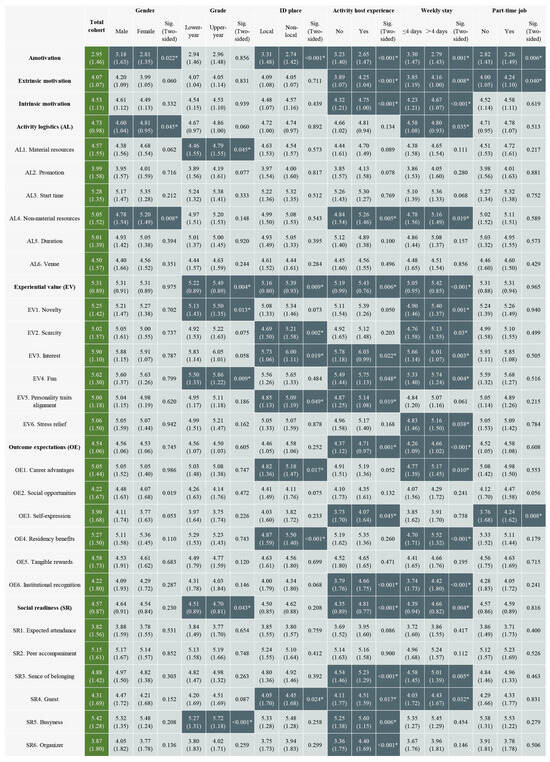
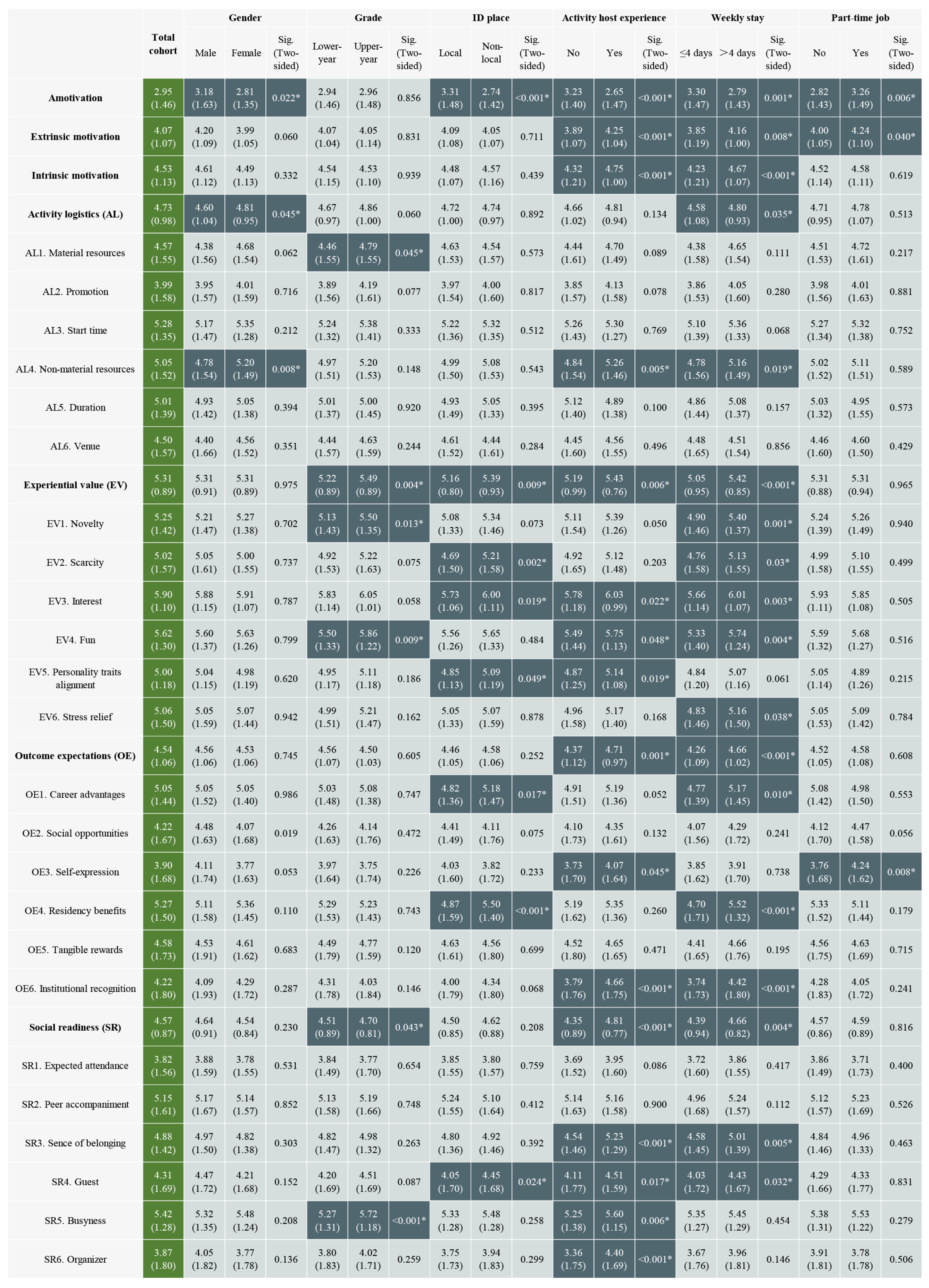
Figure 1 presents the mean scores and standard deviations of the three motivation types and the four influencing factors. To better illustrate how these factors shape students’ participation in RC activities, the mean scores for all 24 subitems are also shown. Between-group differences are displayed to highlight variations across gender, academic year, ID place, hosting experience, weekly stay duration, and part-time job status.
Figure 1.
Mean scores, standard deviations, and between-group comparisons for motivation types and influencing-factor subitems. Notes: The figure presents the Mean (SD) for each motivation type and influencing-factor item in the total cohort and within each demographic subgroup. Green cells represent the total cohort. Gray and dark blue-gray cells represent subgroup results; among these, variables with statistically significant between-group differences are highlighted in dark blue-gray. Independent-samples t-tests were conducted to evaluate mean differences between subgroups, with two-sided p < 0.05 (marked with *) considered statistically significant.
5.1.1. Total Cohort
Across the three motivation types (Figure 1), intrinsic motivation showed the highest score (M = 4.53, SD = 1.13), followed by extrinsic motivation (M = 4.07, SD = 1.07) and amotivation (M = 2.95, SD = 1.46). Among the four influencing-factor categories, experiential value scored highest overall (M = 5.31, SD = 0.89), followed by activity logistics (M = 4.73, SD = 0.98), social context (M = 4.57, SD = 0.87), and outcome expectations (M = 4.54, SD = 1.06). Within experiential value, all subitems exceeded a mean score of 5.00, particularly interest (M = 5.90, SD = 1.10), fun (M = 5.62, SD = 1.30), and novelty (M = 5.25, SD = 1.42). Within activity logistics, start time (M = 5.28, SD = 1.35), non-material resources (M = 5.05, SD = 1.52), and duration (M = 5.01, SD = 1.39) also exceeded 5.00. Within the social context, busyness (M = 5.42, SD = 1.28) and peer accompaniment (M = 5.15, SD = 1.61) were the strongest influences. Within outcome expectations, residency benefits (M = 5.27, SD = 1.50) and career advantages (M = 5.05, SD = 1.44) were highest. The lowest-rated subitems overall were organizer (M = 3.87, SD = 1.80), self-expression (M = 3.90, SD = 1.68), and promotion (M = 3.99, SD = 1.58).
5.1.2. Between-Group Comparisons
Across the six subgroup categories, several differences emerged (Figure 1). All subgroup differences fell within the small to moderate range of effect sizes (Cohen’s d range: 0.01–0.55). Compared to their counterparts, students with activity host experience reported higher extrinsic motivation (M = 4.25, SD = 1.04) and intrinsic motivation (M = 4.75, SD = 1.00) and lower amotivation (M = 2.65, SD = 1.47). A similar pattern appeared among students staying in the RC for more than four days per week, who showed higher extrinsic motivation (M = 4.16, SD = 1.00) and intrinsic motivation (M = 4.67, SD = 1.07) and lower amotivation (M = 2.79, SD = 1.43). Upper-year students reported both higher amotivation (M = 3.26, SD = 1.49) and extrinsic motivation (M = 4.24, SD = 1.10). Students with part-time jobs had relatively higher extrinsic motivation (M = 4.24, SD = 1.10) and amotivation (M = 3.26, SD = 1.49). Male students (M = 3.18, SD = 1.63) and local students (M = 3.31, SD = 1.48) also reported higher amotivation compared with their counterparts.
Differences in influencing factors also varied across subgroups:
- (1)
- Compared with male students, female students placed greater emphasis on activity logistics (M = 4.81, SD = 0.95), particularly non-material resources (M = 5.20, SD = 1.49).
- (2)
- Upper-year students scored higher than lower-year students in social context (M = 4.70, SD = 0.81), particularly on busyness (M = 5.72, SD = 1.18). They also showed higher experiential value (M = 5.49, SD = 0.89), with especially elevated scores in fun (M = 5.86, SD = 1.22) and novelty (M = 5.50, SD = 1.35). In addition, they placed greater importance on material resources (M = 4.79, SD = 1.55).
- (3)
- Non-local students reported higher experiential value (M = 5.39, SD = 0.93) than local students, particularly for interest (M = 6.00, SD = 1.11), scarcity (M = 5.21, SD = 1.58), and personality traits alignment (M = 5.09, SD = 1.19). They also placed greater value on activity guest (M = 4.45, SD = 1.68), career advantages (M = 5.18, SD = 1.47), and residency benefits (M = 5.50, SD = 1.40).
- (4)
- Students with activity host experience reported significantly higher scores in social context (M = 4.81, SD = 0.77), experiential value (M = 5.43, SD = 0.76), and outcome expectations (M = 4.71, SD = 0.97) compared with those without such experience. Within the social context, they assigned greater importance to busyness (M = 5.60, SD = 1.15), sense of belonging (M = 5.23, SD = 1.29), guest (M = 4.51, SD = 1.59), and organizer (M = 4.40, SD = 1.69). Within experiential value, they placed higher value on interest (M = 6.03, SD = 0.99), fun (M = 5.75, SD = 1.13), and personality traits alignment (M = 5.14, SD = 1.08). In regard to outcome expectations, they scored higher in opportunities for self-expression (M = 4.07, SD = 1.64) and stronger institutional recognition (M = 4.66, SD = 1.75). Activities offering richer non-material resources (M = 5.26, SD = 1.46) were also more appealing to these students.
- (5)
- Students who stayed in the RC for more than four days per week reported significantly higher scores across all influencing-factor categories than those with shorter stays: experiential value (M = 5.42, SD = 0.85), outcome expectations (M = 5.17, SD = 1.45), activity logistics (M = 4.80, SD = 0.93), and social context (M = 4.66, SD = 0.82). These students were more likely to consider interest (M = 6.01, SD = 1.07), fun (M = 5.74, SD = 1.24), residency benefits (M = 5.52, SD = 1.32), novelty (M = 5.40, SD = 1.37), career advantages (M = 5.17, SD = 1.45), stress relief (M = 5.16, SD = 1.50), scarcity (M = 5.13, SD = 1.55), non-material resources (M = 5.16, SD = 1.49), sense of belonging (M = 5.01, SD = 1.39), guest (M = 4.43, SD = 1.67), and institutional recognition (M = 4.42, SD = 1.80) when deciding whether to participate.
- (6)
- Aside from higher self-expression (M = 4.24, SD = 1.62) among students with part-time jobs, no other influencing factors differed significantly by part-time employment status.
5.2. Hierarchical Linear Regression Models
We conducted hierarchical linear regression analyses using the three types of motivation as dependent variables. The detailed results are presented in Table 4. For all models, the demographic predictors were entered in the first step, followed by the four influencing factors in the second step. The reference categories for the demographic variables were male, lower-year students, local students, no hosting experience, staying in the RC for four days or fewer per week, and no part-time job.
Table 4.
Hierarchical linear regression model for amotivation, extrinsic motivation, and intrinsic motivation.
For motivation, the complete model explained 20.6% of the variance (R2 = 0.206), representing a 10.8% increase over the demographic-only model (ΔR2 = 0.108; ΔF = 13.363, p < 0.001). Significant demographic factors included gender (β = −0.125, p < 0.01), ID place (β = −0.115, p < 0.05), and activity host experience (β = −0.081, p < 0.001), suggesting that females, non-local students, and those with hosting experience tend to exhibit lower levels of amotivation. Among influencing factors, social context is positively linked to amotivation (β = 0.215, p < 0.001), whereas experiential value showed a significant negative association (β = −0.358, p < 0.001).
Regarding extrinsic motivation, adding influencing factors significantly improved model fit. The full model explained 43.4% of the variance in extrinsic motivation (R2 = 0.434), representing a 35.6% increase over the demographics-only baseline (ΔR2 = 0.356; ΔF = 61.629, p < 0.001). Two sociodemographic characteristics remained significant: gender (β = –0.085, p < 0.05), suggesting lower extrinsic motivation in females than males, and part-time job status (β = 0.091, p < 0.05), indicating higher extrinsic motivation among students with part-time experience. Regarding influencing factors, social context (β = 0.141, p < 0.01), experiential value (β = 0.132, p < 0.01), and outcome expectations (β = 0.397, p < 0.001) all showed significant positive associations with extrinsic motivation.
A similar pattern was observed for intrinsic motivation. The full model accounted for 45.5% of the variance (R2 = 0.455), marking a 38.3% improvement beyond demographics alone (ΔR2 = 0.383; ΔF = 68.892, p < 0.001). Two demographic factors were significant: academic year (β = −0.081, p < 0.05), suggesting lower intrinsic motivation among upper-year students, and activity host experience (β = 0.086, p < 0.05), indicating that students who previously hosted activities showed greater intrinsic motivation. Among the influencing factors, activity logistics (β = 0.117, p < 0.05), experiential value (β = 0.357, p < 0.001), and outcome expectations (β = 0.248, p < 0.001) were all significant positive factors of intrinsic motivation.
6. Discussion
This study provides the first university-scale exploration of motivation for RC activity participation among Chinese undergraduates. Addressing RQ1, intrinsic motivation was the predominant motivational type in the total cohort. Furthermore, motivational patterns varied significantly across subgroups, with activity-hosting experience emerging as the key demographic factor associated with higher intrinsic and extrinsic motivation. For RQ2, experiential value and outcome expectations were positively associated with both intrinsic and extrinsic motivation, while experiential value was also negatively linked to amotivation. Activity logistics specifically enhanced intrinsic motivation. Social context showed a positive association with amotivation. Responding to RQ3, the findings point to strategic directions for boosting student motivation. Targeting RQ1 findings, RCs should first prioritize macro-level strategies by optimizing community identity and leveraging policy resources, and expanding opportunities for hosting activities to foster student competence and autonomy. Targeting RQ2 findings, RCs may prioritize experiential value as the core motivational factor, strategically balancing it with outcome expectations, activity logistics, and social context. Finally, RCs should tailor specific activity formats to address the distinct motivational profiles across various student subgroups.
6.1. High Intrinsic Motivation in RC Activity Participation
Unexpectedly, the results showed the mean score for intrinsic motivation surpassed extrinsic motivation and amotivation in the total cohort, indicating relatively high autonomous participation among RC students. This outcome contrasted with our initial expectation that RC participation in China would be externally driven, consistent with the only prior exploratory study suggesting most students aimed to meet campus requirements linked to residency bonuses (Cai & Qi, 2021). Our findings instead show stronger intrinsic motivation and weaker influence of school-mandated factors such as residency benefits or institutional recognition. This shift may relate to policy developments in the GBA. Since the publication of the Outline Development Plan for the Guangdong-Hong Kong-Macao Greater Bay Area (2019), regional higher education cooperation has expanded. GBA universities have introduced more attractive RC activities that fulfill the needs related to activity logistics, experiential value, outcome expectations, and social context, such as cross-regional study tours and festival activities (So et al., 2021). Additionally, well-structured extracurricular environments have been associated with higher perceived competence and intrinsic motivation (Eckes et al., 2018). While RC culture develops, students may gradually internalize its values and atmosphere. Future Chinese RCs may therefore need to integrate policy support with cultural development to create conditions that foster voluntary participation.
6.2. The Complex Interplay of Influencing Factors on Student Motivation for RC Activities
Experiential value emerged as a key factor associated with motivation. Hierarchical linear regression indicated that experiential value was associated with higher intrinsic and extrinsic motivation, and lower amotivation. The high-rating elements of experiential value, including interest, fun, novelty, and stress relief, share great similarities with students’ needs for autonomy, linked to greater intrinsic motivation (Deci & Ryan, 2013). A study investigating Hong Kong college students’ service learning also provided similar findings, in which higher expectancy and value beliefs were associated with more engagement and thus supported civic development (Lo et al., 2022). Beyond experiential value, outcome expectations were also positively related to both extrinsic motivation and intrinsic motivation. Students may initially participate for instrumental reasons, such as residency benefits or career advantages. Through repeated engagement, these external motives may gradually become internalized (Henderson-King & Smith, 2006).
An intriguing finding is the positive association between social context and amotivation. Social context was originally intended to capture the social conditions surrounding participation in RC activities. However, the results suggest that this construct may also reflect conditioning social conditions rather than purely supportive environments. This interpretation is consistent with the conceptual clarification presented earlier. Although social context reflects objective participation conditions, these conditions may also be interpreted as constraints. When students perceive high busyness or rigidly require peer accompaniment as a prerequisite for attendance, they are setting a high threshold for participation. Unlike intrinsically motivated students who may overlook logistical or social barriers due to genuine interest, students with high amotivation likely focus on these barriers (e.g., lack of time or friends) to justify their non-participation. Thus, for these students, social context may not represent an eagerness to connect, but rather a set of defensive conditions that, when unmet, reinforce their lack of intention to act. This finding aligns with another study that reported busy students may lack motivation to engage in extracurricular activities, even when the activities match their internal needs (Stanek et al., 2015).
Descriptive results also showed that activity logistics received the second-highest ratings among the four influencing factors, especially for start time and non-material resources. However, in the regression model, activity logistics showed a positive association only with intrinsic motivation. This pattern suggests that logistics factors may not be sufficient to activate students with low motivation to participate. Instead, they may facilitate students who already have an interest in converting their motivation into action (Eckes et al., 2018). Thus, to sustain the intrinsic motivation of students who already intend to participate, activity logistics should be improved in ways that align with their values. To attract new participants, RCs should consider strategies that enhance experiential value, social context, and outcome expectancy.
6.3. Demographic Motivational Profiles
Intrinsic motivation was higher among students with activity-hosting experience and among lower-year students. Regression results showed that hosting experience was associated with higher intrinsic motivation. Similar patterns were reported in Asian RC contexts. Activity planning was linked to stronger feelings of autonomy, relatedness, and competence among student organizers (Mukhopadhyay et al., 2022). The association between hosting experience and motivation may also reflect the exam-oriented educational context in East Asia, where students are accustomed to structured responsibilities and task-based engagement (Jiang, 2013). Lower-year students were also associated with higher intrinsic motivation. Previous studies suggest that curiosity and novelty-seeking play an important role in sustaining engagement in learning activities (Chapman et al., 2023).
Extrinsic motivation was higher among students with activity-hosting experience, female students, and students with part-time employment. The association between hosting experience and extrinsic motivation may reflect the recognition and responsibility involved in organizing activities (Mukhopadhyay et al., 2022). Gender differences in motivational orientation have also been reported in cross-cultural research. Male students often prioritise stimulation and personal gains, which aligns with findings that males tend to report stronger extrinsic motivational orientations (Lauderdale et al., 2015). Students with part-time employment were also associated with higher extrinsic motivation. External contingencies and competing role demands may increase attention to instrumental benefits of participation (Stone et al., 2010).
Amotivation was lower among students with activity-hosting experience and among non-local students. Hosting experience was associated with lower amotivation in the regression models. Similar patterns have been reported in studies of campus engagement, where participation roles are linked with stronger feelings of competence and belonging (Mukhopadhyay et al., 2022). Non-local students were also associated with lower amotivation. Comparable patterns were observed in Singapore and Hong Kong. Non-local students demonstrated stronger self-determined motivation in campus participation (Chue & Nie, 2016; Ganotice et al., 2022).
6.4. Practical Implications
Based on the findings, this section offers several targeted recommendations for RC activity design. Many examples draw on practices from the RC system at the university where this study was conducted.
6.4.1. Strengthening Overall Motivation Through Community Identity and Policy Alignment
Given that intrinsic motivation is the predominant form of motivation, RCs may prioritise conditions that encourage voluntary participation. One approach is to cultivate a clearer sense of RC identity. A coherent set of signature and recurring activities that reflect each RC’s character may help to enhance belonging and make participation more meaningful. Examples may include annual RC anniversary events, student-led mascot design projects, or thematic festivals aligned with the RC motto. Visibility can be further enhanced through videos, photos, or short promotional articles on platforms commonly used by students, which may strengthen their sense of community affiliation.
Policy resources can also expand the scope and quality of RC activities. For instance, the Ministry of Education’s extension of the Ten Thousand Student Interflow Programme provides funding for Macao and Hong Kong students and teachers to participate in exchange and academic programmes at mainland universities (Office of Academic Links, Chinese University of Hong Kong, 2025). RCs may utilize this scheme to organize cross-institutional or cross-provincial cultural exchange activities, joint academic visits, or collaborative learning projects. City-level partnerships, such as cultural immersion tours for non-local students, can further enrich the activity portfolio. These opportunities often offer diverse forms of value, which may make them attractive and educationally meaningful for RC students.
6.4.2. Enhancing Experiential Value While Supporting the Other Three Influencing Factors
Experiential value emerged as the key influential factor associated with motivation, suggesting that RCs should prioritise activity designs that resonate with students’ interests, curiosity, and personal relevance. To support this goal, RCs can periodically collect information on shifting preferences and values through short surveys and may invite students to contribute activity ideas. When outstanding suggestions are adopted, small forms of recognition may help reinforce positive engagement.
Lowering the social threshold for participation is equally important. Clear information about expected group size, interaction formats, and activity flow can reduce uncertainty for students who feel apprehensive about social settings. A peer-accompaniment arrangement, where students join activities with a familiar peer or volunteer support, may further ease the entry process.
Increasing the visibility and usefulness of expected outcomes may also promote participation. RCs could develop simple growth records aligned with the intended developmental goals of activities. When students complete an activity, they may receive corresponding growth points, which could be used as references for residency renewal or scholarship applications. However, while such incentives may encourage initial participation, sustained engagement depends on whether the activities themselves can spark internal motivation. This requires thoughtful and targeted activity design.
To sustain participation among students who already exhibit high intrinsic motivation, logistical refinement is essential. Flexible scheduling across different times of day or week can accommodate varied routines. Adequate preparation of both material and non-material resources, including activity-related skills support or guest coordination, can minimise friction and ensure smooth execution. RCs may also establish a simple feedback mechanism. Short post-activity surveys can guide timely adjustments to logistics and content. When students see that their suggestions are adopted, they may feel more respected and more willing to continue participating.
6.4.3. Expanding Opportunities for Hosting Activities to Strengthen Autonomy and Competence
Students with hosting experience display higher intrinsic motivation and lower amotivation. RCs should consider developing a structured pathway that gradually supports students in taking on organising roles. A tiered system can begin with entry-level positions such as activity assistants or section leaders who help with material preparation, participant guidance, and other basic tasks. These roles can make the first step of involvement more accessible. Students who wish to advance can then receive training that introduces them to activity design, resource coordination, and facilitation skills, which may enable them to plan small-scale activities with growing confidence.
Recognition mechanisms can further strengthen engagement. Providing exclusive opportunities, formal certificates that document organisational competence, or acknowledgement in student development records can help reinforce students’ sense of achievement and progression. Creating a platform for organisers to share experiences, exchange ideas, and highlight exemplary practices can also contribute to building a supportive organising community.
RCs may also wish to identify students with potential but limited prior involvement. Short surveys that capture students’ interest in activity planning or their perceived organisational strengths can help reveal individuals who may be well-suited for these roles. Inviting these students to join organising teams can broaden participation and reduce over-reliance on a small group of frequently involved organisers.
6.4.4. Tailoring Strategies for Diverse Student Groups
Motivational differences across student subgroups suggest the need for targeted strategies.
- (1)
- Year of study: Junior students often have more available time and intrinsic motivation, and may benefit from exploratory activities that support their transition into RC life. Activities such as RC discovery tours, cross-major icebreakers, or introductory skill workshops can help them build confidence and connection. Senior students, in contrast, are more motivated by novelty and deeper engagement. Immersive simulations such as workplace negotiation scenarios or community project run-throughs and interdisciplinary workshops that blend creativity and problem-solving may be especially appealing. Given seniors’ heavier academic workload, flexible formats are valuable. Short and engaging activities such as fifteen-minute micro-lectures or lightweight creative competitions can also accommodate fragmented schedules. Additionally, opportunities for seniors to mentor juniors may further strengthen both groups’ motivation and sense of community.
- (2)
- Length of weekly RC stay: Students who stay in the RC for more days score higher across all influencing factors. RCs may invite these students to participate in co-creation, as they are familiar with the environment and can contribute useful insights. Deep-engagement roles, such as governance volunteers or long-term activity advisers, may further strengthen their sense of belonging. Short-stay students often have limited time. They may benefit from compact, high-value activities. Early announcements and simple follow-up materials, such as summary packs or recordings, can help them engage even when they cannot attend the full event.
- (3)
- Local and non-local background: Non-local students value novelty and practical gains. Activities that highlight unique experiences or visible developmental outcomes may work well for them. Local students tend to rely on off-campus networks. RCs may offer activities that connect more closely with local culture or community resources. Examples include city-based alumni gatherings that foster networking or local culture exploration groups that allow students to discover neighbourhood traditions, histories, and community spaces. Engagement may also be strengthened by inviting local students to serve as cultural ambassadors who introduce local customs or share community insights. Such roles may help build their sense of identity within the RC and allow them to contribute expertise that is meaningful to their peers.
- (4)
- Gender: Female students show lower amotivation and extrinsic motivation, and existing research suggests they respond well to structured and predictable environments. Settings that provide clear instructions, defined goals, and a stable activity flow can help female students participate with greater confidence and comfort. However, a structured environment does not need to restrict the ideas that an activity conveys. Activities that invite reflection, conversation, and creative expression, such as thematic tea gatherings on current societal issues, shared reading of poetry, or exhibitions of student artwork, can offer opportunities for female students to think beyond familiar boundaries and engage with new perspectives.
- (5)
- Part-time employment status: Part-time students tend to have higher extrinsic motivation and value the chance for self-expression provided by the activity. Considering their work experience, RCs could therefore offer activities such as résumé enhancement workshops or industry sharing sessions, which allow students to link their participation to practical goals. Similar to upper-year students, the schedules of students with part-time employment are more constrained. Evening sessions or other time slots that match their availability may be more suitable. Providing recorded sessions or summary materials can also help them engage during fragmented time. Creating a platform for part-time student interaction, including experience-sharing meetings or career networking gatherings, may further strengthen their sense of connection and support both their motivational and social needs.
6.5. Limitations and Future Directions
This study has several limitations. First, this study is based on a single GBA university using convenience sampling, which may limit the generalizability of the findings. Self-selection bias may also be present, as more motivated students may have been more likely to participate. These factors should be considered when interpreting the results. Second, given the exploratory nature of the study, certain methodological limitations should be acknowledged. Although the current factor structure was supported by the EFA, some classifications may be conceptually preliminary. For example, the placement of busyness under social context was informed by the prior qualitative study and represented the statistically optimal solution. We offered some possible interpretation, but the relationships among these variables still require further empirical evidence. Also, multiple subgroup comparisons were conducted, which may increase the risk of Type I error. Accordingly, we reported effect sizes alongside p-values, and the results should be interpreted with appropriate caution. Third, academic discipline was not included in the models. Discipline was highly imbalanced across fields, which reduced the feasibility of incorporating it into the analyses. Lastly, the cross-sectional design limits causal interpretation.
Future studies should further validate the findings across different settings and, where feasible, adopt more systematic sampling strategies. To support such comparative research, the original questionnaire items and coding are provided in Supplementary Table S2. In addition, further research is needed to validate the conceptual structure of the influencing factors and to examine their relationships using more robust designs. Studies with more balanced samples are also required to clarify the potential role of academic discipline in student motivation for RC activities. Longitudinal research would further help to examine how these relationships develop over time and whether they remain stable across different stages of students’ RC experiences.
In addition, to further clarify the relationships among different types of motivation, we conducted additional analyses examining the correlations among intrinsic motivation, extrinsic motivation, and amotivation (Supplementary Table S6). The results show that intrinsic and extrinsic motivation are consistently positively correlated across the total sample and all subgroups, while their relationships with amotivation are more variable. As the primary aim of this study is to examine the relationships between different types of motivation and their influencing factors, these interrelationships are not explored in depth. Future research may further investigate how different forms of motivation coexist and interact across student groups.
7. Conclusions
This study examined undergraduate students’ motivation for participating in residential college activities in a Chinese university context. The findings show that intrinsic motivation is the predominant form of motivation and that experiential value plays a central role in supporting motivation, while other influencing factors demonstrate differentiated effects. Motivation also varies across student subgroups, highlighting the need for more targeted activity design. Overall, this study provides empirical evidence on residential college participation in China and offers practical insights for improving activity planning. Future studies using multi-site or longitudinal designs may further clarify how student motivation develops over time.
Supplementary Materials
The following supporting information can be downloaded at: https://www.mdpi.com/article/10.3390/educsci16040595/s1, Text S1: Methods and results of the qualitative study on factors influencing students’ motivation for RC activity participation; Text S2: Personal data collection statement and questionnaire instructions; Table S1: STROBE checklist for cross-sectional studies; Table S2: Variable definition and coding strategy; Table S3: Full results of exploratory factor analysis (EFA); Table S4: Rotated Component Matrix of the IF-Questionnaire; Table S5: Correlations among the four constructs of the IF-Questionnaire; Table S6: Correlations among the three types of motivation overall and among different subgroups.
Author Contributions
D.X.: Conceptualization, Methodology, Validation, Formal analysis, Investigation, Writing–original draft, Writing–review & editing. C.Y.L.: Conceptualization, Investigation, Writing–original draft, Writing–review & editing. Y.L.: Conceptualization, Investigation, Writing–review & editing. J.Y.: Conceptualization, Investigation, Writing–review & editing. L.C.: Writing–review & editing. C.Z.: Writing–review & editing. Y.B.: Conceptualization, Funding acquisition, Methodology, Supervision, Writing–review & editing. D.X. and C.Y.L. contributed equally to this work. All authors have read and agreed to the published version of the manuscript.
Funding
This study is funded by University of Macau (MYRG2019-00044-ICMS, QRCM-IRG2022-001, SKL-QRCM-IRG2023-032, CPRS Research Project_V1_CHN_20240321 CPRS-0001, and 2025 CPRS Research Project CPRS-0012). The funder played no role in the study design, data collection, data analysis, interpretation or writing of this study.
Institutional Review Board Statement
The study adhered to the principles of the Declaration of Helsinki (revised 2013) and received approval from the Ethics Committee of University of Macau (NO. SSHRE24-APP096-ICMS).
Informed Consent Statement
Prior to participation, each respondent reviewed an online Personal Data Collection Statement outlining ethical approval, the absence of personally identifiable data collection, exclusive use of responses for academic research, and secure storage of all data on a non-local survey platform. All participants provided informed consent. All personally identifiable information was anonymized, and confidentiality was strictly maintained.
Data Availability Statement
The datasets generated during the current study are available from the corresponding author on reasonable request.
Acknowledgments
We sincerely thank the residential college students who completed the questionnaire. Special thanks are extended to the resident staff of Lui Che Woo College for their valuable insights and constructive suggestions. We also gratefully acknowledge the University of Macau for funding this research.
Conflicts of Interest
The authors declare no conflicts of interest.
Abbreviations
The following abbreviations are used in this manuscript:
| AL | Activity logistics |
| AM | Amotivation |
| EFA | Exploratory factor analysis |
| EM | Extrinsic motivation |
| EV | Experiential value |
| GBA | Guangdong–Hong Kong–Macao Greater Bay Area |
| ID | Identification |
| IM | Intrinsic motivation |
| KMO | Kaiser–Meyer–Olkin |
| LMS | Leisure Motivation Scale |
| OE | Outcome expectations |
| RC | Residential college |
| SC | Social context |
| SD | Standard deviation |
| SDT | Self-determination theory |
| SE | Standard error |
| STEM | Science, technology, engineering, and mathematics |
| STROBE | Strengthening the Reporting of Observational Studies in Epidemiology |
| VIF | Variance inflation factor |
References
- Amani, D. (2022). The student psychological contract as a predictor of university brand evangelism in Tanzanian higher education: Insights from social exchange theory. International Journal of African Higher Education, 9(2), 150–171. [Google Scholar] [CrossRef] [Scilit]
- Barron, K. E., & Harackiewicz, J. M. (2001). Achievement goals and optimal motivation: Testing multiple goal models. Journal of Personality and Social Psychology, 80(5), 706. [Google Scholar] [CrossRef] [PubMed]
- Cai, J., & Qi, Y. (2021, July 16–18). A brief discussion on residential college activities and student participation motivation: A case study of Choi Kai Yau College. 7th Forum on Modern Residential College Education in Higher Education Institutions, Weihai, China. (In Chinese) [Google Scholar]
- Chapman, G., Emambocus, W., & Obembe, D. (2023). Higher education student motivations for extracurricular activities: Evidence from UK universities. Journal of Education and Work, 36(2), 138–152. [Google Scholar] [CrossRef] [Scilit]
- Chen, S.-Y., Kuo, H.-Y., & Hsieh, T. (2019). New literacy practice in a facebook group: The case of a residential learning community. Computers & Education, 134, 119–131. [Google Scholar] [CrossRef] [Scilit]
- Cheng, C. K. (2020). Innovations and reflections on the residential college system and their implications for higher education in China: A case study of the University of Macau. Revista de Administração Pública de Macau, 33(4), 1–15. (In Chinese) [Google Scholar]
- Cheng, M. W., & Chan, C. K. (2020). Do university residential experiences contribute to holistic education? Journal of Higher Education Policy and Management, 42(1), 31–48. [Google Scholar] [CrossRef] [Scilit]
- Chisholm, C., Harris, M., Northwood, D., & Johrendt, J. (2009). The characterisation of work-based learning by consideration of the theories of experiential learning. European Journal of Education, 44(3), 319–337. [Google Scholar] [CrossRef] [Scilit]
- Chue, K. L., & Nie, Y. (2016). International students’ motivation and learning approach: A comparison with local students. Journal of International Students, 6(3), 678–699. [Google Scholar] [CrossRef] [Scilit]
- Darby, A., & Willingham, L. (2022). Faculty motivation in service-learning based on expectancy x value theory. Journal of Experiential Education, 45(3), 337–353. [Google Scholar] [CrossRef] [Scilit]
- Deci, E. L., & Ryan, R. M. (2013). Intrinsic motivation and self-determination in human behavior. Springer Science & Business Media. [Google Scholar]
- Ditta, A. S., Strickland-Hughes, C. M., Cheung, C., & Wu, R. (2020). Exposure to information increases motivation to learn more. Learning and Motivation, 72, 101668. [Google Scholar] [CrossRef] [Scilit]
- Eccles, J. S., & Wigfield, A. (2002). Motivational beliefs, values, and goals. Annual Review of Psychology, 53(1), 109–132. [Google Scholar] [CrossRef] [Scilit]
- Eckes, A., Großmann, N., & Wilde, M. (2018). Studies on the effects of structure in the context of autonomy-supportive or controlling teacher behavior on students’ intrinsic motivation. Learning and Individual Differences, 62, 69–78. [Google Scholar] [CrossRef] [Scilit]
- Elliot, A. J., & McGregor, H. A. (2001). A 2 × 2 achievement goal framework. Journal of Personality and Social Psychology, 80(3), 501. [Google Scholar] [CrossRef]
- Ganotice, F. A., Jr., Downing, K., Chan, B., & Yip, L. W. (2022). Motivation, goals for study abroad and adaptation of Mainland Chinese students in Hong Kong. Educational Studies, 48(2), 149–164. [Google Scholar] [CrossRef] [Scilit]
- General Office of the State Council. (2017). Opinions on deepening the reform of the education system and mechanisms. Ministry of Education of the People’s Republic of China. Available online: http://www.moe.gov.cn/jyb_xwfb/s6052/moe_838/201709/t20170925_315201.html (accessed on 11 December 2025). (In Chinese)
- Guo, G. Q., & Liem, G. A. D. (2025). The impact of co-curricular activities on youth development: A self-determination theory perspective. Trends in Psychology, 33(1), 1–26. [Google Scholar] [CrossRef] [Scilit]
- Henderson-King, D., & Smith, M. N. (2006). Meanings of education for university students: Academic motivation and personal values as predictors. Social Psychology of Education, 9(2), 195–221. [Google Scholar] [CrossRef] [Scilit]
- Homans, G. C. (1974). Social behavior: Its elementary forms (Revised ed.). Harcourt Brace Jovanovich. [Google Scholar]
- Howard, J. L., Bureau, J., Guay, F., Chong, J. X., & Ryan, R. M. (2021). Student motivation and associated outcomes: A meta-analysis from self-determination theory. Perspectives on Psychological Science, 16(6), 1300–1323. [Google Scholar] [CrossRef] [Scilit]
- Hu, T., Zhang, M.-L., Liu, H., Liu, J.-C., Pan, S.-J., Guo, J.-H., Tian, Z.-E., & Cui, L. (2022). The influence of “small private online course+ flipped classroom” teaching on physical education students’ learning motivation from the perspective of self-determination theory. Frontiers in Psychology, 13, 938426. [Google Scholar] [CrossRef] [Scilit]
- Jiang, J. (2013). Critical thinking in general education in China. International Journal of Chinese Education, 2(1), 108–134. [Google Scholar] [CrossRef] [Scilit]
- Kolb, D. A. (2014). Experiential learning: Experience as the source of learning and development. FT Press. [Google Scholar]
- Kondric, M., Sindik, J., Furjan-Mandic, G., & Schiefler, B. (2013). Participation motivation and student’s physical activity among sport students in three countries. Journal of Sports Science & Medicine, 12(1), 10. [Google Scholar]
- Lam, C. Y., Xue, D.-M., & Ye, J. (2024). Influencing Factors and modeling of experiential teaching participation in cross-cultural communities under “one country, two systems”—The University of Macau college as an example). In Thesis series of the Macao university students’ academic essay competition in celebration of the 25th anniversary of Macao’s reunification with the motherland (Vol. 3, pp. 249–263). The Commercial Press. Available online: https://www.researchgate.net/publication/389426597_Influencing_Factors_and_Modeling_of_Experiential_Teaching_Participation_in_Cross-Cultural_Communities_under_One_Country_Two_Systems_-_The_University_of_Macau_College_as_an_Example (accessed on 11 December 2025). (In Chinese)
- Lauderdale, M. E., Yli-Piipari, S., Irwin, C. C., & Layne, T. E. (2015). Gender differences regarding motivation for physical activity among college students: A self-determination approach. The Physical Educator, 72(5), 153–172. [Google Scholar] [CrossRef] [Scilit]
- Lo, K. W., Ngai, G., Chan, S. C., & Kwan, K.-P. (2022). How students’ motivation and learning experience affect their service-learning outcomes: A structural equation modeling analysis. Frontiers in Psychology, 13, 825902. [Google Scholar] [CrossRef] [Scilit]
- Mukhopadhyay, K., Chang-Koh, S., & Har, J. R. G. (2022). Preparing next-generation-citizens through active-community-engagement: Longitudinal study of informal learning in an Asian undergraduate residential college. The Asia-Pacific Education Researcher, 31(5), 575–587. [Google Scholar] [CrossRef] [Scilit]
- Office of Academic Links, Chinese University of Hong Kong. (2025). Ministry of education ten thousand student interflow programme (MoE10000). Available online: https://www.oalmr.cuhk.edu.hk/en/oalmr-student-interflow/ministry-of-education-ten-thousand-student-interflow-programme-moe10000/ (accessed on 11 December 2025).
- Outline development plan for the Guangdong-Hong Kong-Macao Greater Bay Area. (2019). Available online: https://www.dsaj.gov.mo/greaterbayarea/Doc/devPlan_en.pdf (accessed on 11 December 2025).
- Pelletier, L., Vallerand, R., Brière, N., & Blais, M. (1989, October 28). Construction et validation de l’Échelle de motivation vis-à-vis les Loisirs (EML). Communication Présentée au Congrès Annuel de la SQRP (p. 146), Ottawa, ON, Canada. [Google Scholar]
- So, B. K.-L., Song, Y., & Huang, Z. (2021). Living & learning–Snapshots of residential college life at the University of Macau (2010–2017). University of Macau. [Google Scholar]
- Stanek, J., Rogers, K., & Anderson, J. (2015). Physical activity participation and constraints among athletic training students. Journal of Athletic Training, 50(2), 163–169. [Google Scholar] [CrossRef] [Scilit] [PubMed]
- Stone, D. N., Bryant, S. M., & Wier, B. (2010). Why are financial incentive effects unreliable? An extension of self-determination theory. Behavioral Research in Accounting, 22(2), 105–132. [Google Scholar] [CrossRef] [Scilit]
- Sun, C., Liang, J., Du, R., & Ma, J. (2022). Quality of effort in college activities and learning gains: A case study in China. Frontiers in Psychology, 13, 971639. [Google Scholar] [CrossRef] [Scilit] [PubMed]
- Yang, G., Tian, Z., Yao, G., Wei, L., Wu, X., Wang, K., Pei, X., Zhang, X., Luo, Q., Zhai, G., & Cui, L. (2020). Research report on the implementation of the residential college system in higher education institutions. Chinese Association for Suzhi Education Journal, 3, 4–36. (In Chinese) [Google Scholar]
- Zhao, Q., & Liang, Z. (2024). Learning motivation of college students in multimedia environment with machine learning models. Learning and Motivation, 88, 102046. [Google Scholar] [CrossRef] [Scilit]

Disclaimer/Publisher’s Note: The statements, opinions and data contained in all publications are solely those of the individual author(s) and contributor(s) and not of MDPI and/or the editor(s). MDPI and/or the editor(s) disclaim responsibility for any injury to people or property resulting from any ideas, methods, instructions or products referred to in the content. |
© 2026 by the authors. Licensee MDPI, Basel, Switzerland. This article is an open access article distributed under the terms and conditions of the Creative Commons Attribution (CC BY) license.