Multimodal Technology-Integrated Approaches for Teaching Early Childhood and Early Primary Science: A Scoping Review


Abstract
1. Introduction
1.1. Biological Science and Multimodality in Early Childhood and Early Primary Education
1.2. Trends in Policy and Curriculum for Technology Integration
- Observatory of technological transformations in education.
- Technical assistance and capacity development.
- Formulation and implementation of standard-setting instruments.
1.3. Multimodality and Its Application to This Study
2. Methodology
Identification of Relevant Studies
- Identifying the research questions. Firstly, what are the current perceptions and practices around applying multimodal tools to teach various aspects of science, including biological science in early childhood and early primary education? Secondly, what are the challenges and concerns regarding the integration of gamified and interactive science resources in early childhood and early primary education settings? To assist in answering these, two subsidiary questions were formulated:
- How does the effectiveness of multimodal tools in enhancing student engagement and understanding of scientific concepts compare to other STEM-related topics?
- How is the impact of gamified and interactive science resources on students’ learning outcomes and motivation in early childhood and early primary settings being assessed?
- Identifying relevant studies. Eligibility criteria for articles were:
- Published in the last 7 years;
- Published in English;
- Peer reviewed;
- With children aged 3 to 8 years;
- Available in full text.
- 3.
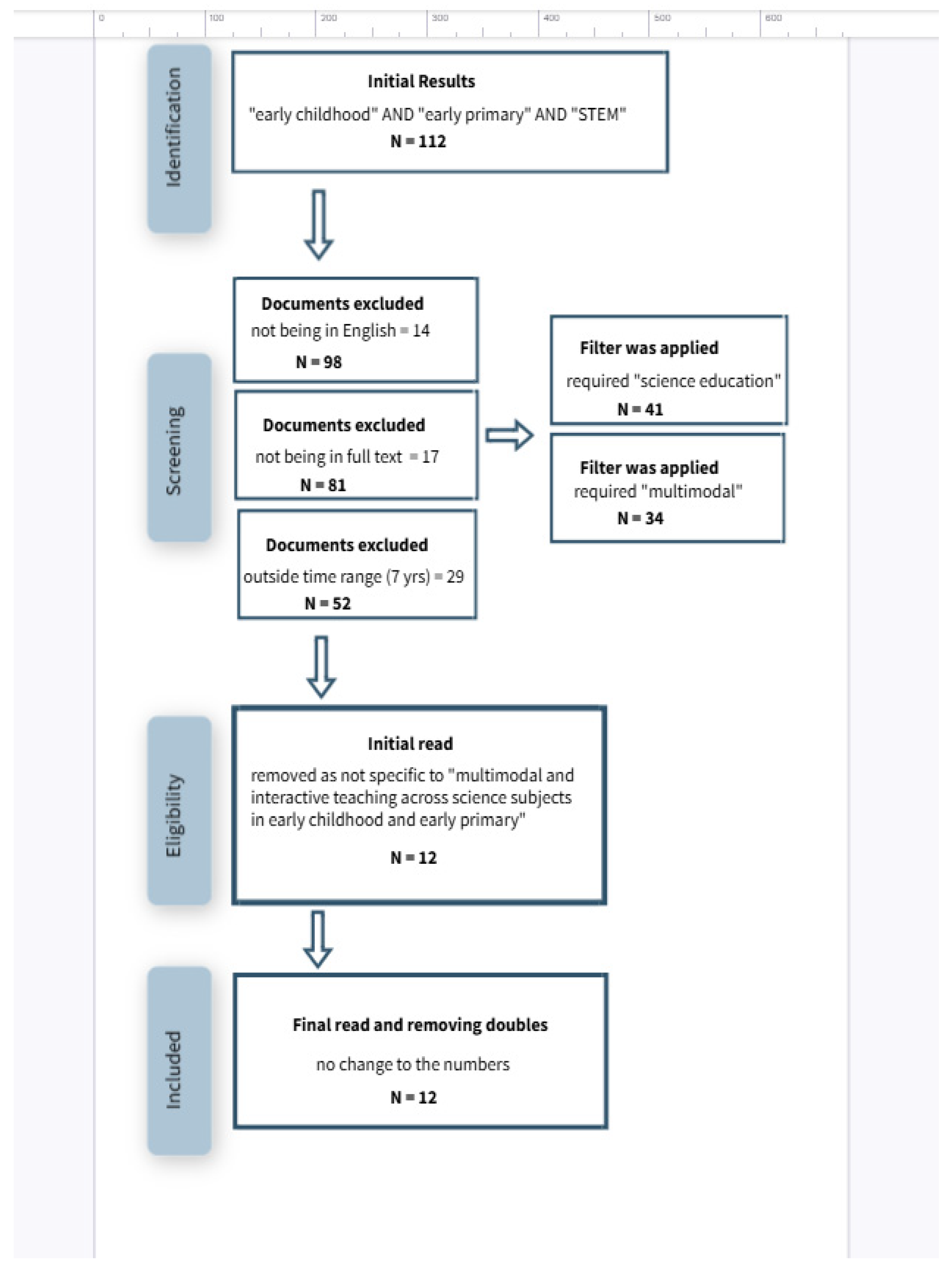
- Study selection. From the initial database search, 112 papers were identified. When the English criteria were applied, the number was reduced to 98 and the full text criteria reduced the number to 81. When the last seven years criteria were applied, the number was reduced to 52. To be more specific to the research questions, the search term “science education” and the term “multimodal” were then added to the filtering process. This resulted in a further 18 studies being removed as they did not include these terms. This reduced the number to 34. After the researchers’ initial reading of the 34 abstracts of these papers, a further 22 were removed as they were not specifically connected to the multimodal and interactive teaching of science subjects in early childhood and early primary settings. Full details of the final 12 articles are included in Table 1.
- 4.
- Charting the data. The data were charted by authors according to year of publication, title, author/s, location of the study and sample size, research aims/questions, theoretical perspective, methodology/data analysis plan, and findings/implications. The 12 publications were divided among the researchers, with each paper to be read in full by at least two authors to ensure that personal bias and opinions were eliminated.
3. Results
3.1. Nature and Extent of Papers
3.2. Main Themes of Findings from Reviewed Papers
- Digital and multimodal tools for early STEM learning;
- The role of educators and parents in facilitating STEM learning;
- The equity, inclusion, and systemic integration of science education.
3.3. Digital and Multimodal Tools for Early STEM Learning
3.4. Role of Educators and Parents in Facilitating STEM Learning
3.5. Equity, Inclusion, and Systemic Integration of Science Education
4. Discussions
5. Limitations and Conclusions
Author Contributions
Funding
Institutional Review Board Statement
Informed Consent Statement
Data Availability Statement
Conflicts of Interest
References
- Alotaibi, M. (2024). The effectiveness of game-based learning in early childhood education: A systematic review and meta-analysis. Journal of Educational Technology & Society, 27(2), 85–105. [Google Scholar]
- Arksey, H., & O’Malley, L. (2005). Scoping studies: Towards a methodological framework. International Journal of Social Research Methodology: Theory and Practice, 8(1), 19–32. [Google Scholar] [CrossRef]
- Australian Children’s Education & Care Quality Authority [ACECQA]. (2023). Belonging, being and becoming: The early years learning framework for Australia (EYLF) V2.0. Available online: https://www.acecqa.gov.au/ (accessed on 20 December 2025).
- Australian Curriculum, Assessment and Reporting Authority [ACARA]. (2025). Key ideas. Australian curriculum. Available online: https://www.acara.edu.au/curriculum (accessed on 20 December 2025).
- Aydin, H., Ozfidan, B., & Carothers, D. (2017). Meeting the challenges of curriculum and instruction in school settings in the United States. Journal of Social Studies Education Research, 8(3), 76–92. [Google Scholar]
- Bowen, G. M., Knoll, E., & Willison, A. M. (2022). Bee-bot robots and their STEM learning potential in the play-based behaviour of preschool children in Canada. In S. D. Tunnicliffe, & T. J. Kennedy (Eds.), Play and STEM education in the early years. Springer. [Google Scholar] [CrossRef]
- Brandt, S. (2004). Multimodal discourse: The modes and media of contemporary communication. Language in Society, 33(1), 115–118. [Google Scholar] [CrossRef]
- Di Fuccio, R., Ponticorvo, M., Nadim, M. A., & Limone, P. (2025). Exploring the effect of digital and multisensory educational materials on retention in primary school using tangible user interfaces. Interactive Learning Environments, 33(4), 2928–2938. [Google Scholar] [CrossRef]
- Fragkiadaki, G., Fleer, M., & Rai, P. (2023). Science concept formation during infancy, toddlerhood, and early childhood: Developing a scientific motive over time. Research in Science Education, 53(1), 275–294. [Google Scholar] [CrossRef]
- Gao, F., Li, L., & Sun, Y. (2020). A systematic review of mobile game-based learning in STEM education. Educational Technology Research and Development, 68(4), 1791–1827. [Google Scholar] [CrossRef]
- Gonçalves, D. A., Caceffo, R., Valente, J. A., Bonacin, R., dos Reis, J. C., & Baranauskas, M. C. C. (2024). Enactive interaction in technology-based learning environments: A systematic literature review. Educational Technology & Society, 27(2), 87–113. [Google Scholar] [CrossRef]
- Gözüm, A. İ. C. (2022). Digital games for STEM in early childhood education: Active co-playing parental mediation and educational content examination. In S. Papadakis, & M. Kalogiannakis (Eds.), STEM, robotics, mobile apps in early childhood and primary education (pp. 489–523). Springer. [Google Scholar] [CrossRef]
- Guarrella, C., van Driel, J., & Cohrssen, C. (2022). Science education in early childhood education—Are we approaching a cure for the state of chronic illness? Research in Science Education, 52(1), 37–45. [Google Scholar] [CrossRef]
- Kähler, J., Hahn, I., & Köller, O. (2020). The development of early scientific literacy gaps in kindergarten children. International Journal of Science Education, 42(12), 1988–2007. [Google Scholar] [CrossRef]
- Kewalramani, S., Aranda, G., Sun, J., Richards, G., Hobbs, L., Xu, L., Millar, V., Dealy, B., & Van Leuven, B. (2024). A systematic review of the role of multimodal resources for inclusive STEM engagement in early childhood education. Education Sciences, 14(6), 604. [Google Scholar] [CrossRef]
- Kos, M., Tunnicliffe, S. D., Praprotnik, L., & Torkar, G. (2024). Learning biology in the early years through nature play in the forest: An exploratory study from Slovenia. In K. Korfiatis, M. Grace, & M. Hammann (Eds.), Shaping the future of biological education research: Selected papers from the ERIDOB 2022 conference (pp. 245–260). Springer. [Google Scholar] [CrossRef]
- Kress, G. (2009). Multimodality: A social semiotic approach to contemporary communication. Routledge. [Google Scholar]
- Lee, J., Kim, H., & Kim, J. (2024). Incorporating humanoid AI robots into early childhood education: A framework for enhancing learning experiences. Journal of Educational Technology & Society, 27(1), 45–60. [Google Scholar]
- MacDonald, A., Huser, C., Sikder, S., & Danaia, L. (2020). Effective early childhood STEM education: Findings from the little scientists evaluation. Early Childhood Education Journal, 48(3), 353–363. [Google Scholar] [CrossRef]
- McCormick, K. I., Uliassi, C., Barber, K., & Wieczorek, K. (2023). Creating multimodal experiences to engage all students in early elementary classrooms. YC Young Children, 78(3), 24–32. [Google Scholar]
- Nikolopoulou, K. (2022). Digital technology in early STEM education: Exploring its supportive role. In S. Papadakis, & M. Kalogiannakis (Eds.), STEM, robotics, mobile apps in early childhood and primary education (pp. 103–115). Springer. [Google Scholar]
- Nixon, R. S., Smith, L. K., & Wimmer, J. J. (2015). Teaching multiple modes of representation in middle-school science classrooms: Impact on student learning and multimodal use. School Science and Mathematics, 115(4), 186–199. [Google Scholar] [CrossRef]
- Oaten, J. (2024). Combating the attention span crisis in our children. Santa Maria College. Available online: https://santamaria.wa.edu.au/decreasing-attention-spans-jennifer-oaten/ (accessed on 20 December 2025).
- OECD. (2025a). How’s life for children in the digital age? OECD Publishing. [Google Scholar] [CrossRef]
- OECD. (2025b). Trends shaping education 2025. Available online: https://www.oecd.org/en/publications/trends-shaping-education-2025_ee6587fd-en.html (accessed on 20 December 2025).
- Oxley, A. (2014). Evaluating game-based learning effectiveness in higher education. Procedia—Social and Behavioral Sciences, 123, 20–27. [Google Scholar] [CrossRef]
- Papadakis, S., & Kalogiannakis, M. (2022). STEM, robotics, mobile apps in early childhood and primary education. Springer. [Google Scholar]
- Roberts, P., Boylan, F., Collins, P. R., & Barblett, L. (2025). Co-designing health-related digital tools with children: A scoping review of current practice. Education Sciences, 15(6), 671. [Google Scholar] [CrossRef]
- Silva, P. C., Rodrigues, A. V., & Vicente, P. N. (2024). An evaluation of the experimental science teaching program for primary education from the teachers’ perspective: An educational design research journey. Education Sciences, 14(7), 782. [Google Scholar] [CrossRef]
- Volpe, G., & Gori, M. (2019). Multisensory interactive technologies for primary education: From science to technology. Frontiers in Psychology, 10, 1076. [Google Scholar] [CrossRef] [PubMed]



| Study | Title | Location of the Study/Samples | Research Questions/Aims | Methodology/Data Analysis Plan | Key Findings and Implications |
|---|---|---|---|---|---|
| Kewalramani et al. (2024) | A Systematic Review of the Role of Multimodal Resources for Inclusive STEM Engagement in Early Childhood Education | Mainly Australia; 29 websites + 13 frameworks (children from birth to 8 years) | Examine the role of multimodal learning resources in promoting inclusive STEM engagement for young children (birth–8 years). | Narrative document analysis using a social semiotic multimodal framework, qualitative (document analysis; narrative approach) | Most STEM resources are text-heavy, rarely interactive, and inclusivity is largely missed |
| Silva et al. (2024) | An Evaluation of the Experimental Science Teaching Programme for Primary Education from the Teachers’ Perspective: An Educational Design Research Journey | Portugal; 10 primary school teachers (children aged 6–10 targeted) | How to systematically promote experimental science teaching in primary education with IBSE and STS orientation, and how to develop coherent assessment tools for children’s learning | Educational design research with final data via questionnaire survey, quantitative (survey analysis) | Teachers found resources effective and provided continuous feedback as wider adoption and teacher training needed |
| Bowen et al. (2022) | Chapter 9: Bee-Bot Robots and Their STEM Learning Potential in the Play-Based Behaviour of Preschool Children in Canada | Canada; preschool children (ages 3–5) via informal observations and curriculum review | Explore how Bee-Bot robots can support STEM learning through play-based activities in early childhood education and prepare children for formal schooling | Review of frameworks, word count analysis, informal observations, conceptual analysis; qualitative (document review + informal observation; conceptual analysis) | Bee-Bots support early STEM skills via guided play and educator support; professional development and policy backing needed |
| Kos et al. (2024) | Chapter 18: Learning Biology in the Early Years Through Nature Play in the Forest: An Exploratory Study from Slovenia | Slovenia; preschool near semi-natural forest; 21 children aged 4–6 | How often do “bio play” episodes occur in nature play? Which organisms do children engage with? What types of bio play emerge? | Exploratory case study; unstructured forest play; video coding; qualitative (case study; thematic coding) | Nature play sparked curiosity, empathy and observation; teacher involvement deepened learning |
| Gözüm (2022) | Chapter 21: Digital Games for STEM in Early Childhood Education: Active Co-playing Parental Mediation and Educational Content Examination | Turkey; 12 children aged 60–72 months and their parents | Do digital games played by children contain quality STEM educational content? How do parents apply the “active co-playing mediation” strategy when playing digital games with STEM content with their children? | Qualitative (interviews + document analysis) | Many games supported STEM skills and active co-playing helped support safety; the need for better designed apps and parent guidance was clear via this study |
| Nikolopoulou (2022) | Chapter 6: Digital Technology in Early STEM Education: Exploring Its Supportive Role | Early childhood education (ECE) settings globally, no single country-specific sample; examines the supportive role of ICT (educational digital technology) in early STEM education | To explore how digital technology tools (ICT) complement and enhance STEM learning in early childhood; investigates integration of ICT in STEM activities and its impact on skills development | Literature-based conceptual analysis, qualitative (conceptual analysis) | Digital tools can complement early STEM education by enhancing problem-solving skills and creativity; however, teacher guidance and focus on the age-appropriate design is crucial |
| Alotaibi (2024) | Game-based learning in early childhood education: a systematic review and meta-analysis | Global scope; studies from North America, Europe, Asia, Africa, Latin America, and the Middle East; focuses on effectiveness of game-based learning (digital and non-digital) for children aged 3–8 years | To synthesise evidence on the impact of game-based learning on five key outcomes: cognitive development, social development, emotional development, motivation, and engagement | Systematic review and meta-analysis; effect sizes, random-effects model; quantitative (meta-analysis; experimental/quasi-experimental focus) | Game-based learning improved cognitive, social, emotional, motivation, and engagement outcomes; challenges include quality control, skill transfer, and screen-time balance |
| Lee et al. (2024) | Incorporating Humanoid Artificial Intelligence (AI) Robots into Early Childhood Education | Global perspective (USA and South Korea); focuses on practical integration of humanoid AI robots in early childhood classrooms; addresses AI literacy and developmentally appropriate activities for young learners | To propose a framework for introducing humanoid AI (H-AI) in early childhood education; goals included introducing AI concepts, building child-AI relationships, designing interactive activities, and tackling challenges | Conceptual and practice-oriented paper; qualitative (conceptual/practice analysis) | Robots can support interactive learning and AI literacy, but some challenges, including cost, teacher training, and ethical concerns remain noticeable |
| Volpe and Gori (2019) | Multisensory Interactive Technologies for Primary Education: From Science to Technology | Italy; focus on primary education, especially math learning, using multisensory interactive technologies | To explore how multisensory technologies (visual, auditory, tactile, kinesthetics can enhance learning; proposes guidelines for integrating these technologies into embodied and enactive pedagogical approaches | Conceptual analysis grounded in neuroscience and design experiences; qualitative (conceptual analysis) | Multisensory approaches can enhance engagement and inclusion when grounded in pedagogy; implementation requires teacher involvement and rigorous evaluation |
| Fragkiadaki et al. (2023) | Science Concept Formation During Infancy, Toddlerhood, and Early Childhood: Developing a Scientific Motive Over Time | Conducted in early childhood education settings in Australia; focus on how science concepts and a scientific motive develop from infancy through toddlerhood to early childhood. | To explore how children form science concepts and develop a scientific motive over the first five years; investigates how teachers create conditions for sustained orientation toward science learning | Longitudinal design with video observations and thematic coding; qualitative (longitudinal observational; dialectical–interactive method) | Scientific motives and concepts develop over time when teachers sustain inquiry and narrative-rich play; highlights the social nature of learning |
| Guarrella et al. (2022) | Science Education in Early Childhood Education—Are We Approaching a Cure for the State of Chronic Illness? | Focused on Australian early childhood education policy and practice; revisits the previous diagnosis of science education as suffering from “chronic illness” due to low priority compared to literacy and numeracy | To analyse the current state of science education in early childhood settings; examines policy developments, interventions, and prospects for systematic integration of science learning | Policy analysis and review of frameworks; qualitative (policy analysis + literature review) | Science remains underprioritised, and teachers’ confidence and systemic curriculum integration are critical for sustained improvement |
| Kähler et al. (2020) | The development of early scientific literacy gaps in kindergarten children | Conducted in Germany using longitudinal data from the National Educational Panel Study (NEPS); focuses on development of scientific literacy (SL) from kindergarten to Grade 3 and factors influencing disparities | To examine how scientific literacy (SL) develops over time and whether early gaps persist; identify structural and process features of home and kindergarten that affect initial SL and its growth | Longitudinal design; latent growth curve models, large sample; quantitative (longitudinal statistical modelling) | Early disparities linked to language and socio-economic factors persisted over time; early, targeted supports are needed to reduce inequities |
| The Digital and Multimodal Tools for Early STEM Learning | The Role of Educators and Parents in Facilitating STEM Learning | The Equity, Inclusion, and Systemic Integration of Science Education |
|---|---|---|
| Play-based and game approaches (n = 4) | Direct classroom practices (n = 4) | Resource-level inclusion (n = 3) |
| Emerging technology and multimodal innovations (n = 3) | Broader capacity-building and systemic efforts (n = 3) | Policy-level and systemic equity efforts (n = 2) |
Disclaimer/Publisher’s Note: The statements, opinions and data contained in all publications are solely those of the individual author(s) and contributor(s) and not of MDPI and/or the editor(s). MDPI and/or the editor(s) disclaim responsibility for any injury to people or property resulting from any ideas, methods, instructions or products referred to in the content. |
© 2026 by the authors. Licensee MDPI, Basel, Switzerland. This article is an open access article distributed under the terms and conditions of the Creative Commons Attribution (CC BY) license.
Share and Cite
Salehi Gahrizsangi, H.; Kewalramani, S.; Richards, G. Multimodal Technology-Integrated Approaches for Teaching Early Childhood and Early Primary Science: A Scoping Review. Educ. Sci. 2026, 16, 586. https://doi.org/10.3390/educsci16040586
Salehi Gahrizsangi H, Kewalramani S, Richards G. Multimodal Technology-Integrated Approaches for Teaching Early Childhood and Early Primary Science: A Scoping Review. Education Sciences. 2026; 16(4):586. https://doi.org/10.3390/educsci16040586
Chicago/Turabian StyleSalehi Gahrizsangi, Hadis, Sarika Kewalramani, and Gerarda Richards. 2026. "Multimodal Technology-Integrated Approaches for Teaching Early Childhood and Early Primary Science: A Scoping Review" Education Sciences 16, no. 4: 586. https://doi.org/10.3390/educsci16040586
APA StyleSalehi Gahrizsangi, H., Kewalramani, S., & Richards, G. (2026). Multimodal Technology-Integrated Approaches for Teaching Early Childhood and Early Primary Science: A Scoping Review. Education Sciences, 16(4), 586. https://doi.org/10.3390/educsci16040586