


Abstract
This pilot study investigates the feasibility and preliminary outcomes of an experimental intervention based on practice variability and teaching styles’ variation, gathering preliminary data on changes in physical fitness and self-perception in primary school children. The sample consists of 142 children (boys = 76, age = 8.97 ± 0.82; girls = 66, age = 9.03 ± 0.77) recruited from one school participating in the SBAM! Project. Physical fitness components were assessed before (t0) and after (t1) a 4-month intervention protocol using the following physical fitness measures: BMI cutoff, standing long jump, 4 × 10 m shuttle run, medicine ball throw (1 kg), and 20 m slalom. Self-perception was assessed with a validated questionnaire. The pre-experimental didactic intervention involved motor tasks based on practice variability to promote inclusion, following the principles of non-linear pedagogy. Pre-and post-intervention changes were analyzed using multivariate analysis accounting for gender and BMI cutoff. The results showed statistically significant differences (p < 0.05) for all included variables, regardless of group. Preliminary findings suggest that this intervention is feasible in fostering positive changes and improvements in physical fitness and self-perception. Further investigations are needed to extend the generalizability of the results through more robust research designs.
1. Introduction
Physical Education (PE) represents a strategic educational domain for promoting children’s global development, encompassing not only the physical domain, but also the cognitive, social, and affective ones (Dudley et al., 2022). Structured motor activities, when methodologically grounded and age-specific, assume an educational role that transcends the field of the discipline itself. The interdisciplinary and participatory nature of motor activities is evident in the broader physical education school context (Durden-Myers et al., 2018a). According to the concept of Physical Literacy (PL), the meanings of PE are not limited to the acquisition of motor competence, but they also foster the establishment of knowledge, skills, and attitudes that enable conscientious, autonomous and lifelong adherence to physical activity (Durden-Myers et al., 2018b; García-Hermoso et al., 2025). The concept of PL is configured as a multidimensional construct, integrating skills (the ability to perform a specific motor task), knowledge (i.e., the cognitive dimension and understanding of specific concepts), and attitudes (i.e., motivation to perform a task) (Colella, 2019; Whitehead, 2001; Edwards et al., 2017). Within this framework, the development of PL has been demonstrated to generate health-oriented pathways and improve students’ well-being (Stodden et al., 2008; Robinson et al., 2015).
Consequently, the relationship between PE and PL requires a profound paradigm shift. While traditional PE has historically leaned toward a “sport-technique” approach—often prioritizing performance and the mechanical repetition of decontextualized skills that can alienate some children—the goal of current PE should be the cultivation of PL (Chow et al., 2007; Chow, 2013). To achieve this, approaches and strategies in PE must evolve to provide meaningful learning experiences, encouraging learners to explore, adapt, and solve motor challenges in relation to their everyday environment (Chow et al., 2007; Chow, 2013).
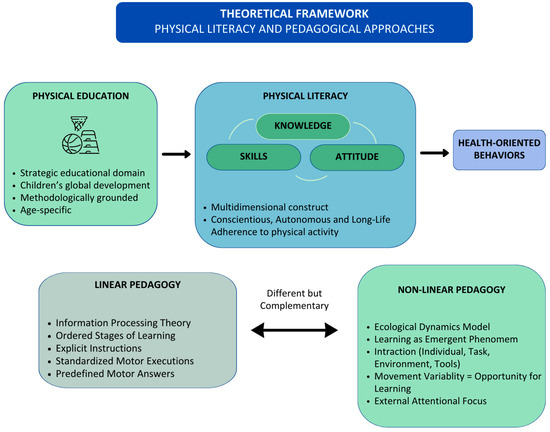
However, the pedagogical implications of teaching PE to support this learner-centered model demand a meticulous selection of tasks and organizational methods, complemented by a thorough examination of teacher–student communication and interaction. A well-structured didactic-educational process in PE requires thorough planning and analysis of motor tasks, equipment, and spaces, focusing on the dynamic relationships among teacher, student, class group, and environment. According to this updated framework, the PE teacher shifts from being a directive instructor to an “environment architect”, tasked with designing scenarios that foster exploration, self-organization and safe uncertainty (Rudd et al., 2021). In this field, the linear and non-linear teaching approaches represent two significantly different, but complementary, models of instructional design in physical education (Figure 1).
Figure 1.
Theoretical Framework.
Linear pedagogy is based on Information Processing Theory, according to which motor learning is divided into ordered stages—cognitive, associative, and autonomous—characterized by explicit instructions, standard motor models, predefined and progressive complexity of exercises (Schmidt et al., 2018).
From this perspective, Non-linear Pedagogy (NLP), in accordance with the Ecological System Dynamics Model, has demonstrated favorable outcomes in terms of task variability and experimentation with motor executions (Rudd et al., 2021). Interventions based on practice variability and motor creativity have been shown to enhance children’s motor development and emotional engagement (Chow et al., 2007, 2021; Crotti et al., 2021).
Moreover, NLP originates in the framework of the ecological-dynamic approach (Rudd et al., 2021; Davids et al., 2012) and considers learning as an emerging phenomenon: motor competencies arise from the interaction between the individual, task, and environment. From this point of view, the PE teacher becomes a facilitator by creating rich learning environments that encourage the exploration of flexible and non-predefined motor solutions, but as a crucial resource for managing uncertainty and developing functional adaptation (Renshaw et al., 2010; Chow, 2013). Recent studies indicate that a focus on external attention promotes higher functional performance and greater efficiency in motor learning (Soderstrom & Bjork, 2015; Wulf & Lewthwaite, 2016).
The Teaching Styles Spectrum developed by Mosston and Ashworth (2008) provides a relevant and significant model for teaching physical education, simultaneously serving as a tool to align teaching styles with specific expected outcomes in cognitive, physical, social, emotional, and moral dimensions (Dudley et al., 2022; Pill et al., 2024). The intentional alternation and interaction between directive and non-directive styles (those that favor open and autonomous responses) allow the development of motor competencies, cognitive, and affective domains (Mosston & Ashworth, 2008; Pill et al., 2024).
The Teaching Styles Spectrum connects linear and non-linear pedagogical models by organizing teaching models along a continuum of decision-making.
The teacher defines the motor task, sequence, frequency, and intensity through “directive” teaching styles (Styles A–E), which are embodied by the linear approach, aimed at achieving motor precision, uniformity, and reducing variability. Conversely, in the “non-directive” part (Styles F–K), closer to non-linear pedagogy, the educator promotes guided discovery, personalized and creative solutions, exploiting variability to favor individual adaptation (Mosston & Ashworth, 2008).
Moreover, linear and non-linear approaches should not be considered opposing, but rather as complementary tools. While stability and short-term motor skills learning can be promoted by the linear approach, the non-linear one fosters adaptive strategies, problem-solving, and intrinsic motivation for learning (Chow, 2013; Renshaw et al., 2010; Davids et al., 2012).
Numerous studies suggest that a conscious use of directive/linear and non-directive/non-linear styles—tailored according to age, context, and objectives—can improve not only motor learning but also perceived motor competence and students’ involvement during PE lessons (Pill et al., 2024; Diloy-Peña et al., 2021).
However, recent scientific evidence shows that not all physical education teachers have real knowledge and a comprehensive understanding of the spectrum of teaching styles (Monacis et al., 2024b; Cuellar-Moreno & Caballero-Juliá, 2019; Simonton et al., 2025; Calmeiro et al., 2025). The design of motor tasks, use of space, equipment and relationships between teacher, students and context need to involve careful construction in order to ensure a positive motivational climate for achieving significant outcomes (Colella, 2019; Espinoza-Gutiérrez et al., 2025).
The variation in teaching styles, from the PE teacher’s perspective, has been linked to positive effects on students’ self-perception, translating into a greater involvement in physical activity (Leisterer & Paschold, 2022; Moreno-Murcia et al., 2022).
During childhood, physical self-perception—defined as complex psychological construct that reflects how the individual assesses their physical abilities and body image (Raudsepp et al., 2002; Christiansen et al., 2018), plays a crucial role in motivating physical participation, acting as a bridge between real motor competence and observable motor behaviors. Recent advancements in the developmental model of motor competence suggest that the relationship between self-perception and physical fitness is more complex.
While the developmental model proposed by Stodden et al. (2008) suggests a synergistic relationship between perceived motor competence and health-related fitness, the current literature emphasizes the role of veridicality, defined as the degree of alignment between a child’s actual and perceived competence (Philpott et al., 2021). Recent evidence suggests that a high-aligned profile—where actual skill meets high perceived competence—provides the most robust foundation for physical fitness and lifelong physical activity (Estevan et al., 2023; Barnett et al., 2022). Conversely, a lack of veridicality may disrupt the positive feedback loops necessary for motor development, suggesting that pedagogical interventions should focus not only on boosting self-perception but on fostering an accurate, realistic self-appraisal of motor skills.
However, despite the extensive literature on the Spectrum, previous research has predominantly focused on three areas: the analysis of teachers’ perceived use of Teaching Styles during PE lessons (Hein et al., 2012; SueSee & Barker, 2019; Syrmpas et al., 2018; Constantinides & Antoniades, 2022; Chatoupis, 2025; Simonton et al., 2025; Calmeiro et al., 2025), the assessment of their effects on motor skill learning and creativity (El Khouri et al., 2020; Cuellar-Moreno & Caballero-Juliá, 2019; Farkash et al., 2022; Hutajulu et al., 2025; Rigon et al., 2024), and upon significant factors in PE and sports activities (i.e., goal orientation, motivation, physical self-perception, enjoyment, and participation) (Klos et al., 2020; Mouratidou et al., 2022; Teraoka et al., 2025; Diloy-Peña et al., 2025; Huang et al., 2025; Llorca-Cano et al., 2025; Schulze et al., 2025).
Literature analysis revealed a critical and theoretical gap regarding the interplay between this pedagogical approach and direct physiological adaptations (Helme et al., 2025). In fact, while Non-Linear Pedagogy posits that movement variability and increased decision-making autonomy—characteristics of “Production Teaching Styles”—foster motor learning, it is still theoretically contested whether the cognitive load and practice variability inherent in these Styles can provide proper physiological stimulus to enhance Physical Fitness Components (PFC).
While a plethora of studies have examined the role of PE interventions during childhood, new directions highlight the effectiveness of teaching styles variation (particularly production styles) in encouraging both motivation, self-perception, and enjoyment during practice, as well as physical fitness components (Coterón et al., 2024).
The effectiveness of varied and non-traditional pedagogical approaches has been studied in school contexts, demonstrating an increase in motor competence, enjoyment, and time spent in physical activity (Invernizzi et al., 2019). Moreover, Komatni (2022) showed how different learning approaches could enhance motor skills and physical fitness development. Research in the field suggests that structured task-based physical education lessons are associated with higher levels of motor skills and show a positive correlation with better physical fitness (including body composition, hand muscle strength, endurance, flexibility, and cardiopulmonary endurance) compared to a command-based approach.
Furthermore, alternative and non-traditional teaching approaches—such as cooperative learning, gamified and game-based approaches—have proven effective not only in promoting academic achievement, but also in health-related outcomes (Elumalai et al., 2022; SueSee & Pill, 2025; Pill et al., 2025; Utamayasa et al., 2025; Schulze et al., 2025; Bores-García et al., 2024; Fernández-Vázquez et al., 2024).
Despite this growing body of evidence, the current scientific literature exhibits a significant lack of knowledge regarding the didactic application of the Spectrum of Teaching Styles. While several interventions and experimental studies report moderate effects regarding the impact of non-linear multi-style approaches on motor competence and psychological engagement, evidence concerning physical fitness components remains inconsistent.
To the best of our knowledge, only a few studies have focused on the assessment of teaching styles variations and how they can foster both physical self-perception and physical fitness during the developmental age.
Therefore, this study aims to address the methodological gap by operationalizing the Spectrum of Teaching Styles not merely as a pedagogical framework, but as an interventional tool. We aim to test whether shifting from a directive (linear) to a discovery-oriented (non-linear) paradigm during PE lessons can drive concurrent improvements in both measurable physical fitness and self-perception according to sex and BMI weight categories.
Based on this research question, the present study moves beyond the descriptive application of the framework, aiming to advance the understanding of how didactic variability influences physical fitness and physical self-perception variables of Physical Literacy in primary school children.
2. Materials and Methods
2.1. Participants
Convenience sampling was used to recruit participants from one school in the province of Lecce for the SBAM!—Health, Wellbeing, Food Education and Movement at School—Project in Apulia Region. A total of 160 children aged 8–10 years (Males = 84; Females = 76) participated in this study. Participants were divided across ten classes, 5 classes in 3rd grade, and 5 classes in 4th grade, respectively.
Participants were recruited based on the following inclusion criteria: enrollment in the participating primary school classes involved in the SBAM! Project, regular attendance in physical education lessons, and no diagnosed physical or cognitive conditions that would preclude safe participation in standardized motor assessment. Exclusion criteria included incomplete physical fitness testing or failure to return the signed consent forms.
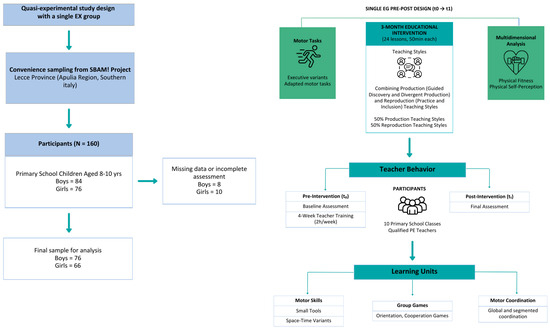
The educational intervention was promoted by the “Scientific Laboratory on Teaching Methods for Physical Education and Motor Assessment” (MAVeS Lab), University of Salento. As suggested by a priori sample size estimation (G*Power Software 3.1; Faul et al., 2009), 142 participants were considered suitable for running subsequent analyses (α = 0.05, medium effect size = 0.5). The expected number of participants was met, resulting in a final sample of 142 participants (see Figure 1), accounting for missing data from 8 boys and 10 girls who did not complete the entire assessment procedure.
This study was approved by the ethics board (approval number: PROT/E 002466, 29 March 2024), and informed consent was obtained from all children’s parents/legal guardians involved in the study.
2.2. Design of Experimental Activities
The educational intervention addressed in this study is organized around three interrelated dimensions:
- (a)
- the development of variable motor tasks to enhance movement adaptation;
- (b)
- the use of different teaching styles, with specific focus on production styles (i.e., guided discovery, divergent production), as they were shown to be the most familiar to Apulian PE teachers (Monacis et al., 2024b);
- (c)
- the analysis of the effects induced by variation in teaching styles, on physical fitness and self-perception.
The teacher’s behavior was defined a priori using preliminary structural observation checklist tool, containing descriptors corresponding to the teaching styles mainly used to manage educational communication and motor tasks, as described in other studies (Monacis et al., 2023).
The experimental intervention adopted the structures described in Table 1.
Table 1.
Lesson structure, model A, B, C, and D; teaching styles: F = guided discovery; H = divergent production; B = practice; E = inclusion.
Ten primary school classes participated in this study. Due to the limited sample size, it was not possible to include a control group. Therefore, the research adopted a single-group pre-post pilot design, with two-point assessment pre-(t0) and post-(t1), as synthesized in Figure 2.
Figure 2.
Pilot Intervention Design.
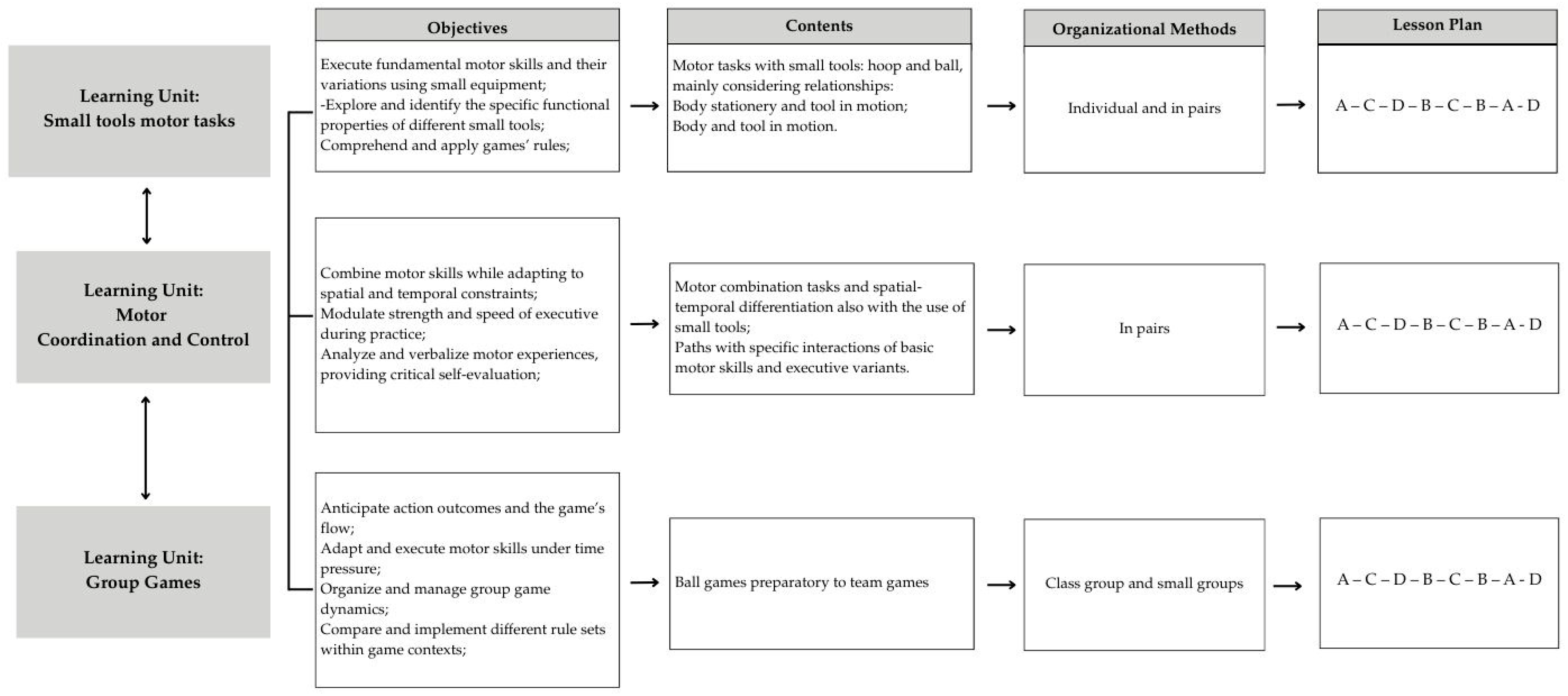
At first, the research team handled the design of the learning units, but then it was discussed with two senior physical education teachers who were working in primary schools. By taking this step, the research team has ensured that experimental activities comprising three learning units (Figure 3), complying with the school context and the planned curriculum objectives, which are as follows:
Figure 3.
Summary of Educational Proposals.
- (a)
- small-tools motor tasks;
- (b)
- group games;
- (c)
- overall motor coordination and control.
Reproductive styles (e.g., practice and inclusion) have been integrated in order to support the learning of fundamental movement skills and ensure children’s participation during experimental activities, regardless of their learning starting level.
The experimental activities were organized developing multiple operational scenarios (i.e., individual, in pairs and/or small group activities, with and without using small tools, open-closed skills). Teachers were asked to modify teaching styles during the lessons, providing encouragement to foster divergent motor thinking, consistent with a non-linear learning framework.
The experimental intervention asked teachers to change how they proposed motor tasks, promoting different ways of thinking and/or executing motor tasks, according to the non-linear learning approach.
Prior to the intervention, participating teachers underwent a 4-week training program (2 h per week) focused on the organizational modalities and activities specific to the experimental intervention and assessment. The activities took place twice a week from October 2024 to January 2025, for a total of 24 lessons lasting approximately 50 min each. The intervention emphasized the use of teaching styles oriented toward autonomous production for at least 50% of the time available in each lesson (e.g., guided discovery and divergent production), according to the taxonomy proposed by the Spectrum of Teaching Styles (Mosston & Ashworth, 2008). The aim was to solicit children’s active involvement, reflection and decision-making autonomy during practice.
While a standardized pedagogical protocol was provided to all participating PE teachers, throughout the four-month period, they frequently needed to adapt the prescribed activities, teaching styles and physical constraints to accommodate the dynamic and unpredictable nature of the school environment (e.g., sudden changes in schedule, spatial limitations, or changes in student engagement levels). However, rather than viewing this flexibility as a methodological limitation, it serves as a justification for the study’s high ecological validity. Allowing teachers the autonomy to adapt the intervention organically ensures that the findings reflect the true feasibility and practical impact of these pedagogical approaches in physical education settings, rather than in highly controlled, artificial laboratory conditions.
2.3. Assessment Tools
To assess the anthropometric profile, participants’ height (m) and weight (kg) were measured. The measurements were performed following the WHO (2024) guidelines and using digital portable stadiometers, characterized by an accuracy of ~0.1 mm for height and ~ 0.1 kg for weight. Subsequently, the Body Mass Index (BMI) was calculated using the formula weight (kg)/height2 (m2).
Participants were then categorized based on BMI using the cut-points recommended by the World Obesity Federation (International Obesity Task Force) (Cole & Lobstein, 2012). Due to the limited number of participants in each classification group, children were pooled into two categories (Normal Weight and Overweight-Obese) to ensure adequate and balanced subgroup sizes required to conduct robust comparative analyses. Despite the absence of scientific agreement on the use of BMI as a diagnostic indicator for obesity (Marković-Jovanović et al., 2015), its application is justified by its global acknowledgment as a cost-effective, and non-invasive method suitable for children (Nuttall, 2015).
Other physical fitness components were assessed through validated physical fitness tests retrieved from the ALPHA-FIT and EUROFIT test batteries: standing long jump (lower limbs explosive strength), medicine ball throw (1 kg) (upper limbs explosive strength), 4 × 10 m shuttle, and 20 m slalom (speed and agility) (Ortega et al., 2008; Ruiz et al., 2011). These tests were chosen due to their extensive cross-cultural validation, high reliability, and feasibility in assessing health-related physical fitness in Italian children (Lovecchio et al., 2010; Galvani et al., 2024; Monacis et al., 2023).
In addition, children were asked to fill in the Italian validated version of Physical Self-Perception Questionnaire to investigate how they feel when participating in physical education classes (i.e., I run very slowly/I run slowly/I run fast/I run very fast; my muscles are extremely weak/my muscles are weak/my muscles are strong/my muscles are extremely strong, etc.) (Colella et al., 2008; Monacis et al., 2024a). This assessment tool is composed of 6 items and is based on a 4-point Likert-type response scale. The maximum total score that can be obtained is 24 points. In the current sample, this scale demonstrated good internal consistency (α = 0.88).
The purpose of the questionnaire is to specifically investigate children’s perception of their motor skills in terms of strength, speed, and coordination. A high total score is considered an index of higher levels of self-perception in these domains, whereas low scores reflect a less positive self-perception. All physical fitness tests and the self-assessment questionnaire were carried out at two distinct times: pre-intervention (t0), conducted one week before the start of the experimental activities, and post-intervention (t1), performed one week after their conclusion. These evaluations aimed to measure the changes attributable to a 16-week educational path (4 months), involving a total of 24 h of physical education lessons (from February to May 2025). In both pre- and post-assessment sessions, the Physical Self-Perception Questionnaire was administered in a classroom environment on a separate day to the physical fitness test to avoid potential carryover effects.
2.4. Statistical Analysis
Descriptive statistics, including means and standard deviations for all dependent variables, were reported for the overall sample and categorized by sex and cutoff groups.
Given the feasibility nature of this study and the absence of a control group, statistical analysis focused on intra-group changes over time.
Statistical analyses were performed using a mixed-design repeated measures multivariate analysis (MANOVA), testing for variations in dependent variables across time and among distinct groups.
The significance of the main and interaction effects was evaluated using Pillai’s Trace for the multivariate tests, as it remains reliable and robust despite assumption violations.
The F-statistic, along with its corresponding level (p-value) and partial eta squared (η2), was considered as the primary index for interpreting effects. A p-value < 0.05 was considered statistically significant. The two-way (Time × Sex; Time × Cutoff) and three-way (Time × Sex × Cutoff) interactions were tested. Effect size (d) was interpreted as follows: small, d ~ 0.2; medium, d ~ 0.5; large, d ~ 0.8 (Cohen, 2013). All significant indices were set at p < 0.05. It was hypothesized that participants would demonstrate significant changes in physical and perceptual measures over time, and that these changes might be influenced by their sex and cutoff group classification. Follow-up univariate tests with Bonferroni correction were also carried out. Statistical analysis was conducted using IBM SPSS Statistics (Version 25).
3. Results
Descriptive statistics (means ± standard deviations) were reported for all variables, highlighting main statistical pre-post intervention differences between groups (Table 2). The assumption of homogeneity of covariance matrices was met, since Box’s M test was non-significant (Box’s M = 243.127, F(165, 7632.322) = 1.055, p = 0.303).
Table 2.
Descriptive statistics and pairwise comparison between groups.
The MANOVA revealed a significant multivariate main effect of Time (Pillai’s Trace = 0.906, F(5, 66) = 127.393, p < 0.001, partial η2 = 0.906) on dependent variables, suggesting statistically significant changes in dependent variables across time (Table 3). However, no significant multivariate interactions were highlighted for Time × Gender (p = 0.370), Time × Group (p = 0.719), or the three-way Time × Sex × Cutoff interactions (p = 0.967).
Table 3.
Multivariate analysis of variance. Note. df = degrees of freedom; ηp2 = partial eta squared.
Moreover, univariate analyses (Table 4) showed significant changes pre-and post-intervention on every dependent variable, as follows: SLJ (F(1, 70) = 100.139, p < 0.001, partial η2 = 0.589), SR4x10 (F(1, 70) = 210.402, p < 0.001, partial η2 = 0.750), MBT (F(1, 70) = 139.241, p < 0.001, partial η2 = 0.665), Slalom 20 m (F(1, 70) = 100.614, p < 0.001, partial η2 = 0.590), and Physical Self-Perception (F(1, 70) = 57.643, p < 0.001, partial η2 = 0.452).
Table 4.
Univariate analysis of variance.
4. Discussion
The data emerging from this research highlight the feasibility of introducing practice variability through the Spectrum of Teaching Styles. The results showed a significant improvement in physical fitness (SLJ, 4 × 10 m SR, MBT, 20 m Slalom) and self-perception among primary school children over the four-month intervention period. The large effect sizes obtained (ηp2 values ranging from 0.453 to 0.750) provide evidence for the feasibility of this pedagogical approach after the pre-experimental intervention. However, given the absence of a control group, these changes cannot be attributed to the intervention solely, and results should be interpreted as preliminary and exploratory.
A highly relevant finding is the absence of significant multivariate interactions between Time and Sex, as well as Time and Cutoff, suggesting that the observed changes over time were consistent across different groups. These findings may indicate the inherent flexibility and adaptability of the practice variability approach, fostering an inclusive school-based environment, which is a key goal for contemporary Physical Education curricula.
However, the lack of statistical significance in these interactions does not demonstrate the inherent inclusivity or adaptability of the intervention, but it suggests that, within the statistical power limits of this feasibility study, no divergent trajectories were detected between sexes or BMI categories. Furthermore, given the single group pre-post design, the large multivariate Time effect observed (ηp2 = 0.906) could be influenced by unmeasured factors—such as developmental maturation, seasonal, effects and repeated-testing adaptations—rather than the efficacy of the experimental activities alone, pointing to potential longitudinal associations rather than causal enhancements.
Associations over time in physical fitness (explosive strength in lower and upper limbs, speed, and agility) emphasize the relevance of practice variability and variation in teaching styles, aligning with the concepts of NLP. These findings suggest that variability is not a “disruption”, but an opportunity for developing resilient and adaptable motor skills, leading to measurable enhancements in physical fitness and factors associated with physical activity (Pesce et al., 2019). In this framework, the emphasis on task variability and autonomous exploration is configured as a key element to support engagement and enhance physical literacy, in line with the principles of NLP and the Spectrum of Teaching Style models (Chow et al., 2007; Mosston & Ashworth, 2008).
Previous studies have similarly confirmed that multi-style interventions and task-based approaches enhance physical fitness and motor competence in this age group.
In fact, an Italian study highlighted the enhancement of physical fitness components, motor skills development, as well as enjoyment and time spent in physical activity during a 12-week multi-teaching styles intervention (Invernizzi et al., 2019). Similarly, another study by Komatni (2022) described how the development of motor skills through different learning methods and teaching strategies can result in the improvement of physical fitness components. Moreover, student-centered and non-traditional teaching-learning methods in physical education revealed their didactic and pedagogical value for the development of both physical self-perception and physical fitness (Elumalai et al., 2022). As demonstrated in previous studies, the variation in teaching styles enabled students to engage in a broader range of decision-making opportunities and to explore multiple and creative movement variations and motor responses, likely contributing not only to the enhancement of physical fitness or motor skill learning, but also to the strengthening of self-perception and enjoyment associated with physical activity (Monacis et al., 2022a, 2023).
Furthermore, this study provides preliminary observational evidence aligning with the interconnected nature of the physical and affective domains of Physical Literacy (Durden-Myers et al., 2018b; Edwards et al., 2017)
The significant increase in physical self-perception suggests that involving students in open, decision-making opportunities may be positively associated with both domains.
Moreover, self-perception takes on an increasing weight in predicting the satisfaction of psychological needs and self-determined motivation towards physical education, both of which are determinants of high levels of MVPA and skill performance (Behzadnia et al., 2025). These findings have been supported by den Uil et al. (2023), who investigated the relationship between actual (AMC) and perceived motor competence (PMC), physical activity, physical fitness, and weight status in 4–13-year old children. The study highlights a robust correlation between AMC and PMC from early childhood, but also their significant association with increased physical activity and physical fitness. These results further support the concept (Stodden et al., 2008) that personal perception plays a significant role in enhancing motor engagement. Moreover, this finding supports the need to develop motor skills from a young age (den Uil et al., 2023).
While broader literature highlighted the role of physical self-perception as a significant mediator between BMI and daily physical activity, positively enhancing adherence to physical activity and participation during PE lessons (Monacis et al., 2022b; De Meester et al., 2016), the current study design does not account for mediation or causal inferences. However, at the same time, the obtained results support the theoretical need for future research to directly test these mediation pathways within the Spectrum of Teaching Styles framework.
In addition to these preliminary results, this study provides a noteworthy methodological contribution by presenting methodological application of specific styles-related checklists for implementing Mosston and Ashworth’s Spectrum of Teaching Styles in PE. These checklists could serve as a useful resource for teacher training in higher education institutions, and for future controlled and randomized studies by advocating for a more objective assessment of teachers’ behavior and implementation of teaching styles during lessons. This pilot study could be the starting point that allows researchers to achieve a better understanding of specific effects linked to teachers’ behavior, testing for the scientific soundness and validity of the Spectrum of Teaching Styles as a pedagogical approach.
The positive association over time obtained in both physical fitness and physical self-perception offers potential empirical support for the notion that the Spectrum of Teaching Styles serves as a potential and feasible model in PE, integrating theoretical and practical framework for developing PL. The analysis of these evidences suggests the need to further explore how teaching strategies can be integrated into PE and their effects on physical fitness, motor development, enjoyment, motivation, and other correlations to physical activity.
The observed improvements can be further understood through the lens of ecological dynamics and the Constraints-Led Approach (Renshaw et al., 2010). By proposing game-based activities and varying teaching styles, PE teachers can actively manipulate task, environmental, and framework constraints. This pedagogical strategy encourages children to explore their environment and discover functional movement solutions, thereby strengthening their perception-action coupling (Davids et al., 2012). In these non-linear learning environments, children are continuously required to make decisions based on the affordances (opportunities for action) presented by the game. As students successfully navigate these problem-solving scenarios, they not only enhance their decision-making capabilities but also build a more grounded physical self-perception. Although research on this topic is still emerging, it is plausible that overcoming motor challenges in an exploratory, game-based context provides authentic mastery experiences that positively shape how children perceive their physical competence (Chow et al., 2021; Renshaw et al., 2010).
From a strictly practical and educational perspective, these preliminary findings offer actionable and potential insights for physical education teachers. Rather than viewing practice variability as a disruption to lesson management, educators should deliberately transition from purely directive models to exploratory teaching environments (Pill et al., 2025; Rudd et al., 2021). Practically, this involves allocating a substantial portion of class time (e.g., 50%) to “production teaching styles” (i.e., guided discovery and divergent production). Moreover, teachers should manipulate task constraints—such as space, rules, and small tools—and pose movement problems, encouraging children to autonomously find their optimal motor solutions, rather than providing explicit and step-by-step motor instructions. This pedagogical shift could ensure that students remain physically active while engaging their cognitive decision-making and affective self-perception.
Study Limitations
While acknowledging the strengths and potential methodological implications of this study for physical education teachers, some limitations need to be discussed adequately.
The primary methodological limitation is the single group pre-post design and the absence of a control group, precluding causal inference regarding the intervention. Furthermore, the significant improvements observed over time cannot be definitively attributed to the intervention protocol based on teaching styles’ variation. Instead, they may be influenced by other confounding factors, including age-related (8–10 years) developmental maturation, seasonal progression in physical education, practice effects due to repeated exposure to fitness testing, and the Hawthorne effect resulting from increased teacher and researcher attention.
This pilot study, dictated by ethical and practical limitations in the school environment, prevents control for confounding variables (i.e., maturation effect, growth spurts, or other unmeasured external variables). Furthermore, the potential influence of learning effect must be considered when interpreting the improvements from pre- to post-intervention, which can lead to improved scores simply due to increased task familiarity and reduced performance anxiety, rather than physical fitness changes (Vrbik et al., 2017; Tomkinson et al., 2018; Mededovic et al., 2018). While the four-month intervention design between testing sessions was intended to minimize this effect, some improvements may be attributable to prior experiences.
In light of these threats to internal validity, the obtained findings should be interpreted strictly as preliminary and exploratory.
Future studies should adopt a more robust study design (i.e., randomized controlled trials and longitudinal studies) with control groups and apply similar educational interventions to other contexts or populations (such as primary or secondary school children) broadening a better understanding of the topic, extending results’ validation and generalizability in other contexts.
As discussed in intervention description, a further significant limitation is the lack of a systematic implementation fidelity assessment. Although the participating teachers underwent a specific 4-week training program and their behaviors were conceptually framed using a priori structured observation checklists, this pilot study did not quantitatively report observational coding data for inter-rater reliability assessment of the observations, as well as teachers’ adherence to the proposed lesson structure models. Future investigations should adopt rigorous fidelity protocols and standardize fidelity metrics to ensure the independent pedagogical variable is manipulated exactly as designed.
5. Conclusions
This study highlights that varying teaching styles during PE lessons could be a feasible methodological approach for enhancing both physical fitness components and self-perception, which are key variables for sustaining long-term engagement in physical activity. The main findings suggest that the Spectrum of Teaching Styles has the potential to serve as a theoretical and practical framework not only for understanding the pedagogical implications of linear and non-linear models, but also for developing specific domains of physical literacy. Moreover, our preliminary data indicate that integrating non-linear, discovery-oriented tasks does not compromise physical intensity, as it serves as a concrete tool to support physical fitness and self-perception development.
However, further study should assess the feasibility of interventions based on teaching styles across multiple dimensions of physical literacy using controlled experimental designs.
Author Contributions
Conceptualization, D.M.; Methodology, D.M. and A.-A.H.; Software, D.M.; Formal analysis, G.P. and A.-A.H.; Investigation, G.P.; Data curation, D.M. and M.B.; Writing—original draft, D.M. and M.B.; Writing—review and editing, A.-A.H. and D.C.; Supervision, D.C.; Project administration, G.P. and D.C. All authors have read and agreed to the published version of the manuscript.
Funding
This research received no external funding.
Institutional Review Board Statement
The study was conducted in accordance with the Declaration of Helsinki, and approved by the Institutional or Ethics Committee of Pegaso University (protocol code 002466, date of approval 29 March 2024).
Informed Consent Statement
Informed consent was obtained from all subjects involved in the study.
Data Availability Statement
The data presented in this study are available on request from the corresponding author. Data are unavailable due to privacy or ethical restrictions.
Conflicts of Interest
The authors declare no conflicts of interest.
Abbreviations
The following abbreviations are used in this manuscript:
| PFC | physical fitness components |
| BMI | body mass index |
| PE | physical education |
| PL | physical literacy |
| MANOVA | multivariate analysis of variance |
| AMC | actual motor competence |
References
- Barnett, L. M., Webster, E. K., Hulteen, R. M., De Meester, A., Valentini, N. C., Lenoir, M., Pesce, C., Getchell, N., Lopes, V. P., Robinson, L. E., Brian, A., & Rodrigues, L. P. (2022). Through the looking glass: A systematic review of longitudinal evidence, providing new insight for motor competence and health. Sports Medicine, 52(4), 875–920. [Google Scholar] [CrossRef] [Scilit]
- Behzadnia, B., Adachi, P. J. C., & Deci, E. L. (2025). Are physical education teachers’ autonomy-supportive behaviors related to high-school students’ actual game-play performance? Physical Education and Sport Pedagogy, 1–16. [Google Scholar] [CrossRef] [Scilit]
- Bores-García, D., Cano-de-la-Cuerda, R., Espada, M., Romero-Parra, N., Fernández-Vázquez, D., Delfa-De-La-Morena, J. M., Navarro-López, V., & Palacios-Ceña, D. (2024). Educational research on the use of virtual reality combined with a practice teaching style in physical education: A qualitative study from the perspective of researchers. Education Sciences, 14(3), 291. [Google Scholar] [CrossRef] [Scilit]
- Calmeiro, L., Paupério, T., McCabe, J., & Teques, P. (2025). Students’ perceptions of teaching styles use and motivation to participate in PE: A multigroup analysis of the mediating role of basic psychological needs. European Physical Education Review, 31, 713–730. [Google Scholar] [CrossRef] [Scilit]
- Chatoupis, C. (2025). Applying a task progression to the divergent discovery style of teaching. Journal of Physical Education, Recreation and Dance, 96(6), 36–40. [Google Scholar] [CrossRef] [Scilit]
- Chow, J. Y. (2013). Nonlinear learning underpinning pedagogy: Evidence, challenges, and implications. Quest, 65(4), 469–484. [Google Scholar] [CrossRef] [Scilit]
- Chow, J. Y., Davids, K., Button, C., Shuttleworth, R., Renshaw, I., & Araújo, D. (2007). The role of nonlinear pedagogy in physical education. Review of Educational Research, 77(3), 251–278. [Google Scholar] [CrossRef] [Scilit]
- Chow, J. Y., Komar, J., & Seifert, L. (2021). The role of nonlinear pedagogy in supporting the design of modified games in junior sports. Frontiers in Psychology, 12, 744814. [Google Scholar] [CrossRef] [Scilit]
- Christiansen, L. B., Lund-Cramer, P., Brondeel, R., Smedegaard, S., Holt, A.-D., & Skovgaard, T. (2018). Improving children’s physical self-perception through a school-based physical activity intervention: The Move for Well-being in School study. Mental Health and Physical Activity, 14, 31–38. [Google Scholar] [CrossRef] [Scilit]
- Cohen, J. (2013). Statistical power analysis for the behavioral sciences. Academic Press. [Google Scholar]
- Cole, T. J., & Lobstein, T. (2012). Extended international (IOTF) body mass index cut-offs for thinness, overweight and obesity. Pediatric Obesity, 7(4), 284–294. [Google Scholar] [CrossRef] [Scilit]
- Colella, D. (2019). Teaching and learning of motor competencies. Processes and Relations. Formazione & Insegnamento, 17(Suppl. S3), 73–88. [Google Scholar] [CrossRef] [Scilit]
- Colella, D., Morano, M., Bortoli, L., & Robazza, C. (2008). A physical self-efficacy scale for children. Social Behavior and Personality: An International Journal, 36, 841–848. [Google Scholar] [CrossRef] [Scilit]
- Constantinides, P., & Antoniades, O. (2022). Preservice physical education teachers’ use of reproduction and production teaching styles. European Journal of Education and Pedagogy, 3, 93–99. [Google Scholar] [CrossRef] [Scilit]
- Coterón, J., Fernández-Caballero, J., Martín-Hoz, L., & Franco, E. (2024). The interplay of structuring and controlling teaching styles in physical education and its impact on students’ motivation and engagement. Behavioral Sciences, 14(9), 836. [Google Scholar] [CrossRef] [Scilit]
- Crotti, M., Rudd, J. R., Roberts, S., Boddy, L. M., Fitton Davies, K., O’Callaghan, L., Utesch, T., & Foweather, L. (2021). Effect of linear and nonlinear pedagogy physical education interventions on children’s physical activity: A cluster randomized controlled trial (SAMPLE-PE). Children, 8(1), 49. [Google Scholar] [CrossRef] [Scilit] [PubMed]
- Cuellar-Moreno, M., & Caballero-Juliá, D. (2019). Student perceptions regarding the command and problem solving teaching styles in the dance teaching and learning process. In Research in dance education (Vol. 20, Issue 3, pp. 297–310). Taylor & Francis. [Google Scholar] [CrossRef] [Scilit]
- Davids, K., Araujo, D., Hristovski, R., Passos, P., & Chow, J. Y. (2012). Ecological dynamics and motor learning design in sport. In Skill acquisition in sport: Research, theory and practice (pp. 112–130). Routledge. [Google Scholar] [CrossRef]
- De Meester, A., Stodden, D., Brian, A., True, L., Cardon, G., Tallir, I., & Haerens, L. (2016). Associations among elementary school children’s actual motor competence, perceived motor competence, physical activity and BMI: A cross-sectional study. PLoS ONE, 11(10), e0164600. [Google Scholar] [CrossRef] [Scilit] [PubMed]
- den Uil, A. R., Janssen, M., Busch, V., Kat, I. T., & Scholte, R. H. J. (2023). The relationships between children’s motor competence, physical activity, perceived motor competence, physical fitness and weight status in relation to age. PLoS ONE, 18(4), e0278438. [Google Scholar] [CrossRef] [Scilit] [PubMed]
- Diloy-Peña, S., García-Cazorla, J., Mayo-Rota, C., García-González, L., Villafaña-Samper, Z., & Abós, Á. (2025). How can physical education teachers’ high directiveness impact students’ experiences of enjoyment and boredom? Psychology, Society and Education, 17(1), 21–28. [Google Scholar] [CrossRef] [Scilit]
- Diloy-Peña, S., García-González, L., Sevil Serrano, J., Sanz-Remacha, M., & Abós, Á. (2021). Motivational teaching style in physical education: How does it affect students’ experiences? Apunts Educacion Fisica y Deportes, 144, 44–51. [Google Scholar] [CrossRef] [Scilit]
- Dudley, D., Mackenzie, E., Van Bergen, P., Cairney, J., & Barnett, L. (2022). What drives quality physical education? A systematic review and meta-analysis of learning and development effects from physical education-based interventions. Frontiers in Psychology, 13, 799330. [Google Scholar] [CrossRef] [Scilit]
- Durden-Myers, E. J., Green, N. R., & Whitehead, M. E. (2018a). Implications for promoting physical literacy. Journal of Teaching in Physical Education, 37(3), 262–271. [Google Scholar] [CrossRef] [Scilit]
- Durden-Myers, E. J., Whitehead, M., & Pot, N. (2018b). Physical literacy and human flourishing. Journal of Teaching in Physical Education, 37, 308–311. [Google Scholar] [CrossRef] [Scilit]
- Edwards, L. C., Bryant, A. S., Keegan, R. J., Morgan, K., & Jones, A. M. (2017). Definitions, foundations and associations of physical literacy: A systematic review. Sports Medicine, 47(1), 113–126. [Google Scholar] [CrossRef] [Scilit]
- El Khouri, F. B., Meira Junior, C. d. M., Rodrigues, G. M., & Miranda, M. L. d. J. (2020). Effects of command and guided discovery teaching styles on acquisition and retention of the handstand. Revista Brasileira de Educação Física e Esporte, 34(1), 11–18. [Google Scholar] [CrossRef] [Scilit]
- Elumalai, G., Chinanapan, K., Choeibuakaew, W., Doewes, R., & Hossein Abadi, F. (2022). Can model-based approach in physical education improve physical fitness, academic performance, and enjoyment among pupils? A systematic literature review. International Journal of Human Movement and Sports Sciences, 10, 21–28. [Google Scholar] [CrossRef] [Scilit]
- Espinoza-Gutiérrez, R., Calleja-Núñez, J. J., Granero-Gallegos, A., & Baños, R. (2025). The mediating role of motivational climate between interpersonal teaching styles and academic self-concept among university student of Physical Education: Is there a gender difference? Revista de Psicodidactica, 31, 500174. [Google Scholar] [CrossRef] [Scilit]
- Estevan, I., De Meester, A., & Barnett, L. M. (2023). Advancing the understanding in the association between actual/perceived motor competence and health-related factors among children and adolescents. Psychology of Sport and Exercise, 67, 102420. [Google Scholar] [CrossRef] [Scilit]
- Farkash, E., Zayed, W., & Bali, N. (2022). The effect of using the two competitive teaching styles and stations on learning some basic football skills for physical education students. Physical Education of Students, 26, 308–315. [Google Scholar] [CrossRef] [Scilit]
- Faul, F., Erdfelder, E., Buchner, A., & Lang, A.-G. (2009). Statistical power analyses using G* Power 3.1: Tests for correlation and regression analyses. Behavior Research Methods, 41(4), 1149–1160. [Google Scholar] [CrossRef] [Scilit] [PubMed]
- Fernández-Vázquez, D., Navarro-López, V., Cano-de-la-Cuerda, R., Palacios-Ceña, D., Espada, M., Bores-García, D., Delfa-de-la-Morena, J. M., & Romero-Parra, N. (2024). Influence of virtual reality and gamification combined with practice teaching style in physical education on motor skills and students’ perceived effort: A mixed-method intervention study. Sustainability, 16(4), 1584. [Google Scholar] [CrossRef] [Scilit]
- Galvani, C., Togni, F., Puci, M. V., Vandoni, M., Correale, L., Codella, R., Orizio, C., Montomoli, C., La Torre, A., D’Angelo, F., & Casolo, F. (2024). Health-related field-based fitness tests: Normative values for Italian primary school children. Journal of Functional Morphology and Kinesiology, 9(4), 190. [Google Scholar] [CrossRef] [Scilit]
- García-Hermoso, A., López-Gil, J. F., & Ezzatvar, Y. (2025). Tracking of physical activity and sport from childhood and adolescence to adulthood: A systematic review and meta-analysis. Translational Pediatrics, 14(6), 1117–1128. [Google Scholar] [CrossRef] [Scilit]
- Hein, V., Ries, F., Pires, F., Caune, A., Heszteráné Ekler, J., Emeljanovas, A., & Valantiniene, I. (2012). The relationship between teaching styles and motivation to teach among physical education teachers. Journal of Sports Science & Medicine, 11(1), 123–130. [Google Scholar]
- Helme, M., Cowburn, I., & Till, K. (2025). Developing the physical fitness of children: A systematic scoping review of pedagogy in research. Sports, 13(9), 309. [Google Scholar] [CrossRef] [Scilit]
- Huang, L., Tian, F., & Li, F. (2025). Teaching styles and sports engagement: Mediation by satisfaction and resilience in Chinese adolescents. Frontiers in Psychology, 16, 1630300. [Google Scholar] [CrossRef] [Scilit]
- Hutajulu, P. T., Lubis, J., & Tirto, A. (2025). Understanding the influence of combined teaching styles on football passing performance among PETE freshmen students. Physical Education Theory and Methodology, 25(3), 594–600. [Google Scholar] [CrossRef] [Scilit]
- Invernizzi, P. L., Crotti, M., Bosio, A., Cavaggioni, L., Alberti, G., & Scurati, R. (2019). Multi-teaching styles approach and active reflection: Effectiveness in improving fitness level, motor competence, enjoyment, amount of physical activity, and effects on the perception of physical education lessons in primary school children. Sustainability, 11(2), 405. [Google Scholar] [CrossRef] [Scilit]
- Klos, L., Feil, K., Eberhardt, T., & Jekauc, D. (2020). Interventions to promote positive affect and physical activity in children, adolescents and young adults—A systematic review. Sports, 8(2), 26. [Google Scholar] [CrossRef] [Scilit]
- Komatni, A. (2022). Effect of learning approach and motor skills on physical fitness. Journal of Physical Education and Sport, 22(9), 2273–2280. [Google Scholar] [CrossRef]
- Leisterer, S., & Paschold, E. (2022). Increased perceived autonomy-supportive teaching in physical education classes changes students’ positive emotional perception compared to controlling teaching. Frontiers in Psychology, 13, 1015362. [Google Scholar] [CrossRef] [Scilit]
- Llorca-Cano, M., Gallardo Márquez, F., Huéscar Hernández, E., Barrachina-Peris, J., & Moreno-Murcia, J. A. (2025). Effects of an autonomy support intervention on motivation and academic competence in physical education. Revista de Investigacion Educativa, 43, 1–21. [Google Scholar] [CrossRef] [Scilit]
- Lovecchio, N., Casolo, F., Invernizzi, P., & Eid, L. (2010). Strength in young Italian students: Results from eurofit test and comparison among european data. Polish Journal of Sport and Tourism, 19, 13–15. [Google Scholar] [CrossRef] [Scilit]
- Marković-Jovanović, S. R., Stolić, R. V., & Jovanović, A. N. (2015). The reliability of body mass index in the diagnosis of obesity and metabolic risk in children. Journal of Pediatric Endocrinology & Metabolism, 28(5–6), 515–523. [Google Scholar] [CrossRef] [Scilit]
- Mededovic, B., Romanov, R., Zubanov, V., Peric, D., Stupar, D., & Ahmetovic, Z. (2018). Influence of familiarization on preschool children’s motor tests results. Acta Gymnica, 48(4), 161–166. [Google Scholar] [CrossRef] [Scilit]
- Monacis, D., Annoscia, S., Colella, D., & Limone, P. (2024a). Measuring validity and reliability of the Italian version of physical activity questionnaire for older children in overweight and obese children. Frontiers in Education, 9, 1414126. [Google Scholar] [CrossRef] [Scilit]
- Monacis, D., Annoscia, S., Limone, P., & Colella, D. (2023). Examining the Effects of reproductive and productive teaching styles interventions on primary schoolchildren. What implications for physical education teachers? Physical Education Theory and Methodology, 23(6), 839–849. [Google Scholar] [CrossRef] [Scilit]
- Monacis, D., Colella, D., & Limone, P. (2022a). Non-linear didactic technology-based intervention to enhance basic motor competencies with MOBAK-5: A pilot study in primary school. Physical Activity Review, 10(1), 22–30. [Google Scholar] [CrossRef] [Scilit]
- Monacis, D., Latino, F., d’Arando, C., Bibba, M., Annoscia, S., Pascali, G., Sannicandro, I., & Colella, D. (2024b). Analysis of self-perceived use of spectrum of teaching styles in Italian physical education teachers. Frontiers in Sports and Active Living, 6, 1397511. [Google Scholar] [CrossRef] [Scilit]
- Monacis, D., Trecroci, A., Invernizzi, P. L., & Colella, D. (2022b). Can Enjoyment and Physical Self-Perception Mediate the Relationship between BMI and Levels of Physical Activity? Preliminary Results from the Regional Observatory of Motor Development in Italy. International Journal of Environmental Research and Public Health, 19(19), 12567. [Google Scholar] [CrossRef] [Scilit]
- Moreno-Murcia, J. A., Ramis-Claver, J., Ruiz-González, L., Rodrigues, F., & Hernández, E. H. (2022). Longitudinal perspective of autonomy support on habitual physical activity of adolescents. International Journal of Sports Science & Coaching, 17(4), 829–837. [Google Scholar] [CrossRef] [Scilit]
- Mosston, M., & Ashworth, S. (2008). Teaching physical education: 1st online edition (1st Online). Spectrum Institute for Teaching and Learning. Available online: https://spectrumofteachingstyles.org/index.php?id=16 (accessed on 5 December 2025).
- Mouratidou, K., Grassinger, R., Lytrosygouni, E., & Ourda, D. (2022). Teaching Style, motivational climate, and physical education: An intervention program for enhancing students’ intention for physical activity. The Physical Educator, 79, 514–532. [Google Scholar] [CrossRef] [Scilit]
- Nuttall, F. Q. (2015). Body mass index: Obesity, BMI, and health: A critical review. Nutrition Today, 50(3), 117–128. [Google Scholar] [CrossRef] [Scilit]
- Ortega, F. B., Artero, E. G., Ruiz, J. R., Vicente-Rodriguez, G., Bergman, P., Hagströmer, M., Ottevaere, C., Nagy, E., Konsta, O., Rey-López, J. P., Polito, A., Dietrich, S., Plada, M., Béghin, L., Manios, Y., Sjöström, M., Castillo, M. J., & on behalf of the HELENA Study Group. (2008). Reliability of health-related physical fitness tests in European adolescents. The HELENA Study. International Journal of Obesity, 32(5), S49–S57. [Google Scholar] [CrossRef] [Scilit]
- Pesce, C., Croce, R., Ben-Soussan, T. D., Vazou, S., McCullick, B., Tomporowski, P. D., & Horvat, M. (2019). Variability of practice as an interface between motor and cognitive development. International Journal of Sport and Exercise Psychology, 17(2), 133–152. [Google Scholar] [CrossRef] [Scilit]
- Philpott, C., Utesch, T., Belton, S., Donovan, B., Chambers, F., Lester, D., & O’Brien, W. (2021). Effects of an 8-week intervention targeting the veridicality of actual and perceived motor competence among Irish adolescents in project FLAME. Perceptual and Motor Skills, 128(5), 2186–2210. [Google Scholar] [CrossRef] [Scilit]
- Pill, S., Griffin, L., & Farias, C. (2025). Game-based approaches: Pedagogical principles. In Game-based approaches in physical education: International applications (pp. 3–10). Taylor and Francis. [Google Scholar] [CrossRef] [Scilit]
- Pill, S., SueSee, B., & Davies, M. (2024). The Spectrum of Teaching Styles and models-based practice for physical education. European Physical Education Review, 30(1), 142–155. [Google Scholar] [CrossRef] [Scilit]
- Raudsepp, L., Liblik, R., & Hannus, A. (2002). Children’s and adolescents’ physical self-perceptions as related to moderate to vigorous physical activity and physical fitness. Pediatric Exercise Science, 14(1), 97–106. [Google Scholar] [CrossRef] [Scilit]
- Renshaw, I., Chow, J. Y., Davids, K., & Hammond, J. (2010). A constraints-led perspective to understanding skill acquisition and game play: A basis for integration of motor learning theory and physical education praxis? Physical Education and Sport Pedagogy, 15(2), 117–137. [Google Scholar] [CrossRef] [Scilit]
- Rigon, M., Invernizzi, P. L., Signorini, G., Trecroci, A., Scurati, R., Formenti, D., Colella, D., Bosio, A., & Cherubini, D. (2024). The “thinking system” in a new school concept: A rhythmic teaching approach in physical education to develop creativity. PLoS ONE, 19(4), e0301858. [Google Scholar] [CrossRef] [Scilit] [PubMed]
- Robinson, L. E., Stodden, D. F., Barnett, L. M., Lopes, V. P., Logan, S. W., Rodrigues, L. P., & D’Hondt, E. (2015). Motor Competence and its Effect on Positive Developmental Trajectories of Health. Sports Medicine, 45(9), 1273–1284. [Google Scholar] [CrossRef] [Scilit] [PubMed]
- Rudd, J. R., Woods, C., Correia, V., Seifert, L., & Davids, K. (2021). An ecological dynamics conceptualisation of physical ‘education’: Where we have been and where we could go next. Physical Education and Sport Pedagogy, 26(3), 293–306. [Google Scholar] [CrossRef] [Scilit]
- Ruiz, J. R., Castro-Piñero, J., España-Romero, V., Artero, E. G., Ortega, F. B., Cuenca, M. M., Jimenez-Pavón, D., Chillón, P., Girela-Rejón, M. J., Mora, J., Gutiérrez, A., Suni, J., Sjöström, M., & Castillo, M. J. (2011). Field-based fitness assessment in young people: The ALPHA health-related fitness test battery for children and adolescents. British Journal of Sports Medicine, 45(6), 518–524. [Google Scholar] [CrossRef] [Scilit]
- Schmidt, R. A., Lee, T. D., Winstein, C., Wulf, G., & Zelaznik, H. N. (2018). Motor control and learning: A behavioral emphasis (6th ed.). Human kinetics. [Google Scholar]
- Schulze, C., von Huth, M., & Schlesinger, T. (2025). Analysis of teachers’ cooperative learning strategies and practices in physical education. Sport, Education and Society, 30(1), 121–136. [Google Scholar] [CrossRef] [Scilit]
- Simonton, K. L., Haneishi, K., Gray, A., & Espinoza, C. (2025). Physical education pre-service teachers’ perceptions of learning about the spectrum of teaching styles and its role in their pedagogical awareness and practice. European Physical Education Review, 31(2), 205–224. [Google Scholar] [CrossRef] [Scilit]
- Soderstrom, N. C., & Bjork, R. A. (2015). Learning versus performance: An Integrative review. Perspectives on Psychological Science, 10(2), 176–199. [Google Scholar] [CrossRef] [Scilit]
- Stodden, D. F., Goodway, J. D., Langendorfer, S. J., Roberton, M. A., Rudisill, M. E., Garcia, C., & Garcia, L. E. (2008). A developmental perspective on the role of motor skill competence in physical activity: An emergent relationship. Quest, 60(2), 290–306. [Google Scholar] [CrossRef] [Scilit]
- SueSee, B., & Barker, D. M. (2019). Self-reported and observed teaching styles of Swedish physical education teachers. Curriculum Studies in Health and Physical Education, 10(1), 34–50. [Google Scholar] [CrossRef] [Scilit]
- SueSee, B., & Pill, S. (2025). Games modifications and teaching styles in game-based approaches in the Australian curriculum: HPE. In Game-based approaches in physical education: International applications (pp. 11–20). Taylor and Francis. [Google Scholar] [CrossRef] [Scilit]
- Syrmpas, I., Chen, S., Pasco, D., & Digelidis, N. (2018). Greek preservice physical education teachers’ mental models of production and reproduction teaching styles. European Physical Education Review, 25(2), 544–564. [Google Scholar] [CrossRef] [Scilit]
- Teraoka, E., Honda, S., Okade, Y., & Yomoda, K. (2025). Understanding the role of basic psychological needs in motivating and demotivating teaching styles: Insights from Japanese physical education teachers. Teaching and Teacher Education, 165, 105149. [Google Scholar] [CrossRef] [Scilit]
- Tomkinson, G. R., Carver, K. D., Atkinson, F., Daniell, N. D., Lewis, L. K., Fitzgerald, J. S., Lang, J. J., & Ortega, F. B. (2018). European normative values for physical fitness in children and adolescents aged 9–17 years: Results from 2,779,165 Eurofit performances representing 30 countries. British Journal of Sports Medicine, 52(22), 1445–14563. [Google Scholar] [CrossRef] [Scilit]
- Utamayasa, I. G. D., Kusuma, A. I., & Ariani, L. P. T. (2025). Innovation in metaverse virtual reality technology and gamification physical education learning styles on students’ motor skills. Journal of Human Sport and Exercise, 20(2), 574–584. [Google Scholar] [CrossRef] [Scilit]
- Vrbik, I., Sporiš, G., Štefan, L., Madić, D., Trajković, N., Valantine, I., & Milanović, Z. (2017). The influence of familiarization on physical fitness test results in primary school-aged children. Pediatric Exercise Science, 29(2), 278–284. [Google Scholar] [CrossRef] [Scilit] [PubMed]
- Whitehead, M. (2001). The concept of physical literacy. European Journal of Physical Education, 6(2), 127–138. [Google Scholar] [CrossRef] [Scilit]
- World Health Organization (WHO). (2024). Brief review of results from round 6 of COSI (WHO European Childhood Obesity Surveillance Initiative) 2022–2024. Available online: https://www.who.int/europe/publications/m/item/brief-review-of-results-from-round-6-of-cosi-2022-2024 (accessed on 22 July 2025).
- Wulf, G., & Lewthwaite, R. (2016). Optimizing performance through intrinsic motivation and attention for learning: The OPTIMAL theory of motor learning. Psychonomic Bulletin & Review, 23(5), 1382–1414. [Google Scholar] [CrossRef] [Scilit] [PubMed]

Disclaimer/Publisher’s Note: The statements, opinions and data contained in all publications are solely those of the individual author(s) and contributor(s) and not of MDPI and/or the editor(s). MDPI and/or the editor(s) disclaim responsibility for any injury to people or property resulting from any ideas, methods, instructions or products referred to in the content. |
© 2026 by the authors. Licensee MDPI, Basel, Switzerland. This article is an open access article distributed under the terms and conditions of the Creative Commons Attribution (CC BY) license.