


Abstract
Educational leadership increasingly operates under conditions of uncertainty, ambiguity, and competing demands. The rapid emergence of artificial intelligence (AI) in education intensifies these challenges, requiring school leaders to navigate tensions between innovation and ethics, autonomy and regulation, and professional judgment and accountability. This study examines AI integration primarily through the lens of educational leadership, proposing that leadership not only shapes teachers’ perceptions of AI but also strengthens the translation of those perceptions into practice. Drawing on transformational leadership theory and technology acceptance models (TAM; UTAUT2), the study tests an integrative model in which teachers’ perceptions of AI function as proximal predictors of use, while transformational leadership serves as a contextual moderator. Data were collected from 141 teachers and analyzed using correlational and regression-based moderation analyses. Findings indicate that transformational leadership significantly predicts teachers’ perceptions of AI and strengthens the relationship between perceptions and AI use. While leadership does not directly predict AI use once perceptions are accounted for, it plays a critical role in enabling the enactment of professional beliefs in instructional practice. These findings position school leadership as a central factor in understanding AI integration, highlighting leadership’s role as a contextual enabler of educational innovation.
1. Introduction
School leadership and management are widely regarded as central drivers influencing instructional quality, organizational culture, and a schools’ capacity to respond effectively to change. Research in educational leadership emphasizes that the role of the school principal extends beyond administrative management to include fostering teachers’ professional growth (Galdames-Calderón, 2023) and leading organizational change processes (Bryant & Walker, 2024). In the context of digital transformation in education systems, school leadership functions as an integrative mechanism that connects systemic demands, resources, and infrastructure with the actual adoption of instructional practices in classrooms (Ruloff & Petko, 2025). Empirical evidence suggests that digital policies and technological infrastructure alone are insufficient; meaningful change also requires supportive organizational conditions, a culture of professional learning, and sustained leadership at the school level (Abdullah & Kadir, 2023; Al Nuaimi et al., 2024).
Over the past decade, particularly following the rapid expansion of artificial intelligence (AI) tools in educational contexts, the leadership challenge in schools has intensified. AI should not be understood merely as another educational technology; rather, it represents a fundamental shift in how knowledge is generated, processed, and represented for both teachers and students (Cope et al., 2021; Guilherme, 2019). Consequently, school leadership is called upon not only to encourage AI use but also to cultivate responsible and pedagogically grounded integration. This includes legitimizing AI use in appropriate instructional contexts, defining ethical and pedagogical boundaries, fostering professional dialogue regarding task quality, assessment, and feedback, and ensuring adequate training and support for teaching staff (Karakose & Tülübas, 2024). Contemporary policy frameworks further underscore the role of school leadership in building human and organizational capacity and in promoting human-centered AI implementation while addressing risks related to bias, privacy, and transparency (Khreisat et al., 2024; Schiff, 2022).
In light of the growing leadership demands associated with AI integration and the limited empirical attention to leadership’s role in shaping teachers’ engagement with AI, this study seeks to address the following questions:
How does school leadership relate to teachers’ engagement with artificial intelligence in instructional practice?
In what ways does transformational leadership shape teachers’ perceptions of AI?
How does leadership influence the translation of teachers’ AI perceptions into classroom practice?
These questions guide the subsequent review of literature and the development of the study’s conceptual model.
1.1. Artificial Intelligence in Education and Teaching
The rapid development of artificial intelligence (AI) technologies in recent years has generated substantial transformations in teaching and learning processes. AI should not be conceptualized merely as an additional technological tool; rather, it represents a system capable of generating knowledge, proposing personalized pedagogical solutions, and supporting educational decision-making. Empirical studies indicate that AI integration may enhance lesson planning, instructional material development, task differentiation, and the provision of adaptive feedback (Luckin & Holmes, 2016; Akgun & Greenhow, 2022).
At the same time, AI integration raises significant challenges. These include ethical concerns, cultural barriers, difficulties in adapting AI-generated content (Filiz et al., 2025), limited understanding of ethical foundations in educational AI use, and the tendency to frame AI as a purely technical instrument rather than a dynamic collaborative partner (Guan et al., 2025). Recent research emphasizes that successful AI integration depends not only on technological availability but also on teachers’ capacity to adopt these tools critically and in alignment with pedagogical goals (Creely & Carabott, 2025; Qureshi, 2025). Importantly, teachers’ AI use is not uniform. Variations are evident in adoption levels, frequency of use, and modes of pedagogical integration (Al Darayseh, 2023; Zhang et al., 2023). Such variability underscores the need to examine psychological and organizational determinants of technology adoption.
One of the most influential frameworks for understanding technology adoption in education is the Technology Acceptance Model (TAM) (Davis, 1989). TAM posits that actual technology use is primarily determined by perceived usefulness and perceived ease of use, namely, the extent to which individuals believe a technology enhances performance and is effortless to operate. In the educational context, differences in teachers’ AI use may therefore stem from variations in these perceptions. Subsequent models, such as UTAUT (Venkatesh et al., 2003), expanded this framework by incorporating additional constructs, including performance expectancy, effort expectancy, social influence, and facilitating conditions. These extensions recognize that technology adoption is not solely a technical decision but also a social and psychological process shaped by organizational support and normative expectations. UTAUT2 (Venkatesh et al., 2012) further adapts the model to educational and organizational contexts by incorporating constructs such as facilitating conditions, hedonic motivation, cost–benefit perceptions, and habitual use, variables particularly relevant for analyzing schools as organizational environments.
The literature consistently highlights that teachers’ perceptions do not develop in isolation. They are shaped by organizational context, school culture, and leadership practices that either promote or constrain innovation. Accordingly, understanding AI use in education requires situating teachers’ perceptions within the broader organizational environment in which they operate.
1.2. School Leadership as a Driver of Innovation Implementation
The implementation of innovation in schools depends not solely on the quality of the technology itself, but fundamentally on the organizational culture shaped by school leadership. The literature consistently identifies the school principal as a gatekeeper of change, determining whether innovations such as artificial intelligence (AI) remain isolated initiatives adopted by individual teachers or become embedded within institutional practice. Among leadership styles, transformational leadership has been identified as particularly influential in facilitating change processes (Zeng et al., 2025). This leadership approach is characterized by self-efficacy, emotional intelligence, strategic management capacity, and organizational fairness (Sun et al., 2017). Transformational leaders engage in intellectual stimulation, challenge the status quo, and encourage teachers to experiment with new pedagogical approaches without fear of failure. Empirical evidence suggests that teachers who perceive strong transformational support demonstrate greater openness to change (Özdemir et al., 2024), particularly regarding emerging technologies (Afshari et al., 2009; Schmitz et al., 2023).
The implementation of complex innovations such as AI often requires expertise beyond that of a single leader. Distributed leadership perspectives conceptualize leadership not as an individual attribute but as a network of relational practices. Within this framework, principals delegate authority to innovation leaders or ICT coordinators, thereby fostering peer support structures that facilitate technology integration (Bingham, 2021; Dexter, 2011). Such approaches promote collaboration and shared decision-making. In contrast, transactional leadership, grounded in contingent rewards and corrective actions, may support accountability and short-term goal attainment but is generally less effective at fostering sustained innovation and long-term technological development (Dong, 2023).
Importantly, the influence of educational leadership on technology use operates not only directly but also indirectly through shaping teachers’ professional perceptions. Leadership may affect how teachers interpret the value of technology, their confidence in using it, and their willingness to integrate it into instruction. Models of educational change emphasize that effective leadership establishes organizational conditions that enable teachers to develop professional competence and engage in innovative practices (Fullan, 2016). In the context of AI, school leadership may contribute to developing pedagogically grounded usage perceptions, defining ethical boundaries, and cultivating a school culture that supports responsible and informed technology use.
1.3. Integrating Technology Acceptance and Educational Leadership
Research on artificial intelligence (AI) integration in education has largely drawn on individual-level frameworks, particularly technology acceptance models such as TAM and UTAUT. These models emphasize teachers’ perceptions such as perceived usefulness, ease of use, and facilitating conditions as proximal determinants of technology adoption. While such approaches provide important insight into why teachers may choose to use or avoid AI tools, they tend to conceptualize adoption primarily as an individual cognitive process. The broader organizational and leadership contexts in which professional decisions are made often remain underexplored. In parallel, scholarship in educational leadership has consistently highlighted the central role of school leadership in shaping organizational climate, fostering innovation, and supporting professional learning. Transformational leadership, in particular, has been associated with openness to change, intellectual stimulation, and the cultivation of shared vision. However, leadership research has seldom been integrated with technology acceptance frameworks in a systematic way, especially in the emerging context of AI integration.
AI presents a distinctive case that calls for such integration. Unlike many prior educational technologies, AI tools raise complex ethical, epistemological, and pedagogical questions related to authorship, knowledge production, assessment integrity, bias, and privacy. As a result, teachers’ decisions regarding AI use are unlikely to be driven solely by perceptions of efficiency or convenience. Rather, they are embedded in professional meaning-making processes shaped by organizational norms, leadership signals, and institutional expectations. Integrating technology acceptance models with educational leadership theory therefore enables a more comprehensive understanding of AI adoption. In this integrated perspective, teachers’ perceptions function as proximal mechanisms of use, while leadership operates as a contextual condition that shapes these perceptions and influences whether they are enacted in practice. Transformational leadership may contribute not only to more positive perceptions of AI but also to the strengthening of the relationship between beliefs and behavior by reducing ambiguity, legitimizing experimentation, and fostering psychological safety.
Building on research in educational leadership and technology adoption, the present study proposes a conceptual model that situates transformational school leadership as a central organizational driver of teachers’ use of artificial intelligence (AI). The model assumes that leadership does not influence instructional technology use solely through direct managerial directives, but primarily by shaping teachers’ professional perceptions. Specifically, transformational leadership is posited to foster supportive organizational conditions, intellectual stimulation, and professional trust, which in turn influence how teachers perceive the usefulness, relevance, and pedagogical legitimacy of AI. These perceptions are expected to function as a mediating mechanism through which leadership translates into actual AI use in classroom practice. At the same time, the model allows for the possibility that transformational leadership may exert a direct effect on teachers’ AI use, reflecting the broader cultural and normative influence leaders hold within schools. By integrating leadership theory with technology acceptance frameworks, the proposed model conceptualizes AI adoption not merely as an individual technical decision but as an organizationally embedded, perception-driven process shaped by school leadership (see Figure 1).
Figure 1.
The theoretical model.
Drawing on technology acceptance models, which conceptualize perceptions as proximal predictors of actual usage behavior, and on the literature on school leadership particularly transformational leadership, which emphasizes the contextual and organizational role of leadership in supporting innovation, the following hypotheses were formulated:
H1.
Teachers’ perceptions of artificial intelligence will positively predict their actual use of AI in instructional practice.
H2.
Transformational school leadership will positively predict teachers’ perceptions of artificial intelligence.
H3.
Transformational school leadership will moderate the relationship between teachers’ perceptions of artificial intelligence and their actual use of AI, such that the relationship will be stronger under conditions of higher levels of transformational leadership.
2. Materials and Methods
2.1. Research Design
The present study employed a quantitative correlational design aimed at examining the relationships among teachers’ perceptions of artificial intelligence (AI), school leadership style, and teachers’ actual use of AI tools in instructional practice. In addition, the study investigated whether school leadership style functions as a moderating variable in the relationship between teachers’ AI perceptions and their actual AI use. In the present study, the term “school leadership” refers primarily to the role of the school principal, who serves as the central instructional and organizational leader within the school. While leadership in schools may also include additional roles (e.g., assistant principals or teacher leaders), the current study focuses on leadership as perceived through the principal’s influence on teachers’ professional practices.
The study was grounded in theoretical models of technology acceptance specifically the Technology Acceptance Model (TAM) and UTAUT2 while integrating perspectives from educational leadership research.
No artificial intelligence tools were used in the article’s process. All stages of the research were conducted manually by the author to ensure methodological rigor and minimize potential biases associated with automated systems.
Context of the Study
The study was conducted within the Israeli K–12 education system, which is characterized by a centralized structure with national-level curriculum guidelines alongside school-level autonomy in pedagogical practices. School principals play a key role in shaping instructional practices and leading innovation within their schools. In recent years, the integration of artificial intelligence in Israeli schools has emerged as a growing area of interest, although its implementation remains uneven and largely dependent on individual school initiatives. At the time of the study, no comprehensive national policy regulating AI use in schools had been fully established, leaving school leaders with significant responsibility in interpreting and guiding its use.
2.2. Participants
The sample consisted of 141 teachers from the Israeli public education system. Participation was voluntary, and data were collected anonymously. A sample size of N = 141 is adequate for testing the proposed mediation and moderation model using multiple regression analysis. Power considerations indicate that for detecting medium effect sizes (f2 ≈ 0.15) with up to three predictors and an interaction term, a sample of approximately 100–120 participants are sufficient to achieve statistical power of 0.80 at α = 0.05 (Cohen, 1988). Therefore, the present sample provides adequate statistical power to detect meaningful effects while ensuring stable parameter estimates.
The data presented in Table 1 shows that nearly half of the participants were between the ages of 20–30 (43.6%), followed by 31–40 (28.6%), 41–50 (17.9%), and 51–60 (10%). Regarding educational background, 44.9% held a bachelor’s degree and 30.4% held a master’s degree. In addition, 24.6% held a senior teaching certificate without an academic degree. It should be noted that within certain sectors of the Israeli education system, particularly in parts of the religious education sector, holding a formal teaching certificate without an academic degree remains institutionally recognized and professionally valid. Income distribution corresponded to typical teacher salaries in Israel. Approximately 44.0% served as educators, 47.5% as professional teachers, and 7.9% in other roles. In terms of teaching experience, 21.7% had up to 2 years of experience, 31.9% up to 5 years, 20.3% up to 10 years, and 26.1% had 15 or more years of experience.
Table 1.
Demographics of participants.
2.3. Research Tools
Data were collected by two questionnaires. Teachers’ Attitudes Toward AI Use Questionnaire (Lewin & Gadge, 2024) assessed agreement on a 4-point Likert scale (1–4). The instrument included subscales measuring attitudes toward independent AI use, attitudes toward AI use with students (7 items), perceived usefulness of AI in teaching (13 items), perceived control over AI use in the classroom (4 items), and technological innovativeness (5 items). Internal consistency reliability was satisfactory (α = 0.80).
Leader opinion questionnaire (L.O.Q) (originally developed by Fleishman, 1989; revised in 1991) included 30 items rated on a three-point Likert scale. The instrument assesses leadership characteristics relevant to school settings. Reliability in the present study was acceptable (α = 0.73).
The questionnaires were distributed online through professional networks and educational groups. Participants received an explanation of the study’s purpose and were assured that responses would remain confidential and used solely for research purposes.
2.4. Data Analysis
Data were analyzed using SPSS (version 29.0.2.0) and R. (version 4.5.3) Descriptive statistics were first computed to examine sample characteristics and variable distributions. Pearson correlations were conducted to assess associations among the primary variables. Multiple linear regression analyses were then performed to examine the predictive contribution of teachers’ perceptions and leadership style to AI use. To test moderation effects, interaction terms between teachers’ AI perceptions and leadership style were examined. Continuous variables were mean centered prior to creating interaction terms to reduce multicollinearity. Simple slopes analyses were conducted to assess the relationship between perceptions and AI use at different levels of leadership (one standard deviation above and below the mean).
To account for potential confounding influences, demographic variables were examined as control variables. Specifically, years of teaching experience, level of education, and income were considered, given prior research suggesting that professional seniority and educational background may influence technology adoption and openness to innovation.
Preliminary analyses indicated that while some demographic variables were modestly correlated with AI use, they did not substantially alter the pattern of relationships among the central study variables. Therefore, the primary analyses focus on the theoretical model variables (leadership, perceptions, and AI use), while demographic factors were monitored to ensure robustness of findings.
2.5. Ethics
The study was conducted in accordance with ethical standards for educational research. Participation was voluntary, and participants could withdraw at any time. Data were collected anonymously and did not include identifying information. Ethical approval was obtained from the Herzog Academic College Ethics Committee (Approval No. 2025/080).
3. Results
To examine relationships among the study variables, composite indices were created. A single variable representing teachers’ perceptions of AI was computed by averaging all items related to perceived AI use. Similarly, a composite variable representing teachers’ AI use was calculated by averaging all items reflecting different modes of AI implementation in instructional practice.
Regarding leadership patterns, an exploratory factor analysis (EFA) was conducted on all items assessing teachers’ perceptions of their school principal’s leadership. Seven initial factors emerged; however, consistent with the theoretical framework guiding the present study, three composite variables were constructed representing the leadership styles relevant to the research model: distributed (participative) leadership, transformational leadership, and transactional leadership. Each leadership construct included items loading on the respective factor, as detailed below.
Distributed Leadership included items reflecting non-critical engagement with teachers (as negative statements), openness to teachers proposed new ideas, and directive communication practices. Internal consistency reliability was modest (α = 0.58).
Transformational Leadership included items reflecting support in problem-solving, the provision of new ideas, and encouragement of teachers to generate innovative ideas. Reliability was modest (α = 0.54).
Transactional Leadership included items reflecting the assignment of roles, provision of rewards, and encouragement of teachers to act in ways aligned with expected performance. Reliability was modest (α = 0.51).
It should be noted that the internal consistency coefficients of the leadership subscales were modest (α ranging from 0.51 to 0.58). Although these values fall below the conventional threshold of 0.70 typically recommended for established scales, several considerations justify their retention in the present study. First, the leadership constructs were derived from a shortened version of an existing instrument, and each subscale included a limited number of items. It is well established that Cronbach’s alpha is sensitive to scale length, and shorter scales frequently yield lower reliability coefficients despite acceptable conceptual coherence. Second, the exploratory factor analysis conducted in this study aimed to identify leadership dimensions relevant to the specific organizational context under investigation. In exploratory research settings, alpha values in the range of 0.50–0.60 are sometimes considered acceptable, particularly when constructs are theoretically grounded and supported by meaningful factor loadings. Third, the study’s primary aim was to examine relational patterns among theoretically derived constructs rather than to validate a measurement instrument. Accordingly, the leadership variables were retained due to their theoretical relevance and conceptual alignment with the research model. However, exploratory factor analysis using principal component analysis with Varimax rotation indicated a clear factor structure. All items loaded above 0.40 on their intended component. No substantial cross-loadings were observed, as no secondary loadings exceeded 0.40 and primary loadings were consistently higher by at least 0.20. These findings support the factorial distinctiveness of the leadership constructs despite modest internal consistency coefficients. The variables are present in Table 2.
Table 2.
Descriptive statistics of research variables.
Descriptive analyses indicate that teachers’ perceptions of artificial intelligence (AI) were relatively positive (M = 2.60, on a four-point scale). However, reported practical use of AI was notably lower (M = 2.20). This pattern suggests a perception–practice gap: although teachers generally express favorable attitudes toward AI, these perceptions do not fully translate into consistent pedagogical practice.
A closer examination of specific usage practices further illustrates this pattern. The most common form of AI use involved searching for subject-related materials or expanding content knowledge (M = 2.50), indicating that AI is primarily utilized as a cognitive support tool for information retrieval. In contrast, more pedagogically embedded uses such as lesson planning and student assessment were less frequent (M = 2.00). These findings imply that AI integration remains largely instrumental rather than transformational, with teachers relying on AI for supportive tasks rather than for deeper instructional redesign.
To further contextualize these findings, associations between socio-demographic characteristics and the primary study variables (AI perceptions, AI use, distributed leadership, transformational leadership, and transactional leadership) were examined. This analysis aimed to determine whether background characteristics account for variability in AI adoption patterns or leadership perceptions. Correlation analyses are presented in Table 3.
Table 3.
Associations with Socio-Demographic Variables.
Pearson correlation analyses were conducted to examine associations between socio- demographic variables, leadership styles, teachers’ AI perceptions, and AI use (see Table 3). Educational level was positively associated with both teachers’ AI perceptions (r = 0.239, p < 0.05) and AI use (r = 0.175, p < 0.05), indicating that teachers with higher academic qualifications reported more favorable perceptions and greater AI use. Transformational leadership was positively correlated with teachers’ AI perceptions (r = 0.168, p < 0.05), suggesting that higher levels of perceived transformational leadership are associated with more positive AI-related perceptions. However, transformational leadership was not significantly correlated with actual AI use (r = 0.082, ns). No significant associations were found between age, income, teaching seniority, distributed leadership, or transactional leadership and either AI perceptions or AI use.
Importantly, teachers’ AI perceptions were strongly and positively correlated with AI use (r = 0.636, p < 0.05), providing preliminary support for the assumption that perceptions function as a proximal predictor of behavioral implementation. The strong association between perceptions and use (r = 0.636) reinforces the theoretical grounding in technology acceptance models, which conceptualize perceived usefulness and related beliefs as key predictors of actual technology adoption. At the same time, the relatively modest correlation between transformational leadership and AI perceptions suggests that leadership may operate indirectly, potentially shaping the conditions under which perceptions translate into practice rather than directly determining use.
To further examine these relationships and test the proposed mediation and moderation effects, regression analyses were conducted. These results are presented below.
A multiple regression analysis was conducted to examine whether socio-demographic variables and leadership styles predict teachers’ perceptions of artificial intelligence (AI) (see Table 4). The model explained 7.7% of the variance in AI perceptions (R2 = 0.077). Educational level emerged as a significant positive predictor (B = 0.239, SE = 0.074, p < 0.01), indicating that teachers with higher academic qualifications reported more favorable perceptions of AI. Importantly, transformational leadership was also positively associated with teachers’ AI perceptions (B = 0.217, SE = 0.105, p < 0.05), supporting H2. This finding suggests that teachers who perceive their school leaders as more transformational tend to hold more positive views regarding AI integration. Other leadership styles (distributed and transactional), as well as income and teaching seniority, were not statistically significant predictors of AI perceptions.
Table 4.
Linear regression to estimate teachers’ AI perceptions.
Having established that transformational leadership is associated with teachers’ AI perceptions, the next step was to examine whether these perceptions translate into actual instructional use. Consistent with technology acceptance frameworks, perceptions are conceptualized as proximal predictors of behavioral implementation. Therefore, a regression analysis was conducted to examine whether teachers’ AI perceptions predict their reported AI use in practice, while controlling for relevant socio-demographic variables and transformational leadership. This analysis allows for testing H1 and assessing whether leadership exerts a direct effect on AI use beyond its influence on perceptions.
A multiple regression analysis was conducted to examine whether teachers’ AI perceptions predict their reported use of artificial intelligence (AI), while controlling for education, income, teaching experience, and transformational leadership (see Table 5). The overall model explained 38.1% of the variance in AI use (R2 = 0.381), indicating substantial explanatory power. Teachers’ AI perceptions emerged as a strong and statistically significant positive predictor of AI use (B = 0.770, SE = 0.093, β = 0.598, p < 0.001). This finding provides strong support for H1, suggesting that more positive perceptions of AI are associated with higher levels of reported instructional use. In contrast, none of the control variables, including education, income, and teaching experience, were statistically significant in the full model. Transformational leadership also did not directly predict AI use (B = −0.040, SE = 0.106, β = −0.026, ns), indicating that leadership does not exert a direct effect on behavioral implementation once teachers’ perceptions are taken into account. These findings are consistent with technology acceptance frameworks, which position perceptions as proximal determinants of technology-related behavior. They further suggest that leadership may influence AI use indirectly, shaping teachers’ perceptions rather than exerting direct behavioral control.
Table 5.
Linear regression to estimate teachers’ AI use.
The findings thus far indicate that teachers’ AI perceptions are a strong predictor of instructional AI use, whereas transformational leadership does not exert a direct effect on use once perceptions are taken into account. This pattern suggests that engagement with AI is closely tied to how teachers interpret its pedagogical value and legitimacy within their professional practice, rather than solely to organizational influence. At the same time, the findings point to a shift in how instructional content is produced, suggesting the emergence of hybrid authorship in which the boundaries between teacher-generated and AI-generated content become increasingly blurred. This shift may reflect a broader change in instructional practices, where teachers move from content generation toward processes of adaptation, refinement, and validation of AI-generated outputs. This shift may also imply an increased need for critical evaluation of AI-generated content, reflecting an underlying tension between trust in AI systems and the need for professional skepticism, as well as the development of epistemic vigilance among teachers.
Furthermore, the absence of a direct effect of transformational leadership on AI use suggests that leadership may function less as a direct behavioral driver and more as a contextual factor shaping how beliefs are translated into practice. In this sense, leadership appears to influence the conditions under which teachers’ perceptions are enacted, rather than the behavior itself. Building on this pattern, it is plausible that transformational leadership strengthens the alignment between teachers’ professional perceptions and their instructional behavior. Under conditions of higher transformational leadership, positive perceptions of AI may be more likely to translate into actual use. To examine this possibility, a moderation analysis was conducted to test whether transformational leadership moderates the relationship between teachers’ AI perceptions and AI use (H3).
To test H3, a moderation analysis was conducted examining whether transformational leadership moderates the relationship between teachers’ AI perceptions and AI use. Prior to computing the interaction term, the continuous predictor variables (teachers’ AI perceptions and transformational leadership) were mean-centered. Centering was. performed to reduce potential multicollinearity between the main effects and the interaction term and to facilitate the interpretation of regression coefficients. An interaction term was then created by multiplying the centered AI perceptions variable by the centered transformational leadership variable. The regression model included the main effects and the interaction term, while controlling for relevant socio-demographic variables, presents in Table 6.
Table 6.
Moderation analysis.
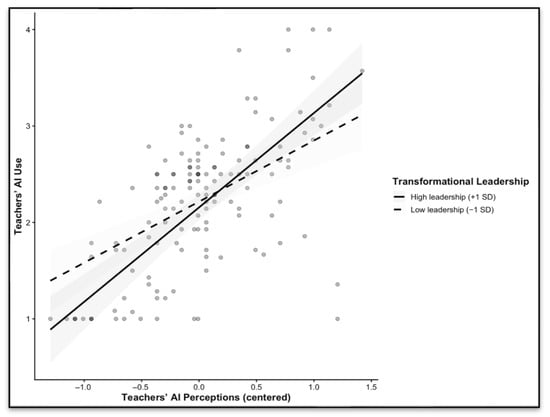
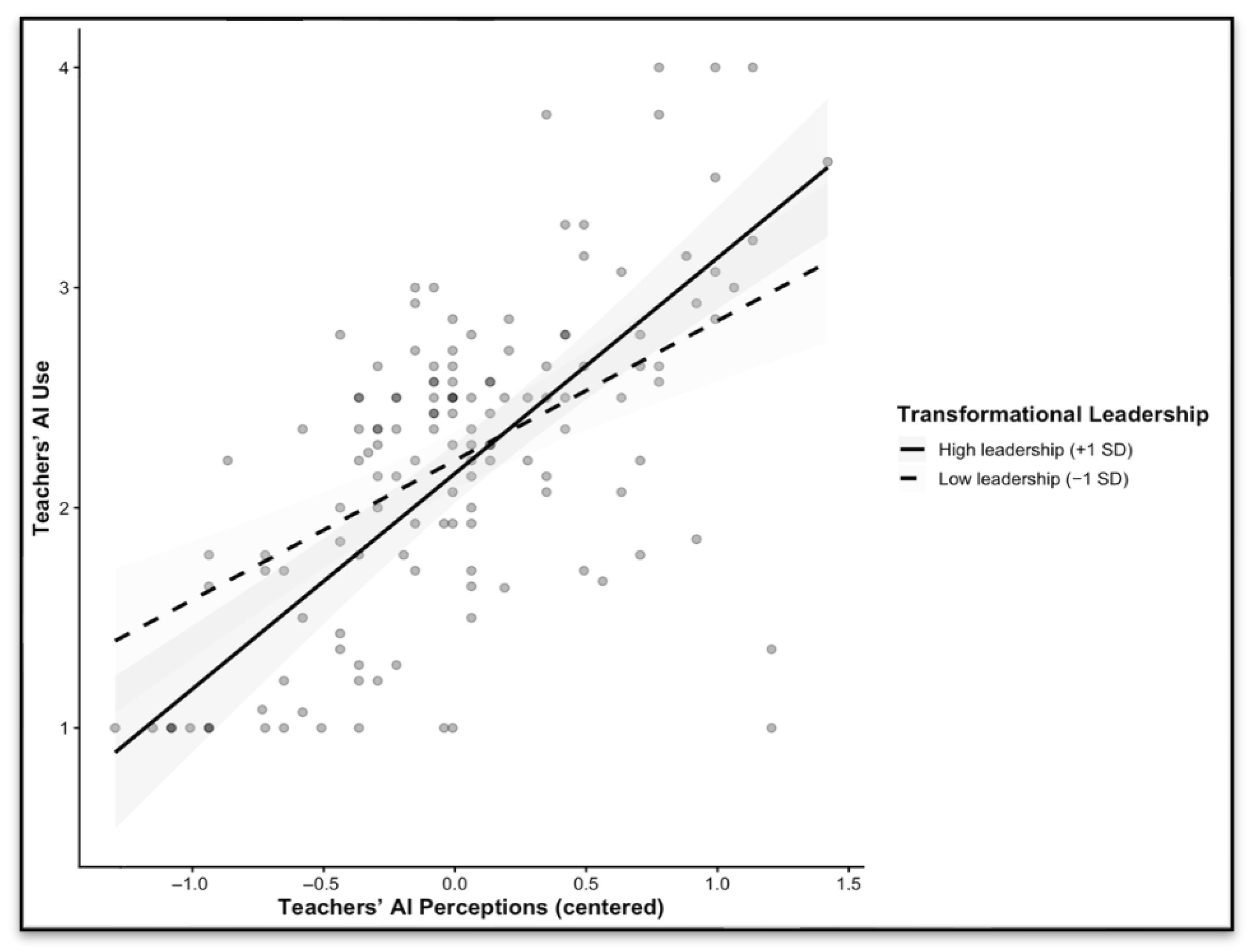
The interaction between teachers’ AI perceptions and transformational leadership was statistically significant (B = 0.386, SE = 0.178, p < 0.05), indicating that transformational leadership moderates the relationship between perceptions and AI use. Figure 2 illustrates the moderating effect of transformational school leadership on the relationship between teachers’ perceptions of AI and AI use.
Figure 2.
Moderating Effect of Transformational Leadership on the Relationship between Teachers’ AI Perceptions and AI Use.
The simple slopes analysis indicates that the association between AI perceptions and AI use is stronger under high transformational leadership (+1 SD) than under low transformational leadership (−1 SD). Specifically, when perceived transformational leadership is high, teachers who report more positive perceptions of AI use substantially more AI. In contrast, under conditions of low transformational leadership, the relationship between perceptions and use is weaker. Although positive perceptions remain associated with increased use, the slope is less steep, suggesting that favorable beliefs alone are insufficient to fully translate into instructional implementation in the absence of supportive leadership. These findings support H3, indicating that transformational leadership functions as a contextual amplifier, strengthening the extent to which teachers’ professional perceptions of AI are translated into classroom practice. In this sense, leadership does not directly determine AI use but enhances the alignment between beliefs and behavior.
Taken together, the results provide partial support for the proposed model. Teachers’ AI perceptions emerged as a strong and consistent predictor of AI use, explaining a substantial proportion of variance in instructional implementation. Transformational leadership was positively associated with teachers’ perceptions of AI, supporting the assumption that leadership shapes professional meaning-making processes. However, transformational leadership did not directly predict AI use. Instead, a significant interaction effect indicated that leadership moderates the relationship between perceptions and behavior, strengthening the translation of positive AI perceptions into classroom practice under higher levels of transformational leadership. These findings highlight the importance of examining both individual-level perceptions and contextual leadership factors when investigating AI integration in educational settings. The theoretical and practical implications of these results are discussed below.
At the time of data collection, the use of artificial intelligence in schools was in an early and exploratory stage. While some teachers had begun experimenting with AI tools for instructional purposes, systematic integration was not yet widespread. In most cases, AI adoption was driven by individual initiative rather than formal policy, leading to variability across schools. This early stage of implementation is important for interpreting the findings, as leadership influence may be particularly salient in shaping teachers’ initial willingness to engage with emerging technologies.
4. Discussion
The present study examined the relationships between school leadership styles, teachers’ perceptions of artificial intelligence (AI), and teachers’ actual use of AI tools in instructional practice. The findings supported all three hypotheses. Teachers’ perceptions of AI emerged as the primary predictor of AI use. Among the leadership styles examined, only transformational leadership significantly predicted teachers’ perceptions of AI. Furthermore, transformational leadership moderates the relationship between perceptions and use, strengthening the association under higher levels of transformational leadership.
Consistent with the Technology Acceptance Model (TAM; Davis, 1989) and its extensions (Venkatesh et al., 2003, 2012), teachers’ perceptions functioned as proximal determinants of AI use. When perceptions were included in the regression model, the predictive contribution of other variables was substantially reduced. This finding underscores that AI adoption in schools is not merely a function of availability or infrastructure, but primarily a matter of professional judgment. Teaching is a relatively autonomous practice in which instructional decisions are made at the classroom level. Accordingly, teachers are unlikely to implement AI tools unless they perceive them as pedagogically meaningful, ethically legitimate, and professionally appropriate Artificial intelligence challenges established notions of authorship, knowledge production, and assessment. Its integration, therefore, requires interpretive and normative clarity rather than solely technical competence. In the absence of pedagogical legitimacy, even accessible tools may remain unused. This highlights the importance of the organizational context in shaping how teachers interpret and evaluate emerging technologies.
Teachers’ decisions are embedded within normative school environments that define what is considered acceptable, professional, and low-risk practice. Given ongoing uncertainties regarding bias, privacy, transparency, and fairness in AI-based processes, teachers may be hesitant to assume individual responsibility for potentially controversial practices. In such contexts, leadership plays a critical role in reducing ambiguity and signaling legitimacy. Transformational leadership, in particular, was associated with more positive AI perceptions, suggesting that leadership influences innovation adoption by shaping teachers’ interpretive frameworks. This aligns with prior research demonstrating that transformational leadership fosters openness to change, professional confidence, and willingness to experiment with complex innovations (Afshari et al., 2009; Özdemir et al., 2024; Schmitz et al., 2023; Sun et al., 2017; Zeng et al., 2025).
In contrast, distributed (participative) and transactional leadership did not significantly predict perceptions or use. While these styles may support routine management, collaboration, or goal attainment, they may be less suited to guiding innovations characterized by ethical and pedagogical uncertainty. AI integration represents not only an operational shift but also a conceptual and normative transformation. Such change appears to require leadership that provides intellectual stimulation, articulates vision, and legitimizes professional experimentation, core dimensions of transformational leadership.
Importantly, transformational leadership did not directly predict AI use after accounting for perception. Instead, it moderated the relationship between perception and use. This suggests that leadership does not mechanically produce instructional change; rather, it strengthens the translation of professional beliefs into enacted practice. Even when teachers hold positive perceptions of AI, their implementation decisions are influenced by organizational climate and contextual support. Transformational leadership may therefore function as a contextual enabler, reducing perceived risk, establishing shared norms, and fostering psychological safety for experimentation.
The study also identified a perception–practice gap: although teachers reported relatively positive perceptions of AI, actual use was lower. Similar discrepancies have been documented in prior research on the adoption of advanced technologies in education (Al Darayseh, 2023; Zhang et al., 2023). Ethical concerns, pedagogical uncertainty, and structural barriers may contribute to this gap (Akgun & Greenhow, 2022; Khreisat et al., 2024). The findings indicate that cultivating positive attitudes alone is insufficient; leadership must actively address structural and ethical conditions that enable routine implementation.
Theoretically, the study contributes to a multi-level understanding of AI integration by integrating individual-level technology acceptance frameworks with leadership theory. Teachers’ perceptions operate as proximal mechanisms of adoption, whereas transformational leadership functions as a contextual condition that both shapes perceptions and strengthens their behavioral enactment. AI adoption in schools thus emerges as an interpretive process situated within organizational meaning systems rather than a linear process of technological diffusion. While recent systematic reviews have conceptually linked transformational leadership and technology acceptance in the context of AI integration (e.g., Zeng et al., 2025), empirical examinations of how leadership shapes the translation of teachers’ perceptions into practice remain limited.
From a practical perspective, the findings suggest that school leaders seeking to promote responsible AI integration should move beyond prescriptive implementation directives. Effective leadership requires articulating pedagogical legitimacy, clarifying ethical boundaries, establishing clear policies regarding privacy and transparency, and fostering professional dialogue about instructional quality. Targeted professional development should focus on pedagogical application rather than solely on technical operation. Moreover, cultivating psychological safety for experimentation to allow teachers to explore, reflect, and adjust practice is central to transformational leadership in the context of AI.
Despite its contributions, the study has limitations. The use of a convenience sample and self-reported data may limit generalizability and introduce social desirability bias. Additionally, the moderate reliability of the leadership measures warrants cautious interpretation. Future research may benefit from longitudinal designs, observational data, or mixed-method approaches to examine how leadership practices are enacted in situ to support AI-related innovation. AI integration in schools is a multi-layered process shaped by both psychological and organizational dynamics. Teachers’ perceptions constitute a central mechanism in AI adoption, yet transformational school leadership serves as the enabling condition that translates these perceptions into sustained educational practice.
5. Conclusions
This study examined the interplay between teachers’ perceptions of artificial intelligence (AI), school leadership styles, and teachers’ AI use in instructional practice. The findings demonstrate that teachers’ AI perceptions are the strongest predictor of AI use, while transformational leadership serves as a contextual condition that both shapes these perceptions and facilitates their translation into practice. Importantly, transformational leadership did not directly predict AI use after accounting for perceptions. Instead, it amplified the relationship between belief and behavior. These findings suggest that AI integration in schools should not be conceptualized as a purely technological or managerial process, but as a multi-level professional and organizational phenomenon in which interpretive frameworks and leadership climate interact. The results highlight that fostering positive attitudes toward AI among teachers is necessary but insufficient. Sustainable integration requires leadership that provides pedagogical legitimacy, reduces ethical ambiguity, and creates psychologically safe conditions for experimentation. As AI continues to reshape educational environments, understanding how leadership and professional meaning-making intersect will be critical for supporting responsible and effective implementation.
Funding
This research received no external funding.
Institutional Review Board Statement
The research discussed in this paper received ethical approval from the Research Authority, Herzog College. Approval number: 2025/080; date of approval: 19 August 2025.
Informed Consent Statement
Informed consent was obtained from all subjects involved in the study.
Data Availability Statement
Data available upon request due to restrictions placed on participant privacy; however, segments of the data can be requested by contacting the corresponding author.
Conflicts of Interest
The author declares no conflicts of interest.
References
- Abdullah, N. S., & Kadir, S. A. (2023). Relationship between principals’ digital leadership and teachers’ digital competency in Klang district secondary schools. Asian Journal of Vocational Education and Humanities, 4(2), 1–14. [Google Scholar] [CrossRef] [Scilit]
- Afshari, M., Bakar, K. A., Luan, W. S., Samah, B. A., & Fooi, F. S. (2009). Technology and school leadership. Technology, Pedagogy and Education, 18(2), 235–248. [Google Scholar] [CrossRef] [Scilit]
- Akgun, S., & Greenhow, C. (2022). Artificial intelligence in education: Addressing ethical challenges in K-12 settings. AI and Ethics, 2(3), 431–440. [Google Scholar] [CrossRef] [Scilit]
- Al Darayseh, A. (2023). Acceptance of artificial intelligence in teaching science: Science teachers’ perspective. Computers and Education: Artificial Intelligence, 4, 100132. [Google Scholar] [CrossRef] [Scilit]
- Al Nuaimi, H., Ahmad, S. Z., & Khalid, K. (2024). The importance of the school principals’ role in the digital transformation of the education sector. International Journal of Comparative Education and Development, 26(1), 17–37. [Google Scholar] [CrossRef] [Scilit]
- Bingham, A. J. (2021). How distributed leadership facilitates technology integration: A case study of “pilot teachers”. Teachers College Record, 123(7), 1–34. [Google Scholar] [CrossRef] [Scilit]
- Bryant, D. A., & Walker, A. (2024). Principal-designed structures that enhance middle leaders’ professional learning. Educational Management Administration & Leadership, 52(2), 435–454. [Google Scholar] [CrossRef] [Scilit]
- Cohen, J. (1988). Statistical power analysis for the behavioral sciences. Routledge. [Google Scholar]
- Cope, B., Kalantzis, M., & Searsmith, D. (2021). Artificial intelligence for education: Knowledge and its assessment in AI-enabled learning ecologies. Educational Philosophy and Theory, 53(12), 1229–1245. [Google Scholar] [CrossRef] [Scilit]
- Creely, E., & Carabott, K. (2025). Teaching and learning with AI: An integrated AI-oriented pedagogical model. The Australian Educational Researcher, 52, 4633–4654. [Google Scholar] [CrossRef] [Scilit]
- Davis, F. D. (1989). Perceived usefulness, perceived ease of use, and user acceptance of information technology. MIS Quarterly, 13, 319–340. [Google Scholar] [CrossRef] [Scilit]
- Dexter, S. (2011). School technology leadership: Artifacts in systems of practice. Journal of School Leadership, 21(2), 166–189. [Google Scholar] [CrossRef] [Scilit]
- Dong, B. (2023). A systematic review of the transactional leadership literature and future outlook. Academic Journal of Management and Social Sciences, 2(3), 21–25. [Google Scholar] [CrossRef] [Scilit]
- Filiz, O., Kaya, M. H., & Adiguzel, T. (2025). Teachers and AI: Understanding the factors influencing AI integration in K-12 education. Education and Information Technologies, 30, 17931–17967. [Google Scholar] [CrossRef] [Scilit]
- Fleishman, E. A. (1989). Leadership opinion questionnaire (revised manual). London House. [Google Scholar]
- Fullan, M. (2016). The elusive nature of whole system improvement in education. Journal of Educational Change, 17(4), 539–544. [Google Scholar] [CrossRef] [Scilit]
- Galdames-Calderón, M. (2023). Distributed leadership: School principals’ practices to promote teachers’ professional development for school improvement. Education Sciences, 13(7), 715. [Google Scholar] [CrossRef] [Scilit]
- Guan, L., Zhang, Y., & Gu, M. M. (2025). Pre-service teachers’ preparedness for AI-integrated education: An investigation from perceptions, capabilities, and teachers’ identity changes. Computers and Education: Artificial Intelligence, 8, 100341. [Google Scholar] [CrossRef] [Scilit]
- Guilherme, A. (2019). AI and education: The importance of teacher and student relations. AI & Society, 34(1), 47–54. [Google Scholar] [CrossRef] [Scilit]
- Karakose, T., & Tülübas, T. (2024). School leadership and management in the age of artificial intelligence (AI): Recent developments and future prospects. Educational Process: International Journal, 13(1), 7–14. [Google Scholar] [CrossRef] [Scilit]
- Khreisat, M. N., Khilani, D., Rusho, M. A., Karkkulainen, E. A., Tabuena, A. C., & Uberas, A. D. (2024). Ethical implications of AI integration in educational decision making: Systematic review. Educational Administration: Theory and Practice, 30(5), 8521–8527. [Google Scholar] [CrossRef] [Scilit]
- Lewin, E., & Gadge, M. (2024). The differences between teachers’ attitudes towards using artificial intelligence for their own needs versus using it with students and the relationship to perceived usefulness, perceived control, and tendency toward innovation [Unpublished masters’ thesis].
- Luckin, R., & Holmes, W. (2016). Intelligence unleashed: An argument for AI in education. UCL Knowledge Lab. [Google Scholar]
- Özdemir, S., Sezgin, F., Kılınç, A. Ç., Erdoğan, O., & Turan Bora, H. (2024). Unveiling the associations between principal self-efficacy, openness to change and transformational leadership: The mediating role of well-being. Journal of Educational Administration, 62(5), 528–544. [Google Scholar] [CrossRef] [Scilit]
- Qureshi, I. (2025). The impact of AI on teacher roles: Towards a collaborative human-AI pedagogy. AI Edify Journal. Available online: https://researchcorridor.org/index.php/aiej/article/view/243/232 (accessed on 20 March 2026).
- Ruloff, M., & Petko, D. (2025). School principals’ educational goals and leadership styles for digital transformation: Results from case studies in upper secondary schools. International Journal of Leadership in Education, 28(2), 422–440. [Google Scholar] [CrossRef] [Scilit]
- Schiff, D. (2022). Education for AI, not AI for education: The role of education and ethics in national AI policy strategies. International Journal of Artificial Intelligence in Education, 32(3), 527–563. [Google Scholar] [CrossRef] [Scilit]
- Schmitz, M. L., Antonietti, C., Consoli, T., Cattaneo, A., Gonon, P., & Petko, D. (2023). Transformational leadership for technology integration in schools: Empowering teachers to use technology in a more demanding way. Computers & Education, 204, 104880. [Google Scholar] [CrossRef] [Scilit]
- Sun, J., Chen, X., & Zhang, S. (2017). A review of research evidence on the antecedents of transformational leadership. Education Sciences, 7(1), 15. [Google Scholar] [CrossRef] [Scilit]
- Venkatesh, V., Morris, M. G., Davis, G. B., & Davis, F. D. (2003). User acceptance of information technology: Toward a unified view. MIS Quarterly, 27, 425–478. [Google Scholar] [CrossRef] [Scilit]
- Venkatesh, V., Thong, J. Y., & Xu, X. (2012). Consumer acceptance and use of information technology: Extending the unified theory of acceptance and use of technology. MIS Quarterly, 36, 157–178. [Google Scholar] [CrossRef] [Scilit]
- Zeng, M., Cheah, K. S., & Abdullah, Z. (2025). The influence of school principals’ digital leadership on teachers’ competency in integrating artificial intelligence: A systematic thematic review. Frontiers in Education, 10, 1655967. [Google Scholar] [CrossRef] [Scilit]
- Zhang, C., Schießl, J., Plößl, L., Hofmann, F., & Gläser-Zikuda, M. (2023). Acceptance of artificial intelligence among pre-service teachers: A multigroup analysis. International Journal of Educational Technology in Higher Education, 20(1), 49. [Google Scholar] [CrossRef] [Scilit]



Disclaimer/Publisher’s Note: The statements, opinions and data contained in all publications are solely those of the individual author(s) and contributor(s) and not of MDPI and/or the editor(s). MDPI and/or the editor(s) disclaim responsibility for any injury to people or property resulting from any ideas, methods, instructions or products referred to in the content. |
© 2026 by the author. Licensee MDPI, Basel, Switzerland. This article is an open access article distributed under the terms and conditions of the Creative Commons Attribution (CC BY) license.