


Abstract
The use of extended reality technologies in cultural heritage contexts raises questions about their effectiveness in enhancing emotional, cognitive, and experiential engagement with artworks, particularly when direct access to original pieces is limited. The aim of this study was to compare emotional, cognitive, and physiological responses elicited by different modes of art presentation and to evaluate their effectiveness relative to direct, in-person museum viewing as a benchmark condition. The study examined visitors’ responses to Caravaggio’s Adoration of the Shepherds through three digital presentation modalities: Virtual Reality (VR), Augmented Reality (AR), and life-sized screen projection (LSP). Seventy-one voluntary participants completed affective assessments (PANAS, SAM), physiological recordings (heart rate, electrodermal activity, oxygen saturation), and artwork evaluations of creativity, pleasantness, technique, and curiosity. Results indicated significant effects of presentation modality: VR tended to elicit the strongest engagement-related responses, including higher positive affect, greater physiological activation, and more favorable ratings of pleasantness and curiosity, whereas AR and LSP showed more variable patterns. Physiological indicators confirmed increased arousal during VR exposure, supporting its potential to evoke more intense affective involvement. These findings suggest that immersive technologies may complement direct museum encounters by fostering curiosity, emotional engagement, and visitor-centered exploration, thereby enriching cultural heritage experiences and informal learning opportunities. Specifically, significant effects of presentation modality were observed for positive affect (F(2,140) = 6.23, p < 0.01), happiness (F(2,140) = 6.78, p = 0.003), skin conductance (F(2,140) = 7.15, p = 0.002), heart rate (F(2,140) = 4.32, p = 0.017), pleasantness (F(2,140) = 9.64, p < 0.001), and curiosity (F(2,140) = 5.21, p = 0.008), with VR generally yielding the highest scores on these measures.
1. Introduction
The integration of digital technologies, particularly Augmented Reality (AR) and Virtual Reality (VR), has emerged as a transformative trend across numerous fields, including education, cultural heritage, tourism, and entertainment. These immersive technologies are reshaping how information is presented, accessed, and experienced, offering new opportunities for engagement and learning. In museum contexts, AR and VR have evolved from being niche tools to becoming central components in enhancing visitor experiences, whether through virtual exhibitions or interactive storytelling (Guertin-Lahoud et al., 2023; Bachiller et al., 2023; Zidianakis et al., 2021; Besoain et al., 2021). The growing adoption of these tools reflects their potential to bridge gaps in accessibility, inclusivity, and user engagement (Guertin-Lahoud et al., 2023; Zidianakis et al., 2021; Besoain et al., 2021; Pei et al., 2023).
Museums represent key informal learning environments where visitors engage with cultural heritage, science, and technology through exploratory and self-directed experiences. In this context, extended reality (XR) tools may enhance visitor engagement by fostering curiosity, emotional involvement, and meaning-making processes beyond traditional exhibition formats.
In recent years, immersive technologies such as virtual reality (VR) and augmented reality (AR) have increasingly been adopted in museums to support interactive interpretation, visitor-centered exploration, and technology-mediated forms of engagement. These tools are often discussed as promising resources for informal learning, as they may stimulate epistemic curiosity and deeper reflection during the museum experience. Importantly, such engagement is not only cognitive but also deeply embodied and affective. In this regard, recent neuroscientific discoveries have revealed a stronger connection between creators, their artistic works, and viewers, showing how embodied mechanisms can simulate actions, bodily sensations, and emotions, thereby enhancing the empathetic experience of art. This perspective suggests that AR and VR may further intensify this relationship by blending cognitive and sensory elements within immersive museum encounters (Freedberg & Gallese, 2007; Huang et al., 2019).
The application of immersive technologies in cultural heritage contexts enables not only broader accessibility but also deeper emotional and cognitive engagement with artistic works (Chen et al., 2025; Bachiller et al., 2023; Besoain et al., 2021; Zidianakis et al., 2021). However, user acceptance and experience remain pivotal to the success of AR and VR applications. While these technologies allow unprecedented levels of immersion and interaction, their adoption depends heavily on usability and the overall quality of the experience provided. Research has shown that immersive environments can enhance engagement and informal learning processes, yet challenges remain in optimizing factors such as presence, interactivity, and emotional arousal (Freeman et al., 2001; Guertin-Lahoud et al., 2023; Wiederhold, 2023).
In the context of aesthetic experience, presence is particularly relevant as it may enhance the perceptual connection between the viewer and the artwork, supporting processes of attention, meaning-making, and emotional resonance. Immersive environments such as VR may therefore promote deeper engagement by integrating the sensory, cognitive, and affective components of experience. Building on this framework, the present study assumes that differences in levels of technological immersion (VR, AR, and LSP) are likely to be associated with variations in experienced presence, which may in turn be reflected in measurable differences in emotional, cognitive, and physiological responses.
Additionally, individual differences—including familiarity with technology, personal preferences, and cognitive load—raise important questions about how immersive interfaces can be designed to accommodate diverse museum audiences (Bachiller et al., 2023; Guertin-Lahoud et al., 2023; Pei et al., 2023). Methodological considerations also play a critical role in advancing the field. The development of AR and VR systems typically involves iterative user-centered design, usability testing, and performance evaluation. Accordingly, researchers increasingly employ mixed methods approaches, combining psychometric surveys, interviews, and physiological measurements to assess engagement, emotional impact, and visitor experience (Bachiller et al., 2023; Guertin-Lahoud et al., 2023; Pei et al., 2023). Despite these efforts, important gaps remain in the museum technology literature. In particular, comparative evidence across different mediation formats—such as Virtual Reality, Augmented Reality, large-scale projection, and direct in-person viewing—is still limited. Moreover, few studies have simultaneously integrated emotional, cognitive, and physiological indicators to evaluate how these modalities shape visitor engagement and meaning-making in informal learning contexts (Pei et al., 2023; Wiederhold, 2023; Zidianakis et al., 2021). Moreover, digital museums increasingly leverage AR and VR to create immersive and personalized experiences, allowing users to interact with three-dimensional artifacts and explore narratives in innovative ways (Bachiller et al., 2023; Pei et al., 2023; Zidianakis et al., 2021). Platforms such as the Invisible Museum further demonstrate how storytelling, semantic representation, and user-driven customization can address challenges related to accessibility, preservation, and audience diversity (Besoain et al., 2021; Pei et al., 2023; Zidianakis et al., 2021).
Building on these advancements, the present study examines how different modalities of artwork mediation—Virtual Reality (VR), Augmented Reality (AR), life-sized projection on a screen, and direct in-person viewing—shape visitors’ emotional, cognitive, and physiological responses when the artwork is physically present in the museum. By focusing on Caravaggio’s Adoration of the Shepherds (Museo Regionale di Messina, Italy), this research aims to evaluate which modality most effectively supports visitor engagement and technology-enhanced informal learning experiences (Locher et al., 2001).
Furthermore, to establish a meaningful benchmark for comparison, the same emotional, cognitive, and physiological indicators were also collected during direct museum viewing, which represents the reference condition for experiencing the artwork within its authentic context. This comparison allows us to examine whether immersive and non-immersive digital modalities can complement—rather than replace—the direct encounter with the original artwork. In line with perspectives on technology-enhanced museum learning, these digital reproductions are conceived as tools to broaden access, foster visitor-centered exploration, and support reflective meaning-making processes among diverse audiences. Overall, the present multimodal approach seeks to highlight how immersive technologies may enrich informal educational opportunities in museums by promoting curiosity, emotional involvement, and sustained engagement with cultural heritage experiences.
Aim and Hypotheses
The primary aim of this study was to compare visitors’ emotional, cognitive, and physiological responses to Caravaggio’s Adoration of the Shepherds across three digital mediation modalities—Virtual Reality (VR), Augmented Reality (AR), and life-sized screen projection (LSP)—using direct in-person museum viewing as a benchmark condition.
Drawing on presence theory, which suggests that more immersive environments elicit stronger engagement and affective involvement (Dunin-Kozicka et al., 2025), we formulated the following hypotheses. In the present study, presence and immersion were treated as theoretical properties of the presentation modalities—particularly VR relative to AR and LSP—rather than as variables directly measured through a dedicated presence questionnaire. Therefore, our hypotheses focused on observable correlates of engagement, namely emotional self-reports, physiological activation, and cognitive evaluations of the artwork.
H1 (Emotional response).
Participants will report higher emotional engagement when viewing the artwork in VR compared to AR and LSP, and higher engagement in AR compared to LSP.
H2 (Cognitive response).
Participants will show greater cognitive appreciation and aesthetic judgment in VR compared to AR and LSP, and greater appreciation in AR compared to LSP.
H3 (Physiological response).
Participants will exhibit higher physiological arousal (e.g., heart rate and electrodermal activity) in VR compared to AR and LSP, and higher arousal in AR compared to LSP.
H4 (Moderating factors).
Individual characteristics (e.g., age, gender, prior familiarity with immersive technologies, art interest, and dispositional positive affect) will moderate emotional, cognitive, and physiological responses across presentation modalities.
2. Materials and Methods
2.1. Participants
Seventy-one participants (N = 71) were recruited on a voluntary basis through university mailing lists, social media, and flyers and were invited to take part in a study on museum-based art experiences. Demographic information (age, gender, educational level, and profession) was collected prior to the experiment.
To minimize expectancy effects related to immersive technologies, participants were informed about the study objectives in general terms, without emphasizing the use of VR or AR. In addition, participants completed a pre-experiment questionnaire assessing prior experience with virtual and augmented reality. This allowed us to examine whether familiarity with immersive technologies influenced emotional engagement or usability responses. The sample included both participants with little to no prior experience as well as those more familiar with such technologies.
2.2. Settings and Experimental Conditions
The study focused on the experience of Caravaggio’s Adoration of the Shepherds, housed at the Regional Museum of Messina (Italy). Digital environments for augmented and virtual reality viewing were developed in order to compare immersive and non-immersive modalities of engagement with the artwork.
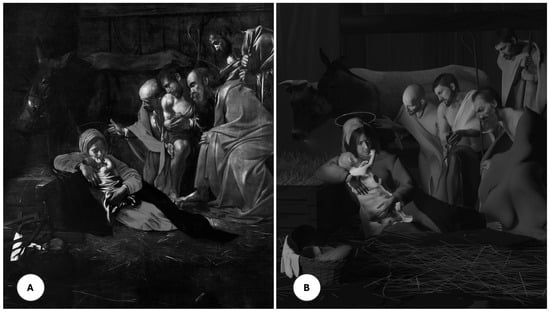
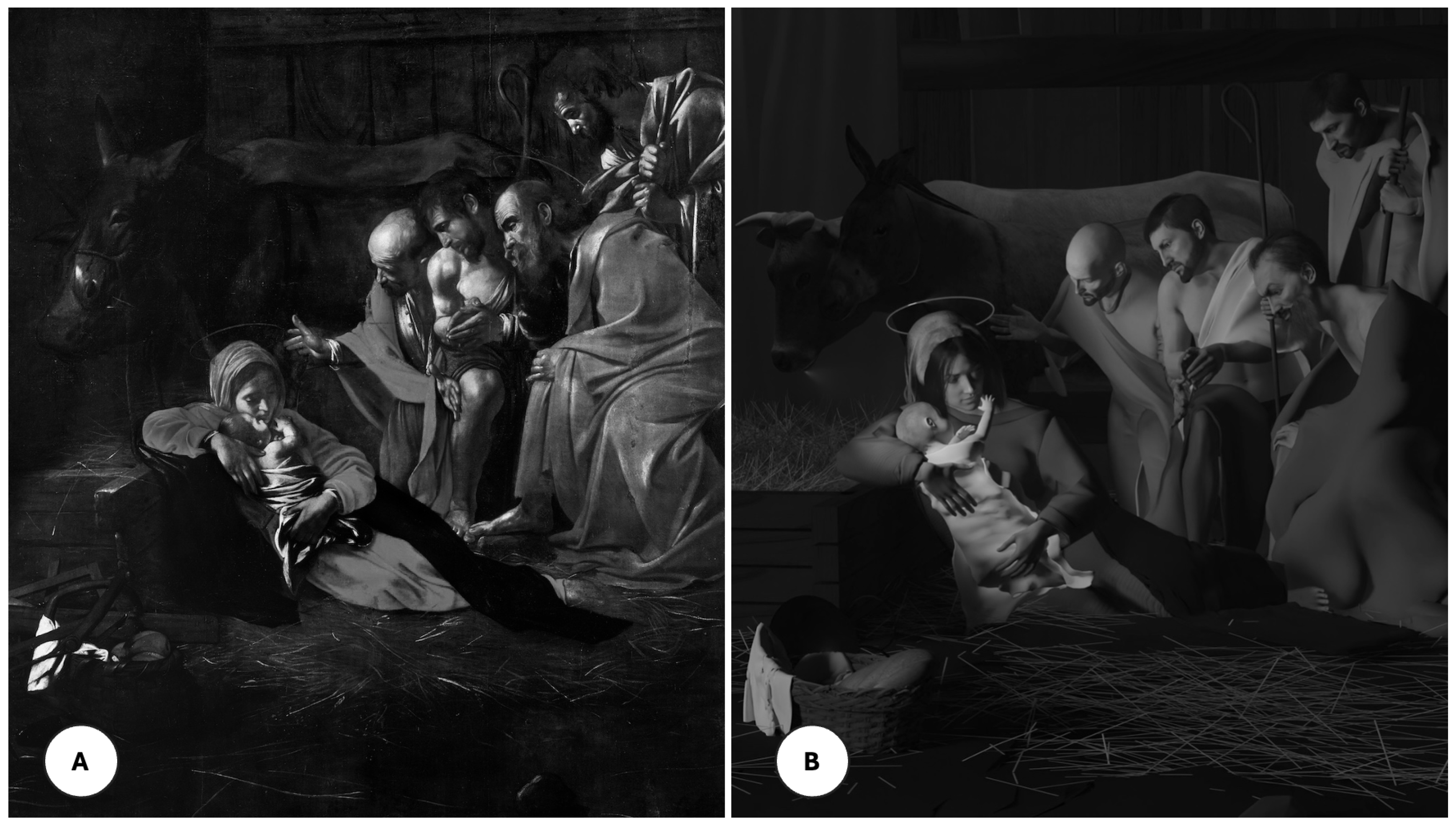
The three-dimensional reconstruction of the scene, including the six main characters and surrounding iconographic elements, required careful spatial reconfiguration, as the original composition is compressed within the two-dimensional pictorial surface. The modeling process was carried out using Blender, and the resulting environment was implemented in Unity 3D to create an application for the Meta Oculus Quest 3 headset (Figure 1). The choice of a standalone headset was motivated by the aim of ensuring user freedom of movement without requiring a wired computer connection.
Figure 1.
(A) Caravaggio’s Adoration of the Shepherds, courtesy of Museo Regionale di Messina (Italy); (B) 3D reproduction of the scene of Caravaggio’s Adoration of the Shepherds.
Participants experienced the artwork through four modalities: Virtual Reality (VR), Augmented Reality (AR), life-sized screen projection (LSP), and direct in-person viewing in the museum. This within-subject design enabled systematic comparison of emotional, cognitive, and physiological responses across formats.
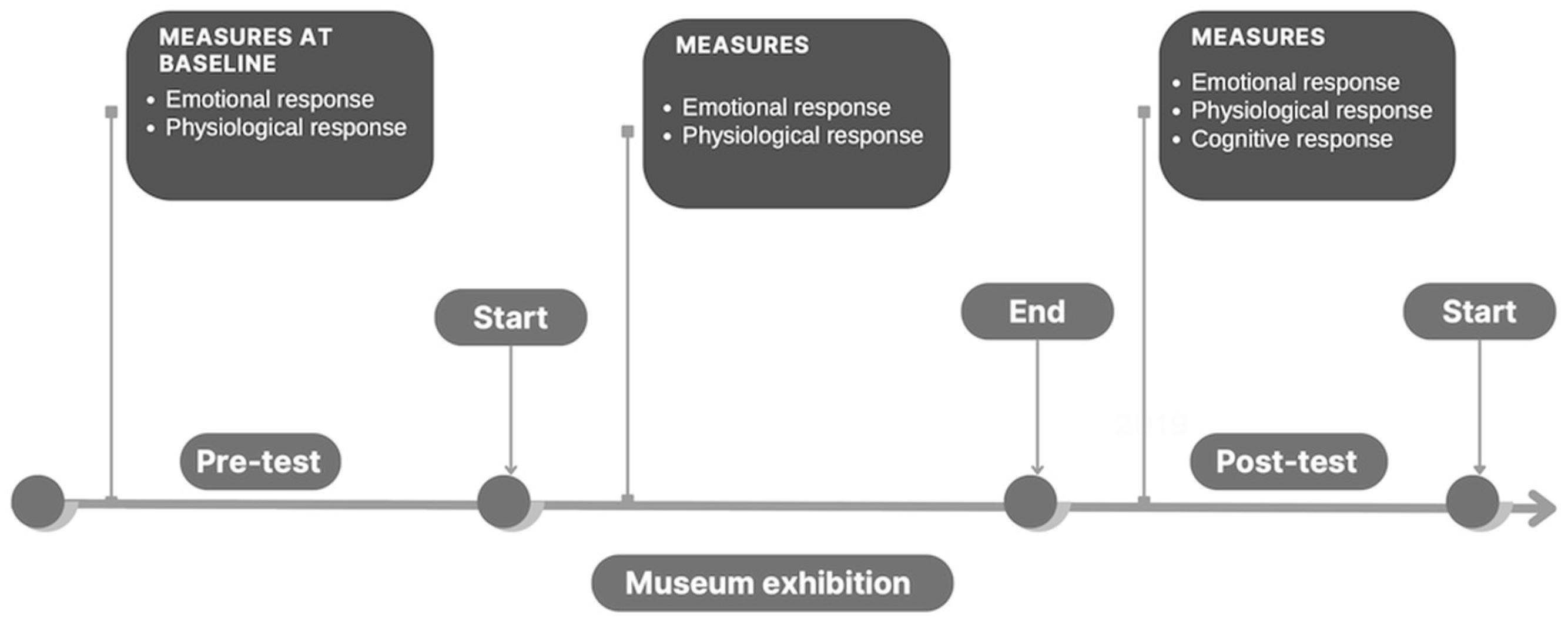
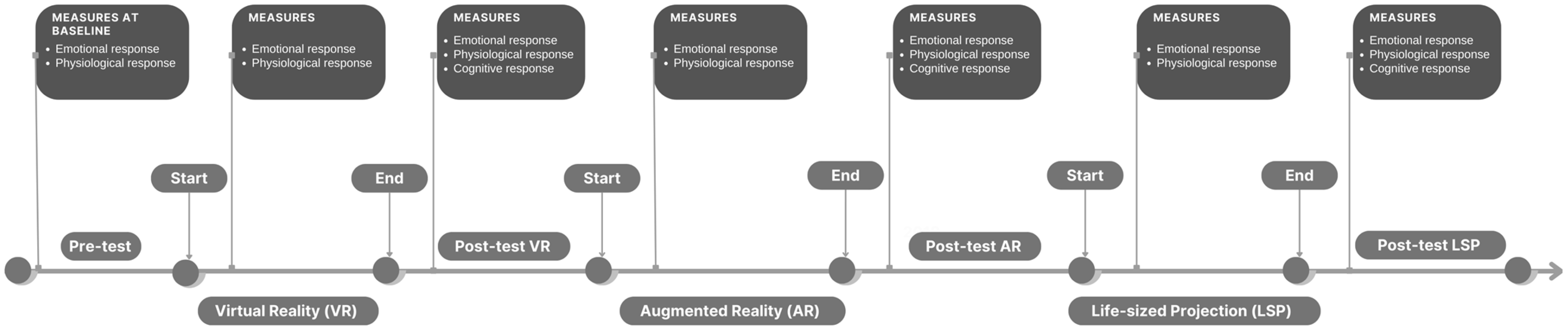
Live viewing took place at the Regional Museum of Messina, whereas the VR, AR, and LSP conditions were conducted at the HuM-HI Laboratory of the University of Messina. The order of the four conditions and questionnaire administration was randomized to minimize sequence and fatigue effects. Sessions were scheduled approximately five days apart; however, due to recruitment procedures and logistical constraints, data collection extended over one academic year. The overall study procedure and the timeline of the four experimental conditions are illustrated in Figure 2 and Figure 3.
Figure 2.
Experimental procedure. Overview of the study workflow, including baseline (pre-test), museum experience, and post-test assessments.
Figure 3.
Experimental workflow across laboratory conditions. Sequence of the procedure across VR, AR, and LSP, including pre-test and post-test assessments (see Section 2).
2.3. Research Tools and Procedure
Prior to the experimental sessions, participants were assigned an anonymous identification code and completed a baseline questionnaire assessing demographic variables and general interest in art. This questionnaire was adapted from Chamorro-Premuzic and Furnham (2005) to measure museum attendance, artistic engagement, and self-reported art knowledge.
Participants also completed a questionnaire assessing prior experience with immersive technologies, adapted from Bernava et al. (2021), to examine whether technological familiarity was associated with participants’ engagement and emotional reactions. Baseline affective state was assessed using the Self-Assessment Manikin (SAM; Bradley & Lang, 1994), which measures valence, arousal, and dominance. In addition, participants completed the Positive and Negative Affect Schedule (PANAS; Watson et al., 1988) to assess habitual mood, and dispositional positive emotionality was further evaluated using the scale proposed by Chirico et al. (2021). No direct measure of presence or immersion (e.g., a standardized presence questionnaire) was administered. Instead, modality-related differences were examined through a multimethod set of outcome indicators, including self-reported affective responses, physiological activation (HR, HRV, EDA, oxygen saturation), cognitive evaluations of the artwork, and usability ratings for the immersive conditions.
2.4. Physiological Measures
Before, during, and after each viewing condition, physiological indicators of arousal were collected, including heart rate (HR), heart rate variability (HRV), electrodermal activity (EDA), and blood oxygen saturation. Measures were recorded non-invasively using a consumer-grade wearable device (Fitbit Sense 2).
The use of Fitbit devices is supported by validation studies. Helmer et al. (2022) reported a mean absolute error below 5 bpm compared to ECG measures, while Ko et al. (2025) found moderate correlations for HR and EDA indicators, although systematic bias was also noted. Evidence from real-world monitoring further suggests that Fitbit devices provide reasonably accurate HR estimates during daily activities (Gorny et al., 2017).
Physiological indicators were interpreted as relative markers of emotional arousal and engagement rather than as clinical diagnostic measures.
2.5. Post-Viewing Measures
After experiencing the artwork in each of the four modalities (live viewing, LSP, AR, and VR), participants completed a set of self-report measures assessing emotional responses, usability, and evaluative judgments. Because the study involved four viewing modalities, most measures were administered after each condition, whereas usability questionnaires were administered only for the immersive VR and AR formats.
Finally, participants completed an aesthetic judgment questionnaire adapted from Hagtvedt and Patrick (2008), assessing perceived quality and appreciation of the artwork across conditions. They were instructed to evaluate the artwork as presented in each modality. In particular, the “Curiosity” item was intended to capture the extent to which the viewing experience elicited interest in the painting and a desire to further explore or understand it, rather than curiosity directed exclusively toward the technology itself. Likewise, the “Technique” item referred to the perceived artistic execution and stylistic qualities of Caravaggio’s painting (e.g., compositional and expressive technique), rather than to the technical quality of the digital model, rendering, or display system.
2.6. Statistical Analysis
Data were analyzed using SPSS Version 25 for Mac. The descriptive statistics of the dependent variables were tabulated and examined. The alpha level was set to 0.05 for all statistical tests. In the case of significant effects, the effect size of the test was reported. The effect sizes were computed and categorized according to Cohen (1988). The Greenhouse–Geisser adjustment for non-sphericity was applied to probability values for repeated measures. Data were analyzed by repeated measures analysis of variance (ANOVA). Post hoc pairwise comparisons were performed using paired-sample t-tests with Bonferroni correction to control for multiple comparisons. Planned comparisons were limited to the three primary contrasts (VR vs. AR, VR vs. LSP, AR vs. LSP).
All data were analyzed with reference to Emotional responses: Positive Affect (PA of PANAS scale), Negative Affect (NA of PANAS scale), Sadness/Happiness of SAM scale, Sleepiness/Excitement of SAM scale, Submission/Dominance of SAM scale; Physiological Response: level of skin conductance (EDA), level of oxygen saturation (OS), Heart Rate (HR), Heart Rate Variability (HRV); Cognitive Response refers to artwork evaluation in terms of: Creativity (CRE), Pleasantness (PLS), Technique (TEC) and Curiosity (CUR).
The cognitive evaluation variables were selected to capture complementary dimensions of aesthetic evaluation and cognitive processing during the art experience. Together, they provide a multidimensional assessment of the evaluative and motivational aspects of the aesthetic response. Creativity reflects the perceived originality and expressive value of the artwork and is associated with higher-level interpretative processing. Pleasantness captures the positive appraisal of the artwork and is closely linked to aesthetic judgment. Technique refers to the perceived quality of artistic execution and stylistic features of the painting, representing a more knowledge-based evaluative dimension. Curiosity reflects the extent to which the artwork stimulates interest and a desire to further explore or understand it.
3. Results
3.1. Preliminary Analysis (a)
For data analysis, an initial preliminary analysis was conducted to examine the cognitive, emotional, and physiological parameters of the participants at the museum site. This analysis served as a baseline to understand the subjects’ reactions to the actual artwork located at the Museo di Messina. Table 1 shows the means and SDs of the emotional, physiological and artwork evaluation.
Table 1.
Means and standard deviations of the responses.
T-tests for paired samples suggest that participants experienced a significant reduction in negative affect and a significant increase in happiness while viewing the artwork at the museum, whereas positive affect showed only a small, non-significant increase. Physiologically, there was a notable decrease in heart rate, indicating a reduction in physiological arousal, potentially reflecting a calming or relaxing effect of the art experience. This reduction was observed from baseline (T1) to museum exposure (T2). Other measures such as skin conductance and HRV showed minimal or non-significant changes.
The cognitive evaluations of the artwork indicated high levels of creativity, pleasantness, technique, and curiosity, as the scores were close to the maximum range of 7. This suggests that participants perceived the artwork very positively in terms of these attributes. These preliminary findings describe responses in the live museum condition, which served as a benchmark before examining differences across the three digital presentation modalities.
3.2. Preliminary Analysis (b)
Before proceeding with the evaluation of the hypotheses, a User Experience Evaluation was conducted for both Interactive Virtual Reality (VR) and Augmented Reality (AR) based on the User Satisfaction Evaluation Questionnaire (USEQ) (Bernava et al., 2021). This analysis aimed to demonstrate that the implementation of both AR and VR systems was effective and met satisfactory usability standards. Table 2 shows means and standard deviations for each item. The conditions of Usability, Control Capacity, and Clarity of Information were reported as moderate to high, with scores ranging from 4 to 5 out of 5 points. In contrast, the conditions of Difficulty, Stress, and Fatigue were reported as low, with scores ranging from 1 to 2. The internal consistency of the USEQ was acceptable across conditions (Cronbach’s α = 0.78 for VR, 0.72 for AR, and 0.70 for LSP), confirming the reliability of the instrument in the present sample. This analysis allows us to conclude that satisfactory usability standards were met.
Table 2.
Means and standard deviations (SD) of USEQ items for VR and AR conditions.
3.3. Comparing Digital Presentation Platforms
To compare participants’ emotional, physiological, and cognitive responses across the three digital presentation modalities (Virtual Reality [VR], Augmented Reality [AR], and Life-Sized Projection [LSP]), one-way repeated-measures ANOVAs were conducted for each dependent variable. For measures that included baseline (pre-exposure) data, a 2 × 3 repeated-measures ANOVA was performed with Phase (baseline vs. exposure) and Presentation Modality (VR, AR, LSP) as within-subjects factors. Greenhouse-Geisser corrections were applied when the assumption of sphericity was violated. Post hoc pairwise comparisons were performed using paired-sample t-tests with Bonferroni correction to control for multiple comparisons.
With reference to emotional responses, positive affect (PANAS) and happiness (SAM) showed significant main effects of Presentation Modality, with VR eliciting the strongest increase in happiness (Positive affect: F(2,140) = 6.23, p < 0.01, ηp2 = 0.13; Happiness: F(2,140) = 6.78, p = 0.003, ηp2 = 0.19; see Table 3). Negative affect decreased significantly from baseline to exposure across all platforms (F(1,70) = 25.67, p < 0.001, ηp2 = 0.47). No significant differences were observed for excitement or dominance (see Table 3).
Table 3.
Emotional responses in the three digital presentation platforms.
With reference to physiological responses, significant effects of Presentation Modality were found for skin conductance (EDA; F(2,140) = 7.15, p = 0.002, ηp2 = 0.20) and heart rate (HR; F(2,140) = 4.32, p = 0.017, ηp2 = 0.09), with VR showing higher physiological activation, particularly compared to LSP (see Table 4). No significant effects were found for oxygen saturation or heart rate variability. Whereas the live museum encounter was associated with reduced arousal relative to baseline, immersive VR elicited comparatively higher physiological activation among the digital modalities.
Table 4.
Physiological Responses in the three presentation modalities (VR, AR and LSP are evidenced during exposures).
In relation to cognitive evaluations, Presentation Modality had significant effects on pleasantness (F(2,140) = 9.64, p < 0.001, ηp2 = 0.16) and curiosity (F(2,140) = 5.21, p = 0.008, ηp2 = 0.09), with VR receiving the highest ratings, whereas AR and LSP showed more comparable scores (see Table 5). Creativity and technique ratings did not differ significantly across modalities (see Table 5). Overall, VR tended to elicit the strongest emotional, physiological, and cognitive engagement across most measures, whereas AR and LSP produced less consistent patterns depending on the outcome. In particular, the LSP condition showed the lowest positive effect score, slightly below baseline, suggesting that this format may have been less effective in eliciting positive emotional engagement.
Table 5.
Cognitive responses (artwork evaluations) in the three presentation modalities.
4. Discussion
This study focuses on exploring different modalities for experiencing artwork when it is physically present in the museum, aiming to determine which approach can most effectively engage users. By investigating Caravaggio’s Adoration of the Shepherds (Museo Regionale di Messina, Italy), this research specifically aims to evaluate the emotional, cognitive, and physiological responses elicited through three alternative modalities: Virtual Reality (VR), Augmented Reality (AR), and a life-sized projection (LSP) on a screen. Furthermore, to establish a benchmark for comparison, the same emotional, cognitive, and physiological data were collected during a live, in-person viewing of the painting—considered in the authors’ vision as the optimal (ideal) condition for appreciating the artwork.
Analysis of the data indicates that negative emotions decreased and positive emotions increased following the viewing of the artwork. This pattern emerged by comparing emotions measured through the PANAS and the SAM parameters across two time points (baseline and post-test). Participants’ mood at baseline therefore differed from their mood after viewing the artwork. The presentation-mode factor was highly significant. The most engaging setting was the museum, that is, the live viewing condition, which offers viewers a direct connection not only with the physical environment but also with the artist who conceived and created the work. For this reason, the various digital presentation modalities—VR, AR, and high-definition laboratory projection (LSP)—were compared.
The results showed that VR was the most engaging presentation modality. Positive PANAS scores in the post-test followed a different trend relative to negative emotions: positive affect increased compared to baseline, and the difference between VR and the other modalities was substantial. The most notable contrast was between VR and the laboratory projection: participants who viewed the laboratory copy showed lower positive PANAS scores than those who experienced the artwork in VR. Notably, the LSP condition yielded the lowest positive affect score, even slightly below baseline. This pattern suggests that life-sized projection was not simply associated with a more variable response profile, but may also have been less effective in fostering positive emotional engagement. A possible explanation is that the projected laboratory setting offered less immediacy and less experiential closeness to the artwork than either VR or direct viewing, resulting in a more detached and less affectively engaging experience. Regarding negative affect, significant reductions from baseline were observed in all conditions. Thus, while positive affect increased substantially in VR and in the museum, negative affect consistently decreased across all modalities.
Physiological data further confirmed the greater impact of VR: this condition elicited higher positive affect, higher physiological arousal (increased skin conductance and heart rate), and greater enjoyment and curiosity compared with AR and screen-based viewing. The higher curiosity reported in the VR condition should be interpreted cautiously. Although the item was intended to refer to curiosity toward the artwork as experienced in each modality, it is possible that, in immersive VR, this response also partly reflected curiosity elicited by the exploratory affordances and relative novelty of the technological environment itself. For museum application design, this distinction is important, as immersive systems may enhance engagement both by directing attention toward the artwork and by stimulating interaction with the medium through which the artwork is presented. Although VR did not lead to improved technical evaluations of the artwork, it produced significant differences in several other domains, underscoring its effectiveness in engaging viewers on multiple levels. These results are consistent with the immersive nature of VR, which makes the experience more absorbing for participants.
Regarding emotions, both top-down factors (e.g., familiarity with VR and AR, personality traits, and the personal relevance of aesthetics) and bottom-up factors (e.g., engagement with the paintings, SAM scores, and PANAS scores) are theoretically relevant in shaping the aesthetic experience. Additional exploratory checks on age, gender, and familiarity with immersive technologies did not reveal clear or robust effects in the present sample. Nevertheless, these variables may still represent relevant sources of inter-individual variability and should be examined more systematically in future research. The analysis of aesthetic judgments was also notable: there were clear differences based on the interaction between the judgment provided and the mode of presentation. The highest aesthetic evaluations were observed in the museum condition, followed by VR, then AR, and finally LSP viewing.
The present findings contribute to the growing literature on technology-enhanced museum learning by showing that different mediation formats—Virtual Reality, Augmented Reality, life-sized projection, and direct viewing—shape visitors’ emotional engagement, curiosity, and physiological arousal in distinct ways. Rather than serving merely as entertainment tools, immersive technologies appear to influence key affective and embodied mechanisms that support meaning-making processes in informal learning environments. Importantly, the live in-person condition provides a valuable benchmark, allowing digital modalities to be interpreted as complementary resources that may broaden accessibility and enrich visitor-centered exploration rather than replace the direct encounter with the original artwork. From an educational perspective, these results suggest that XR applications can enhance museum experiences by fostering sustained interest, emotional involvement, and reflective engagement, which are widely recognized as precursors of informal learning. At the same time, individual variability in technological familiarity and user experience highlights the need for careful design approaches that account for diverse audiences. Overall, this study underscores the potential of immersive mediation to support museums in developing innovative, inclusive, and educationally meaningful cultural heritage experiences, while future research should examine whether these engagement-related effects translate into longer-term learning outcomes and memory in real-world museum contexts.
Limitations
This study presents several limitations that should be considered when interpreting the results. First, the investigation focused on a single artwork, which restricts the generalizability of the findings to other artistic styles or cultural contexts. Second, the sample, although adequate in size, consisted primarily of individuals recruited from academic environments, potentially limiting representativeness. Third, despite controlling for previous experience with immersive technologies, responses to VR and AR may still have been influenced by novelty effects. Fourth, physiological data were collected using a consumer-grade device, which, although validated, is less accurate than clinical-grade instruments and may introduce systematic measurement biases. Fifth, despite the randomized order of exposure, carry-over effects across sessions cannot be entirely excluded. Another limitation concerns the analysis of potential moderating variables. Although age, gender, and familiarity with immersive technologies were reconsidered in an additional exploratory examination of the dataset, no robust effects emerged. This may reflect the fact that the present sample size and study design were not optimal for detecting subtle moderating effects. Finally, an additional limitation is that presence and immersion were not directly measured using a validated self-report instrument. Although the study was theoretically informed by presence research, these constructs were inferred indirectly from the characteristics of the presentation modalities and from participants’ emotional, cognitive, and physiological responses. Future research should include dedicated measures of presence and perceived immersion in order to test more directly the mechanisms underlying modality effects.
5. Conclusions
It is an increasingly popular trend to offer digital reconstructions of artworks. Such reproductions can be valuable for educational and recreational purposes, and can also help broaden art’s audience. This project set out to analyze which type of digital reproduction—VR, AR, or LSP—best engages users when the original artwork remains accessible. We believe these reproductions should not aim to replace direct encounters with the original piece, but rather serve as complementary artworks in their own right, enhancing the overall experience and appreciation of the original.
Future research should further investigate the long-term impact of immersive technologies on learning outcomes, and knowledge acquisition in museum contexts, to better understand how immersive engagement translates into sustained educational and cultural value over time.
Our experimental results show that VR consistently elicited higher positive affect, greater physiological arousal (higher skin conductance and heart rate), and enhanced pleasantness and curiosity compared to AR and projection on a screen. Although VR did not lead to higher excitement or improved technique ratings, it did show significant differences in several other areas, highlighting its effectiveness in engaging viewers on multiple levels. Although our study focuses on a single painting, it constitutes a representative case study designed to evaluate, in a controlled manner, how different modes of digital reproduction (VR, AR, projection) influence viewers’ emotions, cognition, and physiological responses. This approach allows us to assess the effects of immersive technologies while remaining fully aligned with the broader goals of cultural heritage enhancement. The dynamics observed can be generalised and applied to a wide range of museum artefacts and works of art, offering a replicable model for understanding how digital reconstructions can increase accessibility, participation, and audience engagement in museum contexts. The case of Caravaggio thus serves as a starting point for broader discussions on the role of immersive technologies in the enjoyment and interpretation of cultural heritage.
Author Contributions
Conceptualization, A.N., V.C. and R.A.F.; Methodology, A.N. and F.P.C.; Software, A.N. and S.A.; Validation, A.N., V.C. and R.A.F.; Data curation, A.N. and R.A.F.; Writing—original draft, A.N., V.C., S.A., G.I. and R.A.F.; Writing—review and editing, F.P.C. and G.I. All authors have read and agreed to the published version of the manuscript.
Funding
The APC is funded by the University of Messina.
Institutional Review Board Statement
The study was conducted in accordance with the Declaration of Helsinki and approved the Ethics Committee of the Department of Cognitive Sciences, Psychology, Education and Cultural Studies, University of Messina on 9 June 2023 (Approval No. COSPECS_09_2023).
Informed Consent Statement
Informed consent was obtained from all subjects involved in the study.
Data Availability Statement
The raw data supporting the conclusions of this article will be made available by the authors on request.
Acknowledgments
The authors acknowledge support from the University of Messina through the APC initiative.
Conflicts of Interest
The authors declare no conflicts of interest.
Abbreviations
The following abbreviations are used in this manuscript:
| VR | Virtual Reality |
| AR | Augmented Reality |
| LSP | Life-sized Screen Projection |
| XR | Extended Reality |
| EDA | Level of skin conductance |
| OS | Level of oxygen saturation |
| HR | Heart Rate |
| HRV | Heart Rate Variability |
| CRE | Creativity |
| PLS | Pleasantness |
| TEC | Technique |
| CUR | Curiosity |
References
- Bachiller, C., Monzo, J. M., & Rey, B. (2023). Augmented and virtual reality to enhance the didactical experience of technological heritage museums. Applied Sciences, 13, 3539. [Google Scholar] [CrossRef] [Scilit]
- Bernava, G., Nucita, A., Iannizzotto, G., Caprì, T., & Fabio, R. A. (2021). Proteo: A framework for serious games in telerehabilitation. Applied Sciences, 11(13), 5935. [Google Scholar] [CrossRef] [Scilit]
- Besoain, F., Jego, L., & Gallardo, I. (2021). Developing a virtual museum: Experience from the design and creation process. Information, 12(6), 244. [Google Scholar] [CrossRef] [Scilit]
- Bradley, M. M., & Lang, P. J. (1994). Measuring emotion: The self-assessment manikin and the semantic differential. Journal of Behavior Therapy and Experimental Psychiatry, 25(1), 49–59. [Google Scholar] [CrossRef] [Scilit] [PubMed]
- Chamorro-Premuzic, T., & Furnham, A. (2005). Personality and intellectual competence. Psychology Press. [Google Scholar]
- Chen, A., Jesus, R., & Vilarigues, M. (2025). Synergy of art, science, and technology: A case study of augmented reality and artificial intelligence in enhancing cultural heritage engagement. Journal of Imaging, 11(3), 89. [Google Scholar] [CrossRef] [Scilit] [PubMed]
- Chirico, A., Shiota, M. N., & Gaggioli, A. (2021). Positive emotion dispositions and emotion regulation in the Italian population. PLoS ONE, 16(3), e0245545. [Google Scholar] [CrossRef] [Scilit] [PubMed]
- Cohen, J. (1988). Statistical power analysis for the behavioral sciences (2nd ed.). Routledge. [Google Scholar] [CrossRef] [Scilit]
- Dunin-Kozicka, M., Fortuna, P., Szubielska, M., Kopiś-Posiej, N., Kaczmarczyk, Ł., & Iwińska, J. (2025). Presence in virtual art environments affects the perception of novel affordances in real-world objects. Ecological Psychology, 37(3), 226–250. [Google Scholar] [CrossRef] [Scilit]
- Freedberg, D., & Gallese, V. (2007). Motion, emotion and empathy in aesthetic experience. Trends in Cognitive Sciences, 11(5), 197–203. [Google Scholar] [CrossRef] [Scilit] [PubMed]
- Freeman, J., Lessiter, J., & IJsselsteijn, W. A. (2001). An introduction to presence: A sense of being there in a mediated environment. The Psychologist, 14, 190–194. Available online: https://www.researchgate.net/publication/233341637_An_introduction_to_presence_A_sense_of_being_there_in_a_mediated_environment (accessed on 22 February 2026).
- Gorny, A. W., Liew, S. J., Tan, C. S., & Müller-Riemenschneider, F. (2017). Fitbit Charge HR wireless heart rate monitor: Validation study conducted under free-living conditions. JMIR Mhealth and Uhealth, 5(10), e157. [Google Scholar] [CrossRef] [Scilit] [PubMed]
- Guertin-Lahoud, S., Coursaris, C. K., Sénécal, S., & Léger, P.-M. (2023). User experience evaluation in shared interactive virtual reality. Cyberpsychology, Behavior, and Social Networking, 26(4), 263–272. [Google Scholar] [CrossRef] [Scilit] [PubMed]
- Hagtvedt, H., & Patrick, V. M. (2008). Art infusion: The influence of visual art on the perception and evaluation of consumer products. Journal of Marketing Research, 45(3), 379–389. [Google Scholar] [CrossRef] [Scilit]
- Helmer, H., Hottenrott, K., Rodemers, P., Leppich, R., Helwich, M., Pryss, R., Kranke, P., Meybohm, P., Winkler, T., & Sammeth, M. (2022). Accuracy and systematic biases of heart rate measurements by consumer-grade fitness trackers in postoperative patients: Prospective clinical trial. Journal of Medical Internet Research, 24(12), e42359. [Google Scholar] [CrossRef] [Scilit] [PubMed]
- Huang, K.-T., Ball, C., Francis, J., Ratan, R., Boumis, J., & Fordham, J. (2019). Augmented versus virtual reality in education: An exploratory study examining science knowledge retention. Cyberpsychology, Behavior, and Social Networking, 22(2), 105–110. [Google Scholar] [CrossRef] [Scilit] [PubMed]
- Ko, K., McArthur, G., & Johnco, C. (2025). Validation of the Fitbit Charge 5 for the detection of heart rate and electrodermal activity. Psychophysiology, 62(8), e70116. [Google Scholar] [CrossRef] [Scilit] [PubMed]
- Locher, P., Smith, J. K., & Smith, L. F. (2001). The influence of presentation format and viewer training in the visual arts on the perception of pictorial and aesthetic qualities of paintings. Perception, 30(4), 449–465. [Google Scholar] [CrossRef] [Scilit] [PubMed]
- Pei, X., Fu, S., & Jiang, T. (2023). An empirical study on user experience evaluation of VR interface in digital museums. Data and Information Management, 7(4), 100057. [Google Scholar] [CrossRef] [Scilit]
- Watson, D., Clark, L. A., & Tellegen, A. (1988). Development and validation of brief measures of positive and negative affect: The PANAS scales. Journal of Personality and Social Psychology, 54(6), 1063–1070. [Google Scholar] [CrossRef] [PubMed]
- Wiederhold, B. K. (2023). Haptics: Making the metaverse a touching experience. Cyberpsychology, Behavior, and Social Networking, 26(9), 668–669. [Google Scholar] [CrossRef] [Scilit] [PubMed]
- Zidianakis, E., Partarakis, N., Ntoa, S., Dimopoulos, A., Kopidaki, S., Ntagianta, A., Ntafotis, E., Xhako, A., Pervolarakis, Z., & Kontaki, E. (2021). The invisible museum: A user-centric platform for creating virtual 3D exhibitions with VR support. Electronics, 10(3), 363. [Google Scholar] [CrossRef] [Scilit]

Disclaimer/Publisher’s Note: The statements, opinions and data contained in all publications are solely those of the individual author(s) and contributor(s) and not of MDPI and/or the editor(s). MDPI and/or the editor(s) disclaim responsibility for any injury to people or property resulting from any ideas, methods, instructions or products referred to in the content. |
© 2026 by the authors. Licensee MDPI, Basel, Switzerland. This article is an open access article distributed under the terms and conditions of the Creative Commons Attribution (CC BY) license.