


Abstract
On one hand, the University of Kragujevac, Serbia, needs an ESP course in ecology; on the other hand, the available wordlists do not meet fully meet the needs of the target group of students, i.e., the undergraduate ecology students. This discrepancy served the a main incentive for creating an institution-specific word list of key content words found in a corpus compiled from English-medium textbooks intended for ecology students (here referred to as the Eco-Text corpus). The keyword list was generated in AntConc, with a keyness measure threshold automatically set at p < 0.055 (3.84 with Bonferroni correction). After the list was complete, the NGSL (New General Service List), NAWL (New Academic Word List), and the SWL (Science Word List) Highlighters were used to further systemize the words into four sublists. In addition to presenting some key findings, we also suggest areas for further refinement. Although preliminary, the findings can be useful to practitioners in planning an ESP course in ecology and developing materials.
1. Introduction
Internationalization has become a central objective for many higher education institutions (HEIs) worldwide (Hartle et al., 2025). Since English is a lingua franca in academic domains, English—Medium of Instruction (EMI) has emerged as one of the dominant strategies to internationalize a curriculum and prepare students for international mobility, joint degrees, and a globalized workforce (Macaro et al., 2018; Galloway & Rose, 2021; Hartle et al., 2025). Serbia is not an exception. Most faculties at the University of Kragujevac, Serbia, a HEI where the authors of this paper are employed, have decided to introduce ESP courses to prepare students for EMI and internationalization in general.
An ESP course targeting ecology has yet to be developed for undergraduate students. The starting point for the course planning and materials design is to detect the vocabulary ecology students need. Vocabulary is central to understanding and producing language at any level, especially in ESP contexts (Hirsh & Coxhead, 2009). Specialized vocabulary is the core of any efficient ESP course, as it is the lexis that distinguishes various fields of expertise and even their specific domains (Mockiené et al., 2022).
This is where corpus linguistics enters the scene as “one of the great tools to answer the vocabulary needs of our ESP students” (Rayson & Potts, 2021). The current attempts to target the vocabulary salient to ecology do not meet the needs of the target student population. For instance, Liu and Han (2015) offer the Environmental Academic Word List (EAWL), but their purpose-built corpus comprises research articles. Wild et al. (2013) quantify lexical usage of the vocabulary pertaining to the environment and ecosystems in three custom-built specialized web corpora and a reference web corpus. Our target learners rely more heavily on textbooks. Hence, the vocabulary used in textbooks should be prioritized with the target group of learners.
The main goal of this paper is to target the words salient in ecology textbooks, i.e., to create the institution-specific Ecology Textbook Word List (ETWL). To do so, we compiled a purpose-built corpus comprising five English-medium ecology textbooks. A corpus-based keyword analysis was conducted with AntConc. The maximum number of hits in AntConc equals 5000 hits, and to minimize the possibility that key vocabulary is omitted due to the large number of high-frequency functional words and general vocabulary. Moreover, it is generally expected that upon completing secondary school, a large proportion of incoming Serbian freshmen have a B level of English language proficiency (ELP) (Mićović et al., 2023). In other words, freshmen are expected to already have a significant repertoire of functional words. Keyword analysis identifies domain-specific vocabulary while filtering out general high-frequency words.
Some studies have reported that Serbian freshmen are an inhomogeneous group in terms of their ELP (Danilović Jeremić, 2015; Ivančević-Otanjac, 2021; Mićović et al., 2023). Hence, we find it useful to include cross-sectional analyses of the ETWL and the NGSL (New General Service List), the NAWL (New Academic Word List), and the SWL (Science Word List) in order to create sublists that can be utilized as tailored support in accommodating students with varying language skills. The research questions defined here are as follows: RQ1: How many lemmas from the Eco-text keyword list are listed in the NGSL? RQ2: How many lemmas from the Eco-text keyword list are also listed in the NAWL? RQ3: How many lemmas from the Eco-text keyword list are also listed in the SWL? RQ4: How many lemmas from the Eco-text keyword list are not listed in the NGSL, NAWL, and the SWL? The lemmas not included in these lists are used to form the Ecology Textbook Word List (ETWL).
2. Literature Review
Vocabulary acquisition is the foundation of language learning (Sheng & McGregor, 2010). Positive correlations have been determined for vocabulary size and overall language proficiency (Schmitt, 2010), but also students’ writing skills (Hinkel, 2011; Viera, 2017; Kiliç, 2019), reading skills (Van Zeeland & Schmitt, 2012; Yuliastuti, 2021; Yan & Li, 2021; Lisana & Subroto, 2022; Iffah & Subroto, 2023; Pravitasari & Nurfadillah, 2025) and to a lesser extent, listening comprehension (Staehr, 2008).
The challenge of targeting key vocabulary for an ESP course has been facilitated with outstanding advances in software and computer technology over the past decades, since tremendous digital textual databases can be analyzed with relative ease. The research focusing on targeting discipline-specific vocabulary and its frequency has been intensified with the rapid development of computer-assisted corpus analysis. Summarizing the numerous definitions present in the previous literature (cf. Sinclair, 1996; D. Biber et al., 1998; Müller & Waibel, 2000), McEnery et al. (2006) conclude that a corpus is a collection of machine-readable, authentic texts that is sampled to be representative of a particular language, language variety, or register.
The automaticity of the process enabled by advancements in computer technology has resulted in the proliferation of word lists. Several high frequency lists have been compiled, such as GSL (General Service List) by West (1953), the NGSL 1 (New GSL1) by Browne (2014), and the NGSL 2 (New GSL2) by Brezina and Gablasova (2015). The importance of Academic vocabulary has also been underscored in corpus-based word lists. It should be noted that academic vocabulary differs from both the general high-frequency words and discipline-specific vocabulary in that it includes “formal, context-independent words with a high frequency and/or wide range of occurrences across scientific disciplines” (Farrell, 1990). Three major word lists of general academic vocabulary have been developed since 2000: AWL (Academic Word List) by Coxhead (2000), NAWL (New AWL) by Browne et al. (2013) and the AVL (Academic Vocabulary List) by Gardner and Davies (2014). Field-specific academic word lists (Martínez et al., 2009; Liu & Han, 2015) or discipline-based lexical repertoires (Hyland & Tse, 2007) focus on the academic vocabulary closely related to specific disciplines, such as pharmacy (Heidari et al., 2020), accounting (Khany & Kalantari, 2021), linguistics (Moini & Islamizadeh, 2016), geography (Drašler & Kavalir, 2026), marine engineering (Đurović, 2021), etc. Discipline-specific vocabulary typically has low frequency in both general language and across academic disciplines in general (Qureshi & Malik, 2025). It contains vocabulary that is specific to a discipline and related fields, such as electronics (e.g., Farrell, 1990), engineering (e.g., Ward, 1999), medicine (e.g., Wang et al., 2000), business (e.g., Browne & Culligan, 2015), or even plumbing (Coxhead & Demecheleer, 2018), and baseball (Riccobono, 2020). The interest in specific sub-fields stems from the fact that each discipline has its own conventions (Yang, 2015), so available general academic word lists commonly fail to provide sufficient lexical coverage of specialized words (G. Biber, 2006; Durrant, 2016).
Tong et al. (2025) provide a systematic review of 54 corpus-based wordlists developed between 2000 and 2024. In 50 articles, frequency is used as one of the selection criteria. In most studies, at least one more selection criterion is employed, including specialized occurrence (typically ensured by excluding general words), dispersion (also called distribution), keyness, discipline (excluding lemmas concentrated in specific parts of the corpus), expert judgement, and/or dictionary checking. Frequency refers to the total occurrences of a lexical item in a corpus. High-frequency words are commonly seen as the vital starting point for learning vocabulary (Nation, 2013; Schmitt, 2010) since lexemes that occur most frequently are those that each learner is more likely to meet or need (Sutarsyah et al., 1994; Nation, 2006; Granger, 2015; Riccobono, 2020).
As reported by Tong et al. (2025), keyness is used in only seven articles. A keyword is commonly defined as a word occurring with unusual frequency in a text (Scott, 1997), identified by “statistical comparison” of a target corpus with reference or benchmark corpora, which most commonly represent general language (Evison, 2010). Differences in frequency values are compared using the log-likelihood test, which determines whether the observed differences in frequencies are statistically significant or just chance occurrences (Szudarski, 2017). In other words, the software automatically counts the frequencies in a purpose-built and a benchmark corpus, calculates the log-likelihoods, and generates the keyword list, i.e., the list of words that are more frequent in a specialized corpus as compared to one chosen to represent general language. The fact that keyness is used as a selection criterion in only seven articles analyzed in Tong et al. (2025) does not imply nor suggest that a keyness analysis is by any means deficient. Quite contrary, to avoid the acquisition of a large vocabulary stock that is of no use to learners while omitting technical words needed to understand language and communicate within educational and/or professional settings, ESP courses should focus on specialized vocabulary, i.e., words “specific to particular topic, field or discipline” (Nation, 2001). Hence, the analysis that compares the frequencies of words in a specialized corpus to a general corpus may have many advantages. It filters general vocabulary and brings focus to the lexical items that are salient in specific disciplines. It is important to note that in some of the studies analyzed by Tong et al. (2025), there was no need for keyness analysis because, for instance, they focused on general academic language (Coxhead, 2000; Coxhead & Hirsh, 2007).
3. Methodology
The goal of this paper is to target the key words in ecology textbooks as the first step toward the development of an ESP course for undergraduate ecology freshmen. Drawing on the methodology familiar to computer corpus linguistics (Anthony, 2018; Mockiené et al., 2022), the procedure includes four steps: (1) sampling (compiling a corpus consisting of five ecology textbooks published in English), (2) conversion of the .pdf files into a machine-readable .txt format (AntFileConverter 2.1.0), (3) Part-Of-Speech (POS) tagging (TagAnt 2.1.1), and (4) generating a keyword list (AntConc 4.3.1).
3.1. Sampling
The corpus analysis was conducted on an institution-specific, purpose-built, and specialized corpus of five ecology textbooks used by the target student population in the ecology courses: A Textbook of Ecology (Ahad & Ferdous, 2019), Ecology: from Individuals to Ecosystems (Begon & Townsend, 2006), Introduction to Ecology (Ford, 2013), Ecology and Applied Environmental Science (Hadjibiras, 2014), and Fundamentals of Ecology (Odum, 1971). A PDF editor was used to remove filter out the redundant pages, such as glossaries, reference lists, etc., and retain only the chapters, i.e., the pages with educational content. Files were converted to a .doc format to manually remove the hyphenation at line breaks using the “Find” option. The final corpus database (Eco-Text) comprises 509,890 tokens.
3.2. File Conversion and POS Tagging
The second and third phases refer to the preparation of the textual database for further computer processing. First, the textbooks must be converted from the .pdf files into a machine-readable format, i.e., .txt format. The software solution AntFileConverter 2.1.0 was used to create a textual database that other software solutions used here can operate on. The files were used to conduct a keyword analysis. The next step is to perform POS tagging. TagAnt 2.1.1, a freeware segmenter and Part-Of-Speech (POS) tagger, is utilized to obtain POS-tagged text material. This step guarantees that all words are tagged based on their part of speech. The POS-tagged files were further used to determine the part of speech in all those cases in which a word form can be used as a noun or a verb (e.g., breed, cause, etc.) and a noun or an adjective (e.g., alternative, relative, etc.).
3.3. Lexical Profiling
Finally, AntConc 4.3.1, a freeware corpus toolkit for concordancing and text analysis, was selected for computer-assisted lexical analysis. The operation keyword was selected to generate the keyword list. The program generates keyword lists automatically with a keyness measure threshold set at p < 0.055 (3.84 with Bonferroni correction). It compares the frequencies of words in a target corpus and a reference/benchmark corpus (AmE06) based on the background statistical analysis relying on log-likelihood values. The number of hits was set to the maximum possible value for this software solution, i.e., 5000 keywords. The target corpus is the purpose-built corpus of ecology textbooks, and the AmE06, incorporated into AntConc 4.3.1, is used as a reference (benchmark) corpus. The BrE06 database is also incorporated in AntConc but it has not been selected as a reference corpus because it has been decided that there was a risk that at least a certain set of words would be recognized by the software as keyword based solely on spelling. The BrE06 can be used in the future as a sort of a validation test. In addition, since our corpus is relatively small, we did not see a need to include any larger external database for an analysis that is still in its preliminary phase.
The list obtained had to undergo manual examination. First, additional limitations were set in terms of number of hits and range (no. of hits > 10 and range > 2). This means that only the words used more than 10 times in Eco-Text and in more than three textbooks are included in the keyword list. The POS-tagged files were used to determine the parts of speech and classify different word forms as lemmas. Lemmas are used to systematize the word forms rather than word families since not all family members are listed in the NGSL (New General Service List), NAWL (New Academic Word List), and the SWL (Science Word List). Namely, some frequent members are included in the NGSL while others may be found in the NAWL.
The NGSL, NAWL, and SWL Highlighters available at the EAP Foundation website are used to perform the cross-sectional analyses with the NGSL, NAWL, SWL, and the one obtained through this study. The latter list is entered into the box given on the NGSL page, and the software highlights the words that are included in the NGSL. The same principle is used with the other two highlighters. The vocabulary not detected in these three lists entered the ETWL, i.e., the word list containing lemmas salient in the selected ecology textbooks.
4. Results
The keywords detected through this analysis are grouped into lemmas and further classified in the NGSL, NAWL, SWL, and ETWL vocabulary. Table 1 provides an overview of parts of speech across these categories.
Table 1.
Parts of speech across four sublists.
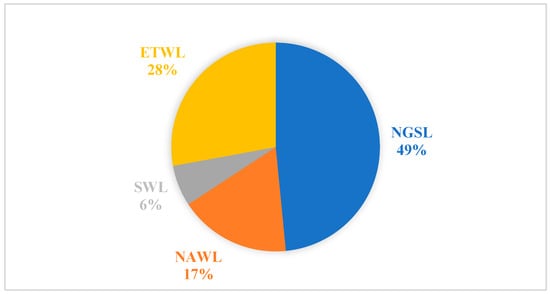
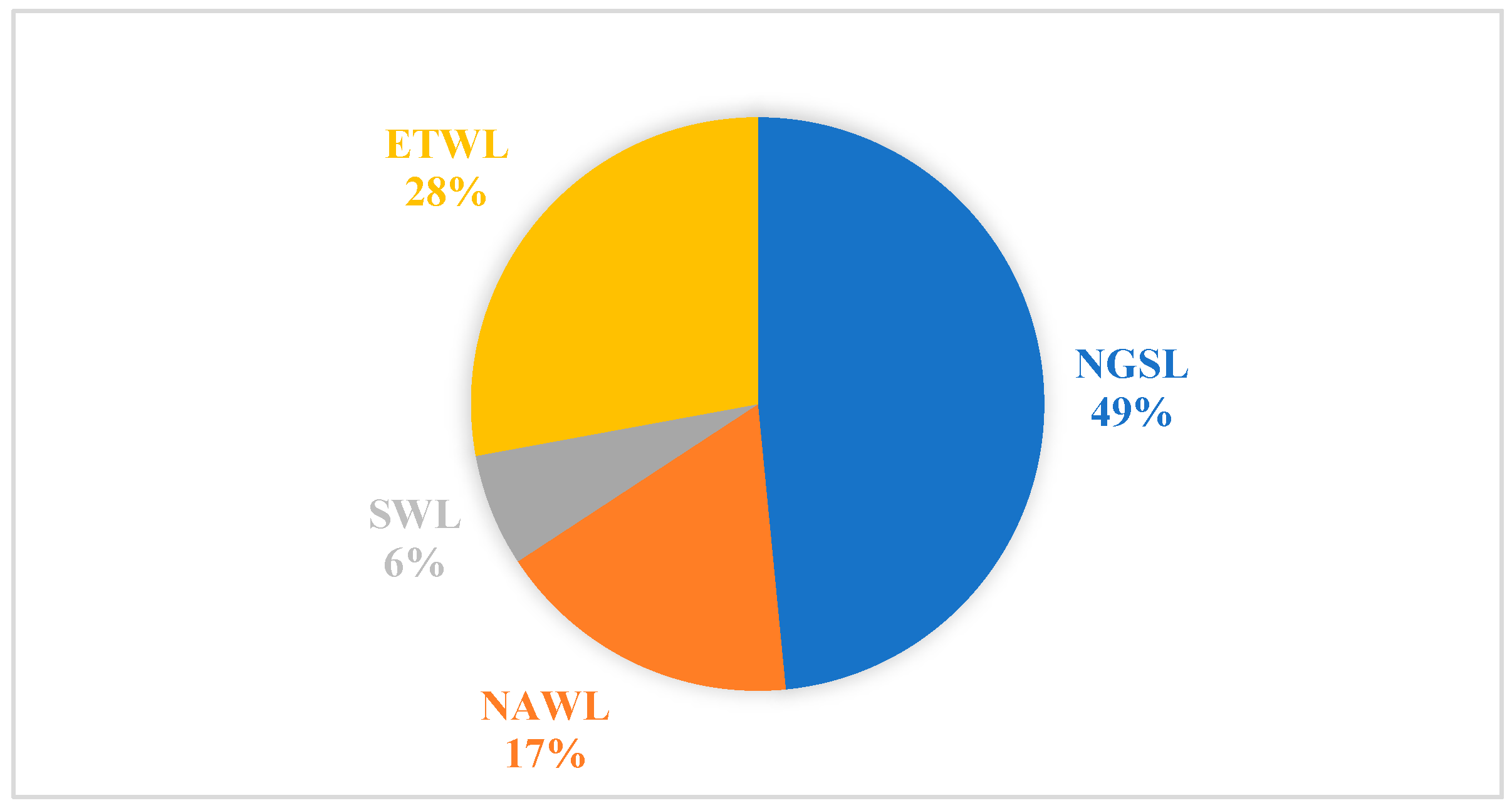
The keyword list obtained through the corpus analysis after adding the mentioned parameters (no. of hits > 10 and range > 2) and organizing word forms into lemmas has 929 items. Their distribution is shown in Figure 1.
Figure 1.
Distribution of lemmas across four sublists.
4.1. The NGSL Sublist
The general vocabulary sublist is obtained by comparing the list obtained through this study with the NGSL (Browne et al., 2013). About 49% of key words from Eco-Text corpus are also listed in the revised general service list. Table 2 presents the top 40 lemmas in order of their absolute frequency.
Table 2.
The top 40 lemmas in the NGSL.
It is important to note that the high share of the core vocabulary justifies our decision to focus on keywords rather than high-frequency words. The latter scenario would result in a higher share of general vocabulary at the cost of words salient in ecology textbooks. It can also be suggested that the inclusion of keywords with a range value equal to 2 would result in a lower share of general vocabulary and a higher share of the vocabulary that is salient in ecology textbooks.
4.2. The NAWL Sublist
The sublist of academic vocabulary is obtained by comparing the list obtained through this study with the NGSL (Browne et al., 2013). About 17% of key words from Eco-Text corpus are general academic vocabulary. Table 3 presents the top 40 lemmas in order of their absolute frequency.
Table 3.
The top 40 lemmas in the NAWL.
The NAWL comprises 570 word families with 3112 words and is designed to supplement the NGSL. From this perspective, it is reasonable to highlight that the NAWL and NGSL vocabulary constitutes 66% of the Eco-text keywords. In other words, even when combined, the mentioned lists provide less than half of the vocabulary stock ecology students need to comprehend their textbooks.
4.3. The SWL Sublist
About 6% of keywords in the Eco-text are also present in the SWL (Coxhead & Hirsh, 2007). The SWL, developed by Averil Coxhead and David Hirsh in 2007, contains 318 families not occurring in the GSL or AWL. With the NGSL and NAWL, the SWL nouns constitute 72% of the lemmas recorded as the key vocabulary in the selected ecology textbooks. The remaining nominal lexemes can be labelled as ETWL vocabulary. The top 40 words are presented in the Table 4.
Table 4.
The top 40 lemmas in the SWL.
4.4. The ETWC Sublist
About 28% of keywords in the Eco-text are not present in the NGSL, NAWL, and SWL. Here they are labeled as ETWL (Ecology Textbook Word List) vocabulary. The data on the top 60 ETWL lemmas with their absolute frequency (AF), range (R), log likelihood (LL), and dispersion (D) are given in Table 5.
Table 5.
The top 60 ETWL lemmas.
5. Discussion
The software-generated word frequency lists are used in making decisions on whether lexical items should be taught or dismissed. In addition, corpus findings ensure that the limited classroom teaching time is devoted to those lexical items that “provide a good return for the learning effort” (Szudarski, 2017). This analysis targets the key vocabulary in the selected ecology textbooks (Eco-Text). Four sublists are created: the NGSL, NAWL, SWL, and ETWL. In many studies, specialized occurrence is ensured by eliminating general and/or general academic vocabulary (Liu & Han, 2015; Kim & Lee, 2019; O’Flynn, 2019; Jablonkai, 2020; Kim & Lee, 2023; Barraza et al., 2024). In this analysis, the NAWL and NGSL words are not eliminated from the list. They are preserved as sublists so that the practitioners who find this list useful can make unique combinations based on the needs of their students. If after prioritizing the ETWL, there is not enough time to underscore the items from the other sublists, students can be given lists or glossaries to learn at home. Pribabadi and Rahmany (2014) examined the effect of keyword method and word-list method instruction on ESP vocabulary learning and concluded that their results are consistent with the findings of previous studies showing that the former method is more effective.
The list of the most frequently occurring vocabulary in a specialized corpus is a valuable tool in designing an ESP syllabus in that it can be utilized to determine the lexical content. Vocabulary lists should be used to plan course syllabi, develop materials and textbooks, and prepare tests (Flowerdew, 1993; Jones & Durrant, 2010). The list provided in this paper can be used as a stand-alone list or can complement other materials. Word lists can be used as a foundation for developing glossaries or even dictionaries. More importantly, they can serve as a guide in developing ESP textbooks. Textbook content is commonly seen as one of the main factors contributing to enhanced student motivation and better language acquisition (Stojanović, 2014).
Although academic word lists for specialized areas are beneficial to optimizing vocabulary instruction and the overall learning outcomes (Ward, 2009), individual pedagogical implications and recommendations can serve only as a guideline; course design is to be specifically tailored to address the professional language needs in terms of other linguistic assets, language skills, and communicative competence. Hence, the language of ecology deserves more comprehensive analyses of the dominant word patterns, grammatical structures, and other discursive elements.
In addition, vocabulary instruction should be integrated with other language skills. On the one hand, vocabulary mastery has a positive impact on all skills. On the other hand, the development of language skills enables spaced repetition and contextualized practice, which are essential for long-term retention and reinforcing vocabulary learning (Nation, 2013). In other words, vocabulary should be learned and memorized via reading, listening, writing, and speaking. The words contained in these sublists should be introduced through reading and listening to authentic language material. By doing so, one can observe and analyze how words are used in different sentential contexts. In addition, ESP students should be encouraged to use the words through both productive skills: writing and speaking. The products of productive skills reveal whether learners know the precise meanings of words and how to use them in a sentence.
The findings of this analysis also indicate that further analyses are needed. Keyword analysis with the BrE06 as a reference corpus, or any other larger general language database, should be used to validate the findings of this study. In addition, word polysemy and homonymy should be investigated in detail before deciding to disregard any of the sublists. Even at first glance, it is easy to see that many NGSL words are polysemic. It is possible that one meaning of a word is used frequently in general language, while any of its other meanings is more prominent in ecology. For instance, the word root may be more frequent in general language, meaning the source or the origin of something, as in the phrase the root of the problem. The same word stands for a morpheme that underlies an inflectional or derivational paradigm (in grammatical and/or linguistic literature), a quantity that when raised to the nth power (multiplied by itself n times) produces a given quantity (in mathematics), and, inter alia, a part of the body of a plant (in biology, ecology, etc.).
The wordlists also show that morphological patterns deserve more attention in future studies. For instance, the verbal prefix de- to signify reversal (i.e., the opposite action) in decomposition (from decompose) and removal (i.e., reduction) in defoliation (from defoliate) and deforestation (from deforest) appears to be more dominant than is the case in general language. In addition, words from the four lists can be classified into word families. The benefits of learning vocabulary via derivational families include, inter alia, the multiplication of vocabulary size and improved reading comprehension, i.e., the recognition of word families helps learners guess the meaning of unfamiliar words based on their knowledge of root and affixes (Bauer & Nation, 1993; Carlisle, 2000; Nation, 2001; Kieffer & Lesaux, 2007).
Finally, the overlap between the SWL and the ETWL deserves more attention. The percentage of only 6% may be surprising without knowing the structure of the corpus used to create the SWL. The corpus of 1.7 million words covers 14 subject areas: agriculture, biology, chemistry, computer science, ecology, engineering and technology, geography, geology, horticultural science, mathematics, nursing and midwifery, physics, sport and health sciences, and veterinary and animal sciences.
6. Conclusions
The findings of the corpus-based keyword analysis of the selected ecology textbooks clearly indicate the necessity for discipline-specific ecology wordlists. The NGSL, NAWL, and SWL cannot provide sufficient vocabulary stock for undergraduate ecology students. On the other hand, courses based on these lists would provide students with a large vocabulary stock that is not immediately needed. Consequently, the main pedagogical implication of the findings presented here is that an ESP course in ecology is needed and worth the investment of time and resources.
The findings also underscore the importance of conducting a thorough needs analysis, including from different perspectives. Different target groups of students have different ELP levels and would need different combinations of the sublists defined in this paper. In addition, it is important to know the genre that students mostly rely on. For instance, the undergraduate freshmen in our context rely solely on textbooks, hence the need to conduct a keyword analysis on textbooks, without including other genres. Liu and Han’s (2015) word list of environmental science overlaps with the AWL by about 50%. The overlap with the academic vocabulary list used in this paper (NAWL) and the keywords in the Eco-text is significantly lower.
The vocabulary items detected through this study are presented in order of frequency. This does not necessarily mean that high frequency is the only indicator that certain lexical items should be prioritized. High frequency raises a chance that a student will encounter a word sooner than other, less frequent words. However, that does not have to be the case. In some contexts, range may be more relevant. Probably the best strategy is to establish cooperation with colleagues teaching the courses in the field. They can provide the chronological lists of the textbooks and/or topics. Hence, ESP practitioners can introduce vocabulary based on the order it is expected to be introduced in their subject area.
This analysis is just a preliminary study into the keywords in ecology textbooks, and should be expanded and deepened in the future. In addition to further frequency and keyword analyses and analyses of morphological and collocational patterns, future studies should also focus on grammatical patterns. Different discursive practices should also be explored. The main limitation is that even practitioners whose target learners also rely on ecology textbooks should use these word lists with caution. Ideally, all ESP practitioners should be equipped with the corpus analysis skills to create institutionally-specific corpora and word lists. Only with such material can one be sure that the corpus is absolutely representative of the English-medium teaching material students have to use in their fields.
Author Contributions
Conceptualization, J.M.J.M. and J.M.M.; methodology, J.M.J.M. and J.M.M.; software, J.M.J.M.; validation, J.M.J.M. and J.M.M.; formal analysis, J.M.J.M.; investigation, J.M.J.M. and J.M.M.; resources, J.M.J.M. and J.M.M.; data curation, J.M.J.M.; writing—original draft preparation, J.M.J.M.; writing—review and editing, J.M.J.M. and J.M.M.; visualization, J.M.J.M.; supervision, J.M.J.M. and J.M.M. All authors have read and agreed to the published version of the manuscript.
Funding
This research received no external funding.
Institutional Review Board Statement
Not applicable.
Informed Consent Statement
Not applicable.
Data Availability Statement
Data supporting the reported results can be found at EAP Foundation website: https://www.eapfoundation.com/ (accessed on 29 January 2026).
Acknowledgments
During the preparation of this manuscript, the authors used (1) AntFileConverter 2.1.0 for the conversion of the .pdf files into a machine-readable .txt format; (2) TagAnt 2.1.1 for Part-Of-Speech (POS) tagging; (3) AntConc 4.3.1 for generating a keyword list; (4) NGSL, NAWL, and SWL Highlighters, the software solutions available on the EAP Foundation website, for sublist comparison. The authors have reviewed and edited the output and take full responsibility for the content of this publication.
Conflicts of Interest
The authors declare no conflicts of interest.
Abbreviations
The following abbreviations are used in this manuscript:
| ESP | English for Specific Purposes |
| EMI | English as a Medium of Instruction |
| EAP | English for Academic Purposes |
| ELP | English Language Proficiency |
| AVL | Academic Vocabulary List |
| GSL | General Service List |
| NGSL | New General Service List |
| AWL | Academic Word List |
| NAWL | New Academic Word List |
| SWL | Science Word List |
| EAWL | Environmental Academic Word List |
| ETWL | Ecology Textbook Word List |
| HEIs | Higher Education Institutions |
References
- Ahad, A., & Ferdous, A. (2019). A textbook of ecology. Himachal Publication/Bishal Book Complex. [Google Scholar]
- Anthony, L. (2018). Introducing English to specific purposes. Routledge. [Google Scholar]
- Barraza, A., Eckstein, G., Lambert, Z., Rogers, C., & Vincent, J. (2024). The Applied Linguistics Academic Word List (ALAWL): The creation of a domain-specific word list for applied linguistics. Journal of Academic Language and Learning, 18(1), 21–48. Available online: https://journal.aall.org.au/index.php/jall/article/view/935 (accessed on 19 September 2025).
- Bauer, L., & Nation, I. S. P. (1993). Word families. International Journal of Lexicography, 6(4), 253–279. [Google Scholar] [CrossRef] [Scilit]
- Begon, M., & Townsend, C. R. (2006). Ecology: From individuals to ecosystems. Blackwell Publishing. [Google Scholar]
- Biber, D., Conrad, S., & Reppen, R. (1998). Corpus linguistics: Investigating language structure and use. Cambridge University Press. [Google Scholar]
- Biber, G. (2006). University language: A corpus-based study of spoken and written registers. John Benjamins. [Google Scholar]
- Brezina, V., & Gablasova, D. (2015). Is there a core general vocabulary? Introducing the new general service list. Applied Linguistics, 36(1), 1–22. [Google Scholar] [CrossRef] [Scilit]
- Browne, C. (2014). A new general service list: The better mousetrap we’ve been looking for? Vocabulary Learning and Instruction, 3(2), 1–10. [Google Scholar] [CrossRef] [Scilit]
- Browne, C., & Culligan, B. (2015). Business service list. Available online: https://www.newgeneralservicelist.com/business-service-list (accessed on 5 September 2025).
- Browne, C., Culligan, B., & Philips, J. (2013). The New Academic Word List (NAWL). Available online: https://www.newgeneralservicelist.org/nawl-new-academic-word-list/ (accessed on 5 September 2025).
- Carlisle, J. F. (2000). Awareness of the structure and meaning of morphologically complex words: Impact on Reading. Reading and Writing: An Interdisciplinary Journal, 12(3), 169–190. [Google Scholar] [CrossRef] [Scilit]
- Coxhead, A. (2000). A new academic word list. TESOL Quarterly, 34(2), 213–238. [Google Scholar] [CrossRef] [Scilit]
- Coxhead, A., & Demecheleer, M. (2018). Investigating the technical vocabulary of plumbing. English for Specific Purposes, 51, 84–97. [Google Scholar] [CrossRef] [Scilit]
- Coxhead, A., & Hirsh, D. (2007). A pilot science-specific word list. Revue française de linguistiqueappliquée, 12(2), 65–78. [Google Scholar] [CrossRef] [Scilit]
- Danilović Jeremić, J. (2015). Lexical knowledge of Serbian L1 English L2 learners: Reception vs. production. Nastava i vaspitanje, 64(1), 87–100. [Google Scholar] [CrossRef] [Scilit]
- Drašler, A., & Kavalir, M. (2026). Compiling a custom corpus and word list for ESAP: The case of English for Geographers. English for Specific Purposes, 81, 92–102. [Google Scholar] [CrossRef] [Scilit]
- Durrant, P. (2016). To what extent is the academic vocabulary list relevant to university student writing? English for Specific Purposes, 43, 49–61. [Google Scholar] [CrossRef] [Scilit]
- Đurović, Z. (2021). Corpus linguistics methods for building ESP word lists, glossaries and dictionaries on the example of a marine engineering word list. Lexikos, 31(1), 259–282. [Google Scholar] [CrossRef] [Scilit]
- Evison, J. (2010). What are the basics of analyzing a corpus? In A. O’Keeffe, & M. McCarthy (Eds.), The Routledge handbook of corpus linguistics (pp. 122–135). Routledge. [Google Scholar]
- Farrell, P. (1990). Vocabulary in ESP: A lexical analysis of the English of electronics and a study of semi-technical vocabulary. In CLCS Occasional Papers, No. 25 (pp. 1–87). Centre for Language and Communication Studies. [Google Scholar]
- Flowerdew, J. (1993). Concordancing as a tool in course design. System, 21(2), 231–244. [Google Scholar] [CrossRef] [Scilit]
- Ford, M. L. (2013). Introduction to ecology. Core Knowledge Foundation. [Google Scholar]
- Galloway, N., & Rose, H. (2021). English medium instruction and the English language practitioner. ELT Journal, 75(1), 33–41. [Google Scholar] [CrossRef] [Scilit]
- Gardner, D., & Davies, M. (2014). A new academic vocabulary list. Applied Linguistics, 35(3), 305–327. [Google Scholar] [CrossRef] [Scilit]
- Granger, S. (2015). Contrastive interlanguage analysis: A reappraisal. International Journal of Learner Corpus Research, 1(1), 7–24. [Google Scholar] [CrossRef] [Scilit]
- Hadjibiras, K. (2014). Ecology and applied environmental science. CRP Press/Taylor and Francis Group. [Google Scholar]
- Hartle, S., Borsetto, E., Hsu, J. L., Vescio, G. D., & Facchinetti, R. (2025). Learning ecologies and transcultural interaction in EMI classes: A comparison of student perceptions in Italy and Taiwan. International Journal of Linguistics, 16(7), 192–223. [Google Scholar] [CrossRef] [Scilit]
- Heidari, F., Jalilifar, A., & Salimi, A. (2020). Developing a corpus-based word list in pharmacy research articles: A focus on academic culture. International Journal of Society, Culture & Language, 8(1), 1–15. [Google Scholar]
- Hinkel, E. (2011). What research on second language writing tells us and what it doesn’t. Handbook of Research in Second Language Teaching and Learning, 2, 523–538. [Google Scholar]
- Hirsh, D., & Coxhead, A. (2009). Ten ways of focusing on science-specific vocabulary in EAP classrooms. English Australia Journal, 25(1), 5–16. [Google Scholar]
- Hyland, K., & Tse, P. (2007). Is there an ‘academic vocabulary’? TESOL Quarterly, 41(2), 235–253. [Google Scholar] [CrossRef] [Scilit]
- Iffah, N., & Subroto, G. (2023). The correlations between students’ vocabulary and mastery and students’ reading comprehension in narrative text: English. JOEY: Journal of English Ibrahimy, 2(2), 56–65. [Google Scholar] [CrossRef] [Scilit]
- Ivančević-Otanjac, M. R. (2021). Students’ attitudes toward ESP course at university level. Specijalna Edukacija i Rehabilitacija, 20(4), 273–281. [Google Scholar] [CrossRef] [Scilit]
- Jablonkai, R. R. (2020). Leveraging professional wordlists for productive vocabulary knowledge. ESP Today, 8(1), 2–24. [Google Scholar] [CrossRef] [Scilit]
- Jones, M., & Durrant, P. (2010). What can a corpus tell us about vocabulary teaching materials? In A. O’Keefe, & M. McCarthy (Eds.), The Routledge handbook of corpus linguistics (pp. 341–357). Routledge. [Google Scholar]
- Khany, R., & Kalantari, B. (2021). Accounting Academic Word List (AAWL): A corpus-based study. Journal of Foreign Language Teaching and Translation Studies, 6(1), 35–58. [Google Scholar] [CrossRef] [Scilit]
- Kieffer, M. J., & Lesaux, N. K. (2007). Breaking down words to build meaning: Morphology, vocabulary, and reading comprehension in the urban classroom. The Reading Teacher, 61(2), 134–144. [Google Scholar] [CrossRef] [Scilit]
- Kiliç, M. (2019). Vocabulary knowledge as a predictor of performance in writing and speaking: A case of Turkish EFL learners. Pisaa, 57, 133–164. [Google Scholar]
- Kim, H. O., & Lee, H. K. (2019). The academic vocabulary list in linguistics for EFL university students. Korean Journal of English Language and Linguistics, 19(1), 27–52. [Google Scholar] [CrossRef] [Scilit]
- Kim, H. O., & Lee, H. K. (2023). The vocabulary list for ELT textbooks in language acquisition and teaching methodology. Korea Journal of English Language and Linguistics, 23, 873–894. [Google Scholar] [CrossRef] [Scilit]
- Lisana, F., & Subroto, G. (2022). Students’ vocabulary mastery and their reading comprehension. Journal of Language, Literature, and English Teaching, 3(1), 10–16. [Google Scholar] [CrossRef] [Scilit]
- Liu, J., & Han, L. (2015). A corpus-based environmental academic word list building and its validity test. English for Specific Purposes, 39, 1–11. [Google Scholar] [CrossRef] [Scilit]
- Macaro, E., Curle, S., Pun, J., An, J., & Dearden, J. (2018). A systematic review of English medium instruction in higher education. Language Teaching, 51(1), 36–76. [Google Scholar] [CrossRef] [Scilit]
- Martínez, I. A., Beck, S. C., & Panza, C. B. (2009). Academic vocabulary in agriculture research articles: A corpus-based study. English for Specific Purposes, 28(3), 183–198. [Google Scholar] [CrossRef] [Scilit]
- McEnery, T., Beck, S. C., & Tono, Y. (2006). Corpus-based language studies: An advanced resource book. Taylor & Francis Group. [Google Scholar]
- Mićović, D., Beko, L., & Đorđević, M. (2023). Has general english knowledge of serbian freshmen students prepared them for an ESP course—A pilot study. Metodički Vidici, 15(2), 117–136. [Google Scholar] [CrossRef] [Scilit]
- Mockiené, L., Rackevičiené, S., & Usinskiene, O. (2022). Integrating corpus analysis tools and practices for terminology studies in ESP courses. The Journal of Teaching English for Specific and Academic Purposes, 10(3), 547–556. [Google Scholar] [CrossRef] [Scilit]
- Moini, R., & Islamizadeh, Z. (2016). Do we need discipline-specific academic word lists? Linguistics Academic Word List (LAWL). Journal of Teaching Language Skills, 35(3), 65–90. [Google Scholar] [CrossRef] [Scilit]
- Müller, F., & Waibel, B. (2000). Corpus linguistics—An introduction. Universität Freiburg. [Google Scholar]
- Nation, I. S. P. (2001). Learning vocabulary in another language. Cambridge University Press. [Google Scholar]
- Nation, I. S. P. (2006). How large a vocabulary is needed for reading and listening? Canadian Modern Language Review, 63(1), 59–82. [Google Scholar] [CrossRef]
- Nation, I. S. P. (2013). Learning vocabulary in another language (2nd ed.). Cambridge University Press. [Google Scholar]
- Odum, E. P. (1971). Fundamentals of ecology. W. B. Saunders Company. [Google Scholar]
- O’Flynn, J. A. (2019). An Economics Academic Word List (EAWL): Using online resources to develop a subject-specific word list and associated teaching-learning materials. Journal of Academic Language and Learning, 13(1), A28–A87. Available online: https://journal.aall.org.au/index.php/jall/article/view/592 (accessed on 11 March 2026).
- Pravitasari, H., & Nurfadillah, L. (2025). Correlation between students’ vocabulary mastery and reading comprehension at junior Islamic school. EDUCASIA: Journal Pendidikah, Pengajaram, dan Pembelajaran, 10(1), 55–68. [Google Scholar] [CrossRef] [Scilit]
- Pribabadi, A., & Rahmany, R. (2014). The effect of the keyword method and word-list method instruction on ESP vocabulary learning. Journal of Language Teaching and Research, 5(5), 1110–1115. [Google Scholar] [CrossRef] [Scilit]
- Qureshi, M. A., & Malik, N. (2025). Academic word lists: A comprehensive review. Vocabulary Learning and Instruction, 14(2), 103079. [Google Scholar] [CrossRef] [Scilit]
- Rayson, P., & Potts, A. (2021). Analysing keyword lists. In M. Paquot, & S. Gries (Eds.), A practical handbook of corpus linguistics (pp. 119–139). Springer. [Google Scholar] [CrossRef] [Scilit]
- Riccobono, P. (2020). Triangulating diamond talk: Identifying technical spoken vocabulary in English for baseball purposes. ESP Today, 8(1), 114–140. [Google Scholar] [CrossRef] [Scilit]
- Schmitt, N. (2010). Researching vocabulary: A vocabulary manual. Springer. [Google Scholar]
- Scott, M. (1997). PC analysis of key words—And key key words. System, 25(2), 233–245. [Google Scholar] [CrossRef] [Scilit]
- Sheng, L., & McGregor, K. K. (2010). Lexical semantic organization in children with specific language impairment. Journal of Speech, Language and Hearing Research, 53(1), 146–159. [Google Scholar] [CrossRef] [Scilit] [PubMed]
- Sinclair, J. (1996). Corpus, concordance, collocation. Oxford University Press. [Google Scholar]
- Staehr, L. S. (2008). Vocabulary size and the skills of listening, reading, and writing. The Language Learning Journal, 36, 139–152. [Google Scholar] [CrossRef] [Scilit]
- Stojanović, M. (2014). Creating core textbooks: Focusing on acquiring knowledge in English rather than about English. The Journal of Teaching English and Academic Purposes, 2(1), 21–31. [Google Scholar]
- Sutarsyah, C. P., Nation, P., & Kennedy, G. (1994). How useful is EAP vocabulary for ESP? A corpus-based study. RELC Journal, 25(2), 34–50. [Google Scholar] [CrossRef] [Scilit]
- Szudarski, P. (2017). Corpus linguistics for vocabulary: A guide for research. Routledge. [Google Scholar]
- Tong, J., Che Abdul Rahman, A. N., & Hamat, A. (2025). A systematic literature review on word selection criteria in corpus-based wordlists development. Cogent Arts & Humanities, 12(1), 2432131. [Google Scholar] [CrossRef] [Scilit]
- Van Zeeland, H., & Schmitt, N. (2012). Lexical coverage in L1 and L2 listening comprehension: The same or different from reading comprehension? Applied Linguistics, 34(4), 457–479. [Google Scholar] [CrossRef] [Scilit]
- Viera, R. T. (2017). Vocabulary knowledge in the production of written texts: A case study on EFL language learners. Revista Technologica ESPOL–RTE, 30(3), 89–105. [Google Scholar]
- Wang, J., Liang, S. L., & Ge, G. C. (2000). Establishment of a medical academic word list. English for Specific Purposes, 27(4), 442–458. [Google Scholar] [CrossRef] [Scilit]
- Ward, J. (1999). How large a vocabulary do EAP engineers need? Reading in a Foreign Language, 12(2), 309–324. [Google Scholar] [CrossRef] [Scilit]
- Ward, J. (2009). A basic engineering English word list for less proficient foundation engineering undergraduates. English for Specific Purposes, 28(3), 170–182. [Google Scholar] [CrossRef] [Scilit]
- West, M. (1953). A General Service List of English Words: With Semantic Frequencies and a Supplementary Word-list for the Writing of Popular Science and Technology. Longman Group LTD. [Google Scholar]
- Wild, K., Church, A., McCarthy, D., & Burgess, J. (2013). Quantifying lexical usage: Vocabulary pertaining to ecosystems and the environment. Corpora, 8(1), 53–79. [Google Scholar] [CrossRef] [Scilit]
- Yan, M., & Li, H. (2021). The roles of decoding and vocabulary in Chinese reading comprehension: A longitudinal study. Journal of Research in Reading, 44(3), 497–515. [Google Scholar]
- Yang, M. (2015). A nursing academic word list. English for Specific Purposes, 37, 27–38. [Google Scholar] [CrossRef] [Scilit]
- Yuliastuti, Y. (2021). Correlation between vocabulary mastery and reading comprehension of the tenth-grade students of SMAN 14. Sigi English Language Teaching Society–ELTS, 5(1), 1–10. [Google Scholar]

Disclaimer/Publisher’s Note: The statements, opinions and data contained in all publications are solely those of the individual author(s) and contributor(s) and not of MDPI and/or the editor(s). MDPI and/or the editor(s) disclaim responsibility for any injury to people or property resulting from any ideas, methods, instructions or products referred to in the content. |
© 2026 by the authors. Licensee MDPI, Basel, Switzerland. This article is an open access article distributed under the terms and conditions of the Creative Commons Attribution (CC BY) license.